1 Peter 3:12

Greek (Tischendorf 8th ed.) 1 Peter 3:12 appears in the Greek New Testament. The text above is from the Tischendorf 8th edition. Each word links to its Strong’s number and a concise gloss. Click any word for its full Thayer’s Greek Lexicon entry.
Download image
Cite this verse

1 Peter 3:12 (World English Bible). Public Domain. Lemma interlinear Bible study tool, https://lemma.gebible.app/v/1-peter/3/12.

Show BibTeX & RIS
BibTeX
RIS
English Translation
For the eyes of the Lord are on the righteous, And his ears open to their prayer; But the face of the Lord is against those who do evil."
World English Bible · Public Domain
Download a study sheet

One document with this verse’s original text, its word-by-word gloss line, the meaning frame, cross-references with their text, attributed commentary, and full source and license credits — printable, and it pastes into notes with its structure intact.

This verse Autodidact and up

Study sheet (.html) Plain text (.txt)

A passage Seminary Student

Up to 50 verses in one chapter. A passage sheet keeps up to 6 commentary sources and 12 cross-references per verse, in the order this page ranks them, and says so on the sheet whenever that leaves anything out. Ask for a single verse and you get the Autodidact verse sheet above.

Everything on this page stays free to read, with no account — the sheet is a download of what is already on screen, not access to it.

Want to remove ads? Support Godless Engineer
Compare translations 3

The same verse in 3 English versions, stacked beneath the original-language interlinear above. Click any original word for its lexicon entry.

Each is an independent rendering of the whole verse — the interlinear is not word-aligned to these translations.

Highlighted words mark where these versions differ — a whole-verse word diff, not a word-by-word alignment.

  • World English Bible Public Domain
    For the eyes of the Lord are on the righteous, And his ears open to their prayer; But the face of the Lord is against those who do evil."
  • King James Version Public Domain
    For the eyes of the Lord are over the righteous, and his ears are open unto their prayers: but the face of the Lord is against them that do evil.
  • unfoldingWord Literal Text CC BY-SA 4.0
    for the eyes of the Lord on righteous ones, and his ears toward their request, but the face of the Lord against those doing evil.”

unfoldingWord Literal Text — © unfoldingWord, licensed CC BY-SA 4.0. Word-aligned USFM3 via Door43 (git.door43.org/unfoldingWord/en_ult).

Versions to compare (up to 4)

3 of 4 selected

Show all 19 translations

Every available English version of this verse, each an independent rendering of the whole verse.

  • World English Bible Public Domain
    For the eyes of the Lord are on the righteous, And his ears open to their prayer; But the face of the Lord is against those who do evil."
  • Berean Standard Bible Public Domain
    For the eyes of the Lord are on the righteous, and His ears are inclined to their prayer. But the face of the Lord is against those who do evil.”
  • Majority Standard Bible Public Domain
    For the eyes of the Lord are on the righteous, and His ears are inclined to their prayer. But the face of the Lord is against those who do evil.”
  • King James Version Public Domain
    For the eyes of the Lord are over the righteous, and his ears are open unto their prayers: but the face of the Lord is against them that do evil.
  • American Standard Version (1901) Public Domain
    For the eyes of the Lord are upon the righteous, And his ears unto their supplication: But the face of the Lord is upon them that do evil.
  • Revised Version (1885) Public Domain
    For the eyes of the Lord are upon the righteous, And his ears unto their supplication: But the face of the Lord is upon them that do evil.
  • Geneva Bible (1599) Public Domain
    For the eyes of the Lord are ouer the righteous, and his eares are open vnto their prayers: and the face of the Lord is against them that do euil.
  • Douay-Rheims (1899) Public Domain
    Because the eyes of the Lord are upon the just, and his ears unto their prayers: but the countenance of the Lord upon them that do evil things.
  • Young's Literal Translation Public Domain
    because the eyes of the Lord `are' upon the righteous, and His ears -- to their supplication, and the face of the Lord `is' upon those doing evil;'
  • Literal Standard Version CC BY-SA 4.0
    because the eyes of the LORD [are] on the righteous, and His ears—to their supplication, but the face of the LORD [is] against those doing evil”;
  • Unlocked Literal Bible CC BY-SA 4.0
    The eyes of the Lord see the righteous, and his ears hear their requests. But the face of the Lord is against those who do evil.”
  • unfoldingWord Literal Text CC BY-SA 4.0
    for the eyes of the Lord on righteous ones, and his ears toward their request, but the face of the Lord against those doing evil.”
  • Darby Bible Public Domain
    because [the] eyes of [the] Lord [are] on [the] righteous, and his ears towards their supplications; but [the] face of [the] Lord [is] against them that do evil.
  • World Messianic Bible Public Domain
    For the eyes of the Lord are on the righteous, and his ears open to their prayer; but the face of the Lord is against those who do evil.”
  • Webster's Bible Public Domain
    For the eyes of the Lord are over the righteous, and his ears are open to their prayers: but the face of the Lord is against them that do evil.
  • Free Bible Version CC BY-SA 4.0
    For God sees those who do right, and he hears their prayers, but he opposes those who do evil.”
  • Bible in Basic English Public Domain
    For the eyes of the Lord are on the upright, and his ears are open to their prayers: but the face of the Lord is against those who do evil.
  • Text-Critical English NT CC BY 4.0
    For the eyes of the Lord are upon the righteous, and his ears are open to their prayers. But the face of the Lord is against those who do evil.”
  • Tyndale New Testament (1534) Public Domain
    For the eyes of the Lorde are over the righteous and his eares are open vnto their prayers. But the face of the Lorde beholdeth the that do evyll.

Literal Standard Version (2020), Covenant Press — licensed CC BY-SA 4.0. Text via the HelloAO Bible API (eBible.org). Unlocked Literal Bible (unfoldingWord) — licensed CC BY-SA 4.0. Text via the HelloAO Bible API (eBible.org). unfoldingWord Literal Text — © unfoldingWord, licensed CC BY-SA 4.0. Word-aligned USFM3 via Door43 (git.door43.org/unfoldingWord/en_ult). Free Bible Version, Dr. Jonathan Gallagher — licensed CC BY-SA 4.0. Text via the HelloAO Bible API (eBible.org).

Word by word

More ways to search: Search by grammar → Find every occurrence → Compare this word →

Practice this passage: Drill this verse → Learn its vocabulary →

δέησιν
déēsis
G1162
“need”
Noun, Accusative, Singular, Feminine
Part of Speech
Noun
Case
Accusative
Number
Singular
Gender
Feminine
Full Thayer's Definition

Origin: from G1189

TDNT: 02:40,1

1. need, indigence, want, privation, penury 2. a seeking, asking, entreating, entreaty to God or to man
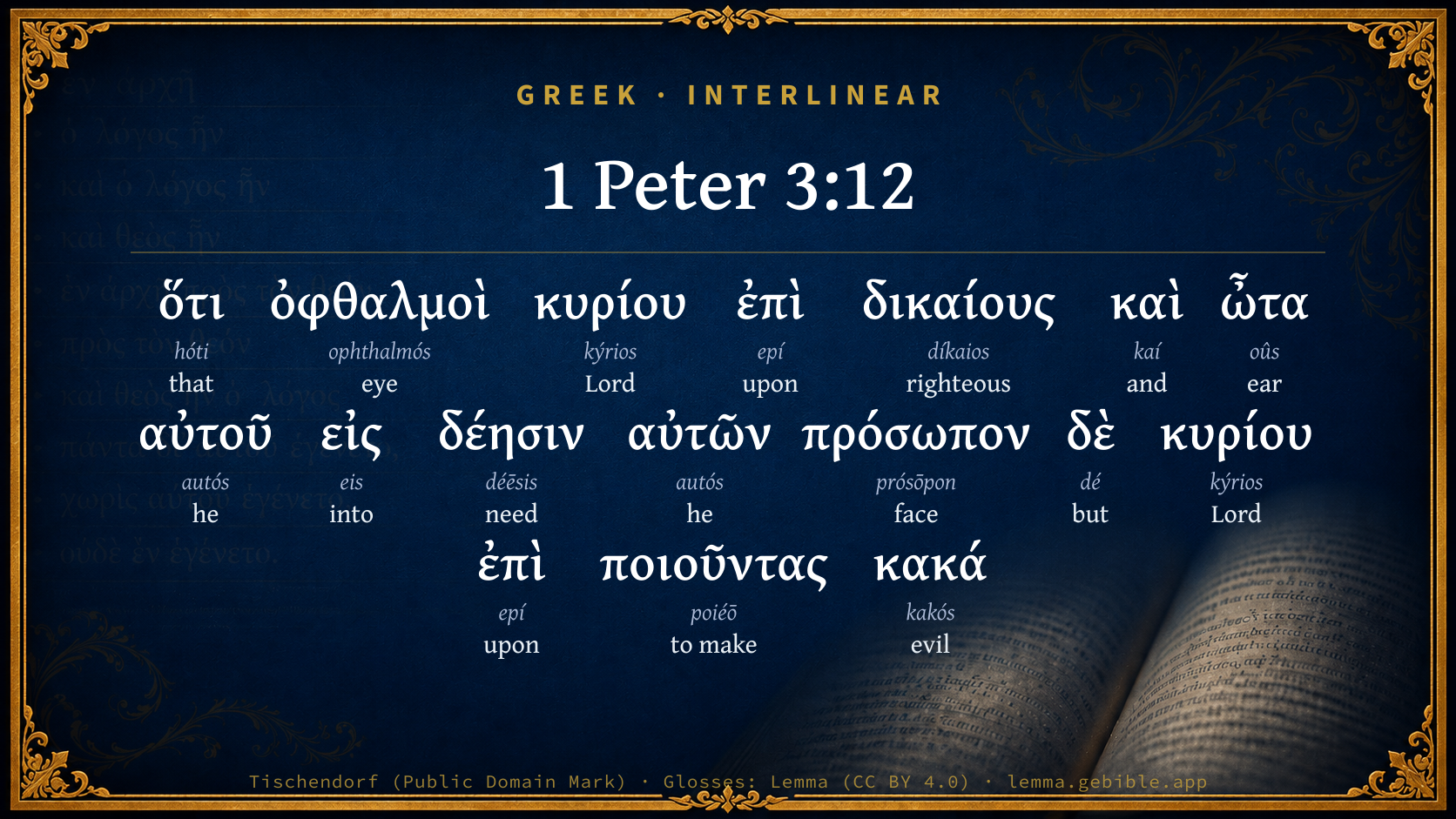
  1. ὅτι hóti G3754 “that” Conjunction
  2. ὀφθαλμοὶ ophthalmós G3788 “eye” Noun, Nominative, Plural, Masculine
  3. κυρίου kýrios G2962 “Lord” Noun, Genitive, Singular, Masculine
  4. ἐπὶ epí G1909 “upon” Preposition
  5. δικαίους díkaios G1342 “righteous” Adjective, Accusative, Plural, Masculine
  6. καὶ kaí G2532 “and” Conjunction
  7. ὦτα oûs G3775 “ear” Noun, Nominative, Plural, Neuter
  8. αὐτοῦ autós G846 “he” Personal pronoun, Genitive, Singular, Masculine
  9. εἰς eis G1519 “into” Preposition
  10. αὐτῶν autós G846 “he” Personal pronoun, Genitive, Plural, Masculine
  11. πρόσωπον prósōpon G4383 “face” Noun, Nominative, Singular, Neuter
  12. δὲ dé G1161 “but” Conjunction
  13. κυρίου kýrios G2962 “Lord” Noun, Genitive, Singular, Masculine
  14. ἐπὶ epí G1909 “upon” Preposition
  15. ποιοῦντας poiéō G4160 “to make” Verb, Present, Active, Participle, Accusative, Plural, Masculine
  16. κακά kakós G2556 “evil” Adjective, Accusative, Plural, Neuter

About this verse

These counts appear in no published source. They are computed here, from the morphology-tagged text and Lemma’s own curated glosses. What Lemma adds →

17
words
14
distinct lemmas
General Epistles
section

Notable vocabulary

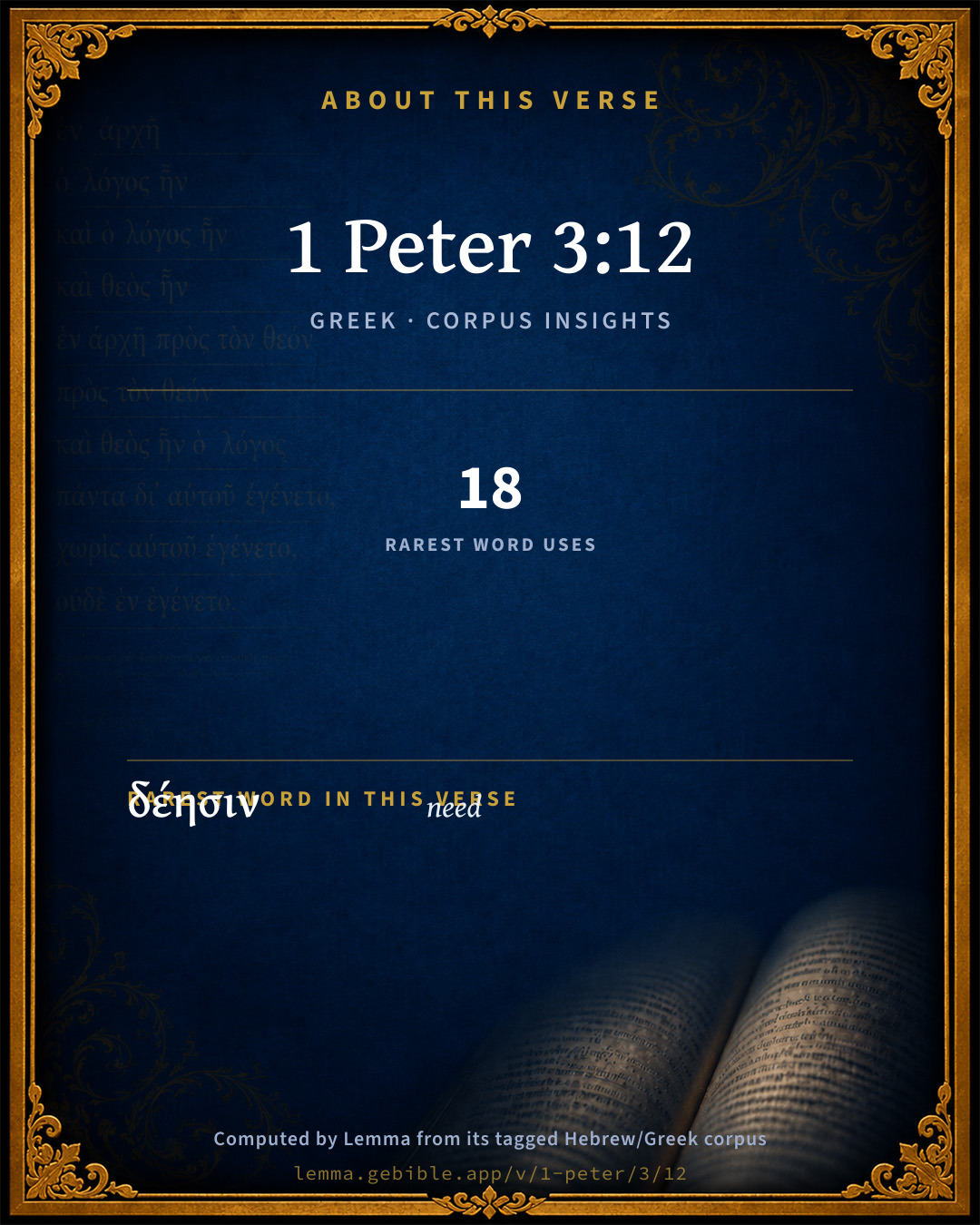
The rarest word here is δέησιν need G1162 — appearing just 18 times in the whole Greek New Testament.

Shared distinctive vocabulary

δέησιν need G1162 occurs in 16 verses of the Greek New Testament. Also found in:

Repetition

Words recur within this verse:

  • κυρίου Lord G2962 ×2
  • ἐπὶ upon G1909 ×2
  • αὐτοῦ he G846 ×2

Cross-references

19

Topical passages linked to 1 Peter 3:12 in the Treasury of Scripture Knowledge — connected by theme and wording, ordered by reader-vote popularity; previews shown in the World English Bible.

  • Psalms 34:15–16 Yahweh's eyes are toward the righteous. His ears listen to their cry.
  • John 9:31 We know that God doesn't listen to sinners, but if anyone is a worshipper of God, and does his will, he listens to him.
  • Proverbs 15:29 Yahweh is far from the wicked, But he hears the prayer of the righteous.
  • Proverbs 15:3 Yahweh's eyes are everywhere, Keeping watch on the evil and the good.
  • 2 Chronicles 7:15 Now my eyes shall be open, and my ears attentive, to the prayer that is made in this place.
  • Proverbs 15:8 The sacrifice made by the wicked is an abomination to Yahweh, But the prayer of the upright is his delight.
  • James 5:16 Confess your offenses to one another, and pray one for another, that you may be healed. The effective, earnest prayer of a righteous man is powerfully effective.
  • 2 Chronicles 16:9 For the eyes of Yahweh run back and forth throughout the whole earth, to show himself strong in the behalf of them whose heart is perfect toward him. Herein you have done foolishly; for from henceforth you shall have wars.
  • Psalms 65:2 You who hear prayer, To you all men will come.
  • Ezekiel 15:7 I will set my face against them; they shall go forth from the fire, but the fire shall devour them; and you shall know that I am Yahweh, when I set my face against them.
  • Deuteronomy 11:12 a land which Yahweh your God cares for: the eyes of Yahweh your God are always on it, from the beginning of the year even to the end of the year.
  • Leviticus 20:3 I also will set my face against that person, and will cut him off from among his people because he has given of his seed to Molech, to defile my sanctuary, and to profane my holy name.
  • Leviticus 26:17 I will set my face against you, and you will be struck before your enemies. Those who hate you will rule over you; and you will flee when no one pursues you.
  • Psalms 80:16 It's burned with fire. It's cut down. They perish at your rebuke.
  • Leviticus 17:10 "'Any man of the house of Israel, or of the strangers who live as foreigners among them, who eats any kind of blood, I will set my face against that soul who eats blood, and will cut him off from among his people.
  • Leviticus 20:6 "'The person that turns to those who are mediums, and to the wizards, to play the prostitute after them, I will even set my face against that person, and will cut him off from among his people.
  • Psalms 11:4 Yahweh is in his holy temple. Yahweh is on his throne in heaven. His eyes observe. His eyes examine the children of men.
  • Jeremiah 21:10 For I have set my face on this city for evil, and not for good, says Yahweh: it shall be given into the hand of the king of Babylon, and he shall burn it with fire.
  • Zechariah 4:10 Indeed, who despises the day of small things? For these seven shall rejoice, and shall see the plumb line in the hand of Zerubbabel. These are the eyes of Yahweh, which run back and forth through the whole earth."

Cross-references courtesy of OpenBible.info (CC BY 4.0).

Commentary

Notes on 1 Peter 3:12 from classic Christian and Jewish commentators (each source and its license shown beneath its notes). The classic Christian expositions comment on the surrounding passage and are grouped to its opening verse, so a note may address several verses; the Jewish commentaries on the Tanakh (Rashi and others) are per-verse, so they appear only where the commentator wrote on this verse.

Lemma curates 59 commentaries, every one of them public domain or Creative Commons licensed, each selected and text-cleaned for this edition rather than reprinted as found. About our sources →

The Biblical Illustrator

Joseph S. Exell

1Pe_3:12

The eyes of the Lord are over the righteous.

Gods different regards to saints and sinners

I. The two sorts of persons here spoken of.

1. The righteous. They have a true love to all Gods commandments, and will not allow themselves in anything which they know to be contrary to the will of God.

2. Those that do evil. Good men sometimes may do evil, through ignorance, or the power of temptation; but this is not the bent of their minds: when sensible of it, they are sorry for it. The persons here spoken of are of a different spirit; they are evil-doers in the strict sense of the word. Iniquity is their practice and delight.

II. How the Lord stands affected both to the one and to the other.

1. His eyes are over the righteous; which implies-

(1) His knowledge of them, their condition and circumstances (Psa_139:2-3).

(2) His affection to them. The eye of human creatures is apt to be very much where the heart is (Psa_146:8; Psa_11:7).

(3) His providential care of them. He acts for their benefit-to guide, guard, and deliver.

2. His ears also are open to their prayer. This implies-

(1) That prayer is the common practice of the righteous (Eph_6:18).

(2) That this their practice is pleasing to God.

(3) That it is a wise and reasonable practice, as it hitherto has been the practice of all good men.

3. His face is against him that doeth evil. This signifies, in general, that He is displeased with such persons (Psa_7:11). This implies-

(1) That He observes them and their actions; therefore, His face is against them, because He sees and knows them to be evil-doers.

(2) That their conduct is highly offensive to Him.

(3) That He will certainly treat them as enemies, if they do not repent and reform (Pro_28:9).

Conclude with some reflections.

1. We may see that happiness is the certain consequence of holiness, and misery as certainly the fruit of sin.

2. We may hence take occasion to reflect on the folly of sin, and the wisdom of being religious.

3. This shows us that good men have a great deal of reason to hope in the most threatening external circumstances; and that bad men have much to fear, even in the most prosperous circumstances.

4. Consider seriously what is said in the words of our text, and let it influence your choice and conduct. (T. Hannam.)

The Divine attentiveness to the righteous

Let us consider, first, who are the persons spoken of as righteous; secondly, what is the consolation and the assistance which they expect from heaven. You might say, if the eyes of the Lord are over only the righteous, who shall presume to hope for His favourable regard? But you well know that the term righteous in Holy Scripture is not always used to signify a faultless perfection. They who love and fear God, who strive earnestly to obey and please Him, are frequently denominated righteous. Their righteousness, indeed, is ever very defective; but they are called righteous, because it is their prevailing quality to be so. These, St. Peter assures us, are the objects of Gods paternal regard. With regard to the eyes of the Lord spoken of in the text, we may observe that Scripture mentions them in three different ways.

1. First, an eye of knowledge, which extends to all things without exception. This is over not only the righteous, but the wicked also, and over all creatures.

2. God looketh with an eye of displeasure (Amo_9:4; Amo_9:8; Eze_9:10). The eyes of the Lord are over the wicked, observing all their evil doings, and preparing for them the correction which they deserved.

3. There is another aspect of the Deity contrary to that last mentioned; namely, of love and favour, with which He regards His faithful servants (Deu_11:12; 1Ki_9:3). Great indeed must be the blessedness of being thus looked upon by the eyes of God. It is not a mere contemplative view, but infinitely powerful in operation. The sun in the firmament is a faint resemblance of it; when He enlightens, warms, animates all earthly things on which his rays descend. But here I must acknowledge that sometimes the outward circumstances of the righteous are calamitous; as if God did not look upon them, as if He had forgotten them. The eyes of the Lord may be over the righteous, whatever be their condition. St. Peter adds, And His ears are open unto their prayers (Psa_50:15; Mat_7:7; Mat_7:11). But God does not always answer the prayers of the righteous in their own time and manner, and this sometimes tempts them to imagine that He is averse to their prayers. If God do not at present grant your requests, it does not follow that He hears them not, or that He is not inclined to do you good. But it may not be the fit time; or, lastly, because He reserves His blessings as the recompense of assiduity and perseverance in praying. But another objection may be urged: Do we not find several examples in Scripture of God refusing to the most holy persons the fulfilment of their prayers (Deu_3:26; 2Co_12:8)? There are two different ways in which God hears our prayers. One is, according to our wishes; the other, according to our real and final good. We are in adversity and affliction, and we cry unto God for deliverance, which He does not vouchsafe to us. But by this trial He awakens our slumbering zeal, He revives our fainting piety. Has not God, then, done better than their prayers desired? But let us carefully remember that this merciful kindness of the Lord is not promised to all men without regard to their fitness for it. The eyes of the Lord are over the righteous, and His ears are open to their prayers, but the face of the Lord is against them that do evil. God heareth not sinners. (S. Partridge, M. A.)

The Biblical Illustrator, edited by Joseph S. Exell (c. 1880s–1900s) — public domain. Text from a community e-Sword module.

Bengel's Gnomon

Johann Albrecht Bengel

1Pe 3:12. Ὅτι οἱ ὀφαθλμοὶ) because the eyes. The Septuagint has ὀφαθαλμοὶ the remainder is in the same words, as far as κακά.—ἐπὶ δικαίους, over the just) who have from that source life and good days.—πρόσωπον, the countenance) with anger: comp. 2Sa 22:28. Anger excites the whole countenance of a man; love affects the eyes.

Bengel's Gnomon of the New Testament — English translation (T&T Clark, Edinburgh, 1860) — public domain. Text from a community e-Sword module.

Expositor's Greek Testament

ed. W. Robertson Nicoll

1Pe 3:12 . πρόσωπον Κυρίου , Jehovah’s face, i.e., wrath (Targum, the face of Jehovah was angry ) as the following clause, to cut off the remembrance of them … shows; cf. Lam 4:16 ; Psa 21:9 . But Peter stops short and leaves room for repentance.

Ver, 13. κακώσων echoes ποιοῦντας κακά (as ζηλ . τοῦ ἀγ . echoes ποιησάτω ἀγαθόν ); but the phrase comes also from O.T.: Isa 1:9 , Κύριος βοηθήσει μοι · τίς κακώσει με ; τοῦ ἀγαθοῦ ζηλωταὶ . The phrase sums up 1Pe 3:11 . All that was good in Judaism, however it may have been perverted, finds its fulfilment in the new Israel (Rom 10:2 ). Some Jews were zealots, boasting their zeal for the Lord or His Law, like Phinehas and the Hasmonaeans (1 Maccabees 2. passim ): all Christians should be zealots for that which is good . So Paul says of himself as Pharisee that he was a zealot for his ancestral traditions (Gal 1:14 ). For him as for the colleague of Simon the Zealot the word retained a flavour of its technical sense; cf. Tit 2:14 , that He might cleanse for Himself a peculiar people, zealot of good ( καλῶν ) works; cf. similar use of ἀφωρισμένος = Pharisee (Rom 1:1 ). τοῦἀγ . in emphatic position.

The Expositor's Greek Testament, edited by W. Robertson Nicoll (1897–1910) — public domain. Text from a community e-Sword module.

Geneva Bible (1599)

Geneva Bible translators

This word (Face) after the manner of the Hebrews, is taken for (anger.)

Geneva Bible (1599) marginal notes — public domain. Text via Bolls.life.

Jamieson, Fausset & Brown

Robert Jamieson, A. R. Fausset & David Brown

Ground of the promised present and eternal life of blessedness to the meek (Pe1 3:10). The Lord's eyes are ever over them for good.

ears . . . unto their prayers-- (Jo1 5:14-15).

face . . . against--The eyes imply favorable regard; the face of the Lord upon (not as English Version, "against") them that do evil, implies that He narrowly observes them, so as not to let them really and lastingly hurt His people (compare Pe1 3:13).

Jamieson, Fausset & Brown — Commentary Critical and Explanatory on the Whole Bible (1871) — public domain (CC PDM 1.0). Text via the HelloAO Bible API.

Adam Clarke's Commentary

Verse 12. The eyes of the Lord are over the righteous] That is, He is continually under God's notice and his care; God continually watches for him and watches over him, and he is under his constant protection.

And his ears are open unto their prayers] The original is very emphatic: The eyes of the Lord are upon the righteous, and his ears to their prayers. The righteous man ever attracts the Divine notice, and wherever he is, there is the ear of God; for, as every righteous man is a man of prayer, wherever he prays, there is the ear of God, into which the prayer, as soon as formed, enters.

But the face of the Lord] Far from his eye being upon them, or his ear open to their requests, (for prayer they have none,) his face, his approbation, his providence and blessing, are turned away from them; and he only looks upon them to abhor them, and to turn the arm of his justice against them.

Adam Clarke's Commentary on the Bible (1810–1826) — public domain. Text from a community e-Sword/MySword module.

John Calvin's Commentaries

12 For the eyes of the Lord are over the righteous, or, on the righteous. It ought to be a consolation to us, sufficient to mitigate all evils, that we are looked upon by the Lord, so that he will bring us help in due time. The meaning then is, that the prosperity which he has mentioned depends on the protection of God; for were not the Lord to care for his people, they would be like sheep exposed to wolves. And that we for little reason raise a clamor, that we suddenly kindle unto wrath, that we burn with the passion of revenge, all this, doubtless, happens, because we do not consider that God cares for us, and because we do not acquiesce in his aid. Thus in vain we shall be taught patience, except our minds are first imbued with this truth, that God exercises such care over us, that he will in due time succor us. When, on the contrary, we are fully persuaded that God defends the cause of the righteous, we shall first attend simply to innocence, and then, when molested and hated by the ungodly, we shall flee to the protection of God. And when he says, that the ears of the Lord are open to our prayers, he encourages us to pray.

But the face of the Lord By this clause he intimates that the Lord will be our avenger, because he will not always suffer the insolence of the ungodly to prevail; and at the same time he shews how it will be, if we seek to defend our life from injuries, even that God will be an adversary to us. But it may, on the other hand, be objected and said, that we experience it daily far otherwise, for the more righteous any one is, and the greater lover of peace he is, the more he is harassed by the wicked. To this I reply, that no one is so attentive to righteousness and peace, but that he sometimes sins in this respect. But it ought to be especially observed, that the promises as to this life do not extend further than as to what is expedient for us to be fulfilled. Hence, our peace with the world is often disturbed, that our flesh may be subdued, in order that we may serve God, and also for other reasons; so that nothing may be a loss to us.

John Calvin's Commentaries (1540-1563) — public domain. Text from the Calvin Translation Society English edition (1840s-50s) via the Christian Classics Ethereal Library (ccel.org). Calvin's coverage is partial (roughly two-thirds of the Bible); uncommented books and verses are honest gaps, never fabricated. The 19th-century editor's footnotes and remarks are omitted so the notes are faithfully Calvin's own voice.

Ellicott's Commentary for English Readers

(12) For.—Or, Because. In the Psalm there is no such connecting particle, but it is involved in the juxtaposition. The sense that the Lord’s eyes are over you is a sufficient reason for self-restraint under provocation: especially, perhaps, when we see that by “the Lord” St. Peter understands Jesus Christ. That this is the case is clear from his use of the same Psalm in 1Pe_2:3. If Christ, the model of meekness under persecution (1Pe_2:23), is watching, we not only need no passionate self-defence, but should be ashamed to use it. Was St. Peter thinking how once, while he himself was cursing and swearing at those who accused him of being a Christian, he felt the eyes of the Lord turn upon him? The thought of His eyes being over Us is chiefly that of guardianship.

Open unto their prayers.—Rather, are towards their prayer—i.e., directed towards it. Here, as in 1Pe_2:3, the Prayer Book version has influenced our translation.

Against them that do evil.—There is no difference in the Greek between this preposition and that just rendered “over.” But the countenance of the Lord is over them that do evil things. He marks what they are doing. This is sufficient comfort when men injure us (1Pe_2:23); sufficient warning not to injure in return. It is instructive now to turn and see the circumstances in which this lovely Psalm was composed. The moment was one of David’s extremest peril among an infuriated heathen population. The danger and dread he was in are shown in Psalms 56. Yet nothing can be brighter and more serene than Psalms 34. He had obtained life and days; and it was all through confidence in God on the one hand, and inoffensive self-submission on the other. Had he used violence—“shown spirit,” as we say—like the “young lions,” he would have come worse off. It seems to be for this cause that St. Peter deemed the Psalm so appropriate to his readers, misjudged and suspiciously watched (Psa_56:5-6) by unbelievers, who only waited the opportunity to shed their blood (Psa_56:1-2). But the striking change is that, whereas David’s trust in Jehovah was a trust simply in the Eternal Being without distinction of Persons, St. Peter bids the Hebrews of Asia read that Psalm into an act of faith in Jesus. We shall see the same thing in 1Pe_3:15, as we saw it in 1Pe_2:3. The force of the change will be felt by any one who reads through that Psalm, substituting (like the Rheims version) “our Lord” for “the Lord.”

A Bible Commentary for English Readers, edited by Charles John Ellicott (1878–1897) — public domain. Text from a community e-Sword module.

The Cambridge Bible for Schools and Colleges

gen. ed. J. J. S. Perowne

12. For the eyes of the Lord are over the righteous] It may be noted that the “for” is added by the Apostle to emphasize the sequence of thought. There is no conjunction either in the Hebrew or the LXX. The disciples of Christ were to find peace and calmness in the thought of the Omniscience of God. He knew all, and would requite all. Vengeance—so far as men dared desire vengeance—was to be left to Him (Rom_12:19). The two prepositions “over the righteous” and “against them that do evil” express, perhaps, the thought of the original, but as the Greek preposition is the same in both cases, they are open to the charge of being an interpolated refinement. The eyes of God are upon both the good and the evil. It lies in the nature of the case that the result is protective or punitive according to the character of each.

The Cambridge Bible for Schools and Colleges (gen. ed. J. J. S. Perowne; Cambridge University Press, 1878–1918) — public domain. Text from a community e-Sword module.

John Gill's Exposition

For the eyes of the Lord are over the righteous,.... Who are so not merely in the sight of men, but of God; nor in their own account, and by their own works, but in the esteem of God, through the imputation of the righteousness of his Son unto them: and because he loves this righteousness, and is well pleased with it, seeing by it his law is magnified and made honourable, therefore his countenance beholds with pleasure and delight those righteous ones who are clothed with it; his eyes of omniscience, love, care, and protection, are always upon them, watching over them, delighting in them, running to and fro in the earth on behalf of them; he sees every injury done them, and in his own time and way will do them justice; which is a reason why they should not take vengeance themselves, but leave it with him, whose it is:

and his ears are open to their prayers; or "prayer"; in the Hebrew text, "to their cry"; he is a God hearing prayer, and his righteous ones have his ear; he hears them while they are speaking, and will sooner or later answer, and avenge his elect, who cry unto him day and night; for as he has an ear to hear their cries, which is not heavy, he has an arm to save them, which is not shortened; and this is another reason why they should behave as before directed, and which is still strengthened by what follows,

but the face of the Lord is against them that do evil; it is added in the psalm, "to cut off the remembrance of them from the earth": by "the face of the Lord" is meant, as the Jewish writers (y) interpret it, the anger of the Lord; it intends, not his kind, pleasant, and loving countenance, but his angry one with the former he beholds the upright, and with it he looks upon his righteous ones; but the latter is upon and against the wicked, and is dreadful and intolerable, and the consequence of it is everlasting destruction from the presence of the Lord, and from the glory of his power,

(y) Jarchi & Menachem apud ib. & Aben Ezra in loc.

John Gill's Exposition of the Whole Bible (1746–1763) — public domain (CC PDM 1.0). Text via the HelloAO Bible API.

Trapp's Complete Commentary

John Trapp

12 For the eyes of the Lord are over the righteous, and his ears are open unto their prayers: but the face of the Lord is against them that do evil.

Ver. 12. For the eyes of the Lord] Should not God see as well as hear, his children should want many things. We apprehend not all our own wants, and so cannot pray for relief of all. He, of his own accord, without any monitor, is wont to aid us.

His ears are open unto, &c.] Gr. His ears are unto their prayers; q.d. though their prayers are so faint that they cannot come up to God, God will come down to them. He can feel breath, when no voice can be heard, Lam 3:56. Fletu saepe agitur non affatu.

John Trapp, A Commentary or Exposition upon All the Books of the Old and New Testament (1647–1656) — public domain. Text from a community e-Sword module.

Albert Barnes' Notes on the Bible

For the eyes of the Lord are over the righteous - That is, he is their Protector. His eyes are indeed on all people, but the language here is that which describes continual guardianship and care.

And his ears are open unto their prayers - He hears their prayers. As he is a hearer of prayer, they are at liberty to go to him at all times, and to pour out their desires before him. This passage is taken from Psa 34:15, and it is designed to show the reason why a life of piety will contribute to length of days.

But the face of the Lord is against them that do evil - Margin, upon. The sense of the passage, however, is against. The Lord sets his face against them: an expression denoting disapprobation, and a determination to punish them. His face is not mild and benignant toward them, as it is toward the righteous. The general sentiment in these verses 1Pe 3:10-12 is, that while length of days is desirable, it is to be secured by virtue and religion, or that virtue and religion will contribute to it. This is not to be understood as affirming that all who are righteous will enjoy long life, for we know that the righteous are often cut down in the midst of their way; and that in fire, and flood, and war, and the pestilence, the righteous and the wicked often perish together. But still there is a sense in which it is true that a life of virtue and religion will contribute to length of days, and that the law is so general as to be a basis of calculation in reference to the future:

I. Religion and virtue contribute to those things which are favorable to length of days, which are conducive to health and to a vigorous constitution. Among those things are the following:

(a)A calm, peaceful, and contented mind - avoiding the wear and tear of the raging passions of lusts, avarice, and ambition;

(b)Temperance in eating and drinking - always favorable to length of days;

(c)Industry - one of the essential means, as a general rule, of promoting long life;

(d)Prudence and economy - avoiding the extravagancies by which many shorten their days; and,

(e)A conscientious and careful regard of life itself.

Religion makes men feel that life is a blessing, and that it should not be thrown away. Just in proportion as a man is under the influence of religion, does he regard life as of importance, and does he become careful in preserving it. Strange and paradoxical as it may seem, the lack of religion often makes people reckless of life, and ready to throw it away for any trifling cause. Religion shows a man what great issues depend on life, and makes him, therefore, desirous of living to secure his own salvation and the salvation of all others.

II. Multitudes lose their lives who would have preserved them if they had been under the influence of religion. To see this, we have only to reflect:

(a)On the millions who are cut off in war as the result of ambition, and the want of religion;

(b)On the countless hosts cut down in middle life, or in youth, by intemperance, who would have been saved by religion;

(c)On the numbers who are the victims of raging passions, and who are cut off by the diseases which gluttony and licentiousness engender;

(d)On the multitude who fall in duels, all of whom would have been saved by religion;

(e)On the numbers who, as the result of disappointment in business or in love, close their own lives, who would have been enabled to bear up under their troubles if they had had religion; and,

(f)On the numbers who are cut off from the earth as the punishment of their crimes, all of whom would have continued to live if they had had true religion.

III. God protects the righteous. He does it by saving them from those vices by which the lives of so many are shortened; and often, we have no reason to doubt, in answer to their prayers, when, but for those prayers, they would have fallen into crimes that would have consigned them to an early grave, or encountered dangers from which they would have had no means of escape. No one can doubt that in fact those who are truly religious are saved from the sins which consign millions to the tomb; nor is there any less reason to doubt that a protecting shield is often thrown before the children of God when in danger. Compare Ps. 91.

Albert Barnes' Notes on the Bible (1834–1885) — public domain. Text from a community e-Sword/MySword module.

Matthew Poole's English Annotations

For the eyes of the Lord are over the righteous, and his ears are open unto their prayers; God watcheth over them, looks favourably on them, and hears their prayers: see Psa 34:15. This he lays down as a motive to patience under injuries, and to keep us from tumultuating passions, and desires of revenge; that God sees all we suffer, hath a care of us, and is ready to hear, and in due time to help us.

But the face of the Lord is against them that do evil; his anger, or indignation; face being here taken not for God’s favour, (as many times it is), but in the contrary sense, as Lev 17:10; 20:5; Psa 68:1,2. Men show by their countenances whether they be angry or pleased; and hence it is that God’s face is sometimes taken for his favour, sometimes for his displeasure. A further argument to persuade us to patience, that God undertakes to plead our cause against our enemies, and avenge us on them; whereas if we think to secure ourselves against them by undue means, we make God an enemy to us.

Matthew Poole's English Annotations on the Holy Bible (1683–1685) — public domain. Text from a community e-Sword/MySword module.

Whedon's Commentary on the Bible

Daniel D. Whedon

12. For—Besides the natural tendency of this course, God watches over such persons with open, observant eyes, and his ears are turned toward their prayers, as though he were careful to lose no word or sigh. On the other hand, his face, much more than his eyes, is upon (επι in both cases) evil doers, so that while he will surely bless and defend the righteous, it is his fixed, unalterable purpose to punish the wicked. This, which is fully expressed in the Psalm, is here left to be inferred from the difference in God’s treatment of different characters.

Daniel D. Whedon (gen. ed.), Commentary on the Old and New Testaments (1874–1909) — public domain. Text from a community e-Sword module.

The Pulpit Commentary

For the eyes of the Lord are over the righteous, and his ears are open unto their prayers. The apostle adds the conjunction "for" (oti, because) to mark the connection. God"s people must turn away from evil and do good, because the all-seeing eye is upon them; they will find strength to do so, because God heareth prayer. Perhaps when the apostle was writing these words he remembered how once "the Lord turned, and looked upon Peter." But the face of the Lord is against them that do evil. The preposition in the two clauses is the same (ejpi, over, or upon). The Lord"s eye is upon the good and the evil. The apostle omits the words that follow in the psalm, "to cut off the remembrance of them from the earth," perhaps because he wishes us to regard the spiritual rather than the temporal consequences of our actions.

The Pulpit Commentary (1880–1919), ed. H.D.M. Spence-Jones & Joseph S. Exell — public domain. Text from a community e-Sword module.

John Wesley's Explanatory Notes

The eyes of the Lord are over the righteous - For good. Anger appears in the whole face; love, chiefly in the eyes.

John Wesley, Explanatory Notes Upon the Whole Bible (1754–1765) — public domain. Text via the GEBible commentary corpus.

Scofield Reference Notes

C. I. Scofield

righteous

(See Scofield "Rom 10:10").

The Scofield Reference Bible (1917 edition), notes by C. I. Scofield — public domain. Text from a community e-Sword module.

The People's New Testament

B. W. Johnson

12. The eyes of the Lord. He ceases not to regard his righteous servants. The ears. He not only sees, but hears when they cry to him. But his face. Is turned in displeasure upon evil doers.

B. W. Johnson's The People's New Testament with Notes (1889–1891) — public domain. Electronic text from the Christian Classics Ethereal Library (CCEL) ThML edition.

Cambridge Greek Testament for Schools and Colleges

12. ἐπὶ δικαίους … ἐπὶ ποιοῦντας κακά. The preposition (ἐπί) is the same in both cases, but in one case God’s eyes look down in love and in the other in wrath, cf. Exo 14:24.

Cambridge Greek Testament for Schools and Colleges (Cambridge University Press, 1896; 21 vols, various authors incl. Carr, Maclear, Plummer, Farrar, Lumby, Moule, M. R. James, Simcox) — public domain. Text from a community e-Sword module.

Alford’s Greek Testament

Henry Alford

12.] The citation continued, and a reason given for the foregoing conditions of prosperity. Because the eyes of the Lord (Jehovah) are (directed, in a favourable sense,—for good) upon righteous men (“inde vitam habent et dies bonos,” Bengel), and His ears (inclined) unto their supplication: but the face of the Lord is (directed, in an unfavourable sense,—for wrath) upon men doing evil things.

Henry Alford, The Greek Testament (1849–1861) — public domain. Text from a community e-Sword module.

Lesson kit

Teaching starters — assembled from the data on this page, not authored interpretation. Every prompt links to the verse data it draws on. Edit before teaching.

1 Peter, in the General Epistles, opens this verse with 17 words (14 distinct Greek lemmas). Its most distinctive word is déēsis (“need”). A historical commentator’s framing appears above. Read the whole chapter for the surrounding context.

Discussion questions

  1. What does “need” (déēsis) contribute to the verse as a whole?
  2. How does Luke 1:13, which shares the word «need», read alongside this verse?
  3. What does the repetition of “Lord” (2× in this one verse) do in this verse?
  4. These translations render this verse differently; the difference is in the English rendering, not the original. What questions does that raise?
  5. Compare how The Biblical Illustrator and Bengel's Gnomon read this verse. Where do they agree or differ?

Things to notice

Reading settings

Reading text

Shown beneath each verse's original-language words.

Old Testament
Old Testament edition

Read the OT as the Masoretic Hebrew (MT) or the Greek Septuagint (LXX).

English shown for the Greek Septuagint (in the Hebrew ↔ Greek comparison).

Comparing translations? Open the Compare panel on any verse page to stack up to four side by side.