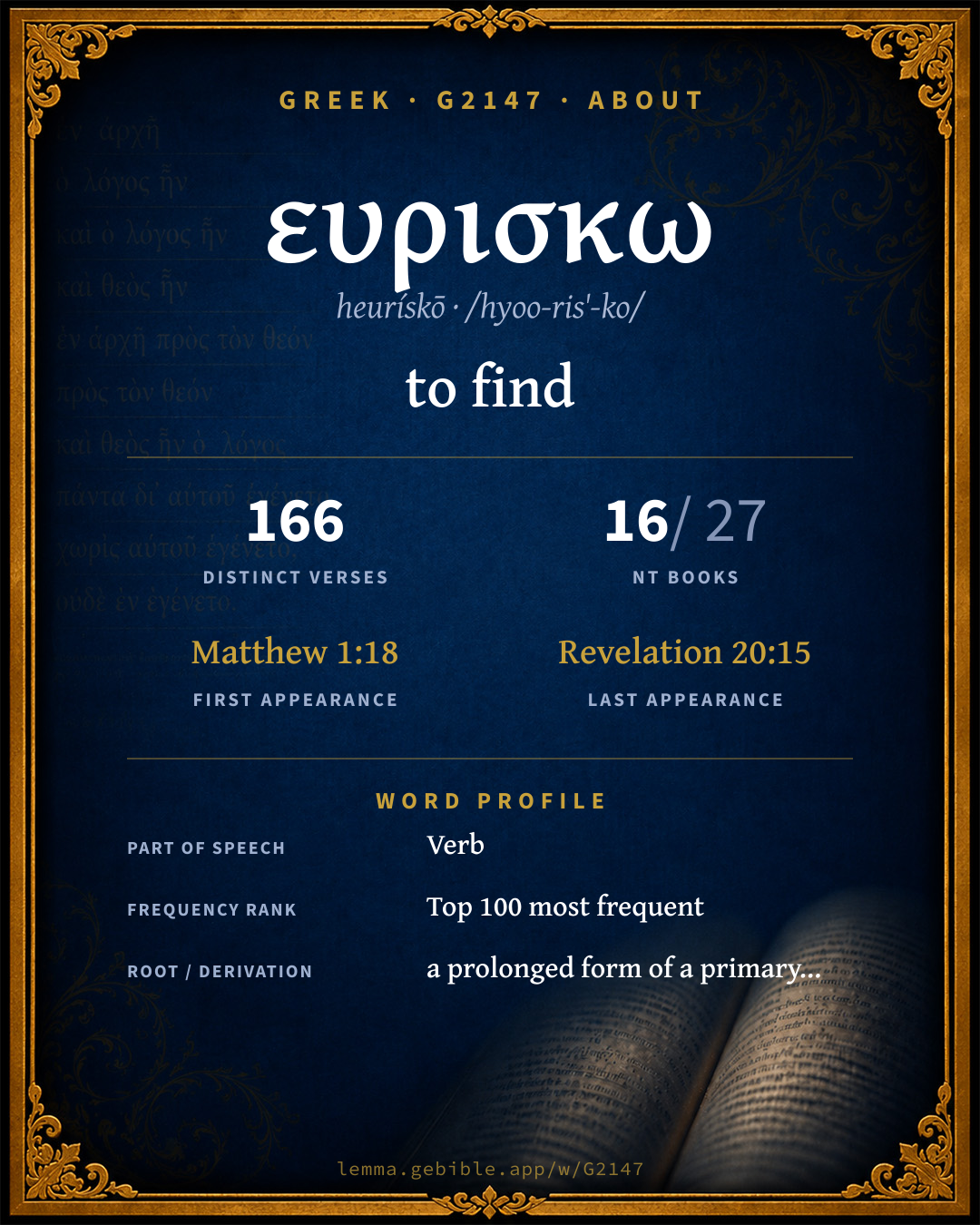
εὑρίσκω
to find
‘to find’ is one of 3 main senses fuller range ↓
Full lexicon entry — Thayer's Greek Lexicon
From Thayer's Greek Lexicon
Where this word appears
See every Aorist-tense verb in the Greek New Testament →
Grammar key — what these labels mean
Part of speech
- Verb
- An action or state-of-being word.
Tense
- Aorist
- Action viewed as a simple whole, without regard to duration — often past (perfective aspect).
- Present
- Ongoing or general action in present time (imperfective aspect).
- Future
- Action expected in future time.
- Imperfect
- Continuous or repeated action in past time (“was writing”).
- Perfect
- A completed past action with continuing present results.
Voice
- Active
- The subject performs the action.
- Passive
- The subject receives the action.
- Middle
- The subject acts on or for itself, or with special interest in the action.
Mood
- Indicative
- States a fact or asks a factual question (the mood of reality).
- Participle
- A verbal adjective (“writing,” “having written”).
- Infinitive
- A verbal noun (“to write”), unmarked for person or number.
- Subjunctive
- Expresses probability, purpose, or possibility (the mood of contingency).
- Optative
- Expresses a wish or a remote possibility.
Case
- Nominative
- The case of the subject (and the predicate nominative).
Person
- 3rd person
- The one spoken about (“he / she / it / they”).
- 2nd person
- The one addressed (“you”).
- 1st person
- The speaker (“I / we”).
Gender
- Masculine
- Grammatically masculine.
- Feminine
- Grammatically feminine.
- Neuter
- Grammatically neuter.
Number
- Plural
- More than one.
- Singular
- One.
1 verse where G2147 appears in the Future tense in the Book of 2 Corinthians. Filtered view — show all forms. Click any verse to open its interlinear word-by-word view. Verse text shown in the World English Bible for context — . Each verse’s Greek form is shown with its reference; the English is not keyword-highlighted, since the data carries no word-level English alignment. Use “Compare translations” on any verse to read it across multiple English versions. This concordance covers the Greek New Testament; Septuagint (Greek Old Testament) occurrences of this word are not indexed here.
2 Corinthians
About this entry
At a glance — auto-summarized from this page’s data, not written by a person. Every figure links to its source below. This summary describes the numbers; it doesn’t interpret them.
The Greek verb ευρισκω centers on the idea of “to find.” Debuting at Matthew 1:18, it then recurs through the corpus. It appears 166 verses across 16 books of the Greek New Testament, among its common vocabulary. The word gravitates to Luke (27%), then Acts and Matthew. Thayer's distinguishes 3 senses for it. For the data behind this summary, explore the sense tree and the renderings breakdown below.
Gloss history
Strong's 1890 vs modern scholarship
About this word
Strong's G2147 catalogs a Greek word from the Greek New Testament.
These counts are not copied from any lexicon or concordance. They are computed here, from the morphology-tagged Greek New Testament. What Lemma adds →
- 166
- distinct verses
- The word appears in 166 distinct verses.
- 16 / 27
- NT books
- The word appears in 16 of 27 New Testament books.
- #90
- by frequency
- Top 100 most frequent Greek words (rank 90 of 5,347 Greek words by occurrence).
View all 166 occurrences in the concordance →
By section of the New Testament
By traditional corpus
Conventional, traditional groupings — biblical authorship is debated, so this is a traditional corpus grouping, not an authorship claim. Some books belong to more than one corpus (Luke is in both the Gospels and the Lukan corpus, and so on), so these shares overlap and need not total 100%. Each figure is a share of the word’s 166 distinct verses.
- Gospels 97 verses · 58%
- Lukan (Luke–Acts) 76 verses · 46%
- Johannine 31 verses · 19%
- Pauline corpus 16 verses · 10%
- Revelation 13 verses · 8%
- Hebrews 4 verses · 2%
- General (Catholic) Epistles 4 verses · 2%
How translations render this word
Counts come from each version’s own published word-to-Strong’s tagging or interlinear alignment — an approximate guide to how each version renders this word, not a word-level alignment the data otherwise carries. Because each total is that version’s own tagged count, the per-version totals vary from one another and need not match the appearance or distinct-verse counts above. These counts may also differ from a printed concordance because Lemma counts each distinctly tagged rendering and does not collapse phrase taggings into a single head-word total. This is a fixed set of word-tagged versions (KJV, ASV, BSB, ULT) and does not change with the reading translation you choose elsewhere. Each version’s license is shown beside its name below (and on Sources).
- King James Version: Found 40×, Find 16×, Findeth 9×
- American Standard Version: Found 41×, Find 14×, They found 13×
- Berean Standard Bible: Found 21×, He found 13×, They found 12×
- unfoldingWord Literal Text: Found 22×, Find 16×, They found 15×
King James Version Public Domain
Renders G2147 across 194 tagged occurrences — most commonly:
Plus other, less common renderings. Plus 41 renderings that appear only once — usually multi-word phrases or single function words the recovered tagging swept in, not distinct renderings.
American Standard Version Public Domain
Renders G2147 across 194 tagged occurrences — most commonly:
Plus other, less common renderings. Plus 40 renderings that appear only once — usually multi-word phrases or single function words the recovered tagging swept in, not distinct renderings.
Berean Standard Bible Public Domain
Renders G2147 across 172 tagged occurrences — most commonly:
Plus other, less common renderings. Plus 45 renderings that appear only once — usually multi-word phrases or single function words the recovered tagging swept in, not distinct renderings. Not rendered by a distinct English word in 4 further occurrences.
unfoldingWord Literal Text CC BY-SA 4.0
Renders G2147 across 224 tagged occurrences — most commonly:
Plus other, less common renderings. Plus 45 renderings that appear only once — usually multi-word phrases or single function words the recovered tagging swept in, not distinct renderings.
Senses in Thayer's
The 3 senses Thayer's distinguishes for this word, in lexicon order (not ranked by frequency or importance). The full entry — with sub-senses — is in the Lexicon Entry tab.
- to come upon, hit upon, to meet with
- to find by enquiry, thought, examination, scrutiny, observation, to find out by practice and experience
- to find out for one's self, to acquire, get, obtain, procure
Word origin
Origin: a prolonged form of a primary heuro hyoo'-ro, which (together with another cognate form heureo hyoo-reh'-o) is used for it in all the tenses except the present and imperfect
A prolonged form of a primary word εὕρω heurō which (together with another cognate form εὑρέω heureō ) is used for it in all the tenses except the present and imperfect; to find (literally or figuratively): - find get obtain perceive see.
— Strong’s Exhaustive Concordance (1890), public domain.
Forms in the corpus
The 48 distinct written forms G2147 takes in the Greek New Testament, most frequent first — each parse links to that tense’s occurrences in the concordance.
Septuagint usage
The same Greek word ευρισκω appears 445 times in the Greek Old Testament (Septuagint), across 416 verses in 33 books.
- 445
- LXX occurrences
- Tagged occurrences of this Greek word in the Septuagint.
- 416
- verses
- Distinct Septuagint verses containing this word.
- 33 / 39
- OT books
- The word appears in 33 of the 39 Old Testament books.
Sample Septuagint occurrences
- Genesis 2:20 εὑρίσκω
- Exodus 5:11 εὑρίσκω
- Leviticus 5:11 εὑρίσκω
- Numbers 6:21 εὑρίσκω
- Deuteronomy 4:29 εὑρίσκω
- Joshua 2:22 εὑρίσκω
- Judges 5:30 εὑρίσκω
- Ruth 1:9 εὑρίσκω
- 1 Samuel 1:18 εὑρίσκω
- 2 Samuel 7:27 εὑρίσκω
- 1 Kings 1:3 εὑρίσκω
- 2 Kings 2:17 εὑρίσκω
Septuagint occurrences (same lexeme)
Every verse where the same Strong’s number (G2147) appears in the Greek Septuagint — showing the first 50 of 416. Verse text shown in the World English Bible for context; the Greek form is the matched word — the English is not keyword-highlighted.
- Genesis 2:20 εὑρίσκω The man gave names to all cattle, and to the birds of the sky, and to every animal of the field; but for man there was not found a helper suitable for him.
- Genesis 4:14 εὑρίσκω Behold, you have driven me out this day from the surface of the ground. I will be hidden from your face, and I will be a fugitive and a wanderer in the earth. It will happen that whoever finds me will kill me."
- Genesis 4:15 εὑρίσκω Yahweh said to him, "Therefore whoever slays Cain, vengeance will be taken on him sevenfold." Yahweh appointed a sign for Cain, lest any finding him should strike him.
- Genesis 5:24 εὑρίσκω Enoch walked with God, and he was not, for God took him.
- Genesis 6:8 εὑρίσκω But Noah found favor in Yahweh's eyes.
- Genesis 8:9 εὑρίσκω but the dove found no place to rest her foot, and she returned to him into the ark; for the waters were on the surface of the whole earth. He put forth his hand, and took her, and brought her to him into the ark.
- Genesis 11:2 εὑρίσκω It happened, as they traveled east, that they found a plain in the land of Shinar; and they lived there.
- Genesis 16:7 εὑρίσκω The angel of Yahweh found her by a fountain of water in the wilderness, by the fountain in the way to Shur.
- Genesis 18:3 εὑρίσκω and said, "My lord, if now I have found favor in your sight, please don't go away from your servant.
- Genesis 18:26 εὑρίσκω Yahweh said, "If I find in Sodom fifty righteous within the city, then I will spare all the place for their sake."
- Genesis 18:28 εὑρίσκω What if there will lack five of the fifty righteous? Will you destroy all the city for lack of five?" He said, "I will not destroy it, if I find forty-five there."
- Genesis 18:29 εὑρίσκω He spoke to him yet again, and said, "What if there are forty found there?" He said, "I will not do it for the forty's sake."
- Genesis 18:30 εὑρίσκω He said, "Oh don't let the Lord be angry, and I will speak. What if there are thirty found there?" He said, "I will not do it, if I find thirty there."
- Genesis 18:31 εὑρίσκω He said, "See now, I have taken it on myself to speak to the Lord. What if there are twenty found there?" He said, "I will not destroy it for the twenty's sake."
- Genesis 18:32 εὑρίσκω He said, "Oh don't let the Lord be angry, and I will speak yet but this once. What if ten are found there?" He said, "I will not destroy it for the ten's sake."
- Genesis 19:19 εὑρίσκω See now, your servant has found favor in your sight, and you have magnified your loving kindness, which you have shown to me in saving my life. I can't escape to the mountain, lest evil overtake me, and I die.
- Genesis 26:12 εὑρίσκω Isaac sowed in that land, and reaped in the same year one hundred times what he planted. Yahweh blessed him.
- Genesis 26:19 εὑρίσκω Isaac's servants dug in the valley, and found there a well of springing water.
- Genesis 26:32 εὑρίσκω It happened the same day, that Isaac's servants came, and told him concerning the well which they had dug, and said to him, "We have found water."
- Genesis 27:20 εὑρίσκω Isaac said to his son, "How is it that you have found it so quickly, my son?" He said, "Because Yahweh your God gave me success."
- Genesis 30:14 εὑρίσκω Reuben went in the days of wheat harvest, and found mandrakes in the field, and brought them to his mother, Leah. Then Rachel said to Leah, "Please give me some of your son's mandrakes."
- Genesis 30:27 εὑρίσκω Laban said to him, "If now I have found favor in your eyes, stay here, for I have divined that Yahweh has blessed me for your sake."
- Genesis 31:32 εὑρίσκω With whoever you find your gods, he shall not live. Before our relatives, discern what is yours with me, and take it." For Jacob didn't know that Rachel had stolen them.
- Genesis 31:33 εὑρίσκω Laban went into Jacob's tent, into Leah's tent, and into the tent of the two maid-servants; but he didn't find them. He went out of Leah's tent, and entered into Rachel's tent.
- Genesis 31:35 εὑρίσκω She said to her father, "Don't let my lord be angry that I can't rise up before you; for the manner of women is on me." He searched, but didn't find the teraphim.
- Genesis 31:37 εὑρίσκω Now that you have felt around in all my stuff, what have you found of all your household stuff? Set it here before my relatives and your relatives, that they may judge between us two.
- Genesis 32:6 εὑρίσκω The messengers returned to Jacob, saying, "We came to your brother Esau. Not only that, but he comes to meet you, and four hundred men with him."
- Genesis 32:20 εὑρίσκω You shall say, 'Not only that, but behold, your servant, Jacob, is behind us.'" For, he said, "I will appease him with the present that goes before me, and afterward I will see his face. Perhaps he will accept me."
- Genesis 33:8 εὑρίσκω Esau said, "What do you mean by all this company which I met?" Jacob said, "To find favor in the sight of my lord."
- Genesis 33:10 εὑρίσκω Jacob said, "Please, no, if I have now found favor in your sight, then receive my present at my hand, because I have seen your face, as one sees the face of God, and you were pleased with me.
- Genesis 33:15 εὑρίσκω Esau said, "Let me now leave with you some of the folk who are with me." He said, "Why? Let me find favor in the sight of my lord."
- Genesis 34:11 εὑρίσκω Shechem said to her father and to her brothers, "Let me find favor in your eyes, and whatever you will tell me I will give.
- Genesis 36:24 εὑρίσκω These are the children of Zibeon: Aiah and Anah. This is Anah who found the hot springs in the wilderness, as he fed the donkeys of Zibeon his father.
- Genesis 37:15 εὑρίσκω A certain man found him, and behold, he was wandering in the field: and the man asked him, saying, "What are you looking for?"
- Genesis 37:17 εὑρίσκω The man said, "They have left here, for I heard them say, 'Let us go to Dothan.'" Joseph went after his brothers, and found them in Dothan.
- Genesis 37:32 εὑρίσκω They took the coat of many colors, and they brought it to their father, and said, "We have found this. Examine it, now, whether it is your son's coat or not."
- Genesis 38:20 εὑρίσκω Judah sent the kid of the goats by the hand of his friend, the Adullamite, to receive the pledge from the woman's hand, but he didn't find her.
- Genesis 38:22 εὑρίσκω He returned to Judah, and said, "I haven't found her; and also the men of the place said, 'There has been no prostitute here.'"
- Genesis 38:23 εὑρίσκω Judah said, "Let her keep it, lest we be shamed. Behold, I sent this kid, and you haven't found her."
- Genesis 39:4 εὑρίσκω Joseph found favor in his sight. He ministered to him, and he made him overseer over his house, and all that he had he put into his hand.
- Genesis 41:38 εὑρίσκω Pharaoh said to his servants, "Can we find such a one as this, a man in whom is the Spirit of God?"
- Genesis 44:6 εὑρίσκω He overtook them, and he spoke to them these words.
- Genesis 44:8 εὑρίσκω Behold, the money, which we found in our sacks' mouths, we brought again to you out of the land of Canaan. How then should we steal silver or gold out of your lord's house?
- Genesis 44:9 εὑρίσκω With whoever of your servants it be found, let him die, and we also will be my lord's bondservants."
- Genesis 44:10 εὑρίσκω He said, "Now also let it be according to your words: he with whom it is found will be my bondservant; and you will be blameless."
- Genesis 44:12 εὑρίσκω He searched, beginning with the eldest, and ending at the youngest. The cup was found in Benjamin's sack.
- Genesis 44:16 εὑρίσκω Judah said, "What will we tell my lord? What will we speak? Or how will we clear ourselves? God has found out the iniquity of your servants. Behold, we are my lord's bondservants, both we, and he also in whose hand the cup is found."
- Genesis 44:17 εὑρίσκω He said, "Far be it from me that I should do so. The man in whose hand the cup is found, he will be my bondservant; but as for you, go up in peace to your father."
- Genesis 44:34 εὑρίσκω For how will I go up to my father, if the boy isn't with me? Lest I see the evil that will come on my father."
- Genesis 47:14 εὑρίσκω Joseph gathered up all the money that was found in the land of Egypt, and in the land of Canaan, for the grain which they bought: and Joseph brought the money into Pharaoh's house.
These are occurrences of the same Greek lexeme (G2147) in the Septuagint — not a translation of any one Hebrew word. The store carries no word-level Hebrew↔Greek alignment, so no Hebrew original is asserted here. Counts come from the recovered LXX Strong's tagging — high-frequency vocabulary is well covered, while rare or late forms may be untagged — so they reflect tagged occurrences and may slightly undercount.