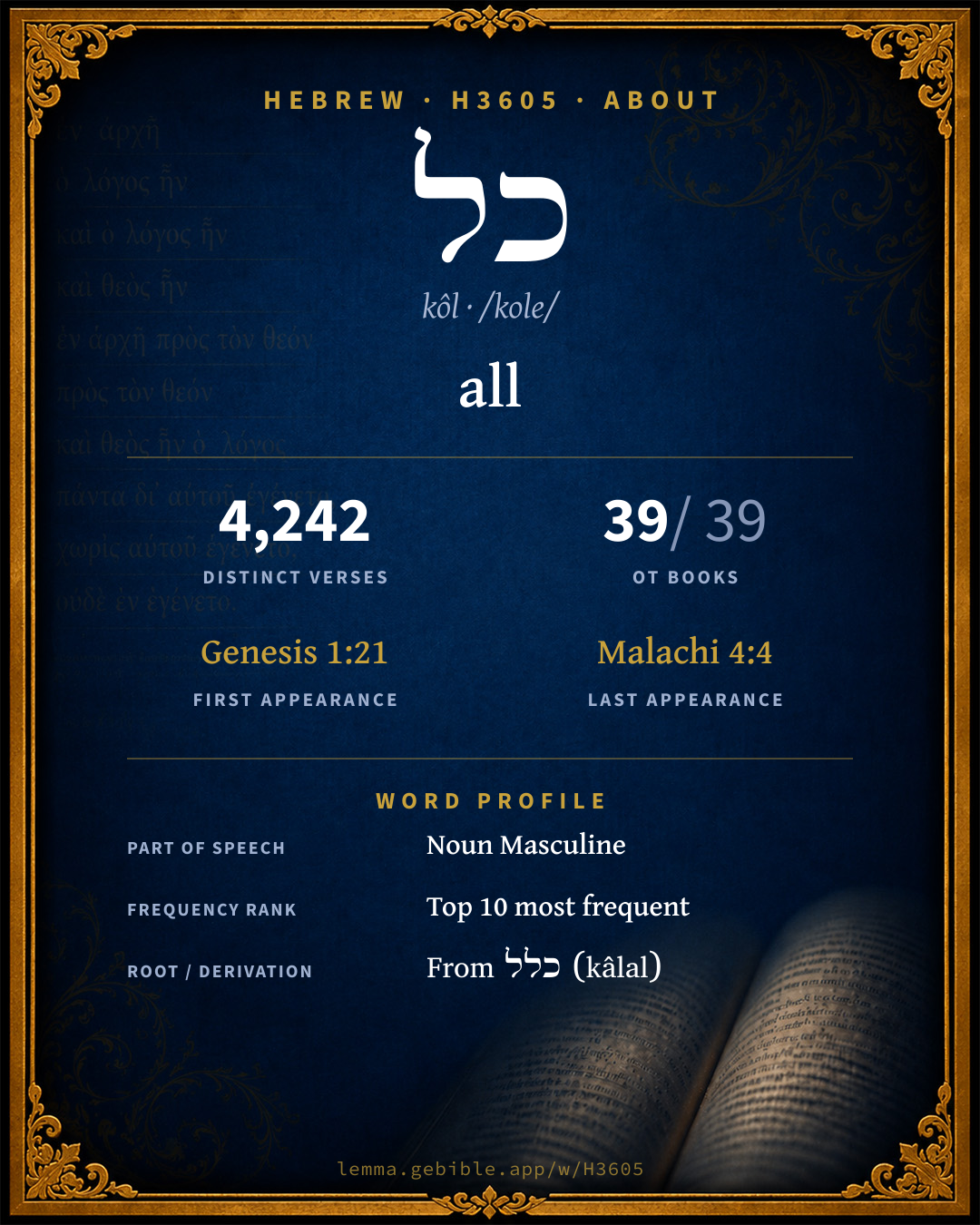
כֹּל
all
‘all’ is one of 4 main senses fuller range ↓
Full lexicon entry — Brown-Driver-Briggs (BDB)
From Brown-Driver-Briggs (BDB)
Where this word appears
See every Construct-state word in the Hebrew Bible →
Grammar key — what these labels mean
Part of speech
- Noun
- A naming word — a person, place, thing, or idea.
Noun type
- Common
- A common noun — a general class of person, place, or thing (“king,” “city,” “water”), not a specific name.
State
- Construct
- A noun bound to a following noun in a possessive / “of” relationship (the construct chain).
- Absolute
- The independent form of a noun, not bound to a following word.
Gender
- Masculine
- Grammatically masculine.
Number
- Singular
- One.
45 verses where H3605 appears in the Construct state in the Book of Ecclesiastes. Filtered view — show all forms. Click any verse to open its interlinear word-by-word view. Verse text shown in the World English Bible for context — . Each verse’s Hebrew form is shown with its reference; the English is not keyword-highlighted, since the data carries no word-level English alignment. Use “Compare translations” on any verse to read it across multiple English versions. This concordance covers the Hebrew Bible; Septuagint (Greek Old Testament) occurrences are not indexed here.
Ecclesiastes
- Ecclesiastes 1:3 בְּ/כָל prep + n c ms cs What does man gain from all his labor in which he labors under the sun?
- Ecclesiastes 1:7 כָּל n c ms cs All the rivers run into the sea, yet the sea is not full. To the place where the rivers flow, there they flow again.
- Ecclesiastes 1:8 כָּל n c ms cs All things are full of weariness beyond uttering. The eye is not satisfied with seeing, nor the ear filled with hearing.
- Ecclesiastes 1:9 כָּל n c ms cs That which has been is that which shall be; and that which has been done is that which shall be done: and there is no new thing under the sun.
- Ecclesiastes 1:14 כָּל הַ/כֹּ֛ל n c ms cs ptcl def.art + n c ms I have seen all the works that are done under the sun; and, behold, all is vanity and a chasing after wind.
- Ecclesiastes 2:5 כָּל n c ms cs I made myself gardens and parks, and I planted trees in them of all kinds of fruit.
- Ecclesiastes 2:7 מִ/כֹּ֛ל prep + n c ms cs I bought men-servants and maid-servants, and had servants born in my house. I also had great possessions of herds and flocks, above all who were before me in Jerusalem;
- Ecclesiastes 2:10 וְ/כֹל֙ מִ/כָּל מִ/כָּל מִ/כָּל conj + n c ms prep + n c ms cs prep + n c ms cs prep + n c ms cs Whatever my eyes desired, I didn't keep from them. I didn't withhold my heart from any joy, for my heart rejoiced because of all my labor, and this was my portion from all my labor.
- Ecclesiastes 2:11 בְּ/כָל הַ/כֹּ֥ל prep + n c ms cs ptcl def.art + n c ms Then I looked at all the works that my hands had worked, and at the labor that I had labored to do; and, behold, all was vanity and a chasing after wind, and there was no profit under the sun.
- Ecclesiastes 2:14 כֻּלָּֽ/ם n c ms cs + sfx pers 3mp The wise man's eyes are in his head, and the fool walks in darkness--and yet I perceived that one event happens to them all.
- Ecclesiastes 2:18 כָּל n c ms cs I hated all my labor in which I labored under the sun, seeing that I must leave it to the man who comes after me.
- Ecclesiastes 2:19 בְּ/כָל prep + n c ms cs Who knows whether he will be a wise man or a fool? Yet he will have rule over all of my labor in which I have labored, and in which I have shown myself wise under the sun. This also is vanity.
- Ecclesiastes 2:20 כָּל n c ms cs Therefore I began to cause my heart to despair concerning all the labor in which I had labored under the sun.
- Ecclesiastes 2:22 בְּ/כָל prep + n c ms cs For what has a man of all his labor, and of the striving of his heart, in which he labors under the sun?
- Ecclesiastes 2:23 כָל n c ms cs For all his days are sorrows, and his travail is grief; yes, even in the night his heart takes no rest. This also is vanity.
- Ecclesiastes 3:1 לַ/כֹּ֖ל לְ/כָל prep det + n c ms prep + n c ms cs For everything there is a season, and a time for every purpose under heaven:
- Ecclesiastes 3:13 כָּל בְּ/כָל n c ms cs prep + n c ms cs Also that every man should eat and drink, and enjoy good in all his labor, is the gift of God.
- Ecclesiastes 3:17 לְ/כָל כָּל prep + n c ms cs n c ms cs I said in my heart, "God will judge the righteous and the wicked; for there is a time there for every purpose and for every work."
- Ecclesiastes 4:1 כָּל n c ms cs Then I returned and saw all the oppressions that are done under the sun: and, behold, the tears of those who were oppressed, and they had no comforter; and on the side of their oppressors there was power; but they had no comforter.
- Ecclesiastes 4:4 כָּל כָּל n c ms cs n c ms cs Then I saw all the labor and achievement that is the envy of a man's neighbor. This also is vanity and a striving after wind.
- Ecclesiastes 4:8 לְ/כָל prep + n c ms cs There is one who is alone, and he has neither son nor brother. There is no end to all of his labor, neither are his eyes satisfied with wealth. For whom then, do I labor, and deprive my soul of enjoyment? This also is vanity, yes, it is a miserable business.
- Ecclesiastes 4:15 כָּל n c ms cs I saw all the living who walk under the sun, that they were with the youth, the other, who succeeded him.
- Ecclesiastes 4:16 לְ/כָל לְ/כֹ֤ל prep + n c ms cs prep + n c ms There was no end of all the people, even of all them over whom he was--yet those who come after shall not rejoice in him. Surely this also is vanity and a chasing after wind.
- Ecclesiastes 5:17 כָּל n c ms cs All his days he also eats in darkness, he is frustrated, and has sickness and wrath.
- Ecclesiastes 5:18 בְּ/כָל prep + n c ms cs Behold, that which I have seen to be good and proper is for one to eat and to drink, and to enjoy good in all his labor, in which he labors under the sun, all the days of his life which God has given him; for this is his portion.
- Ecclesiastes 5:19 כָּֽל n c ms cs Every man also to whom God has given riches and wealth, and has given him power to eat of it, and to take his portion, and to rejoice in his labor--this is the gift of God.
- Ecclesiastes 6:7 כָּל n c ms cs All the labor of man is for his mouth, and yet the appetite is not filled.
- Ecclesiastes 7:2 כָּל n c ms cs It is better to go to the house of mourning than to go to the house of feasting: for that is the end of all men, and the living should take this to heart.
- Ecclesiastes 7:18 כֻּלָּֽ/ם n c ms cs + sfx pers 3mp It is good that you should take hold of this. Yes, also from that don't withdraw your hand; for he who fears God will come forth from them all.
- Ecclesiastes 7:21 לְ/כָל prep + n c ms cs Also don't take heed to all words that are spoken, lest you hear your servant curse you;
- Ecclesiastes 7:23 כָּל n c ms cs All this have I proved in wisdom. I said, "I will be wise;" but it was far from me.
- Ecclesiastes 7:28 בְ/כָל prep + n c ms cs which my soul still seeks; but I have not found: one man among a thousand have I found; but a woman among all those have I not found.
- Ecclesiastes 8:6 לְ/כָל prep + n c ms cs For there is a time and procedure for every purpose, although the misery of man is heavy on him.
- Ecclesiastes 8:9 כָּל לְ/כָֽל n c ms cs prep + n c ms cs All this have I seen, and applied my mind to every work that is done under the sun. There is a time in which one man has power over another to his hurt.
- Ecclesiastes 8:17 כָּל n c ms cs then I saw all the work of God, that man can't find out the work that is done under the sun, because however much a man labors to seek it out, yet he won't find it. Yes even though a wise man thinks he can comprehend it, he won't be able to find it.
- Ecclesiastes 9:1 כָּל כָּל הַ/כֹּ֖ל n c ms cs n c ms cs ptcl def.art + n c ms For all this I laid to my heart, even to explore all this: that the righteous, and the wise, and their works, are in the hand of God; whether it is love or hatred, man doesn't know it; all is before them.
- Ecclesiastes 9:4 כָּל n c ms cs For to him who is joined with all the living there is hope; for a living dog is better than a dead lion.
- Ecclesiastes 9:8 בְּ/כָל prep + n c ms cs Let your garments be always white, and don't let your head lack oil.
- Ecclesiastes 9:9 כָּל כֹּ֖ל n c ms cs n c ms cs Live joyfully with the wife whom you love all the days of your life of vanity, which he has given you under the sun, all your days of vanity: for that is your portion in life, and in your labor in which you labor under the sun.
- Ecclesiastes 9:11 כֻּלָּֽ/ם n c ms cs + sfx pers 3mp I returned, and saw under the sun, that the race is not to the swift, nor the battle to the strong, neither yet bread to the wise, nor yet riches to men of understanding, nor yet favor to men of skill; but time and chance happen to them all.
- Ecclesiastes 11:8 בְּ/כֻלָּ֣/ם כָּל prep + n c ms cs + sfx pers 3mp n c ms Yes, if a man lives many years, let him rejoice in them all; But let him remember the days of darkness, for they shall be many. All that comes is vanity.
- Ecclesiastes 11:9 כָּל n c ms cs Rejoice, young man, in your youth, And let your heart cheer you in the days of your youth, And walk in the ways of your heart, And in the sight of your eyes; But know that for all these things God will bring you into judgment.
- Ecclesiastes 12:4 כָּל n c ms cs And the doors shall be shut in the street; When the sound of the grinding is low, And one shall rise up at the voice of a bird, And all the daughters of music shall be brought low;
- Ecclesiastes 12:13 הַ/כֹּ֣ל כָּל ptcl def.art + n c ms n c ms cs This is the end of the matter. All has been heard. Fear God, and keep his commandments; for this is the whole duty of man.
- Ecclesiastes 12:14 כָּל כָּל n c ms cs n c ms cs For God will bring every work into judgment, with every hidden thing, whether it is good, or whether it is evil.
About this entry
At a glance — auto-summarized from this page’s data, not written by a person. Every figure links to its source below. This summary describes the numbers; it doesn’t interpret them.
“all” is the headline sense of the Hebrew noun כל (kôl). Carrying more than one sense, it rewards its full sense range. With 4,242 verses in 39 books, it is one of the most common word in the Hebrew Bible. Scripture first uses it in Genesis 1:21. From the same root come כלל, כלה and כליל. See the sense tree, 4,242-verse concordance, and the renderings breakdown below.
Gloss history
Strong's 1890 vs modern scholarship
About this word
Strong's H3605 catalogs a Hebrew word from the Hebrew Old Testament.
These counts are not copied from any lexicon or concordance. They are computed here, from the morphology-tagged Hebrew Old Testament. What Lemma adds →
- 4,242
- distinct verses
- The word appears in 4,242 distinct verses.
- 39 / 39
- OT books
- The word appears in 39 of 39 Old Testament books.
- #6
- by frequency
- Top 10 most frequent Hebrew words (rank 6 of 8,640 Hebrew words by occurrence).
View all 4,242 occurrences in the concordance →
Most concentrated in
- Jeremiah 347 verses 8%
- Psalms 319 verses 8%
- Deuteronomy 282 verses 7%
By section of the Old Testament
By traditional corpus
Conventional, traditional groupings — biblical authorship is debated, so this is a traditional corpus grouping, not an authorship claim. Each share is this word’s portion of its verses in that division of the Hebrew canon. Each figure is a share of the word’s 4,242 distinct verses.
- Prophets (Nevi'im) 1,898 verses · 45%
- Torah (Pentateuch) 1,209 verses · 29%
- Writings (Ketuvim) 1,135 verses · 27%
How translations render this word
Counts come from each version’s own published word-to-Strong’s tagging or interlinear alignment — an approximate guide to how each version renders this word, not a word-level alignment the data otherwise carries. Because each total is that version’s own tagged count, the per-version totals vary from one another and need not match the appearance or distinct-verse counts above. These counts may also differ from a printed concordance because Lemma counts each distinctly tagged rendering and does not collapse phrase taggings into a single head-word total. This is a fixed set of word-tagged versions (KJV, ASV, BSB, ULT) and does not change with the reading translation you choose elsewhere. Each version’s license is shown beside its name below (and on Sources).
BDB lists this Strong’s number as 2 distinct words (homographs). Each count above pools all of them and is not split by sense — see the Senses section below. A low-frequency rendering may belong to a different one of those words, not the primary meaning.
- King James Version†: All 4×, Any 2×, Every one 2×
- American Standard Version†: All 4×, Any 2×, Every one 2×
- Berean Standard Bible†: All 2,895×, Every 354×, Whole 217×
- unfoldingWord Literal Text†: All 1,927×, All of 1,422×, Every 473×
King James Version Public Domain
Renders H3605 across 24† tagged occurrences — most commonly:
Plus 12 renderings that appear only once — usually multi-word phrases or single function words the recovered tagging swept in, not distinct renderings. Not rendered by a distinct English word in 2 further occurrences.
American Standard Version Public Domain
Renders H3605 across 24† tagged occurrences — most commonly:
Plus 12 renderings that appear only once — usually multi-word phrases or single function words the recovered tagging swept in, not distinct renderings.
Berean Standard Bible Public Domain
Renders H3605 across 5,100† tagged occurrences — most commonly:
Plus other, less common renderings. Plus 275 renderings that appear only once — usually multi-word phrases or single function words the recovered tagging swept in, not distinct renderings. Not rendered by a distinct English word in 282 further occurrences.
unfoldingWord Literal Text CC BY-SA 4.0
Renders H3605 across 5,278† tagged occurrences — most commonly:
Plus other, less common renderings. Plus 160 renderings that appear only once — usually multi-word phrases or single function words the recovered tagging swept in, not distinct renderings.
11 senses and sub-senses in the full BDB
What do BDB’s symbols mean?
BDB uses these scholarly abbreviations:
| Symbol | Meaning |
|---|---|
| 𝔊 | the Septuagint (the ancient Greek translation, LXX) |
| 𝔙 | the Vulgate (the Latin translation) |
| 𝔖 | the Syriac version (the Peshitta) |
| 𝔗 | the Targum (the Aramaic translation) |
| ψ | the Psalms |
| √ | root (the underlying root or stem) |
| ‖ | parallel passage (a synonymous or contrasted parallel) |
| † | the dagger: every passage where the word occurs is cited |
The 11 senses and sub-senses the full Brown-Driver-Briggs lexicon distinguishes for this word, in lexicon order (not ranked by frequency), with BDB’s own verbatim wording and sub-sense lettering. Shown in Hebrew script with BDB’s own scholarly abbreviations. The condensed entry is in the Lexicon Entry tab. See also the Forms in the corpus table below.
- 1. with foll. gen. (as usually) the whole of, to be rendered, however, often in our idiom, to avoid stiffiness, all or every:
- a. Gn 2:1 כָּל־צְבָאָם the whole of their host, v 13 כָּל־אֶרֶץ כּוּשׁ the whole of the land of Kush; כָּל־הַלַּיְלָה the whole of the night; כָּל־יִשְׂרָאֵל the whole of Israel = all Israel; Dt 4:29 בְּכָל־לְבָֽבְךָ with the whole of thy heart = with all thy heart; + very often With a plural noun, usually determined by the art. or a genitive: Gn 5:5 כל־ימי אדם the whole of (= all) the days of Adam, 37:35 כל־בניו the whole of (= all) his sons, Is 2:2 כל־הגוים all the nations; Gn 43:9 + often כל הימים = continually. In poetry, however, the noun may remain undetermined, כָּל־יָדַיִם the whole of hands = every hand, Is 13:7; Jer 48:37; Ez 21:12; כל־פנים i.e. every face Is 25:8; Joel 2:6; כל שׁלחנות Is 28:8; כל חוצות 51:20 La 2:19 al. Before an inf. †Gn 30:41; Dt 4:7; 1 K 8:52; 1 Ch 23:31. Freq. with sfs., as כֻּלּוֹ (כֻּלֹּה) the whole of him Gn 25:25; Jb 21:23; Ct 5:16, the whole of it Lv 13:13; Je 2:21; Na 2:1; Pr 24:31; כֻּלָּהּ the whole of it Gn 13:10; Ex 19:18; 25:36 Am 8:8; כֻּלָּךְ all of thee Ct 4:7 + (v. ad init.); כֻּלָּנוּ the whole of us Gn 42:11; Dt 5:3; Is 53:6, 6; כֻּלְּכֶם Dt 1:22; 4:4; 1 S 22:7, 7; כֻּלָּם Gn 11:6; 43:34; Jos 8:24; ויפלו כֻּלָּם, Ju 11:6; בְּיַד כֻּלָּם, Is 7:19; 31:3 + often—Twice, strangely, with hyperb. intensive force, ψ 39:6 כָּל־הֶבֶל the whole of vanity are all men (? om. כל, as v 12), 45:14 כָּל־כְּבוּדָּה the whole of gloriousness is the king’s daughter. e.g. Genesis 2:2
- b. followed often by a singular, to be understood collectively, whether with or without the art.: Gn 1:21 את כל נפשׁ החיה the whole of living souls = every living soul, 2:9 כל עץ נחמד למראה the whole of trees (every kind of tree) pleasant to view, 6:12 + כָּל־בָּשָׂר, 7:14 כל צפור כל כנף all birds of every kind of wing (so Ez 17:23), v 21 כל האדם the whole of mankind (so Nu 12:3; 16:29 Ju 16:17 al.); poet. כל־אדם ψ 39:6; 64:10 +; 1 S 14:52 כל אישׁ גבור וכל־בן־חיל, 17:19, 24 כל אישׁ ישׂראל, 22:2; Is 9:16 כל פה the whole of mouths = every mouth, 15:2; 24:10 כָּל־בַּיִת + often (in 2:12–16 the sg. and pl. interchange); ψ 7:12 + בכל־יום, 10:5 + בכל־עת = at all seasons. So כל־העץ Gn 1:29, כל־הבן Ex 1:22 = all the sons, כל־המקום 20:24 Dt 11:24 = all the places, כל־המרכב Lv 15:9, v 26 Dt 4:3 כל־האישׁ אשׁר = all the men who …, 15:19 כל־הבכור, Je 4:29 כל־העיר עזובה all the cities (notice the foll. בָּהֶן); כל־היום = all the days (v. יוֹם 7 f), etc. In late Heb. extended to such phrases as בְּכָל־דּוֹר וָדוֹר †ψ 45:18; 145:13 Est 9:28; בכל־עיר ועיר †2 Ch 11:12; 28:25; 31:19 Est 8:11, 17; 9:28; †2 Ch 32:28 Est 2:11; 3:14; 4:3; 8:13, 17; 9:21, 27, 28(×3), (cf. וְ 1 i b). e.g. Genesis 1:21
- c. the gen. after כל is often a rel. sentence, introduced by אשׁר: Gn 1:31 את כל אשׁר עשׂה the whole of what he had made, 7:22; 13:1 + very often Sometimes, with a prep., כל אשׁר has the force of wheresoever, whithersoever, as Jos 1:9 בְּכֹל אֲשֶׁר תֵּלֵךְ wheresoever thou goest, v 16 אֶל־כָּל־אֲשֶׁר whithersoever (see אֲשֶׁר 4 b γ). Very rarely in such cases is there ellipse of the rel., as Gn 39:4 וְכָל־יֶשׁ־לוֹ נָתַן בְּיָדִי (contrast v 5, 8), Ex 9:4 מכל־לבני ישׂראל, Is 38:16 וּלְכָל־בָּהֶן חַיֵּי רוּחִי, ψ 71:18 לְכָל־יָבוֹא (74:3, v. 2 a), 2 Ch 32:31; peculiarly also in Chr (DrIntr. 505), 1 Ch 29:3 מִכָּל־הֲכִינוֹתִי, 2 Ch 30:18 f. Ezr 1:6; cf. with כֹּל (2 a) 1 Ch 29:11 a 2 Ch 30:17; Ezr 1:5. e.g. Genesis 1:31
- d. with a suffix two idiomatic uses of כל have to be noticed: (a) כל is often made more independent and emphatic by being placed with a suffix after the word which it qualifies, to which it then stands in apposition (cf. in Syriac, Arabic, Ethiopic), as 2 S 2:9 יִשְׂרָאֵל כֻּלֹּה, Jer 13:19; 48:31; Is 9:8; 14:29, 31 פלשׁת כלך Philistia, all of thee! Mi 2:12 Hb 2:6 Jb 34:13 ψ 67:4, 6; especially in Ezek., as 14:5; 29:2 מצדים כֻּלָּהּ 32:12, 30; with change of person (cf. the idiom in Is 22:16; 48:1; 54:1 etc.), 1 K 22:28 = Mi 1:2 שׁמעו עמים כלם Hear, nations, all of them! Mal 3:9 הַגּוֹי כֻּלּוֹ. So even with כל preceding: Nu 16:3 כָּל־הָעֵדָה כֻּלָּם, Is 14:18; Jer 30:16; Ez 11:15 כל בית ישׂראל כֻּלֹּה the whole of the house of Israel, the whole of it (so 20:40; 36:10), 35:15; 36:5 ψ 8:8 (cf. Sab. DHMl.c.); (b) with the sf. of 3 ms., understood as referring to the mass of things or persons meant, כֻּלֹּה or כֻּלּוֹ, lit. the whole of it, is equivalent to all of them, every one, †Ex 14:7 and captains עַל־כֻּלּוֹ upon the whole of it (the רֶכֶב collectively) = all of them, Is 1:23 the whole of it (the people) loveth bribes, 9:16; 15:3; Jer 6:13(×2); 8:6, 10(×2); 20:7; Hab 1:9, 15; ψ 29:9 and in his temple כֻּלּוֹ אֹמֵר כָּבוֹד the whole of it (= every one there) says, Glory! 53:4 (‖ 14:3 הַכֹּל); perhaps Is 16:7; Je 48:38; + Pr 19:6 Ew Hi (וְכֻלֹּה רֵעַ): Je 15:10 read כֻּלְּהֶם קִלֲלוּנִי. e.g. 2 Samuel 2:9
- e. Heb. idiom in certain cases affirms, or denies, of an entire class, where Engl. idiom affirms, or denies, of an individual of the class; thus in a compar. or hypoth. sentence כל is = any, and with a neg. = none; (a) Gn 3:1 the serpent was more subtil מכל חית השׂדה than all beasts of the field (in our idiom: than any beast of the field), Dt 7:7; 1 S 9:2; (b) Lv 4:2 a soul when it sins through ignorance מכל מצות י״י in all the commandments of Jehovah (= in any of the commandments, etc.), 19:23 when ye … plant כל־עץ מאכל = any tree for food, Nu 35:22 or if he have cast upon him כָּל־כְּלִי = any weapon, 1 K 8:37 b; joined with a ptcp. in a hypoth. sense (Dr§ 121 n. Ges§ 116, 5 R. 5), Gn 4:14 כל מצאי all my finders (= if any one find me), he will slay me, v 15 a Nu 21:8; כָּל־הַנָּשׁוּךְ = whosoever (= if any one) is bitten, 1 S 2:13; (c) with a neg., Gn 2:5 all plants of the field טֶרֶם יִהְיֶה were not as yet = no plant of the field as yet was, 4:15 b לבלתי הכות־אתו כל־מצאו for the not-smiting him of all finding him = that none finding him should smite him, Ex 10:15 ולא־נותר כל ירק = and no green things were left, 12:16 כל־מלאכה לא יעשׂה all work shall not be done = no work shall be done, Dt 28:14; Ju 13:4 אַל־תֹּאכְלִי כָּל־טָמֵא eat not of all that is unclean, 19:19 אֵין מַחְסוֹר כָּל־דָּבָר there is no lack of all things i.e. of any thing, ψ 143:2 כי לא־יצדק לפניך כל־חי, + very often (so οὐ πᾶς, as a Hebraism, in the N.T., e.g. Mk 13:20 οὐκ ἂν ἐσώθη πᾶσα σάρξ, Lk 1:37 οὐκ ἀδυνατήσει … πᾶν ῥῆμα, as Jer 32:17 לֹא־יִפָּלֵא מִמְּךָ כָּל־דָּבָר, Gal 2:16 οὐ δικαιωθήσεται … πᾶσα σάρξ, etc.) Usually, in such cases, כל (or its gen.) is without the art., being left purposely indef.: in ψ 49:18 (2 b a) הַכֹּל is emph. (In Nu 23:13 וְכֻלּוֹ לֹא תִרְאֶה the context shews that כֹּל is opp. to a part). e.g. Genesis 3:1
- f. very anomalously, severed from its gen., †2 S 1:9 כִּי־כָל־עוֹד נַפְשִׁי בִי, Jb 27:3 כִּי־כָל־עוֹד נִשְׁמָתִי בִי, Ho 14:3 (si vera l.) כָּל־תִּשָּׂא עָוֹן. On Ec 5:15 כָּל־עֻמַּת־שֶׁ׳ v. עֻמָּה. e.g. 2 Samuel 1:9
- — When the gen. after כל is a noun fem. or pl., the pred. usually agrees with this (as being the really important idea), e.g. Gn 5:5 ויהיו כל ימי אדם, Nu 14:1 וַתִּשָּׂא כָל־הָעֵדָה, Nah 3:1 ψ 150:6 כֹּל הַנְּשָׁמָה תְּהַלֵּל; exceptions being very rare, Is 64:10 b Pr 16:2 (Ges§ 141. 1 R. 2). e.g. Genesis 5:5
- 2. Absolutely:
- a. without the art., all things, all (mostly neuter, but sometimes m.), the sense in which ‘all’ is to be taken being gathered from the context, Gn 9:3 נתתי לכם את כֹּל, 16:12 וְיַד כֹּל בּוֹ, 20:16 ואת כֹּל ונוכחת, 33:11 וכי ישׁ לי כֹל, Nu 8:16 בכור כֹּל מבני ישׂראל, 11:6 אֵין כֹּל nought of all things! = there is nothing (so †2 S 12:3; Pr 13:7, cf. 2 K 4:2), 13:2 כֹּל נשׂיא בהם (cf. 2 S 23:39; 1 Ch 3:9: usually so הַכֹּל), Dt 28:47 מֵרֹב כֹּל, v 48, 37 בְּחֹסֶר כֹּל (cf. Je 44:18), Is 30:5 כֹּל הֹבִאישׁ all exhibit shame, 44:24 י׳ עֹשֶׂה־כֹּל, Je 44:12 וְתַמּוּ כֹל (unusual), Zp 1:2 ψ 8:7; 74:3 (read כֹּל הֵרַע), 145:15 עיני כֹל, Pr 16:4; 26:10; 28:5; Jb 13:1 הן כֹּל ראתה עיני, 42:2; 1 Ch 29:11 b 2 Ch 32:22 (m.), Dn 11:37 (v. also 1 c end); מִכֹּל Gn 6:19, 20 b שְׁנַיִם מִכֹּל, 14:20; 27:33; Je 17:9 עקוב הלב מִכֹּל, Dn 11:2 (m.) After a neg. = anything, Dt 4:25 תְּמוּנַת כֹּל the likeness of anything, 8:9; 28:55; Pr 30:30. In the gen. also, very rarely, to express the idea of all as comprehensively as possible: Ez 44:30 כָּל־בִּכּוּרֵי כֹל וְכָל־תְּרוּמַת כֹּל; ψ 119:128 (si vera l.) כָּל־פִּקּוּדֵי כֹל all the statutes about everything. e.g. Genesis 9:3
- b. with art. הַכֹּל: (a) where the sense is limited by the context to things (or persons) just mentioned, Ex 29:24 ושׂמת הַכֹּל ביד אהרן, Lv 1:9 והקטיר הכהן את הַכֹּל, v 13; 8:27 Dt 2:36 את הַכֹּל נתן י׳ לפנינו, Jos 11:19 (cf. 2 S 19:31 1 K 14:26 = 2 Ch 12:9), 21:43 הַכֹּל בָּא (cf. 23:14), 1 S 30:19 הַכֹּל השׁיב דוד, 2 S 17:3 (corrupt: v. 𝔊 Dr), 24:23 (1 Ch 21:23), 1 K 6:18 הַכֹּל ארז (cf. 7:33; 2 K 25:17 = Je 52:22), 2 K 24:16 הַכֹּל גבורים, Is 65:8 לבלתי השׁחית הַכֹּל, ψ 14:3; or implied, Gn 16:12 יָדוֹ בַכֹּל, 24:1 ברך את אברהם בַּכֹּל, 2 S 23:5 (poet.) עֲרֻכָה בַכֹּל, is 29:11 (peculiarly) חָזוּת הַכֹּל the vision of the whole, Je 13:7, 10 לא יצלח לַכֹּל, Ez 7:14 וְהָכִין הַכֹּל (but Co וְהָכִינוּ הָכֵן), ψ 49:18 לא במותו יקח הַכֹּל: more freq. later, viz. 1 Ch 7:5 (as regards all), 28:19; 29:19 2 Ch 28:6; 29:28; 31:5; 35:7; 36:17, 18; Ezr 1:11; 2:42; 8:34, 35; 10:17 (וַיְכַלּוּ בַכֹּל: v. BeRy), Ec 5:8 (בַּכֹּל, appar. = in all respects), 10:19; 12:13. (b) in a wider sense, all, whether of all mankind or of all living things, the universe (τὸ πᾶν), or of all the circumstances of life (chiefly late), Je 10:16 = 51:19 כי יוצר הַכֹּל הוא, ψ 103:19 (cf. 1 Ch 29:12), 119:91 הַכֹּל עֲבָדֶיךָ, 145:9 טוֹב י׳ לַכֹּל, 1 Ch 29:12, 14, 16 Dn 11:2, and especially in Ec., as 1:2, 14; 2:11, 17; 3:19; 12:8 הַכֹּל הֶבֶל, 2:16 הכל נשׁכח, 3:1 לַכֹּל זְמָן, v 11, 19, 20; 6:6; 7:15; 9:1, 2, 2, 3; 10:3, 19; 11:5. כַּכֹּל, †Jb 24:24 (si vera l.) כַּכֹּל יִקָּֽפְצוּן like all men (i.e. like men in general). e.g. Exodus 29:24
Senses from the full Brown-Driver-Briggs lexicon (Brown, Driver, Briggs; Oxford 1906 — public domain), digitized via Sefaria, supplemented by the OpenScriptures HebrewLexicon (CC BY 4.0). Full attribution on Sources.
Word origin
once כּוֹל (Je 33:8 Kt), n.m. the whole, all (Moab., Ph., id.; Aramaic כּוֹל, ܟܽܠ; Arabic كُلٌّ; Sab. כל, cf. DHMEpigr. Denk. 36–38;. Ethiopic ኵል Assyrian kullatu)—abs. כֹּל, cstr. כֹּל Gn 2:5, 16, 20 + often, once כֹּל־ ψ 138:2 (v. Ba), but more usually כָּל־ (with makk.: without it, †ψ 35:10 Pr 19:7; Köi 84, 95); sf. 2 ms. in p. כֻּלָּךְ †Mi 2:12; 2 fs. כֻּלֵּךְ †Is 14:29, 31, כֻּלָּךְ †Is 22:1 Ct 4:7 (perhaps for assonance with accompanying לָךְ, בָּךְ); 3 ms. כֻּלֹּה 2 S 2:9 (v. Dr) + 17 times (never in Pent.), כֻּלּוֹ Gn 25:25 + 16 times; 3 fs. כֻּלָּהּ Gn 13:10 + 15 times, כֻּלָּא †Ez 36:5; כֻּלָּנוּ (16 times); כֻּלְּכֶם (18 times); כֻּלָּם (often), כּוּלָּם †Je 31:34, כֻּלָּ֑הַם †2 S 23:6 (and prob. Je 15:10 כֻּלְּהֶם); 3 fpl. כֻּ֫לָּנָה †Gn 42:36 Pr 31:29; כֻּלָּֽהְנָה׃ †1 K 7:37:—the whole,
— Brown-Driver-Briggs (Oxford 1906, public domain), digitized via Sefaria, supplemented by the OpenScriptures HebrewLexicon (CC BY 4.0). See Sources.
Derived from כלל (kâlal) (H3634) — to perfect.
Jastrow Dictionary
A second Hebrew/Aramaic lexicon for comparison, covering Aramaic and post-biblical (Talmudic, Targumic, Midrashic) usage that the biblical-Hebrew BDB does not. Matched by lemma rather than by Strong’s number, so a lemma may carry more than one Jastrow headword (shown separately below), and the entries cover usage well beyond the Bible.
כֹּל
- , constr. כָּל (b. h.; כָּלַל) all, every one. Sot. 5ᵃ הקב"ה הניח כל הרים וכ׳ the Lord passed over all mountains and hills and caused his Presence to rest on Sinai. Ib. (ref. to ככל Job XXIV, 24) כאברהם … בַּכֹּל מִכֹּל כֹּל like Abraham, Isaac and Jacob of whom is written ‘with everything’ &c. (Gen. XXIV, 1; XXVII, 33; XXXIII, 11).—Ḥull. I, 1 הַכֹּל שוחטין וכ׳ all persons are competent to slaughter &c.; וכוּלָּן וכ׳ but all those (mentioned as unfit), if they &c. Ib. 2 ובַכֹּל שוחטין וכ׳ and you may slaughter with any cutting tool except &c. Tem. I, 1; a. v. fr.—דברי הכל the words of all, (it is) the unanimous opinion, all agree. Bets. 9ᵃ ד׳ ה׳ מותר all agree that it is permitted; a. fr.—אין … כל עיקר not at all. Y. Dem. I, 21ᵈ אינו מפריש כל עיקר he does not set aside at all; a. fr.—Y. Shebi. VIII, beg. 37ᵈ, a. e. לא הכל ממנו it is not in his power to do so, v. הֵימ־.—כָּל העולם כּוּלּוֹ the whole world. Ber. 17ᵇ; a. fr.—כל ה־, כל ש־ whosoever, whatsoever. Gitt. 11ᵇ כל האומר תנו וכ׳ whoever says, ‘Give you’ (a letter of emancipation &c.), is considered as having said, Take possession (in behalf of the person concerned). Kidd. 43ᵇ כל שאין יכולה וכ׳ whatever woman is incapable of guarding her letter of divorce, is incapable of being divorced. Ḥag. 4ᵇ, v. יֵשׁ; a. v. fr.—כָּל שֶׁהוּא whatever it be, i.e. the smallest quantity. Macc. 17ᵃ, a. e. כ׳ ש׳ למכות for punishment with lashes, the partaking of any quantity is sufficient, opp. כזית, v. זַיִת. Shebu. III, 1 ואכל כ׳ ש׳ and ate the least thing; a. v. fr.—כָּל שֶׁכֵּן (abbr. כ"ש) there is every reason that it is even so, i.e. so much the more, a matter of course. Sabb. 63ᵃ … אורך וכ"ש וכ׳ there is length of life promised and, as a matter of course, wealth and honor; a. fr.—לא כ"ש, v. הַשְׁתָּא. e.g. Job 24:24
כָּל
- ch., v. כּוֹל
A Dictionary of the Targumim, the Talmud Babli and Yerushalmi, and the Midrashic Literature (Marcus Jastrow; London, Luzac, 1903) — Public Domain. Digitized via Sefaria. Digitized via Sefaria. Full attribution on Sources.
Forms in the corpus
The 259 distinct written forms H3605 takes in the Hebrew Bible, most frequent first — each parse links to that state’s occurrences in the concordance. Hebrew forms include their vowel points and cantillation, so a single lemma takes many written forms.
The 60 most common forms are shown; 199 rarer forms follow in the full concordance.
Same root — word family
Other BDB entries built from the same root as H3605, grouped by Strong’s listed origin. These share a root / origin per the lexicon — not necessarily a shared meaning. Each links to that word’s own entry.
Derives from
Shares the same root
- כלה kallâh H3618 bride
- כליל kâlîyl H3632 whole
- כלל kᵉlal H3635 to finish
- מכלול miklôwl H4358 perfection
- מכלל miklâl H4359 perfection
- מכלל miklul H4360 perfect thing
Derived from this word
Proper names from this root
People and places named from this root — a name, not an additional meaning of the word.
Compare all same-root words → Showing 4 of 11 — not the complete family. 2 of the same-root words are proper names (people or places). They share a root, not necessarily a meaning.
Septuagint verse parallels
Most of the 4,242 Hebrew verses this word occurs in also exist in the Greek Old Testament (Septuagint), so the same passages can be read in Greek by switching the Old Testament edition to the Septuagint.
Read these verses in the Septuagint
- Genesis 1:21
- Exodus 1:5
- Leviticus 1:9
- Numbers 1:2
- Deuteronomy 1:1
- Joshua 1:2
- Judges 1:25
- Ruth 1:19
- 1 Samuel 1:4
- 2 Samuel 1:9
- 1 Kings 1:3
- 2 Kings 3:6
This is a verse-level parallel only — the same verses exist in both the Hebrew and Greek Old Testaments. No word-level Hebrew↔Greek correspondence is claimed: the data carries no such alignment, so no Greek word is shown as this Hebrew word’s translation. Coverage is not total — the Septuagint omits the deuterocanon and renumbers the Psalms, so some Hebrew verses have no direct Greek parallel.