Ezekiel 23:6

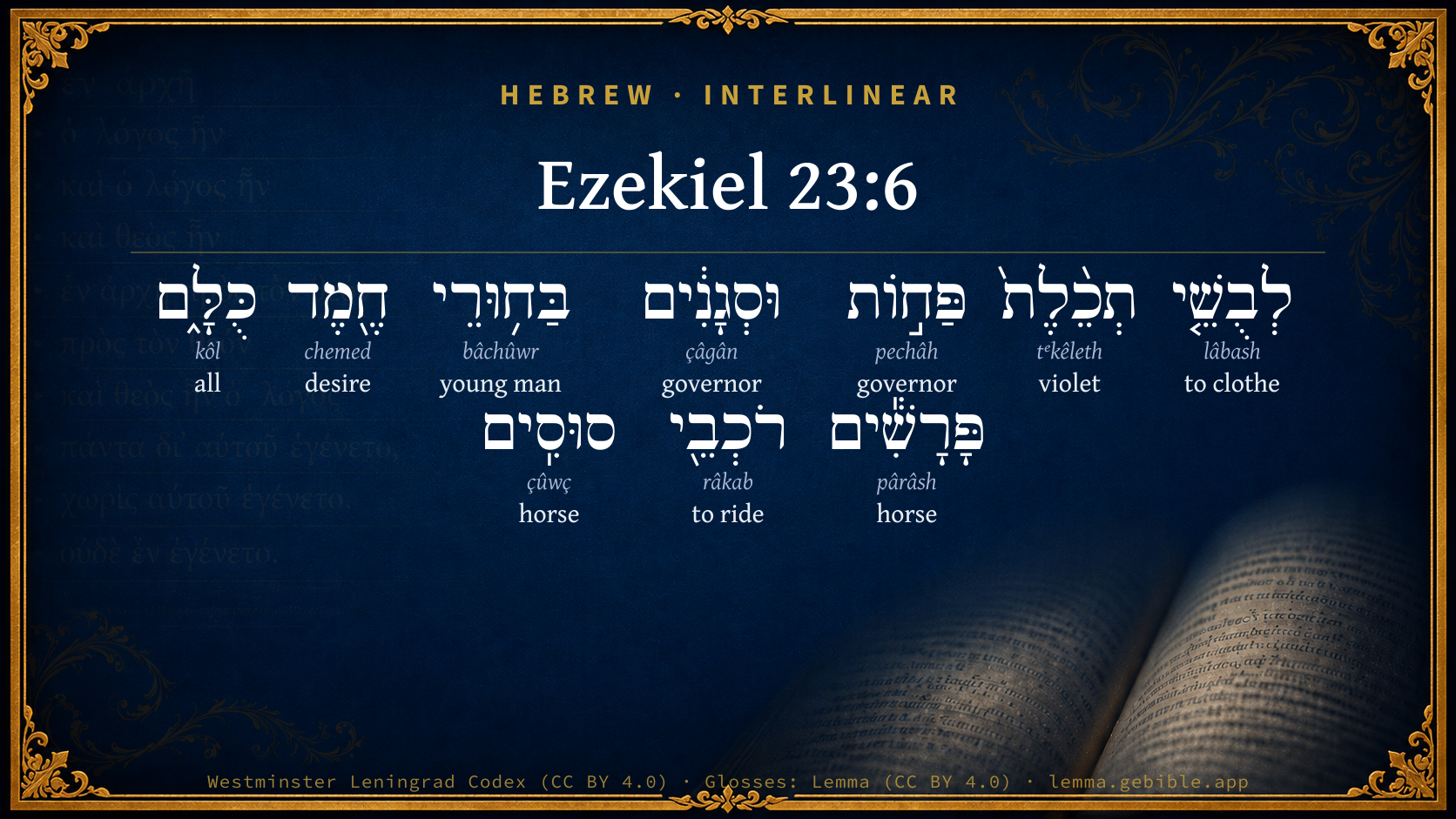
Hebrew (Westminster Leningrad Codex) Ezekiel 23:6 appears in the Hebrew Old Testament. The text above is from the Westminster Leningrad Codex. Each word links to its Strong’s number, a concise gloss, and parsing drawn from the Open Scriptures Hebrew Bible morphology. Click any word for its full Brown-Driver-Briggs (BDB) entry.
Download image
Cite this verse

Ezekiel 23:6 (World English Bible). Public Domain. Lemma interlinear Bible study tool, https://lemma.gebible.app/v/ezekiel/23/6.

Show BibTeX & RIS
BibTeX
RIS
English Translation
who were clothed with blue, governors and rulers, all of them desirable young men, horsemen riding on horses.
World English Bible · Public Domain
Download a study sheet

One document with this verse’s original text, its word-by-word gloss line, the meaning frame, cross-references with their text, attributed commentary, and full source and license credits — printable, and it pastes into notes with its structure intact.

This verse Autodidact and up

Study sheet (.html) Plain text (.txt)

A passage Seminary Student

Up to 50 verses in one chapter. A passage sheet keeps up to 6 commentary sources and 12 cross-references per verse, in the order this page ranks them, and says so on the sheet whenever that leaves anything out. Ask for a single verse and you get the Autodidact verse sheet above.

Everything on this page stays free to read, with no account — the sheet is a download of what is already on screen, not access to it.

Want to remove ads? Support Godless Engineer
Compare translations 3

The same verse in 3 English versions, stacked beneath the original-language interlinear above. Click any original word for its lexicon entry.

Each is an independent rendering of the whole verse — the interlinear is not word-aligned to these translations.

Highlighted words mark where these versions differ — a whole-verse word diff, not a word-by-word alignment.

  • World English Bible Public Domain
    who were clothed with blue, governors and rulers, all of them desirable young men, horsemen riding on horses.
  • King James Version Public Domain
    Which were clothed with blue, captains and rulers, all of them desirable young men, horsemen riding upon horses.
  • unfoldingWord Literal Text CC BY-SA 4.0
    the governor who wore blue, and for his officials, who were strong and handsome, all of them men riding on horses.

unfoldingWord Literal Text — © unfoldingWord, licensed CC BY-SA 4.0. Word-aligned USFM3 via Door43 (git.door43.org/unfoldingWord/en_ult).

Versions to compare (up to 4)

3 of 4 selected

Show all 18 translations

Every available English version of this verse, each an independent rendering of the whole verse.

  • World English Bible Public Domain
    who were clothed with blue, governors and rulers, all of them desirable young men, horsemen riding on horses.
  • Berean Standard Bible Public Domain
    clothed in blue, governors and commanders, all desirable young men, horsemen mounted on steeds.
  • Majority Standard Bible Public Domain
    clothed in blue, governors and commanders, all desirable young men, horsemen mounted on steeds.
  • King James Version Public Domain
    Which were clothed with blue, captains and rulers, all of them desirable young men, horsemen riding upon horses.
  • American Standard Version (1901) Public Domain
    who were clothed with blue, governors and rulers, all of them desirable young men, horsemen riding upon horses.
  • Revised Version (1885) Public Domain
    which were clothed with blue, governors and rulers, all of them desirable young men, horsemen riding upon horses.
  • Geneva Bible (1599) Public Domain
    Which were clothed with blewe silke, both captaines and princes: they were all pleasant yong men, and horsemen riding vpon horses.
  • Douay-Rheims (1899) Public Domain
    Who were clothed with blue, princes, and rulers, beautiful youths, all horsemen, mounted upon horses.
  • Young's Literal Translation Public Domain
    Clothed with blue -- governors and prefects, Desirable young men all of them, Horsemen, riding on horses,
  • Literal Standard Version CC BY-SA 4.0
    Clothed with blue—governors and prefects, || All of them desirable young men, || Horsemen, riding on horses,
  • Unlocked Literal Bible CC BY-SA 4.0
    the governor who wore blue, and for his officials, who were strong and handsome, all of them men riding on horses.
  • unfoldingWord Literal Text CC BY-SA 4.0
    the governor who wore blue, and for his officials, who were strong and handsome, all of them men riding on horses.
  • Darby Bible Public Domain
    clothed with blue, governors and rulers, all of them attractive young men, horsemen riding upon horses.
  • World Messianic Bible Public Domain
    who were clothed with blue—governors and rulers, all of them desirable young men, horsemen riding on horses.
  • Webster's Bible Public Domain
    Who were clothed with blue, captains and rulers, all of them desirable young men, horsemen riding upon horses.
  • Free Bible Version CC BY-SA 4.0
    They were soldiers dressed in blue, leaders and commanders, all of them handsome young men in the cavalry.
  • Bible in Basic English Public Domain
    Who were clothed in blue, captains and rulers, all of them young men to be desired, horsemen seated on horses.
  • JPS Tanakh (1917) Public Domain
    clothed with blue, governors and rulers, handsome young men all of them, horsemen riding upon horses.

Literal Standard Version (2020), Covenant Press — licensed CC BY-SA 4.0. Text via the HelloAO Bible API (eBible.org). Unlocked Literal Bible (unfoldingWord) — licensed CC BY-SA 4.0. Text via the HelloAO Bible API (eBible.org). unfoldingWord Literal Text — © unfoldingWord, licensed CC BY-SA 4.0. Word-aligned USFM3 via Door43 (git.door43.org/unfoldingWord/en_ult). Free Bible Version, Dr. Jonathan Gallagher — licensed CC BY-SA 4.0. Text via the HelloAO Bible API (eBible.org).

Word by word

More ways to search: Search by grammar → Find every occurrence → Compare this word →

Practice this passage: Drill this verse → Learn its vocabulary →

About this verse

These counts appear in no published source. They are computed here, from the morphology-tagged text and Lemma’s own curated glosses. What Lemma adds →

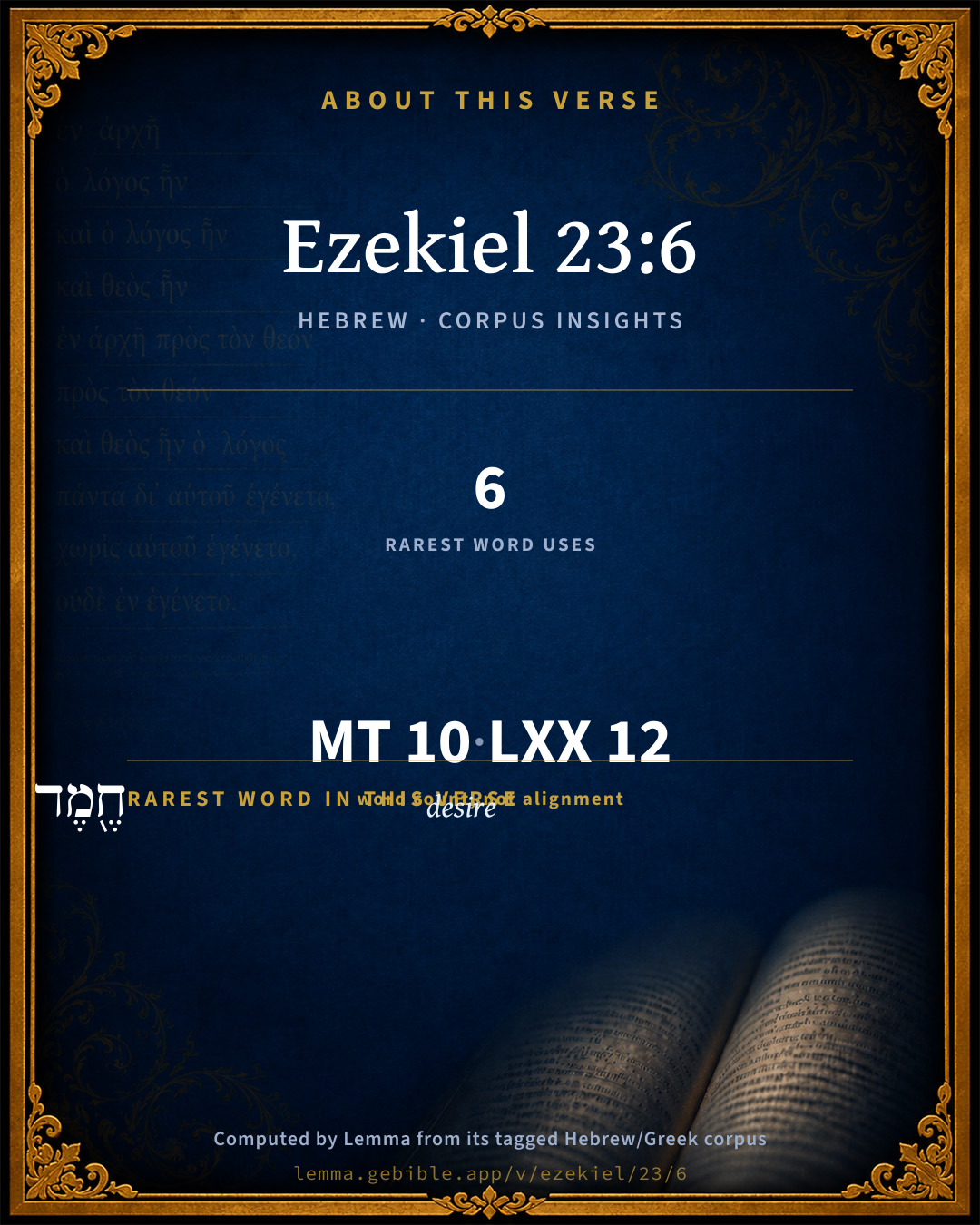
10
words
10
distinct lemmas
Prophets
section

Notable vocabulary

The rarest word here is חֶ֖מֶד desire H2531 — appearing just 6 times in the whole Hebrew Bible.

Shared distinctive vocabulary

חֶ֖מֶד desire H2531 occurs in 6 verses of the Hebrew Bible. Also found in:

Grammatical profile

  • 1 verb
  • 8 nouns
  • 1 adjective

Verb forms

  • רֹכְבֵ֖י Qal · Participle Active

Hebrew & Septuagint length

In English translation the verse runs 18 words from the Hebrew and 17 from the Septuagint (LXX English) — closely comparable.

A rough comparison of the two English renderings, which tokenize alike — not a word-level alignment.

Word counts can differ between the Hebrew and the Greek without any difference in meaning — e.g. the Hebrew direct-object marker אֵת has no separate Greek word, and Greek often adds the article ὁ.

In the original languages it is 10 Hebrew tokens and 12 Greek tokens — but the two are counted differently (Hebrew bundles its prefixes and suffixes into one token; the Greek is in lemma form), so that isn’t a like-for-like length.

Cross-references

1

Topical passages linked to Ezekiel 23:6 in the Treasury of Scripture Knowledge — connected by theme and wording, ordered by reader-vote popularity; previews shown in the World English Bible.

  • Ezekiel 23:23 the Babylonians and all the Chaldeans, Pekod and Shoa and Koa, [and] all the Assyrians with them; desirable young men, governors and rulers all of them, princes and men of renown, all of them riding on horses.

Cross-references courtesy of OpenBible.info (CC BY 4.0).

Hebrew and Greek witnesses Masoretic Hebrew ↔ Greek Septuagint

The same verse in the two great witnesses to the Old Testament, shown verse-for-verse.

These are two independent witnesses, not word-aligned to each other, and the Septuagint is shown in lemma (dictionary) form.

Hebrew Ezekiel 23:6 Masoretic · Westminster Leningrad Codex

לְבֻשֵׁ֤י תְכֵ֨לֶת֙ פַּח֣וֹת וּסְגָנִ֔ים בַּח֥וּרֵי חֶ֖מֶד כֻּלָּ֑ם פָּרָשִׁ֕ים רֹכְבֵ֖י סוּסִֽים

who were clothed with blue, governors and rulers, all of them desirable young men, horsemen riding on horses.

World English Bible · Public Domain

Greek LXX Ezekiel 23:6 Septuagint · lemma form

ἐνδύω ὑακίνθινος ἡγέομαι καί στρατηγός νεανίσκος ἐπίλεκτος πᾶς ἱππεύς ἱππάζομαι ἐπί ἵππος

clothed with purple, princes and captains; they were young men and choice, all horseman riding on horses.

LXX2012 (modern English Septuagint) · Public Domain

Hebrew: Westminster Leningrad Codex (CC BY 4.0). Greek: Septuagint (public domain); English from LXX2012 (modern English Septuagint) (Public Domain). How the Septuagint differs from the Hebrew →

Targum (Aramaic paraphrase)

1

The Targum is the ancient Jewish Aramaic paraphrase of the Hebrew Scriptures — an interpretive translation, not the Hebrew text itself. Onkelos (literal) and Pseudo-Jonathan (expansive) render the Torah, and Jonathan the Prophets. Coverage is partial: where no permissively-licensed English translation exists for a verse, only the Aramaic is shown. This is verse-level text, not a word-by-word alignment to the Hebrew.

  1. Targum Jonathan Prophets (Joshua–Malachi)
    לְבוּשֵׁי גְמִיר שִׁלְטוֹנִין וְטוּרָנִין עוּלֵימֵי חֶמְדָתָא כּוּלְהוֹן פָּרָשִׁין רָכְבֵי סוּסְוָן:

    (no public-domain English translation for this verse)

    Targum Jonathan — Aramaic: “Mikraot Gedolot” (public domain). English: “Sefaria Community Translation” (CC0 1.0 (public-domain dedication)); “London "Chaldee Paraphrase," 1871” (public domain). Text via Sefaria.

Commentary

Notes on Ezekiel 23:6 from classic Christian and Jewish commentators (each source and its license shown beneath its notes). The classic Christian expositions comment on the surrounding passage and are grouped to its opening verse, so a note may address several verses; the Jewish commentaries on the Tanakh (Rashi and others) are per-verse, so they appear only where the commentator wrote on this verse.

Lemma curates 59 commentaries, every one of them public domain or Creative Commons licensed, each selected and text-cleaned for this edition rather than reprinted as found. About our sources →

Trapp's Complete Commentary

John Trapp

Eze 23:6 [Which were] clothed with blue, captains and rulers, all of them desirable young men, horsemen riding upon horses.

Ver. 6. Which were clothed with blue.] With rich and gorgeous attire. Vestis luxuriae nidus.

John Trapp, A Commentary or Exposition upon All the Books of the Old and New Testament (1647–1656) — public domain. Text from a community e-Sword module.

Jamieson, Fausset & Brown

Robert Jamieson, A. R. Fausset & David Brown

blue--rather, "purple" [FAIRBAIRN]. As a lustful woman's passions are fired by showy dress and youthful appearance in men, so Israel was seduced by the pomp and power of Assyria (compare Isa 10:8).

horsemen--cavaliers.

Jamieson, Fausset & Brown — Commentary Critical and Explanatory on the Whole Bible (1871) — public domain (CC PDM 1.0). Text via the HelloAO Bible API.

Adam Clarke's Commentary

Verse 6. Clothed with blue] The purple dye was highly valued among the ancients, and at first was only used by kings, at last it was used among the military, particularly by officers of high rank in the country.

Adam Clarke's Commentary on the Bible (1810–1826) — public domain. Text from a community e-Sword/MySword module.

Ellicott's Commentary for English Readers

(6) Horsemen.—The Assyrians, like the Egyptians, made large use of cavalry, as was necessary to a warlike nation; the multiplication of horses had on this account been forbidden to the Israelites (Deu_17:16).

A Bible Commentary for English Readers, edited by Charles John Ellicott (1878–1897) — public domain. Text from a community e-Sword module.

The Cambridge Bible for Schools and Colleges

gen. ed. J. J. S. Perowne

6. captains and rulers] Or, governors and satraps, cf. Neh_4:14; Neh_5:15.

The Cambridge Bible for Schools and Colleges (gen. ed. J. J. S. Perowne; Cambridge University Press, 1878–1918) — public domain. Text from a community e-Sword module.

John Gill's Exposition

Which were clothed with blue,.... A colour the Assyrians were fond of, and clothed their soldiers in, and was taking to the eye; and is mentioned, because that men, finely clothed find beautifully arrayed, are more engaging to women, who are fond of dress:

captains and rulers; men of power and authority in military and civil affairs, either in the camp, or in the court; officers either in the army, or in the king's palace; and which was a recommendation of them:

desirable young men; for their youth, strength, beauty, and honourable employments and offices:

horsemen riding upon horses: of which there was a scarcity in Judea; wherefore such were the more desirable to them, as appearing more grand, and being more serviceable and helpful to them.

John Gill's Exposition of the Whole Bible (1746–1763) — public domain (CC PDM 1.0). Text via the HelloAO Bible API.

Albert Barnes' Notes on the Bible

The army of the Assyrians is described. War-horses formed an important part in the armies of Assyria and Egypt; Israel was deficient in this respect Isa 36:8.

Albert Barnes' Notes on the Bible (1834–1885) — public domain. Text from a community e-Sword/MySword module.

Haydock's Catholic Bible Commentary

Blue, or purple. This was reserved for the principal nobility.

George Leo Haydock (1774–1849), Haydock's Catholic Family Bible and Commentary, 1859 edition — public domain. Excludes Psalms (Douay-Rheims chapter numbering differs from Protestant) and Deuterocanonical books (Catholic canon only).

Matthew Poole's English Annotations

Clothed with blue; richly apparelled, and, as the humour of that nation, in rich and beautiful blue, very magnificent to the eye.

Captains; daring, valiant men, and fit for wars, who might defend the Jews in time of danger.

Rulers; worthy of authority, and fit to govern in times of peace.

Desirable young men; young and vigorous, full of beauty and strength to commend them to the desire and choice.

Horsemen riding upon horses; skilful in riding, and well furnished with choice horses, on which these deluded apostatizing Israelites relied for help, as appears, Hos 14:3.

Matthew Poole's English Annotations on the Holy Bible (1683–1685) — public domain. Text from a community e-Sword/MySword module.

Whedon's Commentary on the Bible

Daniel D. Whedon

6. Captains and rulers — Rather, prefects and governors, Toy. (See Neh_4:14; Neh_5:15).

Daniel D. Whedon (gen. ed.), Commentary on the Old and New Testaments (1874–1909) — public domain. Text from a community e-Sword module.

The Pulpit Commentary

Clothed with blue. The same word as that used in the description of the tabernacle. (Exo_26:4 Exo_26:31, et al.) It was probably some hue of the Tyrian purple kind which marked the official dress of the "captains" of the Assyrian armies. The words, with those that follow, bring before us the magnificent array of the Assyrian cavalry a force in which Israel, throughout its history, was deficient. (Zec_9:9; Isa_36:8)

The Pulpit Commentary (1880–1919), ed. H.D.M. Spence-Jones & Joseph S. Exell — public domain. Text from a community e-Sword module.

John Wesley's Explanatory Notes

Horsemen - Skillful in riding, and well furnished with choice horses.

John Wesley, Explanatory Notes Upon the Whole Bible (1754–1765) — public domain. Text via the GEBible commentary corpus.

Lesson kit

Teaching starters — assembled from the data on this page, not authored interpretation. Every prompt links to the verse data it draws on. Edit before teaching.

Ezekiel, in the Prophets, opens this verse with 10 words (10 distinct Hebrew lemmas). Its most distinctive word is chemed (“desire”). A historical commentator’s framing appears above. Read the whole chapter for the surrounding context.

Discussion questions

  1. The word chemed carries the sense “desire.” How does it shape the verse?
  2. Isaiah 27:2 shares the word «desire» with this verse. How do the two illuminate each other?
  3. These translations render this verse differently; the difference is in the English rendering, not the original. What questions does that raise?
  4. The verb «רֹכְבֵ֖י» is Qal Participle Active. How does its form color the action?
  5. Reading how Trapp's Complete Commentary and Jamieson, Fausset & Brown read this verse, where do the two commentators agree and where do they part?

Things to notice

Reading settings

Reading text

Shown beneath each verse's original-language words.

Old Testament
Old Testament edition

Read the OT as the Masoretic Hebrew (MT) or the Greek Septuagint (LXX).

English shown for the Greek Septuagint (in the Hebrew ↔ Greek comparison).

Comparing translations? Open the Compare panel on any verse page to stack up to four side by side.