
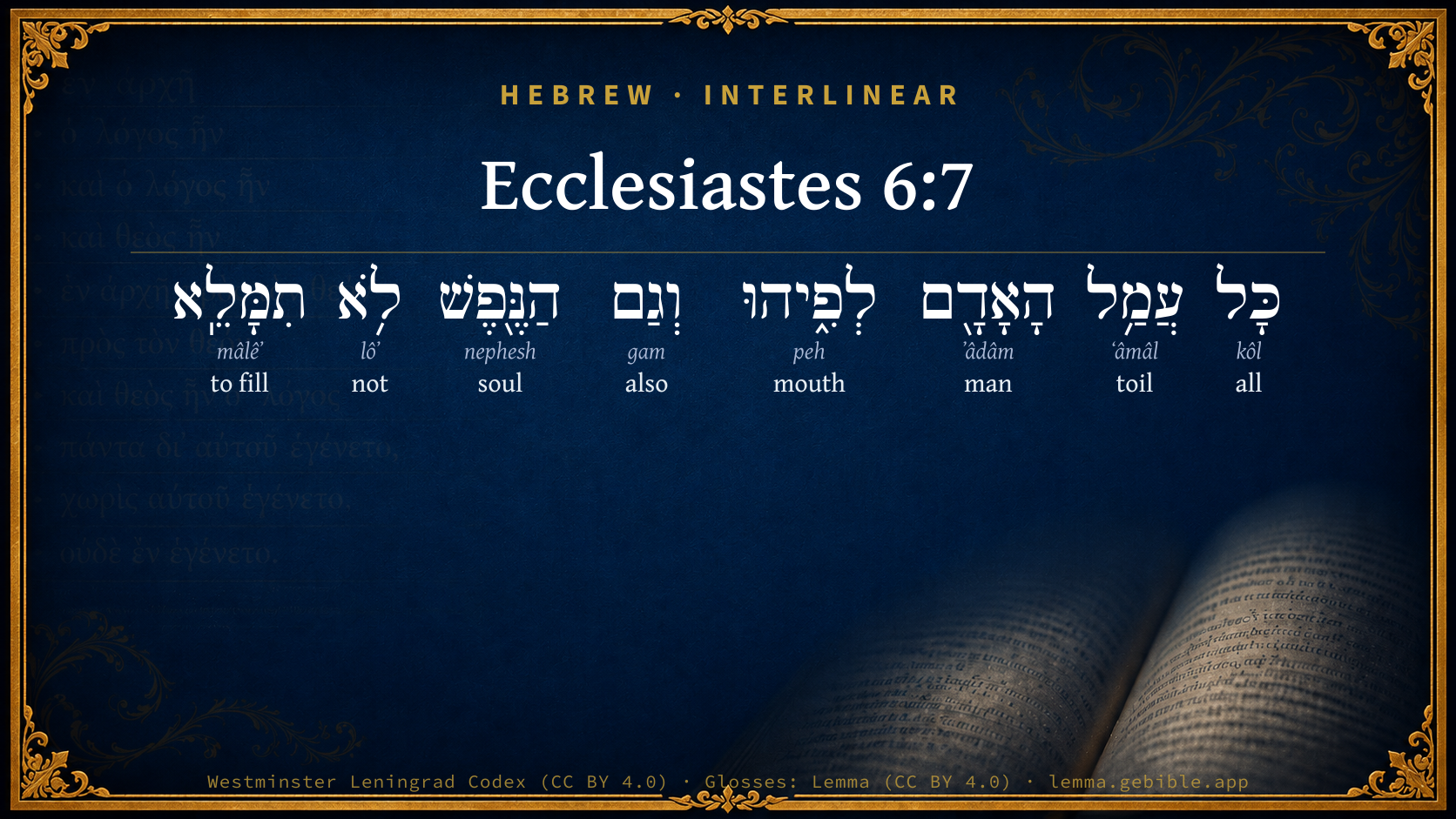
Ecclesiastes 6:7

Hebrew (Westminster Leningrad Codex) Ecclesiastes 6:7 appears in the Hebrew Old Testament. The text above is from the Westminster Leningrad Codex. Each word links to its Strong’s number, a concise gloss, and parsing drawn from the Open Scriptures Hebrew Bible morphology. Click any word for its full Brown-Driver-Briggs (BDB) entry.
Download image
Cite this verse

Ecclesiastes 6:7 (World English Bible). Public Domain. Lemma interlinear Bible study tool, https://lemma.gebible.app/v/ecclesiastes/6/7.

Show BibTeX & RIS
BibTeX
RIS
English Translation
All the labor of man is for his mouth, and yet the appetite is not filled.
World English Bible · Public Domain
Download a study sheet

One document with this verse’s original text, its word-by-word gloss line, the meaning frame, cross-references with their text, attributed commentary, and full source and license credits — printable, and it pastes into notes with its structure intact.

This verse Autodidact and up

Study sheet (.html) Plain text (.txt)

A passage Seminary Student

Up to 50 verses in one chapter. A passage sheet keeps up to 6 commentary sources and 12 cross-references per verse, in the order this page ranks them, and says so on the sheet whenever that leaves anything out. Ask for a single verse and you get the Autodidact verse sheet above.

Everything on this page stays free to read, with no account — the sheet is a download of what is already on screen, not access to it.

Want to remove ads? Support Godless Engineer
Compare translations 3

The same verse in 3 English versions, stacked beneath the original-language interlinear above. Click any original word for its lexicon entry.

Each is an independent rendering of the whole verse — the interlinear is not word-aligned to these translations.

Highlighted words mark where these versions differ — a whole-verse word diff, not a word-by-word alignment.

  • World English Bible Public Domain
    All the labor of man is for his mouth, and yet the appetite is not filled.
  • King James Version Public Domain
    All the labour of man is for his mouth, and yet the appetite is not filled.
  • unfoldingWord Literal Text CC BY-SA 4.0
    All the toil of humanity for his mouth, and yet the soul is not filled.

unfoldingWord Literal Text — © unfoldingWord, licensed CC BY-SA 4.0. Word-aligned USFM3 via Door43 (git.door43.org/unfoldingWord/en_ult).

Versions to compare (up to 4)

3 of 4 selected

Show all 18 translations

Every available English version of this verse, each an independent rendering of the whole verse.

  • World English Bible Public Domain
    All the labor of man is for his mouth, and yet the appetite is not filled.
  • Berean Standard Bible Public Domain
    All a man’s labor is for his mouth, yet his appetite is never satisfied.
  • Majority Standard Bible Public Domain
    All a man’s labor is for his mouth, yet his appetite is never satisfied.
  • King James Version Public Domain
    All the labour of man is for his mouth, and yet the appetite is not filled.
  • American Standard Version (1901) Public Domain
    All the labor of man is for his mouth, and yet the appetite is not filled.
  • Revised Version (1885) Public Domain
    All the labour of man is for his mouth, and yet the appetite is not filled.
  • Geneva Bible (1599) Public Domain
    All the labour of man is for his mouth: yet the soule is not filled.
  • Douay-Rheims (1899) Public Domain
    All the labour of man is for his mouth, but his soul shall not be filled.
  • Young's Literal Translation Public Domain
    All the labour of man `is' for his mouth, and yet the soul is not filled.
  • Literal Standard Version CC BY-SA 4.0
    All the labor of man [is] for his mouth, || And yet the soul is not filled.
  • Unlocked Literal Bible CC BY-SA 4.0
    All a man's work is for his mouth, yet his appetite is not satisfied.
  • unfoldingWord Literal Text CC BY-SA 4.0
    All the toil of humanity for his mouth, and yet the soul is not filled.
  • Darby Bible Public Domain
    All the labour of man is for his mouth, and yet the appetite is not filled.
  • World Messianic Bible Public Domain
    All the labor of man is for his mouth, and yet the appetite is not filled.
  • Webster's Bible Public Domain
    All the labor of man is for his mouth, and yet the appetite is not filled.
  • Free Bible Version CC BY-SA 4.0
    Everyone works so they can live, but they're never satisfied.
  • Bible in Basic English Public Domain
    All the work of man is for his mouth, and still he has a desire for food.
  • JPS Tanakh (1917) Public Domain
    All the labour of man is for his mouth, and yet the appetite is not filled.

Literal Standard Version (2020), Covenant Press — licensed CC BY-SA 4.0. Text via the HelloAO Bible API (eBible.org). Unlocked Literal Bible (unfoldingWord) — licensed CC BY-SA 4.0. Text via the HelloAO Bible API (eBible.org). unfoldingWord Literal Text — © unfoldingWord, licensed CC BY-SA 4.0. Word-aligned USFM3 via Door43 (git.door43.org/unfoldingWord/en_ult). Free Bible Version, Dr. Jonathan Gallagher — licensed CC BY-SA 4.0. Text via the HelloAO Bible API (eBible.org).

Word by word

More ways to search: Search by grammar → Find every occurrence → Compare this word →

Practice this passage: Drill this verse → Learn its vocabulary →

About this verse

These counts appear in no published source. They are computed here, from the morphology-tagged text and Lemma’s own curated glosses. What Lemma adds →

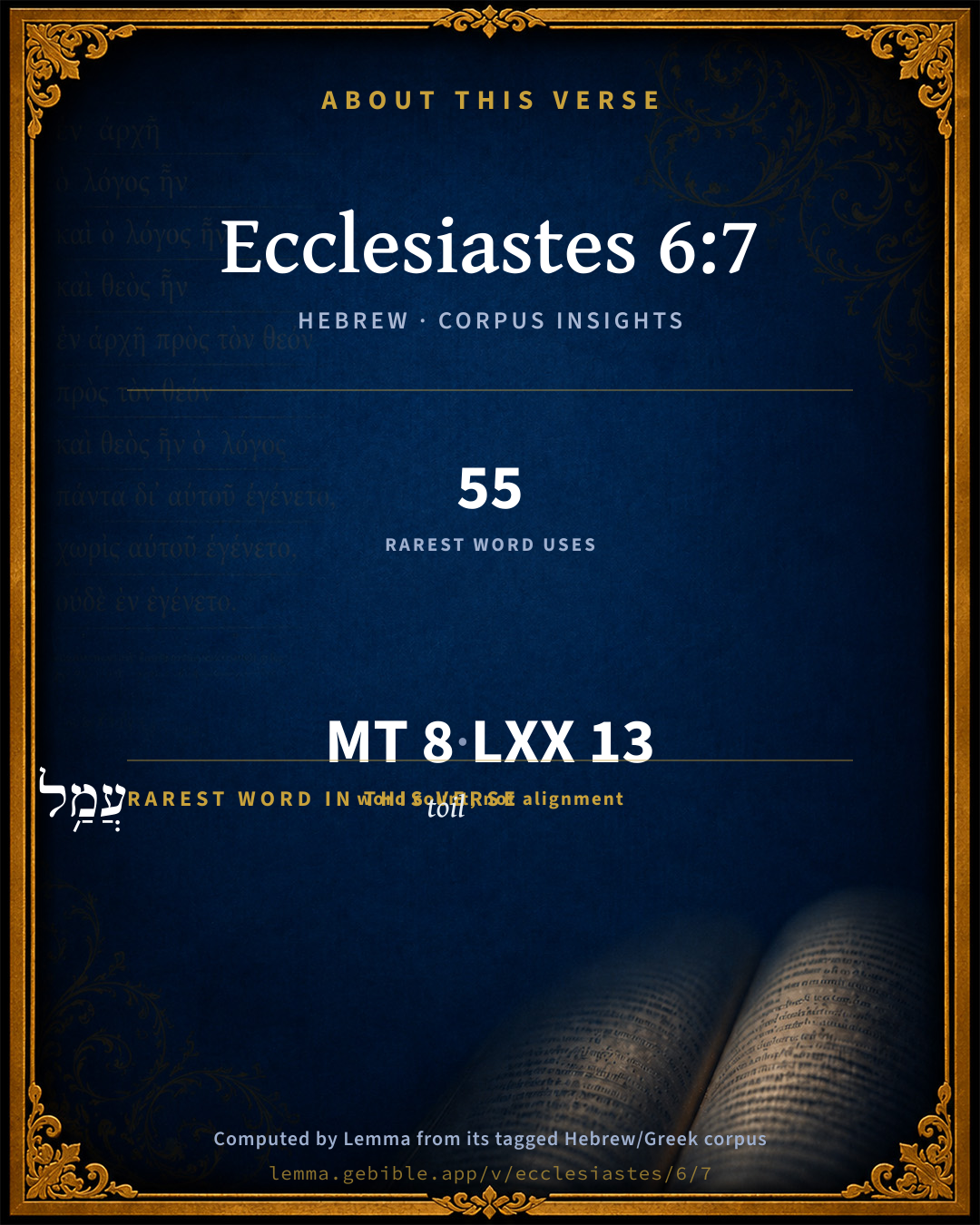
8
words
8
distinct lemmas
Wisdom
section

Shared distinctive vocabulary

עֲמַ֥ל toil H5999 occurs in 54 verses of the Hebrew Bible. Also found in:

Grammatical profile

  • 1 verb
  • 5 nouns
  • 2 particles

Verb forms

  • תִמָּלֵֽא Niphal · Imperfect

Hebrew & Septuagint length

In English translation the verse runs 16 words from the Hebrew and 18 from the Septuagint (LXX English) — closely comparable.

A rough comparison of the two English renderings, which tokenize alike — not a word-level alignment.

Word counts can differ between the Hebrew and the Greek without any difference in meaning — e.g. the Hebrew direct-object marker אֵת has no separate Greek word, and Greek often adds the article ὁ.

In the original languages it is 8 Hebrew tokens and 13 Greek tokens — but the two are counted differently (Hebrew bundles its prefixes and suffixes into one token; the Greek is in lemma form), so that isn’t a like-for-like length.

Cross-references

8

Topical passages linked to Ecclesiastes 6:7 in the Treasury of Scripture Knowledge — connected by theme and wording, ordered by reader-vote popularity; previews shown in the World English Bible.

  • John 6:27 Don't work for the food which perishes, but for the food which remains to eternal life, which the Son of Man will give to you. For God the Father has sealed him."
  • Proverbs 16:26 The appetite of the laboring man labors for him; For his mouth urges him on.
  • 1 Timothy 6:6–8 But godliness with contentment is great gain.
  • Matthew 6:25 Therefore, I tell you, don't be anxious for your life: what you will eat, or what you will drink; nor yet for your body, what you will wear. Isn't life more than food, and the body more than clothing?
  • Ecclesiastes 5:10 He who loves silver shall not be satisfied with silver; nor he who loves abundance, with increase: this also is vanity.
  • Ecclesiastes 6:3 If a man fathers a hundred children, and lives many years, so that the days of his years are many, but his soul is not filled with good, and moreover he has no burial; I say, that an untimely birth is better than he:
  • Luke 12:19 I will tell my soul, "Soul, you have many goods laid up for many years. Take your ease, eat, drink, be merry."'
  • Genesis 3:17–19 To Adam he said, "Because you have listened to your wife's voice, and have eaten of the tree, of which I commanded you, saying, 'You shall not eat of it,' cursed is the ground for your sake. In toil you will eat of it all the days of your life.

Cross-references courtesy of OpenBible.info (CC BY 4.0).

Hebrew and Greek witnesses Masoretic Hebrew ↔ Greek Septuagint

The same verse in the two great witnesses to the Old Testament, shown verse-for-verse.

These are two independent witnesses, not word-aligned to each other, and the Septuagint is shown in lemma (dictionary) form.

Hebrew Ecclesiastes 6:7 Masoretic · Westminster Leningrad Codex

כָּל עֲמַ֥ל הָאָדָ֖ם לְפִ֑יהוּ וְגַם הַנֶּ֖פֶשׁ לֹ֥א תִמָּלֵֽא

All the labor of man is for his mouth, and yet the appetite is not filled.

World English Bible · Public Domain

Greek LXX Ecclesiastes 6:7 Septuagint · lemma form

πᾶς μόχθος ὁ ἄνθρωπος εἰς στόμα αὐτός καί γέ ὁ ψυχή οὐ πληρόω

All the labor of a man is for his mouth, and yet the appetite shall not be satisfied.

LXX2012 (modern English Septuagint) · Public Domain

Hebrew: Westminster Leningrad Codex (CC BY 4.0). Greek: Septuagint (public domain); English from LXX2012 (modern English Septuagint) (Public Domain). How the Septuagint differs from the Hebrew →

Commentary

Notes on Ecclesiastes 6:7 from classic Christian and Jewish commentators (each source and its license shown beneath its notes). The classic Christian expositions comment on the surrounding passage and are grouped to its opening verse, so a note may address several verses; the Jewish commentaries on the Tanakh (Rashi and others) are per-verse, so they appear only where the commentator wrote on this verse.

Lemma curates 59 commentaries, every one of them public domain or Creative Commons licensed, each selected and text-cleaned for this edition rather than reprinted as found. About our sources →

Matthew Henry's Commentary

The preacher here further shows the vanity and folly of heaping up worldly wealth and expecting happiness in it.

I. How much soever we toil about the world, and get out of it, we can have for ourselves no more than a maintenance (Ecc 6:7): All the labour of man is for his mouth, which craves it of him (Pro 16:26); it is but food and raiment; what is more others have, not we; it is all for the mouth. Meats are but for the belly and the belly for meats; there is nothing for the head and heart, nothing to nourish or enrich the soul. A little will serve to sustain us comfortably and a great deal can do no more.

II. Those that have ever so much are still craving; let a man labour ever so much for his mouth, yet the appetite is not filled. 1. Natural desires are still returning, still pressing; a man may be feasted today and yet hungry tomorrow. 2. Worldly sinful desires are insatiable, Ecc 5:10. Wealth to a worldling is like drink to one in a dropsy, which does but increase the thirst. Some read the whole verse thus: Though all a man's labour fall out to his own mind (ori ejus obveniat - so as to correspond with his views, Juv.), just as himself would have it, yet his desire is not satisfied, still he has a mind to something more. 3. The desires of the soul find nothing in the wealth of the world to give them any satisfaction. The soul is not filled, so the word is. When God gave Israel their request he sent leanness into their souls, Psa 106:15. He was a fool who, when his barns were full, said, Soul, take thine ease.

III. A fool may have as much worldly wealth, and may enjoy as much of the pleasure of it, as a wise man; nay, and perhaps not be so sensible of the vexation of it: What has the wise more than the fool? Ecc 6:8. Perhaps he has not so good an estate, so good a trade, nor such good preferment as the fool has. Nay, suppose them to be equal in their possessions, what can a wise man, a scholar, a wit, a politician, squeeze out of his estate more than needful supplies? and a half-witted man may do this. A fool can fare as well and relish it, can dress as well, and make as good a figure in any public appearance, as a wise man; so that if there were not pleasures and honour peculiar to the mind, which the wise man has more than the fool, as to this world they would be upon a level.

IV. Even a poor man, who has business, and is discreet, diligent, and dexterous, in the management of it, may get as comfortably through this world as he that is loaded with an overgrown estate. Consider what the poor has less than the rich, if he but knows to walk before the living, knows how to conduct himself decently, and do his duty to all, how to get an honest livelihood by his labour, how to spend his time well and improve his opportunities. What has he? Why, he is better beloved and more respected among his neighbours, and has a better interest than many a rich man that is griping and haughty. What has he? Why he has as much of the comfort of this life, has food and raiment, and is therewith content, and so is as truly rich as he that has abundance.

V. The enjoyment of what we have cannot but be acknowledged more rational than a greedy grasping at more (Ecc 6:9): Better is the sight of the eyes, making the best of that which is present, than the wandering of the desire, the uneasy walking of the soul after things at a distance, and the affecting of a variety of imaginary satisfactions. He is much happier that is always content, though he has ever so little, than he that is always coveting, though he has ever so much. We cannot say, Better is the sight of the eyes than the fixing of the desire upon God, and the resting of the soul in him; it is better to live by faith in things to come than to live by sense, which dwells only upon present things; but better is the sight of the eyes than the roving of the desire after the world, and the things of it, than which nothing is more uncertain nor more unsatisfying at the best. This wandering of the desire is vanity and vexation of spirit. It is vanity at the best; if what is desired, be obtained, it proves not what we promised ourselves from it, but commonly the wandering desire is crossed and disappointed, and then it turns to vexation of spirit.

VI. Our lot, whatever it is, is that which is appointed us by the counsel of God, which cannot be altered, and it is therefore our wisdom to reconcile ourselves to it and cheerfully to acquiesce in it (Ecc 6:10): That which has been, or (as some read it) that which is, and so likewise that which shall be, is named already; it is already determined in the divine foreknowledge, and all our care and pains cannot make it otherwise than as it is fixed. Jacta est alea - The die is cast. It is therefore folly to quarrel with that which will be as it is, and wisdom to make a virtue of necessity. We shall have what pleases God, and let that please us.

VII. Whatever we attain to in this world, still we are but men, and the greatest possessions and preferments cannot set us above the common accidents of human life: That which has been, and is, that busy animal that makes such a stir and such a noise in the world, is named already. He that made him gave him his name, and it is known that it is man; that is his name by which he must know himself, and it is a humbling name, Gen 5:2. He called their name Adam; and all theirs have the same character, red earth. Though a man could make himself master of all the treasures of kings and provinces, yet he is a man still, mean, mutable, and mortal, and may at any time be involved in the calamities that are common to men. It is good for rich and great men to know and consider that they are but men, Psa 9:20. It is known that they are but men; let them put what face they will upon it, and, like the king of Tyre, set their heart as the heart of God, yet the Egyptians are men, and not gods, and it is known that they are so.

VIII. How far soever our desires wander, and how closely soever our endeavours keep pace with them, we cannot strive with the divine Providence, but must submit to the disposals of it, whether we will or no. If it is man, he may not contend with him that is mightier than he. It is presumption to arraign God's proceedings, and to charge him with folly or iniquity; nor is it to any purpose to complain of him, for he is in one mind and who can turn him? Elihu pacifies Job with this incontestable principle, That God is greater than man (Job 33:12) and therefore man may not contend with him, nor resist his judgments, when they come with commission. A man cannot with the greatest riches make his part good against the arrests of sickness or death, but must yield to his fate.

Matthew Henry's Commentary on the Whole Bible (1708–1710) — public domain (CC PDM 1.0). Text via the HelloAO Bible API.

Trapp's Complete Commentary

John Trapp

Ecc 6:7 All the labour of man [is] for his mouth, and yet the appetite is not filled.

Ver. 7. All the labour of man is for his mouth.] That is, For food and raiment, {as 1Ti 6:8} a little whereof will content nature, which hath therefore given us a little mouth and stomach, {a} to teach us moderation, as Chrysostom well observeth; to the shame of those beastly belly gods, that glut themselves, and devour the creatures, as if they were of kin to that Pope that was called Os porci, Mouth of a pig, fattening themselves like boars, till they be brawned, and having, as Eliphaz speaketh, collops in their flank. A man would think, by their greedy and great eating, that their throats were whirlpools, and their bellies bottomless; that they were like locusts, which have but one gut, the ass fish, that hath his heart in his belly, {b} or the dolphin, that hath his mouth in his maw, as Solinus saith.

And yet the appetite is not filled.] And yet what birds soever fly, what fishes soever swim, what beasts soever run about, are all buried in our bellies, saith Seneca. {c} Heliogabalus was served at one supper with seven thousand fishes and five thousand fowls. He had also six hundred harlots following him in chariots, and yet gave great rewards to him that could invent any new pleasure. His thirst was unquenchable, his appetite like the hill Aetna, ever on fire, after more. Now, as "in water face answereth to face," {Pro 27:19} so doth the appetite of a man to man; we are all as irregular, if God suffer us to range.

{a} Dii boni. quantum hominum unus exercet venter! - Seneca. Deus homini angustum ventrem, &c. - Sergius PP.

{b} Aristot.

{c} Quicquid avium volitat, quicquid piscium natat, quicquid ferarum discurrit, nostris sepelitur ventribus

John Trapp, A Commentary or Exposition upon All the Books of the Old and New Testament (1647–1656) — public domain. Text from a community e-Sword module.

Joseph Benson's Commentary

Ecc 6:7-8. All the labour of man is for his mouth — For meat and other necessary provisions of this life; and yet the appetite is not filled — Although all that a man can obtain by his labours is but a provision for his bodily wants, which the meanest sort of men commonly enjoy, yet such is the vanity of the world, and the folly of mankind, that men are insatiable in their desires, and restless in their endeavours after more and more, and never say they have enough. What hath the wise more than the fool — Namely, in these matters? Both are subject to the same calamities, and partakers of the same comforts of this life. What hath the poor — Especially? What advantage in this respect? That knoweth — Even though he knoweth; to walk before the living? — Though he be ingenious and industrious; that is, fit for service and business, and knows how to conduct himself toward his superiors so as to deserve and gain their favour, and to procure a livelihood; what more hath he than the poor that do not know this? The verse is obscure, and some think it should be rendered, For what hath the wise more than the fool? And what than the poor, who knoweth how to walk before the living? That is, who knows how to act prudently: and they think the meaning is, that the wise and the fool, and even the poor, if they be industrious, and know how to behave themselves properly, all enjoy the necessaries of life, food and raiment. The only objection to this interpretation is, that though it seems to improve the sense, it is not consistent with the Hebrew text, מה לעני, signifying literally, not than the poor, but, What is there to the poor? or, what hath the poor? The Hebrew, however, may be rendered, What excellence hath the wise man more than the fool? What excellence, especially, hath the poor that knoweth, that is, although he knoweth, &c.

Joseph Benson's Commentary on the Old and New Testaments (1811–1818) — public domain. Text from a community e-Sword module.

Tyndale Open Study Notes

Tyndale Open Resources

6:7 People never seem to be satisfied with what they have, no matter how much it is (cp. 5:10).

Tyndale Open Study Notes — © Tyndale Open Resources, licensed CC BY-SA 4.0. Text via the HelloAO Bible API.

Geneva Bible (1599)

Geneva Bible translators

His desire and affection.

Geneva Bible (1599) marginal notes — public domain. Text via Bolls.life.

Jamieson, Fausset & Brown

Robert Jamieson, A. R. Fausset & David Brown

man--rather, "the man," namely, the miser (Ecc 6:3-6). For not all men labor for the mouth, that is, for selfish gratification.

appetite--Hebrew, "the soul." The insatiability of the desire prevents that which is the only end proposed in toils, namely, self-gratification; "the man" thus gets no "good" out of his wealth (Ecc 6:3).

Jamieson, Fausset & Brown — Commentary Critical and Explanatory on the Whole Bible (1871) — public domain (CC PDM 1.0). Text via the HelloAO Bible API.

Adam Clarke's Commentary

Verse 7. All the labour of man] This is the grand primary object of all human labour; merely to provide for the support of life by procuring things necessary. And life only exists for the sake of the soul; because man puts these things in place of spiritual good, the appetite - the intense desire after the supreme good - is not satisfied. When man learns to provide as distinctly for his soul as he does for his body, then he will begin to be happy, and may soon attain his end.

Adam Clarke's Commentary on the Bible (1810–1826) — public domain. Text from a community e-Sword/MySword module.

The Cambridge Bible for Schools and Colleges

gen. ed. J. J. S. Perowne

7. All the labour of man is for his mouth] i.e. for self-preservation and enjoyment. That is assumed to be the universal aim, and yet even that is not satisfied. The “appetite,” literally soul (not the higher, but the sensuous, element in man’s nature), still craves for more. Desire is progressive, and insatiable.

The Cambridge Bible for Schools and Colleges (gen. ed. J. J. S. Perowne; Cambridge University Press, 1878–1918) — public domain. Text from a community e-Sword module.

John Gill's Exposition

All the labour of man is for his mouth,.... For the food of his mouth, as the Targum; for the sustenance of his body, for food and clothing, part being put for the whole: all that a man labours for is to get this; and if he does not enjoy it, his labour is in vain; meats are for the belly, which are taken in by the mouth, and for these a man labours; and if he does not eat them, when he has got them, he labours to no purpose;

and yet the appetite is not filled; even the bodily or sensual appetite; no, not even by those who eat the fruit of their labour; for though their hunger is allayed for the present, and the appetite is satisfied for a while, yet it returns again, and requires more food, and so continually: or, "the soul is not filled", or "satisfied" (c); it is the body only that is filled or satisfied with such things, at best; the mind of man grasps after greater things, and can find no contentment or satisfaction in earthly or sensual enjoyments. This seems to be a new argument, proving the vanity of riches, from the narrow use of them; which only reaches to the body, not to the soul.

(c) "anima non implebitur", Pagninus, Montanus; "anima non expletur", Mercerus, Gejerus; "non impletur", Cocceius, so Broughton; "non satiatur", Drusius.

John Gill's Exposition of the Whole Bible (1746–1763) — public domain (CC PDM 1.0). Text via the HelloAO Bible API.

Albert Barnes' Notes on the Bible

Connect these verses with Ecc 6:2-3 : “All labor is undertaken with a view to some profit, but as a rule the people who labor are never satisfied. What advantage then has he who labors if (being rich) he is wise, or if being poor he knows how to conduct himself properly; what advantage have such laborers above a fool? (None, so far as they are without contentment, for) a thing present before the eyes is preferable to a future which exists only in the desire.”

Ecc 6:8

What - literally, what profit (as in Ecc 1:3).

Knoweth ... living - i. e., “Knows how to conduct himself rightly among his contemporaries.”

Albert Barnes' Notes on the Bible (1834–1885) — public domain. Text from a community e-Sword/MySword module.

Haydock's Catholic Bible Commentary

Mouth. We are always providing food. (St. Jerome) --- The rich are wholly bent on pleasure; or the poor cannot get a sufficiency.

George Leo Haydock (1774–1849), Haydock's Catholic Family Bible and Commentary, 1859 edition — public domain. Excludes Psalms (Douay-Rheims chapter numbering differs from Protestant) and Deuterocanonical books (Catholic canon only).

Matthew Poole's English Annotations

For his mouth; for meat to put into his mouth, that he may get food; and as bread is oft put for all food, so food is put for all necessary provisions for this life, as Pro 30:8, and elsewhere; whereof this is the chief, for which a man will sell his house and lands, yea, the very garments upon his back.

Is not filled: although all that a man can go: by his labours is but necessary food, which the meanest sort of men commonly enjoy, as is observed in the next verse; yet such is the vanity of this world, and the folly of mankind, that men are insatiable in their desires, and restless in their endeavours, after more and more, and never say they have enough.

Matthew Poole's English Annotations on the Holy Bible (1683–1685) — public domain. Text from a community e-Sword/MySword module.

Whedon's Commentary on the Bible

Daniel D. Whedon

7. The man spoken of in the preceding verse is still the subject, as contrasted with the perished embryo.

All the labour of man is for his mouth — That is, for present enjoyment.

Appetite is not filled — Better, Yet his soul is not satisfied.

Daniel D. Whedon (gen. ed.), Commentary on the Old and New Testaments (1874–1909) — public domain. Text from a community e-Sword module.

The Pulpit Commentary

Vers. 7-9. Section 10. Desire is insatiable; men are always striving after enjoyment, but they never gain their wish completely which fortifies the old conclusion that man"s happiness is not in his own power.

All the labor of man is for his mouth; i.e. for self-preservation and enjoyment, eating and drinking being taken as a type of the proper use of earthly blessings. (comp; Ecc_2:24 Ecc_3:13, etc.; Psa_128:2) The sentiment is general, and does not refer specially to the particular person described above, though it carries on the idea of the unsatisfactory result of wealth. Luther translates strangely and erroneously, "To every man is work allotted according to his measure. Such an idea is entirely foreign to the context. And yet the appetite is not filled. The word rendered "appetite" is nephesh, "soul," and Zockler contends that mouth "and "soul" stand in contrast to each other as representatives of the purely sensual and therefore transitory enjoyment (comp. Job_12:11; Pro_16:26) as compared with the deeper, more spiritual, and therefore more lasting kind of joy." But no such contrast is intended; the writer would never have uttered such a truism as that deep, spiritual joy is not to be obtained by sensual pleasure; and, as Delitzsch points out, in some passages (e.g. Pro_16:26; Isa_5:14 Isa_29:8) "mouth" in one sentence corresponds to "soul" in another. The soul is considered as the seat of the appetitive faculty emotions, desires, etc. This is never satisfied (Ecc_1:8) with what it has, but is always craving for more. So Horace affirms that a man rightly obtains the appellation of king, "avidum domando spiritum," by subduing his spirit"s cravings ("Carm.," 2:2. 9).

Vers. 7-9.

The insatiableness of desire.

I IT CONSUMES THE LABOR OF ALL. "All the labor of man is for his mouth, and yet the appetite is not filled" (ver. 7). The appetite, as an imperious master, urges on the soul to labor with all its powers and energies to furnish food for its delectation; and yet the utmost man can provide is insufficient to fill its capacious maw. However varied man"s works may be, they have all this end in common, to appease the hunger of the sensuous nature; and all alike fail in reaching it. The appetite grows by what it feeds on, and hence never cries, "Enough!

II IT AFFECTS THE CHARACTERS OF ALL. "What advantage hath the wise more than the fool? or what advantage hath the poor man, who knows to walk before the living, over the fool?" (ver. 8).

1. Intellectual gifts do not argue the absence of desire. The philosopher, no less than the peasant, is under its dominion. The former may attempt to control, and may even to some extent succeed in controlling, his bodily appetites; but the appetite is there, impelling him to labor equally with the fool.

2. Material poverty does not guarantee the absence of desire. The poor man who knows how to walk before the living, i.e. who understands the art of living, is no more exempt from its sway than is the rich man, though a fool. The poor man may have learned how to put restraints upon himself, because of inability to gratify his desire, but the appetite is as much felt by him as by his rich neighbor.

III IT DISAPPOINTS THE HOPES OF ALL. "Better is the sight of the eyes than the wandering of the desire" (ver. 9). Just because desire is never satisfied, it wanders on in pursuit of other objects which are often visionary, and almost always illusory; as a consequence, like the dog which snapped at his shadow and lost the meat he carried in his mouth, desire frequently misses such enjoyments as are within its reach through striving after those that are beyond its power.

LESSONS.

1. The danger of self-indulgence.

2. The difficulty of keeping the lower nature in subjection.

3. The propriety of preferring present and possible to future and perhaps impossible enjoyments.

Vers. 7-9.

Satisfaction better than desire.

It has sometimes been represented that the quest of good is better than its attainment. The truth and justice of this representation lies in the unquestionable fact that it would not be for our good to possess without effort, without perseverance, without self-denial. Yet the end is superior to the means, however excellently adapted those means may be to the discipline of the character, to the calling out of the best moral qualities.

I MAN"S NATURE IS CHARACTERIZED BY STRIVING, DESIRE, APPETITE, ASPIRATION. Man"s is a yearning, impulsive, acquisitive constitution. His natural instincts urge him to courses of action which secure the continuance of his own being and of that of the race. His restless, eager desires account for the activity and energy which distinguish his movements. His intellectual impulses urge him to the pursuit of knowledge, to scientific and literary achievement. His moral aspirations are the explanation of heroism in the individual, and of true progress in social life.

II OF HUMAN DESIRES, NONE CAN EVER BE FULLY SATISFIED, MANY CANNOT BE SATISFIED AT ALL. The testimony of these who have gone before us is uniform upon this point.

We look before and after, We pine for what is not; Our sincerest laughter With some pain is fraught: Our sweetest songs are those that tell of saddest thought.

Thus it becomes proverbial that man is made to desire rather than to enjoy. Of our aspirations some can never be gratified on earth. The lower animals have desires for which satisfaction is provided; but whilst their life is thus thoroughly adapted to their constitution, this cannot be said of man, who has capacities which cannot be filled, aspirations which cannot be satisfied, faculties for which no sufficient scope is attainable here on earth. His, as the poet tells us, is

The desire of the moth for the star, Of the night for the morrow; The longing for something afar From the sphere of our sorrow.

III EVEN WISDOM DOES BUT ENLARGE THE RANGE OF MAN"S INSATIABLE DESIRES. It is not only upon the lower grade of life that we observe a discordance between what is sought and what is attained. For the philosopher, as for the uncultured child of nature, there is an ideal as well as an actual. Prudence may enjoin the limitation and repression of our requirements. But thought ever looks out from the windows of the high towers, and gazes upon the distant stars.

Who that has gazed upon them shining Can turn to earth without repining, Nor wish for wings to flee away, And mix with their eternal day?

IV THESE CONSIDERATIONS TEND TO INCREASE THE UNHAPPINESS OF THE WORLDLY, WHILST THEY OPEN UP TO THE SPIRITUAL AND PIOUS MIND A GLORIOUS AND IMMORTAL PROSPECT. They to whom the bodily life and the material universe are everything, or even anything regarded by themselves, may well give way to dissatisfaction and despondency when they learn by experience "the vanity of human wishes." On the other hand, such reflections may well prompt the spiritual to gratitude, for they cannot believe the universe to have been fashioned in vain; they cannot but see in the illusions of earth suggestions of the heavenly realities. The storms of life are not to be hated if they toss the navigator of earth"s sea into the haven of God"s breast. The wandering of the desire may end in the sight of the eyes, when the pure in heart shall see God. "In his presence is fullness of joy, and at his right hand am pleasure forevermore. T.

Vers. 7-9.

The insatiability of desire.

In these words the Preacher lays stress upon the little advantage which one man has over another in regard to the attainment of happiness and satisfaction in life. All are tormented by desires and longings which can never be adequately satisfied. His reference is principally, if not entirely, to the cravings of natural appetites to which all are subject, and which cannot by any gratification or exercise of will be wholly silenced. The instinct of self-preservation, the necessity of sustaining the body with food, inspire labor, and yet no amount of labor is sufficient to put an end, once and for all, to the gnawings of desire. The sensuous element in man"s nature is insatiable, and the appetites of which it consists grow in strength as they are indulged. Though the pressure of appetite differs in different cases, none are free from it. The wise as well as the foolish, the man of simple tastes and chastened temper, as well as he who gives free rein to all his impulses, feel it. Gifts of intellect, acquirements in culture, make no difference in this matter. Some little obscurity seems at first to hang over ver. 8 b, but a little examination of the words disperses it. The whole verse runs (Revised Version), "For what advantage hath the wise man more than the fool? or what advantage hath the poor man more than the fool, that knoweth to walk before the living?" "To know to walk before the living is, as is haw generally acknowledged, to understand the right rule of life, to possess the savoir vivre, to be experienced in the right art of living, (Delitzsch). The question accordingly is What advantage has the wise over the fool? and what the poor, who, although poor, knows how to maintain his social position? The matter treated of is the insatiable nature of sensual desire. The wise seeks to control his desire; he who is spoken of as poor knows how to conceal it, for he lays restraints upon himself, that he may make a good appearance and maintain his reputation. But desire is present in both, and they have in this nothing above the fool, who follows the bent of his desire, and lives for the passing hour. In other words, "The idea of the passage seems to be, the desire of man is insatiable, he is never really satisfied; the wise man, however, seeks to keep his desires within bounds, and to keep them to himself, but the fool utters all his mind. (Pro_29:11) Even the poor man, who knows how to conduct himself in life, and understands the right art of living, though he keeps his secret to himself, feels within himself the stirrings of that longing which is destined never to be satisfied on earth" (Wright). The reference here to the poor man may possibly be made because the Preacher has already praised the lot of the laboring man (Ecc_5:12) in comparison with that of the rich, whose abundance will not suffer him to sleep. If so, he virtually says here, half-humorously, "Don"t imagine that poverty is the secret of contentment and happiness. Poverty covers cares and anxieties as well as riches. Both rich and poor are pretty much on the same level." A very simple and practical conclusion is drawn from the fact of the insatiability of desire, and that is the advisability of enjoying the present good that is within our reach (ver. 9). That which the eyes see and recognize as good and beautiful should not be forfeited because the thoughts are wandering after something which may be forever unattainable by us. So far the teaching is not above that of the fable of the dog who lost the piece of flesh he had in his mouth, because he snapped at the reflection of it he saw on the surface of the water. And if this be thought but a poor, cold scrap of morality to offer to men for their guidance in life, the answer may be given that multitudes spend their life in fruitless endeavors after what is far above their reach, and bereave their souls of present good, from an insatiable greed which this fable rebukes. Constituted as we are, placed as we are amid many temptations, we need not despise any small scraps of moral teaching which may be even in threadbare fables, and homely, familiar proverbs. To say that the words, "Better is the sight of the eyes than the wandering of the desire," is about equivalent to the proverb, "A bird in the hand is worth two in the bush," may seem irreverent to some, who would fain read into the text more than it contains. But instead of imagining that the Word of God is degraded by the comparison, let them recognize the good sense and prudent advice which lie in the proverb which corresponds so closely to the sense of the Preacher"s words. J.W.

The Pulpit Commentary (1880–1919), ed. H.D.M. Spence-Jones & Joseph S. Exell — public domain. Text from a community e-Sword module.

John Wesley's Explanatory Notes

Is - For meat. And yet - Men are insatiable in their desires, and restless in their endeavours after more, and never say, they have enough.

John Wesley, Explanatory Notes Upon the Whole Bible (1754–1765) — public domain. Text via the GEBible commentary corpus.

Keil & Delitzsch

C. F. Keil & F. Delitzsch

"All the labour of man is for his mouth, and yet his soul has never enough;" or, properly, it is not filled, so that it desires nothing further and nothing more; נמלא used as appropriately of the soul as of the ear, Ecc 1:8; for that the mouth and the soul are here placed opposite to one another as "organs of the purely sensual and therefore transitory enjoyment, and of the deeper and more spiritual and therefore more lasting kind of joys" (Zck.), is an assertion which brings out of the text what it wishes to be in it, - נפשׁ and פּה stand here so little in contrast, that, as at Pro 16:26; Isa 5:14; Isa 29:8, instead of the soul the stomach could also be named; for it is the soul longing, and that after the means from without of self-preservation, that is here meant; נפשׁ היפה, "beautiful soul," Chullin iv. 7, is an appetite which is not fastidious, but is contented. גּמו, καὶ ὃμως ὃμως δέ, as at Ecc 3:13; Psa 129:2. All labour, the author means to say, is in the service of the impulse after self-preservation; and yet, although it concentrates all its efforts after this end, it does not bring full satisfaction to the longing soul. This is grounded in the fact that, however in other respects most unlike, men are the same in their unsatisfied longing.

Keil & Delitzsch — Biblical Commentary on the Old Testament (1861–1891) — public domain (CC PDM 1.0). Text via the HelloAO Bible API. (Old Testament only.)

unfoldingWord translationNotes

Door43 World Missions Community

is for his mouth

Here putting food in a man's mouth represents feeding him. AT: "is to put food in his mouth" or "is to feed him" (See: Metonymy)

his appetite is not satisfied

This can be stated in active form. AT: "he does not satisfy his appetite" (See: Active or Passive)

what advantage has the wise person over the fool?

The author uses this rhetorical question to emphasize that a wise person does not have any more lasting benefits than a fool. This question can be written as a statement. AT: "it seems the wise person has no advantage over the fool." (See: Rhetorical Question)

What advantage does the poor man have even if he knows how to act in front of other people?

The author uses this rhetorical question to emphasize that a poor man does not have any more lasting benefits than someone else. This question can be written as a statement. AT: "The poor man has no advantage even if he knows how to act in front of other people." (See: Rhetorical Question)

how to act

"how to conduct himself"

translationWords

wise

fool

unfoldingWord translationNotes — © Distant Shores Media and the Door43 World Missions Community, licensed CC BY-SA 4.0. Source: git.door43.org/Door43/en_tn.

Rashi

Rabbi Shlomo Yitzchaki (Rashi)

All of a person’s toil is for his mouth, that he should derive benefit and eat in this world and in the next, but this one derived no benefit in his lifetime.

and is the appetite not yet sated This is a question. But this one—did he not even gratify his desire with a small pleasure? [This is] like (Exod. 15:9): “My lust shall be satisfied upon them (תִּמְלָאֵמוֹ נַפְשִׁי),” an expression of attaining a desire, and since this is so.

Rashi on the Tanakh — English translations: “The Judaica Press complete Tanach with Rashi, translated by A. J. Rosenberg” (CC BY 4.0); “Pentateuch with Rashi's commentary by M. Rosenbaum and A.M. Silbermann, 1929-1934” (public domain); “The Metsudah Tanach series, Lakewood, N.J” (CC BY 4.0); and “The Book of Joshua, Metsudah Publications, 1997” (CC BY 4.0). Text via Sefaria.

Lesson kit

Teaching starters — assembled from the data on this page, not authored interpretation. Every prompt links to the verse data it draws on. Edit before teaching.

Ecclesiastes, in the Wisdom, opens this verse with 8 words (8 distinct Hebrew lemmas). Its most distinctive word is ʻâmâl (“toil”). A historical commentator’s framing appears above. Read the whole chapter for the surrounding context.

Discussion questions

  1. How does “toil” (ʻâmâl) shape what this verse is saying?
  2. How does Genesis 41:51, which shares the word «toil», read alongside this verse?
  3. These translations render this verse differently; the difference is in the English rendering, not the original. What questions does that raise?
  4. «תִמָּלֵֽא» is a Niphal Imperfect verb. How does that grammatical form shape the action described?
  5. Compare how Matthew Henry's Commentary and Trapp's Complete Commentary read this verse. Where do they agree or differ?

Things to notice

Reading settings

Reading text

Shown beneath each verse's original-language words.

Old Testament
Old Testament edition

Read the OT as the Masoretic Hebrew (MT) or the Greek Septuagint (LXX).

English shown for the Greek Septuagint (in the Hebrew ↔ Greek comparison).

Comparing translations? Open the Compare panel on any verse page to stack up to four side by side.