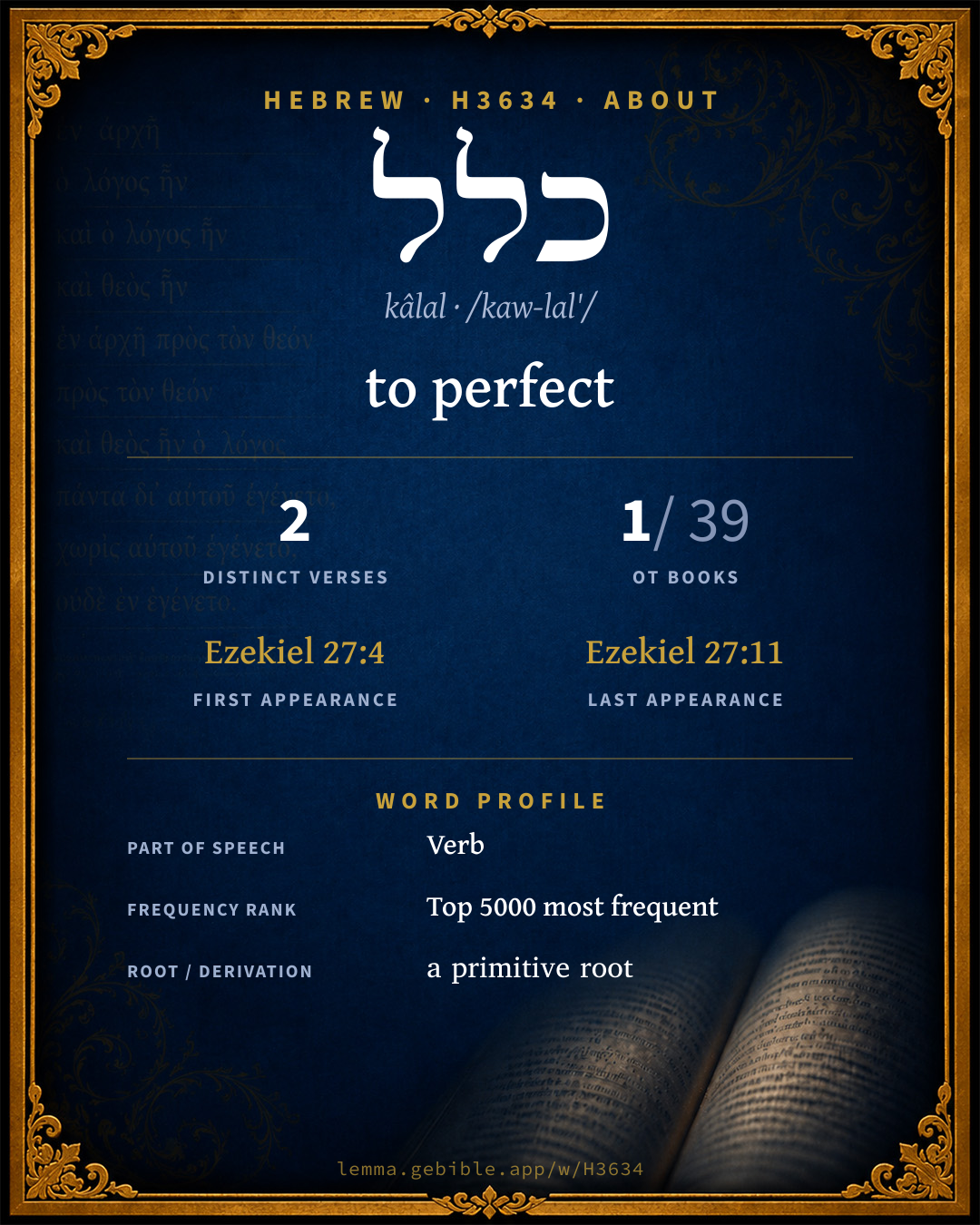
כָּלַל
to perfect
‘to perfect’ is one of 2 main senses fuller range ↓
Full lexicon entry — Brown-Driver-Briggs (BDB)
From Brown-Driver-Briggs (BDB)
Where this word appears
Grammar key — what these labels mean
Part of speech
- Verb
- An action or state-of-being word.
Stem
- Qal
- The basic, simple active stem — the plain form of the verb (“he wrote”).
Form
- Perfect
- A completed action or state — Hebrew marks aspect (completeness) more than strict tense (“he wrote”).
Person
- 3rd Person
- The one spoken about (“he / she / it / they”).
Gender
- Common
- Either gender — not distinguished for this form.
Number
- Plural
- More than one (in Hebrew, generally three or more).
Every verse where H3634 appears — 2 distinct verses across 1 book. Click any verse to open its interlinear word-by-word view. Verse text shown in the World English Bible for context — . Each verse’s Hebrew form is shown with its reference; the English is not keyword-highlighted, since the data carries no word-level English alignment. Use “Compare translations” on any verse to read it across multiple English versions. This concordance covers the Hebrew Bible; Septuagint (Greek Old Testament) occurrences are not indexed here.
Ezekiel 2 verses
- Ezekiel 27:4 כָּלְל֖וּ Qal pf 3cp Your borders are in the heart of the seas; your builders have perfected your beauty.
- Ezekiel 27:11 כָּלְל֥וּ Qal pf 3cp The men of Arvad with your army were on your walls round about, and valorous men were in your towers; they hanged their shields on your walls round about; they have perfected your beauty.
About this entry
At a glance — auto-summarized from this page’s data, not written by a person. Every figure links to its source below. This summary describes the numbers; it doesn’t interpret them.
“to perfect” is the headline sense of the Hebrew verb כלל (kâlal). With only 2 verses it sits in the long tail of Hebrew Bible vocabulary. It clusters heavily in Ezekiel, which alone accounts for 100% of its uses. First canonically at Ezekiel 27:4, it enters the text early. Lexicons map it across 2 senses. The sections below give every sense, occurrence, and version rendering.
Gloss history
Strong's 1890 vs modern scholarship
About this word
Strong's H3634 catalogs a Hebrew word from the Hebrew Old Testament.
These counts are not copied from any lexicon or concordance. They are computed here, from the morphology-tagged Hebrew Old Testament. What Lemma adds →
- 2
- distinct verses
- The word appears in 2 distinct verses.
- 1 / 39
- OT books
- The word appears in 1 of 39 Old Testament books.
- #4,807
- by frequency
- Top 5000 most frequent Hebrew words (rank 4,807 of 8,640 Hebrew words by occurrence).
View all 2 occurrences in the concordance →
Most concentrated in
- Ezekiel 2 verses 100%
By section of the Old Testament
By traditional corpus
Conventional, traditional groupings — biblical authorship is debated, so this is a traditional corpus grouping, not an authorship claim. Each share is this word’s portion of its verses in that division of the Hebrew canon. Each figure is a share of the word’s 2 distinct verses.
- Prophets (Nevi'im) 2 verses · 100%
How translations render this word
Counts come from each version’s own published word-to-Strong’s tagging or interlinear alignment — an approximate guide to how each version renders this word, not a word-level alignment the data otherwise carries. Because each total is that version’s own tagged count, the per-version totals vary from one another and need not match the appearance or distinct-verse counts above. These counts may also differ from a printed concordance because Lemma counts each distinctly tagged rendering and does not collapse phrase taggings into a single head-word total. This is a fixed set of word-tagged versions (KJV, ASV, BSB, ULT) and does not change with the reading translation you choose elsewhere. Each version’s license is shown beside its name below (and on Sources).
- King James Version: Have perfected 1×, Perfect 1×, They have made 1×
- American Standard Version: Have perfected 1×, Perfected 1×, They have 1×
- Berean Standard Bible: Perfected 2×
- unfoldingWord Literal Text: Have perfected 1×, They completed 1×
King James Version Public Domain
Renders H3634 across 3 tagged occurrences — most commonly:
American Standard Version Public Domain
Renders H3634 across 3 tagged occurrences — most commonly:
Berean Standard Bible Public Domain
Renders H3634 across 2 tagged occurrences — most commonly:
unfoldingWord Literal Text CC BY-SA 4.0
Renders H3634 across 2 tagged occurrences — most commonly:
Senses in BDB
The 2 senses BDB distinguishes for this word, in lexicon order (not ranked by frequency or importance). The full entry — with sub-senses — is in the Lexicon Entry tab.
- to complete, perfect, make complete, make perfect
- (Qal) to perfect
Word origin
כָּלַל vb. complete, perfect
— Brown-Driver-Briggs (Oxford 1906, public domain), digitized via Sefaria, supplemented by the OpenScriptures HebrewLexicon (CC BY 4.0). See Sources.
Origin: a primitive root
Jastrow Dictionary
A second Hebrew/Aramaic lexicon for comparison, covering Aramaic and post-biblical (Talmudic, Targumic, Midrashic) usage that the biblical-Hebrew BDB does not. Matched by lemma rather than by Strong’s number, so a lemma may carry more than one Jastrow headword (shown separately below), and the entries cover usage well beyond the Bible.
כָּלַל
- v. כּוּל)
- 1. to surround, comprise, include. Gen. R. s. 4 חזר וכְלָלָן כולן וכ׳ (not וכללו כולו) he again included them all in the praise (Gen. I, 31). Shebu. 23ᵇ בכוֹלֵל המותרים וכ׳ when he (in his vow) includes permitted things as well as forbidden things. Ib. 24ᵃ, a. fr. איסור כולל, v. אִיסּוּר. R. Hash. IV, 5 וכולל מלכיות עמהן and inserts that section of prayers concerning the divine rulership, v. מַלְכוּת; a. fr.—Part. pass. כָּלוּל, f. כְּלוּלָה a) included. Y. Pes. V, 32ᶜ bot. ירידת גשמים כ׳ וכ׳ the praise for the rain-fall is included therein (Ps. CXXXV, 7); Y. Taan. III, 67ᵃ, end.—Y. Ber. I, 3ᶜ top עשרת הדברות כְּלוּלִין בהן the Ten Commandments are contained therein.—b) entire, v. כָּלִיל. e.g. Genesis 1:31
- 2. to generalize (v. כְּלָל). B. Kam. 63ᵃ חזר (הדר) וכ׳ the text generalizes again.—[Y. Ab. Zar. IV, 44ᵇ top טוחנין … כוללין, read: כּוֹבְרִין, v. כָּבַר.]
- to be implied, to be stated in general terms, opp. נפרט. Y. Sot. VII, 21ᵈ top דברים שנִכְלָלוּ ונפרטו things which have been stated both implicitly and specifically.
- 1. to crown. Tanḥ. R’eh 7 אם נוצחין … ומְכַלְּלִין אותו when they (the legions) are victorious, they come and make a wreath, and crown him (the king).
- 2. to include, imply. Part. pass. מְכוּלָּל, pl. מְכוּלָּלִים enclosed (as a germ), potential. Gen. R. s. 10 (ref. to ויכלו, Gen. II, 1) מ׳ היו המעשים things had been created potentially, and then they developed more and more.—[Y. Ber. VI, 10ᵃ top יכללו, read: יִבָּלֲלוּ, v. בָּלַל.] e.g. Genesis 2:1
- to crown, finish, perfect. Part. pass, מוּכְלָל. Yoma 54ᵇ (expl. מכלל, Ps. L, 2) מציון מ׳ יופיו וכ׳ from Zion the beauty of the world was perfected (by religion). [Cant. R. to V, 11, end מוכללת, read: מוּבְלֶלֶת, v. בָּלַל.] e.g. Psalms 50:2
כְּלַל
- 1. to surround, crown. Targ. Cant. III, 11.
- 2. (denom. of כּוֹלָּא) to make whole, combine. Y. Meg. IV, 75ᵇ bot. לינן חזרין וכָלְלִין לון do we not again combine them (the separated portions)?
- 1. to surround, crown. Targ. Ps. V, 13.
- 2. (v. כִּילָה, כִּילְתָא I) to prepare a bridal room. B. Mets. 101ᵇ כַּלְּלֵיה לבריח if the owner of the rented dwelling gave it to his son as a bridal room (Rashi: if he was making preparations for his son’s wedding, and needed the dwelling for the young couple). Gen. R. s. 70; Yalk. Gen. 125 כולי יומא הוו מְכַלְּלִין (ביה) ליה the whole day they were helping him to prepare the bridal chamber (decorating it).
- to crown, surround. Targ. Ps. LXV, 12. Ib. CIII, 4; a. e.—[Kidd. 81ᵇ מכלליה, read: מכלי להו, v. כְּלֵי I.]
- 1. to be crowned, to adorn one’s self. Gen. R. s. 34, beg. (expl. Ps. CXLII, 8) יִתְכַּלְּלוּן בי וכ׳ the righteous shall adorn themselves with me. e.g. Psalms 142:8
- 2. to be led into the bridal room, be married. Meg. 27ᵇ כי איכ׳ רבה וכ׳ when his son R. was to marry.
כְּלָל
- (preced. wds.)
- 1. general rule, principle. Sifra K’dosh., Par. 2, ch. IV (ref. to Lev. XIX, 18) זה כ׳ גדול וכ׳ this (‘love thy neighbor as thyself’) is the most important principle in the Law. Sabb. VII, 1. Ḥull. III, 1 זה הכ׳ this is the general rule; a. v. fr.—Trnsf. בִּכְלַל, לִכְלַל under the influence of. Sifré Num. 157 לפי שהיה בכ׳ כעס בא לכ׳ טעות because he was under the influence of anger, he came under the influence of mistaken judgment; Yalk. ib. 786; a. fr. e.g. Leviticus 19:18
- 2. community. Ber. 49ᵇ לעולם אל … מן הכ׳ a person must never exclude himself from the community (by saying, ‘Praise ye’, instead of ‘Let us praise’). Mekh. Bo., Pisḥa, s. 18 ולפי שהוציא … מן הכ׳ וכ׳ and as he excluded himself from the community (by saying ‘you’) &c.; a. e.
- 3. total, sum. B. Bath. 123ᵃ בכְלָלָן אתה וכ׳ as their sum total you find seventy (Gen. XLVI, 27), whereas the detailed record counts only sixty nine. e.g. Genesis 46:27
- 4. generalization, statement by implication, opp. פרט specification; inclusion, comprehension under a class. Ber. 26ᵇ, a. fr. עד ועד בכ׳, v. עַד.—Sifra introd. מכ׳ ופרט מפרט וּכְ׳ וכ׳ interpretation based upon a general law followed by specification, or specification followed by generalization. Ib. כל דבר שהיה בכ׳ וכ׳ when a law is once laid down in general, and in another place a specification is given (e.g. Lev. VII, 37, a. ib. 20), it is stated specifically not for its own sake alone, but as applicable to the whole class. Ib. beg. מכ׳ ופרט וּכְ׳ אי אתה דן וכ׳ if a general rule is followed by a specification and this again by a generalization, you must be guided by the specification (e.g. Deut. XIV, 26). Tosef. Sot. VIII, 10; Sot. 37ᵃ ברוך בכ׳ … ארור בכ׳ וכ׳ ‘blessed be’ was pronounced on Mount Gerizim in general (corresp. to the general curse, Deut. XXVII, 26) and was specified (corresp. to ib. 15—25); ‘cursed be’ was pronounced on Mount Ebal in general (ib. 26) &c.; a. fr.—מִכְּ׳ by implication. Ned. 11ᵃ, a. fr. מכ׳ לאו אתה שומע הן from no you understand yes, v. הֵן.—Pes. 16ᵇ שהותרה מִכְּלָלָהּ וכ׳ which was permitted (dispensed with), by implication, for a community (if unclean, derived fr. Num. IX, 2, v. Pes. 77ᵃ). Ḥull. 37ᵇ מכ׳ דטרפה וכ׳ this proves by implication that t’refah is not the same as &c.; a. v. fr.—לאו … כ׳ not at all (cmp. כְּלוּם). Ib. 20ᵇ; a. fr.—[Mekh. Bo, beg. כ׳ לדברות, read: כֶּלִי.]—Pl. כְּלָלוֹת (fem.). Naz. 48ᵇ. Sot. 37ᵇ. Erub. 27ᵃ אין למדין מן הכ׳ וכ׳ from general rules (the use of the word כל, as ib. III, 1) we must not derive anything, not even when an exception is stated (as there may be other exceptions); a. fr.—Ex. R. s. 32, beg. כְּלָלִים. e.g. Leviticus 7:37
A Dictionary of the Targumim, the Talmud Babli and Yerushalmi, and the Midrashic Literature (Marcus Jastrow; London, Luzac, 1903) — Public Domain. Digitized via Sefaria. Digitized via Sefaria. Full attribution on Sources.
Forms in the corpus
The 2 distinct written forms H3634 takes in the Hebrew Bible, most frequent first — each parse links to that stem’s occurrences in the concordance. Hebrew forms include their vowel points and cantillation, so a single lemma takes many written forms.
| Form | Parsing | Example | Uses |
|---|---|---|---|
| כָּלְל֖וּ | Verb, Qal, Perfect, 3rd Person, Common, Plural | Ezekiel 27:4 | 1 |
| כָּלְל֥וּ | Verb, Qal, Perfect, 3rd Person, Common, Plural | Ezekiel 27:11 | 1 |
Same root — word family
Other BDB entries built from the same root as H3634, grouped by Strong’s listed origin. These share a root / origin per the lexicon — not necessarily a shared meaning. Each links to that word’s own entry.
Derived from this word
- כל kôl H3605 all
- כלה kallâh H3618 bride
- כליל kâlîyl H3632 whole
- כלל kᵉlal H3635 to finish
- מכלול miklôwl H4358 perfection
- מכלל miklâl H4359 perfection
- מכלל miklul H4360 perfect thing
Proper names from this root
People and places named from this root — a name, not an additional meaning of the word.
Compare all same-root words → Showing 4 of 9 — not the complete family. 1 of the same-root words is a proper name (a person or place). They share a root, not necessarily a meaning.
Septuagint verse parallels
This word appears in 2 verses that also exist in the Greek Old Testament (Septuagint), out of the 2 Hebrew verses it occurs in. You can read those verses in Greek by switching the Old Testament edition to the Septuagint.
Read these verses in the Septuagint
This is a verse-level parallel only — the same verses exist in both the Hebrew and Greek Old Testaments. No word-level Hebrew↔Greek correspondence is claimed: the data carries no such alignment, so no Greek word is shown as this Hebrew word’s translation. Coverage is not total — the Septuagint omits the deuterocanon and renumbers the Psalms, so some Hebrew verses have no direct Greek parallel.