Exodus 15:20

Hebrew (Westminster Leningrad Codex) Exodus 15:20 appears in the Hebrew Old Testament. The text above is from the Westminster Leningrad Codex. Each word links to its Strong’s number, a concise gloss, and parsing drawn from the Open Scriptures Hebrew Bible morphology. Click any word for its full Brown-Driver-Briggs (BDB) entry.
Download image
Cite this verse

Exodus 15:20 (World English Bible). Public Domain. Lemma interlinear Bible study tool, https://lemma.gebible.app/v/exodus/15/20.

Show BibTeX & RIS
BibTeX
RIS
English Translation
Miriam the prophetess, the sister of Aaron, took a tambourine in her hand; and all the women went out after her with tambourines and with dances.
World English Bible · Public Domain
Highlights
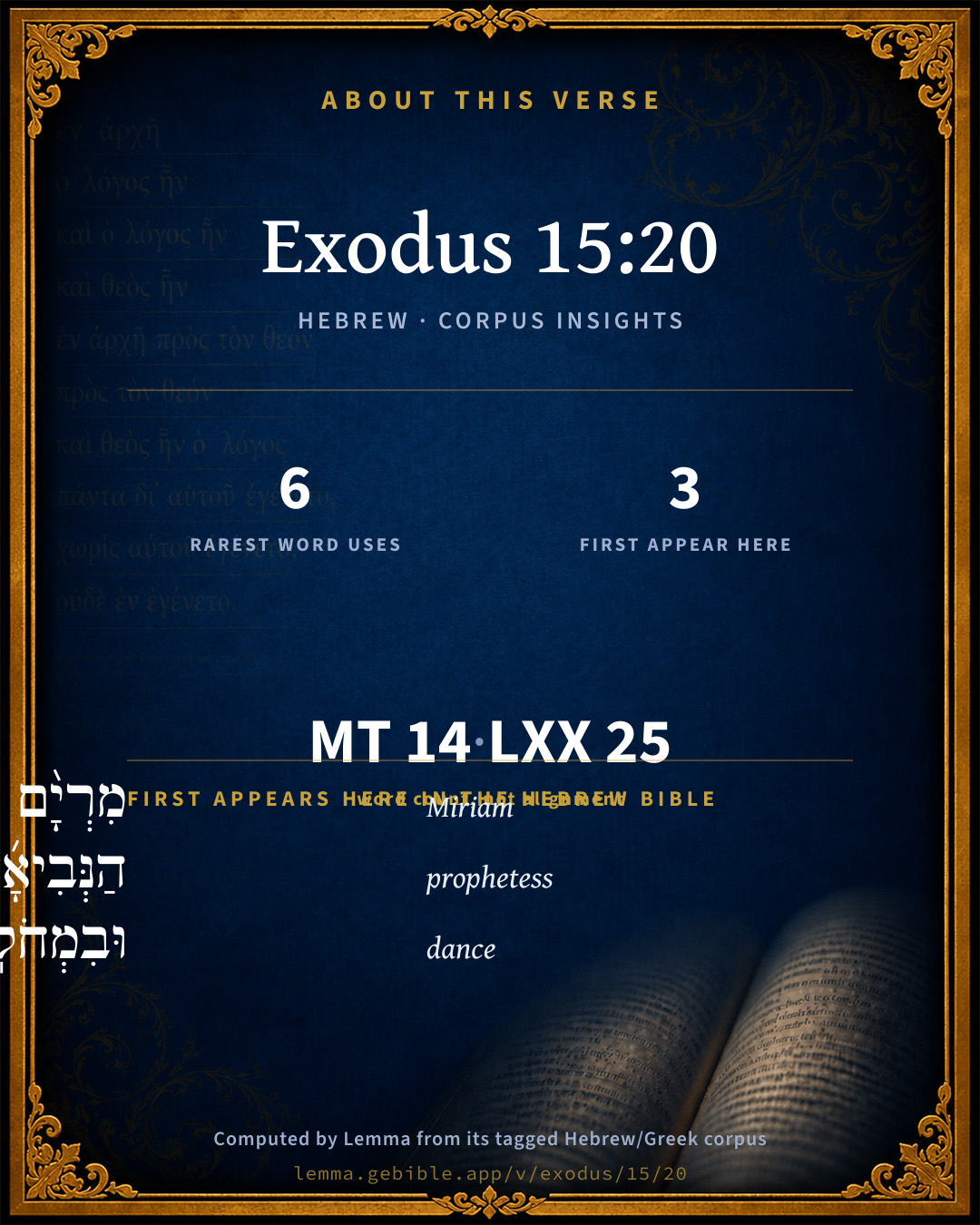
  • 3 first appearances in the Hebrew Bible
Full analysis ↓
Download a study sheet

One document with this verse’s original text, its word-by-word gloss line, the meaning frame, cross-references with their text, attributed commentary, and full source and license credits — printable, and it pastes into notes with its structure intact.

This verse Autodidact and up

Study sheet (.html) Plain text (.txt)

A passage Seminary Student

Up to 50 verses in one chapter. A passage sheet keeps up to 6 commentary sources and 12 cross-references per verse, in the order this page ranks them, and says so on the sheet whenever that leaves anything out. Ask for a single verse and you get the Autodidact verse sheet above.

Everything on this page stays free to read, with no account — the sheet is a download of what is already on screen, not access to it.

Want to remove ads? Support Godless Engineer
Compare translations 3

The same verse in 3 English versions, stacked beneath the original-language interlinear above. Click any original word for its lexicon entry.

Each is an independent rendering of the whole verse — the interlinear is not word-aligned to these translations.

Highlighted words mark where these versions differ — a whole-verse word diff, not a word-by-word alignment.

  • World English Bible Public Domain
    Miriam the prophetess, the sister of Aaron, took a tambourine in her hand; and all the women went out after her with tambourines and with dances.
  • King James Version Public Domain
    And Miriam the prophetess, the sister of Aaron, took a timbrel in her hand; and all the women went out after her with timbrels and with dances.
  • unfoldingWord Literal Text CC BY-SA 4.0
    And Miriam the prophetess, the sister of Aaron, took a tambourine in her hand, and all the women went out after her with tambourines and with dancing.

unfoldingWord Literal Text — © unfoldingWord, licensed CC BY-SA 4.0. Word-aligned USFM3 via Door43 (git.door43.org/unfoldingWord/en_ult).

Versions to compare (up to 4)

3 of 4 selected

Show all 18 translations

Every available English version of this verse, each an independent rendering of the whole verse.

  • World English Bible Public Domain
    Miriam the prophetess, the sister of Aaron, took a tambourine in her hand; and all the women went out after her with tambourines and with dances.
  • Berean Standard Bible Public Domain
    Then Miriam the prophetess, Aaron’s sister, took a tambourine in her hand, and all the women followed her with tambourines and dancing.
  • Majority Standard Bible Public Domain
    Then Miriam the prophetess, Aaron’s sister, took a tambourine in her hand, and all the women followed her with tambourines and dancing.
  • King James Version Public Domain
    And Miriam the prophetess, the sister of Aaron, took a timbrel in her hand; and all the women went out after her with timbrels and with dances.
  • American Standard Version (1901) Public Domain
    And Miriam the prophetess, the sister of Aaron, took a timbrel in her hand; and all the women went out after her with timbrels and with dances.
  • Revised Version (1885) Public Domain
    And Miriam the prophetess, the sister of Aaron, took a timbrel in her hand; and all the women went out after her with timbrels and with dances.
  • Geneva Bible (1599) Public Domain
    And Miriam the prophetesse, sister of Aaron tooke a timbrell in her hande, and all the women came out after her with timbrels and daunces.
  • Douay-Rheims (1899) Public Domain
    So Mary the prophetess, the sister of Aaron, took a timbrel in her hand: and all the women went forth after her with timbrels and with dances:
  • Young's Literal Translation Public Domain
    And Miriam the inspired one, sister of Aaron, taketh the timbrel in her hand, and all the women go out after her, with timbrels and with choruses;
  • Literal Standard Version CC BY-SA 4.0
    And Miriam the inspired one, sister of Aaron, takes the timbrel in her hand, and all the women go out after her, with timbrels and with choruses;
  • Unlocked Literal Bible CC BY-SA 4.0
    Miriam the prophetess, sister of Aaron, picked up a tambourine, and all the women went out with tambourines, dancing along with her.
  • unfoldingWord Literal Text CC BY-SA 4.0
    And Miriam the prophetess, the sister of Aaron, took a tambourine in her hand, and all the women went out after her with tambourines and with dancing.
  • Darby Bible Public Domain
    And Miriam the prophetess, the sister of Aaron, took the tambour in her hand, and all the women went out after her with tambours and with dances.
  • World Messianic Bible Public Domain
    Miriam the prophetess, the sister of Aaron, took a tambourine in her hand; and all the women went out after her with tambourines and with dances.
  • Webster's Bible Public Domain
    And Miriam the prophetess, the sister of Aaron, took a timbrel in her hand; and all the women went out after her, with timbrels, and with dances.
  • Free Bible Version CC BY-SA 4.0
    Miriam the prophet, Aaron's sister, picked up a tambourine, and all the women followed her dancing and playing tambourines.
  • Bible in Basic English Public Domain
    And Miriam, the woman prophet, the sister of Aaron, took an instrument of music in her hand; and all the women went after her with music and dances.
  • JPS Tanakh (1917) Public Domain
    And Miriam the prophetess, the sister of Aaron, took a timbrel in her hand; and all the women went out after her with timbrels and with dances.

Literal Standard Version (2020), Covenant Press — licensed CC BY-SA 4.0. Text via the HelloAO Bible API (eBible.org). Unlocked Literal Bible (unfoldingWord) — licensed CC BY-SA 4.0. Text via the HelloAO Bible API (eBible.org). unfoldingWord Literal Text — © unfoldingWord, licensed CC BY-SA 4.0. Word-aligned USFM3 via Door43 (git.door43.org/unfoldingWord/en_ult). Free Bible Version, Dr. Jonathan Gallagher — licensed CC BY-SA 4.0. Text via the HelloAO Bible API (eBible.org).

Word by word

More ways to search: Search by grammar → Find every occurrence → Compare this word →

Practice this passage: Drill this verse → Learn its vocabulary →

הַנְּבִיאָ֜ה
nᵉbîyʼâh
H5031
“the · prophetess”
Particle, Definite Article + Noun, Common, Feminine, Singular, Absolute
Part of Speech
Particle + Noun
Type
Common
Gender
Feminine
Number
Singular
State
Absolute
Full BDB Definition

Origin: from H5030

TWOT: 1277c

prophetess - ancient type endowed with gift of song (Miriam) - later type consulted for a word (Huldah) - false prophetess (Noadiah) - wife of Isaiah the prophet
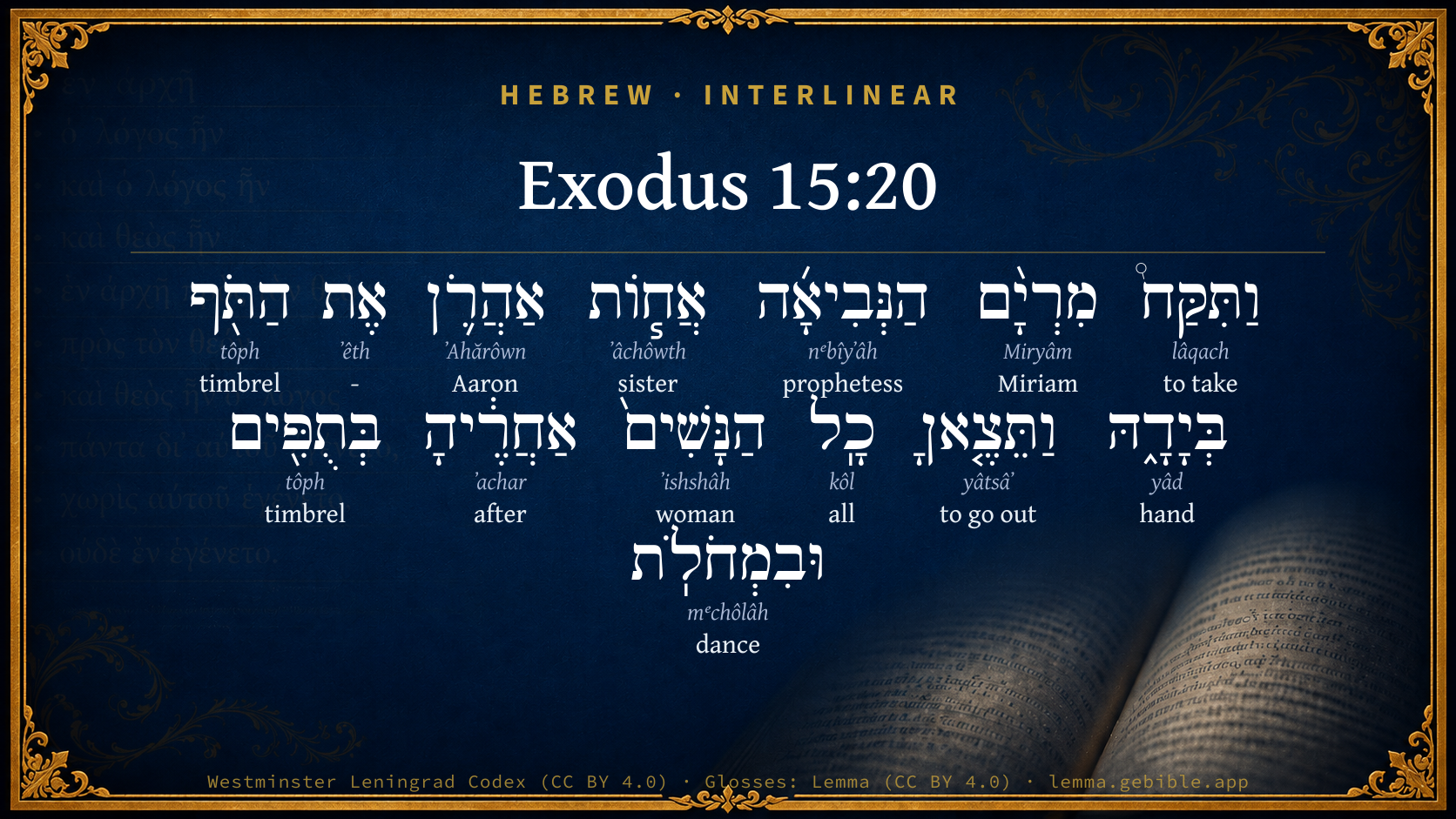
  1. וַתִּקַּח֩ lâqach H3947 “and · to take” Conjunction + Verb, Qal, Sequential Imperfect, 3rd Person, Feminine, Singular
  2. מִרְיָ֨ם Miryâm H4813 “Miriam” Noun, Proper
  3. אֲח֧וֹת ʼâchôwth H269 “sister of” Noun, Common, Feminine, Singular, Construct
  4. אַהֲרֹ֛ן ʼAhărôwn H175 “Aaron” Noun, Proper
  5. אֶת ʼêth H853 “-” Particle, Direct Object
  6. הַתֹּ֖ף tôph H8596 “the · timbrel” Particle, Definite Article + Noun, Common, Masculine, Singular, Absolute
  7. בְּיָדָ֑הּ yâd H3027 “in/at · hand · her” Preposition + Noun, Common, Both, Singular, Construct + Suffix, Personal, 3rd Person, Feminine, Singular
  8. וַתֵּצֶ֤אןָ yâtsâʼ H3318 “and · to go out” Conjunction + Verb, Qal, Sequential Imperfect, 3rd Person, Feminine, Plural
  9. כָֽל kôl H3605 “all of” Noun, Common, Masculine, Singular, Construct
  10. הַנָּשִׁים֙ ʼishshâh H802 “the · women” Particle, Definite Article + Noun, Common, Feminine, Plural, Absolute
  11. אַחֲרֶ֔יהָ ʼachar H310 “after · her” Preposition + Suffix, Personal, 3rd Person, Feminine, Singular
  12. בְּתֻפִּ֖ים tôph H8596 “in/at · timbrels” Preposition + Noun, Common, Masculine, Plural, Absolute
  13. וּבִמְחֹלֹֽת mᵉchôlâh H4246 “and · in/at · dances” Conjunction + Preposition + Noun, Common, Feminine, Plural, Absolute

About this verse

These counts appear in no published source. They are computed here, from the morphology-tagged text and Lemma’s own curated glosses. What Lemma adds →

14
words
13
distinct lemmas
Pentateuch
section

Notable vocabulary

The rarest word here is הַנְּבִיאָ֜ה prophetess H5031 — appearing just 6 times in the whole Hebrew Bible.

First appearance in Scripture

These words make their first canonical appearance in the Hebrew Bible here:

  • מִרְיָ֨ם Miriam H4813
  • הַנְּבִיאָ֜ה prophetess H5031
  • וּבִמְחֹלֹֽת dance H4246

Shared distinctive vocabulary

הַנְּבִיאָ֜ה prophetess H5031 occurs in 6 verses of the Hebrew Bible. Also found in:

Grammatical profile

  • 2 verbs
  • 10 nouns
  • 1 preposition
  • 1 particle

Verb forms

  • וַתִּקַּח֩ Qal · Sequential Imperfect
  • וַתֵּצֶ֤אןָ Qal · Sequential Imperfect

Repetition

A word recurs within this verse — often emphatic in Hebrew:

  • הַתֹּ֖ף timbrel H8596 ×2

Hebrew & Septuagint length

In English translation the verse runs 26 words from the Hebrew and 27 from the Septuagint (LXX English) — closely comparable.

A rough comparison of the two English renderings, which tokenize alike — not a word-level alignment.

Word counts can differ between the Hebrew and the Greek without any difference in meaning — e.g. the Hebrew direct-object marker אֵת has no separate Greek word, and Greek often adds the article ὁ.

In the original languages it is 14 Hebrew tokens and 25 Greek tokens — but the two are counted differently (Hebrew bundles its prefixes and suffixes into one token; the Greek is in lemma form), so that isn’t a like-for-like length.

Cross-references

24

Topical passages linked to Exodus 15:20 in the Treasury of Scripture Knowledge — connected by theme and wording, ordered by reader-vote popularity; previews shown in the World English Bible.

  • Psalms 150:4 Praise him with tambourine and dancing! Praise him with stringed instruments and flute!
  • 1 Samuel 18:6 It happened as they came, when David returned from the slaughter of the Philistine, that the women came out of all the cities of Israel, singing and dancing, to meet king Saul, with tambourines, with joy, and with instruments of music.
  • Psalms 68:25 The singers went before, the minstrels followed after, In the midst of the ladies playing with tambourines,
  • Psalms 149:3 Let them praise his name in the dance! Let them sing praises to him with tambourine and harp!
  • Judges 11:34 Jephthah came to Mizpah to his house; and, behold, his daughter came out to meet him with tambourines and with dances: and she was his only child; besides her he had neither son nor daughter.
  • Numbers 26:59 The name of Amram's wife was Jochebed, the daughter of Levi, who was born to Levi in Egypt: and she bore to Amram Aaron and Moses, and Miriam their sister.
  • Judges 4:4 Now Deborah, a prophetess, the wife of Lappidoth, she judged Israel at that time.
  • Psalms 81:2 Raise a song, and bring here the tambourine, The pleasant lyre with the harp.
  • Micah 6:4 For I brought you up out of the land of Egypt, And redeemed you out of the house of bondage. I sent before you Moses, Aaron, and Miriam.
  • Exodus 2:4 His sister stood far off, to see what would be done to him.
  • 2 Kings 22:14 So Hilkiah the priest, and Ahikam, and Achbor, and Shaphan, and Asaiah, went to Huldah the prophetess, the wife of Shallum the son of Tikvah, the son of Harhas, keeper of the wardrobe (now she lived in Jerusalem in the second quarter); and they talked with her.
  • Psalms 30:11 You have turned my mourning into dancing for me. You have removed my sackcloth, and clothed me with gladness,
  • Psalms 68:11 The Lord announced the word. The ones who proclaim it are a great company.
  • Luke 2:36 There was one Anna, a prophetess, the daughter of Phanuel, of the tribe of Asher (she was of a great age, having lived with a husband seven years from her virginity,
  • Numbers 20:1 The children of Israel, even the whole congregation, came into the wilderness of Zin in the first month: and the people abode in Kadesh; and Miriam died there, and was buried there.
  • Judges 21:21 and see, and, behold, if the daughters of Shiloh come out to dance in the dances, then come you out of the vineyards, and catch you every man his wife of the daughters of Shiloh, and go to the land of Benjamin.
  • 1 Samuel 10:5 After that you shall come to the hill of God, where is the garrison of the Philistines: and it shall happen, when you are come there to the city, that you shall meet a band of prophets coming down from the high place with a psaltery, and a tambourine, and a pipe, and a harp, before them; and they will be prophesying:
  • 2 Samuel 6:14 David danced before Yahweh with all his might; and David was girded with a linen ephod.
  • Acts 21:9 Now this man had four virgin daughters who prophesied.
  • 2 Samuel 6:5 David and all the house of Israel played before Yahweh with all manner of [instruments made of] fir-wood, and with harps, and with psalteries, and with tambourines, and with castanets, and with cymbals.
  • 2 Samuel 6:16 It was so, as the ark of Yahweh came into the city of David, that Michal the daughter of Saul looked out at the window, and saw king David leaping and dancing before Yahweh; and she despised him in her heart.
  • 1 Corinthians 11:5 But every woman praying or prophesying with her head unveiled dishonors her head. For it is one and the same thing as if she were shaved.
  • Numbers 12:1 Miriam and Aaron spoke against Moses because of the Cushite woman whom he had married; for he had married a Cushite woman.
  • 1 Corinthians 14:34 let your wives keep silent in the assemblies, for it has not been permitted for them to speak; but let them be in subjection, as the law also says.

Cross-references courtesy of OpenBible.info (CC BY 4.0).

Hebrew and Greek witnesses Masoretic Hebrew ↔ Greek Septuagint

The same verse in the two great witnesses to the Old Testament, shown verse-for-verse.

These are two independent witnesses, not word-aligned to each other, and the Septuagint is shown in lemma (dictionary) form.

Hebrew Exodus 15:20 Masoretic · Westminster Leningrad Codex

וַתִּקַּח֩ מִרְיָ֨ם הַנְּבִיאָ֜ה אֲח֧וֹת אַהֲרֹ֛ן אֶת הַתֹּ֖ף בְּיָדָ֑הּ וַתֵּצֶ֤אןָ כָֽל הַנָּשִׁים֙ אַחֲרֶ֔יהָ בְּתֻפִּ֖ים וּבִמְחֹלֹֽת

Miriam the prophetess, the sister of Aaron, took a tambourine in her hand; and all the women went out after her with tambourines and with dances.

World English Bible · Public Domain

Greek LXX Exodus 15:20 Septuagint · lemma form

λαμβάνω δέ μαριαμ ὁ προφῆτις ὁ ἀδελφή ααρων ὁ τύμπανον ἐν ὁ χείρ αὐτός καί ἐκἔρχομαι πᾶς ὁ γυνή ὀπίσω αὐτός μετά τύμπανον καί χορός

And Mariam the prophetess, the sister of Aaron, having taken a timbrel in her hand—then there went forth all the women after her with timbrels and dances.

LXX2012 (modern English Septuagint) · Public Domain

Hebrew: Westminster Leningrad Codex (CC BY 4.0). Greek: Septuagint (public domain); English from LXX2012 (modern English Septuagint) (Public Domain). How the Septuagint differs from the Hebrew →

Targum (Aramaic paraphrase)

2

The Targum is the ancient Jewish Aramaic paraphrase of the Hebrew Scriptures — an interpretive translation, not the Hebrew text itself. Onkelos (literal) and Pseudo-Jonathan (expansive) render the Torah, and Jonathan the Prophets. Coverage is partial: where no permissively-licensed English translation exists for a verse, only the Aramaic is shown. This is verse-level text, not a word-by-word alignment to the Hebrew.

  1. Targum Onkelos Torah (Genesis–Deuteronomy)
    וּנְסֵיבַת מִרְיָם נְבִיאֲתָא אֲחָתֵהּ דְאַהֲרֹן יָת תֻּפָּא בִּידַהּ וּנְפָקוּ כָל נְשַׁיָא בַּתְרָהָא בְּתֻפִּין וּבְחִנְגִין:

    (no public-domain English translation for this verse)

    Targum Onkelos — Aramaic: “Onkelos Genesis” (public domain); “Onkelos Exodus” (public domain); “Onkelos Leviticus” (public domain); “Onkelos Numbers” (public domain); “Onkelos Deuteronomy” (public domain). English: “Sefaria Community Translation” (CC0 1.0 (public-domain dedication)); “J.W. Etheridge. The Targums of Onkelos and Jonathan Ben Uzziel on the Pentateuch. London: Longmans, Green, 1862” (public domain). Text via Sefaria.

  2. Targum Pseudo-Jonathan Torah (Genesis–Deuteronomy)
    וּנְסֵיבַת מִרְיָם נְבִיאָתָא אַחְתֵיהּ דְּאַהֲרן יַת תּוּפָא בִידָהּ וְנַפְקָן כָּל נְשַׁיָא בַּתְרָאָה בְּתוּפַיָיא הֲווֹ חַיְילִין וּבְחִנְגַיָא מְחַנְגִין

    And Miriam the prophetess, the sister of Aharon, took a tambourine in her hand, and all the women came out after her, dancing with tambourines and playing on instruments.

    Targum Pseudo-Jonathan — Aramaic: “Targum Jonathan on Genesis” (public domain); “Targum Jonathan on Exodus” (public domain); “Targum Jonathan on Leviticus” (public domain); “Targum Jonathan on Numbers” (public domain); “Targum Jonathan on Deuteronomy” (public domain). English: “The Targum of Jonathan ben Uzziel, trans. J. W. Etheridge, London, 1862” (public domain). Text via Sefaria.

Commentary

Notes on Exodus 15:20 from classic Christian and Jewish commentators (each source and its license shown beneath its notes). The classic Christian expositions comment on the surrounding passage and are grouped to its opening verse, so a note may address several verses; the Jewish commentaries on the Tanakh (Rashi and others) are per-verse, so they appear only where the commentator wrote on this verse.

Lemma curates 59 commentaries, every one of them public domain or Creative Commons licensed, each selected and text-cleaned for this edition rather than reprinted as found. About our sources →

Trapp's Complete Commentary

John Trapp

Exo 15:20 And Miriam the prophetess, the sister of Aaron, took a timbrel in her hand; and all the women went out after her with timbrels and with dances.

Ver. 20. And Miriam.] Souls have no sexes: and if souls follow the temperament of their bodies, as philosophy saith they do, women’s bodies consist of rarer rooms, of a more exact composition than men’s do.

John Trapp, A Commentary or Exposition upon All the Books of the Old and New Testament (1647–1656) — public domain. Text from a community e-Sword module.

Joseph Benson's Commentary

Exo 15:20-21. Miriam the prophetess — So called, either in a general sense, because she was an instructer of other women in the praise and service of God, or in a more special sense, because she had the spirit of prophecy, Num 12:2; Mic 6:4. Miriam (or Mary, for it is the same name) now presided in an assembly of the women, who, according to the common usage of those times, with timbrels and dances, sung this song. Moses led the sacred song, and gave it out for the men, and then Miriam for the women. Famous victories were wont to be applauded by the daughters of Israel, (1Sa 18:6-7,) so was this. When God brought Israel out of Egypt, it is said, (Mic 6:4,) he sent before them Moses, Aaron, and Miriam; though we read not of any thing remarkable that Miriam did but this. But those are to be reckoned great blessings to a people, that go before them in praising God. And Miriam answered them — The men: they sung by turns, or in parts.

Joseph Benson's Commentary on the Old and New Testaments (1811–1818) — public domain. Text from a community e-Sword module.

Geneva Bible (1599)

Geneva Bible translators

Signifying their great joy: which custom the Jews observed in certain solemnities, Judg. 11:34 and 11:21, but it ought not to be a cloak to cover our wanton dances.

Geneva Bible (1599) marginal notes — public domain. Text via Bolls.life.

Jamieson, Fausset & Brown

Robert Jamieson, A. R. Fausset & David Brown

Miriam the prophetess--so called from her receiving divine revelations (Num 12:1; Mic 6:4), but in this instance principally from her being eminently skilled in music, and in this sense the word "prophecy" is sometimes used in Scripture (Ch1 25:1; Co1 11:5).

took a timbrel--or "tabret"--a musical instrument in the form of a hoop, edged round with rings or pieces of brass to make a jingling noise and covered over with tightened parchment like a drum. It was beat with the fingers, and corresponds to our tambourine.

all the women went out after her with timbrels and with dances--We shall understand this by attending to the modern customs of the East, where the dance--a slow, grave, and solemn gesture, generally accompanied with singing and the sound of the timbrel, is still led by the principal female of the company, the rest imitating her movements and repeating the words of the song as they drop from her lips.

Jamieson, Fausset & Brown — Commentary Critical and Explanatory on the Whole Bible (1871) — public domain (CC PDM 1.0). Text via the HelloAO Bible API.

Adam Clarke's Commentary

Verse 20. And Miriam the prophetess] We have already seen that Miriam was older than either Moses or Aaron: for when Moses was exposed on the Nile, she was a young girl capable of managing the stratagem used for the preservation of his life; and then Aaron was only three years and three months old, for he was fourscore and three years old when Moses was but fourscore, (see Ex 7:7;) so that Aaron was older than Moses, and Miriam considerably older than either, not less probably than nine or ten years of age. See Clarke on Ex 2:2.

There is great diversity of opinion on the origin of the name of Miriam, which is the same with the Greek Μαριαμ, the Latin Maria, and the English Mary. Some suppose it to be compounded of מר mar, a drop, (Isa 40:15,) and ים yam, the sea, and that from this etymology the heathens formed their Venus, whom they feign to have sprung from the sea. St. Jerome gives several etymologies for the name, which at once show how difficult it is to ascertain it: she who enlightens me, or she who enlightens them, or the star of the sea. Others, the lady of the sea, the bitterness of the sea, c. It is probable that the first or the last is the true one, but it is a matter of little importance, as we have not the circumstance marked, as in the case of Moses and many others, that gave rise to the name.

The prophetess] הנביאה hannebiah. For the meaning of the word prophet, נביא nabi, See Clarke on Ge 20:7. It is very likely that Miriam was inspired by the Spirit of God to instruct the Hebrew women, as Moses and Aaron were to instruct the men and when she and her brother Aaron sought to share in the government of the people with Moses, we find her laying claim to the prophetic influence, Nu 12:2: Hath the Lord indeed spoken only by Moses? Hath he not SPOKEN ALSO BY US? And that she was constituted joint leader of the people with her two brothers, we have the express word of God by the Prophet Micah, Mic 6:4: For I brought thee up out of the land of Egypt - and I sent before thee Moses, Aaron, and Miriam. Hence it is very likely that she was the instructress of the women, and regulated the times, places, c., of their devotional acts for it appears that from the beginning to the present day the Jewish women all worshipped apart.

A timbrel] תף toph, the same word which is translated tabret, Ge 31:27, on which the reader is desired to consult the note. See Clarke on Ge 31:27.

And with dances.] מחלת mecholoth. Many learned men suppose that this word means some instruments of wind music, because the word comes from the root חלל chalal, the ideal meaning of which is to perforate, penetrate, pierce, stab, and hence to wound. Pipes or hollow tubes, such as flutes, hautboys, and the like, may be intended. Both the Arabic and Persian understand it as meaning instruments of music of the pipe, drum, or sistrum kind; and this seems to comport better with the scope and design of the place than the term dances. It must however be allowed that religious dances have been in use from the remotest times; and yet in most of the places where the term occurs in our translation, an instrument of music bids as fair to be its meaning as a dance of any kind. Miriam is the first prophetess on record, and by this we find that God not only poured out his Spirit upon men, but upon women also; and we learn also that Miriam was not only a prophetess, but a poetess also, and must have had considerable skill in music to have been able to conduct her part of these solemnities. It may appear strange that during so long an oppression in Egypt, the Israelites were able to cultivate the fine arts; but that they did so there is the utmost evidence from the Pentateuch. Not only architecture, weaving, and such necessary arts, were well known among them, but also the arts that are called ornamental, such as those of the goldsmith, lapidary, embroiderer, furrier, c., of which we have ample proof in the construction of the tabernacle and its utensils. However ungrateful, rebellious, &c., the Jews may have been, the praise of industry and economy can never be denied them. In former ages, and in all places even of their dispersions, they appear to have been frugal and industrious, and capable of great proficiency in the most elegant and curious arts but they are now greatly degenerated.

Adam Clarke's Commentary on the Bible (1810–1826) — public domain. Text from a community e-Sword/MySword module.

Ellicott's Commentary for English Readers

(20) Miriam the prophetess.—In Miriam we have the first of that long series of religious women presented to us in Holy Scripture who are not merely pious and God-fearing, but exercise a quasi-ministerial office. Examples of other “prophetesses” will be found in Jdg_4:4; 2Ki_22:14; Isa_8:3; Luk_2:36. In the early Christian Church there was an order of “deaconesses (Rom_16:1; Apost. Const., vi. 17). The office of “prophetess” seems to have been permitted to women in Egypt, though that of “priestess” was, until Ptolemaic times, forbidden them.

The sister of Aaron.—She is called “sister of Aaron,” rather than of Moses, because Aaron was the head of the family (Exo_6:20; Exo_7:7). There is no reasonable doubt that she was the sister who kept watch on Moses when he was in the ark of bulrushes (Exo_2:3-8). On her later history, see Num_12:1-15. The prophet Micah regarded her as having had a part in the work of Israel’s deliverance (Mic_6:4).

Timbrels and with dances.—By “timbrels” are meant tambours, or tambourines, favourite instruments in Egypt, and usually played by women there (Wilkinson: Ancient Egyptians, vol. i., p. 93). The combination of music with song in religious worship, here for the first time brought before us, became the fixed rule of the Tabernacle service from the time of David (2Sa_6:15; 1Ch_23:5; 1Ch_25:1-6), and was adopted into the Temple service from its first establishment (2Ch_5:12). Sanctioned under the new covenant by the general praise of psalmody, and by the representations given in the Apocalypse of the Church triumphant in heaven (Rev_5:8; Rev_14:2-3), it has always maintained itself in the Christian Church, and still holds its ground firmly. Dancing, on the contrary, though adopted into religious worship by many nations, sanctioned by the present passage, by the example of David (2Sa_6:16), and by expressions in the Psalms (Psa_149:3; Psa_150:4), has never found an entrance into Christian ceremonial, unless among a few fanatic sects. The reason of this is to be found in the abuses which, through human infirmity, became by degrees connected with the practice, causing it to become unfit for a religious purpose. In the primitive times, however, solemn and stately dances were deemed appropriate to festival periods and religious rejoicings, and among the more moral tribes and nations had nothing unseemly about them.

The arrangement of the choir on this occasion into two bands—one of males, the other of females—and the combined employment of music, song, and dancing by the female band, are in close accord with Egyptian customs.

A Bible Commentary for English Readers, edited by Charles John Ellicott (1878–1897) — public domain. Text from a community e-Sword module.

The Cambridge Bible for Schools and Colleges

gen. ed. J. J. S. Perowne

20. the prophetess] See Num_12:2; and cf. Jdg_4:4 (of Deborah).

the sister of Aaron] Miriam being more closely associated with Aaron than with Moses: cf. Num_12:1 ff., where Miriam and Aaron act together, even against Moses. See also on Exo_2:1.

a timbrel] or hand-drum, i.e. a ring of wood or metal, covered with a tightly-drawn skin, held up in one hand, and struck by the fingers of the other. The same Heb. is sometimes rendered tabret. The hand-drum was used on joyous occasions, as Gen_31:27, 2Sa_6:5, and with dances, as here, Jdg_11:34, 1Sa_18:6, Jer_31:4. For women celebrating a victory, see Jdg_11:34 (Jephthah’s daughter), Psa_68:11 (RV.), and esp. 1Sa_18:6-7.

went out] viz. from the camp.

dances] For dancing on joyous religious occasions, cf. Exo_32:19, Jdg_21:21, 2Sa_6:14, Psa_149:3; Psa_150:4. ‘In the East dancing was, and is, the language of religion. David, to shew his fervour, danced before the Ark with all his might. In Hellas dancing accompanied every rite and every mystery. The choral dance afforded the outlet to religious enthusiasm which elsewhere is provided by services’ (K. J. Freeman, Schools of Hellas 600–300 b.c., 1907, p. 143 f.).

20, 21. How the opening verse of the Song was sung by Miriam.

The Cambridge Bible for Schools and Colleges (gen. ed. J. J. S. Perowne; Cambridge University Press, 1878–1918) — public domain. Text from a community e-Sword module.

John Gill's Exposition

And Miriam answered them,.... The men, for the word is masculine; that is, repeated, and sung the same song word for word after them, as they had done, of which a specimen is given by reciting the first clause of the song:

sing ye to the Lord; which is by way of exhortation to the women to sing with her, as Moses begins the song thus: "I will sing unto the Lord":

for he hath triumphed gloriously; the horse and his rider hath he thrown into the sea; See Gill on Exo 15:1, the manner of their singing, according to the Jews (z), was, Moses first said, "I will sing", and they said it after him.

(z) T. Hieros. Sotah, fol. 20. 3. T. Bab. Sotah, fol. 30. 2.

John Gill's Exposition of the Whole Bible (1746–1763) — public domain (CC PDM 1.0). Text via the HelloAO Bible API.

Albert Barnes' Notes on the Bible

And Miriam the prophetess - The part here assigned to Miriam and the women of Israel is in accordance both with Egyptian and Hebrew customs. The men are represented as singing the hymn in chorus, under the guidance of Moses; at each interval Miriam and the women sang the refrain, marking the time with the timbrel, and with the measured rhythmical movements always associated with solemn festivities. Compare Jdg 11:34; 2Sa 6:5, and marginal references. The word used in this passage for the timbrel is Egyptian, and judging from its etymology and the figures which are joined with it in the inscriptions, it was probably the round instrument.

Miriam is called a prophetess, evidently Num 12:2 because she and Aaron had received divine communications. The word is used here in its proper sense of uttering words suggested by the Spirit of God. See Gen 20:7. She is called the sister of Aaron, most probably to indicate her special position as coordinate, not with Moses the leader of the nation, but with his chief aid and instrument.

Albert Barnes' Notes on the Bible (1834–1885) — public domain. Text from a community e-Sword/MySword module.

Haydock's Catholic Bible Commentary

Mary, or Mariam, as it was formerly pronounced, though the Masorets now read Miriam: may signify one "exalted, lady, star, bitterness of the sea." --- Prophetess; having revelations from God, (Numbers xii. 1,) and singing his praises. --- Of Aaron. Moses passes over himself out of modesty. She is known by this title, whence it is supposed she never married. (St. Ambrose) (Calmet) --- Timbrels, which were already used in solemn worship. --- And dances. Choris may mean companies of women, singing and dancing in honour of God. The men repeated what Moses had entoned, and the women did the same after Mary; unless, perhaps, the multitude of both sexes, respectively, repeated only the first verse by way of chorus; or Mary and her band took up each verse "in answer" to the men, as the Hebrew insinuates. This divine canticle will afford joy even to the elect, Apocalypse xv. 3.

George Leo Haydock (1774–1849), Haydock's Catholic Family Bible and Commentary, 1859 edition — public domain. Excludes Psalms (Douay-Rheims chapter numbering differs from Protestant) and Deuterocanonical books (Catholic canon only).

Matthew Poole's English Annotations

Miriam the prophetess; so called, either in a general sense, because she was an instructer of other women in the praise and service of God; or in a more special sense, because she had the Spirit of prophecy. See Num 12:2; Mic 6:4.

The sister of Aaron

Quest. Why not of Moses also?

Answ. 1. She might be Moses’s sister only by one parent, Aaron’s by both.

2. She was best known to the people by her relation to Aaron, with whom she had lived for many years, when Moses was banished.

With timbrels and with dances, according to their ancient custom in public solemnities. See Jdg 11:34; 21:21; 1Sa 18:6; 2Sa 6:14,21; Jer 31:4,13.

Matthew Poole's English Annotations on the Holy Bible (1683–1685) — public domain. Text from a community e-Sword/MySword module.

Whedon's Commentary on the Bible

Daniel D. Whedon

20. Miriam the prophetess — Miriam, or Mariam, the Greek and Latin Maria, and the English Mary. Thus the Mother of our Lord bore the name of the prophetess of the Exodus, who is numbered by the prophet Micah (Mic_6:4) with Moses and Aaron as one of the deliverers of Israel.

Sister of Aaron — The Scriptures nowhere speak of her marriage, and she seems to have held an independent position as sister of the high priest and of the leader of Israel. Josephus, however, says that she was the wife of Hur, and grandmother of the tabernacle architect, Bezaleel. (Antiq., 3:2, §4, and 6, § 1.)

Timbrels — Tabrets, tabours, or tambourines. Probably this was the same instrument which is now used by the modern Egyptians — a small, shallow drum, made by stretching a skin upon a hoop, about eleven inches in diameter. LANE says: “The hoop is overlaid with mother of pearl, tortoise shell, white bone or ivory, both without and within, and has ten double circular plates of brass attached to it.… It is held by the left or right hand, and beaten with the fingers of that hand, and by the other hand: the fingers of the hand which holds the instrument, striking only near the hoop, produce higher sounds than the other hand, which strikes in the center.” — Modern Egypt, ii, p. 76. See, also, notes on 1Sa_10:5, and 2Sa_6:5.

Dances — Some render the word guitars.

Daniel D. Whedon (gen. ed.), Commentary on the Old and New Testaments (1874–1909) — public domain. Text from a community e-Sword module.

The Pulpit Commentary

Miriam, the prophetess. Miriam is regarded by the prophet Mic_6:4, as having had a share in the deliverance of Israel, and claims the prophetic gift in Num_12:2. Her claim appears to be allowed both in the present passage, and in Num_12:6-8. where the degree of her inspiration is placed below that of Moses. She is the first woman whom the Bible honours with the title of "prophetess." Prophetesses were common in Egypt at a much earlier date; and thus, that a woman should have the gift would have seemed no strange thing to the Hebrews. For examples of other prophetesses, see Jud_1:4:4; 2Ki_22:14; Isa_8:3; Luk_2:36. The sister of Aaron. Compare Num_26:59. Miriam is generally regarded asthe sister of Moses mentioned in Exo_2:4-8, whose name is not there given. If so, she was considerably older than either Moses or Aaron. Took a timbrel By "a timbrel" our translators meant what is now called "a tambourine." Such instruments were common in Egypt (Wilkinson, Ancient Egyptians, vol. 1. p. 93), and in the representations are generally played by women. The separation of the men and women into distinct bands was an Egyptian custom; as likewise was the execution of dances by performers who accompanied their steps with music (ibid. vol. it. pp. 235, 301).

Vers. 20, 21. The aid which devout women can reader to the Church.

There are religions which exclude women from consideration altogether, express a doubt whether they have souls, and assign them no special Church work. But Judaism did not make this mistake, it utilised the services of women

I AS PROPHETESSES. Miriam was a prophetess. So was Deborah, whose song is one of the most beautiful compositions in the Bible. (Jud 5:2-31) So was Huldah, who delivered God"s message to Hezekiah. (2Ki_22:14-20) So was Anna, (Luk_2:36) whom the tradition makes the virgin"s mother. God did not disdain to hold spiritual converse with women and enlighten them supernaturally; nor did the Israelites omit to take cognizance of the fact and give such persons their due honour.

II AS NATIONAL DELIVERERS. Deborah "judged Israel", (Jud_1:4:4) and it was she, rather than Barak, who delivered the Israelites from Jabin (ib, vers. 8, 14). Esther saved her people from the malice of Haman. Judith is said to have delivered them from Holofernes. Sex was no disqualification for high place among the Jews, any more titan among their neighbours, the Arabs. The queens of Judah obtain constant mention in Kings and Chronicles.

III AS PARTICIPATORS IN RELIGIOUS CEREMONIALS. In the instance of Miriam we see how an important part of the thanksgiving service which Moses celebrated on the passage of the Red Sea was assigned to females. Apparently, on this occasion, half the chanting, and the whole of the instrumental music, was placed in their hands, Miriam acted as Choragus, or conductor, of the female chorus. Music is one of woman"s commonest gifts; and, though not eminent as composers, as renderers of the music of others, they have a fame exceeding that of men. They can do much for the glory of God in contributing to, and even sometimes superintending, the musical services of the sanctuary. In the Christian Church, there has been, equally from the first, a recognition of the services that may be rendered to religion by women. The apostles, after the ascension of our Lord, "continued with one accord in prayer and supplication with the women, and Mary, the mother of Jesus". (Act_1:14) Phoebe, who conveyed to Rome St. Paul"s Epistle to the Romans, was "a deaconess of the church that was at Cenchrea"; (Rom_16:1) and an Order of deaconesses was generally recognised in the primitive Church, and believed to have been instituted by the apostles (Apost. Const. 6:17). In all periods some church work, in many very important church work, has been assigned to women, with great advantage both to themselves and to the community. Though St. Paul forbade their speaking in the Church, (1Co_14:35) and they thus cannot be ministers, subordinate employments of various kinds, suited to the nature of women, are everywhere open to them. The work of Sisters of Charity in various parts of tile world is above all praise. That of district visitors, teachers in Sunday schools, Scripture readers, etc., though less attracting the praise of men, is most valuable. Devout women, working under their ministers, can be the instruments of incalculable good, and so as much for the promotion of true religion as if they were men.

Vers. 1-20, 21. The song of Moses and of the Lamb.

We cannot fail to connect in our thoughts the circumstances of this magnificent triumph-celebration with that other scene, described in the Apocalypse, where they who have "gotten the victory over the beast, and over his image, and over the number of his name, stand oni.e. , on the margin of the sea of glass, having the harps of God," and "sing the song of Moses, the servant of God, and the song of the Lamb". (Rev_15:2) We do not enter into any elaborate explication of the Apocalyptic symbols. The beast and his followers obviously represent the Antichristian foes of the Church the worldly secular powers that resist, oppose, and persecute the true servants of Christ. God"s judgment on these hostile world-powers, already summarily depicted in Exo_14:19, Exo_14:20, is to be afterwards more fully described under the imagery of the seven last plagues. This vision of the multitudes on the sea of glass is anticipative, and represents the celebration by the Church of her own deliverance, and of the completion of judgment upon her enemies. The "sea of glass" has obvious reference to the Red Sea, made to roll back, and stand up like a sea of crystal (ver. 8), yet illuminated and filled with lurid radiance, by the fiery glow of the pillar which shone on Israel. The "sea" is the symbol (in this instance) of deliverance achieved, of victory won, of enemies judged and overwhelmed the fire in the crystal pointing to the burning wrath which consumed them. But what we have immediately to do with is the fact that the saved multitudes sing the "song of Moses, and of the Lamb." This plainly does not mean that they sing two songs; nor yet that the song which they sing is the song recorded here; for the terms of what they sing are subsequently given. (Rev_15:3, Rev_15:4) The meaning is that the Church, having experienced a deliverance similar to that experienced by Israel at the Red Sea, but as much greater than that old deliverance, as Christ is greater than Moses, and his salvtion greater than the salvation from Egypt, the old song is re-cast, and its terms re-adapted, to express both victories at once, the lower and the higher. The old is taken up into the new and is celebrated along with it. No victory of God for his Church will ever pass out of remembrance. Each will be the theme of grateful celebration to all eternity. But type must merge in antitype, and be celebrated with it in a single strain. The song of the redeemed over the defeat of the Antichristian powers at the end over the defeat of all their enemies is the true counterpart of this song of Moses, and the one (the latter) remains for ever the background of the other (the former), and is blended with it in the united celebration. Glancing at the two songs, this in Exodus, and that in the Revelation, we note

1. That the scope of both is the same the defeat of hostile, pursuing, persecuting powers. And as the defeat of Pharaoh was the natural sequel to the exodus, and confirmed to Israel that redemption then achieved, so will the defeat of Christ"s enemies in the end appear as the appropriate sequel to his work upon the Cross, and will complete the deliverance of his Church from those that trouble her. (2Th_1:6)

2. That the attributes of God extolled in both are the same. This of necessity, for the work being similar, so must be the attributes revealed in it holiness, power, unchallengeable supremacy, justice and truth, which here include mercy. "Great and marvellous are thy works, Lord God Almighty," etc.. (Rev_15:3) The effects produced on the nations by this display of God"s attributes are also similar shall not fear thee, O Lord, and glorify thy name for all nations shall come and worship before thee." A higher result this, however, than in the case of the type.

3. The singers in both cases are the same those viz. who haveexperienced the deliverance which they celebrate. Would we join them? We, too, must be in Christ, and partakers with those who, in the strength which he gives, are overcoming the world. J.O. (1Jn_4:4)

Vers. 20, 21. Woman"s part in the song of triumph.

In the history of Israel, we are called on to observe woman coming forward, not continuously, but every now and then, to show how real is her share in the lot of Israel She has had that share in suffering, being consumed with anxiety as to the fate of her offspring. (Ch. 1.) She has had it in ministration, Jochebed, Miriam and Pharaoh"s daughter, being combined in the work un-conscious ministration towards the fitting of Moses for his great work. Whatever may be said of women speaking in the Church, we here behold them joining, in the most demonstrative way, in the public praises of Jehovah. The blessing by the lied Sea was one which went down to that common humanity which underlies the great distinction of sex. But it was also a very special blessing to women. Trials, such as had come to Jochebed when Moses was born, were to cease. Woman would have her own trials in the time to come the pangs of childbirth, the cares of offspring, and all a mother"s peculiar solicitudes; but it was a great deal to have the special curse of bondage in Egypt removed. Then there would be deep thankfulness for the escape of the first-born; a feeling, too, of self-congratulation that they had been obedient in slaying the lamb and sprinkling the blood, and had thus escaped the blow which had fallen heavily on so many homes in Egypt. All these considerations would lead up to and prepare for the final outburst of praise and triumph. And so, if women consider still, they will be both astonished and profoundly grateful because of all that God in Christ Jesus has done for them. They have gained not only according to their simple share in humanity, but according to their peculiar relation towards man. If it be true, that Eve fell first, dreadfully have all her daughters suffered since. As belonging to this fallen world, woman is now in a double subjection. In her creation she was to be subordinate to man, and if she had stood, and he had stood, then what glory and blessedness would have come to both! But when man became the slave of sin, she became doubly slave, as being now linked to one who had himself the servile spirit. What had been subordination in Eden became servitude outside of it. He who is himself the abject slave of passion and selfishness makes woman his slave, so that in addition to all that comes through her own sin as a human being there is the misery that comes through her having got into a wrong relation to man. Hence the peculiar hideousness of a bad woman, a Jezebel or a Herodias. Hence, too, through the work of redemption we get the peculiar beauty of the good woman. Whence should we have got those types of saintly women which beam from the pages of Scripture and Christian biography, save for that great work one stage of which is celebrated in this song? Y.

The Pulpit Commentary (1880–1919), ed. H.D.M. Spence-Jones & Joseph S. Exell — public domain. Text from a community e-Sword module.

John Wesley's Explanatory Notes

Miriam (or Mary, it is the same name) presided in an assembly of the women, who (according to the common usage of those times) with timbrels and dances, sung this song. Moses led the psalm, and gave it out for the men, and then Miriam for the women. Famous victories were wont to be applauded by the daughters of Israel, 1 Sam. xviii, 6, 7, so was this. When God brought Israel out of Egypt, it is said, Micah vi, 4, he sent before them Moses, Aaron, and Miriam; though we read not of any thing remarkable that Miriam did but this. But those are to be reckoned great blessings to a people, that go before them in praising God.

John Wesley, Explanatory Notes Upon the Whole Bible (1754–1765) — public domain. Text via the GEBible commentary corpus.

Rashi

Rabbi Shlomo Yitzchaki (Rashi)

ותקח מרים הנביאה AND MIRIAM THE PROPHETESS TOOK — But where had she prophesied? When she was THE SISTER OF AARON alone — before Moses was born she said, “My mother will at some time bear a son who will deliver Israel etc.”, as is stated in Treatise Sotah 12b (cf. Megillah 14a). Another explanation of אחות אהרן, the sister of Aaron: because he jeopardised his life for her by entreating on her behalf and so possibly incurring God’s displeasure when she was stricken with leprosy, she is called by his name (Mekhilta; cf. Rashi Genesis 34:25).

את התף A TIMBREL — an instrument for a particular kind of music.

בתפים ובמחלת WITH TIMBRELS AND WITH DANCES — The righteous women in that generation were confident that God would perform miracles for them and they accordingly had brought timbrels with them from Egypt (Mekhilta).

Rashi on the Tanakh — English translations: “The Judaica Press complete Tanach with Rashi, translated by A. J. Rosenberg” (CC BY 4.0); “Pentateuch with Rashi's commentary by M. Rosenbaum and A.M. Silbermann, 1929-1934” (public domain); “The Metsudah Tanach series, Lakewood, N.J” (CC BY 4.0); and “The Book of Joshua, Metsudah Publications, 1997” (CC BY 4.0). Text via Sefaria.

Ramban (Nachmanides)

Rabbi Moshe ben Nachman (Ramban / Nachmanides)

AND MIRIAM THE PROPHETESS, THE SISTER OF AARON. The correct interpretation appears to me to be that because Moses and Miriam were mentioned in the Song and Aaron was not, Scripture wanted to mention him. It therefore said the sister of Aaron as a mark of honor to him, i.e., that he was her older brother and that his sister the prophetess connected her genealogy to him, since he too was a prophet and a holy man of G-d. It is possible that it is the custom of Scripture to trace the genealogy of a family through the oldest brother. Similarly it is written, And the sons of Caleb the brother of Jerahmeel, because he was the oldest brother, as it is said: The sons also of Hezron… Jerahmeel, and Ram, and Chelubai., 2:9.

Ramban (Nachmanides) on the Tanakh — English translation: “Commentary on the Torah by Ramban (Nachmanides). Translated and annotated by Charles B. Chavel. New York, Shilo Pub. House, 1971-1976” (CC BY 4.0). Text via Sefaria.

Lesson kit

Teaching starters — assembled from the data on this page, not authored interpretation. Every prompt links to the verse data it draws on. Edit before teaching.

Exodus, in the Pentateuch, opens this verse with 14 words (13 distinct Hebrew lemmas). Its most distinctive word is nᵉbîyʼâh (“prophetess”). A historical commentator’s framing appears above. Read the whole chapter for the surrounding context.

Discussion questions

  1. The word nᵉbîyʼâh carries the sense “prophetess.” How does it shape the verse?
  2. 3 words here appear for the first time in Scripture. What is being introduced at this debut?
  3. Judges 4:4 shares the word «prophetess» with this verse. How do the two illuminate each other?
  4. “timbrel” occurs 2× in this one verse. What is the effect of the repetition?
  5. The translations on this page render this verse differently — a whole-verse word diff, not a word-by-word alignment. What might account for the different wordings?
  6. The verb «וַתִּקַּח֩» is Qal Sequential Imperfect. How does its form color the action?
  7. Reading how Trapp's Complete Commentary and Joseph Benson's Commentary read this verse, where do the two commentators agree and where do they part?

Things to notice

Reading settings

Reading text

Shown beneath each verse's original-language words.

Old Testament
Old Testament edition

Read the OT as the Masoretic Hebrew (MT) or the Greek Septuagint (LXX).

English shown for the Greek Septuagint (in the Hebrew ↔ Greek comparison).

Comparing translations? Open the Compare panel on any verse page to stack up to four side by side.