Deuteronomy 34:12

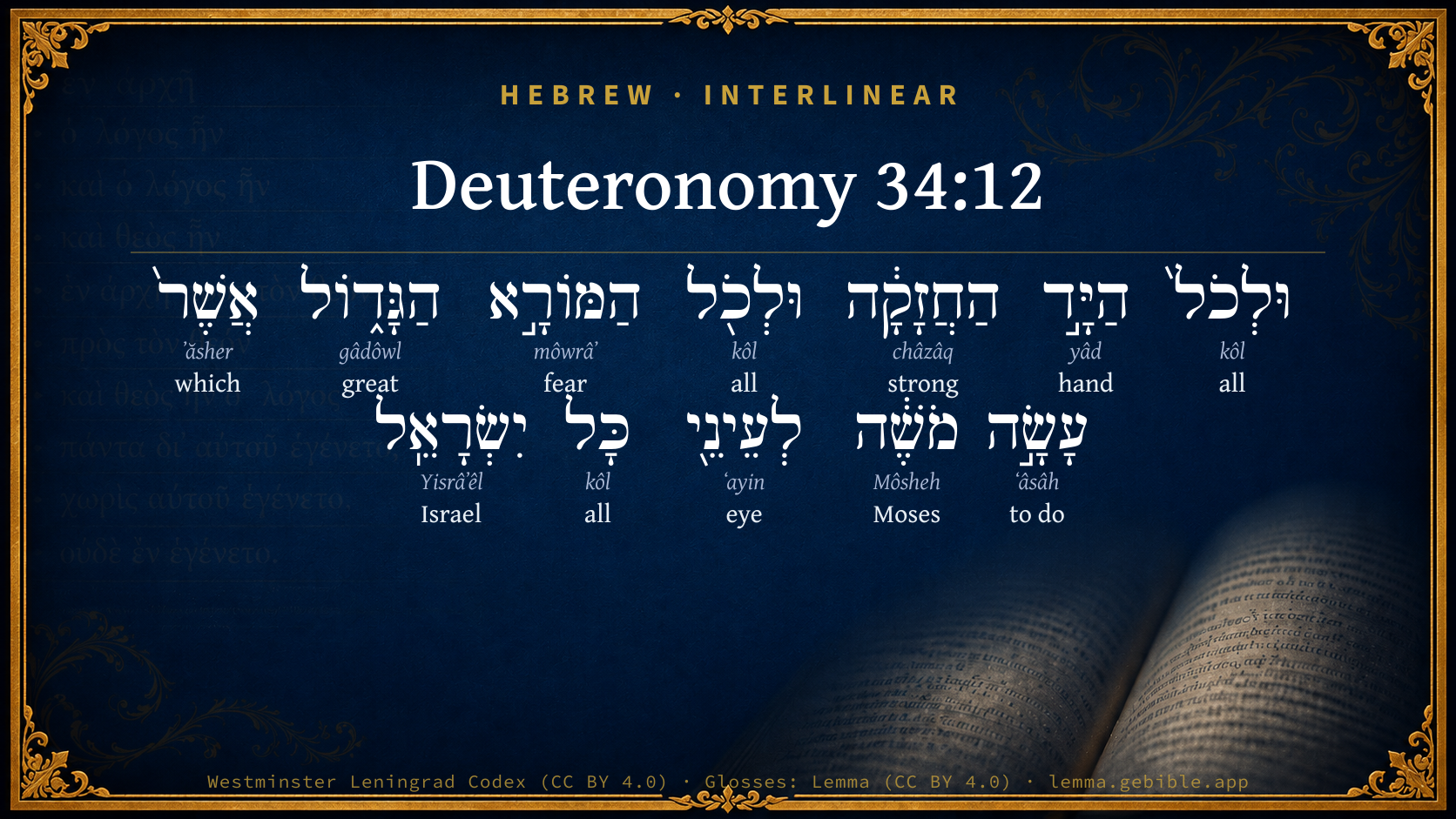
Hebrew (Westminster Leningrad Codex) Deuteronomy 34:12 appears in the Hebrew Old Testament. The text above is from the Westminster Leningrad Codex. Each word links to its Strong’s number, a concise gloss, and parsing drawn from the Open Scriptures Hebrew Bible morphology. Click any word for its full Brown-Driver-Briggs (BDB) entry.
Download image
Cite this verse

Deuteronomy 34:12 (World English Bible). Public Domain. Lemma interlinear Bible study tool, https://lemma.gebible.app/v/deuteronomy/34/12.

Show BibTeX & RIS
BibTeX
RIS
English Translation
and in all the mighty hand, and in all the great terror, which Moses worked in the sight of all Israel.
World English Bible · Public Domain
Download a study sheet

One document with this verse’s original text, its word-by-word gloss line, the meaning frame, cross-references with their text, attributed commentary, and full source and license credits — printable, and it pastes into notes with its structure intact.

This verse Autodidact and up

Study sheet (.html) Plain text (.txt)

A passage Seminary Student

Up to 50 verses in one chapter. A passage sheet keeps up to 6 commentary sources and 12 cross-references per verse, in the order this page ranks them, and says so on the sheet whenever that leaves anything out. Ask for a single verse and you get the Autodidact verse sheet above.

Everything on this page stays free to read, with no account — the sheet is a download of what is already on screen, not access to it.

Want to remove ads? Support Godless Engineer
Compare translations 3

The same verse in 3 English versions, stacked beneath the original-language interlinear above. Click any original word for its lexicon entry.

Each is an independent rendering of the whole verse — the interlinear is not word-aligned to these translations.

Highlighted words mark where these versions differ — a whole-verse word diff, not a word-by-word alignment.

  • World English Bible Public Domain
    and in all the mighty hand, and in all the great terror, which Moses worked in the sight of all Israel.
  • King James Version Public Domain
    And in all that mighty hand, and in all the great terror which Moses showed in the sight of all Israel.
  • unfoldingWord Literal Text CC BY-SA 4.0
    and for all the mighty hand and for all the fearsome great that Moses did before the eyes of all Israel.

unfoldingWord Literal Text — © unfoldingWord, licensed CC BY-SA 4.0. Word-aligned USFM3 via Door43 (git.door43.org/unfoldingWord/en_ult).

Versions to compare (up to 4)

3 of 4 selected

Show all 18 translations

Every available English version of this verse, each an independent rendering of the whole verse.

  • World English Bible Public Domain
    and in all the mighty hand, and in all the great terror, which Moses worked in the sight of all Israel.
  • Berean Standard Bible Public Domain
    and no prophet who performed all the mighty acts of power and awesome deeds that Moses did in the sight of all Israel.
  • Majority Standard Bible Public Domain
    and no prophet who performed all the mighty acts of power and awesome deeds that Moses did in the sight of all Israel.
  • King James Version Public Domain
    And in all that mighty hand, and in all the great terror which Moses showed in the sight of all Israel.
  • American Standard Version (1901) Public Domain
    and in all the mighty hand, and in all the great terror, which Moses wrought in the sight of all Israel.
  • Revised Version (1885) Public Domain
    and in all the mighty hand, and in all the great terror, which Moses wrought in the sight of all Israel.
  • Geneva Bible (1599) Public Domain
    And in all that mightie hand and all that great feare, which Moses wrought in the sight of all Israel.
  • Douay-Rheims (1899) Public Domain
    And all the mighty hand, and great miracles, which Moses did before all Israel.
  • Young's Literal Translation Public Domain
    and in reference to all the strong hand, and to all the great fear which Moses did before the eyes of all Israel.
  • Literal Standard Version CC BY-SA 4.0
    and in reference to all the strong hand and to all the great fear which Moses did before the eyes of all Israel.
  • Unlocked Literal Bible CC BY-SA 4.0
    There has never been any prophet like him in all the great, fearsome deeds that Moses did in the sight of all Israel.
  • unfoldingWord Literal Text CC BY-SA 4.0
    and for all the mighty hand and for all the fearsome great that Moses did before the eyes of all Israel.
  • Darby Bible Public Domain
    and according to all that mighty hand; and according to all the great terribleness that Moses had wrought in the sight of all Israel.
  • World Messianic Bible Public Domain
    and in all the mighty hand, and in all the awesome deeds, which Moses did in the sight of all Israel.
  • Webster's Bible Public Domain
    And in all that mighty hand, and in all the great terror which Moses showed in the sight of all Israel.
  • Free Bible Version CC BY-SA 4.0
    Moses did these amazing things with tremendous power as the Israelites watched.
  • Bible in Basic English Public Domain
    And in all the acts of power and fear which Moses did before the eyes of all Israel.
  • JPS Tanakh (1917) Public Domain
    and in all the mighty hand, and in all the great terror, which Moses wrought in the sight of all Israel.

Literal Standard Version (2020), Covenant Press — licensed CC BY-SA 4.0. Text via the HelloAO Bible API (eBible.org). Unlocked Literal Bible (unfoldingWord) — licensed CC BY-SA 4.0. Text via the HelloAO Bible API (eBible.org). unfoldingWord Literal Text — © unfoldingWord, licensed CC BY-SA 4.0. Word-aligned USFM3 via Door43 (git.door43.org/unfoldingWord/en_ult). Free Bible Version, Dr. Jonathan Gallagher — licensed CC BY-SA 4.0. Text via the HelloAO Bible API (eBible.org).

Word by word

More ways to search: Search by grammar → Find every occurrence → Compare this word →

Practice this passage: Drill this verse → Learn its vocabulary →

הַמּוֹרָ֣א
môwrâʼ
H4172
“the · fear”
Particle, Definite Article + Noun, Common, Masculine, Singular, Absolute
Part of Speech
Particle + Noun
Type
Common
Gender
Masculine
Number
Singular
State
Absolute
Full BDB Definition

Origin: from H3372

TWOT: 907c , 907d

fear, reverence, terror - fear, terror - reverence - object of reverence - awe-inspiring spectacle or deed
  1. וּלְכֹל֙ kôl H3605 “and · to/for · all of” Conjunction + Preposition + Noun, Common, Masculine, Singular, Construct
  2. הַיָּ֣ד yâd H3027 “the · hand” Particle, Definite Article + Noun, Common, Both, Singular, Absolute
  3. הַחֲזָקָ֔ה châzâq H2389 “the · strong” Particle, Definite Article + Adjective, Adjective, Feminine, Singular, Absolute
  4. וּלְכֹ֖ל kôl H3605 “and · to/for · all of” Conjunction + Preposition + Noun, Common, Masculine, Singular, Construct
  5. הַגָּד֑וֹל gâdôwl H1419 “the · great” Particle, Definite Article + Adjective, Adjective, Masculine, Singular, Absolute
  6. אֲשֶׁר֙ ʼăsher H834 “which” Particle, Relative
  7. עָשָׂ֣ה ʻâsâh H6213 “to do” Verb, Qal, Perfect, 3rd Person, Masculine, Singular
  8. מֹשֶׁ֔ה Môsheh H4872 “Moses” Noun, Proper
  9. לְעֵינֵ֖י ʻayin H5869 “to/for · eyes of” Preposition + Noun, Common, Both, Dual, Construct
  10. כָּל kôl H3605 “all of” Noun, Common, Masculine, Singular, Construct
  11. יִשְׂרָאֵֽל Yisrâʼêl H3478 “Israel” Noun, Proper

About this verse

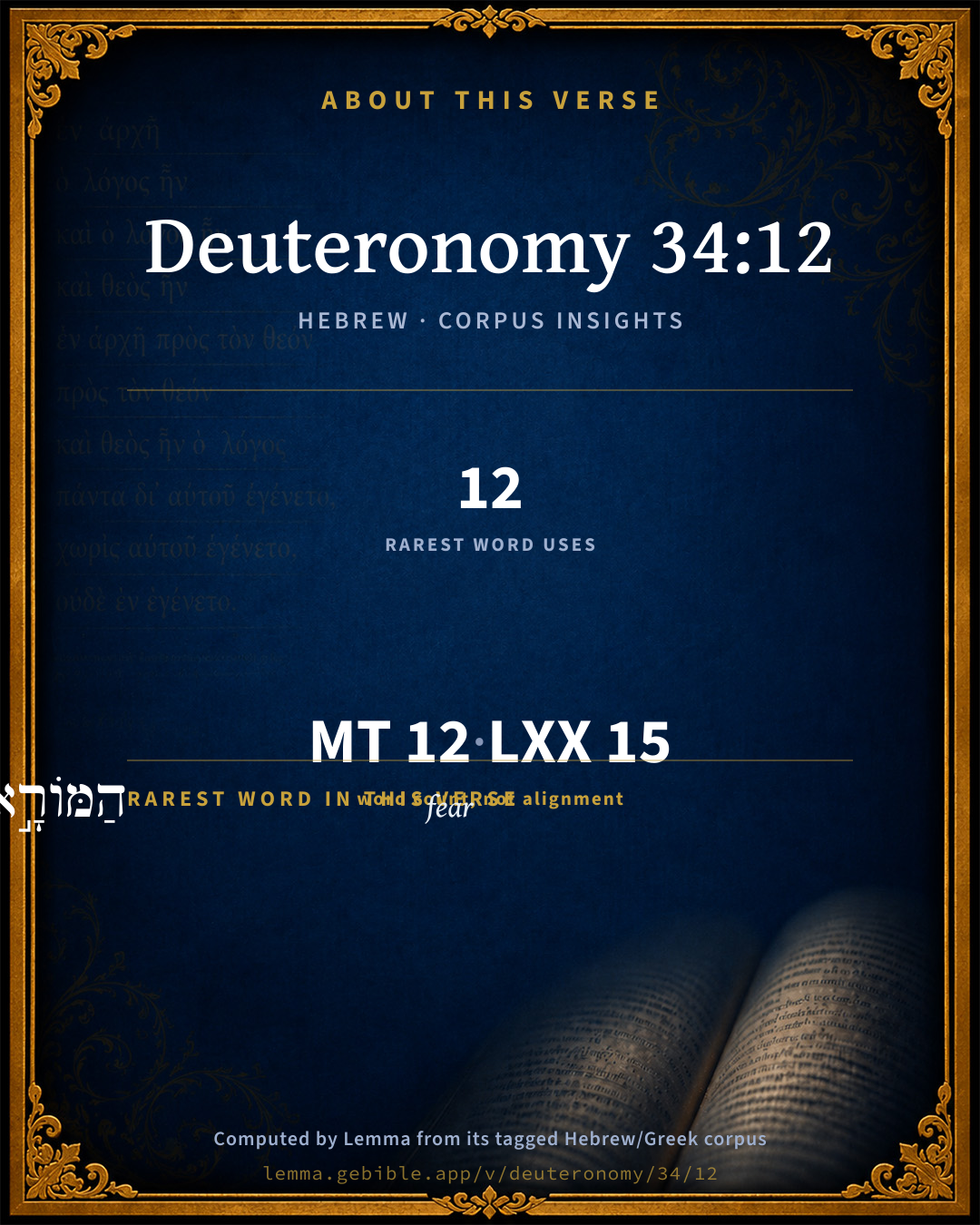
These counts appear in no published source. They are computed here, from the morphology-tagged text and Lemma’s own curated glosses. What Lemma adds →

12
words
10
distinct lemmas
Pentateuch
section

Notable vocabulary

The rarest word here is הַמּוֹרָ֣א fear H4172 — appearing just 12 times in the whole Hebrew Bible.

Shared distinctive vocabulary

הַמּוֹרָ֣א fear H4172 occurs in 12 verses of the Hebrew Bible. Also found in:

Grammatical profile

  • 1 verb
  • 8 nouns
  • 2 adjectives
  • 1 particle

Verb forms

  • עָשָׂ֣ה Qal · Perfect

Repetition

A word recurs within this verse — often emphatic in Hebrew:

  • וּלְכֹל֙ all H3605 ×3

Hebrew & Septuagint length

In English translation the verse runs 21 words from the Hebrew and 13 from the Septuagint (LXX English) — the Septuagint runs noticeably shorter here. See the side-by-side →

A rough comparison of the two English renderings, which tokenize alike — not a word-level alignment.

Word counts can differ between the Hebrew and the Greek without any difference in meaning — e.g. the Hebrew direct-object marker אֵת has no separate Greek word, and Greek often adds the article ὁ.

In the original languages it is 12 Hebrew tokens and 15 Greek tokens — but the two are counted differently (Hebrew bundles its prefixes and suffixes into one token; the Greek is in lemma form), so that isn’t a like-for-like length.

Hebrew and Greek witnesses Masoretic Hebrew ↔ Greek Septuagint

The same verse in the two great witnesses to the Old Testament, shown verse-for-verse.

Here the Septuagint runs noticeably shorter than the Hebrew — LXX2012 (modern English Septuagint) 13 words vs World English Bible 21. A rough length comparison of the two English translations, not a word-level alignment — read both below.

These are two independent witnesses, not word-aligned to each other, and the Septuagint is shown in lemma (dictionary) form.

Hebrew Deuteronomy 34:12 Masoretic · Westminster Leningrad Codex

וּלְכֹל֙ הַיָּ֣ד הַחֲזָקָ֔ה וּלְכֹ֖ל הַמּוֹרָ֣א הַגָּד֑וֹל אֲשֶׁר֙ עָשָׂ֣ה מֹשֶׁ֔ה לְעֵינֵ֖י כָּל יִשְׂרָאֵֽל

and in all the mighty hand, and in all the great terror, which Moses worked in the sight of all Israel.

World English Bible · Public Domain

Greek LXX Deuteronomy 34:12 Septuagint · lemma form

ὁ θαυμάσιος ὁ μέγας καί ὁ χείρ ὁ κραταιός ὅς ποιέω μωυσῆς ἔναντι πᾶς ἰσραήλ

the great wonders, and the mighty hand which Moses displayed before all Israel.

LXX2012 (modern English Septuagint) · Public Domain

Hebrew: Westminster Leningrad Codex (CC BY 4.0). Greek: Septuagint (public domain); English from LXX2012 (modern English Septuagint) (Public Domain). How the Septuagint differs from the Hebrew →

Targum (Aramaic paraphrase)

2

The Targum is the ancient Jewish Aramaic paraphrase of the Hebrew Scriptures — an interpretive translation, not the Hebrew text itself. Onkelos (literal) and Pseudo-Jonathan (expansive) render the Torah, and Jonathan the Prophets. Coverage is partial: where no permissively-licensed English translation exists for a verse, only the Aramaic is shown. This is verse-level text, not a word-by-word alignment to the Hebrew.

  1. Targum Onkelos Torah (Genesis–Deuteronomy)
    וּלְכֹל יְדָא תַקֶפְתָּא וּלְכֹל חֵזְוָנָא רַבָּא דִי עֲבַד מֹשֶׁה לְעֵינֵי כָּל יִשְׂרָאֵל

    (no public-domain English translation for this verse)

    Targum Onkelos — Aramaic: “Onkelos Genesis” (public domain); “Onkelos Exodus” (public domain); “Onkelos Leviticus” (public domain); “Onkelos Numbers” (public domain); “Onkelos Deuteronomy” (public domain). English: “Sefaria Community Translation” (CC0 1.0 (public-domain dedication)); “J.W. Etheridge. The Targums of Onkelos and Jonathan Ben Uzziel on the Pentateuch. London: Longmans, Green, 1862” (public domain). Text via Sefaria.

  2. Targum Pseudo-Jonathan Torah (Genesis–Deuteronomy)
    וּלְכָל גְבוּרַת יְדָא תַקִיפְתָּא הֵיךְ סוֹבַר יַת חוּטְרָא דְמַתְקְלֵיהּ אַרְבְּעִין סָאִין וּבְזַע יַת יַמָא וּמְחָא יַת כֵּיפָא וּלְכָל דְחֵיל רַב דְעָבַד משֶׁה בִּזְמַן דְקַבֵּל תְּרֵין לוּחֵי אֲבַן סַמְפִּירִינוֹן וּמַתְקַלְהוֹן אַרְבְּעִין סָאוִין וְסוֹבְרִינוּן בְּתַרְתֵּין יְדוֹי לְמֵיחְמֵהוֹן דְכוּלְהוֹן יִשְרָאֵל

    and in all the strength of the Mighty Hand by which he bare the rod whose weight was forty savin and that divided the sea, and smote the rock; and in all the solemn things which Mosheh did when he received the two tables of sapphire stone, whose weight was forty savin, and carried both of them in his hands in the sight of all Israel.

    Targum Pseudo-Jonathan — Aramaic: “Targum Jonathan on Genesis” (public domain); “Targum Jonathan on Exodus” (public domain); “Targum Jonathan on Leviticus” (public domain); “Targum Jonathan on Numbers” (public domain); “Targum Jonathan on Deuteronomy” (public domain). English: “The Targum of Jonathan ben Uzziel, trans. J. W. Etheridge, London, 1862” (public domain). Text via Sefaria.

Commentary

Notes on Deuteronomy 34:12 from classic Christian and Jewish commentators (each source and its license shown beneath its notes). The classic Christian expositions comment on the surrounding passage and are grouped to its opening verse, so a note may address several verses; the Jewish commentaries on the Tanakh (Rashi and others) are per-verse, so they appear only where the commentator wrote on this verse.

Lemma curates 59 commentaries, every one of them public domain or Creative Commons licensed, each selected and text-cleaned for this edition rather than reprinted as found. About our sources →

Trapp's Complete Commentary

John Trapp

Deu 34:12 And in all that mighty hand, and in all the great terror which Moses shewed in the sight of all Israel.

Ver. 12. {See Trapp on "Deu 34:11"}

John Trapp, A Commentary or Exposition upon All the Books of the Old and New Testament (1647–1656) — public domain. Text from a community e-Sword module.

Tyndale Open Study Notes

Tyndale Open Resources

34:12 terrifying acts in the sight of all Israel: The people of Israel as well as the Egyptians were impressed by the power of God. They needed a constant reminder to submit to him in reverential fear (see 4:10; 5:29; 6:2; Prov 1:7).

Tyndale Open Study Notes — © Tyndale Open Resources, licensed CC BY-SA 4.0. Text via the HelloAO Bible API.

Geneva Bible (1599)

Geneva Bible translators

Meaning, the power of God working by Moses in the wilderness.

Geneva Bible (1599) marginal notes — public domain. Text via Bolls.life.

Adam Clarke's Commentary

GENERAL OBSERVATIONS ON THE FIVE BOOKS OF MOSES

WE have now passed through the Pentateuch, and have endeavoured carefully to mark its important contents. Its antiquity sets it at the head of all the writings in the world; and the various subjects it embraces make it of the utmost consequence to every civilized part of the earth. Its philosophy, jurisprudence, history, geography, and chronology, entitle it to the respect of the whole human race; while its system of theology and religion demonstrably prove it to be a revelation from GOD. But on these topics, as many observations have already been made as the nature of a commentary professing to study brevity can possibly admit.

Of MOSES, the writer of the Pentateuch, considered as a historian and philosopher, a great deal has been said in the course of the notes on the book of GENESIS; and especially at the conclusion of the fiftieth chapter; to which the reader is particularly referred. See Clarke on Ge 50:26.

Of Moses as a legislator, volumes might be written, and the subject not be exhausted. What is called the Law of Moses, is more properly the Law of God; and Torath Yehovah, the Law of Jehovah, is the grand title of the Pentateuch. Such a definition of this term as comports with the nature, structure, and design of the Pentateuch, has already been given in the note, See Clarke on Ex 12:40, to which the reader is requested to refer. Could we conceive Moses to have been the author of this system, we must consider him more than mortal: no wisdom of man has ever yet been able to invent such a code of laws.

This merit however has been disputed, and his laws severely criticised by certain persons whose interest it was to prove religion to be a cheat, because they had none themselves; and whose case must be hopeless could it be proved to be true. To some whose mental taste and feeling are strangely perverted, every thing in heathenism wears not only the most fascinating aspect, but appears to lay claim to and possess every excellence. These have called up Confucius, Menu, Zoroaster, and Mohammed himself, to dispute the palm of excellence with Moses! To examine the claims of such competitors, and to decide on their respective merits would require a large treatise, and my limits confine me to a sketch. To any godly, impartial mind, properly acquainted with the subject, little needs to be said; to those who are prejudiced, all reasoning is thrown away. A few words on the merit of each of these competitors must suffice.

1. To Con fu tsee, the great Chinese lawgiver, corruptly called Confucius, are attributed, in the records of his country, a number of ordinances and institutions which do honour to his times and to his people; but alas! how much of the darkness, erroneousness, and infirmity of the human mind do they exhibit! And however profitable they may be, as prudential maxims and social regulations to a certain extent, how little are they calculated to elevate or ennoble the human mind, or inspire men with a just notion of vice and virtue! Their author had no correct notion of the Divine nature; his laws had no sanction but that of convenience or necessity, and, notwithstanding their boasted excellence, have left, from the time of their promulgation to the present day, the sum total of that immense nation which profess to be governed by them, in the thickest darkness of the most degrading idolatry, closely verging upon atheism itself! Not so the Mosaic code; it was the light that lightened the universe, and the glory of the people who were governed by its dictates. We have the firmest ground and the most ample authority to assert, that the greatest kings, the wisest statesmen, the most accomplished poets and rhetoricians, the most magnanimous heroes, and the most holy and useful people that ever existed, were formed on the model, and brought up in the bosom and under the influence, of the Mosaic institutions. While the Proverbs and Ecclesiastes of SOLOMON, the history and poetic compositions of DAVID, the inimitable discourses of ISAIAH, JEREMIAH, JOEL, HABAKKUK, and others of the Jewish prophets remain, every intelligent reader will have the fullest proofs of the truth of the above assertion, which shrinks not under the pretence of being hazarded; but which must spring up in every ingenuous mind, from the fullest conviction of its own truth, after a serious perusal of the sacred code in question. All those eminent personages were brought up in the Mosaic school and were prepared by the Pentateuch for the prophetic influence.

2. The Institutes of MENU, lately clothed in an English dress by the elegant hand of Sir William Jones, have been thought to stand in fair competition with the laws of Moses. I have read them carefully, with strong prejudice in their favour; and have endeavoured, to the best of my judgment, duly to appreciate their worth. I have sought for resemblances to the Mosaic institutions, because I thought it possible that the same God who was so fully known in Jewry, might have made at least a partial revelation of himself in Hindostan; but while I alternately admired and regretted, I was ultimately disappointed, as I plainly saw that the system in its essential parts lacked the seal of the living God. My readers may justly question my competency to form a correct opinion of the work under consideration - I shall not therefore obtrude it, but substitute that of the translator, who was better qualified than perhaps any other man in Europe or Asia, to form a correct judgment of its merits. "The work," says he, "now presented to the European world, contains abundance of curious matter, extremely interesting both to speculative lawyers and antiquaries; with many beauties which need not be pointed out, and with many blemishes which cannot be justified or palliated. It is a system of despotism and priestcraft, both indeed limited by law, but artfully conspiring to give mutual support though with mutual checks. It is filled with strange conceits in metaphysics and natural philosophy; with idle superstitions, and with a scheme of theology most obscurely figurative, and consequently liable to dangerous misconception. It abounds with minute and childish formalities, with ceremonies generally absurd and often ridiculous; the punishments are partial and fanciful; for some crimes dreadfully cruel, and for others reprehensibly slight; and the very morals, though rigid enough on the whole, are in one or two instances, as in the case of light oaths and pious perjury, unaccountably relaxed." - PREFACE to the Institutes of Menu.

We may defy its enemies to prove any of these things against the Pentateuch. Priestcraft and despotism cannot appear under its sanction: GOD is KING alone, and the priest his servant; and he who was prevented, by the very law under which he ministered, from having any earthly property, could consequently have no secular power. The king, who was afterwards chosen, was ever considered as God's deputy or vice-gerent; he was obliged to rule according to the laws that were given by God through Moses, and was never permitted either to change them, or add a single precept or rite to the civil or sacred code of his country. Thus despotism and priestcraft were equally precluded. As to its rites and ceremonies, they are at once dignified and expressive; they point out the holiness of their author, the sinfulness of man, the necessity of an atonement, and the state of moral excellence to which the grace and mercy of the Creator have promised to raise the human soul. As to its punishments, they are ever such as the nature and circumstances of the crime render just and necessary - and its rewards are not such as flow merely from a principle of retribution or remunerative justice, but from an enlightened and fatherly tenderness, which makes obedience to the laws the highest interest of the subject.

At the same time that love to God and obedience to his commandments are strongly inculcated, love and benevolence to man are equally enforced, together with piety, which is the soul of obedience, patriotism, the life of society; hospitality to strangers, and humanity to the whole brute creation. To all this might be added that it includes in it, as well as points out, the Gospel of the Son of God, from which it receives its consummation and perfection. Such, reader, is the law of God given through Moses to the people of Israel.

3. Of the laws of Zerdust or Zeratusht, commonly called Zoroaster, It is unnecessary to speak at large; they are incapable of comparison with the Mosaic code. As delivered in the Zend Avesta, they cannot so properly be called a system as a congeries of puerility, superstition, and absurdity; with scarcely a precept or a rite that has any tendency to elevate the mind, or raise man from his state of moral degradation to a proper rank in civilized society, or to any worthy apprehension of the Maker and Governor of the universe. Harmlessness is the sum of the morality they seem to inculcate, with a certain superstitious reverence for fire, probably as the emblem of purity; and for animal life, principally in reference to the doctrine of the Metempsychosis or transmigration of souls, on which it seems to have been originally built.

4. The KORAN of MOHAMMED is the only remaining competitor that can be supposed to be at all qualified to dispute the palm with the Pentateuch of Moses; but the pretensions of this production will be soon settled, when it is known that it possesses not one excellence, the purity and elegance of its language excepted, which it has not borrowed from the writings of Moses and the prophets, or the sayings of Christ and his apostles. This is a fact which none can successfully dispute, and of which the Koran itself bears the most unequivocal evidences. What can be fairly claimed as the peculium of the Arab lawgiver makes a motley mixture with what he has stolen from the book of God, and is in general as absurd and weak as it is on the whole false and wicked. As to the boasted morality of the Koran, it will have as little to exult in of this kind when the law and the Gospel have taken from it that of which they have been plundered, as the daw in the fable had when the different fowls had plucked away their own feathers, with which the vain bird had decorated herself. Mohammed, it is true, destroyed idolatry wherever he came; and he did the same by true religion; for Judaism and Christianity met with no more quarter from him than the grossest errors of pagan idolatry. To compare him with the pure, holy, disinterested, humane, and heavenly-minded Jewish legislator, would be as gross political as it would be palpable religious blasphemy. When we allow that he was a man of a deep and penetrating mind, well acquainted with the superstitious turn of his countrymen; austere, cunning, and hypocritical; a great general and a brutal conqueror, who seemed to sacrifice at no other shrine than that of his lust and ambition, we do him no injustice: the whole of his system bears the most evident proofs of imposition and forgery; nor is there a character to which imposture can lay claim that does not appear prominently in the Koran, and in every part of the Mohammedan system. The chief of these distinctive marks have already been examined in reference to the Pentateuch, in the concluding note on Exod. xviii. These are all found in the Koran, but not one of them in the Pentateuch. The Pentateuch therefore is of God; the Koran came from another quarter.

5. The different systems of the Grecian ethic philosophers cannot come into this inquiry. They were in general incongruous and contradictory, and none of them was ever capable of forming a sect that could be said to have any moral perpetuity.

6. The laws of Lycurgus and Solon could not preserve those states, at the basis of which they were laid; which the laws of Moses have been the means of preserving the people who held them, amidst the most terrible reverses of what are called fortune and fate, for nearly the space of 4,000 years! This is one of the most extraordinary and astonishing facts in the whole history of mankind.

7. The republic of Plato, of which it is fashionable to boast, is, when stripped of what it has borrowed from Moses, like the Utopia of Sir T. More, the aerial figment of a philosophic mind, en delire; both systems are inapplicable and impracticable in the present state of man. To persons under the influence of various and discordant passions, strongly actuated by self-interest, they can never apply. They have no tendency to change the moral state of society from vice to virtue: a nation of saints might agree to regulate their lives and conduct by them, but where is such to be found? Though Plato has borrowed much from Moses, yet he has destroyed the effect of the whole by not referring the precepts and maxims to God, by whom alone strength to fulfil them could be furnished. It is the province of the revelation of God to make the knave an honest man; the unholy and profane, pure and pious; and to cause all who act by its dictates to love one another with pure hearts fervently, and to feel the finest and fullest impressions of

"The generous mind that's not confined at home,

But spreads itself abroad through all the public,

And feels for every member of the land."

Adam Clarke's Commentary on the Bible (1810–1826) — public domain. Text from a community e-Sword/MySword module.

John Gill's Exposition

And in all that mighty hand,.... In all done by his hand, which he stretched out over the sea and divided, to make a passage through it for the Israelites, and with his rod in it smote the rocks, and waters gushed out for them:

and in all that great terror which Moses showed in the sight of all Israel; meaning either the terror the Egyptians were struck with by him, in the sight of all Israel, when he publicly and before them wrought the wonders he did in the land of Ham, which often threw them into a panic, especially the thunders and lightning, the three days darkness, and the slaying of their firstborn; see Psa 78:49; or the terror the Israelites were in at the giving and receiving of the law, Exo 19:16.

Next: Joshua Introduction

John Gill's Exposition of the Whole Bible (1746–1763) — public domain (CC PDM 1.0). Text via the HelloAO Bible API.

John Wesley's Explanatory Notes

Moses was greater than any other of the prophets of the Old Testament. By Moses God gave the law, and molded and formed the Jewish church. By the other prophets he only sent particular reproofs, directions and predictions. But as far as the other prophets came short of him, our Lord Jesus went beyond him. Moses was faithful as a servant, but Christ as a son: his miracles more illustrious, his communion with the father more intimate: for he is in his bosom from eternity. Moses lies buried: but Christ is sitting at the right-hand of God, and of the increase of his government there shall be no end.

John Wesley, Explanatory Notes Upon the Whole Bible (1754–1765) — public domain. Text via the GEBible commentary corpus.

Rashi

Rabbi Shlomo Yitzchaki (Rashi)

ולכל היד החזקה AND IN ALL THAT STRONG HAND — this refers to the fact that he received the Torah that was on the Tablets, in his hands.

ולכל המורא הגדול AND IN ALL THAT GREAT TERRIBLENESS — the miracles and mighty deeds that were wrought in the great and terrible wilderness (cf. (Sifrei Devarim 357:45).

לעיני כל ישראל [WHICH MOSES SHOWED] BEFORE THE EYES OF ALL ISRAEL — This refers to the fact that his heart inspired him to shatter the Tablets before their eyes, as it is said, (Deuteronomy 9:17) “And I broke them before your eyes” (Sifrei Devarim 357:45), and the opinion of the Holy One, blessed be He, regarding this action agreed with his opinion, as it is stated that God said of the Tablets, (Exodus 34:1) אשר שברת "Which you have broken", [which implies] "May your strength be fitting (יישר; an expression of thanks and congratulation) because you have broken them" (Yevamot 62a; Shabbat 87a).

Rashi on the Tanakh — English translations: “The Judaica Press complete Tanach with Rashi, translated by A. J. Rosenberg” (CC BY 4.0); “Pentateuch with Rashi's commentary by M. Rosenbaum and A.M. Silbermann, 1929-1934” (public domain); “The Metsudah Tanach series, Lakewood, N.J” (CC BY 4.0); and “The Book of Joshua, Metsudah Publications, 1997” (CC BY 4.0). Text via Sefaria.

Ramban (Nachmanides)

Rabbi Moshe ben Nachman (Ramban / Nachmanides)

AND IN ALL THE MIGHTY HAND. This alludes to the division of the Red Sea concerning which it is said, And Israel saw the great hand. AND IN ALL THE GREAT TERROR. This is a reference to the Revelation ) at Mount Sinai.” See Vol. II, p. 251, Note 17. concerning which it is stated and that His fear may be before you. He mentioned concerning these [two events] that they were done in the sight of all Israel, because he had already referred to all that was done to Pharaoh, and to all his servants, and to all his land. And in the Sifre it is stated:. “And in all the mighty hand — this refers to the smiting of the firstborn, about which it is said, for by a mighty hand shall he send them away. And in all the great terror — this alludes to the division of the Red Sea. Another interpretation: And in all the great terror — this is the Giving of the Torah.”And by way of the Truth, [the mystic teachings of the Cabala], the mighty hand is the attribute of justice, similar to the expressions: the hand of the Eternal was upon me; for the hand of the Eternal hath wrought this. Therefore it is said with reference to [His] judgment, for the hand of the Eternal is gone forth against me. And the great terror is the attribute of mercy, similar to what is written, Him shall ye sanctify, and let Him be your fear. The Rabbis in the Sifre. meant this when referring to the smiting of the firstborn [which was done by the mighty hand, alluding to the attribute of justice] and the division of the Red Sea [which is alluded to in the phrase and in all the great terror referring to the attribute of mercy], for concerning them it is written, to make Thyself a Glorious Name., 63:14. The rescue of Israel at the Red Sea displayed G-d’s mercy to His people just as the retributive punishment upon the Egyptian firstborn manifested His justice. Both were to make Him a glorious Name.

WHICH MOSES ‘ASAH’ (WROUGHT) — for he prepared and displayed it in the sight of all the people. It is similar to the expressions: and the souls that they ‘asu’ (made) in Haran;, i.e., which Abraham and Sarah brought beneath the sheltering wings of the Divine Presence.” (Rashi). and he hastened ‘la’asoth’ (to make) it;, 18:7. Make, i.e., the servant “dressed” the meat. ‘la’asoth’ (to make) the Sabbath-day., i.e., to “keep” the Sabbath. For Moses did not make the mighty hand and the great terror, he merely arranged [that they be displayed by G-d], and for His sake they were wrought in the sight of all Israel.

Completed are these five books [of the Torah],In which the wisdom of Agur and Ithiel was little.And thousands of blessings to G-d,Who hath bestowed on me according to His compassions,And according to the multitude of His mercies, And bring him whom my heart requests,And He for His Name’s sake consent thereto,And a redeemer will come to Zion!, 59:20.Speedily in our days-may Michael stand up, To build the House [of G-d] and the Ariel, is a reference to the altar.And fulfill the verse written by Ezekiel,And the nations shall know,That I am the Eternal that sanctify Israel,When My Sanctuary shall be in the midst of them, forever.

And blessed be the Eternal, the G-d of Israel,From everlasting even to everlasting. I have found ” he proceeds now in a concluding note to refer to the approaching time of redemption when “G-d will go forth from attribute to attribute — from the attribute of justice to that of mercy to hasten the redemption.” in Midrash Mishlei the following text: “When the Sanhedrin wanted to count Solomon among the three kings and four commoners [that have no share in the World to Come], the Divine Glory stood up before the Holy One, blessed be He, and said: ‘Sovereign of the universe! Seest thou a man diligent in his work? he shall stand before kings etc.’” [in the World to Come] and he shall not stand before mean men [together with those who have no share in the World to Come]. (Rashi Sanhedrin 104b). And in our Gemara, in Chapter Cheilek [the same text is stated in the following way]: “A vision of [Solomon’s] father’s face appeared and prostrated itself before [the members of the Sanhedrin] etc.” And in the Yerushalmi it is stated: “David came and prostrated himself before them.” All these texts mean to express the same thought, namely, that the Holy One, blessed be He, “cometh forth and goeth forth from attribute to attribute; He cometh forth from the attribute of justice, and goeth to the attribute of mercy,” this being “the attribute of David,” just as the Rabbis have said with reference to the sanctification of the moon, “David king of Israel ever lives.” The student learned [in the mysteries of the Torah] will understand.

Ramban (Nachmanides) on the Tanakh — English translation: “Commentary on the Torah by Ramban (Nachmanides). Translated and annotated by Charles B. Chavel. New York, Shilo Pub. House, 1971-1976” (CC BY 4.0). Text via Sefaria.

Ibn Ezra

Rabbi Abraham ibn Ezra

And for the entire strong hand. This refers to the miracles at the Sea of Reeds.

And for the entire great display. This refers to the giving of the Torah at Mount Sinai.

Ibn Ezra on the Tanakh — English translations: “Sefaria Community Translation” (CC0 1.0 (public-domain dedication)); “Yalkut, Sifsei Chachomim Chumash, Metsudah Publications, 2009” (CC BY 4.0); and “Commentary of Ibn Ezra on Isaiah - trans. by M. Friedlander, 1873” (public domain). Text via Sefaria.

Lesson kit

Teaching starters — assembled from the data on this page, not authored interpretation. Every prompt links to the verse data it draws on. Edit before teaching.

Deuteronomy, in the Pentateuch, opens this verse with 12 words (10 distinct Hebrew lemmas). Its most distinctive word is môwrâʼ (“fear”). The Greek Septuagint runs shorter here. A historical commentator’s framing appears above. Read the whole chapter for the surrounding context.

Discussion questions

  1. How does “fear” (môwrâʼ) shape what this verse is saying?
  2. How does Genesis 9:2, which shares the word «fear», read alongside this verse?
  3. What does the repetition of “all” (3× in this one verse) do in this verse?
  4. The Septuagint runs shorter here than the Hebrew. What might account for the difference?
  5. These translations render this verse differently; the difference is in the English rendering, not the original. What questions does that raise?
  6. «עָשָׂ֣ה» is a Qal Perfect verb. How does that grammatical form shape the action described?
  7. Compare how Trapp's Complete Commentary and Tyndale Open Study Notes read this verse. Where do they agree or differ?

Things to notice

Reading settings

Reading text

Shown beneath each verse's original-language words.

Old Testament
Old Testament edition

Read the OT as the Masoretic Hebrew (MT) or the Greek Septuagint (LXX).

English shown for the Greek Septuagint (in the Hebrew ↔ Greek comparison).

Comparing translations? Open the Compare panel on any verse page to stack up to four side by side.