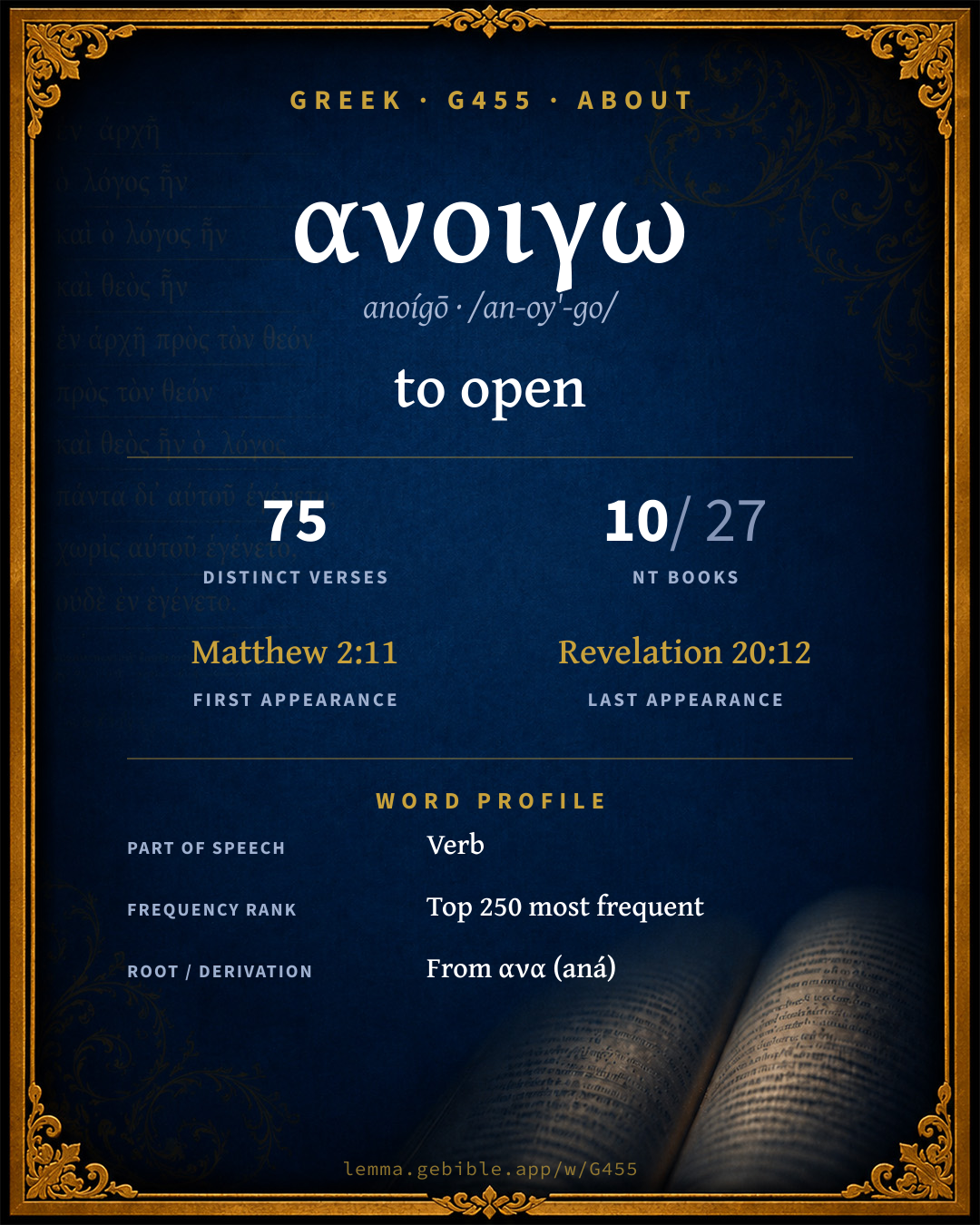
ἀνοίγω
to open
Full lexicon entry — Thayer's Greek Lexicon
From Thayer's Greek Lexicon
Where this word appears
See every Aorist-tense verb in the Greek New Testament →
Grammar key — what these labels mean
Part of speech
- Verb
- An action or state-of-being word.
Tense
- Aorist
- Action viewed as a simple whole, without regard to duration — often past (perfective aspect).
- Future
- Action expected in future time.
- Perfect
- A completed past action with continuing present results.
- Present
- Ongoing or general action in present time (imperfective aspect).
Voice
- Active
- The subject performs the action.
- Passive
- The subject receives the action.
Mood
- Indicative
- States a fact or asks a factual question (the mood of reality).
- Infinitive
- A verbal noun (“to write”), unmarked for person or number.
- Participle
- A verbal adjective (“writing,” “having written”).
- Imperative
- Expresses a command or request.
- Subjunctive
- Expresses probability, purpose, or possibility (the mood of contingency).
Case
- Nominative
- The case of the subject (and the predicate nominative).
- Accusative
- The case of the direct object and of extent.
- Genitive
- The case of source, possession, or “of” — answers “whose / from what.”
Person
- 3rd person
- The one spoken about (“he / she / it / they”).
- 2nd person
- The one addressed (“you”).
- 1st person
- The speaker (“I / we”).
Gender
- Masculine
- Grammatically masculine.
- Neuter
- Grammatically neuter.
- Feminine
- Grammatically feminine.
Number
- Singular
- One.
- Plural
- More than one.
Grammatical forms 27 distinct
- Verb, Aorist, Active, Indicative, 3rd person, Singular 19 times (25%)
- Verb, Aorist, Active, Infinitive 7 times (9%)
- Verb, Aorist, Passive, Indicative, 3rd person, Plural 7 times (9%)
- Verb, Aorist, Active, Participle, Nominative, Singular, Masculine 6 times (8%)
- Verb, Aorist, Passive, Indicative, 3rd person, Singular 5 times (6%)
- Verb, Future, Passive, Indicative, 3rd person, Singular 4 times (5%)
- Verb, Aorist, Active, Participle, Nominative, Plural, Masculine 3 times (4%)
- Verb, Perfect, Active, Indicative, 3rd person, Singular 2 times (3%)
+19 more forms (24 occurrences)
Parsed forms decoded from the imported morphology (Robinson–Tischendorf, public domain), counted across 77 parsed occurrences — not distinct verses.
Every verse where G455 appears — 75 distinct verses across 10 books. Click any verse to open its interlinear word-by-word view. Verse text shown in the World English Bible for context — . Each verse’s Greek form is shown with its reference; the English is not keyword-highlighted, since the data carries no word-level English alignment. Use “Compare translations” on any verse to read it across multiple English versions. This concordance covers the Greek New Testament; Septuagint (Greek Old Testament) occurrences of this word are not indexed here.
Matthew 11 verses
- Matthew 2:11 ἀνοίξαντες aor act ptcp nom pl masc They came into the house and saw the young child with Mary, his mother, and they fell down and worshiped him. Opening their treasures, they offered to him gifts: gold, frankincense, and myrrh.
- Matthew 3:16 ἀνεῴχθησαν aor pass ind 3pl Jesus, when he was baptized, went up directly from the water: and behold, the heavens were opened to him. He saw the Spirit of God descending as a dove, and coming on him.
- Matthew 5:2 ἀνοίξας aor act ptcp nom sg masc He opened his mouth and taught them, saying,
- Matthew 7:7 ἀνοιγήσεται fut pass ind 3sg "Ask, and it will be given you. Seek, and you will find. Knock, and it will be opened for you.
- Matthew 7:8 ἀνοιγήσεται fut pass ind 3sg For everyone who asks receives. He who seeks finds. To him who knocks it will be opened.
- Matthew 9:30 ἀνεῴχθησαν aor pass ind 3pl Their eyes were opened. Jesus strictly charged them, saying, "See that no one knows about this."
- Matthew 13:35 ἀνοίξω fut act ind 1sg that it might be fulfilled which was spoken through the prophet, saying, "I will open my mouth in parables; I will utter things hidden from the foundation of the world."
- Matthew 17:27 ἀνοίξας aor act ptcp nom sg masc But, lest we cause them to stumble, go to the sea, and cast a hook, and take up the first fish that comes up. When you have opened its mouth, you will find a stater coin. Take that, and give it to them for me and you."
- Matthew 20:33 ἀνοιγῶσιν aor pass subj 3pl They told him, "Lord, that our eyes may be opened."
- Matthew 25:11 ἄνοιξον aor act impv 2sg Afterward the other virgins also came, saying, 'Lord, Lord, open to us.'
- Matthew 27:52 ἀνεῴχθησαν aor pass ind 3pl The tombs were opened, and many bodies of the saints who had fallen asleep were raised;
Mark 1 verse
Luke 6 verses
- Luke 1:64 ἀνεῴχθη aor pass ind 3sg His mouth was opened immediately, and his tongue freed, and he spoke, blessing God.
- Luke 3:21 ἀνεῳχθῆναι aor pass inf Now it happened, when all the people were baptized, Jesus also had been baptized, and was praying. The sky was opened,
- Luke 11:9 ἀνοιχθήσεται fut pass ind 3sg "I tell you, keep asking, and it will be given you. Keep seeking, and you will find. Keep knocking, and it will be opened to you.
- Luke 11:10 ἀνοιχθήσεται fut pass ind 3sg For everyone who asks receives. He who seeks finds. To him who knocks it will be opened.
- Luke 12:36 ἀνοίξωσιν aor act subj 3pl Be like men watching for their lord, when he returns from the marriage feast; that, when he comes and knocks, they may immediately open to him.
- Luke 13:25 ἄνοιξον aor act impv 2sg When once the master of the house has risen up, and has shut the door, and you begin to stand outside, and to knock at the door, saying, 'Lord, Lord, open to us!' then he will answer and tell you, 'I don't know you or where you come from.'
John 11 verses
- John 1:52 ἀνεῳγότα perf act ptcp acc sg masc
- John 9:10 ἠνεῴχθησάν aor pass ind 3pl They therefore were asking him, "How were your eyes opened?"
- John 9:14 ἀνέῳξεν aor act ind 3sg It was a Sabbath when Jesus made the mud and opened his eyes.
- John 9:17 ἤνοιξέν aor act ind 3sg Therefore they asked the blind man again, "What do you say about him, because he opened your eyes?" He said, "He is a prophet."
- John 9:21 ἤνοιξεν aor act ind 3sg but how he now sees, we don't know; or who opened his eyes, we don't know. He is of age. Ask him. He will speak for himself."
- John 9:26 ἤνοιξέν aor act ind 3sg They said to him again, "What did he do to you? How did he open your eyes?"
- John 9:30 ἤνοιξέν aor act ind 3sg The man answered them, "How amazing! You don't know where he comes from, yet he opened my eyes.
- John 9:32 ἤνοιξέν aor act ind 3sg Since the world began it has never been heard of that anyone opened the eyes of someone born blind.
- John 10:3 ἀνοίγει pres act ind 3sg The gatekeeper opens the gate for him, and the sheep listen to his voice. He calls his own sheep by name, and leads them out.
- John 10:21 ἀνοῖξαι aor act inf Others said, "These are not the sayings of one possessed by a demon. It isn't possible for a demon to open the eyes of the blind, is it?"
- John 11:37 ἀνοίξας aor act ptcp nom sg masc Some of them said, "Couldn't this man, who opened the eyes of him who was blind, have also kept this man from dying?"
Acts 16 verses
- Acts 5:19 ἀνοίξας aor act ptcp nom sg masc But an angel of the Lord opened the prison doors by night, and brought them out, and said,
- Acts 5:23 ἀνοίξαντες aor act ptcp nom pl masc "We found the prison shut and locked, and the guards standing before the doors, but when we opened them, we found no one inside!"
- Acts 8:32 ἀνοίγει pres act ind 3sg Now the passage of the Scripture which he was reading was this, "He was led as a sheep to the slaughter. As a lamb before his shearer is silent, So he doesn't open his mouth.
- Acts 8:35 ἀνοίξας aor act ptcp nom sg masc Philip opened his mouth, and beginning from this Scripture, preached to him Jesus.
- Acts 9:8 ἠνοιγμένων perf pass ptcp gen pl masc Saul arose from the ground, and when his eyes were opened, he saw no one. They led him by the hand, and brought him into Damascus.
- Acts 9:40 ἤνοιξεν aor act ind 3sg Peter put them all out, and kneeled down and prayed. Turning to the body, he said, "Tabitha, get up!" She opened her eyes, and when she saw Peter, she sat up.
- Acts 10:11 ἀνεῳγμένον perf pass ptcp acc sg masc He saw heaven opened and a certain container descending to him, like a great sheet let down by four corners on the earth,
- Acts 10:34 Ἀνοίξας aor act ptcp nom sg masc Peter opened his mouth and said, "Truly I perceive that God doesn't show favoritism;
- Acts 12:10 ἠνοίγη aor pass ind 3sg When they were past the first and the second guard, they came to the iron gate that leads into the city, which opened to them by itself. They went out, and went down one street, and immediately the angel departed from him.
- Acts 12:14 ἤνοιξεν aor act ind 3sg When she recognized Peter's voice, she didn't open the gate for joy, but ran in, and reported that Peter was standing in front of the gate.
- Acts 12:16 ἀνοίξαντες aor act ptcp nom pl masc But Peter continued knocking. When they had opened, they saw him, and were amazed.
- Acts 14:27 ἤνοιξεν aor act ind 3sg When they had arrived, and had gathered the assembly together, they reported all the things that God had done with them, and that he had opened a door of faith to the Gentiles.
- Acts 16:26 ἠνοίχθησαν aor pass ind 3pl Suddenly there was a great earthquake, so that the foundations of the prison were shaken; and immediately all the doors were opened, and everyone's bonds were loosened.
- Acts 16:27 ἀνεῳγμένας perf pass ptcp acc pl fem The jailer, being roused out of sleep and seeing the prison doors open, drew his sword and was about to kill himself, supposing that the prisoners had escaped.
- Acts 18:14 ἀνοίγειν pres act inf But when Paul was about to open his mouth, Gallio said to the Jews, "If indeed it were a matter of wrong or of wicked crime, you Jews, it would be reasonable that I should bear with you;
- Acts 26:18 ἀνοῖξαι aor act inf to open their eyes, that they may turn from darkness to light and from the power of Satan to God, that they may receive remission of sins and an inheritance among those who are sanctified by faith in me.'
Romans 1 verse
1 Corinthians 1 verse
2 Corinthians 2 verses
Colossians 1 verse
Revelation 25 verses
- Revelation 3:7 ἀνοίγων ἀνοίξει pres act ptcp nom sg masc fut act ind 3sg "To the angel of the assembly in Philadelphia write: "He who is holy, he who is true, he who has the key of David, he who opens and no one can shut, and who shuts and no one opens, says these things:
- Revelation 3:8 ἠνεῳγμένην perf pass ptcp acc sg fem "I know your works (behold, I have set before you an open door, which no one can shut), that you have a little power, and kept my word, and didn't deny my name.
- Revelation 3:20 ἀνοίξῃ aor act subj 3sg Behold, I stand at the door and knock. If anyone hears my voice and opens the door, then I will come in to him, and will dine with him, and he with me.
- Revelation 4:1 ἠνεῳγμένη perf pass ptcp nom sg fem After these things I looked and saw a door opened in heaven, and the first voice that I heard, like a trumpet speaking with me, was one saying, "Come up here, and I will show you the things which must happen after this."
- Revelation 5:2 ἀνοῖξαι aor act inf I saw a mighty angel proclaiming with a loud voice, "Who is worthy to open the book, and to break its seals?"
- Revelation 5:3 ἀνοῖξαι aor act inf No one in heaven above, or on the earth, or under the earth, was able to open the book, or to look in it.
- Revelation 5:4 ἀνοῖξαι aor act inf And I wept much, because no one was found worthy to open the book, or to look in it.
- Revelation 5:5 ἀνοῖξαι aor act inf One of the elders said to me, "Don't weep. Behold, the Lion who is of the tribe of Judah, the Root of David, has overcome; he who opens the book and its seven seals."
- Revelation 5:9 ἀνοῖξαι aor act inf They sang a new song, saying, "You are worthy to take the book, And to open its seals: For you were killed, And bought us for God with your blood, Out of every tribe, language, people, and nation,
- Revelation 6:1 ἤνοιξεν aor act ind 3sg I saw that the Lamb opened one of the seven seals, and I heard one of the four living creatures saying, as with a voice of thunder, "Come and see!"
- Revelation 6:3 ἤνοιξεν aor act ind 3sg When he opened the second seal, I heard the second living creature saying, "Come!"
- Revelation 6:5 ἤνοιξεν aor act ind 3sg When he opened the third seal, I heard the third living creature saying, "Come and see!" And behold, a black horse, and he who sat on it had a balance in his hand.
- Revelation 6:7 ἤνοιξεν aor act ind 3sg When he opened the fourth seal, I heard the fourth living creature saying, "Come and see!"
- Revelation 6:9 ἤνοιξεν aor act ind 3sg When he opened the fifth seal, I saw underneath the altar the souls of those who had been killed for the Word of God, and for the testimony of the Lamb which they had.
- Revelation 6:12 ἤνοιξεν aor act ind 3sg I saw when he opened the sixth seal, and there was a great earthquake. The sun became black as sackcloth made of hair, and the whole moon became as blood.
- Revelation 8:1 ἤνοιξεν aor act ind 3sg When he opened the seventh seal, there was silence in heaven for about half an hour.
- Revelation 9:2 ἤνοιξεν aor act ind 3sg He opened the pit of the abyss, and smoke went up out of the pit, like the smoke from a burning furnace. The sun and the air were darkened because of the smoke from the pit.
- Revelation 10:2 ἠνεῳγμένον perf pass ptcp acc sg neut He had in his hand a little open book. He set his right foot on the sea, and his left on the land.
- Revelation 10:8 ἠνεῳγμένον perf pass ptcp acc sg neut The voice which I heard from heaven, again speaking with me, said, "Go, take the book which is open in the hand of the angel who stands on the sea and on the land."
- Revelation 11:19 ἠνοίγη aor pass ind 3sg God's temple that is in heaven was opened, and the ark of the Lord's covenant was seen in his temple. Lightnings, sounds, thunders, an earthquake, and great hail followed.
- Revelation 12:16 ἤνοιξεν aor act ind 3sg The earth helped the woman, and the earth opened its mouth and swallowed up the river which the dragon spewed out of his mouth.
- Revelation 13:6 ἤνοιξεν aor act ind 3sg He opened his mouth for blasphemy against God, to blaspheme his name, and his dwelling, those who dwell in heaven.
- Revelation 15:5 ἠνοίγη aor pass ind 3sg After these things I looked, and the temple of the tabernacle of the testimony in heaven was opened.
- Revelation 19:11 ἠνεῳγμένον perf pass ptcp acc sg masc I saw the heaven opened, and behold, a white horse, and he who sat on it is called Faithful and True. In righteousness he judges and makes war.
- Revelation 20:12 ἠνοίχθησαν ἠνοίχθη aor pass ind 3pl aor pass ind 3sg I saw the dead, the great and the small, standing before the throne, and they opened books. Another book was opened, which is the book of life. The dead were judged out of the things which were written in the books, according to their works.
About this entry
At a glance — auto-summarized from this page’s data, not written by a person. Every figure links to its source below. This summary describes the numbers; it doesn’t interpret them.
ανοιγω — transliterated anoígō — is a Greek verb carrying the sense “to open.” It first appears in Matthew 2:11. With 75 verses in 10 books, it is a moderately common word in the Greek New Testament. Its uses concentrate in Revelation (33% of all occurrences). From the same root come ανα, αναβαινω and αναβαλλομαι. See the sense tree, 75-verse concordance, and the renderings breakdown below.
Gloss history
Strong's 1890 vs modern scholarship
About this word
Strong's G455 catalogs a Greek word from the Greek New Testament.
These counts are not copied from any lexicon or concordance. They are computed here, from the morphology-tagged Greek New Testament. What Lemma adds →
- 75
- distinct verses
- The word appears in 75 distinct verses.
- 10 / 27
- NT books
- The word appears in 10 of 27 New Testament books.
- #220
- by frequency
- Top 250 most frequent Greek words (rank 220 of 5,347 Greek words by occurrence).
View all 75 occurrences in the concordance →
Most concentrated in
- Revelation 25 verses 33%
- Acts 16 verses 21%
- Matthew 11 verses 15%
By section of the New Testament
By traditional corpus
Conventional, traditional groupings — biblical authorship is debated, so this is a traditional corpus grouping, not an authorship claim. Some books belong to more than one corpus (Luke is in both the Gospels and the Lukan corpus, and so on), so these shares overlap and need not total 100%. Each figure is a share of the word’s 75 distinct verses.
- Johannine 36 verses · 48%
- Gospels 29 verses · 39%
- Revelation 25 verses · 33%
- Lukan (Luke–Acts) 22 verses · 29%
- Pauline corpus 5 verses · 7%
How translations render this word
Counts come from each version’s own published word-to-Strong’s tagging or interlinear alignment — an approximate guide to how each version renders this word, not a word-level alignment the data otherwise carries. Because each total is that version’s own tagged count, the per-version totals vary from one another and need not match the appearance or distinct-verse counts above. These counts may also differ from a printed concordance because Lemma counts each distinctly tagged rendering and does not collapse phrase taggings into a single head-word total. This is a fixed set of word-tagged versions (KJV, ASV, BSB, ULT) and does not change with the reading translation you choose elsewhere. Each version’s license is shown beside its name below (and on Sources).
- King James Version: Open 15×, Opened 13×, He had opened 7×
- American Standard Version: Opened 17×, Open 13×, He opened 11×
- Berean Standard Bible: Opened 16×, Open 13×, Was opened 4×
- unfoldingWord Literal Text: Opened 17×, Open 14×, He opened 9×
King James Version Public Domain
Renders G455 across 78 tagged occurrences — most commonly:
Plus other, less common renderings. Plus 11 renderings that appear only once — usually multi-word phrases or single function words the recovered tagging swept in, not distinct renderings.
American Standard Version Public Domain
Renders G455 across 76 tagged occurrences — most commonly:
Plus 13 renderings that appear only once — usually multi-word phrases or single function words the recovered tagging swept in, not distinct renderings.
Berean Standard Bible Public Domain
Renders G455 across 75 tagged occurrences — most commonly:
Plus 25 renderings that appear only once — usually multi-word phrases or single function words the recovered tagging swept in, not distinct renderings. Not rendered by a distinct English word in 1 further occurrence.
unfoldingWord Literal Text CC BY-SA 4.0
Renders G455 across 81 tagged occurrences — most commonly:
Plus 14 renderings that appear only once — usually multi-word phrases or single function words the recovered tagging swept in, not distinct renderings.
Senses in Thayer's
The 1 sense Thayer's distinguishes for this word, in lexicon order (not ranked by frequency or importance). The full entry — with sub-senses — is in the Lexicon Entry tab.
- to open
Word origin
Derived from ανα (aná) (G303) — among.
From G303 and οἴγω oigō (to open ); to open up (literally or figuratively in various applications): - open.
— Strong’s Exhaustive Concordance (1890), public domain.
Forms in the corpus
The 36 distinct written forms G455 takes in the Greek New Testament, most frequent first — each parse links to that tense’s occurrences in the concordance.
Same root — word family
Other Thayer's entries built from the same root as G455, grouped by Strong’s listed origin. These share a root / origin per the lexicon — not necessarily a shared meaning. Each links to that word’s own entry.
Derives from
Shares the same root
- αναβαινω anabaínō G305 to ascend
- αναβαλλομαι anabállomai G306 to delay
- αναβιβαζω anabibázō G307 to draw up
- αναβλεπω anablépō G308 to look up
- αναβοαω anaboáō G310 to cry out
- αναγγελλω anangéllō G312 to announce
- αναγενναω anagennáō G313 to be born again
- αναγινωσκω anaginṓskō G314 to recognize
- αναγκη anánkē G318 necessity
- αναγνωριζομαι anagnōrízomai G319 to recognize
- αναγω anágō G321 to lead up
- αναδεικνυμι anadeíknymi G322 to proclaim
- αναδεχομαι anadéchomai G324 to take up
- αναδιδωμι anadídōmi G325 to give forth
- αναζαω anazáō G326 to live again
- αναζητεω anazētéō G327 to search out
- αναζωννυμι anazṓnnymi G328 to gird up
- αναζωπυρεω anazōpyréō G329 to inflame
- αναθαλλω anathállō G330 to sprout up
- αναθεωρεω anatheōréō G333 to observe
- αναιρεω anairéō G337 to take away
- ανακαθιζω anakathízō G339 to sit up
- ανακαινιζω anakainízō G340 to renew
- ανακαινοω anakainóō G341 to make new
+51 more words share this root (not shown).
Derived from this word
Compare all same-root words → Showing 4 of 78 — not the complete family. They share a root, not necessarily a meaning.
Septuagint usage
The same Greek word ανοιγω appears 165 times in the Greek Old Testament (Septuagint), across 153 verses in 27 books.
- 165
- LXX occurrences
- Tagged occurrences of this Greek word in the Septuagint.
- 153
- verses
- Distinct Septuagint verses containing this word.
- 27 / 39
- OT books
- The word appears in 27 of the 39 Old Testament books.
Sample Septuagint occurrences
- Genesis 3:5 ἀναοἴγω
- Exodus 2:6 ἀναοἴγω
- Numbers 3:12 ἀναοἴγω
- Deuteronomy 11:6 ἀναοἴγω
- Joshua 8:17 ἀναοἴγω
- Judges 3:25 ἀναοἴγω
- 1 Samuel 3:15 ἀναοἴγω
- 1 Kings 2:46 ἀναοἴγω
- 2 Kings 4:35 ἀναοἴγω
- 1 Chronicles 9:27 ἀναοἴγω
- 2 Chronicles 6:20 ἀναοἴγω
- Ezra 11:6 ἀναοἴγω
Septuagint occurrences (same lexeme)
Every verse where the same Strong’s number (G455) appears in the Greek Septuagint — showing the first 50 of 153. Verse text shown in the World English Bible for context; the Greek form is the matched word — the English is not keyword-highlighted.
- Genesis 3:5 ἀναοἴγω for God knows that in the day you eat it, your eyes will be opened, and you will be like God, knowing good and evil."
- Genesis 3:7 ἀναοἴγω Both of their eyes were opened, and they knew that they were naked. They sewed fig leaves together, and made themselves aprons.
- Genesis 7:11 ἀναοἴγω In the six hundredth year of Noah's life, in the second month, on the seventeenth day of the month, on the same day all the fountains of the great deep were burst open, and the sky's windows were opened.
- Genesis 8:6 ἀναοἴγω It happened at the end of forty days, that Noah opened the window of the ark which he had made,
- Genesis 21:19 ἀναοἴγω God opened her eyes, and she saw a well of water. She went, filled the bottle with water, and gave the boy drink.
- Genesis 29:31 ἀναοἴγω Yahweh saw that Leah was hated, and he opened her womb, but Rachel was barren.
- Genesis 30:22 ἀναοἴγω God remembered Rachel, and God listened to her, and opened her womb.
- Genesis 41:56 ἀναοἴγω The famine was over all the surface of the earth. Joseph opened all the store-houses, and sold to the Egyptians. The famine was severe in the land of Egypt.
- Genesis 43:21 ἀναοἴγω and it happened, when we came to the lodging-place, that we opened our sacks, and, behold, every man's money was in the mouth of his sack, our money in full weight. We have brought it again in our hand.
- Genesis 44:11 ἀναοἴγω Then they hurried, and took down every man his sack to the ground, and opened every man his sack.
- Exodus 2:6 ἀναοἴγω She opened it, and saw the child, and, behold, the baby cried. She had compassion on him, and said, "This is one of the Hebrews' children."
- Exodus 4:12 ἀναοἴγω Now therefore go, and I will be with your mouth, and teach you what you shall speak."
- Exodus 4:15 ἀναοἴγω You shall speak to him, and put the words in his mouth. I will be with your mouth, and with his mouth, and will teach you what you shall do.
- Exodus 13:2 ἀναοἴγω "Sanctify to me all of the firstborn, whatever opens the womb among the children of Israel, both of man and of animal. It is mine."
- Exodus 13:12 ἀναοἴγω that you shall set apart to Yahweh all that opens the womb, and every firstborn which you have that comes from an animal. The males shall be Yahweh's.
- Exodus 13:13 ἀναοἴγω Every firstborn of a donkey you shall redeem with a lamb; and if you will not redeem it, then you shall break its neck; and you shall redeem all the firstborn of man among your sons.
- Exodus 13:15 ἀναοἴγω and it happened, when Pharaoh would hardly let us go, that Yahweh killed all the firstborn in the land of Egypt, both the firstborn of man, and the firstborn of animal. Therefore I sacrifice to Yahweh all that opens the womb, being males; but all the firstborn of my sons I redeem.'
- Exodus 21:33 ἀναοἴγω "If a man opens a pit, or if a man digs a pit and doesn't cover it, and a bull or a donkey falls into it,
- Exodus 34:19 ἀναοἴγω All that opens the womb is mine; and all your cattle that is male, the firstborn of cow and sheep.
- Numbers 3:12 ἀναοἴγω "Behold, I have taken the Levites from among the children of Israel instead of all the firstborn who open the womb among the children of Israel; and the Levites shall be mine:
- Numbers 8:16 ἀναοἴγω For they are wholly given to me from among the children of Israel; instead of all who open the womb, even the firstborn of all the children of Israel, I have taken them to me.
- Numbers 16:30 ἀναοἴγω But if Yahweh make a new thing, and the ground open its mouth, and swallow them up, with all that appertain to them, and they go down alive into Sheol; then you shall understand that these men have despised Yahweh.
- Numbers 16:32 ἀναοἴγω and the earth opened its mouth, and swallowed them up, and their households, and all the men who appertained to Korah, and all their goods.
- Numbers 18:15 ἀναοἴγω Everything that opens the womb, of all flesh which they offer to Yahweh, both of man and animal shall be yours: nevertheless the firstborn of man shall you surely redeem, and the firstborn of unclean animals shall you redeem.
- Numbers 19:15 ἀναοἴγω Every open vessel, which has no covering bound on it, is unclean.
- Numbers 22:28 ἀναοἴγω Yahweh opened the mouth of the donkey, and she said to Balaam, What have I done to you, that you have struck me these three times?
- Numbers 26:10 ἀναοἴγω and the earth opened its mouth, and swallowed them up together with Korah, when that company died; what time the fire devoured two hundred fifty men, and they became a sign.
- Deuteronomy 11:6 ἀναοἴγω and what he did to Dathan and Abiram, the sons of Eliab, the son of Reuben; how the earth opened its mouth, and swallowed them up, and their households, and their tents, and every living thing that followed them, in the midst of all Israel:
- Deuteronomy 15:8 ἀναοἴγω but you shall surely open your hand to him, and shall surely lend him sufficient for his need [in that] which he wants.
- Deuteronomy 15:11 ἀναοἴγω For the poor will never cease out of the land: therefore I command you, saying, You shall surely open your hand to your brother, to your needy, and to your poor, in your land.
- Deuteronomy 20:11 ἀναοἴγω It shall be, if it make you answer of peace, and open to you, then it shall be, that all the people who are found therein shall become tributary to you, and shall serve you.
- Deuteronomy 28:12 ἀναοἴγω Yahweh will open to you his good treasure in the sky, to give the rain of your land in its season, and to bless all the work of your hand: and you shall lend to many nations, and you shall not borrow.
- Joshua 8:17 ἀναοἴγω There was not a man left in Ai or Beth El, who didn't go out after Israel: and they left the city open, and pursued after Israel.
- Joshua 10:22 ἀναοἴγω Then said Joshua, Open the mouth of the cave, and bring forth those five kings to me out of the cave.
- Judges 3:25 ἀναοἴγω They waited until they were ashamed; and, behold, he didn't open the doors of the upper room: therefore they took the key, and opened [them], and, behold, their lord was fallen down dead on the earth.
- Judges 4:19 ἀναοἴγω He said to her, Please give me a little water to drink; for I am thirsty. She opened a bottle of milk, and gave him drink, and covered him.
- Judges 11:35 ἀναοἴγω It happened, when he saw her, that he tore his clothes, and said, Alas, my daughter! you have brought me very low, and you are one of those who trouble me; for I have opened my mouth to Yahweh, and I can't go back.
- Judges 11:36 ἀναοἴγω She said to him, My father, you have opened your mouth to Yahweh; do to me according to that which has proceeded out of your mouth, because Yahweh has taken vengeance for you on your enemies, even on the children of Ammon.
- Judges 19:27 ἀναοἴγω Her lord rose up in the morning, and opened the doors of the house, and went out to go his way; and, behold, the woman his concubine was fallen down at the door of the house, with her hands on the threshold.
- 1 Samuel 3:15 ἀναοἴγω Samuel lay until the morning, and opened the doors of the house of Yahweh. Samuel feared to show Eli the vision.
- 1 Kings 2:46 ἀναοἴγω So the king commanded Benaiah the son of Jehoiada; and he went out, and fell on him, so that he died. The kingdom was established in the hand of Solomon.
- 1 Kings 7:21 ἀναοἴγω He set up the pillars at the porch of the temple: and he set up the right pillar, and called the name of it Jachin; and he set up the left pillar, and called the name of it Boaz.
- 1 Kings 8:29 ἀναοἴγω that your eyes may be open toward this house night and day, even toward the place of which you have said, My name shall be there; to listen to the prayer which your servant shall pray toward this place.
- 1 Kings 8:52 ἀναοἴγω that your eyes may be open to the supplication of your servant, and to the supplication of your people Israel, to listen to them whenever they cry to you.
- 2 Kings 4:35 ἀναοἴγω Then he returned, and walked in the house once back and forth; and went up, and stretched himself on him: and the child sneezed seven times, and the child opened his eyes.
- 2 Kings 6:17 ἀναοἴγω Elisha prayed, and said, Yahweh, Please open his eyes, that he may see. Yahweh opened the eyes of the young man; and he saw: and, behold, the mountain was full of horses and chariots of fire round about Elisha.
- 2 Kings 6:20 ἀναοἴγω It happened, when they were come into Samaria, that Elisha said, Yahweh, open the eyes of these men, that they may see. Yahweh opened their eyes, and they saw; and, behold, they were in the midst of Samaria.
- 2 Kings 9:3 ἀναοἴγω Then take the vial of oil, and pour it on his head, and say, Thus says Yahweh, I have anointed you king over Israel. Then open the door, and flee, and don't wait.
- 2 Kings 9:10 ἀναοἴγω The dogs shall eat Jezebel in the portion of Jezreel, and there shall be none to bury her. He opened the door, and fled.
- 2 Kings 13:17 ἀναοἴγω He said, Open the window eastward; and he opened it. Then Elisha said, Shoot; and he shot. He said, Yahweh's arrow of victory, even the arrow of victory over Syria; for you shall strike the Syrians in Aphek, until you have consumed them.
These are occurrences of the same Greek lexeme (G455) in the Septuagint — not a translation of any one Hebrew word. The store carries no word-level Hebrew↔Greek alignment, so no Hebrew original is asserted here. Counts come from the recovered LXX Strong's tagging — high-frequency vocabulary is well covered, while rare or late forms may be untagged — so they reflect tagged occurrences and may slightly undercount.