Numbers 16:32

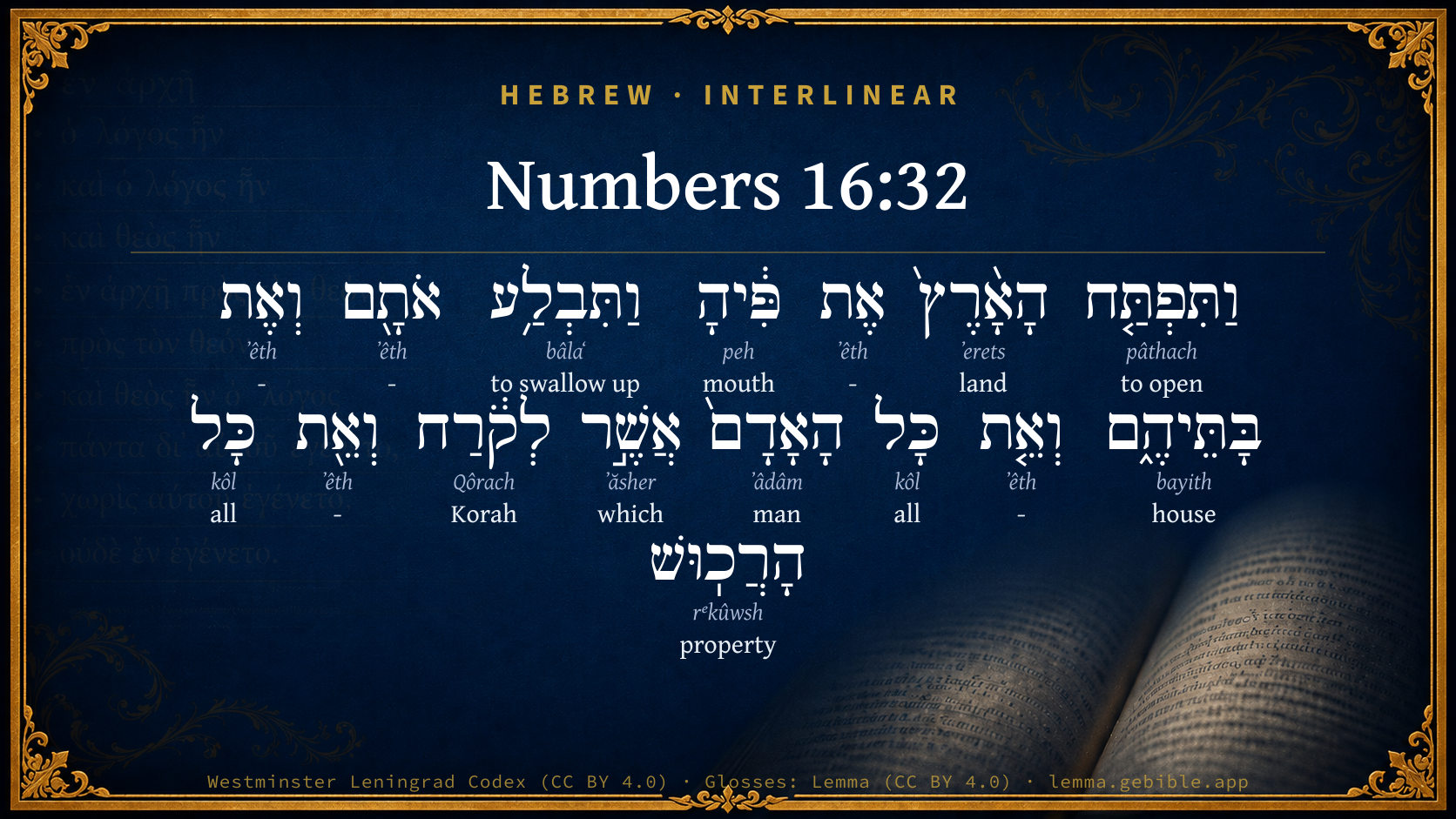
Hebrew (Westminster Leningrad Codex) Numbers 16:32 appears in the Hebrew Old Testament. The text above is from the Westminster Leningrad Codex. Each word links to its Strong’s number, a concise gloss, and parsing drawn from the Open Scriptures Hebrew Bible morphology. Click any word for its full Brown-Driver-Briggs (BDB) entry.
Download image
Cite this verse

Numbers 16:32 (World English Bible). Public Domain. Lemma interlinear Bible study tool, https://lemma.gebible.app/v/numbers/16/32.

Show BibTeX & RIS
BibTeX
RIS
English Translation
and the earth opened its mouth, and swallowed them up, and their households, and all the men who appertained to Korah, and all their goods.
World English Bible · Public Domain
Download a study sheet

One document with this verse’s original text, its word-by-word gloss line, the meaning frame, cross-references with their text, attributed commentary, and full source and license credits — printable, and it pastes into notes with its structure intact.

This verse Autodidact and up

Study sheet (.html) Plain text (.txt)

A passage Seminary Student

Up to 50 verses in one chapter. A passage sheet keeps up to 6 commentary sources and 12 cross-references per verse, in the order this page ranks them, and says so on the sheet whenever that leaves anything out. Ask for a single verse and you get the Autodidact verse sheet above.

Everything on this page stays free to read, with no account — the sheet is a download of what is already on screen, not access to it.

Want to remove ads? Support Godless Engineer
Compare translations 3

The same verse in 3 English versions, stacked beneath the original-language interlinear above. Click any original word for its lexicon entry.

Each is an independent rendering of the whole verse — the interlinear is not word-aligned to these translations.

Highlighted words mark where these versions differ — a whole-verse word diff, not a word-by-word alignment.

  • World English Bible Public Domain
    and the earth opened its mouth, and swallowed them up, and their households, and all the men who appertained to Korah, and all their goods.
  • King James Version Public Domain
    And the earth opened her mouth, and swallowed them up, and their houses, and all the men that appertained unto Korah, and all their goods.
  • unfoldingWord Literal Text CC BY-SA 4.0
    and the earth opened its mouth and swallowed them and their houses and every man who to Korah and all the property,

unfoldingWord Literal Text — © unfoldingWord, licensed CC BY-SA 4.0. Word-aligned USFM3 via Door43 (git.door43.org/unfoldingWord/en_ult).

Versions to compare (up to 4)

3 of 4 selected

Show all 18 translations

Every available English version of this verse, each an independent rendering of the whole verse.

  • World English Bible Public Domain
    and the earth opened its mouth, and swallowed them up, and their households, and all the men who appertained to Korah, and all their goods.
  • Berean Standard Bible Public Domain
    and the earth opened its mouth and swallowed them and their households—all Korah’s men and all their possessions.
  • Majority Standard Bible Public Domain
    and the earth opened its mouth and swallowed them and their households—all Korah’s men and all their possessions.
  • King James Version Public Domain
    And the earth opened her mouth, and swallowed them up, and their houses, and all the men that appertained unto Korah, and all their goods.
  • American Standard Version (1901) Public Domain
    and the earth opened its mouth, and swallowed them up, and their households, and all the men that appertained unto Korah, and all their goods.
  • Revised Version (1885) Public Domain
    and the earth opened her mouth, and swallowed them up, and their households, and all the men that appertained unto Korah, and all their goods.
  • Geneva Bible (1599) Public Domain
    And the earth opened her mouth, and swallowed them vp, with their families, and all the men that were with Korah, and all their goods.
  • Douay-Rheims (1899) Public Domain
    And opening her mouth, devoured them with their tents and all their substance.
  • Young's Literal Translation Public Domain
    and the earth openeth her mouth, and swalloweth them, and their houses, and all the men who `are' for Korah, and all the goods,
  • Literal Standard Version CC BY-SA 4.0
    and the earth opens her mouth and swallows them, and their houses, and all the men who [are] for Korah, and all the goods,
  • Unlocked Literal Bible CC BY-SA 4.0
    The earth opened its mouth and swallowed them, their families, and all the people who belonged to Korah, as well as all their possessions.
  • unfoldingWord Literal Text CC BY-SA 4.0
    and the earth opened its mouth and swallowed them and their houses and every man who to Korah and all the property,
  • Darby Bible Public Domain
    And the earth opened its mouth, and swallowed them up, and their households, and all the men that belonged to Korah, and all their property.
  • World Messianic Bible Public Domain
    The earth opened its mouth and swallowed them up with their households, all of Korah’s men, and all their goods.
  • Webster's Bible Public Domain
    And the earth opened her mouth, and swallowed them up, and their houses, and all the men that appertained to Korah, and all their goods.
  • Free Bible Version CC BY-SA 4.0
    and the earth opened up and swallowed them and their households down, as well as everyone who was there with Korah and everything that belonged to them.
  • Bible in Basic English Public Domain
    And the earth, opening her mouth, took them in, with their families, and all the men who were joined to Korah, and their goods.
  • JPS Tanakh (1917) Public Domain
    And the earth opened her mouth and swallowed them up, and their households, and all the men that appertained unto Korah, and all their goods.

Literal Standard Version (2020), Covenant Press — licensed CC BY-SA 4.0. Text via the HelloAO Bible API (eBible.org). Unlocked Literal Bible (unfoldingWord) — licensed CC BY-SA 4.0. Text via the HelloAO Bible API (eBible.org). unfoldingWord Literal Text — © unfoldingWord, licensed CC BY-SA 4.0. Word-aligned USFM3 via Door43 (git.door43.org/unfoldingWord/en_ult). Free Bible Version, Dr. Jonathan Gallagher — licensed CC BY-SA 4.0. Text via the HelloAO Bible API (eBible.org).

Word by word

More ways to search: Search by grammar → Find every occurrence → Compare this word →

Practice this passage: Drill this verse → Learn its vocabulary →

הָרֲכֽוּשׁ
rᵉkûwsh
H7399
“the · property”
Particle, Definite Article + Noun, Common, Masculine, Singular, Absolute
Part of Speech
Particle + Noun
Type
Common
Gender
Masculine
Number
Singular
State
Absolute
Full BDB Definition

Origin: from pass part of H7408

TWOT: 2167b

property, goods, possessions - property, goods - general term for all movable goods - of livestock - of stores, utensils, etc
  1. וַתִּפְתַּ֤ח pâthach H6605 “and · to open” Conjunction + Verb, Qal, Sequential Imperfect, 3rd Person, Feminine, Singular
  2. הָאָ֨רֶץ֙ ʼerets H776 “the · land” Particle, Definite Article + Noun, Common, Both, Singular, Absolute
  3. אֶת ʼêth H853 “-” Particle, Direct Object
  4. פִּ֔יהָ peh H6310 “mouth · her” Noun, Common, Masculine, Singular, Construct + Suffix, Personal, 3rd Person, Feminine, Singular
  5. וַתִּבְלַ֥ע bâlaʻ H1104 “and · to swallow up” Conjunction + Verb, Qal, Sequential Imperfect, 3rd Person, Feminine, Singular
  6. אֹתָ֖ם ʼêth H853 “- · them” Particle, Direct Object + Suffix, Personal, 3rd Person, Masculine, Plural
  7. וְאֶת ʼêth H853 “and · -” Conjunction + Particle, Direct Object
  8. בָּתֵּיהֶ֑ם bayith H1004 “houses · their” Noun, Common, Masculine, Plural, Construct + Suffix, Personal, 3rd Person, Masculine, Plural
  9. וְאֵ֤ת ʼêth H853 “and · -” Conjunction + Particle, Direct Object
  10. כָּל kôl H3605 “all of” Noun, Common, Masculine, Singular, Construct
  11. הָאָדָם֙ ʼâdâm H120 “the · man” Particle, Definite Article + Noun, Common, Masculine, Singular, Absolute
  12. אֲשֶׁ֣ר ʼăsher H834 “which” Particle, Relative
  13. לְקֹ֔רַח Qôrach H7141 “to/for · Korah” Preposition + Noun, Proper
  14. וְאֵ֖ת ʼêth H853 “and · -” Conjunction + Particle, Direct Object
  15. כָּל kôl H3605 “all of” Noun, Common, Masculine, Singular, Construct

About this verse

These counts appear in no published source. They are computed here, from the morphology-tagged text and Lemma’s own curated glosses. What Lemma adds →

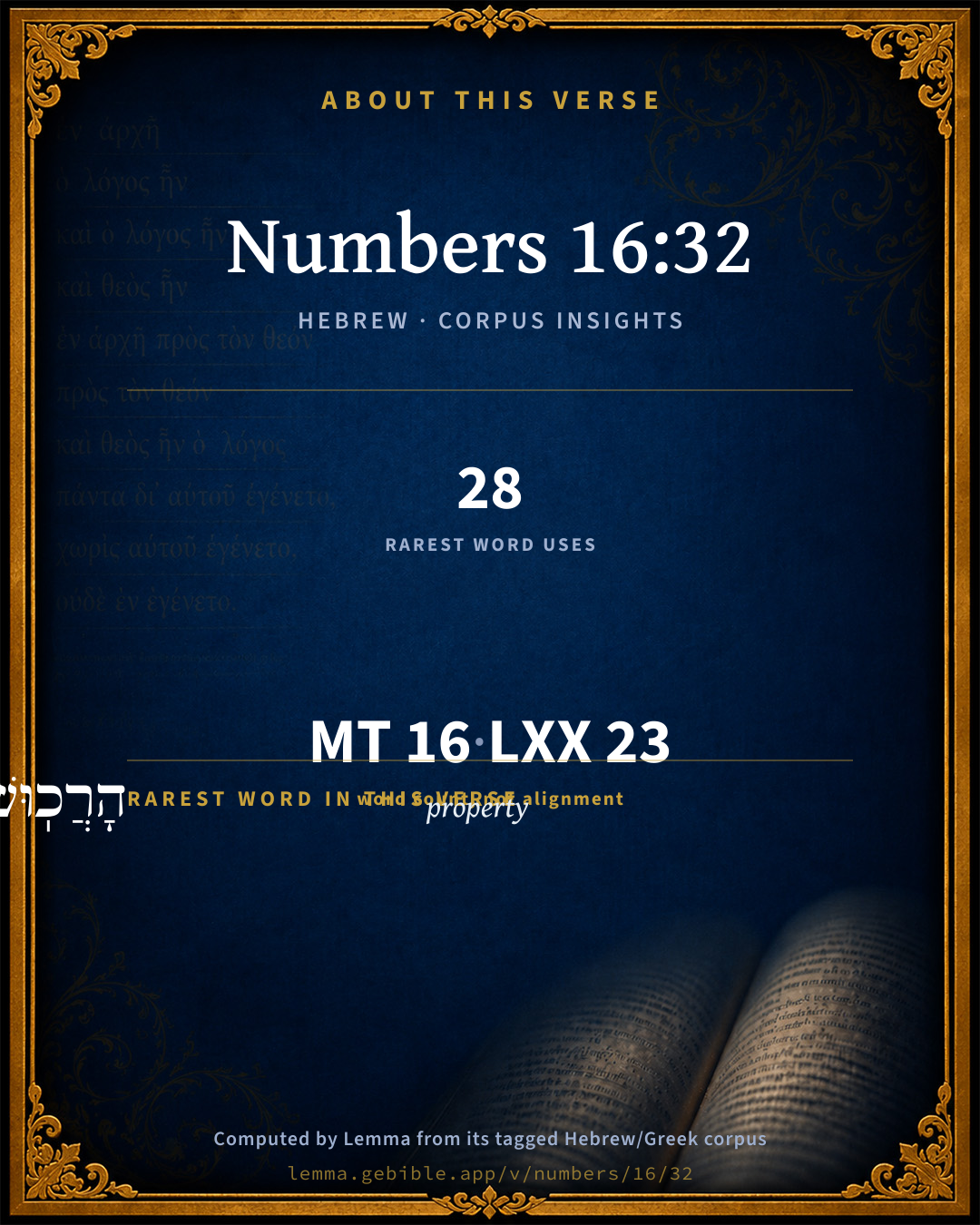
16
words
11
distinct lemmas
Pentateuch
section

Shared distinctive vocabulary

הָרֲכֽוּשׁ property H7399 occurs in 27 verses of the Hebrew Bible. Also found in:

Grammatical profile

  • 2 verbs
  • 8 nouns
  • 6 particles

Verb forms

  • וַתִּפְתַּ֤ח Qal · Sequential Imperfect
  • וַתִּבְלַ֥ע Qal · Sequential Imperfect

Repetition

A word recurs within this verse — often emphatic in Hebrew:

Hebrew & Septuagint length

In English translation the verse runs 25 words from the Hebrew and 22 from the Septuagint (LXX English) — closely comparable.

A rough comparison of the two English renderings, which tokenize alike — not a word-level alignment.

Word counts can differ between the Hebrew and the Greek without any difference in meaning — e.g. the Hebrew direct-object marker אֵת has no separate Greek word, and Greek often adds the article ὁ.

In the original languages it is 16 Hebrew tokens and 23 Greek tokens — but the two are counted differently (Hebrew bundles its prefixes and suffixes into one token; the Greek is in lemma form), so that isn’t a like-for-like length.

Cross-references

14

Topical passages linked to Numbers 16:32 in the Treasury of Scripture Knowledge — connected by theme and wording, ordered by reader-vote popularity; previews shown in the World English Bible.

  • Numbers 26:11 Notwithstanding, the sons of Korah didn't die.
  • Psalms 106:17 The earth opened and swallowed up Dathan, And covered the company of Abiram.
  • Revelation 12:16 The earth helped the woman, and the earth opened its mouth and swallowed up the river which the dragon spewed out of his mouth.
  • 1 Chronicles 6:22 The sons of Kohath: Amminadab his son, Korah his son, Assir his son,
  • Isaiah 5:14 Therefore Sheol has enlarged its desire, And opened its mouth without measure; And their glory, their multitude, their pomp, and he who rejoices among them, descend into it.
  • Numbers 16:17 and take every man his censer, and put incense on them, and bring you before Yahweh every man his censer, two hundred fifty censers; you also, and Aaron, each his censer.
  • Numbers 16:30 But if Yahweh make a new thing, and the ground open its mouth, and swallow them up, with all that appertain to them, and they go down alive into Sheol; then you shall understand that these men have despised Yahweh.
  • Numbers 27:3 Our father died in the wilderness, and he was not among the company of those who gathered themselves together against Yahweh in the company of Korah: but he died in his own sin; and he had no sons.
  • Deuteronomy 11:6 and what he did to Dathan and Abiram, the sons of Eliab, the son of Reuben; how the earth opened its mouth, and swallowed them up, and their households, and their tents, and every living thing that followed them, in the midst of all Israel:
  • 1 Chronicles 6:37 the son of Tahath, the son of Assir, the son of Ebiasaph, the son of Korah,
  • Psalms 84:1 How lovely are your dwellings, Yahweh of Hosts!
  • Psalms 85:1 Yahweh, you have been favorable to your land. You have restored the fortunes of Jacob.
  • Psalms 88:1 Yahweh, the God of my salvation, I have cried day and night before you.
  • Genesis 4:11 Now you are cursed because of the ground, which has opened its mouth to receive your brother's blood from your hand.

Cross-references courtesy of OpenBible.info (CC BY 4.0).

Hebrew and Greek witnesses Masoretic Hebrew ↔ Greek Septuagint

The same verse in the two great witnesses to the Old Testament, shown verse-for-verse.

These are two independent witnesses, not word-aligned to each other, and the Septuagint is shown in lemma (dictionary) form.

Hebrew Numbers 16:32 Masoretic · Westminster Leningrad Codex

וַתִּפְתַּ֤ח הָאָ֨רֶץ֙ אֶת פִּ֔יהָ וַתִּבְלַ֥ע אֹתָ֖ם וְאֶת בָּתֵּיהֶ֑ם וְאֵ֤ת כָּל הָאָדָם֙ אֲשֶׁ֣ר לְקֹ֔רַח וְאֵ֖ת כָּל הָרֲכֽוּשׁ

and the earth opened its mouth, and swallowed them up, and their households, and all the men who appertained to Korah, and all their goods.

World English Bible · Public Domain

Greek LXX Numbers 16:32 Septuagint · lemma form

καί ἀναοἴγω ὁ γῆ καί καταπίνω αὐτός καί ὁ οἶκος αὐτός καί πᾶς ὁ ἄνθρωπος ὁ εἰμί μετά κορε καί ὁ κτῆνος αὐτός

And the ground opened, and swallowed them up, and their houses, and all the men that were with Core, and their cattle.

LXX2012 (modern English Septuagint) · Public Domain

Hebrew: Westminster Leningrad Codex (CC BY 4.0). Greek: Septuagint (public domain); English from LXX2012 (modern English Septuagint) (Public Domain). How the Septuagint differs from the Hebrew →

Targum (Aramaic paraphrase)

2

The Targum is the ancient Jewish Aramaic paraphrase of the Hebrew Scriptures — an interpretive translation, not the Hebrew text itself. Onkelos (literal) and Pseudo-Jonathan (expansive) render the Torah, and Jonathan the Prophets. Coverage is partial: where no permissively-licensed English translation exists for a verse, only the Aramaic is shown. This is verse-level text, not a word-by-word alignment to the Hebrew.

  1. Targum Onkelos Torah (Genesis–Deuteronomy)
    וּפְתָחַת אַרְעָא יָת פּוּמָהּ וּבְלָעַת יַתְהוֹן וְיַת אֱנַשׁ בָּתֵּיהוֹן וְיַת כָּל אֱנָשָׁא דִי לְקֹרַח וְיַת כָּל קִנְיָנָא

    (no public-domain English translation for this verse)

    Targum Onkelos — Aramaic: “Onkelos Genesis” (public domain); “Onkelos Exodus” (public domain); “Onkelos Leviticus” (public domain); “Onkelos Numbers” (public domain); “Onkelos Deuteronomy” (public domain). English: “Sefaria Community Translation” (CC0 1.0 (public-domain dedication)); “J.W. Etheridge. The Targums of Onkelos and Jonathan Ben Uzziel on the Pentateuch. London: Longmans, Green, 1862” (public domain). Text via Sefaria.

  2. Targum Pseudo-Jonathan Torah (Genesis–Deuteronomy)
    וּפְתָחַת אַרְעָא יַת פּוּמָהּ וּבְלָעַת יַתְהוֹן וְיַת אֱנַשׁ בָּתֵּיהוֹן וְיַת כָּל אֵינָשָׁא דִלְקרַח וְיַת כָּל נִכְסַיָא

    and the earth opened her mouth and swallowed them up, and the men of their houses, and all the men who adhered to Korach, and all their substance.

    Targum Pseudo-Jonathan — Aramaic: “Targum Jonathan on Genesis” (public domain); “Targum Jonathan on Exodus” (public domain); “Targum Jonathan on Leviticus” (public domain); “Targum Jonathan on Numbers” (public domain); “Targum Jonathan on Deuteronomy” (public domain). English: “The Targum of Jonathan ben Uzziel, trans. J. W. Etheridge, London, 1862” (public domain). Text via Sefaria.

Commentary

Notes on Numbers 16:32 from classic Christian and Jewish commentators (each source and its license shown beneath its notes). The classic Christian expositions comment on the surrounding passage and are grouped to its opening verse, so a note may address several verses; the Jewish commentaries on the Tanakh (Rashi and others) are per-verse, so they appear only where the commentator wrote on this verse.

Lemma curates 59 commentaries, every one of them public domain or Creative Commons licensed, each selected and text-cleaned for this edition rather than reprinted as found. About our sources →

Trapp's Complete Commentary

John Trapp

Num 16:32 And the earth opened her mouth, and swallowed them up, and their houses, and all the men that [appertained] unto Korah, and all [their] goods.

Ver. 32. And the earth opened her mouth and swallowed them up.] So it did a great part of Antioch, by a horrible earthquake, anno 527, for their horrible heresies and blasphemies there broached by the bishops, and defended by the people. So lately Pleurs in Italy.

John Trapp, A Commentary or Exposition upon All the Books of the Old and New Testament (1647–1656) — public domain. Text from a community e-Sword module.

Joseph Benson's Commentary

Num 16:32. All that appertained unto Korah — That is, all his family that were there, women, children, and servants; but his sons, who were spared, (Num 26:11; Num 26:58; 1Ch 6:22; 1Ch 6:37,) were absent either upon some service of the tabernacle, or upon some other occasion, God so ordering it by his providence, either because they disliked their father’s act, or upon Moses’s intercession for them. Korah himself, it seems, was not here, but continued with his two hundred and fifty men before the Lord, where they were waiting for God’s decision of the controversy. Indeed, it is not probable that their chief captain would desert them, and leave them standing there without a head, especially when Aaron, his great adversary, abode there still, and did not go with Moses to Dathan. Korah was probably consumed with those two hundred and fifty, as seems to be intimated, Num 16:40. Accordingly, when the psalmist relates this history, (Psalms 106.,) the earth’s swallowing them up is confined to Dathan and Abiram, (Num 16:17,) and for all the rest of that conspiracy, it is added, (Num 16:18,) And a fire was kindled in their company, the flame burned up the wicked.

Joseph Benson's Commentary on the Old and New Testaments (1811–1818) — public domain. Text from a community e-Sword module.

Ellicott's Commentary for English Readers

(32) And the earth opened her mouth . . . —Had this verse stood alone it might have been inferred that Korah and his family shared the fate of Dathan and Abiram and their families and households. in regard to the sons of Korah, however, there is direct evidence that they did not share in the punishment of Dathan and Abiram (see Note on Num_16:27): and in regard to Korah there is ground for the belief that he perished by fire with the 250 men who offered incense with him. It is true, indeed, that in Num_26:10 Korah is mentioned in conjunction with Dathan and Abiram (see Note in loc.); but in the other places in which reference is made to the conspiracy, the fate of the chief conspirators is separated. Thus, in Deu_11:6 we read only of what God did unto Dathan and Abiram and their households and tents; and in Psa_106:17 we read that “The earth opened and swallowed up Dathan, and covered the company of Abiram,” whilst in the following verse it is added that “The flame burned up the wicked.” If Korah’s tent remained in its appointed place amongst the Kohathites, it may reasonably be supposed that the chasm did not extend beyond the tents of Dathan and Abiram; or if Korah had pitched a tent for himself adjoining the tents of Dathan and Abiram, it may be inferred that those only of his household remained in it who shared in the conspiracy, and that his sons remained amongst the other Kohathites, or withdrew with the rest of the congregation at the command of Moses. It is most natural to suppose that Korah was at this time before the door of the Tabernacle, with the 250 men of his company who had presumed to offer incense, and that he shared their doom. Ibn Ezra observes that in the song of the Red Sea there is no mention made of the drowning of Pharaoh, but only of his chariots and hosts; whilst in Psa_136:15 we read that Pharaoh and his host were overthrown in the Red Sea.

A Bible Commentary for English Readers, edited by Charles John Ellicott (1878–1897) — public domain. Text from a community e-Sword module.

John Gill's Exposition

And the earth opened her mouth and swallowed them up,.... Dathan and Abiram, their wives, sons, and little ones, that stood at the door of their tents with them, and all their goods, as follows: the earth, as if it was a living creature or a beast of prey, opened its mouth and swallowed them up, as such a creature does its prey:

and their houses; which may be meant both of their families or households, and of the tents they dwelt in, which were their houses; see Deu 1:6,

and all the men that appertained unto Korah: not Korah himself, for he was with the two hundred fifty men that had censers, and with Aaron at the door of the tabernacle of the congregation offering incense, and thereby making trial to whom the priesthood belonged; and who, it is highly probable, perished by fire with the two hundred fifty men, as Josephus, Aben Ezra, and others are of opinion; but the family of Korah, and not all of them, for his sons died not at that time, Num 26:11; and there were of his posterity in the times of David, to whom several of the psalms are inscribed, Psa 42:1; these were either out of the way upon business, the providence of God so ordering it for their safety; or they disliked the proceedings of their father, and joined not with him; or if they did at first, repented of it and forsook him, as it is probable on of the tribe of Reuben also did, since no mention is made of him in the destruction:

and all their goods: their household goods, their substance and riches, their gold, silver, cattle, and whatever they were possessed of: a very extraordinary case this and which perhaps gave rise to some fabulous things among the Heathens; however, if they can be credited, this ought not to be thought incredible; as Amphiaraus, who with his chariot and its rider are said to be swallowed up in the earth, struck by a thunderbolt from Jupiter, and were never seen more (w); and other stories are told of persons praying to their deities for secrecy and shelter, and the earth has opened and hid them; as Althemenes, when he had slain his father (x); and the nymph Thalia pregnant by Jupiter, who, for fear of Juno, wished the earth might open and take her in, and it accordingly did, as is reported (y).

(w) Apollodorus de Deorum Origine, l. 3. p. 157. (x) lb. p. 134. (y) Macrob. Saturnal. l. 5. c. 19.

John Gill's Exposition of the Whole Bible (1746–1763) — public domain (CC PDM 1.0). Text via the HelloAO Bible API.

Albert Barnes' Notes on the Bible

All the men ... - Not his sons (see Num 26:11), but all belonging to him who had associated themselves with him in this rebellion.

Albert Barnes' Notes on the Bible (1834–1885) — public domain. Text from a community e-Sword/MySword module.

Haydock's Catholic Bible Commentary

Tents. Hebrew adds, "all those who belonged to (or sided with) Core, and all their riches." Moses informs us, (chap. xxvi. 10,) how some of Core’s children were miraculously preserved. Their descendants were appointed by David to sing and to guard the doors of the temple, 1 Paralipomenon ix. 19. (Calmet) --- Samuel was of the same family, 1 Paralipomenon vi. 33. (Tirinus)

George Leo Haydock (1774–1849), Haydock's Catholic Family Bible and Commentary, 1859 edition — public domain. Excludes Psalms (Douay-Rheims chapter numbering differs from Protestant) and Deuterocanonical books (Catholic canon only).

Matthew Poole's English Annotations

i.e. All his family which were there, women, children, and servants; but his sons, who were spared Num 26:11,58 1Ch 6:22,37 were absent, either upon some service of the tabernacle, or upon some other occasion; God so ordering it by his providence, either because they disliked their father’s act, or upon Moses’s intercession for them, or for some other reason. This expression may seem to intimate that Korah himself was not here, but that he continued with his two hundred and fifty men before the Lord Num 16:18,19, where they were waiting for God’s decision of the controversy; nor is it probable that their chief captain would desert them, and leave them standing there without a head, especially when Aaron, his great adversary, abode there still, and did not go with Moses to Dathan, &c., Num 16:25. And Korah may seem to have been consumed with those two hundred and fifty, Num 16:35, though he be not mentioned there, but is easily understood by comparing that verse with Num 16:16-18, and from the nature of the thing itself, there being no cause of doubt but that destruction which befell the accessaries did much more involve the principal. And so much is intimated Num 16:40, that no stranger come near to offer incense before the Lord, that he be not as Korah, and as his company, i.e. destroyed, as they were, by fire from the Lord. And when the psalmist relates this history, Psa 106, the earth’s swallowing them up is confined to Dathan and Abiram, Num 16:17; and for all the rest of that conspiracy, it is added, Num 16:18, and a fire was kindled in their company; the flame burnt up the wicked. As for Num 26:10, which seems to oppose this opinion, we shall see more on that place, if God permit.

Matthew Poole's English Annotations on the Holy Bible (1683–1685) — public domain. Text from a community e-Sword/MySword module.

Whedon's Commentary on the Bible

Daniel D. Whedon

32. The earth opened her mouth — A poetic impersonation characteristic of the Orientals.

Houses — Not their tents, but their families. See Num_18:31; Exo_12:3.

All the men that appertained unto Korah — All his partisans — That a portion at least of Korah’s family survived is expressly stated in Num_26:11. The prophet Samuel was his descendant, (1Ch_6:22-28,) and so were some of David’s musicians, (Psalms 44-49, titles.) The adherents of Korah, his servants and retainers, with, possibly, the adult males of his family, perished in this judgment. The Hebrew word for appertained unto is in Exo_32:26, translated “on the side of.”

Daniel D. Whedon (gen. ed.), Commentary on the Old and New Testaments (1874–1909) — public domain. Text from a community e-Sword module.

The Pulpit Commentary

And their houses, i.e., their families, as in Num_18:13. And all the men that appertained unto Korah. Literally, "all the men who to Korah." Whether it means his dependants, or his special partisans, is uncertain: Perhaps some had clung to his fortunes in blind confidence when the rest gat up from his mishcan.

The Pulpit Commentary (1880–1919), ed. H.D.M. Spence-Jones & Joseph S. Exell — public domain. Text from a community e-Sword module.

John Wesley's Explanatory Notes

All that appertained unto Korah - That is, all his family which were there, women, children, and servants; but his sons, who were spared, chap. xxvi, 11, 58; 1 Chron. vi, 22, 37, were absent either upon some service of the tabernacle, or upon some other occasion, God so ordering it by his providence either because they disliked their fathers act, or upon Moses's intercession for them. This expression may intimate, that Korah himself was not here, but that he continued with his two hundred and fifty men before the Lord, where they were waiting for God's decision of the controversy. Nor is it probable that their chief captain would desert them, and leave them standing there without an head, especially, when Aaron his great adversary, abode there still, and did not go with Moses to Dathan. And Korah may seem to have been consumed with those two hundred and fifty. And so much is intimated, ver. 40, that no stranger come near to offer incense before the Lord, that he be not as Korah, and as his company, that is, destroyed, as they were, by fire from the Lord. And when the Psalmist relates this history, Psalm cvi, 17-18, the earth's swallowing them up is confined to Dathan and Abiram, Psalm cvi, 17, and for all the rest of that conspiracy it is added, Psalm cvi, 18. And a fire was kindled in their company, the flame burnt up the wicked.

John Wesley, Explanatory Notes Upon the Whole Bible (1754–1765) — public domain. Text via the GEBible commentary corpus.

Ramban (Nachmanides)

Rabbi Moshe ben Nachman (Ramban / Nachmanides)

AND ALL THE MEN THAT APPERTAINED UNTO KORACH. He [Korach] had acquired [heathen] slaves and bondmaids, and had as members of his household Egyptians, Ethiopians, and Canaanites — the purchase of his money — and these people were punished because they were part of their goods [i.e., those of Korach’s men], for they were punished both personally and in their belongings. Perhaps there were also in Korach’s house Israelites as sojourners and residents, and they were influenced by his counsel and were therefore punished [with Korach]. But it [the phrase all the men that appertained unto Korach] cannot refer to his children, for it is written, But the children of Korach died not, because they were adults, righteous and good men, and their [own] merit stood in their stead [so that they were not swept away with their father]. He had no minor sons and daughters, since Scripture does not mention “little ones” in the case of Korach [as it does when referring to Dathan and Abiram].

Ramban (Nachmanides) on the Tanakh — English translation: “Commentary on the Torah by Ramban (Nachmanides). Translated and annotated by Charles B. Chavel. New York, Shilo Pub. House, 1971-1976” (CC BY 4.0). Text via Sefaria.

Lesson kit

Teaching starters — assembled from the data on this page, not authored interpretation. Every prompt links to the verse data it draws on. Edit before teaching.

Numbers, in the Pentateuch, opens this verse with 16 words (11 distinct Hebrew lemmas). Its most distinctive word is rᵉkûwsh (“property”). A historical commentator’s framing appears above. Read the whole chapter for the surrounding context.

Discussion questions

  1. How does “property” (rᵉkûwsh) shape what this verse is saying?
  2. Genesis 12:5 shares the word «property» with this verse. How do the two illuminate each other?
  3. “all” occurs 2× in this one verse. What is the effect of the repetition?
  4. The translations on this page render this verse differently — a whole-verse word diff, not a word-by-word alignment. What might account for the different wordings?
  5. The verb «וַתִּפְתַּ֤ח» is Qal Sequential Imperfect. How does its form color the action?
  6. Reading how Trapp's Complete Commentary and Joseph Benson's Commentary read this verse, where do the two commentators agree and where do they part?

Things to notice

Reading settings

Reading text

Shown beneath each verse's original-language words.

Old Testament
Old Testament edition

Read the OT as the Masoretic Hebrew (MT) or the Greek Septuagint (LXX).

English shown for the Greek Septuagint (in the Hebrew ↔ Greek comparison).

Comparing translations? Open the Compare panel on any verse page to stack up to four side by side.