Deuteronomy 15:8

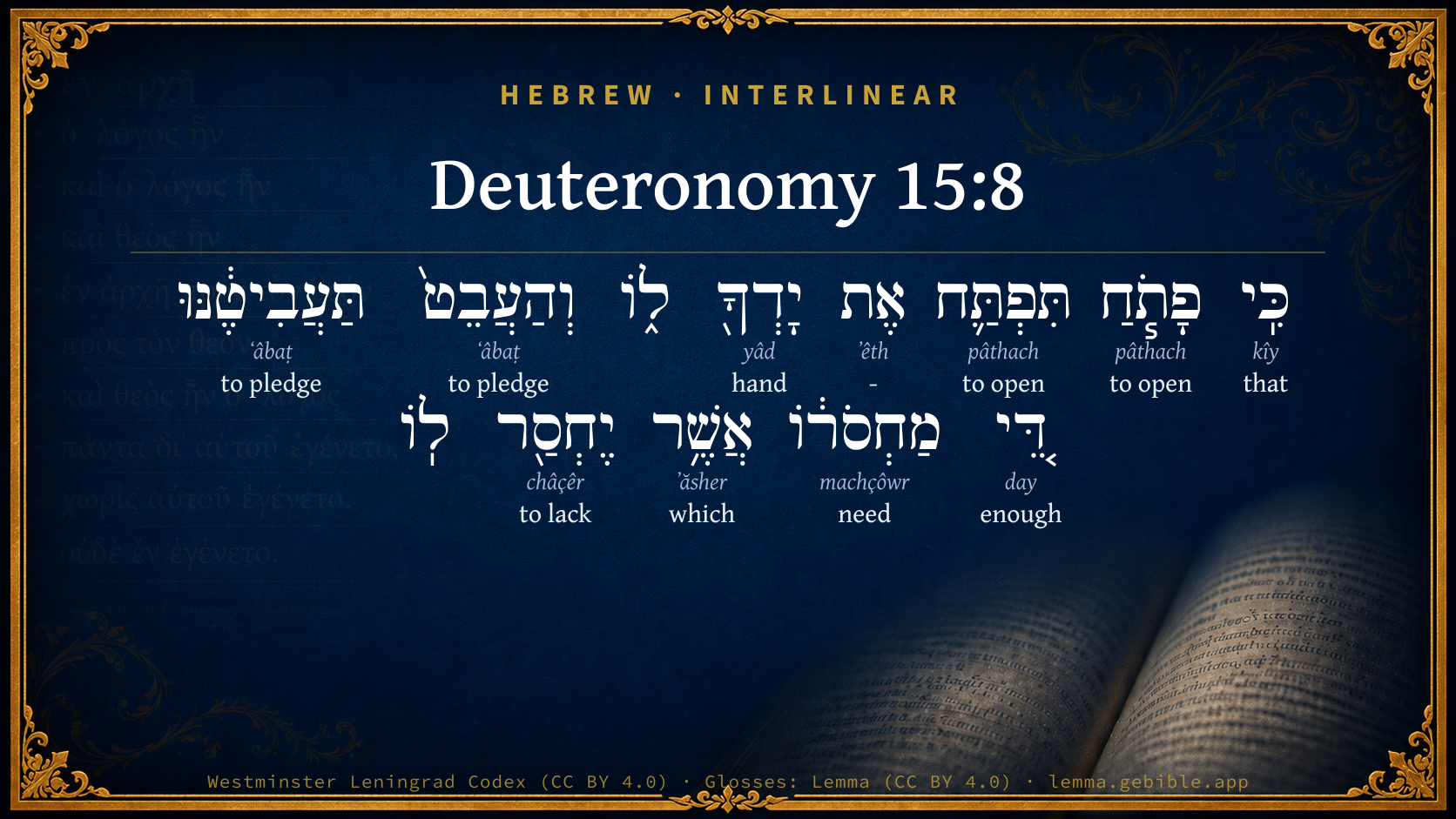
Hebrew (Westminster Leningrad Codex) Deuteronomy 15:8 appears in the Hebrew Old Testament. The text above is from the Westminster Leningrad Codex. Each word links to its Strong’s number, a concise gloss, and parsing drawn from the Open Scriptures Hebrew Bible morphology. Click any word for its full Brown-Driver-Briggs (BDB) entry.
Download image
Cite this verse

Deuteronomy 15:8 (World English Bible). Public Domain. Lemma interlinear Bible study tool, https://lemma.gebible.app/v/deuteronomy/15/8.

Show BibTeX & RIS
BibTeX
RIS
English Translation
but you shall surely open your hand to him, and shall surely lend him sufficient for his need [in that] which he wants.
World English Bible · Public Domain
Highlights
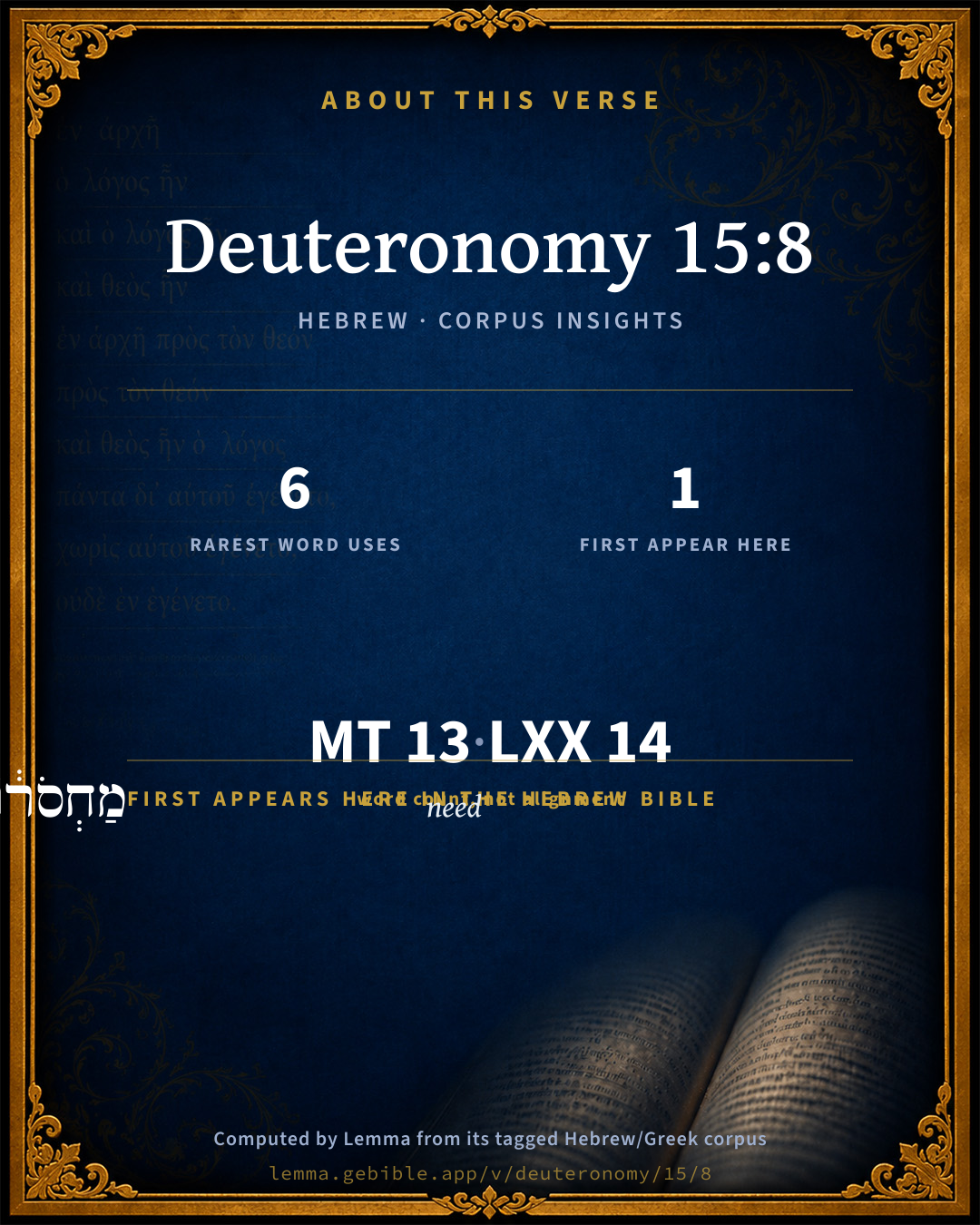
  • 1 first appearance in the Hebrew Bible
Full analysis ↓
Download a study sheet

One document with this verse’s original text, its word-by-word gloss line, the meaning frame, cross-references with their text, attributed commentary, and full source and license credits — printable, and it pastes into notes with its structure intact.

This verse Autodidact and up

Study sheet (.html) Plain text (.txt)

A passage Seminary Student

Up to 50 verses in one chapter. A passage sheet keeps up to 6 commentary sources and 12 cross-references per verse, in the order this page ranks them, and says so on the sheet whenever that leaves anything out. Ask for a single verse and you get the Autodidact verse sheet above.

Everything on this page stays free to read, with no account — the sheet is a download of what is already on screen, not access to it.

Want to remove ads? Support Godless Engineer
Compare translations 3

The same verse in 3 English versions, stacked beneath the original-language interlinear above. Click any original word for its lexicon entry.

Each is an independent rendering of the whole verse — the interlinear is not word-aligned to these translations.

Highlighted words mark where these versions differ — a whole-verse word diff, not a word-by-word alignment.

  • World English Bible Public Domain
    but you shall surely open your hand to him, and shall surely lend him sufficient for his need [in that] which he wants.
  • King James Version Public Domain
    But thou shalt open thine hand wide unto him, and shalt surely lend him sufficient for his need, in that which he wanteth.
  • unfoldingWord Literal Text CC BY-SA 4.0
    but opening, you shall open your hand to him and lending, you shall lend him enough his need that he has need.

unfoldingWord Literal Text — © unfoldingWord, licensed CC BY-SA 4.0. Word-aligned USFM3 via Door43 (git.door43.org/unfoldingWord/en_ult).

Versions to compare (up to 4)

3 of 4 selected

Show all 18 translations

Every available English version of this verse, each an independent rendering of the whole verse.

  • World English Bible Public Domain
    but you shall surely open your hand to him, and shall surely lend him sufficient for his need [in that] which he wants.
  • Berean Standard Bible Public Domain
    Instead, you are to open your hand to him and freely loan him whatever he needs.
  • Majority Standard Bible Public Domain
    Instead, you are to open your hand to him and freely loan him whatever he needs.
  • King James Version Public Domain
    But thou shalt open thine hand wide unto him, and shalt surely lend him sufficient for his need, in that which he wanteth.
  • American Standard Version (1901) Public Domain
    but thou shalt surely open thy hand unto him, and shalt surely lend him sufficient for his need `in that' which he wanteth.
  • Revised Version (1885) Public Domain
    but thou shalt surely open thine hand unto him, and shalt surely lend him sufficient for his need in that which he wanteth.
  • Geneva Bible (1599) Public Domain
    But thou shalt open thine hand vnto him, and shalt lend him sufficient for his neede which he hath.
  • Douay-Rheims (1899) Public Domain
    But shalt open it to the poor man, thou shalt lend him, that which thou perceivest he hath need of.
  • Young's Literal Translation Public Domain
    for thou dost certainly open thy hand to him, and dost certainly lend him sufficient for his lack which he lacketh.
  • Literal Standard Version CC BY-SA 4.0
    for you certainly open your hand to him, and certainly lend him sufficiency for his lack which he lacks.
  • Unlocked Literal Bible CC BY-SA 4.0
    but you must surely open your hand to him and surely lend him sufficient for his need.
  • unfoldingWord Literal Text CC BY-SA 4.0
    but opening, you shall open your hand to him and lending, you shall lend him enough his need that he has need.
  • Darby Bible Public Domain
    but thou shalt open thy hand bountifully unto him, and shalt certainly lend him on pledge what is sufficient for his need, [in that] which he lacketh.
  • World Messianic Bible Public Domain
    but you shall surely open your hand to him, and shall surely lend him sufficient for his need, which he lacks.
  • Webster's Bible Public Domain
    But thou shalt open thy hand wide to him, and shalt surely lend him sufficient for his need, in that which he wanteth.
  • Free Bible Version CC BY-SA 4.0
    On the contrary. You are to be generous to them, and lend them whatever they need.
  • Bible in Basic English Public Domain
    But let your hand be open to give him the use of whatever he is in need of.
  • JPS Tanakh (1917) Public Domain
    but thou shalt surely open thy hand unto him, and shalt surely lend him sufficient for his need in that which he wanteth.

Literal Standard Version (2020), Covenant Press — licensed CC BY-SA 4.0. Text via the HelloAO Bible API (eBible.org). Unlocked Literal Bible (unfoldingWord) — licensed CC BY-SA 4.0. Text via the HelloAO Bible API (eBible.org). unfoldingWord Literal Text — © unfoldingWord, licensed CC BY-SA 4.0. Word-aligned USFM3 via Door43 (git.door43.org/unfoldingWord/en_ult). Free Bible Version, Dr. Jonathan Gallagher — licensed CC BY-SA 4.0. Text via the HelloAO Bible API (eBible.org).

Word by word

More ways to search: Search by grammar → Find every occurrence → Compare this word →

Practice this passage: Drill this verse → Learn its vocabulary →

וְהַעֲבֵט֙
ʻâbaṭ
H5670
“and · to pledge”
Conjunction + Verb, Hiphil, Infinitive Absolute
Part of Speech
Conjunction + Verb
Stem
Hiphil
Form
Infinitive Absolute
Full BDB Definition

Origin: a primitive root

TWOT: 1555

to take a pledge, give a pledge (for a debt) - (Qal) to take a pledge, give a pledge (for a debt) - (Piel) to interchange - (Hiphil) to cause to give a pledge
  1. כִּֽי kîy H3588 “that” Conjunction
  2. פָתֹ֧חַ pâthach H6605 “to open” Verb, Qal, Infinitive Absolute
  3. תִּפְתַּ֛ח pâthach H6605 “to open” Verb, Qal, Imperfect, 2nd Person, Masculine, Singular
  4. אֶת ʼêth H853 “-” Particle, Direct Object
  5. יָדְךָ֖ yâd H3027 “hand · your” Noun, Common, Both, Singular, Construct + Suffix, Personal, 2nd Person, Masculine, Singular
  6. תַּעֲבִיטֶ֔נּוּ ʻâbaṭ H5670 “to pledge · him” Verb, Hiphil, Imperfect, 2nd Person, Masculine, Singular + Suffix, Personal, 3rd Person, Masculine, Singular
  7. דֵּ֚י day H1767 “enough of” Noun, Common, Masculine, Singular, Construct
  8. מַחְסֹר֔וֹ machçôwr H4270 “need · his” Noun, Common, Masculine, Singular, Construct + Suffix, Personal, 3rd Person, Masculine, Singular
  9. אֲשֶׁ֥ר ʼăsher H834 “which” Particle, Relative
  10. יֶחְסַ֖ר châçêr H2637 “to lack” Verb, Qal, Imperfect, 3rd Person, Masculine, Singular

About this verse

These counts appear in no published source. They are computed here, from the morphology-tagged text and Lemma’s own curated glosses. What Lemma adds →

13
words
9
distinct lemmas
Pentateuch
section

Notable vocabulary

The rarest word here is וְהַעֲבֵט֙ to pledge H5670 — appearing just 6 times in the whole Hebrew Bible.

First appearance in Scripture

This word makes its first canonical appearance in the Hebrew Bible here:

  • מַחְסֹר֔וֹ need H4270

Shared distinctive vocabulary

וְהַעֲבֵט֙ to pledge H5670 occurs in 4 verses of the Hebrew Bible. Also found in:

Grammatical profile

  • 5 verbs
  • 3 nouns
  • 2 prepositions
  • 1 conjunction
  • 2 particles

Verb forms

  • פָתֹ֧חַ Qal · Infinitive Absolute
  • תִּפְתַּ֛ח Qal · Imperfect
  • וְהַעֲבֵט֙ Hiphil · Infinitive Absolute
  • תַּעֲבִיטֶ֔נּוּ Hiphil · Imperfect
  • יֶחְסַ֖ר Qal · Imperfect

Repetition

Words recur within this verse — often emphatic in Hebrew:

  • פָתֹ֧חַ to open H6605 ×2
  • וְהַעֲבֵט֙ to pledge H5670 ×2

Hebrew & Septuagint length

In English translation the verse runs 23 words from the Hebrew and 22 from the Septuagint (LXX English) — closely comparable.

A rough comparison of the two English renderings, which tokenize alike — not a word-level alignment.

Word counts can differ between the Hebrew and the Greek without any difference in meaning — e.g. the Hebrew direct-object marker אֵת has no separate Greek word, and Greek often adds the article ὁ.

In the original languages it is 13 Hebrew tokens and 14 Greek tokens — but the two are counted differently (Hebrew bundles its prefixes and suffixes into one token; the Greek is in lemma form), so that isn’t a like-for-like length.

Cross-references

2

Topical passages linked to Deuteronomy 15:8 in the Treasury of Scripture Knowledge — connected by theme and wording, ordered by reader-vote popularity; previews shown in the World English Bible.

  • Matthew 5:42 Give to him who asks you, and don't turn away him who desires to borrow from you.
  • Luke 6:34 If you lend to those from whom you hope to receive, what credit is that to you? Even sinners lend to sinners, to receive back as much.

Cross-references courtesy of OpenBible.info (CC BY 4.0).

Hebrew and Greek witnesses Masoretic Hebrew ↔ Greek Septuagint

The same verse in the two great witnesses to the Old Testament, shown verse-for-verse.

These are two independent witnesses, not word-aligned to each other, and the Septuagint is shown in lemma (dictionary) form.

Hebrew Deuteronomy 15:8 Masoretic · Westminster Leningrad Codex

כִּֽי פָתֹ֧חַ תִּפְתַּ֛ח אֶת יָדְךָ֖ ל֑וֹ וְהַעֲבֵט֙ תַּעֲבִיטֶ֔נּוּ דֵּ֚י מַחְסֹר֔וֹ אֲשֶׁ֥ר יֶחְסַ֖ר לֽוֹ

but you shall surely open your hand to him, and shall surely lend him sufficient for his need [in that] which he wants.

World English Bible · Public Domain

Greek LXX Deuteronomy 15:8 Septuagint · lemma form

ἀναοἴγω ἀναοἴγω ὁ χείρ σύ αὐτός δάνειον δανείζω αὐτός ὅσος ἐπιδέω κατά ὅσος ἐνδέω

You shall surely open your hands to him, and shall lend to him as much as he wants according to his need.

LXX2012 (modern English Septuagint) · Public Domain

Hebrew: Westminster Leningrad Codex (CC BY 4.0). Greek: Septuagint (public domain); English from LXX2012 (modern English Septuagint) (Public Domain). How the Septuagint differs from the Hebrew →

Targum (Aramaic paraphrase)

2

The Targum is the ancient Jewish Aramaic paraphrase of the Hebrew Scriptures — an interpretive translation, not the Hebrew text itself. Onkelos (literal) and Pseudo-Jonathan (expansive) render the Torah, and Jonathan the Prophets. Coverage is partial: where no permissively-licensed English translation exists for a verse, only the Aramaic is shown. This is verse-level text, not a word-by-word alignment to the Hebrew.

  1. Targum Onkelos Torah (Genesis–Deuteronomy)
    אֶלָא מִפְתַּח תִּפְתַּח יָת יְדָךְ לֵהּ וְאוֹזָפָא תּוֹזְפִנֵהּ כְּמִסַת חֶסְרוֹנֵהּ דְיַחֲסִיר לֵהּ

    (no public-domain English translation for this verse)

    Targum Onkelos — Aramaic: “Onkelos Genesis” (public domain); “Onkelos Exodus” (public domain); “Onkelos Leviticus” (public domain); “Onkelos Numbers” (public domain); “Onkelos Deuteronomy” (public domain). English: “Sefaria Community Translation” (CC0 1.0 (public-domain dedication)); “J.W. Etheridge. The Targums of Onkelos and Jonathan Ben Uzziel on the Pentateuch. London: Longmans, Green, 1862” (public domain). Text via Sefaria.

  2. Targum Pseudo-Jonathan Torah (Genesis–Deuteronomy)
    אֶלָא מִפְתַּח תִּפְתַּח יַת אִידָךְ לֵיהּ וּמוּזְפָא תוּזְפִינֵיהּ הֵי כְּמֵיסַת חוּסְרָנֵיהּ דְּיֶיחְסַר לֵיהּ

    but thou shalt open thy hand to him, and lend to him according to the measure of his want through which he is in need.

    Targum Pseudo-Jonathan — Aramaic: “Targum Jonathan on Genesis” (public domain); “Targum Jonathan on Exodus” (public domain); “Targum Jonathan on Leviticus” (public domain); “Targum Jonathan on Numbers” (public domain); “Targum Jonathan on Deuteronomy” (public domain). English: “The Targum of Jonathan ben Uzziel, trans. J. W. Etheridge, London, 1862” (public domain). Text via Sefaria.

Commentary

Notes on Deuteronomy 15:8 from classic Christian and Jewish commentators (each source and its license shown beneath its notes). The classic Christian expositions comment on the surrounding passage and are grouped to its opening verse, so a note may address several verses; the Jewish commentaries on the Tanakh (Rashi and others) are per-verse, so they appear only where the commentator wrote on this verse.

Lemma curates 59 commentaries, every one of them public domain or Creative Commons licensed, each selected and text-cleaned for this edition rather than reprinted as found. About our sources →

Trapp's Complete Commentary

John Trapp

Deu 15:8 But thou shalt open thine hand wide unto him, and shalt surely lend him sufficient for his need, [in that] which he wanteth.

Ver. 8. Thou shalt surely lend him.] {See Trapp on "Mat 5:42"}

John Trapp, A Commentary or Exposition upon All the Books of the Old and New Testament (1647–1656) — public domain. Text from a community e-Sword module.

Adam Clarke's Commentary

Verse 8. Thou shalt open thine hand wide] Thy benevolence shall be in proportion to his distress and poverty, and thy ability. Thou shalt have no other rule to regulate thy charity by.

Adam Clarke's Commentary on the Bible (1810–1826) — public domain. Text from a community e-Sword/MySword module.

Ellicott's Commentary for English Readers

(8) Thou shalt open thine hand wide.—“Even many times.”

And shalt surely lend.—“If he does not like to take it as a gift, grant it to him as a loan.”

Sufficient for his need.—“But it is not thy duty to make him rich.”

In that which he wanteth.—“Even ahorse to ride on, and a slave to run before him.”

A Bible Commentary for English Readers, edited by Charles John Ellicott (1878–1897) — public domain. Text from a community e-Sword module.

The Cambridge Bible for Schools and Colleges

gen. ed. J. J. S. Perowne

8. lend him] See on Deu_15:6.

The Cambridge Bible for Schools and Colleges (gen. ed. J. J. S. Perowne; Cambridge University Press, 1878–1918) — public domain. Text from a community e-Sword module.

John Gill's Exposition

But thou shalt open thine hand wide unto him,.... And give him bountifully and liberally; in order to which the heart must be first opened, the affections moved, and a willing mind disposed to give generously:

and shalt surely lend him sufficient for his need in that which he wanteth: enough to answer his present exigencies, but not to cause him to abound, or to supply him with things needless and superfluous.

John Gill's Exposition of the Whole Bible (1746–1763) — public domain (CC PDM 1.0). Text via the HelloAO Bible API.

Haydock's Catholic Bible Commentary

Need of. The Rabbins understand this of giving freely without any prospect of receiving again, much less of any advantage by usury. They esteem themselves bound also, by the laws of humanity, to assist even idolaters, though they will not beg of such, in public. Some assert, that they never allow public beggars among themselves, and indeed such are seldom to be seen. Yet no law forbids it; and Juvenal (vi. 541,) upbraids them with begging slyly at Rome. Arcanum Judæa tremens mendicat in aurem. (Calmet) --- If people be in extreme want, the law requires that necessaries should be given them; but if they be not so far reduced, but that they may be able to pay again in a little time, it may suffice to lend. (Haydock)

George Leo Haydock (1774–1849), Haydock's Catholic Family Bible and Commentary, 1859 edition — public domain. Excludes Psalms (Douay-Rheims chapter numbering differs from Protestant) and Deuterocanonical books (Catholic canon only).

Matthew Poole's English Annotations

Open thine hand wide unto him, i.e. deal bountifully and liberally with him, giving him as it were by handfuls.

Matthew Poole's English Annotations on the Holy Bible (1683–1685) — public domain. Text from a community e-Sword/MySword module.

Whedon's Commentary on the Bible

Daniel D. Whedon

8. Shalt surely lend him — An anticipation of the gospel injunction to do as we would be done unto.

Daniel D. Whedon (gen. ed.), Commentary on the Old and New Testaments (1874–1909) — public domain. Text from a community e-Sword module.

The Pulpit Commentary

Sufficient for his need, in that which he wanteth; literally, the sufficiency of his need which he needeth, i.e. whatever he might need to meet his requirements.

The Pulpit Commentary (1880–1919), ed. H.D.M. Spence-Jones & Joseph S. Exell — public domain. Text from a community e-Sword module.

John Wesley's Explanatory Notes

Open thine hand wide - That is, deal bountifully and liberally with him.

John Wesley, Explanatory Notes Upon the Whole Bible (1754–1765) — public domain. Text via the GEBible commentary corpus.

Rashi

Rabbi Shlomo Yitzchaki (Rashi)

פתח תפתח [BUT] THOU SHALT SURELY OPEN [THINE HAND] — even many times (Sifrei Devarim 116:13).

כי פתח תפתח BUT THOU SHALT SURELY OPEN [THINE HAND] — Here, you see, the word כי has the meaning of “but” (whilst e.g.. in v. 7 it means “if”, in v. 10 “because”).

והעבט תעביטנו AND THOU SHALT LEND HIM ON PLEDGE — If he does not want a gift, give it to him as a loan (cf. Sifrei Devarim 116:14; Ketubot 67b).

די מחסרו [LEND HIM ON PLEDGE] SUFFICIENT FOR HIS NEED — but you are not commanded to make him rich.

אשר יחסר לו [SUFFICIENT FOR HIS NEED] IN THAT WHICH HE LACKETH — This implies: you must provide him even with a horse to ride on and a slave to run before him (if he was accustomed to such and now feels the lack of them) (Sifrei Devarim 116:16; Ketubot 67b).

לו — implies that you must help him even to get a wife; for so it states. אעשה לו עזר כנגדו “I will make a helpmate for him (לו)” (Sifrei Devarim 116:17; Ketubot 67b).

Rashi on the Tanakh — English translations: “The Judaica Press complete Tanach with Rashi, translated by A. J. Rosenberg” (CC BY 4.0); “Pentateuch with Rashi's commentary by M. Rosenbaum and A.M. Silbermann, 1929-1934” (public domain); “The Metsudah Tanach series, Lakewood, N.J” (CC BY 4.0); and “The Book of Joshua, Metsudah Publications, 1997” (CC BY 4.0). Text via Sefaria.

Lesson kit

Teaching starters — assembled from the data on this page, not authored interpretation. Every prompt links to the verse data it draws on. Edit before teaching.

Deuteronomy, in the Pentateuch, opens this verse with 13 words (9 distinct Hebrew lemmas). Its most distinctive word is ʻâbaṭ (“to pledge”). A historical commentator’s framing appears above. Read the whole chapter for the surrounding context.

Discussion questions

  1. What does “to pledge” (ʻâbaṭ) contribute to the verse as a whole?
  2. This is the first place “need” appears in Scripture (first appears here). What does its debut here establish?
  3. How does Deuteronomy 15:6, which shares the word «to pledge», read alongside this verse?
  4. What does the repetition of “to open” (2× in this one verse) do in this verse?
  5. The translations on this page render this verse differently — a whole-verse word diff, not a word-by-word alignment. What might account for the different wordings?
  6. «פָתֹ֧חַ» is a Qal Infinitive Absolute verb. How does that grammatical form shape the action described?
  7. Compare how Trapp's Complete Commentary and Adam Clarke's Commentary read this verse. Where do they agree or differ?

Things to notice

Reading settings

Reading text

Shown beneath each verse's original-language words.

Old Testament
Old Testament edition

Read the OT as the Masoretic Hebrew (MT) or the Greek Septuagint (LXX).

English shown for the Greek Septuagint (in the Hebrew ↔ Greek comparison).

Comparing translations? Open the Compare panel on any verse page to stack up to four side by side.