Colossians 4:3

Greek (Tischendorf 8th ed.) Colossians 4:3 appears in the Greek New Testament. The text above is from the Tischendorf 8th edition. Each word links to its Strong’s number and a concise gloss. Click any word for its full Thayer’s Greek Lexicon entry.
Download image
Cite this verse

Colossians 4:3 (World English Bible). Public Domain. Lemma interlinear Bible study tool, https://lemma.gebible.app/v/colossians/4/3.

Show BibTeX & RIS
BibTeX
RIS
English Translation
praying together for us also, that God may open to us a door for the word, to speak the mystery of Christ, for which I am also in bonds;
World English Bible · Public Domain
Download a study sheet

One document with this verse’s original text, its word-by-word gloss line, the meaning frame, cross-references with their text, attributed commentary, and full source and license credits — printable, and it pastes into notes with its structure intact.

This verse Autodidact and up

Study sheet (.html) Plain text (.txt)

A passage Seminary Student

Up to 50 verses in one chapter. A passage sheet keeps up to 6 commentary sources and 12 cross-references per verse, in the order this page ranks them, and says so on the sheet whenever that leaves anything out. Ask for a single verse and you get the Autodidact verse sheet above.

Everything on this page stays free to read, with no account — the sheet is a download of what is already on screen, not access to it.

Want to remove ads? Support Godless Engineer
Compare translations 3

The same verse in 3 English versions, stacked beneath the original-language interlinear above. Click any original word for its lexicon entry.

Each is an independent rendering of the whole verse — the interlinear is not word-aligned to these translations.

Highlighted words mark where these versions differ — a whole-verse word diff, not a word-by-word alignment.

  • World English Bible Public Domain
    praying together for us also, that God may open to us a door for the word, to speak the mystery of Christ, for which I am also in bonds;
  • King James Version Public Domain
    Withal praying also for us, that God would open unto us a door of utterance, to speak the mystery of Christ, for which I am also in bonds:
  • unfoldingWord Literal Text CC BY-SA 4.0
    praying together for us also so that God may open a door to us for the word to speak the mystery of Christ, on account of which also I have been bound,

unfoldingWord Literal Text — © unfoldingWord, licensed CC BY-SA 4.0. Word-aligned USFM3 via Door43 (git.door43.org/unfoldingWord/en_ult).

Versions to compare (up to 4)

3 of 4 selected

Show all 19 translations

Every available English version of this verse, each an independent rendering of the whole verse.

  • World English Bible Public Domain
    praying together for us also, that God may open to us a door for the word, to speak the mystery of Christ, for which I am also in bonds;
  • Berean Standard Bible Public Domain
    as you pray also for us, that God may open to us a door for the word, so that we may proclaim the mystery of Christ, for which I am in chains.
  • Majority Standard Bible Public Domain
    as you pray also for us, that God may open to us a door for the word, so that we may proclaim the mystery of Christ, for which I am in chains.
  • King James Version Public Domain
    Withal praying also for us, that God would open unto us a door of utterance, to speak the mystery of Christ, for which I am also in bonds:
  • American Standard Version (1901) Public Domain
    withal praying for us also, that God may open unto us a door for the word, to speak the mystery of Christ, for which I am also in bonds;
  • Revised Version (1885) Public Domain
    withal praying for us also, that God may open unto us a door for the word, to speak the mystery of Christ, for which I am also in bonds;
  • Geneva Bible (1599) Public Domain
    Praying also for vs, that God may open vnto vs the doore of vtterance, to speake ye mysterie of Christ: wherefore I am also in bonds,
  • Douay-Rheims (1899) Public Domain
    Praying withal for us also, that God may open unto us a door of speech to speak the mystery of Christ (for which also I am bound;)
  • Young's Literal Translation Public Domain
    praying at the same time also for us, that God may open to us a door for the word, to speak the secret of the Christ, because of which also I have been bound,
  • Literal Standard Version CC BY-SA 4.0
    also praying for us at the same time, that God may open to us a door for the word, to speak the secret of the Christ, because of which I have also been bound,
  • Unlocked Literal Bible CC BY-SA 4.0
    Pray together for us also, that God would open a door for the word, to speak the secret truth of Christ. Because of this, I am chained up.
  • unfoldingWord Literal Text CC BY-SA 4.0
    praying together for us also so that God may open a door to us for the word to speak the mystery of Christ, on account of which also I have been bound,
  • Darby Bible Public Domain
    praying at the same time for us also, that God may open to us a door of the word to speak the mystery of Christ, on account of which also I am bound,
  • World Messianic Bible Public Domain
    praying together for us also, that God may open to us a door for the word, to speak the mystery of Messiah, for which I am also in bonds,
  • Webster's Bible Public Domain
    At the same time praying also for us, that God would open to us a door of utterance, to speak the mystery of Christ, for which I am also in bonds:
  • Free Bible Version CC BY-SA 4.0
    Pray for us too that God may open a door of opportunity to spread the message, to tell about the revealed mystery of Christ—which is the reason I'm here in prison.
  • Bible in Basic English Public Domain
    And making prayer for us, that God may give us an open door for the preaching of the word, the secret of Christ, for which I am now in chains;
  • Text-Critical English NT CC BY 4.0
    At the same time pray for us as well, that God may open a door to us for the word so that we may speak the mystery of Christ, for which I am in chains.
  • Tyndale New Testament (1534) Public Domain
    prayenge also for vs that God open vnto vs the dore of vtteraunce that we maye speake the mistery of Christ wherfore I am in bondes:

Literal Standard Version (2020), Covenant Press — licensed CC BY-SA 4.0. Text via the HelloAO Bible API (eBible.org). Unlocked Literal Bible (unfoldingWord) — licensed CC BY-SA 4.0. Text via the HelloAO Bible API (eBible.org). unfoldingWord Literal Text — © unfoldingWord, licensed CC BY-SA 4.0. Word-aligned USFM3 via Door43 (git.door43.org/unfoldingWord/en_ult). Free Bible Version, Dr. Jonathan Gallagher — licensed CC BY-SA 4.0. Text via the HelloAO Bible API (eBible.org).

Word by word

More ways to search: Search by grammar → Find every occurrence → Compare this word →

Practice this passage: Drill this verse → Learn its vocabulary →

ἅμα
háma
G260
“together”
Adverb
Part of Speech
Adverb
Full Thayer's Definition

Origin: a primary particle

TDNT: None

adv. 1. at the same time, at once, togetherprep. 2. together with
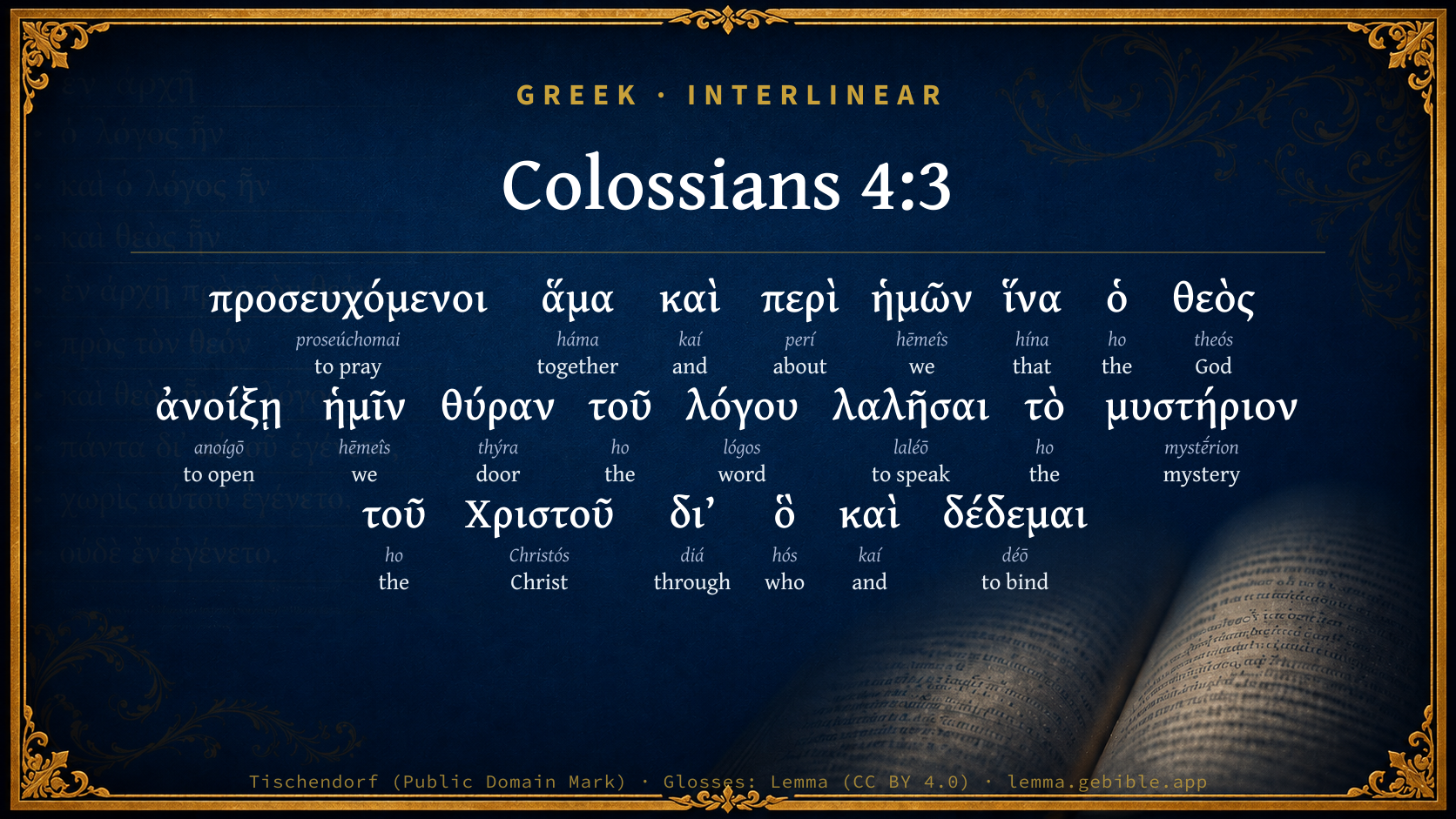
  1. προσευχόμενοι proseúchomai G4336 “to pray” Verb, Present, Middle or Passive deponent, Participle, Nominative, Plural, Masculine
  2. καὶ kaí G2532 “and” Conjunction
  3. περὶ perí G4012 “about” Preposition
  4. ἡμῶν hēmeîs G2249 “we” Personal pronoun, 1st person, Genitive, Plural
  5. ἵνα hína G2443 “that” Conjunction
  6. ὁ ho G3588 “the” Article, Nominative, Singular, Masculine
  7. θεὸς theós G2316 “God” Noun, Nominative, Singular, Masculine
  8. ἀνοίξῃ anoígō G455 “to open” Verb, Aorist, Active, Subjunctive, 3rd person, Singular
  9. ἡμῖν hēmeîs G2249 “we” Personal pronoun, 1st person, Dative, Plural
  10. θύραν thýra G2374 “door” Noun, Accusative, Singular, Feminine
  11. τοῦ ho G3588 “the” Article, Genitive, Singular, Masculine
  12. λόγου lógos G3056 “word” Noun, Genitive, Singular, Masculine
  13. λαλῆσαι laléō G2980 “to speak” Verb, Aorist, Active, Infinitive
  14. τὸ ho G3588 “the” Article, Accusative, Singular, Neuter
  15. μυστήριον mystḗrion G3466 “mystery” Noun, Accusative, Singular, Neuter
  16. τοῦ ho G3588 “the” Article, Genitive, Singular, Masculine
  17. Χριστοῦ Christós G5547 “Christ” Noun, Genitive, Singular, Masculine
  18. δι’ diá G1223 “through” Preposition
  19. ὃ hós G3739 “who” Relative pronoun, Accusative, Singular, Neuter
  20. καὶ kaí G2532 “and” Conjunction
  21. δέδεμαι déō G1210 “to bind” Verb, Perfect, Passive, Indicative, 1st person, Singular

About this verse

These counts appear in no published source. They are computed here, from the morphology-tagged text and Lemma’s own curated glosses. What Lemma adds →

22
words
17
distinct lemmas
Pauline Epistles
section

Notable vocabulary

The rarest word here is ἅμα together G260 — appearing just 10 times in the whole Greek New Testament.

Shared distinctive vocabulary

ἅμα together G260 occurs in 10 verses of the Greek New Testament. Also found in:

Repetition

Words recur within this verse:

Cross-references

21

Topical passages linked to Colossians 4:3 in the Treasury of Scripture Knowledge — connected by theme and wording, ordered by reader-vote popularity; previews shown in the World English Bible.

  • Ephesians 6:19–20 on my behalf, that utterance may be given to me in opening my mouth, to make known with boldness the mystery of the Gospel,
  • Acts 14:27 When they had arrived, and had gathered the assembly together, they reported all the things that God had done with them, and that he had opened a door of faith to the Gentiles.
  • 2 Thessalonians 3:1–2 Finally, brothers, pray for us, that the word of the Lord may spread rapidly and be glorified, even as also with you;
  • Philippians 1:13–14 so that it became evident to the whole praetorian guard, and to all the rest, that my bonds are in Christ;
  • 2 Corinthians 2:12 Now when I came to Troas for the Gospel of Christ, and when a door was opened to me in the Lord,
  • Colossians 1:26 the mystery which has been hidden for ages and generations. But now it has been revealed to his saints,
  • 1 Corinthians 4:1 So let a man think of us as Christ's servants, and stewards of God's mysteries.
  • 1 Corinthians 16:9 for a great and effective door has opened to me, and there are many adversaries.
  • Philippians 1:7 It is even right for me to think this way on behalf of all of you, because I have you in my heart, because, both in my bonds and in the defense and confirmation of the Gospel, you all are partakers with me of grace.
  • Colossians 2:2–3 that their hearts may be comforted, they being knit together in love, and gaining all riches of the full assurance of understanding, that they may know the mystery of God, both of the Father and of Christ,
  • 2 Timothy 2:9 in which I suffer hardship to the point of chains as a criminal. But God's word isn't chained.
  • Revelation 3:7–8 "To the angel of the assembly in Philadelphia write: "He who is holy, he who is true, he who has the key of David, he who opens and no one can shut, and who shuts and no one opens, says these things:
  • Ephesians 4:1 I therefore, the prisoner in the Lord, beg you to walk worthily of the calling with which you were called,
  • 1 Thessalonians 5:25 Brothers, pray for us.
  • Matthew 13:11 He answered them, "To you it is given to know the mysteries of the Kingdom of Heaven, but it is not given to them.
  • Philippians 1:19 For I know that this will turn out to my salvation, through your supplication and the supply of the Spirit of Jesus Christ,
  • Philemon 1:22 Also, prepare a guest room for me, for I hope that through your prayers I will be restored to you.
  • Hebrews 13:18–19 Pray for us, for we are persuaded that we have a good conscience, desiring to live honorably in all things.
  • Ephesians 3:1 For this cause I, Paul, am the prisoner of Christ Jesus on behalf of you Gentiles,
  • 2 Timothy 1:16 May the Lord grant mercy to the house of Onesiphorus, for he often refreshed me, and was not ashamed of my chain,
  • Romans 15:30–32 Now I beg you, brothers, by our Lord Jesus Christ, and by the love of the Spirit, that you strive together with me in your prayers to God for me,

Cross-references courtesy of OpenBible.info (CC BY 4.0).

Commentary

Notes on Colossians 4:3 from classic Christian and Jewish commentators (each source and its license shown beneath its notes). The classic Christian expositions comment on the surrounding passage and are grouped to its opening verse, so a note may address several verses; the Jewish commentaries on the Tanakh (Rashi and others) are per-verse, so they appear only where the commentator wrote on this verse.

Lemma curates 59 commentaries, every one of them public domain or Creative Commons licensed, each selected and text-cleaned for this edition rather than reprinted as found. About our sources →

The Biblical Illustrator

Joseph S. Exell

Col_4:3-4

Withal praying also for us that God would open unto us a door of utterance.

The peoples prayer and the ministers work

I. The persons for whom we must pray. For us, Paul, Timothy, etc.

1. Observe in general

(1)

That we ought to pray not for ourselves alone, but for others.

(2) That roger a large heart in prayer, and perseverance in its practice, we must endeavour to help others by prayer.

(3) That Christians should desire the prayers of others, as carnal men make use of their friends to get wealth, offices, etc.

2. Learn in particular

(1) That the greatest in the Church need the prayers of the meanest.

(2) That in hearing prayer God is no acceptor of persons. He is as willing to hear the Colossians prayers for Paul as Pauls for the Colossians.

(3) That Churches should pray for their own ministers.

(4) That Christians should pray for all ministers. Paul does not desire their prayers for himself alone. Such a desire in some might evidence spiritual pride and envy.

II. The things to be prayed for.

1. That a door of utterance may be opened.

(1) This comprehends--

(a) Liberty to preach the gospel.

(b) Opportunity.

(c) Preaching power.

(d) Courage to rebuke sin, and declare all Gods counsel without fear of any man.

(e) Success: such utterance as will open the door into the heart.

(2) Whence learn what makes a happy pastor: not wealth, popularity, etc., but liberty, etc. This taxes--

(a) Dumb ministers that utter nothing.

(b) Fantastical ministers who preach their own vanities, speaking only pleasing things.

(c) Idle ministers who preach not all Gods counsels in season and out.

(d) Cold ministers.

(3) Note the fact that Paul was in prison, yet he sought not liberty for himself, but for the gospel. Be thankful then for freedom in both senses, and labour to prevent those things which stop the mouths of Gods ministers. These are--

(a) Ignorance and sin in ministers themselves. Polluted lips are no lips for utterance. The lips of preachers should be touched with knowledge, zeal, and mortification.

(b) The sins of the people (Eze_3:24-27).

(c) The violence of persecution (1Co_16:9; 1Th_3:2).

(d) Discouragement and fear (1Co_16:9; 1Co_16:12; Heb_13:17).

(e) Human wisdom which destroys the profit of the hearer and the power of the preacher.

2. That God may open it.

(1) The hearts of the best ministers are shut until God opens them and dispenses the gift.

(2) Tis God only that opens to men the door of utterance. He creates the fruit of the lips to be peace: He opens and no man shuts. If He gives liberty who can restrain!

III. The end for which the things are asked. That the mystery of Christ may be manifested.

1. The mystery.

(1) To whom is the gospel a mystery?

(a) To the Gentiles: that there should be a Saviour.

(b) To the Jews: that salvation should be in a carpenters son.

(c) To the Papists: that He should be the only Saviour.

(d) To heretics: that He should be a Divine human Saviour.

(e) To the carnal man: that He should be a Saviour in particular to him.

(f) To the godly man: that He should be such a Saviour.

(2) How is it a mystery? Because of the hiding of it--

(a) In the breast of God from all eternity.

(b) In the shadows and types of the ceremonial law.

(c) In the treasury of the Scriptures.

(d) In the person, obedience, and passion of Christ.

(e) In the hearts of Christians.

(3) Why is it a mystery to wicked men? Through--

(a) The veil of their ignorance.

(b) Custom in sin and pleasure, etc.

(c) Judicial blindness.

(4) Is it a mystery? Then it should teach us--

(a) To esteem Gods ministers as its dispensers (1Co_4:2).

(b) To strive by all means to gain the open knowledge of this secret (Eph_1:8-9); but because every vessel is not meet to bear this measure we should get a pure conscience to carry this mystery of faith in (1Ti_3:9).

(c) To account this the highest blessedness (Mat_13:11).

2. Its manifestation: clear sound preaching.

(1) It is not enough to preach, we must preach as becometh this mystery.

(a) With power (1Th_1:5).

(b) With instance and all watchfulness (2Ti_4:2-5),

(c) With patience and constancy (1Co_4:9; 2Co_6:4).

(d) With assurance (2Co_4:13).

(e) With all willingness (1Co_9:16-17).

(f) With all faithfulness (1Co_4:2).

(g) With all zeal, knowing the terror of the Lord (2Co_5:11; 1Th_2:12).

(h) With all holy behaviour (1Th_2:11).

(2) The people must also hear, as becometh the mystery of Christ, with attention, patience, reverence, sincerity, hunger, and fruitfulness. (N. Byfield.)

Ministers dependent on the prayers of the people

There is much criticism bestowed upon preachers, much of canvassing of their doctrines, much readiness in imagining that they are swerving from what is orthodox and sound, much complaining that they are not simple enough or too simple, not profound enough, or not practical enough, or not interesting enough, or not searching enough; but is there much of prayer that God would guide them into the knowledge of truth, and put into their mouths the messages most appropriate to the several classes of hearers? Indeed, we say not this in order to exculpate the minister, as though he were not himself answerable for erroneous or defective ministrations; but, probably, in most cases, the blame is at least to be divided, and as a general rule the parish or district which has derived least good from its pastor, is the parish or district which has offered the least prayer for its pastor. Whilst a congregation is murmuring that its teacher never seems to get beyond the first elements of truth, there is, perhaps, scarcely one of its members who makes it a point of conscience frequently to ask God to open to that teacher the treasures of wisdom and knowledge; whilst the pews are occupied with fears and suspicions that something unsound or even heretical has found way into the pulpit, there is hardly one of the hearers who offers his daily supplications that God would keep the instructor from being carried about by the winds of false doc trine. What marvel, then, if there is but little progress in spiritual things, and the public ministrations of the Word seem instrumental to the converting and confirming but few? The hands even of Moses fell, when not sustained by Aaron and Ur; and even St. Paul leant on converts at Colossae, when hoping to be honoured in making converts at Rome. (H. Melvill, B. D.)

Revival through prayer

A once popular minister gradually lost his influence and congregation. The blame was laid entirely upon him. Some of his Church officials went to talk with him on the subject. He replied: I am quite sensible of all you say, for I feel it to be true; and the reason of it is, I have lost my prayer-book. He explained: Once my preaching was acceptable, many were edified by it, and numbers were added to the Church, which was then in a prosperous state. But we were then a praying people. Prayer was restrained, and the present condition of things followed. Let us return to the same means, and the same results may be expected. They acted upon this suggestion, and, in a short time, the minister was as popular as he had ever been, and the Church was again in a flourishing state. The great apostle felt the necessity of co-operative sympathy and prayer (Rom_15:30; 2Th_3:1). (G. Barlow.)

The door of utterance

was a door for the Word to pass through (1Co_16:9; 2Co_2:12)

. In the rush and press of thought the fettered gospel seems to be identified with the apostle in bonds. The Word is a captive with him. They are to pray therefore that God would open before him a door that the imprisoned Word may pass through and speed onward (2Ti_2:9; 2Th_3:1). (Bishop Alexander.)

Doors shut and open

The door of utterance was closed and barred, as it were, upon the apostle by his imprisonment. It had previously remained open for a series of years (Rom_15:19). Now he was an ambassador in bonds. Thus, in every age of the Church, the door is at times shut to the dissemination of the gospel by the obstacles which the world and Satan raise; by the persecution and imprisonment or banishment of the faithful missionary or minister; by strong prejudices excited in mens minds, as in India years ago, so that they will allow no opening for the gospel; by a prevalent spirit of infidelity, as during the first French revolution; by a failure of means in religious societies; by heresies and tendencies to popery for a time prevailing; and by the rapid deaths of eminent missionaries and ministers. Then again the door is opened from time to time by the mercy of God; as when Paul was liberated from prison and allowed again to prosecute for a few years his evangelical labours; as, in other ages and places, when persecutions cease, and the civil magistrate protects the true religion; when the heathen and Mahommedan nations are placed under the sway, or brought into contact with Protestant Christian powers; when heresies and leanings towards popery are checked; when faithful men are raised up, qualified, and placed in important situations of service; when translations of the Scriptures are made and widely diffused; when kings and princes are touched with grace, and take an active interest in the spread of the gospel, as Frederick the Wise of Saxony, at the period of the Reformation, and when a spirit of inquiry, like that among the noble Berseans, is excited, to search the Scriptures daily to see whether the things brought to their knowledge are indeed so. But the door of utterance also includes Gods giving scope to the preaching of the gospel by removing external hindrances; His granting to ministers by His Spirit suitable gifts and graces for discharging their office; and His vouchsafing by the same Spirit efficacy to their word that it may enter the hearts of the hearers. What a vast field of intercessory prayer is here presented! (Bishop D. Wilson.)

For which I am also in bonds.

St. Paul was an ambassador for Christ. According to the law of nations, there is a sacredness about the person of an ambassador, which is never violated unless by the desperate or the barbarous. Let one country send an ambassador to another, with the hope of adjusting points in litigation between the two, and though the proposed terms may be utterly repudiated, and nothing but a war of extermination will satisfy the people to whom the embassage is come, yet is the ambassador commonly treated with every marker respect; his office is a sufficient guarantee for his personal safety, and until he have been honourably dismissed and scrupulously escorted, no steps can be taken against the nation whose representative he is. And if in any case a different course is pursued--if the people ill-use the ambassador, depriving him of liberty, and yet more of life, there is an indignant exclamation throughout the civilized world; a hundred provinces are ready to make common cause with a nation so deeply injured in the person of its representative, and the tribe which has done the wrong is immediately as though placed under sentence of outlawry. Or, to take a more pertinent case. Suppose a revolt to have occurred in one of the provinces of an empire. The king is loth to proceed to extremities, and therefore sends an ambassador with proffers and reims of reconciliation. But the rebels, though they cannot disprove his credentials, nor doubt his authority, not satisfied with contemptuously rejecting his offers, cast him into prison and bind him with chains. Now, tell us, what a feeling of indignation would pervade a whole country, and how like a watchword, in which every class of the community joined, there would pass through the land the cry, An ambassador in bonds! An ambassador in bonds!--why, this is St. Pauls account of himself in the text. He is an ambassador of Christ to publish the gospel, for which, says he, I am in bonds. He gives the description without comment, as though sufficient by itself, and by its strangeness, to arrest the most unthinking. (H. Melvill, D. D.)

Prayer for ministers

The Rev. Solomon Stoddard, the predecessor of the far-famed President Edwards, was engaged by his people on an emergency. They soon found themselves disappointed, for he gave no indications of a renewed and serious mind. In this difficulty their resource was prayer. They agreed to set apart a day for special fasting and prayer, in reference to their pastor. Many of the persons meeting for this purpose had necessarily to pass the door of the minister. Mr. Stoddard hailed a plain man whom he knew, and addressed him, What is all this? What is doing to-day? The reply was, The people, sir, are all meeting to pray for your conversion. It sank into his heart. He exclaimed to himself, Then it is time I prayed for myself! He was not seen that day. He was seeking in solitude what they were asking in company; and, while they were yet speaking, they were heard and answered. The pastor gave unquestionable evidence of the change; he laboured amongst a beloved and devoted people for nearly half a century, and was, for that period, deservedly ranked among the most able and useful of Christian ministers.

The Biblical Illustrator, edited by Joseph S. Exell (c. 1880s–1900s) — public domain. Text from a community e-Sword module.

The Pulpit Commentary

Praying at the same time also for us (Eph_6:19; Rom_15:30-32; 1Th_5:25; 2Th_3:1; Heb_13:18) In Ephesians and Romans the apostle implores prayer for himself alone, and dwells on his personal circumstances. Here and in the Thessalonian letters he unites his fellow labourers with him in the request. That God may open to us a door for the word (1Co_16:9; 2Co_2:12; 1Th_1:9 1Th_2:1)

word" is the Word of God which the apostle preaches (Col_1:5, Col_1:25; 1Th_1:6; Gal_6:6; 2Ti_4:2; Act_16:6) and "a debt" is wanted, in his present difficulties, through which that Word may freely pass, such as he speaks of. (1Co_16:9; 2Co_2:12 comp. Act_14:27; Rev_3:8) It is fanciful to give "door" here the sense of "mouth." The "opening of my mouth," in Eph_6:19, expresses the subjective freedom (corresponding to "as I ought to speak," ver. 4); "the door for the word," the objective liberty desired by St. Paul in his imprisonment. To speak the mystery of Christ, because of which also I am bound (Col_1:23-29; Eph_6:19 Eph_3:1-13 Eph_4:1; Php_1:12-14; Phm_1:9; 2Ti_2:8-10; Act_20:22-24) Were his prison door once opened, the apostle would be able freely to preach the gospel to the Gentiles for this "the mystery of Christ" chiefly signifies (Col_1:25-29; Eph_3:1-8; 1Ti_2:3-7) (On "mystery," see note, (Col_1:26) It is this very mission which makes him long for freedom, that keeps him a prisoner (Col_1:23; Eph_3:13) He is in the strange position of an "ambassador in chains" (Eph_6:19; Phm_1:9, 10: comp. 2Ti_2:9) This "I am bound" (singular) shows that the "for us" of the former clause designedly includes others with himself.

Vers. 3, 4.

Prayer for the apostle and his companions.

praying for us also, that God may open unto us a door for the word, to speak the mystery of Christ for which I am also in bonds; that I may make it manifest, as I ought to speak.

I EVEN THE GREATEST IN THE CHURCH NEEDS THE PRAYERS OF THE LEAST.

1. It is the duty of the people to pray for their ministers.

2. It makes prayer profitable to interest ourselves in the welfare of othersby intercessions for them at a throne of grace.

3. The progress of the gospel depends much upon the prayers of thesaints. (2Th_3:1)

II THE SUBJECT OF THE PRAYER. It was that the apostle and Timothy and Epaphras might have abundant opportunity of preaching the gospel, as well as liberty, power, and success. The prayer implies:

1. That God can open a way for the gospel among the hearts of men. It was the Lord who opened Lydia"s heart, (Act_16:14) and "opened the door of faith to the Gentiles". (Act_14:27)

2. That God could liberate the apostle from prison as a condition of carrying on his apostolic work.

3. That the apostles imprisonment was caused by his devotion to the mystery of Christ," which was the admission of the Gentiles to salvation on equal terms with the Jews, or, in other words, "Christ in them the Hope of glory". (Col_1:27) He would not have been in prison if he had been preaching a gospel with Judaic restrictions. His bonds were due to the strength of Jewish prejudices. But "the truth of the gospel" was so dear to him that he was content to suffer for it, and even to forego the opportunities of enlarged usefulness out of prison.

4. That he might be able to use his opportunities with boldness and success. People ought to pray that their ministers may be able to preach the Word with power; (1Th_5:5) with urgency; (2Ti_4:2, 2Ti_4:3, 2Ti_4:5) with patience, constancy, and fear (1Co_4:9; 2Co_6:4 2Co_4:8) with faithfulness; (1Co_4:2) with zeal, (2Co_5:11 1Th_2:12) approving themselves in the sight of God to their hearers" consciences. T.C. (2Co_2:17)

The Pulpit Commentary (1880–1919), ed. H.D.M. Spence-Jones & Joseph S. Exell — public domain. Text from a community e-Sword module.

Tyndale Open Study Notes

Tyndale Open Resources

4:3 that God will give us many opportunities (literally that God might open for us a door): An open door is a metaphor for an opportunity to proclaim the Good News (see also Acts 14:27; 1 Cor 16:9; 2 Cor 2:12). • his mysterious plan concerning Christ: See Col 1:26-27; 2:2. • That is why I am here in chains: Paul’s dedication to preaching the Good News had led to his imprisonment (see Colossians Book Introduction, “Date and Occasion of Writing”).

Tyndale Open Study Notes — © Tyndale Open Resources, licensed CC BY-SA 4.0. Text via the HelloAO Bible API.

Bengel's Gnomon

Johann Albrecht Bengel

Col 4:3. Ἡμῶν, for us) Ch. Col 1:1.—ἀνοίξῃ θύραν τοῦ λόγου, would open the [but Engl. Vers. not of the mouth; therefore, “a door”] door of utterance) i.e. the mouth, Eph 6:19; Mic 7:5. A great opportunity is elsewhere called a door [and so Engl. Vers. here], 1Co 16:9.—δέδεμαι, ἵνα φανερώσω, I am in bonds, that I may make it manifest[29]) a paradox; as in 2Ti 2:9; Php 1:12-13.

[29] But Engl. Vers. puts a colon after bonds; so that ἵνα is thus connected with προσευχόμενοι, not δέδεμαι.—ED.

Bengel's Gnomon of the New Testament — English translation (T&T Clark, Edinburgh, 1860) — public domain. Text from a community e-Sword module.

Meyer's Critical & Exegetical Commentary

Heinrich August Wilhelm Meyer

Col_4:3. Comp. Eph_6:19 f.

ἅμα καὶ περὶ ἡμ.] while your prayer takes place at the same time also (not merely for yourselves, for others, and about whatever other affairs, but at the same time also) for us, includes us also. This ἡμῶν, not to be referred to Paul alone, like the singular δέδεμαι subsequently and Col_4:4, applies to him and Timothy, Col_1:1.

ἵνα] contents of the prayer ἵνα] contents of the prayer expressed as its purpose, as in Col_1:9 and frequently.

θύραν τ. λόγου] is not equivalent to στόμα (Beza, Calvin, Zanchius, Estius, Cornelius a Lapide, Bengel, and others, comp. Storr and Böhmer)a singular appellation which Eph_6:7 does not warrant us to assumebut is rather a figurative way of indicating the thought: unhindered operation in the preaching of the gospel. So long as this does not exist, there is not opened to the preachers a door for the word, through which they may let it go forth. Comp. 1Co_16:9; 2Co_2:12; Dion. Hal. de vi Dem. p. 1026. 14: οὐδὲ θύρας ἰδὼν λόγος, also Pind. Ol. vi. 44; πύλας ὕμνων ἀναπιτνάμεν, Bacchyl. fr. xiv. 2. The παῤῥησία of the preaching (Chrysostom, Oecumenius, Theophylact), however, lies not in the θύρα and its opening, but in what follows. Hofmann incorrectly holds that the closed door is conceived as being on the side of those, to whom the preachers wished to preach the word, so that it could not enter in. This conception is decidedly at variance with the immediately following λαλῆσαι κ.τ.λ., according to which the hindrance portrayed (the door to be opened) exists on the side of the preachers. Moreover, in this ἵνα ὁ Θεὸς κ.τ.λ. the wish of the apostle, as regards his own person, is certainly directed to liberation from his captivity (comp. Phm_1:22), not, however, to this in itself, but to the free working which depended on it. It was not the preaching in the prison which Paul meant, for that he had; but he longed after the opening of a θύρα τοῦ λόγου; God was to give it to him. Perhaps the thought of liberation suggested to himself the choice of the expression. Nor is the plural ἡμῶν and ἡμῖν, embracing others with himself, at variance with this view (as Hofmann holds); for by the captivity of the apostle his faithful friend and fellow-labourer Timothy, who was with him, was, as a matter of course, also hindered in the freedom of working, to which he might otherwise have devoted himself. This was involved in the nature of their personal and official fellowship. Observe how it is only with δέδεμαι that Paul makes, and must make, a transition to the singular. This transition by no means betrays (in opposition to Hitzig and Holtzmann) the words διʼ ὃ καὶ δέδεμαι, ἵνα φαν. αὐτό to be an interpolation from Eph_6:20. The fact, that Paul elsewhere (Rom_7:2; 1Co_7:27; 1Co_7:39) has δέειν in the figurative sense, cannot matter; comp., on the contrary, the δεσμός and δέσμιος which he so often uses.

λαλῆσαι κ.τ.λ.] infinitive of the aim: in order to speak the mystery of Christ. The emphasis is on λαλῆσαι: not to suppress it, but to let it be proclaimed. Comp. 1Co_2:6; 2Co_4:13; 1Th_2:2.

τοῦ Χριστοῦ] genitive of the subject, the divine mystery contained in the appearance and redemptive act of Christ (comp. Eph_3:4), in so far, namely, as the divine counsel of redemption, concealed previously to its being made known by the gospel, was accomplished in Christs mission and work (Col_1:26, Col_2:2; Eph_1:9; Rom_16:25). Thus the μυστήριον of God in Col_2:2 is, because Christ was the bearer and accomplisher of it, the μυστήριον τοῦ Χριστοῦ.

διʼ ὃ καὶ δέδεμαι] διʼ ὅ applies to the μυστήρ.; and the whole clause serves to justify the intercession desired. When, namely, Paul wishes λαλῆσαι τὸ μυστήρ. τ. Χ., he therewith desires that, which is in such sense his entire destination, that on account of this mysterybecause, namely, he has made it knownhe also bears his fetters. This καί is consequently the also of the corresponding relation, quite common with relatives (Baeumlein, Partik. p. 152).

Meyer — Critical and Exegetical Commentary on the New Testament — English translation by Peter Christie, edited by Frederick Crombie (T&T Clark, 1880) — public domain. Text from a community e-Sword module.

Expositor's Greek Testament

ed. W. Robertson Nicoll

Col 4:3 . ἡμῶν : perhaps including all his fellow-workers, probably not Paul alone, on account of the singular ( δέδεμαι ). θύραν τοῦ λόγου : i.e. , a removal of whatever obstructs its progress, possibly liberation from prison, to which he was looking forward (Phm 1:22 ). For the metaphor, cf. 1Co 16:9 , 2Co 2:12 . λαλῆσαι : “so as to speak,” infinitive of the consequence. τὸ μυστήριον τοῦ Χριστοῦ : the mystery which has Christ for its content. On account of his proclamation of it, and especially of the truth that the Gentiles were admitted freely to its blessings, he is now a prisoner.

The Expositor's Greek Testament, edited by W. Robertson Nicoll (1897–1910) — public domain. Text from a community e-Sword module.

Geneva Bible (1599)

Geneva Bible translators

An open and free mouth to preach the Gospel.

Such as minister the word, must especially be commended to the prayers of the Church.

Geneva Bible (1599) marginal notes — public domain. Text via Bolls.life.

Jamieson, Fausset & Brown

Robert Jamieson, A. R. Fausset & David Brown

for us--myself and Timothy (Col 1:1).

a door of utterance--Translate, "a door for the word." Not as in Eph 6:19, where power of "utterance" is his petition. Here it is an opportunity for preaching the word, which would be best afforded by his release from prison (Co1 16:9; Co2 2:12; Plm 1:22; Rev 3:8).

to speak--so that we may speak.

the mystery of Christ-- (Col 1:27).

for which . . . also--on account of which I am (not only "an ambassador," Eph 6:20, but) ALSO in bonds.

Jamieson, Fausset & Brown — Commentary Critical and Explanatory on the Whole Bible (1871) — public domain (CC PDM 1.0). Text via the HelloAO Bible API.

Adam Clarke's Commentary

Verse 3. Praying also for us] Let the success and spread of the Gospel be ever dear to you; and neglect not to pray fervently to God that it may have free course, run, and be glorified.

A door of utterance] θυραν του λογου. The word θυρα, which commonly signifies a door, or such like entrance into a house or passage through a wall, is often used metaphorically for an entrance to any business, occasion or opportunity to commence or perform any particular work. So in Ac 14:27: The DOOR of faith is opened to the Gentiles; i.e. there is now an opportunity of preaching the Gospel to the nations of the earth. 1Co 16:9: A great and effectual DOOR is opened unto me; i.e. I have now a glorious opportunity of preaching the truth to the people of Ephesus. 2Co 2:12: When I came to Troas-a DOOR was opened unto me; I had a fine opportunity of preaching Christ crucified at that place. So, here, the θυρατου λογου, which we translate door of utterance, signifies an occasion, opportunity, or entrance, for the doctrine of the Gospel. The same metaphor is used by the best Latin writers. Cicero, xiii. Ep. 10: Amiciliae fores aperiuntur; the DOORS of friendship are opened-there is now an opportunity of reconciliation. And Ovid, Amor. Iib. iii., Eleg. xii. ver. 12:-

JANUA per nostras est adaperta manus.

"The gate is opened by our hands."

Of this use of the word among the Greek writers Schleusner gives several examples. See also Re 3:8, where the word is used in the same sense. To multiply examples would be needless; the apostle excites them to pray, not that a door of utterance, i.e. a readiness and fluency of speech, may be given to him and his fellow labourers, but that they may have an opportunity of preaching the doctrine of Christ; and so the term λογος is to be understood here, as well as in many other places of the New Testament, in most of which we have either lost or obscured its meaning by translating it word instead of doctrine.

The mystery of Christ] The Gospel, which had been hidden from all former times, and which revealed that purpose long hidden in the Divine councils, that the Gentiles should be called to enjoy the same privileges with the Jews.

For which I am also in bonds] He was suffering under Jewish malice, and for preaching this very mystery; for they could not bear to hear announced, as from heaven, that the Gentiles, whom they considered eternally shut out from any participation of the Divine favour, should be made fellow heirs with them of the grace of life; much less could they bear to hear that they were about to be reprobated, and the Gentiles elected in their place. It was for asserting these things that they persecuted Paul at Jerusalem, so that to save his life he was obliged to appeal to Caesar; and being taken to Rome, he was detained a prisoner till his case was fully heard; and he was a prisoner at Rome on this very account when he wrote this Epistle to the Colossians. See Clarke on Col 1:24.

Adam Clarke's Commentary on the Bible (1810–1826) — public domain. Text from a community e-Sword/MySword module.

John Calvin's Commentaries

3. Pray also for us. He does not say this by way of pretense, but because, being conscious to himself of his own necessity, he was earnestly desirous to be aided by their prayers, and was fully persuaded that they would be of advantage to them. Who then, in the present day, would dare to despise the intercessions of brethren, which Paul openly declares himself to stand in need of? And, unquestionably, it is not in vain that the Lord has appointed this exercise of love between us — that we pray for each other. Not only, therefore, ought each of us to pray for his brethren, but we ought also, on our part, diligently to seek help from the prayers of others, as often as occasion requires. It is, however, a childish argument on the part of Papists, who infer from this, that the dead must be implored to pray for us. For what is there here that bears any resemblance to this? Paul commends himself to the prayers of the brethren, with whom he knows that he has mutual fellowship according to the commandment of God: who will deny that this reason does not hold in the case of the dead? Leaving, therefore, such trifles, let us return to Paul.

As we have a signal example of modesty, in the circumstance that Paul calls others to his assistance, so we are also admonished, that it is a thing that is replete with the greatest difficulty, to persevere steadfastly in the defense of the gospel, and especially when danger presses. For it is not without cause that he desires that the Churches may assist him in this matter. Consider, too, at the same time, his amazing ardor of zeal. He is not solicitous as to his own safety; he does not ask that prayers may be poured forth by the Churches on his behalf, that he may be delivered from danger of death. He is contented with this one thing, that he may, unconquered and undaunted, persevere in a confession of the gospel; nay more, he fearlessly makes his own life a secondary matter, as compared with the glory of Christ and the spread of the gospel.

By a door of utterance, however, he simply means what, in Ephesians 6:19, he terms the opening of the mouth, and what Christ calls a mouth and wisdom. (Luke 21:15.) For the expression differs nothing from the other in meaning, but merely in form, for he here intimates, by all elegant metaphor, that it is in no degree easier for us to speak confidently respecting the gospel, than to break through a door that is barred and bolted. For this is truly a divine work, as Christ himself said,

It is not ye that speak, but the Spirit of your Father that speaketh in you. (Matthew 10:20.)

Having, therefore, set forward the difficulty, he stirs up the Colossians the more to prayer, by declaring that he cannot speak right, except in so far as his tongue is directed by the Lord. Secondly, he argues from the dignity of the matter, when he calls the gospel the mystery of Christ. For we must labor in a more perfunctory manner in a matter of such importance. Thirdly, he makes mention also of his danger.

John Calvin's Commentaries (1540-1563) — public domain. Text from the Calvin Translation Society English edition (1840s-50s) via the Christian Classics Ethereal Library (ccel.org). Calvin's coverage is partial (roughly two-thirds of the Bible); uncommented books and verses are honest gaps, never fabricated. The 19th-century editor's footnotes and remarks are omitted so the notes are faithfully Calvin's own voice.

Ellicott's Commentary for English Readers

(3) A door of utterance.—Comp. a similar phrase in 1Co_16:9; 2Co_2:12. There, however, the opened door is the door of external opportunity; here the “door of utterance” is the removal of all internal impediments to preaching.

A Bible Commentary for English Readers, edited by Charles John Ellicott (1878–1897) — public domain. Text from a community e-Sword module.

The Cambridge Bible for Schools and Colleges

gen. ed. J. J. S. Perowne

3. praying also for us] Cp. Rom_15:30; Eph_6:19; 1Th_5:25; 2Th_3:1; Heb_13:18. He wisely covets for his apostolic work, and the work of his friends, the prayers of the obscurest watchful believer.

open … a door of utterance] Lit., a door of the word of the Gospel, i.e., an opportunity for the missionary. For the phrase cp. 1Co_16:9; 2Co_2:12; where, as here, the “open door” is not the emboldened mouth (which is chiefly in his thought Eph_6:19-20) but the favourable circumstances. Cp. for a partial parallel Act_14:27, and perhaps Rev_3:8.

to speak] Such was the use to which the “open door” of occasion would be put.

the mystery of Christ] Cp. Eph_3:4 for the same phrase. The word mystery is frequent with St Paul; he uses it in some 21 places, of which 11 lie in this Epistle and Ephesians. On the word, see above on Col_1:26.—“Of Christ:”—with whose Person, Work, and Life, the great Secret was vitally bound up. See on Col_1:27.

for which] On account of which. “St Paul might have been still at large if he had been content to preach a Judaic Gospel” (Lightfoot). Cp. Act_21:13; Act_28:20.

I am … in bonds] Lit., I have been bound. Cp. Eph_6:19 and our notes. And see Eph_3:1; Eph_4:1; Php_1:7; Php_1:13-14; Php_1:16; Phm_1:10; Phm_1:13.—It is easy to read, and to forget, this passing allusion. But what must have been the hourly trial to a sensitive spirit, of this attachment day and night to a (probably) pagan sentinel, perhaps wholly devoid of generous instincts!

The Cambridge Bible for Schools and Colleges (gen. ed. J. J. S. Perowne; Cambridge University Press, 1878–1918) — public domain. Text from a community e-Sword module.

John Gill's Exposition

Withal, praying also for us,.... The persons to be prayed for are next directed to; and these are not only themselves, though their concern is very near and great, but others also, all the saints and people of God, yea, all men, and in particular the ministers of the Gospel. The apostle desires they would pray for him, and his fellow ministers, and which he says not in dissimulation, under a guise of humility, but in true humility and lowliness of mind; being sensible of the greatness of the ministerial work, which this shows, and of his own imperfection and weakness, and of what advantage the prayers, even of the meanest in the church, might be unto him: and this shows, that it is the duty of churches, and of particular believers, to pray for their ministers, and, among the rest, as follows,

that God would open to us a door of utterance; or "of the word"; so the Vulgate Latin, Syriac, Arabic; and Ethiopic versions; meaning, either the word of the Gospel, that the door of that might be opened, that it might have a free course, and be glorified; for though he was bound, that was not; nor does he desire that the door of the prison might be opened, but the door of the word; that there might be an opportunity of preaching it; in which sense this phrase is used, Co1 16:9 that whereas he could not go abroad to preach it, the hearts of men might be inclined to come to him, and hear it from his mouth; and that the door of their hearts might be opened, that they might attend unto it; that it might have an entrance into them, and a place in them: or else the door of his own speech and words is intended, and the sense be, that God would not only set before him an open door for the preaching of the Gospel, and make it effectual for the conversion of many souls; but that, as he would furnish him with all abilities, and every gift for that service, so that with enlargement of heart, and liberty of mind, he would give him elocution, a mouth and wisdom to speak, utterance and freedom of speech; that the door of the Gospel being opened, or an opportunity given to preach it, and the door of men's hearts opened to receive it, the door, of his lips might be also opened to show forth the praise of the grace of God. The Alexandrian copy adds, "with boldness", or "boldly", as in Eph 6:19

to speak the mystery of Christ; the Gospel, of which Christ is the author, preacher, sum, and substance; the whole of which is a mystery; the wisdom of God in a mystery; all the doctrines of it are mysteries; and particularly those, and which are here more especially designed, which regard the person, offices, and grace of Christ, as the mystery of his divine and eternal sonship, of his incarnation, of the union of the two natures, divine and human, in his person, of redemption by his blood, justification by his righteousness, and satisfaction by his sacrifice, things dear to the apostle, and which his soul was full of, and he wanted to speak out; and therefore desires prayer, to be made for him, that a door might be opened, and way made for his speaking of these things with freedom:

for which, says he,

I am also in bonds; this he adds, partly to show how dear the Gospel was to him, that he was willing to suffer, and did suffer cheerfully for the sake of it; and what an honour he esteemed it to lie in chains for it, of which, nor of that, was he in the least ashamed; and partly to stir them up the more to prayer for him, for his liberty in every respect.

John Gill's Exposition of the Whole Bible (1746–1763) — public domain (CC PDM 1.0). Text via the HelloAO Bible API.

Trapp's Complete Commentary

John Trapp

3 Withal praying also for us, that God would open unto us a door of utterance, to speak the mystery of Christ, for which I am also in bonds:

Ver. 3. Withal, praying also for us] {See Trapp on "Eph 6:19"} By the word a door is opened into heaven.

John Trapp, A Commentary or Exposition upon All the Books of the Old and New Testament (1647–1656) — public domain. Text from a community e-Sword module.

Albert Barnes' Notes on the Bible

Withal - With all the supplications which you offer for other persons and things; or at the same time that you pray for them.

Praying also for us - Notes, Eph 6:19-20; compare 2Co 1:11; Phi 1:19; Heb 13:18-19.

That God would open to us a door of utterance - To preach the gospel. He earnestly desired to have liberty to preach the gospel, and asked them to pray that this might be restored to him; see the notes at Eph 6:19.

To speak the mystery of Christ - Called in Eph 6:19, the “mystery of the gospel;” see the notes there.

For which I also am in bonds - A prisoner at Rome; Notes, Eph 6:20.

Albert Barnes' Notes on the Bible (1834–1885) — public domain. Text from a community e-Sword/MySword module.

Haydock's Catholic Bible Commentary

A door of speech; i.e. of free speech to preach the gospel. (Witham)

George Leo Haydock (1774–1849), Haydock's Catholic Family Bible and Commentary, 1859 edition — public domain. Excludes Psalms (Douay-Rheims chapter numbering differs from Protestant) and Deuterocanonical books (Catholic canon only).

Matthew Poole's English Annotations

Withal praying also for us; not only putting up petitions for themselves, but also interceding for Paul, and others with him, especially Timothy, mentioned in the salutation, Col 1:1,7; Ro 15:30; 2Co 1:11; Phi 1:19; 2Th 3:1; Phm 1:22.

That God would open unto us a door of utterance; that God would vouchsafe to us freedom of speech: See Poole on "Eph 6:19".

To speak the mystery of Christ; effectually to preach the mystery of Christ: see Col 1:26,27; 2:2; Mat 13:11; 1Co 16:9; Eph 1:9.

For which I am also in bonds: for which I am an ambassador in bonds, or, in a chain, Eph 6:20; i.e. with the soldier that kept him in his own hired dwelling, Act 28:16,20,30,31.

Matthew Poole's English Annotations on the Holy Bible (1683–1685) — public domain. Text from a community e-Sword/MySword module.

Whedon's Commentary on the Bible

Daniel D. Whedon

3. A door of utterance—The intercession desired is for the removal of any and all hinderances to the free preaching of the gospel, and the furnishing an opportunity to its extension. Was not their prayer really answered, though in a different way, as indeed God often answers, when the apostle’s closer imprisonment resulted in “the furtherance of the gospel?” Php_1:12.

The mystery—Namely, of which Christ is the sum. See on Col_2:2.

Daniel D. Whedon (gen. ed.), Commentary on the Old and New Testaments (1874–1909) — public domain. Text from a community e-Sword module.

John Wesley's Explanatory Notes

That God would open to us a door of utterance - That is, give us utterance, that we "may open our mouth boldly," Eph. vi, 19, and give us an opportunity of speaking, so that none may be able to hinder.

John Wesley, Explanatory Notes Upon the Whole Bible (1754–1765) — public domain. Text via the GEBible commentary corpus.

Scofield Reference Notes

C. I. Scofield

mystery

(See Scofield "Mat 13:11").

The Scofield Reference Bible (1917 edition), notes by C. I. Scofield — public domain. Text from a community e-Sword module.

Burkitt's Expository Notes on the New Testament

William Burkitt

Our apostle having directed the Colossians to the duty of prayer in general, here he requests an interest in their prayers for himself, and all the ministers of Christ in particular.

Whence observe, 1. That the ministers of Jesus Christ are, and ought in an especial manner to be remembered in the saints’ prayers.

Observe, 2. The mercies he desires may be prayed for, on his behalf, namely, utterance and boldness: Ministers depend upon God, as for other ministerial gifts, so particularly for the gift of utterance, and it is their people’s duty to be earnest and instant with God for the same: And as for utterance in delivering their message, so for boldness in suffering for it, when called to it.

No prayers can be too much to strengthen the hands, and encourage the hearts of the ministers of Christ unto an holy boldness, who suffer persecution for what they preach; therefore is St. Paul so earnest here with the Colossians, as he was before with the Ephesians, Eph 6:18 and with the Romans, Rom 15:30 desiring them to strive together in their prayers for him:

Where, by the way, remark, That the apostle thus passionately desiring the living saints to pray for him, but never desiring once the prayers and intercessions of the saints departed, nor of the Virgin Mary, is an evidence that he approved not of their prayers, nor looked upon them as mediators and intercessors with God then, as the church of Rome does now.

William Burkitt's Expository Notes on the New Testament (1700–1703) — public domain. Text from a community e-Sword module.

The People's New Testament

B. W. Johnson

3. Praying also for us. Note the spirit of this prayer; not a thought of his ease, comfort, or even safety, but only that he may be given full opportunity to preach Christ. So sublime a self-forgetfulness in a suffering prisoner is almost divine. The mystery of Christ. The gospel of Christ. It was a mystery, i. e., a hidden truth until it was revealed. See 1 Cor. 4:1; Eph. 6:19; Col. 1:26; 2:2. In bonds. See notes on Eph. 6:20; Phil. 1:7.

B. W. Johnson's The People's New Testament with Notes (1889–1891) — public domain. Electronic text from the Christian Classics Ethereal Library (CCEL) ThML edition.

Cambridge Greek Testament for Schools and Colleges

3. θύραν τοῦ λόγου. A interprets by adding ἐν παρρησίᾳ.

τὸ μυστήριον τοῦ χριστοῦ. B*L read τοῦ θεοῦ with a few cursives, aeth. and this is possibly right, though a commoner expression (vide Lightfoot, p. 315 n.).

3. προσευχόμενοι ἅμα καὶ, i.e. at the same time as you are praying for yourselves. Other examples of ἅμα καί in the N.T. are Act 24:26; 1Ti 5:13; Phm 1:22†.

περὶ ἡμῶν. Not only St Paul (contrast δέδεμαι, infra) but also Timothy (Col 1:1), and perhaps others working with St Paul, e.g. Epaphras (Col 4:12-13) and the συνεργοί in Col 4:10-11.

For other examples of St Paul begging the prayers of those to whom he is writing see, besides Eph 6:19-20, 1Th 5:25; 2Th 3:1; Rom 15:30.

ἵνα. Not fully final, but weakened after προσεύχομαι; cf. Col 1:9.

ὁ θεὸς ἀνοίξῃ ἡμῖν (τὴν) θύραν τοῦ λόγου. In view of the || Eph 6:19, it is very tempting to explain the phrase here “that God may open for us the power of speech,” i.e. give us liberty of utterance. But θύρα in the N.T. is rather the opportunity; cf. 1Co 16:9; 2Co 2:12; Rev 3:8 (on which see Ramsay, Epp. to the Seven Churches, p. 404). ὁ λόγος (cf. Gal 6:6, al.) will then be the Gospel message, the meaning of the phrase being that God will open for us a way for the Gospel to pass on. The immediate reference is probably to his being now a prisoner and therefore unable to carry out, as he would like, his work of preaching the Gospel.

λαλῆσαι. Stating the aim of this “opening.”

τὸ μυστήριον (Col 1:26-27, Col 2:2, notes) τοῦ χριστοῦ, Eph 3:4†. See notes on Textual Criticism. Almost certainly not objective, “the secret about Christ,” but subjective, “brought by Christ.” Compare ὁ λόγος τοῦ χριστοῦ, Col 3:16. It nearly = the revelation brought by Christ, but while that term would have regarded the fact from the side of God, this is rather from that of the limitation of human knowledge according to its mere natural powers.

That St Paul uses the term with special reference to the reception of the Gospel by the Gentiles see Col 1:27.

διʼ δ. His faithfulness in insisting on this μυστήριον, releasing as it did men from the obligation of the Law and thus including the free admission of Gentiles to full religious privileges, was the ultimate cause of that opposition by the Jews which ended in his being a prisoner.

καὶ. Hardly “even,” laying stress on the magnitude of the privation, but “also,” marking the correspondence either between the message and the personal effect of preaching it, or, more probably, between his wish for liberty (ἵνα … ἀνοίξῃ κ.τ.λ.) and the state in which he now is.

δέδεμαι. || Eph 6:20.

Cambridge Greek Testament for Schools and Colleges (Cambridge University Press, 1896; 21 vols, various authors incl. Carr, Maclear, Plummer, Farrar, Lumby, Moule, M. R. James, Simcox) — public domain. Text from a community e-Sword module.

Alford’s Greek Testament

Henry Alford

3.] ἡμῶν, not ‘me,’—see ch. 1:1, 3. This is plainly shewn here by the singular following after.

ἵνα] see on 1Co 14:13. Here, the idea of final result is prominent: but the purport is also included.

θύραν τ. λόγου] not as Calv., al., oris apertionem, Eph 6:19; but as in reff., objective, an opening of opportunity for the extension of the Gospel by the word. This would, seeing that the Apostle was a prisoner, naturally be given first and most chiefly, as far as he was concerned, by his liberation: cf. Phm 1:22.

λαλῆσαι] inf. of purpose—so that we may speak.

διʼ ὃ κ. δ.] for (on account of) which (mystery) I am (not only a minister but) also bound.

Henry Alford, The Greek Testament (1849–1861) — public domain. Text from a community e-Sword module.

Vincent's Word Studies in the New Testament

Marvin R. Vincent

Door of utterance (quran tou logou). Rev., better, a door for the world. Compare 1Co 16:9; 2Co 2:12; Rev 3:8. See also entering in, 1Th 1:9; 1Th 2:1. And the parallel passage, Eph 6:19. There may be an allusion to a release from imprisonment.

Marvin R. Vincent, Word Studies in the New Testament (1887–1900) — public domain. Text from a community e-Sword/MySword module.

Lightfoot's Colossians and Philemon

J. B. Lightfoot

3. ἡμῶν] ‘us’, ‘the Apostles and preachers of the Gospel’, with reference more especially to Timothy (i. 1) and Epaphras (iv. 12, 13). Where the Apostle speaks of himself alone, he uses the singular (ver. 3, 4 δέδεμαι, φανερώσω). Indeed there is no reason to think that St Paul ever uses an ‘epistolary’ plural, referring to himself solely: see the note on 1 Thess. iii. 1.

ἵνα κ.τ.λ.] On the sense of ἵνα after προσεύχεσθαι etc., see the note on i. 9.

θύραν τοῦ λόγου] ‘a door of admission for the word’, i.e. ‘an opportunity of preaching the Gospel’, as 1 Cor. xvi. 9 θύρα γάρ μοι ἀνέῳγεν μεγάλη καὶ ἐνεργής, 2 Cor. ii. 12 θύρας μοι ἀνεῳγμένης ἐν Κυρίῳ: comp. Plut. Mor. p. 674 D ὥσπερ πύλης ἀνοιχθέισης, οὐκ ἀντέσχον ... συνεισιοῦσι παντοδαποῖς ἀκρόαμασιν. Similarly )έισοδος is used in 1 Thess. i. 9, ii. 1. The converse application of the metaphor appears in Acts xiv. 27 ἤνοιξεν τοῖς ἔθνεσιν θύραν πίστεως, where the door is opened not to the teachers, but to the recipients of the Gospel. According to another interpretation (suggested by Ephes. vi. 19 ἵνα μοι δοθῇ λόγος ἐν ἀνοίζει τοῦ στόματος μου) it is explained ‘the door of our speech’, i.e. ‘our mouth’: comp. Ps. cxli (cxl). 3, Mic. vii. 5, Ecclus. xxviii. 25. But the parallel passages do not favour this sense, nor will the words themselves admit it. In that case for ἡμῖν θύραν τοῦ λόγου we should require τὴν θύραν τῶν λόγωυ [ἡμῶν]. ‘The word’ here is ‘the Gospel’, as frequently.

λαλῆσαι ‘so as to speak’, the infinitive of the consequence, like εἰδέναι ver. 6 ; see Winer § xliv, p. 400.

τὸ μυστήριον κ.τ.λ. i.e. the doctrine of the free admission of the Gentiles. For the leading idea which St Paul in these epistles attaches to ‘the mystery’ of the Gospel, see the note on i. 26.

δι’ ὅ St Paul might have been still at large, if he had been content to preach a Judaic Gospel. It was because he contended for Gentile liberty, and thus offended Jewish prejudices, that he found himself a prisoner. See Acts xxi. 28, xxii. 21, 22, xxiv. 5, 6, xxv. 6, 8. The other reading, δι’ ὅν, destroys the point of the sentence.

καὶ δέδεμαι 2 Tim. ii. 9 μέχρι δεσμῶν, Philem. 9 νυνὶ δὲ καὶ δέσμιος.

J. B. Lightfoot, St Paul's Epistles to the Colossians and Philemon: a revised text with introductions, notes and dissertations (London: Macmillan, 1875) — public domain. Electronic text from Project Gutenberg (ebook #50857). Covers Colossians and Philemon only (the verse-by-verse notes; introductions and dissertations are omitted); Lightfoot's companion Galatians and Philippians volumes are not included, as the available public-domain scans carry garbled Greek that cannot be faithfully reproduced.

Lesson kit

Teaching starters — assembled from the data on this page, not authored interpretation. Every prompt links to the verse data it draws on. Edit before teaching.

Colossians, in the Pauline Epistles, opens this verse with 22 words (17 distinct Greek lemmas). Its most distinctive word is háma (“together”). A historical commentator’s framing appears above. Read the whole chapter for the surrounding context.

Discussion questions

  1. What does “together” (háma) contribute to the verse as a whole?
  2. How does Matthew 13:29, which shares the word «together», read alongside this verse?
  3. What does the repetition of “the” (4× in this one verse) do in this verse?
  4. These translations render this verse differently. What is at stake in choosing one wording over another?
  5. Compare how The Biblical Illustrator and The Pulpit Commentary read this verse. Where do they agree or differ?

Things to notice

Reading settings

Reading text

Shown beneath each verse's original-language words.

Old Testament
Old Testament edition

Read the OT as the Masoretic Hebrew (MT) or the Greek Septuagint (LXX).

English shown for the Greek Septuagint (in the Hebrew ↔ Greek comparison).

Comparing translations? Open the Compare panel on any verse page to stack up to four side by side.