Numbers 22:28

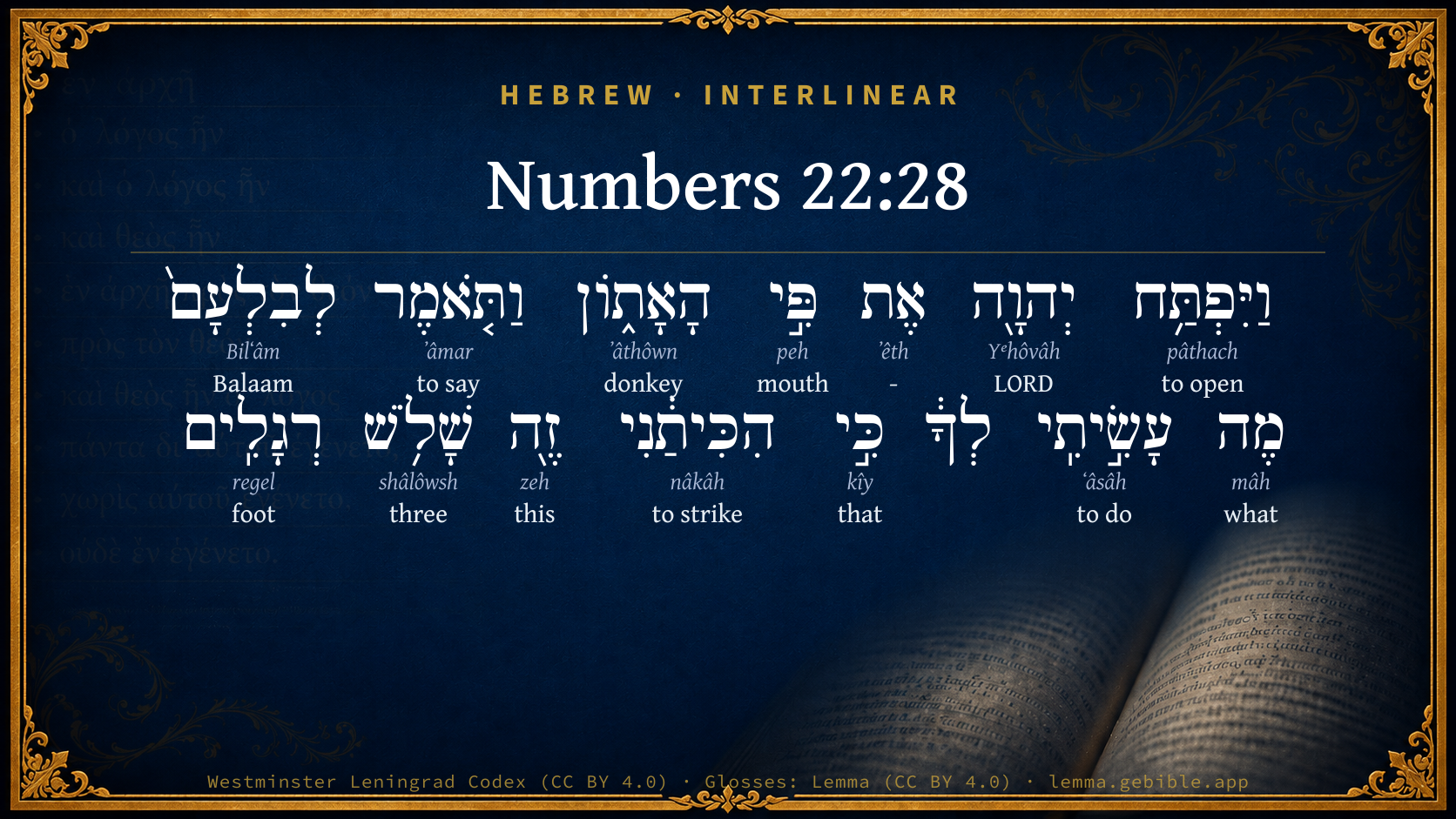
Hebrew (Westminster Leningrad Codex) Numbers 22:28 appears in the Hebrew Old Testament. The text above is from the Westminster Leningrad Codex. Each word links to its Strong’s number, a concise gloss, and parsing drawn from the Open Scriptures Hebrew Bible morphology. Click any word for its full Brown-Driver-Briggs (BDB) entry.
Download image
Cite this verse

Numbers 22:28 (World English Bible). Public Domain. Lemma interlinear Bible study tool, https://lemma.gebible.app/v/numbers/22/28.

Show BibTeX & RIS
BibTeX
RIS
English Translation
Yahweh opened the mouth of the donkey, and she said to Balaam, What have I done to you, that you have struck me these three times?
World English Bible · Public Domain
Download a study sheet

One document with this verse’s original text, its word-by-word gloss line, the meaning frame, cross-references with their text, attributed commentary, and full source and license credits — printable, and it pastes into notes with its structure intact.

This verse Autodidact and up

Study sheet (.html) Plain text (.txt)

A passage Seminary Student

Up to 50 verses in one chapter. A passage sheet keeps up to 6 commentary sources and 12 cross-references per verse, in the order this page ranks them, and says so on the sheet whenever that leaves anything out. Ask for a single verse and you get the Autodidact verse sheet above.

Everything on this page stays free to read, with no account — the sheet is a download of what is already on screen, not access to it.

Want to remove ads? Support Godless Engineer
Compare translations 3

The same verse in 3 English versions, stacked beneath the original-language interlinear above. Click any original word for its lexicon entry.

Each is an independent rendering of the whole verse — the interlinear is not word-aligned to these translations.

Highlighted words mark where these versions differ — a whole-verse word diff, not a word-by-word alignment.

  • World English Bible Public Domain
    Yahweh opened the mouth of the donkey, and she said to Balaam, What have I done to you, that you have struck me these three times?
  • King James Version Public Domain
    And the LORD opened the mouth of the ass, and she said unto Balaam, What have I done unto thee, that thou hast smitten me these three times?
  • unfoldingWord Literal Text CC BY-SA 4.0
    And Yahweh opened the mouth of the female donkey, and she said to Balaam, “What have I done to you, that you have struck me these three times?”

unfoldingWord Literal Text — © unfoldingWord, licensed CC BY-SA 4.0. Word-aligned USFM3 via Door43 (git.door43.org/unfoldingWord/en_ult).

Versions to compare (up to 4)

3 of 4 selected

Show all 18 translations

Every available English version of this verse, each an independent rendering of the whole verse.

  • World English Bible Public Domain
    Yahweh opened the mouth of the donkey, and she said to Balaam, What have I done to you, that you have struck me these three times?
  • Berean Standard Bible Public Domain
    Then the LORD opened the donkey’s mouth, and she said to Balaam, “What have I done to you that you have beaten me these three times?”
  • Majority Standard Bible Public Domain
    Then the LORD opened the donkey’s mouth, and she said to Balaam, “What have I done to you that you have beaten me these three times?”
  • King James Version Public Domain
    And the LORD opened the mouth of the ass, and she said unto Balaam, What have I done unto thee, that thou hast smitten me these three times?
  • American Standard Version (1901) Public Domain
    And Jehovah opened the mouth of the ass, and she said unto Balaam, What have I done unto thee, that thou hast smitten me these three times?
  • Revised Version (1885) Public Domain
    And the LORD opened the mouth of the ass, and she said unto Balaam, What have I done unto thee, that thou hast smitten me these three times?
  • Geneva Bible (1599) Public Domain
    Then the Lord opened the mouth of the asse, and she saide vnto Balaam, What haue I done vnto thee, that thou hast smitten me nowe three times?
  • Douay-Rheims (1899) Public Domain
    And the Lord opened the mouth of the ass, and she said: What have I done to thee? Why strikest thou me, lo, now this third time?
  • Young's Literal Translation Public Domain
    And Jehovah openeth the mouth of the ass, and she saith to Balaam, `What have I done to thee that thou hast smitten me these three times?'
  • Literal Standard Version CC BY-SA 4.0
    And YHWH opens the mouth of the donkey, and she says to Balaam, “What have I done to you that you have struck me these three times?”
  • Unlocked Literal Bible CC BY-SA 4.0
    Then Yahweh opened the donkey's mouth so she could talk. She said to Balaam, “What have I done to you that induced you to strike me these three times?”
  • unfoldingWord Literal Text CC BY-SA 4.0
    And Yahweh opened the mouth of the female donkey, and she said to Balaam, “What have I done to you, that you have struck me these three times?”
  • Darby Bible Public Domain
    And Jehovah opened the mouth of the ass, and she said to Balaam, What have I done to thee, that thou hast smitten me these three times?
  • World Messianic Bible Public Domain
    The LORD opened the mouth of the donkey, and she said to Balaam, “What have I done to you, that you have struck me these three times?”
  • Webster's Bible Public Domain
    And the LORD opened the mouth of the ass, and she said to Balaam, What have I done to thee, that thou hast smitten me these three times?
  • Free Bible Version CC BY-SA 4.0
    The Lord gave the donkey the ability to speak and it said to Balaam, “What have I done to you for you to beat me three times?”
  • Bible in Basic English Public Domain
    Then the Lord gave the ass the power of talking, and opening her mouth she said to Balaam, What have I done to you that you have given me blows these three times?
  • JPS Tanakh (1917) Public Domain
    And the LORD opened the mouth of the ass, and she said unto Balaam: 'What have I done unto thee, that thou hast smitten me these three times?'

Literal Standard Version (2020), Covenant Press — licensed CC BY-SA 4.0. Text via the HelloAO Bible API (eBible.org). Unlocked Literal Bible (unfoldingWord) — licensed CC BY-SA 4.0. Text via the HelloAO Bible API (eBible.org). unfoldingWord Literal Text — © unfoldingWord, licensed CC BY-SA 4.0. Word-aligned USFM3 via Door43 (git.door43.org/unfoldingWord/en_ult). Free Bible Version, Dr. Jonathan Gallagher — licensed CC BY-SA 4.0. Text via the HelloAO Bible API (eBible.org).

Word by word

More ways to search: Search by grammar → Find every occurrence → Compare this word →

Practice this passage: Drill this verse → Learn its vocabulary →

הָאָת֑וֹן
ʼâthôwn
H860
“the · donkey”
Particle, Definite Article + Noun, Common, Feminine, Singular, Absolute
Part of Speech
Particle + Noun
Type
Common
Gender
Feminine
Number
Singular
State
Absolute
Full BDB Definition

Origin: probably from the same as H386 (sense of patience)

TWOT: 190a

she-ass, she-donkey
  1. וַיִּפְתַּ֥ח pâthach H6605 “and · to open” Conjunction + Verb, Qal, Sequential Imperfect, 3rd Person, Masculine, Singular
  2. יְהוָ֖ה Yᵉhôvâh H3068 “LORD” Noun, Proper
  3. אֶת ʼêth H853 “-” Particle, Direct Object
  4. פִּ֣י peh H6310 “mouth of” Noun, Common, Masculine, Singular, Construct
  5. וַתֹּ֤אמֶר ʼâmar H559 “and · to say” Conjunction + Verb, Qal, Sequential Imperfect, 3rd Person, Feminine, Singular
  6. לְבִלְעָם֙ Bilʻâm H1109 “to/for · Balaam” Preposition + Noun, Proper
  7. מֶה mâh H4100 “what” Particle, Interrogative
  8. עָשִׂ֣יתִֽי ʻâsâh H6213 “to do” Verb, Qal, Perfect, 1st Person, Common, Singular
  9. כִּ֣י kîy H3588 “that” Conjunction
  10. הִכִּיתַ֔נִי nâkâh H5221 “to strike · me” Verb, Hiphil, Perfect, 2nd Person, Masculine, Singular + Suffix, Personal, 1st Person, Common, Singular
  11. זֶ֖ה zeh H2088 “this” Pronoun, Demonstrative, Masculine, Singular
  12. שָׁלֹ֥שׁ shâlôwsh H7969 “three” Adjective, Cardinal number, Feminine, Singular, Absolute
  13. רְגָלִֽים regel H7272 “feet” Noun, Common, Feminine, Plural, Absolute

About this verse

These counts appear in no published source. They are computed here, from the morphology-tagged text and Lemma’s own curated glosses. What Lemma adds →

15
words
14
distinct lemmas
Pentateuch
section

Shared distinctive vocabulary

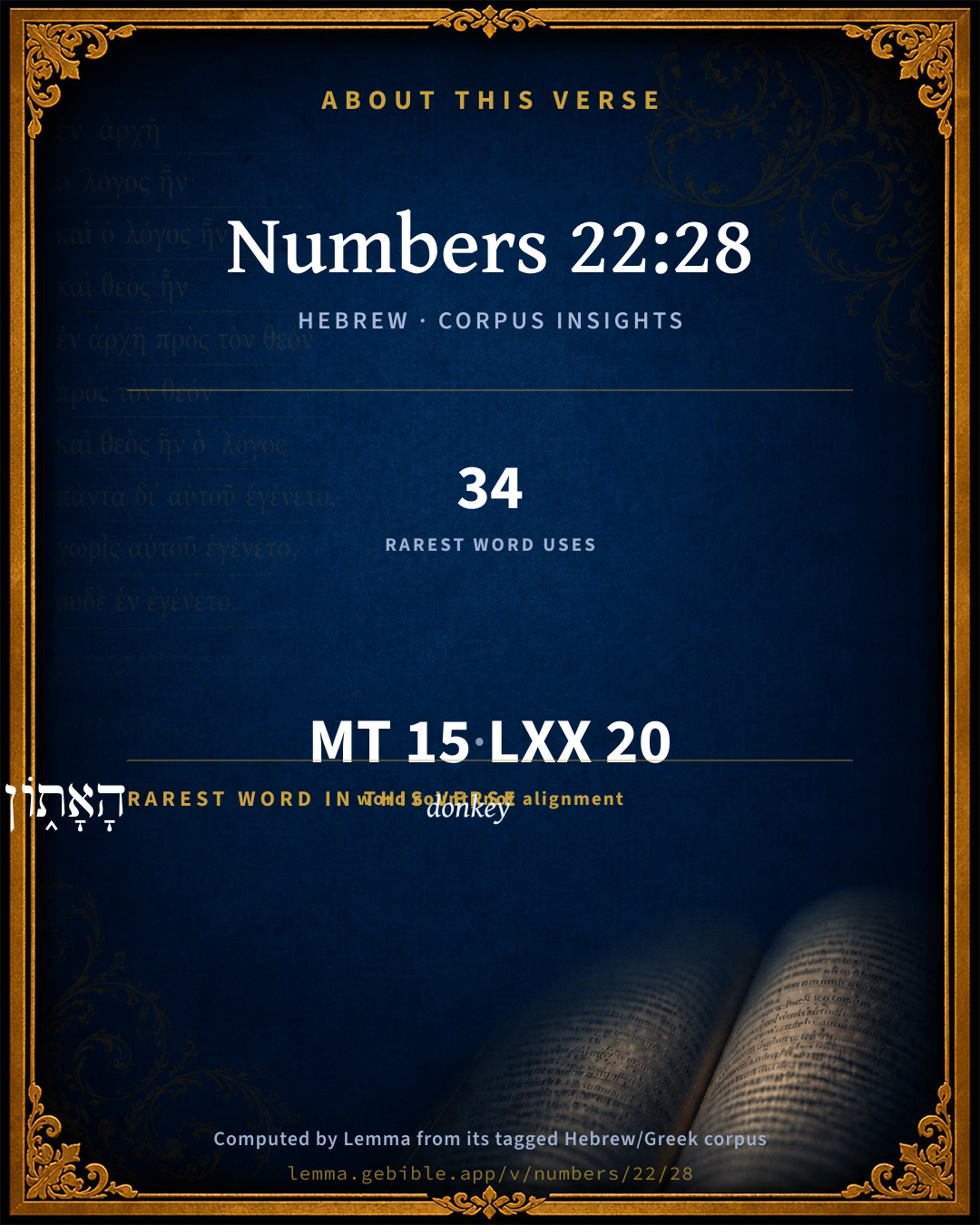
הָאָת֑וֹן donkey H860 occurs in 28 verses of the Hebrew Bible. Also found in:

Grammatical profile

  • 4 verbs
  • 5 nouns
  • 1 adjective
  • 1 pronoun
  • 1 preposition
  • 1 conjunction
  • 2 particles

Verb forms

  • וַיִּפְתַּ֥ח Qal · Sequential Imperfect
  • וַתֹּ֤אמֶר Qal · Sequential Imperfect
  • עָשִׂ֣יתִֽי Qal · Perfect
  • הִכִּיתַ֔נִי Hiphil · Perfect

Hebrew & Septuagint length

In English translation the verse runs 26 words from the Hebrew and 27 from the Septuagint (LXX English) — closely comparable.

A rough comparison of the two English renderings, which tokenize alike — not a word-level alignment.

Word counts can differ between the Hebrew and the Greek without any difference in meaning — e.g. the Hebrew direct-object marker אֵת has no separate Greek word, and Greek often adds the article ὁ.

In the original languages it is 15 Hebrew tokens and 20 Greek tokens — but the two are counted differently (Hebrew bundles its prefixes and suffixes into one token; the Greek is in lemma form), so that isn’t a like-for-like length.

Cross-references

5

Topical passages linked to Numbers 22:28 in the Treasury of Scripture Knowledge — connected by theme and wording, ordered by reader-vote popularity; previews shown in the World English Bible.

  • 2 Peter 2:16 but he was rebuked for his own disobedience. A mute donkey spoke with man's voice and stopped the madness of the prophet.
  • Exodus 4:11 Yahweh said to him, "Who made man's mouth? Or who makes one mute, or deaf, or seeing, or blind? Isn't it I, Yahweh?
  • Luke 1:37 For everything spoken by God is possible."
  • 1 Corinthians 1:19 For it is written, "I will destroy the wisdom of the wise, I will bring the discernment of the discerning to nothing."
  • Romans 8:22 For we know that the whole creation groans and travails in pain together until now.

Cross-references courtesy of OpenBible.info (CC BY 4.0).

Hebrew and Greek witnesses Masoretic Hebrew ↔ Greek Septuagint

The same verse in the two great witnesses to the Old Testament, shown verse-for-verse.

These are two independent witnesses, not word-aligned to each other, and the Septuagint is shown in lemma (dictionary) form.

Hebrew Numbers 22:28 Masoretic · Westminster Leningrad Codex

וַיִּפְתַּ֥ח יְהוָ֖ה אֶת פִּ֣י הָאָת֑וֹן וַתֹּ֤אמֶר לְבִלְעָם֙ מֶה עָשִׂ֣יתִֽי לְךָ֔ כִּ֣י הִכִּיתַ֔נִי זֶ֖ה שָׁלֹ֥שׁ רְגָלִֽים

Yahweh opened the mouth of the donkey, and she said to Balaam, What have I done to you, that you have struck me these three times?

World English Bible · Public Domain

Greek LXX Numbers 22:28 Septuagint · lemma form

καί ἀναοἴγω ὁ θεός ὁ στόμα ὁ ὄνος καί λέγω ὁ βαλααμ τίς ποιέω σύ ὅτι παίω ἐγώ οὗτος τρίτος

And God opened the mouth of the ass, and she says to Balaam, What have I done to you, that you have struck me this third time?

LXX2012 (modern English Septuagint) · Public Domain

Hebrew: Westminster Leningrad Codex (CC BY 4.0). Greek: Septuagint (public domain); English from LXX2012 (modern English Septuagint) (Public Domain). How the Septuagint differs from the Hebrew →

Targum (Aramaic paraphrase)

2

The Targum is the ancient Jewish Aramaic paraphrase of the Hebrew Scriptures — an interpretive translation, not the Hebrew text itself. Onkelos (literal) and Pseudo-Jonathan (expansive) render the Torah, and Jonathan the Prophets. Coverage is partial: where no permissively-licensed English translation exists for a verse, only the Aramaic is shown. This is verse-level text, not a word-by-word alignment to the Hebrew.

  1. Targum Onkelos Torah (Genesis–Deuteronomy)
    וּפְתַח יְיָ יַת פּוּמָא דַאֲתָּנָא וַאֲמָרַת לְבִּלְעָם מָה עֲבָדִית לָךְ אֲרֵי מְחִיתַנִי דְנַן תְּלַת זִמְנִין

    (no public-domain English translation for this verse)

    Targum Onkelos — Aramaic: “Onkelos Genesis” (public domain); “Onkelos Exodus” (public domain); “Onkelos Leviticus” (public domain); “Onkelos Numbers” (public domain); “Onkelos Deuteronomy” (public domain). English: “Sefaria Community Translation” (CC0 1.0 (public-domain dedication)); “J.W. Etheridge. The Targums of Onkelos and Jonathan Ben Uzziel on the Pentateuch. London: Longmans, Green, 1862” (public domain). Text via Sefaria.

  2. Targum Pseudo-Jonathan Torah (Genesis–Deuteronomy)
    עֲשַרְתֵּי פִתְגָמִין אִתְבְּרִיאוּ בָּתַר שַׁכְלוּל עַלְמָא בְּמֵיעֲלֵי שַׁבְּתָא בֵּינֵי שִׁימְשָׁתָא מַנָא וּבֵירָא וְחוּטְרָא דְמֹשֶׁה וּשְׁמִירָא וְקַשְׁתָּא וַעֲנָנֵי יְקָרָא וּפוּם אַרְעָא וּכְתַב לוּחֵי קְיָימָא וּמַזִיקֵי וּפוּם מַמְלַל אַתְנָא בֵּי הַהִיא שַׁעְתָּא פְּתַח מֵימְרָא דַיְיָ יַת פּוּמָהּ וְאִזְדַמֵן לָהּ מַמְלַל וַאֲמָרַת לְבִלְעָם מַה עֲבָדִית לָךְ אֲרוּם מְחִיתַנִי דֵין תְּלַת זִמְנִין

    Ten things were created after the world had been founded at the coming in of the Sabbath between the suns, - the manna, the well, the rod of Mosheh, the diamond, the rainbow, the cloud of glory, the mouth of the earth, the writing of the tables of the covenant, the demons, and the speaking ass. And in that hour the Word of the Lord opened her mouth, and fitted her to speak: and she said to Bileam. What have I done to thee, that thou hast smitten me these three times?

    Targum Pseudo-Jonathan — Aramaic: “Targum Jonathan on Genesis” (public domain); “Targum Jonathan on Exodus” (public domain); “Targum Jonathan on Leviticus” (public domain); “Targum Jonathan on Numbers” (public domain); “Targum Jonathan on Deuteronomy” (public domain). English: “The Targum of Jonathan ben Uzziel, trans. J. W. Etheridge, London, 1862” (public domain). Text via Sefaria.

Commentary

Notes on Numbers 22:28 from classic Christian and Jewish commentators (each source and its license shown beneath its notes). The classic Christian expositions comment on the surrounding passage and are grouped to its opening verse, so a note may address several verses; the Jewish commentaries on the Tanakh (Rashi and others) are per-verse, so they appear only where the commentator wrote on this verse.

Lemma curates 59 commentaries, every one of them public domain or Creative Commons licensed, each selected and text-cleaned for this edition rather than reprinted as found. About our sources →

Trapp's Complete Commentary

John Trapp

Num 22:28 And the LORD opened the mouth of the ass, and she said unto Balaam, What have I done unto thee, that thou hast smitten me these three times?

Ver. 28. And the Lord opened the mouth of the ass.] Fear not, therefore, thine own inability and rudeness to reply in a good cause. There is no mouth into which God cannot put words; and how oft doth he choose the weak to confound the wise

And she said unto Balaam.] The angel, some think, did speak in the ass, as the devil had done to Eve in the serpent.

John Trapp, A Commentary or Exposition upon All the Books of the Old and New Testament (1647–1656) — public domain. Text from a community e-Sword module.

Joseph Benson's Commentary

Num 22:28-29. Opened the mouth — Conferred upon her the power of speech and reasoning for that time. Balaam said — Balaam was not much terrified with the ass’s speaking, because perhaps he was accustomed to converse with evil spirits, who appeared to him and discoursed with him in the shape of different creatures. Or, perhaps, he was so blinded by passion that he did not consider the strangeness of the thing.

Joseph Benson's Commentary on the Old and New Testaments (1811–1818) — public domain. Text from a community e-Sword module.

Tyndale Open Study Notes

Tyndale Open Resources

22:28-31 The only scriptural parallel to this phenomenon of a talking animal is the serpent who spoke with Eve (Gen 3:1-5). God used the donkey to rebuke the foolish diviner (2 Pet 2:15-16).

Tyndale Open Study Notes — © Tyndale Open Resources, licensed CC BY-SA 4.0. Text via the HelloAO Bible API.

Geneva Bible (1599)

Geneva Bible translators

Gave her power to speak.

Geneva Bible (1599) marginal notes — public domain. Text via Bolls.life.

Jamieson, Fausset & Brown

Robert Jamieson, A. R. Fausset & David Brown

the Lord opened the mouth of the ass--to utter, like a parrot, articulate sounds, without understanding them. That this was a visionary scene is a notion which seems inadmissible, because of the improbability of a vision being described as an actual occurrence in the middle of a plain history. Besides, the opening of the ass's mouth must have been an external act, and that, with the manifest tenor of Peter's language, strongly favors the literal view [Pe2 2:15-16]. The absence of any surprise at such a phenomenon on the part of Balaam may be accounted for by his mind being wholly engrossed with the prospect of gain, which produced "the madness of the prophet" [Pe2 2:16]. "It was a miracle, wrought to humble his proud heart, which had to be first subjected in the school of an ass before he was brought to attend to the voice of God speaking by the angel" [CALVIN].

Jamieson, Fausset & Brown — Commentary Critical and Explanatory on the Whole Bible (1871) — public domain (CC PDM 1.0). Text via the HelloAO Bible API.

Adam Clarke's Commentary

Verse 28. The Lord opened the mouth of the ass] And where is the wonder of all this? If the ass had opened her own mouth, and reproved the rash prophet, we might well be astonished; but when God opens the mouth, an ass can speak as well as a man. It is worthy of remark here, that Balaam testifies no surprise at this miracle, because he saw it was the Lord's doing. Of animate and inanimate things receiving for a short time the gift of speech, the heathen mythology furnishes many fictitious examples, with which I do not deem it proper to occupy the reader's time.

Adam Clarke's Commentary on the Bible (1810–1826) — public domain. Text from a community e-Sword/MySword module.

Ellicott's Commentary for English Readers

(28) And the Lord opened the mouth of the ass.—Many critics, who admit the miraculous character of the events recorded in this and the following verses, maintain the subjective character of some of the incidents, and they adduce arguments to show that, whilst the same results might have been brought about in either manner, it is more in accordance with the general analogy of Scripture to assign a subjective than an objective interpretation to the language which is here employed. The following remarks may be made in regard to this interpretation:—(1) Consistency requires that the whole of the narrative should be interpreted either objectively or subjectively; and hence, that if the voice of the ass be interpreted as a subjective impression made upon the mind of Balaam, the appearance of the angel must be understood in the same manner. In this case, however, a difficulty arises which is as great, or greater, than that which the subjective theory is thought to remove. If the appearance of the angel to Balaam was subjective, the appearance must have been subjective also to the ass. In this case, moreover, it may be fairly alleged that if the line which divides the intelligent from the brute creation is transgressed by ascribing articulate speech to the ass, much more is that line transgressed by the supposition that an impression was produced in a subjective manner upon the mind of the ass. But (2) the real question at issue is not whether the recorded results might have been accomplished on the supposition that the incidents are to be explained subjectively, but what is the interpretation which the narrative itself suggests, and which the words of St. Peter (2Pe_2:16) require? In regard to the narrative itself, there is no intimation given that its respective portions are to be differently interpreted; nor is it possible, without doing violence to its obvious meaning, to interpret some parts of it objectively and other parts subjectively; whilst in regard to the testimony of St. Peter, it would be impossible to conceive of a statement couched in terms more directly suggestive of a literal fact than the following—“The dumb ass, speaking with man’s voice, forbad the madness of the prophet.” In regard to the objections which have been raised to the literal interpretation, grounded on the absence of any expression of surprise on the part of Balaam, and of any allusion to the effect produced upon the Moabitish princes and Balaam’s servants, it will suffice to observe (1) that here, as elsewhere, no just inference can be drawn from the silence of Scripture; and (2) that, as in the case of those who were with St. Paul as he went to Damascus, we have no means of determining, on the assumption of the presence of witnesses throughout the miraculous occurrences described, what amount of those occurrences they may have seen and heard. The angel was visible, in the first instance, only to the ass. In like manner the angel may have been visible only to Balaam, not to those who were with him. So also in regard to the voice: it may have been audible only to him to whom it was addressed.

A Bible Commentary for English Readers, edited by Charles John Ellicott (1878–1897) — public domain. Text from a community e-Sword module.

The Cambridge Bible for Schools and Colleges

gen. ed. J. J. S. Perowne

28. The miracle here recorded finds no parallel in the O.T. except that of the serpent who spoke to Eve (Gen_3:1; Gen_3:4 f.). But similar instances are to be found in the folklore of many nations (see Gray, p. 334). The speaking ass is to be considered not as a fable—in the sense in which the word is applied, for example, to Aesop’s Fables—but as a detail of a fabulous nature which attached itself, during the course of Israel’s early traditions, to a narrative which may have had a historical basis. With the modern knowledge, to which God has led us, of the gradual nature of His self-revelation to Israel, and of the many different stages of literary development which are represented in the O.T., we are not under the necessity either of believing that the ass actually spoke, or of explaining away the miracle in some rationalising manner, e.g. by supposing that Balaam had a vision. The permanent spiritual value of the story lies in its representation of the strivings of conscience.

The Cambridge Bible for Schools and Colleges (gen. ed. J. J. S. Perowne; Cambridge University Press, 1878–1918) — public domain. Text from a community e-Sword module.

John Gill's Exposition

Then the Lord opened the eyes of Balaam,.... Who either was struck with blindness, as the men of Sodom were, so some think, or rather his eyes were held, that he could not see the angel; he could see other objects, as his ass, but he could not see that; as Elisha's servant could see the host that compassed the city, but not the chariots and horses of fire about Elisha, till his eyes were opened, Kg2 6:15 and so it was with Balaam until the Lord uncovered his eyes, or rolled away the vail over them, or took that off which by his power and providence hindered his sight:

and he saw the angel of the Lord standing in the way, and his sword drawn in his hand; in the same position as in Num 22:23.

and he bowed down his head, and fell flat on his face; from off his ass upon the ground, in reverence of the illustrious object before him, and through fear of being slain by his sword in his hand.

John Gill's Exposition of the Whole Bible (1746–1763) — public domain (CC PDM 1.0). Text via the HelloAO Bible API.

Albert Barnes' Notes on the Bible

And the Lord opened the mouth of the ass - The account was perhaps given by Balaam to the Israelites after his capture in the war against Midian. Compare Num 31:8. That which is here recorded was apparently perceived by him alone among human witnesses. God may have brought it about that sounds uttered by the creature after its kind became to the prophet’s intelligence as though it addressed him in rational speech. Indeed to an augur, priding himself on his skill in interpreting the cries and movements of animals, no more startling warning could be given than one so real as this, yet conveyed through the medium of his own art.

Albert Barnes' Notes on the Bible (1834–1885) — public domain. Text from a community e-Sword/MySword module.

Haydock's Catholic Bible Commentary

Opened the mouth, &c. The angel moved the tongue of the ass, to utter these speeches, to rebuke, by the mouth of a brute beast, the brutal fury and folly of Balaam. (Challoner) --- St. Thomas Aquinas ([Summa Theologiae] ii. 2. q. 105) says, an angel spoke by the mouth of the ass, in like manner as the devil did by that of the serpent, Genesis iii. Infidels deride this miracle, and some have thought that it was only in the imagination of Balaam, that this dialogue was formed. (Maimonides) --- St. Gregory of Nyssa, seems to think that the ass only brayed as usual, and that the soothsayer, being accustomed to augur from the voice of animals, understood its meaning. But St. Peter says, the dumb beast....speaking with man’s voice, forbade the folly of the prophet, 2 Peter ii. 16. God did not endue it with understanding on this occasion, but only formed, by its mouth, such sounds as might serve to repress the cruel folly of Balaam. But he was more stupid than the ass. "Being accustomed, it seems, to such prodigies," (monstris) and intent upon lucre, he paid no further regard to such a wonderful transaction, but held conversation with his ass, without any emotion. (St. Augustine, q. 48, 50.) (Calmet) --- The pagan historians relate many instances of beasts and trees speaking; (Grotius) so that they object to this history, and to that of the serpent, with a very bad grace, as St. Cyril remarks, in his third book against Julian. (Haydock) --- They relate that the ass of Bacchus spoke to him, and the horse and elephant of Achilles and Porus addressed their respective masters, while the oaks of Dodona were famous for their oracles. (Calmet) --- The river Causus said, "Hail, Pythagoras." (Porphyrius, cited by St. Cyril, &c.) (Haydock)

George Leo Haydock (1774–1849), Haydock's Catholic Family Bible and Commentary, 1859 edition — public domain. Excludes Psalms (Douay-Rheims chapter numbering differs from Protestant) and Deuterocanonical books (Catholic canon only).

Matthew Poole's English Annotations

i.e.

The Lord conferred upon the ass the power of speech and reasoning for that time. Impudent are those heathens that disbelieve and scoff at the Scripture for this and some such relations contained in it, when there are examples of the same kind of prodigies, to wit, of oxen and other brute creatures speaking some few words, in the greatest and most approved writers of the Roman history as Plutarch, Polybius, Livy, an others. See the particulars in my Latin Synopsis on this place. Not included

Matthew Poole's English Annotations on the Holy Bible (1683–1685) — public domain. Text from a community e-Sword/MySword module.

Whedon's Commentary on the Bible

Daniel D. Whedon

28. The Lord opened the mouth of the ass — These words irresistibly compel the conclusion that the animal was the direct object of the divine operation. Peter’s statement, (2Pe_2:16,) that “the dumb ass speaking with man’s voice forbade the madness of the prophet,” is a strong affirmation of a real utterance. No other narrative in the Bible has given rise to so much dispute, ridicule, and false exposition. Every scoffer at the Holy Scriptures delights in a ride upon Balaam’s ass. The ridicule is all the more piquant by reason of the general estimation of Master Long-ear by the western nations as the ideal of absurdity and stupidity — an estimation of which there is not the least trace among the Orientals, especially in antiquity.

Daniel D. Whedon (gen. ed.), Commentary on the Old and New Testaments (1874–1909) — public domain. Text from a community e-Sword module.

The Pulpit Commentary

And the Lord opened the mouth of the ass. On the face of it this expression would seem decisive that an audible human voice proceeded from the ass"s mouth, as St. Peter beyond doubt believed: upozugion afwnon en anyrwtou fwnh fyegxamenon . It is truly said, however, that a passing illusion of this kind, while it testifies that the Apostle understood the words, like all his contemporaries, in their most natural and simple sense, does not oblige us to hold the same view; if he was mistaken in this matter, it does not at all affect the inspired truth of his teaching. Two theories, therefore, have been proposed in order to avoid the difficulties of the ordinary belief, while vindicating the reality of the occurrence. It has been held by some that the whole affair took place in a trance, and resembled St. Peter"s vision of the sheet let down from heaven, (Act_10:10) which we rightly conceive to have been purely subjective. This is open to the obvious and apparently fatal objection that no hint is given of any state of trance or ecstasy, and that, on the contrary, the wording of the narrative as given to us is inconsistent with such a thing. In verse 31 Balaam"s eyes are said to have been opened so that he saw the angel; but to have the eyes open so that the (ordinarily) invisible became visible, and the (otherwise) inaudible became audible, was precisely the condition of which Balaam speaks (Num_24:3, Num_24:4) as that of trance. According to the narrative, therefore, Balaam was in an ecstasy, if at all, after the speaking of the ass, and not before. By others it has been put forward, somewhat confusedly, that although Balaam was in his ordinary senses, he did not really hear a human voice, but that the "cries" of the ass became intelligible to his mind; and it is noted that as an augur he had been accustomed to assign meanings to the cries of animals. If instead of "cries" we read "brayings," for the ass is endowed by nature with no other capacity of voice, being indeed one of the dumbest of "dumb" animals, we have the matter more fairly before us. To most people it would appear more incredible that the brayings of an ass should convey these rational questions to the mind of its rider than that the beast should have spoken outright with a man"s voice. It would indeed seem much more satisfactory to regard the story, if we cannot accept it as literally true, as a parable which Balaam wrote against himself, and which Moses simply incorporated in the narrative; we should at least preserve in this way the immense moral and spiritual value of the story, without the necessity of placing non-natural constructions upon its simple statements. Supposing the miracle to have really occurred, it must always be observed that the words put into the ass"s mouth do nothing more than express such feeling"s as a docile and intelligent animal of her kind would have actually felt. That domestic animals, and especially such as have been long in the service of man, feel surprise, indignation, and grief in the presence of injustice and ill-treatment is abundantly certain. In many well-authenticated eases they have done things in order to express these feelings which seemed as much beyond their "irrational" nature as if they had spoken. We constantly say of a dog or a horse that he can do everything but speak, and why should it seem incredible that God, who has given the dumb beast so close an approximation to human feeling and reason, should for once have given it human voice? With respect to Balaam"s companions, their presence need not cause any difficulty. The princes of Midian and Moab had probably gone on to announce the coming of Beldam; his servants would naturally follow him at some little distance, unless he summoned them to his side. It is very likely too that Balaam was wont to carry on conversations with himself, or with imaginary beings, as he rode along, and this circumstance would account for any sound of voices which reached the ears of others.

The Pulpit Commentary (1880–1919), ed. H.D.M. Spence-Jones & Joseph S. Exell — public domain. Text from a community e-Sword module.

John Wesley's Explanatory Notes

Opened the mouth - Conferred upon her the power of speech and reasoning for that time.

John Wesley, Explanatory Notes Upon the Whole Bible (1754–1765) — public domain. Text via the GEBible commentary corpus.

Keil & Delitzsch

C. F. Keil & F. Delitzsch

"Then Jehovah opened the mouth of the ass, and she said to Balaam, What have I done to thee, that thou hast smitten me now three times?" But Balaam, enraged at the refractoriness of his ass, replied, "Because thou hast played me ill (התעלּל, see Exo 10:2): if there were only a sword in my hand, verily I should now have killed thee." But the ass replied, that she had been ridden by him from a long time back, and had never been accustomed to act in this way towards him. These words of the irrational beast, the truth of which Balaam was obliged to admit, made an impression upon him, and awakened him out of his blindness, so that God could now open his eyes, and he saw the angel of the Lord.

In this miraculous occurrence, which scoffers at the Bible constantly bring forward as a weapon of attack upon the truth of the word of God, the circumstance that the ass perceived the appearance of the angel of the Lord sooner than Balaam did, does not present the slightest difficulty; for it is a well-known fact, that irrational animals have a much keener instinctive presentiment of many natural phenomena, such as earthquakes, storms, etc., than man has with the five senses of his mind. And the fact is equally undeniable, that many animals, e.g., horses and cows, see the so-called second sight, and are terrified in consequence.

(Note: In support of this we will simply cite the following from the remarks made by Martin upon this subject, and quoted by Hengstenberg in his Balaam (p. 385), from Passavant's work on animal magnetism and clairvoyance: "That horses see it (the second sight), is also evident from their violent and rapid snorting, when their rider has had a vision of any kind either by day or night. And in the case of the horse it may also be observed, that it will refuse to go any farther in the same road until a circuitous course has been taken, and even then it is quite in a sweat.")

The rock of offence in this narrative is to be found in the rational words of an irrational and speechless ass. It is true, that in the actual meaning of the words there is nothing beyond the sensations and feelings to which animals constantly give utterance in gestures and inarticulate sounds, when subjected to cruel treatment. But in this instance the feelings were expressed in the rational words of human language, which an animal does not possess; and hence the question arises. Are we to understand this miracle as being a purely internal fact of an ecstatic nature, or a fact that actually came under the cognizance of the senses? If we examine the arguments which Hengstenberg has adduced in favour of the former, and Kurtz in support of the latter, there is nothing at all in the circumstance, that the narrative itself says nothing about Balaam being in an ecstasy, nor in the statement that "Jehovah opened the mouth of the ass," nor lastly, in the words of Pe2 2:16, "The dumb ass, speaking with man's voice, forbade the madness of the prophet," to furnish conclusive, not to say irresistible, proofs of the assertion, that "as the ass was corporeally and externally visible, its speaking must have been externally and corporeally audible" (Kurtz). All that is contained in the two scriptural testimonies is, that the ass spoke in a way that was perceptible to Balaam, and that this speaking was effected by Jehovah as something altogether extraordinary. But whether Balaam heard the words of the animal with the outward, i.e., the bodily ear, or with an inward spiritual ear, is not decided by them. On the other hand, neither the fact that Balaam expressed no astonishment at the ass speaking, nor the circumstance that Balaam's companions - viz., his two servants (Num 22:22) and the Moabitish messengers, who were also present, according to Num 22:35 - did not see the angel or hear the ass speaking, leads with certainty to the conclusion, that the whole affair must have been a purely internal one, which Balaam alone experienced in a state of ecstasy, since argumenta e silentio confessedly prove but very little. With regard to Balaam, we may say with Augustine (quaest. 50 in Num.), "he was so carried away by his cupidity, that he was not terrified by this marvellous miracle, and replied just as if he had been speaking to a man, when God, although He did not change the nature of the ass into that of a rational being, made it give utterance to whatever He pleased, for the purpose of restraining his madness." But with regard to the Moabitish messengers, it is very doubtful whether they were eye-witnesses and auditors of the affair. It is quite possible that they had gone some distance in advance, or were some distance behind, when Balaam had the vision. On the other hand, there was no necessity to mention particularly that they saw the appearance of the angel, and heard the speaking of the animal, as this circumstance was not of the least importance in connection with the main purpose of the narrative. And still less can it be said that "the ass's speaking, if transferred to the sphere of outward reality, would obviously break through the eternal boundary-line which has been drawn in Gen 1 between the human and the animal world." The only thing that would have broken through this boundary, would have been for the words of the ass to have surpassed the feelings and sensations of an animal; that is to say, for the ass to have given utterance to truths that were essentially human, and only comprehensible by human reason. Now that was not the case. All that the ass said was quite within the sphere of the psychical life of an animal.

The true explanation lies between the notion that the whole occurrence was purely internal, and consisted exclusively in ecstasy brought by God upon Balaam, and the grossly realistic reduction of the whole affair into the sphere of the senses and the outward material world. The angel who met the soothsayer in the road, as he was riding upon his ass, and who was seen at once by the ass, though he was not seen by Balaam till Jehovah had opened his eyes, did really appear upon the road, in the outward world of the senses. But the form in which he appeared was not a grossly sensuous or material form, like the bodily frame of an ordinary visible being; for in that case Balaam would inevitably have seen him, when his beast became alarmed and restive again and again and refused to go forward, since it is not stated anywhere that God had smitten him with blindness, like the men of Sodom (Gen 19:11), or the people in Kg2 6:18. It rather resembled the appearance of a spirit, which cannot be seen by every one who has healthy bodily eyes, but only by those who have their senses awakened for visions from the spirit-world. Thus, for example, the men who went to Damascus with Paul, saw no one, when the Lord appeared to him in a miraculous light from heaven, and spoke to him, although they also heard the voice (Act 9:7).

(Note: Or, strictly speaking, they saw the light (Act 22:9), but saw no man (Act 9:7); and they heard the sound (τῆς φωνῆς, the voice or noise generally, Act 9:7), but not the words (τὴν φωνὴν τοῦ λαλοῦντός μοι, the voice or articulate words of the person speaking, Act 22:9). The construction of ἀκούω, with the genitive in the one case and the accusative in the other, is evidently intended to convey this distinct and distinctive meaning. - Tr.)

Balaam wanted the spiritual sense to discern the angel of the Lord, because his spirit's eye was blinded by his thirst for wealth and honour. This blindness increased to such an extent, with the inward excitement caused by the repeated insubordination of his beast, that he lost all self-control. As the ass had never been so restive before, if he had only been calm and thoughtful himself, he would have looked about to discover the cause of this remarkable change, and would then, no doubt, have discovered the presence of the angel. But as he lost all his thoughtfulness, God was obliged to open the mouth of the dumb and irrational animal, to show a seer by profession his own blindness. "He might have reproved him by the words of the angel; but because the rebuke would not have been sufficiently severe without some deep humiliation, He made the beast his teacher" (Calvin). The ass's speaking was produced by the omnipotence of God; but it is impossible to decide whether the modulation was miraculously communicated to the animal's voice, so that it actually gave utterance to the human words which fell upon Balaam's ears (Kurtz), or whether the cries of the animal were formed into rational discourse in Balaam's soul, by the direct operation of God, so that he alone heard and understood the speech of the animal, whereas the servants who were present heard nothing more than unintelligible cries.

(Note: See the analogous case mentioned in Joh 12:28-29, of the voice which came to Jesus from the skies, when some of the people who were standing by said that it only thundered, whilst others said an angel spoke to Him.)

In either case Balaam received a deeply humiliating admonition from the mouth of the irrational beast, and that not only to put him to shame, but also to call him to his senses, and render him capable of hearing the voice of God. The seer, who prided himself upon having eyes for divine revelations, was so blind, that he could not discern the appearance of the angel, which even the irrational beast had been able to see.

(Note: God made use of the voice of an ass, both because it was fitting that a brutish mind should be taught by a brute, and also, as Nyssenus says, to instruct and chastise the vanity of the augur (Balaam), who was accustomed to observe the meaning of the braying of the ass and the chirping of birds (C. a. Lap.).)

By this he was taught, that even a beast is more capable of discerning things from the higher world, than a man blinded by sinful desires. It was not till after this humiliation that God opened his eyes, so that he saw the angel of the Lord with a drawn sword standing in his road, and fell upon his face before this fearful sight.

Keil & Delitzsch — Biblical Commentary on the Old Testament (1861–1891) — public domain (CC PDM 1.0). Text via the HelloAO Bible API. (Old Testament only.)

unfoldingWord translationNotes

Door43 World Missions Community

Then Yahweh opened the donkey's mouth so she could talk

Opening the mouth is associated with the ability to speak. AT: "Then Yahweh gave the donkey the ability to speak like a human would speak" (See: Metonymy)

She said to Balaam

"The donkey said to Balaam"

Am not I your donkey on which you have ridden all your life long to this present day?

This rhetorical question was used to convict Balaam that his judgment of the donkey was unfair. This can be translated as a statement. AT: "I am your donkey on which you have ridden all your life, right up to the present moment." (See: Rhetorical Question)

Have I ever been in the habit of doing such things to you before?

This rhetorical question was used to further convict Balaam that his judgment of the donkey was unfair. This can be translated as a statement. AT: "I have never been in the habit of doing such things to you!" (See: Rhetorical Question)

translationWords

life

unfoldingWord translationNotes — © Distant Shores Media and the Door43 World Missions Community, licensed CC BY-SA 4.0. Source: git.door43.org/Door43/en_tn.

Rashi

Rabbi Shlomo Yitzchaki (Rashi)

זה שלש רגלים THESE THREE TIMES — By these words he suggested to him: You seek to root out a nation that celebrates three festivals (שלש רגלים) annually?! (Midrash Tanchuma, Balak 9).

Rashi on the Tanakh — English translations: “The Judaica Press complete Tanach with Rashi, translated by A. J. Rosenberg” (CC BY 4.0); “Pentateuch with Rashi's commentary by M. Rosenbaum and A.M. Silbermann, 1929-1934” (public domain); “The Metsudah Tanach series, Lakewood, N.J” (CC BY 4.0); and “The Book of Joshua, Metsudah Publications, 1997” (CC BY 4.0). Text via Sefaria.

Lesson kit

Teaching starters — assembled from the data on this page, not authored interpretation. Every prompt links to the verse data it draws on. Edit before teaching.

Numbers, in the Pentateuch, opens this verse with 15 words (14 distinct Hebrew lemmas). Its most distinctive word is ʼâthôwn (“donkey”). A historical commentator’s framing appears above. Read the whole chapter for the surrounding context.

Discussion questions

  1. What does “donkey” (ʼâthôwn) contribute to the verse as a whole?
  2. Genesis 12:16 shares the word «donkey» with this verse. How do the two illuminate each other?
  3. The translations on this page render this verse differently — a whole-verse word diff, not a word-by-word alignment. What might account for the different wordings?
  4. The verb «וַיִּפְתַּ֥ח» is Qal Sequential Imperfect. How does its form color the action?
  5. Reading how Trapp's Complete Commentary and Joseph Benson's Commentary read this verse, where do the two commentators agree and where do they part?

Things to notice

Reading settings

Reading text

Shown beneath each verse's original-language words.

Old Testament
Old Testament edition

Read the OT as the Masoretic Hebrew (MT) or the Greek Septuagint (LXX).

English shown for the Greek Septuagint (in the Hebrew ↔ Greek comparison).

Comparing translations? Open the Compare panel on any verse page to stack up to four side by side.