Joshua 10:22

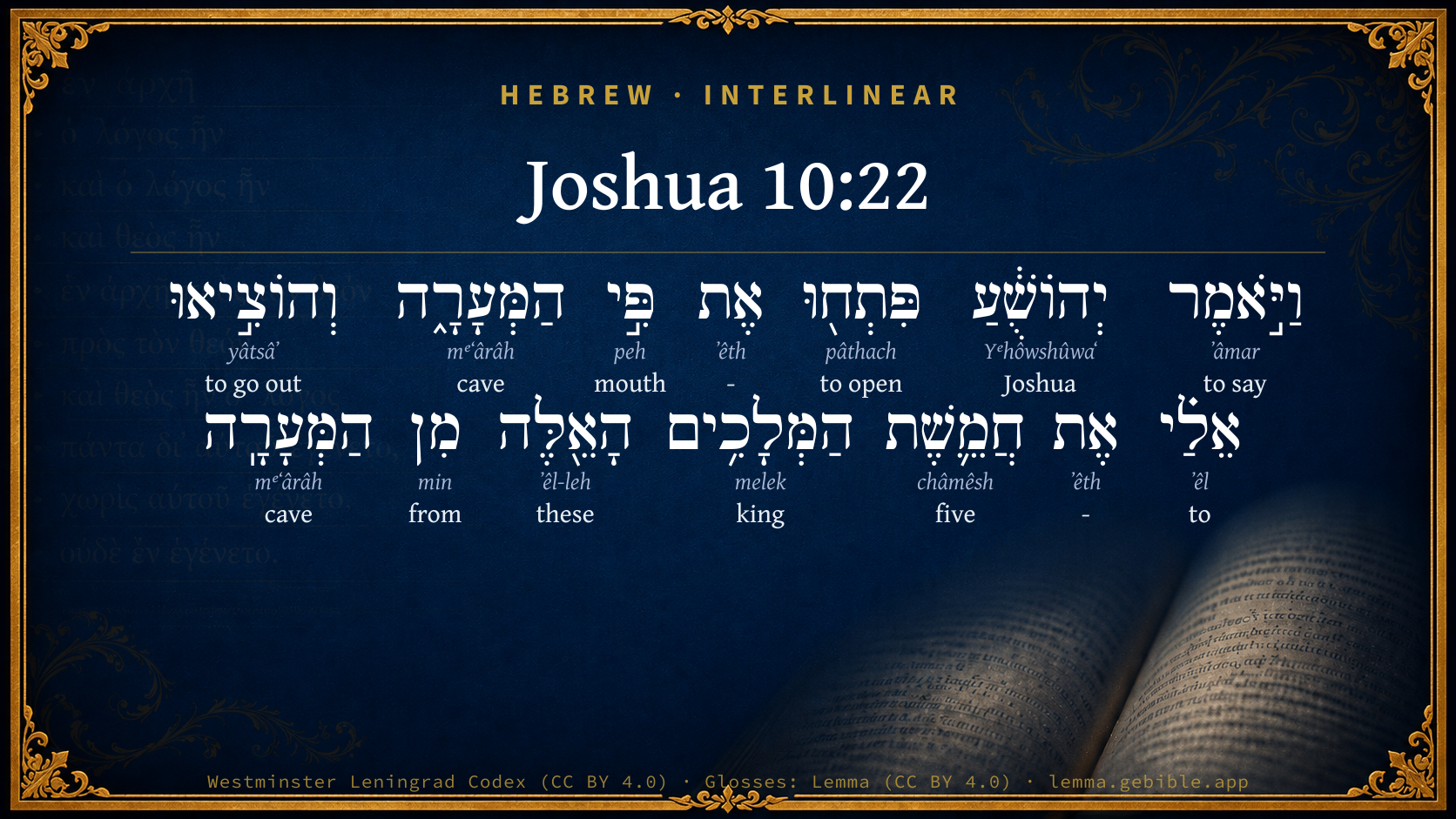
Hebrew (Westminster Leningrad Codex) Joshua 10:22 appears in the Hebrew Old Testament. The text above is from the Westminster Leningrad Codex. Each word links to its Strong’s number, a concise gloss, and parsing drawn from the Open Scriptures Hebrew Bible morphology. Click any word for its full Brown-Driver-Briggs (BDB) entry.
Download image
Cite this verse

Joshua 10:22 (World English Bible). Public Domain. Lemma interlinear Bible study tool, https://lemma.gebible.app/v/joshua/10/22.

Show BibTeX & RIS
BibTeX
RIS
English Translation
Then said Joshua, Open the mouth of the cave, and bring forth those five kings to me out of the cave.
World English Bible · Public Domain
Download a study sheet

One document with this verse’s original text, its word-by-word gloss line, the meaning frame, cross-references with their text, attributed commentary, and full source and license credits — printable, and it pastes into notes with its structure intact.

This verse Autodidact and up

Study sheet (.html) Plain text (.txt)

A passage Seminary Student

Up to 50 verses in one chapter. A passage sheet keeps up to 6 commentary sources and 12 cross-references per verse, in the order this page ranks them, and says so on the sheet whenever that leaves anything out. Ask for a single verse and you get the Autodidact verse sheet above.

Everything on this page stays free to read, with no account — the sheet is a download of what is already on screen, not access to it.

Want to remove ads? Support Godless Engineer
Compare translations 3

The same verse in 3 English versions, stacked beneath the original-language interlinear above. Click any original word for its lexicon entry.

Each is an independent rendering of the whole verse — the interlinear is not word-aligned to these translations.

Highlighted words mark where these versions differ — a whole-verse word diff, not a word-by-word alignment.

  • World English Bible Public Domain
    Then said Joshua, Open the mouth of the cave, and bring forth those five kings to me out of the cave.
  • King James Version Public Domain
    Then said Joshua, Open the mouth of the cave, and bring out those five kings unto me out of the cave.
  • unfoldingWord Literal Text CC BY-SA 4.0
    And Joshua said, “Open the mouth of the cave and bring out to me these five kings from the cave.”

unfoldingWord Literal Text — © unfoldingWord, licensed CC BY-SA 4.0. Word-aligned USFM3 via Door43 (git.door43.org/unfoldingWord/en_ult).

Versions to compare (up to 4)

3 of 4 selected

Show all 18 translations

Every available English version of this verse, each an independent rendering of the whole verse.

  • World English Bible Public Domain
    Then said Joshua, Open the mouth of the cave, and bring forth those five kings to me out of the cave.
  • Berean Standard Bible Public Domain
    Then Joshua said, “Open the mouth of the cave and bring those five kings out to me.”
  • Majority Standard Bible Public Domain
    Then Joshua said, “Open the mouth of the cave and bring those five kings out to me.”
  • King James Version Public Domain
    Then said Joshua, Open the mouth of the cave, and bring out those five kings unto me out of the cave.
  • American Standard Version (1901) Public Domain
    Then said Joshua, Open the mouth of the cave, and bring forth those five kings unto me out of the cave.
  • Revised Version (1885) Public Domain
    Then said Joshua, Open the mouth of the cave, and bring forth those five kings unto me out of the cave.
  • Geneva Bible (1599) Public Domain
    After, Ioshua sayd, Open the mouth of the caue, and bring out these fiue Kings vnto me forth of the caue.
  • Douay-Rheims (1899) Public Domain
    And Josue gave orders, saying: Open the mouth of the cave, and bring forth to me the five kings that lie hid therein.
  • Young's Literal Translation Public Domain
    And Joshua saith, `Open ye the mouth of the cave, and bring out unto me these five kings from the cave;'
  • Literal Standard Version CC BY-SA 4.0
    And Joshua says, “Open the mouth of the cave, and bring out to me these five kings from the cave”;
  • Unlocked Literal Bible CC BY-SA 4.0
    Then Joshua said, “Open the mouth of the cave and out of the cave bring to me these five kings.”
  • unfoldingWord Literal Text CC BY-SA 4.0
    And Joshua said, “Open the mouth of the cave and bring out to me these five kings from the cave.”
  • Darby Bible Public Domain
    And Joshua said, Open the mouth of the cave, and bring forth to me those five kings out of the cave.
  • World Messianic Bible Public Domain
    Then Joshua said, “Open the cave entrance, and bring those five kings out of the cave to me.”
  • Webster's Bible Public Domain
    Then said Joshua, Open the mouth of the cave, and bring those five kings to me out of the cave.
  • Free Bible Version CC BY-SA 4.0
    Then Joshua said, “Open the cave entrance and bring out the five kings to me from the cave.”
  • Bible in Basic English Public Domain
    Then Joshua said, Take away the stones from the mouth of the hole in the rock, and make those five kings come out to me.
  • JPS Tanakh (1917) Public Domain
    Then said Joshua: 'Open the mouth of the cave, and bring forth those five kings unto me out of the cave.'

Literal Standard Version (2020), Covenant Press — licensed CC BY-SA 4.0. Text via the HelloAO Bible API (eBible.org). Unlocked Literal Bible (unfoldingWord) — licensed CC BY-SA 4.0. Text via the HelloAO Bible API (eBible.org). unfoldingWord Literal Text — © unfoldingWord, licensed CC BY-SA 4.0. Word-aligned USFM3 via Door43 (git.door43.org/unfoldingWord/en_ult). Free Bible Version, Dr. Jonathan Gallagher — licensed CC BY-SA 4.0. Text via the HelloAO Bible API (eBible.org).

Word by word

More ways to search: Search by grammar → Find every occurrence → Compare this word →

Practice this passage: Drill this verse → Learn its vocabulary →

הַמְּעָרָ֑ה
mᵉʻârâh
H4631
“the · cave”
Particle, Definite Article + Noun, Common, Feminine, Singular, Absolute
Part of Speech
Particle + Noun
Type
Common
Gender
Feminine
Number
Singular
State
Absolute
Full BDB Definition

Origin: from H5783

TWOT: 1704a

cave, den, hole
  1. וַיֹּ֣אמֶר ʼâmar H559 “and · to say” Conjunction + Verb, Qal, Sequential Imperfect, 3rd Person, Masculine, Singular
  2. יְהוֹשֻׁ֔עַ Yᵉhôwshûwaʻ H3091 “Joshua” Noun, Proper
  3. פִּתְח֖וּ pâthach H6605 “open” Verb, Qal, Imperative, 2nd Person, Masculine, Plural
  4. אֶת ʼêth H853 “-” Particle, Direct Object
  5. פִּ֣י peh H6310 “mouth of” Noun, Common, Masculine, Singular, Construct
  6. וְהוֹצִ֣יאוּ yâtsâʼ H3318 “and · go out” Conjunction + Verb, Hiphil, Imperative, 2nd Person, Masculine, Plural
  7. אֵלַ֗י ʼêl H413 “to · me” Preposition + Suffix, Personal, 1st Person, Common, Singular
  8. אֶת ʼêth H853 “-” Particle, Direct Object
  9. חֲמֵ֛שֶׁת châmêsh H2568 “five” Adjective, Cardinal number, Masculine, Singular, Construct
  10. הַמְּלָכִ֥ים melek H4428 “the · kings” Particle, Definite Article + Noun, Common, Masculine, Plural, Absolute
  11. הָאֵ֖לֶּה ʼêl-leh H428 “the · these” Particle, Definite Article + Pronoun, Demonstrative, Common, Plural
  12. מִן min H4480 “from” Preposition
  13. הַמְּעָרָֽה mᵉʻârâh H4631 “the · cave” Particle, Definite Article + Noun, Common, Feminine, Singular, Absolute

About this verse

These counts appear in no published source. They are computed here, from the morphology-tagged text and Lemma’s own curated glosses. What Lemma adds →

14
words
12
distinct lemmas
Historical
section

Shared distinctive vocabulary

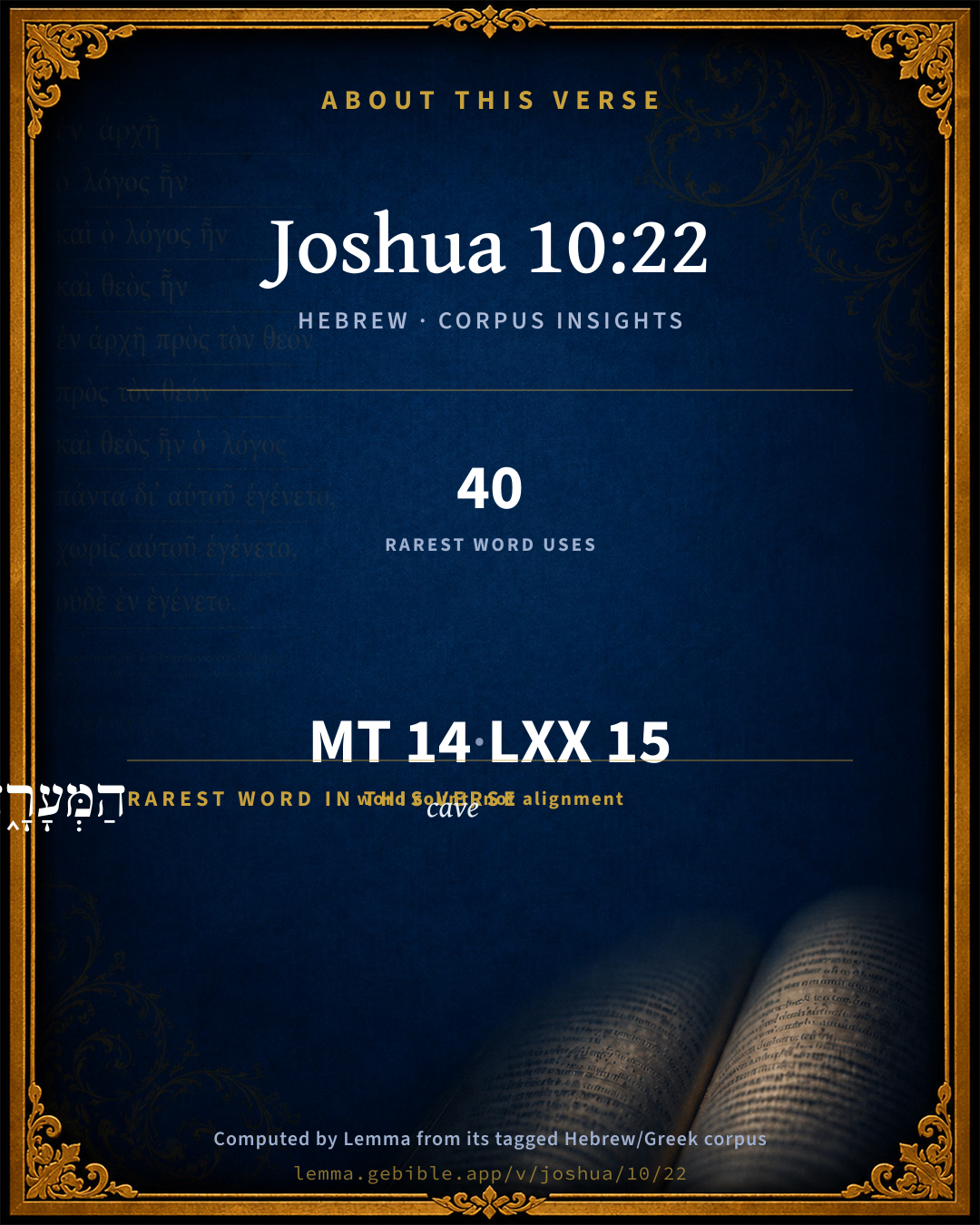
הַמְּעָרָ֑ה cave H4631 occurs in 36 verses of the Hebrew Bible. Also found in:

Grammatical profile

  • 3 verbs
  • 5 nouns
  • 1 adjective
  • 1 pronoun
  • 2 prepositions
  • 2 particles

Verb forms

  • וַיֹּ֣אמֶר Qal · Sequential Imperfect
  • פִּתְח֖וּ Qal · Imperative
  • וְהוֹצִ֣יאוּ Hiphil · Imperative

Repetition

A word recurs within this verse — often emphatic in Hebrew:

  • הַמְּעָרָ֑ה cave H4631 ×2

Hebrew & Septuagint length

In English translation the verse runs 21 words from the Hebrew and 16 from the Septuagint (LXX English) — closely comparable.

A rough comparison of the two English renderings, which tokenize alike — not a word-level alignment.

Word counts can differ between the Hebrew and the Greek without any difference in meaning — e.g. the Hebrew direct-object marker אֵת has no separate Greek word, and Greek often adds the article ὁ.

In the original languages it is 14 Hebrew tokens and 15 Greek tokens — but the two are counted differently (Hebrew bundles its prefixes and suffixes into one token; the Greek is in lemma form), so that isn’t a like-for-like length.

Cross-references

1

Topical passages linked to Joshua 10:22 in the Treasury of Scripture Knowledge — connected by theme and wording, ordered by reader-vote popularity; previews shown in the World English Bible.

  • 1 Samuel 15:32 Then said Samuel, Bring you here to me Agag the king of the Amalekites. Agag came to him cheerfully. Agag said, Surely the bitterness of death is past.

Cross-references courtesy of OpenBible.info (CC BY 4.0).

Hebrew and Greek witnesses Masoretic Hebrew ↔ Greek Septuagint

The same verse in the two great witnesses to the Old Testament, shown verse-for-verse.

These are two independent witnesses, not word-aligned to each other, and the Septuagint is shown in lemma (dictionary) form.

Hebrew Joshua 10:22 Masoretic · Westminster Leningrad Codex

וַיֹּ֣אמֶר יְהוֹשֻׁ֔עַ פִּתְח֖וּ אֶת פִּ֣י הַמְּעָרָ֑ה וְהוֹצִ֣יאוּ אֵלַ֗י אֶת חֲמֵ֛שֶׁת הַמְּלָכִ֥ים הָאֵ֖לֶּה מִן הַמְּעָרָֽה

Then said Joshua, Open the mouth of the cave, and bring forth those five kings to me out of the cave.

World English Bible · Public Domain

Greek LXX Joshua 10:22 Septuagint · lemma form

καί εἶπον ἰησοῦς ἀναοἴγω ὁ σπήλαιον καί ἐκἄγω ὁ πέντε βασιλεύς οὗτος ἐκ ὁ σπήλαιον

And Joshua said, Open the cave, and bring out these five kings out of the cave.

LXX2012 (modern English Septuagint) · Public Domain

Hebrew: Westminster Leningrad Codex (CC BY 4.0). Greek: Septuagint (public domain); English from LXX2012 (modern English Septuagint) (Public Domain). How the Septuagint differs from the Hebrew →

Targum (Aramaic paraphrase)

1

The Targum is the ancient Jewish Aramaic paraphrase of the Hebrew Scriptures — an interpretive translation, not the Hebrew text itself. Onkelos (literal) and Pseudo-Jonathan (expansive) render the Torah, and Jonathan the Prophets. Coverage is partial: where no permissively-licensed English translation exists for a verse, only the Aramaic is shown. This is verse-level text, not a word-by-word alignment to the Hebrew.

  1. Targum Jonathan Prophets (Joshua–Malachi)
    וַאֲמַר יְהוֹשֻׁעַ פְּתָחוּ יַת פּוּמָא דִמְעַרְתָּא וְאַפִּיקוּ לְוָתִי יַת חַמְשָׁא מַלְכַיָא הָאִלֵין מִן מְעַרְתָּא:

    (no public-domain English translation for this verse)

    Targum Jonathan — Aramaic: “Mikraot Gedolot” (public domain). English: “Sefaria Community Translation” (CC0 1.0 (public-domain dedication)); “London "Chaldee Paraphrase," 1871” (public domain). Text via Sefaria.

Commentary

Notes on Joshua 10:22 from classic Christian and Jewish commentators (each source and its license shown beneath its notes). The classic Christian expositions comment on the surrounding passage and are grouped to its opening verse, so a note may address several verses; the Jewish commentaries on the Tanakh (Rashi and others) are per-verse, so they appear only where the commentator wrote on this verse.

Lemma curates 59 commentaries, every one of them public domain or Creative Commons licensed, each selected and text-cleaned for this edition rather than reprinted as found. About our sources →

Trapp's Complete Commentary

John Trapp

Jos 10:22 Then said Joshua, Open the mouth of the cave, and bring out those five kings unto me out of the cave.

Ver. 22. bring out those five kings.] So shall Christ one day say of all, whether kings or prisoners, lords or rag-a-muffins, that will not have him to reign over them. Those that will not now obey that sweet voice, "Come unto me, all ye that are weary and heavy laden," shall then have no other voice to obey but "Go, ye cursed," &c.

John Trapp, A Commentary or Exposition upon All the Books of the Old and New Testament (1647–1656) — public domain. Text from a community e-Sword module.

Whedon's Commentary on the Bible

Daniel D. Whedon

THE FIVE KINGS EXECUTED, Jos_10:22-27.

24. Called for all the men of Israel — This must be limited to the bravest warriors; those only were at Makkedah; the rest of the people were at Gilgal. See Jos_10:7, note, also Jos_10:43. A grand assembly of the army was made for the formal humiliation and public execution of the five kings. It was desirable to make the execution as impressive as possible.

Put your feet upon the necks of these kings — Symbolical actions are very common in the East, such as passing under yokes and kissing the conqueror’s feet, and in case of extreme and perfect subjection the victor proclaimed his triumph by treading on the neck of his conquered foe. This impressive act inspirited the Israelites, and struck terror into their enemies yet unconquered. Some regard this as the fulfilment of the prophecy of Moses in Deu_33:29. It also explains the expression, “to make one’s enemies his footstool.” Psa_110:1.

Daniel D. Whedon (gen. ed.), Commentary on the Old and New Testaments (1874–1909) — public domain. Text from a community e-Sword module.

The Cambridge Bible for Schools and Colleges

gen. ed. J. J. S. Perowne

22. Then said Joshua] Probably this was on the morning after the victory.

The Cambridge Bible for Schools and Colleges (gen. ed. J. J. S. Perowne; Cambridge University Press, 1878–1918) — public domain. Text from a community e-Sword module.

John Gill's Exposition

And they did so,.... Opened the mouth "of" the cave, by rolling away the stones:

and brought forth those five kings unto him out of the cave; who are next mentioned by name, one by one, according to their dignity, and in the order they were brought unto him:

the king of Jerusalem, the king of Hebron, the king of Jarmuth, the king of Lachish, and the king of Eglon; who are particularly named for the greater glory of the conquest, and the triumph over them.

John Gill's Exposition of the Whole Bible (1746–1763) — public domain (CC PDM 1.0). Text via the HelloAO Bible API.

Keil & Delitzsch

C. F. Keil & F. Delitzsch

Joshua then commanded the five kings to be fetched out of the cave, and directed the leaders of the army to set their feet upon the necks of the kings; and when this had been done, he ordered the kings to be put to death, and to be hanged upon trees until the evening, when their bodies were to be thrown into the cave in which they had concealed themselves. Of course this did not take place till the day after the battle, as the army could not return from their pursuit of the foe to the camp at Makkedah till the night after the battle; possibly it did not take place till the second day, if the pursuit had lasted any longer. In Jos 10:24, "all the men of Israel" are all the warriors in the camp. ההלכוּא, with ה artic., instead of the relative pronoun (see Ges. 109; Ew. 331, b.); and the ending וּא for וּ or וּן, as in Isa 28:12 (see Ew. 190, b.). The fact that the military leaders set their feet at Joshua's command upon the necks of the conquered kings, was not a sign of barbarity, which it is necessary to excuse by comparing it with still greater barbarities on the part of the Canaanites, as in Jdg 1:7, but was a symbolical act, a sign of complete subjugation, which was customary in this sense even in the Eastern empire (see Bynaeus de calceis, p. 318, and Constant. Porphyrogen de cerimon. aulae Byzant. ii. 19). It was also intended in this instance to stimulate the Israelites to further conflict with the Canaanites. This is stated in the words of Joshua (Jos 10:25): "Fear not, nor be dismayed (vid., Jos 1:9; Jos 8:1); for thus shall the Lord do to all your enemies." On the putting to death and then hanging, see Jos 8:29 and Deu 21:22-23. The words וגו ויּשׂימוּ (Jos 10:27) are generally understood as signifying, that after the bodies of the kings had been cast into the cave, the Israelites placed large stones before the entrance, just as in other cases heaps of stones were piled upon the graves of criminals that had been executed (vid., Jos 7:25), and that these stones remained there till the account before us was written. But this leaves the words עצם עד unexplained, as עצם never occurs in any other case where the formula "until this day" is used with the simple meaning that a thing had continued to the writer's own time. הזּה היּום עצם expresses the thought that the day referred to was the very same day about which the author was writing, and no other (see Jos 5:11; Gen 7:13; Gen 17:23; Exo 12:17, etc.). If, therefore, it has any meaning at all in the present instance, we must connect the whole clause with the one preceding, and even construe it as a relative clause: "where they (the kings) had hidden themselves, and they (the Israelites) had placed large stones at the mouth of the cave until that very day" (on which the kings were fetched out and executed).

Keil & Delitzsch — Biblical Commentary on the Old Testament (1861–1891) — public domain (CC PDM 1.0). Text via the HelloAO Bible API. (Old Testament only.)

unfoldingWord translationNotes

Door43 World Missions Community

Open the mouth of the cave

Here "mouth" is an idiom that means "entrance." AT: "Open the entrance of the cave" (See: Idiom)

Jarmuth ... Lachish ... Eglon

These are the names of places. (See: How to Translate Names)

translationWords

Joshua

king

Jerusalem

Hebron

unfoldingWord translationNotes — © Distant Shores Media and the Door43 World Missions Community, licensed CC BY-SA 4.0. Source: git.door43.org/Door43/en_tn.

Lesson kit

Teaching starters — assembled from the data on this page, not authored interpretation. Every prompt links to the verse data it draws on. Edit before teaching.

Joshua, in the Historical, opens this verse with 14 words (12 distinct Hebrew lemmas). Its most distinctive word is mᵉʻârâh (“cave”). A historical commentator’s framing appears above. Read the whole chapter for the surrounding context.

Discussion questions

  1. How does “cave” (mᵉʻârâh) shape what this verse is saying?
  2. How does Genesis 19:30, which shares the word «cave», read alongside this verse?
  3. What does the repetition of “cave” (2× in this one verse) do in this verse?
  4. These translations render this verse differently. What is at stake in choosing one wording over another?
  5. «וַיֹּ֣אמֶר» is a Qal Sequential Imperfect verb. How does that grammatical form shape the action described?
  6. Compare how Trapp's Complete Commentary and Whedon's Commentary on the Bible read this verse. Where do they agree or differ?

Things to notice

Reading settings

Reading text

Shown beneath each verse's original-language words.

Old Testament
Old Testament edition

Read the OT as the Masoretic Hebrew (MT) or the Greek Septuagint (LXX).

English shown for the Greek Septuagint (in the Hebrew ↔ Greek comparison).

Comparing translations? Open the Compare panel on any verse page to stack up to four side by side.