Revelation 15:5

Greek (Tischendorf 8th ed.) Revelation 15:5 appears in the Greek New Testament. The text above is from the Tischendorf 8th edition. Each word links to its Strong’s number and a concise gloss. Click any word for its full Thayer’s Greek Lexicon entry.
Download image
Cite this verse

Revelation 15:5 (World English Bible). Public Domain. Lemma interlinear Bible study tool, https://lemma.gebible.app/v/revelation/15/5.

Show BibTeX & RIS
BibTeX
RIS
English Translation
After these things I looked, and the temple of the tabernacle of the testimony in heaven was opened.
World English Bible · Public Domain
Download a study sheet

One document with this verse’s original text, its word-by-word gloss line, the meaning frame, cross-references with their text, attributed commentary, and full source and license credits — printable, and it pastes into notes with its structure intact.

This verse Autodidact and up

Study sheet (.html) Plain text (.txt)

A passage Seminary Student

Up to 50 verses in one chapter. A passage sheet keeps up to 6 commentary sources and 12 cross-references per verse, in the order this page ranks them, and says so on the sheet whenever that leaves anything out. Ask for a single verse and you get the Autodidact verse sheet above.

Everything on this page stays free to read, with no account — the sheet is a download of what is already on screen, not access to it.

Want to remove ads? Support Godless Engineer
Compare translations 3

The same verse in 3 English versions, stacked beneath the original-language interlinear above. Click any original word for its lexicon entry.

Each is an independent rendering of the whole verse — the interlinear is not word-aligned to these translations.

Highlighted words mark where these versions differ — a whole-verse word diff, not a word-by-word alignment.

  • World English Bible Public Domain
    After these things I looked, and the temple of the tabernacle of the testimony in heaven was opened.
  • King James Version Public Domain
    And after that I looked, and, behold, the temple of the tabernacle of the testimony in heaven was opened:
  • unfoldingWord Literal Text CC BY-SA 4.0
    And after these things I looked, and the temple of the dwelling of the testimony in heaven had been opened.

unfoldingWord Literal Text — © unfoldingWord, licensed CC BY-SA 4.0. Word-aligned USFM3 via Door43 (git.door43.org/unfoldingWord/en_ult).

Versions to compare (up to 4)

3 of 4 selected

Show all 19 translations

Every available English version of this verse, each an independent rendering of the whole verse.

  • World English Bible Public Domain
    After these things I looked, and the temple of the tabernacle of the testimony in heaven was opened.
  • Berean Standard Bible Public Domain
    After this I looked, and the temple—the tabernacle of the Testimony—was opened in heaven.
  • Majority Standard Bible Public Domain
    After this I looked, and the temple—the tabernacle of the Testimony—was opened in heaven.
  • King James Version Public Domain
    And after that I looked, and, behold, the temple of the tabernacle of the testimony in heaven was opened:
  • American Standard Version (1901) Public Domain
    And after these things I saw, and the temple of the tabernacle of the testimony in heaven was opened:
  • Revised Version (1885) Public Domain
    And after these things I saw, and the temple of the tabernacle of the testimony in heaven was opened:
  • Geneva Bible (1599) Public Domain
    And after that, I looked, and beholde, the Temple of the tabernacle of testimonie was open in heauen.
  • Douay-Rheims (1899) Public Domain
    And after these things I looked; and behold, the temple of the tabernacle of the testimony in heaven was opened:
  • Young's Literal Translation Public Domain
    And after these things I saw, and lo, opened was the sanctuary of the tabernacle of the testimony in the heaven;
  • Literal Standard Version CC BY-SA 4.0
    And after these things I saw, and behold, the temple of the Dwelling Place of the Testimony was opened in Heaven;
  • Unlocked Literal Bible CC BY-SA 4.0
    After these things I looked, and the temple having the tent of witness was open in heaven.
  • unfoldingWord Literal Text CC BY-SA 4.0
    And after these things I looked, and the temple of the dwelling of the testimony in heaven had been opened.
  • Darby Bible Public Domain
    And after these things I saw, and the temple of the tabernacle of witness in the heaven was opened;
  • World Messianic Bible Public Domain
    After these things I looked, and the temple of the tabernacle of the testimony in heaven was opened.
  • Webster's Bible Public Domain
    And after that I looked, and behold, the temple of the tabernacle of the testimony in heaven was opened:
  • Free Bible Version CC BY-SA 4.0
    After this I looked and the Temple of the “Tent of Witness” was opened.
  • Bible in Basic English Public Domain
    And after these things I saw, and the house of the Tent of witness in heaven was open:
  • Text-Critical English NT CC BY 4.0
    After this I looked, and the sanctuary of the tent of witness in heaven was opened,
  • Tyndale New Testament (1534) Public Domain
    And after that I loked and beholde the temple of the tabernacle of testimony was opyn in heven

Literal Standard Version (2020), Covenant Press — licensed CC BY-SA 4.0. Text via the HelloAO Bible API (eBible.org). Unlocked Literal Bible (unfoldingWord) — licensed CC BY-SA 4.0. Text via the HelloAO Bible API (eBible.org). unfoldingWord Literal Text — © unfoldingWord, licensed CC BY-SA 4.0. Word-aligned USFM3 via Door43 (git.door43.org/unfoldingWord/en_ult). Free Bible Version, Dr. Jonathan Gallagher — licensed CC BY-SA 4.0. Text via the HelloAO Bible API (eBible.org).

Word by word

More ways to search: Search by grammar → Find every occurrence → Compare this word →

Practice this passage: Drill this verse → Learn its vocabulary →

σκηνῆς
skēnḗ
G4633
“tabernacle”
Noun, Genitive, Singular, Feminine
Part of Speech
Noun
Case
Genitive
Number
Singular
Gender
Feminine
Full Thayer's Definition

Origin: apparently akin to G4632 and G4639

TDNT: 13:08,1

1. tent, tabernacle, (made of green boughs, or skins or other materials) 2. of that well known movable temple of God after the pattern of which the temple at Jerusalem was built
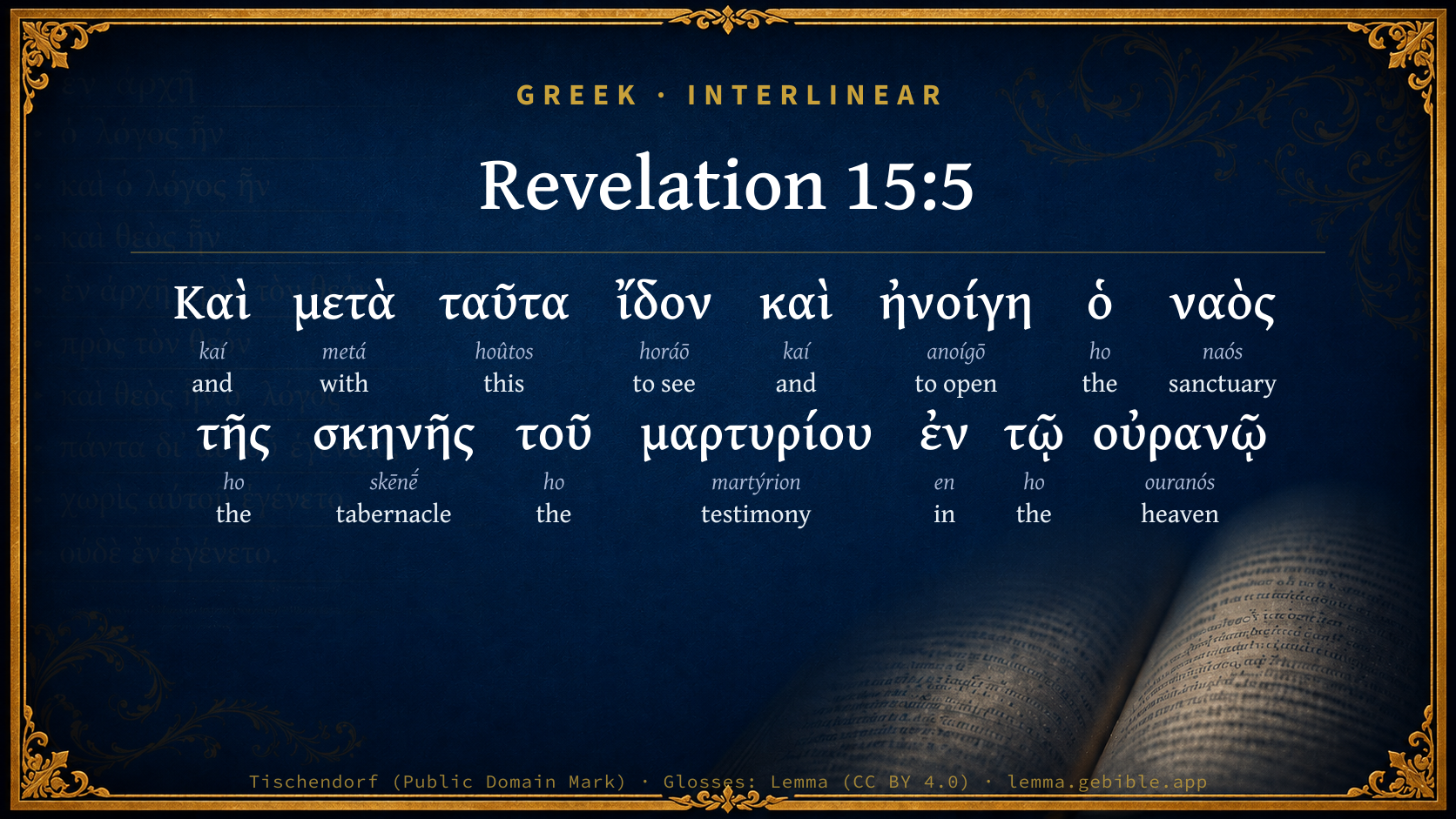
  1. Καὶ kaí G2532 “and” Conjunction
  2. μετὰ metá G3326 “with” Preposition
  3. ταῦτα hoûtos G3778 “this” Demonstrative pronoun, Accusative, Plural, Neuter
  4. ἴδον horáō G3708 “to see” Verb, Aorist, Active, Indicative, 1st person, Singular
  5. καὶ kaí G2532 “and” Conjunction
  6. ἠνοίγη anoígō G455 “to open” Verb, Aorist, Passive, Indicative, 3rd person, Singular
  7. ὁ ho G3588 “the” Article, Nominative, Singular, Masculine
  8. ναὸς naós G3485 “sanctuary” Noun, Nominative, Singular, Masculine
  9. τῆς ho G3588 “the” Article, Genitive, Singular, Feminine
  10. τοῦ ho G3588 “the” Article, Genitive, Singular, Neuter
  11. μαρτυρίου martýrion G3142 “testimony” Noun, Genitive, Singular, Neuter
  12. ἐν en G1722 “in” Preposition
  13. τῷ ho G3588 “the” Article, Dative, Singular, Masculine
  14. οὐρανῷ ouranós G3772 “heaven” Noun, Dative, Singular, Masculine

About this verse

These counts appear in no published source. They are computed here, from the morphology-tagged text and Lemma’s own curated glosses. What Lemma adds →

15
words
11
distinct lemmas
Revelation
section

Notable vocabulary

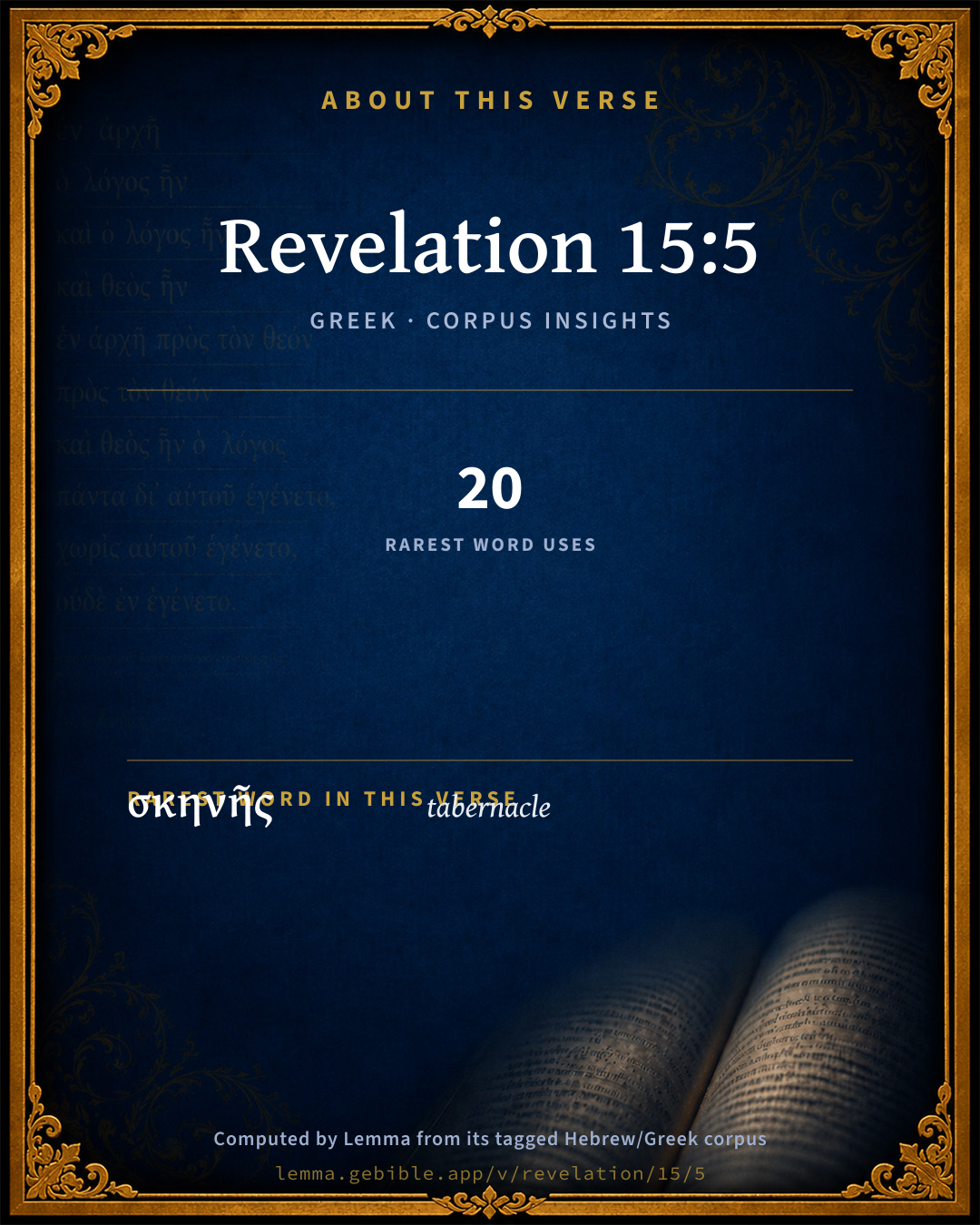
The rarest word here is σκηνῆς tabernacle G4633 — appearing just 20 times in the whole Greek New Testament.

Shared distinctive vocabulary

σκηνῆς tabernacle G4633 occurs in 20 verses of the Greek New Testament. Also found in:

Repetition

Words recur within this verse:

Cross-references

6

Topical passages linked to Revelation 15:5 in the Treasury of Scripture Knowledge — connected by theme and wording, ordered by reader-vote popularity; previews shown in the World English Bible.

  • Revelation 11:19 God's temple that is in heaven was opened, and the ark of the Lord's covenant was seen in his temple. Lightnings, sounds, thunders, an earthquake, and great hail followed.
  • Numbers 1:50 but appoint the Levites over the Tabernacle of the Testimony, and over all its furnishings, and over all that belongs to it. They shall carry the tabernacle, and all its furnishings; and they shall take care of it, and shall encamp around it.
  • Matthew 27:51 Behold, the veil of the temple was torn in two from the top to the bottom. The earth quaked and the rocks were split.
  • Exodus 38:21 This is the amount of material used for the tent, even the Tent of the Testimony, as they were counted, according to the commandment of Moses, for the service of the Levites, by the hand of Ithamar, the son of Aaron the priest.
  • Numbers 1:53 But the Levites shall encamp around the Tabernacle of the Testimony, that there may be no wrath on the congregation of the children of Israel: and the Levites shall be responsible for the Tabernacle of the Testimony."
  • Exodus 25:21 You shall put the mercy seat on top of the ark, and in the ark you shall put the testimony that I will give you.

Cross-references courtesy of OpenBible.info (CC BY 4.0).

Where the printed editions differ

1 variant

Places in this verse where the major printed Greek editions disagree on the wording in a way that affects the translation — a comparison of editions, not a manuscript-by-manuscript collation. The editions are the modern critical texts (Nestlé-Aland 28/27, SBL, Westcott-Hort, Tregelles, Tyndale House) and the traditional texts behind the KJV (the Textus Receptus and the Byzantine/Majority text). It is not a claim about which reading is original.

  1. Extra text
    ἰδού

    “behold”

    In TR Not in NA28NA27TynSBLWHTregByz

    ἰδού (idou) 'behold' is only in traditional manuscripts (TR)

Textual data: Translators Amalgamated Greek New Testament (STEPBible TAGNT) · CC BY 4.0.

Commentary

Notes on Revelation 15:5 from classic Christian and Jewish commentators (each source and its license shown beneath its notes). The classic Christian expositions comment on the surrounding passage and are grouped to its opening verse, so a note may address several verses; the Jewish commentaries on the Tanakh (Rashi and others) are per-verse, so they appear only where the commentator wrote on this verse.

Lemma curates 59 commentaries, every one of them public domain or Creative Commons licensed, each selected and text-cleaned for this edition rather than reprinted as found. About our sources →

Matthew Henry's Commentary

Observe, I. How these angels appeared - coming out of heaven to execute their commission: The temple of the tabernacle of the testimony in heaven was opened, Rev 15:5. Here is an allusion to the holiest of all the tabernacle and temple, where was the mercy-seat, covering the ark of the testimony, where the high priest made intercession, and God communed with his people, and heard their prayers. Now by this, as it is here mentioned, we may understand, 1. That, in the judgments God was now about to execute upon the antichristian interest, he was fulfilling the prophecies and promises of his word and covenant, which were there always before him, and of which he was ever mindful. 2. That in this work he was answering the prayers of the people, which were offered to him by their great high priest. 3. That he was herein avenging the quarrel of his own Son, and our Saviour Jesus Christ, whose offices and authority had been usurped, his name dishonoured, and the great designs of his death opposed, by antichrist and his adherents. 4. That he was opening a wider door of liberty for his people to worship him in numerous solemn assemblies, without the fear of their enemies.

II. How they were equipped and prepared for their work. Observe, 1. Their array: They were clothed with pure and white linen, and had their breasts girded with golden girdles, Rev 15:6. This was the habit of the high priests when they went in to enquire of God, and came out with an answer from him. This showed that these angels were acting in all things under the divine appointment and direction, and that they were going to prepare a sacrifice to the Lord, called the supper of the great God, Rev 19:17. The angels are the ministers of divine justice, and they do every thing in a pure and holy manner. 2. Their artillery, what it was, and whence they received it; their artillery, by which they were to do this great execution, was seven vials filled with the wrath of God; they were armed with the wrath of God against his enemies. The meanest creature, when it comes armed with the anger of God, will be too hard for any man in the world; but much more an angel of God. This wrath of God was not to be poured out all at once, but was divided into seven parts, which should successively fall upon the antichristian party. Now from whom did they receive these vials? From one of the four living creatures, one of the ministers of the true church, that is, in answer to the prayers of the ministers and people of God, and to avenge their cause, in which the angels are willingly employed.

III. The impressions these things made upon all who stood near the temple: they were all, as it were, wrapt up in clouds of smoke, which filled the temple, from the glorious and powerful presence of God; so that no man was able to enter into the temple, till the work was finished. The interests of antichrist were so interwoven with the civil interests of the nations that he could not be destroyed without giving a great shock to all the world; and the people of God would have but little rest and leisure to assemble themselves before him, while this great work was a doing. For the present, their sabbaths would be interrupted, ordinances of public worship intermitted, and all thrown into a general confusion. God himself was now preaching to the church and to all the world, by terrible things in righteousness; but, when this work was done, then the churches would have rest, the temple would be opened, and the solemn assemblies gathered, edified, and multiplied. The greatest deliverances of the church are brought about by awful and astonishing steps of Providence.

Matthew Henry's Commentary on the Whole Bible (1708–1710) — public domain (CC PDM 1.0). Text via the HelloAO Bible API.

The Biblical Illustrator

Joseph S. Exell

Rev_15:5-6

The seven angels came out of the temple, having the seven plagues.

Angelic agencies of retribution

Note,

1. The instruments employed by God for executing His wrath upon sinners--angels, seven angels: not that He needs them, but He is pleased to make use of them, and they are but instruments in His hand, who receive all their efficacy from the hand that uses them.

2. From whence these seven angels come, namely, out of the temple, more immediately from the presence of God, implying that they came forth to execute vengeance by Gods special directions, and consequently that the work was very well pleasing unto God which they went about.

3. How they are furnished, having seven plagues--namely, to inflict upon the idolatrous enemies of the Church.

4. In and after what manner these angels were apparelled and appeared.

(1) They were clothed in pure and white linen, to denote the holiness of their persons, as also the holiness of that work which they had then in hand.

(2) This clothing of theirs was girded to them, expressing thereby their great readiness for, and their great alacrity in, their work.

(3) The girdle wherewith they were girded was a golden girdle, exactly answering the habit of the high priest, when he entered into the holy of holies, to inquire of God, or came out with an answer from God.

5. From the whole learn, that when the Lord comes to pull down Babylon, as well as to build up Sion, He will appear in glory; the angels are Gods special ministers; when they go forth to pour out the vials of His wrath upon Babylon, they appear gloriously apparelled, glittering like the high priest, and girded with golden girdles. (W. Burkitt, M. A.)

Genuine discipline of soul

I. The source of genuine soul discipline. After that (these things) I looked (saw), and, behold, the temple of the tabernacle of the testimony in heaven was opened. The discipline, as we have seen, was of a painful character. It involved seven angels with seven plagues. Whence did it proceed? Not from secondary instrumentalities, fortuitous circumstances, or a heartless, rigorous fatality, but direct from the presence of the Infinite. The language here points to the inner compartment of the old Jewish tabernacle, known as the Holy of Holies. There the Jew regarded Jehovah as especially revealing Himself to them, and as communicating to them His ideas and plans. To a genuinely disciplined soul all influences from heaven tending to purify and ennoble are regarded as coming direct from the presence of the Great Father. Its inner eye, so to speak, is so opened and quickened that it glances into the very shrine of the Almighty.

II. The ministers of genuine soul discipline.

1. They are complete in number and qualification. Seven angels and seven plagues.

2. They go forth direct from His presence. Came out of the temple, etc.

3. They are divinely marked and attired as Gods priests. Clothed (arrayed) in pure and white linen.

4. They have a commission of severity. True soul-education involves pain. The very severity is a blessing.

III. The indispensability of genuine soul discipline. No man (no one) was able to enter into the temple till the seven plagues of the seven angels were fulfilled (should be finished). The idea suggested is that no man could enter into the shrine or into the immediate presence of God until the discipline had been fully accomplished. (David Thomas, D. D.)

The Biblical Illustrator, edited by Joseph S. Exell (c. 1880s–1900s) — public domain. Text from a community e-Sword module.

Joseph Benson's Commentary

Rev 15:5-7. After that I looked, and behold, the temple of the tabernacle — In which was the ark of the testimony in heaven, was opened — Namely, the most holy place, disclosing a new theatre for the coming forth of the judgments of God, now made manifest. And the seven angels came out of the temple — From the immediate presence of God, to denote that their commission was immediately from him; having the seven plagues — Already mentioned; clothed — Like the high-priest, but in a more august manner; in pure and white linen — To signify the righteousness of these judgments; and having their breasts girded — To show their readiness to execute the divine commands; with golden girdles — As emblems of their power and majesty. And one of the four living creatures — The representatives of the church; gave unto the seven angels seven golden vials — Bowls, or censers; the Greek word signifies vessels broader at the top than at the bottom; full of the wrath of God — By which it is intimated that it is in vindication of the church and true religion that these plagues are inflicted; who liveth for ever and ever — A circumstance which adds greatly to the dreadfulness of his wrath, and the value of his favour; and that he is to be regarded as the most formidable enemy, as well as the most desirable friend, to immortal beings.

Joseph Benson's Commentary on the Old and New Testaments (1811–1818) — public domain. Text from a community e-Sword module.

Tyndale Open Study Notes

Tyndale Open Resources

15:5-6 God’s Tabernacle implies God’s presence (see John 1:14); even the plagues have their source in God’s presence. Christ’s sacrifice (Matt 27:51; Mark 15:38; Heb 6:19-20; 10:19-20) removed the veil between God and humanity (see Exod 26:31-35; Lev 16). Now those who do not belong to Christ experience the full force of God’s presence (see Rev 20:11-15; Isa 13:4-12; Zeph 2:1-3; Mal 3:2-3). • white linen: Linen, a symbol of purity, was also worn by the priests when performing their duties (see Exod 28:39-43; Lev 16:4, 23; see also Ezek 9:2-3; Dan 12:6-7). The function of these angels is not intercession; they are agents of judgment. The linen therefore represents the purity and justice of God’s judgment. • The gold sashes across their chests probably symbolize their divine mission as ministers of justice on God’s behalf (cp. Rev 1:13).

Tyndale Open Study Notes — © Tyndale Open Resources, licensed CC BY-SA 4.0. Text via the HelloAO Bible API.

Meyer's Critical & Exegetical Commentary

Heinrich August Wilhelm Meyer

Rev_15:5-8. After the introductory song καὶ μετὰ ταῦτα (Rev_15:5),[3635] the seven angels which hold the seven plagues come out of the heavenly temple, and receive seven vials full of the wrath of God.

ὁ ναὸς τῆς σκηνὴς τοῦ μαρτυρίου ἐν τ. οὐρ. Cf. Rev_11:19. It is not the holy of holies[3636] that is designated by the entire expression, but the proper temple[3637] in heaven, which is more accurately described by the addition of the gen. τὴς σκ. τ. μαρτ.,[3638] as the ναός belonging to the tabernacle of the testimony, i.e., including it,[3639]not as existing in the σκην. τ. μαρτ.[3640]

The heavenly δόξα of the seven angels is to be seen from their adornment; one attribute, the golden girdle, they have in common even with the Lord himself.[3641] The first expression ἐνδεδ. λίθον καθαρὸν λαμπρὸν, in which, considering the manuscript authority for it, the λίθον can scarcely be a clerical error,[3642] is by no means to be so explained as to refer to Christ himself, the corner-stone[3643] or the various adornments of virtues,[3644] as the clothing of the angel; if, however, only a comparison with Eze_28:13 (πᾶν λίθον χρῆστον ἐνδέδεσαι) give an explanation that is at all events satisfactory, a plural, nevertheless, would possibly be expected, as πᾶν λιθ. stands in Ezekiel. The idea must, then, be that each angel wears a garment set with a pure, brilliant gem. The later expositors all follow the reading λίνον, according to which the angels appear in sacerdotal garments.[3645] Hengstenb. compares this with Rev_19:8, where, however, the expression λίνον does not occur. Ew. ii. refers properly to the fact that the καθαρόν does not appear to require the idea of a garment. But the weight of the witnesses who advocate the reading which is more difficult, and yet not to be derived from Ezekiel,[3646] is too great. א also appears by its peculiarities to betray with what difficulty the attempt was made to explain away the difficult-to-be-understood λίθον.[3647]

That one of the four beings (Rev_4:6) gives[3648] to the angels the vials of wrath, is significant, because it has to do with plagues which pertain to all earthly creatures whose representatives those beings are.[3649] As in their song of praise in Rev_4:7, they looked towards the end, so also the end does not come without their participation.[3650]

τοῦ ζῶντος εἰς τοὺς αἰῶνας τῶν αἰώνων. The making eternity conspicuous has the same relation as already in Rev_1:8.

καὶ ἐγεμίσθη, κ.τ.λ., Rev_15:8. The smoke with which the temple is filled,[3651] is not the sign of the incomprehensibility of the Divine judgments,[3652] nor directly of the wrath of God;[3653] but, as the text itself explains, that the smoke is represented as proceeding from the glory and power of God (ἐκ δ. τ. θ. καὶ ἐκ τ. δυν. αὐτ.), as a sign of the majesty, actually present in the ναός, of God revealing himself immediately in his power. In the cloud of smoke there the כבוֹד יה״[3654] is enthroned, which now, as the addition Κ. ἘΚ Τ. ΔΥΝΆΜΕΩς ΑὐΤ. especially emphasizes, will be manifested on the side of its omnipotence. The subject, it is true, refers to a revelation of judgment upon enemies, that is full of grace to believers; but the interpretation of the smoke fails to be in accordance with the text, if this be regarded as, on that account, either a sign of Divine wrath, or even of Gods grace working for the good of the godly.[3655] Beng. says, correctly, concerning the ΚΑΠΝ.: The covering of Divine Majesty.[3656]

ΚΑῚ ΟὐΔΕΙς ἘΔΎΝΑΤΟ ΕἸΣΕΛΘΕῖΝ, Κ.Τ.Λ. The description depends upon types like Exo_40:34; 1Ki_8:10 sq.[3657] Incorrect are all the allegorical explanations which depend upon the presumption that the heavenly ΝΑΌς represents the Church on earth.[3658] Just as incorrect, and entirely remote, Grot.: God was not willing to give any other oracles but these. Nothing whatever is said, also, to the purport that no one could go into the temple, in order by prayer to avert the threatening judgments.[3659] The correct explanation is derived from the words ἌΧΡΙ ΤΕΛΕΣΘ., Κ.Τ.Λ., which, upon the foundation of the general idea of the inaccessibility of God as present in his personal ΔΌΞΑ,[3660] suggests that not until satisfaction shall be rendered his holy wrath, by the full execution of all the plagues impending from Gods justice, shall access to him be possible. Until then, the immediate presence of his glory and power (Rev_15:8 a) must consume all creatures.[3661]

[3635] See on Rev_15:1.

[3636] Grot., etc.

[3637] Cf. Rev_11:1.

[3638] Cf., on this designation, Act_7:44; Exo_29:10-11, LXX.

[3639] Ewald.

[3640] De Wette.

[3641] Cf. Rev_1:13.

[3642] Grot.

[3643] 1Pe_2:6.

[3644] Andr., Beda.

[3645] De Wette.

[3646] Volkm.

[3647] See Critical Notes.

[3648] Cf. Rev_6:1; Rev_6:3; Rev_6:5; Rev_6:7.

[3649] Hengstenb. But cf. also Riehm, l. c., p. 24.

[3650] Cf. also Rev_19:4.

[3651] cf. Isa_6:4.

[3652] C. a Lap., etc.

[3653] Andr., Grot., Heinr., Hengstenb., Ebrard.

[3654] Exo_40:34. LXX.: δόξα κυρίου.

[3655] Züllig, Hengstenb.

[3656] Cf. also De Wette.

[3657] De Wette, Hengstenb.

[3658] Beda: No one can be incorporated among the members of the Church unless one who listening learns the mysteries of faith from preachers. Coccejus: Papal human ordinances hinder the faith of the most. Vitr.: In the time of the plagues … there shall be such a demonstration of the glorious and gracious presence of God in the Church, as can be compared with the symbolical demonstration of the Divine presence in the tabernacle under the old covenant.

[3659] Ewald, Stern.

[3660] Cf. Exo_19:21; Isa_6:5.

[3661] Cf. Hengstenb.; likewise also Züllig, De Wette.

Meyer — Critical and Exegetical Commentary on the New Testament — English translation by Peter Christie, edited by Frederick Crombie (T&T Clark, 1880) — public domain. Text from a community e-Sword module.

Expositor's Greek Testament

ed. W. Robertson Nicoll

Rev 15:5 . The temple in heaven is here “the tent (or tabernacle) of witness,” as it represents God’s judicial revelation and presence; its contents and the movements of which it forms the source, are evidence of God’s covenant with his people.

The Expositor's Greek Testament, edited by W. Robertson Nicoll (1897–1910) — public domain. Text from a community e-Sword module.

Cambridge Greek Testament for Schools and Colleges

5–8. THE PREPARATION FOR THE LAST PLAGUES

Here the description of the vision announced in Rev 15:1 begins, though the Seer still anticipates, see on Rev 15:6: for the relation of Rev 15:1; Rev 15:5, see on Rev 12:14.

5. ἠνοίγη. No translation seems to connect ἠνοίγη directly with ἐν τῷ οὐρανῷ, and the connexion is less in the style of the Book than the ordinary connexion ὁ ναὸς ἐν τῷ οὐρανῷ, though the former might be supported here by the parallel in the next verse ἐξῆλθον … ἐκ τοῦ ναοῦ.

ὁ ναὸς τῆς σκηνῆς τοῦ μαρτυρίου ἐν τῷ οὐρανῷ. For ὁ ναὸς see Rev 11:19; for τῆς σκηνῆς τοῦ μαρτυρίου the one New Testament parallel is Act 7:44; cf. Exo 27:21; Num 1:50 &c. It is not clear whether we are to translate the temple of the heavenly tabernacle, or the heavenly temple of the tabernacle. To say that the holy place of the heavenly tabernacle is opened, is to say no more than that the heavenly tabernacle is opened. Possibly, as we are told that not only the Ark, but the Tabernacle which Moses made according to the pattern shewed unto him in the Mount, was brought up into Solomon’s Temple, it may be meant here that the heavenly Temple contains the archetype of the earthly tabernacle. In any case the Tabernacle is mentioned because its origin was more directly divine than that of the Temple. Compare 1Ch 28:19; Exo 25:40; Exo 26:30.

Cambridge Greek Testament for Schools and Colleges (Cambridge University Press, 1896; 21 vols, various authors incl. Carr, Maclear, Plummer, Farrar, Lumby, Moule, M. R. James, Simcox) — public domain. Text from a community e-Sword module.

Geneva Bible (1599)

Geneva Bible translators

The second part of the narration (as was [noted,] verse 2) wherein first the authority of the whole argument and matter thereof is figured by a forerunning type of a temple opened in heaven, as Rev. 11:19, namely that all those things are divine and of God, that proceed from thence, in this verse. Secondly, the administers or executors, come forth out of the Temple, verse 6. Thirdly, they are furnished with instruments of the judgments of God, and weapons fit for the manner of the same judgments, verse 7. Finally they are confirmed by testimony of the visible glory of God, in the last verse. A like testimony whereunto was exhibited of old in the Law, Exod. 40:34.

Geneva Bible (1599) marginal notes — public domain. Text via Bolls.life.

Jamieson, Fausset & Brown

Robert Jamieson, A. R. Fausset & David Brown

So Rev 11:19; compare Rev 16:17. "The tabernacle of the testimony" appropriately here comes to view, where God's faithfulness in avenging His people with judgments on their foes is about to be set forth. We need to get a glimpse within the Holy place to "understand" the secret spring and the end of God's righteous dealings.

behold--omitted by A, B, C, Syriac, and ANDREAS. It is supported only by Vulgate, Coptic, and PRIMASIUS, but no manuscript.

Jamieson, Fausset & Brown — Commentary Critical and Explanatory on the Whole Bible (1871) — public domain (CC PDM 1.0). Text via the HelloAO Bible API.

Adam Clarke's Commentary

Verse 5. The temple of the tabernacle of the testimony] The temple which succeeded the tabernacle, in which was the testimony, viz., the two tables, Aaron's rod, pot of manna, holy anointing oil, &c. All bearing testimony to the truth of God and his miraculous interposition in their behalf.

Adam Clarke's Commentary on the Bible (1810–1826) — public domain. Text from a community e-Sword/MySword module.

Ellicott's Commentary for English Readers

(5) And after that . . .—Better, And after these things I saw, and there was opened the temple of the tabernacle of the testimony (or, witness) in the heaven. This temple is called the temple of the tabernacle of the testimony; the expression sounds cumbrous, but it is nevertheless suitable. St. Stephen spoke of “the tabernacle of witness” in the wilderness, which was made after the pattern showed in the mount (Act_7:44). The tabernacle was well called the tabernacle of witness, for it contained the ark of the testimony with the Law of God, and was a perpetual witness of God’s presence among His people. The temple of the tabernacle then is the shrine, or inner sanctuary, of the heavenly true tabernacle, after the pattern of which the tabernacle of Moses was fashioned, which is now opened.

A Bible Commentary for English Readers, edited by Charles John Ellicott (1878–1897) — public domain. Text from a community e-Sword module.

The Cambridge Bible for Schools and Colleges

gen. ed. J. J. S. Perowne

5. the Temple … was opened] Rev_11:19. For the phrase “Tabernacle of the Testimony” (or “Witness”—the word is the same) cf. Act_7:44 : see Num_1:50). “Was opened in Heaven” would give the sense, more accurately than the order of the A. V.

The Cambridge Bible for Schools and Colleges (gen. ed. J. J. S. Perowne; Cambridge University Press, 1878–1918) — public domain. Text from a community e-Sword module.

John Gill's Exposition

And after that I looked,.... That is, after John had seen the above vision, he looked again, and saw what follows:

and behold, the temple of the tabernacle of the testimony in heaven was opened; this does not refer to heaven itself, the antitype of the holy of holies, which is opened by the blood of Christ, by which he himself has entered, and his people have boldness to enter now by faith, and where their souls always enter upon their departure from their bodies; for of this temple cannot be said what is in Rev 15:8 nor to the Jerusalem state, or the most glorious state of the church on earth, during the thousand years' reign; for in that there will be no temple, Rev 21:22 much less to any material temple on earth; the temple at Jerusalem was destroyed before this vision was, and is never to be rebuilt; nor will there be any third temple, as the Jews vainly expect: but to the church of God in the spiritual reign of Christ, under the blowing of the seventh trumpet; and designs the same thing as in Rev 11:19 and this is to be understood as what will be, not before, but after the seven angels have poured out their vials; for till they have fulfilled the seven plagues, there is no entering into the temple for smoke, Rev 15:8 and besides, it was after these things; after John had seen the seven angels, with the seven last plagues, Rev 15:1 that he beheld the temple opened. The church is called "the temple", in allusion to Solomon's temple, because of its builder, materials, situation, magnificence, strength, holiness, and use; See Gill on Co2 6:16 and the tabernacle, in allusion to the tabernacle of Moses, which was before the temple, because God dwells in it, as he did in that; and because like that it is movable, and but for a while; and points at this church state, which will not always be so, but change and sink into the Laodicean state: and it is called "the tabernacle of the testimony", as that was; the testimony was the law, or the two tables of stone, so called, because they testified what was the good, and perfect, and acceptable will of God; and these being put into the ark, were a testimony of the covenant between God and the people of Israel, and were a witness against them, when they transgressed them, Deu 31:26 and over these were the mercy seat, and cherubim, as a testimony of the divine Presence; and the law being put into the ark, hence the ark was called the ark of the testimony, and that being placed in the tabernacle, that was called the tabernacle of the testimony, or of witness, Num 1:50 and all these were types of, and came to signify Christ, and the covenant of grace, the Gospel, and the mysteries of it: so that by the opening of the temple, &c. is meant a free exercise of the true religion, a setting up of Gospel churches according to the original plan, a keeping of the ordinances, as they were first delivered, and a more clear discovery of Gospel truths: it is the same with the open door in the Philadelphian church state, Rev 3:8 as well as that at this time there will be a full manifestation of the judgments of God upon antichrist: the Alexandrian copy leaves out the word "behold".

John Gill's Exposition of the Whole Bible (1746–1763) — public domain (CC PDM 1.0). Text via the HelloAO Bible API.

Trapp's Complete Commentary

John Trapp

5 And after that I looked, and, behold, the temple of the tabernacle of the testimony in heaven was opened:

Ver. 5. The temple of the tabernacle] These words are all one with those Rev 11:19, to the consideration whereof we are here recalled, after so long an interruption.

John Trapp, A Commentary or Exposition upon All the Books of the Old and New Testament (1647–1656) — public domain. Text from a community e-Sword module.

Albert Barnes' Notes on the Bible

And after that I looked - After I had seen in vision the redeemed thus referred to, celebrating the praises of God, I saw the preparation made for the execution of these purposes of judgment.

And behold, the temple of the tabernacle of the testimony - Not the whole temple, but only that part to which this name was given. The word “tabernacle” - σκηνή skēnē - means properly a booth, hut, tent, and was the name commonly given to the tent or tabernacle that was erected in the wilderness for the service of God. See the notes on Act 7:44. The same word came naturally to be applied to the temple that was reared for the same purpose in Jerusalem. It is called the “tabernacle of testimony,” because it was a testimony or witness of the presence of God among the people - that is, it served to keep up the remembrance of him. See the notes as above on Act 7:44, where the same Greek phrase is used as here - rendered there “tabernacle of witness.” The word “temple” here - ναὸς naos - does not refer to the whole of the building called the “temple,” but to the holy of holies. See the notes on Heb 9:3. This was regarded as the unique dwelling-place of God; and it was this sacred place, usually closed from all access, that now seemed to be opened, implying that the command to execute these purposes came directly from God himself.

In heaven - That is, that part of heaven which corresponds to the most holy place in the temple was opened; to wit, what is the unique residence of God himself.

Was opened - Was thrown open to the viewer John, so that he was permitted to look, as it were, upon the very dwelling-place of God. From his holy presence now came forth the angels to execute his purposes of judgment on that anti-Christian power which had so long corrupted religion and oppressed the world.

Albert Barnes' Notes on the Bible (1834–1885) — public domain. Text from a community e-Sword/MySword module.

Haydock's Catholic Bible Commentary

And after these things. Here the scene changes, and is carried back to the period of time that immediately precedes the seven plagues. This removal of the scene St. John insinuates by the unusual circumlocution, "after these things I beheld," and looked on the commencement of this scene. The temple opens, and the seven Angels with the seven plagues proceed from the sanctuary to execute the work they are charged with. (Pastorini) --- One ought not to be surprised to see the good Angels employed in these kinds of offices, as justice is no less an attribute of the Deity than mercy, and therefore equally the object of the ministry of the Angels. (Calmet) --- Behold, the temple of the tabernacle....in heaven, was opened. We have before observed, that these visions were shewn to St. John as it were in a temple in heaven, and with an allusion to the sanctuary and its parts under Moses. The Angels are seen coming out with clean and white linen, and with golden girdles, being an allusion to the habits of the priests in the ancient law. (Witham)

George Leo Haydock (1774–1849), Haydock's Catholic Family Bible and Commentary, 1859 edition — public domain. Excludes Psalms (Douay-Rheims chapter numbering differs from Protestant) and Deuterocanonical books (Catholic canon only).

Matthew Poole's English Annotations

Here is a plain allusion to the Jewish tabernacle or temple, in which was the holy place, and the holy of holies; into the latter the high priest only entered. There were kept in the ark the two tables of God’s law, often called the testimonies of God. From this

tabernacle of the testimony proceeded God’s oracles, there God gave answers from the mercy-seat, and therefore in the Book of Kings it is called the oracle. The sense some put upon this is: That God here showed unto his prophet the liberty that should be, after the downfal of antichrist, to preach the gospel. But in this sense it must be an anticipation of what orderly should have come in after the pouring out of the vials: I had rather understand it of God’s being now about to give out an answer to his people’s prayers for a deliverance from the tyranny of antichrist; as the place called the oracle in the Jewish temple was opened when the high priest had been inquiring of God, to give an account of the answer he had.

Matthew Poole's English Annotations on the Holy Bible (1683–1685) — public domain. Text from a community e-Sword/MySword module.

Whedon's Commentary on the Bible

Daniel D. Whedon

5. The present song of the martyr spirits before the throne corresponds with their song on Zion, Rev_14:1, and also to the utterances of the great voices in heaven at the sounding of the seventh trumpet, Rev_11:15-19. And as in the latter passage (Rev_11:19) the ark of the testimony is made visible, so there is here also the same opening of the same token of testimony to the sight. In both presentations the meaning is the same, (see note Rev_11:19,) namely, the responsive pledge of Jehovah that the judgment predicted by the martyr song shall be inflexibly inflicted. By the faith of the Lord God Almighty the judgment is assured.

I looked, and, behold—This opening of the inner sanctuary was a startling wonder.

Temple—The naos, or most holy place.

Of the tabernacle—The reproduction of the old tabernacle of Moses in the wilderness, where God once dwelt with Israel.

Of the testimony—Namely, of God’s covenant with his people. In this vision it declares God’s covenant with his martyrs that judgment shall not fail. And forthwith the executioners of that judgment, the seven angels, appear on the scene.

Daniel D. Whedon (gen. ed.), Commentary on the Old and New Testaments (1874–1909) — public domain. Text from a community e-Sword module.

The Pulpit Commentary

And after that I looked, and, behold; and after these things 1 saw. The characteristic commencement of a new vision or portion of a vision. (see on Rev_4:1, etc.) The temple of the tabernacle of the testimony in heaven was opened. The tabernacle had its counterpart in heaven. (Heb_8:5) In Exo_25:16, 21 we have the reason of the title "tabernacle of the testimony a name which is common in the Bible. (see Exo_38:21 Num_1:50, 53 9:15 10:11) The "temple" is the naov , the inner shrine, the holy of holies which contained the ark of the testimony, which in Rev_11:1:9 is seen in connection with the judgments of God. Thence now proceed the angels bearing the plagues for men.

Vers. 5-8. Final judgments proclaimed.

From this point commences the final delineation of the overthrow of the kingdom of evil. It may be difficult, if not impossible, to interpret the symbolical language in detail into realistic descriptions. Probably such interpretation is misleading. But the great ideas stand out prominently, and afford matter for contemplation, and, without puzzling the lowly reader, will help him to a knowledge of the "ways" and "judgments" of God. The complete vision of the destruction of "Babylon" reaches to the end of the eighteenth chapter. The portion named above is preliminary. A glance through the whole is sufficient to assure us that it represents a widespread struggle a struggle of the utmost intensity and severity, and a final one. Within it occur the significant, prophetic words, "It is done!" Let this first glance, starting at the first words and reaching to the last, embrace the whole in a preliminary view, and we shall be instantly arrested

I BY THE SEVERITY OF THE JUDGMENT THREATENED. The vision is one of judgment, not of warfare. It is only incidentally that the idea of war is introduced. (Rev_16:14, 16 17:14) Judgment is the burden of the vision. The severity of the judgments is seen in the terms used. There are seven vials, or bowls. The first becomes "a noisome and grievous sore," etc. (ver. 2); the second a cause of death living soul died;" the third turns "the rivers and fountains of the waters" into "blood;" the fourth, "men were scorched with great beat;" the fifth, "they gnawed their tongues for pain;" the sixth prepares the way for the coming of (antagonistic) kings (this requires a subsequent interpretation); the seventh brings "lightnings and voices and thunders" and "a great earthquake, such as was not since there were men upon the earth." Thus is set forth ideally the utmost painfulness and severity of judgments. Much of the imagery carries us back to Egypt"s plagues.

II We are further arrested by the UNIVERSALITY OF THE JUDGMENT. There is no reference to portions of the earth, as earlier. (Rev_8:7-11)

III BY THE FINALITY OF THE JUDGMENTS. "In them is finished the wrath of God." It is the judgment of "Babylon the great," "the great harlot that sitteth upon many waters." "Babylon the great, the mother of the harlots, and of the abominations of the earth," whose flesh they shall eat, and "shall burn her utterly with fire." Thus by outward materialistic judgments are we to see a spiritual conquest and destruction and judgment ideally represented. Blessed are they who are not included in "the judgment of the great harlot"! R. G.

Vers. 5-8. Genuine discipline of soul.

"And after that I looked, and, behold, the temple of the tabernacle of the testimony in heaven was opened: and the seven angels came out of the temple, having the seven plagues, clothed in pure and white linen," etc. I do not know that I can turn these words to a more legitimate and practical use than by using them as an illustration of genuine soul discipline. In this light they suggest to us the source, the ministers, and the indispensability of genuine soul discipline.

I THE SOURCE OF GENUINE SOUL DISCIPLINE. "After that these things I looked saw, and, behold, the temple of the tabernacle of the testimony in heaven was opened" (ver. 5). The discipline, as we have seen, was of a painful character. It involved "seven angels" with "seven plagues." Whence did it proceed? Not from secondary instrumentalities, fortuitous circumstances, or a heartless, rigorous fatality, but direct from the presence of the Infinite. The language here points to the inner compartment of the old Jewish tabernacle, known as the "holy of holies." There the Jew regarded Jehovah as especially revealing himself to them, and as communicating to them his ideas and plans. To a genuinely disciplined soul all influences from heaven tending to purify and ennoble are regarded as coming direct from the presence of the great Father. Its inner eye, so to speak, is so opened and quickened that it glances into the very shrine of the Almighty. It feels that "every good and perfect gift cometh down from the Father of lights," etc. It is a characteristic, or rather a law, of true religiousness that it bears the soul away through nature, churches, and chapels, right up into the very presence of God, to the very fontal Source of all good, the mighty Mainspring that works the universe. God is its all in all. It can truly say, "I looked, and, behold, the temple of the tabernacle of the testimony in heaven was opened" (ver. 5). The grand difference between a spurious and a genuine religiousness of soul is this the one busies itself about the fussy doings and foggy dogmas of little sects, and the other is so absorbed with the Supreme Good, that it feels with the old Hebrew, "Whom have I in heaven but thee? and whom on earth do I desire but thee?

II THE MINISTERS OF GENUINE SOUL DISCIPLINE. "And the seven angels came out of the temple, having that had the seven plagues" (ver. 6). The great Father who makes his children "meet for the inheritance of the saints in light," carries on his sublime educational work by angels or ministers. Concerning those ministers, observe:

1. They are complete in number and qualification. "Seven angels" and "seven plagues.

2. They go forth direct from his presence. "Came out of the temple," etc.

3. They are divinely marked and attired as God"s priests. "Clothed arrayed in pure and white linen precious stones pure and bright, and having their breasts girded girt about the breasts with golden girdles" (ver. 6).

4. They have a commission of severity. "And one of the four beasts living creatures gave unto the seven angels seven golden vials bowls full of the wrath of God, who liveth forever and ever" (ver. 7). (The wrath of God is his antagonism to sin.) In the great moral school of humanity there has always been, as in all schools, not a little severity. True soul education involves pain. The very severity is a blessing. "What son is he whom the father chasteneth not?" "Our light afflictions, which are but for a moment," etc. Whilst the majority of men regard this life as a market, or a banquet, or a playground, he who regards it as a great moral school has the only true idea as a school in which every object is a lesson, every agent a teacher, and every teacher coming forth directly from God.

III THE INDISPENSABILITY OF GENUINE SOUL DISCIPLINE. "No man no one was able to enter into the temple, till the seven plagues of the seven angels were fulfilled should be finished" (ver. 8). The idea suggested is that no man could enter into the shrine or into the immediate presence of God until the discipline had been fully accomplished. Here is a commentary on this: "Who shall ascend into the hill of the Lord? or who shall stand in his holy place? He that hath clean hands and a pure heart, who hath not lifted up his soul unto vanity." Cleanness in hands and heart means having conduct void of offence towards God and man. Freedom from vanity means moral reality. These two things, moral cleanness and moral reality, are the qualifications for ascending to the "holy hill," or fellowship with God. "It is not," says Luther, "he who sings so well or so many psalms, nor he who fasts or watches so many days, nor he who divides his own among the poor, nor he who preaches to others, nor he who lives quietly, kindly, and friendly, nor, in fine, is it he who knows all sciences and languages, nor he who works all virtuous and all good works that ever any man spoke or read of; but it is he alone who is pure within and without. D.T.

The Pulpit Commentary (1880–1919), ed. H.D.M. Spence-Jones & Joseph S. Exell — public domain. Text from a community e-Sword module.

John Wesley's Explanatory Notes

After these things the temple of the tabernacle of the testimony - The holiest of all. Was opened - Disclosing a new theatre for the coming forth of the judgments of God now made manifest.

John Wesley, Explanatory Notes Upon the Whole Bible (1754–1765) — public domain. Text via the GEBible commentary corpus.

Kretzmann's Popular Commentary

Paul E. Kretzmann

The seven angels with the seven vials:

v. 5. And after that I looked, and, behold, the temple of the tabernacle of the testimony in heaven was opened;

v. 6. and the seven angels came out of the temple, having the seven plagues, clothed in pure and white linen, and having their breasts girded with golden girdles.

v. 7. And one of the four beasts gave unto the seven angels seven golden vials full of the wrath of God, who liveth forever and ever.

v. 8. And the temple was filled with smoke from the glory of God and from His power; and no man was able to enter into the temple till the seven plagues of the seven angels were fulfilled.

The hymn of the perfected saints served as a prologue to the revelation whose preparatory incidents are now shown. It was a marvelous sight which met the eyes of John: And after these things I saw, and there was opened the temple of the tabernacle of the testimony in heaven. This was the very innermost shrine and sanctuary, the most holy place of the heavenly temple. The temple is here called the tabernacle of witness, since it symbolizes the presence and revelation of God’s justice, and its opening indicated that the most holy God was now ready to speak and to act through His representatives, or messengers. This the prophet describes: And there came out of the sanctuary the seven angels having the seven plagues, clothed in white, shining linen, and girded about their breasts with a golden girdle. The fact that these angels were clothed in gold and light gives an indication of, their origin, while the linen denotes their sacred office as priests of the Lord. These seven angels were the bearers of the seven last plagues against the enemies of the Lord.

And another fact is related in the preliminary incidents: And one of the four living beings gave to the seven angels seven golden vials filled with the wrath of God, Him that lives forever and ever, and the sanctuary was filled with the smoke of the glory of God and of His power, and no one is able to enter into the sanctuary until the seven plagues of the seven angels are completed. One of the four cherubs that stood around the throne, acting at God’s command, delivered to the seven angels bowls, or vials, filled with the wrath of the everlasting God. And the seven angels were not to hold back with this wrath, but were to pour it out upon the enemies of the Lord. This revelation of God’s justice was attended with praise and honor for Himself, as the smoke indicates which filled the sanctuary. See Isa 6:4. Till the plagues are over, the presence of God is unendurable and His majesty unapproachable.

The meaning of this picture seems fairly evident. From the sanctuary of God, from the midst of the Christian Church, men should arise as witnesses and soldiers of Christ to attack and overcome the kingdom of Anti-Christ and all anti-Christian teaching. Clothed in linen they were and with golden girdles, in the garments of the exalted Christ. For they were sure from the very start that their testimony and their battle would be victorious, since they were dealing with enemies that had really been overcome through the victory of Christ. Thus these angels, witnesses of God and for the Lord, were to be instruments of the wrath of God to convey to all enemies of the Church God’s condemnation. With the smoke of the glory and power of God arising and following them, what enemy will be able to withstand them?

Summary

In two preliminary, or introductory, pictures, that of the perfected saints praising the Lord, and that of the seven angels receiving the vials of God’s wrath, the seven last plagues upon the enemies of the Lord are ushered in.

Paul E. Kretzmann, Popular Commentary of the Bible (1921–1924) — public domain. Text from a community e-Sword module.

Burkitt's Expository Notes on the New Testament

William Burkitt

Observe here, 1. The vision which St. John had: he thought he saw the Holy of holies open to him, and seven angels coming forth with seven plagues, as the executioners of God’s judgments upon idolatrous persons.

Where note, 1. The instruments employed by God for executing his wrath upon sinners, angels, seven angels; not that he needs them, but he is pleased to make use of them; and they are but instruments in his hand, his bow and his battle-axe, mere dead tools, who receive all their efficacy from the hand that uses them: their presence adds no strength to him, their absence makes the work no more difficult before him.

Note, 2. From whence these seven angels came, namely, out of the temple, out of the oracle, more immediately from the presence of God; implying, that they came forth to execute vengeance by God’s special directions, and not barely by his permission: and consequently that the work was very acceptable and well-pleasing unto God which they went about.

Note, 3. How they are furnished, having seven plagues; namely, to inflict upon the idolatrous enemies of the church.

Note, 4. In and after what manner these angels were apparelled and appeared. 1. They were clothed in pure, white linen, to denote the holiness of their persons, as also the holiness of that work which they had then in hand. 2. This clothing of theirs was girded to them, expressing thereby their great readiness for, and their great alacrity and cheerfulness in, their work. 3. The girdle wherewith they were girded was a golden girdle, exactly answering the habit of the High-priest, when he entered into the Holy of holies to enquire of God, or came out with an answer from God.

From the whole learn, That when the Lord comes to pull down Babylon as well as to build up Sion, he will appear in glory: the angels are God’s special ministers; when they go forth to pour out the vials of his wrath upon Babylon, they appear gloriously apparelled, glittering like the High-priest, and girded with golden girdles.

William Burkitt's Expository Notes on the New Testament (1700–1703) — public domain. Text from a community e-Sword module.

The People's New Testament

B. W. Johnson

5–7. Behold, the temple of the tabernacle of the testimony in heaven was opened. After that I looked. The apostle looks again and “behold, the temple of the tabernacle of the testimony in heaven is opened.” The tabernacle of the testimony was the Holy of Holies. Into it none but the High Priest entered, and he only to make intercession for the forgiveness of sins. It is the type of the Holy of Holies above, the mercy seat in the heavens where our High Priest intercedes for us, and where the smoke of the incense of prayer arises to God.

B. W. Johnson's The People's New Testament with Notes (1889–1891) — public domain. Electronic text from the Christian Classics Ethereal Library (CCEL) ThML edition.

unfoldingWord translationNotes

Door43 World Missions Community

Connecting Statement:

The seven angels with the seven plagues come out of the most holy place. They were spoken of previously in Revelation 15:1.

After these things

"After the people finished singing"

the seven angels holding the seven plagues

These angels were seen as holding seven plagues because in Revelation 17:7 they are given seven bowls full of the wrath of God.

linen

a fine, expensive cloth made from flax

sashes

A sash is a decorative piece of cloth worn on the upper body.

translationWords

temple

tent of meeting

heaven

angel

plague

clothe

pure

gold

unfoldingWord translationNotes — © Distant Shores Media and the Door43 World Missions Community, licensed CC BY-SA 4.0. Source: git.door43.org/Door43/en_tn.

Vincent's Word Studies in the New Testament

Marvin R. Vincent

Behold. Omit.

The temple of the tabernacle [ο ναος της σκηνης] . The sanctuary of the tabernacle. See on Mt 4:5.

Of the testimony. See Act 7:44. The tabernacle was called "the Tabernacle of the Testimony" because it contained the ark with the law of God which testifies against sin. See Exo 25:16, 21; Exo 30:36; Exo 34:29; Exo 38:21. Compare ch. 11 19.

Marvin R. Vincent, Word Studies in the New Testament (1887–1900) — public domain. Text from a community e-Sword/MySword module.

Lesson kit

Teaching starters — assembled from the data on this page, not authored interpretation. Every prompt links to the verse data it draws on. Edit before teaching.

Revelation, in the Revelation, opens this verse with 15 words (11 distinct Greek lemmas). Its most distinctive word is skēnḗ (“tabernacle”). A historical commentator’s framing appears above. Read the whole chapter for the surrounding context.

Discussion questions

  1. What does “tabernacle” (skēnḗ) contribute to the verse as a whole?
  2. Matthew 17:4 shares the word «tabernacle» with this verse. How do the two illuminate each other?
  3. “the” occurs 4× in this one verse. What is the effect of the repetition?
  4. The translations on this page render this verse differently — a whole-verse word diff, not a word-by-word alignment. What might account for the different wordings?
  5. Reading how Matthew Henry's Commentary and The Biblical Illustrator read this verse, where do the two commentators agree and where do they part?

Things to notice

Reading settings

Reading text

Shown beneath each verse's original-language words.

Old Testament
Old Testament edition

Read the OT as the Masoretic Hebrew (MT) or the Greek Septuagint (LXX).

English shown for the Greek Septuagint (in the Hebrew ↔ Greek comparison).

Comparing translations? Open the Compare panel on any verse page to stack up to four side by side.