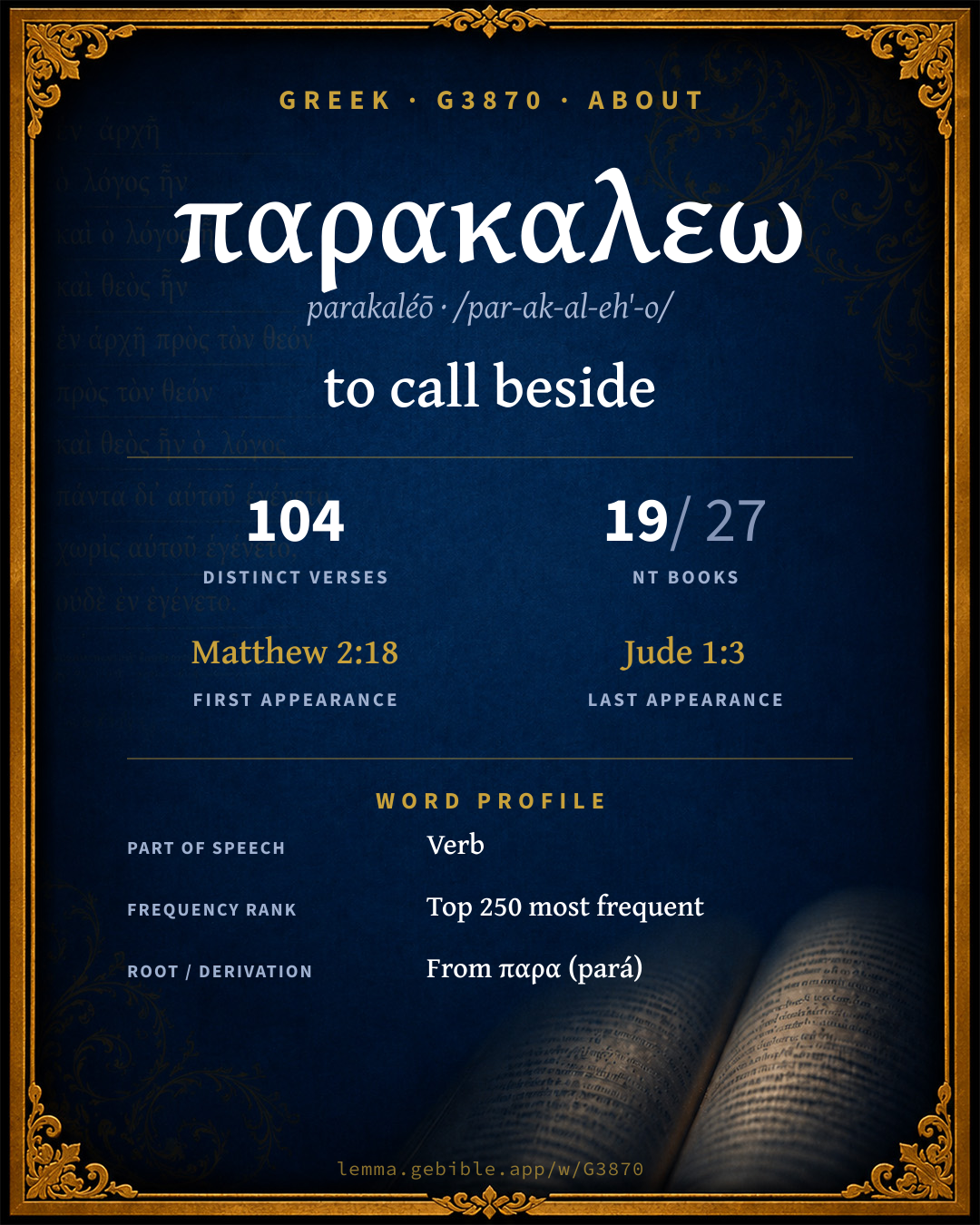
παρακαλέω
to call beside
‘to call beside’ is one of 2 main senses fuller range ↓
Full lexicon entry — Thayer's Greek Lexicon
From Thayer's Greek Lexicon
Where this word appears
See every Present-tense verb in the Greek New Testament →
Grammar key — what these labels mean
Part of speech
- Verb
- An action or state-of-being word.
Tense
- Present
- Ongoing or general action in present time (imperfective aspect).
- Imperfect
- Continuous or repeated action in past time (“was writing”).
- Aorist
- Action viewed as a simple whole, without regard to duration — often past (perfective aspect).
- Future
- Action expected in future time.
- Perfect
- A completed past action with continuing present results.
Voice
- Active
- The subject performs the action.
- Passive
- The subject receives the action.
Mood
- Indicative
- States a fact or asks a factual question (the mood of reality).
- Participle
- A verbal adjective (“writing,” “having written”).
- Infinitive
- A verbal noun (“to write”), unmarked for person or number.
- Imperative
- Expresses a command or request.
- Subjunctive
- Expresses probability, purpose, or possibility (the mood of contingency).
- Optative
- Expresses a wish or a remote possibility.
Case
- Nominative
- The case of the subject (and the predicate nominative).
- Genitive
- The case of source, possession, or “of” — answers “whose / from what.”
Person
- 1st person
- The speaker (“I / we”).
- 3rd person
- The one spoken about (“he / she / it / they”).
- 2nd person
- The one addressed (“you”).
Gender
- Masculine
- Grammatically masculine.
Number
- Singular
- One.
- Plural
- More than one.
Grammatical forms 33 distinct
- Verb, Present, Active, Indicative, 1st person, Singular 20 times (19%)
- Verb, Present, Active, Participle, Nominative, Singular, Masculine 9 times (8%)
- Verb, Imperfect, Active, Indicative, 3rd person, Singular 8 times (7%)
- Verb, Imperfect, Active, Indicative, 3rd person, Plural 7 times (6%)
- Verb, Aorist, Active, Indicative, 3rd person, Plural 6 times (6%)
- Verb, Present, Active, Indicative, 1st person, Plural 6 times (6%)
- Verb, Aorist, Active, Indicative, 1st person, Singular 5 times (5%)
- Verb, Aorist, Active, Infinitive 5 times (5%)
+25 more forms (42 occurrences)
Parsed forms decoded from the imported morphology (Robinson–Tischendorf, public domain), counted across 108 parsed occurrences — not distinct verses.
Every verse where G3870 appears — 104 distinct verses across 19 books. Click any verse to open its interlinear word-by-word view. Verse text shown in the World English Bible for context — . Each verse’s Greek form is shown with its reference; the English is not keyword-highlighted, since the data carries no word-level English alignment. Use “Compare translations” on any verse to read it across multiple English versions. This concordance covers the Greek New Testament; Septuagint (Greek Old Testament) occurrences of this word are not indexed here.
Matthew 9 verses
- Matthew 2:18 παρακληθῆναι aor pass inf "A voice was heard in Ramah, Lamentation, weeping and great mourning, Rachel weeping for her children; She wouldn't be comforted, Because they are no more."
- Matthew 5:5 παρακληθήσονται fut pass ind 3pl Blessed are the gentle, For they shall inherit the earth.
- Matthew 8:5 παρακαλῶν pres act ptcp nom sg masc When he came into Capernaum, a centurion came to him, asking him,
- Matthew 8:31 παρεκάλουν impf act ind 3pl The demons begged him, saying, "If you cast us out, permit us to go away into the herd of pigs."
- Matthew 8:34 παρεκάλεσαν aor act ind 3pl Behold, all the city came out to meet Jesus. When they saw him, they begged that he would depart from their borders.
- Matthew 14:36 παρεκάλουν impf act ind 3pl and they begged him that they might just touch the fringe of his garment. As many as touched it were made whole.
- Matthew 18:29 παρεκάλει impf act ind 3sg "So his fellow servant fell down at his feet and begged him, saying, 'Have patience with me, and I will repay you!'
- Matthew 18:32 παρεκάλεσάς aor act ind 2sg Then his lord called him in, and said to him, 'You wicked servant! I forgave you all that debt, because you begged me.
- Matthew 26:53 παρακαλέσαι aor act inf Or do you think that I couldn't ask my Father, and he would even now send me more than twelve legions of angels?
Mark 9 verses
- Mark 1:40 παρακαλῶν pres act ptcp nom sg masc There came to him a leper, begging him, kneeling down to him, and saying to him, "If you want to, you can make me clean."
- Mark 5:10 παρεκάλει impf act ind 3sg He begged him much that he would not send them away out of the country.
- Mark 5:12 παρεκάλεσαν aor act ind 3pl All the demons begged him, saying, "Send us into the pigs, that we may enter into them."
- Mark 5:17 παρακαλεῖν pres act inf They began to beg him to depart from their region.
- Mark 5:18 παρεκάλει impf act ind 3sg As he was entering into the boat, he who had been possessed by demons begged him that he might be with him.
- Mark 5:23 παρακαλεῖ pres act ind 3sg and begged him much, saying, "My little daughter is at the point of death. Please come and lay your hands on her, that she may be made healthy, and live."
- Mark 6:56 παρεκάλουν impf act ind 3pl Wherever he entered, into villages, or into cities, or into the country, they laid the sick in the marketplaces, and begged him that they might touch just the fringe of his garment; and as many as touched him were made well.
- Mark 7:32 παρακαλοῦσιν pres act ind 3pl They brought to him one who was deaf and had an impediment in his speech. They begged him to lay his hand on him.
- Mark 8:22 παρακαλοῦσιν pres act ind 3pl He came to Bethsaida. They brought a blind man to him, and begged him to touch him.
Luke 6 verses
- Luke 3:18 παρακαλῶν pres act ptcp nom sg masc Then with many other exhortations he preached good news to the people,
- Luke 8:31 παρεκάλουν impf act ind 3pl They begged him that he would not command them to go into the abyss.
- Luke 8:32 παρεκάλεσαν aor act ind 3pl Now there was there a herd of many pigs feeding on the mountain, and they begged him that he would allow them to enter into those. He allowed them.
- Luke 8:41 παρεκάλει impf act ind 3sg Behold, there came a man named Jairus, and he was a ruler of the synagogue. He fell down at Jesus' feet, and begged him to come into his house,
- Luke 15:28 παρεκάλει impf act ind 3sg But he was angry, and would not go in. Therefore his father came out, and begged him.
- Luke 16:25 παρακαλεῖται pres pass ind 3sg "But Abraham said, 'Son, remember that you, in your lifetime, received your good things, and Lazarus, in like manner, bad things. But now here he is comforted and you are in anguish.
Acts 22 verses
- Acts 2:40 παρεκάλει impf act ind 3sg With many other words he testified, and exhorted them, saying, "Save yourselves from this crooked generation!"
- Acts 8:31 παρεκάλεσέν aor act ind 3sg He said, "How can I, unless someone explains it to me?" He begged Philip to come up and sit with him.
- Acts 9:38 παρακαλοῦντες pres act ptcp nom pl masc As Lydda was near Joppa, the disciples, hearing that Peter was there, sent two men to him, imploring him not to delay in coming to them.
- Acts 11:23 παρεκάλει impf act ind 3sg who, when he had come, and had seen the grace of God, was glad. He exhorted them all, that with purpose of heart they should remain near to the Lord.
- Acts 13:42 παρεκάλουν impf act ind 3pl So when the Jews went out of the synagogue, the Gentiles begged that these words might be preached to them the next Sabbath.
- Acts 14:22 παρακαλοῦντες pres act ptcp nom pl masc confirming the souls of the disciples, exhorting them to continue in the faith, and that through many afflictions we must enter into the Kingdom of God.
- Acts 15:32 παρεκάλεσαν aor act ind 3pl Judas and Silas, also being prophets themselves, encouraged the brothers with many words, and strengthened them.
- Acts 16:9 παρακαλῶν pres act ptcp nom sg masc A vision appeared to Paul in the night. There was a man of Macedonia standing, begging him, and saying, "Come over into Macedonia and help us."
- Acts 16:15 παρεκάλεσεν aor act ind 3sg When she and her household were baptized, she begged us, saying, "If you have judged me to be faithful to the Lord, come into my house, and stay." So she persuaded us.
- Acts 16:39 παρεκάλεσαν aor act ind 3pl and they came and begged them. When they had brought them out, they asked them to depart from the city.
- Acts 16:40 παρεκάλεσαν aor act ind 3pl They went out of the prison, and entered into Lydia's house. When they had seen the brothers, they encouraged them, and departed.
- Acts 19:31 παρεκάλουν impf act ind 3pl Certain also of the Asiarchs, being his friends, sent to him and begged him not to venture into the theater.
- Acts 20:1 παρακαλέσας aor act ptcp nom sg masc After the uproar had ceased, Paul sent for the disciples, took leave of them, and departed to go into Macedonia.
- Acts 20:2 παρακαλέσας aor act ptcp nom sg masc When he had gone through those parts, and had encouraged them with many words, he came into Greece.
- Acts 20:12 παρεκλήθησαν aor pass ind 3pl They brought the boy in alive, and were greatly comforted.
- Acts 21:12 παρεκαλοῦμεν impf act ind 1pl When we heard these things, both we and they of that place begged him not to go up to Jerusalem.
- Acts 24:4 παρακαλῶ pres act ind 1sg But, that I don't delay you, I entreat you to bear with us and hear a few words.
- Acts 25:2 παρεκάλουν impf act ind 3pl Then the high priest and the principal men of the Jews informed him against Paul, and they begged him,
- Acts 27:33 παρεκάλει impf act ind 3sg While the day was coming on, Paul begged them all to take some food, saying, "This day is the fourteenth day that you wait and continue fasting, having taken nothing.
- Acts 27:34 παρακαλῶ pres act ind 1sg Therefore I beg you to take some food, for this is for your safety; for not a hair will perish from any of your heads."
- Acts 28:14 παρεκλήθημεν aor pass ind 1pl where we found brothers, and were entreated to stay with them for seven days. So we came to Rome.
- Acts 28:20 παρεκάλεσα aor act ind 1sg For this cause therefore I asked to see you and to speak with you. For because of the hope of Israel I am bound with this chain."
Romans 4 verses
- Romans 12:1 Παρακαλῶ pres act ind 1sg Therefore I urge you, brothers, by the mercies of God, to present your bodies a living sacrifice, holy, acceptable to God, which is your spiritual service.
- Romans 12:8 παρακαλῶν pres act ptcp nom sg masc or he who exhorts, to his exhorting: he who gives, let him do it with liberality; he who rules, with diligence; he who shows mercy, with cheerfulness.
- Romans 15:30 παρακαλῶ pres act ind 1sg Now I beg you, brothers, by our Lord Jesus Christ, and by the love of the Spirit, that you strive together with me in your prayers to God for me,
- Romans 16:17 Παρακαλῶ pres act ind 1sg Now I beg you, brothers, look out for those who are causing the divisions and occasions of stumbling, contrary to the doctrine which you learned, and turn away from them.
1 Corinthians 6 verses
- 1 Corinthians 1:10 Παρακαλῶ pres act ind 1sg Now I beg you, brothers, through the name of our Lord, Jesus Christ, that you all speak the same thing and that there be no divisions among you, but that you be perfected together in the same mind and in the same judgment.
- 1 Corinthians 4:13 παρακαλοῦμεν pres act ind 1pl Being defamed, we entreat. We are made as the filth of the world, the dirt wiped off by all, even until now.
- 1 Corinthians 4:16 παρακαλῶ pres act ind 1sg I beg you therefore, be imitators of me.
- 1 Corinthians 14:31 παρακαλῶνται pres pass subj 3pl For you all can prophesy one by one, that all may learn, and all may be exhorted.
- 1 Corinthians 16:12 παρεκάλεσα aor act ind 1sg Now concerning Apollos, the brother, I strongly urged him to come to you with the brothers; and it was not at all his desire to come now; but he will come when he has an opportunity.
- 1 Corinthians 16:15 Παρακαλῶ pres act ind 1sg Now I beg you, brothers (you know the house of Stephanas, that it is the first fruits of Achaia, and that they have set themselves to minister to the saints),
2 Corinthians 15 verses
- 2 Corinthians 1:4 παρακαλῶν παρακαλεῖν παρακαλούμεθα pres act ptcp nom sg masc pres act inf pres pass ind 1pl who comforts us in all our affliction, that we may be able to comfort those who are in any affliction, through the comfort with which we ourselves are comforted by God.
- 2 Corinthians 1:6 παρακαλούμεθα pres pass ind 1pl But if we are afflicted, it is for your comfort and salvation. If we are comforted, it is for your comfort, which produces in you the patient enduring of the same sufferings which we also suffer.
- 2 Corinthians 2:7 παρακαλέσαι aor act inf so that on the contrary you should rather forgive him and comfort him, lest by any means such a one should be swallowed up with his excessive sorrow.
- 2 Corinthians 2:8 παρακαλῶ pres act ind 1sg Therefore I beg you to confirm your love toward him.
- 2 Corinthians 5:20 παρακαλοῦντος pres act ptcp gen sg masc We are therefore ambassadors on behalf of Christ, as though God were entreating by us. We beg you on behalf of Christ, be reconciled to God.
- 2 Corinthians 6:1 παρακαλοῦμεν pres act ind 1pl Working together, we entreat also that you not receive the grace of God in vain,
- 2 Corinthians 7:6 παρακαλῶν παρεκάλεσεν pres act ptcp nom sg masc aor act ind 3sg Nevertheless, he who comforts the lowly, God, comforted us by the coming of Titus;
- 2 Corinthians 7:7 παρεκλήθη aor pass ind 3sg and not by his coming only, but also by the comfort with which he was comforted in you, while he told us of your longing, your mourning, and your zeal for me; so that I rejoiced still more.
- 2 Corinthians 7:13 παρακεκλήμεθα perf pass ind 1pl Therefore we have been comforted. In our comfort we rejoiced the more exceedingly for the joy of Titus, because his spirit has been refreshed by you all.
- 2 Corinthians 8:6 παρακαλέσαι aor act inf So we urged Titus, that as he made a beginning before, so he would also complete in you this grace.
- 2 Corinthians 9:5 παρακαλέσαι aor act inf I thought it necessary therefore to entreat the brothers that they would go before to you, and arrange ahead of time the generous gift that you promised before, that the same might be ready as a matter of generosity, and not of greediness.
- 2 Corinthians 10:1 παρακαλῶ pres act ind 1sg Now I Paul, myself, entreat you by the humility and gentleness of Christ; I who in your presence am lowly among you, but being absent am of good courage toward you.
- 2 Corinthians 12:8 παρεκάλεσα aor act ind 1sg Concerning this thing, I begged the Lord three times that it might depart from me.
- 2 Corinthians 12:18 παρεκάλεσα aor act ind 1sg I exhorted Titus, and I sent the brother with him. Did Titus take any advantage of you? Didn't we walk in the same spirit? Didn't we walk in the same steps?
- 2 Corinthians 13:11 παρακαλεῖσθε pres pass impv 2pl Finally, brothers, rejoice. Be perfected, be comforted, be of the same mind, live in peace, and the God of love and peace will be with you.
Ephesians 2 verses
- Ephesians 4:1 Παρακαλῶ pres act ind 1sg I therefore, the prisoner in the Lord, beg you to walk worthily of the calling with which you were called,
- Ephesians 6:22 παρακαλέσῃ aor act subj 3sg whom I have sent to you for this very purpose, that you may know our state, and that he may comfort your hearts.
Philippians 1 verse
Colossians 2 verses
- Colossians 2:2 παρακληθῶσιν aor pass subj 3pl that their hearts may be comforted, they being knit together in love, and gaining all riches of the full assurance of understanding, that they may know the mystery of God, both of the Father and of Christ,
- Colossians 4:8 παρακαλέσῃ aor act subj 3sg I am sending him to you for this very purpose, that he may know your circumstances and comfort your hearts,
1 Thessalonians 8 verses
- 1 Thessalonians 2:11 παρακαλοῦντες pres act ptcp nom pl masc As you know how we exhorted, comforted, and implored every one of you, as a father does his own children,
- 1 Thessalonians 3:2 παρακαλέσαι aor act inf and sent Timothy, our brother and God's servant in the Gospel of Christ, to establish you, and to comfort you concerning your faith;
- 1 Thessalonians 3:7 παρεκλήθημεν aor pass ind 1pl for this cause, brothers, we were comforted over you in all our distress and affliction through your faith.
- 1 Thessalonians 4:1 παρακαλοῦμεν pres act ind 1pl Finally then, brothers, we beg and exhort you in the Lord Jesus, that as you received from us how you ought to walk and to please God, that you abound more and more.
- 1 Thessalonians 4:10 παρακαλοῦμεν pres act ind 1pl for indeed you do it toward all the brothers who are in all Macedonia. But we exhort you, brothers, that you abound more and more;
- 1 Thessalonians 4:18 παρακαλεῖτε pres act impv 2pl Therefore comfort one another with these words.
- 1 Thessalonians 5:11 παρακαλεῖτε pres act impv 2pl Therefore exhort one another, and build each other up, even as you also do.
- 1 Thessalonians 5:14 παρακαλοῦμεν pres act ind 1pl We exhort you, brothers, admonish the disorderly, encourage the fainthearted, support the weak, be patient toward all.
2 Thessalonians 2 verses
1 Timothy 4 verses
- 1 Timothy 1:3 παρεκάλεσά aor act ind 1sg As I exhorted you to stay at Ephesus when I was going into Macedonia, that you might charge certain men not to teach a different doctrine,
- 1 Timothy 2:1 Παρακαλῶ pres act ind 1sg I exhort therefore, first of all, that petitions, prayers, intercessions, and givings of thanks, be made for all men:
- 1 Timothy 5:1 παρακάλει pres act impv 2sg Don't rebuke an older man, but exhort him as a father; the younger men as brothers;
- 1 Timothy 6:2 παρακάλει pres act impv 2sg Those who have believing masters, let them not despise them, because they are brothers, but rather let them serve them, because those who partake of the benefit are believing and beloved. Teach and exhort these things.
2 Timothy 1 verse
Titus 3 verses
- Titus 1:9 παρακαλεῖν pres act inf holding to the faithful word which is according to the teaching, that he may be able to exhort in the sound doctrine, and to convict those who contradict him.
- Titus 2:6 παρακάλει pres act impv 2sg Likewise, exhort the younger men to be sober-minded;
- Titus 2:15 παρακάλει pres act impv 2sg Say these things and exhort and reprove with all authority. Let no man despise you.
Philemon 2 verses
Hebrews 4 verses
- Hebrews 3:13 παρακαλεῖτε pres act impv 2pl but exhort one another day by day, so long as it is called "today;" lest any one of you be hardened by the deceitfulness of sin.
- Hebrews 10:25 παρακαλοῦντες pres act ptcp nom pl masc not forsaking our own assembling together, as the custom of some is, but exhorting one another; and so much the more, as you see the Day approaching.
- Hebrews 13:19 παρακαλῶ pres act ind 1sg I strongly urge you to do this, that I may be restored to you sooner.
- Hebrews 13:22 Παρακαλῶ pres act ind 1sg But I exhort you, brothers, endure the word of exhortation, for I have written to you in few words.
1 Peter 3 verses
- 1 Peter 2:11 παρακαλῶ pres act ind 1sg Beloved, I beg you as foreigners and pilgrims, to abstain from fleshly lusts, which war against the soul;
- 1 Peter 5:1 παρακαλῶ pres act ind 1sg I exhort the elders among you, as a fellow elder, and a witness of the sufferings of Christ, and who will also share in the glory that will be revealed.
- 1 Peter 5:12 παρακαλῶν pres act ptcp nom sg masc Through Silvanus, our faithful brother, as I consider him, I have written to you briefly, exhorting, and testifying that this is the true grace of God in which you stand.
Jude 1 verse
About this entry
At a glance — auto-summarized from this page’s data, not written by a person. Every figure links to its source below. This summary describes the numbers; it doesn’t interpret them.
παρακαλεω — transliterated parakaléō — is a Greek verb carrying the sense “to call beside.” Translators differ — “besought” in the King James Version, then “encourage” (Berean Standard Bible) and “i urge” (unfoldingWord Literal Text), as the renderings breakdown shows. With 104 verses in 19 books, it is a common word in the Greek New Testament. First canonically at Matthew 2:18, it enters the text early. Catalogued under 2 senses, its meaning is not single-sense. See the sense tree, 104-verse concordance, and the renderings breakdown below.
Gloss history
Strong's 1890 vs modern scholarship

About this word
Strong's G3870 catalogs a Greek word from the Greek New Testament.
These counts are not copied from any lexicon or concordance. They are computed here, from the morphology-tagged Greek New Testament. What Lemma adds →
- 104
- distinct verses
- The word appears in 104 distinct verses.
- 19 / 27
- NT books
- The word appears in 19 of 27 New Testament books.
- #153
- by frequency
- Top 250 most frequent Greek words (rank 153 of 5,347 Greek words by occurrence).
View all 104 occurrences in the concordance →
Most concentrated in
- Acts 22 verses 21%
- 2 Corinthians 15 verses 14%
- Matthew 9 verses 9%
By section of the New Testament
By traditional corpus
Conventional, traditional groupings — biblical authorship is debated, so this is a traditional corpus grouping, not an authorship claim. Some books belong to more than one corpus (Luke is in both the Gospels and the Lukan corpus, and so on), so these shares overlap and need not total 100%. Each figure is a share of the word’s 104 distinct verses.
- Pauline corpus 50 verses · 48%
- Lukan (Luke–Acts) 28 verses · 27%
- Gospels 24 verses · 23%
- Hebrews 4 verses · 4%
- General (Catholic) Epistles 4 verses · 4%
How translations render this word
Counts come from each version’s own published word-to-Strong’s tagging or interlinear alignment — an approximate guide to how each version renders this word, not a word-level alignment the data otherwise carries. Because each total is that version’s own tagged count, the per-version totals vary from one another and need not match the appearance or distinct-verse counts above. These counts may also differ from a printed concordance because Lemma counts each distinctly tagged rendering and does not collapse phrase taggings into a single head-word total. This is a fixed set of word-tagged versions (KJV, ASV, BSB, ULT) and does not change with the reading translation you choose elsewhere. Each version’s license is shown beside its name below (and on Sources).
- King James Version: Besought 13×, I beseech 12×, Exhort 11×
- American Standard Version: Besought 10×, Exhort 10×, I beseech 9×
- Berean Standard Bible: Encourage 10×, I urge 10×, Begged 8×
- unfoldingWord Literal Text: I urge 11×, Exhort 6×, Exhorting 6×
King James Version Public Domain
Renders G3870 across 113 tagged occurrences — most commonly:
Plus other, less common renderings. Plus 31 renderings that appear only once — usually multi-word phrases or single function words the recovered tagging swept in, not distinct renderings. Not rendered by a distinct English word in 1 further occurrence.
American Standard Version Public Domain
Renders G3870 across 112 tagged occurrences — most commonly:
Plus other, less common renderings. Plus 32 renderings that appear only once — usually multi-word phrases or single function words the recovered tagging swept in, not distinct renderings.
Berean Standard Bible Public Domain
Renders G3870 across 106 tagged occurrences — most commonly:
Plus other, less common renderings. Plus 39 renderings that appear only once — usually multi-word phrases or single function words the recovered tagging swept in, not distinct renderings. Not rendered by a distinct English word in 3 further occurrences.
unfoldingWord Literal Text CC BY-SA 4.0
Renders G3870 across 119 tagged occurrences — most commonly:
Plus other, less common renderings. Plus 54 renderings that appear only once — usually multi-word phrases or single function words the recovered tagging swept in, not distinct renderings.
Senses in Thayer's
The 2 senses Thayer's distinguishes for this word, in lexicon order (not ranked by frequency or importance). The full entry — with sub-senses — is in the Lexicon Entry tab.
- to call to one's side, call for, summon
- to address, speak to, (call to, call upon), which may be done in the way of exhortation, entreaty, comfort, instruction,…
Word origin
Derived from παρα (pará) (G3844) — from.
Forms in the corpus
The 35 distinct written forms G3870 takes in the Greek New Testament, most frequent first — each parse links to that tense’s occurrences in the concordance.
Same root — word family
Other Thayer's entries built from the same root as G3870, grouped by Strong’s listed origin. These share a root / origin per the lexicon — not necessarily a shared meaning. Each links to that word’s own entry.
Derives from
Shares the same root
- παραβαινω parabaínō G3845 to neglect
- παραβαλλω parabállō G3846 to place beside
- παραβιαζομαι parabiázomai G3849 to compel
- παραβουλευομαι parabouleúomai G3851 to consult wrongly
- παραγγελλω parangéllō G3853 to announce
- παραγινομαι paragínomai G3854 to appear
- παραγω parágō G3855 to pass by
- παραδειγματιζω paradeigmatízō G3856 to make example
- παραδεχομαι paradéchomai G3858 to receive
- παραδιατριβη paradiatribḗ G3859 empty business
- παραδιδωμι paradídōmi G3860 to deliver
- παραδοξος parádoxos G3861 strange
- παραζηλοω parazēlóō G3863 to provoke
- παραθαλασσιος parathalássios G3864 by the sea
- παραθεωρεω paratheōréō G3865 to compare
- παραινεω parainéō G3867 to exhort
- παραιτεομαι paraitéomai G3868 to beg pardon
- παρακαθιζω parakathízō G3869 to sit beside
- παρακαλυπτω parakalýptō G3871 to cover up
- παρακαταθηκη parakatathḗkē G3872 deposit
- παρακειμαι parákeimai G3873 to lie beside
- παρακολουθεω parakolouthéō G3877 to follow after
- παρακουω parakoúō G3878 to disobey
- παρακυπτω parakýptō G3879 to look into
+51 more words share this root (not shown).
Derived from this word
Proper names from this root
People and places named from this root — a name, not an additional meaning of the word.
Compare all same-root words → Showing 4 of 79 — not the complete family. 1 of the same-root words is a proper name (a person or place). They share a root, not necessarily a meaning.
Septuagint usage
The same Greek word παρακαλεω appears 86 times in the Greek Old Testament (Septuagint), across 79 verses in 16 books.
- 86
- LXX occurrences
- Tagged occurrences of this Greek word in the Septuagint.
- 79
- verses
- Distinct Septuagint verses containing this word.
- 16 / 39
- OT books
- The word appears in 16 of the 39 Old Testament books.
Sample Septuagint occurrences
- Genesis 24:67 παρακαλέω
- Exodus 15:13 παρακαλέω
- Deuteronomy 3:28 παρακαλέω
- Judges 2:18 παρακαλέω
- Ruth 2:13 παρακαλέω
- 1 Samuel 22:4 παρακαλέω
- 2 Samuel 10:2 παρακαλέω
- 1 Chronicles 7:22 παρακαλέω
- Job 2:11 παρακαλέω
- Psalms 22:4 παρακαλέω
- Proverbs 1:10 παρακαλέω
- Ecclesiastes 4:1 παρακαλέω
Septuagint occurrences (same lexeme)
Every verse where the same Strong’s number (G3870) appears in the Greek Septuagint — showing the first 50 of 79. Verse text shown in the World English Bible for context; the Greek form is the matched word — the English is not keyword-highlighted.
- Genesis 24:67 παρακαλέω Isaac brought her into his mother Sarah's tent, and took Rebekah, and she became his wife. He loved her. Isaac was comforted after his mother's death.
- Genesis 37:35 παρακαλέω All his sons and all his daughters rose up to comfort him; but he refused to be comforted. He said, "For I will go down to Sheol to my son mourning." His father wept for him.
- Genesis 38:12 παρακαλέω After many days, Shua's daughter, the wife of Judah, died. Judah was comforted, and went up to his sheep-shearers to Timnah, he and his friend Hirah, the Adullamite.
- Genesis 50:21 παρακαλέω Now therefore don't be afraid. I will nourish you and your little ones." He comforted them, and spoke kindly to them.
- Exodus 15:13 παρακαλέω "You, in your loving kindness, have led the people that you have redeemed. You have guided them in your strength to your holy habitation.
- Deuteronomy 3:28 παρακαλέω But charge Joshua, and encourage him, and strengthen him; for he shall go over before this people, and he shall cause them to inherit the land which you shall see.
- Deuteronomy 13:7 παρακαλέω of the gods of the peoples who are round about you, near to you, or far off from you, from the one end of the earth even to the other end of the earth;
- Deuteronomy 32:36 παρακαλέω For Yahweh will judge his people, Repent himself for his servants; When he sees that [their] power is gone, There is none [remaining], shut up or left at large.
- Judges 2:18 παρακαλέω When Yahweh raised them up judges, then Yahweh was with the judge, and saved them out of the hand of their enemies all the days of the judge: for it repented Yahweh because of their groaning by reason of those who oppressed them and vexed them.
- Judges 21:6 παρακαλέω The children of Israel repented them for Benjamin their brother, and said, There is one tribe cut off from Israel this day.
- Judges 21:15 παρακαλέω The people repented them for Benjamin, because that Yahweh had made a breach in the tribes of Israel.
- Ruth 2:13 παρακαλέω Then she said, Let me find favor in your sight, my lord, because you have comforted me, and because you have spoken kindly to your handmaid, though I am not as one of your handmaidens.
- 1 Samuel 22:4 παρακαλέω He brought them before the king of Moab: and they lived with him all the while that David was in the stronghold.
- 2 Samuel 10:2 παρακαλέω David said, I will show kindness to Hanun the son of Nahash, as his father shown kindness to me. So David sent by his servants to comfort him concerning his father. David's servants came into the land of the children of Ammon.
- 2 Samuel 10:3 παρακαλέω But the princes of the children of Ammon said to Hanun their lord, Do you think that David honors your father, in that he has sent comforters to you? Hasn't David sent his servants to you to search the city, and to spy it out, and to overthrow it?
- 2 Samuel 12:24 παρακαλέω David comforted Bathsheba his wife, and went in to her, and lay with her: and she bore a son, and he called his name Solomon. Yahweh loved him;
- 2 Samuel 13:39 παρακαλέω [the soul of] king David longed to go forth to Absalom: for he was comforted concerning Amnon, seeing he was dead.
- 2 Samuel 24:16 παρακαλέω When the angel stretched out his hand toward Jerusalem to destroy it, Yahweh repented him of the evil, and said to the angel who destroyed the people, It is enough; now stay your hand. The angel of Yahweh was by the threshing floor of Araunah the Jebusite.
- 1 Chronicles 7:22 παρακαλέω Ephraim their father mourned many days, and his brothers came to comfort him.
- 1 Chronicles 19:2 παρακαλέω David said, I will show kindness to Hanun the son of Nahash, because his father shown kindness to me. So David sent messengers to comfort him concerning his father. David's servants came into the land of the children of Ammon to Hanun, to comfort him.
- 1 Chronicles 19:3 παρακαλέω But the princes of the children of Ammon said to Hanun, Think you that David does honor your father, in that he has sent comforters to you? Aren't his servants come to you to search, and to overthrow, and to spy out the land?
- Job 2:11 παρακαλέω Now when Job's three friends heard of all this evil that had come on him, they each came from his own place: Eliphaz the Temanite, Bildad the Shuhite, and Zophar the Naamathite, and they made an appointment together to come to sympathize with him and to comfort him.
- Job 4:3 παρακαλέω Behold, you have instructed many, You have strengthened the weak hands.
- Job 7:13 παρακαλέω When I say, 'My bed shall comfort me, My couch shall ease my complaint;'
- Job 21:34 παρακαλέω So how can you comfort me with nonsense, Seeing that in your answers there remains only falsehood?"
- Job 29:25 παρακαλέω I chose out their way, and sat as chief. I lived as a king in the army, As one who comforts the mourners.
- Job 42:11 παρακαλέω Then came there to him all his brothers, and all his sisters, and all those who had been of his acquaintance before, and ate bread with him in his house. They comforted him, and consoled him concerning all the evil that Yahweh had brought on him. Everyone also gave him a piece of money, and everyone a ring of gold.
- Psalms 22:4 παρακαλέω Our fathers trusted in you. They trusted, and you delivered them.
- Psalms 68:21 παρακαλέω But God will strike through the head of his enemies, The hairy scalp of such a one as still continues in his guiltiness.
- Psalms 70:21 παρακαλέω
- Psalms 76:3 παρακαλέω There he broke the flaming arrows of the bow, The shield, and the sword, and the weapons of war. Selah.
- Psalms 85:17 παρακαλέω
- Psalms 89:13 παρακαλέω You have a mighty arm. Your hand is strong, and your right hand is exalted.
- Psalms 118:50 παρακαλέω
- Psalms 118:52 παρακαλέω
- Psalms 118:76 παρακαλέω
- Psalms 118:82 παρακαλέω
- Psalms 125:1 παρακαλέω Those who trust in Yahweh are as Mount Zion, Which can't be moved, but remains forever.
- Psalms 134:14 παρακαλέω
- Proverbs 1:10 παρακαλέω My son, if sinners entice you, don't consent.
- Proverbs 8:4 παρακαλέω "To you men, I call! I send my voice to the sons of mankind.
- Ecclesiastes 4:1 παρακαλέω Then I returned and saw all the oppressions that are done under the sun: and, behold, the tears of those who were oppressed, and they had no comforter; and on the side of their oppressors there was power; but they had no comforter.
- Isaiah 10:31 παρακαλέω Madmenah is a fugitive; the inhabitants of Gebim flee for safety.
- Isaiah 10:32 παρακαλέω This very day shall he halt at Nob: he shakes his hand at the mountain of the daughter of Zion, the hill of Jerusalem.
- Isaiah 13:2 παρακαλέω Set up an ensign on the bare mountain, lift up the voice to them, wave the hand, that they may go into the gates of the nobles.
- Isaiah 21:2 παρακαλέω A grievous vision is declared to me; the treacherous man deals treacherously, and the destroyer destroys. Go up, Elam; besiege, Media; all the sighing of it have I made to cease.
- Isaiah 22:4 παρακαλέω Therefore said I, Look away from me, I will weep bitterly; don't labor to comfort me for the destruction of the daughter of my people.
- Isaiah 33:7 παρακαλέω Behold, their valiant ones cry outside; the ambassadors of peace weep bitterly.
- Isaiah 35:4 παρακαλέω Tell those who are of a fearful heart, Be strong, don't be afraid: behold, your God will come [with] vengeance, [with] the recompense of God; he will come and save you.
- Isaiah 38:16 παρακαλέω Lord, by these things men live; Wholly therein is the life of my spirit: You restore me, and cause me to live.
These are occurrences of the same Greek lexeme (G3870) in the Septuagint — not a translation of any one Hebrew word. The store carries no word-level Hebrew↔Greek alignment, so no Hebrew original is asserted here. Counts come from the recovered LXX Strong's tagging — high-frequency vocabulary is well covered, while rare or late forms may be untagged — so they reflect tagged occurrences and may slightly undercount.