1 Thessalonians 5:14

Greek (Tischendorf 8th ed.) 1 Thessalonians 5:14 appears in the Greek New Testament. The text above is from the Tischendorf 8th edition. Each word links to its Strong’s number and a concise gloss. Click any word for its full Thayer’s Greek Lexicon entry.
Download image
Cite this verse

1 Thessalonians 5:14 (World English Bible). Public Domain. Lemma interlinear Bible study tool, https://lemma.gebible.app/v/1-thessalonians/5/14.

Show BibTeX & RIS
BibTeX
RIS
English Translation
We exhort you, brothers, admonish the disorderly, encourage the fainthearted, support the weak, be patient toward all.
World English Bible · Public Domain
Highlights
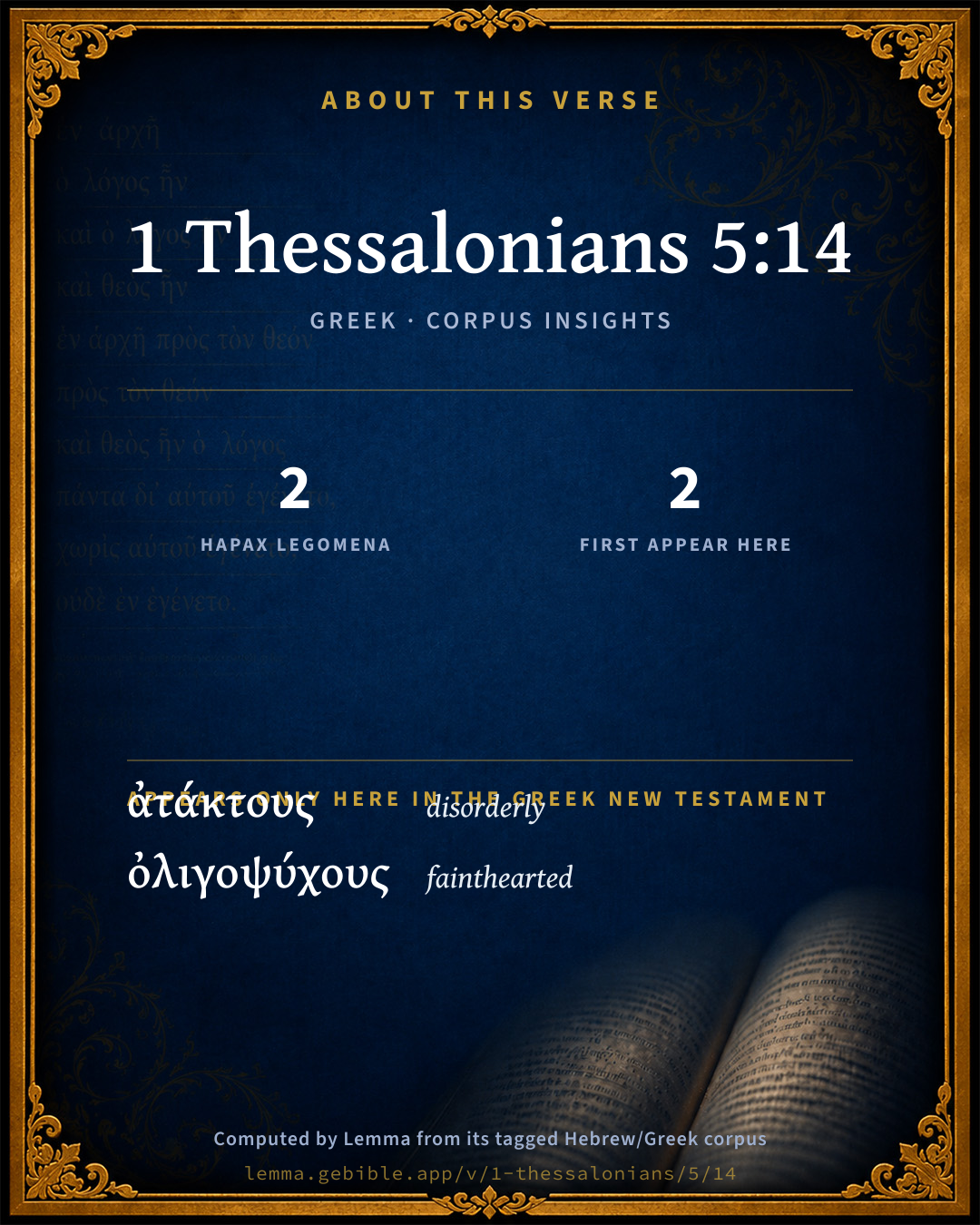
  • 2 hapax legomena — only here in the Greek New Testament
  • 2 first appearances in the Greek New Testament
Full analysis ↓
Download a study sheet

One document with this verse’s original text, its word-by-word gloss line, the meaning frame, cross-references with their text, attributed commentary, and full source and license credits — printable, and it pastes into notes with its structure intact.

This verse Autodidact and up

Study sheet (.html) Plain text (.txt)

A passage Seminary Student

Up to 50 verses in one chapter. A passage sheet keeps up to 6 commentary sources and 12 cross-references per verse, in the order this page ranks them, and says so on the sheet whenever that leaves anything out. Ask for a single verse and you get the Autodidact verse sheet above.

Everything on this page stays free to read, with no account — the sheet is a download of what is already on screen, not access to it.

Want to remove ads? Support Godless Engineer
Compare translations 3

The same verse in 3 English versions, stacked beneath the original-language interlinear above. Click any original word for its lexicon entry.

Each is an independent rendering of the whole verse — the interlinear is not word-aligned to these translations.

Highlighted words mark where these versions differ — a whole-verse word diff, not a word-by-word alignment.

  • World English Bible Public Domain
    We exhort you, brothers, admonish the disorderly, encourage the fainthearted, support the weak, be patient toward all.
  • King James Version Public Domain
    Now we exhort you, brethren, warn them that are unruly, comfort the feebleminded, support the weak, be patient toward all men.
  • unfoldingWord Literal Text CC BY-SA 4.0
    Now we encourage you, brothers: Admonish the disorderly, comfort the discouraged, help the weak, be patient toward all.

unfoldingWord Literal Text — © unfoldingWord, licensed CC BY-SA 4.0. Word-aligned USFM3 via Door43 (git.door43.org/unfoldingWord/en_ult).

Versions to compare (up to 4)

3 of 4 selected

Show all 19 translations

Every available English version of this verse, each an independent rendering of the whole verse.

  • World English Bible Public Domain
    We exhort you, brothers, admonish the disorderly, encourage the fainthearted, support the weak, be patient toward all.
  • Berean Standard Bible Public Domain
    And we urge you, brothers, to admonish the unruly, encourage the fainthearted, help the weak, and be patient with everyone.
  • Majority Standard Bible Public Domain
    And we urge you, brothers, to admonish the unruly, encourage the fainthearted, help the weak, and be patient with everyone.
  • King James Version Public Domain
    Now we exhort you, brethren, warn them that are unruly, comfort the feebleminded, support the weak, be patient toward all men.
  • American Standard Version (1901) Public Domain
    And we exhort you, brethren, admonish the disorderly, encourage the fainthearted, support the weak, be longsuffering toward all.
  • Revised Version (1885) Public Domain
    And we exhort you, brethren, admonish the disorderly, encourage the fainthearted, support the weak, be longsuffering toward all.
  • Geneva Bible (1599) Public Domain
    We desire you, brethren, admonish them that are out of order: comfort ye feeble minded: beare with the weake: be pacient toward all men.
  • Douay-Rheims (1899) Public Domain
    And we beseech you, brethren, rebuke the unquiet, comfort the feeble minded, support the weak, be patient towards all men.
  • Young's Literal Translation Public Domain
    and we exhort you, brethren, admonish the disorderly, comfort the feeble-minded, support the infirm, be patient unto all;
  • Literal Standard Version CC BY-SA 4.0
    and we exhort you, brothers, admonish the disorderly, comfort the feeble-minded, support the weak, be patient to all;
  • Unlocked Literal Bible CC BY-SA 4.0
    We exhort you, brothers: Warn the disorderly, encourage the discouraged, help the weak, and be patient toward all.
  • unfoldingWord Literal Text CC BY-SA 4.0
    Now we encourage you, brothers: Admonish the disorderly, comfort the discouraged, help the weak, be patient toward all.
  • Darby Bible Public Domain
    But we exhort you, brethren, admonish the disorderly, comfort the faint-hearted, sustain the weak, be patient towards all.
  • World Messianic Bible Public Domain
    We exhort you, brothers: Admonish the disorderly; encourage the faint-hearted; support the weak; be patient toward all.
  • Webster's Bible Public Domain
    Now we exhort you, brethren, warn them that are disorderly, comfort the feeble-minded, support the weak, be patient towards all men.
  • Free Bible Version CC BY-SA 4.0
    We urge you, brothers and sisters, to warn those who are lazy, encourage those who are anxious, help those who are weak, and be patient with everyone.
  • Bible in Basic English Public Domain
    And our desire is that you will keep control over those whose lives are not well ordered, giving comfort to the feeble-hearted, supporting those with little strength, and putting up with much from all.
  • Text-Critical English NT CC BY 4.0
    And we urge you, brothers, to admonish those who are idle, encourage the fainthearted, support the weak, and be patient toward all.
  • Tyndale New Testament (1534) Public Domain
    We desyre you brethren warne them that are vnruly comforte the feble mynded forbeare the weake have continuall pacience towarde all men.

Literal Standard Version (2020), Covenant Press — licensed CC BY-SA 4.0. Text via the HelloAO Bible API (eBible.org). Unlocked Literal Bible (unfoldingWord) — licensed CC BY-SA 4.0. Text via the HelloAO Bible API (eBible.org). unfoldingWord Literal Text — © unfoldingWord, licensed CC BY-SA 4.0. Word-aligned USFM3 via Door43 (git.door43.org/unfoldingWord/en_ult). Free Bible Version, Dr. Jonathan Gallagher — licensed CC BY-SA 4.0. Text via the HelloAO Bible API (eBible.org).

Word by word

More ways to search: Search by grammar → Find every occurrence → Compare this word →

Practice this passage: Drill this verse → Learn its vocabulary →

ἀτάκτους
átaktos
G813
“disorderly”
Adjective, Accusative, Plural, Masculine
Part of Speech
Adjective
Case
Accusative
Number
Plural
Gender
Masculine
Full Thayer's Definition

Origin: from G1 (as a negative particle) and a derivative of G5021

TDNT: 08:47,1

1. disorderly, out of ranks (often so of soldiers) 2. irregular, inordinate, immoderate pleasures 3. deviating from the prescribed order or rule Used in Greek society of those who did not show up for work.
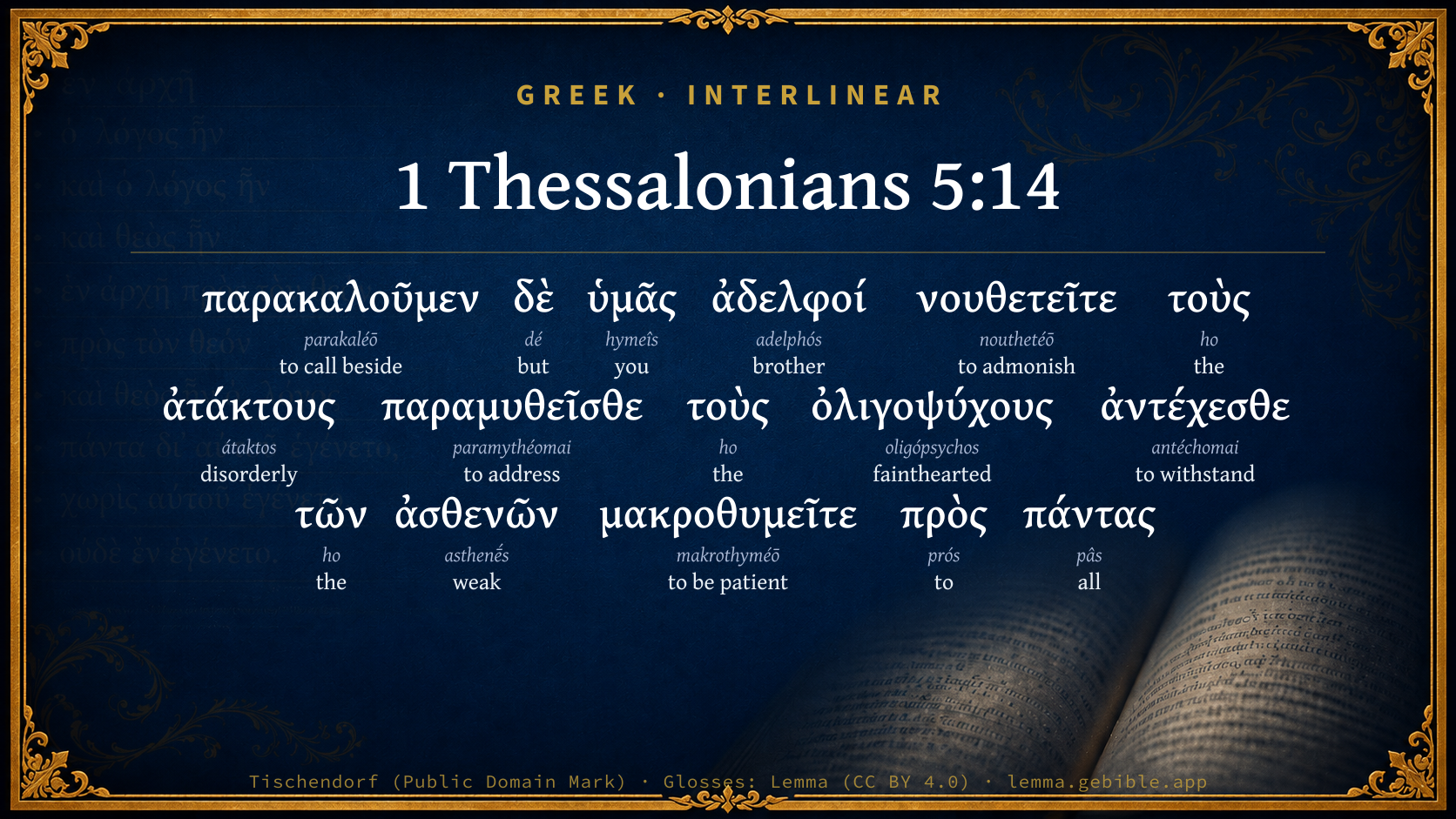
  1. παρακαλοῦμεν parakaléō G3870 “to call beside” Verb, Present, Active, Indicative, 1st person, Plural
  2. δὲ dé G1161 “but” Conjunction
  3. ὑμᾶς hymeîs G5210 “you” Personal pronoun, 2nd person, Accusative, Plural
  4. ἀδελφοί adelphós G80 “brother” Noun, Vocative, Plural, Masculine
  5. νουθετεῖτε nouthetéō G3560 “to admonish” Verb, Present, Active, Imperative, 2nd person, Plural
  6. τοὺς ho G3588 “the” Article, Accusative, Plural, Masculine
  7. παραμυθεῖσθε paramythéomai G3888 “to address” Verb, Present, Middle or Passive deponent, Imperative, 2nd person, Plural
  8. τοὺς ho G3588 “the” Article, Accusative, Plural, Masculine
  9. ὀλιγοψύχους oligópsychos G3642 “fainthearted” Adjective, Accusative, Plural, Masculine
  10. ἀντέχεσθε antéchomai G472 “to withstand” Verb, Present, Middle or Passive deponent, Imperative, 2nd person, Plural
  11. τῶν ho G3588 “the” Article, Genitive, Plural, Masculine
  12. ἀσθενῶν asthenḗs G772 “weak” Adjective, Genitive, Plural, Masculine
  13. μακροθυμεῖτε makrothyméō G3114 “to be patient” Verb, Present, Active, Imperative, 2nd person, Plural
  14. πρὸς prós G4314 “to” Preposition
  15. πάντας pâs G3956 “all” Adjective, Accusative, Plural, Masculine

About this verse

These counts appear in no published source. They are computed here, from the morphology-tagged text and Lemma’s own curated glosses. What Lemma adds →

16
words
14
distinct lemmas
Pauline Epistles
section

Notable vocabulary

2 hapax legomena — words that appear only here in the entire Greek New Testament:

  • ἀτάκτους disorderly G813
  • ὀλιγοψύχους fainthearted G3642

First appearance in Scripture

These words make their first canonical appearance in the Greek New Testament here:

  • ἀτάκτους disorderly G813
  • ὀλιγοψύχους fainthearted G3642

Shared distinctive vocabulary

παραμυθεῖσθε to address G3888 occurs in 4 verses of the Greek New Testament. Also found in:

Repetition

A word recurs within this verse:

  • τοὺς the G3588 ×3

Cross-references

37

Topical passages linked to 1 Thessalonians 5:14 in the Treasury of Scripture Knowledge — connected by theme and wording, ordered by reader-vote popularity; previews shown in the World English Bible.

  • 2 Timothy 4:2 preach the word; be urgent in season and out of season; reprove, rebuke, and exhort, with all patience and teaching.
  • Romans 14:1 Now receive one who is weak in faith, but not for disputes over opinions.
  • Acts 20:35 In all things I gave you an example, that so laboring you ought to help the weak, and to remember the words of the Lord Jesus, that he himself said, 'It is more blessed to give than to receive.'"
  • 2 Thessalonians 3:6–7 Now we command you, brothers, in the name of our Lord Jesus Christ, that you withdraw yourselves from every brother who walks in rebellion, and not after the tradition which they received from us.
  • Isaiah 35:3–4 Strengthen you the weak hands, and confirm the feeble knees.
  • Romans 15:1–3 Now we who are strong ought to bear the weaknesses of the weak, and not to please ourselves.
  • 1 Corinthians 13:4–5 Love is patient and is kind; love doesn't envy. Love doesn't brag, is not proud,
  • Galatians 6:1–2 Brothers, even if a man is caught in some fault, you who are spiritual must restore such a one in a spirit of gentleness; looking to yourself so that you also aren't tempted.
  • 2 Thessalonians 3:11–13 For we hear of some who walk among you in rebellion, who don't work at all, but are busybodies.
  • Isaiah 40:1–2 Comfort you, comfort you my people, says your God.
  • Isaiah 40:11 He will feed his flock like a shepherd, he will gather the lambs in his arm, and carry them in his bosom, [and] will gently lead those who have their young.
  • 1 Corinthians 4:14 I don't write these things to shame you, but to admonish you as my beloved children.
  • Ephesians 4:2 with all lowliness and humility, with patience, bearing with one another in love;
  • Colossians 1:28 whom we proclaim, admonishing every man and teaching every man in all wisdom, that we may present every man perfect in Christ Jesus;
  • 1 Thessalonians 2:7–12 But we were gentle among of you, as when a nurse cherishes her own children.
  • 1 Timothy 6:11 But you, man of God, flee these things, and follow after righteousness, godliness, faith, love, patience, and gentleness.
  • 2 Timothy 2:24–25 The Lord's servant must not quarrel, but be gentle towards all, able to teach, patient,
  • Hebrews 5:2–3 The high priest can deal gently with those who are ignorant and going astray, because he himself is also surrounded with weakness.
  • Hebrews 13:3 Remember those who are in bonds, as bound with them; and those who are ill-treated, since you are also in the body.
  • Isaiah 63:9 In all their affliction he was afflicted, and the angel of his presence saved them: in his love and in his pity he redeemed them; and he bore them, and carried them all the days of old.
  • Ezekiel 3:17–21 Son of man, I have made you a watchman to the house of Israel: therefore hear the word at my mouth, and give them warning from me.
  • Ezekiel 34:16 I will seek that which was lost, and will bring back that which was driven away, and will bind up that which was broken, and will strengthen that which was sick: but the fat and the strong I will destroy; I will feed them in justice.
  • Acts 20:31 Therefore watch, remembering that for a period of three years I didn't cease to admonish everyone night and day with tears.
  • Matthew 12:20 He won't break a bruised reed. He won't quench a smoking flax, Until he leads justice to victory.
  • John 21:15–17 So when they had eaten their breakfast, Jesus said to Simon Peter, "Simon, son of Jonah, do you love me more than these?" He said to him, "Yes, Lord; you know that I have affection for you." He said to him, "Feed my lambs."
  • Acts 20:27 for I didn't shrink from declaring to you the whole counsel of God.
  • Romans 12:1 Therefore I urge you, brothers, by the mercies of God, to present your bodies a living sacrifice, holy, acceptable to God, which is your spiritual service.
  • Colossians 3:12–13 Put on therefore, as God's chosen ones, holy and beloved, a heart of compassion, kindness, lowliness, humility, and perseverance;
  • Jeremiah 6:12 Their houses shall be turned to others, their fields and their wives together; for I will stretch out my hand on the inhabitants of the land, says Yahweh.
  • Ezekiel 33:3–9 if, when he sees the sword come on the land, he blow the trumpet, and warn the people;
  • Luke 22:32 but I prayed for you, that your faith wouldn't fail. You, when once you have turned again, establish your brothers."
  • Galatians 5:22 But the fruit of the Spirit is love, joy, peace, patience, kindness, goodness, faithfulness,
  • Ephesians 4:32–5:2 And be kind to one another, tenderhearted, forgiving each other, just as God also in Christ forgave you.
  • 1 Timothy 3:3 not a drinker, not violent, not greedy for money, but gentle, not quarrelsome, not covetous;
  • Titus 1:6 if anyone is blameless, the husband of one wife, having children who believe, who are not accused of loose or unruly behavior.
  • Hebrews 12:12 Therefore, lift up the hands that hang down and the feeble knees,
  • Titus 1:10 For there are also many unruly men, vain talkers and deceivers, especially those of the circumcision,

Cross-references courtesy of OpenBible.info (CC BY 4.0).

Commentary

Notes on 1 Thessalonians 5:14 from classic Christian and Jewish commentators (each source and its license shown beneath its notes). The classic Christian expositions comment on the surrounding passage and are grouped to its opening verse, so a note may address several verses; the Jewish commentaries on the Tanakh (Rashi and others) are per-verse, so they appear only where the commentator wrote on this verse.

Lemma curates 59 commentaries, every one of them public domain or Creative Commons licensed, each selected and text-cleaned for this edition rather than reprinted as found. About our sources →

The Biblical Illustrator

Joseph S. Exell

1Th_5:14

Now we exhort you, brethren, war them that are unruly--The verse contains four distinct, but coordinate and mutually connected exhortations.

I. Warn them that are unruly. In pursuing peace, fidelity was not to be sacrificed; and one of the methods in which Christian peace might be promoted was the faithful and tender rebuke of those whose quarrelsome temper or wayward conduct disturbed fraternal harmony. The unruly were such as, either from lax principles with respect to ecclesiastical government, or from pride, ambition, or recklessness, refused submission to legitimate authority; and such their fellow Christians were to warn. In warning this class of persons, much, of course, depends on the manner in which the work is done. But when it is performed by one true Christian to another with intelligence and tenderness, there is good reason to believe that it will prove successful; nor can it be supposed that the spirit of the Psalmists words (Psa_141:5) is altogether alien from the followers of Christ.

II. Comfort the feeble minded, such as, from a natural want of energy and firmness, or from deficiency in Christian faith and confidence, were disquieted amidst the calamities of life. The worldling might despise them for their cowardice; the religious censor might blame them for their culpable distrust. But Christianity took them under her protection, and here commands their firmer hearted brethren to soothe and cheer them amidst the struggles of the faith and the adversities of time.

III. support the weak. Here, as in Rom_14:1-2 and 1Co_8:7-12, the word weak denotes a special deficiency in knowledge or faith, and liability to fall. Such weakness might arise from the prejudices produced by a Jewish or Pagan education, from the recency of conversion, or from causes more obviously culpable. But to whatever source the weakness might be traceable, one whom Christ had received was not to be despised by his older or stronger brethren. The word rendered support denotes the act of taking another by the hand or arm.

IV. Be patient toward all men. By this command the apostle calls on the Thessalonian Christians to guard against being led, whether by the intellectual obtuseness and moral imperfection of members of the Church, or by the calumnious reproaches and persecuting rage of the enemies of the truth, to resort to bitter and upbraiding words, or to cease from efforts to do the individual good. Love suffereth long and is kind (1Co_13:4). (A. S. Patterson, D. D.)

Precepts

I. Warn the unruly: those who, like disorderly soldiers, break the ranks, and become idle, dissolute and worthless. This was a besetting sin in the primitive Churches. Many entertaining false views about the nearness of Christs Advent became indifferent to work, and sank into apathy or even worse. The proverb says, An idle mind is the devils workshop; and when a man is not occupied he is apt to become an instrument of evil and a disturber of the Church. It is difficult to pin some people down to do a bit of fair honest work. They are full of schemes for other people, and are forever finding fault that other people do not carry them out. These are the restless gipsies, the pests of every Christian community, the mischief makers and busybodies in other peoples matters. Warn such. Admonish gently at first, putting them in mind of their duty. It is the fault of many to limit admonitions to gross and grievous sins, but in these cases warning often comes too late. If admonition is not effectual, then proceed to sharper reproof. If that is unavailing, separate yourselves from their society.

II. Comfort the feeble minded. More correctly--encourage the faint hearted. The reference is not to the intellectually weak, but to such as faint in the day of adversity or the prospect of it (1Th_2:14), or who are disheartened in consequence of the loss of friends (1Th_4:13). It may also include those who are perplexed with doubt as to their spiritual condition, and who through fear are subject to bondage. There are some people so weighed down with a sense of modesty as to incapacitate them from using their abilities. Others, again, are so oppressed with the inveteracy of sin that they despair of gaining the victory and give up all endeavours. These need encouraging with the promises of God, and with the lessons and examples furnished by experience. Heart courage is what the faint hearted require.

III. Support the weak. A man may be weak in judgment or in practice. There may be lack of information or lack of capacity to understand. Such was the condition of many who, not apprehending the abrogation of the Mosaic law, and thinking they were still bound to observe ordinances, were weak in faith. Some linger for years in the misty borderland between doubt and certainty, ever learning, but never coming to a knowledge of the truth. Defective faith implies defective practice. Support such with the moral influence of sympathy, prayer, counsel, example.

IV. Be patient towards all men, even the most wayward and persecuting. Consider the patience of God and imitate it. Lack of present success is no excuse. The triumphs of genius in art, science, and literature are triumphs of patience. (G. Barlow.)

The feeble minded

Littleness is implied. The word occurs here only in the New Testament (see Isa_35:4 LXX), and is almost unknown in classical Greek. The student of Aristotle will look upon it as implying the contradictory of the great souled, with his high estimate of himself, just contempt for others, and freedom from excessive elation or depression. The whole passage here might well lead us to suppose that, as the Thessalonian Christians had a tender and almost feminine susceptibility about those they had loved and lost, so they would be likely also to have some of the rest of the characteristics which accompany that beautiful weakness. We may perhaps refer to the chief women not a few (Act_17:4). The morbid conscientious ness, the form of self-torment known to spiritual writers as scrupulousness, would be well expressed by the word little-minded. (Bp. Alexander.)

Precept and practice

St. Paul gives an admirable precept to the Thessalonians, but precept must blossom into practice, and practice will prove the best commentary on precept.

I. The precept illustrated by practice. All the persons in Gods great family are not of the same height and strength; though some are old men and fathers, and others are young and strong, yet many are little children, nay, babes in Christ: some can go alone, or with a little help, if you hold them but by their leading strings; but others must be carried in arms, and will require much love and patience to overcome their childish forwardness. Christ winks at their weaknesses, who hath most reason to be moved with them. Though His disciples were raw, and dull, and slow to understand and believe, yet He bears with them; nay, though when He was watching for them, and in His bloody sweat, and they lay sleeping and snoring, and could not watch with Him one hour, He doth not fall fiercely upon them, and afterward excuseth them for their lack of service. Their spirit was willing, but their flesh was weak. It is no wonder that their pace was slow, when, like the snail, they have such a house--such a hindrance--on their backs. Who can think of this infinite grace of the blessed Redeemer in making such an apology for them when He had such cause to be full of fury against them, and not be incited to imitate so admirable a pattern? Gods treatment of Jonah was very similar to Christs treatment of His disciples. Jonah runs from His business: God sends him to Nineveh; he will go to Tarshish. Here was plain rebellion against his Sovereign, which was repeated. But lo! He cannot permit Jonah to perish; He will rather whip him to his work than let him wander to his ruin. But how gentle is the rod! God cannot forget the love of a father though Jonah forget the duty of a child, and will rather work a miracle and make a devourer his saviour than Jonah shall miscarry. Oh, the tenderness of God toward His weak and erring children! Now Christians are to be imitators of God. If He, so glorious, holy, and infinite, beareth with His creatures thus, what cause have they to bear patiently with their fellows! We that are strong ought to bear the infirmities of the weak.

II. This practice is grounded upon principle. It was love on the part of Christ and on the part of God that led these Divine Persons to act so graciously as They did; and the same love must ever prompt Christians to imitate Them--love to Jesus Himself and love to them for whom He died, but who need practical sympathy and help. There must be no bitterness, no envyings, no heart burnings among the brethren, but they must love each other as each loves himself, and suffer together in all suffering. Oh, how sweet is the music when saints join saints in concert! but how harsh is the sound of jarring strings! A mutual yielding and forbearance is no small help to our own peace and safety. There is a story of two goats which may excellently illustrate this matter. They both met on a narrow bridge, under which a very deep and fierce stream did glide; there was no going blindly back, neither could they press forward for the narrowness of the bridge. Now, had they fought for their passage, they had both been certain to perish; this, therefore, they did--they agreed that one should lie down and the other go over him, and thus both their lives were preserved. While Christians are doing the reverse of this, they are like some small chickens, a prey to kites and other ravenous creatures. In quietness shall be their strength. (G. Swinnock, M. A.)

Warnings

Warnings are given in love (1Co_4:14). Warnings are given in mercy. Warnings are given in duty (Eze_3:20).

I. The warning of example. Fallen angels (Jud_1:6). Ungodly men (Jud_1:7). Untrue professors (Jud_1:17-19).

II. The warnings of instruction. God has given us warning in His Holy Word that life is uncertain (Jam_4:13-14); that it is an evil thing to offend God (Rom_2:8-9); that it is a foolish thing to forsake Christ (Heb_2:8); that it must be foolish to run such risk (Act_4:12); that it must therefore be foolish to turn away from this only hope.

III. The warnings of experience. The experiences of sin are bitter (Rom_7:24). The enjoyments of salvation are sweet (2Th_2:16-17). If warnings are to do us good they must be heard (2Ti_4:3-4), believed (Gen_19:14), obeyed (Mat_21:28-31). This is our lesson-- Pro_29:1. (J. Richardson, M. A.)

Support the weak, be patient towards all men--Manton says: Though we cannot love their weaknesses, yet we must love the weak, and bear with their infirmities, not breaking the bruised reed. Infants must not be turned out of the family because they cry, and are unquiet and troublesome; though they be peevish and froward, yet we must bear it with gentleness and patience, as we do the frowardness of the sick; if they revile we must not revile again, but must seek gently to restore them, notwithstanding all their censures. This patience is far too rare. We do not make allowances enough for our fellows, but sweepingly condemn those whom we ought to cheer with our sympathy. If we are out of temper ourselves, we plead the weather, or a headache, or our natural temperament, or aggravating circumstances; we are never at a loss for an excuse for ourselves, why should not the same ingenuity be used by our charity in inventing apologies and extenuations for others? It is a pity to carry on the trade of apology making entirely for home consumption; let us supply others. True, they are very provoking, but if we suffered half as much as some of our irritable friends have to endure we should be even more aggravating. Think in many cases of their ignorance, their unfortunate bringing up, their poverty, their depression of spirit, and their home surroundings, and pity will come to the help of patience. We are tender to a man who has a gouty toe, cannot we extend the feeling to those who have an irritable soul? Our Lord will be angry with us if we are harsh to His little ones whom He loves; nor will He be pleased if we are unkind to His poor afflicted children with whom He would have us be doubly tender. We ourselves need from Him ten times more consideration than we show to our brethren. For His sake we ought to be vastly more forbearing than we are. Think how patient He has been to us, and let our hard heartedness be confessed as no light sin. (C. H. Spurgeon.)

The contrast between heathenism and Christianity in the treatment of the weak

Heathen philosophy, even Platos, was systematically hard on the weakly. It anticipated modern theories and practice in such matters as the struggle for existence, survival of the fittest, and happy dispatch. In the exercise of the art of medicine Plato held that it might serve to cure the occasional distempers of men whose constitutions are good; but as to those who have bad constitutions, let them die; and the sooner the better: such men are unfit for war, for magistracy, for domestic affairs, for severe study; and the best thing for such is to have done with life at once. In contrast with this Bacon vindicated the art of healing by appealing to the exampleor Christ, and reminded men that the great Physician of the soul did not disdain to be the Physician of the body. Hawthorne asserts that most men have a natural indifference, if not hostility, towards those whom disease, or weakness, or calamity of any kind causes to falter and faint amid the rude jostle of our selfish existence. The education of Christianity, he owned, the sympathy of a like experience, and the example of women, may soften and possibly subvert this ugly characteristic; but it is originally there, and has its analogy in the practice of our brute brethren, who hunt the sick or disabled member of the herd from among them as an enemy. Faithful to which code of action, says Balzac, the world at large is lavish of hard words and harsh conduct to the wretched who dare spoil the gaiety of its fetes and to cast a gloom over its pleasures: whoever is a sufferer in mind or body, or is destitute of money or power is a pariah. The weakly or deformed child of a Spartan was thrown, by order, into the cavern called apothetae, in the belief that its life could be no advantage either to itself or to the state. The worst of charity is, complains Emerson, that the lives you are asked to preserve are not worth preserving. (F. Jacox, B. A.)

The difficulty of the strong to sympathize with the weak

A disposition to despise weakness, observed Mr. Fonblanque, seems to be a law of nature which humanity prevails against with effort, by urging the sympathies and stimulating them by the imagination. Poor Boswell again and again makes piteous record of Johnsons unimaginative contempt for the sufferings of frailer constitutions; and he philosophizes on the fact that in full health men can scarcely believe that their ailing neighbours suffer much, so faint is the image of pain upon our imagination. At your age, sir, I had no headache, snapped the doctor at Sir William Scott once when the future Lord Stowell ventured to complain of one. When Fanny Burney fell ill at court, she wrote, Illness here, till of late, has been so unknown that it is commonly supposed that it must be wilful, and therefore meets little notice till accompanied by danger. This is by no means from hardness, but from prejudice and want of personal experience. John Stuart Mill reckoned it as one of the disadvantages of Bentham that from his childhood he had never had a days illness; his unbroken health helped to incapacitate him for sympathy with his fellows, and weakened his power of insight into other minds. (F. Jacox, B. A.)

Helping the weak

A poor bee had fallen into the pond, and was struggling as well as her failing strength would allow. We seized a pole, and placed the end of it just under her. She took firm hold, and we lifted the pole and the bee. A little while was spent in drying herself and pluming her wings, and then our worker made a straight line for the hive, and doubtless was soon at her daily task rewarding us with honey. May not many a human worker be found in a sinking condition? A little sensible help might save him. Who will give it? He who does so shall receive the blessing of him that is ready to perish. Poor hearts are often in deep despondency, sinking for lack of a sympathetic word. Do not withhold it. Rescue the perishing. Be on the watch for despairing minds; if no other good comes of it, you will, at least, be more grateful for your own cheerful ness. But good will come of it in unexpected instances, and it will be heavens music in your ears to hear sighs turned into songs. (C. H. Spurgeon.)

Support the weak

In the town of Leeds I was waiting one wet wintry night outside the railway station, when a ragged, dirty boy, selling papers, came up to me and said: Buy an evening paper, sir. Please do. Only seven left, and theys all my profit. The boys eagerness to sell arrested my attention, and on looking down I saw a bright, intelligent face with a look of honesty in it. So I questioned him, and found his parents were, he supposed, drinking at a public house in Briggate. Had he no cap to wear that rainy night? Yes, but he had lent it to his sister, who was waiting for him in an old doorway across the road till he sold out. The cap wasnt on her head because she had no boots and stockings, so I told her to put her feet inside my cap to keep em warm and prevent her ketchin cold. Surely this was a self-sacrificing chivalry worthy of the knights of old, for a boy who thus cared for his sister exhibited the true spirit of bravery. (Told in Dr. Bernardos Night and Day. )

Patience

is a Divine attribute, and is repeatedly mentioned as a fruit of Gods Spirit in the soul. In the text this grace as made a universal duty. It is not to be a tribute paid to the virtuous, but to all. And the man who enjoined it exercised it.

I. The nature and sources of Christian patience.

1. In respect to personal trial patience is exercised in its lower form. Patience in labour, fatigue, pain, etc., is not easy, but it is the easiest kind of patience. When, however, we are called to have patience with others, we enter a higher and more difficult sphere of duty. Men may endure their own trials from pride, hope, native firmness, duty, etc.; but when we are required to be patient towards bad dispositions, evil conduct, etc., this is a nobler achievement and proceeds from nobler motives.

1. Patience does not imply approval of mens conduct or character, nor indifference to them. On the contrary, we must see things as they are before God; and if we refrain from attacking it must not be, construed into approbation.

2. This patience implies such benevolence and pity as shall make us tolerant, and which can only spring from that regenerated love that God works in the soul.

II. The conditions of its exercise and its objects. It must be exercised towards all men. To be patient with those we love is natural; but we must not stop there; nor with our own set: nor with the good even when they stumble; nor with those who hold our opinions; but also with--

1. The dull and foolish, who are very trying, especially if you are nervous and they are not; if you are mercurial and they are phlegmatic. They are in your way, and make your tasks troublesome. Nevertheless, you must be patient with them.

2. The conceited; a very hard work indeed, to submit to haughty looks and arrogant conduct.

3. The selfish and cunning, patience with whom places you at a disadvantage.

4. The rude.

5. The passionate, etc. Wherever you find a man that has the brand of Gods creation upon him, and immortality for his destiny, there you find the object of this command. Do you find this hard, impossible? Then consider--

III. Its motives.

1. It is only by having patience with men that you can retain any hold upon them. The man who is outside your pity is outside your diocese. You cannot do anything for a man you dislike, and one of the worst things that can befall a benevolent nature is to be incapacitated to do good.

2. Only in this way can we imitate Christ. I say unto you, love your enemies, etc.

3. It is by this very patience on Gods part that we ourselves are saved. (H. W. Beecher.)

Patience and charity needed

Lord, I cant make these sticks perfectly straight; I have lost all my strength. Send me to another field. But what is the answer of the Holy Spirit? You were not sent to that field to take every crook out of those sticks; you cant perfect human nature; that is My work. Now there is something in every man--ministers included--that is a little gnarly. It is peculiar to the individual--a streak of the old Adam inwrought in his individuality. In one it is stubbornness, in another it is suspiciousness, in another reserve, in another a disposition to be critical, or fault finding, or censorious. By whatever name it may be known, it is, in fact, a little twist of depravity, and no human influence, no preacher, can untwist it and straighten it out. It is a peculiar twist of self, inborn, inbred, inwrought. So when I discover what a mans peculiar twist is, I say, The Lord only can take that out of him, and I wont touch it if I can help it. I tried my hand at this once on a good Scotch brother, and I will never try it again. He was a most uncompromising subject, and I am quite convinced that if I had had a little more charity for his peculiarities he would have been a very useful man. (Dr. Spinning.)

The Biblical Illustrator, edited by Joseph S. Exell (c. 1880s–1900s) — public domain. Text from a community e-Sword module.

Joseph Benson's Commentary

1Th 5:14-15. We exhort you, brethren — Not only you who are pastors and rulers, but you that are private members of the church; warn them that are unruly — Greek, ατακτους, disorderly; them that stand, as it were, out of their ranks in the spiritual warfare: for it is a military term, expressing the character of soldiers who break their ranks, desert their posts, or will not know their colours, and therefore cannot perform their duty as soldiers, especially in battle. It is fitly used to denote those who neglect the proper duty of their office or station. Comfort the feeble- minded — Whose courage and resolution are ready to fail them under the difficulties they meet with. The original expression, ολιγοψυχους, properly means those of little soul, or such as are peculiarly wanting in fortitude and vigour of mind; support the weak — The infirm, whether in soul or body; be patient — Μακροθυμειτε, be long-suffering; toward all men — Bearing with the weaknesses of the children of God, and exercising meekness and gentleness even toward the perverse, obstinate, and ungrateful. The beauty of this whole passage is thus illustrated by Mr. Blackwall: (Sac. Class., vol. 1. p. 257:) “It is as admirable for the purity of its moral, and the diffusiveness of its charitable meaning, as for the elegance and force of its words, and the delicate turn of its structure. The union of the words within each comma or stop, and their mutual relation and assistance, is exquisitely proper and natural. The noble period runs on with strength and smoothness, and ends close and full. Both the ear and judgment are satisfied.” See that none, &c. — Watch over both yourselves and each other, and whatever injury any of you may have received, whether from professed friends or from avowed enemies, let no one render evil for evil, but ever follow that which is good — Endeavouring to the utmost to promote the happiness of all about you; and that resolutely and perseveringly; both among yourselves — That is, toward all your fellow- Christians; and to all men — Not exempting your enemies and persecutors.

Joseph Benson's Commentary on the Old and New Testaments (1811–1818) — public domain. Text from a community e-Sword module.

The Preacher's Complete Homiletical Commentary

Joseph S. Exell (gen. ed.)

CRITICAL AND EXPLANATORY NOTES

1Th_5:14. Warn them that are unruly.—R.V. “admonish the disorderly.” Every Church knows these characters—men who will break through all restraint. Comfort the feebleminded.—R.V. “encourage the faint-hearted.” In 1Th_2:11 we have met the verb before. The feeble-minded would have been scarcely worth the pity of the philosophers with whom alone the great-souled man was supreme. The comfort in that teaching, for the hour when the strong shall be as tow, was very scanty and inadequate. Support the weak.—So be like the Lord who “upholdeth all that fall, and raiseth up all those that be bowed down” (Psa_145:14). Be patient toward all men.—R.V. “longsuffering.” It is the very opposite of what we mean by being “short-tempered.”

1Th_5:15. Evil for evil.—A quid pro quo, similar in kind and in quantity perhaps, but retaliation delights in interest.

MAIN HOMILETICS OF THE PARAGRAPH.—1Th_5:14-15

A Group of Christian Precepts.

The supernatural character of Christianity is not less apparent in the purity and loftiness of the morality it inculcates, than in the superiority of the truths it reveals. It is intensely practical in its teaching and aim. It is not like a glow of light that irradiates the external character for a time; it is an inward radiance that cannot help making itself visible in the outer life. It is not a sentiment; it is a principle. The moral precepts of Christianity can be appreciated and obeyed only by the soul that has become thoroughly possessed by the Christian spirit. Each precept in these verses may be fittingly used as the homiletical heading of a distinct paragraph.

I. Warn them that are unruly.—The unruly are those who, like disorderly soldiers, break their ranks, and become idle, dissolute, and worthless in their lives. This disorderliness was a besetting sin of the primitive Churches, not excepting the Thessalonian. Many of them, entertaining false ideas about the nearness of Christ’s second coming, became indifferent to the ordinary work of life, and sank into listlessness and apathy, and even worse. Says the proverb, “An idle brain is the devil’s workshop,” and when a man is not diligently employed in some healthy and vigorous occupation, he is apt, notwithstanding his Christian profession, to become an instrument of evil and a disturber of the Church, the peace of which he is pledged to maintain. It is difficult to pin some people down to do a bit of fair and honest work. They are full of schemes and suggestions for other people to carry out; they lay down the line of conduct with the utmost precision, but never themselves illustrate the easiness or difficulty of keeping on the line; they make laws and regulations which they never dream of observing themselves, and are for ever finding fault that other people do not observe them. These are the restless gipsies of the Church, the pests of every Christian community into which they intrude, the mischief-makers and busybodies in other people’s matters. Warn such. Admonish gently at first, putting them in mind of their duty. It is the fault of many to limit admonitions to gross and grievous sins; but in these cases warning often comes too late. If admonition in the earlier stage is not effectual, then proceed to sharper and more faithful reproof. If that is unavailing, besitate not to take more summary measures—separate yourselves from their society.

II. Comfort the feeble-minded.—More correctly—encourage the faint-hearted. The reference is not to the intellectually weak, but to such as faint in the day of adversity, or are ready to fall away before the prospect of persecution and suffering (1Th_2:14), or who are disheartened and desponding in consequence of the loss of friends (1Th_4:13). It may also include those who are perplexed with constant doubt and apprehension as to their spiritual condition, and who through fear are all their lifetime subject to bondage. There are some people so weighed down with a sense of modesty as to incapacitate them from using the abilities they certainly possess, though underneath all this modesty there may be the pride of thinking themselves better able to judge of themselves and their abilities than anybody else. Others, again, are so oppressed with the inveteracy of sin, that they despair of gaining the victory over it, and give up all endeavours. These need encouraging with the promises of God, and with the lessons and examples furnished by experience. Heart-courage is what the faint-hearted require.

III. Support the weak.—A man may be weak in judgment or weak in practice. There may be lack of information as to certain great truths necessary to be believed and stoutly maintained, or lack of capacity in clearly understanding and grasping those truths. Such was the condition of many in the apostle’s day, who, not apprehending the complete abrogation of the Mosaic law, and thinking they were still conscientiously bound to observe ordinances, were weak in faith. Some linger for years in the misty borderland between doubt and certainty, with all its enfeebling and poisonous malaria—ever learning, but never coming to a knowledge of the truth. Defective faith implies defective practice. Support such with the moral influence of our sympathy, our prayers, our counsel, our example. While not countenancing their sins, we may bear or prop them up by judiciously commending in them that which is good, by not too severely condemning them in the practice of things indifferent (1Co_9:20), and by striving to rectify their errors with all gentleness and fidelity.

IV. Be patient toward all men.—Not only toward the weak, the fainthearted, and the disorderly, but toward all men—the most wayward and perverse, the bitterest enemies and persecutors. Consider the patience of God towards ourselves, while for years we refused His calls and despised His admonitions; and let us strive to imitate His longsuffering and kindness. Lack of present success is no warrant to any to cease from obvious duties, and leave things to drift into hopeless entanglement and ruin. The triumphs of genius in art, science, and literature are triumphs of patience.

V. See that none renders evil for evil unto any man.—Retaliation betrays a weak, ignoble, and cruel disposition. Pagan morality went so far as to forbid only the unprovoked injuring of others, and it is not without noble examples of the exercise of a spirit of forgiveness.

“Exalted Socrates, divinely brave,

Injured he fell, and dying, he forgave;

Too noble for revenge, which still we find

The weakest frailty of a feeble mind.”

The Jews prostituted to purposes of private revenge the laws which were intended to administer equitable retributions between man and man. It is Christianity alone that teaches man to bear personal injuries without retaliation. “Hath any wronged thee?” says Quarles; “be bravely avenged—slight it, and the work is begun; forgive it, and it is finished. He is below himself that is not above an injury.” Public wrongs the public law will avenge; and the final recompense for all wrong, private and public, must be left to the infallible Judge of all (Rom_12:19-20).

VI. But ever follow that which is good, both among yourselves and to all men.—The noblest retaliation is that of good for evil. In the worst character there is some element of goodness, that may call out the desire to do good towards it. Our beneficence should be as large as an enemy’s malice (Mat_5:44-45). That which is good is not always that which is pleasing to the objects of our benevolence, nor is it always pleasing to ourselves. Goodness should be sought for its own sake, and sought with increasing earnestness and perseverance, as the hunter seeks his prey. It is the great aim and business of life. Goodness is essentially diffusive; it delights in multiplying itself in others. It is undeterred by provocation; it conquers the most virulent opposition.

Lessons.—

1. The preceptive morality of Christianity is a signal evidence of its transcendent glory.

2. Practice is more potent than precept.

3. The Christian spirit is the root of genuine goodness.

The Preacher's Complete Homiletical Commentary (gen. ed. Joseph S. Exell; Funk & Wagnalls, c. 1892) — public domain (pre-1929). A full-Bible homiletical/sermon-outline anthology covering 65 of 66 books (2 John is absent from the source module). Text from a community e-Sword module.

Tyndale Open Study Notes

Tyndale Open Resources

5:14 The responsibility for the moral progress of the congregation does not rest solely with the leaders (4:18; 5:11). Paul urged the church to warn those who are lazy, that is, those who were “disorderly,” and who did not live by the apostles’ instructions (see 2 Thes 3:6-15). • Take tender care of those who are weak, or those who have no economic or social power. Greek society denigrated the weak. • Instead of being irritable, believers should be patient in their relationships (Gal 5:23; Eph 4:2).

Tyndale Open Study Notes — © Tyndale Open Resources, licensed CC BY-SA 4.0. Text via the HelloAO Bible API.

Bengel's Gnomon

Johann Albrecht Bengel

1Th 5:14. Τοὺς ἀτάκτους, the disorderly [unruly]) Such persons were not wanting, how flourishing soever that church might be. And ἀταξία, disorder, presently increased, 2Th 3:6; 2Th 3:11.—ἀντέχεσθε) pay attention to, שמר, ἀντέχεσθαι, to have regard to, Pro 4:6.—πρὸς πάντας, to all) There is no believer to whom long-suffering (μακροθυμία, implied in μακροθυμεῖτε) may not be shown; none, to whom a believer ought not to show it. Many show it more to strangers than to their own families, more to the powerful than to the more humble; but it should be shown towards all.

Bengel's Gnomon of the New Testament — English translation (T&T Clark, Edinburgh, 1860) — public domain. Text from a community e-Sword module.

Meyer's Critical & Exegetical Commentary

Heinrich August Wilhelm Meyer

1Th_5:14. Ἄτακτος] is especially said of the soldier who does not remain in his rank and file (so inordinatus in Livy); then of people who will not conform to civil regulations; then generally disorderly. Here the apostle alludes to those members of the Thessalonian church who, instead of applying themselves to the duties of their calling, had given themselves up to an unregulated and unsteady nature and to idleness, comp. 1Th_4:11; 2Th_3:6; 2Th_3:11. We are not to understand, with Chrysostom, Oecumenius, Theophylact, Estius, Fromond., Turretin, Benson, Bolten, Bloomfield, and others, the presbyters as the subject of νουθετεῖτε, but, as is already evident from the addition of ἀδελφοί, and generally from the similarity of the introductory words of 1Th_5:14 with those of 1Th_5:12, the members of the church in their totality. Paul thus here puts it out of the question that the church as such had fallen into ἀταξία (see on 1Th_4:11). But it also follows from these words that the apostle was far removed from all hierarchical notions in regard to rulers (Olshausen).

Further, they were to comfort, to calm τοὺς ὀλιγοψύχους] the faint-hearted, the desponding. Paul here thinks particularly on those who, according to 1Th_4:13 ff., were painfully agitated concerning their deceased friends. Yet this does not prevent us from extending the expression also to such who failed in endurance in persecution, or who, conscious of some great sin, despaired of the attainment of divine grace, etc.

The ἀσθενεῖς] the weak, whom the church is to assist, are not the bodily sick, but fellow-Christians who still cling to prejudices, and were more imperfect than others in faith, in knowledge, or in reference to a Christian life; comp. Rom_14:1-2; 1Co_8:7; 1Co_8:11-12.

μακροθυμεῖν] to be long-suffering, denotes the disposition by which we do not fly into a passion at injuries inflicted, but bear them with patience and forbearance, comp. 1Co_13:4; Eph_4:2; Col_3:12.

πρὸς πάντας] to all, is not to be limited to ἄτακτοι, ὀλιγόψυχοι, and ἀσθενεῖς (Koppe), nor to fellow-Christians (Riggenbach), but is to be understood of all men generally; comp. εἰς ἀλλήλους καὶ εἰς πάντας, 1Th_5:15.

Meyer — Critical and Exegetical Commentary on the New Testament — English translation by Peter Christie, edited by Frederick Crombie (T&T Clark, 1880) — public domain. Text from a community e-Sword module.

Expositor's Greek Testament

ed. W. Robertson Nicoll

1Th 5:14 . The particular form of insubordination at Thessalonica was idleness (for the contemporary use of ἀτ . in this sense, see Oxyrh. Papyri , ii. 1901, p. 275). Similarly, in Olynth . iii. 11, Demosthenes denounces all efforts made to shield from punishment τοὺς ἀτακτοῦντας , i.e. , those citizens who shirk active service and evade the State’s call for troops. ὀλιγοψύχους = “faint-hearted” (under trial, 1Th 1:6 , see references), ἀντέχεσθε (cleave to, put your arm round), ἀσθενῶν ( i.e. , not in health only but in faith or position, Act 20:35 ), μακ . π . πάντας = do not lose temper or patience with any (of the foregoing classes) however unreasonable and exacting they may be ( cf. Pro 18:14 , LXX). The mutual services of the community are evidently not to be left to the προϊστάμενοι , for Paul here urges on the rank and file the same kind of social duties as he implies were incumbent upon their leaders ( cf. νουθετ . 12, 14). If ἀδελφοί here meant the προϊστάμενοι , it would have been more specificially defined. An antithesis between 12 and 14 would be credible in a speech, not in a letter.

The Expositor's Greek Testament, edited by W. Robertson Nicoll (1897–1910) — public domain. Text from a community e-Sword module.

International Critical Commentary

14. παρακαλοῦμε … ἀδελφοι. With δε new point in the exhortation is introduced. The similarity of the phrase (4:10) to ἐρωτῶμε … ἀδελφοι (v. 12) and the repetition of ἀδελφοι make probable that the persons addressed are the same as in vv. 12-13, that is, not the workers only (Chrys.; Th. Mops. who says: “vertit suum sermonem ad doctores”; and Born, Find.) but the brethren as a whole. The only individuals obviously excluded are the recipients of the warning, encouragement, and support. “Those who labour among you,” though they take the lead in practical affairs and admonish, have no monopoly of the functions of νουθετεῖν, παραμυθεῖσθα and ἀντέχεσθα.

On νουθετεῖ, see v. 12. D omits ὑμᾶ Instead of the expected infinitives after παρακαλοῦμε (4:10), we have imperatives (1Co 4:16; cf. above εἰρηνεύετ). GF, indeed, read νουθετεῖν, παραμυθεῖσθα, and ἀντέχεσθα (so D), perhaps intimating (and if so, correctly; cf. Wohl.) that with the imperative μακροθυμεῖτ, Paul turns from brotherly love (cf. 4:10-12) to love (πρὸς πάντα; cf. εἰς πάντα, v. 15; εἰς ἀλλήλου v. 15 is of course included).

τοὺς ἀτάκτου. “The idlers.” Since in 4:11-12, to which these words evidently refer, people of unquiet mind, meddlesome, and idle are mentioned, most commentators content themselves here with a general translation, the “disorderly,” “unquiet,” “unruly,” even when they admit that idleness is the main count in the disorder (Ephr.: “inquietos, qui otiosi ambulant et nihil faciunt nisi inania”). The certainty that the specific sense “the idlers” is here intended is given in II 3:6 ff. where the context demands that ἀτακτεῖ and περιπατεῖν ἀτάκτω be rendered as Rutherford translates and the usage in papyri allows, “to be a loafer,” “to behave as a loafer” (cf. Theodoret: “τοὺς ἀτάκτους τοὺς ἀργίᾳ συζῶντας οὕτως ἐκάλεσε).

In the N. T., ἄτακτο occurs only here, ἀτακτεῖ only in II 3:7, and ἀτάκτω only in II 3:6, 11. Chrys. notes that they are originally military words, the τάξι being that of troops in battle array, or of soldiers at their post of duty. By a natural extension of usage, they come to describe various types of irregularity such as “intermittent” fevers, “disorderly” crowds, and “unrestrained” pleasures; and, by a still further extension, “disorderly” life in general (cf. 3 Mac. 1:19; Deu 32:10, Eze 12:20, Eze 12:4 Reg. 9:20 (Sym.); Test. xii, Naph. 2:9; 1 Clem. 40:2 Diogn. 9:1). In an exhaustive note, Milligan (152-154) has called attention to several papyri concerned with contracts of apprenticeship (e. g. P. Oxy. 275, 724-5) where ἀτακτεῖ and ἀργεῖ are used interchangeably. In a letter to the present editor under date of February 12, 19:10, Dr. Milligan refers “to a still more striking instance of ἀτακτέ = ‘to be idle’ than the Oxyrhyncus passages. In BGU, 1125:8 (13 b.c.)—a contract—the words occur ἃς δὲ ἐὰν ἀρτα̣κ̣τήσηι ἠὶ ἀρρωστήση Evidently ἀτακτήση is to be read, with a confusion in the writer’s mind with ἀργήση (Schubart).” In a paper in the volume entitled Essays in Modern Theology (in honour of Dr. Briggs), 1911, 191-206, reasons are advanced in some detail for concluding that ἀτακτεῖ and its cognates, as employed by Paul, are to be translated not “to be idle,” etc. (cf. AJT 1904, 614 ff.) but “to loaf,” etc. In II 3:10, the idleness is a refusal to work, a direct violation of instructions orally given (παράδοσι 3:6), of Paul’s own example (3:7 f.), and of the gospel utterance (τῷ λόγῳ ἡμῶ 3:14). To express this notion of neglect, Paul chooses not σχολάζει (cf. Exo 5:8, Exo 5:17), a word he prefers to use in the sense “to have leisure for” (1Co 7:5; cf. Psa 45:11); not ἀργεῖ (cf. *Sir. 30:36; also ἀργό Sir. 37:11, Mat 12:36, Mat 12:20:3, Mat 12:6, 1Ti 5:13, Tit 1:12), a word which Paul does not use; but ἀτακτεῖ (ἀτάκτως, ἄτακτο), a word which distinctly implies the wilful neglect of the “golden rule of labour” (Dob.). In English, this notion of neglect is conveyed best not by “to be idle,” etc., but by “to be a loafer,” etc. as Rutherford saw in II 3:6, 7 but not in I 5:14.

τοὺς ὀλιγοψύχου. “The faint-hearted.” These “men of little heart” (Wiclif) were worried not only about their dead (4:13-18) but also about their own salvation (5:1-11). They are not troublesome like the idlers; hence they require not warning but encouragement (παραμυθεῖσθ; cf. 2:11; see also παρακαλεῖτ 4:18, 5:11 and the discussion in II 1:3-2:17).

Theodoret (cf. Chrys.) explains τοὺς ὀλιγοψύχου both as τοὺς ἐπὶ τοῖς τεθνεῶσιν ἀμετρίως ἀθυμοῦντα (cf. Col 3:21) and as τοὺς μὴ ἀνδρείως φέροντας τῶν ἐναντίων τὰς προσβολά The first reference is probable; but in place of the second reference, namely, to persecution, an allusion to the lack of assurance of salvation (5:1-11) is more probable. In the prayer of 1 Clem. 59:4 there is an interesting parallel: ἐξανάστησον τοὺς ἀσθενοῦντας, παρακάλεσο (cf. παρακαλεῖτ 4:18, 5:11) τοὺς ὀλιγοψυχοῦντα In the Lxx, ὀλιγόψυχο (only here in N. T.; cf. Pro 14:29, Pro 18:14, Isa 25:5, Isa 35:4, Isa 54:6, Isa 57:15), ὀλιγοψυχεῖ (not in N. T.), and ὀλιγοψυχί (not in N. T.) are regularly used, with the exception of Jon 4:8 (where physical faintness is meant; cf. Isoc. 19:39), of the depressed and the despondent in whom little spirit is left; so Isa 57:15: ὀλιγοψύχοις διδοὺς μακροθυμίαν καὶ διδοὺς ζωὴν τοῖς τὴν καρδίαν συντετριμμένοι

ἀντέχεσθε τῶν ἀσθενῶ. “Cling to the weak.” In this connection, the reference is to the weak not physically (1Co 11:30) but morally. Furthermore, since “the idlers” and “the faint-hearted” refer to classes already exhorted (4:11-12; 4:13-5:11), it is probable that “the weak” are not generally the weak in faith (Chrys., Ephr. and others) but specifically those who are tempted to impurity (4:3-8; so Th. Mops.: de illis qui fornicatione deturpabantur). Being persons of worth, they are not to be despised (cf. Mat 6:24 = Luk 16:13) but are to be held to and tenderly but firmly supported.

ἀντέχεσθα, always middle in Gk. Bib. except 4 Mac. 7:4, is construed with the gen. either of persons (Mat 6:24 = Luk 16:13, Pro 4:6, Zep 1:6, Isa 57:13) or of things (Tit 1:9, Isa 56:4, etc.). For a different connotation of οἱ ἀσθενεῖ, cf. 1Co 8:9, 1Co 9:22.

(9) Love (5:14 d-15)

With μακροθυμεῖτε πρὸς πάντα, Paul seems to turn from the specific needs of the three classes just named to a need of the group as a whole in reference to one another and especially to all men, namely, not simply brotherly love but also love. The exhortation, directed to all the converts, that they be slow to anger, and that they see to it that no one of their number retaliate a wrong done but that they rather seek earnestly the good toward one another and toward all, suggests, though the exhortation is general and characteristic of Paul, a specific situation, namely, that the friction between workers and idlers within, and chiefly the persecutions from without at the hands of Gentiles directly and Jews indirectly, had stirred up a spirit of impatience destined to express itself, if it had not done so already, in revenge. To prevent this violation of the moral ideal, τὸ ἀγαθό, that is, love in which Paul had previously prayed (3:12) that the Lord would make them abound εἰς ἀλλήλους καὶ εἰς πάντα the present injunction is apparently intended.

πρὸς πάντα includes all men (Gal 6:10), the Thessalonians (vv. 26-27) and their fellow-Christians (4:10) and the Gentiles and Jews (εἰς ἀλλήλους καὶ εἰς πάντα v. 15, 3:12). It is probable, therefore, that μακροθυμεῖτ goes not with the preceding which has to do solely with brotherly love (so most) but with the following (so Wohl.). It is perhaps not accidental that, as in vv. 16-18 (χαίρετε, προσεύχεσθε, εὐχαριστεῖτ), and in vv. 12-13 (εἰδέναι, ἡγεῖσθαι, εἰρηνεύετ), so now in v. 14 a-c (νουθετεῖτε, παραμυθεῖσθε, ἀντέχεσθ) and vv. 14 d-15 (μακροθυμεῖτε, ὁρᾶτε, διώκετ) we have the arrangement in triplets.

14dBe patient with all men; 15see to it that no one pays back to any one evil for evil, but do you always follow the good toward one another and toward all.

14d. μακροθυμεῖτ. “Be patient with all men,” literally, “long-tempered,” slow to anger and retaliation, as opposed to the disposition of the ὀξύθυμο who, unable to endure much, acts ill-advisedly (Pro 14:17) and stirs up strife (cf. Pro 26:20 (A): ὅπου δὲ οὐκ ἔστιν ὀξύθυμος, ἡσυχάζει μάχ). Patience is a fruit of the Spirit (Gal 5:22) and a characteristic of love (1Co 13:4 ἡ ἀγάπημακροθυμει).

In Paul μακροθυμί is several times closely joined with χρηστότη (Gal 5:22, 2Co 6:6; cf. 1Co 13:4); it is used not only of men but of God (Rom 2:4, Rom 2:9:22; cf. μακρόθυμος καὶ πολυέλεο Exo 34:6, Ps. 85:15, Psa 102:8, etc.). In Gk. Bib. μακροθυμεῖ is regularly construed with ἐπι (Sir. 18:11, Jas 5:7, etc.), once with εἰ (2Pe 3:9); cf. μετα Ign. Polyc. 6:2.

International Critical Commentary — older volumes (1896–1929), various authors — public domain. Text from a community e-Sword module.

Geneva Bible (1599)

Geneva Bible translators

That keep not their rank or standing.

We must have consideration of every man, and as the disease is, so must the remedy be used.

Geneva Bible (1599) marginal notes — public domain. Text via Bolls.life.

Jamieson, Fausset & Brown

Robert Jamieson, A. R. Fausset & David Brown

brethren--This exhortation to "warm (Greek, 'admonish,' as in Th1 5:12) the unruly (those 'disorderly' persons, Th2 3:6, Th2 3:11, who would not work, and yet expected to be maintained, literally, said of soldiers who will not remain in their ranks, compare Th1 4:11; also those insubordinate as to Church discipline, in relation to those 'over' the Church, Th1 5:12), comfort the feeble-minded (the faint-hearted, who are ready to sink 'without hope' in afflictions, Th1 4:13, and temptations)," applies to all clergy and laity alike, though primarily the duty of the clergy (who are meant in Th1 5:12)."

support--literally, "lay fast hold on so as to support."

the weak--spiritually. Paul practiced what he preached (Co1 9:22).

be patient toward all men--There is no believer who needs not the exercise of patience "toward" him; there is none to whom a believer ought not to show it; many show it more to strangers than to their own families, more to the great than to the humble; but we ought to show it "toward all men" [BENGEL]. Compare "the long-suffering of our Lord" (Co2 10:1; Pe2 3:15).

Jamieson, Fausset & Brown — Commentary Critical and Explanatory on the Whole Bible (1871) — public domain (CC PDM 1.0). Text via the HelloAO Bible API.

Adam Clarke's Commentary

Verse 14. Warn them that are unruly] The whole phraseology of this verse is military; I shall consider the import of each term. ατακτους. Those who are out of their ranks, and are neither in a disposition nor situation to perform the work and duty of a soldier; those who will not do the work prescribed, and who will meddle with what is not commanded. There are many such in every Church that is of considerable magnitude.

Comfort the feeble-minded] τους ολιγοψυχους. Those of little souls; the faint-hearted; those who, on the eve of a battle, are dispirited, because of the number of the enemy, and their own feeble and unprovided state. Let them know that the battle is not theirs, but the Lord's; and that those who trust in him shall conquer.

Support the weak] αντεχεσθε των ασθενων. Shore up, prop them that are weak; strengthen those wings and companies that are likely to be most exposed, that they be not overpowered and broken in the day of battle.

Be patient toward all] μακροθυμειτε προς παντας. The disorderly, the feeble-minded, and the weak, will exercise your patience, and try your temper. If the troops be irregular, and cannot in every respect be reduced to proper order and discipline, let not the officers lose their temper nor courage; let them do the best they can; God will be with them, and a victory will give confidence to their troops. We have often seen that the Christian life is compared to a warfare, and that the directions given to soldiers are, mutatis mutandis; allowing for the different systems, suitable to Christians. This subject has been largely treated on, Eph. 6. The ministers of Christ, being considered as officers, should acquaint themselves with the officers' duty. He who has the direction and management of a Church of God will need all the skill and prudence he can acquire.

Adam Clarke's Commentary on the Bible (1810–1826) — public domain. Text from a community e-Sword/MySword module.

John Calvin's Commentaries

14 Admonish the unruly. It is a common doctrine — that the welfare of our brethren should be the object of our concern. This is done by teaching, admonishing, correcting, and arousing; but, as the dispositions of men are various, it is not without good reason that the Apostle commands that believers accommodate themselves to this variety. He commands, therefore, that the unruly be admonished, that is, those who live dissolutely. The term admonition, also, is employed to mean sharp reproof, such as may bring them back into the right way, for they are deserving of greater severity, and they cannot be brought to repentance by any other remedy.

Towards the faint-hearted another system of conduct must be pursued, for they have need of consolation. The weak must also be assisted. By faint-hearted, however, he means those that are of a broken and afflicted spirit. He accordingly favors them, and the weak, in such a way as to desire that the unruly should be restrained with some degree of sternness. On the other hand, he commands that the unruly should be admonished sharply, in order that the weak may be treated with kindness and humanity, and that the faint-hearted may receive consolation. It is therefore to no purpose that those that are obstinate and intractable demand that they be soothingly caressed, inasmuch as remedies must be adapted to diseases.

He recommends, however, patience towards all, for severity must be tempered with some degree of lenity, even in dealing with the unruly. This patience, however, is, properly speaking, contrasted with a feeling of irksomeness, for nothing are we more prone to than to feel wearied out when we set ourselves to cure the diseases of our brethren. The man who has once and again comforted a person who is faint-hearted, if he is called to do the same thing a third time, will feel I know not what vexation, nay, even indignation, that will not permit him to persevere in discharging his duty. Thus, if by admonishing or reproving, we do not immediately do the good that is to be desired, we lose all hope of future success. Paul had in view to bridle impatience of this nature, by recommending to us moderation towards all.

John Calvin's Commentaries (1540-1563) — public domain. Text from the Calvin Translation Society English edition (1840s-50s) via the Christian Classics Ethereal Library (ccel.org). Calvin's coverage is partial (roughly two-thirds of the Bible); uncommented books and verses are honest gaps, never fabricated. The 19th-century editor's footnotes and remarks are omitted so the notes are faithfully Calvin's own voice.

Ellicott's Commentary for English Readers

(14) Now we exhort you, brethren.—Rather and than now. The writers turn to the presbytery, and explain their duty in the administration of discipline to the flock. The flock will be more apt to receive the discipline when they see with what apostolic authority their pastors are armed. Several special parts of the clerical office are then enumerated.

Warn.—The same Greek word as “admonish” in 1Th_5:12, and selected for that very reason. The “unruly” or “disorderly” are those who infringe good discipline—said of soldiers who leave their ranks: here notably of those mentioned in 2Th_3:11.

Feebleminded.—Or, fainthearted, pusillanimous. Such persons, e.g., as were overburdened with sorrow for the dead, or afraid of the persecutions, or the like.

Support the weak.—Or, keep hold of them, to help them on. The “weak” are not quite the same as the “feebleminded,” but rather (judging from Rom_14:1 et seq.) those who have not attained that robust common-sense and breadth of conscience which discriminates between truths and superstitions, necessities and expediencies; or who are not yet ripe enough Christians to be sure of standing in persecution.

Patient toward all men.—Church officers are not to be rendered impatient by the defects, errors, weakness, stupidity, unbelief of any one, catholic, heretic, or heathen.

A Bible Commentary for English Readers, edited by Charles John Ellicott (1878–1897) — public domain. Text from a community e-Sword module.

The Cambridge Bible for Schools and Colleges

gen. ed. J. J. S. Perowne

14. Now we exhort you, brethren, warn them that are unruly] More strictly, But we exhort, &c. The Apostle is not passing to a new topic. His exhortation to “peace” needs to be qualified. “The unruly” must not for the sake of peace be left unreproved. It is a false and cowardly peace that leaves disorder to range unchecked.

Read admonish for warn—same verb as in 1Th_5:12. The Church at large must second its presiding eiders in such admonishing. In every well-ordered community, whether church or school or nation, needful discipline claims the support of public opinion. The disorder that required this general censure was doubtless that hinted at in ch. 1Th_4:11 (see note), and which had grown more pronounced when St Paul wrote 2Th_2:6-15; it was a common injury and discredit.

The unruly: better, the disorderly (R. V.), as in 2Th_3:11.

comfort the feebleminded, support the weak] Rather, the faint-hearted (R. V.). The former verb was used in ch. 1Th_2:11 (see note), where the Apostle reminds his readers how he had “exhorted, and comforted (or consoled)” them, “as a father his own children.” The second of these directions also St Paul enforces by his example, in Act_20:35 : “In all things I have shown you how that so labouring you ought to help the weak.” Comp. Eph_4:28, for the same sentiment.

“The weak” and “fainthearted” stand in contrast with “the disorderly.” The latter are overbold, and need to be checked: the former are despondent, and need stimulus and help. Fainthearted men think themselves weak, but perhaps are not so; and encouragement may make them bold. The mourners whom St Paul consoled in ch. 1Th_4:13-18, would be amongst “the fainthearted” at Thessalonica.

be patient toward all men] longsuffering toward all (R. V.)—“whether weak or strong, whether they try you by their presumption or timidity, by rude aggressiveness or by feebleness and incapacity.” Longsuffering is one of the special marks of Christian grace: “Charity suffereth long” (1Co_13:4); it was a chief quality of Jesus Christ, and is an attribute of God Himself (1Pe_3:20; 1Ti_1:16; &c.).

The Cambridge Bible for Schools and Colleges (gen. ed. J. J. S. Perowne; Cambridge University Press, 1878–1918) — public domain. Text from a community e-Sword module.

John Gill's Exposition

Now we exhort you, brethren,.... This is said either to the ministers of the word that laboured among them, presided over them, and admonished them; and the rather, because some of these things here directed to are pressed upon the members of the church in Th1 5:11 and which otherwise must make a repetition here; or to the members in conjunction with their pastors:

warn them that are unruly; or disorderly, idle persons, working not at all, busying themselves with other men's matters, and living upon the church's stock, reprove them for their sloth, exhort them to work with their own hands, to do their own business, and with quietness eat their own bread; or such who keep not their places in the church, but are like soldiers that go out of their rank, desert their companies, and fly from their colours, or stand aside, rebuke these, and exhort them to fill up their places, to abide by the church, and the ordinances of Christ; or such who are contentious and quarrelsome, turbulent, headstrong, and unruly, that cause and foment animosities and divisions, check them, admonish them, lay them under censure, for such a custom and practice is not to be allowed of in the churches of Christ.

Comfort the feebleminded: such as are not able to bear the loss of near and dear relations; are ready to stagger under the cross, and at the reproaches and persecutions of the world; and are almost overset with the temptations of Satan; and are borne down and discouraged with the corruptions of their hearts, speak a comfortable word to them, encourage them with the doctrines of grace, and the promises of the Gospel.

Support the weak; who are weak in faith and knowledge, strengthen them, hold them up; or as the Syriac version renders it, "take the burden of the weak" and carry it, bear their infirmities, as directed in Rom 15:1,

be patient towards all men; towards the unruly, the feebleminded, and the weak as well as to believers; give place to wrath, and leave vengeance to him to whom it belongs; exercise longsuffering and forbearance with fellow creatures and fellow Christians.

John Gill's Exposition of the Whole Bible (1746–1763) — public domain (CC PDM 1.0). Text via the HelloAO Bible API.

Trapp's Complete Commentary

John Trapp

14 Now we exhort you, brethren, warn them that are unruly, comfort the feebleminded, support the weak, be patient toward all men.

Ver. 14. Warn them that are unruly] Cry Cave miser, Beware the wretch, stop them in their cursed career, tell them that hell gapes for them, and is but a little before them; snatch them out of the fire, saving them with fear, Jdg 1:23. Neglect of private admonition, how it stings the consciences of the best at death, see Mr Hiron’s Life prefixed to the second part of his worthy works. See also Mr Baxter’s Saint’s Everlasting Rest, p. 497.

Comfort the feeble minded] The dispirited, faint hearted, sick, and sinking under the sense of sin and fear of wrath. A Christian should have feeding lips and a healing tongue. The contrary whereunto is deeply detested, Eze 34:4.

Support the weak] Set to your shoulder and shore them up, αστεχεσθε. Deal not as the herd of deer do with the wounded deer, forsake and push it away from them. Christ gathereth his lambs with his arm, and bears them in his bosom, Isa 40:11. He had a great care of his weaker tribes when they marched through the wilderness, for in their several brigades he put a strong tribe to two weak tribes, as Judah to Issachar and Zabulon, &c. The Greek word here rendered support, signifieth sublevare alioqui ruituros, saith Beza, to keep up those that would else go to the ground.

John Trapp, A Commentary or Exposition upon All the Books of the Old and New Testament (1647–1656) — public domain. Text from a community e-Sword module.

Albert Barnes' Notes on the Bible

Now we exhort you, brethren - Margin, “beseech.” This earnest entreaty is evidently addressed to the whole church, and not to the ministers of the gospel only. The duties here enjoined are such as pertain to all Christians in their appropriate spheres, and should not be left to be performed by ministers only.

Warn them - The same word which in 1Th 5:12 is rendered “admonish.” It is the duty of every church member, as well as of the ministers of the gospel, affectionately to admonish those whom they know to be living contrary to the requirements of the gospel. One reason why there is so little piety in the church, and why so many professors of religion go astray, is, that the great mass of church members feel no responsibility on this subject. They suppose that it is the duty only of the officers of the church to admonish an erring brother, and hence many become careless and cold and worldly, and no one utters a kind word to them to recall them to a holy walk with God.

That are unruly - Margin, “disorderly.” The word here used (ἄτακτος ataktos), is one which properly means “not keeping the ranks,” as of soldiers; and then irregular, confused, neglectful of duty, disorderly. The reference here is to the members of the church who were irregular in their Christian walk. It is not difficult, in an army, when soldiers get out of the line, or leave their places in the ranks, or are thrown into confusion, to see that little can be accomplished in such a state of irregularity and confusion. As little difficult is it, when the members of a church are out of their places, to see that little can be accomplished in such a state. Many a church is like an army where half the soldiers are out of the line; where there is entire insubordination in the ranks, and where not half of them could be depended on for efficient service in a campaign. Indeed, an army would accomplish little if as large a proportion of it were irregular, idle, remiss, or pursuing their own aims to the neglect of the public interest, as there are members of the church who can never be depended on in accomplishing the great purpose for which it was organized.

Comfort the feeble-minded - The dispirited; the disheartened; the downcast. To do this is also the duty of each church member. There are almost always those who are in this condition, and it is not easy to appreciate the value of a kind word to one in that state. Christians are assailed by temptation; in making efforts to do good they are opposed and become disheartened; in their contests with their spiritual foes they are almost overcome; they walk through shades of spiritual night, and find no comfort. In such circumstances, how consoling is the voice of a friend! How comforting is it to feel that they are not alone! How supporting to be addressed by one who has had the same conflicts, and has triumphed! Every Christian - especially every one who has been long in the service of his Master - has a fund of experience which is the property of the church, and which may be of incalculable value to those who are struggling now amidst many embarrassments along the Christian way. He who has that experience should help a weak and sinking brother; he should make his own experience of the efficacy of religion in his trials and conflicts, the means of sustaining others in their struggles. There is no one who would not reach out his hand to save a child borne down rapid stream; yet how often do experienced and strong men in the Christian faith pass by those who are struggling in the “deep waters, where the proud waves have come over their souls!”

Support the weak - See the notes at Rom 15:1.

Be patient toward all men - See the Greek word here used, explained in the notes on 1Co 13:4; compare Eph 4:2; Gal 5:22; Col 3:12.

Albert Barnes' Notes on the Bible (1834–1885) — public domain. Text from a community e-Sword/MySword module.

Haydock's Catholic Bible Commentary

Rebuke, or correct the unquiet.[1] By the Greek, it signifies the disorderly, or those that keep no order. (Witham)

===============================

[BIBLIOGRAPHY]

The unquiet: inquietos, Greek: ataktous, inordinatos, sine ordine et regula viventes.

====================

George Leo Haydock (1774–1849), Haydock's Catholic Family Bible and Commentary, 1859 edition — public domain. Excludes Psalms (Douay-Rheims chapter numbering differs from Protestant) and Deuterocanonical books (Catholic canon only).

Matthew Poole's English Annotations

Now we exhort you, brethren: some think the apostle now turns his speech to their teachers, whom he here calls brethren in a more peculiar sense, and because the duties here enjoined do more properly belong to the ministry. But others more truly judge he continues his discourse to the whole church, and the several members of it. The same duties are to be performed by both, though under a different obligation: as in the civil state all are to seek the good of the commonwealth, though the magistrates and the governors are more specially obliged by office.

Warn them that are unruly; or admonish, as the same word is rendered in the former verse, here meant of brotherly, there of ministerial, admonition; wherein great prudence is to be used, as to time, place, persons, manner: and the unruly are such as keep not their place, alluding to soldiers that keep not their rank and station, and they are called in the margin disorderly, and that:

1. In civil respects, when men live without a calling, or, being in it, neglect it, or intrude into other men’s business, and perform not the duties of their civil relations.

2. In natural respects, when men follow not the light of nature, and fulfil not the law of natural relations.

3. In spiritual respects, when men neglect or transgress the rules and order of their walking in their church state, either with respect to their teachers or one another. Admonition belongs to such, and is the first step of church censure when regularly performed.

Comfort the feeble-minded; oligofucouv, or the pusillanimous, men of little souls, as the word imports, such as dare not venture upon hazardous duties, or faint under the fears or feeling of afflictions, or are dejected under the sense of sin, and their own unworthiness, or fears of God’s wrath, and assaulted by temptations which endanger their falling.

Support the weak; antecesye an allusion to such as lift at one end of the burden, to help to bear it, answering to the word συναντιλαμβανεται, Rom 8:26; The Spirit helpeth our infirmities: and the weak are either the weak in knowledge, weak in faith, that understand not their own liberty in the gospel, Rom 14:1; 1Co 8:9; and hereupon cannot practise as others do; their conscience is weak, 1Co 8:12; and so were in bondage to some ceremonial rites, when those that were strong stood fast in their liberty. These are to be supported, dealt tenderly with, and not to be despised, or rigorously used. Or, weak in grace, new converts, babes in Christ, tender plants, not well rooted in the gospel.

Be patient toward all men: this duty is universal; the former concerned only the saints. The word signifies longanimity, or long-suffering, and is often attributed to God, Exo 34:6; Rom 9:22. It consisteth in the deferring or moderating of anger, to wait without anger when men delay us, and to suffer without undue anger when they deal injuriously with us, whether they be good men or evil, believers or infidels, the strong or the weak, ministers or people.

Matthew Poole's English Annotations on the Holy Bible (1683–1685) — public domain. Text from a community e-Sword/MySword module.

Whedon's Commentary on the Bible

Daniel D. Whedon

14. Exhort you—Conybeare heads this with a title indicating that it is addressed “to the presbyters.” And undoubtedly the functionaries implied in 1Th_5:12 would be the proper persons to take these words especially to themselves. Yet we lack any word to authorize any limitation of the words to them. They are addressed to all persons in the Church able to receive and perform the duties aright.

Unruly—Dr. Clarke, with some plausibility, treats the terms of this verse as being military. This word primarily designates a soldier who does not stand in rank or order; hence, disorderly.

Feeble-minded—Literally, small-souled. The pusillanimous, the narrow-minded, people of little culture and small intellect, need the culture, the tender consideration, of our sweet gospel.

Support the weak—The world in its pride is ready to crush them. It calls the feeble-minded man a fool, the timid a coward, and the weak a nuisance, and hustles them out. In “the struggle for existence” they have a poor chance. The law of “the survival of the fittest” has no mercy for them. “Natural Selection” rejects them and sends them off to perish. But our Christianity is a higher law than the law of death to the weakest. It sees an immortality, a redemption by Christ, a value above all physical worlds, In the humblest form of humanity. It stands before the weak and says, Do not crush, but support.

Toward all—Not merely of the Church, but as in next verse, all others.

Daniel D. Whedon (gen. ed.), Commentary on the Old and New Testaments (1874–1909) — public domain. Text from a community e-Sword module.

The Pulpit Commentary

Now we exhort you, brethren; an exhortation also addressed to all. Warn them that are unruly; or, as in the margin, disorderly (R.V). Different modes of treatment have to be adapted to different classes; the unruly have to be warned. The word here rendered "unruly" or "disorderly" was originally a military term expressing the character of those soldiers who would not keep their ranks out of the ranks. It would seem from this and other intimations that disorders existed among the Thessalonians; and that, especially being impressed by a belief in the near approach of the advent, several of them neglected the common duties of life, and abstained from working. Comfort the feebleminded. By "the feeble-minded" are meant the desponding or faint-hearted; those who were agitated about the fate of their deceased friends, or those who despaired of the grace of God by reason of their sins. These were not to be reprimanded, but comforted and exhorted. Support the weak. By "the weak" are not meant those who are physically weak the sick; but those who are spiritually weak, whose faith was feeble those who were afraid of persecution, or were troubled with vain scruples. These were to be supported confirmed in the faith, be patient toward all men; all men in general, whether believers or unbelievers; toward them patience and forbearance were to be exercised.

Mutual duties of Church members.

The Church must act as well as its pastors.

I ADMONITION TO THE DISORDERLY. "Warn them that are unruly.

1. The unruly are, literally, those who break rank, taking exceptional courses, to the injury of the peace or unity of the Church. Probably the apostle refers to the unhinging effect of the error concerning the near approach of the advent, leading individuals to abandon work and loiter about in a sort of meddlesome idleness.

2. Such persons need to be warned, even with sharpness of reproof, yet in love; for "God is not the author of confusion, but of peace, in all the Churches of the saints". (1Co_14:33) Warn them to "do their own business, and work with their own hands.

II COMFORT THE FEEBLE-MINDED. "Comfort the feeble-minded.

1. These persons were overburdened with sorrow on account of the dead, under the influence of error respecting their safety. They were not intellectually feeble, but had become dispirited and desponding through their failure to realize the hope of the resurrection at the advent.

2. They were to be comforted; not rebuked or admonished for their sins, but exhorted lovingly in the truth. It is the Lord"s way "to raise them that are bowed down," and "to comfort them which be in any trouble". (2Co_1:4) There is "consolation in Christ.

III SUPPORT FOR THE WEAK. "Support the weak.

1. The weak in faith, or other Christian graces, who may still feel the lingering influence of Jewish prejudice and pagan delusions. We are to "bear the infirmities of the weak.

2. They must be sustained, not despised for their weakness. "Be eyes to the blind; be feet to the lame." Thus "we fulfill the Law of Christ." We must "lift up the hands which hang down, and the feeble knees". (Heb_12:12, Heb_12:13)

IV PATIENCE TOWARD ALL MEN. "Be patient toward all men.

1. Patience or long-suffering, in view of the perverseness, or defects, or follies, or sins of men. It points to a temper not easily moved or offended, to a disposition to bear and forbear after the example of that Father who "is long-suffering to us-ward, not willing that any should perish, but that all should come to repentance". (2Pe_3:9) This disposition greatly promotes the comfort and usefulness of life.

2. It is to be exercised toward all men. Even to those outside the household of faith who may gainsay or persecute the truth. T.C.

The Pulpit Commentary (1880–1919), ed. H.D.M. Spence-Jones & Joseph S. Exell — public domain. Text from a community e-Sword module.

John Wesley's Explanatory Notes

Warn the disorderly - Them that stand, as it were, out of their rank in the spiritual warfare. Some such were even in that church. The feeble-minded - Literally, them of little soul; such as have no spiritual courage.

John Wesley, Explanatory Notes Upon the Whole Bible (1754–1765) — public domain. Text via the GEBible commentary corpus.

Burkitt's Expository Notes on the New Testament

William Burkitt

Here our apostle directs the ministers of Christ how to carry themselves towards their people, namely, that they should admonish those that are unruly and walk disorderly; that they should comfort the feeble-minded, such as are dispirited by, and rejected under their afflictions, that they should bear with the weak in faith, and be patient towards all mankind.

Note hence, that the church of Christ here on earth, is like a hospital of sickly and infirm persons, labouring under great variety of spiritual diseases, and consequently fit objects of Christ’s ministers, to exercise their patience and pains upon; some unruly, some weak, some feeble-minded; every person, every member of the church is a patient, and every patient has his particular distemper, which calls for indefatigable diligence, and invincible patience, from such as are spiritual physicians.

William Burkitt's Expository Notes on the New Testament (1700–1703) — public domain. Text from a community e-Sword module.

McGarvey & Pendleton's Commentaries

J. W. McGarvey

And we exhort you, brethren, admonish the disorderly, encourage the fainthearted, support the weak, be longsuffering toward all . [The word "disorderly" describes the soldier who does not remain in the ranks; it is the following out of the military figure introduced at verse 8. The whole is an admonition against a too strictly disciplinarian spirit. The disorderly are not to be too hastily considered apostates, nor are the fainthearted to be regarded as cowards, nor the weak called backsliders, nor are any to be hastily cast out; but the church, being slow to condemn, is to bear with offenders, and seek to reclaim them.]

J. W. McGarvey (with Philip Y. Pendleton), Commentaries on the New Testament (The Fourfold Gospel, 1914; Acts; and the epistles) — public domain. Text from a community e-Sword/MySword module.

The People's New Testament

B. W. Johnson

14–16. Warn them that are unruly. The duties named in this section are those of the elders especially, but in a lesser sense the duty of all. Unruly. Those who are wayward, inconsistent, and disposed to follow their own will. Feeble-minded. Timid ones, who are easily discouraged by persecution, or cast down by trouble. Support the weak. Those weak in the faith.

B. W. Johnson's The People's New Testament with Notes (1889–1891) — public domain. Electronic text from the Christian Classics Ethereal Library (CCEL) ThML edition.

Cambridge Greek Testament for Schools and Colleges

14. Παρακαλοῦμεν δὲ ὑμᾶς, ἀδελφοί. But we exhort you, brothers. Upon the analysis suggested at the head of the section, ὑμᾶς is distinctive: the writers now speak to those spoken of in 1Th 5:12 f., viz. the Church-officers; ἐνταῦθα πρὸς τοὺς ἄρχοντας διαλέγεται (Chrysostom). They need to be “encouraged” (see notes on παρακαλέω, 1Th 2:12, 1Th 4:1, and παράκλησις, 1Th 2:3) to the duties imposed on them, while the Church is “asked” (see note, 1Th 5:12) to pay them deference. Παρακαλέω is not often complemented by a sentence in direct narration; 1Co 4:16 and Act 9:38 give instances of this.

Three classes needing special pastoral care at Thessalonica—or, on the other view of the connexion, a specially interested attention on the part of the Church—are οἱ ἄτακτοι, οἱ ὀλιγόψυχοι, and οἱ ἀσθενεῖς—the unruly, the pusillanimous, and the weak. The first category the brethren are to admonish, the second to comfort, the third to hold to or help.

The attitude and disposition of the ἄτακτοι in this Church come to light in 2Th 3:6 ff.—on which passage see the notes; see also Introd. pp. xxxi., xxxviii.; ch. 1Th 4:11 f. already gave some hint of trouble of this sort. For νουθετεῖτε, see note to 1Th 5:12: the recurrence of this verb suggests that οἱ νουθετοῦντες of the former verse are the persons addressed in this; the disorder described in Ep. II. is of such a kind that those directing the business of the Church were bound to come into conflict with it. Ὀλιγόψυχος is a LXX word, used to render several Hebrew phrases denoting “broken in spirit” and the like (Isa 54:6; Isa 57:15, &c.). St Paul’s ὀλιγόψυχος is not therefore the μικρόψυχος of Aristotle (Nic. Eth. iv.7–9), the opposite of the latter’s μεγαλόψυχος—“the magnanimous, high-spirited man” so much commended by the philosophers; not generosity nor self-respect, but courage, confidence are wanting to him; ch. 1Th 4:13 ff. illustrate this condition, and again 2Th 2:2. On παραμυθέομαι, see note to 1Th 2:11 above. Ἀντέχεσθαι uniformly means elsewhere “to hold by,” “cleave to” a person or thing (Mat 6:24; Luk 16:13; Tit 1:9), and bears this sense here: “the feeble” are apt to be neglected, or even cast off, through contempt and impatience of the trouble they give; attaching oneself to them is the way to help them and give them strength; cf. the synon. ἀντιλαμβάνεσθαι, e.g. in Act 20:35, ἐπιλαμβάνεσθαι in Heb 2:16. These ἀσθενεῖς are men “weak in faith” (Rom 14:1), not “the sick” (as in 1Co 11:30) or “weak” in worldly resources (Act 20:35).

The ὀλιγόψυχοι and ἀσθενεῖς stand contrasted with the ἄτακτοι. The latter are overbold, and need to be checked; the former are despondent, and need stimulus and help. “Fainthearted” men think themselves “weak” when they are not so; encouragement may make them bold.

If the instructions of this verse apply to the προϊστάμενοι (see note on Παρακαλοῦμεν δὲ ὑμᾶς above), μακροθυμεῖτε πρὸς πάντας refers consequently to the body of the Church, in contrast with the three faulty classes already noticed; whereas εἰς πάντας in the next verse, contrasted with εἰς ἀλλήλους, looks to the world outside. The duties of Church office require in him who exercises them good temper and patience all round (πρὸς πάντας), even where infirmity or disorder is not in question. The μακρόθυμος, longanimis, is the opposite of the ὀξύθυμος (short-tempered): μακροθυμία implies personal relationship—patience (on the part of God or man) toward the troubles and provocations arising in human intercourse; whereas ὑπομονή (1Th 1:3, &c.) is a brave endurance of the ills of life generally, of trying things; see Trench’s Syn. § 53.

Cambridge Greek Testament for Schools and Colleges (Cambridge University Press, 1896; 21 vols, various authors incl. Carr, Maclear, Plummer, Farrar, Lumby, Moule, M. R. James, Simcox) — public domain. Text from a community e-Sword module.

Alford’s Greek Testament

Henry Alford

14-22.] General exhortations with regard to Christian duties. There appears no reason for regarding these verses as addressed to the presbyters, as Conybeare in his translation (after Chrys., Œc, Thl., Est., al.). They are for all: for each to interpret according to the sphere of his own duties. By the ἀδελφοί, he continues the same address as above. The attempt to give a stress to ὑμᾶς (‘you, brethren, I exhort,’ Conyb.) is objectionable: (1) because in that case the order of the words would be different (ὑμᾶς δέ, ἀδ., παρ., or ὑμᾶς δέ παρ., ἀδ.),—(2) because the attention has been drawn off from οἱ προϊστάμενοι by εἰρηνεύετε ἐν ἑαυτοῖς intervening.

14. ἀτάκτους] This as ch. 4:11, 2Th 3:6, 2Th 3:11, certainly implies that there was reason to complain of this ἀταξία in the Thessalonian church. “ἄτακτος is especially said of the soldier who does not remain in his rank: so inordinatus in Livy.” Lün.: hence disorderly.

ὀλιγοψύχους] such e.g. as needed the comfort of ch. 4:13 ff.

ἀντέχεσθε] keep hold of (reff.)—i.e. support.

οἱ ἀσθενεῖς must, be understood of the spiritually weak, not the literally sick: see reff.

πρὸς πάντας] not, ‘all the foregoing’ (ἀτάκτους, ὀλιγοψύχους, ἀσθενῶν); but all men: cf. next verse.

Henry Alford, The Greek Testament (1849–1861) — public domain. Text from a community e-Sword module.

Vincent's Word Studies in the New Testament

Marvin R. Vincent

Them that are unruly [τους ατακτους] . N. T. o The A. V. is more vigorous and less stilted than Rev. disorderly. From aj not and tassein draw up or arrange. Those who are out of line. Comp. the adverb ajgaqov disorderly, 2Th 3:6, 11. Probably referring to the idlers and busybodies described there.

Feeble - minded [ολιγοψυχους] . N. T. o. Better fainthearted. Oligov little and yuch soul. Those of little heart. oClass. In LXX see Pro 14:29; Isa 25:5; Isa 54:6; Isa 57:15. Oligoyucia faint - heartedness, o N. T. LXX, Exo 6:9; Psa 54:8. Comp. Ps. of Sol., 16 11.

Support [αντεχεσθε] . Comp. Mt 6:24; Tit 1:9. Anti against and ecesqai to hold one's self. The primary sense is, keeping one's self directly opposite to another so as to sustain him.

Marvin R. Vincent, Word Studies in the New Testament (1887–1900) — public domain. Text from a community e-Sword/MySword module.

Lesson kit

Teaching starters — assembled from the data on this page, not authored interpretation. Every prompt links to the verse data it draws on. Edit before teaching.

1 Thessalonians, in the Pauline Epistles, opens this verse with 16 words (14 distinct Greek lemmas). Its most distinctive word is átaktos (“disorderly”). A historical commentator’s framing appears above. Read the whole chapter for the surrounding context.

Discussion questions

  1. How does “disorderly” (átaktos) shape what this verse is saying?
  2. 2 words here appear nowhere else in the Greek New Testament. Why might the author reach for such rare wording?
  3. 2 words make their first appearance in Scripture here. What does this debut establish?
  4. How does John 11:19, which shares the word «to address», read alongside this verse?
  5. What does the repetition of “the” (3× in this one verse) do in this verse?
  6. These translations render this verse differently; the difference is in the English rendering, not the original. What questions does that raise?
  7. Compare how The Biblical Illustrator and Joseph Benson's Commentary read this verse. Where do they agree or differ?

Things to notice

  • 2 words in this verse appear nowhere else in the Greek New Testament.
  • 2 words make their first canonical appearance in Scripture here.
  • These translations choose different wording for 16 words in this verse.
  • “the” occurs 3× in this single verse.
  • 14 distinct Greek lemmas span 16 words in this verse.

Reading settings

Reading text

Shown beneath each verse's original-language words.

Old Testament
Old Testament edition

Read the OT as the Masoretic Hebrew (MT) or the Greek Septuagint (LXX).

English shown for the Greek Septuagint (in the Hebrew ↔ Greek comparison).

Comparing translations? Open the Compare panel on any verse page to stack up to four side by side.