

Titus 1:9
Greek (Tischendorf 8th ed.) Titus 1:9 appears in the Greek New Testament. The text above is from the Tischendorf 8th edition. Each word links to its Strong’s number and a concise gloss. Click any word for its full Thayer’s Greek Lexicon entry.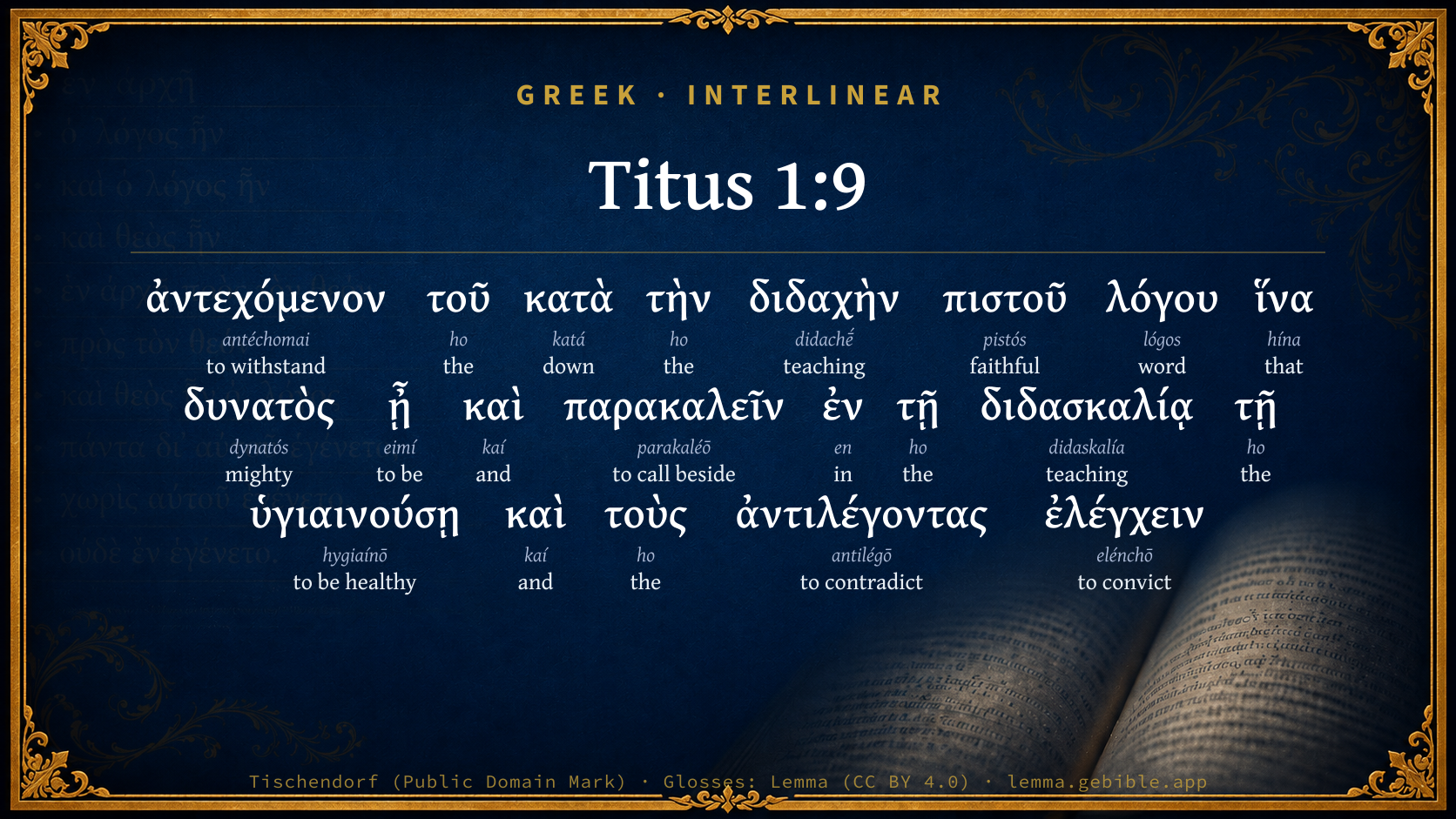
holding to the faithful word which is according to the teaching, that he may be able to exhort in the sound doctrine, and to convict those who contradict him.
Download a study sheet
One document with this verse’s original text, its word-by-word gloss line, the meaning frame, cross-references with their text, attributed commentary, and full source and license credits — printable, and it pastes into notes with its structure intact.
This verse Autodidact and up
A passage Seminary Student
Up to 50 verses in one chapter. A passage sheet keeps up to 6 commentary sources and 12 cross-references per verse, in the order this page ranks them, and says so on the sheet whenever that leaves anything out. Ask for a single verse and you get the Autodidact verse sheet above.
Everything on this page stays free to read, with no account — the sheet is a download of what is already on screen, not access to it.
Compare translations 3
The same verse in 3 English versions, stacked beneath the original-language interlinear above. Click any original word for its lexicon entry.
Each is an independent rendering of the whole verse — the interlinear is not word-aligned to these translations.
Highlighted words mark where these versions differ — a whole-verse word diff, not a word-by-word alignment.
-
World English Bible Public Domain
holding to the faithful word which is according to the teaching, that he may be able to exhort in the sound doctrine, and to convict those who contradict him.
-
King James Version Public Domain
Holding fast the faithful word as he hath been taught, that he may be able by sound doctrine both to exhort and to convince the gainsayers.
-
unfoldingWord Literal Text CC BY-SA 4.0
He must hold tightly to the trustworthy message that is in accordance with the teaching, so that he may be able both to encourage others with sound teaching and to rebuke the ones opposing.
unfoldingWord Literal Text — © unfoldingWord, licensed CC BY-SA 4.0. Word-aligned USFM3 via Door43 (git.door43.org/unfoldingWord/en_ult).
Show all 19 translations
Every available English version of this verse, each an independent rendering of the whole verse.
-
World English Bible Public Domain
holding to the faithful word which is according to the teaching, that he may be able to exhort in the sound doctrine, and to convict those who contradict him.
-
Berean Standard Bible Public Domain
He must hold firmly to the faithful word as it was taught, so that he can encourage others by sound teaching and refute those who contradict it.
-
Majority Standard Bible Public Domain
He must hold firmly to the faithful word as it was taught, so that he can encourage others by sound teaching and refute those who contradict it.
-
King James Version Public Domain
Holding fast the faithful word as he hath been taught, that he may be able by sound doctrine both to exhort and to convince the gainsayers.
-
American Standard Version (1901) Public Domain
holding to the faithful word which is according to the teaching, that he may be able to exhort in the sound doctrine, and to convict the gainsayers.
-
Revised Version (1885) Public Domain
holding to the faithful word which is according to the teaching, that he may be able both to exhort in the sound doctrine, and to convict the gainsayers.
-
Geneva Bible (1599) Public Domain
Holding fast that faithfull worde according to doctrine, that he also may bee able to exhort with wholesome doctrine, and conuince them that say against it.
-
Douay-Rheims (1899) Public Domain
Embracing that faithful word which is according to doctrine, that he may be able to exhort in sound doctrine, and to convince the gainsayers.
-
Young's Literal Translation Public Domain
holding -- according to the teaching -- to the stedfast word, that he may be able also to exhort in the sound teaching, and the gainsayers to convict;
-
Literal Standard Version CC BY-SA 4.0
holding—according to the teaching—to the steadfast word, that he may also be able to exhort in the sound teaching, and to convict the deniers;
-
Unlocked Literal Bible CC BY-SA 4.0
He should hold tightly to the trustworthy message that was taught, so that he may be able to encourage others with good teaching and correct those who oppose him.
-
unfoldingWord Literal Text CC BY-SA 4.0
He must hold tightly to the trustworthy message that is in accordance with the teaching, so that he may be able both to encourage others with sound teaching and to rebuke the ones opposing.
-
Darby Bible Public Domain
clinging to the faithful word according to the doctrine taught, that he may be able both to encourage with sound teaching and refute gainsayers.
-
World Messianic Bible Public Domain
holding to the faithful word which is according to the teaching, that he may be able to exhort in the sound doctrine, and to convict those who contradict him.
-
Webster's Bible Public Domain
Holding fast the faithful word as he hath been taught, that he may be able by sound doctrine both to exhort and to convince the gainsayers.
-
Free Bible Version CC BY-SA 4.0
and must be devoted to the trustworthy message as it's taught. In this way he can encourage others through correct teaching, and be able to convince those who disagree.
-
Bible in Basic English Public Domain
Keeping to the true word of the teaching, so that he may be able to give comfort by right teaching and overcome the arguments of the doubters.
-
Text-Critical English NT CC BY 4.0
holding firmly to the trustworthy message as it has been taught, so that he can encourage others with sound doctrine and refute those who contradict it.
-
Tyndale New Testament (1534) Public Domain
and suche as cleveth vnto the true worde of doctryne that he maye be able to exhorte with wholsom learnynge and to improve them that saye agaynst it.
Literal Standard Version (2020), Covenant Press — licensed CC BY-SA 4.0. Text via the HelloAO Bible API (eBible.org). Unlocked Literal Bible (unfoldingWord) — licensed CC BY-SA 4.0. Text via the HelloAO Bible API (eBible.org). unfoldingWord Literal Text — © unfoldingWord, licensed CC BY-SA 4.0. Word-aligned USFM3 via Door43 (git.door43.org/unfoldingWord/en_ult). Free Bible Version, Dr. Jonathan Gallagher — licensed CC BY-SA 4.0. Text via the HelloAO Bible API (eBible.org).
Word by word
More ways to search: Search by grammar → Find every occurrence → Compare this word →
Practice this passage: Drill this verse → Learn its vocabulary →
- Appears 4× in the Greek New Testament
- First appears at Matthew 6:24
- Part of Speech
- Verb
- Tense
- Present
- Voice
- Middle or Passive deponent
- Mood
- Participle
- Case
- Accusative
- Number
- Singular
- Gender
- Masculine
Full Thayer's Definition
- ἀντεχόμενον antéchomai G472 “to withstand” Verb, Present, Middle or Passive deponent, Participle, Accusative, Singular, Masculine
- τοῦ ho G3588 “the” Article, Genitive, Singular, Masculine
- κατὰ katá G2596 “down” Preposition
- τὴν ho G3588 “the” Article, Accusative, Singular, Feminine
- διδαχὴν didachḗ G1322 “teaching” Noun, Accusative, Singular, Feminine
- πιστοῦ pistós G4103 “faithful” Adjective, Genitive, Singular, Masculine
- λόγου lógos G3056 “word” Noun, Genitive, Singular, Masculine
- ἵνα hína G2443 “that” Conjunction
- δυνατὸς dynatós G1415 “mighty” Adjective, Nominative, Singular, Masculine
- ᾖ eimí G1510 “to be” Verb, Present, Active, Subjunctive, 3rd person, Singular
- καὶ kaí G2532 “and” Conjunction
- παρακαλεῖν parakaléō G3870 “to call beside” Verb, Present, Active, Infinitive
- ἐν en G1722 “in” Preposition
- τῇ ho G3588 “the” Article, Dative, Singular, Feminine
- διδασκαλίᾳ didaskalía G1319 “teaching” Noun, Dative, Singular, Feminine
- τῇ ho G3588 “the” Article, Dative, Singular, Feminine
- ὑγιαινούσῃ hygiaínō G5198 “to be healthy” Verb, Present, Active, Participle, Dative, Singular, Feminine
- καὶ kaí G2532 “and” Conjunction
- τοὺς ho G3588 “the” Article, Accusative, Plural, Masculine
- ἀντιλέγοντας antilégō G483 “to contradict” Verb, Present, Active, Participle, Accusative, Plural, Masculine
- ἐλέγχειν elénchō G1651 “to convict” Verb, Present, Active, Infinitive
About this verse
These counts appear in no published source. They are computed here, from the morphology-tagged text and Lemma’s own curated glosses. What Lemma adds →
- 21
- words
- 16
- distinct lemmas
- Pauline Epistles
- section
Cross-references
23Topical passages linked to Titus 1:9 in the Treasury of Scripture Knowledge — connected by theme and wording, ordered by reader-vote popularity; previews shown in the World English Bible.
- 2 Thessalonians 2:15 So then, brothers, stand firm, and hold the traditions which you were taught by us, whether by word, or by letter.
- 2 Timothy 1:13 Hold the pattern of sound words which you have heard from me, in faith and love which is in Christ Jesus.
- 1 Timothy 6:3 If anyone teaches a different doctrine, and doesn't consent to sound words, the words of our Lord Jesus Christ, and to the doctrine which is according to godliness,
- 1 Timothy 1:10 for the sexually immoral, for homosexuals, for slave-traders, for liars, for perjurers, and for any other thing contrary to the sound doctrine;
- 1 Timothy 1:15 The saying is faithful and worthy of all acceptance, that Christ Jesus came into the world to save sinners; of whom I am chief.
- Revelation 3:3 Remember therefore how you have received and heard. Keep it, and repent. If therefore you won't watch, I will come as a thief, and you won't know what hour I will come upon you.
- Revelation 3:11 I am coming quickly! Hold firmly that which you have, so that no one takes your crown.
- Job 2:3 Yahweh said to Satan, "Have you considered my servant Job? For there is none like him in the earth, a blameless and an upright man, one who fears God, and turns away from evil. He still maintains his integrity, although you incited me against him, to ruin him without cause."
- Proverbs 23:23 Buy the truth, and don't sell it: Get wisdom, discipline, and understanding.
- Acts 18:28 for he powerfully refuted the Jews, publicly showing by the Scriptures that Jesus was the Christ.
- 1 Corinthians 14:24 But if all prophesy, and someone unbelieving or unlearned comes in, he is reproved by all, and he is judged by all.
- 1 Thessalonians 5:21 Test all things, and hold firmly that which is good.
- 1 Timothy 4:9 This saying is faithful and worthy of all acceptance.
- 2 Timothy 2:2 The things which you have heard from me among many witnesses, commit the same to faithful men, who will be able to teach others also.
- 2 Timothy 4:3 For the time will come when they will not listen to the sound doctrine, but, having itching ears, will heap up for themselves teachers after their own lusts;
- Titus 1:11 whose mouths must be stopped; men who overthrow whole houses, teaching things which they ought not, for dishonest gain's sake.
- Titus 2:1 But say the things which fit sound doctrine,
- Titus 2:7–8 in all things showing yourself an example of good works; in your teaching showing integrity, seriousness, incorruptibility,
- Jude 1:3 Beloved, while I was very eager to write to you about our common salvation, I was constrained to write to you exhorting you to contend earnestly for the faith which was once for all delivered to the saints.
- Job 27:6 I hold fast to my righteousness, and will not let it go. My heart shall not reproach me so long as I live.
- 1 Timothy 1:19 holding faith and a good conscience; which some having thrust away made a shipwreck concerning the faith;
- 2 Timothy 2:25 in gentleness correcting those who oppose him: perhaps God may give them repentance leading to a full knowledge of the truth,
- Revelation 2:25 Nevertheless, hold firmly that which you have, until I come.
Cross-references courtesy of OpenBible.info (CC BY 4.0).
Lesson kit
Teaching starters — assembled from the data on this page, not authored interpretation. Every prompt links to the verse data it draws on. Edit before teaching.
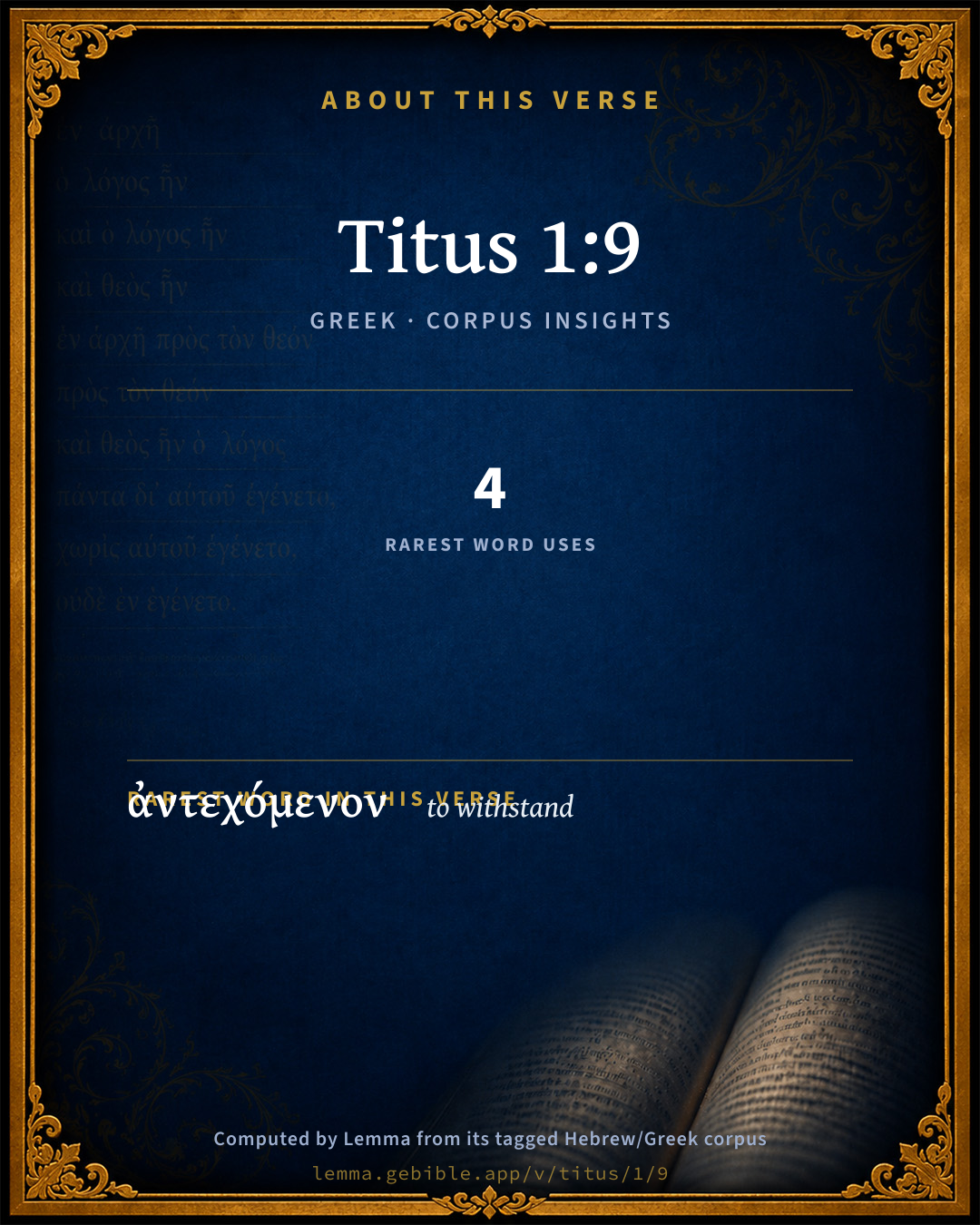
Titus, in the Pauline Epistles, opens this verse with 21 words (16 distinct Greek lemmas). Its most distinctive word is antéchomai (“to withstand”). A historical commentator’s framing appears above. Read the whole chapter for the surrounding context.
Discussion questions
- The word antéchomai carries the sense “to withstand.” How does it shape the verse?
- How does Matthew 6:24, which shares the word «to withstand», read alongside this verse?
- What does the repetition of “the” (5× in this one verse) do in this verse?
- These translations render this verse differently. What is at stake in choosing one wording over another?
- Compare how Tyndale Open Study Notes and Bengel's Gnomon read this verse. Where do they agree or differ?
Things to notice
- These translations choose different wording for 29 words in this verse.
- “the” occurs 5× in this single verse.
- 16 distinct Greek lemmas span 21 words in this verse.
Commentary
Notes on Titus 1:9 from classic Christian and Jewish commentators (each source and its license shown beneath its notes). The classic Christian expositions comment on the surrounding passage and are grouped to its opening verse, so a note may address several verses; the Jewish commentaries on the Tanakh (Rashi and others) are per-verse, so they appear only where the commentator wrote on this verse.
Lemma curates 59 commentaries, every one of them public domain or Creative Commons licensed, each selected and text-cleaned for this edition rather than reprinted as found. About our sources →
Tyndale Open Study Notes
Tyndale Open Resources
Tyndale Open Study Notes — © Tyndale Open Resources, licensed CC BY-SA 4.0. Text via the HelloAO Bible API.
Bengel's Gnomon
Johann Albrecht Bengel
Bengel's Gnomon of the New Testament — English translation (T&T Clark, Edinburgh, 1860) — public domain. Text from a community e-Sword module.
Meyer's Critical & Exegetical Commentary
Heinrich August Wilhelm Meyer
Meyer — Critical and Exegetical Commentary on the New Testament — English translation by Peter Christie, edited by Frederick Crombie (T&T Clark, 1880) — public domain. Text from a community e-Sword module.
Expositor's Greek Testament
ed. W. Robertson Nicoll
The Expositor's Greek Testament, edited by W. Robertson Nicoll (1897–1910) — public domain. Text from a community e-Sword module.
Geneva Bible (1599)
Geneva Bible translators
Geneva Bible (1599) marginal notes — public domain. Text via Bolls.life.
Jamieson, Fausset & Brown
Robert Jamieson, A. R. Fausset & David Brown
Jamieson, Fausset & Brown — Commentary Critical and Explanatory on the Whole Bible (1871) — public domain (CC PDM 1.0). Text via the HelloAO Bible API.
Adam Clarke's Commentary
Adam Clarke's Commentary on the Bible (1810–1826) — public domain. Text from a community e-Sword/MySword module.
John Calvin's Commentaries
John Calvin's Commentaries (1540-1563) — public domain. Text from the Calvin Translation Society English edition (1840s-50s) via the Christian Classics Ethereal Library (ccel.org). Calvin's coverage is partial (roughly two-thirds of the Bible); uncommented books and verses are honest gaps, never fabricated. The 19th-century editor's footnotes and remarks are omitted so the notes are faithfully Calvin's own voice.
Ellicott's Commentary for English Readers
A Bible Commentary for English Readers, edited by Charles John Ellicott (1878–1897) — public domain. Text from a community e-Sword module.
The Cambridge Bible for Schools and Colleges
gen. ed. J. J. S. Perowne
The Cambridge Bible for Schools and Colleges (gen. ed. J. J. S. Perowne; Cambridge University Press, 1878–1918) — public domain. Text from a community e-Sword module.
John Gill's Exposition
John Gill's Exposition of the Whole Bible (1746–1763) — public domain (CC PDM 1.0). Text via the HelloAO Bible API.
Trapp's Complete Commentary
John Trapp
John Trapp, A Commentary or Exposition upon All the Books of the Old and New Testament (1647–1656) — public domain. Text from a community e-Sword module.
Albert Barnes' Notes on the Bible
Albert Barnes' Notes on the Bible (1834–1885) — public domain. Text from a community e-Sword/MySword module.
Matthew Poole's English Annotations
Matthew Poole's English Annotations on the Holy Bible (1683–1685) — public domain. Text from a community e-Sword/MySword module.
Whedon's Commentary on the Bible
Daniel D. Whedon
Daniel D. Whedon (gen. ed.), Commentary on the Old and New Testaments (1874–1909) — public domain. Text from a community e-Sword module.
The Pulpit Commentary
The Pulpit Commentary (1880–1919), ed. H.D.M. Spence-Jones & Joseph S. Exell — public domain. Text from a community e-Sword module.
John Wesley's Explanatory Notes
John Wesley, Explanatory Notes Upon the Whole Bible (1754–1765) — public domain. Text via the GEBible commentary corpus.
Fairbairn on Ezekiel, Jonah & the Pastoral Epistles
Patrick Fairbairn
Patrick Fairbairn — An Exposition of Ezekiel (1851), Jonah (1849), and The Pastoral Epistles (1874) — public domain. Text from a community e-Sword module.
The People's New Testament
B. W. Johnson
B. W. Johnson's The People's New Testament with Notes (1889–1891) — public domain. Electronic text from the Christian Classics Ethereal Library (CCEL) ThML edition.
Cambridge Greek Testament for Schools and Colleges
Cambridge Greek Testament for Schools and Colleges (Cambridge University Press, 1896; 21 vols, various authors incl. Carr, Maclear, Plummer, Farrar, Lumby, Moule, M. R. James, Simcox) — public domain. Text from a community e-Sword module.
International Critical Commentary
International Critical Commentary — older volumes (1896–1929), various authors — public domain. Text from a community e-Sword module.
Vincent's Word Studies in the New Testament
Marvin R. Vincent
Marvin R. Vincent, Word Studies in the New Testament (1887–1900) — public domain. Text from a community e-Sword/MySword module.