
1 Corinthians 4:16

Greek (Tischendorf 8th ed.) 1 Corinthians 4:16 appears in the Greek New Testament. The text above is from the Tischendorf 8th edition. Each word links to its Strong’s number and a concise gloss. Click any word for its full Thayer’s Greek Lexicon entry.
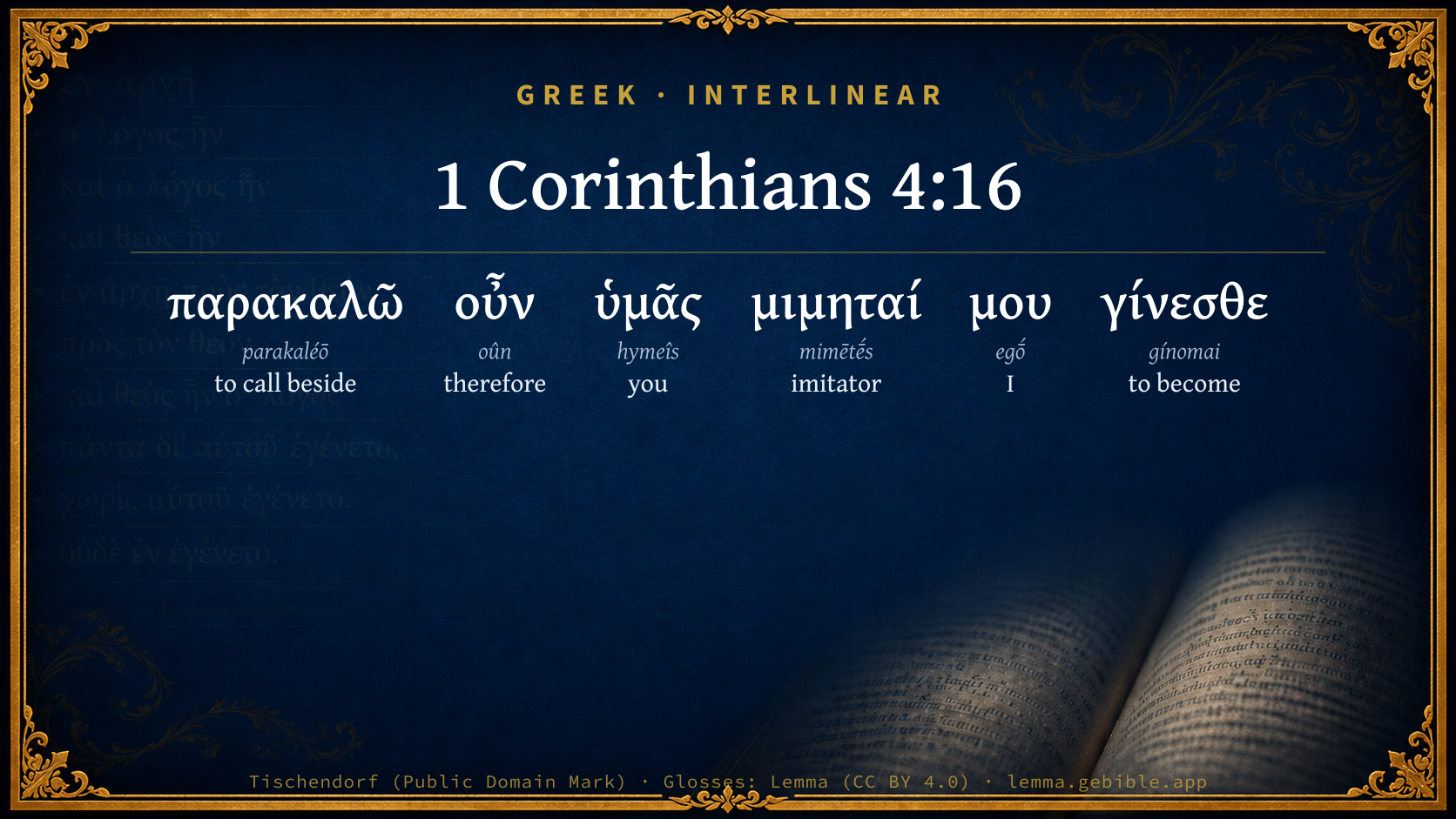
Download image
Cite this verse

1 Corinthians 4:16 (World English Bible). Public Domain. Lemma interlinear Bible study tool, https://lemma.gebible.app/v/1-corinthians/4/16.

Show BibTeX & RIS
BibTeX
RIS
English Translation
I beg you therefore, be imitators of me.
World English Bible · Public Domain
Highlights
  • 1 first appearance in the Greek New Testament
Full analysis ↓
Download a study sheet

One document with this verse’s original text, its word-by-word gloss line, the meaning frame, cross-references with their text, attributed commentary, and full source and license credits — printable, and it pastes into notes with its structure intact.

This verse Autodidact and up

Study sheet (.html) Plain text (.txt)

A passage Seminary Student

Up to 50 verses in one chapter. A passage sheet keeps up to 6 commentary sources and 12 cross-references per verse, in the order this page ranks them, and says so on the sheet whenever that leaves anything out. Ask for a single verse and you get the Autodidact verse sheet above.

Everything on this page stays free to read, with no account — the sheet is a download of what is already on screen, not access to it.

Want to remove ads? Support Godless Engineer
Compare translations 3

The same verse in 3 English versions, stacked beneath the original-language interlinear above. Click any original word for its lexicon entry.

Each is an independent rendering of the whole verse — the interlinear is not word-aligned to these translations.

Highlighted words mark where these versions differ — a whole-verse word diff, not a word-by-word alignment.

  • World English Bible Public Domain
    I beg you therefore, be imitators of me.
  • King James Version Public Domain
    Wherefore I beseech you, be ye followers of me.
  • unfoldingWord Literal Text CC BY-SA 4.0
    Therefore, I urge you, become imitators of me.

unfoldingWord Literal Text — © unfoldingWord, licensed CC BY-SA 4.0. Word-aligned USFM3 via Door43 (git.door43.org/unfoldingWord/en_ult).

Versions to compare (up to 4)

3 of 4 selected

Show all 19 translations

Every available English version of this verse, each an independent rendering of the whole verse.

  • World English Bible Public Domain
    I beg you therefore, be imitators of me.
  • Berean Standard Bible Public Domain
    Therefore I urge you to imitate me.
  • Majority Standard Bible Public Domain
    Therefore I urge you to imitate me.
  • King James Version Public Domain
    Wherefore I beseech you, be ye followers of me.
  • American Standard Version (1901) Public Domain
    I beseech you therefore, be ye imitators of me.
  • Revised Version (1885) Public Domain
    I beseech you therefore, be ye imitators of me.
  • Geneva Bible (1599) Public Domain
    Wherefore, I pray you, be ye folowers of me.
  • Douay-Rheims (1899) Public Domain
    Wherefore I beseech you, be ye followers of me, as I also am of Christ.
  • Young's Literal Translation Public Domain
    I call upon you, therefore, become ye followers of me;
  • Literal Standard Version CC BY-SA 4.0
    I call on you, therefore, become followers of me;
  • Unlocked Literal Bible CC BY-SA 4.0
    So I urge you to be imitators of me.
  • unfoldingWord Literal Text CC BY-SA 4.0
    Therefore, I urge you, become imitators of me.
  • Darby Bible Public Domain
    I entreat you therefore, be my imitators.
  • World Messianic Bible Public Domain
    I beg you therefore, be imitators of me.
  • Webster's Bible Public Domain
    Wherefore I beseech you, be ye followers of me.
  • Free Bible Version CC BY-SA 4.0
    So I'm pleading with you to imitate me!
  • Bible in Basic English Public Domain
    So my desire is that you take me as your example.
  • Text-Critical English NT CC BY 4.0
    Therefore I urge you to be imitators of me.
  • Tyndale New Testament (1534) Public Domain
    Wherfore I desyre you to folowe me.

Literal Standard Version (2020), Covenant Press — licensed CC BY-SA 4.0. Text via the HelloAO Bible API (eBible.org). Unlocked Literal Bible (unfoldingWord) — licensed CC BY-SA 4.0. Text via the HelloAO Bible API (eBible.org). unfoldingWord Literal Text — © unfoldingWord, licensed CC BY-SA 4.0. Word-aligned USFM3 via Door43 (git.door43.org/unfoldingWord/en_ult). Free Bible Version, Dr. Jonathan Gallagher — licensed CC BY-SA 4.0. Text via the HelloAO Bible API (eBible.org).

Word by word

More ways to search: Search by grammar → Find every occurrence → Compare this word →

Practice this passage: Drill this verse → Learn its vocabulary →

About this verse

These counts appear in no published source. They are computed here, from the morphology-tagged text and Lemma’s own curated glosses. What Lemma adds →

6
words
6
distinct lemmas
Pauline Epistles
section

Notable vocabulary

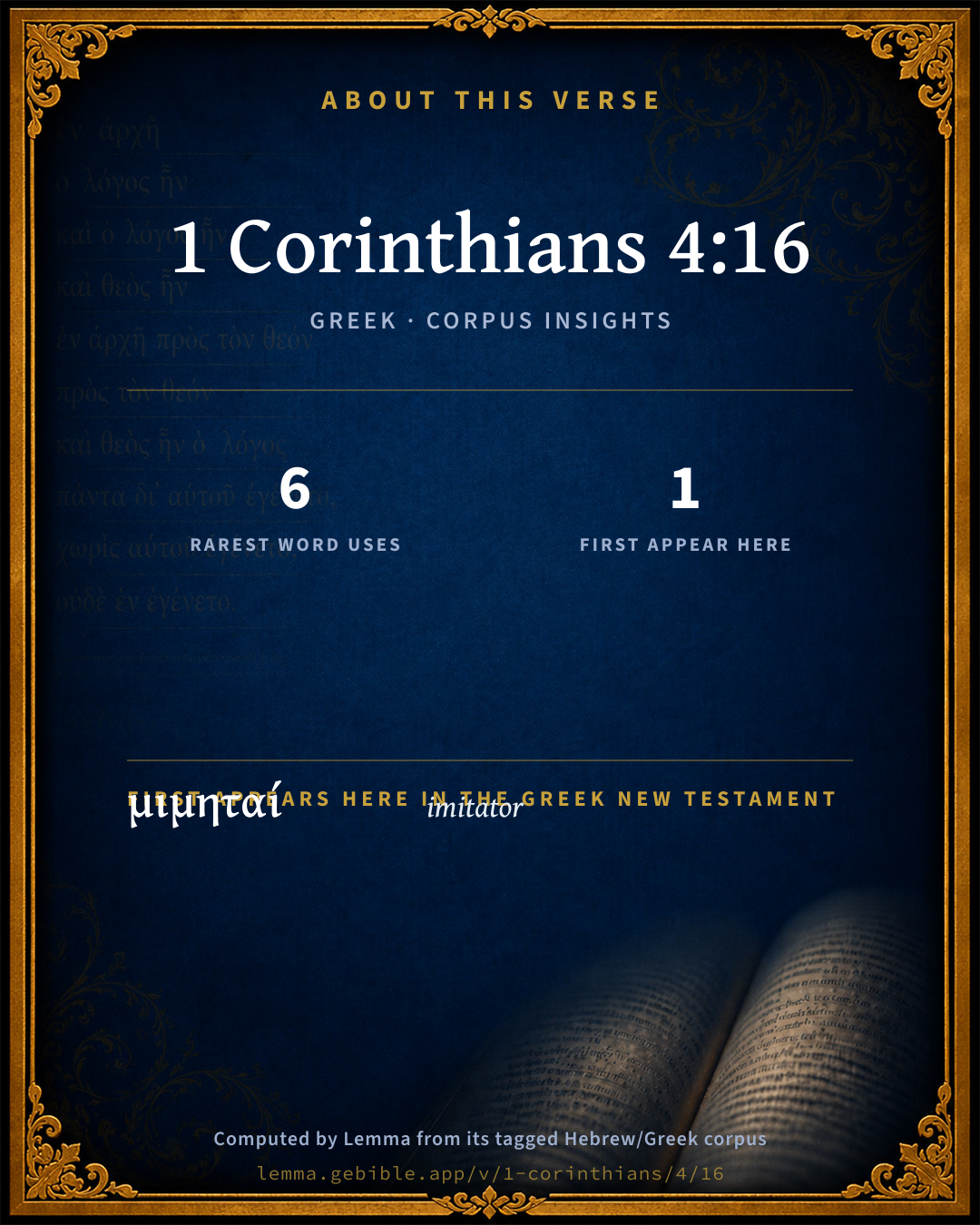
The rarest word here is μιμηταί imitator G3402 — appearing just 6 times in the whole Greek New Testament.

First appearance in Scripture

This word makes its first canonical appearance in the Greek New Testament here:

  • μιμηταί imitator G3402

Shared distinctive vocabulary

μιμηταί imitator G3402 occurs in 6 verses of the Greek New Testament. Also found in:
Cross-references

8

Topical passages linked to 1 Corinthians 4:16 in the Treasury of Scripture Knowledge — connected by theme and wording, ordered by reader-vote popularity; previews shown in the World English Bible.

  • 1 Corinthians 11:1 Be imitators of me, even as I also am of Christ.
  • Philippians 3:17 Brothers, be imitators together of me, and note those who walk this way, even as you have us for an example.
  • 2 Thessalonians 3:9 not because we don't have the right, but to make ourselves an example to you, that you should imitate us.
  • 1 Thessalonians 1:6 You became imitators of us, and of the Lord, having received the word in much affliction, with joy of the Holy Spirit,
  • Philippians 4:9 The things which you learned, received, heard, and saw in me: do these things, and the God of peace will be with you.
  • Hebrews 13:7 Remember your leaders, men who spoke to you the word of God, and considering the results of their conduct, imitate their faith.
  • John 10:4–5 Whenever he brings out his own sheep, he goes before them, and the sheep follow him, for they know his voice.
  • 1 Peter 5:3 neither as lording it over the charge allotted to you, but making yourselves examples to the flock.

Cross-references courtesy of OpenBible.info (CC BY 4.0).

Commentary

Notes on 1 Corinthians 4:16 from classic Christian and Jewish commentators (each source and its license shown beneath its notes). The classic Christian expositions comment on the surrounding passage and are grouped to its opening verse, so a note may address several verses; the Jewish commentaries on the Tanakh (Rashi and others) are per-verse, so they appear only where the commentator wrote on this verse.

Lemma curates 59 commentaries, every one of them public domain or Creative Commons licensed, each selected and text-cleaned for this edition rather than reprinted as found. About our sources →

Bengel's Gnomon

Johann Albrecht Bengel

1Co 4:16. Παρακαλῶ, I exhort) A short exhortation after a long and true account of his own example is valuable.—μιμηταί μου, imitators of me) as sons. Having laid aside pride, cultivate that feeling even without the cross, which is fostered in us by means of the cross. He proposes the imitation of himself to those, with whom he had been, Gal 4:12; Php 3:17.

Bengel's Gnomon of the New Testament — English translation (T&T Clark, Edinburgh, 1860) — public domain. Text from a community e-Sword module.

Meyer's Critical & Exegetical Commentary

Heinrich August Wilhelm Meyer

1Co_4:16. Οὖν] since I am your father.

μιμ. μ. γίν.] become imitators of me. Paul does not add any more precise definition as to the matter (in cura tutandae in ecclesia tum unitatis tum sanctitatis, Grotius thinks, but without warrant in the context); but the connection of the passage, after 1Co_4:6-13, leaves no room for doubt that he has in view the discarding of conceit and self-seeking, and the putting on of humility and self-denial.

As regards the phrase μιμ. γίν., comp 1Co_11:1; 1Th_1:6; 1Th_2:14; Eph_5:1; Php_3:17; and as regards the idea, Xen. Mem. i. 6. 3 : οἱ διδάσκαλοι τοὺς μαθητὰς μιμητὰς ἑαυτῶν ἀποδεικνύουσιν.

Meyer — Critical and Exegetical Commentary on the New Testament — English translation by Peter Christie, edited by Frederick Crombie (T&T Clark, 1880) — public domain. Text from a community e-Sword module.

Expositor's Greek Testament

ed. W. Robertson Nicoll

1Co 4:16 . “I beseech you therefore (as your father), be imitators of me.” γίνεσθε (pr [766] impr.) signifies, in moral exhortations, be in effect, show yourselves ( cf. Eph 4:32 ; Eph 5:17 ). μιμηταὶ γίνεσθε demands, beyond μιμεῖσθε , a character formed on the given model. Imitation is the law of the child’s life; cf. Eph 5:1 ; and for the highest illustration, Joh 5:17-20 . It is one thing to say “I am of Paul” (1Co 1:12 ), another to tread in Paul’s steps. The imitation would embrace, in effect, much of what was described in 1Co 4:9 ff.

[766] present tense.

The Expositor's Greek Testament, edited by W. Robertson Nicoll (1897–1910) — public domain. Text from a community e-Sword module.

Hodge's Commentary on Romans, Ephesians & First Corinthians

Charles Hodge

1Co_4:16

Wherefore, I beseech you, be ye followers of me.

Wherefore, i.e. because I am your father. Be ye followers (μιμηταί, literally, imitators) of me. He does not exhort them to become his followers or partisans, instead of being the followers of Apollos or of Cephas. But as he had spoken of himself as being humble, self-denying and self-sacrificing in the cause of Christ, he beseeches them to follow his example. In 1Co_11:1 he says, Be ye imitators of me, as I am of Christ. Comp. 1Th_1:6; 1Th_2:14. Eph_5:1.

Charles Hodge — Commentary on Romans (1835), First Corinthians (1857), and Ephesians (1856) — public domain. Text from a community e-Sword module.

Jamieson, Fausset & Brown

Robert Jamieson, A. R. Fausset & David Brown

be ye followers of me--literally, "imitators," namely, in my ways, which be in Christ (Co1 4:17; Co1 11:1), not in my crosses (Co1 4:8-13; Act 26:29; Gal 4:12).

Jamieson, Fausset & Brown — Commentary Critical and Explanatory on the Whole Bible (1871) — public domain (CC PDM 1.0). Text via the HelloAO Bible API.

Adam Clarke's Commentary

Verse 16. Wherefore, I beseech you, be ye followers of me.] It should rather be translated, Be ye imitators of me; μιμηται, from which we have our word mimic, which, though now used only in a bad or ludicrous sense, simply signifies an imitator of another person, whether in speech, manner, habit, or otherwise. As children should imitate their parents in preference to all others, he calls on them to imitate him, as he claims them for his children. He lived for God and eternity, seeking not his own glory, emolument, or ease: those sowers of sedition among them were actuated by different motives. Here then the apostle compares himself with them: follow and imitate me, as I follow and imitate Christ: do not imitate them who, from their worldly pursuits, show themselves to be actuated with a worldly spirit.

Adam Clarke's Commentary on the Bible (1810–1826) — public domain. Text from a community e-Sword/MySword module.

John Calvin's Commentaries

16. I exhort you. He now expresses also, in his own words, what he requires from them in his fatherly admonition — that, being his sons, they do not degenerate from their father. For what is more reasonable than that sons endeavor to be as like as possible to their father. At the same time he gives up something in respect of his own right, when he exhorts them to this, by way of entreaty rather than of command. But to what extent he wishes them to be imitators of him, he shows elsewhere, when he adds, as he was of Christ (1 Corinthians 11:1.) This limitation must always be observed, so as not to follow any man, except in so far as he leads us to Christ. We know what he is here treating of. The Corinthians did not merely shun the abasement of the cross, but they also regarded their father with contempt, on this account, that, forgetting earthly glory, he gloried rather in reproaches for Christ; and they reckoned themselves and others fortunate in having nothing contemptible according to the flesh. He accordingly admonishes them to devote themselves, after his example, to the service of Christ, so as to endure all things patiently.

John Calvin's Commentaries (1540-1563) — public domain. Text from the Calvin Translation Society English edition (1840s-50s) via the Christian Classics Ethereal Library (ccel.org). Calvin's coverage is partial (roughly two-thirds of the Bible); uncommented books and verses are honest gaps, never fabricated. The 19th-century editor's footnotes and remarks are omitted so the notes are faithfully Calvin's own voice.

Ellicott's Commentary for English Readers

(16) Wherefore.—Because I stand in this relation I call you to preserve, as it were, in a moral sense, that family likeness which would naturally accompany such a relationship (Gal_4:12; Eph_5:1; Php_3:17).

A Bible Commentary for English Readers, edited by Charles John Ellicott (1878–1897) — public domain. Text from a community e-Sword module.

The Cambridge Bible for Schools and Colleges

gen. ed. J. J. S. Perowne

16. be ye followers of me] Literally, imitators. Vulgate, imitatores. St Paul’s was no spurious humility, such as has too often taken the place of real gospel humility in the Christian Church. He could venture to refer to his own example, where his conscience told him he had honestly striven to carry out his Master’s commands.

The Cambridge Bible for Schools and Colleges (gen. ed. J. J. S. Perowne; Cambridge University Press, 1878–1918) — public domain. Text from a community e-Sword module.

John Gill's Exposition

Wherefore, I beseech you,.... Though he might have used the power and authority of a father, yet he chose rather to entreat and beseech them; saying,

be ye followers of me; for who should children follow, but their parents? The Vulgate Latin, adds, "as I am of Christ"; so Chrysostom in his time read it; and Beza says he found it so written in one Greek exemplar; and so it is in one of Stephens's; it seems to have crept in from Co1 11:1. However, though it might not be now expressed by the apostle, it is to be supposed; for he never desired any to follow him any more, or further than he followed Christ; particularly he was desirous that these his spiritual children would follow him, and abide by him in the doctrine of a crucified Christ, he had preached among them, and not the false apostles, who had represented his ministry as weak and foolish; and in his life and conversation, especially in his humble carriage and deportment among them, and in his tender love and affection for them; observing their growing pride, haughtiness, and vain opinion of themselves, and those unnatural divisions and animosities which were fomented among them; and also in bearing reproach and persecution cheerfully and patiently, for the Gospel of Christ; a detail of which he had given them in some preceding verses.

John Gill's Exposition of the Whole Bible (1746–1763) — public domain (CC PDM 1.0). Text via the HelloAO Bible API.

Trapp's Complete Commentary

John Trapp

16 Wherefore I beseech you, be ye followers of me.

Ver. 16. Be ye followers of me] As dear children. A bove maiori discit arare minor. From the larger bull the smaller ones are taught to plough, (Ovid.) Constantine’s children resembled their father exactly, they put him wholly on, saith Eusebius, and were, as it were, very he, ολον ενεδυσαντο τον Κονσταντινον.

John Trapp, A Commentary or Exposition upon All the Books of the Old and New Testament (1647–1656) — public domain. Text from a community e-Sword module.

Albert Barnes' Notes on the Bible

Wherefore - Since I am your spiritual father.

Be ye followers of me - Imitate me; copy my example; listen to my admonitions. Probably Paul had particularly in his eye their tendency to form parties; and here admonishes them that he had no disposition to form sects, and entreats them in this to imitate his example. A minister should always so live as that he can, without pride or ostentation, point to his own example; and entreat his people to imitate him. He should have such a confidence in his own integrity; he should lead such a blameless life; and “he should be assured that his people have so much evidence of his integrity,” that he can point them to his own example, and entreat them to live like himself. And to do this, he should live a life of piety, and should furnish such evidence of a pure conversation, that his people may have reason to regard him as a holy man.

Albert Barnes' Notes on the Bible (1834–1885) — public domain. Text from a community e-Sword/MySword module.

Matthew Poole's English Annotations

I might as a father command you, but I beseech you, be ye followers of me, in preserving the unity and promoting the holiness of the church. He expounds this, 1Co 11:1; Be ye followers of me, as I am of Christ. Holiness of life and conversation is necessary to a true minister of Christ; for their people ought not only to be their hearers, but their followers; they are ensamples to the flock, 1Pe 5:3, and ought to be examples of believers, in word, in conversation, in charity, in spirit, in faith, in purity, 1Ti 4:12; in all things showing themselves patterns of good works; in doctrine showing uncorruptness, gravity, sincerity, & c., Tit 2:7. Those who teach well and live ill, are no good ministers of Christ; they cannot say unto people: Be ye followers of me.

Matthew Poole's English Annotations on the Holy Bible (1683–1685) — public domain. Text from a community e-Sword/MySword module.

Whedon's Commentary on the Bible

Daniel D. Whedon

16. Followers—Imitators, as of a model. Christianity is new; and what fashion of character it requires us to shape ourselves to needs not only an inspired instruction but a living pattern. It was a greatness in St. Paul, that, disclaiming all originality, and claiming to be like Christ, he could call the world to imitate himself. Notes on Act_20:17-38.

Daniel D. Whedon (gen. ed.), Commentary on the Old and New Testaments (1874–1909) — public domain. Text from a community e-Sword module.

The Pulpit Commentary

Be ye followers; rather, imitators. He makes the same appeal 1Co_11:1; Php_3:17. Of course, he only uses his human example as a guide to them in the special virtues of humility, self denial, and faithfulness (1Pe_5:3; Heb_13:7) In the highest sense we can only be "imitators of God". (Eph_5:1)

Vers. 16-21.

Six subjects worth reflection.

I beseech you, be ye followers of me," etc. There are six noteworthy subjects in these verses.

I A REMARKABLE REQUEST. "Be ye followers of me." Were Paul an ordinary man, such an exhortation would resound with arrogance; but he was a man of preeminent excellence, Christly in spirit, deportment, and ministry. There were three reasons why they should imitate him.

1. He was a follower of Christ. There was no living man who had followed his Master so closely. Elsewhere he says, "Be ye followers of me, as I also am of Christ.

2. He was their spiritual father. He had begotten them in the gospel; they were his moral offspring. They had numerous instructors, but he was their father; they gave them ideas, he gave them character.

3. He was no partisan. Other teachers amongst them became the leaders of parties, these parties were contending one with another; but Paul belonged to no party, he followed Christ, knew "nothing amongst men but Christ, and him crucified." Such a man was justified in calling on others to follow him. "Ministers," says an old writer, "should so live that their people may take pattern from them, and even after their copy; they should guide them by their lives as well as by their lips, go before them on the way to heaven, and not content themselves with pointing.

II A HIGH TESTIMONY. "For this cause have I sent unto you Timotheus, who is my beloved son, and faithful in the Lord, who shall bring you into remembrance of my ways which be in Christ, as I teach everywhere in every Church." He is dear to me as a "son;" he is "faithful in the Lord;" he knows my "ways." High testimony this. And this is the man he promises to send to them. What for? That he might give them good reasons why they should be followers of him. I do not want you to follow me in the dark; I send him that he may throw light upon my ways everywhere, "in every Church." A man must have a high consciousness of rectitude who can trust the representation of his character to one who knows him as well as a son knows his father, and withal a man of incorruptible honesty.

III A FOOLISH EXULTATION. "Now some are puffed up, as though I would not come to you." There were those in the Church at Corinth who were out of sympathy with Paul, and who had no desire that he should visit them, and as the "wish is father to the thought," when they heard he was coming they would not believe it. When the intelligence that he was sending Timothy to them reached them, they would be likely to say, "This proves the truth of our assertion; he is afraid to come himself, and so he sends Timothy." In this they seem to have rejoiced; they were "puffed up." Now, I rail this a foolish exultation, because the visit of Paul to them was what they deeply needed, and was intended to confer on them the highest blessing. How often do we foolishly rejoice in deliverance from visitations fraught with priceless blessings!

Ye fearful saints, fresh courage take, The clouds ye so much dread Are big with mercy, and shall break In blessings on your head." (Cowper. )

IV AN EXEMPLARY DECISION. "But I will come to you shortly if the Lord will," etc. Paul believed that God had a will concerning him, and that will determined his destiny. Hence on this he based all his calculations in life; all his plans and purposes were subject to that will. "If the Lord will." This is an exemplary decision. His will is not only absolute and righteous, but benevolent; therefore to acquiesce in that will is not only right, but wise. "Go to now, ye that say, Today or tomorrow we will go into such a city, and continue there a year, and buy and sell, and get gain; whereas ye know not what will be on the morrow?

V A GLORIOUS SYSTEM. "For the kingdom of God is not in word, but in power." By this he means, I presume, the gospel ministry. It is a divinely regal "kingdom; it is not a thing of sentiments or ceremony; it is invested with Divine authority. It is not a thing of mere word;" it transcends all language, however logical in force or rhetorical in beauty; it is "power the "power of God unto salvation.

VI A SOLEMN PROPOSAL. "What will ye? shall I come unto you with a rod, or in love, and in the spirit of meekness?" In any case I shall come as a father. Shall I come as a father to chastise you with a "rod," or with looks of "love" and words of commendation and sympathy? God"s minister is bound to deal with men according to their states of mind. His ministry to some must be as the severity of Sinai, with others as the tenderness of Calvary. Evermore is it true that the effects of Divine visitations depend on the spirit in which they are received, and what this spirit shall be is for man to determine. God says to every man, "What will ye? shall I come unto you with a rod, or in love, and in the spirit of meekness?" This is the solemn proposal.

Imitators of men.

The Revised Version of this passage reads, "I beseech you therefore, be ye imitators of me." It may, however, be disputed whether the word "followers" is not a better and more suitable one to express the apostle"s idea. Mere imitating is the work of the unintelligent; it is represented by the mere reproduction of sounds and manners such as we have in the parrot or the monkey, or more fully in the child. For men, all mere imitations are either signs of mental and moral weakness, or they are the accidents attending on an intelligent acceptance of the principles which another man exhibits in conduct. We are not, in the limited sense of the word, even to imitate Christ; we are to "copy his example," and to "follow in his steps;" but when more fully and worthily apprehended, we find that what we really are to do is to "let that mind be in us which was also in Christ Jesus." In the passage now before us St. Paul has been speaking of his relationship to the Corinthian Christians. He was their father in Christ; "For in Christ Jesus I have begotten you through the gospel." And he is really pleading with them to preserve the family likeness which should accompany such a relation. But it may be said Are we ever justified in following or imitating our fellow men? We reply Yes, so far as men are Christ like, we may; so far as they are more Christ like than ourselves; so far as they have reached any Christly virtue or grace beyond us, we may. And since there is a sense in which Christ must ever seem to us out of reach; since of his virtue we must ever say, "It is high, I cannot attain unto it; it may often be really helpful to us to see his virtue reflected in a fellow man, and manifestly brought within the reach of human attainment. This may help us while we are weak, but when we more fully grasp the truth of our Lord"s humanity, we shall realize that Divine virtues were shown by him in a human life precisely that we might feel the possibility, of attaining them, and so seek to be "changed into his image." After dwelling on the "imitative faculty," its uses and abuses, consider that

I GOOD MEN MAY BECOME MODELS FOR US. Observe:

1. That in every age some men have risen above their fellows in moral virtues; and some have been set in prominent positions so as to attract the attention of their fellows.

2. From the Scripture models which are preserved to us, learn:

(1) That no merely human being can present his entire human life, the whole circle of his doings, for our imitation. "There is none righteous; no, not one." Illustrate the sides of moral infirmity in all Scripture characters Abraham, Moses, David, Hezekiah, Peter, Paul, etc.

(2) That each becomes a model of some one characteristic feature; e.g. Abraham of faith, Moses of disinterestedness, David of habits of personal piety, Paul of singular loyalty to the living Christ. So with modern saints, and the holy ones from our own circles; in some one thing each is strong, and just in that one thing each may be a model.

II GOOD MEN"S MODELS ABE, AT THE BEST, BUT IMPERFECT. Sensible of this, David says in his prayer before God, "My goodness extendeth not to thee; but to the saints that are in the earth, and to the excellent." Even in the one thing in which they are strong, God can find weakness. When we most admire, we are compelled sadly to feel that the "trail of the serpent is over it all." So we must use men"s examples as but incomplete copies of the Divine, and remember that our aim is to transcend any previous human attainments, and to be "perfect, even as our Father in heaven is perfect." Whatever there is in men that is imitable is but a reflection of Christ, and we may have shining on us what they have in measure caught, even the very light of Christ himself. We may "follow his example, who did no sin?

III CHRIST IS OUR GREAT MODEL, AND MEN ARE MODELS ONLY SO FAR AS THEY BRING HIM NEAR AND GLORIFY HIM TO OUR THOUGHT. We must take this knowledge of them that they have been with Jesus, and have, in measure, caught his likeness. Impress that we may fully copy Christ"s life, but only very seldom can we copy men"s actions; we can only seek to be possessed and ruled by the same principles. R.T.

The Pulpit Commentary (1880–1919), ed. H.D.M. Spence-Jones & Joseph S. Exell — public domain. Text from a community e-Sword module.

John Wesley's Explanatory Notes

Be ye followers of me - In that spirit and behaviour which I have so largely declared.

John Wesley, Explanatory Notes Upon the Whole Bible (1754–1765) — public domain. Text via the GEBible commentary corpus.

Godbey's Commentary on the New Testament

William B. Godbey

16. During Paul’s absence of three years in Asia, much error had crept in. Many preachers had been with them, some all right, others not so. He prefers to correct the heresies and reform the apostasies at a distance, lest if he waited until his arrival he would have to enforce severe discipline.

Meanwhile he sent to them Timothy, his favorite preacher, who in point of humility, orthodoxy and plainness was almost a facsimile of Paul, whose wholesome teaching was just what they needed.

William B. Godbey, Commentary on the New Testament (1896–1900) — public domain. Text from a community e-Sword module.

McGarvey & Pendleton's Commentaries

J. W. McGarvey

I beseech you therefore, be ye imitators of me . [Again, in the highest sense we can only be imitators of God ( Eph_5:1 ); but in a secondary sense the Corinthians could imitate Paul--his humility, faithfulness, self-sacrifice and industry, as did the Thessalonians-- 1Th_1:6 ]

J. W. McGarvey (with Philip Y. Pendleton), Commentaries on the New Testament (The Fourfold Gospel, 1914; Acts; and the epistles) — public domain. Text from a community e-Sword/MySword module.

The People's New Testament

B. W. Johnson

16. Be ye followers of me. Hence, since he was their spiritual father, they ought all to imitate him, his lowliness and self-denial. Children should seek to be like the parent, rather than like the tutor.

B. W. Johnson's The People's New Testament with Notes (1889–1891) — public domain. Electronic text from the Christian Classics Ethereal Library (CCEL) ThML edition.

Cambridge Greek Testament for Schools and Colleges

16. μιμηταί. Imitators. Vulgate, imitatores. St Paul’s was no spurious humility, such as has too often taken the place of real Gospel humility in the Christian Church. He could venture to refer to his own example, where his conscience told him he had honestly striven to carry out his Master’s commands.

Cambridge Greek Testament for Schools and Colleges (Cambridge University Press, 1896; 21 vols, various authors incl. Carr, Maclear, Plummer, Farrar, Lumby, Moule, M. R. James, Simcox) — public domain. Text from a community e-Sword module.

Alford’s Greek Testament

Henry Alford

16.] οὖν, because I am your father.

μιμηταί, not only, nor perhaps chiefly, in the things just mentioned, vv. 9-13,—but as ver. 17, in αἱ ὁδοί μου αἱ ἐν χρ., my manner of life and teaching. See reff.

Henry Alford, The Greek Testament (1849–1861) — public domain. Text from a community e-Sword module.

International Critical Commentary

16. παρακαλῶ οὖν. ‘Therefore, as having the right to do so, I call upon my children to take after their father.’ Si fili estis, debitum honorem debetis impendere patri, et imitatores existere (Atto). Cf. 1Th 1:6, 1Th 1:7, 1Th 1:2:7, 11.

μιμηταί μον γίνεσθε. ‘Show yourselves imitators of me’; ‘by your conduct prove your parentage.’ Here and 11:1 (see note there), ‘imitators’ rather than ‘followers’ (AV.). The context shows the special points of assimilation, viz. humility and self-sacrifice (vv. 10-13). In Php 3:17 we have συνμιμητής. The charge is not given in a spirit of self-confidence. He has received the charge to lead them, and he is bound to set an example for them to follow, but he takes no credit for the pattern (11:1).

International Critical Commentary — older volumes (1896–1929), various authors — public domain. Text from a community e-Sword module.

Godet's Commentaries

Frédéric Louis Godet

Vv. 16. A father has a right to expect that wellborn children follow his steps; hence the therefore. The apostle is thinking particularly of the absence of all self-seeking and self-satisfaction, of the abnegation and humility of which they had an example in him. The νουθετεῖν (1Co 4:14) referred especially to their past, and to all that was blameworthy in it; the παρακαλεῖν applies to the future, and to the good which ought to appear among them. The word γίνεσθε, become (be), reminds them how far they have gone astray.

To help them on the way of return to a new course, Paul sends them one of his most faithful fellow-labourers, whom he hopes soon to follow himself (1Co 4:17-21).

Frédéric Louis Godet — Commentaries on Luke, John, Romans, and 1 Corinthians — English translation (T&T Clark, Edinburgh, 1870s–1890s) — public domain. Text from a community e-Sword module.

Lesson kit

Teaching starters — assembled from the data on this page, not authored interpretation. Every prompt links to the verse data it draws on. Edit before teaching.

1 Corinthians, in the Pauline Epistles, opens this verse with 6 words (6 distinct Greek lemmas). Its most distinctive word is mimētḗs (“imitator”). A historical commentator’s framing appears above. Read the whole chapter for the surrounding context.

Discussion questions

  1. What does “imitator” (mimētḗs) contribute to the verse as a whole?
  2. The word “imitator” first appears here in Scripture. What is being introduced at this debut?
  3. 1 Corinthians 11:1 shares the word «imitator» with this verse. How do the two illuminate each other?
  4. The translations on this page render this verse differently — a whole-verse word diff, not a word-by-word alignment. What might account for the different wordings?
  5. Reading how Bengel's Gnomon and Meyer's Critical & Exegetical Commentary read this verse, where do the two commentators agree and where do they part?

Things to notice

  • 1 word makes its first canonical appearance in Scripture here.
  • These translations choose different wording for 8 words in this verse.
  • 6 distinct Greek lemmas span 6 words in this verse.

Reading settings

Reading text

Shown beneath each verse's original-language words.

Old Testament
Old Testament edition

Read the OT as the Masoretic Hebrew (MT) or the Greek Septuagint (LXX).

English shown for the Greek Septuagint (in the Hebrew ↔ Greek comparison).

Comparing translations? Open the Compare panel on any verse page to stack up to four side by side.