1 Thessalonians 4:10

Greek (Tischendorf 8th ed.) 1 Thessalonians 4:10 appears in the Greek New Testament. The text above is from the Tischendorf 8th edition. Each word links to its Strong’s number and a concise gloss. Click any word for its full Thayer’s Greek Lexicon entry.

Download image
Cite this verse

1 Thessalonians 4:10 (World English Bible). Public Domain. Lemma interlinear Bible study tool, https://lemma.gebible.app/v/1-thessalonians/4/10.

Show BibTeX & RIS
BibTeX
RIS
English Translation
for indeed you do it toward all the brothers who are in all Macedonia. But we exhort you, brothers, that you abound more and more;
World English Bible · Public Domain
Download a study sheet

One document with this verse’s original text, its word-by-word gloss line, the meaning frame, cross-references with their text, attributed commentary, and full source and license credits — printable, and it pastes into notes with its structure intact.

This verse Autodidact and up

Study sheet (.html) Plain text (.txt)

A passage Seminary Student

Up to 50 verses in one chapter. A passage sheet keeps up to 6 commentary sources and 12 cross-references per verse, in the order this page ranks them, and says so on the sheet whenever that leaves anything out. Ask for a single verse and you get the Autodidact verse sheet above.

Everything on this page stays free to read, with no account — the sheet is a download of what is already on screen, not access to it.

Want to remove ads? Support Godless Engineer
Compare translations 3

The same verse in 3 English versions, stacked beneath the original-language interlinear above. Click any original word for its lexicon entry.

Each is an independent rendering of the whole verse — the interlinear is not word-aligned to these translations.

Highlighted words mark where these versions differ — a whole-verse word diff, not a word-by-word alignment.

  • World English Bible Public Domain
    for indeed you do it toward all the brothers who are in all Macedonia. But we exhort you, brothers, that you abound more and more;
  • King James Version Public Domain
    And indeed ye do it toward all the brethren which are in all Macedonia: but we beseech you, brethren, that ye increase more and more;
  • unfoldingWord Literal Text CC BY-SA 4.0
    For also you do it to all the brothers who in all Macedonia. But we encourage you, brothers, to abound even more

unfoldingWord Literal Text — © unfoldingWord, licensed CC BY-SA 4.0. Word-aligned USFM3 via Door43 (git.door43.org/unfoldingWord/en_ult).

Versions to compare (up to 4)

3 of 4 selected

Show all 19 translations

Every available English version of this verse, each an independent rendering of the whole verse.

  • World English Bible Public Domain
    for indeed you do it toward all the brothers who are in all Macedonia. But we exhort you, brothers, that you abound more and more;
  • Berean Standard Bible Public Domain
    And you are indeed showing this love to all the brothers throughout Macedonia. But we urge you, brothers, to excel more and more
  • Majority Standard Bible Public Domain
    And you are indeed showing this love to all the brothers throughout Macedonia. But we urge you, brothers, to excel more and more
  • King James Version Public Domain
    And indeed ye do it toward all the brethren which are in all Macedonia: but we beseech you, brethren, that ye increase more and more;
  • American Standard Version (1901) Public Domain
    for indeed ye do it toward all the brethren that are in all Macedonia. But we exhort you, brethren, that ye abound more and more;
  • Revised Version (1885) Public Domain
    for indeed ye do it toward all the brethren which are in all Macedonia. But we exhort you, brethren, that ye abound more and more;
  • Geneva Bible (1599) Public Domain
    Yea, and that thing verily yee doe vnto all the brethren, which are throughout all Macedonia: but we beseech you, brethren, that ye increase more and more,
  • Douay-Rheims (1899) Public Domain
    For indeed you do it towards all the brethren in all Macedonia. But we entreat you, brethren, that you abound more:
  • Young's Literal Translation Public Domain
    for ye do it also to all the brethren who `are' in all Macedonia; and we call upon you, brethren, to abound still more,
  • Literal Standard Version CC BY-SA 4.0
    for you do it also to all the brothers who [are] in all Macedonia; and we call on you, brothers, to abound still more,
  • Unlocked Literal Bible CC BY-SA 4.0
    Indeed, you do this for all the brothers who are in all Macedonia. But we exhort you, brothers, to do this even more.
  • unfoldingWord Literal Text CC BY-SA 4.0
    For also you do it to all the brothers who in all Macedonia. But we encourage you, brothers, to abound even more
  • Darby Bible Public Domain
    For also ye do this towards all the brethren in the whole of Macedonia; but we exhort you, brethren, to abound still more,
  • World Messianic Bible Public Domain
    for indeed you do it toward all the brothers who are in all Macedonia. But we exhort you, brothers, that you abound more and more;
  • Webster's Bible Public Domain
    And indeed ye do it towards all the brethren who are in all Macedonia: but we beseech you, brethren, that ye increase more and more;
  • Free Bible Version CC BY-SA 4.0
    and in fact you are demonstrating this love to all the believers throughout Macedonia. Even so we want to encourage you, brothers and sisters, to love more and more.
  • Bible in Basic English Public Domain
    And, truly, you are lovers of all the brothers in Macedonia; but it is our desire that your love may be increased still more;
  • Text-Critical English NT CC BY 4.0
    And indeed you do love all the brothers throughout Macedonia. But we urge you, brothers, to do so more and more.
  • Tyndale New Testament (1534) Public Domain
    Ye and that thinge verely ye do vnto all the brethren which are thorow oute all Macedonia. We beseche you brethren that ye encreace more and more

Literal Standard Version (2020), Covenant Press — licensed CC BY-SA 4.0. Text via the HelloAO Bible API (eBible.org). Unlocked Literal Bible (unfoldingWord) — licensed CC BY-SA 4.0. Text via the HelloAO Bible API (eBible.org). unfoldingWord Literal Text — © unfoldingWord, licensed CC BY-SA 4.0. Word-aligned USFM3 via Door43 (git.door43.org/unfoldingWord/en_ult). Free Bible Version, Dr. Jonathan Gallagher — licensed CC BY-SA 4.0. Text via the HelloAO Bible API (eBible.org).

Word by word

More ways to search: Search by grammar → Find every occurrence → Compare this word →

Practice this passage: Drill this verse → Learn its vocabulary →

Μακεδονίᾳ
Makedonía
G3109
“Macedonia”
Noun, Dative, Singular, Feminine
Part of Speech
Noun
Case
Dative
Number
Singular
Gender
Feminine
Full Thayer's Definition

Origin: from G3110

TDNT: None

Macedonia = "extended land" 1. a country bounded on the south by Thessaly and Epirus, on the east by Thrace and the Aegean Sea, on the west by Illyria, and on the North by Dardania and Moesia
  1. καὶ kaí G2532 “and” Conjunction
  2. γὰρ gár G1063 “for” Conjunction
  3. ποιεῖτε poiéō G4160 “to make” Verb, Present, Active, Indicative, 2nd person, Plural
  4. αὐτὸ autós G846 “he” Personal pronoun, Accusative, Singular, Neuter
  5. εἰς eis G1519 “into” Preposition
  6. πάντας pâs G3956 “all” Adjective, Accusative, Plural, Masculine
  7. τοὺς ho G3588 “the” Article, Accusative, Plural, Masculine
  8. ἀδελφοὺς adelphós G80 “brother” Noun, Accusative, Plural, Masculine
  9. ἐν en G1722 “in” Preposition
  10. ὅλῃ hólos G3650 “all” Adjective, Dative, Singular, Feminine
  11. τῇ ho G3588 “the” Article, Dative, Singular, Feminine
  12. παρακαλοῦμεν parakaléō G3870 “to call beside” Verb, Present, Active, Indicative, 1st person, Plural
  13. δὲ dé G1161 “but” Conjunction
  14. ὑμᾶς hymeîs G5210 “you” Personal pronoun, 2nd person, Accusative, Plural
  15. ἀδελφοί adelphós G80 “brother” Noun, Vocative, Plural, Masculine
  16. περισσεύειν perisseúō G4052 “to abound” Verb, Present, Active, Infinitive
  17. μᾶλλον mâllon G3123 “more” Adverb

About this verse

These counts appear in no published source. They are computed here, from the morphology-tagged text and Lemma’s own curated glosses. What Lemma adds →

18
words
16
distinct lemmas
Pauline Epistles
section

Notable vocabulary

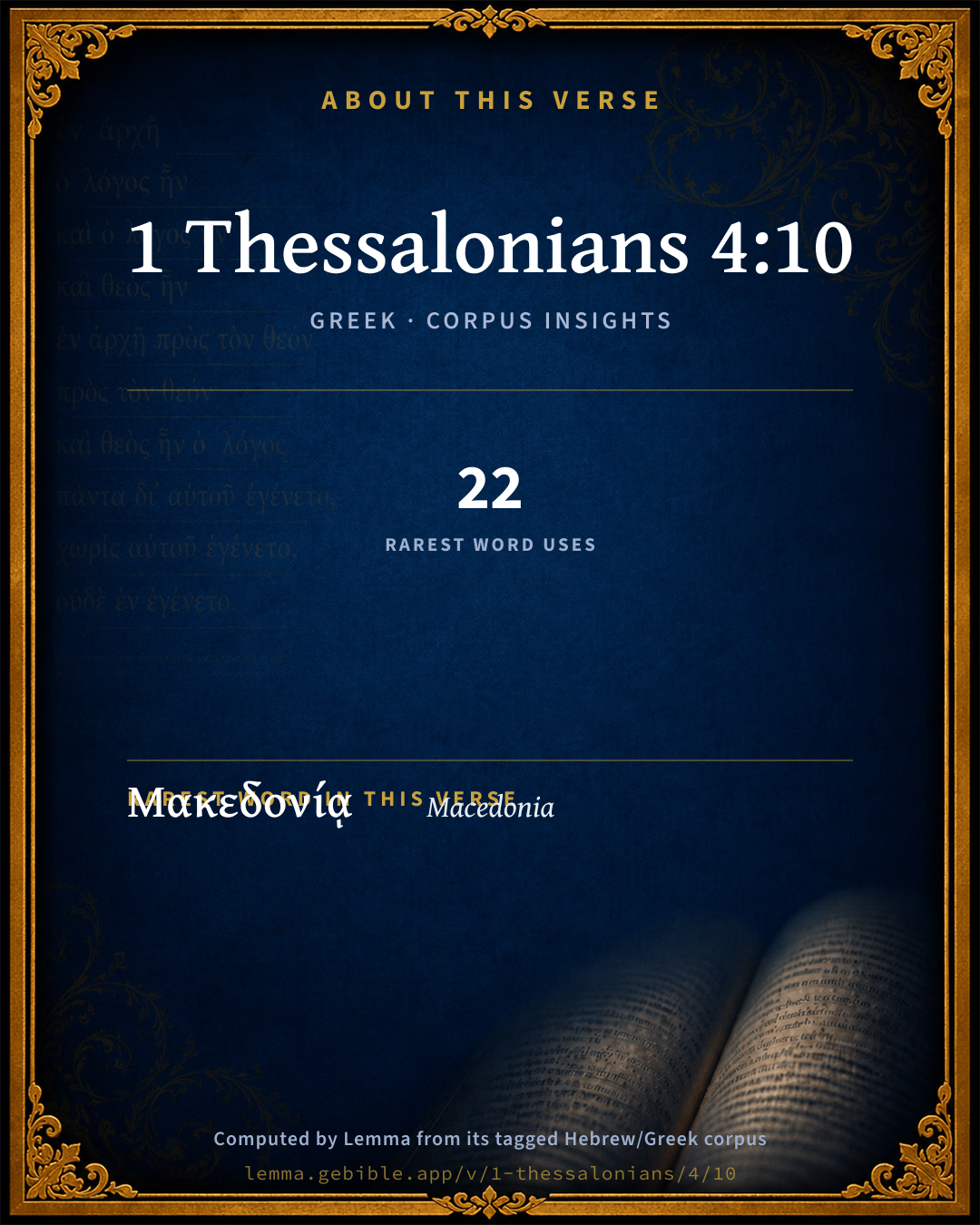
The rarest word here is Μακεδονίᾳ Macedonia G3109 — appearing just 22 times in the whole Greek New Testament.

Shared distinctive vocabulary

Μακεδονίᾳ Macedonia G3109 occurs in 20 verses of the Greek New Testament. Also found in:

Repetition

Words recur within this verse:

  • ἀδελφοὺς brother G80 ×2
  • τοὺς the G3588 ×2

Cross-references

12

Topical passages linked to 1 Thessalonians 4:10 in the Treasury of Scripture Knowledge — connected by theme and wording, ordered by reader-vote popularity; previews shown in the World English Bible.

  • Philippians 1:9 This I pray, that your love may abound yet more and more in knowledge and all discernment;
  • 1 Thessalonians 3:12 and the Lord make you to increase and abound in love one toward another, and toward all men, even as we also do toward you,
  • 2 Thessalonians 1:3 We are bound to always give thanks to God for you, brothers, even as it is appropriate, because your faith grows exceedingly, and the love of each and every one of you towards one another abounds;
  • 1 Thessalonians 1:7 so that you became an example to all who believe in Macedonia and in Achaia.
  • 2 Corinthians 8:1–2 Moreover, brothers, we make known to you the grace of God which has been given in the assemblies of Macedonia;
  • 2 Corinthians 8:8–10 I speak not by way of commandment, but as proving through the earnestness of others the sincerity also of your love.
  • Philippians 3:13–15 Brothers, I don't regard myself as yet having taken hold, but one thing I do. Forgetting the things which are behind, and stretching forward to the things which are before,
  • Colossians 1:4 having heard of your faith in Christ Jesus, and of the love which you have toward all the saints,
  • 1 Thessalonians 4:1 Finally then, brothers, we beg and exhort you in the Lord Jesus, that as you received from us how you ought to walk and to please God, that you abound more and more.
  • 2 Peter 3:18 But grow in the grace and knowledge of our Lord and Savior Jesus Christ. To him be the glory both now and forever. Amen.
  • Ephesians 1:15 For this cause I also, having heard of the faith in the Lord Jesus which is among you, and the love which you have toward all the saints,
  • Philemon 1:5–7 hearing of your love, and of the faith which you have toward the Lord Jesus, and toward all the saints;

Cross-references courtesy of OpenBible.info (CC BY 4.0).

Commentary

Notes on 1 Thessalonians 4:10 from classic Christian and Jewish commentators (each source and its license shown beneath its notes). The classic Christian expositions comment on the surrounding passage and are grouped to its opening verse, so a note may address several verses; the Jewish commentaries on the Tanakh (Rashi and others) are per-verse, so they appear only where the commentator wrote on this verse.

Lemma curates 59 commentaries, every one of them public domain or Creative Commons licensed, each selected and text-cleaned for this edition rather than reprinted as found. About our sources →

Tyndale Open Study Notes

Tyndale Open Resources

4:10 The Thessalonian believers demonstrated love toward all the believers in the province of Macedonia (Philippi and Berea; see also 1:7-8) through economic aid (cp. 2 Cor 8:1-5).

Tyndale Open Study Notes — © Tyndale Open Resources, licensed CC BY-SA 4.0. Text via the HelloAO Bible API.

Meyer's Critical & Exegetical Commentary

Heinrich August Wilhelm Meyer

1Th_4:10. An explanatory confirmation of the statement θεοδίδακτοί ἐστε εἰς τὸ ἀγαπᾶν ἀλλήλους by an actual historical instance. Calvin finds in 1Th_4:10 an argumentum a majore ad minus: nam quum eorum caritas per totam Macedoniam se diffundat, colligit non esse dubitandum, quin ipsi mutuo inter se ament. But the emphasis rests not on ἀλλήλους and τοὺς ἀδελφοὺς τοὺς ἐν ὅλῃ τῇ Μακεδονίᾳ, but on ἀγαπᾶν and ποιεῖτε. Also the opinion of de Wette, whom Koch follows, that an additional reason is here adduced why the Thessalonians require no further exhortation, is to be rejected, as then καὶ ποιεῖτε would require to be written instead of καὶ γὰρ ποιεῖτε, because γάρ cannot be co-ordinate with the preceding γάρ.

καὶ γάρ] not equivalent to simple γάρ (so most critics), and also not quin etiam, or imo (Calvin), but for also; comp. Hartung, Partikell. I. p. 137 f. Whilst γάρ is a justification of ἀγαπᾶν, the idea of διδαχθῆναι is carried on to the idea of ποιεῖν by means of the corresponding καί.

ποιεῖτε] has the chief accent; it denotes the actual practice.

αὐτό] scilicet, τὸ ἀγαπᾶν, not τὸ τῆς φιλαδελφίας (Baumgarten-Crusius and Koch).

περισσεύειν μᾶλλον] to increase yet more, scilicet, in brotherly love. Musculus, appealing to Php_4:12, arbitrarily takes περισσεύειν absolutely, whilst he makes a new train of thought commence with παρακαλοῦμεν: qua eos redigat in ordinem, qui doctrina charitatis ad ignaviae suae, desidiei, curiositatis et quaestus occasionem abutebantur, nihil operis facientes, sed otiose ac curiose circumeundo ex aliorum laboribus victitantes, and finds the meaning: ut abundetis magis, h. e. ut magis in eo sitis, ut copiam eorum, quae ad vitae hujus sunt sustentationem necessaria, habeatis, quam ut penuriam patientes fratribus sitis oneri. Equally erroneously, because unnatural, Ewald thinks that as the following φιλοτιμεῖσθαι, so also even περισσεύειν μᾶλλον, is to be included in the unity of idea with ἡσυχάζειν κ.τ.λ., 1Th_4:11 : to keep quiet still more, and zealously, etc. Besides, the construction of περισσεύειν, with a simple infinitive following, would be wholly without example.[51]

μᾶλλον] The same intensification as in 1Th_4:1.

[51] Ewald in vain endeavours anew to defend the above construction of the words in his Jahrb. d. bibl. Wissenschaft, 10 Jahrb. Gött. 1860, p. 241 ff.: That the apostle, after he had before said that it was not necessary to write to the Thessalonians concerning brotherly love, because they sufficiently practised it, could not, without self-contradiction, proceed to say, but we exhort you yet to increase in brotherly love. In this Ewald is certainly right. But Paul only declared before that the Thessalonians practised brotherly lovethat they already practised it sufficiently we do not read; this, on the contrary, is only arbitrarily introduced by Ewald.

REMARK.

After the example of Schrader, Baur (p. 484) finds also 1Th_4:9-10 only suitable for a church which had already existed for a considerable time. How otherwise could the brotherly love of the Thessalonians, which they showed to all the brethren in all Macedonia, be praised as a virtue already so generally proved? Certainly Paul recognises the brotherly love of the Thessalonians as a virtue already proved; but Baur, no less than Schrader, overlooks (1) that not εἰς πάντας τοὺς ἁγίους, but εἰς πάντας τοὺς ἀδελφοὺς ἐν ὅλῃ τῇ Μακεδονίᾳ, is written; consequently, the exercise of that virtue is limited to the Christian circle nearest to the Thessalonians; (2) that Paul yet desires an increase in that virtue, thus indicating that the exercise of it had only shortly before commenced. An interval of half a year (see Introduction, § 3) was accordingly a sufficient time for the Thessalonians to make themselves worthy of a praise restricted within such bounds.

Meyer — Critical and Exegetical Commentary on the New Testament — English translation by Peter Christie, edited by Frederick Crombie (T&T Clark, 1880) — public domain. Text from a community e-Sword module.

International Critical Commentary

10. καὶ γὰρ ποιεῖτε κτλ. “For you are also doing it,” that is, τὸ ἀγαπᾷν ἀλλήλου. With καὶ γά (3:4), Paul “confirms the statement that they had already been divinely instructed in regard to it” (Lillie) and strengthens the reason for οὐ χρείαν ἔχετ (v. 9). Two points are in mind (cf. 1:8): (1) not only are they taught it, they also practise it; (2) they practise it not only at home but also throughout all Macedonia. These two points are so combined that the proof of love at home is found in the love exhibited toward all the Macedonian Christians, an argument from the greater to the less (Calvin).

On ποιεῖν εἰ, cf. 1Co 10:31. B alone puts a και before εἰ, marking the advance from ἀλλήλου to πάντα BKLH (?) repeat τού after ἀδελφού (cf. 1:8, 2:1); אADGF, et al., omit; it is hard to tell whether it has been inserted as an improvement of style (Zim Dob.) or whether it is original, the omission being due to partial haplography; cf. Phm 1:6 ἀγαθοῦ του (AC omit του). ὅλῃ may be enthusiastic (cf. 1:7-8), but Thessalonica as well as Philippi and Berœa may have been a centre of influence for Macedonia as a whole; cf. 2Co 1:1 τοῖς οὖσιν ἐν ὅλῃ τῇ Ἀχαίᾳ The disposition to love all the Macedonian Christians may have expressed itself both in hospitality to visiting brothers, Philippians, Berœans, and others (Dob.), and “in ministering to the necessity of other churches” (McGiffert, EB 5041). Mill. (XLVII) quotes a remark of Jerome, in his commentary on Galatians (Migne, PL. 26, 356), that reveals the charitable disposition of the Macedonians of his day: Macedones in charitate laudantur et hospitalite ac susceptione fratrum.

(4) Idleness (4:10b.12)

Though the readers are practising brotherly love, yet (δε) Paul urges them both generally “to abound the more” (cf. v. 1) in that virtue, and specifically “to strive to be calm, and to mind their own business, and to work with their hands.” This last injunction at least (ἐργάζεσθα) is not new (cf. II 3:10), as he forthwith proceeds to add (καθὼς ὑμῖν παρηγγείλαμε; cf. v. 2); it is repeated here (v. 12) to the end (1) that the readers may behave themselves becomingly, having in mind the opinion of non-Christians, and (2) that they may be dependent on no one for support.

Precisely what the situation is to which Paul speaks, beyond the fact that it has to do with brotherly love, is not clear. It may be assumed that the belief in the coming of the Lord had created in the minds of some of the converts a feeling of restlessness and excitement which manifested itself outwardly in idleness and meddlesomeness in the affairs of the brotherhood. The idlers, we may imagine, being in want, had asked support from the church, and being refused on the ground that they were able to support themselves, had attempted to interfere in the affairs of the group. The peace of the brotherhood was disturbed and Christianity was falling into disrepute with unbelievers. Being in doubt as to how brotherly love was to be exhibited in such a case, the leaders wrote Paul for advice.

The clue to the interpretation of vv. 10b-12 is given in II 3:6-15 without which our verses would remain obscure. But neither I nor II tells us precisely wherein the meddlesomeness, alluded to in πράσσειν τὰ ἴδι and expressed in περιεργάζεσθα (II 3:11), consists. For idleness, while it naturally leads to poverty and to demands upon the brotherhood for support (Theodoret, Estius, Lft.), does not of itself involve interference with the affairs of the church. But as the position of πράσσειν τὰ ἴδι before ἐργάζεσθα intimates, meddlesomeness, the result of idleness, is the disturbing factor. Some light may be thrown on the situation by hints given in 5:12 ff. In 5:12-13, for example, the readers are urged to appreciate the worth of (εἰδένα as v. 4) “those who labour among you,” those, namely, who act as leaders and function as νουθετοῦντε; and to regard them highly in love on account of their work. Furthermore, the readers are commanded to be at peace not with them, but among themselves; and also to warn the idlers (5:14). In 5:19-22 they are exhorted not to quench the operations of the Spirit, not to despise the gift of prophecy; and again are bidden to test all sorts of charismata, holding fast to such as make for edification and holding aloof from every evil kind of charismata. In 5:23 the God of peace is invoked; and in 5:27 this letter is ordered read to all the brethren. From these statements we may surmise that the idlers (οἱ ἄτακτο, 5:14) are the disturbing element in the brotherhood, their idleness being due to a religious cause, namely, the excitement occasioned by the expectancy of the coming of the Lord. They became poor and asked “the workers among them” for assistance, only to be refused on the ground that the applicants were able but unwilling to support themselves, and were thus acting in direct violation of what Paul had taught (II 3:10: εἴ τις οὐ θέλει ἐργάζεσθαι μηδὲ ἐσθιέτ, a passage which suggests that καθὼς ὑμῖν παρηγγείλαμε (I 4:11) is to be restricted to ἐργάζεσθα). The leaders were probably not tactful, as εἰρηνεύετε ἐν ἑαυτοῖ (5:13) implies and II 3:13, 15 confirms. Possibly the demand of the idlers was made “in the Spirit,” on the analogy of Did. 11:12: ὅς δʼ ἂν εἴπῃ ἐν πνεύματι· Δός μοι ἀργύρια ἢ ἕτερά τινα, οὐκ ἀκούσεσθε αὐτου Such a misuse of spiritual gifts may well have led “the workers among you” to distrust the validity of the χαρίσματ; in which case the exhortation in 5:19-22 is ad hoc. The invocation of the God of peace in 5:23 is pertinent; the solemn adjuration that the letter be read to all the brethren intimates that some of the idlers had asserted that they would give no heed to the epistolary injunctions of Paul, a suggestion confirmed by II 3:14, 17.

10bWe urge you, however, brothers to abound the more, 11and to strive to be calm and to mind your own business, and to work with your hands as we charged you, 12in order that you may behave yourselves becomingly in reference to the unbelievers and may have need of no one to support you.

International Critical Commentary — older volumes (1896–1929), various authors — public domain. Text from a community e-Sword module.

Jamieson, Fausset & Brown

Robert Jamieson, A. R. Fausset & David Brown

And indeed--Greek, "For even."

Jamieson, Fausset & Brown — Commentary Critical and Explanatory on the Whole Bible (1871) — public domain (CC PDM 1.0). Text via the HelloAO Bible API.

Adam Clarke's Commentary

Verse 10. Ye do it toward all the brethren] Ye not only love one another at Thessalonica, but ye love all the brethren in Macedonia; ye consider them all as children of the same Father; and that all the Churches which are in Christ make one great and glorious body, of which he is the head.

Adam Clarke's Commentary on the Bible (1810–1826) — public domain. Text from a community e-Sword/MySword module.

John Calvin's Commentaries

10 And we exhort you. Though he declares that they were sufficiently prepared of themselves for all offices of love, he nevertheless does not cease to exhort them to make progress, there being no perfection in men. And, unquestionably, whatever appears in us in a high state of excellence, we must still desire that it may become better. Some connect the verb φιλοτιμεῖσζαι with what follows, as if he exhorted them to strive at the maintaining of peace; but it corresponds better with the expression that goes before. For after having admonished them to increase in love, he recommends to them a sacred emulation, that they may strive among themselves in mutual affection, or at least he enjoins that each one strive to conquer himself; and I rather adopt this latter interpretation. That, therefore, their love may be perfect, he requires that there be a striving among them, such as is wont to be on the part of those who eagerly aspire at victory. This is the best emulation, when each one strives to overcome himself in doing good. As to my not subscribing to the opinion of those who render the words, strive to maintain peace, this single reason appears to me to be sufficiently valid — that Paul would not in a thing of less difficulty have enjoined so arduous a conflict — which suits admirably well with advancement in love, where so many hindrances present themselves. Nor would I have any objection to the other meaning of the verb — that they should exercise liberality generally towards others.

John Calvin's Commentaries (1540-1563) — public domain. Text from the Calvin Translation Society English edition (1840s-50s) via the Christian Classics Ethereal Library (ccel.org). Calvin's coverage is partial (roughly two-thirds of the Bible); uncommented books and verses are honest gaps, never fabricated. The 19th-century editor's footnotes and remarks are omitted so the notes are faithfully Calvin's own voice.

Ellicott's Commentary for English Readers

(10) And indeed ye do it—i.e., “love one another;” but the words seem to imply a very practical form of love. This fact justifies St. Paul in saying that the Thessalonians were so taught of God.

Toward.—Rather, even unto; as far as unto. The Thessalonians’ charity has travelled already a long way from its starting-point at home, extending over all northern Greece. As Thessalonica had been the centre of evangelisation (1Th_1:8), so also of the maintenance of the Churches. The words need not necessarily (though they do probably) imply a number of missionary stations besides the three places where the Apostles had preached.

Increase more and more.—A little too emphatic: abound (or, overflow) still more. The words are identical with those in 1Th_4:1. The brotherly kindness of the Thessalonians did not spread over a wide enough area in merely traversing Macedonia, nor was it so unostentatious as true love should be.

A Bible Commentary for English Readers, edited by Charles John Ellicott (1878–1897) — public domain. Text from a community e-Sword module.

The Cambridge Bible for Schools and Colleges

gen. ed. J. J. S. Perowne

10. And indeed] should be For indeed. Their practice of the Divine lesson, as described in this verse, showed that they were truly “taught of God” to this effect.

ye do it towards all the brethren which are in all Macedonia] Thessalonica was a prosperous commercial city and the capital of Macedonia (see Introd. Chap. I.). It was the natural centre of the Macedonian Churches—including Philippi and Berœa, with other communities which had probably sprung up around these principal towns. The Thessalonian Christians were using their position and influence for the good of their brethren around them, and thus giving proof that they had learnt the great lesson of Divine grace. Silas and Timothy, recently returned from Macedonia (Act_18:5; see ch. 1Th_3:6), had doubtless told the Apostle how well they did their duty towards the neighbour Churches (comp. ch. 1Th_1:7-8, and notes).

but we beseech you, brethren] should be exhort (R. V.), as in 1Th_4:1 (comp. note, also on “comfort,” ch. 1Th_3:2); same word in 1Th_4:18, and ch. 1Th_5:11; 1Th_5:14.

that ye increase &c.] Better rendered, that you abound still more; the Apostle repeats the exact phrase employed in 1Th_4:1, which takes up the verb of ch. 1Th_3:12 (see notes).

In all Christian virtues growth is possible and desired, but “brotherly love” above others is susceptible of constant and unlimited increase. The Apostle reverts to this point once more, in ch. 1Th_5:16.

Philadelphia (brother-love) in common Greek did not go beyond its literal sense. In Christian speech it was at once applied to the “brothers” of the new life in Christ, those who are united in the acknowledgement of God as their Father (ch. 1Th_1:1, see note). Comp. 1Jn_4:21; 1Jn_5:1, “This commandment have we from Him, that he who loveth God love his brother also.… Whosoever loveth Him that begat, loveth him also that is begotten of Him.” The word recurs in Rom_12:10; Heb_13:1; 1Pe_1:22; also in 2Pe_1:7, where in “brother-love” charity (or love) is directed to he “supplied,” as its spiritual and universal principle.

From the second topic of his “charge,” which the Apostle is happily able to dismiss in a few words, he proceeds to the third:—

The Cambridge Bible for Schools and Colleges (gen. ed. J. J. S. Perowne; Cambridge University Press, 1878–1918) — public domain. Text from a community e-Sword module.

John Gill's Exposition

And indeed ye do it towards all the brethren,.... Whether high or low, rich or poor, bond or free, greater or lesser believers, and whether related in the bonds of nature or not; they exercised this grace of love without respect of persons, to all, and not only to all the brethren in the particular community at Thessalonica, but

which are in all Macedonia; throughout the whole country, particularly at Philippi and Berea, and other places:

but we beseech you, brethren. The Alexandrian copy reads, "beloved brethren"; and the Syriac version, "I beseech you, my brethren: that ye increase more and more"; in showing love to the brethren; which may be done both by administering to them in things temporal, by assisting them in distress, by sympathizing with them, and by giving them counsel and advice; and in things spiritual, by bearing their burdens, forbearing with them, and forgiving them; by admonishing them in love, by stirring them up to love and good works, by praying with them and for them, and by instructing and building them up in their most holy faith; and this increase, and abounding in the exercise of this grace, may respect not only the more frequent and fervent use of it, but also the larger extent of it to other objects; as not only to all the brethren in their own church, and to all that were in Macedonia, to which it did extend, but likewise to all the brethren in other parts of the world, and which are more distant and remote; and even to the poor saints at Jerusalem in particular; and accordingly we find that their love did abound unto them; see Rom 15:25, this shows, that though brotherly love was much practised by these saints, yet it was not perfect; nor is any grace perfect as to degrees; nor is any saint perfect in the discharge of duty in this life.

John Gill's Exposition of the Whole Bible (1746–1763) — public domain (CC PDM 1.0). Text via the HelloAO Bible API.

Trapp's Complete Commentary

John Trapp

10 And indeed ye do it toward all the brethren which are in all Macedonia: but we beseech you, brethren, that ye increase more and more;

Ver. 10. Towards all the brethren] This universality of their love showed the sincerity of it, and that it was for the truth’s sake, 2Jn 1:2. One or more good men may be favoured of those that love no good man, as Jeremiah was of Nebuzaradan, because he foretold the victory.

John Trapp, A Commentary or Exposition upon All the Books of the Old and New Testament (1647–1656) — public domain. Text from a community e-Sword module.

Albert Barnes' Notes on the Bible

And indeed ye do it - See the notes on 1Th 1:7.

But we beseech you, brethren, that ye increase more and more - See the notes at 1Th 3:12. Here, as elsewhere, the apostle makes the fact that they deserved commendation for what they had done, a stimulus to arouse them to still higher attainments. Bloomfield.

Albert Barnes' Notes on the Bible (1834–1885) — public domain. Text from a community e-Sword/MySword module.

Matthew Poole's English Annotations

As an evidence of the truth of their love for which he commended them, and that they were taught it of God, he gives a practical instance of it in this verse; else the apostle might have been thought to flatter, or to command a love that was without fruit; and therefore he saith not, ye profess it, but ye do it: so 2Co 8:11, perform the doing of it.

Toward all the brethren which are in all Macedonia; which was a large province, wherein were planted many churches. Their love was not guided by interests, opinions, civil relations, or self-respects, but it reached to all that were brethren; and that in some real effect of it, in some work of charity, or liberality, or otherwise, not here mentioned, but we read of it, 2Co 8:1,2.

But we beseech you, brethren, that ye increase more and more; but, however, their love was not yet perfect, and therefore he beseecheth them to abound more and more; either meant as to the extent of it, not to confine it only to Macedonia, or as to the degree of it, to excel men in it, as the Greek word may be rendered: and the same word the apostle useth, and upon the same account, 2Co 8:7. Neither love, nor any other grace, is made perfect at once; even those that are taught of God, are taught by degrees. And love being a grace so suitable to the gospel, and their present suffering state, he therefore especially exhorts to a progress in it.

Matthew Poole's English Annotations on the Holy Bible (1683–1685) — public domain. Text from a community e-Sword/MySword module.

Whedon's Commentary on the Bible

Daniel D. Whedon

10. Ye do it—Timothy had seen it and reported.

More and more—What you have is of the right sort; let it richly abound.

Daniel D. Whedon (gen. ed.), Commentary on the Old and New Testaments (1874–1909) — public domain. Text from a community e-Sword module.

The Pulpit Commentary

And indeed ye do it toward all the brethren which are in all Macedonia. Not only to those in Thessalonica, but to all believers in your country and neighborhood. But we beseech you, brethren, that ye increase more and more; that ye make progress in brotherly love that it increase in purity, in warmth, and in extent.

The Pulpit Commentary (1880–1919), ed. H.D.M. Spence-Jones & Joseph S. Exell — public domain. Text from a community e-Sword module.

McGarvey & Pendleton's Commentaries

J. W. McGarvey

for indeed ye do it toward all the brethren that are in all Macedonia. But we exhort you, brethren, that ye abound more and more [Though their love already reached beyond the large confines of Thessalonica, and took in all Macedonia, Paul exhorts them to extend it to even a larger compass. Christian love must embrace the world];

J. W. McGarvey (with Philip Y. Pendleton), Commentaries on the New Testament (The Fourfold Gospel, 1914; Acts; and the epistles) — public domain. Text from a community e-Sword/MySword module.

The People's New Testament

B. W. Johnson

10. And indeed ye do. Their conduct showed their brotherly love.

B. W. Johnson's The People's New Testament with Notes (1889–1891) — public domain. Electronic text from the Christian Classics Ethereal Library (CCEL) ThML edition.

Cambridge Greek Testament for Schools and Colleges

10. τους (before εν ολῃ) wanting in א*AD*G, and presumably in codd. followed by latt vg, Ambrst. On the one hand, the article may have been lost by homœoteleuton after αδελφους; or on the other, supplied (as in BHKL) by way of grammatical improvement.

Cambridge Greek Testament for Schools and Colleges (Cambridge University Press, 1896; 21 vols, various authors incl. Carr, Maclear, Plummer, Farrar, Lumby, Moule, M. R. James, Simcox) — public domain. Text from a community e-Sword module.

Alford’s Greek Testament

Henry Alford

10.] follows up the θεοδίδακτοί ἐστε by a matter of fact, shewing the teaching to have been in some measure effectual.

καί γάρ] the καί belongs to ποιεῖτε—‘besides being taught it, ye do it,’—ποιεῖτε carrying the emphasis of the sentence.

αὐτό, scil. τὸ ἀγαπᾷν ἀλ.

περισσεύειν, viz. in this ἀγάπη. (But there does not seem any reason, with Jowett, to ascribe this αταξία to their uneasiness about the state of the dead: much rather (as he also states: see below) to their mistaken anticipations of the immediate coming of the Lord.) It would seem as if, notwithstanding their liberality to those without, there were some defect of quiet diligence and harmony within, which prompted this exhortation: see 2Th 3:11, 2Th 3:12. Thdrt. assigns another reason for it: οὐκ ἐναντία τοῖς προῤῥηθεῖσιν ἐπαίνοις ἡ παραίνεσις. συνέβαινε γὰρ τοὺς μὲν φιλοτίμως χορηγεῖν τοῖς δεομένοις τὴν χρείαν, τοὺς δὲ διὰ τὴν τούτων φιλοτιμίαν ἀμελεῖν τῆς ἐργασίας· εἰκότως τοίνυν κἀκείνους ἐπῄνεσε, καὶ τούτοις τὰ πρόσφορα συνεβούλευσε. (So also Est., Benson, Flatt, Schott, and De W.) Lünem. objects to this, that thus the Church would be divided into two sections, the one exhorted to persist and abound in their liberality, the other to work diligently to support themselves; whereas there is no trace in the text of such a division. He therefore would abandon the idea of a connexion, and treat vv. 11, 12 as applying to a totally distinct subject; accounting for its introduction in such close grammatical connexion with ver. 10, by St. Paul’s rapid transitions in the practical parts of his Epistles. But we may well answer, that instances are frequent enough of exhortations being addressed to whole churches which in their application would require severing and allotting to distinct classes of persons.

Henry Alford, The Greek Testament (1849–1861) — public domain. Text from a community e-Sword module.

Lesson kit

Teaching starters — assembled from the data on this page, not authored interpretation. Every prompt links to the verse data it draws on. Edit before teaching.

1 Thessalonians, in the Pauline Epistles, opens this verse with 18 words (16 distinct Greek lemmas). Its most distinctive word is Makedonía (“Macedonia”). A historical commentator’s framing appears above. Read the whole chapter for the surrounding context.

Discussion questions

  1. The word Makedonía carries the sense “Macedonia.” How does it shape the verse?
  2. Acts 16:9 shares the word «Macedonia» with this verse. How do the two illuminate each other?
  3. “brother” occurs 2× in this one verse. What is the effect of the repetition?
  4. These translations render this verse differently. What is at stake in choosing one wording over another?
  5. Reading how Tyndale Open Study Notes and Meyer's Critical & Exegetical Commentary read this verse, where do the two commentators agree and where do they part?

Things to notice

Reading settings

Reading text

Shown beneath each verse's original-language words.

Old Testament
Old Testament edition

Read the OT as the Masoretic Hebrew (MT) or the Greek Septuagint (LXX).

English shown for the Greek Septuagint (in the Hebrew ↔ Greek comparison).

Comparing translations? Open the Compare panel on any verse page to stack up to four side by side.