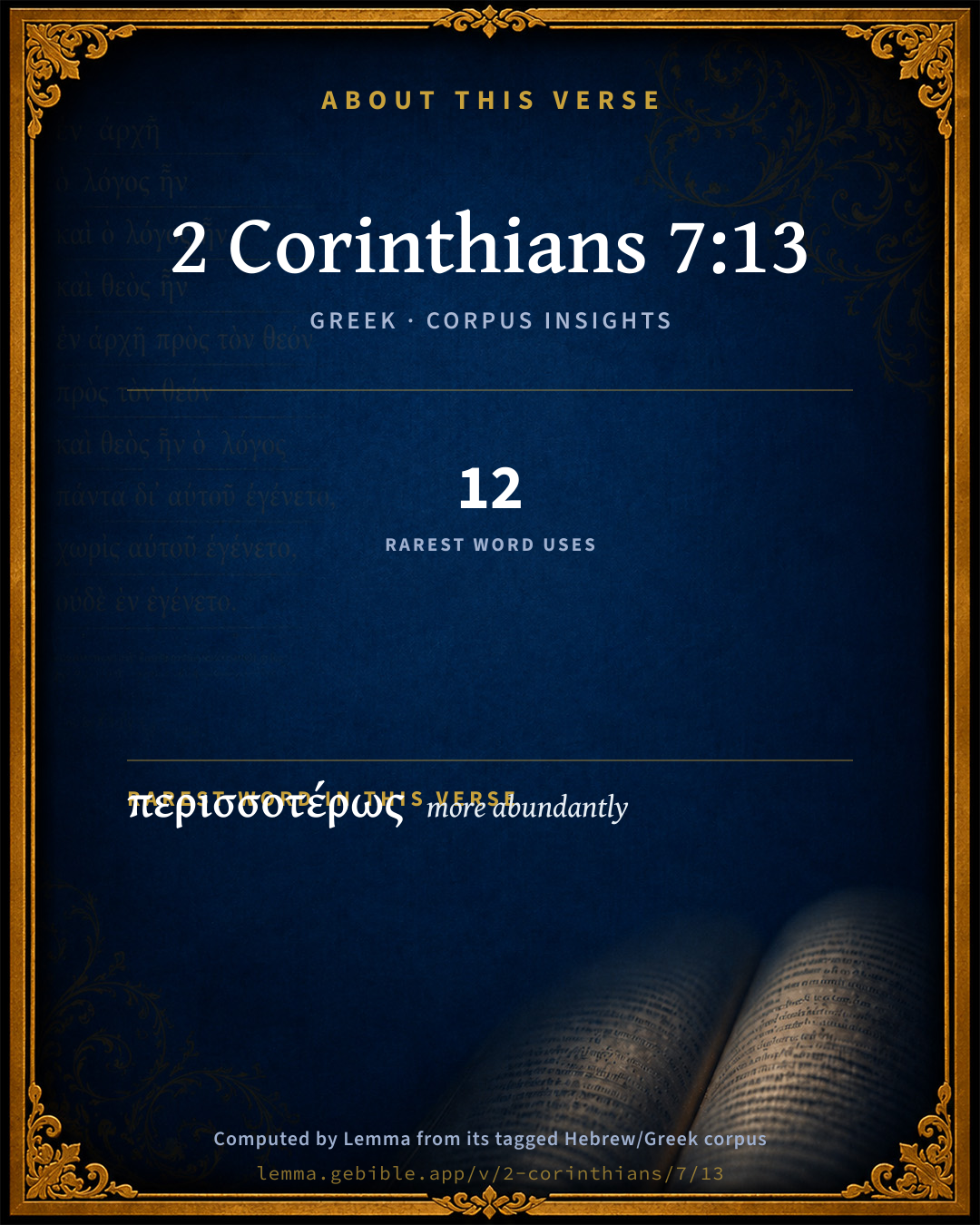
2 Corinthians 7:13

Greek (Tischendorf 8th ed.) 2 Corinthians 7:13 appears in the Greek New Testament. The text above is from the Tischendorf 8th edition. Each word links to its Strong’s number and a concise gloss. Click any word for its full Thayer’s Greek Lexicon entry.
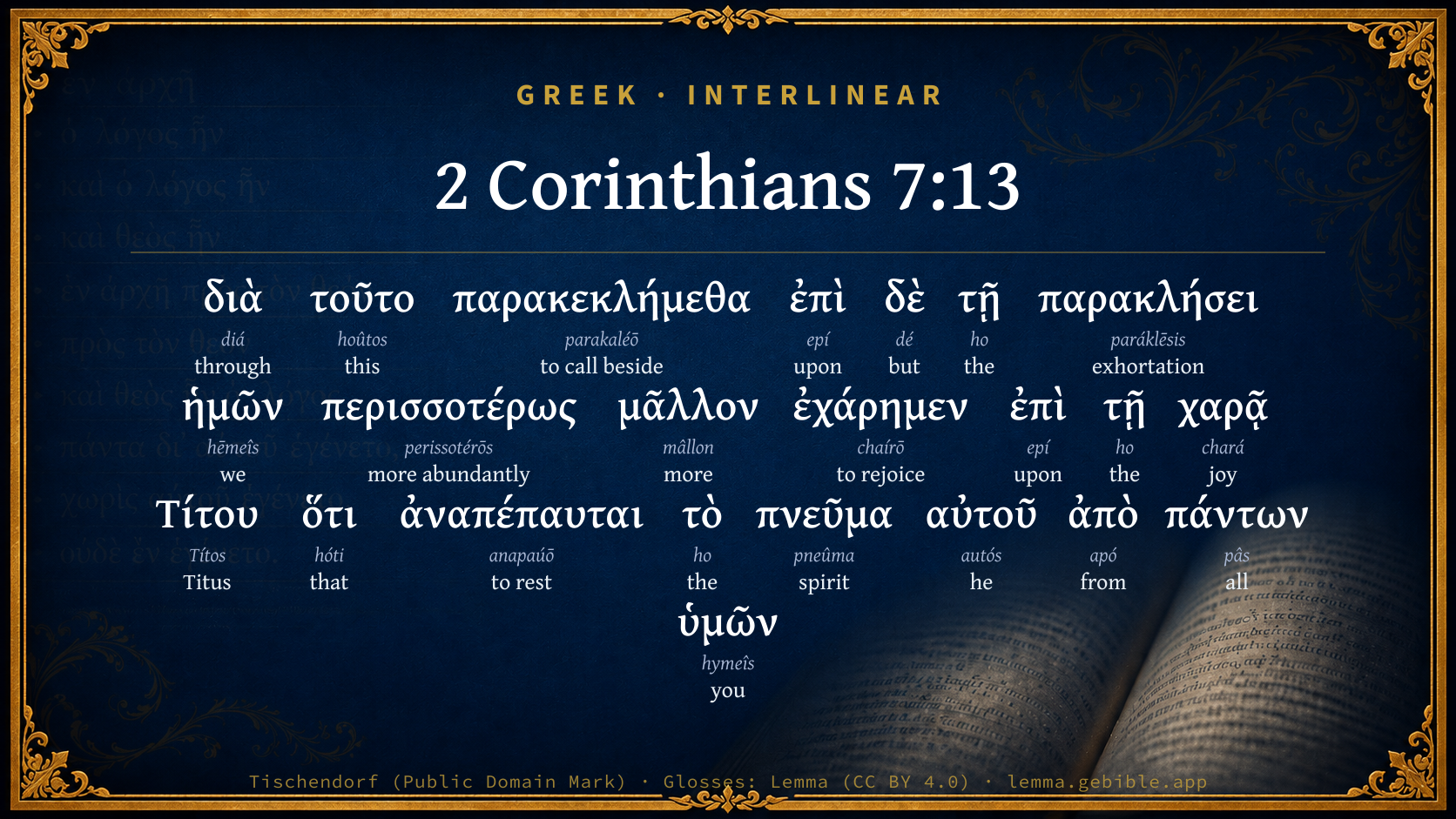
Download image
Cite this verse

2 Corinthians 7:13 (World English Bible). Public Domain. Lemma interlinear Bible study tool, https://lemma.gebible.app/v/2-corinthians/7/13.

Show BibTeX & RIS
BibTeX
RIS
English Translation
Therefore we have been comforted. In our comfort we rejoiced the more exceedingly for the joy of Titus, because his spirit has been refreshed by you all.
World English Bible · Public Domain
Download a study sheet

One document with this verse’s original text, its word-by-word gloss line, the meaning frame, cross-references with their text, attributed commentary, and full source and license credits — printable, and it pastes into notes with its structure intact.

This verse Autodidact and up

Study sheet (.html) Plain text (.txt)

A passage Seminary Student

Up to 50 verses in one chapter. A passage sheet keeps up to 6 commentary sources and 12 cross-references per verse, in the order this page ranks them, and says so on the sheet whenever that leaves anything out. Ask for a single verse and you get the Autodidact verse sheet above.

Everything on this page stays free to read, with no account — the sheet is a download of what is already on screen, not access to it.

Want to remove ads? Support Godless Engineer
Compare translations 3

The same verse in 3 English versions, stacked beneath the original-language interlinear above. Click any original word for its lexicon entry.

Each is an independent rendering of the whole verse — the interlinear is not word-aligned to these translations.

Highlighted words mark where these versions differ — a whole-verse word diff, not a word-by-word alignment.

  • World English Bible Public Domain
    Therefore we have been comforted. In our comfort we rejoiced the more exceedingly for the joy of Titus, because his spirit has been refreshed by you all.
  • King James Version Public Domain
    Therefore we were comforted in your comfort: yea, and exceedingly the more joyed we for the joy of Titus, because his spirit was refreshed by you all.
  • unfoldingWord Literal Text CC BY-SA 4.0
    Because of this we have been encouraged. Now in addition to our own encouragement, we rejoiced even more abundantly at the joy of Titus, because his spirit had been refreshed by all of you.

unfoldingWord Literal Text — © unfoldingWord, licensed CC BY-SA 4.0. Word-aligned USFM3 via Door43 (git.door43.org/unfoldingWord/en_ult).

Versions to compare (up to 4)

3 of 4 selected

Show all 19 translations

Every available English version of this verse, each an independent rendering of the whole verse.

  • World English Bible Public Domain
    Therefore we have been comforted. In our comfort we rejoiced the more exceedingly for the joy of Titus, because his spirit has been refreshed by you all.
  • Berean Standard Bible Public Domain
    On account of this, we are encouraged. In addition to our own encouragement, we were even more delighted by the joy of Titus. For his spirit has been refreshed by all of you.
  • Majority Standard Bible Public Domain
    On account of this, we are encouraged. And in your encouragement, we were even more delighted by the joy of Titus. For his spirit has been refreshed by all of you.
  • King James Version Public Domain
    Therefore we were comforted in your comfort: yea, and exceedingly the more joyed we for the joy of Titus, because his spirit was refreshed by you all.
  • American Standard Version (1901) Public Domain
    Therefore we have been comforted: And in our comfort we joyed the more exceedingly for the joy of Titus, because his spirit hath been refreshed by you all.
  • Revised Version (1885) Public Domain
    Therefore we have been comforted: and in our comfort we joyed the more exceedingly for the joy of Titus, because his spirit hath been refreshed by you all.
  • Geneva Bible (1599) Public Domain
    Therefore we were comforted, because ye were comforted: but rather we reioyced much more for the ioye of Titus, because his spirit was refreshed by you all.
  • Douay-Rheims (1899) Public Domain
    Before God: therefore we were comforted. But in our consolation, we did the more abundantly rejoice for the joy of Titus, because his spirit was refreshed by you all.
  • Young's Literal Translation Public Domain
    because of this we have been comforted in your comfort, and more abundantly the more did we rejoice in the joy of Titus, that his spirit hath been refreshed from you all;
  • Literal Standard Version CC BY-SA 4.0
    because of this we have been comforted in your comfort, and more abundantly the more we rejoiced in the joy of Titus, that his spirit has been refreshed from you all;
  • Unlocked Literal Bible CC BY-SA 4.0
    It is by this that we are encouraged. In addition to our own comfort, we also rejoiced even more because of Titus' joy, because his spirit was refreshed by all of you.
  • unfoldingWord Literal Text CC BY-SA 4.0
    Because of this we have been encouraged. Now in addition to our own encouragement, we rejoiced even more abundantly at the joy of Titus, because his spirit had been refreshed by all of you.
  • Darby Bible Public Domain
    For this reason we have been encouraged. And we the rather rejoiced in our encouragement more abundantly by reason of the joy of Titus, because his spirit has been refreshed by you all.
  • World Messianic Bible Public Domain
    Therefore we have been comforted. In our comfort we rejoiced the more exceedingly for the joy of Titus, because his spirit has been refreshed by you all.
  • Webster's Bible Public Domain
    Therefore we were comforted in your comfort: and exceedingly the more we rejoiced for the joy of Titus, because his spirit was refreshed by you all.
  • Free Bible Version CC BY-SA 4.0
    We are so encouraged by this. Added to our own encouragement, we were so pleased to see how happy Titus was, because you set his mind at rest.
  • Bible in Basic English Public Domain
    So we have been comforted: and we had the greater joy in our comfort because of the joy of Titus, for his spirit had been made glad by you all.
  • Text-Critical English NT CC BY 4.0
    In this we find comfort. And in addition to the comfort we received from you, we rejoiced all the more at the joy of Titus, because his spirit has been refreshed by you all.
  • Tyndale New Testament (1534) Public Domain
    Therfore we are comforted because ye are comforted: yee and excedyngly the moare ioyed we for the ioye that Titus had: because his sprete was refresshed of you all.

Literal Standard Version (2020), Covenant Press — licensed CC BY-SA 4.0. Text via the HelloAO Bible API (eBible.org). Unlocked Literal Bible (unfoldingWord) — licensed CC BY-SA 4.0. Text via the HelloAO Bible API (eBible.org). unfoldingWord Literal Text — © unfoldingWord, licensed CC BY-SA 4.0. Word-aligned USFM3 via Door43 (git.door43.org/unfoldingWord/en_ult). Free Bible Version, Dr. Jonathan Gallagher — licensed CC BY-SA 4.0. Text via the HelloAO Bible API (eBible.org).

Word by word

More ways to search: Search by grammar → Find every occurrence → Compare this word →

Practice this passage: Drill this verse → Learn its vocabulary →

περισσοτέρως
perissotérōs
G4056
“more abundantly”
Adverb, Comparative
Part of Speech
Adverb
Degree
Comparative
Full Thayer's Definition

Origin: from G4055

TDNT: None

1. more abundantly 2. more in a greater degree 3. more earnestly, more exceedingly 4. especially, above others
  1. διὰ diá G1223 “through” Preposition
  2. τοῦτο hoûtos G3778 “this” Demonstrative pronoun, Accusative, Singular, Neuter
  3. παρακεκλήμεθα parakaléō G3870 “to call beside” Verb, Perfect, Passive, Indicative, 1st person, Plural
  4. ἐπὶ epí G1909 “upon” Preposition
  5. δὲ dé G1161 “but” Conjunction
  6. τῇ ho G3588 “the” Article, Dative, Singular, Feminine
  7. παρακλήσει paráklēsis G3874 “exhortation” Noun, Dative, Singular, Feminine
  8. ἡμῶν hēmeîs G2249 “we” Personal pronoun, 1st person, Genitive, Plural
  9. μᾶλλον mâllon G3123 “more” Adverb
  10. ἐχάρημεν chaírō G5463 “to rejoice” Verb, Aorist, Passive deponent, Indicative, 1st person, Plural
  11. ἐπὶ epí G1909 “upon” Preposition
  12. τῇ ho G3588 “the” Article, Dative, Singular, Feminine
  13. χαρᾷ chará G5479 “joy” Noun, Dative, Singular, Feminine
  14. Τίτου Títos G5103 “Titus” Noun, Genitive, Singular, Masculine
  15. ὅτι hóti G3754 “that” Conjunction
  16. ἀναπέπαυται anapaúō G373 “to rest” Verb, Perfect, Passive, Indicative, 3rd person, Singular
  17. τὸ ho G3588 “the” Article, Nominative, Singular, Neuter
  18. πνεῦμα pneûma G4151 “spirit” Noun, Nominative, Singular, Neuter
  19. αὐτοῦ autós G846 “he” Personal pronoun, Genitive, Singular, Masculine
  20. ἀπὸ apó G575 “from” Preposition
  21. πάντων pâs G3956 “all” Adjective, Genitive, Plural, Masculine
  22. ὑμῶν hymeîs G5210 “you” Personal pronoun, 2nd person, Genitive, Plural

About this verse

These counts appear in no published source. They are computed here, from the morphology-tagged text and Lemma’s own curated glosses. What Lemma adds →

23
words
20
distinct lemmas
Pauline Epistles
section

Notable vocabulary

The rarest word here is περισσοτέρως more abundantly G4056 — appearing just 12 times in the whole Greek New Testament.

Shared distinctive vocabulary

περισσοτέρως more abundantly G4056 occurs in 11 verses of the Greek New Testament. Also found in:

Repetition

Words recur within this verse:

Cross-references

13

Topical passages linked to 2 Corinthians 7:13 in the Treasury of Scripture Knowledge — connected by theme and wording, ordered by reader-vote popularity; previews shown in the World English Bible.

  • 2 Corinthians 7:6 Nevertheless, he who comforts the lowly, God, comforted us by the coming of Titus;
  • Romans 12:15 Rejoice with those who rejoice. Weep with those who weep.
  • Romans 15:32 that I may come to you in joy through the will of God, and together with you, find rest.
  • 1 Corinthians 16:13 Watch! Stand firm in the faith! Be courageous! Be strong!
  • 1 Peter 3:8 Finally, be all like-minded, compassionate, loving as brothers, tenderhearted, courteous,
  • 1 Corinthians 12:26 When one member suffers, all the members suffer with it. Or when one member is honored, all the members rejoice with it.
  • 1 Corinthians 13:5–7 doesn't behave itself inappropriately, doesn't seek its own way, is not provoked, takes no account of evil;
  • 2 Corinthians 2:3 And I wrote this very thing to you, so that, when I came, I wouldn't have sorrow from them of whom I ought to rejoice; having confidence in you all, that my joy would be shared by all of you.
  • 2 Corinthians 2:13 I had no relief for my spirit, because I didn't find Titus, my brother, but taking my leave of them, I went out into Macedonia.
  • 2 Corinthians 7:15 His affection is more abundantly toward you, while he remembers all of your obedience, how with fear and trembling you received him.
  • Philippians 2:28 I have sent him therefore the more diligently, that, when you see him again, you may rejoice, and that I may be the less sorrowful.
  • 2 Timothy 1:16 May the Lord grant mercy to the house of Onesiphorus, for he often refreshed me, and was not ashamed of my chain,
  • Philemon 1:20 Yes, brother, let me have joy from you in the Lord. Refresh my heart in the Lord.

Cross-references courtesy of OpenBible.info (CC BY 4.0).

Where the printed editions differ

1 variant

Places in this verse where the major printed Greek editions disagree on the wording in a way that affects the translation — a comparison of editions, not a manuscript-by-manuscript collation. The editions are the modern critical texts (Nestlé-Aland 28/27, SBL, Westcott-Hort, Tregelles, Tyndale House) and the traditional texts behind the KJV (the Textus Receptus and the Byzantine/Majority text). It is not a claim about which reading is original.

  1. Different wording
    ἡμῶν

    “of us”

    In NA28NA27TynSBLWHTreg Not in TRByz

    ὑμῶν (humōn) 'of you' occurs in traditional manuscripts (TR+Byz) instead of ἡμῶν (hēmōn) 'of us' in older manuscripts (NA28+NA27+Tyn+SBL+WH+Treg)

Textual data: Translators Amalgamated Greek New Testament (STEPBible TAGNT) · CC BY 4.0.

Commentary

Notes on 2 Corinthians 7:13 from classic Christian and Jewish commentators (each source and its license shown beneath its notes). The classic Christian expositions comment on the surrounding passage and are grouped to its opening verse, so a note may address several verses; the Jewish commentaries on the Tanakh (Rashi and others) are per-verse, so they appear only where the commentator wrote on this verse.

Lemma curates 59 commentaries, every one of them public domain or Creative Commons licensed, each selected and text-cleaned for this edition rather than reprinted as found. About our sources →

Tyndale Open Study Notes

Tyndale Open Resources

7:13b-16 The way the Corinthians had welcomed and obeyed Titus as Paul’s agent endeared the Corinthians to Titus and delighted Paul. The crisis at Corinth was over, and Paul had complete confidence that all was well.

Tyndale Open Study Notes — © Tyndale Open Resources, licensed CC BY-SA 4.0. Text via the HelloAO Bible API.

Bengel's Gnomon

Johann Albrecht Bengel

2Co 7:13. ʼ Επὶ τῇ παρακλήσει ὑμῶν, on account of your comfort) which followed that very sorrow.—περισσοτέρως [42] μᾶλλον, more abundantly rather [exceedingly the more]) That feeling rather [μᾶλλον] takes the name of joy than comfort; and the joy was, περισσοτέρως, mor abundant, than the comfort. So μᾶλλον with the superlative, 2Co 12:9: μᾶλλον for δὲ [43] [autem], yea and, is put here with striking effect.

[42] Tischend. and Lachm. stop thus: διὰ τοῦτο παρακεκλήμεθα. ἐπὶ δὲ τῇ παρακλήσει, etc. The δὲ is put after περισσοτέρως by Rec. Text. But after ἐπὶ by BCD(Λ) Gfg Vulg.—ED.

[43] The omission, however, of the particle δὲ both in the margin of the 2d Ed. and in the Germ. Ver., is thought to be not quite so certain.—E. B.

Bengel's Gnomon of the New Testament — English translation (T&T Clark, Edinburgh, 1860) — public domain. Text from a community e-Sword module.

Meyer's Critical & Exegetical Commentary

Heinrich August Wilhelm Meyer

2Co_7:13. Wherefore, because I had no other purpose than this (which is now attained), we are comforted; and, to our consolation there was further added a very great increase in joy over the joy of Titus, et.

ἐπὶ δὲ τῇ παρακλ. ἡμ.] ἐπί used of supervening on something already in existence.[264] See Matthiae, p. 1371; Winer, p. 368 [E. T. 490].

περισσοτ. μᾶλλον ἐχάρημεν] the joy of our consolation became still more increased. Comp. on 2Co_7:7. Regarding the strengthening of the comparative by μᾶλλον, see Pflugk, ad Eur. Hec. 377; Heind. ad Plat. Gorg. p. 679 E; Boissonade, ad Aristaen. p. 430.

ὅτι ἀναπέπαυται κ.τ.λ.] does not specify the reason of Pauls joy (Rückert, although with hesitation), for that is contained in ἘΠῚ Τ. ΧΑΡᾷ ΤΊΤΟΥ, but is a more precise definition confirmatory of Τῇ ΧΑΡᾷ ΤΊΤΟΥ; since indeed his spirit (2Co_2:13) is refreshed by you all. ἀναπέπαυται (comp. 1Co_16:18; Phm_1:7; Phm_1:20) is placed first as the pith of the thought; ἈΠΌ denotes the proceeding from, the origin: forth from, from the side of. See Bernhardy, p. 222; Kühner, ad Xen. Anab. vi. 5. 18.

[264] Yet it may also be taken simply of the state: in our consolation. But the explanation above is more in keeping with the climactic character of the discourse.

REMARK.

According to the Recepta διὰ τοῦτο παρακεκλήμεθα ἐπὶ τῇ παρακλήσει ὑμῶν· περισσοτέρως δὲ μᾶλλον κ.τ.λ., the first ἐτί is through, properly on account of, just as in ἐπὶ τῇ χαρᾷ Τίτου, so that the παράκλησις ὑμῶν is that which causes the παρακεκλήμεθα (Winer, p. 368 [E. T. 491]); but ὑμῶν is not, with Flatt, de Wette, and many others, to be explained: by the consolation, which you have afforded to me, but: consolatione vestri (Luther, Beza, Cornelius a Lapide, Bengel, and most), i.e. by your being comforted over the pain, which my Epistle caused to you, now by means of the happy change which it has produced among you (2Co_7:11). The two genitives, namely ὑμῶν and Τίτου, must be taken uniformly. On the state of the case delicately denoted by παρακλ. ὑμῶν Calvin aptly remarks: Nam correctionis acerbitas facile dulcescit, simulatque gustare incipimus, quam nobis fuerit utilis. Michaelis, on the other hand, objects that what follows will then be discourteous; but the seeming discourtesy disappears before the reason for Titus joy, and is amply outweighed by 2Co_7:14. According to Reiche, Comm. crit. I. p. 370, the παράκλησις ὑμῶν means the admonitio et castigatio given in the first Epistle, for the sharpness and severity of which Paul is now consoled by the happy result. But after παρακεκλήμεθα, according to the analogy, moreover, of ἐχάρημεν ἐπὶ τῇ χαρῇ, as well as in accordance with 2Co_7:4; 2Co_7:6, παράκλησις cannot be otherwise taken than as solatium.

Meyer — Critical and Exegetical Commentary on the New Testament — English translation by Peter Christie, edited by Frederick Crombie (T&T Clark, 1880) — public domain. Text from a community e-Sword module.

Expositor's Greek Testament

ed. W. Robertson Nicoll

2Co 7:13-16 . THE JOY OF TITUS IN THE TIDINGS HE BROUGHT. Chrysostom notes the tact which leads St. Paul to communicate this so emphatically; Titus was going back to Corinth on the business of the collection (2Co 8:6 ; 2Co 8:16 ; 2Co 8:23 ), and it was very desirable that he should be well received there. ἐπὶ δὲ τῇ παρακλήσει ἡμῶν περισσοτέρως μᾶλλον κ . τ . λ .: and in addition to this comfort of ours we rejoiced the more exceedingly ( cf. 2Co 7:7 , and for the double comparative cf. Mar 7:36 , Phi 1:23 ) at (for the constr. χαίρειν ἐπὶ cf. 1Co 13:6 ; 1Co 16:17 , etc.) the joy of Titus, because his spirit hath been refreshed by you all ( cf. the somewhat similar use of ἀπό in chap. 2Co 2:3 , Mat 11:19 , Act 2:22 ). Both here and at 2Co 7:15 πάντων is emphasised by its position before ὑμῶν ; Titus was well received by all at Corinth, and it seems to be implied at 2Co 12:18 that he left a favourable impression upon them all.

2Co 7:13 . διὰ τοῦτο παρακεκλ .: wherefore we have been comforted . With Tisch., W.H. and modern editors generally we place a full stop here. What follows introduces a new idea.

The Expositor's Greek Testament, edited by W. Robertson Nicoll (1897–1910) — public domain. Text from a community e-Sword module.

Jamieson, Fausset & Brown

Robert Jamieson, A. R. Fausset & David Brown

The oldest manuscripts read thus, "Therefore (Greek, 'for this cause,' namely, because our aim has been attained) we have been (English Version, 'were,' is not so accurate) comforted; yea (Greek, 'but'), in OUR comfort we exceedingly the more joyed for the joy of Titus," &c. (compare Co2 7:7).

Jamieson, Fausset & Brown — Commentary Critical and Explanatory on the Whole Bible (1871) — public domain (CC PDM 1.0). Text via the HelloAO Bible API.

Adam Clarke's Commentary

Verse 13. For the joy of Titus] Titus, who had now met St. Paul in Macedonia, gave him the most flattering accounts of the improved state of the Corinthian Church; and indeed their kind usage of Titus was a full proof of their affection for St. Paul.

Adam Clarke's Commentary on the Bible (1810–1826) — public domain. Text from a community e-Sword/MySword module.

John Calvin's Commentaries

13. We received consolation. Paul was wholly intent upon persuading the Corinthians, that nothing was more eagerly desired by him than their advantage. Hence he says, that he had shared with them in their consolation. Now their consolation had been this — that, acknowledging their fault, they did not merely take the reproof in good part, but had received it joyfully. For the bitterness of a reproof is easily sweetened, so soon as we begin to taste the profitableness of it to us.

What he adds — that he rejoiced more abundantly on account of the consolation of Titus, is by way of congratulation. Titus had been overjoyed in finding them more obedient and compliant than could have been expected — nay more, in his finding a sudden change for the better. Hence we may infer, that Paul’s gentleness was anything but flattery, inasmuch as he rejoiced in their joy, so as to be, at the same time, chiefly taken up with their repentance.

John Calvin's Commentaries (1540-1563) — public domain. Text from the Calvin Translation Society English edition (1840s-50s) via the Christian Classics Ethereal Library (ccel.org). Calvin's coverage is partial (roughly two-thirds of the Bible); uncommented books and verses are honest gaps, never fabricated. The 19th-century editor's footnotes and remarks are omitted so the notes are faithfully Calvin's own voice.

Ellicott's Commentary for English Readers

(13) Therefore we were comforted.—The tense of the Greek verb implies a different structure of the sentence: Therefore we have been comforted: and upon (i.e., over and above) our comfort we rejoiced more exceedingly at the joy of Titus. That was to St. Paul a new source of happiness. The intense sympathy of his nature would have made him share the disappointment of his delegate, and in like manner he now shares his joy. The messenger had shown himself to be his true son in the faith (Tit_1:1).

His spirit was refreshed.—Better, as expressing the permanence of the effect, has been refreshed. The term was a favourite one with the writer. Stephanas, and Fortunatus, and Achaicus had “refreshed” his spirit (1Co_16:18. Comp. also Phm_1:7; Phm_1:20). The primary idea of the word is, however, rather that of “giving rest” to the weary, as in Mat_11:28; Mat_26:45.

A Bible Commentary for English Readers, edited by Charles John Ellicott (1878–1897) — public domain. Text from a community e-Sword module.

The Cambridge Bible for Schools and Colleges

gen. ed. J. J. S. Perowne

13. Therefore we were comforted in your comfort] Most modern editors punctuate as follows: ‘Therefore we were comforted. And in addition to (or in consequence of) our comfort we rejoiced a very great deal more at the joy of Titus,’ ‘our’ being read for the ‘your’ of the A. V.

exceedingly the more] See note on 2Co_7:4.

The Cambridge Bible for Schools and Colleges (gen. ed. J. J. S. Perowne; Cambridge University Press, 1878–1918) — public domain. Text from a community e-Sword module.

John Gill's Exposition

Therefore we were comforted in your comfort,.... In the comfortable situation the church was in; not in their grief and sorrow, as a natural passion, but in the effects of it as a godly sorrow; by which it appeared that their repentance was genuine, and that they were clear in the matter that had given so much trouble; and that things had so well succeeded for the welfare and more comfortable estate of the church for the future. The comfortable estate, flourishing condition, and well being of churches, yield great pleasure and consolation to the ministers of the Gospel: the Vulgate Latin, Syriac, and Ethiopic versions read, "our comfort: yea, and exceedingly the more joyed we, for the joy of Titus"; not only the repentance of the Corinthians, and the blessed effects of that, occasioned joy in the apostle; but what added to it, and increased it the more abundantly, was the joy of Titus, which he had been a partaker of during his stay with them:

because his spirit was refreshed by you all; not by one only, or a few, but by all the members of the church; he was received by them with great respect, provided for in a liberal manner, treated with all humanity and courteousness; and, above all, his mind was eased and filled with an unexpected pleasure, to find them in such an agreeable frame of mind; so sensible of their neglect of duty, so ready to reform, so united in themselves, so affected to the apostle, and so determined to abide by the order, ordinances, and truths of the Gospel, against all false teachers.

John Gill's Exposition of the Whole Bible (1746–1763) — public domain (CC PDM 1.0). Text via the HelloAO Bible API.

Trapp's Complete Commentary

John Trapp

13 Therefore we were comforted in your comfort: yea, and exceedingly the more joyed we for the joy of Titus, because his spirit was refreshed by you all.

Ver. 13. His spirit was refreshed] After his long and tedious toil and travel to come to you, he never thought much of his labour. Calvin said that it would not grieve him to sail over ten seas, Ne decem quidem maria, about a uniform draught for religion.

John Trapp, A Commentary or Exposition upon All the Books of the Old and New Testament (1647–1656) — public domain. Text from a community e-Sword module.

Albert Barnes' Notes on the Bible

Therefore we were comforted in your comfort - The phrase “your comfort,” here seems to mean the happiness which they had, or might reasonably be expected to have in obeying the directions of Paul, and in the repentance which they had manifested. Paul had spoken of no other consolation or comfort than this; and the idea seems to be that they were a happy people, and would be happy by obeying the commands of God. This fact gave Paul additional joy, and he could not but rejoice that they had removed the cause of the offence, and that they would not thus be exposed to the displeasure of God. Had they not repented and put away the evil, the consequences to them must have been deep distress. As it was, they would be blessed and happy.

And exceedingly the more ... - Titus had been kindly received, and hospitably entertained, and had become much attached to them. This was to Paul an additional occasion of joy; see 2Co 7:7.

Albert Barnes' Notes on the Bible (1834–1885) — public domain. Text from a community e-Sword/MySword module.

Matthew Poole's English Annotations

We were comforted in your comfort; the comfort which your letters brought us, and so came from you; or the comfort which you received upon your reformation of those things which were amiss amongst you. And we also

joyed for the joy that Titus conceived, upon his understanding of your affairs, and your ready obedience to the Epistle which I wrote to you: such is the union between the true members of Christ, that they are comforted with one another’s comforts, and afflicted with one another’s sorrows and griefs.

Matthew Poole's English Annotations on the Holy Bible (1683–1685) — public domain. Text from a community e-Sword/MySword module.

Whedon's Commentary on the Bible

Daniel D. Whedon

13. Your comfort… joy of Titus—Paul sympathized with both Corinth and Titus. Their comfort was his comfort; Titus’s joy was his joy.

Daniel D. Whedon (gen. ed.), Commentary on the Old and New Testaments (1874–1909) — public domain. Text from a community e-Sword module.

The Pulpit Commentary

Therefore we were comforted, etc. Since my Epistle secured the result of manifesting your true feelings towards me, "we have been comforted." The Revised Version and many editions put the stop here, and continue (reading de after ejpi), and in addition to our consolation, abundantly the more did we rejoice at the joy of Titus, because his spirit has been refreshed by you all. Exceedingly the more. In the Greek this is expressed by double comparatives. (comp. 2Co_12:9; Php_1:23) Was refreshed; rather, has been (and is) refreshed. The same verb is used in 1Co_16:18; Phm_1:7, Phm_1:20.

Refreshment of spirit.

The very decidedly personal character of this Epistle is the occasion of its bringing before the reader some topics to which otherwise his attention might not be directed. The writer, his friends and colleagues, Timothy and Titus, the several persons in the Corinthian Church alluded to, the community which was called upon to take action, all seem to live before us. Human feelings appear in the light of Christian truth, privilege, and duty. The experiences of the heart are represented as hallowed and elevated by the principles of spiritual religion. Titus is depicted as visiting Corinth, as received with respect, and as obeyed with alacrity, and consequently as cherishing a deepened affection for the Corinthian Christians, as rejoicing because of their attitude of spirit and their united action, and, in fact, as refreshed in spirit by his visit to them.

I THE SPIRIT"S NEED OF REFRESHMENT. This may arise from:

1. Weariness in labour. One may become weary in the work when not weary of it.

2. Disappointment in efforts made for the good of others. When energy andself-denial have done their best, and no results have followed, or at all events none have become apparent, the spirit is sometimes saddened and dejected.

3. Opposition, whether from the world without or from professed brethren,produces a most disheartening effect upon the sensitive nature.

III THE POWER OF TRUE CHRISTIAN FELLOWSHIP TO REFRESH THE SPIRIT. It does this in many ways.

1. It brings home the conviction that the Christian labourer is not alone. Hemay be disposed to lament, as Elijah did, that he is left alone in the world; but it is not so, and there are occasions upon which he realizes this.

2. It sometimes takes the form of appreciation of services rendered onbehalf of the brotherhood. The pastor finds that his visits have been valued; the preacher that his word has been a living seed in hearts of which he had thought there was but little that was good; the admonition awakens confessions, acknowledgments, resolutions, which were but little expected.

3. United exercises of praise and prayer react upon the weary soul; listlessness, discouragement, disappear; the whole nature is braced by Heaven-born energy for new and happier service. T.

The Pulpit Commentary (1880–1919), ed. H.D.M. Spence-Jones & Joseph S. Exell — public domain. Text from a community e-Sword module.

Kretzmann's Popular Commentary

Paul E. Kretzmann

The joy of Titus over the good tidings which he brought:

v. 13. Therefore we were comforted in your comfort; yea, and exceedingly the more joyed we for the joy of Titus, because his spirit was refreshed by you all.

v. 14. For if I have boasted anything to him of you, I am not ashamed; but as we spake all things to you in truth, even so our boasting which I made before Titus is found a truth.

v. 15. And his inward affection is more abundant toward you, whilst he remembereth the obedience of you all, how with fear and trembling ye received him.

v. 16. I rejoice, therefore, that I have confidence in you in all things.

The first words of v. 13 really are the concluding statement of the previous passage: Wherefore we have been comforted. That was the result of the entire transaction so far as the apostle was concerned. But in addition to his own comfort and consolation he had all the more reason for great joy at the joy of Titus, the bearer of the good news from Corinth. His new joy, which was added to his previous comfort, was more abundant than the comfort itself, because the spirit of Titus had been refreshed by them all. The representative of the apostle had been received well by all the members of the Corinthian congregation and treated with the utmost kindness and respect. There was no trace of a stubborn and conceited behavior, and so his mind was set entirely at rest on their behalf.

This fact pleased the apostle all the more: For if in anything on your behalf I have boasted to him, I was not put to shame. As Paul had boasted in other cities about the excellence of the Corinthian congregation, so he had praised his present readers also before Titus. If the latter had therefore not found matters as his teacher had pictured them so glowingly, the praise which Paul bestowed on them would have been found empty foolishness, mere vanity. But now he is pleased: As we spoke all things to you truthfully, so also our boasting before Titus was found to be truth. On this point Paul was very sensitive. When he had sent Titus to Corinth, he had encouraged him by the description he gave of the good qualities of the Corinthian Christians. That is what caused him to be so well satisfied now, since matters turned out, proved to be, in accordance with the facts: the Corinthians had fully lived up to the expectations of their teacher.

The gratification which Paul felt was equaled by the satisfaction which filled the heart of Titus: And his heart is the more abundantly inclined toward you, since he remembers the obedience of you all, how with fear and trembling you received him. Titus had been the bearer of a harsh message, even as Paul’s letter had been uncompromising in its severity on the point of the scandal in their midst. And so they had received him with profound reverence and had shown all obedience to the suggestions which he had to offer as the apostle’s representative. The entire matter had thus turned out well, and Paul concludes: I rejoice that in everything I have good courage concerning you. The encouragement which he had thus received by finding his confidence not misplaced, gave him a happy boldness before them; there was no further reason to fear that they would again be tossed about by matters of a similar nature. When things in any congregation have progressed to such a point that the first serious crisis is weathered, conditions will usually be favorable to a steady growth in Christian knowledge and sanctification.

Summary

Paul admonishes the Corinthians to make progress in holiness; he assures them that he, as well as Titus, has been filled with comfort and rejoicing by their godly repentance and cheerful obedience in the case of church discipline.

Paul E. Kretzmann, Popular Commentary of the Bible (1921–1924) — public domain. Text from a community e-Sword module.

Burkitt's Expository Notes on the New Testament

William Burkitt

That is, in all the forementioned effects and fruits, signs and evidences of a true repentance, which were found in you, and are matter of great comfort to you, we are also comforted with you; and we also had a superadded joy, for the joy that Titus conceived, upon his understanding of your affairs; also your ready compliance with the duties and directions given you in my former epistle, did wonderfully refresh and rejoice his spirit; and in all these your consolations and comforts am I comforted.

Hence learn, That such is the intimate and endeared union between the ministers and members of Jesus Christ, that they are comforted with one another’s comforts, and afflicted with each other’s sorrows and sufferings.

William Burkitt's Expository Notes on the New Testament (1700–1703) — public domain. Text from a community e-Sword module.

McGarvey & Pendleton's Commentaries

J. W. McGarvey

Therefore we have been comforted: and in our comfort we joyed the more exceedingly for the joy of Titus, because his spirit hath been refreshed by you all . [Therefore, as we have said before, our anxiety has been removed, and we have been comforted when we have seen how you have obeyed us, and stood the test which we imposed upon you, and our joy has been greatly increased as we have seen the joy felt by Titus at your conduct.]

J. W. McGarvey (with Philip Y. Pendleton), Commentaries on the New Testament (The Fourfold Gospel, 1914; Acts; and the epistles) — public domain. Text from a community e-Sword/MySword module.

The People's New Testament

B. W. Johnson

13. Therefore we were comforted in your comfort. He still pours forth his joy over the happy change in the church, a joy due to his great affection for it.

B. W. Johnson's The People's New Testament with Notes (1889–1891) — public domain. Electronic text from the Christian Classics Ethereal Library (CCEL) ThML edition.

unfoldingWord translationNotes

Door43 World Missions Community

It is by this that we are encouraged

Here the word "this" refers to the way the Corinthians responded to Paul's previous letter, as he described in the previous verse. This can be stated in active form. AT: "This is what encourages us" (See: Active or Passive)

his spirit was refreshed by all of you

Here the word "spirit" refers to a person's temperament and disposition. This can be stated in active form. AT: "all of you refreshed his spirit" or "all of you made him stop worrying" (See: Active or Passive)

For if I boasted to him about you

"For although I boasted to him about you"

I was not embarrassed

"you did not disappoint me"

our boasting about you to Titus proved to be true

"you proved that our boasting about you to Titus was true"

translationWords

courage

comfort

joy

Titus

joy

spirit

boast

true

unfoldingWord translationNotes — © Distant Shores Media and the Door43 World Missions Community, licensed CC BY-SA 4.0. Source: git.door43.org/Door43/en_tn.

Cambridge Greek Testament for Schools and Colleges

13. Here again some texts (KL, Copt.) have ὑμῶν for ἡμῶν. The omission of δέ after ἐπί and insertion after περισσοτέρως (Rec.) has little authority (37, Pesh. Aeth.).

13. διαʼ τοῦτο παρακεκλήμεθα. For this cause (because you behaved so well and our purpose was conscientious) we have been comforted, and remain so. These words, with a full stop after them, should be the conclusion of 2Co 7:12. They sum up 2Co 7:11-12.

Ἐπὶ δὲ τῇ παρακλήσει ἡμῶν κ.τ.λ. See critical note. But besides our comfort, we joyed the more exceedingly for the joy of Titus. The comfort was one joy; on the top of which came joy at the joy of Titus περισσοτέρως (2Co 1:12, 2Co 2:4) μᾶλλον (2Co 3:9).

ὅτι ἀναπέπαυται τὸ πνεῦμα αὐτοῦ ἀπὸ πάντων ὑμῶν. Because his spirit hath been refreshed by you all. Comp. Phm 1:7; Phm 1:20. The πάντων here and 2Co 7:15 confirms the explanation given of ὑπὸ τῶν πλειόνων (2Co 2:6). That majority, which inflicted punishment on the offender, is contrasted with a minority; and the minority was not a rebellious minority, contending that no punishment ought to be inflicted (in which case πάντων ὑμῶν, here and 2Co 7:15, would not be true), but an ultra-loyal minority, contending that the punishment was inadequate as a vindication of the Apostle’s authority. But most were in favour of some penalty, and the rest in favour of a more severe one, so that the πάντων ὑμῶν in both verses is quite true. ‘Hath been refreshed and remains so’: Titus returned to S. Paul in this frame of mind. For ἀπό = ‘at the hands of’ comp. Luk 7:35; Jas 1:13.

Cambridge Greek Testament for Schools and Colleges (Cambridge University Press, 1896; 21 vols, various authors incl. Carr, Maclear, Plummer, Farrar, Lumby, Moule, M. R. James, Simcox) — public domain. Text from a community e-Sword module.

Alford’s Greek Testament

Henry Alford

13.] On this account (on account of the fulfilment of this purpose) we are comforted: but in addition to (or, on the occurrence of) our comfort, we rejoiced very much more (reff.) at the joy of Titus, because his spirit has been refreshed by you all. A similar declaration to that in ver. 7, where not only the arrival of Titus, but his comfort wherewith he was comforted by them, is described as the ground of the Apostle’s joy. According to the received reading, the sense is: ‘Therefore we are consoled on account of your consolation (either gen. subj., ‘that which you feel on account of the good issue of the affair,’—or gen. object., ‘the consolation received from you’): but we rejoiced very much more,’ &c. This however would hardly represent the real state of things.

Henry Alford, The Greek Testament (1849–1861) — public domain. Text from a community e-Sword module.

International Critical Commentary

13. διὰ τοῦτο παρακεκλήμεθα. ‘For this cause (because our good purpose was accomplished in bringing your loyalty to light) we have been and are comforted.’ These words, with a full stop after them, should have, been given to v. 12. Chrysostom ends a Homily with them, and he begins another (16.) with the words which follow. A teacher is comforted by the progress of his pupils, a spiritual ruler by the loyalty of the ruled; and spiritual rule is the highest of all arts.

Ἐπὶ δὲ τῇ παρακλήσει ἡμῶν. ‘But over and above our personal comfort.’ The δέ is certainly rightly placed here (see below), and it bars the rendering of Luther, Beza, and AV, which takes ἐπὶ τ. π. with the preceding παρακεκλημεθα, reading ὑμῶν for ἡμῶν, ‘we were comforted in your comfort.’ This does not fit the context.

περισσοτέρως μᾶλλον ἐχάρημεν ἐπὶ τῇ χαρᾷ Τίτου. ‘My own comfort was great; in addition to it came the more abundant joy at the joy of Titus.’ The strengthening of the comparative with a pleonastic μᾶλλον is not rare; μᾶλλον περισσότερον ἐκήρυσσον (Mar 7:36); πολλῷ γὰρ μᾶλλον κρεῖσσον (Php 1:23). It is found in class. Grk. Blass, § 44. 5; Wetstein on Php 1:23. In 12:9 μᾶλλον does not strengthen ἥδιστα, but belongs to καυχήσομαι.

ὅτι ἀναπέπαυται τὸ πνεῦμα αὐτοῦ ἀπὸ πάντων ὑμῶν. ‘Because his spirit has been refreshed, thanks to all of you.’ Cf. ἀνέπαυσαν γὰρ τὸ ἐμὸν πνεῦμα (1Co 16:18; see note there). In Phm 1:7, Phm 1:20 we have τὰ σπλάγχνα for τὸ πνεῦμα. “The compound ἀναπαύεσθαι expresses a temporary relief, as the simple παύεσθαι a final cessation” (Lightfoot), a truce as distinct from a peace. It is refreshment and relief which Christ promises to the weary and heavy laden, not a permanent removal of their burdens, ἀναπαύσω ὑμᾶς (Mat 11:28). For ἀπό where ὑπό might have stood, ‘at the hands of’ rather than ‘by,’ cf. πολλὰ παθεῖν ἀπὸ τῶν πρεσβυτέρων (Mat 16:21; also Luk 7:35, Luk 7:17:25; Jas 1:13). Blass, § 40. 3. This πάντων ὑμῶν is repeated in v. 15. The whole Corinthian Church had had a share in making this happy impression on Titus, and he was deeply grateful to them for it. The Apostle is careful to let them know this, because Titus is to return to them to carry out the arrangements for the collection for the poor at Jerusalem (8:6, 16).

δέ is certainly to be retained after ἐπί, and to be omitted after περισσοτέρως, with א B C D F G K L P, Latt. Goth. The insertion after περισς. has very little authority. A few cursives and Arm. omit δέ altogether. F K L, Copt. have τῇ παρακλήσει ὑμῶν, another confusion of the two pronouns, as in v. 12.

International Critical Commentary — older volumes (1896–1929), various authors — public domain. Text from a community e-Sword module.

Vincent's Word Studies in the New Testament

Marvin R. Vincent

Were comforted in your comfort [παρακεκλημεθα επι τη παρακλησει υμων] . The best texts place a period after were comforted, transfer the de and (yea) from after ejpi exceedingly the more to directly after ejpi in (your comfort), and instead of your read our. The whole, as Rev., therefore we have been comforted. And in our comfort we joyed the more exceedingly, etc.

In our comfort [επι] . In addition to. Stanley, with this comfort before me, I was still more rejoiced, etc.

Marvin R. Vincent, Word Studies in the New Testament (1887–1900) — public domain. Text from a community e-Sword/MySword module.

Lesson kit

Teaching starters — assembled from the data on this page, not authored interpretation. Every prompt links to the verse data it draws on. Edit before teaching.

2 Corinthians, in the Pauline Epistles, opens this verse with 23 words (20 distinct Greek lemmas). Its most distinctive word is perissotérōs (“more abundantly”). A historical commentator’s framing appears above. Read the whole chapter for the surrounding context.

Discussion questions

  1. The word perissotérōs carries the sense “more abundantly.” How does it shape the verse?
  2. How does 2 Corinthians 1:12, which shares the word «more abundantly», read alongside this verse?
  3. What does the repetition of “upon” (2× in this one verse) do in this verse?
  4. The translations on this page render this verse differently — a whole-verse word diff, not a word-by-word alignment. What might account for the different wordings?
  5. Compare how Tyndale Open Study Notes and Bengel's Gnomon read this verse. Where do they agree or differ?

Things to notice

Reading settings

Reading text

Shown beneath each verse's original-language words.

Old Testament
Old Testament edition

Read the OT as the Masoretic Hebrew (MT) or the Greek Septuagint (LXX).

English shown for the Greek Septuagint (in the Hebrew ↔ Greek comparison).

Comparing translations? Open the Compare panel on any verse page to stack up to four side by side.