1 Timothy 6:2

Greek (Tischendorf 8th ed.) 1 Timothy 6:2 appears in the Greek New Testament. The text above is from the Tischendorf 8th edition. Each word links to its Strong’s number and a concise gloss. Click any word for its full Thayer’s Greek Lexicon entry.
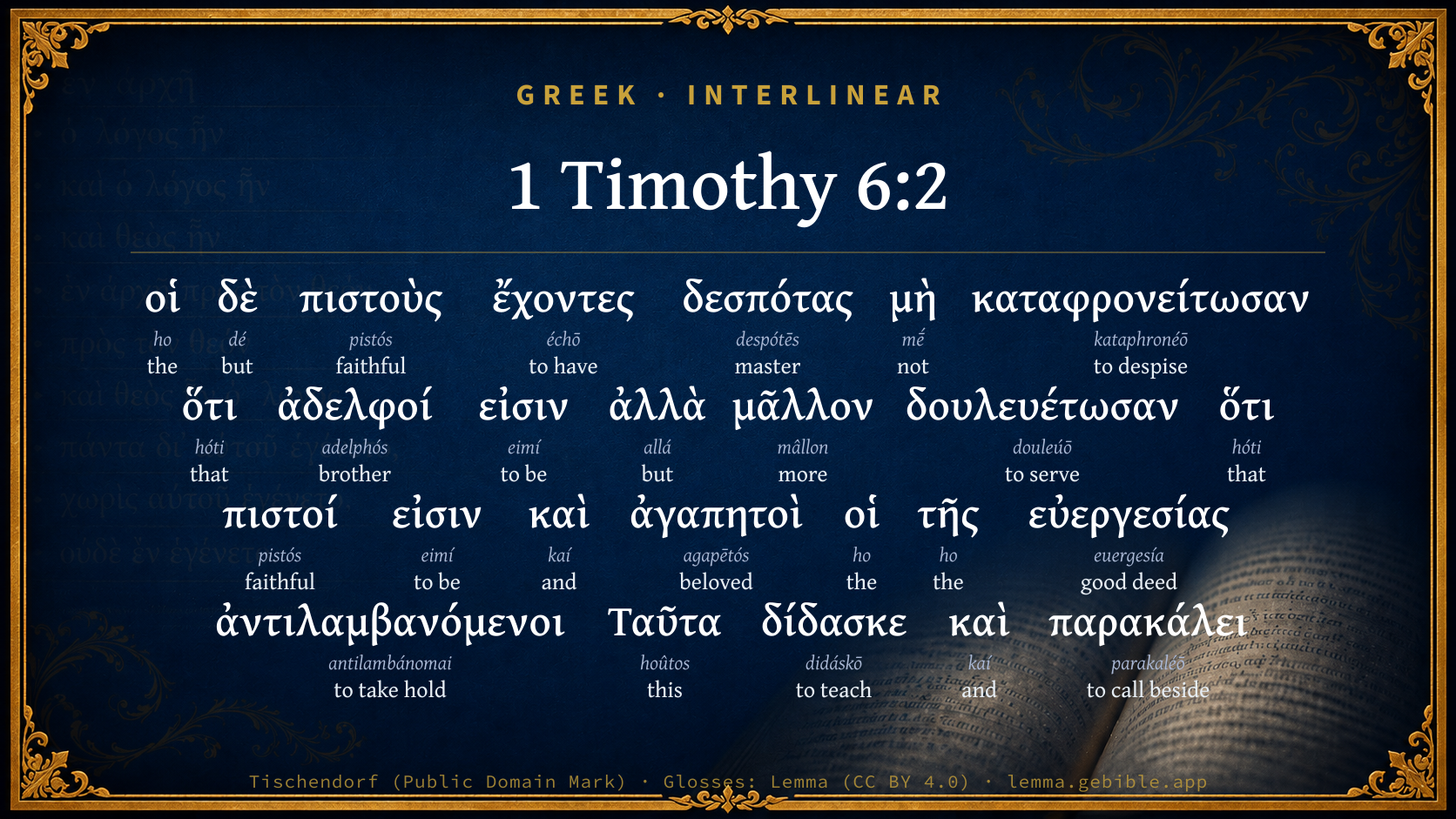
Download image
Cite this verse

1 Timothy 6:2 (World English Bible). Public Domain. Lemma interlinear Bible study tool, https://lemma.gebible.app/v/1-timothy/6/2.

Show BibTeX & RIS
BibTeX
RIS
English Translation
Those who have believing masters, let them not despise them, because they are brothers, but rather let them serve them, because those who partake of the benefit are believing and beloved. Teach and exhort these things.
World English Bible · Public Domain
Download a study sheet

One document with this verse’s original text, its word-by-word gloss line, the meaning frame, cross-references with their text, attributed commentary, and full source and license credits — printable, and it pastes into notes with its structure intact.

This verse Autodidact and up

Study sheet (.html) Plain text (.txt)

A passage Seminary Student

Up to 50 verses in one chapter. A passage sheet keeps up to 6 commentary sources and 12 cross-references per verse, in the order this page ranks them, and says so on the sheet whenever that leaves anything out. Ask for a single verse and you get the Autodidact verse sheet above.

Everything on this page stays free to read, with no account — the sheet is a download of what is already on screen, not access to it.

Want to remove ads? Support Godless Engineer
Compare translations 3

The same verse in 3 English versions, stacked beneath the original-language interlinear above. Click any original word for its lexicon entry.

Each is an independent rendering of the whole verse — the interlinear is not word-aligned to these translations.

Highlighted words mark where these versions differ — a whole-verse word diff, not a word-by-word alignment.

  • World English Bible Public Domain
    Those who have believing masters, let them not despise them, because they are brothers, but rather let them serve them, because those who partake of the benefit are believing and beloved. Teach and exhort these things.
  • King James Version Public Domain
    And they that have believing masters, let them not despise them, because they are brethren; but rather do them service, because they are faithful and beloved, partakers of the benefit. These things teach and exhort.
  • unfoldingWord Literal Text CC BY-SA 4.0
    But the ones having believing masters, let them not despise because they are brothers, but rather, let them serve because the ones taking the benefaction are believers and beloved. Teach and urge these things.

unfoldingWord Literal Text — © unfoldingWord, licensed CC BY-SA 4.0. Word-aligned USFM3 via Door43 (git.door43.org/unfoldingWord/en_ult).

Versions to compare (up to 4)

3 of 4 selected

Show all 19 translations

Every available English version of this verse, each an independent rendering of the whole verse.

  • World English Bible Public Domain
    Those who have believing masters, let them not despise them, because they are brothers, but rather let them serve them, because those who partake of the benefit are believing and beloved. Teach and exhort these things.
  • Berean Standard Bible Public Domain
    Those who have believing masters should not show disrespect because they are brothers, but should serve them all the more, since those receiving their good service are beloved believers. Teach and encourage these principles.
  • Majority Standard Bible Public Domain
    Those who have believing masters should not show disrespect because they are brothers, but should serve them all the more, since those receiving their good service are beloved believers. Teach and encourage these principles.
  • King James Version Public Domain
    And they that have believing masters, let them not despise them, because they are brethren; but rather do them service, because they are faithful and beloved, partakers of the benefit. These things teach and exhort.
  • American Standard Version (1901) Public Domain
    And they that have believing masters, let them not despise them, because they are brethren; but let them serve them the rather, because they that partake of the benefit are believing and beloved. These things teach and exhort.
  • Revised Version (1885) Public Domain
    And they that have believing masters, let them not despise them, because they are brethren; but let them serve them the rather, because they that partake of the benefit are believing and beloved. These things teach and exhort.
  • Geneva Bible (1599) Public Domain
    And they which haue beleeuing masters, let them not despise them, because they are brethren, but rather doe seruice, because they are faithfull, and beloued, and partakers of the benefite. These things teach and exhort.
  • Douay-Rheims (1899) Public Domain
    But they that have believing masters, let them not despise them, because they are brethren; but serve them the rather, because they are faithful and beloved, who are partakers of the benefit. These things teach and exhort.
  • Young's Literal Translation Public Domain
    and those having believing masters, let them not slight `them', because they are brethren, but rather let them serve, because they are stedfast and beloved, who of the benefit are partaking. These things be teaching and exhorting;
  • Literal Standard Version CC BY-SA 4.0
    and those having believing masters, do not let them slight [them], because they are brothers, but rather let them serve, because they are steadfast and beloved, who are partaking of the benefit. Be teaching and exhorting these things;
  • Unlocked Literal Bible CC BY-SA 4.0
    The slaves who have believing masters should not disrespect them because they are brothers. Instead, they should serve them all the more. For the masters who are helped by their work are believers and are loved. Teach and declare these things.
  • unfoldingWord Literal Text CC BY-SA 4.0
    But the ones having believing masters, let them not despise because they are brothers, but rather, let them serve because the ones taking the benefaction are believers and beloved. Teach and urge these things.
  • Darby Bible Public Domain
    And they that have believing masters, let them not despise [them] because they are brethren; but let them the rather serve them with subjection, because they are faithful and beloved, who profit by the good and ready service [rendered]. These things teach and exhort.
  • World Messianic Bible Public Domain
    Those who have believing masters, let them not despise them because they are brothers, but rather let them serve them, because those who partake of the benefit are believing and beloved. Teach and exhort these things.
  • Webster's Bible Public Domain
    And they that have believing masters, let them not despise them, because they are brethren; but rather do them service, because they are faithful and beloved, partakers of the benefit. These things teach and exhort.
  • Free Bible Version CC BY-SA 4.0
    Slaves who have Christian masters should not disrespect them because they are brothers. Instead they should serve them even better, because those who are benefiting from their service are fellow-believers they should love. Teach these instructions, and encourage people to follow them.
  • Bible in Basic English Public Domain
    And let those whose masters are of the faith have respect for them because they are brothers, working for them the more readily, because those who take part in the good work are of the faith and are dear. Give orders and teaching about these things.
  • Text-Critical English NT CC BY 4.0
    Slaves who have believing masters must not despise them, for they are brothers; rather they must serve them, because those who benefit from their good service are faithful and beloved. False Teachers and the Love of Money Teach and encourage these things.
  • Tyndale New Testament (1534) Public Domain
    Se that they which have belevynge masters despyse them not because they are brethren: but so moche the rather do service for as moche as they are belevynge and beloved and partakers of the benefite. These thynges teache and exhorte.

Literal Standard Version (2020), Covenant Press — licensed CC BY-SA 4.0. Text via the HelloAO Bible API (eBible.org). Unlocked Literal Bible (unfoldingWord) — licensed CC BY-SA 4.0. Text via the HelloAO Bible API (eBible.org). unfoldingWord Literal Text — © unfoldingWord, licensed CC BY-SA 4.0. Word-aligned USFM3 via Door43 (git.door43.org/unfoldingWord/en_ult). Free Bible Version, Dr. Jonathan Gallagher — licensed CC BY-SA 4.0. Text via the HelloAO Bible API (eBible.org).

Word by word

More ways to search: Search by grammar → Find every occurrence → Compare this word →

Practice this passage: Drill this verse → Learn its vocabulary →

εὐεργεσίας
euergesía
G2108
“good deed”
Noun, Genitive, Singular, Feminine
Part of Speech
Noun
Case
Genitive
Number
Singular
Gender
Feminine
Full Thayer's Definition

Origin: from G2110

TDNT: 12:54,3

1. a good deed, benefit
  1. οἱ ho G3588 “the” Article, Nominative, Plural, Masculine
  2. δὲ dé G1161 “but” Conjunction
  3. πιστοὺς pistós G4103 “faithful” Adjective, Accusative, Plural, Masculine
  4. ἔχοντες échō G2192 “to have” Verb, Present, Active, Participle, Nominative, Plural, Masculine
  5. δεσπότας despótēs G1203 “master” Noun, Accusative, Plural, Masculine
  6. μὴ mḗ G3361 “not” Particle, Negative
  7. καταφρονείτωσαν kataphronéō G2706 “to despise” Verb, Present, Active, Imperative, 3rd person, Plural
  8. ὅτι hóti G3754 “that” Conjunction
  9. ἀδελφοί adelphós G80 “brother” Noun, Nominative, Plural, Masculine
  10. εἰσιν eimí G1510 “to be” Verb, Present, Active, Indicative, 3rd person, Plural
  11. ἀλλὰ allá G235 “but” Conjunction
  12. μᾶλλον mâllon G3123 “more” Adverb
  13. δουλευέτωσαν douleúō G1398 “to serve” Verb, Present, Active, Imperative, 3rd person, Plural
  14. ὅτι hóti G3754 “that” Conjunction
  15. πιστοί pistós G4103 “faithful” Adjective, Nominative, Plural, Masculine
  16. εἰσιν eimí G1510 “to be” Verb, Present, Active, Indicative, 3rd person, Plural
  17. καὶ kaí G2532 “and” Conjunction
  18. ἀγαπητοὶ agapētós G27 “beloved” Adjective, Nominative, Plural, Masculine
  19. οἱ ho G3588 “the” Article, Nominative, Plural, Masculine
  20. τῆς ho G3588 “the” Article, Genitive, Singular, Feminine
  21. ἀντιλαμβανόμενοι antilambánomai G482 “to take hold” Verb, Present, Middle or Passive deponent, Participle, Nominative, Plural, Masculine
  22. Ταῦτα hoûtos G3778 “this” Demonstrative pronoun, Accusative, Plural, Neuter
  23. δίδασκε didáskō G1321 “to teach” Verb, Present, Active, Imperative, 2nd person, Singular
  24. καὶ kaí G2532 “and” Conjunction
  25. παρακάλει parakaléō G3870 “to call beside” Verb, Present, Active, Imperative, 2nd person, Singular

About this verse

These counts appear in no published source. They are computed here, from the morphology-tagged text and Lemma’s own curated glosses. What Lemma adds →

26
words
20
distinct lemmas
Pauline Epistles
section

Notable vocabulary

The rarest word here is εὐεργεσίας good deed G2108 — appearing just 2 times in the whole Greek New Testament.

Shared distinctive vocabulary

εὐεργεσίας good deed G2108 occurs in 2 verses of the Greek New Testament. Also found in:

Repetition

Words recur within this verse:

  • πιστοὺς faithful G4103 ×2
  • εἰσιν to be G1510 ×2
  • οἱ the G3588 ×3
  • ὅτι that G3754 ×2
  • καὶ and G2532 ×2

Cross-references

30

Topical passages linked to 1 Timothy 6:2 in the Treasury of Scripture Knowledge — connected by theme and wording, ordered by reader-vote popularity; previews shown in the World English Bible.

  • Colossians 4:1 Masters, give to your servants that which is just and equal, knowing that you also have a Master in heaven.
  • 1 Timothy 4:11 Command and teach these things.
  • Genesis 16:4–5 He went in to Hagar, and she conceived. When she saw that she had conceived, her mistress was despised in her eyes.
  • Numbers 16:3 and they assembled themselves together against Moses and against Aaron, and said to them, You take too much on you, seeing all the congregation are holy, everyone of them, and Yahweh is among them: why then lift yourselves up above the assembly of Yahweh?
  • Joel 2:28 "It will happen afterward, that I will pour out my Spirit on all flesh; And your sons and your daughters will prophesy. Your old men will dream dreams. Your young men will see visions.
  • Matthew 6:24 "No one can serve two masters, for either he will hate the one and love the other; or else he will be devoted to one and despise the other. You can't serve both God and Mammon.
  • Matthew 23:8 But don't you be called 'Rabbi,' for one is your teacher, the Christ, and all of you are brothers.
  • Matthew 25:40 "The King will answer them, 'Most assuredly I tell you, inasmuch as you did it to one of the least of these my brothers, you did it to me.'
  • Romans 8:29 For whom he foreknew, he also predestined to be conformed to the image of his Son, that he might be the firstborn among many brothers.
  • Romans 11:17 But if some of the branches were broken off, and you, being a wild olive, were grafted in among them, and became partaker with them of the root and of the richness of the olive tree;
  • Galatians 3:26–29 For you are all children of God, through faith in Christ Jesus.
  • Galatians 5:6 For in Christ Jesus neither circumcision amounts to anything, nor uncircumcision, but faith working through love.
  • Ephesians 1:1 Paul, an apostle of Christ Jesus through the will of God, to the saints who are at Ephesus, and the faithful in Christ Jesus:
  • Ephesians 1:15 For this cause I also, having heard of the faith in the Lord Jesus which is among you, and the love which you have toward all the saints,
  • Ephesians 3:6 that the Gentiles are fellow heirs, and fellow members of the body, and fellow partakers of his promise in Christ Jesus through the Gospel,
  • Colossians 1:2 to the saints and faithful brothers in Christ at Colossae: Grace to you and peace from God our Father, and the Lord Jesus Christ.
  • Colossians 1:4 having heard of your faith in Christ Jesus, and of the love which you have toward all the saints,
  • Colossians 3:11–12 where there can't be Greek and Jew, circumcision and uncircumcision, barbarian, Scythian, bondservant, freeman; but Christ is all, and in all.
  • 2 Thessalonians 1:3 We are bound to always give thanks to God for you, brothers, even as it is appropriate, because your faith grows exceedingly, and the love of each and every one of you towards one another abounds;
  • 1 Timothy 5:1 Don't rebuke an older man, but exhort him as a father; the younger men as brothers;
  • Titus 2:1 But say the things which fit sound doctrine,
  • Titus 2:15 Say these things and exhort and reprove with all authority. Let no man despise you.
  • Titus 3:8 This saying is faithful, and concerning these things I desire that you affirm confidently, so that those who have believed God may be careful to maintain good works. These things are good and profitable to men;
  • Philemon 1:10–16 I beg you for my child, whom I have become the father of in my chains, Onesimus,
  • Hebrews 3:1 Therefore, holy brothers, partakers of a heavenly calling, consider the Apostle and High Priest of our confession, Jesus;
  • Hebrews 3:14 For we have become partakers of Christ, if we hold fast the beginning of our confidence firm to the end:
  • 1 Peter 5:1 I exhort the elders among you, as a fellow elder, and a witness of the sufferings of Christ, and who will also share in the glory that will be revealed.
  • 2 Peter 2:10 but chiefly those who walk after the flesh in the lust of defilement, and despise authority. Daring, self-willed, they are not afraid to speak evil of dignitaries;
  • Jude 1:8 Yet in like manner these also in their dreaming defile the flesh, despise authority, and slander celestial beings.
  • Philemon 1:5–7 hearing of your love, and of the faith which you have toward the Lord Jesus, and toward all the saints;

Cross-references courtesy of OpenBible.info (CC BY 4.0).

Commentary

Notes on 1 Timothy 6:2 from classic Christian and Jewish commentators (each source and its license shown beneath its notes). The classic Christian expositions comment on the surrounding passage and are grouped to its opening verse, so a note may address several verses; the Jewish commentaries on the Tanakh (Rashi and others) are per-verse, so they appear only where the commentator wrote on this verse.

Lemma curates 59 commentaries, every one of them public domain or Creative Commons licensed, each selected and text-cleaned for this edition rather than reprinted as found. About our sources →

Fairbairn on Ezekiel, Jonah & the Pastoral Epistles

Patrick Fairbairn

Ver. 2. But supposing the masters themselves had embraced the gospel, and master and slave stood on the common footing of brethren in Christ, were those under the yoke still to be held bound to esteem and honour the masters who so held them? Should not the old relations in such a case rather give way? Practically, no doubt, they would in a great measure do so. But formally it was not the slave’s part to demand this, or to act as if, by reason of his church-fellowship with his master, he could claim civil freedom as his right; for this had been to turn the gospel into a political charter, and give rise to the greatest confusion. The change in that direction must be wrought for the slave, not asserted by him, and could only be brought about by the gradual diffusion of right views respecting men’s relation to God, and, growing out of this, their relation one to another. Meanwhile, the most effectual way to secure a partial amelioration, and ultimately a general abolition, of the evil, was by the Christian slaves themselves bearing their burden and doing their part with Christian meekness and generosity, as the apostle here exhorts: But such as have believing masters, let them not despise them, because they are brethren—as if the spiritual equality had effaced the civil distinction; but the rather serve them, because they who receive the benefit are faithful and beloved. Some (for example, Wetstein) would understand these latter epithets of the slaves, which grammatically might be considered tenable; but the connection is against it, as the object of the apostle manifestly is to present motives which should induce Christian slaves to continue stedfastly in a course of well-doing; and here, in particular, from the position and character of the masters. They were faithful and beloved; and whatever benefit might accrue from the conscientious and diligent labour of the bondmen, these had the satisfaction of knowing it was reaped by persons who were worthy to receive it. The verb ἀντιλαμβάνω, elsewhere used in the sense of laying hold of, with a view to helping or aiding (Luk 1:54; Act 20:35), must here mean to lay hold of in the sense of sharing in, or obtaining the participation of the accruing good,—a sense of the word not unknown in other writers. These things teach and exhort—those, namely, which had respect to the behaviour of bondmen. (For further remarks on the New Testament treatment of slavery, see Appendix C.)

Appendix C—Page 232. The Treatment of Slavery in New Testament Scripture (1Ti 6:2; Tit 2:10)

This subject, in its relation to the spirit and teaching of Christianity, naturally falls into three closely-related parts: first, the direct instructions it gave to those standing to each other in the relation of slave and slave-owner; second, the principles it unfolded tending indirectly, yet most materially, to bear on the relation; and third, the practical measures which, under the influence of one or the other of these, came to be adopted with a view to the improvement of the existing order of things.

1. As regards the first of these points, it is to be borne in mind that the original heralds of Christianity had to do with slavery as not only an existing, but a time-honoured and widely-ramified institution, with a recognised place in the laws and usages of the empire, and of such gigantic proportions that in the gospel age a slave for every freeman has been thought a moderate computation for the provinces of the empire at large. (This is Gibbon’s estimate.) In particular districts the proportion was much greater, though in others probably somewhat less. It was such, indeed, that in the more populous parts of the empire nearly all menial employments must have been discharged by servile hands, as well as much besides that belonged to the category of skilled labour. Now, with this vast system of legalized property in human flesh, the evangelists and apostles of our Lord came into contact chiefly as it bore on the class, not of owners, but of owned —of bondmen, not of those who held them in bondage; for the gospel drew at first the great body of its adherents from the lower grades of society, and those who ranked immediately above them. Of the first generation of believers in Christ, an extremely small proportion, it may be confidently assumed, would be owners of slaves; but not a few, in all probability, of the slaves themselves, whose depressed and suffering condition would naturally dispose them to hail a religion which looked so benignly on the afflicted, and held out such elevating prospects to all who sincerely embraced it. We thus quite readily account for the circumstance that the prescriptions in New Testament Scripture bearing on the relation in question are most numerous and pointed with respect to the slaves; and that sometimes, when charges are given as to the behaviour becoming them, none are delivered on the correlative duties of masters. It was not that the one class required the word of counsel or admonition more than the other; but because there were as yet scarcely any of the higher class who professed subjection to Christ, while there were many of the lower.

Having, therefore, mainly to do with those who occupied the lower place in this relationship, the authorized ambassadors of Christ naturally regarded them as peculiar objects both of pity and concern. They found them in an abject and humiliating condition, which they had no power, however they might have wished it, to alter or amend,—a condition which, in all its essential features, was fixed and regulated by the legislation of the empire. While the gospel of Christ could not break the chains which outwardly lay upon them, it could, and did also, in a moral and spiritual respect, mightily relieve and benefit their state; and, in return, it justly called them to prize the better things which it brought within their reach, and to show their profiting therein by discharging in another manner than before the duty of service exacted of them—to eye, in all they did, the divine rather than the human authority under which they stood: that so they might honour and commend to others the Master whom now it was their delight and glory to serve. They were thus, by their very calling as Christians, elevated within their own sphere to the high rank of witnesses of Christ, and instruments in His hand for diffusing abroad that saving light and truth by which alone the greater disorders of society could be rectified, and the troubles of the more afflicted portions of mankind effectually removed. By taking the line of conduct prescribed, also, they would pursue the course which was almost sure to react beneficially on their social position. They necessarily became patterns of active virtue; and such were the encouragements given under the system of Roman slavery for obtaining freedom as the reward of good conduct, that Christian slaves, who in their daily procedure exhibited the spirit of the gospel, might be said to be on the high road toward manumission.

So much did the apostles set by conformity in this respect to the mind of Christ, and so confidently did they reckon upon other desirable ends being thus in due time attained, that they scarcely ever touched on the civil aspect of the question—on the acquirement of liberty. Incidentally the subject comes up in the Epistle to Philemon, with respect to Onesimus, his runaway slave; and yet it is so considerately and delicately handled by the apostle, that, while he shows distinctly enough his appreciation of a brotherly as contrasted with a servile relation, he would not have the former in any case acquired by fraud—would not even have it wrung from the legal owner by a reluctant concession; yet, if frankly conferred, would esteem it a most worthy expression of enlightened and sanctified feeling. In another place—a passage in the First Epistle to the Corinthians—the subject is also briefly treated in connection with a more general question, namely, how the reception of the gospel should be regarded as affecting people’s family and social relationships? Were they still to continue in these after they had become Christians? Or were they to find in their Christianity a reason for abandoning them? The apostle’s direction is: Abide as you are, and where you are, if you can do so consistently with Christian principle; and in so far as anything in your existing relations may be trying and irksome, instead of hastily ridding yourselves of it by a self-chosen method of escape, seek rather by your meek, patient, noble Christian bearing, to rise above the disadvantages of your outward position, and in the interests of godliness triumph over them. This is the general principle of action enunciated; and when applied to those who, on becoming Christians, found themselves oppressed by the yoke of slavery, it meant that they were not to use any power or opportunity they might have to break the yoke violently asunder; that they were rather to regard this as a part of the burden which, meanwhile, they had to bear for the sake of Christ; and that, while it was not good to be in slavery to man, it was possible even in this to be Christ’s freeman: and to be such was so noble and blessed a thing, that their civil disabilities might be borne, while they lasted, with comparative indifference. This seems plainly the gist and bearing of the apostle’s treatment of the subject, however we interpret the particular expressions. (It is only in respect to chap. 7:21 that any diversity of interpretation prevails. See at the close of this Dissertation, p. 448.) It did not, when fairly considered, betoken any insensibility in the apostle’s mind to the evils of slavery, taken by themselves. It is impossible, indeed, that he and the other heralds of the cross should have thought lightly of them, seeing they were in themselves so numerous and flagrant, and so contrary to the spirit of philanthropy which breathed in the gospel of Christ, and which was also exemplified so finely in the conduct of its divinely-commissioned teachers. But these men of God knew that the promptings of nature were likely to furnish a sufficient stimulus in that direction, and were not forgetful also of the effect which the new wine of the kingdom might have in the same direction—fermenting, as it would naturally do, in the minds of Christian slaves, with thoughts and aspirations in ill accord with their depressed and abject condition. It was therefore the part of Christian wisdom to throw the fence mainly on the more exposed side, and urge them, as their main concern, to the cultivation of those graces and habits which tended to elevate them as rational and immortal beings.

On this side of the question, then, wisdom was manifestly justified of her children; but was it equally so in the reserve practised, on the other side, toward the masters? If the apostles were right in plying the oppressed class with exhortations to virtue and obedience, why should they not have pressed those who had the power to let the oppressed go free? They certainly did not do this. The considerations chiefly urged upon the masters are, that they should remember they had to do with One who is no respecter of persons; who stood to them in the relation of a Master, as they to their fellow-creatures; and that they should consequently forbear, not the use of the lash merely, but even threatening, and should give to all under their control what is just and equal. Such injunctions, if properly carried out, would at least secure practical freedom to the slave—such freedom as would enable him to serve God faithfully in the humble duties of his station. But we can scarcely say apostolical precept, in its direct and explicit requirements of the slave-owner, goes further; especially as, when the supposition is made of believing servants under the yoke having also believing masters (1Ti 6:2), the latter are spoken of as still retaining their proprietary rights, and the former are enjoined to do their work of service all the more cheerfully that they were under believing masters. If, however, we take into account not the letter merely, but the spirit also of the exhortations given, we shall doubtless see that something further is required of the parties in question, and that they could not have intelligently and cordially done so much without feeling impelled in ordinary circumstances to do more. For if the master consented, as he was expressly required, to treat his bondmen as rational beings, capable of the same exalted privileges and hopes as himself, how could he desire to have them kept in a position which exposed them to treatment of another kind, treatment from which his own spiritual nature must have recoiled? Plainly he could not with hearty good-will take the one part of a Christian behaviour, without feeling drawn to do something also in respect to the other. And that the Apostle Paul thought persons in that situation should have so felt and acted, is evident from the style of address in his letter to Philemon respecting Onesimus, in which, as already indicated, he did not indeed claim strictly as a right, or demand as by divine authority, yet besought with powerful suasion, the reception of Onesimus, not merely as a forgiven bondman who had wronged his master, but in a higher character—“above a slave (as he expressed himself), a brother beloved.” To yield to this affectionate entreaty, and yet re-assert over Onesimus his proprietary rights as a slaveholder, had been impossible; the very attempt to do so would have been justly branded as a pitiful evasion.

But if such were the mind of the apostles, and the certain tendency of their instructions, might it not have been better to go straight to the point, and lay upon every Christian slave-owner the authoritative injunction to enfranchise his slaves? So some have, even in our time, been bold enough to assert. But had the course in question been taken, how many enfranchisements might have been expected through its operation? Or what progress was Christianity likely to have made in ameliorating the social evils of the Empire? With this startling demand among its requirements,—in the very front, we may say, of these requirements (for it was sure to be the first that should ever meet the eye of the slave-owner),—persons of this class would with one consent have denounced Christianity as the opponent of their legal interests and hereditary rights; they would have everywhere met it with their determined opposition—would have put it, in fact, under the ban of the Empire, as a system that, under the guise of religion, aimed at unsettling the foundations of society, and kindling the flames of a servile war. It was at once the wiser and the more humane course to make the direct prescriptions of the gospel bear only on the just and equitable treatment of the slave, so that the moment he was placed under the dominion of a believing master he should become practically free to move within the ordinary sphere of Christian duty; and in addition to this, to place the master as well as the slave under motives and considerations of a higher kind, which, in proportion as they were realized and acted on, necessarily led to the readjustment or removal of whatever in their mutual relationship was at variance with the essential principles of rectitude and goodness.

2. This touches, however, upon the second point—the higher influences brought by the gospel to bear on the hearts of slave-owners, and tending indirectly to loose the bonds of slavery. The whole spirit and tendency of the religion of the gospel must have wrought in this direction.

The view given in Scripture of the common origin and natural relationships of mankind—even this, which is implied in the revelations of the gospel, rather than directly announced—could not, if thoughtfully pondered, be without effect in this particular line. That all should be the offspring of one parent,—inheritors of one blood, and partakers of the same rational and immortal nature,—and yet that they should make merchandise of one another, as if some belonged to a different world, or a different order of creation from the rest;—who that justly considers the one can find it in his heart to do the other? How especially could he do so, if he coupled with men’s brotherly relation to himself their filial relation to God, though he should only think of that relation as it exists in nature, implying the formation of all alike in God’s image, and their calling as such to occupy the earth, and use its means and opportunities of good for Him? To treat a human being so formed, so constituted and destined by the hand of his Maker, as from the mere accidents of position bereft of freedom of will and independent action, were virtually to disown and shamefully dishonour the claims and interests of such a natural relationship.

Yet this is but the preliminary ground or implied basis of Christianity, not its proper substance; and its influence in this direction becomes much greater when its grand central doctrine of the incarnation and death of the Son of God for the salvation of mankind is brought distinctly into view. This, when rightly known and considered by men, could not but be felt to be like the letting in of a new light upon the world, tending by a moral necessity to raise the common platform of humanity to a higher than its former level. It is from hence, most of all, that has sprung the idea of the brotherhood of mankind—of their original equality in God’s sight, and of the honour and blessedness of ministering to their wellbeing, apart from all the outward and artificial distinctions which in the heathen world entered so largely into men’s estimation of their fellow-men, and threw something like an impassable gulf between race and race, and one condition of life and another. The infinite condescension and glorious example of Christ virtually established for all a claim to the highest offices of kindness, and, wherever practically known, gave such an impulse to the more generous feelings of the heart, and the more active charities of life, that everything like cruel neglect or lordly oppression toward even the humblest grades of society could not fail to be regarded otherwise than as an outrage on humanity.

Then, regard to the interests of salvation must have wrought in the same direction. From the moment that any one became a genuine believer, it was part of his obligations to see that everything of a proper and fitting kind was done to bring all under his influence or control to partake with him in the blessings of salvation. But how could the slave-owner commend to others about him the offers of a love, of which it was but too clear he had not yet received the full impression in his own bosom? How could he desire in earnest to see them rising to the possession and enjoyment of the liberties of God’s dear children? The attainment of such a standing in spiritual things, with its high privileges and endowments, he could not but see, would only render them the more deeply conscious of the ignoble chains which rested on their bodily condition; for how could they possess the rank of sons in God’s house, and realize their title to the glorious inheritance of the saints in light, without feeling the incongruity and the dishonour of being denied the place of citizens of earth, or of being allowed to take an independent part in the ordinary concerns of a present life? It was obviously impossible that the intelligent Christian slave should have felt otherwise than is now represented; and if not absolutely impossible, at least not very natural or easy, for his master to become a sincere convert to the gospel, and still keep the yoke of bondage riveted on the neck of a Christian brother.

Of the force of these considerations the history of the subject has yielded two very instructive and convincing illustrations. The first is the reluctance commonly exhibited by slave-owners to let those under their sway enjoy the full benefit of Christian instruction and privilege. How far this was the case in ancient times we can only infer from what has happened among the modern representatives of the class; but inthe particular point under consideration, it is likely to have been worse rather than better in the earlier as compared with the later ages. Yet, as regards these later ages, no one in the least acquainted with the history of slavery can be ignorant how commonly slave-owners have been jealous of the diffusion of Christian knowledge and instruction among their slaves—what restraints they have generally laid upon it—how often even they have expressly and by severe penalties interdicted it. Viewed as a whole, it is not too much to say of their conduct, that it has betrayed an unmistakeable conviction that the light and liberties of the gospel carry along with them a certain danger to their proprietary interests, and involve views of truth and duty materially different from their own. The other confirmatory fact consists in the grounds and reasons which have most commonly induced believing slave-owners to grant liberation to their bondmen. It appears that in the actual progress of events the spirit of the gospel, imperfectly as it was too often understood and imbibed, played an important part. While the work of emancipation made slow advances compared with the progressive advancement of an external Christianity, it still was always proceeding, and generally did so within the professing church as a response to the undeserved mercy of Heaven—an act of becoming tenderness and compassion in the recipients of divine grace and blessing. This may be seen by referring to the ancient charters of that description given by Du Cange, or even from the specimens selected out of them by Dr. Robertson (Charles V., note 20). We find there grants of freedom made by sundry persons in favour of their slaves—made “for the love of God,” “for the benefit of the soul” of the grantor, or something to that effect. When Pope Gregory the Great bestowed liberty on some slaves that had become his property, he prefaced the deed thus: “The Redeemer made Himself a propitiation to free men from the yoke of bondage, and restore them to their pristine condition; whence it well became men to restore those whom the law of nations, not nature, had brought into servitude, to the freedom which originally and properly belonged to them.” Hence also a large number of manumissions appear to have been granted by persons on their death-beds, when their near approach to the judgment-seat rendered their consciences more alive to the great realities of the gospel, and the corresponding obligations: they granted the boon, it is commonly stated, “for the redemption of their soul.” And hence also occasions of special favour and blessing were not unfrequently seized for conferring the grant; the benefit received on the one side being naturally felt to call for the bestowal of a like benefit on the other.

Indeed, it is difficult to understand how any one, if he could only divest himself of the perverting bias of habit, or the still more perverting bias of worldly interest, and would calmly look at the matter in the light of gospel truth, could come to another conclusion than that of either abandoning his right of property in his fellow-men, or of disclaiming allegiance to the authority of Christ. I do not see how, even with the kindest and most considerate treatment of his slaves, he could feel that he had discharged his obligations according to the requirements of the gospel without releasing them from their bondage. By one of these requirements he is called to be an imitator of Christ in that very walk of love wherein Christ has at once set so illustrious an example and given so costly a sacrifice. By another, he is enjoined to do to others whatsoever he would that they should do to him. By a third, he is urged to do good to all around him, as he has opportunity—to do it beyond the measure of the heathen, and for the promotion especially of the higher interests of mankind. But, on the supposition of his continuing to be a slave-owner, what honour do such precepts receive at his hands? He deliberately prefers holding men subject to bondage, while it was the special glory of his Master to deliver them from it; he practises upon them a wrong; and if he does not personally inflict, he leaves them in a position in which they may have inflicted upon them, insults and injuries, pains and cruelties, which no man of sane mind would wish another to have the power of inflicting upon himself. And instead of using his opportunities to do the part of a wise benefactor and moral regenerator of the world, he lazily and selfishly contributes to the maintenance of one of the foulest stains on the brotherhood of mankind; he lends his countenance and support to a system of which, as a whole, and as regards its inherent tendency, it has been not more eloquently than justly said: “It darkens and depraves the intellect; it paralyzes the hand of industry; it is the nourisher of agonizing fears and of sullen revenge; it crushes the spirit of the bold; it is the tempter, the murderer, and the tomb of virtue; and either blasts the felicity of those over whom it domineers, or forces them to seek for relief from their sorrows in the gratifications, and the mirth, and the madness of the passing hour.” (Speech of Dr. Andrew Thomson, Edinburgh.)

It is proper to add, however, that there may have been persons in ancient times, as there are known to have been some in later, who were not insensible to the considerations now noticed, and yet refrained from granting liberation to their slaves, out of regard chiefly to the present temporal comfort of the slaves themselves. In those States where slavery has become a widely-extended and compact system, the manners and usages of society so adapt themselves to it, that emancipation in individual cases, or on isolated properties, might have the effect of throwing the emancipated out of one class without being able to secure their introduction into another, better, or even so well, situated for employment and comfort as the one they had. They might, in consequence, if enfranchised, become exposed to neglect and want. There can be no doubt that such was the case, about the gospel era and before it, with many freedmen in certain districts of Italy, where, from the general employment of slaves in the cultivation of the soil, the free part of the population often fell into a very depressed and pitiable condition. The same may have happened, and doubtless did happen, in other provinces of the empire, of which we have less specific information; and it is also known to have happened in particular portions of what but lately were the slave states of the West Indies and of America. So that it would not always be simply from the power of the gospel not being felt, or from a deliberate disregard of its claims in this particular direction, that the bondmen of Christian masters did not regain their freedom. A benevolent regard to their present wellbeing, even though possibly a somewhat mistaken or undue regard, may have often contributed to the result.

3. We turn now, lastly, to the practical measures in which, so far as we know, the early teachers and representatives of the gospel gave effect to the direct instructions, and the indirect, the higher considerations under which, in this respect, they were placed by their belief of the truth.

On this point our means of information are very limited and fragmentary, and there is much we should like to know of the earlier periods of church action of which we must be content to be ignorant. Undoubtedly the process of relief within the church would have been quick and satisfactory, compared with what we have reason to believe it was, if all in the position of slave-owners, who professed obedience to the gospel, had risen at once to the proper height of knowledge and attainment in this branch of their calling. But we are not at liberty to suppose that; the pleading alone in the Epistle to Philemon, shows plainly enough how slowly the very best of the early converts grasped here the full results and consequences of their faith. There would doubtless be many who at once felt it their duty to give hearty obedience to the precepts of the gospel, in so far as these required a kind and considerate treatment of their dependants, who yet, from the force of habit or other influences, would never think of bringing the system itself of slavery to the test of the great principles of the gospel. The case of John Newton, in modern times, may be cited in proof, since, after undergoing one of the most remarkable conversions on record, he continued for a time not only insensible to the common evils of slavery, but even actively engaged in the inhuman transactions of the slave-trade, conceiving all his obligations in the matter to be discharged if only he looked after the bodily comfort of the unhappy victims who fell into his hands. The utterly antichristian character of the traffic disclosed itself but gradually to his mind. A bequest may also be noticed in the same connection, which was left by an American gentleman of last century to the Society for the Propagation of the Gospel—“a plantation stocked with slaves.” “An odd legacy,” says Warburton, in the sermon preached by him for the Society of the same year; “an odd legacy to the promulgators of the law of liberty, but intended, perhaps, as a kind of compensation for these violations of it.” Custom had in all probability rendered the individual entirely unconscious of the inconsistence.

It should not therefore surprise us to learn that, in the church of the apostolic and immediately subsequent age, there were Christian slave-owners as well as Christian slaves in her communion, with a relaxation no doubt of the bond, and a tendency begun toward its dissolution, yet still no general movement made for its formal extinction. Slaves and masters alike, on their professing Christianity, came under the discipline of the church, and were amenable to it for their actual behaviour. This was of itself a great security against all harsh treatment, considering what discipline was in those early times—how impartial and how stringent; and it is probably the main reason why so little is said on the subject of slavery in the more ancient Patristic writings, although doubtless the ascetic tendency which so early began to tell on leading men in the church exercised, to some extent, an unfavourable influence also here. The so-called Apostolic Fathers—Justin Martyr, also Irenaeus, Tertullian, Cyprian —very rarely refer to the subject of slavery in any way, and give no special instructions concerning it. Even in the voluminous writings of Augustine, we shall scarcely find a more explicit or pointed testimony than the following: “A Christian should not possess a slave after the same manner that he does a horse or a piece of silver” (De Serm. Dom. In Monte, L. i. § 590). And when giving a summary of what the church, as the true mother of all Christians, enjoins upon her children, the whole he says in her behalf as to the relation of master and servant is: “Thou teachest servants to cleave to their masters, not so much from the necessity of their condition, as from delight in the duties of their calling. Thou makest masters placable toward their servants, from regard to the great God, their common Lord, and more ready to give counsel than to practise coercion” (De Mor. Eccl. Cath. § 63). Chrysostom failed even more than Augustine to bring out on this point the true spirit of the gospel; and his continuous commentaries on the epistles of the New Testament furnished him also with better opportunities. In his exposition of Philemon, while he speaks strongly enough of the scandal brought on Christianity by slaves running away from their masters, and of Christians abetting and aiding them in their attempts to do so, he does not say a single word on the duty of Christian masters to grant liberty to their slaves; he speaks also quite familiarly of our custom of purchasing slaves with money, and of its being esteemed the glory of a master to have many of them. He is somewhat better at Eph 6:9, where masters are enjoined to do the same things toward their slaves that the slaves themselves were exhorted to do, and to forbear threatening, as knowing that they had a Master in heaven, with whom there is no respect of persons. Here Chrysostom presses the consideration that masters shall assuredly have their measure meted back to them; that they must do as they hope to be done to; and that they should teach their slaves to be pious and godly, and then all would go well. But emancipation is not once hinted at.

Notwithstanding such comparative failures, however, on the part of the standard-bearers of the church, the mild, beneficent, love-embracing spirit of the gospel made way, first lightening the yoke, and then subverting the existence of slavery. This appears especially in the efforts put forth from time to time to obtain the freedom of Christians who by misfortune had been reduced to slavery, and the fresh facilities that were given to slave emancipation by legal enactment. The barbarous treatment of the servile class was openly condemned by the ministers and councils of the church. Clement of Alexandria absolutely prohibited the acceptance of any oblations from cruel and sanguinary masters; and several councils appointed temporary excommunications to be pronounced against those who, without any judicial sentence, put their slaves to death. Acacius, bishop of Amida, had the gold and silver vessels of his church melted to redeem 7000 captives, whom the Romans had brought from Persia, and sent them back free. Ambrose did something of the same sort at Milan. Cases are even mentioned of persons who sold their whole property to purchase the freedom of their fellow-Christians. One Melania is said to have liberated so many as 8000 slaves; Obidius, a Gaulish Christian, 5000, etc. And so congenial did the work of manumission seem to the spirit of the gospel, that Constantine, while suspending ordinary work on the Lord’s day, expressly allowed the manumission of slaves, as having in itself the essential characteristics of a pious and charitable action. (Guizot, Hist. of Civil. in France, ii. p. 128; Bingham, Ant. B. xx. c. 2, 5.)

In another respect, also, the ancient church did good service: she guarded the chastity of female slaves, and servile birth formed no disqualification for the sacred offices of the priesthood. The legal statutes, for a considerable time, embarrassed her operations, and made the progress of the work more difficult. The Code of Justinian recognised, indeed, the original equality of mankind, but it admitted the forfeiture of this equality by the casualties which use and wont had allowed to entail the loss of freedom. Still, what was not removed was in several respects alleviated. Masters were forbidden to abandon their slaves when sick or enfeebled with age—they were obliged to have them privately cared for, or sent to the hospitals. In heathen times, slaves could not properly marry; their union was merely concubinage; and for a free person to marry a slave was even held a capital offence. The Christian church struggled long and stedfastly against such things, and at last succeeded in getting legal sanction to the marriage of slaves, and gave to marriages of this kind, as well as others, her benediction. The tendency of the imperial legislation became increasingly favourable to the interests of the slave; and Gibbon says of Justinian’s Code, that “the spirit of his laws promoted the extinction of domestic servitude.” But the extinction was much retarded, especially by two causes.

The first of these was the growing worldliness and corruption of the church. The salt, to a very large extent, had lost its savour. In process of time, churches themselves came to hold property in slaves, and even had their property in this respect guarded by special enactments. While churches were constituted asylums for runaway slaves, slaves that belonged to ecclesiastics or sacred foundations, if they became runaways, were denied all right of protection; any one who harboured them became liable to pay a triple fine (Milman’s Lat. Christianity, i. 365). The other circumstance was the enormous multiplication of slaves consequent upon the irruption of the northern nations. This increased the evil to such an extent that, by its very excess, it helped to work out the remedy. Slaves ceased in a manner to be saleable; they became serfs—labourers attached to the soil; and by this appropriation they had conceded to them a measure of security against the caprice and despotism of the masters. In this state one could not be sold, save as part and parcel of the ground on which he resided; and while thus bound to a kind of hereditary serfdom, his position was regulated by law—guarded, though still but imperfectly, from the freaks of arbitrary violence and oppression. Other changes, mainly effected by trade and commerce, came in to ameliorate their condition; and after centuries of delay, and a step-to-step progress, serfdom itself passed, throughout the different countries of Europe, into personal and social freedom.

Broken, therefore, and chequered as the history is, interrupted by many haltings and even temporary reverses, it has still been an advancement—Christianity has vindicated her title to the character of a friend of the captive and the bond. She would have done so, it is true, far more speedily and extensively if she had herself remained free from the corruptions of the world, and if her grand aims for the good of mankind had been properly carried out. But, as matters actually stood, a gradual rectification took place; a milder and better tone was diffused throughout society; a standard of generosity and loving-kindness was everywhere raised, which might be said to frown on the intolerance and cruelty of slavery, and prepared the world for giving practical effect to the feeling of a common brotherhood. Nothing, indeed, can be more certain, from the struggles and triumphs of the past, than that this horrid institution, which is alike dishonouring to God and injurious to the best interests of society, cannot stand with a healthful and robust Christianity: as the one lives and thrives, the other of necessity gives way; and were there a gospel everywhere triumphant, there would infallibly be a free as well as a righteous and a blessed world.

NOTE to p. 435, On 1Co 7:21

In illustration of the general principle that people, on becoming Christians, should abide in the calling wherein they were called, the apostle refers, along with some other cases, to that of bondmen: “Wast thou called, being a slave? Care not for it. But if also (or indeed) thou art able to become free, use it rather.” “That is,” says Chrysostom, “rather be a slave. And why, then, does he bid him, who had it in his power to become free, to continue a slave? He did it to show that slavery no way injures, but rather profits (ὅτι ὀυδεν βλάπτει ἡ δουλεία, ἀλλὰ καὶ ὠφελεί).” Rather Strange doctrine, surely, to ascribe to one who in his own case valued so highly, not merely his common liberty, but his special freedom as a Roman citizen, that he would not allow its rights to be trampled on; and who, in respect to his convert Onesimus, showed how well he could distinguish between the disadvantages of a slave’s place and the honourable position of a brother! Chrysostom adds that he was aware there were some who understood the use recommended of liberty: if you are able to become free, embrace freedom rather. But he rejects this view as against the connection, which (he thinks) requires that even if a believing slave had the option of becoming free, he should prefer his slavery. And the same view is taken by Theodoret, Theophylact, also by various modern commentators of note, in particular by Estius, Wolf, Bengel, Meyer, Alford. Several of them hold it to be the only view grammatically tenable; for when καὶ succeeds εἰ, it does not belong to εἰ, but to the following clause, which it is spread over and qualifies; so that the meaning (it is alleged) can only be: But if even thou canst be free, use it—namely, slavery—rather. Dean Stanley hesitates between the two modes of explanation. Whether freedom or slavery is to be supplied to the verb use, he conceives to be “one of the most evenly balanced questions in the interpretation of the New Testament.” And he goes on to state, with his wonted dexterity, the considerations that appear to make for the two views respectively, but commences with the strange assertion that the verb χρῆσαι “may either be choose, or make use of, although it leans rather to the former, and thus favours the first interpretation”—that, namely, which would couple it with slavery. He does not, however, produce any passage in the New Testament in support of the sense of choosing; nor can a single one be produced. In the two Epistles to the Corinthians it occurs, besides the present passage, six times (1Co 7:31, 1Co 9:12, 1Co 9:15; 2Co 1:17, 1Co 3:12, 1Co 13:10), but never in the sense of choosing—always in that of using, making use of. And retaining this as the only allowable meaning, how could the apostle exhort any Christian slave, who had the opportunity of becoming free, to use slavery rather? Slavery is not a gift or talent to be used, but a restraint, a hardship to be borne or submitted to—if necessary—but no more. And with all its tendency to asceticism, and to a foolish self-imposition of outward restraints, the ancient church still had common sense enough, and native instincts remaining, to dispose her members generally so to regard it. The well-known practice of Christians in freely spending of their means to liberate their brethren from servitude, when by some calamity reduced to it, was a virtual protest against the inflated oratory of Chrysostom, and his false exegesis.

As to the grammatical canon, very formally propounded by Alford, that καὶ after εἰ qualifies the succeeding clause, so as to mark a gradation upward—if even,—one has only to look at the passages in which the particles occur to see how far it will carry us. Sometimes, no doubt, the ascensive force is plain enough, as at Php 2:17, “But if I even be offered (ἀλλὰ εἰ καὶ σπένδομαι); “to which may be added 1Pe 3:14. But take other examples—such as 2Co 11:15, where, speaking of Satan and his instruments of working, the apostle says, “No great wonder, therefore, if also (εἰ καὶ) his ministers are transformed as ministers of righteousness.” Here the particles indicate merely an additional and subordinate fact—if progress at all, a progress downward, not upward. So also at 1Co 4:7, “What hast thou, that thou didst not receive? But if also (or indeed) thou didst receive it—εἰ δὲ καὶ ἔλαβες” (also 2Co 5:16, 2Co 7:8); on which Alford is himself obliged to let go the ascensive force. It does not appear that for the New Testament usage one can go further with a grammatical principle in the matter than as stated by Winer: “In general, εἰ καὶ signifies although, si etiam, quanquam, indicating something as an actual fact; “or, as Mr. Moulton puts it in a note, indicating either that what the sentence expresses is, in the writer’s belief, an actual fact, or a concession on his part that the supposition is correct (Gr. § 53, 7, Clark’s ed.). Mr. Moulton, however, himself adopts the ascensive force in the passage before us.

The difficulty, as appears to me, in giving a natural and proper explanation of the passage has been aggravated by supposing that either ἐλευθερία, freedom, or δουλεία, bondage, must be supplied for the verb χρῆσαι. The more natural construction is to supply the noun involved in the preceding verb; the stress lies on it—on δύνασαι. “Wast thou called, being a slave? Care not for it. But if also thou art able (δύνασαι) to become free, use it (the δύναμις, ability) rather;” having the power, turn it rather to account. It is not properly the use of the freedom which the apostle advises (in which case we should certainly, as Alford remarks, have judged ἐλευθερία to be the proper word to be supplied to χρῆσαι), but the use of the power to obtain freedom; and either this, or the whole clause, power to become free, is the thing to be supplied. Thus viewed, two suppositions are made in the verse: first, slavery without the power of escaping from it—in which case the principle of abiding in one’s station holds without any qualification, and under the elevating influence of the gospel a noble indifference is recommended; second, the power of acquiring freedom, with an advice to take advantage of the opportunity. Then, in the following verse, a twofold consideration is introduced by γὰρ, suited to the two suppositions going before: the bondman, even though remaining such, is the Lord’s freeman, and the freeman is the Lord’s bondman. Either way a qualifying circumstance—in the one case tending to abate the natural evil, in the other to circumscribe and regulate the natural good. But to leave no doubt that the apostle was not insensible to the superiority of a free over an enslaved condition, and regarded the former as alone properly suited to the place of a believer, he adds, 1Co 7:24, “Ye were bought with a price; do not become slaves of men.” Seeing how great a price has been given to raise you into the glorious liberty of the gospel, do not act an unseemly part by becoming bondmen to your fellow-creatures. And of course, if they should not voluntarily become such, neither should they voluntarily continue such, when it was in their power to escape from the anomalous position.

Interpreted in this manner, the exhortation of the apostle is throughout reasonable and consistent. His general direction is that people, on becoming Christians, should continue in the relations which they at the time occupied—the married (though to a heathen spouse) in wedlock, the uncircumcised in uncircumcision, the slave in bondage. But where a change to the better might be found practicable, let it be adopted—the Christian wife drawing over to the faith her unbelieving husband, or, failing in that, and finding domestic peace impracticable, retiring into privacy; the slave having the power to become free, using that power; but the free on no account bartering their freedom for a state of bondage, since that would be unsuitable to their high calling as the redeemed children of God in Christ.

Patrick Fairbairn — An Exposition of Ezekiel (1851), Jonah (1849), and The Pastoral Epistles (1874) — public domain. Text from a community e-Sword module.

Tyndale Open Study Notes

Tyndale Open Resources

6:2b-21 The last major section of the letter returns to the need for Timothy to confront the false teachers. The whole section has a similar structure to 1:3-20.

6:2b-10 This paragraph exposes the false teachers’ desire to become wealthy.

Tyndale Open Study Notes — © Tyndale Open Resources, licensed CC BY-SA 4.0. Text via the HelloAO Bible API.

Bengel's Gnomon

Johann Albrecht Bengel

1Ti 6:2. Ἀδελφοὶ, brethren) and in that respect equal.—εἰσὶν, are) viz. the masters. Servants (slaves) might seek a pretext for refusing obedience, whether they had believing or unbelieving masters. Both sins are met (counteracted).—δουλευέτωσαν, let them do service) let them remain in the household.—πιστοί εἰσι καὶ ἀγαπητοὶ are faithful and beloved) Supply, the masters, beloved, having experienced the Divine love, and then in consequence showing love to their servants (slaves).—οἱ τῆς εὐεργεσίας ἀντιλαμβανόμενοι, [Eng. Vers. partakers of the benefit, but Bengel] subserving the [divine] beneficence) Beneficence is the beneficence of God, as the word, the name, the Spirit, the wrath, stand for the word of God, the name of God, etc. Believing masters, as being benefactors [εὐεργέται, taken out of εὐεργεσίας], subserve this beneficence. Believers experience the heavenly beneficence towards men, and subserve it; for example, masters towards their household, and through their household towards others. This by implication teaches also believing masters their duty: 1Ti 6:17 also teaches it.

Bengel's Gnomon of the New Testament — English translation (T&T Clark, Edinburgh, 1860) — public domain. Text from a community e-Sword module.

Expositor's Greek Testament

ed. W. Robertson Nicoll

1Ti 6:2 . A Christian slave would be more likely to presume on his newly acquired theory of liberty, equality and fraternity in relation to a Christian master than in relation to one that was a heathen. The position of a Christian master must have been a difficult one, distracted between the principles of a faith which he shared with his slave, and the laws of a social state which he felt were not wholly wrong. 1Co 7:22 and Phm 1:16 illustrate the position.

μᾶλλον δουλευέτωσαν : serve them all the more, magis serviant (Vulg.).

For this use of μᾶλλον cf. Rom 14:13 , 1Co 5:2 ; 1Co 6:7 ; 1Co 6:9 , Eph 4:28 ; Eph 5:11 . Ignat. Polyc . 4 says of Christian slaves, μηδὲ αὐτοὶ φυσιούσθωσαν , ἀλλʼ εἰς δόξαν θεοῦ πλέον δουλευέτωσαν .

ὅτι πιστοί , κ . τ . λ .: The Christian slave is to remember that the fact of his master being a Christian, believing and beloved , entitles him to service better, if possible, than that due to a heathen master. The slave is under a moral obligation to render faithful service to any master. If the spiritual status of the master be raised, it is reasonable that the quality of the service rendered be not lowered, but rather idealised. “ The benefit is the improved quality of the service, and they that partake of or enjoy it are the masters” (Field in loc .). So Vulg., qui beneficii participes sunt .

εὐεργεσία has its usual non-religious signification, as in Act 4:9 . It does not indicate the goodness of God in redemption, as suggested in A.V., influenced no doubt directly by Calvin and Beza, though the explanation is as old as Ambr., because they are faithful and beloved, partakers of the benefit . On the other hand, it is more natural to use εὐεργεσία of the kindness of an employer to a servant or employee, than of the advantage gained by the employer from his servant’s good-will. Accordingly Chrysostom takes it here in the former sense, the whole clause referring to the slaves. Von Soden, taking εὐεργεσία similarly, renders, as those who occupy themselves in doing good . No doubt the best reward of faithful service is the acquisition of a character of trustworthiness and the grateful love of the master to whom you are invaluable; but it is rather far-fetched to read this subtle meaning into the passage before us. In support of the view taken above, Alford quotes from Seneca, De Beneficiis , iii. 18, a discussion of the query, “An beneficium dare servus domino possit?” which Seneca answers in the affirmative, adding further: “Quidquid est quod servilis officii formulam excedit, quod non ex imperio sed ex voluntate praestatur, beneficium est”. See Lightfoot, Philippians , 270 sqq., St. Paul and Seneca .

ἀντιλαμβανόμενοι : ἀντιλαμβάνεσθαι properly means to lay hold of , hence to help , as in reff.; and the Harclean Syriac gives that sense here. Like our English word apprehend , it passes from an association with the sense of touch to an association with the other senses or faculties which connect us with things about us. Field ( in loc .) gives examples of the use of ἀντιλαμβάνεσθαι as expressive of a person being sensible of anything which acts upon the senses, e.g. , the smell of a rose. The Peshitta agrees with this. Alford renders mutually receive , by which he seems to intend the same thing as Ell., who suggests that ἀντί has “a formal reference to the reciprocal relation between master and servant”. Field rejects this because “receive in exchange” is ἀντιλαμβάνειν , and the examples cited by Alf. are middle only in form.

δίδασκε καὶ παρακάλει : See note on 1Ti 4:13 .

The Expositor's Greek Testament, edited by W. Robertson Nicoll (1897–1910) — public domain. Text from a community e-Sword module.

Geneva Bible (1599)

Geneva Bible translators

A general conclusion, that these things ought not only to be simply taught, but must with exhortations be diligently beaten into their heads.

The second rule: Let not servants that are come to the faith, and have also masters of the same profession and religion, abuse the name of brotherhood, but let them so much the rather obey them.

Let this be sufficient, that as touching those things which pertain to everlasting life, they are partakers of the same good will and love of God, as their masters themselves are.

Geneva Bible (1599) marginal notes — public domain. Text via Bolls.life.

Jamieson, Fausset & Brown

Robert Jamieson, A. R. Fausset & David Brown

And--rather, "But." The opposition is between those Christian slaves under the yoke of heathen, and those that have believing masters (he does not use the phrase "under the yoke" in the latter case, for service under believers is not a yoke). Connect the following words thus, "Let them (the slaves) not, because they (the masters) are brethren (and so equals, masters and slaves alike being Christians), despise them (the masters)."

but rather, &c.--"but all the more (so much the more: with the greater good will) do them service because they (the masters) are faithful (that is, believers) and beloved who receive (in the mutual interchange of relative duties between master and servant; so the Greek) the benefit" (English Version violates Greek grammar). This latter clause is parallel to, "because they are brethren"; which proves that "they" refers to the masters, not the servants, as TITTMANN takes it, explaining the verb in the common sense (Luk 1:54; Act 20:35), "who sedulously labor for their (masters') benefit." The very term "benefit" delicately implies service done with the right motive, Christian "good will" (Eph 6:7). If the common sense of the Greek verb be urged, the sense must be, "Because they (the masters) are faithful and beloved who are sedulously intent on the benefiting" of their servants. But PORPHYRY [On Abstinence, 1.46] justifies the sense of the Greek verb given above, which also better accords with the context; for otherwise, the article "the," will have nothing in the preceding words to explain it, whereas in my explanation above "the benefit" will be that of the slaves' service.

These things teach-- (Ti1 4:11; Tit 2:15).

Jamieson, Fausset & Brown — Commentary Critical and Explanatory on the Whole Bible (1871) — public domain (CC PDM 1.0). Text via the HelloAO Bible API.

Adam Clarke's Commentary

Verse 2. And they that have believing masters] Who have been lately converted as well as themselves.

Let them not despise them] Supposing themselves to be their equals, because they are their brethren in Christ; and grounding their opinion on this, that in him there is neither male nor female, bond nor free; for, although all are equal as to their spiritual privileges and state, yet there still continues in the order of God's providence a great disparity of their station: the master must ever be in this sense superior to the servant.

But rather do them service] Obey them the more cheerfully, because they are faithful and beloved; faithful to God's grace, beloved by him and his true followers.

Partakers of the benefit.] της ευεπγεσιας αντιλαμβανομενοι. Joint partakers of the benefit. This is generally understood as referring to the master's participation in the services of his slaves. Because those who are partakers of the benefit of your services are faithful and beloved; or it may apply to the servants who are partakers of many benefits from their Christian masters. Others think that benefit here refers to the grace of the Gospel, the common salvation of believing masters and slaves; but Dr. Macknight well observes that ευεργεσια is nowhere used to denote the Gospel. One of Uffenbach's MSS. has εργασιασ, of the service; this reading is plainly a gloss; it is not acknowledged by any other MS., nor by any version. FG, and the Codex Augustanus 6, have ευσεβειας, of godliness; a term by which the whole Gospel doctrine is expressed, 1Ti 4:7-8, as also in the 6th verse of this chapter. 1Ti 6:6

Adam Clarke's Commentary on the Bible (1810–1826) — public domain. Text from a community e-Sword/MySword module.

John Calvin's Commentaries

2 Who have believing masters The name of brother may be thought to constitute equality, and consequently to take away dominion. Paul argues, on the contrary, that slaves ought the more willingly to subject themselves to believing masters, because they acknowledge them to be children of God, and are bound to them by brotherly love, and are partakers of the same grace. It is no small honor, that God has made them equal to earthly lords, in that which is of the highest importance; for they have the same adoption in common with them; and therefore this ought to be no slight inducement to bear slavery with patience.

They are believers and beloved It is an additional argument, that slavery is much more easily endured under mild lords, who love us, and whom we love in return. There is also the bond of faith which binds very closely together those who are of different conditions.

These things teach and exhort. He means that these are matters on the teaching of which he ought to dwell largely, and wishes that doctrine should be accompanied by exhortations. It is as if he had said, that this kind of instruction ought to be daily repeated, and that men need not only to be taught, but likewise to be roused and urged by frequent exhortations.

John Calvin's Commentaries (1540-1563) — public domain. Text from the Calvin Translation Society English edition (1840s-50s) via the Christian Classics Ethereal Library (ccel.org). Calvin's coverage is partial (roughly two-thirds of the Bible); uncommented books and verses are honest gaps, never fabricated. The 19th-century editor's footnotes and remarks are omitted so the notes are faithfully Calvin's own voice.

Ellicott's Commentary for English Readers

(2) And they that have believing masters, let them not despise them, because they are brethren.—This being in servitude to Christian masters, of course, in the days of St. Paul would happen less frequently. Let those Christian slaves who have the good fortune to serve “believing masters” allow no such thoughts as, “Shall I remain my brother’s slave?” take root in the breast and poison the life-work. Let them not presume on the common brotherhood of men in Christ, on their being fellow-heirs of heaven, and on this account deem their earthly masters their equals, and so refuse them the customary respect and attention. Let them remember that, though in heaven there would be no respect of persons, on earth the old class differences were not removed.

But rather do them service, because they are faithful and beloved, partakers of the benefit.—The Greek here is better translated thus: but the rather serve them, because believing and beloved are they who are partakers of their good service. Let these slaves of Christians rather (or, the more) serve their masters zealously and loyally, because the masters who will profit by their true faithful service are themselves believers in Jesus, the beloved of God. This thought should never be absent from the heart of a Christian slave to a Christian master. “Every good piece of work I do will be a kindness shown to one who loves my Lord.”

A Bible Commentary for English Readers, edited by Charles John Ellicott (1878–1897) — public domain. Text from a community e-Sword module.

The Cambridge Bible for Schools and Colleges

gen. ed. J. J. S. Perowne

2. rather do them service] Better, serve them the rather, all the more zealously.

partakers of the benefit] The article with the participle is clearly subject; and the masters are certainly meant. But then divergence arises, Bp Wordsworth making both masters and slaves the benefactors: ‘they (i.e. the masters) who take part in the mutual good offices (between masters and slaves) are believing and beloved.’ He quotes from Thucyd. ii. 61 for this sense of the verb ‘to take hold of with a view to mutual assistance.’ Conybeare and Lewin make the slaves the benefactors, quoting from Arist. Ran. 777 for the verb ‘they who claim their slaves’ services.’ Grimm, following Chrysostom and Grotius, makes the masters the benefactors, quoting from LXX. Isa_26:3 for the verb ‘they who devote themselves to the kindly care of their slaves.’ So far as the usage of the verb in N. T. goes—‘to help’ ‘to succour,’ and also of the noun ‘the good deed’ (to the impotent man), Act_4:9 and LXX., the help of the weaker by the stronger is suggested, and so the last view is borne out. Compare too the significant use of the connected noun ‘benefactor,’ in Luk_22:25, ‘they that have authority over them are called benefactors.’ Is St Paul using a recognised synonym honoris causa for ‘lordship,’ and, with all the delicate grace natural to the writer of the Epistle to Philemon, lifting it to the height of Christian love? ‘Bid them serve their masters all the better. Masters did I say? Nay; own and requite the faith, the love, that makes them set it as their aim to be—not Masters,—no—Brothers of Blessing.’

These things teach and exhort] The words have more weight if held to close the whole section from 1Ti_5:1 than if thought merely to refer to 1Ti_6:1-2.

The Cambridge Bible for Schools and Colleges (gen. ed. J. J. S. Perowne; Cambridge University Press, 1878–1918) — public domain. Text from a community e-Sword module.

John Gill's Exposition

And they that have believing masters,.... That believe in one God, in opposition to the Gentiles, that held many gods, and in Jesus Christ, in distinction from the Jews; who believed in him with the heart, and professed him with their mouths, and held the mystery of faith in a pure conscience. What is said before, is said to servants that had unbelieving masters; who would be ready to blaspheme, should they act amiss. Servants were under a snare both ways, through the insinuations of false teachers; who suggested, that their servitude was not consistent with their Christian liberty; that they ought not to serve wicked men, because being called of God, they were advanced above them; nor good men, because they were upon a level with them. But the apostle teaches another doctrine;

let them not despise them, because they are brethren; of the same family named of Christ, and of the same household of God, and of faith, and have the same father; for though with regard to spiritual blessings, privileges, and ordinances, they were equal; yet not with regard to temporal and civil affairs; and therefore should not treat them with less respect, or be more backward to obey their lawful commands, on that account:

but rather do them service; more heartily, and with a greater good will, as to the Lord; these masters belonging to him, and being engaged in his cause; which they, their servants, by yielding a cheerful obedience to them, are assisting in: and the rather,

because they are faithful; in lesser things, in giving to them, their servants, what is just and equal, proper food and suitable raiment, and their just wages; and in using their wealth and riches in a good way, for the interest of Christ, the assistance of the poor saints, and the spreading of the Gospel; and so in greater things, by holding fast the profession of their faith, adhering to Christ, his truths and ordinances: or "because they are believing, or believers"; it is the same word as before used; and therefore they should be precious to them, and high in their esteem; for faith is a precious grace, and such as have it are chosen of God, and precious:

and beloved; of God, who had chosen them to salvation; and of Christ, who had redeemed them by his blood; and of the saints, who are taught of God to love one another; and this is another reason why they should be served, and not despised; and a third follows:

partakers of the benefit; of the free grace of God; of redemption and salvation by Jesus Christ, and of all spiritual blessings in him; and therefore should serve them the more cheerfully. The Syriac version renders it, "such as enjoy rest in", or "are refreshed by their service"; or "by their service to them", as the Arabic version: the sense is, that when believing servants serve their believing masters readily and faithfully, their masters are well pleased with them, delight in their service, and consider it as a benefit to them, and a kindness done them; and which therefore should animate and encourage them to serve them. Some understand these characters of

faithful and beloved, of the servants' themselves; that because they are such; therefore they should serve, and not despise their believing masters; and particularly the last clause, which may be rendered, "who in return receive a benefit from them", as food, raiment, and wages; and besides, they are used with humanity and kindness, and in a manner becoming Christians; to which agrees the Ethiopic version, which renders it, "who will receive and help you"; will take care of you, and assist you, and supply you with what is proper and necessary:

these things teach and exhort; the Syriac and Arabic versions add them; the servants. The apostle was not above instructing and exhorting persons of such a capacity, and in so low a state of life; and it became Timothy to do so likewise; and every minister of the word.

John Gill's Exposition of the Whole Bible (1746–1763) — public domain (CC PDM 1.0). Text via the HelloAO Bible API.

Trapp's Complete Commentary

John Trapp

2 And they that have believing masters, let them not despise them, because they are brethren; but rather do them service, because they are faithful and beloved, partakers of the benefit. These things teach and exhort.

Ver. 2. Partakers of the benefit] i.e. Of Christ who is here called the benefit, as Joh 4:10, the gift of God.

John Trapp, A Commentary or Exposition upon All the Books of the Old and New Testament (1647–1656) — public domain. Text from a community e-Sword module.

Albert Barnes' Notes on the Bible

And they that have believing masters - Masters who are Christians. It is clear from this, that Paul supposed that, at that time, and under those circumstances, a man might become a Christian who had slaves under him. How long he might continue to hold his fellow-men in bondage, and yet be a Christian, is, however, quite a different question. It is quite clear, from the New Testament, as well as from facts now, that God may convert people when pursuing any kind of wickedness. The effect of religion, however, in all cases, will be to lead them to cease to do wrong. It is by no means improbable that many of those who had owned slaves, in accordance with the prevailing custom in the Roman empire, may have been converted - for the fact that a man has been living a life of sin does not prevent the possibility of his conversion. There is no evidence that Paul refers here to any who had bought slaves after they were converted; nor is there any intimation of any such transaction among Christians in the New Testament. Nor is there any intimation that he regarded it as right and best that they should continue to hold slaves; nor that he would approve their making arrangements to persevere in this as a permanent institution.

Nor is it to be fairly inferred from this passage that he meant to teach that they might continue this, and yet be entitled to all the respect and confidence due to the Christian name, or be regarded as maintaining a good standing in the church. Whatever may be true on these points, the passage before us only proves that Paul considered that a man who was a slaveholder might be converted, and be spoken of as a “believer,” or a Christian. Many have been converted in similar circumstances, as many have in the practice of all other kinds of iniquity. What was their duty after their conversion, was another question and what was the duty of their “servants” or slaves, was another question still. It is only this latter question which the apostle is here considering.

Not despise them, because they are brethren - Not treat them with any want of the respect which is due to their station. The word here used sometimes denotes “to neglect,” or, “not to care for;” Mat 6:24; Luk 16:13. Here it is not necessary to suppose that it denotes actual contempt, but only that want of respect which might possibly spring up in the mind if not well instructed, or not on its guard, among those who were servants or slaves. It was to be apprehended that the effect of the master and the slave having both embraced religion, would be to produce in the mind of the servant a want of respect and deference for his master. This danger was to be apprehended from the following causes:

(1) Christianity taught that all people were made of “one blood,” and were by nature equal; Act 17:26. It was natural, therefore for the slave to infer that by nature he was equal to his master, and it would be easy to pervert this truth to make him disrespectful and insubordinate.

(2) They were equal to them as Christians. Christianity taught them that they were all “brethren” in the Lord, and that there was no distinction before God. It might be natural to infer from this, that all distinctions in society were to be abolished, and that, in all respects, the slave was to regard himself as on a level with his master.

(3) Some, who did not well understand the nature of Christianity, or who might have been disposed to cause trouble, may have taken advantage of the undeniable truths about the equality of people by nature and by redemption, to produce discontent on the part of the slave. They may have endeavored to embitter the feelings of the slaves toward their masters who held them in bondage. The effect, it is easy to see, may have been to lead those who were in a state of servitude to manifest open and marked disrespect. In opposition to this, the apostle would have Timothy teach that Christianity did not rudely assail the existing institutions of society, and especially did not teach those who were in subordinate ranks to be disrespectful to these above them.

But rather do them service - That is, serve them with more cheerfulness and alacrity than they did before the master was converted; or serve them with the more cheerfulness because they were Christians. The reasons for this were, because the master was now more worthy of affectionate regard, and because the servant might look for better treatment at his hands; compare notes on Eph 6:6.

Because they are faithful - That is, “because” they are “believers,” or are Christians - πιστοί pistoi; the same word which in the beginning of the verse is rendered “believing.” It does not here mean that they were “faithful” to their servants or their God, but merely that they were Christians.

And beloved - Probably, “beloved of God;” for so the word is often used. As they are the friends of God, they who are servants should show them the more respect. The idea is, simply, that one whom God loves should be treated with more respect than if he were not thus beloved; or, a good man deserves more respect than a wicked man. In all the relations of life, we should respect those above us the more in proportion to the excellency of their character.

Partakers of the benefit - That is, the benefit which the gospel imparts - for so the connection requires us to understand it. It cannot mean, as many have supposed, that they were “partakers of the benefit of the labors of the servant,” or enjoyed the fruits of their labors - for how could this be a reason for their treating them with the more respect? It would be rather a reason for treating them with less respect, because they were living on the avails of unrequited toil. But the true reason assigned is that the master had been, by the grace of God, permitted to participate in the same benefits of salvation as the servant; he had received, like him, the pardon of sin, and he was to be regarded as a fellow-heir of the grace of life. The expression here might be rendered, “they are partakers of, or are devoted to, the good cause.” Robinson’s Lexicon. The argument is, that they were not infidels, or strangers to religion, or those who would try to hinder the progress of that which was dear to the heart of the servant, but were united with them in that same good work; they participated in the blessings of the same salvation, and they were really endeavoring to further the interests of religion. There ought, therefore, to be the more respect shown to them, and the more cheerful service rendered them.

Albert Barnes' Notes on the Bible (1834–1885) — public domain. Text from a community e-Sword/MySword module.

Matthew Poole's English Annotations

Some Christians were servants to Jews or pagans, who both came under the gospel notion of believers; as to these the apostle had given directions in 1Ti 6:1. Others served masters and mistresses that were Christians. The apostle, not ignorant of Satan’s devices, foresaw that the former would be under a temptation to neglect and despise their masters or mistresses, because they were idolaters, or of a false religion, enemies to the gospel; and the latter under a temptation not to be so diligent and serviceable as they should be, because their governors in a spiritual sense were their equals, their brethren and sisters. The apostle here declares, that the rules of the gospel neither allow the one nor the other: as to the former he had spoken; nor, saith he, let those that have masters or mistresses that are Christians

despise them, by which he means, not be equally obedient or serviceable to them, because there is a spiritual equality or relation between them.

But rather do them service, looking upon this as a further obligation upon them.

Because they are faithful and beloved, partakers of the benefit; because they are believers, such as love our common Lord, and are beloved of him, and such as all good Christians ought to love, being partakers of the gift of God, Christ Jesus, and the great benefit of redemption through his blood.

These things teach and exhort; and he willeth Timothy to teach the Christians at Ephesus, that this was the will of God, and accordingly to call upon them for an obedience to it.

Matthew Poole's English Annotations on the Holy Bible (1683–1685) — public domain. Text from a community e-Sword/MySword module.

Whedon's Commentary on the Bible

Daniel D. Whedon

2. Believing masters—Whose servants were not under the yoke. Each one was “not now as a servant, but above a servant, a brother beloved.” Phm_1:16. The forms of subordination remained; the Roman statutes were still in legal force; but the servant was no longer a slave.

Let them—The servants.

Not despise—Set at naught the authority of them, the masters.

Because—That is, under the pretext that they, the masters, are brethren—Are Christians, and so bound to release them.

But rather do them service—And in the same form of servitude, yet under a new principle and law, the law, namely, of Christian love. Note, 1Co_7:21. That is, serve them, (literally, rendered) because the partakers or receivers of the benefit of your service, namely, the masters, are faithful and beloved. Those whom you once served compulsorily under the law of slavery continue now to serve voluntarily, under the law of gospel freedom. Teach, in principle, and exhort, urge, in practice. These words close the topic in hand, as in 1Ti_4:11; 1Ti_4:13-14.

Daniel D. Whedon (gen. ed.), Commentary on the Old and New Testaments (1874–1909) — public domain. Text from a community e-Sword module.

The Pulpit Commentary

Let them serve them the rather for rather do them service, A.V; that partake of the benefit are believing and beloved for are faithful and beloved, partakers of the benefit, A.V They that have believing masters. The direction in the preceding verse applied to all slaves, though chiefly to what, as Alford says, was far the commonest ease, that of those who had unbelieving masters. But now he adds a caution with regard to the Christian slave of a Christian master. There was a danger lest the feeling that slaves and masters are brothers in Christ should unduly interfere with the respect which he owed him as his master. And so St. Paul addresses a word of special advice to such. Let them not despise them. Let not their spiritual equality with their masters lead them to underrate the worldly difference that separates them; or to think slightly of the authority of a master relatively to his slaves. (comp 2Pe_2:10) But let them serve them the rather, because they that partake of the benefit are believing and beloved. There is a good deal of obscurity in this sentence, but it may be observed first that the grammatical rendering of the R.V is clearly right, and that of the A.V clearly wrong. "They that partake of the benefit" is beyond all doubt the subject, and not the predicate. Then the construction of the two sentences (this and the preceding one) makes it certain that the subject in this sentence (oiJ thv eujergesiav ajntilambanomenoi) are the same persons as the despotai in the preceding sentence, because it is predicated of them both that they are pistoi, and of both that they are, in convertible terms, ajgaphtoi and ajdelfoi. And this leads us, with nearly certainty, to the further conclusion that the eujergesia, the beneficium, or "benefit," spoken of is that especial service that service of love and good will running ahead of necessary duty, which the Christian slave gives to the Christian master; a sense which the very remarkable passage quoted by Alford from Seneca strikingly confirms. The only remaining difficulty, then, is the meaning "partake of" ascribed to ajntilambanomenoi But this is scarcely a difficulty. It is true that in the only two other passages in the New Testament where this verb occurs, and in its frequent use in the LXX, it has the sense of "helping" (Luk_1:54; Act_20:35) but there is nothing strange in this. The verb in the middle voice means to "lay hold of," You may lay hold of for the purpose of helping, supporting, clinging to, laying claim to, holding in check, etc. (see Liddell and Scott). Here the masters lay hold of the benefit for the purpose of enjoying it. There is possibly an indication in the word that the masters actively and willingly accept it they stretch out their hand to take it. There does not seem to be any sense of reciprocity, as some think, in the use of ajnti. The sense of the whole passage seems to be clearly, "Let not those who have believing masters think slightly of their authority because they are brethren; but let them do them extra service, beyond what they are obliged to do, for the very reason that those whom they will thus benefit are believing and beloved brethren." Teach (didaske). Observe the connection of this word with the hJ didaskaliA of vers. 1, 3, and elsewhere.

The duties of slaves to Christian masters.

This relationship would be less common than the other.

I THE RESPECT DUE TO CHRISTIAN MASTERS. "And they that have believing masters, let them not despise them because they are brethren, but the rather serve them." The duty is presented in a twofold form.

1. Negatively. "Let them not despise them." The false teachers might tell the slaves that their servitude was inconsistent with Christian liberty. The slaves might thus, especially in the case of Christian masters, regard them as fully their equals on the ground of the common brotherhood of believers, and refuse them the respect due to their position.

2. Positively. "But the rather serve them." The best way of effecting a partial amelioration of their condition was by rendering a service all the more faithful, because it was rendered to a brother in Christ. Servants must never under any circumstances be disrespectful.

II THE REASONS FOR THIS COMMAND. They are twofold.

1. Because their masters are brethren. The slaves ought, therefore, to treat them with Christian respect and generosity, knowing that such a service is showing kindness to "brethren.

2. Because those who were to receive the benefit" of their hearty and willing service were faithful and beloved." This thought ought to dignify as well as ameliorate the position of the slave. Such masters were willing to receive such service.

III THE NECESSITY OF ENFORCING THESE DUTIES. "These things teach and exhort.

1. It was necessary for the comfort of the slave himself as well as for the interests of the master.

2. It was necessary for the credit and honor of the gospel, which would be gravely compromised by restiveness or insubordination on the part of the great subject class.

3. The gospel is not vulgarized by such counsel. It rather dignifies human life in its meanest respects by infusing into it a new beauty and a new generosity of feeling. T.C.

The Pulpit Commentary (1880–1919), ed. H.D.M. Spence-Jones & Joseph S. Exell — public domain. Text from a community e-Sword module.

John Wesley's Explanatory Notes

Let them not despise them - Pay them the less honour or obedience. Because they are brethren -- and in that respect on a level with them. They that live in a religious community know the danger of this; and that greater grace is requisite to bear with the faults of a brother, than of an infidel, or man of the world. But rather do them service - Serve them so much the more diligently. Because they are joint partakers of the great benefit - Salvation. These things - Paul, the aged, gives young Timotheus a charge to dwell upon practical holiness. Less experienced teachers are apt to neglect the superstructure, whilst they lay the foundation; but of so great importance did St. Paul see it to enforce obedience to Christ, as well as to preach faith in his blood, that, after strongly urging the life of faith on professors, he even adds another charge for the strict observance of it.

John Wesley, Explanatory Notes Upon the Whole Bible (1754–1765) — public domain. Text via the GEBible commentary corpus.

The People's New Testament

B. W. Johnson

2. Because they are brethren. Converted slaves must not despise their masters, because in the church they are equal. Rather, they must serve them better, because they are beloved brethren, and partakers of the benefit of their service.

B. W. Johnson's The People's New Testament with Notes (1889–1891) — public domain. Electronic text from the Christian Classics Ethereal Library (CCEL) ThML edition.

Cambridge Greek Testament for Schools and Colleges

2. The exceptional case of Christian masters is next dealt with

οἱ δὲ πιστοὺς κ.τ.λ., let those who have believers as their masters not despise them, because they are brethren. Equal membership in the Kingdom of Christ is not to be a pretext for the neglect of social duty to superiors.

ἀλλὰ μᾶλλον δουλ., but let them serve them the rather. μᾶλλον is emphatic (cp. Rom 14:13; Eph 5:4); heathen masters have their claim to service, but Christian masters have an additional claim in that they are πιστοὶ καὶ ἀγαπητοί, linked with their slaves by common faith and love.

πιστοί εἰσιν καὶ ἀγ. κ.τ.λ. πιστοὶ καὶ ἀγαπητοί must be the predicate of the sentence, which determines that οἱ τῆς εὐεργεσίας ἀντιλαμβανόμενοι, the subject, must be a description of the masters who have already been called πιστοὺς at the beginning of the verse. ἀντιλαμβάνεσθαι only occurs twice elsewhere in the N.T., viz. Luk 1:54 (in a quotation from the LXX. where it is frequent) and Act 20:35 (in a speech of St Paul); in both these instances it is equivalent to succurrere, a meaning which is not applicable here. In late Greek, however, it sometimes means ‘to be sensible of,’ percipere, of anything which acts upon the senses (cp. Porphyr. de Abstin. i. 46 μήτε ἐσθίων πλειόνων ἡδονῶν ἀντιλήψεται); and so may be rendered here (with all the versions) ‘to partake of.’ εὐεργεσία is (a) not the Benefit of Redemption; that is not here in question. And as (b) the masters are the subject of the sentence, it can have no reference to the benefits which they may confer upon their slaves. It remains therefore that we take it (c) as the benefit which the masters receive from the heartiness of their slaves’ obedience. Alford cites an apposite passage from Seneca (de benef. III. 21), in which the question an beneficium dare servus domino possit is answered in the affirmative, and where the definition is given quidquid est quod servilis officii formulam excedit, quod non ex imperio sed ex voluntate praestatur, beneficium est. We therefore translate the words before us, because they that are partakers [sc. the masters] of the benefit [the improved quality of the service] are faithful and beloved. The A.V. is here incorrect.

ταῦτα δίδασκε καὶ παρακάλει. see on 1Ti 4:11. The only question is as to the reference of ταῦτα. It may refer to what follows, but the usage of it in similar contexts throughout the Epistle (1Ti 3:14, 1Ti 4:6; 1Ti 4:11; 1Ti 4:15) makes it more probable that it refers to what precedes, viz. the directions just given about the demeanour of slaves.

Cambridge Greek Testament for Schools and Colleges (Cambridge University Press, 1896; 21 vols, various authors incl. Carr, Maclear, Plummer, Farrar, Lumby, Moule, M. R. James, Simcox) — public domain. Text from a community e-Sword module.

Alford’s Greek Testament

Henry Alford

2.] But (see above) let those who have believing masters not despise them because (belongs to καταφρονείτωσαν only, containing the ground of their contempt,—not to the exhortation μὴ καταφρονείτωσαν) they (the masters, not the slaves) are brethren, but all the more serve them (μᾶλλον has the emphatic position: cf. Eph 5:11, where it merely signifies ‘rather,’ and the verb has the emphasis, μᾶλλον δὲ καὶ ἐλέγχετε. Cf. also Hom. Od. ο. 369, φίλει δέ με κηρόθι μᾶλλον: and in the same sense ἐπὶ μᾶλλον, Herod. i. 94,—ἐπεί τε δὲ οὐκ ἀνιέναι τὸ κακόν, ἀλλʼ ἐπὶ μᾶλλον ἔτι βιάζεσθαι, iii. 104; iv. 181. “The slaves who were under heathen masters were positively to regard their masters as deserving of honour;—the slaves under Christian masters were, negatively, not to evince any want of respect. The former were not to regard their masters as their inferiors, and to be insubordinate; the latter were not to think them their equals, and to be disrespectful.” Ellicott), because those who receive (mutually receive: the interchange of service between them in the Christian life being taken for granted, and this word purposely used to express it. So Eur. Andr. 742 ff., κἂν … τολοιπὸν ᾖ| σώφρων καθʼ ἡμᾶς, σώφρονʼ ἀντιλήψεται. | θυμούμενος δέ, τεύξεται θυμουμένων, ἔργοισι δʼ ἔργα διάδοχʼ ἀντιλήψεται. This sense, in the active, also occurs Theogn. 110, οὔτε κακοὺς εὖ δρῶν, εὖ πάλιν ἀντιλάβοις. And Plut. Pericl. circa init. has it with the middle and the genitive construction,—τῇ μὲν γὰρ αἰσθήσει, κατὰ πάθος τῆς πληγῆς ἀντιλαμβανομένῃ τῶν προστυγχανόντων …; and so Porphyr. de abstinentia, i. 46, μήτε ἐσθίων πλειόνων ἡδονῶν ἀντιλήψεται. On other senses, see below) the benefit (of their μᾶλλον δουλεύειν. There is an apt and interesting passage in Seneca, de beneficiis, iii. 18: ‘Quæritur a quibusdam, an beneficium dare servus domino possit?’ This question he answers in the affirmative: ‘servos qui negat dare aliquando domino beneficium, ignarus est juris humani: refert enim, cujus animi sit qui præstat, non cujus status:’ and at some length explains when, and how, such benefits can be said to be bestowed. The passage is remarkable, as constituting perhaps one of those curious indications of community of thought between the Apostle and the philosopher which could hardly have been altogether fortuitous. For instance, when Seneca proceeds thus, “Quidquid est quod servilis officii formulam excedit, quod non ex imperio sed ex voluntate præstatur, beneficium est,” we can hardly forbear connecting the unusual sense here of εὐεργεσία after the μᾶλλον δουλευέτωσαν, with the moralist’s discussion) are faithful and beloved.

Very various meanings and references have been assigned to these last words. Chrys., Thl., Grot., Kypke, al., interpret εὐεργεσίας of the kindness of the master to the slave (“quia fideles sunt et dilecti qui beneficii participes sunt (vulg.): primum, quia fide in Deum sunt præditi: deinde diligendi eo nomine quod curam gerant, ut vobis benefaciant: id est ut vos vestiant, pascant, ab injuriis protegant.” Grot.). On the other hand, Ambr. (?), Lomb., Th.-Aq., Calv., Beza, Bengel, al., understand it of God’s grace in redemption. But thus, if we make οἱ τῆς εὐεργ. ἀντιλ. the subject, as by the article it must be, the sentence will express nothing but a truism: if we escape from this by turning those words into the predicate (as E. V., “because they are faithful and beloved, partakers of the benefit”), we are violating the simplest rules of grammar. These things (viz. those immediately preceding, relating to slaves) teach and exhor

Henry Alford, The Greek Testament (1849–1861) — public domain. Text from a community e-Sword module.

International Critical Commentary

2. ὅτι ἀδ. εἰσί: the reason for καταφρονείτωσαν, not for μὴ καταφ.: cf. Pro 23:22 μὴ καταφρόνει ὅτι γεγήρακέν σου ἡ μὴτηρ.

ὅτι . . . ἀντιλαμβανόμενοι] The punctuation of these words and the exact reference of each word are uncertain, but the balance of the sentence seems to show that ὅτι πιστοί εἰσι takes up πιστούς and is parallel to ὅτι ἀδελφοί εἰσι, and therefore must refer to the masters; and this probably carries with it the rest of the sentence, “because the masters who receive the benefit of their better service are believers and beloved.” But W.-H. (mg.) punctuate ἀλλὰ μᾶλλον δουλευέτωσαν, ὅτι πιστοί εἰσι καὶ ἀγαπητοί, οἱ τῆς εὐεργεσίας ἀντιλ. (“but let the slaves, who take part in the benefit, serve all the better because the masters are believers and beloved”), and Wohlenberg punctuates ἀλλὰ μᾶλλον δουλευέτωσαν ὅτι πιστοί εἰσι, καὶ ἀγαπητοί οἱ τῆς ἐνεργεσίας ἀντιλαμβανόμενοι (“let those who have believing masters not despise them because they themselves are in Christ brothers to their masters; but let them serve all the better because their masters are believers, and those who take part in conferring kindness (as they would do by serving better) are always beloved”); but this destroys the parallelism between ὅτι ἀδελφοί εἰσι and ὅτι πιστοί εἰσι.

ἀντιλαμβανόμενοι] taking part in. It might either be “taking part in conferring” or “taking part in receiving” (cf. Mart. Polyc. 15, εὐωδίας ἀντελαβόμεθα), and this suits the context best.

τῆς εὐεργεσίας] possibly “the divine εὐεργεσία, ” “the unspeakable gift” of 2Co 9:15 “those who share the blessing of redemption.” Cf. Clem. Alex. Protrept. 111. 1, ἄθρει τὴν θείαν εὐεργεσίαν: 112. 1, ὁ διδάσκαλος ὁ πληρώσας τὰ πάντα . . . δημιουργίᾳ, σωτηρίᾳ, εὐεργεσίᾳ, νομοθεσίᾳ: Liturg. Jacobi ap. Brightman, L. E. and W., p. 41, Ἰησοῦν Χριστὸν σωτῆρα καὶ λυτρώτην καὶ εὐεργέτην. Compare the frequent application of it in the Papyri to the εὐεργεσία of an Emperor to his people (M.M. s.v.); and for the ground of the appeal 1 P 3:7 ἀπονέμοντες τίμην ὡς καὶ συγκληρονόμοι χάριτος ζωῆς.

Perhaps more probably “the human kindness,” not of the masters (Chrys. Thdt. Pelagius, von Soden, Dibelius)—as this is scarcely implied in the context—but of the slaves as shown by their better service (Hofmann, Wohlenberg, Field, etc.). Seneca, in a noble passage, de Beneficiis, iii. 18-21, discusses the question whether a slave can confer a beneficium on a master, and decides that he can: “quidquid est quod servilis officii formulam excedit, quod non ex imperio sed ex voluntate præstatur, beneficium est.” The Christian writer assumes it without discussion. Yet even if this is the central meaning, the thought of the divine εὐεργεσία may lie in the background: cf. Ep. Diogn. x. 6, ὅστις . . . ἐν ᾧ κρείσσων ἐστὶν ἕτερον τῶν ἐλαττουμένων εὐεργετεῖν ἐθέλει, . . . θεὸς γίνεται τῶν λαμβανόντων, οὗτος μιμητής ἐστι Θεοῦ.

ἀγαπητοί] they share their faith and have become beloved—no longer feared—by themselves: perhaps also with the suggestion “beloved of God.”

International Critical Commentary — older volumes (1896–1929), various authors — public domain. Text from a community e-Sword module.

Vincent's Word Studies in the New Testament

Marvin R. Vincent

Partakers of the benefit [οι της ευεργεσιας αντιλαμβανομενοι] . The verb means to take hold of; hence, to take hold for the purpose of helping; to take up for, as Luk 1:54; Act 20:35. o P. Euergesia, benefit only here and Act 4:9. Better, kindly service. Rend. they that busy themselves in the kindly service. 126 The reference is to the kindly acts which the masters do to their slaves; not to the benefits received by the slaves. Comp. Gal 5:13.

Marvin R. Vincent, Word Studies in the New Testament (1887–1900) — public domain. Text from a community e-Sword/MySword module.

Lesson kit

Teaching starters — assembled from the data on this page, not authored interpretation. Every prompt links to the verse data it draws on. Edit before teaching.

1 Timothy, in the Pauline Epistles, opens this verse with 26 words (20 distinct Greek lemmas). Its most distinctive word is euergesía (“good deed”). A historical commentator’s framing appears above. Read the whole chapter for the surrounding context.

Discussion questions

  1. What does “good deed” (euergesía) contribute to the verse as a whole?
  2. How does Acts 4:9, which shares the word «good deed», read alongside this verse?
  3. What does the repetition of “faithful” (2× in this one verse) do in this verse?
  4. These translations render this verse differently. What is at stake in choosing one wording over another?
  5. Compare how Fairbairn on Ezekiel, Jonah & the Pastoral Epistles and Tyndale Open Study Notes read this verse. Where do they agree or differ?

Things to notice

  • These translations choose different wording for 18 words in this verse.
  • “faithful” occurs 2× in this single verse.
  • 20 distinct Greek lemmas span 26 words in this verse.

Reading settings

Reading text

Shown beneath each verse's original-language words.

Old Testament
Old Testament edition

Read the OT as the Masoretic Hebrew (MT) or the Greek Septuagint (LXX).

English shown for the Greek Septuagint (in the Hebrew ↔ Greek comparison).

Comparing translations? Open the Compare panel on any verse page to stack up to four side by side.