
Romans 12:8

Greek (Tischendorf 8th ed.) Romans 12:8 appears in the Greek New Testament. The text above is from the Tischendorf 8th edition. Each word links to its Strong’s number and a concise gloss. Click any word for its full Thayer’s Greek Lexicon entry.
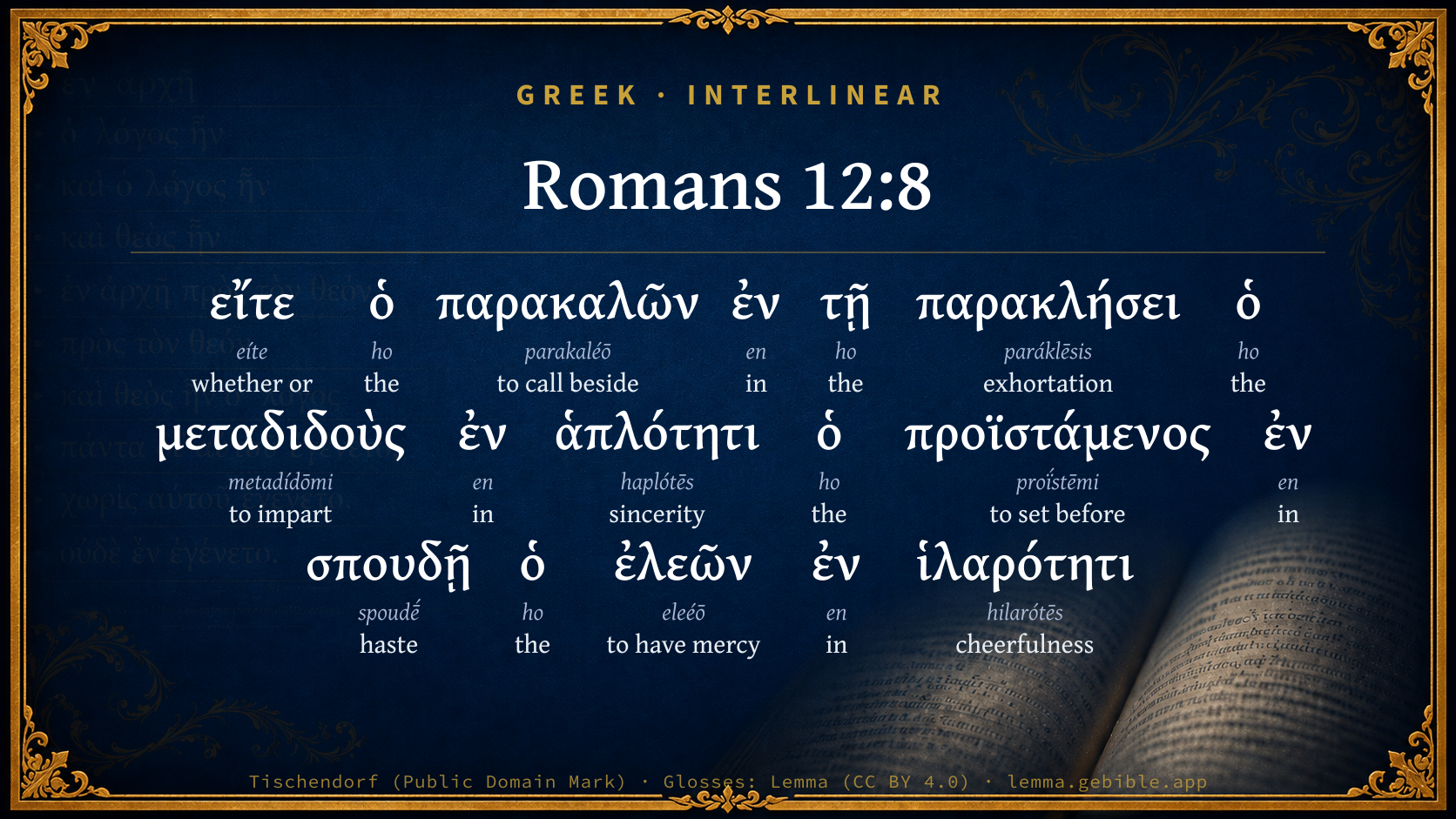
Download image
Cite this verse

Romans 12:8 (World English Bible). Public Domain. Lemma interlinear Bible study tool, https://lemma.gebible.app/v/romans/12/8.

Show BibTeX & RIS
BibTeX
RIS
English Translation
or he who exhorts, to his exhorting: he who gives, let him do it with liberality; he who rules, with diligence; he who shows mercy, with cheerfulness.
World English Bible · Public Domain
Highlights
  • 1 hapax legomenon — only here in the Greek New Testament
  • 3 first appearances in the Greek New Testament
Full analysis ↓
Download a study sheet

One document with this verse’s original text, its word-by-word gloss line, the meaning frame, cross-references with their text, attributed commentary, and full source and license credits — printable, and it pastes into notes with its structure intact.

This verse Autodidact and up

Study sheet (.html) Plain text (.txt)

A passage Seminary Student

Up to 50 verses in one chapter. A passage sheet keeps up to 6 commentary sources and 12 cross-references per verse, in the order this page ranks them, and says so on the sheet whenever that leaves anything out. Ask for a single verse and you get the Autodidact verse sheet above.

Everything on this page stays free to read, with no account — the sheet is a download of what is already on screen, not access to it.

Want to remove ads? Support Godless Engineer
Compare translations 3

The same verse in 3 English versions, stacked beneath the original-language interlinear above. Click any original word for its lexicon entry.

Each is an independent rendering of the whole verse — the interlinear is not word-aligned to these translations.

Highlighted words mark where these versions differ — a whole-verse word diff, not a word-by-word alignment.

  • World English Bible Public Domain
    or he who exhorts, to his exhorting: he who gives, let him do it with liberality; he who rules, with diligence; he who shows mercy, with cheerfulness.
  • King James Version Public Domain
    Or he that exhorteth, on exhortation: he that giveth, let him do it with simplicity; he that ruleth, with diligence; he that sheweth mercy, with cheerfulness.
  • unfoldingWord Literal Text CC BY-SA 4.0
    if the one encouraging, in the encouragement; the one giving, in generosity; the one leading, in diligence; the one showing mercy, with cheerfulness.

unfoldingWord Literal Text — © unfoldingWord, licensed CC BY-SA 4.0. Word-aligned USFM3 via Door43 (git.door43.org/unfoldingWord/en_ult).

Versions to compare (up to 4)

3 of 4 selected

Show all 19 translations

Every available English version of this verse, each an independent rendering of the whole verse.

  • World English Bible Public Domain
    or he who exhorts, to his exhorting: he who gives, let him do it with liberality; he who rules, with diligence; he who shows mercy, with cheerfulness.
  • Berean Standard Bible Public Domain
    if it is encouraging, let him encourage; if it is giving, let him give generously; if it is leading, let him lead with diligence; if it is showing mercy, let him do it cheerfully.
  • Majority Standard Bible Public Domain
    if it is encouraging, let him encourage; if it is giving, let him give generously; if it is leading, let him lead with diligence; if it is showing mercy, let him do it cheerfully.
  • King James Version Public Domain
    Or he that exhorteth, on exhortation: he that giveth, let him do it with simplicity; he that ruleth, with diligence; he that sheweth mercy, with cheerfulness.
  • American Standard Version (1901) Public Domain
    or he that exhorteth, to his exhorting: he that giveth, `let him do it' with liberality; he that ruleth, with diligence; he that showeth mercy, with cheerfulness.
  • Revised Version (1885) Public Domain
    or he that exhorteth, to his exhorting: he that giveth, let him do it with liberality; he that ruleth, with diligence; he that sheweth mercy, with cheerfulness.
  • Geneva Bible (1599) Public Domain
    Or he that exhorteth, on exhortation: he that distributeth, let him doe it with simplicitie: he that ruleth, with diligence: he that sheweth mercie, with cheerefulnesse.
  • Douay-Rheims (1899) Public Domain
    He that exhorteth, in exhorting; he that giveth, with simplicity; he that ruleth, with carefulness; he that sheweth mercy, with cheerfulness.
  • Young's Literal Translation Public Domain
    or he who is exhorting -- `In the exhortation!' he who is sharing -- `In simplicity!' he who is leading -- `In diligence?' he who is doing kindness -- `In cheerfulness.'
  • Literal Standard Version CC BY-SA 4.0
    or he who is exhorting, in the exhortation; he who is sharing, in simplicity; he who is leading, in diligence; he who is doing kindness, in cheerfulness.
  • Unlocked Literal Bible CC BY-SA 4.0
    If one's gift is encouragement, let him encourage. If one's gift is giving, let him do it generously. If one's gift is leading, let it be done with care. If one's gift is in showing mercy, let it be done with cheerfulness.
  • unfoldingWord Literal Text CC BY-SA 4.0
    if the one encouraging, in the encouragement; the one giving, in generosity; the one leading, in diligence; the one showing mercy, with cheerfulness.
  • Darby Bible Public Domain
    or he that exhorts, in exhortation; he that gives, in simplicity; he that leads, with diligence; he that shews mercy, with cheerfulness.
  • World Messianic Bible Public Domain
    or he who exhorts, to his exhorting; he who gives, let him do it with generosity; he who rules, with diligence; he who shows mercy, with cheerfulness.
  • Webster's Bible Public Domain
    Or he that exhorteth, on exhortation: he that giveth, let him do it with simplicity; he that ruleth, with diligence; he that showeth mercy, with cheerfulness.
  • Free Bible Version CC BY-SA 4.0
    if encouragement then you should encourage; if giving then you should give generously; if leadership then you should lead with commitment; if being merciful then you should do so gladly.
  • Bible in Basic English Public Domain
    He who has the power of comforting, let him do so; he who gives, let him give freely; he who has the power of ruling, let him do it with a serious mind; he who has mercy on others, let it be with joy.
  • Text-Critical English NT CC BY 4.0
    if it is exhortation, he should exhort; if it is giving, he should do so generously; if it is leadership, he should do so diligently; if it is showing mercy, he should do so cheerfully.
  • Tyndale New Testament (1534) Public Domain
    Let him that exhorteth geve attendaunce to his exhortacion. Yf eny man geve let him do it with singlenes. Let him that ruleth do it with diligence. Yf eny man shewe mercy let him do it with cherfulnes.

Literal Standard Version (2020), Covenant Press — licensed CC BY-SA 4.0. Text via the HelloAO Bible API (eBible.org). Unlocked Literal Bible (unfoldingWord) — licensed CC BY-SA 4.0. Text via the HelloAO Bible API (eBible.org). unfoldingWord Literal Text — © unfoldingWord, licensed CC BY-SA 4.0. Word-aligned USFM3 via Door43 (git.door43.org/unfoldingWord/en_ult). Free Bible Version, Dr. Jonathan Gallagher — licensed CC BY-SA 4.0. Text via the HelloAO Bible API (eBible.org).

Word by word

More ways to search: Search by grammar → Find every occurrence → Compare this word →

Practice this passage: Drill this verse → Learn its vocabulary →

ἱλαρότητι
hilarótēs
G2432
“cheerfulness”
Noun, Dative, Singular, Feminine
Part of Speech
Noun
Case
Dative
Number
Singular
Gender
Feminine
Full Thayer's Definition

Origin: from G2431

TDNT: 07:57,4

1. cheerfulness, readiness of mind
  1. εἴτε eíte G1535 “whether or” Conjunction
  2. ὁ ho G3588 “the” Article, Nominative, Singular, Masculine
  3. παρακαλῶν parakaléō G3870 “to call beside” Verb, Present, Active, Participle, Nominative, Singular, Masculine
  4. ἐν en G1722 “in” Preposition
  5. τῇ ho G3588 “the” Article, Dative, Singular, Feminine
  6. παρακλήσει paráklēsis G3874 “exhortation” Noun, Dative, Singular, Feminine
  7. ὁ ho G3588 “the” Article, Nominative, Singular, Masculine
  8. μεταδιδοὺς metadídōmi G3330 “to impart” Verb, Present, Active, Participle, Nominative, Singular, Masculine
  9. ἐν en G1722 “in” Preposition
  10. ἁπλότητι haplótēs G572 “sincerity” Noun, Dative, Singular, Feminine
  11. ὁ ho G3588 “the” Article, Nominative, Singular, Masculine
  12. προϊστάμενος proḯstēmi G4291 “to set before” Verb, Present, Middle, Participle, Nominative, Singular, Masculine
  13. ἐν en G1722 “in” Preposition
  14. σπουδῇ spoudḗ G4710 “haste” Noun, Dative, Singular, Feminine
  15. ὁ ho G3588 “the” Article, Nominative, Singular, Masculine
  16. ἐλεῶν eleéō G1653 “to have mercy” Verb, Present, Active, Participle, Nominative, Singular, Masculine
  17. ἐν en G1722 “in” Preposition

About this verse

These counts appear in no published source. They are computed here, from the morphology-tagged text and Lemma’s own curated glosses. What Lemma adds →

18
words
11
distinct lemmas
Pauline Epistles
section

Notable vocabulary

1 hapax legomenon — a word that appears only here in the entire Greek New Testament:

  • ἱλαρότητι cheerfulness G2432

First appearance in Scripture

These words make their first canonical appearance in the Greek New Testament here:

  • ἁπλότητι sincerity G572
  • προϊστάμενος to set before G4291
  • ἱλαρότητι cheerfulness G2432

Shared distinctive vocabulary

μεταδιδοὺς to impart G3330 occurs in 5 verses of the Greek New Testament. Also found in:
Repetition

Words recur within this verse:

Cross-references

54

Topical passages linked to Romans 12:8 in the Treasury of Scripture Knowledge — connected by theme and wording, ordered by reader-vote popularity; previews shown in the World English Bible.

  • 2 Corinthians 9:7 Let each man give according as he has determined in his heart; not grudgingly, or under compulsion; for God loves a cheerful giver.
  • 1 Timothy 5:17 Let the elders who rule well be counted worthy of double honor, especially those who labor in the word and in teaching.
  • 1 Corinthians 12:28 God has set some in the assembly: first apostles, second prophets, third teachers, then miracle workers, then gifts of healings, helps, governments, and various kinds of languages.
  • Acts 15:32 Judas and Silas, also being prophets themselves, encouraged the brothers with many words, and strengthened them.
  • 1 Timothy 3:4–5 one who rules his own house well, having children in subjection with all reverence;
  • Acts 13:15 After the reading of the law and the prophets, the rulers of the synagogue sent to them, saying, "Brothers, if you have any word of exhortation for the people, speak."
  • Acts 20:2 When he had gone through those parts, and had encouraged them with many words, he came into Greece.
  • Acts 20:28 Take heed, therefore, to yourselves, and to all the flock, in which the Holy Spirit has made you overseers, to shepherd the assembly of the Lord and God which he purchased with his own blood.
  • 1 Thessalonians 5:12–14 But we beg you, brothers, to know those who labor among you, and are over you in the Lord, and admonish you,
  • Hebrews 13:7 Remember your leaders, men who spoke to you the word of God, and considering the results of their conduct, imitate their faith.
  • Hebrews 13:17 Obey your leaders and submit to them, for they watch on behalf of your souls, as those who will give account, that they may do this with joy, and not with groaning, for that would be unprofitable for you.
  • Hebrews 13:22 But I exhort you, brothers, endure the word of exhortation, for I have written to you in few words.
  • Acts 11:28–30 One of them named Agabus stood up, and indicated by the Spirit that there should be a great famine all over the world, which also happened in the days of Claudius.
  • 1 Corinthians 14:3 But he who prophesies speaks to men for their edification, exhortation, and consolation.
  • 2 Corinthians 8:12 For if the readiness is there, it is acceptable according to what you have, not according to what you don't have.
  • Hebrews 10:25 not forsaking our own assembling together, as the custom of some is, but exhorting one another; and so much the more, as you see the Day approaching.
  • Hebrews 13:24 Greet all of your leaders and all the saints. The Italians greet you.
  • Psalms 37:21 The wicked borrow, and don't pay back, But the righteous give generously.
  • Psalms 101:1–8 I will sing of loving kindness and justice. To you, Yahweh, I will sing praises.
  • Psalms 112:9 He has dispersed, he has given to the poor. His righteousness endures forever. His horn will be exalted with honor.
  • Proverbs 22:9 He who has a generous eye will be blessed; For he shares his food with the poor.
  • Ecclesiastes 9:10 Whatever your hand finds to do, do it with your might; for there is no work, nor device, nor knowledge, nor wisdom, in Sheol, where you are going.
  • Ecclesiastes 11:1–2 Cast your bread on the waters; For you shall find it after many days.
  • Ecclesiastes 11:6 In the morning sow your seed, And in the evening don't withhold your hand; For you don't know which will prosper, whether this or that, Or whether they both will be equally good.
  • Isaiah 64:5 You meet him who rejoices and works righteousness, those who remember you in your ways: behold, you were angry, and we sinned: in them [have we been] of long time; and shall we be saved?
  • Matthew 6:2–4 Therefore when you do merciful deeds, don't sound a trumpet before yourself, as the hypocrites do in the synagogues and in the streets, that they may get glory from men. Most assuredly I tell you, they have received their reward.
  • Matthew 25:40 "The King will answer them, 'Most assuredly I tell you, inasmuch as you did it to one of the least of these my brothers, you did it to me.'
  • Luke 21:1–4 He looked up, and saw the rich people who were putting their gifts into the treasury.
  • Romans 12:13 contributing to the needs of the saints; given to hospitality.
  • 2 Corinthians 1:12 For our boasting is this: the testimony of our conscience, that in holiness and sincerity of God, not in fleshly wisdom but in the grace of God we behaved ourselves in the world, and more abundantly toward you.
  • 2 Corinthians 9:11 you being enriched in everything to all liberality, which works through us thanksgiving to God.
  • 2 Corinthians 9:13 seeing that through the proof given by this service, they glorify God for the obedience of your confession to the Gospel of Christ, and for the liberality of your contribution to them and to all;
  • 1 Thessalonians 2:3 For our exhortation is not of error, nor of uncleanness, nor in deception.
  • 1 Thessalonians 2:8 Even so, affectionately longing for you, we were well pleased to impart to you, not the Gospel of God only, but also our own souls, because you had become very dear to us.
  • 1 Timothy 4:13 Until I come, pay attention to reading, to exhortation, and to teaching.
  • Genesis 18:19 For I have known him, to the end that he may command his children and his household after him, that they may keep the way of Yahweh, to do righteousness and justice; to the end that Yahweh may bring on Abraham that which he has spoken of him."
  • Deuteronomy 15:8–11 but you shall surely open your hand to him, and shall surely lend him sufficient for his need [in that] which he wants.
  • Deuteronomy 15:14 you shall furnish him liberally out of your flock, and out of your threshing floor, and out of your winepress; as Yahweh your God has blessed you, you shall give to him.
  • Deuteronomy 16:11 and you shall rejoice before Yahweh your God, you, and your son, and your daughter, and your man-servant, and your maid-servant, and the Levite who is within your gates, and the foreigner, and the fatherless, and the widow, who are in the midst of you, in the place which Yahweh your God shall choose, to cause his name to dwell there.
  • Deuteronomy 16:14–15 and you shall rejoice in your feast, you, and your son, and your daughter, and your man-servant, and your maid-servant, and the Levite, and the foreigner, and the fatherless, and the widow, who are within your gates.
  • Job 31:16–20 "If I have withheld the poor from their desire, Or have caused the eyes of the widow to fail,
  • Isaiah 32:5 The fool shall be no more called noble, nor the scoundrel be highly respected.
  • Isaiah 32:8 But the noble devises noble things; and in noble things shall he continue.
  • Isaiah 58:7–11 Isn't it to deal your bread to the hungry, and that you bring the poor who are cast out to your house? when you see the naked, that you cover him; and that you not hide yourself from your own flesh?
  • Acts 2:44–46 All who believed were together, and had all things in common.
  • Acts 4:33–35 With great power, the apostles gave their testimony of the resurrection of the Lord Jesus. Great grace was on them all.
  • Acts 13:12 Then the proconsul, when he saw what was done, believed, being astonished at the teaching of the Lord.
  • Romans 13:6 For this reason you also pay taxes, for they are ministers of God's service, attending continually on this very thing.
  • 2 Corinthians 8:1–9 Moreover, brothers, we make known to you the grace of God which has been given in the assemblies of Macedonia;
  • 2 Corinthians 11:3 But I am afraid that somehow, as the serpent deceived Eve in his craftiness, so your minds might be corrupted from the simplicity that is in Christ.
  • Ephesians 6:5 Servants, be obedient to those who according to the flesh are your masters, with fear and trembling, in singleness of your heart, as to Christ;
  • Colossians 3:22 Servants, obey in all things those who are your masters according to the flesh, not just when they are looking, as men-pleasers, but in singleness of heart, fearing God.
  • 1 Peter 4:9–11 Be hospitable one to another without grumbling.
  • 1 Peter 5:2–3 Shepherd the flock of God which is among you, exercising the oversight, not under compulsion, but voluntarily, not for dishonest gain, but willingly;

Cross-references courtesy of OpenBible.info (CC BY 4.0).

Commentary

Notes on Romans 12:8 from classic Christian and Jewish commentators (each source and its license shown beneath its notes). The classic Christian expositions comment on the surrounding passage and are grouped to its opening verse, so a note may address several verses; the Jewish commentaries on the Tanakh (Rashi and others) are per-verse, so they appear only where the commentator wrote on this verse.

Lemma curates 59 commentaries, every one of them public domain or Creative Commons licensed, each selected and text-cleaned for this edition rather than reprinted as found. About our sources →

The Expositor's Bible

Chapter 26

CHRISTIAN DUTY: DETAILS OF PERSONAL CONDUCT

Rom_12:8-21

ST. PAUL has set before us the life of surrender, of the "giving over" of faculty to God, in one great preliminary aspect. The fair ideal (meant always for a watchful and hopeful realisation) has been held aloft. It is a life whose motive is the Lords "compassions"; whose law of freedom is His will; whose inmost aim is, without envy or interference towards our fellow servants, to "finish the work He hath given us to do." Now into this noble outline are to be poured the details of personal conduct which, in any and every line and field are to make the characteristics of the Christian.

As we listen again, we will again remember that the words are levelled not at a few, but at all who are in Christ. The beings indicated here are not the chosen names of a Church Calendar, nor are they the passionless inhabitants of a Utopia. They are all who, in Rome of old, in England now, "have peace with God through our Lord Jesus Christ," "have the Spirit of God dwelling in them," and are living out this wonderful but most practical life in the straight line of their Fathers will.

As if he could not heap the golden words too thickly together, St. Paul dictates here with even unusual abruptness and terseness of expression. He leaves syntax very much alone; gives us noun and adjective, and lets them speak for themselves. We will venture to render as nearly verbatim as possible. The English will inevitably seem more rough and crude than the Greek, but the impression given will be truer on the whole to the original than a fuller rendering would be.

Your love, unaffected. Abominating the ill, wedded to the good. For your brotherly kindness, full of mutual home affection. For your honour, your code of precedence, deferring to one another. For your earnestness, not slothful. For the Spirit, as regards your possession and use of the divine Indweller, glowing. For the Lord, bond serving. For your hope, that is to say, as to the hope of the Lords Return, rejoicing. For your affliction, enduring. For your prayer, persevering. For the wants of the saints, for the poverty of fellow Christians, communicating; "sharing," a yet nobler thing than the mere "giving" which may ignore the sacred fellowship of the provider and the receiver. Hospitality-prosecuting as with a studious cultivation. Bless those who persecute you; bless, and do not curse. This was a solemnly appropriate precept, for the community over which, eight years later, the first great Persecution was to break in "blood, and fire, and vapour of smoke." And no doubt there was abundant present occasion for it, even while the scene was comparatively tranquil. Every modern mission field can illustrate the possibilities of a "persecution" which may be altogether private, or which at most may touch only a narrow neighbourhood; which may never reach the point of technical outrage, yet may apply a truly "fiery trial" to the faithful convert. Even in circles of our decorous English society is no such thing known as the "persecution" of a life "not conformed to this world," though the assault or torture may take forms almost invisible and impalpable, except to the sensibilities of the object of it? For all such cases, as well as for the confessor on the rack, and the martyr in the fire, this precept holds expressly: "Bless, do not curse." In Christ find possible the impossible; let the resentment of nature die, at His feet, in the breath of His love.

To rejoice with the rejoicing, and to weep with the weeping; holy duties of the surrendered life, too easily forgotten. Alas, there is such a phenomenon, not altogether rare, as a life whose self-surrender, in some main aspects, cannot be doubted, but which utterly fails in sympathy. A certain spiritual exaltation is allowed actually to harden, or at least to seem to harden, the consecrated heart; and the man who perhaps witnesses for God with a prophets ardour is yet not one to whom the mourner would go for tears and prayer in his bereavement, or the child for a perfectly human smile in its play. But this is not as the Lord would have it be. If indeed the Christian has "given his body over," it is that his eyes, and lips, and hands, may be ready to give loving tokens of fellowship in sorrow, and (what is less obvious) in gladness too, to the human hearts around him.

Feeling the same thing towards one another; animated by a happy identity of sympathy and brotherhood. Not haughty in feeling, but full of lowly sympathies; accessible, in an unaffected fellowship, to the poor, the social inferior, the weak and the defeated, and again to the smallest and homeliest interests of all. It was the Lords example; the little child, the wistful parent, the widow with her mite, the poor fallen woman of the street, could "lead away" His blessed sympathies with a touch, while He responded with an unbroken majesty of gracious power, but with a kindness for which condescension seems a word far too cold and distant.

Do not get to be wise in your own opinion; be ready always to learn; dread the attitude of mind, too possible even for the man of earnest spiritual purpose, which assumes that you have nothing to learn and everything to teach; which makes it easy to criticise and to discredit; and which can prove an altogether repellent thing to the observer from outside, who is trying to estimate the Gospel by its adherent and advocate. Requiting no one evil for evil; safe from the spirit of retaliation, in your surrender to Him "who when He was reviled, reviled not again; when He suffered, threatened not." Taking forethought for good in the sight of all men; not letting habits, talk, expenses, drift into inconsistency; watching with open and considerate eyes against what others may fairly think to be unchristian in you. Here is no counsel of cowardice, no recommendation of slavery to a public opinion which may be altogether wrong. It is a precept of loyal jealousy for the heavenly Masters honour. His servant is to be nobly indifferent to the worlds thought and word, where he is sure that God and the world antagonise. But he is to be sensitively attentive to the worlds observation where the world, more or less acquainted with the Christian precept or principle, and more or less conscious of its truth and right, is watching, maliciously or it may be wistfully, to see if it governs the Christians practice. In view of this the man will never be content even with the satisfaction of his own conscience; he will set himself not only to do right, but to be seen to do it. He will not only be true to a monetary trust, for example; he will take care that the proofs of his fidelity shall be open. He will not only mean well towards others; he will take care that his manner and bearing, his dealings and intercourse, shall unmistakably breathe the Christian air.

If possible, as regards your side (the "your" is as emphatic as possible in position and in meaning), living at peace with all men; yes, even in pagan and hostile Rome. A peculiarly Christian principle speaks here. The men who had "given over their bodies a living sacrifice" might think, imaginably, that their duty was to court the worlds enmity, to tilt as it were against its spears, as if the one supreme call was to collide, to fall, and to be glorified. But this would be fanaticism; and the Gospel is never fanatical, for it is the law of love. The surrendered Christian is not, as such, an aspirant for even a martyrs fame, but the servant of God and man. If martyrdom crosses his path, it is met as duty; but he does not court it as eclat. And what is true of martyrdom is of course true of every lower and milder form of the conflict of the Church, and of the Christian, in the world.

Nothing more nobly evidences the divine origin of the Gospel than this essential precept; "as far as it lies with you, live peaceably with all men." Such wise and kind forbearance and neighbourliness would never have been bound up with the belief of supernatural powers and hopes, if those powers and hopes had been the mere issue of human exaltation, of natural enthusiasm. The supernatural of the Gospel leads to nothing but rectitude and considerateness, in short to nothing but love, between man and man. And why? Because it is indeed divine; it is the message and gift of the living Son of God, in all the truth and majesty of His rightfulness. All too early in the history of the Church "the crown of martyrdom" became an object of enthusiastic ambition. But that was not because of the teaching of the Crucified, nor of His suffering Apostles.

Not avenging yourselves, beloved; no, give place to the wrath; let the angry opponent, the dread persecutor, have his way, so far as your resistance or retaliation is concerned. "Beloved, let us love"; {1Jn_4:7} with that strong and conquering love which wins by suffering. And do not fear lest eternal justice should go by default; there is One who will take care of that matter; you may leave it with Him. For it stands written, {Deu_32:35} "To Me belongs vengeance; I will recompense, saith the Lord." "But if" (and again he quotes the older Scriptures, finding in the Pro_25:21-22 -the same oracular authority as in the Pentateuch), "but if thy enemy is hungry, give him food; if he is thirsty, give him drink; for so doing thou wilt heap coals of fire on his head"; taking the best way to the only "vengeance" which a saint can wish, namely, your "enemys" conviction of his wrong, the rising of a burning shame in his soul, and the melting of his spirit in the fire of love. Be not thou conquered by the evil, but conquer, in the good, the evil.

"In the good"; as if surrounded by it, moving invulnerable, in its magic circle, through "the contradiction of sinners," "the provoking of all men." The thought is just that of Psa_31:18-19 : "How great is Thy goodness, which Thou hast laid up for them that fear Thee, which Thou hast wrought for them that trust in Thee before the sons of men! Thou shalt hide them in the secret of Thy presence from the pride of man; Thou shalt keep them secretly in a pavilion from the strife of tongues." "The good" of this sentence of St. Pauls is no vague and abstract thing; it is "the gift of God"; {Rom_6:23} it is the life eternal found and possessed in union with Christ, our Righteousness, our Sanctification, our Redemption. Practically, it is "not It but He." The Roman convert who should find it more than possible to meet his enemy with love, to do him positive good in his need, with a conquering simplicity of intention, was to do so not so much by an internal conflict between his "better self" and his worse, as by the living power of Christ received in his whole being; by "abiding in Him."

It is so now, and forever. The open secret of divine peace and love is what it was; as necessary, as versatile, as victorious. And its path of victory is as straight and as sure as of old. And the precept to tread that path, daily and hourly, if occasion calls, is still as divinely binding as it ever was for the Christian, if indeed he has embraced "the mercies of God," and is looking to his Lord to be evermore "transfigured, by the renewing of his mind."

As we review this rich field of the flowers, and of the gold, of holiness, this now completed paragraph of epigrammatic precepts, some leading and pervading principles emerge. We see first that the sanctity of the Gospel is no hushed and cloistered "indifferentism." It is a thing intended for the open field of human life; to be lived out "before the sons of men." A strong positive element is in it. The saint is to "abominate the evil"; not only to deprecate it, and deplore. He is to be energetically "in earnest." He is to "glow" with the Spirit, and to "rejoice" in the hope of glory. He is to take practical, provident pains to live not only aright, but manifestly aright, in ways which "all men" can recognise. Again, his life is to be essentially social. He is contemplated as one who meets other lives at every turn, and he is never to forget or neglect his relation to them. Particularly in the Christian Society, he is to cherish the "family affection" of the Gospel; to defer to fellow Christians in a generous humility; to share his means with the poor among them; to welcome the strangers of them to his house. He is to think it a sacred duty to enter into the joys and the sorrows round him. He is to keep his sympathies open for despised people, and for little matters. Then again, and most prominently after all, he is to be ready to suffer, and to meet suffering with a spirit far greater than that of only resignation. He is to bless his persecutor; he is to serve his enemy in ways most practical and active; he is to conquer him for Christ, in the power of a divine communion.

Thus, meanwhile, the life, so positive, so active in its effects, is to be essentially all the while a passive, bearing, enduring, life. Its strength is to spring not from the energies of nature, which may or may not be vigorous in the man, but from an internal surrender to the claim and government of his Lord. He has "presented himself to God"; {Rom_6:13} he has "presented his body, a living sacrifice". {Rom_12:1} He has recognised, with a penitent wonder and joy, that he is but the limb of a Body, and that his Head is the Lord. His thought is now not for his personal rights, his individual exaltation, but for the glory of his Head, for the fulfilment of the thought of his Head, and for the health and wealth of the Body, as the great vehicle in the world of the gracious will of the Head.

It is among the chief and deepest of the characteristics of Christian ethics, this passive root below a rich growth and harvest of activity. All through the New Testament we find it expressed or suggested. The first Beatitude uttered by the Lord {Mat_5:3} is given to "the poor, the mendicant (πτωχοί) in spirit." The last {Joh_20:29} is for the believer, who trusts without seeing. The radiant portrait of holy Love {1 Cor. 13} produces its effect, full of indescribable life as well as beauty, by the combination of almost none but negative touches; the "total abstinence" of the loving soul from impatience, from envy, from self-display, from self-seeking, from brooding over wrong, from even the faintest pleasure in evil, from the tendency to think ill of others. Everywhere the Gospel bids the Christian take sides against himself. He is to stand ready to forego even his surest rights, if only he is hurt by so doing; while on the other hand he is watchful to respect even the least obvious rights of others, yea, to consider their weaknesses, and their prejudices, to the furthest just limit. He is "not to resist evil"; in the sense of never fighting for self as self. He is rather to "suffer himself to be defrauded" {1Co_6:7} than to bring discredit on his Lord in however due a course of law. The straits and humiliations of his earthly lot, if such things are the will of God for him, are not to be materials for his discontent, or occasions for his envy, or for his secular ambition. They are to be his opportunities for inward triumph; the theme of a "song of the Lord," in which he is to sing of strength perfected in weakness, of a power not his own "overshadowing" him. {2Co_12:9-10}

Such is the passivity of the saints, deep beneath their serviceable activity. The two are in vital connection. The root is not the accident, but the proper antecedent of the product. For the secret and unostentatious surrender of the will, in its Christian sense, is no mere evacuation, leaving the house swept but empty; it is the reception of the Lord of life into the open castle of the City of Mansoul. It is the placing in His hands of all that the walls contain. And placed in His hands, the castle, and the city, will show at once, and continually more and more, that not only order, but life, has taken possession. The surrender of the Moslem is, in its theory, a mere submission. The surrender of the Gospel is a reception also; and thus its nature is to come out in "the fruit of the Spirit."

Once more, let us not forget that the Apostle lays his main emphasis here rather on being than on doing. Nothing is said of great spiritual enterprises; everything has to do with the personal conduct of the men who, if such enterprises are done, must do them. This too is characteristic of the New Testament. Very rarely do the Apostles say anything about their converts duty, for instance, to carry the message of Christ around them in evangelistic aggression. Such aggression was assuredly attempted, and in numberless ways, by the primeval Christians, from those who were "scattered abroad" {Act_8:4} after the death of Stephen onwards. The Philippians {Php_2:15-16} "shone as lights in the world, holding out the word of life." The Ephesians {Eph_5:13} penetrated the surrounding darkness, being themselves "light in the Lord." The Thessalonians {1Th_1:8} made their witness felt "in Macedonia, and Achaia, and in every place." The Romans; encouraged by St. Pauls presence and sufferings, "were bold to speak the word without." {Php_1:14} St. John {3Jn_1:7} alludes to missionaries who, "for the Names sake, went forth, taking nothing of the Gentiles."

Yet is it not plain that, when the Apostles thought of the life and zeal of their converts, their first care, by far, was that they should be wholly conformed to the will of God in personal and social matters? This Was the indispensable condition to their being, as a community, what they must be if they were to prove true witnesses and propagandists for their Lord.

God forbid that we should draw from this phenomenon one inference, however faint, to thwart or discredit the missionary zeal now in our day rising like a fresh, pure tide in the believing Church. May our Master continually animate His servants in the Church at home to seek the lost around them, to recall the lapsed with the voice of truth and love. May He multiply a hundredfold the scattered host of His "witnesses in the uttermost parts of the earth," through the dwelling places of those eight hundred millions who are still pagan, not to speak of the lesser yet vast multitudes of misbelievers, Mahometan and Jewish. But neither in missionary enterprise, nor in any sort of activity for God and man, is this deep suggestion of the Epistles to be forgotten. What the Christian does is even more important than what he says. What he is is the all-important antecedent to what he does. He is "nothing yet as he ought to" be if, amidst even innumerable efforts and aggressions, he has not "presented his body a living sacrifice" for his Lords purposes, not his own; if he has not learnt, in his Lord, an unaffected love, a holy family affection, a sympathy with griefs and joys around him, a humble esteem of himself, and the blessed art of giving way to wrath, and of overcoming evil in "the good" of the presence of the Lord.

William Robertson Nicoll, ed., The Expositor's Bible (London: Hodder & Stoughton, 1887–1910) — public domain. 65 of 66 books (1 Corinthians is not separately keyed, as that volume carries no machine-parseable verse references); section-level commentary keyed to the opening verse. Introductory and overview sections not keyed to a specific passage are excluded.

Tyndale Open Study Notes

Tyndale Open Resources

12:8 give generously: See also 2 Cor 8:2; 9:11, 13.

Tyndale Open Study Notes — © Tyndale Open Resources, licensed CC BY-SA 4.0. Text via the HelloAO Bible API.

Bengel's Gnomon

Johann Albrecht Bengel

Rom 12:8. Μεταδιδούς) διδόναι signifies to give; μεταδιδόναι to impart, [to give a share,] so that, he who gives, may not strip himself of all, that he has.—ἐν ἁπλότητι) as God gives, Jas 1:5, ‘liberally,’ abundantly, 2Co 8:2, [neither prevented by the desire of private advantage, nor by anxious deliberation, whether or not another may be worthy of the favour given, and whether proper moderation be observed in giving.—V. g.]—ὁ προϊστάμενος) one who has the care of [rules, Engl. V.] others, and has them under his patronage.—ἐν σπουδῇ, with diligence) The force of this word is very extensive; Rom 12:11; 2Co 7:11, note.

Bengel's Gnomon of the New Testament — English translation (T&T Clark, Edinburgh, 1860) — public domain. Text from a community e-Sword module.

Meyer's Critical & Exegetical Commentary

Heinrich August Wilhelm Meyer

Rom_12:8. Ὁ μεταδιδοὺς κ.τ.λ.] The detailed exposition with εἴτε ceases as the discourse flows onward more vehemently, but the series of those charismatically endowed is continued, yet in such a way that now there are no longer mentioned such as possess a χάρισμα for a definite function in the church, but such as possess it generally for the activity of public usefulness in the social Christian life. Hence, because with ἐν ἁπλότητι κ.τ.λ. the continuance of the exhortations is indicated, we are to place before ὁ μεταδιδοὺς not a full stop, but a comma, or, better, a colon. The reference of these last three points to definite ministerial functions (such as that ὁ μεταδιδ. is the diaconus who distributes the gifts of love; ὁ προϊστάμ. the president of the community, bishop or presbyter; ὁ ἐλεῶν he who takes charge of the sick) is refuted, first, by the fact that the assumed references of μεταδιδ. (according to Act_4:35, we should at least expect διαδιδούς) are quite incapable of proof, and indeed improbable in themselves; secondly, by the consideration that such an analysis of the diaconal gift would be out of due place, after mention had been already made of the διακονία as a whole; and thirdly, by the consideration that the position of the προϊστάμενος, as the presbyter, between two diaconal functions, and almost at the end of the series, would he unsuitable. But if we should wish to explain προϊστάμ. as guardian of the strangers (my first edition; Borger), there is an utter want of proof both for this particular feature of the diaconia and for its designation by προϊστάμ. (for the προστάτης at Athens, the patron of the metoeci, was something quite different; Hermann, Staatsalterth. § 115. 4).

ὁ μεταδιδούς] he who imparts, who exercises the charisma of charitableness by imparting of his means to the poor. Eph_4:28; Luk_3:11. To understand the imparting of spiritual good (Baumgarten-Crusius), or this along with the other (Hofmann), receives no support from the context, especially seeing that the spiritual imparting has already been previously disposed of in its distinctive forms.

ἐν ἁπλότ.] in simplicity, therefore without any selfishness, without boasting, secondary designs, etc., but in plain sincerity of disposition. Comp. 2Co_8:2; 2Co_9:11; 2Co_9:13, and the classical collocations of ἁπλοῦς καὶ ἀληθής, ἁπλ. κ. γενναῖος κ.τ.λ. On the subject-matter, comp. Mat_6:2 ff.

ὁ προϊστάμενος] the president, he who exercises the χάρισμα of presiding over others as leader, of directing affairs and the like (comp. προΐστασθαι τῶν πραγμάτων, Herodian, vii. 10. 16), consequently one who through spiritual endowment is ἡγεμονικὸς καὶ ἀρχικός (Plato, Prot. p. 352 B). This χάρισμα προστατικόν had to be possessed by the presbyter or ἐπίσκοπος for behoof of his work (comp. 1Co_12:28); but we are not to understand it as applying to him exclusively, or to explain it specially of the office of presbyter, as Rothe and Philippi again do, in spite of the general nature of the context, while Hofmann likewise thinks that the presbyter is meant, not as respects his office, but as respects his activity. What is meant is the category of charismatic endowment, under which the work destined for the presbyter falls to be included.

ἐν σπουδῇ] with zeal; it is the earnest, strenuous attention to the fulfilment of duty, the opposite of φαυλότης.

ὁ ἐλεῶν] he who is merciful towards the suffering and unfortunate, to whom it is his χάρισμα to administer comfort, counsel, help.

ἐν ἱλαρότ.] with cheerful, friendly demeanour, 2Co_9:7, the opposite of a reluctant and sullen carriage. Comp. Xen. Mem. ii. 7. 12 : ἱλαραὶ δὲ ἀντὶ σκυθρωπῶν.

Observe, further, that ἐν ἁπλότ., ἐν σπουδῇ, and ἐν ἱλαρότ. do not denote, like the preceding definitions with ἐν, the sphere of service within which the activity is to exert itself, but the quality, with which those who are gifted are to do their work; and all these three qualities characterize, in like manner, the nature of true σωφρονεῖν, Rom_12:3.

Meyer — Critical and Exegetical Commentary on the New Testament — English translation by Peter Christie, edited by Frederick Crombie (T&T Clark, 1880) — public domain. Text from a community e-Sword module.

Hodge's Commentary on Romans, Ephesians & First Corinthians

Charles Hodge

Rom_12:8

He that exhorteth, on exhortation. The word (παρακαλέω) here used, means to invite, exhort, and to comfort. Our translators have probably selected the most appropriate sense. Teaching is addressed to the understanding; exhortation, to the conscience and feelings. There was probably no distinct class of officers called exhorters, as distinguished from teachers; but as the apostle is speaking of gifts as well as officers, (both are included in the word χαρίσματα,) his direction is, that he who had the gift of teaching, should teach; and that he who had a gift for exhortation, should be content to exhort.

He that giveth, let him do it with simplicity; he that ruleth, with diligence; he that showeth mercy, with cheerfulness. These directions have reference to the manner in which the duties of church officers and of private Christians ought to be performed. In this connection, the former no doubt are principally, though not exclusively intended. It is a common opinion, that giving, ruling, showing mercy, (ὁ μεταδιδούς, ὁ προΐστάμενος, ὁ ἐλεῶν), refer to different functions of the deaconate. But not only the use of μεταδιδούς instead of διαδιδούς the former properly meaning giving, (what is ones own,) and the latter, distributing is opposed to this view, but the whole exhortation, which refers with equal, or greater propriety, to the state of mind and the manner in which the private duties of Christian fellowship are to be performed. There seems to be no good reason for the restriction of the directions here given to either class, officers or private members, exclusively. He that giveth, with simplicity, ἀπλότητι, singleness of mind. This direction, considered in reference to the deacons, whom, no doubt, Paul included in his exhortation, contemplates their duty of imparting or distributing to the necessity of the saints. This duty, by whomsoever performed, is to be done with simplicity, i.e. with purity of motive, free from all improper designs. This same word is rendered singleness of heart, in Eph_6:5; Col_3:22, and occurs in the same sense, in the phrase, simplicity and godly sincerity, 2Co_1:12. Considered in reference to private Christians, this clause may be rendered, he that giveth, with liberality; see 2Co_8:2; 2Co_9:11, 2Co_9:13.

He that ruleth, with diligence. Here again the right discharge of ecclesiasticial duties is principally intended; 1Th_5:12, We beseech you, brethren, to know (esteem, love) them that are over you in the Lord; 1Ti_5:17, The elders that rule well. There is considerable diversity of opinion as to the explanation to be here given to ὁ προΐστάμενος. The word properly means, one who is placed over, who presides, or rules. It is, however, used in a more restricted sense, for a patron, one who befriends others, and especially strangers. Hence in Rom_16:2, Phoebe is called a προστάτις, a patroness, one who befriended strangers. As what precedes and what follows, giving and showing mercy, relate to acts of kindness, the one to the poor, the other to the sick, so this word, it is urged, should be understood of showing kindness to strangers. There is certainly force in this consideration. But as there is very slight foundation for the ascription of this meaning to the word in the New Testament, and as it is elsewhere used in its ordinary sense, (see 1Th_5:12, comp. 1Ti_5:17), it is commonly understood of rulers. Some take it in reference to rulers in general, civil or ecclesiastical; others, of church-rulers or elders; others, specifically of the forestaer,‹66› or pastor, or bishop of the congregation. The objection against this restricted reference to the presiding officer of a church, is the introduction of the term in the enumeration of ordinary Christian duties. He that gives, he that acts as pastor, he that shows mercy, is rather an incongruous association. It is more common, therefore, to understand προΐστάμενος, of any one who exercises authority in the church. Those who were called to exercise the office of ruler, were required to do it (ἐν σπουδῇ) with diligence, i.e. with attention and zeal. This is opposed to inertness and carelessness. The government of the church, in collecting abuses, preventing disorders, and in the administration of discipline, calls for constant vigilance and fidelity. Προΐσταμένους tametsi proprie nuncupat eos, quibus mandata erat ecclesiae gubernatio (erant autem illi seniores, qui aliis praeibant ac moderabantur, vitaeque censuram exercebant,) quod autem de illis dicit extendi in universum ad praefecturas omne genus potest. Neque enim aut parva ab iis solicitudo requiritur, qui omnium securitati consulere, aut parva sedulitas ab iis, qui pro salute omnium noctes diesque excubare debent. Calvin.

He that showeth mercy, with cheerfulness, (ἱλαρότης, hilarity.) As the former direction (he that giveth, with simplicity) had reference to the care of the poor, this relates to the care of the sick and afflicted. These were the two great departments of the deacons duties. The former was to be discharged with honesty, this with cheerfulness; not as a matter of constraint, but with alacrity and kindness. On this, the value of any service rendered to the children of sorrow mainly depends.

Doctrine

1. The great principle, that truth is in order to holiness, which is so frequently taught in the Scriptures, is plainly implied in this passage. All the doctrines of justification, grace, election, and final salvation, taught in the preceding part of the epistle, are made the foundation for the practical duties enjoined in this, Rom_12:1.

2. The first great duty of redeemed sinners is the dedication of themselves to God. This consecration must be entire, of the body as well as the soul; it must be constant, and according to his will, Rom_12:1.

3. Regeneration is a renewing of the mind, evincing itself in a transformation of the whole character, and leading to the knowledge and approbation of whatever is acceptable to God, Rom_12:2.

4. God is the giver of all good, of honors and offices as well as of talents and graces; and in the distribution of his favors he renders to every man according to his own will, Rom_12:3-6.

5. Christians are one body in Christ. This unity is not only consistent with great diversity of gifts, but necessarily implies it; as the body is one from the union of various members, designed for the performance of various functions, Rom_12:4, Rom_12:5.

6. The different offices of the church are of divine appointment, and are designed for the benefit of the whole body, and not for the advantage of those who hold them, Rom_12:6-8.

Remarks

1. The effect produced upon us by the mercies of God, in redemption, and in his providence, affords an excellent criterion of character. If they lead us to devote ourselves to his service, they produce the effect for which they were designed, and we may conclude that we are of the number of his children. But if they produce indifference to duty, and cherish the idea that we are the special favorites of heaven, or that we may sin with impunity, it is an evidence that our hearts are not right in the sight of God, Rom_12:1.

2. While Christians should remember that the service which they are called upon to render is a rational service, pertaining to the soul, they should not suppose that it consists merely in the secret exercises of the heart. The whole man and the whole life must be actively and constantly devoted to God, Rom_12:1.

3. Those professors of religion who are conformed to the world, cannot have experienced that renewing of the mind which produces a transformation of character, Rom_12:2.

4. Self-conceit and ambition are the besetting sins of men entrusted with power, or highly gifted in any respect, as discontent and envy are those to which persons of inferior station or gifts are most exposed. These evil feelings, so offensive to God, would be subdued, if men would properly lay to heart, that peculiar advantages are bestowed according to the divine pleasure; that they are designed to advance the glory of God, and the good of his church, and not the honor or emolument of those who receive them; and that very frequently those which are least attractive in the sight of men, are the most important in the sight of God. It is here as in the human frame; not the most comely parts are the most valuable, but those which are the least so. The vital parts of our system never attract the praise of men, and are never the source of vanity or pride, Rom_12:3.

5. As Christians are one body in Christ, they should feel their mutual dependence and their common interest in their Head, from whom life, intelligence, enjoyment, and every good comes. They should sympathize in each others joys and sorrows; the hand should not envy the eye, nor the eye despise the foot. How can they, who are destitute of this common feeling with their fellow Christians, be partakers of that Spirit by which true believers are constituted really and not merely nominally one? Rom_12:4, Rom_12:5.

6. Real honor consists in doing well what God calls us to do, and not in the possession of high offices or great talents, Rom_12:6-8.

7. No mans usefulness is increased by going out of his sphere. It is a great mistake to suppose because one possession or employment may, in itself considered, afford better opportunity of doing good than another, that therefore any or every man would be more useful in the one than in the other. The highest improvement of the individual, and the greatest good of the whole, are best secured by each being and doing what God sees fit to determine. If all were the same member, where were the body? God is not the author of confusion, but of order, in all the churches of the saints, Rom_12:6-8.

8. No amount of learning, no superiority of talent, nor even the pretension to inspiration, can justify a departure from the analogy of faith, i.e. from the truths taught by men to whose inspiration God has born witness. All teachers must be brought to this standard; and even if an angel from heaven should teach anything contrary to the Scriptures, he should be regarded as anathema, Gal_1:8. It is a matter of constant gratitude that we have such a standard whereby to try the spirits whether they be of God. Ministers of Christ should see to it, that they do not incur the curse which Paul denounces on those who preach another gospel, Rom_12:6.

9. Private Christians, and especially ecclesiastical officers, are required to discharge their respective duties with singleness of heart, and in the exercise of those virtues which the peculiar nature of their vocation may demand, Rom_12:6-8.

Charles Hodge — Commentary on Romans (1835), First Corinthians (1857), and Ephesians (1856) — public domain. Text from a community e-Sword module.

Geneva Bible (1599)

Geneva Bible translators

Who in other places is called the Pastor.

To wit, the alms, that he distribute them faithfully, and without respect of person.

The Elders of the Church.

They that are busied about tending on the poor, must do it with cheerfulness, lest they add sorrow to sorrow.

Geneva Bible (1599) marginal notes — public domain. Text via Bolls.life.

Jamieson, Fausset & Brown

Robert Jamieson, A. R. Fausset & David Brown

Or he that exhorteth--Since all preaching, whether by apostles, prophets, or teachers, was followed up by exhortation (Act 11:23; Act 14:22; Act 15:32, &c.), many think that no specific class is here in view. But if liberty was given to others to exercise themselves occasionally in exhorting the brethren, generally, or small parties of the less instructed, the reference may be to them.

he that giveth--in the exercise of private benevolence probably, rather than in the discharge of diaconal duty.

with simplicity--so the word probably means. But as simplicity seems enjoined in the next clause but one of this same verse, perhaps the meaning here is, "with liberality," as the same word is rendered in Co2 8:2; Co2 9:11.

he that ruleth--whether in the Church or his own household. See Ti1 3:4-5, where the same word is applied to both.

with diligence--with earnest purpose.

he that showeth mercy, with cheerfulness--not only without grudging either trouble or pecuniary relief, but feeling it to be "more blessed to give than to receive," and to help than be helped.

Jamieson, Fausset & Brown — Commentary Critical and Explanatory on the Whole Bible (1871) — public domain (CC PDM 1.0). Text via the HelloAO Bible API.

Adam Clarke's Commentary

Verse 8. Or he that exhorteth] Ὁ παρακαλων, The person who admonished and reprehended the unruly or disorderly; and who supported the weak and comforted the penitents, and those who were under heaviness through manifold temptations.

He that giveth] He who distributeth the alms of the Church, with simplicity-being influenced by no partiality, but dividing to each according to the necessity of his case.

He that ruleth] Ὁ προΐσταμενος, He that presides over a particular business; but as the verb προΐσταμαι also signifies to defend or patronize, it is probably used here to signify receiving and providing for strangers, and especially the persecuted who were obliged to leave their own homes, and were destitute, afflicted, and tormented. It might also imply the persons whose business it was to receive and entertain the apostolical teachers who travelled from place to place, establishing and confirming the Churches. In this sense the word προστατις is applied to Phoebe, Ro 16:2: She hath been a SUCCOURER of many, and of myself also. The apostle directs that this office should be executed with diligence, that such destitute persons should have their necessities as promptly and as amply supplied as possible.

He that showeth mercy] Let the person who is called to perform any act of compassion or mercy to the wretched do it, not grudgingly nor of necessity, but from a spirit of pure benevolence and sympathy. The poor are often both wicked and worthless: and, if those who are called to minister to them as stewards, overseers, c., do not take care, they will get their hearts hardened with the frequent proofs they will have of deception, lying, idleness, &c. And on this account it is that so many of those who have been called to minister to the poor in parishes, workhouses, and religious societies, when they come to relinquish their employment find that many of their moral feelings have been considerably blunted and perhaps the only reward they get for their services is the character of being hard-hearted. If whatever is done in this way be not done unto the Lord, it can never be done with cheerfulness.

Adam Clarke's Commentary on the Bible (1810–1826) — public domain. Text from a community e-Sword/MySword module.

John Calvin's Commentaries

8. Or he who gives, let him do so in simplicity, etc. From the former clauses we have clearly seen, that he teaches us here the legitimate use of God’s gifts. By the μεταδιδούντοις, the givers, of whom he speaks here, he did not understand those who gave of their own property, but the deacons, who presided in dispensing the public charities of the Church; and by the ἐλούντοις, those who showed mercy, he meant the widows, and other ministers, who were appointed to take care of the sick, according to the custom of the ancient Church: for there were two different offices, — to provide necessaries for the poor, and to attend to their condition. But to the first he recommends simplicity, so that without fraud or respect of persons they were faithfully to administer what was entrusted to them. He required the services of the other party to be rendered with cheerfulness, lest by their peevishness (which often happens) they marred the favor conferred by them. For as nothing gives more solace to the sick or to any one otherwise distressed, than to see men cheerful and prompt in assisting them; so to observe sadness in the countenance of those by whom assistance is given, makes them to feel themselves despised.

Though he rightly calls those προϊστάμενους presidents, to whom was committed the government of the Church, (and they were the elders, who presided over and ruled others and exercised discipline;) yet what he says of these may be extended universally to all kinds of governors: for no small solicitude is required from those who provide for the safety of all, and no small diligence is needful for them who ought to watch day and night for the wellbeing of the whole community. Yet the state of things at that time proves that Paul does not speak of all kinds of rulers, for there were then no pious magistrates; but of the elders who were the correctors of morals.

John Calvin's Commentaries (1540-1563) — public domain. Text from the Calvin Translation Society English edition (1840s-50s) via the Christian Classics Ethereal Library (ccel.org). Calvin's coverage is partial (roughly two-thirds of the Bible); uncommented books and verses are honest gaps, never fabricated. The 19th-century editor's footnotes and remarks are omitted so the notes are faithfully Calvin's own voice.

Ellicott's Commentary for English Readers

(8) He that exhorteth.—It will be observed that in the apostolic writings, the one idea of “preaching” is divided into its several branches, “speaking with tongues,” “prophesying” (which appears to have had reference to the more recondite portions or relations of the faith), “teaching,” “exhortation.” This last form of address, corresponding perhaps rather to our word “encouragement,” would be especially needed in the troubled circumstances of the early Church.

He that giveth.—In this and the following phrases the Apostle passes on from considering the definite functions of the ministry to those which were common to all members of the Church; “giveth” is therefore here to be taken in a wide sense.

Simplicity.—With singleness of motive, desiring only God’s glory, and to benefit the object for which he gives, and with no secret thought of self-exaltation. He who gives “to be seen of men,” or with any selfish motive, exhausts thereby the merit of the act, see Mat_6:2 et seq.

He that ruleth.—He who holds any position of prominence or importance in the Church. The same word is applied to “presbyters” in 1Th_5:12; 1Ti_5:17; and to heads of families in 1Ti_3:4-5; 1Ti_3:12.

He that sheweth mercy, with cheerfulness.—A happy combination which is an instance of the Apostle’s fresh and genuine view of human nature. The kindness of charity is doubled when it is done in a cheerful and kindly way. There is a class of religious minds which is especially apt to forget this. Cheerfulness is not merely a matter of temperament, but to be cultivated as a duty.

A Bible Commentary for English Readers, edited by Charles John Ellicott (1878–1897) — public domain. Text from a community e-Sword module.

The Cambridge Bible for Schools and Colleges

gen. ed. J. J. S. Perowne

8. he that exhorteth] Here again a special division of Christian work is alluded to. The “exhortation” was, perhaps, a department of the speaking-duty of the Church less elaborate than the “teaching;” more entirely regarding practice; and allotted more with a view to physical qualifications, as of voice, &c.

on exhortation] Lit. in the exhortation.

giveth] distributeth; “imparteth” of his own possessions to the needy. Here, of course, no special office, but special opportunity, is in view. Every Christian would, more or less, be a giver; but the wealthier Christians would have peculiar responsibility in the matter.

with simplicity] Lit. in simplicity. A derived meaning of the Gr. word, in connexion with giving, (and so here,) is liberality, openhandedness; the opposite to the doubled, closed, hand of the niggard.—Same word as 2Co_8:2; 2Co_9:11; 2Co_9:13, (where lit. “liberality of distribution”).

ruleth] Lit. presideth; whether in the Church, or over any section of work, or over his own household.

with diligence] Lit. in haste, i.e. with earnestness: with laborious and minute attention to duty.

he that sheweth mercy] Here it is unlikely that a special class, or duty, is in view; except so far as some Christians, by means or opportunity, would be specially led to works of love for the sad and the destitute. Such workers of mercy were to give their work full effect by a spirit of cheerful, and cheering, kindness; as those who had known the kindness of God.

The Cambridge Bible for Schools and Colleges (gen. ed. J. J. S. Perowne; Cambridge University Press, 1878–1918) — public domain. Text from a community e-Sword module.

John Gill's Exposition

Or he that exhorteth, on exhortation,.... This is the other branch of prophesying or preaching, and which is more practical, and lies in giving a word of exhortation to the saints, as their particular cases call for; for as prophets were teachers, Act 13:1; so also exhorters, Act 15:32; and one considerable branch of the ministry, and which is more principally the pastor's work, as well as to teach, is to exhort all sorts of persons, young and old, rich and poor, high and low, bond and free, under his care, with all longsuffering and doctrine. The words will bear to be read, "he that comforteth, on consolation"; and so the Syriac version renders them, , "and another who is a comforter, in his consolation". Though all the ministers of the Gospel are to speak comfortably to the saints, by preaching the doctrines of free justification by Christ's righteousness, and remission of sins by his blood, by bringing the good news of salvation by him, and by opening the exceeding great and precious promises of the Gospel; yet some have a greater talent this way than others; some are "Boanergeses", sons of thunder, Mar 3:17, and others "Barnabases", sons of consolation, Act 4:36; and each should attend to that with all diligence and humility, he is best qualified for.

He that giveth, let him do it with simplicity. Here begins the subdivision of the deacon's office into its several branches, "giving", "ruling", and "showing mercy": by "giving" is meant, not giving of his own, or performing: acts of charity, which is common to all the members of the church, who ought liberally to contribute to the relief of the poor; but imparting or distributing the church's money to proper objects, which is to be done "with simplicity"; with all faithfulness and integrity, without fraud or embezzling the church's stock, with impartiality, and without respect of persons, and liberally and bountifully, as the word here used signifies; see Co2 8:2;

he that ruleth, with diligence; deacons are the "helps, governments", mentioned in Co1 12:28, who are assisting to the pastor in the government of the church; their business is, to observe the conversations of the members of the church, and to warn them that are unruly and walk disorderly, to compose differences, and prepare matters to lay before the church; a deacon is "one that goes before"; and leads on others by way of example in his conduct and conversation; or as the Syriac renders it, , "that stands at the head" of affairs in the church; in the management of which he ought to use all study, thoughtfulness, care and diligence:

he that sheweth mercy, with cheerfulness; which is not to be understood of showing compassion to miserable objects in common, or of giving alms to necessitous persons, and which ought to be done according to the Jewish (l) canons, , "with a cheerful countenance"; and is what is highly pleasing to God, who "loves a cheerful giver": but of a branch of the deacon's office, whose work, among other things, is to visit the sick and distressed, and communicate to them as their wants require; all which should be done, not in a morose and frowning manner, but with a pleasant look and cheerful countenance, which makes the visit and the gift more welcome, acceptable, and useful.

(l) Maimon. Hilch. Mattanot Anayim, c. 10. sect. 4. 13.

John Gill's Exposition of the Whole Bible (1746–1763) — public domain (CC PDM 1.0). Text via the HelloAO Bible API.

Trapp's Complete Commentary

John Trapp

8 Or he that exhorteth, on exhortation: he that giveth, let him do it with simplicity; he that ruleth, with diligence; he that sheweth mercy, with cheerfulness.

Ver. 8. Or he that exhorteth] The pastor properly so called. {See Trapp on "Eph 4:11"}

John Trapp, A Commentary or Exposition upon All the Books of the Old and New Testament (1647–1656) — public domain. Text from a community e-Sword module.

Albert Barnes' Notes on the Bible

He that exhorteth - This word properly denotes one who urges to the practical duties of religion, in distinction from one who teaches its doctrines. One who presents the warnings and the promises of God to excite men to the discharge of their duty. It is clear that there were persons who were recognised as engaging especially in this duty, and who were known by this appellation, as distinguished from prophets and teachers. How long this was continued, there is no means of ascertaining; but it cannot be doubted that it may still be expedient, in many times and places, to have persons designated to this work. In most churches this duty is now blended with the other functions of the ministry.

He that giveth - Margin, “imparteth.” The word denotes the person whose function it was to distribute; and probably designates him who distributed the alms of the church, or him who was the deacon of the congregation. The connection requires that this meaning should be given to the passage: and the word rendered “giveth” may denote one who imparts or distributes that which has been committed to him for that purpose, as well as one who gives out of his private property. As the apostle is speaking here of offices in the church, the former is evidently what is intended. It was deemed an important matter among the early Christians to impart liberally of their substance to support the poor, and provide for the needy: Act 2:44-47; Act 4:34-37; Act 5:1-11; Gal 2:10; Rom 15:26; 2Co 8:8; 2Co 9:2, 2Co 9:12. Hence, it became necessary to appoint persons over these contributions, who should be especially charged with the management of them, and who would see that they were properly distributed; Act 6:1-6. These were the persons who were denominated deacons; Phi 1:1; 1Ti 3:8, 1Ti 3:12.

With simplicity - see Mat 6:22, “If thine eye be single,” etc.; Luk 11:34. The word “simplicity” ἁπλοτής haplotēs is used in a similar sense to denote singleness, honesty of aim, purity, integrity, without any mixture of a base, selfish, or sinister end. It requires the bestowment of a favor without seeking any personal or selfish ends; without partiality; but actuated only by the desire to bestow them in the best possible manner to promote the object for which they were given; 2Co 8:2; 2Co 9:11, 2Co 9:13; 2Co 1:12; Eph 6:5; Col 3:22. It is plain that when property was intrusted to them, there would be danger that they might be tempted to employ it for selfish and sinister ends, to promote their influence and prosperity; and hence, the apostle exhorted them to do it with a single aim to the object for which it was given. Well did he know that there was nothing more tempting than the possession of wealth, though given to be appropriated to others. And this exhortation is applicable not only to the deacons of the churches, but to all who in this day of Christian benevolence are intrusted with money to advance the kingdom of the Lord Jesus Christ.

He that ruleth - This word properly designates one who is set over others, or who presides or rules, or one who attends with diligence and care to a thing. In 1Th 5:12, it is used in relation to ministers in general: “And we beseech you, brethren, to know them which labor among you, and are over you in the Lord;” 1Ti 3:4-5, 1Ti 3:12, it is applied to the head of a family, or one who diligently and faithfully performs the duty of a father: “One that ruleth well his own house;” 1Ti 5:17, it is applied to “elders” in the church: “Let the elders that rule well, etc.” It is not used elsewhere except in Tit 3:8, Tit 3:14, in a different sense, where it is translated “to maintain good works.” The prevailing sense of the word, therefore, is to rule, to preside over, or to have the management of. But to what class of persons reference is had here, and what was precisely their duty, has been made a matter of controversy, and it is not easy to determine. Whether this refers to a permanent office in the church, or to an occasional presiding in their assemblies convened for business, etc. is not settled by the use of the word. It has the idea of ruling, as in a family, or of presiding, as in a deliberate assembly; and either of these ideas would convey all that is implied in the original word; compare 1Co 12:28.

With diligence - This word properly means haste Mar 6:25; Luk 1:39; but it also denotes industry, attention, care; 2Co 7:11, “What carefulness it wrought in you;” 2Co 7:12, “That our care for you in the sight of God, etc.;” 2Co 8:7-8, (Greek) Heb 6:11. It means here that they should be attentive to the duties of their vocation, and engage with ardor in what was committed to them to do.

He that showeth mercy - It is probable, says Calvin, that this refers to those who had the care of the sick and infirm, the aged and the needy; not so much to provide for them by charity, as to attend on them in their affliction, and to take care of them. To the deacons was committed the duty of distributing alms, but to others that of personal attendance. This can hardly be called an office, in the technical sense; and yet it is not improbable that they were designated to this by the church, and requested to perform it. There were no hospitals and no almshouses. Christians felt it was their duty to show personal attention to the infirm and the sick; and so important was their function, that it was deemed worthy of notice in a general direction to the church.

With cheerfulness - The direction given to those who distributed alms was to do it with simplicity, with an honest aim to meet the purpose for which it was intrusted to them. The direction here varies according to the duty to be performed. It is to be done with cheerfulness, pleasantness, joy; with a kind, benign, and happy temper. The importance of this direction to those in this situation is apparent. Nothing tends so much to enhance the value of personal attendance on the sick and afflicted, as a kind and cheerful temper. If any where a mild, amiable, cheerful, and patient disposition is needed, it is near a sick bed, and when administering to the wants of those who are in affliction. And whenever we may be called to such a service, we should remember that this is indispensable. If moroseness, or impatience, or fretfulness is discovered in us, it will pain those whom we seek to benefit, embitter their feelings, and render our services of comparatively little value. The needy and infirm, the feeble and the aged, have enough to bear without the impatience and harshness of professed friends. It may be added that the example of the Lord Jesus Christ is the brightest which the world has furnished of this temper. Though constantly encompassed by the infirm and the afflicted, yet he was always kind, and gentle, and mild, and has left before us exactly what the apostie meant when he said, “he that showeth mercy with cheerfulness.” The example of the good Samaritan is also another instance of what is intended by this direction; compare 2Co 9:7. This direction is particularly applicable to a physician.

We have here an account of the establishment, the order, and the duties of the different members of the Christian church. The amount of it all is, that we should discharge with fidelity the duties which belong to us in the sphere of life in which we are placed; and not despise the rank which God has assigned us; not to think of ourselves more highly than we ought; but to act well our part, according to the station where we are placed, and the talents with which we are endowed. If this were done, it would put an end to discontent, ambition, and strife, and would produce the blessings of universal peace and order.

Albert Barnes' Notes on the Bible (1834–1885) — public domain. Text from a community e-Sword/MySword module.

Matthew Poole's English Annotations

Exhortation: see the notes on the foregoing verse.

He that giveth, let him do it with simplicity; i.e. he that hath the office of collecting and distributing the church alms, (which was the deacons’ work or charge, Act 6:1, &c.), let him discharge it with simplicity, or with singleness of heart; ( so the word is rendered, Eph 6:5); let him do it faithfully and impartially, and without favour or affection.

He that ruleth; or he that is a president, and set over others. There is great difference amongst expositors, who is meant by this ruler. It is not meant of state rulers, (of them he treats in the next chapter), but of church rulers. Some understand, all church officers in general. Others think, such are meant as were not properly pastors and teachers, put together with them had the oversight of the church, to rule the same; to regulate misdemeanors, to pacify differences, to administer discipline in admonition and censures: these they call seniors or elders, or the censors of manners; and are the same the apostle calls governments, or governors, 1Co 12:28; see 1Ti 5:17.

He that showeth mercy, with cheerfulness: some understand this generally of all Christians, that they should be charitable, and that with cheerfulness. But the apostle is yet speaking of the special offices of the church. It cannot be meant of deacons, forasmuch as he had spoken of them before in this very verse. Such therefore may be intended, as had the care assigned them of the sick and impotent, of prisoners and strangers, &c.; see 1Ti 5:10; the same, it may be, that he calleth helps in 1Co 12:28. This charge he directeth them to discharge with cheerfulness; without being weary of that troublesome work, or being sour and froward to those they had to do with.

Matthew Poole's English Annotations on the Holy Bible (1683–1685) — public domain. Text from a community e-Sword/MySword module.

Whedon's Commentary on the Bible

Daniel D. Whedon

8. Exhorteth—As the teacher explained facts and truths for the memory, so the exhorter, on the same grade below the prophet, was the emotional stirrer of the heart. Undoubtedly the prophet, and even above him the apostle, could and often did both teach and exhort, (1Ti_6:2; Tit_2:15.) Nor was there any official boundary line preventing the teacher or exhorter, if the divine charism moved him, from rising into the prophet, but never into the proper apostle. (See note on Luk_1:2.)

Giveth—Distributeth, that is, the charities of the Church.

Ruleth—Or presides, whether as a permanent official or as chosen chairman for any particular occasion.

Showeth mercy—Compassion or benefaction to any case of distress.

All the good-doings thus far mentioned contribute to the united activity of the Church; but they do not specify so many officers by appointment, the whole moving by the spontaneity of the Spirit, rather than by a constituted polity.

Daniel D. Whedon (gen. ed.), Commentary on the Old and New Testaments (1874–1909) — public domain. Text from a community e-Sword module.

John Wesley's Explanatory Notes

He that presideth - That hath the care of a flock. He that showeth mercy - In any instance. With cheerfulness - Rejoicing that he hath such an opportunity.

John Wesley, Explanatory Notes Upon the Whole Bible (1754–1765) — public domain. Text via the GEBible commentary corpus.

Godbey's Commentary on the New Testament

William B. Godbey

8. “Or he that exhorteth, in exhortation.” “The church was multiplied exceedingly by the exhortation of the Holy Ghost” (Act 9:31). Hence we see that the red-hot exhortation rung out by the rank and file of the membership, baptized with the Holy Ghost and fire, is the very thing in the divine order, to convict, convert and sanctify the people, thus multiplying the membership of the church, while teaching them the Word of God is the means of their progressive edification. “He that giveth, with a single eye,” i. e., having nothing in view but the glory of God in making his contribution. All this surreptitious carnal policy through stratagem, fandangos and human trickery, appealing to pride, vanity and lust, so prevalent in the churches, in order to raise money to keep up their finances, is an abomination in the sight of God, grieving away the Holy Spirit and plunging the church into apostasy and damnation. It actually scandalizes God in the estimation of the wicked world, as if He were poor and hard pressed for money, depending on the liberality of the devil’s people to support His church, which is all an infamous lie. He says, “If I were hungry I would not tell you, for the cattle upon a thousand hills are mine.” “He that standeth before the people, with expedition.” A slow leader quickly slows down and ruins anything that he leads. In this way prayer meetings and Sunday-schools and all sorts of religious services are constantly and everywhere undergoing torture and homicide. By all means have a live, wide awake, expeditious leader in everything. Put in a laggard, and he holds all the balance back till he slows the thing to death. “He that showeth mercy, with laughter.” “For God loves a laughing giver” (1Co 9:7). If you can not give to God with a heart so cheerful that you laugh over the privilege of making your contribution, whether for the ministry, the poor or the heathens, God does not want your poor, stingy offering, for He has millions of ravens ready to fly on missions of love and mercy.

William B. Godbey, Commentary on the New Testament (1896–1900) — public domain. Text from a community e-Sword module.

McGarvey & Pendleton's Commentaries

J. W. McGarvey

or he that exhorteth, to his exhorting: he that giveth, let him do it with liberality [Exhortation is addressed to the feeling as teaching is to the understanding. It is used to stir or excite people, whether of the church or not, to do their duty. As endowed or spiritually gifted Christians of that day spoke with tongues (1 Cor 12 and 14), both the teacher and the exhorter would be properly classed as among the workers of miracles. After mentioning the exhorter, Paul drops the word "or" (eite), and thus seems to make a distinction between the workers of miracles whom he has been admonishing, and the class of workers who follow, who evidently had no miraculous power whatever. "Liberality" (haplotes) signifies "the disposition not to turn back on oneself; and it is obvious that from this first meaning there may follow either that of generosity, when a man gives without letting himself be arrested by any selfish calculation; or that of simplicity, when he gives without his left hand knowing what his right hand does--that is to say, without any vain going back on himself, and without any air of haughtiness" (Godet). The word may be correctly translated objectively "liberality" ( 2Co_8:2 ; 2Co_9:11 ; 2Co_9:13 ; Jam_1:5 ); but, used subjectively and more naturally, it signifies singleness of purpose, simplicity, sincerity ( Mat_6:22 ; Luk_11:34 ; 2Co_1:12 ; 2Co_11:3 ; Eph_6:5 ; Col_3:22 ). The latter meaning is clearly indicated here by the context,* for Paul is rebuking ostentation (comp. Mat_6:1-4 ) and enforcing humility, sober self-thought, subjective investigation, simplicity. The giving was to be with honesty of aim, without ulterior or personal or selfish motive]; he that ruleth, with diligence; he that showeth mercy, with cheerfulness . [Whether they ruled as elders and deacons in the church, or as parents at home ( 1Ti_3:3-5 ; 1Ti_3:12 ), they were to do so with a spirit of zealous attention to the work entrusted to them, not with a vainglorious desire to lord it, or to exalt or enrich themselves ( 1Th_5:12-13 ; 1Ti_3:4-5 ; 1Ti_3:12 ; 1Ti_5:17 ; 1Pe_5:1-4 ). Showing mercy is probably best defined at Mat_25:35-36 . Paul here directs that these acts be performed with cheerfulness. The context shows that he means inward joy, not outward simulation of it; for the whole passage is subjective, not objective. (Comp. 2Co_9:7 ) Cheer, like love, must be without hypocrisy, for the one showing mercy has the better end of the blessing ( Act_20:35 ). The purpose of the entire passage is to enforce the spirit of contented humility upon Christians in all their actions, lest those having superior gifts be thereby betrayed into pride and self-exaltation, and those having inferior gifts be seduced by envy to fall into bitterness of spirit or idleness. "In the school of Christ," says Leighton, "the first lesson of all is, self-denial and humility; yea, it is written above the door, as the rule of entry or admission, 'Learn of me, for I am meek and lowly in heart.'"]

* We are decidedly averse to criticizing or correcting the text of the English Revised Version, not wishing to breed suspicious unrest in the minds of its readers. But we can not but feel that occasionally the translators yield to the strong temptation to choose the English word which can be understood at once without the aid of the commentator, whether it conveys the shade of meaning desired by the Scripture writer or not. (Compare note on "spiritual," Rom_12:1 .) In such cases we have pointed out the looseness of the translators. "Give much!" is the urgent cry of this age, and it is thoroughly Scriptural; but the Spirit, speaking through Paul, also said, "Give in simplicity"--i. e., in meekness--and the command must not be lost sight of, simply to effect an easy translation. Perhaps this age needs the latter command more than the former; for, as Caryl observes, "you must rather bring your graces to the touchstone, to try their truth, than to the balance, to weigh their measure."

J. W. McGarvey (with Philip Y. Pendleton), Commentaries on the New Testament (The Fourfold Gospel, 1914; Acts; and the epistles) — public domain. Text from a community e-Sword/MySword module.

The People's New Testament

B. W. Johnson

8. Or he that exhorteth. He whose peculiar strength was to encourage feeble saints, and to stir up Christians to duty. He that giveth. A duty of all, which must be discharged without ostentation. See Matt. 6:2. He that ruleth. One who is an elder should attend to his duty with diligence, an exhortation that a great many elders have overlooked. Every leader should be diligent. He that sheweth mercy. Whenever called upon to show compassion.

B. W. Johnson's The People's New Testament with Notes (1889–1891) — public domain. Electronic text from the Christian Classics Ethereal Library (CCEL) ThML edition.

Cambridge Greek Testament for Schools and Colleges

8. ὁ παρακαλῶν. S. Paul is not thinking only of gifts qualifying for office, but of all gifts which help the society and its members. So here of the gift of stimulus or encouragement, especially in the application of truth to conduct; cf. 1Ti 6:2; Tit 1:9; Tit 2:15.

ὁ μεταδιδοὺς κ.τ.λ. Here and in the two following clauses we have to supply an imperative from the participle.

ἁπλότητι, liberality; cf. 2Co 8:2; 2Co 9:11; 2Co 9:13; Jas 1:5; where see Hort: S. Paul’s use seems to be definitely = liberality.

ὁ προϊστάμενος, very general, for any one in a position of control or guidance; cf. 1Th 5:12; 1Ti 3:4 f., Rom 5:17 (alibi Tit 3:8; Tit 3:14).

ὁ ἐλεῶν, only here and Jud 1:22 (outside the Gospels) of human mercy, ἐν ἱλ. cf. Sirach 32. (35.):11, Pro 22:8 S. H.; perhaps there is a special reference to works of compassion, with almsgiving or healing. Cf. ἐλεημοσύνη, Mat 6:2 f.

Cambridge Greek Testament for Schools and Colleges (Cambridge University Press, 1896; 21 vols, various authors incl. Carr, Maclear, Plummer, Farrar, Lumby, Moule, M. R. James, Simcox) — public domain. Text from a community e-Sword module.

Alford’s Greek Testament

Henry Alford

8.] The παρακαλῶν was not necessarily distinct from the προφητεύων,—see 1Co 14:31.

ὁ μεταδιδούς appears to be the giver of the alms to the poor,—either the deacon himself, or some distributor subordinate to the deacon. This however has been doubted, and not without reason: for a transition certainly seems to be made, by the omission of the εἴτε, from public to private gifts. We cannot find any ecclesiastical meaning for ἐλεῶν (though indeed Calvin, al., understand by it “viduas et alios ministros qui curandis ægrotis, secundum veterem Ecclesiæ morem, præficiebantur”),—and the very fact of the three preceding being all limited to their respective official spheres, whereas these three are connected with qualitative descriptions, speaks strongly for their being private acts, to be always performed in the spirit described. Add to all, that, as Vitringa remarks, διαδιδόναι is more properly to distribute (Act 4:35), μεταδιδόναι to impart of one’s own to another. I would therefore render it: He that bestoweth.

ἐν ἁπλότητι] ordinarily, ‘with simplicity.’ But seeing that ἁπλότης, referred to alms-giving, bears another and an objective meaning, this hardly satisfies me, because σπουδή and ἱλαρότης designate not so much the inward frame of mind, as the outward character of the superintendence and the compassion: as might be expected, when gifts to be exercised for mutual benefit are spoken of. In 2Co 8:2; 2Co 9:11, 2Co 9:13, Jos. Antt. vii. 13. 4 (where David admires Araunah, τῆς ἁπλότητος καὶ τῆς μεγαλοψυχίας), the word signifies ‘liberality:’ so perhaps ἁπλῶς also, Jas 1:5, but see note there. This meaning is not recognized by Wahl, Lex., but defended by Tholuck, who connects it with the phrase found in Stobæus, Eclog. Phys. i. p. 123, ἁπλοῦν τὰς χεῖρας, ‘to open the hands wide:’—and I would thus render it here.

ὁ προϊστάμενος] He that presides—but over what? If over the Church exclusively, we come back to offices again: and it is hardly likely that the rulers of the Church, as such, would be introduced so low down in the list, or by so very general a term, as this. In 1Ti 3:4, 1Ti 3:5, 1Ti 3:12, we have the verb used of presiding over a man’s own household: and in its absolute usage here, I do not see why that also should not be included. Meyer would understand it of ‘patronage of strangers’ (ch. 16:2). Stuart in his Excursus on this place, appended to his Commentary, takes up and defends the same view. But, not insisting on the general usage of the word being preferable where it occurs absolutely, will ἐν σπουδῇ apply to this meaning? Of course so far as σπουδή is applicable to every employment, it might, but more than this is required, where words are connected in so marked a manner as here. Giving προϊστάμενος the ordinary meaning, these words fit admirably: implying that he who is by God set over others, be they members of the Church or of his own household, must not allow himself to forget his responsibility, and take his duty indolently and easily, but must προΐστασθαι σπουδαίως, making it a serious matter of continual diligence.

ὁ ἐλεῶν] See above: He that sheweth mercy, is the very best rendering: and I cannot conceive that any officer of the Church is intended, but every private Christian who exercises compassion. It is in exhibiting compassion, which is often the compulsory work of one obeying his conscience rather than the spontaneous effusion of love, that cheerfulness is so peculiarly required, and so frequently wanting. And yet in such an act it is even of more consequence towards the effect,—consoling the compassionated, than the act itself. κρείσσων λόγος ἢ δόσις, Sir. 18:16.

Henry Alford, The Greek Testament (1849–1861) — public domain. Text from a community e-Sword module.

International Critical Commentary

8. ὁ μεταδιδούς: the man who gives alms of his own substance is to do it in singleness of purpose and not with mixed motives, with the thought of ostentation or reward. With ὁ μεταδιδούς, the man who gives of his own, while ὁ διαδιδούς is the man who distributes other persons’ gifts, comp. Test. XII. Patr. Iss. 7 παντὶ ἀνθρώπῳ ὀδυνομένῳ συνεστέναξα, καὶ πτωχῷ μετέδωκα τὸν ἄρτον μου.

ἁπλότης. The meaning of this word is illustrated best by Test. XII. Patr. Issachar, or περὶ ἁπλότητος. Issachar is represented as the husbandman, who lived simply and honestly on his land. ‘And my father blessed me, seeing that I walk in simplicity (ἁπλότης). And I was not inquisitive in my actions, nor wicked and envious towards my neighbour. I did not speak evil of any one, nor attack a man’s life, but I walked with a single eye (ἐν ἁπλότητι ὀφθαλμῶν). … To every poor and every afflicted man I provided the good things of the earth, in simplicity (ἁπλότης) of heart. … The simple man (ὁ ἁπλοῦς) doth not desire gold, doth not ravish his neighbour, doth not care for all kinds of dainty meats, doth not wish for diversity of clothing, doth not promise himself (οὐχ ὑπογράφει) length of days, he receiveth only the will of God … he walketh in uprightness of life, and beholdeth all things in simplicity (ἁπλότητι).’ Issachar is the honourable, hardworking, straightforward farmer; open-handed and open-hearted, giving out of compassion and in singleness of purpose, not from ambition.

The word is used by St. Paul alone in the N. T., and was specially suited to describe the generous unselfish character of Christian almsgiving; and hence occurs in one or two places almost with the signification of liberality, 2Co 9:11, 2Co 9:13; just as ‘liberality’ in English has come to have a secondary meaning, and δικαιοσύνη in Hellenistic Greek (Hatch, Essays in Biblical Greek, p. 49). Such specialization is particularly natural in the East, where large-hearted generosity is a popular virtue, and where such words as ‘good’ may be used simply to mean munificent.

ὁ προϊστάμενος, the man that presides, or governs in any position, whether ecclesiastical or other. The word is used of ecclesiastical officials, 1Th 5:12; 1Ti 5:17; Just. Mart. Apol. i. 67; and of a man ruling his family (1Ti 3:4, 1Ti 3:5, 1Ti 3:12), and need not be any further defined. Zeal and energy are the natural gifts required of any ruler.

ὁ ἐλεῶν. ‘Let any man or woman who performs deeds of mercy in the church, do so brightly and cheerfully.’ The value of brightness in performing acts of kindness has become proverbial, Ecclus. 32:11. (11) ἐν πάσῃ δόσει ἱλάρωσον τὸ πρόσωπόν σου: Pro 22:8 ἄνδρα ἱλαρὸν καὶ δότην εὐλογεῖ ὁ Θεός (quoted 2Co 9:7); but just as singleminded sincerity became an eminently Christian virtue, so cheerfulness in all the paths of life, a cheerfulness which springs from a warm heart, and a pure conscience and a serene mind set on something above this world, was a special characteristic of the early Christian (Act 2:46; Act 5:41; Php 1:4, Php 1:18; Php 2:18, &c. 1Th 5:16).

Spiritual Gifts

The word χάρισμα (which is almost purely Pauline) is used of those special endowments which come to every Christian as the result of God’s free favour (χάρις) to men and of the consequent gift of faith. In Rom 5:15, Rom 6:13, indeed, it has a wider signification, meaning the free gift on the part of God to man of forgiveness of sins and eternal life, but elsewhere it appears always to be used for those personal endowments which are the gifts of the Spirit. In this connexion it is not confined to special or conspicuous endowments or to special offices. There are, indeed, τὰ χαρίσματα τὰ μείζονα (1Co 12:31), which are those apparently most beneficial to the community; but in the same Epistle the word is also used of the individual fitness for the married or the unmarried state (1Co 7:7); and in Rom 1:13 it is used of the spiritual advantage which an Apostle might confer on the community. So again, χαρίσματα include miraculous powers, but no distinction is made between them and non-miraculous gifts. In the passage before us there is the same combination of very widely differing gifts; the Apostle gives specimens (if we may express it so) of various Christian endowments; it is probable that some of them were generally if not always the function of persons specially set apart for the purpose (although not perhaps necessarily holding ecclesiastical office), others would not be confined to any one office, and many might be possessed by the same person. St. Paul’s meaning is: By natural endowments, strengthened with the gifts of the Spirit, you have various powers and capacities: in the use of these it is above all necessary for the good of the community that you should show a wise and prudent judgement, not attempting offices or work for which you are not fitted, nor marring your gifts by exercising them in a wrong spirit.

This being the meaning of χαρίσματα and St. Paul’s purpose in this chapter, interpretations of it, as of the similar passage (chap. 12) in the First Epistle to the Corinthians, which have attempted to connect spiritual gifts more closely with the Christian ministry are unfounded. These are of two characters. One, that of Neander, maintains that in the original Church there were no ecclesiastical officers at all but only χαρίσματα, and that as spiritual gifts died out, regularly appointed officers took the place of those who possessed them. The other finds, or attempts to find, an ecclesiastical office for each gift of the Spirit mentioned in this chapter and the parallel passage of the Corinthians, or at any rate argues that there must have been προφῆται, διδάσκαλοι &c., existing as church officers in the Corinthian and Roman communities. Neither of these is a correct deduction from the passages under consideration. In dealing with the χαρίσματα St. Paul is discussing a series of questions only partially connected with the Christian ministry. Every church officer would, we may presume, be considered to have χαρίσματα which would fit him for the fulfilment of such an office; but most, if not all, Christians would also have χαρίσματα. The two questions therefore are on different planes which partially intersect, and deductions from these chapters made in any direction as to the form of the Christian organization are invalid, although they show the spiritual endowments which those prominent in the community could possess.

A comparison of the two passages, 1Co_12. and Rom 12:3-8, is interesting on other grounds. St. Paul in the Corinthian Epistle is dealing with a definite series of difficulties arising from the special endowments and irregularities of that church. He treats the whole subject very fully, and, as was necessary, condemns definite disorders. In the Roman Epistle he is evidently writing with the former Epistle in his mind: he uses the same simile: he concludes equally with a list of forms of χαρίσματα—shorter, indeed, but representative; but there is no sign of that directness which would arise from dealing with special circumstances. The letter is written with the experience of Corinth fresh in the writer’s mind, but without any immediate purpose. He is laying down directions based on his experience; but instead of a number of different details, he sums up all that he has to say in one general moral principle: Prudence and self-restraint in proportion to the gift of faith. Just as the doctrinal portions of the Epistle are written with the memory of past controversies still fresh, discussing and laying down in a broad spirit positions which had been gained in the course of those controversies, so we shall find that in the practical portion St. Paul is laying down broad and statesmanlike positions which are the result of past experience and deal with circumstances which may arise in any community.

MAXIMS TO GUIDE THE CHRISTIAN LIFE

International Critical Commentary — older volumes (1896–1929), various authors — public domain. Text from a community e-Sword module.

Vincent's Word Studies in the New Testament

Marvin R. Vincent

Exhortation. Aimed at the heart and will. See on consolation, Luk 6:24. Compare 1Co 14:3; Act 4:36, where Rev. gives son of exhortation.

He that giveth [ο μεταδιδους] . Earthly possessions. The preposition meta indicates sharing with. He that imparteth. Compare Eph 4:28; Luk 3:11.

Simplicity [απλοτητι] . See on single, Mt 6:22, and compare Jas 1:5, where it is said that God gives aJplwv simply. See note there. In 2Co 8:2; 2Co 9:11, 13, the A. V. gives liberality; and in Jas 1:5, liberally. Rev. accepts this in the last - named passage, but gives singleness in margin. In all the others liberality is, at best, very doubtful. The sense is unusual, and the rendering simplicity or singleness is defensible in all the passages.

He that ruleth [ο προισταμενος] . Lit., he that is placed in front. The reference is to any position involving superintendence. No special ecclesiastical office is meant. Compare Tit 3:8, to maintain good works; the idea of presiding over running into that of carrying on or practicing. See note there. Compare also prostativ succorer, Rom 16:2, and see note.

With diligence [εν σπουδη] . See on Jude 1:3. In Mr 6:25; Luk 1:39, it is rendered haste. In 2Co 7:11, carefulness (Rev., earnest care). In 2Co 7:12, care (Rev., earnest care). In 2Co 8:8, forwardness (Rev., earnestness). In 2Co 8:16, earnest care. With cheerfulness [εν ιλαροτητι] . Only here in the New Testament. It reappears in the Latin hilaritas; English, hilarity, exhilarate. "The joyful eagerness, the amiable grace, the affability going the length of gayety, which make the visitor a sunbeam penetrating into the sick - chamber, and to the heart of the afflicted."

Marvin R. Vincent, Word Studies in the New Testament (1887–1900) — public domain. Text from a community e-Sword/MySword module.

Lesson kit

Teaching starters — assembled from the data on this page, not authored interpretation. Every prompt links to the verse data it draws on. Edit before teaching.

Romans, in the Pauline Epistles, opens this verse with 18 words (11 distinct Greek lemmas). Its most distinctive word is hilarótēs (“cheerfulness”). A historical commentator’s framing appears above. Read the whole chapter for the surrounding context.

Discussion questions

  1. What does “cheerfulness” (hilarótēs) contribute to the verse as a whole?
  2. 1 word here appears nowhere else in the Greek New Testament. Why might the author reach for such rare wording?
  3. 3 words make their first appearance in Scripture here. What does this debut establish?
  4. How does Luke 3:11, which shares the word «to impart», read alongside this verse?
  5. What does the repetition of “the” (5× in this one verse) do in this verse?
  6. The translations on this page render this verse differently — a whole-verse word diff, not a word-by-word alignment. What might account for the different wordings?
  7. Compare how The Expositor's Bible and Tyndale Open Study Notes read this verse. Where do they agree or differ?

Things to notice

  • 1 word in this verse appears nowhere else in the Greek New Testament.
  • 3 words make their first canonical appearance in Scripture here.
  • These translations choose different wording for 23 words in this verse.
  • “the” occurs 5× in this single verse.
  • 11 distinct Greek lemmas span 18 words in this verse.

Reading settings

Reading text

Shown beneath each verse's original-language words.

Old Testament
Old Testament edition

Read the OT as the Masoretic Hebrew (MT) or the Greek Septuagint (LXX).

English shown for the Greek Septuagint (in the Hebrew ↔ Greek comparison).

Comparing translations? Open the Compare panel on any verse page to stack up to four side by side.