2 Thessalonians 3:12

Greek (Tischendorf 8th ed.) 2 Thessalonians 3:12 appears in the Greek New Testament. The text above is from the Tischendorf 8th edition. Each word links to its Strong’s number and a concise gloss. Click any word for its full Thayer’s Greek Lexicon entry.
Download image
Cite this verse

2 Thessalonians 3:12 (World English Bible). Public Domain. Lemma interlinear Bible study tool, https://lemma.gebible.app/v/2-thessalonians/3/12.

Show BibTeX & RIS
BibTeX
RIS
English Translation
Now those who are that way, we command and exhort in the Lord Jesus Christ, that with quietness they work, and eat their own bread.
World English Bible · Public Domain
Download a study sheet

One document with this verse’s original text, its word-by-word gloss line, the meaning frame, cross-references with their text, attributed commentary, and full source and license credits — printable, and it pastes into notes with its structure intact.

This verse Autodidact and up

Study sheet (.html) Plain text (.txt)

A passage Seminary Student

Up to 50 verses in one chapter. A passage sheet keeps up to 6 commentary sources and 12 cross-references per verse, in the order this page ranks them, and says so on the sheet whenever that leaves anything out. Ask for a single verse and you get the Autodidact verse sheet above.

Everything on this page stays free to read, with no account — the sheet is a download of what is already on screen, not access to it.

Want to remove ads? Support Godless Engineer
Compare translations 3

The same verse in 3 English versions, stacked beneath the original-language interlinear above. Click any original word for its lexicon entry.

Each is an independent rendering of the whole verse — the interlinear is not word-aligned to these translations.

Highlighted words mark where these versions differ — a whole-verse word diff, not a word-by-word alignment.

  • World English Bible Public Domain
    Now those who are that way, we command and exhort in the Lord Jesus Christ, that with quietness they work, and eat their own bread.
  • King James Version Public Domain
    Now them that are such we command and exhort by our Lord Jesus Christ, that with quietness they work, and eat their own bread.
  • unfoldingWord Literal Text CC BY-SA 4.0
    But such ones we are commanding and exhorting in the Lord Jesus Christ, that working with quietness, they might eat their own bread.

unfoldingWord Literal Text — © unfoldingWord, licensed CC BY-SA 4.0. Word-aligned USFM3 via Door43 (git.door43.org/unfoldingWord/en_ult).

Versions to compare (up to 4)

3 of 4 selected

Show all 19 translations

Every available English version of this verse, each an independent rendering of the whole verse.

  • World English Bible Public Domain
    Now those who are that way, we command and exhort in the Lord Jesus Christ, that with quietness they work, and eat their own bread.
  • Berean Standard Bible Public Domain
    We command and urge such people by our Lord Jesus Christ to begin working quietly to earn their own living.
  • Majority Standard Bible Public Domain
    We command and urge such people by our Lord Jesus Christ to begin working quietly to earn their own living.
  • King James Version Public Domain
    Now them that are such we command and exhort by our Lord Jesus Christ, that with quietness they work, and eat their own bread.
  • American Standard Version (1901) Public Domain
    Now them that are such we command and exhort in the Lord Jesus Christ, that with quietness they work, and eat their own bread.
  • Revised Version (1885) Public Domain
    Now them that are such we command and exhort in the Lord Jesus Christ, that with quietness they work, and eat their own bread.
  • Geneva Bible (1599) Public Domain
    Therefore them that are such, we warne and exhort by our Lord Iesus Christ, that they worke with quietnes, and eate their owne bread.
  • Douay-Rheims (1899) Public Domain
    Now we charge them that are such, and beseech them by the Lord Jesus Christ, that, working with silence, they would eat their own bread.
  • Young's Literal Translation Public Domain
    and such we command and exhort through our Lord Jesus Christ, that with quietness working, their own bread they may eat;
  • Literal Standard Version CC BY-SA 4.0
    and such we command and exhort through our Lord Jesus Christ, that working with quietness, they may eat their own bread;
  • Unlocked Literal Bible CC BY-SA 4.0
    Now such ones we command and exhort in the Lord Jesus Christ, that they should work with quietness and eat their own food.
  • unfoldingWord Literal Text CC BY-SA 4.0
    But such ones we are commanding and exhorting in the Lord Jesus Christ, that working with quietness, they might eat their own bread.
  • Darby Bible Public Domain
    Now such we enjoin and exhort in [the] Lord Jesus Christ, that working quietly they eat their own bread.
  • World Messianic Bible Public Domain
    Now those who are that way, we command and exhort in the Lord Yeshua the Messiah, that they work with quietness and eat their own bread.
  • Webster's Bible Public Domain
    Now them that are such we command and exhort by our Lord Jesus Christ, that with quietness they work, and eat their own bread.
  • Free Bible Version CC BY-SA 4.0
    We're ordering such people, urging them in the Lord Jesus, to settle down and work to pay for their own food.
  • Bible in Basic English Public Domain
    Now to such we give orders and make request in the Lord Jesus, that, working quietly, they get their living.
  • Text-Critical English NT CC BY 4.0
    Now we command and exhort such people by our Lord Jesus Christ to work quietly and eat their own bread.
  • Tyndale New Testament (1534) Public Domain
    Them that are soche we commaunde and exhorte by oure lorde Iesu Christ that they worke with quyetnes and eate their awne breed.

Literal Standard Version (2020), Covenant Press — licensed CC BY-SA 4.0. Text via the HelloAO Bible API (eBible.org). Unlocked Literal Bible (unfoldingWord) — licensed CC BY-SA 4.0. Text via the HelloAO Bible API (eBible.org). unfoldingWord Literal Text — © unfoldingWord, licensed CC BY-SA 4.0. Word-aligned USFM3 via Door43 (git.door43.org/unfoldingWord/en_ult). Free Bible Version, Dr. Jonathan Gallagher — licensed CC BY-SA 4.0. Text via the HelloAO Bible API (eBible.org).

Word by word

More ways to search: Search by grammar → Find every occurrence → Compare this word →

Practice this passage: Drill this verse → Learn its vocabulary →

ἡσυχίας
hēsychía
G2271
“quietness”
Noun, Genitive, Singular, Feminine
Part of Speech
Noun
Case
Genitive
Number
Singular
Gender
Feminine
Full Thayer's Definition

Origin: from G2272

TDNT: None

1. quietness a. description of the life of one who stays at home doing his own work, and does not officiously meddle with the affairs of others 2. silence
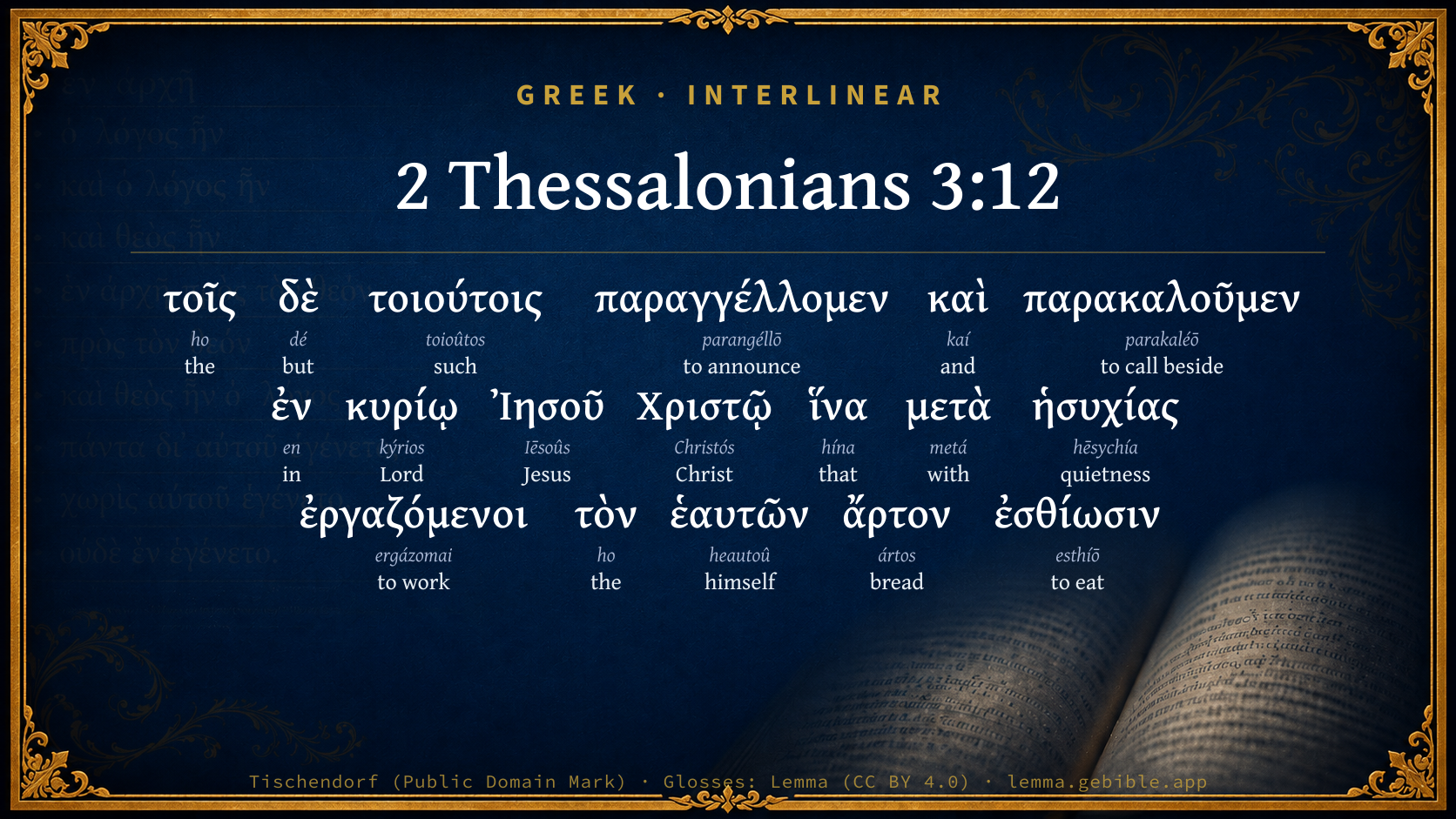
  1. τοῖς ho G3588 “the” Article, Dative, Plural, Masculine
  2. δὲ dé G1161 “but” Conjunction
  3. τοιούτοις toioûtos G5108 “such” Demonstrative pronoun, Dative, Plural, Masculine
  4. παραγγέλλομεν parangéllō G3853 “to announce” Verb, Present, Active, Indicative, 1st person, Plural
  5. καὶ kaí G2532 “and” Conjunction
  6. παρακαλοῦμεν parakaléō G3870 “to call beside” Verb, Present, Active, Indicative, 1st person, Plural
  7. ἐν en G1722 “in” Preposition
  8. κυρίῳ kýrios G2962 “Lord” Noun, Dative, Singular, Masculine
  9. Ἰησοῦ Iēsoûs G2424 “Jesus” Noun, Dative, Singular, Masculine
  10. Χριστῷ Christós G5547 “Christ” Noun, Dative, Singular, Masculine
  11. ἵνα hína G2443 “that” Conjunction
  12. μετὰ metá G3326 “with” Preposition
  13. ἐργαζόμενοι ergázomai G2038 “to work” Verb, Present, Middle or Passive deponent, Participle, Nominative, Plural, Masculine
  14. τὸν ho G3588 “the” Article, Accusative, Singular, Masculine
  15. ἑαυτῶν heautoû G1438 “himself” Reflexive pronoun, 3rd person, Genitive, Plural, Masculine
  16. ἄρτον ártos G740 “bread” Noun, Accusative, Singular, Masculine
  17. ἐσθίωσιν esthíō G2068 “to eat” Verb, Present, Active, Subjunctive, 3rd person, Plural

About this verse

These counts appear in no published source. They are computed here, from the morphology-tagged text and Lemma’s own curated glosses. What Lemma adds →

18
words
17
distinct lemmas
Pauline Epistles
section

Notable vocabulary

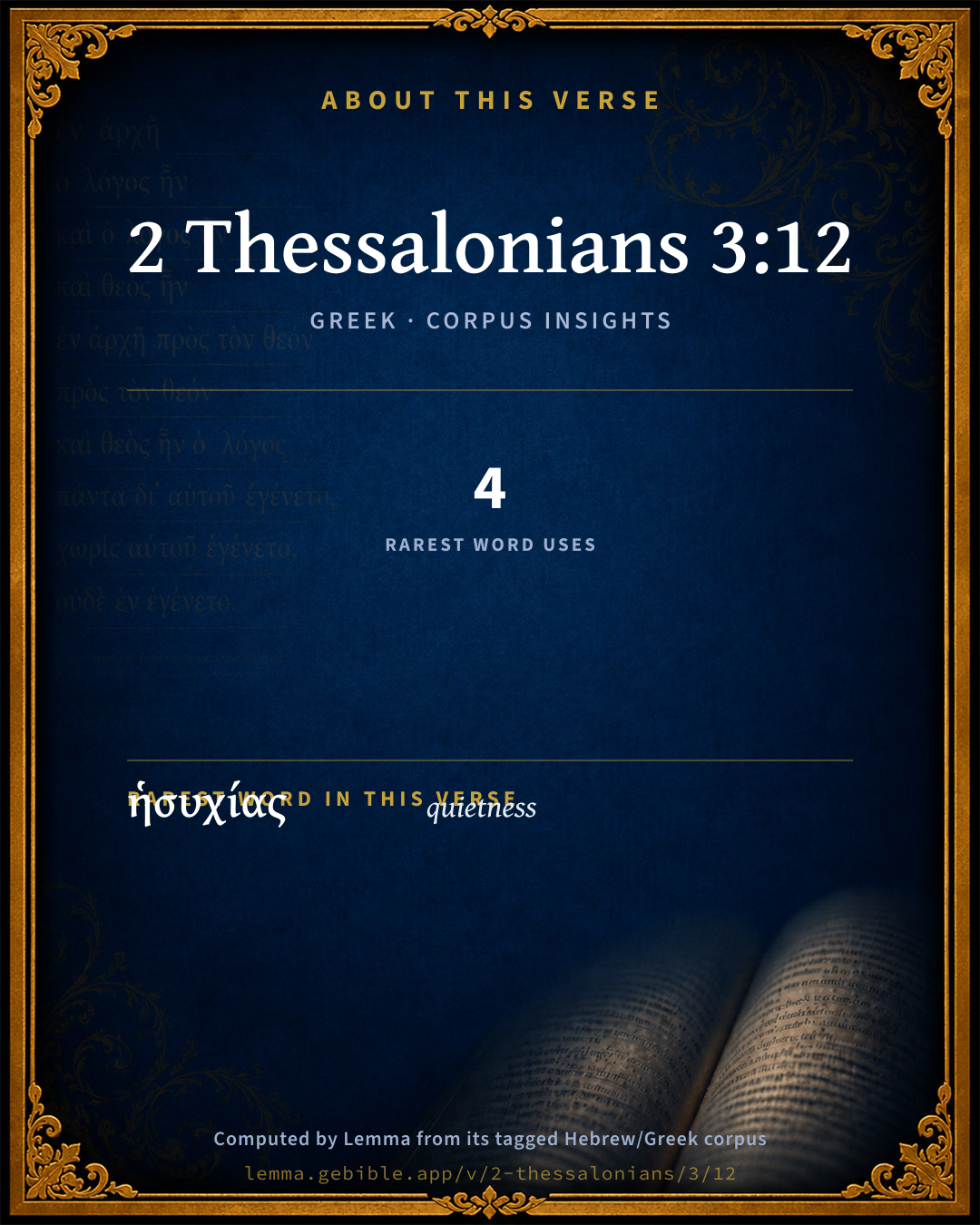
The rarest word here is ἡσυχίας quietness G2271 — appearing just 4 times in the whole Greek New Testament.

Shared distinctive vocabulary

ἡσυχίας quietness G2271 occurs in 4 verses of the Greek New Testament. Also found in:

Repetition

A word recurs within this verse:

  • τοῖς the G3588 ×2

Cross-references

9

Topical passages linked to 2 Thessalonians 3:12 in the Treasury of Scripture Knowledge — connected by theme and wording, ordered by reader-vote popularity; previews shown in the World English Bible.

  • Ephesians 4:28 Let him who stole steal no more; but rather let him labor, working with his hands the thing that is good, that he may have something to give to him who has need.
  • 1 Thessalonians 4:11 and that you make it your ambition to lead a quiet life, and to do your own business, and to work with your own hands, even as we charged you;
  • 2 Thessalonians 3:8 neither did we eat bread from anyone's hand without paying for it, but in labor and travail worked night and day, that we might not burden any of you;
  • Proverbs 17:1 Better is a dry morsel with quietness, Than a house full of feasting with strife.
  • Ecclesiastes 4:6 Better is a handful, with quietness, than two handfuls with labor and chasing after wind.
  • Luke 11:3 Give us day by day our daily bread.
  • Genesis 49:14–15 "Issachar is a strong donkey, Lying down between the saddlebags.
  • 1 Thessalonians 4:1 Finally then, brothers, we beg and exhort you in the Lord Jesus, that as you received from us how you ought to walk and to please God, that you abound more and more.
  • 1 Timothy 2:2 for kings and all who are in high places; that we may lead a tranquil and quiet life in all godliness and reverence.

Cross-references courtesy of OpenBible.info (CC BY 4.0).

Where the printed editions differ

1 variant

Places in this verse where the major printed Greek editions disagree on the wording in a way that affects the translation — a comparison of editions, not a manuscript-by-manuscript collation. The editions are the modern critical texts (Nestlé-Aland 28/27, SBL, Westcott-Hort, Tregelles, Tyndale House) and the traditional texts behind the KJV (the Textus Receptus and the Byzantine/Majority text). It is not a claim about which reading is original.

  1. Extra text
    ἡμῶν

    “of us”

    In TRByz Not in NA28NA27TynSBLWHTreg

    ἡμῶν (hēmōn) 'of us' is only in traditional manuscripts (TR+Byz)

Textual data: Translators Amalgamated Greek New Testament (STEPBible TAGNT) · CC BY 4.0.

Commentary

Notes on 2 Thessalonians 3:12 from classic Christian and Jewish commentators (each source and its license shown beneath its notes). The classic Christian expositions comment on the surrounding passage and are grouped to its opening verse, so a note may address several verses; the Jewish commentaries on the Tanakh (Rashi and others) are per-verse, so they appear only where the commentator wrote on this verse.

Lemma curates 59 commentaries, every one of them public domain or Creative Commons licensed, each selected and text-cleaned for this edition rather than reprinted as found. About our sources →

Tyndale Open Study Notes

Tyndale Open Resources

3:12 Paul underscores the strength of the command by appealing to the authority of the Lord Jesus (as in 3:6; 1 Thes 4:1-2). • settle down: i.e., lead a quiet life instead of being involved in meddlesome activities (see 1 Thes 4:11).

Tyndale Open Study Notes — © Tyndale Open Resources, licensed CC BY-SA 4.0. Text via the HelloAO Bible API.

Bengel's Gnomon

Johann Albrecht Bengel

2Th 3:12. Μετὰ ἡσυχίας, with quietness) Laying aside curiosity [over-officiousness or inquisitiveness].—ἑαυτῶν, their own) not another’s.

Bengel's Gnomon of the New Testament — English translation (T&T Clark, Edinburgh, 1860) — public domain. Text from a community e-Sword module.

Meyer's Critical & Exegetical Commentary

Heinrich August Wilhelm Meyer

2Th_3:12. Καὶ παρακαλοῦμεν] sc. αὐτούς.

μετὰ ἡσυχίας ἐργαζόμενοι] with quietness, i.e. applying yourself to your earthly calling, subjectively with a quiet and collected mind, and objectively with noiseless modesty. Contrast to μηδὲν ἐργάζεσθαι ἀλλὰ περιεργάζεσθαι. Comp. 1Th_4:11.

ἑαυτῶν] emphatic, their own bread, that is to say, their self-earned sustenance, avoiding a maintenance which depends on the charity of others.

Meyer — Critical and Exegetical Commentary on the New Testament — English translation by Peter Christie, edited by Frederick Crombie (T&T Clark, 1880) — public domain. Text from a community e-Sword module.

Expositor's Greek Testament

ed. W. Robertson Nicoll

2Th 3:12 . They are not directly addressed (contrast 6, 13). μετὰ ἡσυχίας , in the homely sphere of work. The three causes of disquiet at Thessalonica are ( a ) the disturbing effect of persecution, ( b ) the tension produced by the thought of the advent of Christ, and ( c ), as an outcome of the latter, irregularity and social disorganisation in the community.

The Expositor's Greek Testament, edited by W. Robertson Nicoll (1897–1910) — public domain. Text from a community e-Sword module.

Geneva Bible (1599)

Geneva Bible translators

The Lord commandeth, and the Apostles pray in the name of Christ, first that no men be idle, and next, that every man do quietly and carefully see to do his duty in that office and calling wherein the Lord hath placed him.

Geneva Bible (1599) marginal notes — public domain. Text via Bolls.life.

Jamieson, Fausset & Brown

Robert Jamieson, A. R. Fausset & David Brown

by--The oldest manuscripts read, "IN the Lord Jesus." So the Greek, Th1 4:1, implying the sphere wherein such conduct is appropriate and consistent. "We exhort you thus, as ministers IN Christ, exhorting our people IN Christ."

with quietness--quiet industry; laying aside restless, bustling, intermeddling officiousness (Th2 3:11).

their own--bread earned by themselves, not another's bread (Th2 3:8).

Jamieson, Fausset & Brown — Commentary Critical and Explanatory on the Whole Bible (1871) — public domain (CC PDM 1.0). Text via the HelloAO Bible API.

Adam Clarke's Commentary

Verse 12. With quietness they work] μετα ησυχιας. With silence; leaving their tale-bearing and officious intermeddling. Less noise and more work!

That - they work, and eat their own bread.] Their own bread, because earned by their own honest industry. What a degrading thing to live on the bounty or mercy of another, while a man is able to acquire his own livelihood! He who can submit to this has lost the spirit of independence; and has in him a beggar's heart, and is capable of nothing but base and beggarly actions. Witness the great mass of the people of England, who by their dependence on the poor rates are, from being laborious, independent, and respect able, become idle, profligate, and knavish; the propagators and perpetrators of crime; a discredit to the nation, and a curse to society. The apostle's command is a cure for such; and the Church of God should discountenance such, and disown them.

Adam Clarke's Commentary on the Bible (1810–1826) — public domain. Text from a community e-Sword/MySword module.

John Calvin's Commentaries

12 Now we command such. He corrects both of the faults of which he had made mention — a blustering restlessness, and retirement from useful employment. He accordingly exhorts them, in the first place, to cultivate repose — that is, to keep themselves quietly within the limits of their calling, or, as we commonly say, “sans faire bruit,” (without making a noise.) For the truth is this: those are the most peaceable of all, that exercise themselves in lawful employments; while those that have nothing to do give trouble both to themselves and to others. Further, he subjoins another precept — that they should labor, that is, that they should be intent upon their calling, and devote themselves to lawful and honorable employments, without which the life of man is of a wandering nature. Hence, also, there follows this third injunction — that they should eat their own bread; by which he means, that they should be satisfied with what belongs to them, that they may not be oppressive or unreasonable to others.

Drink water, says Solomon, from thine own fountains, and let the streams flow down to neighbors. (Proverbs 5:15.)

This is the first law of equity, that no one make use of what belongs to another, but only use what he can properly call his own. The second is, that no one swallow up, like some abyss, what belongs to him, but that he be beneficent to neighbors, and that he may relieve their indigence by his abundance. In the same manner, the Apostle exhorts those who had been formerly idle to labor, not merely that they may gain for themselves a livelihood, but that they may also be helpful to the necessities of their brethren, as he also teaches elsewhere. (Ephesians 4:28.)

John Calvin's Commentaries (1540-1563) — public domain. Text from the Calvin Translation Society English edition (1840s-50s) via the Christian Classics Ethereal Library (ccel.org). Calvin's coverage is partial (roughly two-thirds of the Bible); uncommented books and verses are honest gaps, never fabricated. The 19th-century editor's footnotes and remarks are omitted so the notes are faithfully Calvin's own voice.

Ellicott's Commentary for English Readers

(12) We command.—The fourth time the severe word is used in this very chapter. Perhaps “we order” might convey the meaning still more sharply. But immediately, lest severity provoke rebellion, he adds, “and we beseech,” alleging also the grounds on which he rests his appeal: “in our Lord”—i.e., “on the strength of our union in the Body of Christ.” (Comp. 1Th_4:1.)

That with quietness they work.—The opposites of bustling, and of idleness.

Eat their own bread.—Not other people’s. This passage tempts us to take the marginal version in 1Th_4:12 : “have need of no man.” The phrase is not fatal to the idea of there being a communism established. The bread would still be “their own”—i.e., they would have a right to it, supposing it had been earned for the community by hard work: otherwise, communism or no communism, the bread was stolen. The commentators aptly compare a rabbinical saying:” When a man eats his own bread he is composed and tranquil in mind; but if he be eating the bread of his parents or children, much more that of strangers, his mind is less tranquil.”

A Bible Commentary for English Readers, edited by Charles John Ellicott (1878–1897) — public domain. Text from a community e-Sword module.

The Cambridge Bible for Schools and Colleges

gen. ed. J. J. S. Perowne

12. Now them that are such we command and exhort by our Lord Jesus Christ] The “exhort” of the first Epistle (1Th_4:10) is now charge and exhort, put with a new tone of sternness.

Not by but in the Lord Jesus Christ (R.V.); on this phrase—both as to the preposition, and the triple name—see notes to 2Th_3:4-5 above, also 1Th_4:1; 1Th_1:1 (p. 47). The appeal assumes a character of the most grave urgency.

These idle meddlers, a burden and scandal to the Church, the Apostle “charges, and appeals” to them, on the ground of their relationship to Christ and with all the weight of Christ’s authority committed to him, that working with quietness, they eat their own bread—not the bread of their honest and laborious brethren. See notes to 2Th_3:8, and 1Th_4:11.

In the Teaching of the Twelve Apostles (ch. 1), probably the oldest Post-Apostolic writing extant, there is a remarkable warning addressed both to givers and receivers of alms, which illustrates this passage: “Blessed is he that giveth according to the commandment, for he is guiltless. Woe to him that takes! For if indeed one takes out of necessity, he will be guiltless; but he who takes without need shall give account why he took, and for what purpose; and thrown into prison he will be examined respecting his conduct, and will not come out thence until he has paid the uttermost farthing. Moreover, concerning this matter it has been said: Let thine alms sweat into thy hands, until thou knowest to whom thou shouldst give.”

The Cambridge Bible for Schools and Colleges (gen. ed. J. J. S. Perowne; Cambridge University Press, 1878–1918) — public domain. Text from a community e-Sword module.

John Gill's Exposition

Now them that are such,.... For this was not the case and character of them all. Did such practices generally obtain, no community, civil or religious, could subsist. And the apostle wisely distinguishes them from others, that the innocent might not be involved in the charge.

We command and exhort by our Lord Jesus Christ; using both authority and entreaty; taking every way to reclaim them, commanding in the name of Christ and beseeching for the sake of Christ

that with quietness they work: with their own hands, at their proper callings, and so support themselves, provide for their families, and have something to give to them that are in need; by which means they will live peaceable and quiet lives, in godliness and honesty, and not disturb the peace of neighbourhoods, churches, and families:

and eat their own bread; got by their own labour, and bought with their money, and not the bread of others, or that of idleness.

John Gill's Exposition of the Whole Bible (1746–1763) — public domain (CC PDM 1.0). Text via the HelloAO Bible API.

Trapp's Complete Commentary

John Trapp

12 Now them that are such we command and exhort by our Lord Jesus Christ, that with quietness they work, and eat their own bread.

Ver. 12. That with quietness] Being no meddler in other men’s matters, but minding his own. Res tuas age. The pragmatic person is an odious person, and the place where he lives longs for a vomit to spew him out. {See Trapp on "1Th 4:11"}

John Trapp, A Commentary or Exposition upon All the Books of the Old and New Testament (1647–1656) — public domain. Text from a community e-Sword module.

Albert Barnes' Notes on the Bible

Now them that are such we command and exhort by our Lord Jesus ... - A more solemn command and appeal to do what he had before enjoined on all of them; 1Th 4:11; see the notes on that verse.

Albert Barnes' Notes on the Bible (1834–1885) — public domain. Text from a community e-Sword/MySword module.

Haydock's Catholic Bible Commentary

Eat their own bread, which they work for, and deserve, not that of others. (Witham)

George Leo Haydock (1774–1849), Haydock's Catholic Family Bible and Commentary, 1859 edition — public domain. Excludes Psalms (Douay-Rheims chapter numbering differs from Protestant) and Deuterocanonical books (Catholic canon only).

Matthew Poole's English Annotations

Now them that are such we command and exhort by our Lord Jesus Christ: he had before given command to the church to withdraw from them, 2Th 3:6; and now he lays the commandment upon themselves, and that in the name of Christ.

That with quietness they work: working is set opposite to their idleness, and quietness to their busy meddling where they ought not, whereby they might occasion strife. The apostle here, and in many other places, requires Christians to live peaceably, as 2Co 13:11; Col 3:15; 1Th 5:13; Heb 12:14.

And eat their own bread; not to live as drones, upon another’s labours; yet he forbids not dealing their bread to the hungry, nor requires this of the poor that are necessitated to live upon alms. And by eating their own bread the apostle means, maintaining themselves and families, for bread is taken in Scripture for all things that maintain the natural life: and the apostle here insinuates a blessing upon honest labour, that thereby men shall have bread of their own; and doth assert property against that community which some have pleaded for, the civil right that men have to what they honestly get and possess; but hereby condemns oppressors, pirates, robbers, cheaters, usurpers, yea, and tyrannical princes, who maintain themselves upon the spoil of others, and take their bread out of others’ mouths; and why not also such as are not quiet and contented with their own portion, but either envy others, or murmur against providence?

Matthew Poole's English Annotations on the Holy Bible (1683–1685) — public domain. Text from a community e-Sword/MySword module.

Whedon's Commentary on the Bible

Daniel D. Whedon

12. Direct appeal to the idlers.

Command—A command on which a penalty depends.

Exhort—A tenderer word, appealing to their own sense of Christian duty.

Quietness—The opposite of a restless, busybody impertinence.

Own bread—Instead of playing the parasite and eating the bread of others.

Daniel D. Whedon (gen. ed.), Commentary on the Old and New Testaments (1874–1909) — public domain. Text from a community e-Sword module.

The Pulpit Commentary

Now them that are such we command and exhort by (or, as the best manuscripts read, in) our Lord Jesus Christ; in him, as the source of authority; "In his Name." That with quietness. In contrast to being busybodies, with calmness of spirit, freedom from excitement. They work, and eat their own bread; not the bread of others, but their own, for which they have laboured and which they have earned. They would thus be independent of the liberality and generosity of others. (For similar exhortations, see (1Th_4:11; Eph_4:28)

The Pulpit Commentary (1880–1919), ed. H.D.M. Spence-Jones & Joseph S. Exell — public domain. Text from a community e-Sword module.

John Wesley's Explanatory Notes

Work quietly - Letting the concerns of other people alone.

John Wesley, Explanatory Notes Upon the Whole Bible (1754–1765) — public domain. Text via the GEBible commentary corpus.

McGarvey & Pendleton's Commentaries

J. W. McGarvey

Now them that are such we command and exhort [mixing entreaty with authority] in the Lord Jesus Christ, that with quietness they work, and eat their own [this word is emphatic] bread .

J. W. McGarvey (with Philip Y. Pendleton), Commentaries on the New Testament (The Fourfold Gospel, 1914; Acts; and the epistles) — public domain. Text from a community e-Sword/MySword module.

The People's New Testament

B. W. Johnson

12. Now … such we command. Such are solemnly commanded in the name of Christ to go to work, to live quiet lives, and to support themselves. The idlers were restless and meddlesome.

B. W. Johnson's The People's New Testament with Notes (1889–1891) — public domain. Electronic text from the Christian Classics Ethereal Library (CCEL) ThML edition.

Cambridge Greek Testament for Schools and Colleges

12. The Syrian text reads δια του for εν (κ. Ι. Χ.), after 1Th 4:2.

12. τοῖς δὲ τοιούτοις παραγγέλλομεν καὶ παρακαλοῦμεν ἐν κυρίῳ Ἰησοῦ Χριστῷ. But those that are such we charge and exhort in the Lord Jesus Christ: the παραγγελία of 2Th 3:6 was given to the Church respecting the offenders; now the Apostles turn to address, in the same authoritative and solemn manner, the ἄτακτοι and περιεργαζόμενοι themselves. With the definite τοῖς τοιούτοις—“the men of this sort,” “those who answer to the above description”—cf. Rom 16:18; 1Co 5:11; 1Co 16:16; 2Co 2:6; Gal 5:23; Php 2:29; Tit 3:11: it is the qualitative of τινές above (2Th 3:11). The third instance of παραγγέλλω in this homily (2Th 3:6; 2Th 3:10). But παρακαλοῦμεν is added (see 1Th 2:11 on the word) with a softening force; cf. the transition in Phm 1:8 f., also the combinations of 1Th 2:11; 1Th 4:1, and 2Ti 4:2. For ἐν κυρίῳ Ἰ. X., see note on the threefold Name, 1Th 1:1; also on ἐν ὀνόματι κ.τ.λ., 2Th 3:6.

ἵνα μετὰ ἡσυχίας ἐργαζόμενοι τὸν ἑαυτῶν ἄρτον ἐσθίωσιν, that with quietness, keeping to their work, they eat their own bread: cf. 1Th 4:11 (and notes), closely echoed here. Μετὰ ἡσυχίας (= ἡσυχάζοντες, 1Th 4:11)—in contrast with περιεργαζόμενοι (2Th 3:11)—appears to qualify the whole clause, while ἐργαζόμενοι stands in the same relation to ἐσθίωσιν as to ἐφάγομεν in 2Th 3:8: “that they eat their own bread quietly, by working,” not by going about in idleness and taxing the community. For τὸν ἑαυτῶν ἄρτον, see 2Th 3:8—“their own bread,” not the bread of others received δωρεάν (2Th 3:8); “a Rabbinical phrase” (Lightfoot). For the use of ἵνα after παρακαλέω and the like, see note on 1Th 4:1. For μετά of the attendant disposition, cf. 1Th 1:6; Eph 4:2, 1Ti 2:15, &c.; cf. ἐν ἡσυχίᾳ, 1Ti 2:11 f.

Cambridge Greek Testament for Schools and Colleges (Cambridge University Press, 1896; 21 vols, various authors incl. Carr, Maclear, Plummer, Farrar, Lumby, Moule, M. R. James, Simcox) — public domain. Text from a community e-Sword module.

Alford’s Greek Testament

Henry Alford

12.] παρακαλοῦμεν, scil, αὐτούς.

ἐν κυρ. see on ver. 6.

μετὰ ἡσυχ. may be taken either subjectively,—with a quiet mind;—or objectively, with quietness, i.e. in out ward peace. The former is most probable, as addressed to the offenders themselves. ἑαυτῶν, emphatic—that which they themselves have earned.

Henry Alford, The Greek Testament (1849–1861) — public domain. Text from a community e-Sword module.

International Critical Commentary

12. τοῖς δὲ τοιούτοις κτλ Having explained in vv. 7-11 why he commands the brothers to hold aloof from every brother who lives in idleness, Paul now turns (δε) to command the idlers to work and earn their own living in tranquillity of mind, the τοῖστοιούτοι being in contrast with ὑμῖ (v. 6). Paul, however, says not “we command you idlers,” or even “those idlers,” but in directly and impersonally “such as these.” Furthermore, though he uses παραγγέλλομε as in v. 6, he adds to it a παρακαλοῦμε, tempering the command with an exhortation. And still further, wishing it to be understood that he speaks on the authority not of himself but of the indwelling Christ, he adds “in the Lord Jesus Christ.” The tone of the verse is obviously tactful. Paul speaks as one of them, not as an apostle but as a babe (I 2:7); and he is confident that this word from him will suffice for most of the idlers, though in v. 14 he faces the contingency that a few of them will continue to be disobedient (I 5:27).

ἵνα μετὰ ἡσυχίας κτλ. Not without reference to his own example, Paul commands and exhorts them (ἵν introducing the object) to work and earn their own living, and that too with tranquillity of spirit. They are to depend for their maintenance not upon others (I 4:12) but upon their own exertions (Chrys. notes the emphatic ἑαντῶ). In the light of ἡσυχάζει (I 4:11 q. v.), μετὰ ἡσυχία is to be understood as the opposite not of περιεργάζεσθα, as if “without meddlesomeness” were meant, but of the feverish excitement of mind stimulated by the belief that the Parousia was at hand, or, in its new and erroneous form (2:2), was actually present, a belief which together with the persecutions (vv. 1-5) accounts for the increase of idleness and meddlesomeness since the writing of I.

On τοιοῦτα, which defines the τινἀ with reference to them individually or as a class, see Bl 47:9 and cf. Rom 16:18, 1Co 16:16 ff., etc.—παραγγέλλει (I 4:11) and παρακαλεῖ (I 2:11) are not combined elsewhere in Paul; on the ἵν with παρακαλεῖ, cf. I 4:11; with παραγγελλει Paul elsewhere employs the infinitive (v. 6, 1Co 7:10; contrast 1Ti 5:7). After παρακαλοῦμε, supply αὐτούς ορ τοὺς τοιούτου—On the divine name with ἐ, see I 1:1; P omits Χριστῷ KL, et al., read the logically synonymous διὰ τοῦ κυρίου ἡμῶν Ἰ. Χ with Rom 15:30 (see on I 4:2).—On ἡσυχί, cf. Act 22:2, 1Ti 2:11 f., Sir. 28:16; μετα marks the quality of mind with which working and earning their own living are to be associated.—On έσθίειν ἄρτο, see v. 8.

International Critical Commentary — older volumes (1896–1929), various authors — public domain. Text from a community e-Sword module.

Vincent's Word Studies in the New Testament

Marvin R. Vincent

With quietness - work. See on study to be quiet, 1Th 4:11.

Marvin R. Vincent, Word Studies in the New Testament (1887–1900) — public domain. Text from a community e-Sword/MySword module.

Lesson kit

Teaching starters — assembled from the data on this page, not authored interpretation. Every prompt links to the verse data it draws on. Edit before teaching.

2 Thessalonians, in the Pauline Epistles, opens this verse with 18 words (17 distinct Greek lemmas). Its most distinctive word is hēsychía (“quietness”). A historical commentator’s framing appears above. Read the whole chapter for the surrounding context.

Discussion questions

  1. How does “quietness” (hēsychía) shape what this verse is saying?
  2. Acts 22:2 shares the word «quietness» with this verse. How do the two illuminate each other?
  3. “the” occurs 2× in this one verse. What is the effect of the repetition?
  4. The translations on this page render this verse differently — a whole-verse word diff, not a word-by-word alignment. What might account for the different wordings?
  5. Reading how Tyndale Open Study Notes and Bengel's Gnomon read this verse, where do the two commentators agree and where do they part?

Things to notice

Reading settings

Reading text

Shown beneath each verse's original-language words.

Old Testament
Old Testament edition

Read the OT as the Masoretic Hebrew (MT) or the Greek Septuagint (LXX).

English shown for the Greek Septuagint (in the Hebrew ↔ Greek comparison).

Comparing translations? Open the Compare panel on any verse page to stack up to four side by side.