
1 Timothy 1:3

Greek (Tischendorf 8th ed.) 1 Timothy 1:3 appears in the Greek New Testament. The text above is from the Tischendorf 8th edition. Each word links to its Strong’s number and a concise gloss. Click any word for its full Thayer’s Greek Lexicon entry.
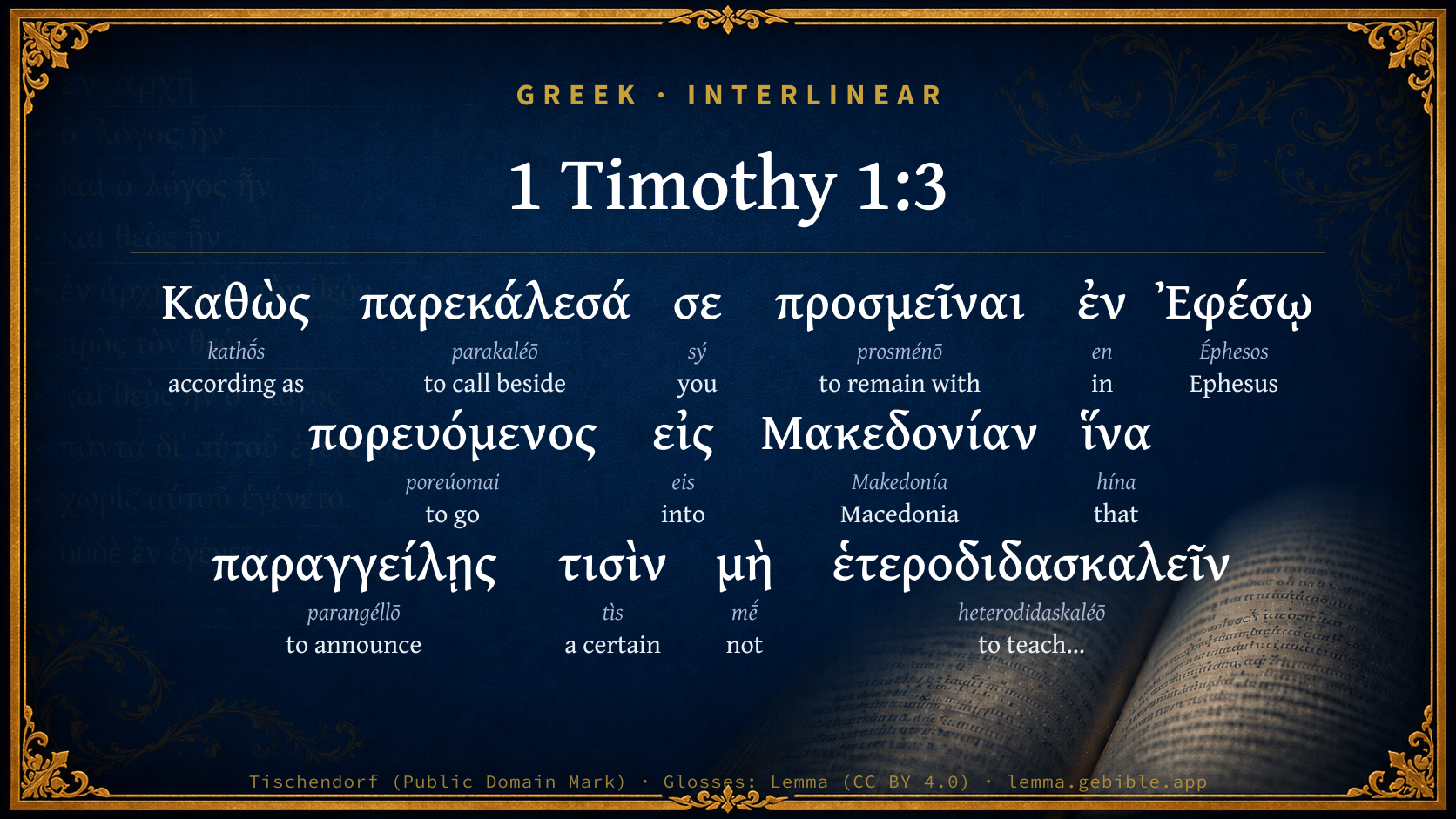
Download image
Cite this verse

1 Timothy 1:3 (World English Bible). Public Domain. Lemma interlinear Bible study tool, https://lemma.gebible.app/v/1-timothy/1/3.

Show BibTeX & RIS
BibTeX
RIS
English Translation
As I exhorted you to stay at Ephesus when I was going into Macedonia, that you might charge certain men not to teach a different doctrine,
World English Bible · Public Domain
Highlights
  • 1 first appearance in the Greek New Testament
Full analysis ↓
Download a study sheet

One document with this verse’s original text, its word-by-word gloss line, the meaning frame, cross-references with their text, attributed commentary, and full source and license credits — printable, and it pastes into notes with its structure intact.

This verse Autodidact and up

Study sheet (.html) Plain text (.txt)

A passage Seminary Student

Up to 50 verses in one chapter. A passage sheet keeps up to 6 commentary sources and 12 cross-references per verse, in the order this page ranks them, and says so on the sheet whenever that leaves anything out. Ask for a single verse and you get the Autodidact verse sheet above.

Everything on this page stays free to read, with no account — the sheet is a download of what is already on screen, not access to it.

Want to remove ads? Support Godless Engineer
Compare translations 3

The same verse in 3 English versions, stacked beneath the original-language interlinear above. Click any original word for its lexicon entry.

Each is an independent rendering of the whole verse — the interlinear is not word-aligned to these translations.

Highlighted words mark where these versions differ — a whole-verse word diff, not a word-by-word alignment.

  • World English Bible Public Domain
    As I exhorted you to stay at Ephesus when I was going into Macedonia, that you might charge certain men not to teach a different doctrine,
  • King James Version Public Domain
    As I besought thee to abide still at Ephesus, when I went into Macedonia, that thou mightest charge some that they teach no other doctrine,
  • unfoldingWord Literal Text CC BY-SA 4.0
    Just as I, going into Macedonia, urged you to remain in Ephesus so that you can command certain ones not to teach differently

unfoldingWord Literal Text — © unfoldingWord, licensed CC BY-SA 4.0. Word-aligned USFM3 via Door43 (git.door43.org/unfoldingWord/en_ult).

Versions to compare (up to 4)

3 of 4 selected

Show all 19 translations

Every available English version of this verse, each an independent rendering of the whole verse.

  • World English Bible Public Domain
    As I exhorted you to stay at Ephesus when I was going into Macedonia, that you might charge certain men not to teach a different doctrine,
  • Berean Standard Bible Public Domain
    As I urged you on my departure to Macedonia, you should stay on at Ephesus to instruct certain men not to teach false doctrines
  • Majority Standard Bible Public Domain
    As I urged you on my departure to Macedonia, you should stay on at Ephesus to instruct certain men not to teach false doctrines
  • King James Version Public Domain
    As I besought thee to abide still at Ephesus, when I went into Macedonia, that thou mightest charge some that they teach no other doctrine,
  • American Standard Version (1901) Public Domain
    As I exhorted thee to tarry at Ephesus, when I was going into Macedonia, that thou mightest charge certain men not to teach a different doctrine,
  • Revised Version (1885) Public Domain
    As I exhorted thee to tarry at Ephesus, when I was going into Macedonia, that thou mightest charge certain men not to teach a different doctrine,
  • Geneva Bible (1599) Public Domain
    As I besought thee to abide still in Ephesus, when I departed into Macedonia, so doe, that thou mayest warne some, that they teach none other doctrine,
  • Douay-Rheims (1899) Public Domain
    As I desired thee to remain at Ephesus when I went into Macedonia, that thou mightest charge some not to teach otherwise,
  • Young's Literal Translation Public Domain
    according as I did exhort thee to remain in Ephesus -- I going on to Macedonia -- that thou mightest charge certain not to teach any other thing,
  • Literal Standard Version CC BY-SA 4.0
    According as I exhorted you to remain in Ephesus—I going on to Macedonia—that you might charge certain [ones] not to teach any other thing,
  • Unlocked Literal Bible CC BY-SA 4.0
    As I urged you to do when I was leaving for Macedonia, remain in Ephesus so that you can command certain people not to teach a different doctrine.
  • unfoldingWord Literal Text CC BY-SA 4.0
    Just as I, going into Macedonia, urged you to remain in Ephesus so that you can command certain ones not to teach differently
  • Darby Bible Public Domain
    Even as I begged thee to remain in Ephesus, [when I was] going to Macedonia, that thou mightest enjoin some not to teach other doctrines,
  • World Messianic Bible Public Domain
    As I urged you when I was going into Macedonia, stay at Ephesus that you might command certain men not to teach a different doctrine,
  • Webster's Bible Public Domain
    As I besought thee to abide still at Ephesus, when I went into Macedonia, that thou mightest charge some that they teach no other doctrine,
  • Free Bible Version CC BY-SA 4.0
    When I was on my way to Macedonia I asked you to stay behind in Ephesus, so that you could speak with those who teach false ideas and insist that they stop.
  • Bible in Basic English Public Domain
    It was my desire, when I went on into Macedonia, that you might make a stop at Ephesus, to give orders to certain men not to put forward a different teaching,
  • Text-Critical English NT CC BY 4.0
    Just as I urged yoʋ when I was going to Macedonia, remain in Ephesus so that yoʋ may charge certain people not to teach different doctrines
  • Tyndale New Testament (1534) Public Domain
    As I besought the to abyde styll in Ephesus when I departed into Macedonia even so do that thou commaunde some that they teache no nother wise:

Literal Standard Version (2020), Covenant Press — licensed CC BY-SA 4.0. Text via the HelloAO Bible API (eBible.org). Unlocked Literal Bible (unfoldingWord) — licensed CC BY-SA 4.0. Text via the HelloAO Bible API (eBible.org). unfoldingWord Literal Text — © unfoldingWord, licensed CC BY-SA 4.0. Word-aligned USFM3 via Door43 (git.door43.org/unfoldingWord/en_ult). Free Bible Version, Dr. Jonathan Gallagher — licensed CC BY-SA 4.0. Text via the HelloAO Bible API (eBible.org).

Word by word

More ways to search: Search by grammar → Find every occurrence → Compare this word →

Practice this passage: Drill this verse → Learn its vocabulary →

ἑτεροδιδασκαλεῖν
heterodidaskaléō
G2085
“to teach differently”
Verb, Present, Active, Infinitive
Part of Speech
Verb
Tense
Present
Voice
Active
Mood
Infinitive
Full Thayer's Definition

Origin: from G2087 and G1320

TDNT: 04:43,2

1. to teach other or different doctrine a. deviating from the truth
  1. Καθὼς kathṓs G2531 “according as” Adverb
  2. παρεκάλεσά parakaléō G3870 “to call beside” Verb, Aorist, Active, Indicative, 1st person, Singular
  3. σε sý G4771 “you” Personal pronoun, 2nd person, Accusative, Singular
  4. προσμεῖναι prosménō G4357 “to remain with” Verb, Aorist, Active, Infinitive
  5. ἐν en G1722 “in” Preposition
  6. Ἐφέσῳ Éphesos G2181 “Ephesus” Noun, Dative, Singular, Feminine
  7. πορευόμενος poreúomai G4198 “to go” Verb, Present, Middle or Passive deponent, Participle, Nominative, Singular, Masculine
  8. εἰς eis G1519 “into” Preposition
  9. Μακεδονίαν Makedonía G3109 “Macedonia” Noun, Accusative, Singular, Feminine
  10. ἵνα hína G2443 “that” Conjunction
  11. παραγγείλῃς parangéllō G3853 “to announce” Verb, Aorist, Active, Subjunctive, 2nd person, Singular
  12. τισὶν tìs G5100 “a certain” Indefinite pronoun, Dative, Plural, Masculine
  13. μὴ mḗ G3361 “not” Particle, Negative

About this verse

These counts appear in no published source. They are computed here, from the morphology-tagged text and Lemma’s own curated glosses. What Lemma adds →

14
words
14
distinct lemmas
Pauline Epistles
section

Notable vocabulary

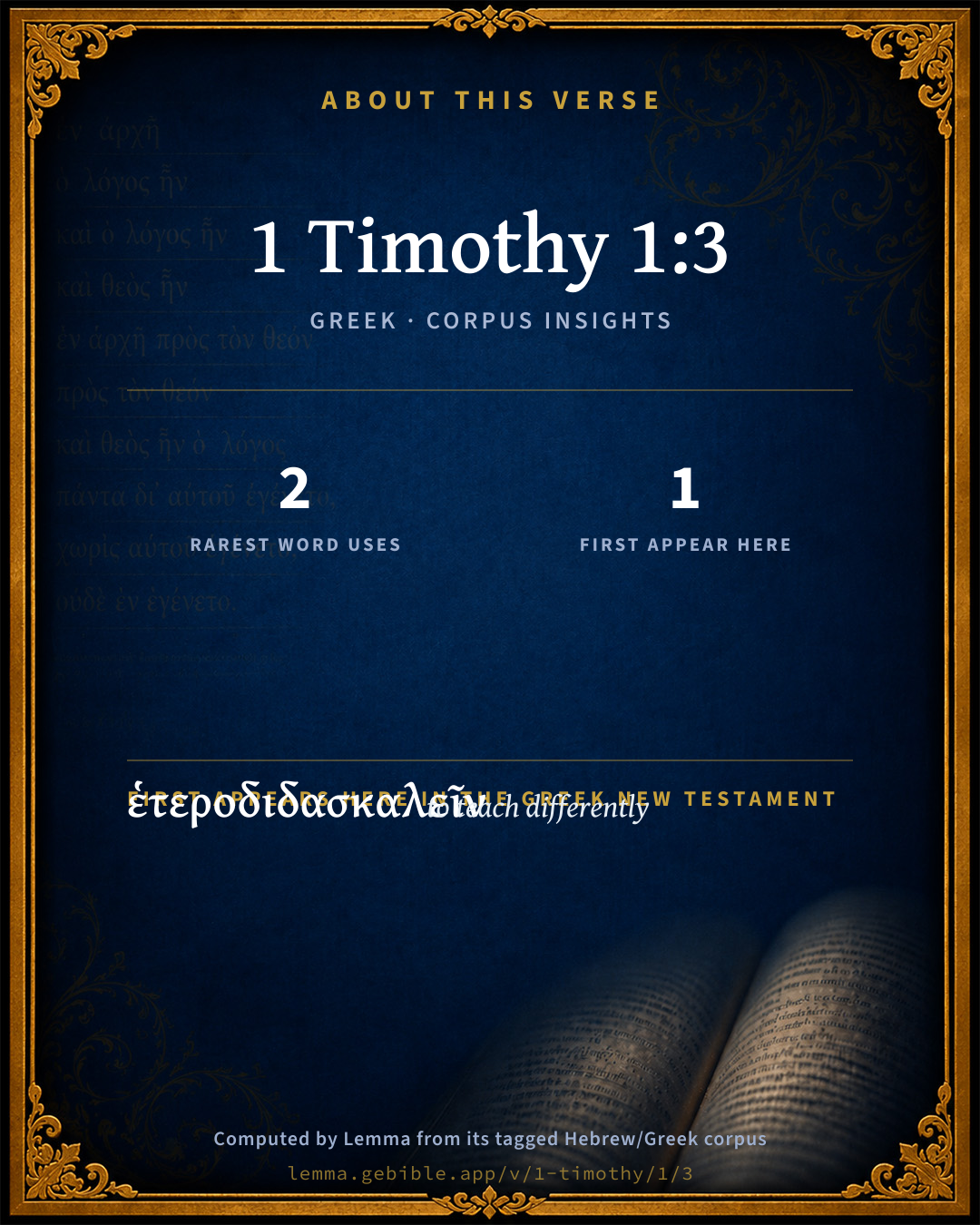
The rarest word here is ἑτεροδιδασκαλεῖν to teach differently G2085 — appearing just 2 times in the whole Greek New Testament.

First appearance in Scripture

This word makes its first canonical appearance in the Greek New Testament here:

  • ἑτεροδιδασκαλεῖν to teach differently G2085

Shared distinctive vocabulary

ἑτεροδιδασκαλεῖν to teach differently G2085 occurs in 2 verses of the Greek New Testament. Also found in:
Cross-references

19

Topical passages linked to 1 Timothy 1:3 in the Treasury of Scripture Knowledge — connected by theme and wording, ordered by reader-vote popularity; previews shown in the World English Bible.

  • Galatians 1:6–7 I marvel that you are so quickly deserting him who called you in the grace of Christ to a different gospel;
  • 1 Timothy 6:3 If anyone teaches a different doctrine, and doesn't consent to sound words, the words of our Lord Jesus Christ, and to the doctrine which is according to godliness,
  • 2 John 1:9–10 Whoever transgresses and doesn't remain in the teaching of Christ, doesn't have God. He who remains in the teaching, the same has both the Father and the Son.
  • Titus 1:9–11 holding to the faithful word which is according to the teaching, that he may be able to exhort in the sound doctrine, and to convict those who contradict him.
  • 2 John 1:7 For many deceivers have gone out into the world, those who don't confess that Jesus Christ came in the flesh. This is the deceiver and the Antichrist.
  • Acts 20:1–3 After the uproar had ceased, Paul sent for the disciples, took leave of them, and departed to go into Macedonia.
  • Colossians 2:6–11 As therefore you received Christ Jesus, the Lord, walk in him,
  • 1 Timothy 4:6 If you instruct the brothers of these things, you will be a good servant of Christ Jesus, nourished in the words of the faith, and of the good doctrine which you have followed.
  • 1 Timothy 4:11 Command and teach these things.
  • Acts 18:19 He came to Ephesus, and he left them there; but he himself entered into the synagogue, and reasoned with the Jews.
  • Acts 19:1–10 It happened that, while Apollos was at Corinth, Paul, having passed through the upper country, came to Ephesus, and found certain disciples.
  • Ephesians 4:14 that we may no longer be children, tossed back and forth and carried about with every wind of doctrine, by the trickery of men, in craftiness, after the wiles of error;
  • Philippians 2:24 But I trust in the Lord that I myself also will come shortly.
  • 1 Timothy 5:7 Also command these things, that they may be without reproach.
  • 1 Timothy 6:10 For the love of money is a root of all kinds of evil. Some have been led astray from the faith in their greed, and have pierced themselves through with many sorrows.
  • 1 Timothy 6:17 Charge those who are rich in this present world that they not be haughty, nor have their hope set on the uncertainty of riches, but on the living God, who richly provides us with everything to enjoy;
  • Revelation 2:1–2 To the angel of the assembly in Ephesus write: "He who holds the seven stars in his right hand, he who walks among the seven golden lampstands says these things:
  • Revelation 2:14 But I have a few things against you, because you have there some who hold the teaching of Balaam, who taught Balak to throw a stumbling block before the children of Israel, to eat things sacrificed to idols, and to commit sexual immorality.
  • Revelation 2:20 But I have this against you, that you tolerate your woman, Jezebel, who calls herself a prophetess. She teaches and seduces my servants to commit sexual immorality, and to eat things sacrificed to idols.

Cross-references courtesy of OpenBible.info (CC BY 4.0).

Commentary

Notes on 1 Timothy 1:3 from classic Christian and Jewish commentators (each source and its license shown beneath its notes). The classic Christian expositions comment on the surrounding passage and are grouped to its opening verse, so a note may address several verses; the Jewish commentaries on the Tanakh (Rashi and others) are per-verse, so they appear only where the commentator wrote on this verse.

Lemma curates 59 commentaries, every one of them public domain or Creative Commons licensed, each selected and text-cleaned for this edition rather than reprinted as found. About our sources →

The Biblical Illustrator

Joseph S. Exell

1Ti_1:3-4

As I besought thee to abide still at Ephesus.

Timothys charge

Our translators have supplied two words at the close of the fourth verse, in order to complete the sentence which the apostle left unfinished; but it would have been better had they inserted them earlier, for the meaning is more clear if we read, As I besought thee to abide still at Ephesus when I went into Macedonia, so I beseech thee now to remain there. It is an example of the way in which Pauls living thoughts leaped ahead of the words which might have clothed them.

I. The period to which he refers in the phrase, when I went into Macedonia, cannot be certainly fixed. There was, indeed, one occasion mentioned in Act_20:1, when, in consequence of the peril in which he was placed through the uproar raised by Demetrius, he did leave Ephesus for Macedonia; but in the chapter preceding that narrative we read that he had already sent Timothy and Erastus thither; and we know that he joined them there, because in the First Epistle to the Corinthians, written thence, he mentions Timothy as being then with him.

II. The mode of address to Timothy demands a word or two. I besought thee--not I commanded thee. No doubt this is expressive of the gentleness and affection with which Timothy was regarded, but it is also an indication of the kind of authority which was exercised by the apostles over their fellow-workers. There was nothing dictatorial about it, nothing of the military discipline which is so popular and effective in an aggressive section of the Church in our day. Influence then was that of character; authority was the outcome of inspiration; and even the chosen twelve were better pleased to rule by love than fear. It must be admitted this may give rise to abuses and perils.

III. The purport of Pauls entreaty was that Timothy should check the progress of false doctrine in the Ephesian Church. There was a ferment going on in the minds of men at that time, such as usually accompanies or follows a great religious movement. False notions of God, and of His law, arising from an imperfectly understood Judaism, combined with a speculative heathen philosophy, were threatening to destroy the simplicity of the gospel A sort of cabalistic system was being constituted in the Church, by an incongruous mixture of Jewish fancies with heathen speculations, and this threatened disaster--just as the ivy, climbing slowly but surely, thrusts in a root here and a tendril there, till the once strong wall has every stone loosened, and in the storm it falls.

IV. The reason given for opposing such teaching is, that it ministered questions rather than godly edifying. The Revised Version adopts another reading, and rightly so. The meaning is, that these questionings did not subserve Gods dispensation mills specific plan for admission to His kingdom, His method of salvation unfolded in the Gospel; for that dispensation consists in faith. And as a matter of experience we know that questions which merely excite the fancy, or even the intellect, tend to make the objects of faith distasteful. For example, a course of sensational novel reading, which peoples the mind with unrealities, does extrude earnest thoughts on spiritual realities. And this which is true of the rites of the Church is equally true of its organizations, and we have constantly to be on our guard lest the occupation of the mind with the details of Church work should divert us from the cultivation of personal Christian life. But the apostle here condemns chiefly the unhealthy practice of giving prominence to unimportant questions, whether it be in the sphere of philosophy or of religion. When a settler has to grow his own corn to provide himself with daily bread, he will let speculation on the strata beneath the surface wait till he has found time to sow and to reap. (A. Rowland, LL. B.)

The doctrine condemned in the Pastoral Epistles a Jewish form of Gnosticism: the Gnostics problem

It is of more importance to inquire what was the nature of the different doctrine which Timothy was to endeavour to counteract. And on this point we are not left in serious doubt. There are various expressions used respecting it in these two letters to Timothy which seem to point to two factors in the heterodoxy about which St. Paul is anxious.

1. The heresy is Jewish in character. Its promoters desire to be teachers of the Law (1Ti_1:7). Some of them are they of the circumcision (Tit_1:10). It consists in Jewish fables (Tit_1:14). The questions which it raises are fightings about the Law (Tit_3:9).

2. Its Gnostic character is also indicated. We are told both in the text and in the Epistle to Titus (Tit_1:14; Tit_3:9) that it deals in fables and genealogies. It is, empty talking (verse 6), disputes of words (1Ti_6:4), and profane babblings (1Ti_6:20). It teaches an unscriptural and unnatural asceticism (1Ti_4:3; 1Ti_4:8). It is Gnosis falsely so called (1Ti_6:20). A heresy containing these two elements, Judaism and Gnosticism, meets us both before and after the period covered by the Pastoral Epistles: before in the Epistle to the Colossians; afterwards in the Epistles of Ignatius. The evidence gathered from these three sources is entirely in harmony with what we learn elsewhere--that the earliest forms of Christian Gnosticism were Jewish in character. It will be observed that this is indirect confirmation of the genuineness of the Pastoral Epistles. The Gnosticism condemned in them is Jewish; and any form of Gnosticism that was in existence in St. Pauls time would almost certainly be Jewish. Professor Godet has pointed out how entirely the relation of Judaism to Christianity which is implied in these Epistles, fits in with their being the last group of epistles written by St. Paul. At first, Judaism was entirely outside the Church, opposing and blaspheming. Then it entered the Church and tried to make the Church Jewish, by foisting the Mosaic Law upon it. Lastly, it becomes s, fantastic heresy inside the Church, and sinks into profane frivolity. Pretended revelations are given as to the names and genealogies of angels; absurd ascetic rules are laid down as counsels of perfection, while daring immorality defaces the actual life. This is the phase which is confronted in the Pastoral Epistles: and St. Paul meets it with a simple appeal to faith and morality. It is quite possible that the fables, or myths, and genealogies ought to be transferred from the Gnostic to the Jewish side of the account. And thus Chrysostom interprets the passage. By fables he does not mean the Law; far from it; but inventions and forgeries, and counterfeit doctrines. For, it seems, the Jews wasted their whole discourse on these unprofitable points. They numbered up their fathers and grandfathers, that they might have the reputation of historical knowledge and research. The fables then, may be understood to be those numerous legends which the Jews added to the Old Testament, specimens of which abound in the Talmud. But similar myths abound in Gnostic systems, and therefore fables may represent both elements of the heterodox teaching. So also with the endless genealogies. These cannot well refer to the genealogies in Genesis, for they are not endless, each of them being arranged in tens. But it is quite possible that Jewish speculations about the genealogies of angels may be meant. Such things, being purely imaginary, would be endless. Or the Gnostic doctrine of emanations, in its earlier and cruder forms, may be intended. By genealogies in this sense early thinkers, especially in the East, tried to bridge the chasm between the infinite and the finite, between God and creation. In various systems it is assumed that matter is inherently evil. The material universe has been from the beginning not very good but very bad. How then can it be believed that the Supreme Being, infinite in goodness, would create such a thing? This is incredible: the world must be the creature of some inferior and perhaps evil being. But when this was conceded, the distance between this inferior power and the supreme God still remained to be bridged. This, it was supposed, might be done by an indefinite number of generations, each lower in dignity than the preceding one, until at last a being capable of creating the universe was found. From the Supreme God emanated an inferior deity, and from this lower power a third still more inferior; and so on until the Creator of the world was reached. These ideas are found in the Jewish philosopher Philo; and it is to these that St. Paul probably alludes in the endless genealogies which minister questionings rather than a dispensation of God. (A. Plummer, D. D.)

Speculations condemned

St. Paul condemns such speculations on four grounds.

1. They are fables, myths, mere imaginings of the human intellect in its attempt to account for the origin of the world and the origin of evil.

2. They are endless and interminable. From the nature of things there is no limit to mere guesswork of this kind. Every new speculator may invent a fresh genealogy of emanations in his theory of creation and may make it any length that he pleases. If hypotheses need never be verified--need not even be capable of verification--one may go on constructing them ad infinitum.

3. As a natural consequence of this (αἵτινες) they minister questionings and nothing better. It is all barren speculation and fruitless controversy. Where any one may assert without proof, any one else may contradict with out proof; and nothing comes of this see-saw of affirmation and negation.

4. Lastly, these vain imaginings are a different doctrine. They are not only empty but untrue, and are a hindrance to the truth, they occupy the ground which ought to be filled with the dispensation of God which is in faith. Human minds are limited in their capacity, and, even if these empty hypotheses were innocent, minds that were filled With them would have little room left for the truth. But they are not innocent: and those who are attracted by them become disaffected towards the truth. The history of the next hundred and fifty years amply justifies the anxiety and severity of St. Paul. The germs of Gnostic error, which were in the air when Christianty was first preached, fructified with amazing rapidity. It would be hard to find a parallel in the history of philosophy to the speed with which Gnostic views spread in and around Christendom between a.d. 70 and 220. Throughout the Christian world, and especially in intellectual centres such as Ephesus, Alexandria, and Rome, there was perhaps not a single educated congregation which did not contain persons who were infected with some form of Gnosticism. Jeromes famous hyperbole respecting Arianism might be transferred to this earlier form of error, perhaps the most perilous that the Church has ever known: The whole world groaned and was amazed to find itself Gnostic. However severely we may con demn these speculations, we cannot but sympathize with the perplexities which produced them. The origin of the universe, and still more the origin of evil, to this day remain unsolved problems. No one in this life is ever likely to reach a complete solution of either. (A. Plummer, D. D.)

The Biblical Illustrator, edited by Joseph S. Exell (c. 1880s–1900s) — public domain. Text from a community e-Sword module.

Joseph Benson's Commentary

1Ti 1:3-4. As I besought thee — Παρεκαλεσα σε, I entreated thee. It is observed by Beza, that by using this soft expression the apostle hath left a singular example of modesty, to be imitated by superiors in their behaviour toward their inferiors in the church. When I went into Macedonia, (Act 20:1,) that thou mightest charge some — Who appeared to be inclined to introduce their own corrupt notions into the church; that they teach no other doctrine — Than I have taught. Let them put nothing in the place of it, add nothing to it. These teachers were probably Judaizers, and members of the church at Ephesus; for with other teachers Timothy could have little influence. In not mentioning the names of these corrupt teachers, the apostle showed great delicacy, hoping that they might still be reclaimed. The same delicacy he had observed in his treatment of the false teacher or teachers at Corinth, and of the incestuous person there. Neither give heed to fables — To fabulous Jewish traditions, so as either to teach or regard them; and endless genealogies — Questions about their genealogies. The apostle does not speak of those recorded in the Scriptures, but of the long intricate pedigrees whereby many of the Jews strove to prove their descent from certain persons: which minister questions — Which lead only to useless and endless controversies; rather than godly edifying — The promotion of holiness, which leads men to God; which is in faith — Which edification is by faith in the great truths of the Scriptures, and in Christ, of whom the Scriptures testify as the Redeemer and Saviour of lost sinners.

Joseph Benson's Commentary on the Old and New Testaments (1811–1818) — public domain. Text from a community e-Sword module.

Whedon's Commentary on the Bible

Daniel D. Whedon

PART FIRST.

THE APOSTOLIC CHARGE, 1Ti_1:1-20.

1. Safe-keeping of a pure gospel doctrine, 1Ti_1:3-11.

3. As—More fully, according as; to which our translators have inserted so do, in Italics, in order to make a completed statement. Some, as Fairbairn, insert after Macedonia “so I do now;” but that would simply make Paul charge Timothy still to stay at Ephesus. Our so do is preferable, applying it to the charge of this verse. Paul’s meaning is, Do now as I charged thee when I left Ephesus. His verbal charge he would now make a recorded charge.

Went into Macedonia—This going from Ephesus into Macedonia cannot be identified with that mentioned in Act_20:1; for, as appears from Act_19:22, he had before that going into Macedonia sent Timothy to Corinth. And, as there appears no going to Macedonia and leaving Timothy at Ephesus apparently possible before Paul’s first imprisonment, so this passage requires a second imprisonment. See Introduction.

Some—A reprehensive word, implying that these teachers were a certain few, not to be named here, but too well known to Timothy. Note on 1Ti_1:20.

Teach no other doctrine—In Paul’s Greek a newly coined and very expressive single Greek word, to-be-otherwise-teachers. It expresses the idea that the original gospel of Jesus, as purely and genuinely transmitted through the apostles, must be retained unmixed with any other elements, and without variation.

Daniel D. Whedon (gen. ed.), Commentary on the Old and New Testaments (1874–1909) — public domain. Text from a community e-Sword module.

The Preacher's Complete Homiletical Commentary

Joseph S. Exell (gen. ed.)

CRITICAL AND EXPLANATORY NOTES

1Ti_1:3. Charge some that they teach no other doctrine.—R.V. “charge certain men not to teach a different doctrine.” It is doctrine that differs in quality that was not to be taught. In his impassioned address to the Galatians St. Paul would anathematise “even an angel from heaven” who should dare to proclaim another gospel, “ ‘different,’ from its commixture with an unedifying, vain, and morbid theosophy.”

1Ti_1:4. Fables and endless genealogies.—Rabbinical fables and fabrications, whether in history or doctrine—these, according to Ellicott, are the fables, and the genealogies are to be taken in the proper sense with which, however, these wilder speculations were very probably combined. Most modern commentators refer the terms to the spiritual myths and emanations of Gnosticism. The which minister questions.—The wordy wars in which the Christian community would be involved by these genealogies would be as long as they themselves, and as vacuous. Godly edifying.—R.V. “a dispensation of God.” The A.V. is an impossible rendering of the word from which our “economy” comes. The translators followed another reading, and the Vulgate “ædificationem.”

MAIN HOMILETICS OF THE PARAGRAPH.—1Ti_1:3-4

A Difficult Pastoral Charge.

I. A sphere of active and distracting heresies.—“Neither give heed to fables and endless genealogies, which minister questions, rather than godly edifying which is in faith” (1Ti_1:4). The Gnostic problem was now beginning to manifest itself, and to mingle with the development of the gospel. The heresy spread with marvellous rapidity between A.D. 70 and 220; and Eusebius tells us that “as soon as the apostles and those who had listened to them with their own ears had passed away, the conspiracy of godless error took its rise through the deceit of false teachers, who endeavoured with brazen face to preach their knowledge falsely so called in opposition to the preaching of the truth.” The Gnostic theory was that matter is eternal and that evil resides inherently in matter, so that there were two coeternal existences—God and matter. This theory afterwards developed the creed that there are two coeternal and coequal powers—good and evil; and the doctrine of emanations from the supreme God of a series of inferior deities, the last being regarded as the creator of the world. Here was scope for the “fables and endless genealogies” which the apostle condemns and against which he warns Timothy. The existence of these confusing errors, which were rife in Ephesus, rendered the position of the young pastor both delicate and difficult. Not less difficult and anxious is the relation of the minister to modern speculations and doubts. The activity of the propagators of false ethics, of scepticism, theosophy, agnosticism, materialism, and a crude unformed socialism in the present day, creates concern in the breast of the earnest preacher of the gospel.

II. Requiring caution and fidelity in enforcing the true doctrine.—“As I besought thee to abide still at Ephesus … that thou mightest charge some that they teach no other doctrine … so do” (1Ti_1:3-4). The apostle’s specific for the errors of that day was not to advertise and spread them by injudicious controversy, but to teach with the more care and faithfulness “no other doctrine” than the gospel of Christ. Error must be slain by a clearer and more emphatic statement of the truth, of which it is a distortion and caricature. The same method is applicable to the times in which we live. The modern preacher must know and therefore study the theories of unbelief, however wild and extravagant they may seem, and much as he may recoil from the disagreeable and dangerous task. He must fight his own way through the wicked antagonisms of the truth to faith and certainty; but he must not introduce into his pulpit ministrations the details of the errors he seeks to refute. He need not expose the progressive steps by which he reaches his conclusions, but should use those conclusions in the most condensed and concrete form. Error is most effectually quenched by a faithful preaching of the truth as it is in Jesus, and insisting upon a holy and consistent life. Unbelief is more an obliquity of the heart than the head; and if the heart is to be reached and changed, we must “teach no other doctrine” than that which Timothy was exhorted to expound and enforce.

III. Retained with evident reluctance.—“As I besought thee” (1Ti_1:3). Timothy shrank from the formidable task proposed to him. He saw its vital importance and its difficulties too, and perhaps his natural timidity tempted him to exaggerate these. He was subject to moods of discouragement (compare 2Ti_1:7-8; 2Ti_2:1-13; 2Ti_4:5). It was only after earnest and affectionate persuasion on the part of Paul that he at length consented to undertake the difficult work. It was impossible for him to resist the pleading of his father in the gospel; and, fearful and hesitating, his instinctive obedience led him to comply. When he parted from Paul—probably at Miletus, where he first received this charge—Timothy was in tears (Act_20:36-38). Duty is not always easy: the more difficult it is, the greater the honour and the more distinguished the reward. St. Ambrose relates a legend that, when persecution arose in Rome, the Christians, anxious to preserve the life of Peter, advised him to flee. He was in the act of leaving the city when he met our Lord. “Lord, whither goest Thou?” asked the apostle. “I go to Rome,” was the answer, “there once more to be crucified.” Peter understood the rebuke, returned at once, and was crucified. Duty must be done whatever the result. We may safely leave that with God.

Lessons.—

1. The minister should be awake to the tendency of modern error.

2. Faithful preaching of the truth is the best antidote to error.

3. The work of the ministry is beset with difficulties.

GERM NOTES ON THE VERSES

1Ti_1:4. “Godly edifying which is in faith.” Moral-building.

I. The soul is edified only as it advances in godliness.

II. The materials for moral-building are supplied by the gospel.

III. Moral-building is hindered by the discussion of frivolous questions.

The Preacher's Complete Homiletical Commentary (gen. ed. Joseph S. Exell; Funk & Wagnalls, c. 1892) — public domain (pre-1929). A full-Bible homiletical/sermon-outline anthology covering 65 of 66 books (2 John is absent from the source module). Text from a community e-Sword module.

Lange's Commentary on the Holy Scriptures

II

Occasion for the writing of this Epistle.—Preliminary description and condemnation of the heretical teachers who had appeared at Ephesus, who misunderstood equally the nature both of the Law and of the Gospel

1Ti_1:3-11

3As8 I besought thee to abide still at Ephesus, when I went into Macedonia, that thou mightest charge some that they teach no other doctrine, 4Neither give heed to fables and endless genealogies, which minister questions [questionings], rather than godly edifying [the dispensation of God]9 which is in faith: so do. 5Now the end of the commandment is charity out of a pure heart, and of a good conscience, and of faith unfeigned: 6From which some haying swerved have turned aside unto vain jangling; 7Desiring to be teachers of the law; understanding 8[considering] neither what they say, nor whereof they affirm. But we know that the law is good, if a man use10 it lawfully; 9Knowing this, that the law is not made [set forth = posita] for a righteous man, but for the lawless and disobedient, for the ungodly and for sinners, for the unholy and profane, for murderers of fathers and murderers of mothers,11 for man-slayers, 10For whoremongers, for them that defile themselves with mankind, for men-stealers, for liars, for perjured persons, and if there be any other thing that is contrary to sound doctrine: 11According to the glorious gospel [the gospel of glory] of the blessed God, which was committed to my trust [which I have been entrusted with].

EXEGETICAL AND CRITICAL

Ver.3. Besought. For the occasion and object of this exhortation, see the Introduction. Timothy must remain at Ephesus, προσμεῖναι (the same word occurs in Act_18:18), in order, by his presence, to oppose the evil which was becoming apparent there. The simplest explanation of this somewhat singular phrase, is, that Paul had already, at Ephesus, given this injunction to Timothy, and had then left him in order to set out on his journey to Macedonia. According to Chrysostom, the form in which this admonition is couched is a proof of the friendly spirit of the Apostle towards Timothy: “οὐ γὰρ ἐ͂ιπεν: ἐπέταξα, οὐδὲ ἐκέλευσα, οὐδὲ παρῆ̣νεσα, ὰλλὰ τί; παρεκάλεσά σε.”—Some. In Other places, also, the Apostle speaks, without any personal designation, of those whom he calls upon Timothy to oppose (1Ti_1:6; 1Ti_1:19; 1Ti_4:1; 2Ti_2:18). Timothy knew them from his own experience, and needed, therefore, no more exact advice. He was to charge them, not at once publicly (Matthies), yet in an earnest and emphatic way, to teach no other doctrine than that which the Apostle had before delivered. Ἑτεροδιδασκαλεῖν (comp. 1Ti_6:3; Tit_1:13). The word indicates the strange elements that may mingle with the teaching of the gospel, and easily assume a character hostile to it. The same warning Paul bad already given, in another form, to the elders of the church (Act_20:29). The pure doctrine, in which men must steadfastly abide, is naturally, in his thought, identical with his gospel (2Ti_2:8).

1Ti_1:4. Fables and endless genealogies (comp. Tit_1:14; 1Ti_4:7; 2Ti_4:4; Tit_3:9). It is difficult to know with certainty what μῦθοι and γενεαλογίαι are here specially meant. From all that we gather, however, in this Epistle, it is most probable that reference is made to fables of Jewish form and origin, which were endlessly spun out, and had called forth much dispute in the church. “Although there were many fables among the heathen, yet the Apostle has in special view the Jewish traditiones; for it was asserted that Moses had not written down all the mysteries revealed by God, but had given much orally to the elders, by whom they were handed down as a traditional law, or Kabbala, although these Jewish notions were mostly of their own invention, and in part, too, drawn from heathen philosophy;” Starke. The genealogical records here mentioned appear also to have been mainly of Jewish origin, and, as we know, were held in high repute, and gave occasion for many useless and curious questions; although we need not entirely exclude a reference to the doctrine of Emanation, taught by the heretical schools. The ζητήσεις are nothing but the foolish questions (Tit_3:9), which lead to strife and discord. This love of fables and genealogies is held by the Apostle in such great aversion, because it furnished such material for dispute, rather than for a right knowledge of the essential way of redemption (οἰκονομία). “Μᾶλλον, non semper comparationis sed sæpius correctionis et oppositionis nota est (comp. 2Ti_1:4);” Glassius. Most commentators agree that the clause which begins the third verse should be understood to close at the end of the fourth verse, with an οὕτω καὶ νῦν παρακαλῶ, which certainly might be most fitly inserted in this place. Otherwise it must be supposed that the Apostle, after a long digression (1Ti_1:5-7), takes up again, at 1Ti_1:18, the thread of the broken exhortation; 1Ti_1:5 or 1Ti_1:12 forms no perfect conclusion.

1Ti_1:5. The end of the commandment. It is a question, whether reference is made to the command given by Paul, in 1Ti_1:3, to Timothy, or, in a wider sense, to the Divine commandment in general, which Timothy is to impress upon his hearers. The latter is the more probable, since the Apostle begins forthwith to oppose a false view of the Mosaic law. “Παραγγελία, practical teaching as the chief element of the διδασκαλία ὑγιαίνουσα; a contract to the μῦθοι;” De Wette.—End; Luther: The sum, as this word designates that to which we are chiefly to look, and toward which we are to strive. “The ultimate aim of all the admonitions of the Christian preacher should be practical—to call out a true love;” Olshausen. Even to Timothy, Paul writes very little of the mysteries of Christianity, that, by his example, he may yet more put to shame this germinal Gnosticism.—Charity out of a pure heart, &c. Love, “the bond of all Christian virtues,” the fruit of the tree, whose root, faith, is presupposed as already existing, and commended at the close of the exhortation. This love can only spring out of a pure heart, cleansed from all selfishness and evil desires; out of a good conscience, which, being free from the guilt of sin, and reconciled with God, can then first love in truth; and from an unfeigned faith.—Unfeigned, ἀνυπόκριτος; that is, no empty thought or fancy, but a spiritual light and spiritual life not consisting in words, but in a living assurance of the heart, and proving its life in its fruits. Without real faith there is no good-conscience; without a reconciliation of the conscience there is no pure heart; without a pure heart there is no true Christian love conceivable. Thus all are blended in the closest union. [Alford: “It is faith—not the pretence of faith, the mere Scheinglaube of the hypocrite. Wiesinger well remarks, that we see that the general character of these false teachers, as of those against whom Titus is warned, was not so much error in doctrine, as leading men astray from the earnestness of the loving Christian life to useless and vain questionings, ministering only strife.”]

1Ti_1:6. From which vain jangling.Ὧν, that is, from the Christian dispositions and virtues mentioned in 1Ti_1:5. The polemic character of the Epistle of Paul appears immediately after the statement of the τέλος τῆς παραγγελίας. The heretics were separatists, ἀστοχήσαντες; they had failed of the end which the Apostle has set forth—the same word occurs in 1Ti_6:21; 2Ti_2:18—and were thus astray in a false path, because they had turned εἰς ματαιολογίαν. The etymology indicates the meaning of this word, which, besides, is found only here. (Tit_1:10, ματαιολόγοι occurs). Here is suggested that waste of words, that empty talk, in which there can be found no rational sense, no unity of conviction. Compare the βέβηλοι κενοφωνίαι (1Ti_6:20), and the βέβηλοι καί γραώδεις μῦθοι (1Ti_4:7; Tit_3:9). The character of this vain jangling is more exactly defined by what immediately follows, in 1Ti_1:7.

1Ti_1:7. Teachers of the law, νομοδιδάσκαλοι, not in a good, but in a bad, unevangelical sense of this word; men who so mixed together law and gospel, that the latter was weakened, and who would likewise force a Mosaic system upon the Christian, in the notion that they themselves had pierced deeper than others into its nature and spirit. It is the same Jewish legalism, which, in its special relation to the Gentiles, the Apostle opposes in Rom_12:17 and Gal_6:12; because, in its inmost spirit, it is in irreconcilable conflict with Christian truth and freedom. In the keenest way, throughout the following verses, it is held up to view in its utter nakedness, μὴ νοοῦντες, κ.τ.λ. “Bonus doctor debet esse intelligent, simulque certus: istis, inquit Paulus, utrumque deest;” Bengel. They themselves understand not what they say, nor whereof they affirm. If we may draw a distinction between these two expressions, the former seems to mean the subjective opinions, the expressed ideas, the fictions of these men; while the second designates the objective views, the material, on which they based their convictions with the greatest confidence, but into which, according to the assertion of Paul, they had no clear insight. So also Raphelius: “Qui neque ea, quæ loquuntur satis intelligant, neque quibus de rebus loquantur, considerant.” What these νομοδιδάσκαλοι held as to the unaltered authority of the Mosaic law, rested on their plain ignorance of the very purpose of the law; which is therefore, in the 8th and following verses, designedly placed by the Apostle in its true light. It appears, also, from this whole argument, that these heretics were not already separated from the community, or in opposition to it—in which case Timothy could have had no further influence over them—but they were still within its pale. It is worthy of note, too, that they continually sought authority in the writings of the Old Testament for their half-heathen speculations.

1Ti_1:8. But we know. An authoritative apostolic οἴδαμεν, of quite other worth than that of the Scribes and Pharisees (Joh_9:29; Joh_9:31). The Apostle places the declaration of his knowledge, which he had learned in the school of the Holy Ghost, against the arrogant view of the false Gnosis. Perhaps its advocates had thought to raise a suspicion against him, as if he despised the law, or, at least, denied it any real worth. He opposes to this his doctrine, which he fully knows will be received by Timothy—that the law is good (properly, beautiful, καλός), and in itself blameless (comp. Rom_7:12); yet only on condition that every man use the same lawfully, νομίμως, which was not done by these heretics. A play upon the word; as if to say, that the law must be fulfilled according to law. We have special cause to be thankful that the true definition of the law has been so fully stated by Paul in the Epistles to the Romans and Galatians, as rightly to explain 1Ti_1:8-10. Νομίμως is the use of the law by the man who allows it to exercise its proper office, who is brought by it to a knowledge of his own sin and liability to punishment. “This knowledge will give us its spirit and intent—not room for idle questions and subtleties, nor for self-deception through a feigned and outward righteousness. This lawful use of the law is meant by Christ, when He promises life to those who keep the law (Luk_10:28; Luk_18:20, et seq;)” Von Gerlach. It is self-evident, also, that Paul in this place speaks not of the hearer or the reader of the law, but solely of its application by its teachers, who may well reflect on the verses which follow.

1Ti_1:9. That the law is not made for a righteous man. It is not strange that this passage should at first awaken surprise in many readers, and that, at the time of the Reformation, it should have been controverted by Agricola. The first question is, whom the Apostle means by this righteous man—a question which is at once answered by the antithesis following it, ἀνόμοις δὲ, κ.τ.λ. In distinction from this, the person meant by δίκαιος may be one whose life is righteous and moral according to the requirements of the law. But since, according to the invariable doctrine of the Apostle, all who are under the law are also under the curse of the law, so that by the works of the law no flesh can be justified (Gal_3:10; Rom_3:20), it follows, that by the righteous Christian man must be meant one who has been justified by faith in Christ, and wholly renewed by the Holy Spirit (justus per justificationem, et per sanctificationem). Of such a man Paul says, that the law is not made for him, νόμος οὐ κεῖται. As the article is wanting before νόμος, it may be thought that only a general proposition is stated as to the nature and purpose of any moral code (Chrysostom, Brentano). But the mention of the gospel in contrast with the law (1Ti_1:11), and the argument against the νομοδιδάσκαλοι (1Ti_1:7), imperatively requires us here to understand the Mosaic law alone. On the omission of the article, see Winer’sGrammar, in loco. This law, then, is not made for the righteous man; that is, it is not given to him, as such. When De Wette says, “This view of the law seems foreign to the Apostle,” he seems to forget entirely such passages as Gal_5:18-23. The thought, that the letter of the Mosaic law possesses no more binding force for the redeemed in Christ, is so entirely Pauline, that it forms one of the main pillars of his whole doctrinal structure. It certainly gives also a fulfilment of the law from the Christian standpoint, as it is announced in Rom_3:31; Rom_8:4, and in other places. But in this passage the Apostle expressly shows its meaning for the wholly unconverted, in order to expose more clearly the folly of those heretics who will put the law by the side of, or even above the gospel, for the Christian. [Augustin on Psalms 1 : “Justus non est sub lege, quia in lege Domini est voluntas ejus; qui enim in lege est, secundum legem agitur; ille ergo liber est; hic servus.” Hooker, Eccl. Pol., B. 1, c. 8. “A law is a directive rule unto goodness of operation. The rule of Divine operation is the definitive appointment of God’s own wisdom set down within Himself. The rule of natural agents that work by necessity is the determination of the wisdom of God, known to God, but not unto them. The rule of voluntary agents on earth is the venture that reason giveth concerning the goodness of those things which they are to do. Neither must we suppose that there needeth one rule to know the good, and another the evil by. For he that knoweth the straight, doth even thereby discern the crooked. Goodness in actions is like unto straightness; wherefore, that which is done well, we term right.”—W.]—But for the lawless. In contrast to this true spirit of law, the Apostle now names a long list of evildoers, for whom the law remained in full force; a list in which one familiar with the Pauline writings will not expect completeness, systematic order, or logical strictness, in its various conceptions; yet which by no means lacks connection, and has clearly this thought at the bottom, that they who are most zealous for the law often most grossly transgress it (comp. Rom_2:20). He names, at the outset, two by two, six classes of wicked men—ἀνόμοις καί ἀνυποτάκτοις; that is, such as care nothing for the law, and have altogether refused obedience to it (comp. Tit_1:6-10); ἀσεβέσι καὶ ἁμαρτολοῖς, godless (comp. Tit_2:12) and gross sinners, who have no fear of God in their hearts (comp. Rom_4:5; Rom_5:6). Here the hostile attitude toward God becomes more prominent, while the preceding two are violators of the law in general. Ἀνοσίοις καὶ βεβήλοις blend both the first conceptions, as the irreligious and profane, here depicted, are alike despisers of the Holy God, and of His holy law. Here follow, more in detail, certain specimina mali, from which we may suppose that, with the exception of the last vitium, ἐπιόρκοις, the various statutes of the second table passed before the mind of the Apostle. He names the murder of father and mother—those who violate the first commandment with promise (Eph_6:2), and grossly abuse their parents (πατραλοίας; ὁ τὸν πατέρα ἀτιμάζων, τύπτων ἢ κτείνων; Hesychius). Murderer, consequently a breaker of the sixth commandment, ἀνδροφόνοις; in the New Testament an ἃπαξ λεγόμενον. Further, those who sin against the seventh commandment, commit fornication with women (πόρνοις), or with the male sex (ἀρσενοκοίταις), comp. Rom_1:27; both natural and unnatural crime (comp. Leviticus 19, 23). Then follow transgressions of the eighth commandment, here wholly concerning men—the sin of man-stealing, specially forbidden in Exo_21:16; Deu_24:7; ἀνδραποδισταῖς, plagiariis. It was, besides, no rare crime among the Greeks to steal boys or girls, that they might be sold into slavery. Lastly follow those who break the ninth commandment, ψεῦσται, ἐπίορκοι; such as deliberately speak falsehood, or swear to a falsehood, or break an oath already taken. By the following εί τε ἕτερον, κ.τ.λ., we may suppose meant transgression against the tenth commandment, which is here omitted. We find, however, in this catalogus-criminum, no orderly reference to the commandments of the first table; and Bengel has clearly gone too far, when he writes, “Paulus pro ordine decalogi hic nominat injustos.” This is true only of the second half of the decalogue.—And if there be any other thing that is contrary to sound doctrine. Sound doctrine—one of the expressions characteristic of the Pastoral Epistles (comp. 2Ti_4:3; Tit_2:1, and elsewhere). Not healthful doctrine is meant (Luther), nor a sound morality (Leo), but the Christian teaching in general is approved in its inner soundness, as opposed to the ματαιολογία of the heretics. This phrase is used also to express those symptoms of disease which St. Paul saw with grief springing up in the church (comp. 2Ti_2:17). [It is observable that the word “wholesome” occurs nine times in the Pastoral Epistles, and always in reference to doctrine; Wordsworth.—W.]

1Ti_1:11. According to the glorious gospel committed to my trust.Κατά is not used here for the more exact definition of sound doctrine, as some have thought; for, in that case, τῆ̣ would have to be repeated before κατά; nor need it be supposed in apposition to ἀντίκειται, which would give a very awkward conclusion. 1Ti_1:11 is an addition, which refers to the whole preceding line of thought, and means that, according to the gospel of Paul, the law has no other purpose than that fully explained in 1Ti_1:6-10. The Apostle would have us understand, that his view of the law is not the fruit of his private opinion, but rather the true summary of the gospel committed to him. This qualification of the gospel is really apologetic. The gospel of glory, τῆς δόξης, not signifying ἔνδοξον (Heydenreich), in the sense of blessed, glorious doctrine, but the gospel by which the glory of God in Christ has become manifest to the world; whose especial and chief substance is this Divine glory (2Co_4:4), and indeed the glory of the blessed God, τοῦ μακαρίου Θεοῦ (comp. 1Ti_6:15). If God Himself be blessed, then the revelation of His glory, which has been proclaimed, not through the law, but through the gospel, will be full of blessing. Perhaps the repeated use of the epithet in this Epistle has a certain reference to the system of Æons taught by the heretics. This gospel is committed in trust to Paul, ὃ ἐπιστεύθην ἐγώ. A peculiarly Pauline construction, on which, comp. Winer, Gramm. N. T., p. 40. In other places, too, the Apostle speaks with warmth of this his dear prerogative; as Rom_15:16; Eph_3:8; Col_1:25. Those who oppose the genuineness of the Pastoral Epistles, are therefore wrong in thinking such emphatic reference to his person and his office at all extraordinary. The consciousness which Paul had of his high calling, rises with redoubled power as he contends with the heretics; and in this letter to his friend and scholar he follows the warm outpouring of his spirit, not in a logical order, yet in harmony with his whole thought, as we read in 1Ti_1:12-17.

DOCTRINAL AND ETHICAL

1. Two opposite views, in regard to the character and condition of the early Christian Church have prevailed, with more or less success, in our time, both of which are disproved in the opening verses of the first Pastoral Epistle. In the one view, it is thought that the apostolic age was a kind of paradisaic state of the young community—a state full of love, and innocence, and purity; in contrast with which the post-apostolic age seems a fall, like that of our first parents (Thiersch, and others). In the other view, there was at first only a chaos of manifold parties and tendencies, out of which there gradually rose, in the second century, after many conciliatory efforts, the harmonious structure of the Catholic church (Tübingen school). But the little we have already learned from the Epistle to Timothy neither favors the one nor the other view. It is apparent that already, soon after A. D. 60, heresies and factions sprang up in the church, hostile to the original spirit of Christianity, which the Apostle believed that he must oppose with all his energy. We find that the germs of Gnosticism, whose formal development we can trace in the second century under manifold shapes, were already broadcast in the second half of the first century. But, on the other hand, this error appears only as a fleck of rust on the pure metal of that truth, earlier taught and fully acknowledged. We see the Apostle, clothed with an authority which no one can defy with impunity, and rising high above the strife of parties. His gospel is no other in substance than that proclaimed by his fellow-Apostles, and by his and their coworkers. His word becomes the sharp but healthful corrective of the errorists, who have gained head so early; and it remains the norm of its development for the church, in the second and the succeeding centuries.

2. The characteristic marks of the heretics of the first century rise here already to our view. A sickly search after the discovery of the unattainable, with a thankless misconception of simple truth; an undue valuing of lesser things, with a depreciation of the essentials of Christianity; a striving after their own honor, while they cared little for the edification of believers; a fastening of their own philosophic theories on the falsely-interpreted letter of the Scriptures, whose spirit they sadly misconceived; a denial of the practical nature of Christianity, while its real freedom is abused as an allowance to the flesh; a falsehood as to the special relation between the law and the gospel of Christ;—all these symptoms of disease are found anew, in countless forms, among the sectaries and heretics of later days.

3. The Apostle is alike removed from the one-sided view either of a love without faith, or of a faith without love. He will neither have the fruit without the tree, nor the tree without the fruit. He knows only the one requirement of the gospel—love; yet only the love blossoming in a heart purified through faith. Here, as afterwards more frequently, purity of faith and purity of conscience are linked in their inmost relationship.

4. “Love, out of a pure heart,” &c. In this Statement of the chief requisite of Christianity there is confirmed the essential unity of theology and morality, whose arbitrary separation so often does unmeasured injury to each, and has kept many from the right understanding of the gospel.

5. We have here a weighty help toward answering the question, how far the Mosaic law has a binding power. But fully to understand the Apostle’s mode of thought upon this subject, the Epistles to the Romans and Galatians must be specially compared. Here, also, Paul appears the same glowing and zealous advocate, as he had before shows himself, of the right of Christian freedom. While he exalts the worth of the law in its own proper sphere, beyond any disparagement, he shows its entire insufficiency whenever it is placed by the side of, or above the gospel.

6. We find the chief forms of Judaism in the time of our Lord, again existing in His earliest church—Pharisaism and Sadduceeism. Against this united power of self-righteousness and unrighteousness, the disciple no less than the Master is pledged to bear the sword of the Spirit with all power (Mat_16:6).

7. A precept, of the first importance in pastoral theology, is here given by the Apostle to the preachers of the Word. It is not enough to preach the truth free from all error; but they are also bound to contend with every energy against error. Persecution of heretics is indeed unchristian and unevangelical, and its frightful traces remain on many a page of Church history, marked with blood and tears. Yet he would be no less to blame, who, like Timothy a ruler in the church, capable of large in fluence, should allow the errorist to go unchecked, and remain satisfied, if not himself corrupted by the leaven of error. The bee which has lost its sting can produce no more honey. The saying of Calvin is that of every true witness of Jesus Christ: “A dog barks loudly when one seizes his master; and should I be silent when the truth of God is assailed?” Polemics against leading heretics ought not to be the chief staple of gospel preaching; nor should this be wholly and always lost sight of.

HOMILETICAL AND PRACTICAL

No doctrine should be permitted or preached in the church but the unadulterated apostolic doctrine.—The relation of Mythology to Christianity.—The difference between the holy “mystery of the gospel,” and a sickly mysticism.—A sermon whose first and last fruit is strife and dispute, instead of the promotion of the Divine way of redemption, is thereby self-condemned.—The sum of the commandment: (1) No Christianity without love; (2) no Christian love without purity of heart; (3) no purity of heart without a good conscience; (4) no good conscience without an unsullied faith.—How far we may swerve from the end of the Divine revelation, even when we believe ourselves very near to it.—The attitude of the Christian toward the law.—Among the confessors of the gospel there were and are at all times (1) some, who are neither under the law nor under grace; (2) others, who are indeed under the law, but not yet under grace; (3) others, who are under grace, and no more under the law.—The worth of the law as a bar, as a mirror, as a seal. [German: Riegel, Spiegel, u. Siegel.]—For whom the law is given, and for whom not.—The Christian redeemed from the curse of the law, so that the righteousness required by the law is fulfilled in him.—Every gross or slight, open or concealed immorality, is directly opposed to sound doctrine.—A noble eulogy of the gospel: (1) The gospel of the glory of God; (2) this God, the blessed God; (3) through this blessed God, the ministry of the gospel is entrusted to a man like Paul.—Every estimate of the law that does not accord with the gospel of Paul deserves to be rejected.—The ceaseless alternation of Legalism and Antinomianism in the Christian Church: (1) Its traces; (2) its causes; (3) its import; (4) its only remedy.—[Ignatius: Ἀρχὴ μὲν πίστις, τέλος τὲ ἀλάπη. Faith the beginning, but love the end, or final cause.—W.]

Starke: Osiander: The pure doctrine is a great gift of God, therefore it is to be guarded well; a costly loan, therefore to be well laid out.—Lange’s Opus Bibl.: Pure doctrine and a godly life must always go together.—Hedinger: What helps not growth in godliness, we ought to banish from church and school.—Anton: If the enemy cannot else lead us astray in our Christianity, he sings to us of high things, which common Christians do not know.—Lange’s Op.: Theologians must especially care that they do not become loose talkers, and thus corrupters of others.—In nothing is pride more perceptible, more hurtful, and perilous, than in spiritual things.—Every preacher of the gospel is also a teacher of the law; for the gospel shows how man can and ought to hold the law of God in the gospel way.—Quesnel: Gospel doctrine does not so hold up faith as to bend the law (1Co_9:21).—Sins must not be judged by human fancy, but according to the law and the gospel.—Sins that are forbidden in the law, are also contrary to the gospel (Rom_3:31).—Anton: In the office of preacher, the whole aim must be to know the gospel as a gospel of the glory of God (2Co_4:6).

[Cudworth, Sermon I.: Christ came not into the world to fill our heads with mere speculations, to kindle a fire of wrangling and contentious dispute, whilst, in the mean time, our hearts remain all ire within toward God. Christ was vitæ magister, not scholæ; and he is the best Christian whose heart beats with the purest pulse toward heaven; not he, whose head spinneth out the finest cobwebs. Ink and paper can never make us Christians—can never beget a new nature, a living principle in us—can never form Christ, or any true notions of spiritual things, in our hearts. A painter that would draw a rose, though he may flourish some likeness of it in figure and color, yet he can never paint the scent and fragrancy.—Donne, Sermons: As the soul is infused by God, but diffused over the whole body, and so there is a man; so faith is infused from God, but diffused into our works, and so there is a saint. Practice is the incarnation of faith; faith is incorporate and manifest in a body by works.—W.]

Footnotes:

[1][Latin: Incipit ad Timotheum prima. English Version: The First Epistle of Paul the Apostle to Timothy; which is a translation of the title in the Recepta.

[2]1Ti_1:1.—[χριστοῦ Ἰησοῦ, instead of Ἰησ. Χριστ., the reading of the Recepta, and of Lachmann also. The Sinaiticus has Ἰησ.—E. H.]

[3]1Ti_1:1.—[κατ’ ἐπιταγήν. So all the authorities. The Sinaiticus has κατ’ ἐπαγγελίαν = according to the promise, &c.; cf. 1Ti_1:1. But the true reading, doubtless, is the received.—E. H.]

[4]1Ti_1:1.—[Θεοῦ σωτῆρος ἡμῶν; the order of these words varies much in the later MSS. See Tischendorf; so Huther.—E. H.]

[5]1Ti_1:1.—Received text: Lord Jesus Christ. [Omitted by Lachmann and Tischendorf; found in the Sinaiticus. In the Minuscules, καὶ is left out, or placed sometimes before σωτῆρος, according to Huther.—E. H.]

[6]1Ti_1:2.—[ἡμῶν; in the Recepta, but to be omitted; is omitted by our author in his text.—E. H.]

[7]1Ti_1:2.—[Χριστοῦ Ἰησοῦ; so Lachmann and Tischendorf, supported by the weightiest authorities. The Sinaiticus the same.—E. H.]

[8]1Ti_1:3.—[No apodosis to καθώς. Lachmann brackets 1Ti_1:5-17; but this scarcely meets the case. Perhaps we had better supply, with our author, at the end of 1Ti_1:4, so now also I exhort thee. So likewise Conybeare and Howson.—E. H.]

[9]1Ti_1:4.—Dispensation (Haushaltung), according to the reading οἰκονομίαν, instead of the οἰκοδομίαν of the Recepta, which has scarcely any critical confirmation at all. The reading οἰκονομίαν is supported by such weighty authorities (now also by the Sinaiticus), that its accuracy cannot be doubted. Matthäi says: “οἰκονομἰαν, ita omnes omnino mei, ac ii quidem, qui scholia habent, etiam in scholiis uti quoque interpretes editi. οἰκοδομίαν nihil nisi error est typothetarum Erasmi, δ cum ν confuso nisi Erasmus deliberate ita correxerit ad latinum: ædificationem;” Huther.

[10]1Ti_1:8.—[Lachmann, on the authority of A., reads χρήσητοι; the rest have χρῆται. So also the Sinaiticus.—E. H.]

[11]1Ti_1:9.—[πατρολῴαις, μητρολῴαις. Lachmann, Tischendorf, Sinaiticus, instead of πατρα., μητρα.—E. H.]

Lange's Commentary on the Holy Scriptures (Critical, Doctrinal, and Homiletical), ed. John Peter Lange, English translation edited by Philip Schaff (1864–1880) — public domain. Text from a community e-Sword module.

Tyndale Open Study Notes

Tyndale Open Resources

1:3-11 Paul’s greetings are usually followed by thanksgiving or blessing to God; Greco-Roman letters often did the same. First Timothy and Titus probably do not include this because of their character as official letters authorizing a delegate (see 1 Timothy Book Introduction, “Literary Genre”). Instead, Paul first addresses his concern to silence the false teachers.

1:3 stop those . . . contrary to the truth: Just as Paul had previously warned (Acts 20:29-31), false teachers came into the church in Ephesus; this letter was written to help Timothy to deal with them.

Tyndale Open Study Notes — © Tyndale Open Resources, licensed CC BY-SA 4.0. Text via the HelloAO Bible API.

Bengel's Gnomon

Johann Albrecht Bengel

1Ti 1:3. Καθὼς, even as) The Protasis; the Apodosis is at 1Ti 1:18. [In the meantime Paul refutes those who taught other doctrine, by the very striking example of his own conversion.—V. g.]

There are three divisions of this epistle:

I. The Inscription, 1Ti 1:1-2.

II. The Instruction of Timothy in regard to the holy administration of the church affairs at Ephesus in the absence of Paul: where

1) In general, he commits to him a charge to he delivered to those who erroneously taught the law, the sum of the Gospel being established and confirmed by his own example, 1Ti 1:3-4; 1Ti 1:8-9; 1Ti 1:11-12; 1Ti 1:18-19.

2) In particular,

1) He prescribes the order of prayer, 1Ti 2:1-2, chiefly to men, ver. 8; moreover to women good works, 1Ti 2:9-10, with modesty, 1Ti 2:11-12.

2) He enumerates the requisite qualifications of a bishop, 1Ti 3:1-2.

And also the duties of deacons and women, 1Ti 3:8-9; 1Ti 3:11-13.

3) He explains what Timothy ought to teach, after he had very weightily set forth the most momentous points, 1Ti 3:14 to 1Ti 4:3; in 1Ti 4:4-5, also what he ought to avoid, and what he ought to follow, 1Ti 4:7-8; 1Ti 4:12-13:

Then how he should deal with men and women, 1Ti 5:1-2;

With widows, 1Ti 5:3-4; 1Ti 5:9-12; 1Ti 5:16;

With elders, 1Ti 5:17-18;

With offenders, 1Ti 5:20-21;

With Timothy himself, 1Ti 5:22-23;

With those of whom he is in doubt, 1Ti 5:24-25;

With servants, 1Ti 6:1-2.

4) Those who teach otherwise are reproved, 1Ti 6:3-4; 1Ti 6:6-7; but Timothy is admonished and incited forward, 1Ti 6:11-12, and a charge is given to him, 1Ti 6:13-14; and precepts are prescribed to be enforced upon the rich, 1Ti 6:17-18.

III. The Conclusion.

—προσμεῖναι, to abide) The same word occurs in Act 18:18. The presence of good men is a restraint upon the wicked. Timothy at Ephesus, Titus at Crete, were not bishops, but were directors of the bishops, and, so to speak, Vicars Apostolic.—μὴ ἑτεροδιδασκαλεῖν, to teach no other doctrine) than that which I have taught. Let them not substitute anything else for it, let them not add [liter, impart by rubbing, ‘affricent’] aught to it. Comp. the address of Paul to these same Ephesians, Act 20:28-30. The same word occurs, ch. 1Ti 6:3, where those things which are contrary [to wholesome doctrine] are condemned, just as at the beginning of the epistle, the things which are good are commended. Even the things which seem to be only different (“other doctrine”), carry with them something which is positively contrary [to the true doctrine]. They taught the law, in opposition to the Gospel, 1Ti 1:7; 1Ti 1:11.

Bengel's Gnomon of the New Testament — English translation (T&T Clark, Edinburgh, 1860) — public domain. Text from a community e-Sword module.

Meyer's Critical & Exegetical Commentary

Heinrich August Wilhelm Meyer

1Ti_1:3-4. The apostle reminds Timothy, in the first place, of a previous exhortation, obviously for the purpose of impressing it more deeply on him.

The most natural construction of the sentence appears to be, to take it as an anacolouthon, to connect ἐν Ἐφέσῳ with προσμεῖναι, to refer πορευόμενος to the subject of παρεκάλεσα, and to make ἵνα dependent on παρεκαλεσά σε κ.τ.λ. This construction is held by most expositors to be the only admissible one. The missing apodosis cannot, however, be supplied before ἵνα, because ἵνα is closely connected with what precedes; we may insert with Erasmus ita facito, or with Beza vide, or with most expositors οὕτω καὶ νῦν παρακαλῶ (Winer, p. 530 [E. T. p. 592]). The peculiarity in such an involuntary (Buttm. p. 331) anacolouthon is, that the grammatical connection is not established by inserting the omitted apodosis. The most simple course is to suppose that the apostle had οὕτω καὶ νῦν παρακαλῶ or οὕτω ποίει, in mind, but the place for it was lost in the abundance of the thoughts that streamed in on him.

Several expositors depart from the construction commonly accepted. Matthies takes προσμεῖναι as stay, not as remain behind, refers πορευόμενος not to the subject of παρεκάλεσα, but to σε (making an unjustifiable appeal to Eph_3:17-18; Eph_4:1-2; Col_3:16[40]), and explains the whole thus: When Timothy was intending to travel to Macedonia, Paul had charged him to stop at Ephesus and remain there. Schneckenburger (see his Beiträge z. Einl. pp. 182 ff.) arbitrarily changes the infin. προσμεῖναι into the partic. ΠΡΟΣΜΕΊΝΑς, and refers ΠΟΡΕΥΌΜΕΝΟς to the following clause: ἽΝΑ ΠΑΡΑΓΓΕΊΛῌς. Otto treats ΠΟΡΕΥΌΜΕΝΟς in the same way, at the same time connecting ἘΝ ἘΦΈΣῼ with ΠΑΡΕΚΆΛΕΣΑ, taking ΠΡΟΣΜΕῖΝΑΙ in an absolute sense, making the apodosis begin with ἽΝΑ, and translating: Just as I exhorted you to stand firm in Ephesus, so shalt thou on the journey to Macedonia command the people not to give attention to strange teachers, nor to hold them in esteem, etc. This construction is, however, so artificial, that it is obviously incorrect to every one who is not blinded by the desire of placing the date of the composition of the epistle in a period of the apostles life known to us.

[40] In the passages quoted, Paul adds the participles to the previous clauses in the nom., and these participial clauses thus acquire the independence due to them according to the context. But in these passages the relation of the participial clause to the preceding main clause is quite different from what it is here, where there is no reason whatever for departing from the regular construction.

REMARK.

In order to justify his view of the sentence, Otto tries to prove the incorrectness of the usual construction, and to get rid of the objections to his own. The hypothesis of an ellipsis he rejects on account of the rule that the emphatic word can never be omitted, and that if we supply the apodosis by οὕτω καὶ νῦν παρακαλῶ, the emphatic words are καὶ νῦν. But these words are not by any means the most emphatic. The apostle might be using them not specially of the contrast between past and present, but only to give point to his former exhortation; hence he might easily omit the apodosis. Otto further maintains, that in the usual construction καθώς, which always denotes a material, actual correspondence, even to identity of motives, and further, of material contents, does not get its full force. On this point we indeed grant that the peculiar meaning of καθώς (as distinguished from ὠς) is not distinctly marked by the expositors; but it is not at all necessary in the usual interpretation to weaken arbitrarily the force of καθώς, since the apostles former exhortation could not but be his guide in the present one. Still less difficulty, however, is presented by καθώς, if we choose to supply οὕτω ποίει (as Hofmann does), since the meaning then is, that Timothys conduct is to be conformed to the exhortation already given by the apostle.

Otto tries further to show that in the usual explanation the participle πορευόμενος is not in its proper place. The rules which Otto lays down on the subject of participial clauses in order to support his assertion are, on the whole, not incorrect. The passages he quotes from the N. T. certainly show that the participle following a finite verb mostly defines it more precisely; that it either explains more precisely the verbal notion, or gives the accompanying circumstances of the verb. But Otto has overlooked the departures from this rule which occur in the N. T.; comp. Luk_4:40 with Mar_1:31; Mat_12:49 with Act_26:1; Mat_22:15 with Mat_12:14; further, Luk_24:17.[41] It cannot be denied that the participle following sometimes gives simply the time in which the action of the finite verb takes place; that here, therefore, the ΠΟΡΕΥΌΜΕΝΟς may simply denote the time of the former exhortation.[42] Otto quotes the passage in Act_12:25 as supporting the rule that the participle following should serve to explain the verbal notion, and justifies this by saying that the participle ΠΛΗΡΏΣΑΝΤΕς ΤῊΝ ΔΙΑΚΟΝΊΑΝ gives the motive of the return. But to give the motive is no explanation. In this passage, however, the position of the participle after the finite verb is justified in this way, that it gives the motive for the action expressed by the finite verb. So, too, in the passage here there is nothing to be said against the connection of πορευόμενος with ΠΑΡΕΚΆΛΕΣΑ, so soon as we suppose that the journey was the occasion for Paul giving Timothy the exhortation in question. Lastly, Otto attacks the usual construction from the notion of προσμεῖναι, because this word is explained in the construction to be equivalent to remain, stay; whereas, when not connected with a dative (or with a participial clause representing a dative), but standing absolutely, it has the meaning: to maintain the position hitherto possessed, to stand firm. Hence, if any definition of place is added, it is not as a completion of the verbal notion, but only indicates where the standing firm takes place. Otto infers from this: accordingly ἘΝ ἘΦΈΣῼ here does not complete ΠΡΟΣΜΕῖΝΑΙ, but rather ΠΡΟΣΜΕῖΝΑΙ is absolute, and ἘΝ ἘΦΈΣῼ gives the place at which the whole sentence, viz. ΠΑΡΕΚΆΛΕΣΆ ΣΕ ΠΡΟΣΜΕῖΝΑΙ, took place. This inference is obviously incorrect, since from Ottos premises it only follows that, if ἘΝ ἘΦΈΣῼ belongs to ΠΡΟΣΜΕῖΝΑΙ, the place is thus given where Timothy is to stand fast,in particular against the heretics,it does not follow that ἘΝ ἘΦΈΣῼ may be connected with ΠΡΟΣΜΕῖΝΑΙ. Besides, from Act_18:18, it is clear beyond dispute that ΠΡΟΣΜΈΝΕΙΝ does occur in the N. T. in the weakened sense of remain, stay.[43] Otto does not disguise the objections to his view, but he thinks that when thoroughly weighed they are more apparent than real. In this, too, he is wrong. It is indeed right to say that in the N. T. a sentence often begins with ἽΝΑ without any verb preceding on which it depends,and this not only in cases where the governing verbal notion is easily supplied from what precedes, as in Joh_1:8; Joh_9:3; Joh_13:18, 2Co_8:7, but also when that is not the case, so that the clause beginning with ἽΝΑ stands as an imperative clause, as in Eph_5:33; Mar_5:23 (comp. Buttm. pp. 207 f.). But in all passages where ἽΝΑ is used elliptically, this is shown clearly and distinctly by the form of the sentence, which is not the case here. It is right also to say that emphatic parts of the clause construed with ἽΝΑ are often placed before ἽΝΑ, so that ΠΟΡΕΥΌΜΕΝΟς, therefore, might very well be connected with the clause following ἽΝΑ; but this, too, is always indicated clearly by the form of the sentence. Wherever words standing before ἽΝΑ are to be referred to what follows ἽΝΑ, these words cannot possibly be connected with what precedes them, and the part of the sentence following ἽΝΑ is incomplete in itself, so that it has to be taken along with the part before ἽΝΑ. It is wrong to maintain that the participial clause ΠΟΡΕΥΌΜΕΝΟς ΕἸς ΜΑΚΕΔ. becomes emphatic by contrast with ἘΝ ἘΦΈΣῼ, inasmuch as what took place in Ephesus is now to take place also on the journey to Macedonia; forthe two things are not at all the same. In Ephesus (according to Ottos view), Paul exhorted Timothy to stand firm; but on the journey to Macedonia, Timothy is to encounter those who had been led astray. Lastly, it is right to assume that the sender of a letter, if he has anything to say of the place from which the letter is sent, may speak of it by name, comp. 1Co_15:32; 1Co_16:8, so that ἐν Ἐφέσῳ might convey to us that Paul was himself in Ephesus while writing; but we must take into consideration the special circumstances of the case. According to Otto, our epistle is a paper of instructions which the apostle put into Timothys hands in Ephesus, where he wrote it before setting out for Macedonia. In that case it was improper to mention the place by name. We cannot understand, then, why Paul in such a paper of instructions should have laid special stress on the exhortation he had imparted to Timothy in the very place where he put that paper into his hands.

[41] Otto tries to weaken the force of this passage against him by assuming a rhetorical inversion, because, he says, it is declared that taking a walk and holding solemn dispute are inconsistent with one another (!).

[42] In his groundless denial of this, Otto thinks that if πορευόμενος be joined to παρεκάλεσα it must be assumed to be a circumstance accompanying the παρεκάλεσα, but that this assumption is impossible, since a continuing fact (part. pres.) cannot be regarded as the accompanying circumstance of a concluded fact (part. aor.). But Otto overlooks the fact that πορευόμενος in this connection is not to be understood in the sense of continuing a journey, but in the sense of beginning one, of setting out.

[43] In this passage, also, Otto claims for προσμένειν, as a vox militaris, the meaning: keep ones ground, remarking, for the circumstances in Corinth were such that they might well have induced Paul to cease his labours and depart. But this assertion is in contradiction with Lukes statement, that the attack attempted by the Jews through Gallio was decisively warded off. Ottos explanation, too, becomes all the more unsuitable, since, according to it, Luke would charge the apostle with not holding his ground more, and with abandoning his post.Further, Otto seems to hesitate whether to take προσμεῖναι in the present passage as really absolute, or whether to supply with it the dative ἐμοί. After finally deciding for the former, he then explains προσμεῖναι as keeping ground along with the leader appointed by God in the struggle against all the attacks of the heretic, and thus in self-contradiction returns to the latter, since this leader is the Apostle Paul.

Some expositors take the whole section 1Ti_1:5-17 to be a parenthesis, and 1Ti_1:18 to be the apodosis corresponding to καθώς. The awkwardness of this construction is obvious; but Plitt thinks that, though it is not without its difficulties, most may be said for it. He is wrong, however, since ταύτην τὴν παραγγελίαν, in 1Ti_1:18, does not resume the παρεκάλεσά σε.

If we avoid all subtleties, we cannot but explain it: Even as I exhorted thee to remain in Ephesus when I set out for Macedonia, that thou mightst command certain men not to teach false doctrine … even so do (or: even so I exhort thee also now).[44] Regarding the meaning of ΚΑΘΏς and ΠΡΟΣΜΕῖΝΑΙ, see the above remark.

ΠΑΡΕΚΆΛΕΣΑ] Chrys.: ἌΚΟΥΕ ΤῸ ΠΡΟΣΗΝΈς, Πῶς Οὐ ΔΙΔΑΣΚΆΛΟΥ ΚΈΧΡΗΤΑΙ ῬΩΜῇ, ἈΛΛʼ ΟἸΚΈΤΟΥ ΣΧΕΔΌΝ· Οὐ ΓᾺΡ ΕἾΠΕΝ ἘΠΈΤΑΞΑ, ΟὐΔῈ ἘΚΈΛΕΥΣΑ, ΟὐΔῈ ΠΑΡῄΝΕΣΑ, ἈΛΛᾺ ΤΊ; ΠΑΡΕΚΆΛΕΣΆ ΣΕ. Towards Titus, however, Paul uses the expression ΔΙΕΤΑΞΆΜΗΝ (Tit_1:5), although he was not less friendly towards him than towards Timothy.

ΠΟΡΕΥΌΜΕΝΟς ΕἸς ΜΑΚΕΔΟΝΊΑΝ] when I went away, from Ephesus to Macedonia; ΠΟΡΕΥΈΣΘΑΙ has in itself the general meaning of going, but it is also used of going away from a place, both absolutely (Mat_11:7) and connected with ἈΠΌ (Mat_24:1; Mat_25:41; Mat_19:15 : ἘΚΕῖΘΕΝ; Luk_13:31 : ἘΝΤΕῦΘΕΝ). Otto explains it: on the way to Macedonia, which is grammatically correct, but opposed to the connection of ideas. There is no ground whatever for thinking that Paul, in this expression, had in mind one particular place on the way to Macedonia, viz. Corinth. We can see no reason why Paul should have expressed himself indefinitely. Otto, indeed, is of opinion that Timothy could not have been uncertain about the meaning of the expression; and that the apostle chose it in order to spare the feelings of the Corinthians, and that he might not confess to the heretics how they had provoked his apostolic opposition to an exceptional degree. But the first reason proves too much, since Paul, if he refrained from the definite expression because Timothy knew his wishes without it, would also have refrained from the indefinite expression. The other two reasons are weak, because if Timothy was to labour successfully against the heretics, he must necessarily appeal to the authority of the apostle in whose name he was to labour. Besides, such playing at hide-and-seek as Otto imputes to the apostle, is in entire contradiction with Pauls frank character.

ἽΝΑ ΠΑΡΑΓΓΕΊΛῌς Κ.Τ.Λ.] gives the purpose for which Timothy was to remain in Ephesus. The theory that this gives at the same time the purpose of the whole epistle (Matthies), which opinion de Wette brings forward as proving the epistle not to be genuine, is wrong.

ΠΑΡΑΓΓΕΊΛῌς] does not necessarily involve the suggestion of publicity which Matthies finds in it.

ΤΙΣΊ] The same indefinite term is used for the heretics also in 1Ti_1:6; 1Ti_1:19; 1Ti_4:1; 1Ti_5:15, etc.: certain people whom the apostle is unwilling to designate further; Timothy already knows them (Wiesinger).

ΜῊ ἙΤΕΡΟΔΙΔΑΣΚΑΛΕῖΝ] The word, which is not made up of ἝΤΕΡΟς and ΔΙΔΑΣΚΆΛΕΙΝ (= ΔΙΔΆΣΚΕΙΝ), but is derived from ἙΤΕΡΟΔΙΔΆΣΚΑΛΟς, occurs in the N. T. only here and in 1Ti_6:3 (comp. ἙΤΕΡΟΖΥΓΕῖΝ in 2Co_6:14). In ἝΤΕΡΟς there is not seldom the notion of different in kind, strange, something not agreeing with something else, but opposed to it. Accordingly, in the apostles use of the word, a ἑτεροδιδάσκαλος is a teacher who teaches other things than he should teach, who puts forward doctrines in opposition to the gospel; and ἙΤΕΡΟΔΙΔΑΣΚΑΛΕῖΝ here means nothing else than to teach something opposed to the gospel (Heb_13:9 : ΔΙΔΑΧΑῖς ΠΟΙΚΊΛΑΙς ΚΑῚ ΞΈΝΑΙς ΜῊ ΠΑΡΑΦΈΡΕΣΘΕ); comp. 2Co_11:4; Gal_1:6 : ΕὐΑΓΓΈΛΙΟΝ ἝΤΕΡΟΝ. Wiesinger, in order to favour his theory that heresy proper is not spoken of, weakens the meaning into teach otherwise, so that according to him it signifies teaching things which lie apart from Ἡ ΚΑΤʼ ΕὐΣΈΒΕΙΑΝ ΔΙΔΑΣΚΑΛΊΑ. This is incorrect, for in that case some more precise definition would have been given.

Even in classic Greek, ἝΤΕΡΟς, in composition, often has the meaning alleged by us; thus ἙΤΕΡΟΔΟΞΕῖΝ = diversae opinionis esse; comp. Plato, Theaet. p. 190 E: δόξαν εἶναι ψευδῆ τὸ ἑτεροδοξεῖν. According to Otto, ἙΤΕΡΟΔΙΔΑΣΚΑΛΕῖΝ means: to have another teacher, to follow another teacher. Otto wrongly appeals for this to Euseb. Hist. Eccles. iii. 32, where ἑτεροδιδάσκαλοι does not mean false teachers, but such members of the church as had abandoned the teaching of the apostles and become attached to strange teachers; and also to Ignat. ad Polycarp. chap. 3, where ἑτεροδιδασκαλοῦντες has the same meaning.[45] Otto also makes appeal to the Greek usage, according to which, in composite nouns, the concluding word, if it be a noun, does not contain the subject of the fundamental thought in such composite words, but the nearer or more distant object. But this rule is only valid with adjectival forms. In composite substantives, on the contrary, the concluding word (if it be an unaltered substantive) may also denote the subject, which is only defined more precisely by the word that precedes.[46]

There is no ground whatever for Schleiermachers opinion, that the verb suggests the idea of a hierarchy.

To ΜῊ ἙΤΕΡΟΔΙΔΑΣΚΑΛΕῖΝ there is added a second point: ΜΗΔῈ ΠΡΟΣΈΧΕΙΝ Κ.Τ.Λ., which Timothy is to forbid to ΤΙΝΕς.[47] Except in the Pastoral Epistles, προσέχειν does not occur in Paul. Here, as in Tit_1:14, it includes the notion of agreement; so also in Act_8:6.

μύθοις καὶ γενεαλογίαις] The καί is to be taken epexegetically; we can neither join the two expressions as an hendiadys (fabulosae genealogiae, Heumann), nor regard them as denoting different things. The notion of μῦθοι has been limited too narrowly by many expositors,as by Theodoret, who understands by it the traditional supplements to the law; or by others, who take it as denoting the allegorical system of interpretation, or the Jewish stories of miracles (such as occur in the pseudo-epigrapha or the Apocrypha), or even the Gentile mythologies. Leo is wrong in agreeing with Theodorets exposition, appealing to Ignatius (Ep. ad Magnes. chap. 8), and alluding to 1Ti_1:7. From that verse it is certainly clear that heretics had peculiar views regarding the law, which were in contradiction with the gospel; but it is a mere assertion to say that μῦθοι here refers to these views, all the more that the word stands closely connected with γενεαλογίαι. De Wette limits the meaning of the word in another fashion, inferring from 2Pe_1:16 : σεσοφισμένοι μῦθοι, that the μῦθοι here meant, formed the definite element in an artificial system; the notion of something artificial is obviously imported. Other expositors take the expression quite generally in the sense of false doctrine, as Suidas explains the word: μῦθος· λόγος ψευδής, εἰκονίζων τὴν ἀλήθειαν; this is too indefinite. Paul rather employs it because it was used to denote false ideas regarding the nature of the Godhead. The word that follows defines the nature of these μῦθοι more precisely.

On the γενεαλογίαι ἀπέραντοι, see Introd. sect. 4. Wiesingers view, that they denote the genealogies in the O. T., as well as that of Hofmann, that they are the historical facts in the Thora, are both to be rejected. Credners view, that the genealogies of Christ are meant, is quite arbitrary. So, too, with Chrysostoms explanation: οἶμαι καὶ Ἕλληνας αὐτὸν ἐνταῦθα αἰνίττεσθαι, ὅταν λέγῃ μύθοις καὶ γενεαλογίαις, ὡς τοὺς θεοὺς αὐτῶν καταλεγόντων. It is very far-fetched to refer to the Kabbalistic Sephiroth. The application of the expression to the Essenic doctrine of angels (Michaelis), is contradicted by the fact that theories of emanations cannot be proved to have existed among the Essenes. The view upheld by most expositors, that the apostle was thinking of the series of emanations in the speculation of the heretics, must be considered the right one. It is confirmed by the addition of the adjective ἀπέραντοι. The genealogies are unlimited, since there was no necessity for them to stop at any point whatever. The conclusion was altogether arbitrary: hence, in the various systems, the genealogies of the aeons differ from one another in all sorts of ways.

αἵτινες] is not simply an attributive relative; it gives at the same time the reason of the foregoing exhortation μὴ προσέχειν as those which (comp. Soph. Oed. R. 1184; Pape, Handwörterbuch der griech. Spr. See the word ὅστις).

Ζητήσεις παρέχουσι μᾶλλον ἢ οἰκονομίαν Θεοῦ] Both notions: ζητήσεις and οἰκονομ. Θεοῦ, may be taken either subjectively or objectively. If ζητήσεις be taken objectively, it is points of controversy, questions of dispute; if subjectively, it is investigations, controversies, disputations (each one trying to maintain his arbitrary fictions, Matthies). If οἰκονομία Θεοῦ is taken objectively, it is the salvation of God (the salvation grounded historically in Christ and publicly preached by means of His apostles, Matthies; or according to others, the ministry of the gospel; or, lastly, the divine gift of grace, i.e. the divine influence on individuals by which they are brought to the faith). If it is taken subjectively, it is the work of man as an οἰκόνομος Θεοῦ; de Wette: the work of a steward of God in the faith (to be awakened or to be furthered). This latter may be taken, in a general sense, as meaning, the Christian activity, the Christian exercise of the divine gifts of grace,[48] or, more narrowly: the maintaining, the strengthening in Christianity, the nourishment in the faith by the spiritual food of Christianity, which the teachers as stewards of God distribute, Zachariae. The meaning of παρέχουσι is also modified according to the interpretation of these two notions. If they are interpreted objectively, παρέχειν is reach forth, present; if subjectively, it is cause, bring about (so Gal_6:17; also frequently in classic Greek and in the Apocrypha of the O. T.; comp. Wahl, Clav. libr. V. T. apocryph., under the word). Ζήτησις is not identical with ζήτημα; οἰκονομία is indeed used in the sense of office of steward, but οἰκονομία Θεοῦ denotes the preparation, the arrangement made by God (comp. Eph_1:10; Eph_3:9), and never the divine salvation. Hence the subjective interpretation (Hofmann) is to be preferred to the objective (as formerly in this commentary; also Wiesinger, Plitt, Oosterzee). In any case, Matthies is wrong in taking ζητήσεις subjectively and οἰκονομία Θεοῦ objectively, and then assuming that παρέχειν is used in a zeugma. Ottos explanation is purely arbitrary. He explains ζητήσεις by speculations, and οἰκονομίαν Θεοῦ τὴν ἐν πίστει by a system of divine order in the universe (sc. creation and government), resting on faith, grounded in faith,the cosmogony and physics of the Jewish gnosis. Of the latter phrase, he says that Paul adopts the hypocritical name which the νομοδιδάσκαλοι claimed for their system, so that the ζητήσεις form the real, the οἰκον. ἡ ἐν πίστει, on the contrary, the pretended contents of the μῦθοι and γενεαλογίαι. By the addition of τὴν ἐν πίστει, the labour of the οἰκόνομος Θεοῦ is defined more precisely as one in the sphere of faith (not causing faith, Hofmann).

μᾶλλον ἤ] as in several passages of the N. T., Joh_3:19, Act_27:11, 2Ti_3:4, stands here in the sense of denying the thought contained in the following member, so that (with Suidas) it is equivalent to καὶ οὔ.[49]

With the reading ΟἸΚΟΔΟΜΊΑ (or ΟἸΚΟΔΟΜΉ) ΘΕΟῦ, we must interpret, the edifying in the faith as decreed by God (Luther, inaccurately: the improvement towards God in the faith).

[44] Hofmann is wrong in asserting that Paul, when he wrote καθώς (not ὡς), could not have had in mind any expression of which the writer was the subject, but only an exhortation as to what Timothy was to do.

[45] The first passage runs: τηνικαῦτα (viz. after the apostles death) τῆς ἀθέου πλάνης ἀρχὴν ἐλάμβανεν ἡ σύστασις διὰ τῆς τῶν ἑτεροδιδασκάλων ἀτάτης, οἱ καὶ … γυμνῇ λοιπὸν ἤδη κεφαλῇ τῷ τῆς ἀληθείας κηρύγματι τὴν ψευδώνυμον γεῶσιν ἀντικηρύττειν ἐπεχείρουν. The relative clause shows most clearly that the word ἑτεροδιδάσκαλοι means nothing else than false teachers.The second passage is: οἱ δοκοῦντες ἀξιόπιστοι εἶναι καὶ ἑτεροδιδασκαλοῦντες μή σε καταπλησσέτωσαν; in which, also, false teachers, heretics, are meant, as is evident from the injunction: μή σε κ.τ.λ., as well as from the exhortation that follows.

[46] The adj. ἑτερόπους certainly does not denote a halting foot, but one who has a halting foot. On the contrary, κακόδουλος is not one who has a bad slave, but a bad slave. Comp. also μικροβασιλεύς, ψευδόμαντις, and others; in the N. T., especially the expressions: ψευδοδιδάσκαλος (ψευδοπροφήτης, ψευδόμαρτυρ, ψευδαπόστολος), 2Pe_2:1, and καλοδιδάσκαλος, Tit_2:3. It is to be noted, also, that in Sextus Empiricus, Adv. Rhet. 42, κακοδιδασκαλεῖν does not mean to have a bad teacher, but to teach what is bad.

[47] Without grounds in usage or in fact, Hofmann asserts that προσέχειν πινί is not an expression applicable to a teacher, and that therefore the ἑτεροδ. was to be applied to some, and the προσέχειν κ.τ.λ. to others.

[48] Thus Reiche: ista commenta … non exhibent, praebent, efficiunt dispensationem (distributionem) bonoram quae Deus Christo misso in nos contulit.

[49] Hofmann wrongly applies this form of expression in order to dispute the reference of γενεαλογίαι to the series of aeons, saying: How could it occur to the apostle to treat the question only as a possible one, whether these follies of their own invention could not in some measure be useful to what he calls οἰκονομίαν Θεοῦ? Such a possibility is not indicated by μᾶλλον ἤ.

Meyer — Critical and Exegetical Commentary on the New Testament — English translation by Peter Christie, edited by Frederick Crombie (T&T Clark, 1880) — public domain. Text from a community e-Sword module.

Expositor's Greek Testament

ed. W. Robertson Nicoll

1Ti 1:3-7 . THE MOTIVE OF THIS LETTER: to provide Timothy with a written memorandum of previous verbal instructions, especially with a view to novel speculations about the Law which sap the vitality of the Gospel; the root of which is sincerity, and its fruit, love.

1Ti 1:3 . καθώς : The apodosis supplied at the end of 1Ti 1:4 in the R.V., so do I now , is feebler than the so do of the A.V. We need something more vigorous. St. Paul was more anxious that Timothy should charge some , etc., than that he should merely abide at Ephesus . This is implied in the A.V., in which so do = stay there and be a strong ruler .

An exact parallel occurs in Mar 1:2 . Similar anacolutha are found in Rom 5:12 , Gal 2:4-6 , Eph 3:1 .

παρεκάλεσά σε : It is far-fetched to regard this word as specially expressive of a mild command, as Chrys. suggests. παρακαλεῖν constantly occurs, and with very varying meanings, in the Pauline Epistles. διεταξάμην is used in the corresponding place in Tit 1:5 , because there the charge concerns a series of injunctions.

προσμεῖναι : ut remaneres (Vulg.). The word (see Act 18:18 ) naturally implies that St. Paul and Timothy had been together at Ephesus, and that St. Paul left Timothy there as vicar apostolic.

πορευόμενος refers to St. Paul, not to Timothy, as De Wette alleged. The grammatical proof of this is fully gone into by Winer-Moulton, Gram . p. 404, “If the subject of the infinitive is the same as that of the finite verb, any attributes which it may have are put in the nominative”.

It is unnecessary here to prove that it is impossible to fit this journey of St. Paul to Macedonia, and Timothy’s stay at Ephesus connected therewith, into the period covered by the Acts.

τισίν : τινες is intentionally vague. The writer has definite persons in his mind, but for some reason he does not choose to specify them. To do so, in this case, would have had a tendency to harden them in their heresy, “render them more shameless” (Chrys.). The introduction of the personal element into controversy has a curiously irritating effect. For this use of τινες see 1Co 4:18 , 2Co 3:1 ; 2Co 10:2 , Gal 1:7 ; Gal 2:12 , 1Ti 1:6 ; 1Ti 1:19 ; 1Ti 5:15 ; 1Ti 6:10 ; 1Ti 6:21 , 2Ti 2:18 .

μὴ ἑτεροδιδασκαλεῖν : This compound occurs again in 1Ti 6:3 , and means to teach a gospel or doctrine different from that which I have taught . ἕτερος certainly seems to connote difference in kind . Gal 1:6 , ἕτερον εὐαγγέλιον , δ οὐκ ἔστιν ἄλλο , and 2Co 11:4 , illustrate St. Paul’s language here. The heresy may have been of recent origin, and not yet completely systematised heresy of course does not aim at finality but St. Paul does not mean to deal gently with it. It was to him false and accursed ( cf. Gal 1:8-9 ). His forebodings for the church in Ephesus (Act 20:29-30 ) were being fulfilled now. Hort ( Judaistic Christianity , p. 134) compares the διδαχαῖς ποικίλαις καὶ ξέναις of Heb 13:9 .

St. Paul elsewhere uses compounds with ἑτερο , e.g. , 2Co 6:14 , ἑτεροζυγεῖν ; and more remarkably still, when quoting Isa 28:11 in 1Co 14:21 , he substitutes ἐν ἑτερογλώσσοις for διὰ γλώσσης ἑτέρας of the LXX. The word is found in Ignat. ad Polyc . 3, οἱ δοκοῦντες ἀξιόπιστοι εἶναι καὶ ἑτεροδιδασκαλοῦντες .

The Expositor's Greek Testament, edited by W. Robertson Nicoll (1897–1910) — public domain. Text from a community e-Sword module.

Geneva Bible (1599)

Geneva Bible translators

This whole Epistle consisteth in admonitions, wherein all the duties of a faithful Pastor are lively set out. And the first admonition is this, that no innovation be made either in the Apostle’s doctrine itself, or in the manner of teaching it.

Geneva Bible (1599) marginal notes — public domain. Text via Bolls.life.

Jamieson, Fausset & Brown

Robert Jamieson, A. R. Fausset & David Brown

Timothy's superintendence of the Church at Ephesus was as locum tenens for the apostle, and so was temporary. Thus, the office of superintending overseer, needed for a time at Ephesus or Crete, in the absence of the presiding apostle, subsequently became a permanent institution on the removal, by death, of the apostles who heretofore superintended the churches. The first title of these overseers seems to have been "angels" (Rev 1:20).

As I besought thee to abide still--He meant to have added, "so I still beseech thee," but does not complete the sentence until he does so virtually, not formally, at Ti1 1:18.

at Ephesus--Paul, in Act 20:25, declared to the Ephesian elders, "I know that ye all shall see my face no more." If, then, as the balance of arguments seems to favor (see Introduction), this Epistle was written subsequently to Paul's first imprisonment, the apparent discrepancy between his prophecy and the event may be reconciled by considering that the terms of the former were not that he should never visit Ephesus again (which this verse implies he did), but that they all should "see his face no more." I cannot think with BIRKS, that this verse is compatible with his theory, that Paul did not actually visit Ephesus, though in its immediate neighborhood (compare Ti1 3:14; Ti1 4:13). The corresponding conjunction to "as" is not given, the sentence not being completed till it is virtually so at Ti1 1:18.

I besought--a mild word, instead of authoritative command, to Timothy, as a fellow helper.

some--The indefinite pronoun is slightly contemptuous as to them (Gal 2:12; Jde 1:4), [ELLICOTT].

teach no other doctrine--than what I have taught (Gal 1:6-9). His prophetic bodings some years before (Act 20:29-30) were now being realized (compare Ti1 6:3).

Jamieson, Fausset & Brown — Commentary Critical and Explanatory on the Whole Bible (1871) — public domain (CC PDM 1.0). Text via the HelloAO Bible API.

Adam Clarke's Commentary

Verse 3. I besought thee] The apostle had seen that a bad seed had been sown in the Church; and, as he was obliged to go then into Macedonia, he wished Timothy, on whose prudence, piety, and soundness in the faith he could depend, to stay behind and prevent the spreading of a doctrine that would have been pernicious to the people's souls. I have already supposed that this epistle was written after Paul had been delivered from his first imprisonment at Rome, about the end of the year 64, or the beginning of 65. See the preface. When, therefore, the apostle came from Rome into Asia, he no doubt visited Ephesus, where, ten years before, he had planted a Christian Church, and, as he had not time to tarry then, he left Timothy to correct abuses.

That thou mightest charge some] He does not name any persons; the Judaizing teachers are generally supposed to be those intended; and the term τισι, some, certain persons, which he uses, is expressive of high disapprobation, and at the same time of delicacy: they were not apostles, nor apostolic men; but they were undoubtedly members of the Church at Ephesus, and might yet be reclaimed.

Adam Clarke's Commentary on the Bible (1810–1826) — public domain. Text from a community e-Sword/MySword module.

John Calvin's Commentaries

3. As I besought thee Either the syntax is elliptical, or the particle ἵνα is redundant; and in both cases the meaning will be obvious. First, he reminds Timothy why he was besought to remain at Ephesus. It was with great reluctance, and through hard necessity, that he parted with a companion so dearly beloved and so faithful, in order that he might laboriously hold the part of his deputy, which no other man would have been competent to fill; and, therefore, Timothy must have been powerfully excited by this consideration, not only not to throw away his time, but to conduct himself in an excellent and distinguished manner.

I wish that thou shouldst forbid any. Thus, by way of inference, he exhorts him to oppose the false teachers who corrupted pure doctrine. In the injunction given to Timothy, to occupy his place at Ephesus, we ought to observe the holy anxiety of the Apostle; for while he labored so much to collect many churches he did not leave the former churches destitute of a pastor. And indeed, as an ancient writer remarks, “To keep what has been gained is not a smaller virtue than to make new acquisitions.” The word forbid denotes power; for Paul wishes to arm him with power to restrain others.

Not to teach differently The Greek word (ἑτεροδιδασκαλεῖν) which Paul employs, is a compound, and, therefore, may either be translated, “to teach differently,” or after a new method, or, “to teach a different doctrine.” The translation given by Erasmus, (sectari,) “to follow,” does not satisfy me; because it might be understood to apply to the hearers. Now Paul means those who, for the sake of ambition, brought forward a new doctrine.

If we read it, “to teach differently,” the meaning will be more extensive; for by this expression he will forbid Timothy to permit any new forms of teaching to be introduced, which do not agree with the true and pure doctrine which he had taught. Thus, in the Second Epistle, he recommends ὑποτύπωσις, that is, a lively picture of his doctrine. (2 Timothy 1:13.) For, as the truth of God is one, so is there but one plain manner of teaching it, which is free from false ornament, and which partakes more of the majesty of the Spirit than of the parade of human eloquence. Whoever departs from that, disfigures and corrupts the doctrine itself; and, therefore, “to teach differently,” must relate to the form.

If we read it, “to teach something different,” it will relate to the matter. Yet it is worthy of observation, that we give the name of another doctrine not only to that which is openly at variance with the pure doctrine of the gospel, but to everything that either corrupts the pure gospel by new and borrowed inventions, or obscures it by ungodly speculations. For all the inventions of men are so many corruptions of the gospel; and they who make sport of the Scriptures, as ungodly people are accustomed to do, so as to turn Christianity into an act of display, darken the gospel. His manner of teaching therefore, is entirely opposed to the word of God, and to that purity of doctrine in which Paul enjoins the Ephesians to continue.

John Calvin's Commentaries (1540-1563) — public domain. Text from the Calvin Translation Society English edition (1840s-50s) via the Christian Classics Ethereal Library (ccel.org). Calvin's coverage is partial (roughly two-thirds of the Bible); uncommented books and verses are honest gaps, never fabricated. The 19th-century editor's footnotes and remarks are omitted so the notes are faithfully Calvin's own voice.

Ellicott's Commentary for English Readers

(3) That thou mightest charge some.—Some time after the first imprisonment at Rome, and consequently beyond the period included by St. Luke in the Acts, St. Paul must have left Timothy behind at Ephesus while he pursued his journey towards Macedonia, and given him the solemn charge here referred to. The false teachers who are disturbing the Church at Ephesus are not named. There is, perhaps, a ring of contempt in the expression “some,” but it seems more probable that the names were designedly omitted in this letter, which was intended to be a public document. The chief superintendent of the Ephesian community, doubtless, knew too well who were the mistaken men referred to.

That they teach no other doctrine.—“Other”—i.e., other than the truth. When the Apostle and his disciple Timothy re-visited Ephesus, after the long Cæsarean and Roman imprisonment, they found the Church there distracted with questions raised by Jewish teachers. The curious and hair-splitting interpretation of the Mosaic law, the teaching concerning the tithing of mint and anise and cummin, which in the days of Jesus of Nazareth had paralysed all real spiritual life in Jerusalem, had found its way during the Apostle’s long enforced absence into the restless, ever-changing congregations at Ephesus.

Dangerous controversies, disputings concerning old prophecies, mingled with modern traditions, occupied the attention of many of the Christian teachers. They preferred to talk about theology rather than try to live the life which men like St. Paul had told them that followers of Jesus must live if they would be His servants indeed.

Unless these deadening influences were removed, the faith of the Ephesian Church threatened to become utterly impractical. The doctrine these restless men were teaching, and which St. Paul so bitterly condemns, seems to have been no settled form of heresy, but a profitless teaching, arising mainly, if not entirely, from Jewish sources.

A Bible Commentary for English Readers, edited by Charles John Ellicott (1878–1897) — public domain. Text from a community e-Sword module.

The Cambridge Bible for Schools and Colleges

gen. ed. J. J. S. Perowne

3. As I besought thee … so do] Rather as I exhorted thee … so do I now, i.e. exhort thee. The R.V. varies between ‘beseech’ and ‘exhort’ for parakalein, e.g. reading in Phm_1:9, ‘for love’s sake I rather beseech.’

to abide still] Or to tarry; the force of the preposition in the verb is expressed by ‘still’; the aorist is usual after verbs of hoping, &c.

when I went into Macedonia] The present participle is emphatic—when I was going. This journey into Macedonia cannot be fitted in anywhere during the period covered by the Acts. See Ellicott here, and Paley, Hor. Paul. ch. xi. Cf. Introduction, p. 43.

that thou mightest charge some] Rather certain persons slightingly, and indicating that he could name them if he would; the word for ‘charge,’ cf. 1Ti_1:5, is in St Paul’s mind in writing, and occurs seven times in this epistle.

no other doctrine] Better, not to be teachers of a different doctrine, as in Gal_1:6, ‘a different gospel,’ i.e. different in kind; the word appears in our ‘heterodoxy,’ difference for the worse from the established view of things.

3–11. Timothy is exhorted to faithful Ministry. He is reminded first of the character of the true Gospel

The Cambridge Bible for Schools and Colleges (gen. ed. J. J. S. Perowne; Cambridge University Press, 1878–1918) — public domain. Text from a community e-Sword module.

John Gill's Exposition

As I besought thee to abide, still at Ephesus,.... Where it seems he now was, being left here by the apostle, and where he was desired by him to continue:

when I went into Macedonia; not when he went his first journey there, for Timothy was then along with him, Act 16:3 and so he seems to be in his journey through it, in Act 20:3. It may be this may refer to a journey which Luke has given no account of:

that thou mightest charge some, that they teach no other doctrine; than the doctrine of Christ and his apostles; than what had been preached by the apostle at Ephesus, and the saints there had received; than what was agreeably to the Scriptures of truth, and was according to godliness; for all other doctrines must be divers and strange ones: nor would he have them teach in another way, in new words, but hold fast the form of sound words; for new words often produce new doctrines: the apostle perhaps by other doctrine chiefly respects the doctrine of justification by the works of the law. It seems as if there were some teachers in this place the apostle was suspicious of, or he had heard that they began to innovate in the doctrine of faith; wherefore he desires Timothy to continue a while, in order to be a check on these persons, and to charge them not to introduce any new doctrine; for it was only "some", and not all that taught there, he was so to charge. Some refer this to hearers; and render, the words, "that they follow no other doctrine"; but it seems best to understand it of teachers; the Syriac and Arabic versions render the words as we do.

John Gill's Exposition of the Whole Bible (1746–1763) — public domain (CC PDM 1.0). Text via the HelloAO Bible API.

Trapp's Complete Commentary

John Trapp

3 As I besought thee to abide still at Ephesus, when I went into Macedonia, that thou mightest charge some that they teach no other doctrine,

Ver. 3. That they teach no other doctrine] Either for matter or manner, for substance or circumstance. What hideous heresies are today broached and preached among us in city and country. See Mr Edwards’ Gangrena, the first and second part.

John Trapp, A Commentary or Exposition upon All the Books of the Old and New Testament (1647–1656) — public domain. Text from a community e-Sword module.

Albert Barnes' Notes on the Bible

As I besought thee to abide still at Ephesus - It is clear from this, that Paul and Timothy had been laboring together at Ephesus, and the language accords with the supposition that Paul had been compelled to leave before he had completed what he had designed to do there. See the Intro. Section 2.

When I went into Macedonia - Having been driven away by the excitement caused by Demetrius and his fellow-craftsmen; Act 20:1. See the Intro. Section 2, 3.

That thou mightest charge some - The word charge here - παραγγειλης parangeilēs - seems to mean more than is commonly implied by the word as used by us. If it had been a single direction or command, it might have been given by Paul himself before he left, but it seems rather to refer to that continuous instruction which would convince these various errorists and lead them to inculcate only the true doctrine. As they may have been numerous - as they may have embraced various forms of error, and as they might have had plausible grounds for their belief, this was evidently a work requiring time, and hence Timothy was left to effect this at leisure. It would seem that the wrath which had been excited against Paul had not affected Timothy, but that he was permitted to remain and labor without molestation. It is not certainly known who these teachers were, but they appear to have been of Jewish origin, and to have inculcated the special sentiments of the Jews respecting the law.

That they teach no other doctrine - That is, no other doctrine than that taught by the apostles. The Greek word here used is not found in the classic writers, and does not elsewhere occur in the New Testament, except in 1Ti 6:3 of this Epistle, where it is rendered “teach otherwise.” We may learn here what was the design for which Timothy was left at Ephesus.

(1) It was for a temporary purpose, and not as a permanent arrangement. It was to correct certain errors prevailing there which Paul would have been able himself soon to correct if he had been suffered to remain. Paul expected soon to return to him again, and then they would proceed unitedly with their work; 1Ti 4:13; 1Ti 3:15.

(2) It was not that he might be the “Bishop” of Ephesus. There is no evidence that he was “ordained” there at all, as the subscription to the Second Epistle declares (see the notes on that subscription), nor were the functions which he was to perform, those of a prelatical bishop. He was not to take the charge of a “diocese,” or to ordain ministers of the “second rank,” or to administer the rite of confirmation, or to perform acts of discipline. He was left there for a purpose which is specified, and that is as far as possible from what are now regarded as the appropriate functions of a prelatical bishop. Perhaps no claim which has ever been set up has had less semblance of argument than that which asserts that Timothy was the “Bishop of Ephesus.” See this clause examined in my “Inquiry into the Organization and Government of the Apostolic Church,” pp. 84-107.

Albert Barnes' Notes on the Bible (1834–1885) — public domain. Text from a community e-Sword/MySword module.

Haydock's Catholic Bible Commentary

Not to teach otherwise;[2] i.e. than what I taught them. (Witham) --- The distinctive mark of a heretic, is the teaching differently from that which they found generally taught and believed in the unity of the Catholic Church before their time. The Greek word admirably expresses this; Greek: eterodidaskalein. Had Luther and the other original reformers attended to this, the peace of the Church would not have been so disturbed.

===============================

[BIBLIOGRAPHY]

Ne aliter docerent, Greek: me eterodidaskalein, aliud docere.

George Leo Haydock (1774–1849), Haydock's Catholic Family Bible and Commentary, 1859 edition — public domain. Excludes Psalms (Douay-Rheims chapter numbering differs from Protestant) and Deuterocanonical books (Catholic canon only).

Matthew Poole's English Annotations

Ephesus was a great city in Asia the Less, whither Paul came, Act 19:1; where Demetrius raised a tumult against him, which the town clerk appeased, as we read there. From thence he

went into Macedonia, Act 20:1-3. Upon this his motion into Macedonia (as divines judge) he left Timothy at Ephesus. The end of leaving him at Ephesus was, that he might

charge some that they preached no other doctrine, that is, none contrary to what he had preached, none contrary to the doctrine of the gospel, Gal 1:8,9. What power was here committed to Timothy is by some questioned; supposing (which is very probable) there were a greater number of disciples than could meet in one assembly, his power was more than pastoral, for he had a power over the teachers. Whether this power was extraordinary, or ordinary, and what God intended ever to continue in the chnrch, is the question. Those who make it to be such, make it to be episcopal; those that make it extraordinary, say it was the work of an evangelist, 2Ti 4:5. That there was such an officer in the primitive church appears from Act 21:8; Eph 4:11. That this was Timothy’s work appears from 2Ti 4:5. Nor is it a new thing, but very common in the settlement of all new governments, to authorize some special commissioners, and to give them an extraordinary power for a time, till the government can be settled and things brought into a fixed order. If we consider the words without prejudice:

I besought thee to abide still at Ephesus, they seem to signify that Timothy was not the established bishop of Ephesus; for to what end should the apostle desire a bishop to reside in his own diocess, which he could not forsake without neglecting his duty, and the offence of God? This were a tacit reflection, as if he were careless of his duty. And the word abide, prosmeinai, does not necessarily import his constant residence there; for it is used to signify continuance for some time only; as it is said of the apostle, that he remained many days at Corinth, Act 18:18, when his stay there was only for some months. The intention of the apostle seems to be that Timothy should continue for a while at Ephesus, and not accompany him in his voyage to Macedonia, as he was wont to do upon other occasions. And it is evident by the sacred history, that about six months after Timothy was with the apostle in Greece, that he went with him to Macedonia, and Troas, and Miletus, Act 20:1,4, where the apostle sent for the elders or bishops of Ephesus, to leave his last solemn charge with them. In short, if Timothy had been appointed the bishop of Ephesus, the apostle would probably have given this title of honour to him in the inscription of his Epistle. Upon the impartial considering of the whole matter, though the passion of prelacy is so ingenious as to discover so many mysteries and mitres in a few plain words, (viz. that Timothy was bishop of that city, metropolitan of the province, and primate of all Asia), yet it is most likely that Timothy was left only for some time with a kind of apostolical power in the church of Ephesus; of which power this was one branch, authoritatively to command seducers not to teach another doctrine than what was taught by the apostles, who were Divinely illuminated: a Divine rule, and most worthy of perpetual observation by all in the office of the ministry. And this showeth the mighty proneness of men, as to deviate in their conversations, from the right ways, so in their judgments from the truths of God, otherwise Paul had no need to have left Timothy for that end in this church so newly planted.

Matthew Poole's English Annotations on the Holy Bible (1683–1685) — public domain. Text from a community e-Sword/MySword module.

The Pulpit Commentary

Exhorted for besought, A.V; tarry for abide still, A.V; was going for went, A.V; certain men for some, A.V; not to teach a different for that they teach no other , A.V Exhorted (parekalesa). In about sixty places this word has the sense of "beseech," "entreat," "desire," "pray," which is more suitable to this passage than the R.V exhort. It is a strong expression, and seems to imply that Timothy had been anxious to go with St. Paul to Macedonia, to share his labors and wait upon him; but that St. Paul, with that noble disinterestedness which characterized his whole life, had, not without difficulty, persuaded him to abide at Ephesus. Tarry. Here again the R.V is unfortunate. The exact sense of prosmeinai is "to stay on," or, as in the A.V, "to abide still." The word tells us that Timothy was already at Ephesus when he received the request from St. Paul to stay on there instead of going to Macedonia. There is nothing in the phrase that implies that St. Paul was at Ephesus himself when he made the request to Timothy. It may have been made by message or by letter. When I was going. Some commentators have endeavored to explain poreuomenov as applying to Timothy, or as if the order were ina poreuomenov paraggeilhv; but the Greek will not admit of it. Charge (paraggeilhv); a word implying authority, almost invariably rendered "command" or "charge." It is taken up in ver. 18 (tauthn than), "This charge," etc. Teach a different doctrine (eJterodidaskalein). This is one of the many words peculiar to the pastoral Epistles. It only occurs hereskalov, 1Ti_6:3. It is formed from eJterodida a teacher of other than right doctrine, and means "to play the part of a teacher of other than right doctrine," just as in ecclesiastical language ejterodoxov means "one who holds opinions contrary to that which is orthodox," and such as do so are said eJterodoxein. The classical sense is a little different, "one who holds a different opinion be of a different opinion." The introduction of the word into the vocabulary of Scripture is a sign of the somewhat later age to which this Epistle belongs, when heresies were growing and multiplying. Other similar compounds are eJteroglwssov (1Co_14:21) and eJterozugein. (2Co_6:14)

Vers. 3-11, 19, 20.

The heretic.

We have in these verses some of the characteristics of heresy very graphically portrayed. First, there is the teaching of other or different doctrine from that which they had received. The Fathers always lay stress upon novelty as characteristic of heresy, while it was characteristic of the Church to teach the old truths which had been banded down to them by those who went before them. And they are right. "I delivered unto you that which I also received," is the spirit of sound teaching. To invent new doctrines, and to preach things of one"s own choosing, is the spirit of heresy. Then, again, it is characteristic of heresy to start curious questions, not with a view to real edification in the faith of Jesus Christ, but for the sake of displaying subtlety in disputing, and keeping up controversy and a war of words, and factious partisanship. The unity of the Church, and loving agreement amongst the brethren, is the last thing that heretics think of. Puffed up with self-importance, desirous of being leaders, despising others, treating with contempt all who will not follow them, they turn the Church into a bear-garden, and substitute vain jangling for the words of truth and soberness. Especially is arrogance combined with ignorance a leading feature in the heretic; and in his method of handling Divine truth he makes a display of both. Another feature may be noted, as set forth in ver. 19, viz. the divorce between conscience and faith. The heretic handles the things of God as matter for mere intellectual contests, apart from reverence and godly fear. He disputes about God and about Christ, and thinks it unimportant whether his own heart is pure or impure. He walks in open disobedience to God"s commandments, and yet thinks himself competent to judge of God"s nature and attributes. He darkens his own soul by sin, and yet dares to approach the mystery of godliness. Lastly, it is characteristic of the heretic that he rarely, if ever, repents, and returns to the faith which he denied. Hymenaeus and Alexander, in spite of the godly discipline ministered to them for their correction, are still found subverting the faith of many, and withstanding the apostle of Jesus Christ, in the latest mention of them. They were in this respect like their brethren in heresy, Simon Magus, Cerinthus, Marcion, Valentinus, Montanus, Manes, Arius, Socinus, and many more. The shipwreck of faith is, for the most part, total and irremediable.

Vers. 3, 4.

The object of Timothy"s continued sojourn at Ephesus.

I CONSIDER THE TENDER CARE WHICH THE APOSTLE TAKES OF THE EPHESIAN CHURCH, "As I besought thee to abide still at Ephesus, when I was going into Macedonia, so do I beseech thee now that thou charge some that they teach no other doctrine." As Timothy was with the apostle in his first journey through Macedonia, (Act_16:3, 12 20:3, 4) this must refer to a later journey, occurring after the first imprisonment at Rome.

1. Mark the affectionate style of his address besought thee;" whereas to Titus he said, "I gave thee command". (Tit_1:5) Timothy received no authoritative injunction, but merely a tender request that he would prolong his stay so as to check the waywardness of false teachers who had risen to mar the simplicity of the gospel.

2. Mark the tendency of the purest Churches to be spoiled by false doctrine. The apostle had foretold the rise of a separatist party when he was addressing the elders of Ephesus at Miletus. (Act_20:29, Act_20:30) They may have been few but if they were like "the grievous wolves" of the prediction, they might succeed in "drawing away disciples after them, speaking perverse things.

II THE CHARGE WHICH THE APOSTLE GIVES TO BE ADDRESSED TO THE FALSE TEACHERS.

1. It was a charge that they should teach no doctrine different from the gospel. "That they teach no other doctrine.

(1) This implied that the apostle"s doctrine was the true standard of teaching by which all other teaching was to be judged.

(2) There may have been no doctrinal heresy at Ephesus; but the teaching, being of a morbid, unedifying, speculative character, would tend to reduce the warmth of "the first love" of Ephesian saints, if not to lead to serious departures from the faith.

(3) Ministers must take special care that no false doctrines be broached in the Church of God.

2. It was a charge that the errorists should give no heed to fables and genealogies.

(1) Fables. Evidently rabbinical fables and fabrications in the regions of history and doctrine. The Talmud is full of them.

(2) Endless genealogies. The genealogies of the Pentateuch were actually made the foundation of allegorical interpretations by Jews like Philo, who largely influenced their countrymen. There may have been a disposition likewise, on the part of Jews, to establish their genealogical connection with Abraham, as if the bond of a physical relationship could add strength to that firmer bond which allies all to Abraham, whether they are Jews or Gentiles, who believe in Christ. (Gal_3:29)

3. Consider the ground upon which the apostle condemns this injurious teaching. "Inasmuch as they minister questions, rather than the dispensation of God which is in faith.

(1) The teaching was unprofitably disputatious. It ministered questions not easily answered, and which, if answered, had no practical bearing upon Christian life.

(2) It did not tend to promote the scheme of salvation as set forth by the apostles dispensation of God which is in faith.

(a) God"s dispensation is simply his method of salvation, as unfolded in the gospel, (Eph_1:10) with which the Apostle Paul was specially entrusted. (1Co_4:1)

(b) This dispensation has its principle in kith; unlike the fables and genealogies, which might exercise the mind or the imagination, but not the heart. Faith is the sphere of action upon which the dispensation turns.

(3) The apostle"s anxiety to check this false teaching at Ephesus had evidently two grounds.

(a) This rabbinical teaching, if allowed to enter into the training of Gentile congregations, would cause Christianity to shrink into the narrow limits of a mere Jewish sect. Judaism might thus become the grave of Christianity.

(b) It would despiritualize the Christian Church, and rob it of its "first love," and prepare the way to bitter apostasy. T.C.

The Pulpit Commentary (1880–1919), ed. H.D.M. Spence-Jones & Joseph S. Exell — public domain. Text from a community e-Sword module.

John Wesley's Explanatory Notes

Charge some to teach no other doctrine - Than I have taught. Let them put nothing in the place of it, add nothing to it.

John Wesley, Explanatory Notes Upon the Whole Bible (1754–1765) — public domain. Text via the GEBible commentary corpus.

Fairbairn on Ezekiel, Jonah & the Pastoral Epistles

Patrick Fairbairn

Vers. 3, 4. According as I besought thee when setting out for Macedonia, [so I do now], to abide still at Ephesus, in order that thou mightest charge some not to teach any other doctrine, nor to give heed to fables and endless genealogies, inasmuch as they minister strifes rather than God’s dispensation in faith. The sentence is elliptical in the earlier part, to be explained, with Winer (Gr. § 64), by the rapidity of the apostle’s style, throwing into the protasis what should have been expressed in an apodosis, such as οὕτω καὶ νῦν παρακαλῶ: As before I besought, so now also I beseech. Our translators, after Erasmus (ita facito), have supplied, at the end of the entire sentence, so do—which makes the sense plain enough; but it seems better to introduce the supplement a little earlier. The verb expressive of Timothy’s continued residence at Ephesus, which as to the sense betokens a kind of prolonged present, is put in the aorist (προσμεῖναι), because dependent on an aorist which precedes, according to the principle of the parity of tenses, which the Greeks particularly regarded (Winer, § 45, 8). The preceding verb itself —παρεκάλεσα, I besought—was viewed by Chrysostom as indicative of the apostle’s gentleness and affection toward Timothy: he would not authoritatively enjoin his prolonged stay at Ephesus, but would only give an earnest expression of his desire regarding it, as in a matter that deeply concerned the interests of the church. There appears ground for the remark; and Tit 1:5, where a stronger word is used in regard to the evangelistic labours of Titus in Crete—“as I appointed,” or ordered thee (διεταξάμην)—is no argument to the contrary, for the cases were not strictly similar. Titus stood in a somewhat different relation to Paul from Timothy, The latter, like a beloved son and bosom companion, had his appropriate place beside the apostle; and any arrangement which involved a departure from this rule, was rather a subject for mutual consent, or at the most for earnest entreaty on the one side, and submissive compliance on the other, than for express command. Titus, however, was simply one of various fellow-labourers in the gospel, and by the nature of his office stood under the authority and direction of the apostle. So that, viewed with respect to the relative position of the parties, there was a fitness and delicacy in the choice of the words applied to each, such as might quite naturally present itself to the mind of the apostle, though by no means likely to occur to another person. The difficulties connected with the apostle’s going into Macedonia, and leaving Timothy to tarry on at Ephesus, in a historical point of view, have already been considered in the Introduction.

The more special and immediate object of Timothy’s continued residence at Ephesus, was that he might charge some not to teach any other doctrine— ἑτεροδιδασκαλεῖν. By ἕτερος; is meant other, or different, in the sense of diverse, or of another kind; so that the teaching meant was teaching after a different type of doctrine from that which bore on it the sanction of apostolic authority. This, it is implied, was the standard; all right teaching must conform to it; what did not do so was an unwarranted deviation—a heterodoxy. So, at an earlier period, the apostle had designated the Jewish leaven introduced into the churches of Galatia; it was another gospel (ἕτερον εὐαγγέλιον, Gal 1:6) which they had received, and the persons who had pressed it on their acceptance were false teachers. But in neither case might there be any formal abjuration of the essential facts of the gospel, such as to constitute them heretics in the modern sense; the error lay rather in superinducing thereupon foreign elements, and giving way to considerations and practices which were at variance with the proper genius of the gospel, and inevitably tended to corrupt its character and mar its design. Here, the false admixtures are described as fables and endless genealogies. The application which began to be made at an early period of these words to the generations of aeons in the Gnostic systems of the second century, has already been noticed in the Introduction: it was an accommodation, as there stated, rather than a just and proper interpretation; both because the term genealogies could not, except in a kind of secondary and figurative sense, be understood of such ethereal fancies; and also because alike here and in Titus they are connected directly with Jewish perversions and misuses of the law.

We have undoubted evidence, that about, and even previous to, the gospel era, the minds of a certain portion of the Jewish dispersion took a set in that direction, and from a strange, incongruous combination of their own religion with the spirit of heathen philosophy, formed a sort of Cabalistic system, made up of allegory, fable, mystic notions, and legal technicalities. Philo partly reflected and partly also aided this false tendency, though with him it was kept free from many of the extravagances which discovered themselves among the inferior class of Jews, who often sought through such things to secure their own carnal and selfish ends. But with whatever view prosecuted, as they were in their nature entirely speculative and fanciful, they necessarily tended, as the apostle says, to give occasion to questions and strifes which admitted of no proper settlement, and yielded no real profit: αἵτινες ζητήσεις παρέχουσιν, being such as do so, having that for their natural consequence.

The converse of this has unhappily been obscured by a corruption in the received text. Following this, the A.V. reads, “rather than godly edifying,” a fair enough rendering of οἰκοδομίαν θεοῦ. But it should undoubtedly be οἰκονομίαν θεοῦ, which is the reading of all the older mss.; and this can only mean God’s dispensation, or economy—His specific plan or arrangement for the administration of His kingdom. So it is plainly used by St. Paul in other parts of his writings, as at 1Co 9:17, Eph 1:10, Eph 3:9. The method of salvation by Jesus Christ unfolded in the gospel is God’s dispensation, as connected with the fulness of the times (Eph 1:10); and as an apostle of Christ, Paul had this dispensation entrusted to him; as a steward, he was put in charge, to a certain extent, with the direction of its affairs (1Co 4:1, 1Co 9:17). The idea, it is true, does not exactly suit the verb in the preceding clause (προσέχουσιν); as one can scarcely say, “do not minister God’s dispensation;” and hence, no doubt, the tendency in the later copyists and the versions to substitute edification for dispensation. But it is merely an example of what is of frequent occurrence in Greek—of construction by zeugma, which requires that a verb, when coupled with words too diversified in import to be strictly applicable to each, be taken in a looser sense with its more remote than with its more immediate object. Here, the apostle chose a verb that was quite appropriate to the things which were foremost in his regard—namely, the frivolous disputations which the fondness for fables and genealogies naturally generated; and he left it to the good sense of his reader to make the requisite adaptation of the import to the matter subsequently presented: they minister questions rather than subserve what belongs to God’s dispensation. And he indicates the reason, when he adds τὴν ἐν πίστει, that is in faith, has its sphere therein, or stands vitally related to that humble, confiding principle in the soul, as the bond more especially which connects men with it, and the avenue through which it developes spiritual life and hope in their experience. But fables and genealogies of whatsoever sort belonged to a different category; they did not address themselves to the principle of faith; they merely exercised the fancy and the intellect, and did so in a manner fitted rather to create a distaste for the proper objects of faith. The more one might give himself to such a line of things, the more would he find himself carried away from the sphere of God’s merciful economy for the salvation of sinners.

Patrick Fairbairn — An Exposition of Ezekiel (1851), Jonah (1849), and The Pastoral Epistles (1874) — public domain. Text from a community e-Sword module.

Kretzmann's Popular Commentary

Paul E. Kretzmann

The Judaizing Teachers.

v. 3. As I besought thee to abide still at Ephesus, when I went into Macedonia, that thou mightest charge some that they teach no other doctrine,

v. 4. neither give heed to fables and endless genealogies, which minister questions, rather than godly edifying which is in faith; so do.

v. 5. Now the end of the commandment is charity out of a pure heart, and of a good conscience, and of faith unfeigned,

v. 6. from which some, having swerved, have turned aside unto vain jangling;

v. 7. desiring to be teachers of the Law; understanding neither what they say, nor whereof they affirm.

Without further introductory remarks the apostle here takes up one of the most urgent matters that demanded his attention. So great is his anxiety to have Timothy take up at once the matter broached by him that he does not finish his sentence: Even as I besought thee to abide at Ephesus, while I journeyed into Macedonia, that thou mightest charge some men to teach no strange doctrines nor to apply themselves to myths and endless genealogies, such as cause questionings rather than stewardship toward God (so do). At a meeting with Timothy, which had probably taken place at Miletus when Paul was on his way from Crete to Macedonia, or when he was making the journey directly to Philippi, after the first imprisonment, the apostle had given this charge to Timothy. It seems that the latter had found his position in Ephesus too difficult and had made some attempt to convince the apostle that he was not the man for the position. But Paul had not agreed with him, bidding him rather persevere, hold out, continue in his work. He did not come to the assistance of his young fellow-laborer, but continued his journey into Macedonia. Note: Difficulties in the work of the Church often tend to discourage younger pastors, and in such a case a word of encouragement from an older and more experienced pastor may serve to keep an important post supplied.

Instead of yielding to Timothy’s wishes, the apostle had rather given him some specific commands regarding certain people in Ephesus that were probably the reason for his discouraged attitude. These people were to be told not to teach a doctrine different from that which had been delivered by Christ and the apostles, different from that which Paul had taught. It seems that there were indications of an unhealthy movement within the congregation. Certain men, who may have been, as Luther suggests, very able men and pupils of the apostles themselves, were beginning to emphasize secondary doctrines and various questions which drew the minds away from the central doctrine of redemption and justification. The general tendency of their teaching seems to have been Judaizing, and they insisted on the necessity of the Law for man’s salvation. The apostle’s prophecy, given to the elders of Ephesus, was being fulfilled now. Paul’s apprehension was aroused especially by the fact that these teachers were paying such decided attention to myths, rabbinical legends, and genealogies as they were found in the Old Testament and in tradition. It was a favorite pastime of the Jewish teachers of those days to be engaged in crafty speculations in genealogical tables, upon which they placed a great deal of weight. But discussions concerning these questions were endless, infinite, they could not lead to a definite conclusion. Instead of satisfying minds that were anxious for the knowledge of the truth they caused questionings, violent disputings. The number of Jewish rabbinical authorities being so large and their schools differing widely in their understanding of Scripture and tradition, all discussions about the matters introduced by these Judaistic teachers were bound to result in greater divergencies in the congregation than ever. And these vain disputes took the place of the stewardship of God in faith. God’s activity as steward of His own mysteries which He carries out through His ministers realizes its object in faith by which people are added to the Christian Church. Naturally, the work of God’s spiritual economy is hampered or outright hindered if preachers within the Church replace the old Gospel-truth with subtleties of various kinds, purporting, at the same time, to be the acme of wisdom. Note: This text fits the activity of many so-called ministers in our day, since many of them apparently have a veritable mania to discover doctrines and topics which have only the most remote connection with the fundamental doctrines of the Bible. Thus did Timothy receive his orders to combat the Judaizing teachers and to serve the cause of the Church of Christ.

The apostle, however, is not satisfied with mere criticism and condemnation, desiring rather that people should learn the way of true sanctification: But the purpose of the Law is love out of a pure heart and a good conscience and sincere faith. The end and purpose of the entire content of Christian doctrine, of the preaching of the New Testament, particularly in so far as it contains precept and admonition, is love, Joh 13:34; 1Co 13:1-13. The apostle designates the fruit of the tree, which serves as a proof for its life and fruitfulness. He therefore also modifies the term "love" by adding that it must he out of a pure heart, a heart free from all impure motives and objects; out of a good conscience, one that is conscious of its justification through the redemption of Christ and desires to serve the Lord in humble love; out of sincere faith, a faith free from hypocrisy, based with definite confidence upon the Savior, no vain and empty imagination, but spiritual light and spiritual life. All this flows out of the proper preaching of sin and grace.

Having thus indicated briefly wherein the ministry of the Sew Testament properly consists, the apostle directs his attention again to the errorists: From which certain individuals have erred and have turned aside to empty talking, desiring to be masters of Scripture, though they understand neither what they say nor whereof they affirm. The men to whom the apostle here refers had swerved aside, they had missed the mark; they may originally have had in mind love and a good conscience and faith, but because they followed their own ideas as to the attainment of these virtues instead of being directed only by the Word of God, they had gone in an altogether false direction and landed far from the goal. By placing their historical and genealogical speculations into the center of teaching instead of the simple Gospel-truths, they had lost sight of their object. And the next step naturally was that they lost their way entirely. They ended up with vain jangling, empty talk, discourses without sense. See Tit 1:10. They desired indeed to be masters of Scripture; they thought, in their own mind, that they were penetrating into its truths more deeply than the apostle. But Paul’s verdict in their case is that they had no idea what they were really talking about, that they did not possess the faintest notion as to what their affirmations really amounted to. Their own assertions with regard to the Law and its purposes were not clear to them; their arguments, intended to make an impression upon the unlearned, were not understood by themselves. Note: This is invariably the case when men despise the foolishness of preaching, as found in the Gospel, and substitute human wisdom. All the so-called moral Christianity and the social gospel of our day belongs into this category, and the discourses that are delivered in its name, and the books that are printed for its propagation, reflect only too well the truth of Paul’s judgment.

Paul E. Kretzmann, Popular Commentary of the Bible (1921–1924) — public domain. Text from a community e-Sword module.

Burkitt's Expository Notes on the New Testament

William Burkitt

Note here, 1. The tender care which St. Paul took of the new planted church at Ephesus; when his office called him into Macedonia, he leaves Timothy behind him at Ephesus, to water what he had planted, and to build upon that foundation which he had laid; When I went into Macedonia, I besought thee to abide still at Ephesus.

Note, 2. The charge and command which St. Paul left with Timothy at his departure from him, to take care that no new or strange doctrine be taught, or any other doctrine received by the church, than what was delivered by him: Charge some that they teach no other doctrine.

But who are these?

Very probably they were the judaizing teachers, who strenously endeavoured to corrupt the purity, and deprave the somplicity of the gospel.

Thence learn, 1. That though the doctrine of Christ and his apostles was abundantly sufficient to salvation, yet the church of Christ, even in the earliest days of Christianity, were in very great danger of being corrupted early by other doctrines than those delivered by them.

Learn, 2. That it is the great duty, and ought to be the special care, of the ministers of God, that no new or strange doctrine be broached in the church of Christ; I besought thee--that thou mightest charge some that they teach no other doctrine.

William Burkitt's Expository Notes on the New Testament (1700–1703) — public domain. Text from a community e-Sword module.

Godbey's Commentary on the New Testament

William B. Godbey

3. “As I call thee to abide in Ephesus, going into Macedonia.” I am satisfied Paul never wrote this letter when over in Asia while Timothy was with him, as he left him there; but after crossing the Aegan Sea, and landing in Europe, he dictated it to Luke while stopping and preaching in some of those Macedonian Churches; i.e., Philippi, Thessalonica, or Berea. “In order that you may command certain ones not to teach heterodoxy.”

Orthodoxy is the simple, unsophisticated Word of God. Everything else is heterodox. These words have been awfully abused by unspiritual preachers, and frequently given even a reverse interpretation. The preachers who confine themselves to the pure and unadulterated Word are this day like angels’ visits.

William B. Godbey, Commentary on the New Testament (1896–1900) — public domain. Text from a community e-Sword module.

The People's New Testament

B. W. Johnson

3, 4. As I besought thee to abide still at Ephesus. Paul, it is presumed, seeing on the occasion of his last visit the need of a trusty evangelist at Ephesus to counteract the errors which were arising, had left Timothy behind. He was not left there as a bishop, as has been sometimes claimed, for we find that a part of his business was to appoint bishops; but as the representative of the apostle, an evangelist. The office of Titus in Crete was similar. That they teach no other doctrine. Than the gospel which they had been taught. Some of the errors which he was to correct are stated in the next verse 4.

B. W. Johnson's The People's New Testament with Notes (1889–1891) — public domain. Electronic text from the Christian Classics Ethereal Library (CCEL) ThML edition.

unfoldingWord translationNotes

Door43 World Missions Community

Connecting Statement:

Paul encourages Timothy to reject the wrong use of the law and use good teaching from God.

General Information:

The word "you" in this letter is singular and refers to Timothy. (See: Forms of You)

As I urged you

"As I pleaded with you" or "As I asked you very strongly"

remain in Ephesus

"wait for me there in the city of Ephesus"

a different doctrine

The implied information can be stated explicitly. AT: "a different doctrine from what we teach" (See: Assumed Knowledge and Implicit Information)

Neither should they pay attention

The understood information can be stated clearly. AT: "And I also want you to command them not to pay attention" (See: Ellipsis)

to stories

These may have been stories about their ancestors.

endless genealogies

With the word "endless" Paul uses exaggeration to emphasize that the genealogies are very long. (See: Hyperbole and Generalization)

genealogies

the written or verbal record of a person's parents and ancestors

These cause arguments

"These make people angrily disagree." The people debated about stories and genealogies about which no one could know the truth for certain.

rather than helping the plan of God, which is by faith

Possible meanings are 1) "rather than helping us to understand God's plan to save us, which we learn by faith" or 2) "rather than helping us to do God's work, which we do by faith."

translationWords

Macedonia

Ephesus

command

teach

doctrine

faith

unfoldingWord translationNotes — © Distant Shores Media and the Door43 World Missions Community, licensed CC BY-SA 4.0. Source: git.door43.org/Door43/en_tn.

Cambridge Greek Testament for Schools and Colleges

3–11. REPETITION OF CHARGE ALREADY GIVEN TO TIMOTHY

3. καθὼς παρεκάλεσά σε. There is no apodosis here; the sentence is unfinished, and grammatically incoherent. The writer meant to add words like οὕτω καὶ νῦν παρακαλῶ or οὔτω ποίει, but he was carried away by the rapid flow of his thought (see note on 1Ti 1:18). Thus the A.V. adds at the end of 1Ti 1:4 “so do,” in italics. This is quite in St Paul’s manner (cp. Gal 2:6), and would be beyond the art of a forger to produce.

παρεκάλεσα, I exhorted, is perhaps a shade less strong than the parallel διεταξάμην, I charged, of Tit 1:5; see on 1Ti 4:13.

προσμεῖναι. To abide. προσμένειν is not used by Paul outside 1 Timothy; cp. Act 18:18.

πορευόμενος εἰς Μακεδονίαν. When I was going into Macedonia. For the necessity of remanding this visit to a time outside the period covered by the Acts, see Introd. p. xxiv. ff.

ἵνα παραγγείλῃς τισίν. That thou mightest charge certain men. Classical Greek would require the optative mood after the past tense παρεκάλεσα: but in the N.T. the use of ἵνα with the optative is seldom found. παραγγελία is a regular term for ‘an order’ passed along the line (παρά); see 1Ti 1:5. The purpose of Timothy’s continued residence in Ephesus was that he might check the progress of heretical doctrine. The false teachers are not named (their names were no doubt known to Timothy), but they are described vaguely as τινές: this is St Paul’s usual way of referring to opponents (cp. 1Ti 1:19 and 1Co 4:18, 2Co 3:1, Gal 1:7).

μὴ ἑτεροδιδασκαλεῖν. Not to teach other [sc. incongruous] doctrine. The word ἑτεροδιδασκαλεῖν only occurs in the Greek Bible here and at 1Ti 6:3. The element ἑτερο- points to irrelevance and incongruity of teaching (see Introd. p. xlvi.), as in 2Co 11:4, Gal 1:6 εὐαγγέλιον ἕτερον; it is equivalent, in fact, to ἕτερα διδάσκειν, ‘to be a teacher of ἕτερα.ʼ In our own Ordinal both priests and bishops are instructed that it is their duty to drive away not only “erroneous” but “strange” doctrine. So the false teachers are to be warned not ‘to play at deviations’ from the faith. ἑτεροδιδασκαλεῖν is used by Ignatius (Polyc. 3); similar verbal forms are νομοδιδάσκαλος (1Ti 1:7), καλοδιδάσκαλος (Tit 2:3), ψευδοδιδάσκαλος (2Pe 2:1), κακοδιδασκαλεῖν ([2 Clem.] 10), ἐθελοδιδάσκαλος (Hermas Sim. ix. 22. 2), λαθροδιδασκαλεῖν (Iren. Haer. iii. 4. 2).

Cambridge Greek Testament for Schools and Colleges (Cambridge University Press, 1896; 21 vols, various authors incl. Carr, Maclear, Plummer, Farrar, Lumby, Moule, M. R. James, Simcox) — public domain. Text from a community e-Sword module.

Alford’s Greek Testament

Henry Alford

3-20.] From specifying the object for which Timotheus was left at Ephesus (vv. 3, 4), and characterizing the false teachers (5-7), he digresses to the true use of the law which they pretended to teach (8-10), and its agreement with the gospel with which he was entrusted (11): thence to his own conversion, for the mercies of which he expresses his thankfulness in glowing terms (12-17). Thence he returns to his exhortations to Timotheus (18-20). On these repeated digressions, and the inferences from them, see Prolegg. ch. vii. § i. 36 f.

3.] The sentence begins As I exhorted thee, &c., but in his negligence of writing, the Apostle does not finish the construction: neither verse 5, nor 12, nor 18, will form the apodosis without unnatural forcing.

παρεκάλεσα] Chr. lays stress on the word, as implying great mildness—ἄκουε τὸ προσηνές, πῶς οὐ διδασκάλου κέχρηται ῥωμῇ, ἀλλʼ οἰκέτου σχεδόν· οὐ γὰρ εἶπεν ἐπέταξα οὐδὲ ἐκέλευσα, οὐδὲ παρῄνεσα, ἀλλὰ τί; παρεκάλεσά σε. This has been met (Huther, al.), by remarking that he says διεταξάμην to Titus, Tit 1:5. The present word however was the usual one to his fellow-helpers, see reff.: and διεταξάμην there refers rather to a matter of detail—‘as I prescribed to thee.’

The sense of προσμεῖναι, to tarry, or stay at a place, is sufficiently clear from ref. Acts. The προς- implies a fixity when the word is absolutely used, which altogether forbids the joining προσμεῖναι with πορευόμενος understood of Timotheus, as some have attempted to do. The aorist προσμεῖναι refers to the act of remaining behind when the Apostle departed; the present would have marked an endurance of stay. Various endeavours have been made to escape from the difficulties of the fact implied. Schneckenburger would read προσμείνας: others would take προσμεῖναι as imperative, most unnaturally. No one can doubt, that the straightforward rendering is, As I besought thee to tarry in Ephesus, when I was going to Macedonia.… And on this straightforward rendering we must build our chronological considerations. See the whole subject discussed in the prolegomena, ch. vii. § ii.: and cf. Ellicott’s note here.

προευόμενος, present, when I was on my way.

ἵνα, &c. object of his tarrying.

παραγγείλῃς, see reff.

τισίν] so constantly (reff.) in these Epistles: sometimes οἱ ἀντιλέγοντες Tit 1:9, or πολλοί ib. 10. Huther infers from τισί, that the number at this time was not considerable: but this is hardly safe. “The indefinite pronoun is more probably slightly contemptuous: ‘le mot τινες a quelque chose de méprisant,’ see Arnaud, on Jud 1:4, compare Gal 2:12.” Ellicott.

ἑτεροδιδασκαλεῖν] There seems to be in ἑτερο-, as in ἑτεροζυγοῦντες 2Co 6:14, the idea of strange, or incongruous, not merely of different: cf. also ἑτερόγλωσσος, 1Co 14:21. And the compound -διδασκαλεῖν, not -διδάσκειν, brings in the sense of ‘acting as a teacher:’ not to be teachers of strange things. Eusebius has the substantive, H. E. iii. 32—διὰ τῆς τῶν ἑτεροδιδασκάλων ἀπάτης,—in the sense of heretical teachers—which however is too fixed and developed a meaning to give here. We have καλοδιδάσκαλος, Tit 2:3. The meanings of ‘other teaching’ and ‘false teaching,’ when we remember that the faith which St. Paul preached was incapable (Gal 1:8, Gal 1:9) of any the least compromise with the errors subsequently described, lie very close to one another.

προσέχειν, to give attention to: see reff.: “as it were, a mean term between ἀκούειν and πιστεύειν, compare Polyb. iv. 84. 6, διακούσαντες οὐδὲν προσέσχον; Jos. B. J. vii. 5. 3, οὔτε προσεῖχον οὔτε ἐπίστευον.” Ellicott.

μύθοις] We can only judge from the other passages in these Epistles where the word occurs, what kind of fables are alluded to. In Tit 1:14, we have μὴ προσέχοντες Ἰουδαϊκοῖς μύθοις. In our ch. 4:7, they are designated as βέβηλοι καὶ γραώδεις. In 2Ti 4:4, they are spoken of absolutely, as here. If we are justified in identifying the ‘fables’ in Tit. with these, they had a Jewish origin: but merely to take them, as Thdrt., for the Jewish traditional comments on the law (μύθους δὲ οὐ τὴν τοῦ νόμου διδασκαλίαν ἐκάλεσεν, ἀλλὰ τὴν ἰουδαϊκὴν ἑρμηνείαν τὴν ὑπʼ αὐτῶν καλουμένην δευτέρωσιν (משְׁנֶה, mischna)), does not seem to satisfy the βέβηλοι καὶ γραώδεις. And consequently others have interpreted them of the gnostic mythology of the Æons. So Tert. adv. Valentinianos, ch. 3, vol. ii. p. 515: ‘qui ex alia conscientia venerit fidei, si statim inveniat tot nomina æonum, tot coniugia, tot genimina, tot exitus, tot eventus, felicitates, infelicitates dispersae atque concisae divinitatis, dubitabiturne ibidem pronuntiare, has esse fabulas et genealogias indeterminatas, quas apostoli spiritus his iam tunc pullulantibus seminibus haereticis damnare praevenit?’ And Iren., in his præf., p. 1, assumes these words in the very outset, almost as his motto—ἐπεὶ τὴν ἀλήθειαν παραπεμπόμενοί τινες ἐπεισάγουσι λόγους ψευδεῖς κ. γενεαλογίας ματαίας αἵτινες ζητήσεις μᾶλλον παρέχουσι, καθὼς ἱ ἀπόστολός φησιν, ἢ οἰκοδομὴν θεοῦ τὴν ἐν πίστει.… Others again (as Suidas’s definition, μῦθος, λόγος ψευδής, εἰκονίζων τὴν ἀλήθειαν) would give an entirely general meaning to the word,—‘false teaching’ of any kind. But this is manifestly too lax: for the descriptions here (ver. 7, e.g.) point at a Jewish origin, and a development in the direction of γενεαλογίαι ἀπέραντοι. It does not seem easy to define any further these μῦθοι, but it is plain that any transitional state from Judaism to gnosticism will satisfy the conditions here propounded, without inferring that the full-blown gnosticism of the second century must be meant, and thus calling in question the genuineness of the Epistle. On the whole subject, see Prolegg. ch. vii. § i. 8 ff.

γενεαλ. ἀπερ.] De W. in his note on Tit 1:14, marks out well the references which have been assigned to this expression: “γενεαλογίαι cannot be 1) properly genealogical registers,—either for a pure genealogico-historical end (Chr., Œc., Thl., Ambr., Est., Calov., Schöttg., Wolf), or for a dogmatico-historical one, to foster the religious national pride of Jews against Gentiles, cf. Php 3:4 f. (Storr, Flatt, Wegsch., Leo), or to ascertain the descent of the Messiah (Thdrt., Jer., Wegsch.: according to Nicol. Lyr., to shew that Jesus was not the Messiah), least of all genealogies of Timotheus himself (Wetst.),—for all this does not touch, or too little touches religious interests: nor are they 2) gentile theogonies (Chr. gives this as well as the former interpretation: also Œc., Thl., Elsn.); nor again 3) pedigrees of the cabalistic sephiroth (Vitring. Obss. 1, v. 13: see Wolf), which will hardly suit γενεαλ.: nor 4) Essenian genealogies of angels (Mich., Heinr., al.), of the existence of which we have no proof; nor 5) allegorizing genealogies, applications of psychological and historical considerations to the genealogies contained in the books of Moses; as in Philo (Dähne, Stud. u. Krit. 1853, 1008),—a practice too peculiar to Philo and his view: but most probably 6) lists of gnostic emanations (Tert. contr. Val. 3,—præscr. 33, Iren, præf. (see above), Grot., Hamm., Chr., Mosh., Mack, Baur, al.), &c.”

But again, inasmuch as γενεαλογίαι are coupled in Tit 3:9 with μάχαι νομικαί, it seems as if we must hardly understand the ripened fruits of gnosticism, but rather the first beginnings of those genealogies in the abuse of Judaism. See Prolegg. “It is curious that Polybius uses both terms in similarly close connexion, Hist. ix. 2. 1.” Ellicott.

ἀπεράντοις may be used merely in popular hyperbole to signify the tedious length of such genealogies. The meaning ‘profitless’ (Chr., ἤτοι πέρας μηδὲν ἔχουσαι, ἢ οὐδὲν χρήσιμον, ἢ δυσκατάληπτον ἡμῖν, and so Thdrt.; see below) would be a natural deduction from the other, and is therefore hardly to be so summarily set aside as it has been by De W., al.

αἵτινες, of the kind which.

ζητήσεις] objective, questions: not subjective, ‘questionings:’ see reff. in these Epistles, in which ζητήσεις are not themselves, but lead to, ἔρεις, μάχαι, &c.

παρέχουσιν] minister, as E. V., is the best rendering: ‘afford,’ ‘give rise to,’ ‘furnish:’ see below.

μᾶλλον ἤ is a mild way of saying καὶ οὐ: see reff.

οἰκονομίαν θεοῦ …] This has been taken two ways: 1) objectively: the dispensation (reff.) of God (towards man) which is (consists) in (the) faith: in which case παρέχουσιν must bear something of a transferred meaning,—zeugmatic, as the grammarians call it,—as applied to οἰκονομίαν, implying, “rather than they set forth,” &c. And to this there can be no objection, as the instances of it are so common. This meaning also suits that of οἰκονομία in the reff., even 1Co 9:17, where the οἰκονομία is the objective matter wherewith the Apostle was entrusted, not his own subjective fulfilment of it. 2) subjectively:—‘the exercising of the stewardship of God in faith:’ so Conyb.: or as paraphrased by Storr (in Huther) ζητοῦντας αὐτοὺς ποιοῦσι, μᾶλλον ἢ οἰκονόμους θεοῦ πιστούς. But to this there is the serious objection, that οἰκονομία in this subjective sense, ‘the fulfilment of the duty of an οἰκονόμος,’ wants example: and even could this be substantiated, οἰκονομίαν παρέχειν, in the sense required, would seem again questionable. I would therefore agree with Huther and Wiesinger (and Ellicott) in the objective sense—the dispensation of God. Then τὴν ἐν πίστει has also been variously taken. Chrys. says, καλῶς εἶπεν, οἰκονομίαν θεοῦ· μεγάλα γὰρ ἡμῖν δοῦναι ἠθέλησεν ὁ θεός, ἀλλʼ οὐ δέχεται ὁ λογισμὸς τὸ μέγεθος αὐτοῦ τῶν οἰκονομιῶν. διὰ πίστεως οὖν τοῦτο γίνεσθαι δεῖ. And Thdrt.: αἱ μὲν περιτταὶ ζητήσεις ἀνόνητοι, ἡ δὲ πίστις φωτίζει τὸν νοῦν, καὶ ἐπιδείκνυσι τὰς θείας οἰκονομίας. But the words will hardly bear either of these. The only legitimate meaning seems to be—which is in faith, i.e. finds its sphere, and element, and development among men, in faith. Thus ἐν πίστει stands in contrast to ζητήσεις, in which the οἰκονομία θεοῦ does not consist; and the way for the next sentence is prepared, which speaks of πίστις ἀνυπόκριτος as one of the means to the great end of the Gospel.

Henry Alford, The Greek Testament (1849–1861) — public domain. Text from a community e-Sword module.

International Critical Commentary

3-11. Paraphrase. I wrote to press on you the purpose with which I urged you to stay in Ephesus when I had to leave for Macedonia. It is that you should strictly charge certain teachers there—I need not mention their names—not to pride themselves on being teachers of novelties, or to waste their time on untrustworthy legends and questions of genealogies which are unending, for they only supply them with abstruse investigations, and do not help them to do their work as God’s stewards, whose one aim is to produce faith. The whole purpose of the charge which Christ has given us, His stewards, is to produce a true spirit of love, springing out of simplicity of aim, of a clear conscience, and a sincere faith. But some of these teachers have wholly failed in these qualities, and turned out of the narrow path into worthless discussions: they claim to be Christian rabbis, but they do not understand their own assertions, nor the meaning of the subjects on which they are so positive. But we know that the law is of high value, if a teacher enforces its right purpose, if he realizes that law is never enacted to control one who is already acting rightly, but it is to control the wilful and restless, those who violate their duty to God and their neighbour in any way that is inconsistent with the sound teaching of Christ. This is the position of the law in the light of the good news that the blessed God has now communicated His glory to men and enabled them to obey. It is this good news with which I was entrusted, I on whose behalf you have to speak.

Note.—With the whole section cf. Act 20:30, and inf. 6:3-10: here, the stress is laid on the character of the teaching; there, on the character of the teachers.

3. For the historical position, cf. p. xvii. On the duty of the Bishop to check his clergy from useless discussions, cf. Chrys., de Sacerd., §§ 409-412.

καθὼς παρεκάλεσα] What is the apodosis? Probably (as Grotius suggested) ἵνα παραγγείλῃς, “As I urged, so now see that you charge”; ἵνα being elliptical, vid. note on Tit 3:13. If this is not so, then the sentence is an anacoluthon, cf. Rom 5:12; such anacolutha are common at the commencement of letters; cf. Ignatius, Rom_1, Eph_1, Son_1; Pap. Oxyr. x. 1299, quoted in MM S.V. καθώς. The reason is that the act of writing takes the place of an apodosis. “As I urged, so now I write.” So on the stage the apodosis has often to be supplied from some movement on the part of the actor; cf. Soph. O.T. 325. A similar movement explains Mat 26:50.

παρεκάλεσα] Perhaps “encouraged,” implying hesitation on T.’s part (so Chrys., Theod.-Mops.), but more probably “urged.” Cf. 2:1, Phm 1:9.

προσμεῖναι (cf. 5:5, not in the earlier Epistles, but cf. Act 13:43), slightly stronger than μένειν, “stay on.”

τισί] They have not reached the point of shipwreck of faith, and have not had to be dealt with judicially like Hymenæus and Alexander (20); so he tactfully mentions no names; cf. 6-19, 5:15, 24, 6:10, 21, and compare 2Co 3:1, 2Co 10:2.

ἑτεροδιδασκαλεῖν, cf. 6:3, Ign. ad Polyc. 3 (Cf. κακοδιδασκαλεῖν, Clem. R. ii. 10; ἑτεροδιδάσκαλος, Eus. H.E. iii. 32). The word was possibly coined by the writer, half-parodying νομοδιδάσκαλοι. They pride themselves on being “teachers of law”; they are really only teachers of novelties, of things alien to the true gospel, παρὰ τὴν διδαχὴν ἣν ὑμεῖς ἐμάθετε, Rom 16:17; ἕτερον εὐαγγέλιον, Gal 1:6.

International Critical Commentary — older volumes (1896–1929), various authors — public domain. Text from a community e-Sword module.

Vincent's Word Studies in the New Testament

Marvin R. Vincent

Even as [καθως] . An awkward construction, there being nothing to answer to kaqwv.

To abide [προσμειναι] . To continue on. The compound does not occur in Paul, but is found in Act 11:23; Act 13:43; Act 18:18.

When I went [πορευομενος] . Better, was going, or was on my way. The participle cannot refer to Timothy.

Might'st charge [παραγγειλης] See on Act 1:4. Very common in Luke and Acts, but not in Paul. In 1st Timothy alone five times.

Some [τισιν] Note the indefinite designation of the errorists, and comp. verse 6; 1Ti 4:1; 1Ti 5:15, 24; 1Ti 6:21. The expression is contemptuous. It is assumed that Timothy knows who they are. This is after the Pauline manner. See Gal 1:7; Gal 2:12; 1Co 4:18; 1Co 14:12; 2Co 3:1; Col 2:4, 8.

That they teach no other doctrine [μη ετεροδιδασκαλειν] . Better, not to teach a different doctrine. For eterov different, see on Gal 1:6. The verb Past o. o LXX o Class. The charge is not to teach anything contrary to the sound teaching (verse 10) or irreconcilable with it. Comp. Gal 1:6; 2Co 11:4; Rom 16:17.

Marvin R. Vincent, Word Studies in the New Testament (1887–1900) — public domain. Text from a community e-Sword/MySword module.

Lesson kit

Teaching starters — assembled from the data on this page, not authored interpretation. Every prompt links to the verse data it draws on. Edit before teaching.

1 Timothy, in the Pauline Epistles, opens this verse with 14 words (14 distinct Greek lemmas). Its most distinctive word is heterodidaskaléō (“to teach differently”). A historical commentator’s framing appears above. Read the whole chapter for the surrounding context.

Discussion questions

  1. What does “to teach differently” (heterodidaskaléō) contribute to the verse as a whole?
  2. This is the first place “to teach differently” appears in Scripture (first appears here). What does its debut here establish?
  3. How does 1 Timothy 6:3, which shares the word «to teach differently», read alongside this verse?
  4. These translations render this verse differently; the difference is in the English rendering, not the original. What questions does that raise?
  5. Compare how The Biblical Illustrator and Joseph Benson's Commentary read this verse. Where do they agree or differ?

Things to notice

  • 1 word makes its first canonical appearance in Scripture here.
  • These translations choose different wording for 25 words in this verse.
  • 14 distinct Greek lemmas span 14 words in this verse.

Reading settings

Reading text

Shown beneath each verse's original-language words.

Old Testament
Old Testament edition

Read the OT as the Masoretic Hebrew (MT) or the Greek Septuagint (LXX).

English shown for the Greek Septuagint (in the Hebrew ↔ Greek comparison).

Comparing translations? Open the Compare panel on any verse page to stack up to four side by side.