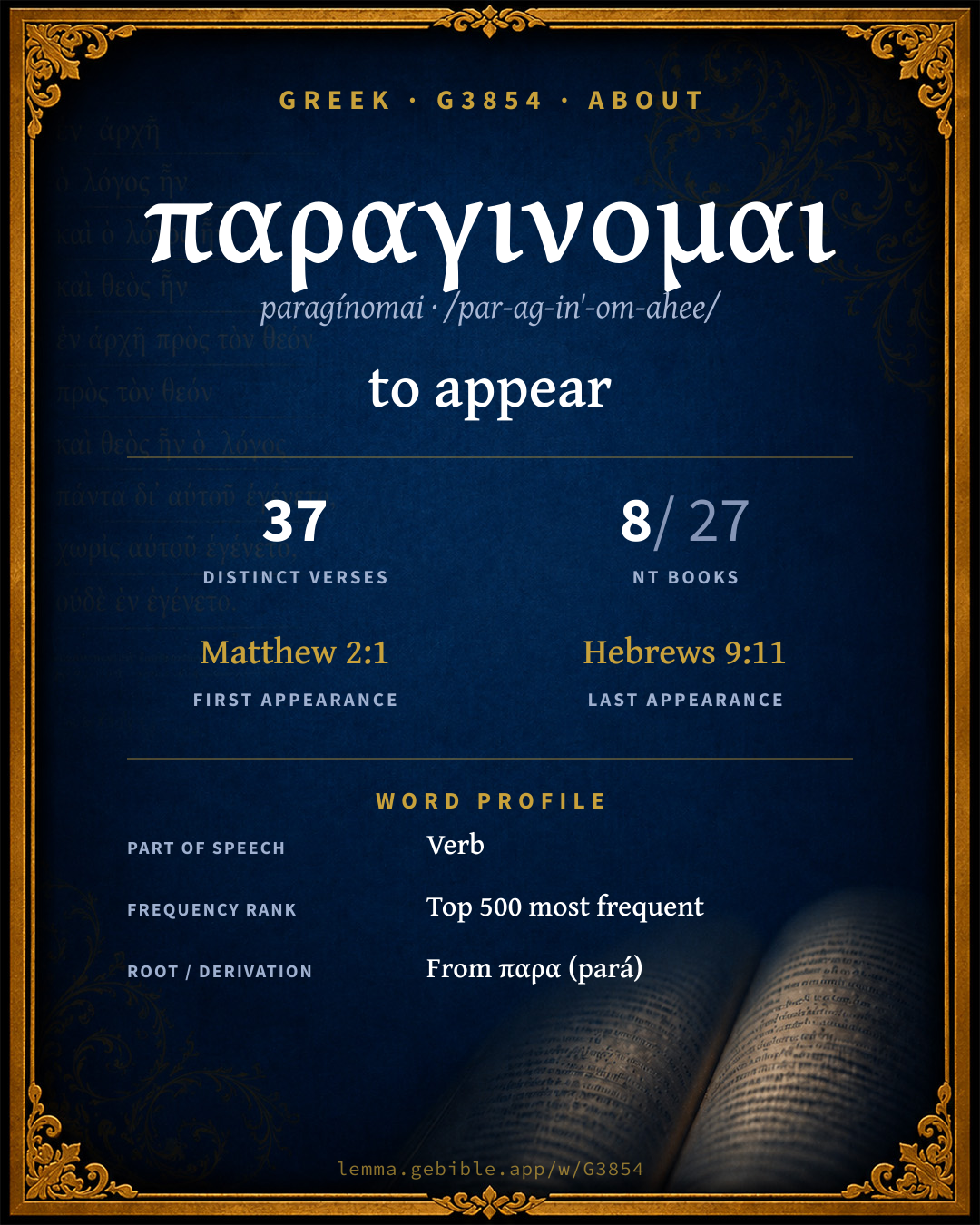
παραγίνομαι
to appear
‘to appear’ is one of 2 main senses fuller range ↓
Full lexicon entry — Thayer's Greek Lexicon
From Thayer's Greek Lexicon
Where this word appears
See every Aorist-tense verb in the Greek New Testament →
Grammar key — what these labels mean
Part of speech
- Verb
- An action or state-of-being word.
Tense
- Aorist
- Action viewed as a simple whole, without regard to duration — often past (perfective aspect).
- Present
- Ongoing or general action in present time (imperfective aspect).
- Imperfect
- Continuous or repeated action in past time (“was writing”).
Voice
- Middle deponent
- Middle in form but active in meaning.
- Middle or Passive deponent
- Middle/passive in form but active in meaning.
Mood
- Participle
- A verbal adjective (“writing,” “having written”).
- Indicative
- States a fact or asks a factual question (the mood of reality).
- Subjunctive
- Expresses probability, purpose, or possibility (the mood of contingency).
Case
- Nominative
- The case of the subject (and the predicate nominative).
- Accusative
- The case of the direct object and of extent.
- Genitive
- The case of source, possession, or “of” — answers “whose / from what.”
Person
- 3rd person
- The one spoken about (“he / she / it / they”).
- 1st person
- The speaker (“I / we”).
Gender
- Masculine
- Grammatically masculine.
Number
- Singular
- One.
- Plural
- More than one.
Grammatical forms 12 distinct
- Verb, Aorist, Middle deponent, Participle, Nominative, Singular, Masculine 11 times (30%)
- Verb, Aorist, Middle deponent, Participle, Nominative, Plural, Masculine 6 times (16%)
- Verb, Aorist, Middle deponent, Indicative, 3rd person, Plural 4 times (11%)
- Verb, Aorist, Middle deponent, Indicative, 3rd person, Singular 4 times (11%)
- Verb, Present, Middle or Passive deponent, Indicative, 3rd person, Singular 4 times (11%)
- Verb, Aorist, Middle deponent, Indicative, 1st person, Singular 2 times (5%)
- Verb, Aorist, Middle deponent, Participle, Accusative, Plural, Masculine 1 time (3%)
- Verb, Aorist, Middle deponent, Participle, Accusative, Singular, Masculine 1 time (3%)
+4 more forms (4 occurrences)
Parsed forms decoded from the imported morphology (Robinson–Tischendorf, public domain), counted across 37 parsed occurrences — not distinct verses.
Every verse where G3854 appears — 37 distinct verses across 8 books. Click any verse to open its interlinear word-by-word view. Verse text shown in the World English Bible for context — . Each verse’s Greek form is shown with its reference; the English is not keyword-highlighted, since the data carries no word-level English alignment. Use “Compare translations” on any verse to read it across multiple English versions. This concordance covers the Greek New Testament; Septuagint (Greek Old Testament) occurrences of this word are not indexed here.
Matthew 3 verses
- Matthew 2:1 παρεγένοντο aor mid.dep ind 3pl Now when Jesus was born in Bethlehem of Judea in the days of Herod the king, behold, wise men from the east came to Jerusalem, saying,
- Matthew 3:1 παραγίνεται pres mid/pass.dep ind 3sg In those days, John the Baptizer came, preaching in the wilderness of Judea, saying,
- Matthew 3:13 παραγίνεται pres mid/pass.dep ind 3sg Then Jesus came from Galilee to the Jordan to John, to be baptized by him.
Mark 1 verse
Luke 8 verses
- Luke 7:4 παραγενόμενοι aor mid.dep ptcp nom pl masc When they came to Jesus, they begged him earnestly, saying, "He is worthy for you to do this for him,
- Luke 7:20 παραγενόμενοι aor mid.dep ptcp nom pl masc When the men had come to him, they said, "John the Baptizer has sent us to you, saying, 'Are you he who comes, or should we look for another?'"
- Luke 8:19 Παρεγένετο aor mid.dep ind 3sg His mother and brothers came to him, and they could not come near him for the crowd.
- Luke 11:6 παρεγένετο aor mid.dep ind 3sg for a friend of mine has come to me from a journey, and I have nothing to set before him,'
- Luke 12:51 παρεγενόμην aor mid.dep ind 1sg Do you think that I have come to give peace in the earth? I tell you, no, but rather division.
- Luke 14:21 παραγενόμενος aor mid.dep ptcp nom sg masc "That servant came, and told his lord these things. Then the master of the house, being angry, said to his servant, 'Go out quickly into the streets and lanes of the city, and bring in the poor, maimed, blind, and lame.'
- Luke 19:16 παρεγένετο aor mid.dep ind 3sg The first came before him, saying, 'Lord, your mina has made ten more minas.'
- Luke 22:52 παραγενομένους aor mid.dep ptcp acc pl masc Jesus said to the chief priests, captains of the temple, and elders, who had come against him, "Have you come out as against a robber, with swords and clubs?
John 2 verses
- John 3:23 παρεγίνοντο impf mid.dep ind 3pl John also was baptizing in Enon near Salim, because there was much water there. They came, and were baptized.
- John 8:2 παρεγένετο pres mid/pass.dep ind 3sg Now very early in the morning, he came again into the temple, and all the people came to him. He sat down, and taught them.
Acts 20 verses
- Acts 5:21 παραγενόμενος aor mid.dep ptcp nom sg masc When they heard this, they entered into the temple about daybreak, and taught. But the high priest came, and those who were with him, and called the council together, and all the senate of the children of Israel, and sent to the prison to have them brought.
- Acts 5:22 παραγενόμενοι aor mid.dep ptcp nom pl masc But the officers who came didn't find them in the prison. They returned and reported,
- Acts 5:25 παραγενόμενος aor mid.dep ptcp nom sg masc One came and told them, "Behold, the men whom you put in prison are in the temple, standing and teaching the people."
- Acts 9:26 Παραγενόμενος aor mid.dep ptcp nom sg masc When Saul had come to Jerusalem, he tried to join himself to the disciples; but they were all afraid of him, not believing that he was a disciple.
- Acts 9:39 παραγενόμενον aor mid.dep ptcp acc sg masc Peter got up and went with them. When he had come, they brought him into the upper chamber. All the widows stood by him weeping, and showing the coats and garments which Dorcas had made while she was with them.
- Acts 10:33 παραγενόμενος aor mid.dep ptcp nom sg masc Therefore I sent to you at once, and it was good of you to come. Now therefore we are all here present in the sight of God to hear all things that have been commanded you by God."
- Acts 11:23 παραγενόμενος aor mid.dep ptcp nom sg masc who, when he had come, and had seen the grace of God, was glad. He exhorted them all, that with purpose of heart they should remain near to the Lord.
- Acts 13:14 παρεγένοντο aor mid.dep ind 3pl But they, passing on from Perga, came to Antioch of Pisidia. They went into the synagogue on the Sabbath day, and sat down.
- Acts 14:27 παραγενόμενοι aor mid.dep ptcp nom pl masc When they had arrived, and had gathered the assembly together, they reported all the things that God had done with them, and that he had opened a door of faith to the Gentiles.
- Acts 15:4 παραγενόμενοι aor mid.dep ptcp nom pl masc When they had come to Jerusalem, they were received by the assembly and the apostles and the elders, and they reported all things that God had done with them.
- Acts 17:10 παραγενόμενοι aor mid.dep ptcp nom pl masc The brothers immediately sent Paul and Silas away by night to Beroea. When they arrived, they went into the Jewish synagogue.
- Acts 18:27 παραγενόμενος aor mid.dep ptcp nom sg masc When he had determined to pass over into Achaia, the brothers encouraged him, and wrote to the disciples to receive him. When he had come, he greatly helped those who had believed through grace;
- Acts 20:18 παρεγένοντο aor mid.dep ind 3pl When they had come to him, he said to them, "You yourselves know, from the first day that I set foot in Asia, how I was with you all the time,
- Acts 21:18 παρεγένοντο aor mid.dep ind 3pl The day following, Paul went in with us to James; and all the elders were present.
- Acts 23:16 παραγενόμενος aor mid.dep ptcp nom sg masc But Paul's sister's son heard of their lying in wait, and he came and entered into the barracks and told Paul.
- Acts 23:35 παραγένωνται aor mid.dep subj 3pl "I will hear you fully when your accusers also arrive." He commanded that he be kept in Herod's palace.
- Acts 24:17 παρεγενόμην aor mid.dep ind 1sg Now after some years, I came to bring gifts for the needy to my nation, and offerings;
- Acts 24:24 παραγενόμενος aor mid.dep ptcp nom sg masc But after some days, Felix came with Drusilla, his wife, who was a Jewess, and sent for Paul, and heard him concerning the faith in Christ Jesus.
- Acts 25:7 παραγενομένου aor mid.dep ptcp gen sg masc When he had come, the Jews who had come down from Jerusalem stood around him, bringing against him many and grievous charges which they could not prove,
- Acts 28:21 παραγενόμενός aor mid.dep ptcp nom sg masc They said to him, "We neither received letters from Judea concerning you, nor did any of the brothers come here and report or speak any evil of you.
1 Corinthians 1 verse
2 Timothy 1 verse
Hebrews 1 verse
About this entry
At a glance — auto-summarized from this page’s data, not written by a person. Every figure links to its source below. This summary describes the numbers; it doesn’t interpret them.
παραγινομαι — transliterated paragínomai — is a Greek verb carrying the sense “to appear.” Its uses cluster heavily in Acts (54% of all occurrences). With 37 verses in 8 books, it is a moderately common word in the Greek New Testament. Its lexical range runs to 2 senses. Translators differ — “came” in the King James Version, then “arrived” (Berean Standard Bible) and “having arrived” (unfoldingWord Literal Text), as the renderings breakdown shows. Each statement above links to its evidence; the full detail follows below.
Gloss history
Strong's 1890 vs modern scholarship

About this word
Strong's G3854 catalogs a Greek word from the Greek New Testament.
These counts are not copied from any lexicon or concordance. They are computed here, from the morphology-tagged Greek New Testament. What Lemma adds →
- 37
- distinct verses
- The word appears in 37 distinct verses.
- 8 / 27
- NT books
- The word appears in 8 of 27 New Testament books.
- #397
- by frequency
- Top 500 most frequent Greek words (rank 397 of 5,347 Greek words by occurrence).
View all 37 occurrences in the concordance →
By section of the New Testament
By traditional corpus
Conventional, traditional groupings — biblical authorship is debated, so this is a traditional corpus grouping, not an authorship claim. Some books belong to more than one corpus (Luke is in both the Gospels and the Lukan corpus, and so on), so these shares overlap and need not total 100%. Each figure is a share of the word’s 37 distinct verses.
- Lukan (Luke–Acts) 28 verses · 76%
- Gospels 14 verses · 38%
- Johannine 2 verses · 5%
- Pauline corpus 2 verses · 5%
- Hebrews 1 verse · 3%
How translations render this word
Counts come from each version’s own published word-to-Strong’s tagging or interlinear alignment — an approximate guide to how each version renders this word, not a word-level alignment the data otherwise carries. Because each total is that version’s own tagged count, the per-version totals vary from one another and need not match the appearance or distinct-verse counts above. These counts may also differ from a printed concordance because Lemma counts each distinctly tagged rendering and does not collapse phrase taggings into a single head-word total. This is a fixed set of word-tagged versions (KJV, ASV, BSB, ULT) and does not change with the reading translation you choose elsewhere. Each version’s license is shown beside its name below (and on Sources).
- King James Version: Came 10×, They came 3×, They were come 3×
- American Standard Version: Came 8×, They were come 4×, Cometh 3×
- Berean Standard Bible: Arrived 6×, Arrival 4×, Came 4×
- unfoldingWord Literal Text: Having arrived 8×, Came 4×, Having come 4×
King James Version Public Domain
Renders G3854 across 38 tagged occurrences — most commonly:
Plus 13 renderings that appear only once — usually multi-word phrases or single function words the recovered tagging swept in, not distinct renderings.
American Standard Version Public Domain
Renders G3854 across 38 tagged occurrences — most commonly:
Plus 14 renderings that appear only once — usually multi-word phrases or single function words the recovered tagging swept in, not distinct renderings.
Berean Standard Bible Public Domain
Renders G3854 across 35 tagged occurrences — most commonly:
Plus 13 renderings that appear only once — usually multi-word phrases or single function words the recovered tagging swept in, not distinct renderings. Not rendered by a distinct English word in 2 further occurrences.
unfoldingWord Literal Text CC BY-SA 4.0
Renders G3854 across 39 tagged occurrences — most commonly:
Plus 17 renderings that appear only once — usually multi-word phrases or single function words the recovered tagging swept in, not distinct renderings.
Senses in Thayer's
The 2 senses Thayer's distinguishes for this word, in lexicon order (not ranked by frequency or importance). The full entry — with sub-senses — is in the Lexicon Entry tab.
- to be present, to come near, approach
- to come forth, make one's public appearance
Word origin
Derived from παρα (pará) (G3844) — from.
Forms in the corpus
The 15 distinct written forms G3854 takes in the Greek New Testament, most frequent first — each parse links to that tense’s occurrences in the concordance.
Same root — word family
Other Thayer's entries built from the same root as G3854, grouped by Strong’s listed origin. These share a root / origin per the lexicon — not necessarily a shared meaning. Each links to that word’s own entry.
Derives from
Shares the same root
- παραβαινω parabaínō G3845 to neglect
- παραβαλλω parabállō G3846 to place beside
- παραβιαζομαι parabiázomai G3849 to compel
- παραβουλευομαι parabouleúomai G3851 to consult wrongly
- παραγγελλω parangéllō G3853 to announce
- παραγω parágō G3855 to pass by
- παραδειγματιζω paradeigmatízō G3856 to make example
- παραδεχομαι paradéchomai G3858 to receive
- παραδιατριβη paradiatribḗ G3859 empty business
- παραδιδωμι paradídōmi G3860 to deliver
- παραδοξος parádoxos G3861 strange
- παραζηλοω parazēlóō G3863 to provoke
- παραθαλασσιος parathalássios G3864 by the sea
- παραθεωρεω paratheōréō G3865 to compare
- παραινεω parainéō G3867 to exhort
- παραιτεομαι paraitéomai G3868 to beg pardon
- παρακαθιζω parakathízō G3869 to sit beside
- παρακαλεω parakaléō G3870 to call beside
- παρακαλυπτω parakalýptō G3871 to cover up
- παρακαταθηκη parakatathḗkē G3872 deposit
- παρακειμαι parákeimai G3873 to lie beside
- παρακολουθεω parakolouthéō G3877 to follow after
- παρακουω parakoúō G3878 to disobey
- παρακυπτω parakýptō G3879 to look into
+51 more words share this root (not shown).
Proper names from this root
People and places named from this root — a name, not an additional meaning of the word.
Compare all same-root words → Showing 4 of 78 — not the complete family. 1 of the same-root words is a proper name (a person or place). They share a root, not necessarily a meaning.
Septuagint usage
The same Greek word παραγινομαι appears 113 times in the Greek Old Testament (Septuagint), across 111 verses in 21 books.
- 113
- LXX occurrences
- Tagged occurrences of this Greek word in the Septuagint.
- 111
- verses
- Distinct Septuagint verses containing this word.
- 21 / 39
- OT books
- The word appears in 21 of the 39 Old Testament books.
Sample Septuagint occurrences
- Genesis 14:13 παραγίγνομαι
- Exodus 2:16 παραγίγνομαι
- Leviticus 14:48 παραγίγνομαι
- Numbers 9:6 παραγίγνομαι
- Deuteronomy 18:6 παραγίγνομαι
- Joshua 5:14 παραγίγνομαι
- Judges 6:5 παραγίγνομαι
- Ruth 1:19 παραγίγνομαι
- 1 Samuel 8:4 παραγίγνομαι
- 2 Samuel 1:3 παραγίγνομαι
- 1 Kings 3:15 παραγίγνομαι
- 2 Kings 9:17 παραγίγνομαι
Septuagint occurrences (same lexeme)
Every verse where the same Strong’s number (G3854) appears in the Greek Septuagint — showing the first 50 of 111. Verse text shown in the World English Bible for context; the Greek form is the matched word — the English is not keyword-highlighted.
- Genesis 14:13 παραγίγνομαι One who had escaped came and told Abram, the Hebrew. Now he lived by the oaks of Mamre, the Amorite, brother of Eshcol, and brother of Aner; and these were allies of Abram.
- Genesis 26:32 παραγίγνομαι It happened the same day, that Isaac's servants came, and told him concerning the well which they had dug, and said to him, "We have found water."
- Genesis 32:21 παραγίγνομαι So the present passed over before him: and he himself lodged that night in the camp.
- Genesis 35:9 παραγίγνομαι God appeared to Jacob again, when he came from Paddan Aram, and blessed him.
- Genesis 45:19 παραγίγνομαι Now you are commanded: do this. Take wagons out of the land of Egypt for your little ones, and for your wives, and bring your father, and come.
- Genesis 50:10 παραγίγνομαι They came to the threshing floor of Atad, which is beyond the Jordan, and there they lamented with a very great and sore lamentation. He mourned for his father seven days.
- Genesis 50:16 παραγίγνομαι They sent a message to Joseph, saying, "Your father commanded before he died, saying,
- Exodus 2:16 παραγίγνομαι Now the priest of Midian had seven daughters. They came and drew water, and filled the troughs to water their father's flock.
- Exodus 2:17 παραγίγνομαι The shepherds came and drove them away; but Moses stood up and helped them, and watered their flock.
- Exodus 2:18 παραγίγνομαι When they came to Reuel, their father, he said, "How is it that you have returned so early today?"
- Exodus 8:20 παραγίγνομαι Yahweh said to Moses, "Rise up early in the morning, and stand before Pharaoh; behold, he comes forth to the water; and tell him, 'This is what Yahweh says, "Let my people go, that they may serve me.
- Exodus 16:35 παραγίγνομαι The children of Israel ate the manna forty years, until they came to an inhabited land. They ate the manna until they came to the borders of the land of Canaan.
- Exodus 18:6 παραγίγνομαι He said to Moses, I, your father-in-law Jethro, have come to you with your wife, and her two sons with her.
- Exodus 18:12 παραγίγνομαι Jethro, Moses' father-in-law, took a burnt offering and sacrifices for God. Aaron came with all of the elders of Israel, to eat bread with Moses' father-in-law before God.
- Exodus 18:15 παραγίγνομαι Moses said to his father-in-law, "Because the people come to me to inquire of God.
- Exodus 19:9 παραγίγνομαι Yahweh said to Moses, "Behold, I come to you in a thick cloud, that the people may hear when I speak with you, and may also believe you forever." Moses told the words of the people to Yahweh.
- Exodus 20:20 παραγίγνομαι Moses said to the people, "Don't be afraid, for God has come to test you, and that his fear may be before you, that you won't sin."
- Exodus 36:4 παραγίγνομαι All the wise men, who performed all the work of the sanctuary, each came from his work which they did.
- Leviticus 14:48 παραγίγνομαι "If the priest shall come in, and examine it, and, behold, the plague hasn't spread in the house, after the house was plastered, then the priest shall pronounce the house clean, because the plague is healed.
- Numbers 9:6 παραγίγνομαι There were certain men, who were unclean because of the dead body of a man, so that they could not keep the Passover on that day, and they came before Moses and before Aaron on that day.
- Numbers 10:21 παραγίγνομαι The Kohathites set forward, bearing the sanctuary: and [the others] did set up the tent against their coming.
- Numbers 14:36 παραγίγνομαι The men, whom Moses sent to spy out the land, who returned, and made all the congregation to murmur against him, by bringing up an evil report against the land,
- Numbers 20:5 παραγίγνομαι Why have you made us to come up out of Egypt, to bring us in to this evil place? it is no place of seed, or of figs, or of vines, or of pomegranates; neither is there any water to drink.
- Numbers 20:22 παραγίγνομαι They traveled from Kadesh: and the children of Israel, even the whole congregation, came to Mount Hor.
- Numbers 21:7 παραγίγνομαι The people came to Moses, and said, We have sinned, because we have spoken against Yahweh, and against you; pray to Yahweh, that he take away the serpents from us. Moses prayed for the people.
- Deuteronomy 18:6 παραγίγνομαι If a Levite comes from any of your gates out of all Israel, where he lives as a foreigner, and comes with all the desire of his soul to the place which Yahweh shall choose;
- Joshua 5:14 παραγίγνομαι He said, No; but [as] prince of the host of Yahweh am I now come. Joshua fell on his face to the earth, and did worship, and said to him, What says my lord to his servant?
- Joshua 9:8 παραγίγνομαι They said to Joshua, We are your servants. Joshua said to them, Who are you? and from whence come you?
- Joshua 9:12 παραγίγνομαι This our bread we took hot for our provision out of our houses on the day we came forth to go to you; but now, behold, it is dry, and is become moldy:
- Joshua 10:9 παραγίγνομαι Joshua therefore came on them suddenly; [for] he went up from Gilgal all the night.
- Joshua 11:5 παραγίγνομαι All these kings met together; and they came and encamped together at the waters of Merom, to fight with Israel.
- Joshua 18:8 παραγίγνομαι The men arose, and went: and Joshua charged those who went to describe the land, saying, Go and walk through the land, and describe it, and come again to me; and I will cast lots for you here before Yahweh in Shiloh.
- Joshua 21:45 παραγίγνομαι There failed not anything of any good thing which Yahweh had spoken to the house of Israel; all came to pass.
- Joshua 22:15 παραγίγνομαι They came to the children of Reuben, and to the children of Gad, and to the half-tribe of Manasseh, to the land of Gilead, and they spoke with them, saying,
- Joshua 24:11 παραγίγνομαι You went over the Jordan, and came to Jericho: and the men of Jericho fought against you, the Amorite, and the Perizzite, and the Canaanite, and the Hittite, and the Girgashite, the Hivite, and the Jebusite; and I delivered them into your hand.
- Judges 6:5 παραγίγνομαι For they came up with their cattle and their tents; they came in as locusts for multitude; both they and their camels were without number: and they came into the land to destroy it.
- Judges 8:15 παραγίγνομαι He came to the men of Succoth, and said, See Zebah and Zalmunna, concerning whom you did taunt me, saying, Are the hands of Zebah and Zalmunna now in your hand, that we should give bread to your men who are weary?
- Ruth 1:19 παραγίγνομαι So they two went until they came to Bethlehem. It happened, when they were come to Bethlehem, that all the city was moved about them, and [the women] said, Is this Naomi?
- Ruth 1:22 παραγίγνομαι So Naomi returned, and Ruth the Moabitess, her daughter-in-law, with her, who returned out of the country of Moab: and they came to Bethlehem in the beginning of barley harvest.
- 1 Samuel 8:4 παραγίγνομαι Then all the elders of Israel gathered themselves together, and came to Samuel to Ramah;
- 1 Samuel 9:6 παραγίγνομαι He said to him, See now, there is in this city a man of God, and he is a man who is held in honor; all that he says comes surely to pass: now let us go there; peradventure he can tell us concerning our journey whereon we go.
- 1 Samuel 13:8 παραγίγνομαι He stayed seven days, according to the set time that Samuel [had appointed]: but Samuel didn't come to Gilgal; and the people were scattered from him.
- 1 Samuel 13:10 παραγίγνομαι It came to pass that as soon as he had made an end of offering the burnt offering, behold, Samuel came; and Saul went out to meet him, that he might greet him.
- 1 Samuel 13:11 παραγίγνομαι Samuel said, What have you done? Saul said, Because I saw that the people were scattered from me, and that you didn't come within the days appointed, and that the Philistines assembled themselves together at Michmash;
- 1 Samuel 13:15 παραγίγνομαι Samuel arose, and got him up from Gilgal to Gibeah of Benjamin. Saul numbered the people who were present with him, about six hundred men.
- 1 Samuel 15:13 παραγίγνομαι Samuel came to Saul; and Saul said to him, Blessed are you by Yahweh: I have performed the commandment of Yahweh.
- 1 Samuel 19:18 παραγίγνομαι Now David fled, and escaped, and came to Samuel to Ramah, and told him all that Saul had done to him. He and Samuel went and lived in Naioth.
- 1 Samuel 20:21 παραγίγνομαι Behold, I will send the boy, [saying], Go, find the arrows. If I tell the boy, Behold, the arrows are on this side of you; take them, and come; for there is peace to you and no hurt, as Yahweh lives.
- 1 Samuel 20:24 παραγίγνομαι So David hid himself in the field: and when the new moon was come, the king sat him down to eat food.
- 1 Samuel 20:27 παραγίγνομαι It happened on the next day after the new moon, [which was] the second [day], that David's place was empty: and Saul said to Jonathan his son, Why doesn't the son of Jesse come to meat, neither yesterday, nor today?
These are occurrences of the same Greek lexeme (G3854) in the Septuagint — not a translation of any one Hebrew word. The store carries no word-level Hebrew↔Greek alignment, so no Hebrew original is asserted here. Counts come from the recovered LXX Strong's tagging — high-frequency vocabulary is well covered, while rare or late forms may be untagged — so they reflect tagged occurrences and may slightly undercount.