1 Thessalonians 2:11

Greek (Tischendorf 8th ed.) 1 Thessalonians 2:11 appears in the Greek New Testament. The text above is from the Tischendorf 8th edition. Each word links to its Strong’s number and a concise gloss. Click any word for its full Thayer’s Greek Lexicon entry.
Download image
Cite this verse

1 Thessalonians 2:11 (World English Bible). Public Domain. Lemma interlinear Bible study tool, https://lemma.gebible.app/v/1-thessalonians/2/11.

Show BibTeX & RIS
BibTeX
RIS
English Translation
As you know how we exhorted, comforted, and implored every one of you, as a father does his own children,
World English Bible · Public Domain
Download a study sheet

One document with this verse’s original text, its word-by-word gloss line, the meaning frame, cross-references with their text, attributed commentary, and full source and license credits — printable, and it pastes into notes with its structure intact.

This verse Autodidact and up

Study sheet (.html) Plain text (.txt)

A passage Seminary Student

Up to 50 verses in one chapter. A passage sheet keeps up to 6 commentary sources and 12 cross-references per verse, in the order this page ranks them, and says so on the sheet whenever that leaves anything out. Ask for a single verse and you get the Autodidact verse sheet above.

Everything on this page stays free to read, with no account — the sheet is a download of what is already on screen, not access to it.

Want to remove ads? Support Godless Engineer
Compare translations 3

The same verse in 3 English versions, stacked beneath the original-language interlinear above. Click any original word for its lexicon entry.

Each is an independent rendering of the whole verse — the interlinear is not word-aligned to these translations.

Highlighted words mark where these versions differ — a whole-verse word diff, not a word-by-word alignment.

  • World English Bible Public Domain
    As you know how we exhorted, comforted, and implored every one of you, as a father does his own children,
  • King James Version Public Domain
    As ye know how we exhorted and comforted and charged every one of you, as a father doth his children,
  • unfoldingWord Literal Text CC BY-SA 4.0
    just as you know how, each one of you, as a father his own children,

unfoldingWord Literal Text — © unfoldingWord, licensed CC BY-SA 4.0. Word-aligned USFM3 via Door43 (git.door43.org/unfoldingWord/en_ult).

Versions to compare (up to 4)

3 of 4 selected

Show all 19 translations

Every available English version of this verse, each an independent rendering of the whole verse.

  • World English Bible Public Domain
    As you know how we exhorted, comforted, and implored every one of you, as a father does his own children,
  • Berean Standard Bible Public Domain
    For you know that we treated each of you as a father treats his own children—
  • Majority Standard Bible Public Domain
    For you know that we treated each of you as a father treats his own children—
  • King James Version Public Domain
    As ye know how we exhorted and comforted and charged every one of you, as a father doth his children,
  • American Standard Version (1901) Public Domain
    as ye know how we `dealt with' each one of you, as a father with his own children, exhorting you, and encouraging `you', and testifying,
  • Revised Version (1885) Public Domain
    as ye know how we dealt with each one of you, as a father with his own children, exhorting you, and encouraging you, and testifying,
  • Geneva Bible (1599) Public Domain
    As ye knowe how that we exhorted you, and comforted, and besought euery one of you (as a father his children)
  • Douay-Rheims (1899) Public Domain
    As you know in what manner, entreating and comforting you, (as a father doth his children,)
  • Young's Literal Translation Public Domain
    even as ye have known, how each one of you, as a father his own children, we are exhorting you, and comforting, and testifying,
  • Literal Standard Version CC BY-SA 4.0
    even as you have known how we are exhorting each one of you, as a father his own children, and comforting, and testifying,
  • Unlocked Literal Bible CC BY-SA 4.0
    In the same way you know how we dealt with each one of you as a father deals with his own children.
  • unfoldingWord Literal Text CC BY-SA 4.0
    just as you know how, each one of you, as a father his own children,
  • Darby Bible Public Domain
    as ye know how, as a father his own children, we used to exhort each one of you, and comfort and testify,
  • World Messianic Bible Public Domain
    As you know, we exhorted, comforted, and implored every one of you, as a father does his own children,
  • Webster's Bible Public Domain
    As ye know how we exhorted, and comforted, and charged every one of you, as a father doth his children,
  • Free Bible Version CC BY-SA 4.0
    You know how we cared for every one of you like a father caring for his own children. We encouraged you, comforted you, and shared with you our experience
  • Bible in Basic English Public Domain
    Even as you saw how, like a father with his children, we were teaching and comforting you all, and giving witness,
  • Text-Critical English NT CC BY 4.0
    As you know, we dealt with each one of you like a father deals with his own children, exhorting you, encouraging you,
  • Tyndale New Testament (1534) Public Domain
    as ye knowe how that we exhorted and comforted and besought every one of you as a father his children

Literal Standard Version (2020), Covenant Press — licensed CC BY-SA 4.0. Text via the HelloAO Bible API (eBible.org). Unlocked Literal Bible (unfoldingWord) — licensed CC BY-SA 4.0. Text via the HelloAO Bible API (eBible.org). unfoldingWord Literal Text — © unfoldingWord, licensed CC BY-SA 4.0. Word-aligned USFM3 via Door43 (git.door43.org/unfoldingWord/en_ult). Free Bible Version, Dr. Jonathan Gallagher — licensed CC BY-SA 4.0. Text via the HelloAO Bible API (eBible.org).

Word by word

More ways to search: Search by grammar → Find every occurrence → Compare this word →

Practice this passage: Drill this verse → Learn its vocabulary →

παραμυθούμενοι
paramythéomai
G3888
“to address”
Verb, Present, Middle or Passive deponent, Participle, Nominative, Plural, Masculine
Part of Speech
Verb
Tense
Present
Voice
Middle or Passive deponent
Mood
Participle
Case
Nominative
Number
Plural
Gender
Masculine
Full Thayer's Definition

Origin: from G3844 and the middle voice of a derivative of G3454

TDNT: 18:36,8

1. to speak to, address one, whether by way of admonition and incentive, or to calm and console a. to encourage, console
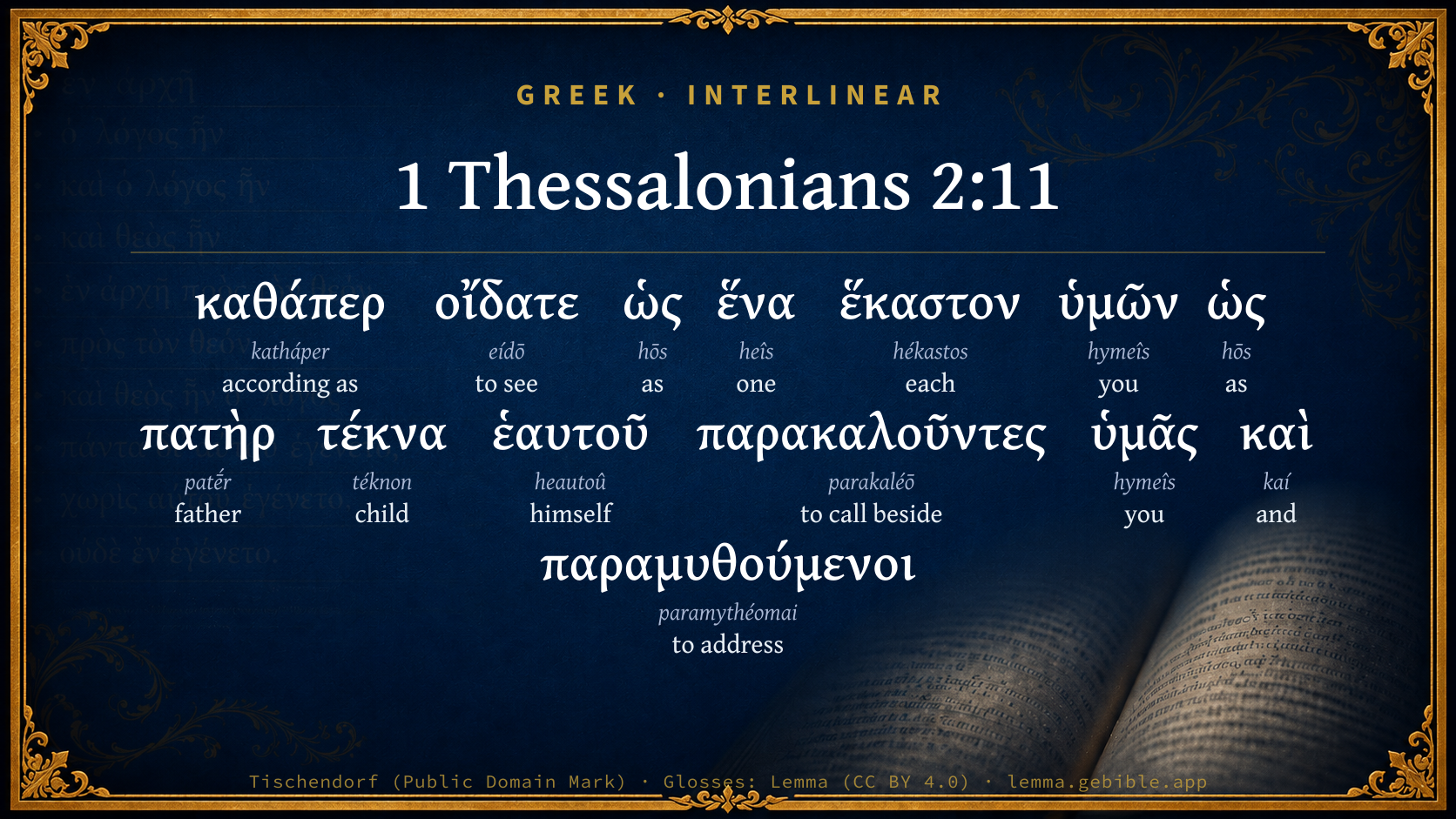
  1. καθάπερ katháper G2509 “according as” Adverb
  2. οἴδατε eídō G1492 “to see” Verb, Perfect, Active, Indicative, 2nd person, Plural
  3. ὡς hōs G5613 “as” Adverb
  4. ἕνα heîs G1520 “one” Adjective, Accusative, Singular, Masculine
  5. ἕκαστον hékastos G1538 “each” Adjective, Accusative, Singular, Masculine
  6. ὑμῶν hymeîs G5210 “you” Personal pronoun, 2nd person, Genitive, Plural
  7. ὡς hōs G5613 “as” Adverb
  8. πατὴρ patḗr G3962 “father” Noun, Nominative, Singular, Masculine
  9. τέκνα téknon G5043 “child” Noun, Accusative, Plural, Neuter
  10. ἑαυτοῦ heautoû G1438 “himself” Reflexive pronoun, 3rd person, Genitive, Singular, Masculine
  11. παρακαλοῦντες parakaléō G3870 “to call beside” Verb, Present, Active, Participle, Nominative, Plural, Masculine
  12. ὑμᾶς hymeîs G5210 “you” Personal pronoun, 2nd person, Accusative, Plural
  13. καὶ kaí G2532 “and” Conjunction

About this verse

These counts appear in no published source. They are computed here, from the morphology-tagged text and Lemma’s own curated glosses. What Lemma adds →

14
words
12
distinct lemmas
Pauline Epistles
section

Notable vocabulary

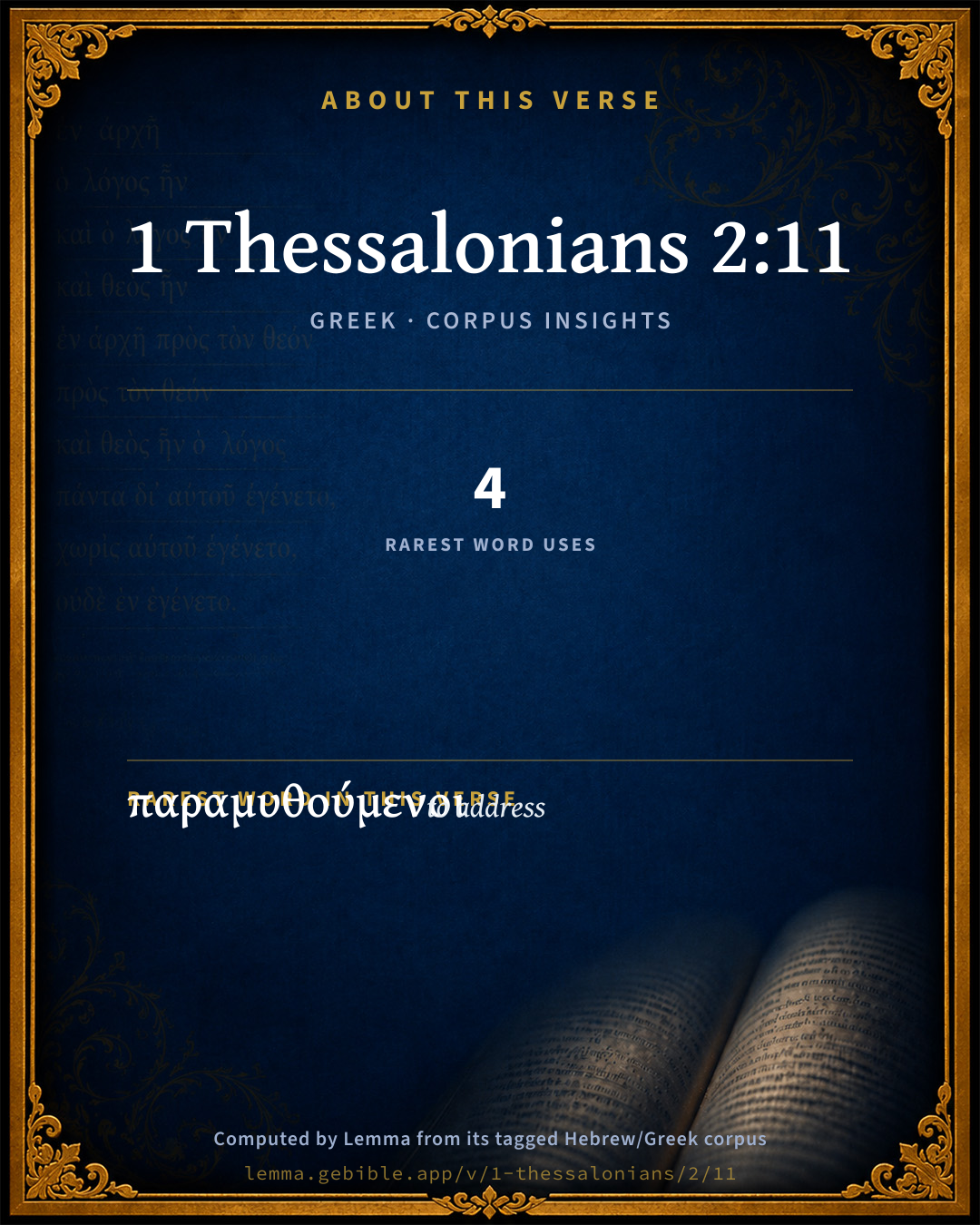
The rarest word here is παραμυθούμενοι to address G3888 — appearing just 4 times in the whole Greek New Testament.

Shared distinctive vocabulary

παραμυθούμενοι to address G3888 occurs in 4 verses of the Greek New Testament. Also found in:

Repetition

Words recur within this verse:

Cross-references

35

Topical passages linked to 1 Thessalonians 2:11 in the Treasury of Scripture Knowledge — connected by theme and wording, ordered by reader-vote popularity; previews shown in the World English Bible.

  • 1 Corinthians 4:14–15 I don't write these things to shame you, but to admonish you as my beloved children.
  • Hebrews 13:22 But I exhort you, brothers, endure the word of exhortation, for I have written to you in few words.
  • 2 Thessalonians 3:12 Now those who are that way, we command and exhort in the Lord Jesus Christ, that with quietness they work, and eat their own bread.
  • 1 Timothy 5:21 I charge you in the sight of God, and Christ Jesus, and the chosen angels, that you observe these things without prejudice, doing nothing by partiality.
  • 2 Timothy 4:1–2 I charge you therefore before God and the Lord Jesus Christ, who will judge the living and the dead at his appearing and his Kingdom:
  • Deuteronomy 3:28 But charge Joshua, and encourage him, and strengthen him; for he shall go over before this people, and he shall cause them to inherit the land which you shall see.
  • 1 Chronicles 28:20 David said to Solomon his son, Be strong and of good courage, and do it: don't be afraid, nor be dismayed; for Yahweh God, even my God, is with you; he will not fail you, nor forsake you, until all the work for the service of the house of Yahweh is finished.
  • 1 Thessalonians 2:7 But we were gentle among of you, as when a nurse cherishes her own children.
  • 1 Thessalonians 5:11 Therefore exhort one another, and build each other up, even as you also do.
  • Genesis 50:16–17 They sent a message to Joseph, saying, "Your father commanded before he died, saying,
  • Numbers 27:19 and set him before Eleazar the priest, and before all the congregation; and give him a charge in their sight.
  • Deuteronomy 31:14 Yahweh said to Moses, Behold, your days approach that you must die: call Joshua, and present yourselves in the tent of meeting, that I may give him a charge. Moses and Joshua went, and presented themselves in the tent of meeting.
  • 1 Chronicles 22:11–13 Now, my son, Yahweh be with you; and prosper you, and build the house of Yahweh your God, as he has spoken concerning you.
  • 1 Chronicles 28:9 You, Solomon my son, know the God of your father, and serve him with a perfect heart and with a willing mind; for Yahweh searches all hearts, and understands all the imaginations of the thoughts: if you seek him, he will be found of you; but if you forsake him, he will cast you off forever.
  • Psalms 34:11 Come, you children, listen to me. I will teach you the fear of Yahweh.
  • Proverbs 1:10 My son, if sinners entice you, don't consent.
  • Proverbs 1:15 My son, don't walk in the way with them. Keep your foot from their path,
  • Proverbs 2:1 My son, if you will receive my words, And store up my commandments within you;
  • Proverbs 3:1 My son, don't forget my teaching; But let your heart keep my commandments:
  • Proverbs 4:1–12 Listen, sons, to a father's instruction. Pay attention and know understanding;
  • Proverbs 5:1–2 My son, pay attention to my wisdom. Turn your ear to my understanding:
  • Proverbs 6:1 My son, if you have become collateral for your neighbor, If you have struck your hands in pledge for a stranger;
  • Proverbs 7:1 My son, keep my words. Lay up my commandments within you.
  • Proverbs 7:24 Now therefore, sons, listen to me. Pay attention to the words of my mouth.
  • Proverbs 31:1–9 The words of king Lemuel; the oracle which his mother taught him.
  • Acts 20:2 When he had gone through those parts, and had encouraged them with many words, he came into Greece.
  • 1 Thessalonians 4:1 Finally then, brothers, we beg and exhort you in the Lord Jesus, that as you received from us how you ought to walk and to please God, that you abound more and more.
  • 1 Timothy 5:7 Also command these things, that they may be without reproach.
  • 1 Timothy 6:2 Those who have believing masters, let them not despise them, because they are brothers, but rather let them serve them, because those who partake of the benefit are believing and beloved. Teach and exhort these things.
  • 1 Timothy 6:13 I charge you before God, who gives life to all things, and before Christ Jesus, who before Pontius Pilate testified the good confession,
  • 1 Timothy 6:17 Charge those who are rich in this present world that they not be haughty, nor have their hope set on the uncertainty of riches, but on the living God, who richly provides us with everything to enjoy;
  • Titus 2:6 Likewise, exhort the younger men to be sober-minded;
  • Titus 2:15 Say these things and exhort and reprove with all authority. Let no man despise you.
  • Ephesians 4:17 This I say therefore, and testify in the Lord, that you no longer walk as the rest of the Gentiles also walk, in the futility of their mind,
  • Titus 2:9 Exhort servants to be in subjection to their own masters, and to be well-pleasing in all things; not contradicting;

Cross-references courtesy of OpenBible.info (CC BY 4.0).

Commentary

Notes on 1 Thessalonians 2:11 from classic Christian and Jewish commentators (each source and its license shown beneath its notes). The classic Christian expositions comment on the surrounding passage and are grouped to its opening verse, so a note may address several verses; the Jewish commentaries on the Tanakh (Rashi and others) are per-verse, so they appear only where the commentator wrote on this verse.

Lemma curates 59 commentaries, every one of them public domain or Creative Commons licensed, each selected and text-cleaned for this edition rather than reprinted as found. About our sources →

Tyndale Open Study Notes

Tyndale Open Resources

2:11 In the ancient world, the moral instruction of children was a fundamental obligation of fathers. Roman fathers could be harsh, but Plutarch advised Greek fathers to use praise, reason, exhortations, and good counsel when teaching children to avoid vice and embrace virtue. Paul describes himself as this kind of father to the Thessalonians.

Tyndale Open Study Notes — © Tyndale Open Resources, licensed CC BY-SA 4.0. Text via the HelloAO Bible API.

Bengel's Gnomon

Johann Albrecht Bengel

1Th 2:11. Ὡς ἕνα ἕκαστον, how every one) They do not act in this way who seek [their own] glory, 1Th 2:6.—ὡς πατὴρ, as a father) Mild gravity is the characteristic of fathers.—παρακαλοῦντες, exhorting) This depends on ἐγενήθημεν, we became (behaved), 1Th 2:10. Παράκλησις, exhortation, rouses one to do something willingly; παραμύθιον, consolation, to do it joyfully; τὸ μαρτυρεῖσθαι, earnest entreaty, testifying [charging], to do it with awe.

Bengel's Gnomon of the New Testament — English translation (T&T Clark, Edinburgh, 1860) — public domain. Text from a community e-Sword module.

Meyer's Critical & Exegetical Commentary

Heinrich August Wilhelm Meyer

are not a mere further digression into particulars, which we can scarcely assume after the general concluding words in 1Th_2:10, without blaming the author, notwithstanding the freedom of epistolary composition, of great logical arbitrariness and looseness, but are a proof of the general concluding sentence 1Th_2:10, ex analogia

1Th_2:11-12 are not a mere further digression into particulars, which we can scarcely assume after the general concluding words in 1Th_2:10, without blaming the author, notwithstanding the freedom of epistolary composition, of great logical arbitrariness and looseness, but are a proof of the general concluding sentence 1Th_2:10, ex analogia. As in all that has hitherto been said the twofold reference to the apostle and his two associates on the one hand, and to the readers on the other, has predominated, so is this also the case in 1Th_2:10-12. The circumstance that he has anxiously and earnestly exhorted his readers to a similar conduct in ὁσιότης, δικαιοσύνη, and ἀμεμψία, is asserted by the apostle as a proof that he himself behaved in the most perfect manner (ὡς) among the Thessalonians ὁσίως καὶ δικαίως καὶ ἀμέμπτως. For if any one be truly desirous that others walk virtuously, this presupposes the endeavour after virtue in himself. It is thus erroneous when de Wette and Koch, p. 172, think that the apostle in 1Th_2:10 speaks of his conduct generally, and in 1Th_2:11-12 of his ministerial conduct particularly. In 1Th_2:11-12 Paul does not speak wholly of his ministerial conduct, for the participles παρακαλοῦντες, παραμυθούμενοι, and μαρτυρόμενοι are not to be taken independently, but receive their full sense only in union with εἰς τὸ περιπατεῖν κ.τ.λ., so that the chief stress in the sentence rests on εἰς τὸ κ.τ.λ., and the accumulation of participles serves only to bring vividly forward the earnestness and urgency of the apostles exhortation to περιπατεῖν. Entirely erroneous, therefore, is Pelts idea of the connection: Redit P. ad amorem, quo eos amplectatur, iterum profitendum; for the attestation of love, in the conduct described in 1Th_2:11-12, is only expressed by the addition: ὡς πατὴρ τέκνα ἑαυτοῦ, and is thus only subsidiary to the main thought.

καθάπερ] as then, denotes the conformity of what follows to what precedes. As regards the construction: οἴδατε ὡς κ.τ.λ., we miss a finite tense.[35] Koppe considers that the participles are put instead of the finite tenses, ὡς παρεκαλέσαμεν καὶ παρεμυθησάμεθα καὶ ἐμαρτυρησάμεθα, an assertion which we can in the present day the less accept, as it is of itself self-evident that the participles of the present must have another meaning than that which could have been expressed by the finite forms of the aorist, i.e. of the purely historical tense. Others, objecting to the two accusatives, ἕνα ἕκαστον and ὙΜᾶς, have united ὙΜᾶς with the participle, and suggested a finite tense to ἕνα ἕκαστον, which, at the beginning of the period, must have been in Pauls mind, but which he forgot to add when dictating to his amanuensis. Vatablus, Er. Schmid, Ostermann would supply to ἝΝΑ ἝΚΑΣΤΟΝ, ἨΓΑΠΉΣΑΜΕΝ; Whitby, ἘΦΙΛΉΣΑΜΕΝ, or ἨΓΑΠΉΣΑΜΕΝ, or ἘΘΆΛΨΑΜΕΝ, from 1Th_2:7; Pelt, ΟὐΧ ἈΦΉΚΑΜΕΝ(?); Schott, a verb containing the notio curandi sive tractandi sive educandi.[36] But (1) the two accusatives do not at all justify supplying a special verb to ἝΝΑ ἝΚΑΣΤΟΝ, as not only among the classics is the twofold use of personal determinations not rare (see Bernhardy, Syntax, p. 275), but also in Pauls Epistles there are similar repetitions of the personal object (comp. Col_2:13; Eph_2:1; Eph_2:5). (2) To supply ἠγαπήσαμεν, or a similar idea, is in contradiction with the design and contents of 1Th_2:11-12, as the chief point in these verses is to be sought in the recollection of the impressive exhortations addressed to the Thessalonians to aim at a conduct similar to that of the apostle. Not only the simplest, but the only correct method, is, with Musculus, Wolf, Turretin, Bengel, Alford, and Hofmann, to supply ἐγενήθημεν, which has just preceded 1Th_2:10, to Ὡς … ΠΑΡΑΚΑΛΟῦΝΤΕς Κ.Τ.Λ. And just because ἘΓΕΝΉΘΗΜΕΝ precedes, the supplying of ἮΜΕΝ, which Beza, Grotius, Flatt, and others assume, and which otherwise would be the most natural word, is to be rejected. Accordingly, there is no anacoluthon in 1Th_2:11-12, but ἘΓΕΝΉΘΗΜΕΝ to be supplied in thought is designedly suppressed by the apostle in order to put the greater emphasis on the verbal ideas, παρακαλεῖν, παραμυθεῖσθαι, and ΜΑΡΤΎΡΕΣΘΑΙ. The circumlocutionary form, ἘΓΕΝΉΘΗΜΕΝ ΠΑΡΑΚ. Κ.Τ.Λ., has this in common with the form ἮΜΕΝ ΠΑΡΑΚ. Κ.Τ.Λ., that it denotes duration in the past, but it is distinguished from it by this, that it does not refer the action of the verb simply as something actually done, and which has had duration in the past; but this action, enduring in the past (and effected by God), is described in its process of completion, i.e. in the phase of its self-development.

ἕνα ἕκαστον ὑμῶν ὡς πατὴρ τέκνα ἑαυτοῦ] The thought, according to Flatt, consists in this: the apostle has exhorted and charged, with a view to the special wants of each, just as a father gives heed to the individual wants of his children. But ἝΝΑ ἝΚΑΣΤΟΝ ὙΜῶΝ denotes only the carefulness of the exhortation which is addressed to each individual without distinction (of rank, endowment, Chrysostom: Βαβαὶ ἐν τοσούτῳ πλήθει μηδένα παραλιπεῖν, μὴ μικρόν, μὴ μέγαν, μὴ πλούσιον, μὴ πένητα), and the addition Ὡς ΠΑΤῊΡ ΤΈΚΝΑ ἙΑΥΤΟῦ denotes only paternal love (in contrast to the severity of a taskmaster) as the disposition from which the exhortations proceeded. But in a fitting manner Paul changes the image formerly used of a mother and her children into that of a father and his children, because in the context the point insisted on is not so much that of tender love, which finds its satisfaction in itself, as that of educating love; for the apostle, by his exhortation, would educate the Thessalonians for the heavenly kingdom. That the apostle resided a long time in Thessalonica (Calovius) does not follow from ἕνα ἕκαστον.

παρακαλεῖν] to exhort by direct address. Erroneously Chrysostom, Theophylact: ΠΡῸς ΤῸ ΦΈΡΕΙΝ ΠΆΝΤΑ.

ὙΜᾶς] resumes ἝΝΑ ἝΚΑΣΤΟΝ ὙΜῶΝ; but whilst that emphatically precedes, this is placed after παρακαλοῦντες, because here the verb ΠΑΡΑΚ. has the emphasis (comp. Col_2:13). Paul adds ὙΜᾶς, which certainly might be omitted, not so much from carelessness or from inadvertence, but for the sake of perspicuity, in order to express the personal object belonging to the participles in immediate connection with them.

Also ΠΑΡΑΜΥΘΕῖΣΘΑΙ does not mean here to comfort (Wolf, Schott, and others), but to address, to exhort, to encourage; yet not to encourage to stedfastness, to exhort to moral courage (Oecumenius, Theophylact, de Wette), for the object of ΠΑΡΑΜΥΘΟΎΜΕΝΟΙ does not follow until 1Th_2:12.

[35] Certainly otherwise Schrader, who regards καθάπερ οἴδατε as a mere parenthesis which refers to what goes before and what follows, so that then ὡς παρακαλοῦντες καὶ παραμ. καὶ μαρτ., vv. 11, 12, would be only parallel to ὡς ὁσίως καὶ δικ. καὶ ἀμέμπτ., ver. 10. So recently also Auberlen. But this construction is impossible, because καθάπερ οἴδατε is not a complete repetition of the preceding ὑμεῖς μάρτυρες καὶ ὁ Θεός, but only of its first part (ὑμεῖς μάρτυρες), and thus can in no wise be considered as a meaningless addition.

[36] Erasmus completes the clause: complexi fuerimus, and finds in the double accusatives a balbuties apostolicae charitatis, quae se verbis humanis seu temulenta non explicat.

Meyer — Critical and Exegetical Commentary on the New Testament — English translation by Peter Christie, edited by Frederick Crombie (T&T Clark, 1880) — public domain. Text from a community e-Sword module.

Expositor's Greek Testament

ed. W. Robertson Nicoll

1Th 2:11 . καθάπερ , sharper than καθώς . Viteau (ii. 111) suggests that κ . ο . is a parenthesis, and ὡς a causal introductory particle for the participles (“heartening,” “encouraging,” “adjuring”) which in their turn depend on ὑμῖν … ἐγενήθημεν , but the likelihood is that in the rush of emotion, as he dictates, Paul leaves the participial clause without a finite verb (so e.g. , 2Co 7:5 ). ὡς πατήρ κ . τ . λ . ( cf. ὡς ἐὰν τροφός , 7). The figure was used by Jewish teachers of their relationship to their pupils. Cf. e.g. , the words of Eleazar b. Azarja to his dying master, “Thou art more to Israel than father or mother; they only bring men into this world, whereas thou guidest us for this world and the next”. Catullus, lxxii. 4 (dilexi tum te non tantum ut uulgus amicam, sed pater ut natos diligit et generos).

The Expositor's Greek Testament, edited by W. Robertson Nicoll (1897–1910) — public domain. Text from a community e-Sword module.

Geneva Bible (1599)

Geneva Bible translators

To exhort and comfort with a fatherly mind and affection.

Geneva Bible (1599) marginal notes — public domain. Text via Bolls.life.

Jamieson, Fausset & Brown

Robert Jamieson, A. R. Fausset & David Brown

exhorted and comforted--Exhortation leads one to do a thing willingly; consolation, to do it joyfully [BENGEL], (Th1 5:14). Even in the former term, "exhorted," the Greek includes the additional idea of comforting and advocating one's cause: "encouragingly exhorted." Appropriate in this case, as the Thessalonians were in sorrow, both through persecutions, and also through deaths of friends (Th1 4:13).

charged--"conjured solemnly," literally, "testifying"; appealing solemnly to you before God.

every one of you--in private (Act 20:20), as well as publicly. The minister, if he would be useful, must not deal merely in generalities, but must individualize and particularize.

as a father--with mild gravity. The Greek is, "his own children."

Jamieson, Fausset & Brown — Commentary Critical and Explanatory on the Whole Bible (1871) — public domain (CC PDM 1.0). Text via the HelloAO Bible API.

Adam Clarke's Commentary

Verse 11. How we exhorted] What pastoral care is marked here! They exhorted-were continually teaching and instructing, the objects of their charge; this was their general work.

And comforted] They found many under trials and temptations, and those they encouraged.

And charged] μαρτυρουμενοι. Continued witness to the people that all the threatenings and promises of God were true; that he required faith, love, and obedience; that he could not behold sin with allowance; that Jesus died to save them from their sins; and that, without holiness, none should see God. And all these things they did, not in a general way only, but they spoke to every man; none was left unnoticed, unadmonished, uncomforted. The spirit in which they performed all these branches of the pastoral care was that which was most likely to insure success; as a father treats his children, so they treated every member of the Church.

Adam Clarke's Commentary on the Bible (1810–1826) — public domain. Text from a community e-Sword/MySword module.

John Calvin's Commentaries

11 Every one as a father. He insists more especially on those things which belong to his office. He has compared himself to a nurse: he now compares himself to a father. What he means is this — that he was concerned in regard to them, just as a father is wont to be as to his sons, and that he had exercised a truly paternal care in instructing and admonishing them. And, unquestionably, no one will ever be a good pastor, unless he shews himself to be a father to the Church that is committed to him. Nor does he merely declare himself to be such to the entire body, but even to the individual members. For it is not enough that a pastor in the pulpit teach all in common, if he does not add also particular instruction, according as necessity requires, or occasion offers. Hence Paul himself, in Acts 20:26, declares himself to be free from the blood of all men, because he did not cease to admonish all publicly, and also individually in private in their own houses. For instruction given in common is sometimes of little service, and some cannot be corrected or cured without particular medicine.

John Calvin's Commentaries (1540-1563) — public domain. Text from the Calvin Translation Society English edition (1840s-50s) via the Christian Classics Ethereal Library (ccel.org). Calvin's coverage is partial (roughly two-thirds of the Bible); uncommented books and verses are honest gaps, never fabricated. The 19th-century editor's footnotes and remarks are omitted so the notes are faithfully Calvin's own voice.

Ellicott's Commentary for English Readers

(11) As (emphatic):” we lived holily—just (in fact) as you remember we tried to induce each one of you to live.”

Every one,—Now they appeal to the individual recollection of the Thessalonians. It gives us an incidental glimpse of the apostolic method,—which was, to deal with individual souls. (Comp. Act_20:20; Act_20:31; Col_1:21.) St. Chrysostom exclaims: “Fancy! not one in all that multitude passed over!” The image is changed from that of motherly tenderness to that of fatherly direction.

Comforted is here used as almost equivalent to “exhorted,” or, rather, encouraged, when the moral aspirations were beginning to flag.

Charged.—Better, adjured; so Gal_5:3.

A Bible Commentary for English Readers, edited by Charles John Ellicott (1878–1897) — public domain. Text from a community e-Sword module.

The Cambridge Bible for Schools and Colleges

gen. ed. J. J. S. Perowne

11. as you know how we exhorted and comforted and charged every one of you, as a father doth his children] The R. V. recasts the verse, restoring the order and emphasis of the Apostle’s words: how we dealt with each one of you, as a father with his own children, exhorting you, and encouraging you, and testifying, &c. “Dealt with” is not in the Greek, but English idiom requires some such verb to sustain the participles that follow. The writer intended to complete the sentence with some governing verb, but the intervening words carried his thoughts away. See the observations on St Paul’s style in the Introd. Chap. VI.

The Apostle compared himself to a nurse-mother (1Th_2:7) in his tender, gentle affection; now he is a father in the fidelity and manly strength of his counsels. Comp. 1Co_4:14-21, where he gives a different turn to the figure.

“Exhorting” is the general term for animating address: comp. notes on 1Th_2:3, and ch. 1Th_3:2. “Encouraging” (as in ch. 1Th_5:14, Joh_11:19; Joh_11:31; rendered uniformly in A.V., “comforting”) is the calming and consoling side of exhortation, as addressed to the afflicted or the weak. “Testifying” (same word as in Gal_5:3; Eph_4:17; Act_26:22) supplies its solemn, warning element. The Thessalonian Church was both suffering and tempted, and the Apostle’s ministry to them had been at once consolatory and admonitory. So are his two Epistles.

every one] Lit., each single one, as in 2Th_1:3, indicates St Paul’s discrimination and care for individuals. Comp. the “publicly, and from house to house” of Act_20:20.

The Cambridge Bible for Schools and Colleges (gen. ed. J. J. S. Perowne; Cambridge University Press, 1878–1918) — public domain. Text from a community e-Sword module.

John Gill's Exposition

As you know,.... This is added to the end of the last verse in the Arabic version, and which begins this verse thus, "as one of you, and as a father comforting his sons, so we", &c. but for what is said in the former verse, an appeal is made both to God and to the Thessalonians, so that there is no need of adding such a clause there; it properly stands here in connection with what follows,

how we exhorted; to flee from wrath to come, and to Christ for refuge; to look to, and believe in him, as the only Saviour of lost sinners; to perform the duties of religion, and to continue in the faith; to cleave to Christ, and walk on in him as they had received him, and to abide by the truths and ordinances of the Gospel they had embraced:

and comforted; under a sense of sin, with the soul comforting doctrines of free justification by the righteousness of Christ, of full pardon by his blood, and of a plenary satisfaction and atonement by his sacrifice; and under all their afflictions and persecutions for the sake of Christ, with exceeding great and precious promises of the presence, grace, and strength of Christ here, and glory hereafter:

and charged everyone of you; not only publicly, but privately, going from house to house; not in an austere and domineering way, but with the greatest tenderness, and yet faithfulness: even

as a father doth his children; not only in an authoritative, but in an affectionate way, and also with solid wisdom and judgment; for in such a relation, in a Spiritual sense, did the apostle and his fellow ministers stand in to them; see Co1 4:15 and the substance of the charge is as follows:

John Gill's Exposition of the Whole Bible (1746–1763) — public domain (CC PDM 1.0). Text via the HelloAO Bible API.

Trapp's Complete Commentary

John Trapp

11 As ye know how we exhorted and comforted and charged every one of you, as a father doth his children,

Ver. 11. As a father] Before, as a mother, 1Th 2:7, a nurse not mercenary, but natural, with greatest tenderness and indulgence. Here he tempers his mother-like meekness with the gravity and authority of a father. Ministers must turn themselves, as it were, into all shapes and fashions, both of speech and spirit, to win people to God.

John Trapp, A Commentary or Exposition upon All the Books of the Old and New Testament (1647–1656) — public domain. Text from a community e-Sword module.

Albert Barnes' Notes on the Bible

How we exhorted - That is, to a holy life.

And comforted - In the times of affliction.

And charged - Greek, “testified.” The word testify is used here in the sense of protesting, or making an earnest and solemn appeal. They came as witnesses from God of the truth of religion, and of the importance of living in a holy manner They did not originate the gospel themselves, or teach its duties and doctrines as their own, but they came in the capacity of those who bore witness of what God had revealed and required, and they did this in the earnest and solemn manner which became such an office.

As a father doth his children - With an interest in your welfare, such as a father feels for his children, and with such a method as a father would use. It was not done in a harsh, dictatorial, and arbitrary manner, but in tenderness and love.

Albert Barnes' Notes on the Bible (1834–1885) — public domain. Text from a community e-Sword/MySword module.

Matthew Poole's English Annotations

Besides his public ministry, he dealt more privately with them, as Act 20:20; and that in a way of exhortation and comfort; by exhortation to quicken them, and by comfort to support them under troubles both outward and inward. And he did this as a father to his children, with much earnestness, compassion, and love, yea, and authority also. He was before represented as a mother, 1Th 2:7; and here as a father, whose work and duty is to exhort, counsel, and comfort his children privately at home; so did he as well as publicly, for he was their spiritual father, as he begat them to Christ by the gospel, as he tells the Corinthians also, 1Co 4:15. As before he represented his gentleness, so here his fatherly care. Or, at their first conversion he carried it with gentleness as a mother, but afterwards used his fatherly authority. And in this he appeals to their own knowledge also, calling their own consciences to bear witness to what he speaks, that it might leave the greater impression upon them.

Matthew Poole's English Annotations on the Holy Bible (1683–1685) — public domain. Text from a community e-Sword/MySword module.

Whedon's Commentary on the Bible

Daniel D. Whedon

11. Exhorted—By presenting earnest motives; comforted, in view of persecutions and trials, by presenting heavenly consolations; charged, or adjured, as in the presence of an all-seeing God, our witness and judge.

Daniel D. Whedon (gen. ed.), Commentary on the Old and New Testaments (1874–1909) — public domain. Text from a community e-Sword module.

The Pulpit Commentary

As ye know how we exhorted and comforted and charged every one of you, as a father doth his children. The translation of this verse is somewhat faulty; it ought to be, as in the R.V, as ye know how we dealt with each one of you, as a father with his own children, exhorting you, and encouraging you, and testifying. Paul here changes the image from that of a nursing mother to that of a father; because then he was speaking of his tender care for his converts, whereas here he speaks of the instructions and admonitions which he gave them; as a mother he nourished their spiritual life, and as a father he superintended their spiritual education. "Exhorting and comforting and charging;" representing three modes of the apostle"s instructions: "exhorting" denotes also encouraging and consoling; "comforting" denotes supporting and sustaining ("Comfort the feeble minded,"; 1Th_5:14) and "charging" denotes testifying or protesting a solemn pressing home of the exhortation to the hearers.

The Pulpit Commentary (1880–1919), ed. H.D.M. Spence-Jones & Joseph S. Exell — public domain. Text from a community e-Sword module.

John Wesley's Explanatory Notes

By exhorting, we are moved to do a thing willingly; by comforting, to do it joyfully; by charging, to do it carefully.

John Wesley, Explanatory Notes Upon the Whole Bible (1754–1765) — public domain. Text via the GEBible commentary corpus.

Burkitt's Expository Notes on the New Testament

William Burkitt

Observe, that still our apostle appeals to their own consciences for his good behaviour amongst them: Ye know: Happy minister, that has a throne in the consciences of his people, unto which he can and dare, at all times, appeal, for the clearing of his innocency and integrity, in and before the face of the whole world!

Observe next, that having compared himself to a nurse before, he resembles himself to a father now, we exhorted you as a father doth his children. As it is the office of a father to direct and instruct, to counsel and exhort his children, so the apostle did exhort, comfort, and charge the Thessalonians, that they be strictly conscientious in the faithful discharge of their whole duty, both to God and man, and patient under all, and all manner of trials and afflictions whatsoever, which they did, or might meet with, in the way of well doing.

Where note, that a mixture of meekness and gentleness, accompanied with authority and gravity is an excellent compostion in the ministers of the gospel: St. Paul having shewn, that, for gentleness, he was a nursing mother, declareth here, that for authority and gravity, he was an instructing father.

Observe lastly, the great duty which he did direct them in, and exhort them to, namely, to walk worthy of God, who had called them unto his kingdom and glory.

Note here, 1. The duty exhorted to, namely, to walk worthy of God: How so? Not with a worthiness of merit, but with a worthiness of meekness, to walk as becomes them who profess the name of God, who bear the image of God, answerable to the high and holy privileges received from God.

Note, 2. The reason or argument inforcing the duty, he hath called you to his kingdom and glory that is, to grace; and by grace here, to glory hereafter; such as are called to the one, are called to both; grace is a certain pledge and earnest of glory, a low degree of glory, and glory the highest degree of grace; such as walk worthy of God now, shall live with him, ere long, to eternal ages.

William Burkitt's Expository Notes on the New Testament (1700–1703) — public domain. Text from a community e-Sword module.

McGarvey & Pendleton's Commentaries

J. W. McGarvey

as ye know how we dealt with each one of you [individually, and without partiality], as a father [as patiently, tenderly and earnestly as a father] with his own children, exhorting you, and encouraging you, and testifying ,

J. W. McGarvey (with Philip Y. Pendleton), Commentaries on the New Testament (The Fourfold Gospel, 1914; Acts; and the epistles) — public domain. Text from a community e-Sword/MySword module.

The People's New Testament

B. W. Johnson

11. As a father doth his children. As tenderly and earnestly.

B. W. Johnson's The People's New Testament with Notes (1889–1891) — public domain. Electronic text from the Christian Classics Ethereal Library (CCEL) ThML edition.

Cambridge Greek Testament for Schools and Colleges

11, 12. καθάπερ οἴδατε ὡς ἕνα ἕκαστον … παρακαλοῦντες κ.τ.λ. The ὡς … παρακαλοῦντες sentence is not completed, and ἕνα ἕκαστον remains in suspense, an object with no verb to govern it. The participial clause begins as if leading up to a finite verb, such as ἐνουθετοῦμεν (Act 20:31), or ἀνετρέφομεν (see τροφός, 1Th 2:7), or ἐτηροῦμεν (1Th 5:23); but the writer is carried away by the extension of his third participle, μαρτυρόμενοι, and in rounding off this clause forgets the missing verb, the sense of which is however practically supplied by the full import of the three participles. Similarly διὰ τοὺς παρεισὰκ. ψευδαδέλφους is left suspended in Gal 2:4, and τὸ ἀδύνατον τοῦ νόμου in Rom 8:3; for a like participial anacoluthon, see 2Co 7:5 b. It is more natural, and much more after St Paul’s manner, to admit such a lapse than to suppose that ἐγενήθημεν (1Th 2:10) is resumed in thought across the intervening καθάπερ οἴδατε to support the participles, and that ἕνα ἕκαστον is conceived as object to παρακαλοῦντες κ.τ.λ., to be quickly followed by the pleonastic ὑμᾶς: see Ellicott ad loc.

Καθάπερ is more emphatic than καθὼς οἴδατε (1Th 2:2, &c.),—“as verily,” “even as”; cf. 1Th 3:6, &c. Οἴδατε ὡς—for ὄτι, as often in classical Greek—implies the manner as well as the bare fact: “you know the way in which (we dealt with) each one”; cf. ἐπίστασθε πῶς, Act 20:18, and see note on οἶοι (ποῖοι), 1Th 1:5, for the difference between ὡς and πῶς. For ἕνα ἕκαστον, asserting the individualizing care of these true pastors, cf. Act 20:31; Joh 10:3 b.

ὡς πατὴρ τέκνα ἑαυτοῦ adds the father’s heedful oversight to the mother’s tender self-devotion (1Th 2:7; cf. τὰ ἑαυτῆς τέκνα): with every kind of solicitude the missionaries “imparted their souls” (1Th 2:8) to this Church and made themselves over to it (ὑμῖν … ἐγενήθημεν, 1Th 2:10). St Paul calls the Corinthians also (1Co 4:14, 2Co 6:13), and the Galatians (Gal 4:19), and Timothy (2Th 1:2, &c.), his τέκνα; so in 1 John τεκνία, passim. 1Co 4:14-21 gives a different turn to the figure.

11. παρακαλοῦντες … παραμυθούμενοι … μαρτυρόμενοι, exhorting … encouraging … testifying. Παρακαλέω is the general term for animating address (cf. note on παράκλησις, 1Th 2:3, also 1Th 3:2); παραμυθέομαι denotes exhortation on its soothing and consoling side (see 1Th 5:14; Joh 11:19), suitably to the afflicted state of the Thessalonians (1Th 1:6): 1Th 4:13 ff. and 2Th 1:5 ff. are specimens of Pauline παραμυθία (Lightfoot, however, in his note ad loc. questions this distinction). Hofmann thus defines the three terms: “παρακαλεῖν is speech that addresses itself to the will, παραμυθεῖσθαι to the sensibilities, while μαρτύρεσθαι signalizes the impressive seriousness with which the speaker personally vouches for what he says.” For μαρτύρομαι, to protest, give solemn witness, cf. Eph 4:17; Gal 5:3; Act 20:26; Act 26:22: to be carefully distinguished from μαρτυρέω (-έομαι; see Rom 3:21). The Vulg. reads, “deprecantes vos, et consolantes, testificati sumus,” turning the last participle into a finite verb to complete the sentence, and confusing μαρτύρομαι with μαρτυρέω; Erasmus and Beza, more correctly, obtestantes; Estius, contestantes.

Cambridge Greek Testament for Schools and Colleges (Cambridge University Press, 1896; 21 vols, various authors incl. Carr, Maclear, Plummer, Farrar, Lumby, Moule, M. R. James, Simcox) — public domain. Text from a community e-Sword module.

Alford’s Greek Testament

Henry Alford

11.] καθάπερ refers what follows to what has gone before, as co-ordinate with it.

ὡς ἕνα ἕκαστ … ὑμᾶς] The construction is that of nouns in apposition, in cases where the one designates the individuals of whom the other is the aggregate. In this case the noun of larger designation generally comes first. The simplest instance that can be given is ταῦτα πάντα, where ταῦτα is the aggregate, πάντα the individualizing noun (whereas in πάντα ταῦτα, ταῦτα is the individuals, and πάντα merely the adjective designation of their completeness): so here ἕνα ἕκαστον ὑμῶν … ὑμᾶς differs very little from πάντας ὑμᾶς. As regards the participles, the simplest way of constructing them is to supply ἐγενήθημεν, which has just preceded. Ellicott would rather regard them as an instance of St. Paul’s common participial anacolutha, which may also be: but here the construction is simple without such a supposition. Both παρακλ. and παραμυθ. seem here best taken, with Lünem., as applying to exhortation, but in a sense nearly allied to consolation: see note on ver. 3. The subject of the exhortation follows, εἰς τὸ κ.τ.λ.: and this would be closely connected with their bearing up under trouble and persecution: cf. vv. 14 ff.

Henry Alford, The Greek Testament (1849–1861) — public domain. Text from a community e-Sword module.

International Critical Commentary

11-12. καθάπερ οἴδατε κτλ. Not as a κόλαξ (v. 5 κολακία but as a πατή (1Co 4:15, Php 2:22), they urged the converts individually (ἕνα ἕκαστον ὑμῶ; cf. II 1:3, Eph 4:7, Col 4:6), each according to his specific need, as the added παραμυφούμενο and μαρτυρόμενο intimate. The faint-hearted, they encouraged (5:14 παραμυθεῖσθε τοὺς ὀλιγοψύχου); to the idlers (5:14), they gave a solemn protest. παρακαλεῖ is general, παραμυθεῖσθα and μαρτύρεσθα specific. Hence εἰς το is to be construed only with παρακαλοῦντε (cf. 2Co 1:4; also δέομα below 3:10 and ἐρωτά II 2:2). “We were urging both by encouragement and by solemn protest, that you walk,” etc.

καθάπε (3:6, 12, 4:5), found frequently in Paul and in Exodus, is equivalent to the less Attic καθώ—ὡ as in v. 10 = πῶ (GF).—παρακαλεῖ, a favourite word in Paul and susceptible of various translations, here means “urge,” “exhort.”—παραμυθεῖσθαι a rare word in Gk. Bib. (5:14, Joh 11:19, Joh 11:31, Joh 11:2 Mac. 15:9), means here and 5:14 not “comfort” but “encourage.” On παρακαλεῖ and παραμυθεῖσθα, cf. 1Co 14:3, Php 2:1, Php 2:2 Mac. 15:8-9. μαρτύρεσθα (Gal 5:3, Eph 4:17, Act 20:26, Act 26:22, Judith 7:28, 1 Mac. 2:56 א) is stronger than παρακαλεῖ and means either “to call to witness” or “to protest solemnly”; in later Gk. (cf. Mill. ad loc. and 1 Mac. 2:56), it approximates μαρτυρεῖ (hence DG have here μαρτυρούμενο).—The participial construction (παρακαλοῦντε for παρεκαλοῦμε) is quite admissible (cf. 2Co 7:5 and Bl 79:10). Some comm. repeat ἐγενήθημε (v. 10), attaching the participle loosely; others supply a verb like ἐνουθετοῦμε (Lft.).—The ὑμᾶ (which א omits) after παρακαλοῦντε resumes ἕνα ἕκαστον ὑμῶ

περιπατεῖν ἀξίως τοῦ θεοῦ κτλ. The object (εἰς το) of the fatherly exhortation is that the readers conduct themselves in a manner worthy of their relation to God who calls them, through the preaching of the gospel (II 2:14), into his own kingdom and his own (sc. ἑαυτου) glory. βασιλεί, an infrequent word in Paul compared with the Synoptic Gospels, denotes the redeemed society of the future over which God rules, the inheritance of believers (Gal 5:21, 1Co 6:9, 1Co 6:10, 1Co 6:15:50; cf. Eph 5:5), and the consummation of salvation (II 1:5, 1Co 15:24). Foretastes of this sway of God (Rom 14:17 ἐν πνεύματι ἁγίῳ cf. 1Co 4:20, Col 4:11) or of Christ (Col 1:13) are already enjoyed by believers in virtue of the indwelling power of Christ or the Spirit. δόξ is parallel with βασιλεί and suggests not only the radiant splendour of God or of Christ (II 2:14) but also the majesty of their perfection (cf. Psa 96:6, Rom 3:23).

περιπατεῖν ἀξίως τοῦ θεου, found elsewhere in Gk. Bib. only Col 1:10 (κυρίο), is common in the Pergamon inscriptions (Deiss. NBS 75 f.), and appears also in the Magnesian inscriptions (Mill. ad loc.); cf. πολιτεύεσθαι ἀξίως αὐτου 1 Clem. 21:1 Polyc. 5:2.—περιπατεῖ like ἀναστρέφεσθα in the ethical sense is both a Hebrew and a Greek idiom, KL read here, as in Col 1:10, Eph 4:1, περιπατῆσα—τοῦ καλοῦντο (5:24, Gal 5:8, Rom 9:11) is timeless like τὸν ῥυόμενο (1:10). Paul prefers the present to the aorist participle (Gal 1:6. Gal 1:15 and א A here) of καλεῖ On εἰ after καλεῖν cf. II 2:14, 1Co 1:9, Col 3:15.—On βασιλεία θεου, cf. Sap. 10:10, 2Ch 13:8 Ps. Sol. 17:4; on Christ’s kingdom, cf. Col 1:13, Eph 5:5, 2Ti 4:1, 2Ti 4:18, Joh 18:36. ἑαυτου does not of necessity indicate a contrast with Satan’s kingdom (Col 1:13, Mar 3:23 ff.). On the meaning of δόξ see Gray, HDB II, 183 ff.; Kennedy, Last Things, 299 ff.; Gunkel, Die Wirkungen des heiligen Geistes, 108 ff.; and SH on Rom 3:23.

(3) Welcome in Persecutions; the Jews (2:13-16)

After the defence of his visit (2:1-12), Paul turns again (cf. 1:6, 9) to the welcome received. Repeating in v. 13 the thanksgiving of 1:2 ff., he points out that just as he is conscious of preaching God’s gospel (vv. 1-4) so the readers welcomed his word as God’s word. That it is not a human word, as the Jews alleged, but a divine word, operating in the hearts of believers, is demonstrated by the fact that the readers welcomed it in spite of persecutions (v. 14 resuming 1:6 ff.), persecutions at the hands of Gentiles similar to those which the Jewish Christians in Judæa experienced at the hands of Jews. Then remembering the constant opposition of the Jews to himself in Thessalonica, Berœa, and Corinth, and their defamation of his character since he left Thessalonica, and the fact that though the Gentiles are the official persecutors yet the Jews are the prompting spirits, Paul, in a prophetic outburst (cf. Php 3:1 ff.), adds, neglecting negative instances, that the Jews have always opposed the true messengers of God, killing the prophets and the Lord Jesus, and persecuting Paul; and prophesies that this their constant defiance is bound to result, in accordance with the purpose of God, in the filling up of their sins always, and in judgment at the day of wrath. Indeed, to his prophetic vision, that day has come at last.

13And for this reason, we too as well as you thank God continually, namely, because when you had received from us the word which you heard, God’s word, you welcomed it, not as a word of men but as it really is, as a word of God which also is operative in you who believe. 14For you, brothers, became imitators of the assemblies of God in Judæa, those, namely, that are in Christ Jesus, in that you underwent the same sufferings at the hands of your own countrymen, as they themselves at the hands of the Jews—15the men who killed both the Lord Jesus and the prophets, and persecuted us; who please not God and are against all mankind 16in that they hinder us from talking to the Gentiles with a view to their salvation,—in order that they might fill up the purposed measure of their sins always; but the wrath has come upon them at last.

International Critical Commentary — older volumes (1896–1929), various authors — public domain. Text from a community e-Sword module.

Vincent's Word Studies in the New Testament

Marvin R. Vincent

Comforted [παραμυθουμενοι] . The A. V. renders the three participles in this verse as finite verbs, we exhorted, etc. Rev. retains the participial construction. Better than comforted, persuading. Persuasion is the form which the exhortation assumed. Paraklhsiv exhortation, and paramuqiou persuasion, are associated in Phi 2:1. The verb paramuqeomai, to persuade occurs only four times in N. T. See on Phi 2:1. Neither verb nor noun in LXX

Charged [μαρτυρομενοι] . Rev. testifying; but the A. V. is more correct. Rend. charging. The verb means to conjure, or appeal to by something sacred. So Eph 4:17. Comp. Act 20:26; Gal 5:3, and diamarturomai I charge, 1Ti 5:21; 2Ti 2:14; 2Ti 4:1. Comp. Thucyd. 6 80.

Marvin R. Vincent, Word Studies in the New Testament (1887–1900) — public domain. Text from a community e-Sword/MySword module.

Lesson kit

Teaching starters — assembled from the data on this page, not authored interpretation. Every prompt links to the verse data it draws on. Edit before teaching.

1 Thessalonians, in the Pauline Epistles, opens this verse with 14 words (12 distinct Greek lemmas). Its most distinctive word is paramythéomai (“to address”). A historical commentator’s framing appears above. Read the whole chapter for the surrounding context.

Discussion questions

  1. What does “to address” (paramythéomai) contribute to the verse as a whole?
  2. How does John 11:19, which shares the word «to address», read alongside this verse?
  3. What does the repetition of “as” (2× in this one verse) do in this verse?
  4. These translations render this verse differently. What is at stake in choosing one wording over another?
  5. Compare how Tyndale Open Study Notes and Bengel's Gnomon read this verse. Where do they agree or differ?

Things to notice

Reading settings

Reading text

Shown beneath each verse's original-language words.

Old Testament
Old Testament edition

Read the OT as the Masoretic Hebrew (MT) or the Greek Septuagint (LXX).

English shown for the Greek Septuagint (in the Hebrew ↔ Greek comparison).

Comparing translations? Open the Compare panel on any verse page to stack up to four side by side.