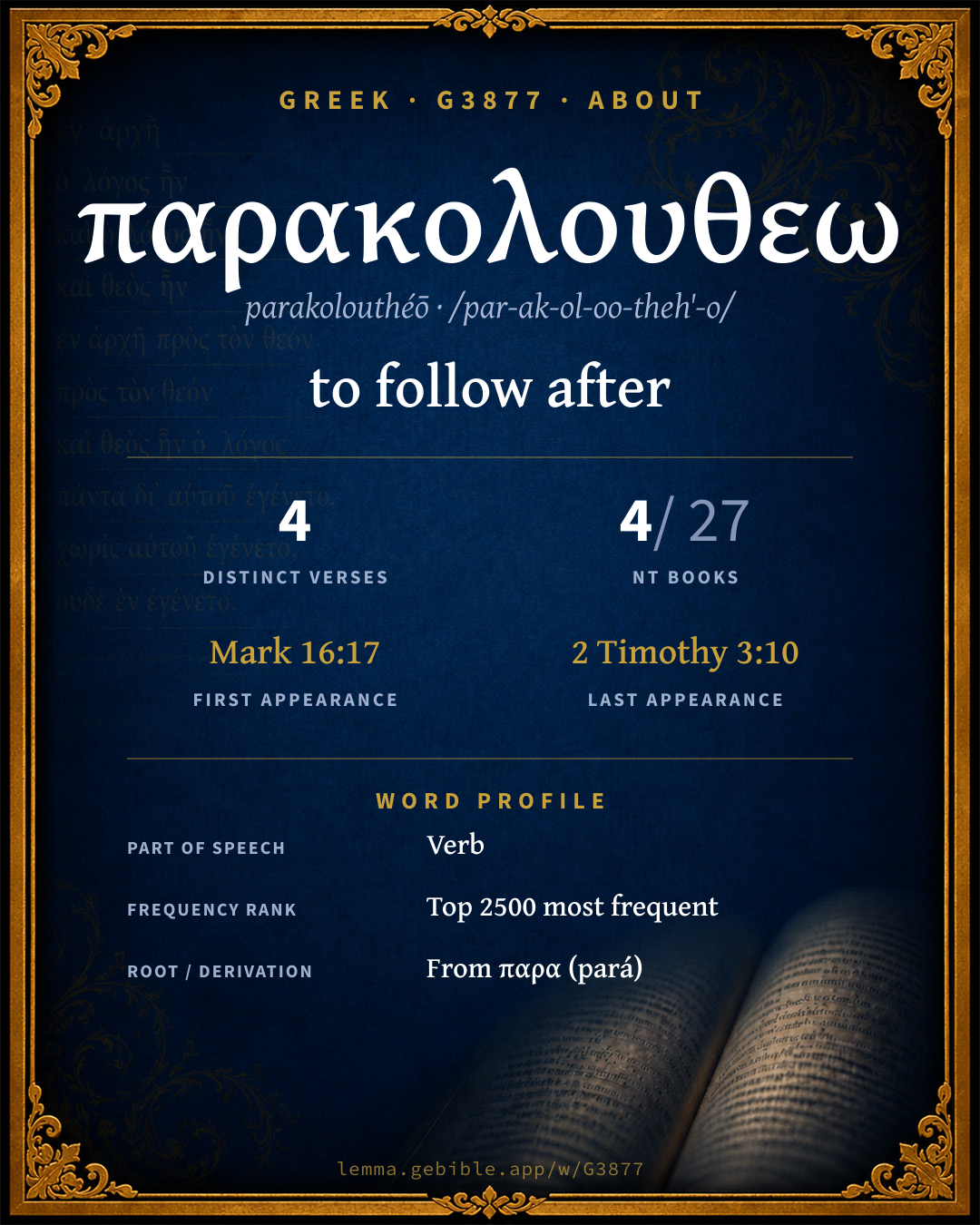
παρακολουθέω
to follow after
‘to follow after’ is one of 3 main senses fuller range ↓
Full lexicon entry — Thayer's Greek Lexicon
From Thayer's Greek Lexicon
Where this word appears
See every Perfect-tense verb in the Greek New Testament →
Grammar key — what these labels mean
Part of speech
- Verb
- An action or state-of-being word.
Tense
- Aorist
- Action viewed as a simple whole, without regard to duration — often past (perfective aspect).
- Future
- Action expected in future time.
- Perfect
- A completed past action with continuing present results.
Voice
- Active
- The subject performs the action.
Mood
- Indicative
- States a fact or asks a factual question (the mood of reality).
- Participle
- A verbal adjective (“writing,” “having written”).
Case
- Dative
- The case of the indirect object, means, or location — “to / for / with / in.”
Person
- 2nd person
- The one addressed (“you”).
- 3rd person
- The one spoken about (“he / she / it / they”).
Gender
- Masculine
- Grammatically masculine.
Number
- Singular
- One.
Grammatical forms
- Verb, Aorist, Active, Indicative, 2nd person, Singular 1 time (25%)
- Verb, Future, Active, Indicative, 3rd person, Singular 1 time (25%)
- Verb, Perfect, Active, Indicative, 2nd person, Singular 1 time (25%)
- Verb, Perfect, Active, Participle, Dative, Singular, Masculine 1 time (25%)
Parsed forms decoded from the imported morphology (Robinson–Tischendorf, public domain), counted across 4 parsed occurrences — not distinct verses.
Every verse where G3877 appears — 4 distinct verses across 4 books. Click any verse to open its interlinear word-by-word view. Verse text shown in the World English Bible for context — . Each verse’s Greek form is shown with its reference; the English is not keyword-highlighted, since the data carries no word-level English alignment. Use “Compare translations” on any verse to read it across multiple English versions. This concordance covers the Greek New Testament; Septuagint (Greek Old Testament) occurrences of this word are not indexed here.
Mark 1 verse
Luke 1 verse
1 Timothy 1 verse
2 Timothy 1 verse
About this entry
At a glance — auto-summarized from this page’s data, not written by a person. Every figure links to its source below. This summary describes the numbers; it doesn’t interpret them.
The Greek verb παρακολουθεω centers on the idea of “to follow after.” The Greek New Testament uses it only 4 verses. Mark dominates its distribution — 1 of 4 verses. Its earliest occurrence is Mark 16:17. Thayer's distinguishes 3 senses for it. Dig into 4-verse concordance and the renderings breakdown below.
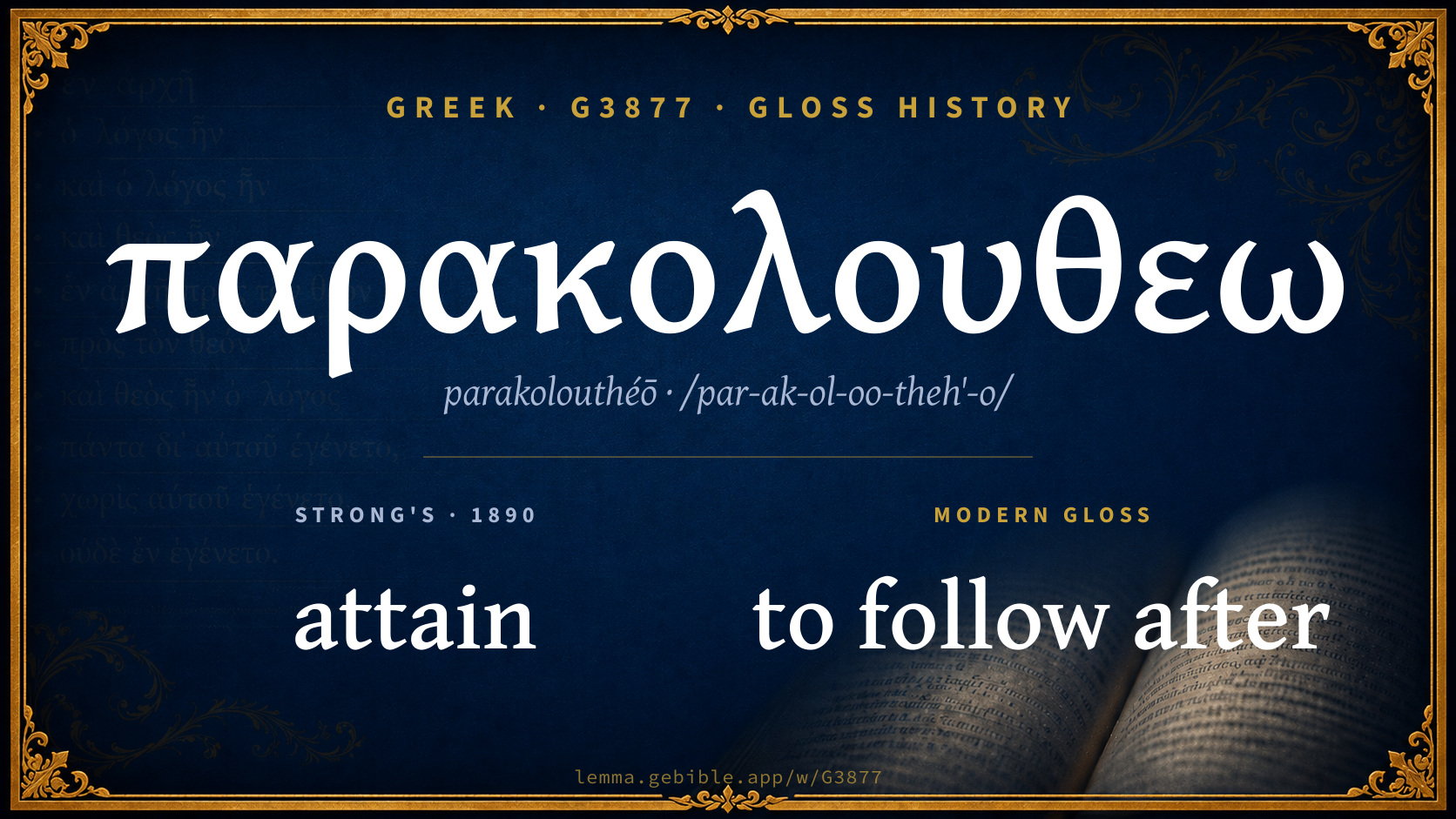
Gloss history
Strong's 1890 vs modern scholarship
About this word
Strong's G3877 catalogs a Greek word from the Greek New Testament.
These counts are not copied from any lexicon or concordance. They are computed here, from the morphology-tagged Greek New Testament. What Lemma adds →
- 4
- distinct verses
- The word appears in 4 distinct verses.
- 4 / 27
- NT books
- The word appears in 4 of 27 New Testament books.
- #1,877
- by frequency
- Top 2500 most frequent Greek words (rank 1,877 of 5,347 Greek words by occurrence).
View all 4 occurrences in the concordance →
By section of the New Testament
By traditional corpus
Conventional, traditional groupings — biblical authorship is debated, so this is a traditional corpus grouping, not an authorship claim. Some books belong to more than one corpus (Luke is in both the Gospels and the Lukan corpus, and so on), so these shares overlap and need not total 100%. Each figure is a share of the word’s 4 distinct verses.
- Gospels 2 verses · 50%
- Pauline corpus 2 verses · 50%
- Lukan (Luke–Acts) 1 verse · 25%
How translations render this word
Counts come from each version’s own published word-to-Strong’s tagging or interlinear alignment — an approximate guide to how each version renders this word, not a word-level alignment the data otherwise carries. Because each total is that version’s own tagged count, the per-version totals vary from one another and need not match the appearance or distinct-verse counts above. These counts may also differ from a printed concordance because Lemma counts each distinctly tagged rendering and does not collapse phrase taggings into a single head-word total. This is a fixed set of word-tagged versions (KJV, ASV, BSB, ULT) and does not change with the reading translation you choose elsewhere. Each version’s license is shown beside its name below (and on Sources).
- King James Version: Hast fully known 1×, Shall follow 1×, Thou hast attained 1×
- American Standard Version: Course 1×, Didst follow 1×, Followed until now 1×
- Berean Standard Bible: Have observed 1×, Therefore having carefully investigated 1×, You have followed 1×
- unfoldingWord Literal Text: Have followed 1×, Having 1×, Investigated 1×
King James Version Public Domain
Renders G3877 across 4 tagged occurrences — most commonly:
American Standard Version Public Domain
Renders G3877 across 5 tagged occurrences — most commonly:
Berean Standard Bible Public Domain
Renders G3877 across 3 tagged occurrences — most commonly:
unfoldingWord Literal Text CC BY-SA 4.0
Renders G3877 across 5 tagged occurrences — most commonly:
Senses in Thayer's
The 3 senses Thayer's distinguishes for this word, in lexicon order (not ranked by frequency or importance). The full entry — with sub-senses — is in the Lexicon Entry tab.
- so to follow one as to be always at his side
- to follow close, accompany
- metaph.
Word origin
Derived from παρα (pará) (G3844) — from.
Forms in the corpus
The 4 distinct written forms G3877 takes in the Greek New Testament, most frequent first — each parse links to that tense’s occurrences in the concordance.
| Form | Parsing | Example | Uses |
|---|---|---|---|
| παρακολουθήσει parakolouthḗsei | Verb, Future, Active, Indicative, 3rd person, Singular | Mark 16:17 | 1 |
| παρηκολουθηκότι parēkolouthēkóti | Verb, Perfect, Active, Participle, Dative, Singular, Masculine | Luke 1:3 | 1 |
| παρηκολούθηκας parēkoloúthēkas | Verb, Perfect, Active, Indicative, 2nd person, Singular | 1 Timothy 4:6 | 1 |
| παρηκολούθησάς parēkoloúthēsás | Verb, Aorist, Active, Indicative, 2nd person, Singular | 2 Timothy 3:10 | 1 |
Same root — word family
Other Thayer's entries built from the same root as G3877, grouped by Strong’s listed origin. These share a root / origin per the lexicon — not necessarily a shared meaning. Each links to that word’s own entry.
Derives from
Shares the same root
- παραβαινω parabaínō G3845 to neglect
- παραβαλλω parabállō G3846 to place beside
- παραβιαζομαι parabiázomai G3849 to compel
- παραβουλευομαι parabouleúomai G3851 to consult wrongly
- παραγγελλω parangéllō G3853 to announce
- παραγινομαι paragínomai G3854 to appear
- παραγω parágō G3855 to pass by
- παραδειγματιζω paradeigmatízō G3856 to make example
- παραδεχομαι paradéchomai G3858 to receive
- παραδιατριβη paradiatribḗ G3859 empty business
- παραδιδωμι paradídōmi G3860 to deliver
- παραδοξος parádoxos G3861 strange
- παραζηλοω parazēlóō G3863 to provoke
- παραθαλασσιος parathalássios G3864 by the sea
- παραθεωρεω paratheōréō G3865 to compare
- παραινεω parainéō G3867 to exhort
- παραιτεομαι paraitéomai G3868 to beg pardon
- παρακαθιζω parakathízō G3869 to sit beside
- παρακαλεω parakaléō G3870 to call beside
- παρακαλυπτω parakalýptō G3871 to cover up
- παρακαταθηκη parakatathḗkē G3872 deposit
- παρακειμαι parákeimai G3873 to lie beside
- παρακουω parakoúō G3878 to disobey
- παρακυπτω parakýptō G3879 to look into
+51 more words share this root (not shown).
Proper names from this root
People and places named from this root — a name, not an additional meaning of the word.
Compare all same-root words → Showing 4 of 78 — not the complete family. 1 of the same-root words is a proper name (a person or place). They share a root, not necessarily a meaning.