Philemon 1:9

Greek (Tischendorf 8th ed.) Philemon 1:9 appears in the Greek New Testament. The text above is from the Tischendorf 8th edition. Each word links to its Strong’s number and a concise gloss. Click any word for its full Thayer’s Greek Lexicon entry.
Download image
Cite this verse

Philemon 1:9 (World English Bible). Public Domain. Lemma interlinear Bible study tool, https://lemma.gebible.app/v/philemon/1/9.

Show BibTeX & RIS
BibTeX
RIS
English Translation
yet for love's sake I rather beg, being such a one as Paul, the aged, but also a prisoner of Jesus Christ.
World English Bible · Public Domain
Download a study sheet

One document with this verse’s original text, its word-by-word gloss line, the meaning frame, cross-references with their text, attributed commentary, and full source and license credits — printable, and it pastes into notes with its structure intact.

This verse Autodidact and up

Study sheet (.html) Plain text (.txt)

A passage Seminary Student

Up to 50 verses in one chapter. A passage sheet keeps up to 6 commentary sources and 12 cross-references per verse, in the order this page ranks them, and says so on the sheet whenever that leaves anything out. Ask for a single verse and you get the Autodidact verse sheet above.

Everything on this page stays free to read, with no account — the sheet is a download of what is already on screen, not access to it.

Want to remove ads? Support Godless Engineer
Compare translations 3

The same verse in 3 English versions, stacked beneath the original-language interlinear above. Click any original word for its lexicon entry.

Each is an independent rendering of the whole verse — the interlinear is not word-aligned to these translations.

Highlighted words mark where these versions differ — a whole-verse word diff, not a word-by-word alignment.

  • World English Bible Public Domain
    yet for love's sake I rather beg, being such a one as Paul, the aged, but also a prisoner of Jesus Christ.
  • King James Version Public Domain
    Yet for love's sake I rather beseech thee, being such an one as Paul the aged, and now also a prisoner of Jesus Christ.
  • unfoldingWord Literal Text CC BY-SA 4.0
    because of love I appeal to you instead—being such a one as Paul, an elder, and now also a prisoner of Christ Jesus.

unfoldingWord Literal Text — © unfoldingWord, licensed CC BY-SA 4.0. Word-aligned USFM3 via Door43 (git.door43.org/unfoldingWord/en_ult).

Versions to compare (up to 4)

3 of 4 selected

Show all 19 translations

Every available English version of this verse, each an independent rendering of the whole verse.

  • World English Bible Public Domain
    yet for love's sake I rather beg, being such a one as Paul, the aged, but also a prisoner of Jesus Christ.
  • Berean Standard Bible Public Domain
    I prefer to appeal on the basis of love. For I, Paul, am now aged, and a prisoner of Christ Jesus as well.
  • Majority Standard Bible Public Domain
    I prefer to appeal on the basis of love. For I, Paul, am now aged, and a prisoner of Jesus Christ as well.
  • King James Version Public Domain
    Yet for love's sake I rather beseech thee, being such an one as Paul the aged, and now also a prisoner of Jesus Christ.
  • American Standard Version (1901) Public Domain
    yet for love's sake I rather beseech, being such a one as Paul the aged, and now a prisoner also of Christ Jesus:
  • Revised Version (1885) Public Domain
    yet for love’s sake I rather beseech, being such a one as Paul the aged, and now a prisoner also of Christ Jesus:
  • Geneva Bible (1599) Public Domain
    Yet for loues sake I rather beseeche thee, though I be as I am, euen Paul aged, and euen nowe a prisoner for Iesus Christ.
  • Douay-Rheims (1899) Public Domain
    For charity sake I rather beseech, whereas thou art such a one, as Paul an old man, and now a prisoner also of Jesus Christ.
  • Young's Literal Translation Public Domain
    because of the love I rather entreat, being such an one as Paul the aged, and now also a prisoner of Jesus Christ;
  • Literal Standard Version CC BY-SA 4.0
    because of the love I rather plead, being such a one as Paul the aged, and now also a prisoner of Jesus Christ;
  • Unlocked Literal Bible CC BY-SA 4.0
    yet because of love, I appeal to you instead—I, Paul, an old man, and now a prisoner for Christ Jesus.
  • unfoldingWord Literal Text CC BY-SA 4.0
    because of love I appeal to you instead—being such a one as Paul, an elder, and now also a prisoner of Christ Jesus.
  • Darby Bible Public Domain
    for love's sake I rather exhort, being such a one as Paul the aged, and now also prisoner of Jesus Christ.
  • World Messianic Bible Public Domain
    yet for love’s sake I rather appeal to you, being such a one as Paul, the aged, but also a prisoner of Yeshua the Messiah.
  • Webster's Bible Public Domain
    Yet for love's sake I rather beseech thee, being such one as Paul the aged, and now also a prisoner of Jesus Christ.
  • Free Bible Version CC BY-SA 4.0
    I would rather ask you this favor out of love. Old Paul, now also a prisoner of Christ Jesus,
  • Bible in Basic English Public Domain
    Still, because of love, in place of an order, I make a request to you, I, Paul, an old man and now a prisoner of Christ Jesus:
  • Text-Critical English NT CC BY 4.0
    I would rather appeal to yoʋ on the basis of love. I, Paul, an old man and now a prisoner for Jesus Christ,
  • Tyndale New Testament (1534) Public Domain
    yet for loves sake I rather beseche the though I be as I am even Paul aged and now in bondes for Iesu Christes sake.

Literal Standard Version (2020), Covenant Press — licensed CC BY-SA 4.0. Text via the HelloAO Bible API (eBible.org). Unlocked Literal Bible (unfoldingWord) — licensed CC BY-SA 4.0. Text via the HelloAO Bible API (eBible.org). unfoldingWord Literal Text — © unfoldingWord, licensed CC BY-SA 4.0. Word-aligned USFM3 via Door43 (git.door43.org/unfoldingWord/en_ult). Free Bible Version, Dr. Jonathan Gallagher — licensed CC BY-SA 4.0. Text via the HelloAO Bible API (eBible.org).

Word by word

More ways to search: Search by grammar → Find every occurrence → Compare this word →

Practice this passage: Drill this verse → Learn its vocabulary →

πρεσβύτης
presbýtēs
G4246
“old man”
Noun, Nominative, Singular, Masculine
Part of Speech
Noun
Case
Nominative
Number
Singular
Gender
Masculine
Full Thayer's Definition

Origin: from the same as G4245

TDNT: 17:23,9

1. an old man, an aged man 2. ambassador
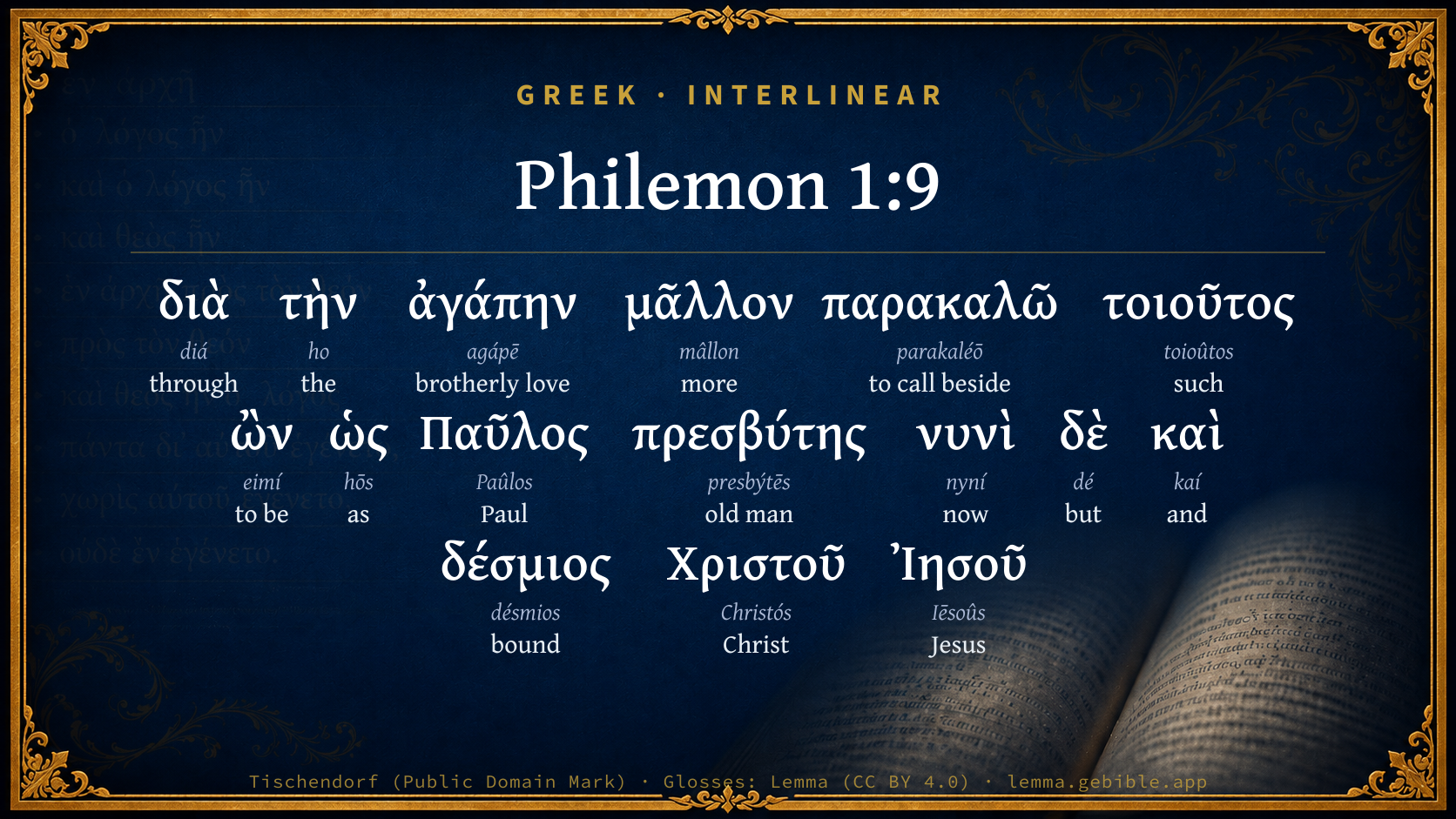
  1. διὰ diá G1223 “through” Preposition
  2. τὴν ho G3588 “the” Article, Accusative, Singular, Feminine
  3. ἀγάπην agápē G26 “brotherly love” Noun, Accusative, Singular, Feminine
  4. μᾶλλον mâllon G3123 “more” Adverb
  5. παρακαλῶ parakaléō G3870 “to call beside” Verb, Present, Active, Indicative, 1st person, Singular
  6. τοιοῦτος toioûtos G5108 “such” Demonstrative pronoun, Nominative, Singular, Masculine
  7. ὢν eimí G1510 “to be” Verb, Present, Active, Participle, Nominative, Singular, Masculine
  8. ὡς hōs G5613 “as” Adverb
  9. Παῦλος Paûlos G3972 “Paul” Noun, Nominative, Singular, Masculine
  10. νυνὶ nyní G3570 “now” Adverb
  11. δὲ dé G1161 “but” Conjunction
  12. καὶ kaí G2532 “and” Conjunction
  13. δέσμιος désmios G1198 “bound” Noun, Nominative, Singular, Masculine
  14. Χριστοῦ Christós G5547 “Christ” Noun, Genitive, Singular, Masculine
  15. Ἰησοῦ Iēsoûs G2424 “Jesus” Noun, Genitive, Singular, Masculine

About this verse

These counts appear in no published source. They are computed here, from the morphology-tagged text and Lemma’s own curated glosses. What Lemma adds →

16
words
16
distinct lemmas
Pauline Epistles
section

Notable vocabulary

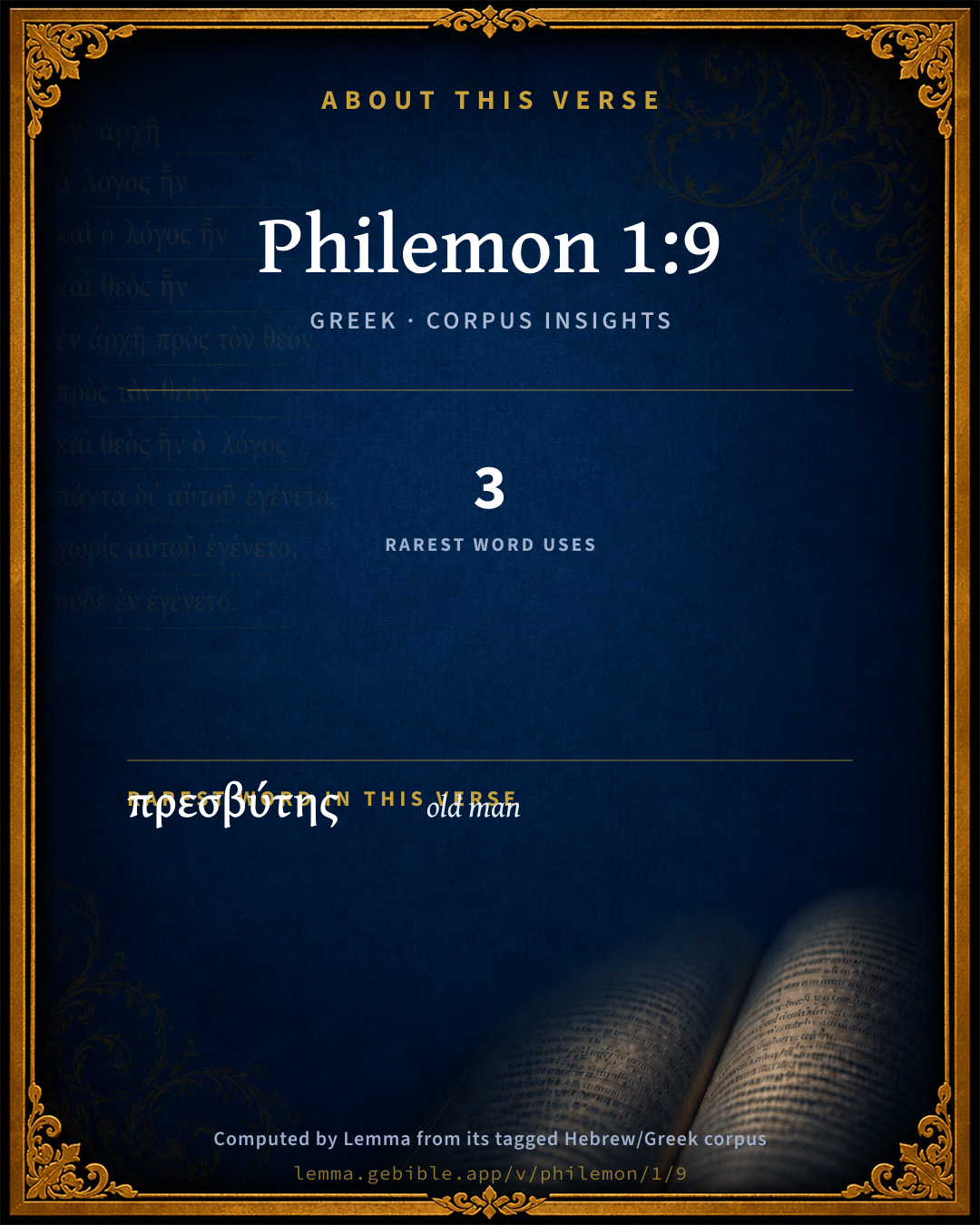
The rarest word here is πρεσβύτης old man G4246 — appearing just 3 times in the whole Greek New Testament.

Shared distinctive vocabulary

πρεσβύτης old man G4246 occurs in 3 verses of the Greek New Testament. Also found in:

Cross-references

12

Topical passages linked to Philemon 1:9 in the Treasury of Scripture Knowledge — connected by theme and wording, ordered by reader-vote popularity; previews shown in the World English Bible.

  • Romans 12:1 Therefore I urge you, brothers, by the mercies of God, to present your bodies a living sacrifice, holy, acceptable to God, which is your spiritual service.
  • 2 Corinthians 5:20 We are therefore ambassadors on behalf of Christ, as though God were entreating by us. We beg you on behalf of Christ, be reconciled to God.
  • Ephesians 4:1 I therefore, the prisoner in the Lord, beg you to walk worthily of the calling with which you were called,
  • Ephesians 3:1 For this cause I, Paul, am the prisoner of Christ Jesus on behalf of you Gentiles,
  • Philemon 1:1–25 Paul, a prisoner of Christ Jesus, and Timothy our brother, to Philemon, our beloved fellow worker,
  • Psalms 71:9 Don't reject me in my old age. Don't forsake me when my strength fails.
  • Psalms 71:18 Yes, even when I am old and gray-haired, God, don't forsake me, Until I have declared your strength to the next generation, Your might to everyone who is to come.
  • Proverbs 16:31 Gray hair is a crown of glory. It is attained by a life of righteousness.
  • Isaiah 46:4 and even to old age I am he, and even to gray hairs will I carry you. I have made, and I will bear; yes, I will carry, and will deliver.
  • 2 Corinthians 6:1 Working together, we entreat also that you not receive the grace of God in vain,
  • Hebrews 13:19 I strongly urge you to do this, that I may be restored to you sooner.
  • 1 Peter 2:11 Beloved, I beg you as foreigners and pilgrims, to abstain from fleshly lusts, which war against the soul;

Cross-references courtesy of OpenBible.info (CC BY 4.0).

Commentary

Notes on Philemon 1:9 from classic Christian and Jewish commentators (each source and its license shown beneath its notes). The classic Christian expositions comment on the surrounding passage and are grouped to its opening verse, so a note may address several verses; the Jewish commentaries on the Tanakh (Rashi and others) are per-verse, so they appear only where the commentator wrote on this verse.

Lemma curates 59 commentaries, every one of them public domain or Creative Commons licensed, each selected and text-cleaned for this edition rather than reprinted as found. About our sources →

The Biblical Illustrator

Joseph S. Exell

Phm_1:9

Yet for loves sake I rather beseech thee

A beautiful specimen of Christian humility and genuine pathos

I might be bold to command thee in Christs name, by which I am strong; but thou dost not need any argument derived from my strength: and for loves sake I rather beseech thee by my own weakness, by my years, and by my chains.

Such language--the language of entreaty--best befits me now in my prison and in my old age. (Bp. Chris. Wordsworth.)

The entreaty of love

Love naturally beseeches, and does not command. The harsh voice of command is simply the imposition of anothers will, and it belongs to relationships in which the heart has no share. But wherever love is the bond, grace is poured into the lips, and I order becomes I pray. So that even where the outward form of authority is still kept, as in a parent to young children, there will ever be some endearing word to swathe the harsh imperative in tenderness, like a sword blade wrapped about with wool, lest it should wound. Love tends to obliterate the hard distinction of superior and inferior, which finds its expression in laconic orders and silent obedience. It seeks not for mere compliance with commands, but for oneness of will. Its entreaties are more powerful than imperatives. The lightest wish breathed by loved lips is stronger than all stern injunctions--often, alas I than all laws of duty. The heart is so tuned as only to vibrate to that one tone. The rocking stones, which all the storms of winter may howl round and not move, can be set swinging by a light touch. Una leads the lion in a silken leash. Love controls the wildest nature. Authority is the weapon of a weak man, who is afraid of his own power to get himself obeyed; or of a selfish one, who seeks for mechanical submission rather than for the fealty of willing hearts. Love is the weapon of a strong man, who can cast aside the trappings of superiority, and is never loftier than when he descends, nor more absolute than when he abjures authority and appeals with love to love. (A. Maclaren, D. D.)

Gentle means of persuading men to be used rather than severe

I. Reasons.

1. We are bound to use those means and to take that course which is most forcible and effectual. But to deal with love, and to handle our brethren kindly and meekly, is most likely to prevail with most men. Therefore the apostle requireth that the Servant of God must not strive, but must be gentle toward all men, apt to teach, suffering the evil, instructing them with meekness that are contrary minded. There is no way so available to bring evil men out of the dangers wherein they stand, who are, as it were, made bondslaves to do the devils will, than to allure them by gentleness, to draw them by long suffering, and to overcome them by patience.

2. This course, well and duly observed, serveth to persuade them with whom we deal of our love and tender affection towards them. For loving and friendly dealing argueth loving and affectionate minds, and the ready way to bend and incline him unto that which is good, and to turn him from that which is evil, when his persuasions are perceived to tend to the profit and benefit of him whom we would persuade.

3. We are to imitate our Head and Master, Christ Jesus; He used not His authority and power that was in Him; He dealt not roughly and severely with His enemies, but meekly and mercifully, and most compassionately; lie was meek, and as a lamb before the shearer.

II. Uses.

1. We learn that mercy and compassion--yea, all tokens and testimonies of love--are to he showed toward malefactors, even when justice is to be executed and punishment inflicted.

2. Seeing we are to win men rather by gentleness and love, we must acknowledge that great wisdom and discretion is required in the ministry, to divide the Word of God aright, and to be able to apply himself to every degree and calling of men. When the people of God went out to war, the Lord commanded them to offer conditions of peace to that city; if it refuse to make peace, they should besiege it, smite it, and destroy it. So should we, when we execute our office, first offer peace before we proclaim war; first allure by gentleness before we thunder out judgments; first exhort before we threaten. In the material building, all the stones that are to be fitted to the building are not of one nature; some are soft and easy to be fitted and hammered; others more hard and of a flintier marble disposition--they require sharp tools, strong blows, before they can be brought into form, or be squared for that place which they are to hold. So it is with the lively stones of the spiritual temple of God: some have soft hearts of flesh, and are of humble and contrite spirits, like the bruised reed or the smoking flax; others have hearts hard as the adamant, and cannot easily be brought to feel the strokes of the Word of God. These are not to be dealt withal and handled alike, but after a divers manner. This is the counsel of the apostle Jude, Have compassion of some in putting difference, and others save with fear, pulling them out of the fire, and hate even that garment which is spotted by the flesh. This serveth to reprove, first, such as use unseasonable lenity when godly severity is required. Some diseases require sharp medicines. Secondly, it reproveth such as are too sharp and vigorous against offenders, and forget all rules of charity toward them. True it is, the pastors and ministers are to rebuke such as are fallen; but when they see sorrow for sin, and repentance from dead works wrought in them, they should begin to raise them up again and comfort them with the precious promises of the gospel, lest they should be overwhelmed with despair and he swallowed up with over-much heaviness.

3. And, last of all, we learn for our obedience, that whensoever entreating, gentle, or loving dealing is used to call men home to God and to themselves, it is their duty to yield themselves and to embrace earnestly the mercies of God offered unto them. The sin of contempt and contumacy is fearful, when the bountifulness of God is despised, His mercies loathed, His patience and long suffering abused. If we will not hear when He crieth to us, we shall cry also in the days of our misery, and He will not hear us in our trouble, but mock at our affliction. (W. Attersoll.)

Love more effective than severity

One winter morning, as the Wind set out on his days work, he found the trees loaded with ice. Every tiny twig was bending under an armour many times its weight. The little white lady birches had drooped until their heads touched the ground. A great groan to be delivered went up from all the trees. This will never do! cried the Wind; and straightway he went to work with all his might. The branches of the giant elms swung and creaked. The brown, curled leaves still clinging to the oaks were snatched away and went whirling through the air. There was a great rustling in all the wood. But the ice did not move. Still harder the wind blew. And now whole branches came crashing down, until they lay thick on the ground in their glittering winding sheets. But still the ice did not move. At last the Spirit of the Woods came forth, frowning. Do you call this helping? cried she. You are ruining my trees. To get rid of the ice, forsooth, you are breaking off the boughs. Get you gone! The Wind retired to his cave, and was melancholy all day. He had had a sincere desire to do good, but now he saw that he had only done harm. He shuddered as he thought of the wrecks he had made in his untempered zeal. What is the use of nay trying to do anything? he sighed. Many an eager soul has known such hours, when it had thought to add its note of praise to the great chorus, and has only succeeded in making a discord. The next morning the Sun knocked at the door of the cave, and cried, in genial tones, Come on, friend! I want your help. The trees must be rid of their load. I will shine on them, and then do you gently wave their branches and shake off the loosened ice. They went forth together, and the Sun shone on the forest. An hour passed. The only visible result was here and there a drop of water from the icy boughs. We shall never get through at this rate! panted the Wind. Gently, friend, gently! All in good time! replied the Sun. The ice was a day and a night in forming. Could you hope to get rid of it by one fierce gust? When I get higher in the sky, I can strike the trees more directly with my beams. After another hour of silent shining, the Sun whispered, Now, friend, with your wings! But not too violently. See, now, some pieces are falling. Two or three hours of work like this, and our task is done. There is another piece loose. So the Sun shone on, and the wind from time to time shook down the loosened pieces of ice, and what did not rattle down dissolved in fast-flowing tears under the gentle yet burning eye of the Sun. The birches gradually lifted their pliant forms. The Spirit of the Woods came out with her blessing for the two workers. And that night the Wind returned to his cave humbled but joyous, because he had found the more excellent way.

Paul the aged--

The aged Christian

We have--

I. In Pauls circumstances the occupations of the aged Christian.

1. He preaches and teaches.

2. He is full of care for distant Churches.

3. He is tenderly interested in individuals near him.

II. In Pauls recollections the memories of the aged Christian.

1. Trials.

2. Labours.

3. Graces.

III. In Pauls anticipations the hopes of the aged Christian.

1. Hope of renewed service on earth.

2. Hope of the victory of the truth on earth.

3. Hope of blessedness in heaven. (U. R. Thomas.)

Paul the aged

We are accustomed to think of Paul the persecutor, the Christian, the missionary, the apostle, the inspired scribe, the sufferer for Christ. Here another and unexpected epithet pictures him to us as Paul the aged. The word is from his own pen. Perhaps now he is learning for the first time that his days of mature vigour are past. Manifold labours, perils, trials, have broken him in premature age.

I. Paul wears old age as a crown (see Pro_16:31). There is a pleasant story told of Frederick the Great. At a parade of the guard in the Kings apartments at Berlin, Fredericks quick eye picked out among the splendid crowd the brave old Ziethen, who, though turned eighty-five years, had come to pay his duty to his monarch. Greeting the veteran with a cry of joy, the King called for a chair. Objections were in vain. Sit down, good father, said the King. I will have it so, or I must instantly leave the room. The old soldier yielded, and Frederick the Great continued standing before him, the centre of the illustrious circle that had gathered around, and so honoured the face of the old man. The aged Christian has his peculiar infirmities, but he also has his peculiar joys. To the aged saint come the fullest revelations of God, the most comfortable words of Christ, the sweetest visitations of the Spirit.

II. Pauls old age had its duties and labours. He does not excuse himself from duty on the ground of age. He will do what he can for Onesimus. He writes for him with a delicacy, a tact, a tenderness, an urgency, such as he himself never surpassed. The aged Christian is still a unit in the host of society, still kindred to some and neighbour and friend to others. And still, however much may be lost, duty remains--duty to himself, to others, and in all to God. Life is lengthened that it may labour for Christ. And is not the old the best workman? The young may attract more attention, but it is the experienced hand that does the most and best.

III. Paul used his age as a plea of love. Where we may command, it is wise to request. Love wins love. Gentleness calls out gentleness.

IV. Paul is Paul the aged no more. He has escaped, through death, from all earthly prisons, and is op pressed by old age no longer. He is with Christ, which is far better. (G. T. Coster.)

Reverence due to old age

Old men are to be reverenced--

1. For their very age, because they draw nearest to the Ancient of Days (Lev_19:32).

2. For their wisdom.

3. For their experience.

4. For their piety (Pro_16:31). (W. Jones, D. D.)

The aged minister

I. Review his past history.

1. His character; and how, during this long period, he has conducted himself: what reputation he has spent so many years in building up, and in what estimate he is now held when grey hairs are upon him.

2. His labours. True, his toils are chiefly mental; but who knows not that, on this account, they are the more exhausting and wearing?

3. His usefulness. How many have been impressed by his example, enriched by his beneficence, blessed by his prayers, and instructed by his principles.

4. His trials. Ah, you know a ministers joys far better than you know his sorrows. You see his sails, but not his ballast. You follow him in his public walks of labour, but not in his Gethsemane retreat, where he goes to pray and agonise alone. He calls you to share his felicities, but he carries his perplexities and his griefs to his closet and his God. Look, then, at the hoary man over whom the clouds of fifty years have rolled. How many storms have burst upon that aged tree, tearing off its branches, stripping off its leaves, and dismantling it in some cases, till little else but the mere trunk and a few boughs remain of all that once umbrageous top. Still, however, the venerable trunk does remain, and there is life in it to the last. How much of Divine power and faithfulness and grace we associate with that sacred antique.

5. His temptations. A minister is the chief mark for Satans arrows.

II. Estimate his present claims.

1. He is entitled, if a holy and faithful man, and in proportion to his sanctity and fidelity, to respect and veneration.

2. He is entitled to affection. It is not claimed for what he is in himself, but what he is to his people as their friend and counsellor; in fact, the instrument of their salvation and the promoter of their progressive sanctification.

3. He has a right to expect gratitude.

4. I next mention candour and forbearance as virtues which an aged minister is entitled to expect, and of which, in some cases, by the gathering infirmities of declining years, he will stand in need.

5. And has he not a claim upon your attendance upon his ministry? To desert him when he is old is a poor reward for the more effective services of younger and stronger days.

III. Anticipate his future destiny. Growth, decline, and death, are the law of all life on earth, from which there is no exemption on behalf of the minister of the gospel. The weary, worn out labourer goes to his rest and to his reward; goes to be associated with those who were his hope and joy on earth, and now are to be his crown of rejoicing in the presence of Christ; goes to meet his Maker, and hear Him say, Well done, good and faithful servant; enter thou into the joy of the Lord. (J. A. James.)

A review of life and a glimpse of glory

This language--

1. Supposes childhood and the scenes of life already past.

2. Suggests a review of the events of individual life.

3. Reminds us of the infirmities which years witness.

4. Shows Paul to us as an old disciple--not only a man, but a new man, a man in Christ.

5. Contains a touching plea.

6. Suggests that the aged Christian has nearly finished his course. (J. S. Pearsall.)

The standard of age

He was, perhaps, sixty, perhaps a few years more. Labour, sorrow, the storms of ocean and the fires of thought, possible sickliness--the sad and solemn maturity which is the portion upon earth of men who believe intensely--had done their work. Roger Bacon wrote me senem at fifty-two or fifty-three, and Sir Walter Scott at fifty-five calls himself sadly an old grey man and aged. In truth, the standard by which old age is measured is pretty much subjective. At an age about fifteen years earlier than that of St. Paul at this time, Chateaubriand writes, Deja je nappartenais plus a ces matins qui se consolent eux-memes--je touchais a ces heures du soir qui ont besoin detre consolees. A different periods of life we adopt a different standard. It was said by Victor Hugo that forty is the old age of youth, and fifty the youth of old age. (Bp. Wm. Alexander.)

Anxieties tell on age

Such a multitude of anxieties and endurances as are recounted in 2Co_11:23-30 must have told upon him and exhausted his manly vigour. (M. F. Sadler, M. A.)

Christian old age

No more beautiful picture of the bright energy and freshness still possible to the old was ever painted than may be gathered from the apostles unconscious sketch of himself. He delighted in having fresh young life about him--Timothy, Titus, Mark, and others--boys in comparison with himself, whom yet he admitted to close intimacy, as some old general might the youths of his staff, warming his old age at the genial flame of their growing energies and unworn hopes. His was a joyful old age, too, notwithstanding many burdens of anxiety and sorrow. We hear the clear song of his gladness ringing through the epistle of joy--that to the Philippians--which, like this, dates from his Roman captivity. A Christian old age should be joyful, and it only will be; for the joys of the natural life burn low when the fuel that fed them is nearly exhausted, and withered hands ave held in vain over the dying embers. But Christs joy remains, and a Christian old age maybe like the polar midsummer days, when the sun shines till midnight, and dips but for an imperceptible interval ere it rises for the unending day of heaven. Paul the aged was full of interest in the things of the day--no mere praiser of time none by, but a strenuous worker, cherishing a quick sympathy and an eager interest, which kept him young to the end. And over his cheery, sympathetic, busy old age there is thrown the light of a great hope, which kindles desire and onward looks in his dim eyes, and parts such a one as Paul the aged by a whole universe from the old whose future is dark and their past dreary, whose hope is a phantom and their memory a pang. (A. Maclaren, D. D.)

Now also a prisoner of Jesus Christ--

Duty enforced by personal consideration

He holds up his fettered wrist, and in effect says, Surely you will not refuse anything that you can do to wrap a silken softness round the cold, hard iron, especially when you remember for whose sake and by whose will I am bound with this chain. He thus brings personal motives to reinforce duty which is binding from other and higher considerations. Christ does thus with His servants. He does not simply hold up before us a cold law of duty, but warms it by introducing our personal relation to Him as the main motive for keeping it. Apart from Him, morality can only point to the tables of stone and say, There! that is what you ought to do. Do it, or face the consequences. But Christ says, I have given Myself for you. My will is your law. Will you do it for My sake? Instead of the chilling, statuesque ideal, as pure as marble and as cold, a Brother stands before us with a heart that beats, a smile on His face, a hand outstretched to help; and His word is, If ye love Me, keep My commandments. (A. Maclaren, D. D.)

The Biblical Illustrator, edited by Joseph S. Exell (c. 1880s–1900s) — public domain. Text from a community e-Sword module.

MacLaren's Expositions of Holy Scripture

Alexander MacLaren

Acts

THE YOUNG SAUL AND THE AGED PAUL 1

Act 7:58. - Phm 1:9.

A far greater difference than that which was measured by years separated the young Saul from the aged Paul. By years, indeed, the difference was, perhaps, not so great as the words might suggest, for Jewish usage extended the term of youth farther than we do, and began age sooner. No doubt, too, Paul’s life had aged him fast, and probably there were not thirty years between the two periods. But the difference between him and himself at the beginning and the end of his career was a gulf; and his life was not evolution, but revolution.

At the beginning you see a brilliant young Pharisee, Gamaliel’s promising pupil, advanced above many who were his equals in his own religion, as he says himself; living after its straitest sect, and eager to have the smallest part in what seemed to him the righteous slaying of one of the followers of the blaspheming Nazarene. At the end he was himself one of these followers. He had cast off, as folly, the wisdom which took him so much pains to acquire. He had turned his back upon all the brilliant prospects of distinction which were opening to him. He had broken with countrymen and kindred. And what had he made of it? He had been persecuted, hunted, assailed by every weapon that his old companions could fashion or wield; he is a solitary man, laden with many cares, and accustomed to look perils and death in the face; he is a prisoner, and in a year or two more he will be a martyr. If he were an apostate and a renegade, it was not for what he could get by it.

What made the change? The vision of Jesus Christ. If we think of the transformation on Saul, its causes and its outcome, we shall get lessons which I would fain press upon your hearts now. Do you wonder that I would urge on you just such a life as that of this man as your highest good?

I. I would note, then, first, that faith in Jesus Christ will transform and ennoble any life.

It has been customary of late years, amongst people who do not like miracles, and do not believe in sudden changes of character, to allege that Paul’s conversion was but the appearance, on the surface, of an underground process that had been going on ever since he kept the witnesses’ clothes. Modern critics know a great deal more about the history of Paul’s conversion than Paul did. For to him there was no consciousness of undermining, but the change was instantaneous. He left Jerusalem a bitter persecutor, exceeding mad against the followers of the Nazarene, thinking that Jesus was a blasphemer and an impostor, and His disciples pestilent vermin, to be harried off the face of the earth. He entered Damascus a lowly disciple of that Christ. His conversion was not an underground process that had been silently sapping the foundations of his life; it was an explosion. And what caused it? What was it that came on that day on the Damascus road, amid the blinding sunshine of an Eastern noontide? The vision of Jesus Christ. An overwhelming conviction flooded his soul that He whom he had taken to be an impostor, richly deserving the Cross that He endured, was living in glory, and was revealing Himself to Saul then and there. That truth crumbled his whole past into nothing; and he stood there trembling and astonished, like a man the ruins of whose house have fallen about his ears. He bowed himself to the vision. He surrendered at discretion without a struggle. ‘Immediately,’ says he, ‘I was not disobedient to the heavenly vision,’ and when he said ‘Lord, Lord, what wilt Thou have me to do?’ he flung open the gates of the fortress for the Conqueror to come in. The vision of Christ reversed his judgments, transformed his character, revolutionised his life.

That initial impulse operated through all the rest of his career. Hearken to him: ‘I live, yet not I, but Christ liveth in me. To me to live is Christ. Whether we live, we live unto the Lord; or whether we die, we die unto the Lord. Living or dying, we are the Lord’s.’ ‘We labour that whether present or absent, we may be accepted of Him.’ The transforming agency was the vision of Christ, and the bowing of the man’s whole nature before the seen Saviour.

Need I recall to you how noble a life issued from that fountain? I am sure that I need do no more than mention in a word or two the wondrous activity, flashing like a flame of fire from East to West, and everywhere kindling answering flames, the noble self-oblivion, the continual communion with God and the Unseen, and all the other great virtues and nobleness which came from such sources as these. I need only, I am sure, remind you of them, and draw this lesson, that the secret of a transforming and noble life is to be found in faith in Jesus Christ. The vision that changed Paul is as available for you and me. For it is all a mistake to suppose that the essence of it is the miraculous appearance that flashed upon the Apostle’s eyes. He speaks of it himself, in one of his letters, in other language, when he says, ‘It pleased God to reveal His Son in me.’ And that revelation in all its fulness, in all its sweetness, in all its transforming and ennobling power, is offered to every one of us. For the eye of faith is no less gifted with the power of direct and certain vision-yea! is even more gifted with this-than is the eye of sense. ‘If they hear not Moses and the prophets, neither will they be persuaded though one rose from the dead.’ Christ is revealed to each one of us as really, as veritably, and the revelation may become as strong an impulse and motive in our lives as ever it was to the Apostle on the Damascus road. What is wanted is not revelation, but the bowed will-not the heavenly vision, but obedience to the vision. I suppose that most of you think that you believe all that about Jesus Christ, which transformed Gamaliel’s pupil into Christ’s disciple. And what has it done for you? In many cases, nothing. Be sure of this, dear young friends, that the shortest way to a life adorned with all grace, with all nobility, fragrant with all goodness, and permanent as that life which does the will of God must clearly be, is this, to bow before the seen Christ, seen in His word, and speaking to your hearts, and to take His yoke and carry His burden. Then you will build upon what will stand, and make your days noble and your lives stable. If you build on anything else, the structure will come down with a crash some day, and bury you in its ruins. Surely it is better to learn the worthlessness of a non-Christian life, in the light of His merciful face, when there is yet time to change our course, than to see it by the fierce light of the great White Throne set for judgment. We must each of us learn it here or there.

II. Faith in Christ will make a joyful life, whatever its circumstances.

I have said that, judged by the standard of the Exchange, or by any of the standards which men usually apply to success in life, this life of the Apostle was a failure. We know, without my dwelling more largely upon it, what he gave up. We know what, to outward appearance, he gained by his Christianity. You remember, perhaps, how he himself speaks about the external aspects of his life in one place, where he says ‘Even unto this present hour we both hunger and thirst, and are naked, and are buffeted, and have no certain dwelling-place, and labour, working with our own hands. Being reviled, we bless; being persecuted, we suffer it; being defamed, we entreat. We are made as the filth of the world, and as the offscouring of all things unto this day.’

That was one side of it. Was that all? This man had that within him which enabled him to triumph over all trials. There is nothing more remarkable about him than the undaunted courage, the unimpaired elasticity of spirit, the buoyancy of gladness, which bore him high upon the waves of the troubled sea in which he had to swim. If ever there was a man that had a bright light burning within him, in the deepest darkness, it was that little weather-beaten Jew, whose ‘bodily presence was weak, and his speech contemptible.’ And what was it that made him master of circumstances, and enabled him to keep sunshine in his heart when winter bound all the world around him? What made this bird sing in a darkened cage? One thing-the continual presence, consciously with Him by faith, of that Christ who had revolutionised his life, and who continued to bless and to gladden it. I have quoted his description of his external condition. Let me quote two or three words that indicate how he took all that sea of troubles and of sorrows that poured its waves and its billows over him. ‘In all these things we are more than conquerors through Him that loved us.’ ‘As the sufferings of Christ abound in us, so our consolation aboundeth also by Christ.’ ‘For which cause we faint not, but though our outward man perish, yet our inward man is renewed day by day.’ ‘Most gladly therefore will I rather glory in my infirmities, that the power of Christ may rest upon me.’ ‘I have learned in whatsoever state I am therewith to be content.’ ‘As sorrowful, yet always rejoicing; as poor, yet making many rich; as having nothing, yet possessing all things.’

There is the secret of blessedness, my friends; there is the fountain of perpetual joy. Cling to Christ, set His will on the throne of your hearts, give the reins of your life and of your character into His keeping, and nothing ‘that is at enmity with joy’ can either ‘abolish or destroy’ the calm blessedness of your spirits.

You will have much to suffer; you will have something to give up. Your life may look, to men whose tastes have been vulgarised by the glaring brightnesses of this vulgar world, but grey and sombre, but it will have in it the calm abiding blessedness which is more than joy, and is diviner and more precious than the tumultuous transports of gratified sense or successful ambition. Christ is peace, and He gives His peace to us; and then He gives a joy which does not break but enhances peace. We are all tempted to look for our gladness in creatures, each of which satisfies but a part of our desire. But no man can be truly blessed who has to find many contributories to make up his blessedness. That which makes us rich must be, not a multitude of precious stones, howsoever precious they may be, but one Pearl of great price; the one Christ who is our only joy. And He says to us that He gives us Himself, if we behold Him and bow to Him, that His joy might remain in us, and that our joy might be full, while all other gladnesses are partial and transitory. Faith in Christ makes life blessed. The writer of Ecclesiastes asked the question which the world has been asking ever since: ‘Who knoweth what is good for a man in this life, all the days of this vain life which he passeth as a shadow?’ You young people are asking, ‘Who will show us any good?’ Here is the answer-Faith in Christ and obedience to Him; that is the good part which no man taketh from us. Dear young friend, have you made it yours?

III. Faith in Christ produces a life which bears being looked back upon.

In a later Epistle than that from which my second text is taken, we get one of the most lovely pictures that was ever drawn, albeit it is unconsciously drawn, of a calm old age, very near the gate of death; and looking back with a quiet heart over all the path of life. I am not going to preach to you, dear friends, in the flush of your early youth, a gospel which is only to be recommended because it is good to die by, but it will do even you, at the beginning, no harm to realise for a moment that the end will come, and that retrospect will take the place in your lives which hope and anticipation fill now. And I ask you what you expect to feel and say then?

What did Paul say? ‘I have fought the good fight, I have finished my course, I have kept the faith: henceforth there is laid up for me a crown of righteousness.’ He was not self-righteous; but it is possible to have lived a life which, as the world begins to fade, vindicates itself as having been absolutely right in its main trend, and to feel that the dawning light of Eternity confirms the choice that we made. And I pray you to ask yourselves, ‘Is my life of that sort?’ How much of it would bear the scrutiny which will have to come, and which in Paul’s case was so quiet and calm? He had had a stormy day, many a thundercloud had darkened the sky, many a tempest had swept across the plain; but now, as the evening draws on, the whole West is filled with a calm amber light, and all across the plain, right away to the grey East, he sees that he has been led by, and has been willing to walk in, the right way to the ‘City of habitation.’ Would that be your experience if the last moment came now?

There will be, for the best of us, much sense of failure and shortcoming when we look back on our lives. But whilst some of us will have to say, ‘I have played the fool and erred exceedingly,’ it is possible for each of us to lay himself down in peace and sleep, awaiting a glorious rising again and a crown of righteousness.

Dear young friends, it is for you to choose whether your past, when you summon it up before you, will look like a wasted wilderness, or like a garden of the Lord. And though, as I have said, there will always be much sense of failure and shortcoming, yet that need not disturb the calm retrospect; for whilst memory sees the sins, faith can grasp the Saviour, and quietly take leave of life, saying, ‘I know in whom I have believed, and that He is able to keep that which I have committed to Him against that day.’

So I press upon you all this one truth, that faith in Jesus Christ will transform, will ennoble, will make joyous your lives whilst you live, and will give you a quiet heart in the retrospect when you come to die. Begin right, dear young friends. You will never find it so easy to take any decisive step, and most of all this chiefest step, as you do to-day. You will get lean and less flexible as you get older. You will get set in your ways. Habits will twine their tendrils round you, and hinder your free movement. The truth of the Gospel will become commonplace by familiarity. Associations and companions will have more and more power over you; and you will be stiffened as an old tree-trunk is stiffened. You cannot count on to-morrow; be wise to-day. Begin this year aright. Why should you not now see the Christ and welcome Him? I pray that every one of us may behold Him and fall before Him with the cry, ‘Lord! what wilt Thou have me to do?’

1 To the young.

Alexander MacLaren, Expositions of Holy Scripture (1904–1910) — public domain. Text from a community e-Sword module.

Bengel's Gnomon

Johann Albrecht Bengel

Phm 1:9. Ἀγάπην, love) Mine to thee, thine to Onesimus. Philemon’s love to Paul was previously mentioned. Paul asks lovingly one who loves him.—μᾶλλον, rather) He does not say, if you refuse you will incur my indignation and that of Peter, according to the style of the Roman court, a style which is by no means apostolical.—παρακαλῶ, I beseech).

There are three divisions of the epistle:

I. THE INSCRIPTION, Phm 1:1-3.

II. Having mentioned the flourishing condition of Philemon in spiritual things, Phm 1:4, etc., HE BEGS him to receive Onesimus, a runaway slave, Phm 1:12-17. And desires him to provide a lodging for himself, Phm 1:22.

III. CONCLUSION, Phm 1:23-25.

—τοιοῦτος, such) He lays down three arguments why he would rather affectionately exhort and ask him, than issue a command: his own (Paul’s) natural disposition, long ago well known to Philemon, his old age, and his imprisonment. Old age renders men mild: comp. Luk 5:39: but even before old age, Paul was still Paul; he formerly depended on the kindness of others, and now, in no respect happier abroad, he still depends upon it. The graceful courtesy in this epistle is mixed with gravity.

Bengel's Gnomon of the New Testament — English translation (T&T Clark, Edinburgh, 1860) — public domain. Text from a community e-Sword module.

Meyer's Critical & Exegetical Commentary

Heinrich August Wilhelm Meyer

f

Phm_1:9 f. Before τοιοῦτος we have to place a full stop; the participial predication τοιοῦτος ὤν sums up the quality which was expressed in Phm_1:8 by πολλὴν … μᾶλλον παρακαλῶ; and lastly, ὡς Παῦλος … Χριστοῦ supports the παρακαλῶ σε κ.τ.λ. of Phm_1:10, from a consideration of the personal position of the apostle in such a way, that the granting of the request could not but appear to Philemon as a matter of dutiful affection. Consequently: Seeing that I am so constituted,[70] since such is my manner of thinking and dealing, that, namely, in place of commanding thee, I rather for loves sake betake myself to the παρακαλεῖν, I exhort thee as Paul, etc. A very mistaken objection to this view of τοιοῦτος ὤν is that Paul would not have said at all that he was so constituted, but only that he did so in the given case (Hofmann, following Wiesinger). He, in fact, says even now with τοιοῦτος ὤν itself that such is his nature. Observe, moreover, that the supporting elements, ὡς Παῦλος κ.τ.λ., are prefixed with all the emphasis of urgency to the παρακαλῶ, since in them lies the progress of the representation, namely, that which comes in as additional to the παρακαλῶ, already said before. Usually τοιοῦτος is taken as preparative, so that ὡς Παῦλος κ.τ.λ. is the more precise explanation of it; in which case some (as Luther, Calvin, and others, including Flatt, de Wette, Wiesinger, Ewald) find only two elements, taking ὡς Π. πρεσβύτης together; others (most expositors since the time of Chrysostom, including Bleek and Hofmann), three elements

Παῦλος, πρεσβύτης, δέσμιος. Expositors have differed in defining the significance of the particulars in their bearing on the matter in hand,[71] while recognising on the whole the pondus ad movendum Philemonis animum (Estius). According to de Wette (comp. Wetstein), τοιοῦτος ὤν κ.τ.λ. is to be held parallel to the participial clause of Phm_1:8, in accordance with which the participle would thus have to be resolved by although. But the whole mode of interpretation, which takes τοιοῦτος as preparative, is untenable. It must of necessity point back, summing up under the notion of personal quality what was said by πολλὴν … παρακαλῶ in Phm_1:8; for if ΤΟΙΟῦΤΟς is not already defined (as is here the case by reference to Phm_1:8), it may, doubtless, become defined either by an adjective immediately following, or by a following οἷος (Plato, Conv. p. 199 D; Dem. 41, 3), or ὅς (Xen. Anab. i. 4. 2; Plat. Phaed. p. 92 B; Heb_8:1), or ὅσος (Isocr. Paneg. 21), or by ὥστε with the infinitive (Plato, Conv. p. 175 D, al.), but never by ὡς, which neither actually occurs (the usually cited passage from Andocides in Wetstein, de Wette has rightly described as not here relevant[72]) nor can take place logically, since ὡς, that is, as (not like, which it means after τοιόνδε in Aesch. Pers. 180), already presupposes the definiteness of τοιοῦτος. This more precise definiteness is not, however, to be relegated to the mere conception or mode of view of the writer (Wiesinger: I, in my circumstances), according to which ὡς is then held to introduce an appositional definition, to which also Bleek and Hofmann ultimately come; but it is to be taken from what Paul has previously said, because it results from that quite simply and suitably. Comp. on τοιοῦτος ὤν, which always in classical writers alsowhere it is not followed by a corresponding ΟἿΟς, Ὅς, ὍΣΟς, or ὭΣΤΕsummarily denotes the quality, disposition, demeanour, or the like, more precisely indicated before; Plato, Rep. p. 493 C; Xen. Anab. i. 1. 30; Hellen. iv. 1. 38; Cyrap. i. 5, 8; Soph. Aj. 1277 (1298); Lucian, Cont. 20, and many other places. It is further to be noted, (1) that the true explanation of τοιοῦτος ὢν κ.τ.λ. of itself imperatively requires that we connect these words with the following παρακαλῶ (Flatt, Lachmann, who, however, parenthesises Ὡς ΠΑῦΛΟς, de Wette, Wiesinger, Ewald, Bleek, Hofmann), not with that which precedes (as formerly was usual), in which case the second παρακαλῶ is understood as resumptive, an ΟὖΝ (Theophylact), inquam, or the like, being supplied in thought (so Castalio, Beza, Hagenbach, and many). (2) The elements expressed by ὡς Παῦλος … Χριστοῦ standseeing that ΠΡΕΣΒΎΤΗς is a substantive and has not the articlein such relation to each other, that πρεσβύτης and ΝΥΝῚ ΔῈ ΚΑῚ ΔΈΣΜΙΟς Κ.Τ.Λ. are two attributive statements attaching themselves to Παῦλος; consequently: as Paul, who is an old man, and now also a prisoner, etc. (3) The (flexible) notion of πρεσβύτης must by no means have its meaning altered, as is done e.g. by Calvin, who makes it denote non aetatem, sed officium; but, at the same time, may not be rigidly pressed in so confidential a private writing, in which lepos mixtus gravitate (Bengel), prevails, especially if Philemon was much younger than Paul. Observe, withal, that the apostle does not use some such expression as γέρων, but the more relative term ΠΡΕΣΒ.; comp. Tit_2:2 with the contrast ΤΟῪς ΝΕΩΤΈΡΟΥς in Phm_1:6. He sets himself down as a veteran in contradistinction to the younger friend, who was once his disciple. At the stoning of Stephen, and so some twenty-six or twenty-seven years earlier, Paul was still νεανίας (Act_7:58); he might thus be now somewhere about fifty years of age.

ΔΈΣΜΙΟς Ἰ. Χ.] as in Phm_1:1.

ΤΈΚΝΟΥ] tenderly affectionate designation of his convert (comp. 1Co_4:14 f.; Gal_4:19; 1Pe_5:13), in connection with which the conception of his own child is brought more vividly into prominence by the prefixed ἐμοῦ and by ἘΓΏ (see the critical remarks), and ἘΝ ΤΟῖς ΔΕΣΜΟῖς[73] makes the recommendation yet more affecting and urgent.

Ὀνήσιμον] Accusative, in accordance with a well-known attraction; see Winer, p. 155 [E. T. 205]; Buttmann, p. 68 [E. T. 78],

[70] The Vulgate erroneously referred ὤν to Philemon: cum sis talis, which Cornelius a Lapide unsuccessfully defends.

[71] So e.g. Erasmus, Paraphr.: Quid enim neges roganti? primum Paulo: cum Paulum dico non paulum rerum tibi significo; deinde seni: nonnihil tribui solet et aetati … nunc etiam vincto: in precibus nonnihil ponderis habet et calamitas obtestantis; postremo vincto Jesu Christi: sic vincto favere debent, qui profitentur Christi doctrinam. Similarly Grotius and others; while, according to Heinrichs, by Παῦλος there was to be awakened gratitude; by πρεσβ. the readiness to oblige, natural towards the aged; and by δέσμιος Ἰ. Χρ. compassion. Hofmann holds that the name Paul puts Philemon in mind of all that makes it a historical one, and that the impression of this becomes thereupon confirmed by the other two elements.

[72] The passage runs: ὃ δὲ πάντων δεινότατόν ἐστι, τοιοῦτος ὢν ὡς εὔνους τῷ δήμῳ τοὺς λόγους ποιεῖται. Here, precisely as in our passage, ὡς εὔνους belongs not to τοιοῦτος ὤν, but to what follows, and τοιοῦτος ὤν sums up what had been said before.The comparison of τοιόσδε, Hom. od. xvi. 205 (Hofmann), where besides no ὡς follows, is unsuitable, partly on the general ground of the well-known diversity of meaning of the two words (comp. Kühner, ad Xen. Mem. i. 7. 5), which is not to be abandoned without special reason, partly because in that passage ἐγὼ τοιόσδε stands absolutely and δεικτικῶς (hicce ego talis), so that the following παθὼν κ.τ.λ. belongs to ἤλυθον.

[73] That the expression: in the bonds, was suitable only to Rome and not to Caesarea, is incorrectly inferred by Wieseler, p. 420, from Act_24:23. See on that passage. It was likewise incorrect to assign the Epistle, on account of πρεσβύτης, to the alleged second imprisonment at Rome (Calovius).

Meyer — Critical and Exegetical Commentary on the New Testament — English translation by Peter Christie, edited by Frederick Crombie (T&T Clark, 1880) — public domain. Text from a community e-Sword module.

Expositor's Greek Testament

ed. W. Robertson Nicoll

Phm 1:9 . τοιοῦτος ὢν ὡς : “ τοιοῦτος can be defined only by a following adjective, or by οἷος , ὅς , ὅσος , or ὤστε with the infinitive; never by ὡς ” (Vincent). It seems, therefore, best to take τοιοῦτος ὤν as referring to … μᾶλλον παρακλῶ , which is taken up again in the next verse; ὡς Παῦλος … Ἰησοῦ must be regarded as though in brackets; τοιοῦτος ὢν would then mean “one who beseeches”. πρεσβύτης : this can scarcely be in reference to age, for which γέρων would be more likely to have been used; besides, in Act 7:58 , at the martyrdom of St. Stephen, the term νεανίας is applied to St. Paul. Lightfoot in his interesting note on this verse, says: “There is reason for thinking that in the common dialect πρεσβύτης may have been written indifferently for πρεσβευτής in St. Paul’s time; and if so, the form here may be due, not to some comparatively late scribe, but to the original autograph itself or to an immediate transcript”; and he gives a number of instances of the form πρεσβύτης being used for πρεσβευτής . If, as seems very likely, we should translate the word “ambassador” here, then we have the striking parallel in the contemporary epistle to the Eph 6:20 , ὑπὲρ οὗ πρεσβεύω ἐν ἁλύσει . Deissmann ( Licht vom Osten , p. 273) points out that both the verb πρεσβεύω , and the substantive πρεσβευτής , were used in the Greek Orient for expressing the title of the Legatus of the emperor. Accepting the meaning “ambassador” here, the significance of the passage is much increased; for Christ’s ambassador had the right to command, but in merely exhorting he throws so much more responsibility on Philemon. The word “ambassador” would be at least as strong an assertion of authority as “apostle”; to a Greek, indeed, more so. δέσμιος : perhaps mentioned for the purpose of hinting that in respect of bondage his position was not unlike that of him for whom he is about to plead; cf. the way in which St. Paul identifies himself with Onesimus in Phm 1:12 … αὐτόν , τοῦτʼ ἔστιν τὰ ἐμὰ σπλάγχνα , and Phm 1:17 … ὡς ἐμέ . Χριστοῦ Ἰησοῦ : belongs both to πρεσβύτης and to δέσμιος , cf. Phm 1:1 , Eph 3:1 ; Eph 4:1 , 2Ti 1:8 .

The Expositor's Greek Testament, edited by W. Robertson Nicoll (1897–1910) — public domain. Text from a community e-Sword module.

Cambridge Greek Testament for Schools and Colleges

9. διὰ τὴν ἀγάπην. Probably Philemon’s. After expressly saying σοῦ τὴν ἀγάπην (Phm 1:5) and ἐπὶ τῇ ἀγάπῃ σου (Phm 1:7) it was not necessary for St Paul to repeat the personal pronoun once more. The love that Philemon has shown warrants St Paul in not commanding but in making request. Other interpretations are (a) St Paul’s love; (b) “our love,” i.e. the reciprocal love of St Paul and Philemon; (c) “love” absolutely, “Christian love in abstracto, conceived of as a power, 1 Corinthians 13.” (Meyer).

μᾶλλον, Phm 1:16, i.e. rather than command; cf. 1Ti 6:2.

παρακαλῶ, “appeal.” Hardly absolute here because it is taken up again in Phm 1:10, παρακαλῶ σε. It is used of appealing to God in 2Co 12:8, and in the Gospels of appeals made to the Lord Jesus for help, Mat 8:5; Mat 14:36 al. In Php 4:2 St Paul probably rather “appeals to” than “exhorts” the two ladies.

τοιοῦτος ὤν ὡς. The regular correlatives of τοιοῦτος are οἷος (2Co 10:11 al.), ὁποῖος (Act 26:29†), ὅστις (1Co 5:1†), and, as it seems, ὡς is never undoubtedly employed as its correlative, though ὥσπερ is found, e.g. Alexis (Meineke, Fragm. Com. III. p. 399), τοιοῦτο τὸ ζῆν ἐστιν ὥσπερ οἱ κύβοι (quoted in Lightfoot). Hence Meyer and many others join τοιοῦτος ὤν to the preceding clause, and ὡς Παῦλος κ.τ.λ. closely to Phm 1:10, παρακαλῶ σε.

But besides the ensuing strangeness of τοιοῦτος ὤν (for such an ending to a clause can hardly be Pauline) this separation is not really necessary, τοιοῦτος has summed up the description of him (cf. οἱ τοιοῦτος, 2Co 10:11) and ὡς ratifies it; “being such a man as may be described by the terms Παῦλος πρεσβ.” So in the passage of Alexis, “Life may be described as a game of dice.” “All the Greek commentators without a single exception connect the words τοιοῦτος ὤν ὡς Παῦλος together” (Lightfoot).

On the question whether the phrase τοιοῦτος ὤν ὡς κ.τ.λ. adds an argument in the appeal (παρακαλῶ, Phm 1:9-10) or supplements παρρησίαν ἔχων κ.τ.λ. (Phm 1:8), see below.

πρεσβύτης. There is, as it seems, no various reading in this passage, but Lightfoot has shown by abundant evidence that the words πρεσβύτης (old man), πρεσβευτής (ambassador) were often confused by copyists, e.g. 1Ma 14:22, where for πρεσβευταὶ Ἰουδαίων the Sinaitic and Venetus read πρεσβύται. Hence it is possible that St Paul or his amanuensis (if he employed one for this letter) originally wrote πρεσβυτης (sic), intending it to have the meaning of πρεσβευτής, or, preferably, that πρεσβευτής was the original and was altered by a very early copyist to πρεσβύτης (cf. W.H. Appendix).

In itself either meaning gives excellent sense.

(1) In favour of “Paul (the) old man” (Luk 1:18; Tit 2:2†; cf. Tit 2:3) is the important fact that, with the possible exception of Theophylact in the eleventh century τοιοῦτος ὤν, φησι, πρεσβευτής, καὶ οὔτως ἄξιος ἀκούεσθαι (in Lightfoot), all writers accepted this rendering, until (as it seems) Bentley. So Chrysostom continues the words quoted in the last note ἀπὸ τῆς ἡλικίς, ὅτι πρεσβύτης. If this be right the sentence τοιοῦτος … Ἰησοῦ must almost certainly be taken with παρακαλῶ, “I appeal to you, and remember that I am old and also a prisoner”; or possibly “I appeal, for it is not so fitting for an old man and a prisoner to command.”

(2) But it must be confessed that “ambassador” makes a far stronger sentence. The words τοιοῦτος … Ἰησοῦ then go closely with παρρ. ἔχων ἐπιτάσσειν, expanding the thought of his power to command. He is an ambassador (probably “Christ’s ambassador” (see below)), even though in bonds (for the thought cf. the contemporary Eph 6:20), and yet he does not use his power. Observe however that, after all, this strengthens his appeal and therefore is rightly placed by St Paul after παρακαλῶ.

νυνὶ δὲ, “but as the case stands now,” νυνί (not νῦν). Its argumentative force (Col 1:21 note) is felt more if “ambassador” be right.

καὶ δέσμιος Χριστοῦ Ἰησοῦ, Phm 1:1, notes. Χρ. Ἰησ. is probably to be joined also with πρεσβύτης if this has the meaning of “ambassador.”

Cambridge Greek Testament for Schools and Colleges (Cambridge University Press, 1896; 21 vols, various authors incl. Carr, Maclear, Plummer, Farrar, Lumby, Moule, M. R. James, Simcox) — public domain. Text from a community e-Sword module.

Geneva Bible (1599)

Geneva Bible translators

An example of a Christian exercise and commendation for another man.

Geneva Bible (1599) marginal notes — public domain. Text via Bolls.life.

Jamieson, Fausset & Brown

Robert Jamieson, A. R. Fausset & David Brown

for love's sake--mine to thee, and (what ought to be) thine to Onesimus. Or, that Christian love of which thou showest so bright an example (Plm 1:7).

being such an one--Explain, Being such a one as thou knowest me to be, namely,

Paul--the founder of so many churches, and an apostle of Christ, and thy father in the faith.

the aged--a circumstance calculated to secure thy respect for anything I request.

and now also a prisoner of Jesus Christ--the strongest claim I have on thy regard: if for no other reason, at least in consideration of this, through commiseration gratify me.

Jamieson, Fausset & Brown — Commentary Critical and Explanatory on the Whole Bible (1871) — public domain (CC PDM 1.0). Text via the HelloAO Bible API.

Adam Clarke's Commentary

Verse 9. Paul the aged] If we allow St. Paul to have been about 25 years of age at the utmost, in the year 31, when he was assisting at the martyrdom of Stephen, Ac 7:58; as this epistle was written about A. D. 62, he could not have been at this time more than about 56 years old. This could not constitute him an aged man in our sense of the term; yet, when the whole length of his life is taken in, being martyred about four years after this, he may not improperly be considered an aged or elderly man, though it is generally allowed that his martyrdom took place in the 66th year of our Lord.

But the word πρεσβυς signifies, not only an old man, but also an ambassador; because old or elderly men were chosen to fulfil such an office, because of their experience and solidity; and πρεσβυτης, for πρεσβευτης, is used in the same sense and for the same reason by the Septuagint; hence some have thought that we should translate here, Paul the ambassador. This would agree very well with the scope and even the design of the place.

Adam Clarke's Commentary on the Bible (1810–1826) — public domain. Text from a community e-Sword/MySword module.

John Calvin's Commentaries

9. Being such a one. He claims the right to command on two grounds, that he is an elder, and that he is a prisoner for Christ He says that, on account of Philemon’s love, he chooses rather to entreat, because we interpose authority in commanding those things which we wish to extort by necessity even from the unwilling, but there is no need of commanding those who willingly obey. And because they who are ready of their own accord to do their duty listen more willingly to a calm statement of what is necessary to be done than to the exercise of authority, with good reason does Paul, when he has to deal with an obedient man, use entreaty. By his example he shows that pastors should endeavor to draw disciples gently rather than to drag them by force; and indeed, when, by condescending to entreaty, he foregoes his right, this has far greater power to obtain his wish than if he issued a command. Besides, he claims nothing for himself, but in Christ, that is, on account of the office which he has received from him; for he does not mean that they whom Christ has appointed to be apostles are destitute of authority.

What is proper. By adding this, he means that teachers have not power to enact whatever they please, but that their authority is confined within these limits, that they must not command anything but “what is proper,” and, in other respects, consistent with every man’s duty. Hence (as I said a little before) pastors are reminded that the hearts of their people must be soothed with all possible gentleness, wherever this method is likely to be more advantageous, but yet so as to know that they who are treated so gently have nothing less exacted from them than what they ought to do.

The designation “elder,” here, denotes not age, but office. He calls himself an apostle for this reason, that the person with whom he has to deal, and with whom he talks familiarly, is a fellow-laborer in the ministry of the word.

John Calvin's Commentaries (1540-1563) — public domain. Text from the Calvin Translation Society English edition (1840s-50s) via the Christian Classics Ethereal Library (ccel.org). Calvin's coverage is partial (roughly two-thirds of the Bible); uncommented books and verses are honest gaps, never fabricated. The 19th-century editor's footnotes and remarks are omitted so the notes are faithfully Calvin's own voice.

The Cambridge Bible for Schools and Colleges

gen. ed. J. J. S. Perowne

9. for love’s sake] Lit., “because of the love”; i.e., perhaps, “because of our love.” Ellicott, Alford, and Lightfoot take the reference to be to (Christian) love in general. But the Greek commentators (cent. 11) Theophylact and Œcumenius (quoted by Ellicott) explain the phrase as referring to the love of the two friends; and this is surely in point in this message of personal affection.

beseech] The verb is one which often means “exhort,” in a sense less tender than “beseech.” But see e.g. Php_4:2 for a case where, as here, it evidently conveys a loving appeal.

being such a one as] Does this mean, “because I am such,” or “although I am such”? The answer depends mainly on the explanation of the next following words.

Paul the aged] Paulus senex, Latin Versions; “and so apparently all versions” (Ellicott). So R.V. text. Its margin has “Paul an ambassador”; and this rendering is advocated by Lightfoot in a long and instructive note. He points out that not only are presbûtês (“an elder,” which all mss. have here) and presbeutês (“an envoy”) nearly identical in form, but that the latter word was often spelt by the Greeks like the former. And he points to Eph_6:20 (see our note there), where “the ambassador in chains” expressly describes himself—a passage written perhaps on the same day as this. So explaining, the phrase would be a quiet reminder, in the act of entreaty, that the suppliant was no ordinary one; he was the Lord’s envoy, dignified by suffering for the Lord.

But, with reverence to the great Commentator, is not the other explanation after all more in character in this Epistle, which carries a tender pathos in it everywhere? A fresh reminder of his dignity, after the passing and as it were rejected allusion to it in Phm_1:8, seems to us to be out of harmony; while nothing could be more fitting here than a word about age and affliction. The question whether St Paul was “an old man,” as we commonly reckon age, is not important; so Lightfoot himself points out. At all periods, men have called themselves old when they felt so; Lightfoot instances Sir Walter Scott at fifty-five. (St Paul was probably quite sixty at this time.) And it is immaterial whether or no Philemon was his junior. If he were Paul’s coeval, it would matter little. The appeal lies in the fact of the writer’s “failing powers,” worn in the Lord’s service; and this would touch an equal as readily as a junior. To our mind too the phrase, “being such a one as,” conveys, though it is hard to analyse the impression, the thought of a pathetic self-depreciation.

On the whole we recommend the rendering of the A.V. and (text) R.V. But by all means see Lightfoot’s note.

also a prisoner of Jesus Christ] See on Phm_1:1.—“Also”:—the weakness of age was aggravated by the helplessness of bonds.

The Cambridge Bible for Schools and Colleges (gen. ed. J. J. S. Perowne; Cambridge University Press, 1878–1918) — public domain. Text from a community e-Sword module.

John Gill's Exposition

Yet for love's sake I rather beseech thee,.... Either for the sake of the great love which the apostle bore to Philemon, being, as he calls him, his dearly beloved, he took this method; or because of Philemon's great love to all the saints before mentioned, he was encouraged to proceed in this manner, hoping on that account to have success; or it may be, it was for the sake of that love with which God had loved him, and which he puts him in mind of, to engage him to grant his request; that seeing God the Father had loved him, and chosen him in Christ; and Christ had loved him, and redeemed him by his blood; and the Holy Spirit had loved him, and sanctified him by his grace, that therefore he would receive his servant again for the sake of this love; who also was the object of it; see Rom 15:30. The Alexandrian copy reads, "for", or "through necessity", as if necessity obliged him to this request,

Being such an one as Paul the aged; or "the elder"; meaning either in office, which he might mention with this view, that his request might have the greater weight and influence; or else in years, and which he might observe partly to move compassion in Philemon, and that he might not grieve him in his old age, as he would, should he deny his request; and partly to suggest to him, that the advice he was about to give him, to receive his servant, did not come from a raw young man, but from one well stricken in years, with whom were wisdom and understanding; and therefore not to be treated with neglect or contempt: how old the apostle was at this time, is not certain; he could not be less than sixty years of age, or he would not have called himself an old man; for no man was so called by the Jews, but he that was at the age of sixty (b). Some editions of the Vulgate Latin version, as that of the London Polyglot Bible, read, "seeing thou art such an one as Paul the aged"; as if Philemon was an old man, as the apostle was, and therefore he would not lay his commands upon him, as an ancient man might upon a young man, but rather entreat him as equal to him in years: but then it follows, which does not appear to be true of Philemon, or that he was in the like case,

and now also a prisoner of Jesus Christ; which is observed with the same view as in Plm 1:1. See Gill on Plm 1:1.

(b) Pirke Abot, c. 5. sect. 1.

John Gill's Exposition of the Whole Bible (1746–1763) — public domain (CC PDM 1.0). Text via the HelloAO Bible API.

Trapp's Complete Commentary

John Trapp

9 Yet for love’s sake I rather beseech thee, being such an one as Paul the aged, and now also a prisoner of Jesus Christ.

Ver. 9. Yet for love’s sake, &c.] Here is brave oratory, such as might well mollify the hardest heart; Petendo movet, et movendo petit.

Paul the aged] And therefore venerable. Cognata sunt. Old age and honour are in the Greek tongue very near akin; γηρας and γερας. It is a crown (saith Solomon), and that of glory, when found in the way of righteousness, Pro 16:31. These bear a resemblance of the Ancient of days, Dan 7:9. These are like flowers which have their roots perfect when themselves are withering; these, like roses, keep a sweet savour though they lose their colour. These give greatest glimpse at their going down. Magna fuit semper capitis reverentia cani, Act 21:16.

John Trapp, A Commentary or Exposition upon All the Books of the Old and New Testament (1647–1656) — public domain. Text from a community e-Sword module.

Albert Barnes' Notes on the Bible

Yet for love’s sake - For the love which you bear me, and for the common cause.

I rather beseech thee - Rather than command thee.

Being such an one as Paul the aged - πρεσβυτης presbutēs - an old man. We have no means of ascertaining the exact age of Paul at this time, and I do not recollect that he ever alludes to his age, though he often does to his infirmities, in any place except here. Doddridge supposes that at the time when Stephen was stoned, when he is called “a young man” (νεανίας neanias, Act 7:58), he was 24 years of age, in which case he would now have been about 53. Chrysostom supposes that he may have been 35 years old at the time of his conversion, which would have made him about 63 at this time. The difficulty of determining with any degree of accuracy the age of the apostle at this time, arises from the indefinite nature of the word used by Luke, Act 7:58, and rendered “a young man.” That word, like the corresponding word νεανίσκος neaniskos, was applied to men in the vigor of manhood up to the age of 40 years.

Robinson, Lex. Phavorinus says a man is called νεανίσκος neaniskos, a young man, until he is 28; and πρεσβύτης presbutēs, presbutēs, from 49 until he is 56. Varro says that a man is young (“juvenis”), until he is 45, and aged at 60. Whitby. These periods of time, however, are very indefinite, but it will accord well with the usual meaning of the words to suppose that Paul was in the neighborhood of 30 when he was converted, and that he was now not far from 60. We are to remember also, that the constitution of Paul may have been much broken by his labors, his perils, and his trials. Not advanced probably to the usual limit of human life, he may have had all the characteristics of a very aged man; compare the note of Benson. The argument here is, that we feel that it is proper, as far as we can, to grant the request of an old man. Paul thus felt that it was reasonable to suppose that Philemon would not refuse to gratify the wishes of an aged servant of Christ, who had spent the vigor of his life in the service of their common Master. It should be a very strong case when we refuse to gratify the wishes of an aged Christian in anything, especially if he has rendered important services to the church and the world.

And now also a prisoner of Jesus Christ - In the cause of Jesus Christ; or a prisoner for endeavoring to make him known to the world; compare the Eph 3:1; Eph 4:1; Eph 6:20 notes; Col 4:10 note. The argument here is, that it might be presumed that Philemon would not refuse the request of one who was suffering in prison on account of their common religion. For such a prisoner we should be ready to do all that we can to mitigate the sorrows of his confinement, and to make his condition comfortable.

Albert Barnes' Notes on the Bible (1834–1885) — public domain. Text from a community e-Sword/MySword module.

Haydock's Catholic Bible Commentary

I rather beseech thee, thou being such a one,[4] as Paul. That is, united to him in spirit, by the same faith and charity; I am therefore confident thou wilt not refuse the request of Paul, now an aged man, and a prisoner, for the sake of Jesus Christ. (Witham)

===============================

[BIBLIOGRAPHY]

Cum sis talis ut Paulus senex, Greek: toioutos on os Paulos presbutes.

George Leo Haydock (1774–1849), Haydock's Catholic Family Bible and Commentary, 1859 edition — public domain. Excludes Psalms (Douay-Rheims chapter numbering differs from Protestant) and Deuterocanonical books (Catholic canon only).

Matthew Poole's English Annotations

Yet for love’s sake; writing to thee in a cause of love, where so good and charitable a man may have an opportunity to express his charity. Or rather, out of my love and kindness to thee, persuading me that I need not use my apostolical authority to such a brother and friend,

I beseech thee.

Being such an one as Paul the aged; being such a one as Paul now much in years, and not like to trouble thee long with any request. Or, Paul the elder by office, one who is thy brother in the ministry.

And now also a prisoner of Jesus Christ; and now a prisoner for Christ’s sake, and so cannot personally speak to thee; and I know such is thy piety, that my being a sufferer for the sake of Christ will not render my petition to thee lest acceptable, or to be regarded less.

Matthew Poole's English Annotations on the Holy Bible (1683–1685) — public domain. Text from a community e-Sword/MySword module.

Whedon's Commentary on the Bible

Daniel D. Whedon

9. Being such—Alford, and others of the best class of commentators, place a period before being, a comma after such, and a comma after Christ. The following as, then, does not correspond with such; and such refers to Paul as being entitled to enjoin, as above. Being such, (as might enjoin thee,) being Paul the aged, being also Christ’s prisoner—for these three motives he does beseech. He is thus triply a supplicator for Onesimus, placing his own personality as pleader in front of his client.

The aged—The veneration for his own age, for his long antecedents of toils, imprisonments, and martyrdoms, must plead for Onesimus. Paul was “a young man” at the martyrdom of St. Stephen, (Act_7:58,) but as he was then clothed by the Sanhedrin with plenary authorities, and was himself a member of the Sanhedrin, he was, probably, not less than thirty years of age. Supposing this to have been A.D. 37, and the letter to Philemon A.D. 63, Paul must now be near sixty. But bearing the weight of only sixty years, he bore the load of a life of labours and excitements, and the prestige of a great history, so as to have possessed the venerability of near seventy. But his age of sixty would imply that Philemon, from whom St. Paul claims the deference due to age, was a much younger man, so that Archippus could hardly have been, as some commentators suggest, his son.

Daniel D. Whedon (gen. ed.), Commentary on the Old and New Testaments (1874–1909) — public domain. Text from a community e-Sword module.

The Pulpit Commentary

Being such a one as Paul the aged; a veteran. Theodoret comments thus: For he who hears Paul, hears the preacher of the whole world, the traverser of land and sea, the chosen vessel, and other things besides he is.... He adds also "the aged," showing the gray hairs which have grown during his labors." Non aetatem, sed offieium" (Calvin). Presbutes may mean "an ambassador ambassador of Christ Jesus, and now also his prisoner," as in Eph_6:20. (and see Eph_3:1 and Eph_4:1 of the same Epistle) A prisoner of Jesus Christ; i.e. for his cause. The apostle was in custody at Rome, owing to a long suspension of his trial, for causes not known to us. "Have regard for Paul; have regard for my bonds, which I wear as a preacher of the truth" (Theodoret). "Great reverence is due to these who endure sufferings for the most honorable causes" (Grotius).

Vers. 9, 10. Love"s motive-power.

"For love"s sake I rather beseech thee... for my son Onesimus." Onesimus was a slave one who in past times had been, as was natural, unmoved by any inspiration to good service and was "unprofitable." He had been begotten again through the ministry of Paul, and now that he sends him back, he tells Philemon that the new Divine life in him will make him faithful, earnest, and "profitable.

I TRUTH TRIUMPHS IN TIME. Slavery did not fall at once, nor was polygamy destroyed at once. Revolution would have been the cost of any such attempt. Paul left the cross to do its mighty work. The spirit of the gospel made slavery and polygamy alike impossible, because the cross destroys self, teaches us that we are not our own, and emancipates all who are oppressed through a love which gives itself for others instead of holding them in bondage.

II LOVE IS THE SUPREME COMMAND. He will not enjoin. Men resist orders and commands. They find excuses for inaction, and their pride is hurt. But when love entreats, and when that love is like that of Paul the aged, and Paul a prisoner, and Paul to whom Philemon owed his own self (Ver. 19), we need not wonder that love won the day; so Onesimus would be received back as a servant (a bond-servant), "but above a servant, a brother beloved. W.M.S.

The Pulpit Commentary (1880–1919), ed. H.D.M. Spence-Jones & Joseph S. Exell — public domain. Text from a community e-Sword module.

John Wesley's Explanatory Notes

Yet out of love I rather entreat thee - In how handsome a manner does the apostle just hint, and immediately drop, the consideration of his power to command, and tenderly entreat Philemon to hearken to his friend, his aged friend, and now prisoner for Christ! With what endearment, in the next verse, does he call Onesimus his son, before he names his name! And as soon as he had mentioned it, with what fine address does he just touch on his former faults, and instantly pass on to the happy change that was now made upon him! So disposing Philemon to attend to his request, and the motives wherewith he was going to enforce it.

John Wesley, Explanatory Notes Upon the Whole Bible (1754–1765) — public domain. Text via the GEBible commentary corpus.

The People's New Testament

B. W. Johnson

9. Yet. Yet he does not come thus with commands, but as beseeching for love's sake. Paul the aged. That his appeal may be more sure to touch Philemon, he reminds him that Paul is an old, gray-haired, scarred veteran of Christ, who has grown aged in his service, and is now a prisoner suffering for his Lord.

B. W. Johnson's The People's New Testament with Notes (1889–1891) — public domain. Electronic text from the Christian Classics Ethereal Library (CCEL) ThML edition.

Alford’s Greek Testament

Henry Alford

9. τὴν ἀγάπην] is not to be restricted to ‘this thy love’ (of ver. 7: so Calv., al.), or ‘our mutual love’ (Grot., al.), but is quite general—‘that Christian love, of which thou shewest so bright an example:’ ver. 7.

τοιοῦτος ὤν] reason for the μᾶλλον—‘I prefer this way, as the more efficacious, being such an one, &c.’ The ‘cum sis talis’ of the Vulgate is evidently a mistake. I believe Meyer is right in maintaining that τοιοῦτος cannot be taken as preparatory to ὡς, ‘such an one, as …’ as in E. V., and commonly. I have therefore punctuated accordingly, as has Ellic. The rendering will be: Being such an one (as declared in διὸ.… παρακαλῶ),—as (1) Paul the aged and (2) now a prisoner also of Christ Jesus (two points are made, and not three as Chrys., all.—Παῦλος πρεσβύτης going together, and the fact of his being a prisoner, adding weight (καί). The fact of πρεσβύτης is interesting, as connected with the date of this Epistle and those to Eph. and Col.: see Prolegg. to Eph. § iv.), I beseech thee, &c.

If we read ἐγώ before ἐγέννησα, the repetition of ἐμοῦ—ἐγώ will serve, as Meyer remarks, to mark more forcibly the character of his own child, and ἐν τοῖς δεσμοίς gives more weight still to the entreaty.

Ὀνήσιμον is not (with Erasm.-Schmid) to be treated as if it were a play on the name ὃν ἐγένν … ὀνήσιμον, ‘profitable to me:’ but simply to be regarded as an accusative by attraction.

Henry Alford, The Greek Testament (1849–1861) — public domain. Text from a community e-Sword module.

International Critical Commentary

9. διὰ τὴν ἀγάπην: ‘for love’s sake.’ Love in its widest sense, as the characteristic virtue of all Christians. Not to be limited to the affection between Paul and Philemon.

μᾶλλον: ‘rather’ than command thee. The object of comparison is omitted. (See on Php 1:12.) Paul desires to obtain for love’s sake and by asking, what he might have obtained by authority. Comp. the opening and close of Pliny’s letter to a friend on a similar occasion: “Vereor ne videar non rogare sed cogere” (Ep. ix.).

τοιοῦτος ὤν, ὡς Παῦλος πρεσβύτης νυνὶ δὲ καὶ δέσμιος Χριστοῦ Ἰησοῦ παρακαλῶ: ‘being such (as I am), as Paul the aged and now also a prisoner of Jesus Christ, I beseech thee.’ Paul would say: I might justly enjoin thee, but, for love’s sake, I rather beseech thee. This general statement of his attitude stands by itself, and forms a complete sentence. He then goes on to define. I do not speak as an apostle, but simply in my personal capacity. Being such as I am,—Paul, an old man, a prisoner of Christ,—I beseech thee, etc. Thus a period is placed after παρακαλῶ, vs. 9. Τοιοῦτος is Paul’s general description of himself, which is farther defined with the three particulars,—Paul, aged, a prisoner. Accordingly τοιοῦτος points forward to these details.

There is much difference among interpreters as to the connection. The points in question are:

(1) Whether τοιοῦτος ὢν is to be connected with ὡς Παῦλος or separated from it.

(2) Whether τοιοῦτος ὢν begins a new sentence or is connected with the preceding παρακαλῶ, i.e. whether a period or a comma shall be placed after παρακ. (vs. 9).

(3) Whether the thought in τοι. ὢν refers back to Paul’s attitude as a suppliant (διὰ τ. ἀγ. μᾶλ. παρακ.), or to his claim as an apostle (παρρης. ἔχ. ἐπιτ.), or points forward to his attitude as merely Paul, an old man and a prisoner.

As to (1), Lightf., Dw., Beet, R.V., make τοιοῦ. and ὡς correlative: ‘such an one as Paul.’ But τοιοῦτος can be defined only by a following adjective, or by οἷος, ὅς, ὅσος, or ὥστε with the infin. Never by ὡς. Τοιοῦτος followed by ὡς occurs nowhere in N.T., and Lightf. has not established the correlation by the single citation from Plat. (Symp. 181 E) and another from Alexis. Besides it is doubtful whether the reference to Symp. is in point; for τὸ τοιοῦτον may be taken absolutely there, and need not be correlated with ὥσπερ. (See Jelf, 655.) This absolute use of τοιοῦτος is well established. (See Hom. Il. vii. 42; Soph. Aj. 1298; Philoct. 1049; Plat. Repub. 429 B.) Moreover, the rule which makes τοιοῦτος refer to what precedes, while τοιόσδε refers to what follows, is often reversed (Jelf, 655). Professor Sophocles says: “Unless the Greek be irregular, τοιοῦτος and ὡς cannot be reciprocal terms.”

(2) Period after παρακαλῶ (vs. 9), by Ellic., Mey., Alf., De W., v. Sod., Oltr. Comma after παρακαλῶ, and τοι. ὢν the continuation of the preceding clause (Lightf., Dw.). ‘I beseech thee, being such an one as Paul,’ etc. In that case the παρακ. of vs. 10 is resumptive.

(3) τοιοῦτος ὢν is referred to Paul’s attitude as a suppliant by Mey., v. Sod., Ellic., Alf.

Παῦλος, πρεσβύτης, δέσμιος: Apparently three details of τοιοῦ. are intended. Some, however, take Παῦλ. and πρεσβ. as one conception (Luth., Calv., De W., Ellic., Oltr.).

πρεσβύτης: ‘an aged man.’ His precise age cannot be determined. He is called νεανίας at the time of the martyrdom of Stephen (Act 7:58); and if, at the time of writing this letter he were sixty or even fifty years old, there would be no impropriety in his calling himself πρεσβύτης. The term is wholly relative. He might have aged prematurely under his numerous hardships. According to Hippocrates, a man was called πρεσβύτης from forty-nine to fifty-six; after that, γέρων.

Lightf. conjectures that the reading is πρεσβευτής, ‘an ambassador,’ in accordance with Eph 6:20; and that that should be the meaning even if πρεσβύτης is retained. So WH. The two forms are certainly interchanged in LXX. (See 2Ch 32:31; 2Ch_1 Macc. 13:21, 14:21, 22; 2 Macc. 11:34.) Both in Eph 6:20, and 2Co 5:20, πρεσβεύειν is used in connection with public relations. “Ambassador” does not seem quite appropriate to a private letter, and does not suit Paul’s attitude of entreaty. The suggestion of public relations is rather in δέσμιος ’I. X.

νυνὶ δὲ καὶ: ‘now,’ at the time of my writing this; καὶ: ‘besides,’ in addition to my age.

δέσμιος Ἰησοῦ Χριστοῦ: Comp. vs. 1; Eph 3:1; Eph 4:1; 2Ti 1:8. Not ‘a prisoner belonging to Christ,’ nor ‘for Christ’s sake,’ διὰ Χριστὸν δεδεμένος (Chr.), but one whom Christ has brought into captivity. (See Win. xxx. 2.)

Lightf., in accordance with his explanation of πρεσβύτης, thinks that the genit. Ἰ. Χ. belongs to both πρεσβ. and δέσμ.

International Critical Commentary — older volumes (1896–1929), various authors — public domain. Text from a community e-Sword module.

Vincent's Word Studies in the New Testament

Marvin R. Vincent

Being such an one as Paul the aged [τοιουτος ων ως παυλος πρεσβυτης] . Being such an one, connect with the previous I rather beseech, and with Paul the aged. Not, being such an one (armed with such authority), as Paul the aged I beseech (the second beseech in ver. 10); but, as Rev., for love 's sake I rather beseech, being such an one as Paul the aged. The beseech in ver. 10 is resumptive. Aged; or ambassador (so Rev., in margin). The latter rendering is supported by presbeuw I am an ambassador, Eph 6:10. 21 0 There is no objection to aged on the ground of fact. Paul was about sixty years old, besides being prematurely aged from labor and hardship. For aged see Luk 1:18; Tit 2:2.

Marvin R. Vincent, Word Studies in the New Testament (1887–1900) — public domain. Text from a community e-Sword/MySword module.

Lightfoot's Colossians and Philemon

J. B. Lightfoot

9. διὰ τὴν ἀγάπην] ‘for love’s sake’, i.e. ‘having respect to the claims of love’. It is not Philemon’s love (vv. 5, 7,) nor St Paul’s own love, but love absolutely, love regarded as a principle which demands a deferential respect.

τοιοῦτος ὢν κ.τ.λ.] ‘being such an one as Paul an ambassador, and now also a prisoner, of Christ Jesus’. Several questions of more or less difficulty arise on these words. (1) Is τοιοῦτος ὤν to be connected with or separated from ὡς Παῦλος κ.τ.λ.? If separated, τοιοῦτος ὤν will mean ‘though as an Apostle I am armed with such authority’, and ὡς Παῦλος κ.τ.λ. will describe his condescension to entreaty, ‘yet as simply Paul, etc.’ But the other construction is much more probable for the following reasons., (a) τοιοῦτος ὤν so used, implying, as it would, something of a personal boast, seems unlike St Paul’s usual mode of speaking. Several interpreters indeed, taking τοιοῦτος ὤν separately, refer it to ver. 8, ‘seeing that this is my disposition’, i.e. ‘seeing that I desire to entreat’; but τοιοῦτος suggests more than an accidental impulse. (b) As τοιοῦτος and ὡς are correlative words, it is more natural to connect them together; comp. Plato Symp. 181 E προσαναγκάζειν τὸ τοιοῦτον ὥσπερ καὶ κ.τ.λ., Alexis (Meineke Fragm. Com. III. p. 399) τοιοῦτο τὸ ζῆν ἐστιν ὥσπερ ὁι κύβοι. Such passages are an answer to the objection that τοιοῦτος would require some stronger word than ὡς, such as οἷος, ὅς, or ὥστε. Even after such expressions as ὁ ἀυτός, τὸ ἀυτό, instances occur of ὥς (ὥσπερ): see Lobeck Phryn. p. 427, Stallbaum on Plat. Phæd. 86 A. Indeed it may be questioned whether any word but ὡς would give exactly St Paul’s meaning here. (c) All the Greek commentators without a single exception connect the words τοιοῦτος ὢν ὥς Παῦλος together. (2) Assuming that the words τοιοῦτος ὢν ὡς κ.τ.λ. are taken together, should they be connected with the preceding or the following sentence? On the whole the passage is more forcible, if they are linked to the preceding words. In this case the resumptive παρακαλῶ (ver. 10) begins a new sentence, which introduces a fresh subject. The Apostle has before described the character of his appeal; he now speaks of its object. (3) In either connexion, what is the point of the words τοιοῦτος ὢν ὡς Παῦλος κ.τ.λ.? Do they lay down the grounds of his entreaty, or do they enforce his right to command? If the view of πρεσβύτης adopted below be correct, the latter must be the true interpretation; but even though πρεσβύτης be taken in its ordinary sense, this will still remain the more probable alternative; for, while πρεσβύτης and δέσμιος would suit either entreaty or command, the addition Χριστοῦ Ἰησοῦ suggests an appeal to authority.

ὡς Παῦλος] The mention of his personal name involves an assertion of authority, as in Ephes. iii. 1; comp. Gal. v. 2, with the note there. Theodoret writes, ὁ Παῦλον ἀκούσας τῆς οἰκουμένης ἀκούει τὸν κήρυκα, γῆς καὶ θαλάττης τὸν γεωργόν, τῆς ἐκλογῆς τὸ σκεῦος, κ.τ.λ.

πρεσβύτης] Comparing a passage in the contemporary epistle, Ephes. vi. 20 ὑπὲρ ὁῦ πρεσβεύω ἐν ἁλύσει, it had occurred to me that we should read πρεσβευτής here, before I was aware that this conjecture had been anticipated by others, e.g. by Bentley (Crit. Sacr. p. 93) and by Benson (Paraphrase etc. on Six Epistles of St Paul p. 357). It has since been suggested independently in Linwood’s Observ. quæd. in nonnulla N. T. loca 1865, and probably others have entertained the same thought. Still believing that St Paul here speaks of himself as an ‘ambassador’, I now question whether any change is necessary. There is reason for thinking that in the common dialect πρεσβύτης may have been written indifferently for πρεσβευτής in St Paul’s time; and if so, the form here may be due, not to some comparatively late scribe, but to the original autograph itself or to an immediate transcript. In 1 Macc. xiv. 21 the Sinaitic MS has οι πρεσβυτεροι (a corruption of οι πρεσβυται οι, for the common reading is οἱ πρεσβευτὰι οἱ); in xiv. 22 it reads πρεσβυται Ιουδαιων; but in xiii. 21 πρεσβευτας: though in all passages alike the meaning is ‘ambassadors’. Again the Alexandrian MS has πρεσβυτας in xiii. 21, but πρεσβευται in xiv. 22, and οι πρεσβευτε οι (i.e. οἱ πρεσβευτὰι οἱ) in xiv. 21. In 2 Macc. xi. 34 this same MS has πρεσβυτε, and the reading of the common texts of the LXX (even Tischendorf and Fritzsche) there is πρεσβῦται. Grimm treats it as meaning ‘ambassadors’, without even noticing the form. Other MSS are also mentioned in Holmes and Parsons which have the form πρεσβυτης in 1 Macc. xiii. 21. In 2 Chron. xxxii. 31 again the word for ‘ambassador’ is written thus in the Vatican MS, though the ε is added above the line; and here too several MSS in Holmes and Parsons agree in reading πρεσβύταις. Thus it is plain that, in the age of our earliest extant MSS at all events, the scribes used both forms indifferently in this sense. So also Eusebius on Isaiah xviii. 2 writes ὁ δε Ἀκύλας πρεσβύτας ἐξέδωκεν εἰπών, (Ο ἀποστέλλων ἐν θαλάσσῃ πρεσβύτας. Again in Ignat. Smyrn. 11 θεοπρεσβύτης is the form in all the MSS of either recension, though the meaning is plainly ‘an ambassador of God.’ So too in Clem. Hom. Ep. Clem. 6 the MSS read ὁ τῆς ἀληθείας πρεσβύτης, which even Schwegler and Dressel tacitly retain. See also Appian Samn. 7, where πρεσβευτοῦ is due to the later editors, and Acta Thomæ § 10, where there is a v. l. πρεσβύτης in at least one MS. And probably examples of this substitution might be largely multiplied. The main reason for adopting this reading is the parallel passage, which suggests it very strongly. The difficulty which many find in St Paul’s describing himself as an old man is not serious. On any showing he must have been verging on sixty at this time, and may have been some years older. A life of unintermittent toil and suffering, such as he had lived, would bring a premature decay; and looking back on a long eventful life, he would naturally so think and speak of himself. Thus Roger Bacon (Opus Majus I 10, p. 15, ed. Jebb; Opus Tertium p. 63, ed. Brewer) writes ‘me senem’, ‘nos senes’, in 1267, though he appears to have been not more than fifty-two or fifty-three at the time and lived at least a quarter of a century after (see E. Charles Roger Bacon, Sa Vie etc. pp. 4 sq., 40). So too Scott in his fifty-fifth year speaks of himself as ‘an old grey man’ and ‘aged’ (Lockhart’s Life VIII. pp. 327, 357). It is more difficult to understand how St Paul should make his age a ground of appeal to Philemon who, if Archippus was his son, cannot have been much younger than himself. The commentator Hilary says that the Apostle appeals to his friend ‘quasi coævum ætatis’, but this idea is foreign to the context. The comment of Theophylact is, τοιοῦτος ὤν, φησι, πρεσβευτής , καὶ ὅυτως ἄξιος ἀκούεσθαι, ὡς εἰκὸς Παῦλον πρεσβύτην, τουτέστι καὶ ἀπὸ τοῦ διδασκαλικοῦ ἀξίωματος καὶ τοῦ χρόνου τὸ αἰδέσιμον ἔχοντα κ.τ.λ. Does he mean to include both meanings in πρεσβύτης? Or is he accidentally borrowing the term ‘ambassador’ from some earlier commentator without seeing its bearing?

καὶ δέσμιος] Another title to respect. The mention of his bonds might suggest either an appeal for commiseration or a claim of authority: see the note on ver. 13. Here the addition of Χριστοῦ Ἰησοῦ invests it with the character of an official title, and so gives prominence to the latter idea. To his old office of ‘ambassador’ Christ has added the new title of ‘prisoner’. The genitive Χριστοῦ Ἰησοῦ belongs to πρεσβύτης as well as to δέσμιος, and in both cases describes the person who confers the office or rank.

J. B. Lightfoot, St Paul's Epistles to the Colossians and Philemon: a revised text with introductions, notes and dissertations (London: Macmillan, 1875) — public domain. Electronic text from Project Gutenberg (ebook #50857). Covers Colossians and Philemon only (the verse-by-verse notes; introductions and dissertations are omitted); Lightfoot's companion Galatians and Philippians volumes are not included, as the available public-domain scans carry garbled Greek that cannot be faithfully reproduced.

Lesson kit

Teaching starters — assembled from the data on this page, not authored interpretation. Every prompt links to the verse data it draws on. Edit before teaching.

Philemon, in the Pauline Epistles, opens this verse with 16 words (16 distinct Greek lemmas). Its most distinctive word is presbýtēs (“old man”). A historical commentator’s framing appears above. Read the whole chapter for the surrounding context.

Discussion questions

  1. The word presbýtēs carries the sense “old man.” How does it shape the verse?
  2. Luke 1:18 shares the word «old man» with this verse. How do the two illuminate each other?
  3. These translations render this verse differently. What is at stake in choosing one wording over another?
  4. Reading how The Biblical Illustrator and MacLaren's Expositions of Holy Scripture read this verse, where do the two commentators agree and where do they part?

Things to notice

Reading settings

Reading text

Shown beneath each verse's original-language words.

Old Testament
Old Testament edition

Read the OT as the Masoretic Hebrew (MT) or the Greek Septuagint (LXX).

English shown for the Greek Septuagint (in the Hebrew ↔ Greek comparison).

Comparing translations? Open the Compare panel on any verse page to stack up to four side by side.