
Psalms 22:4

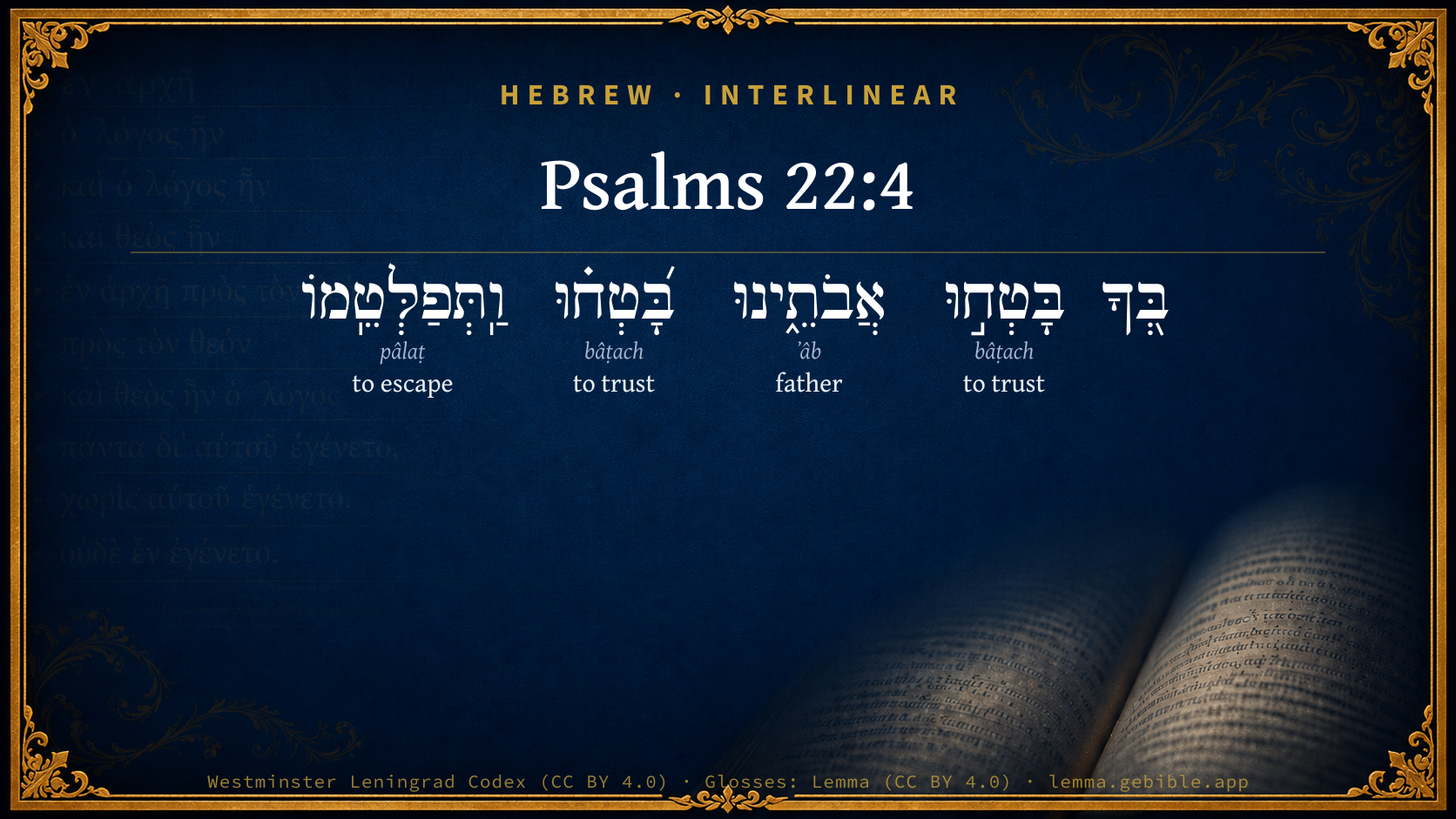
Hebrew (Westminster Leningrad Codex) Psalms 22:4 appears in the Hebrew Old Testament. The text above is from the Westminster Leningrad Codex. Each word links to its Strong’s number, a concise gloss, and parsing drawn from the Open Scriptures Hebrew Bible morphology. Click any word for its full Brown-Driver-Briggs (BDB) entry.
Download image
Cite this verse

Psalms 22:4 (World English Bible). Public Domain. Lemma interlinear Bible study tool, https://lemma.gebible.app/v/psalms/22/4.

Show BibTeX & RIS
BibTeX
RIS
English Translation
Our fathers trusted in you. They trusted, and you delivered them.
World English Bible · Public Domain
Download a study sheet

One document with this verse’s original text, its word-by-word gloss line, the meaning frame, cross-references with their text, attributed commentary, and full source and license credits — printable, and it pastes into notes with its structure intact.

This verse Autodidact and up

Study sheet (.html) Plain text (.txt)

A passage Seminary Student

Up to 50 verses in one chapter. A passage sheet keeps up to 6 commentary sources and 12 cross-references per verse, in the order this page ranks them, and says so on the sheet whenever that leaves anything out. Ask for a single verse and you get the Autodidact verse sheet above.

Everything on this page stays free to read, with no account — the sheet is a download of what is already on screen, not access to it.

Want to remove ads? Support Godless Engineer
Compare translations 3

The same verse in 3 English versions, stacked beneath the original-language interlinear above. Click any original word for its lexicon entry.

Each is an independent rendering of the whole verse — the interlinear is not word-aligned to these translations.

Highlighted words mark where these versions differ — a whole-verse word diff, not a word-by-word alignment.

  • World English Bible Public Domain
    Our fathers trusted in you. They trusted, and you delivered them.
  • King James Version Public Domain
    Our fathers trusted in thee: they trusted, and thou didst deliver them.
  • unfoldingWord Literal Text CC BY-SA 4.0
    In you our fathers trusted; they trusted, and you delivered them.

unfoldingWord Literal Text — © unfoldingWord, licensed CC BY-SA 4.0. Word-aligned USFM3 via Door43 (git.door43.org/unfoldingWord/en_ult).

Versions to compare (up to 4)

3 of 4 selected

Show all 18 translations

Every available English version of this verse, each an independent rendering of the whole verse.

  • World English Bible Public Domain
    Our fathers trusted in you. They trusted, and you delivered them.
  • Berean Standard Bible Public Domain
    In You our fathers trusted; they trusted and You delivered them.
  • Majority Standard Bible Public Domain
    In You our fathers trusted; they trusted and You delivered them.
  • King James Version Public Domain
    Our fathers trusted in thee: they trusted, and thou didst deliver them.
  • American Standard Version (1901) Public Domain
    Our fathers trusted in thee: They trusted, and thou didst deliver them.
  • Revised Version (1885) Public Domain
    Our fathers trusted in thee: they trusted, and thou didst deliver them.
  • Geneva Bible (1599) Public Domain
    Our fathers trusted in thee: they trusted, and thou didest deliuer them.
  • Douay-Rheims (1899) Public Domain
    But thou dwellest in the holy place, the praise of Israel.
  • Young's Literal Translation Public Domain
    In Thee did our fathers trust -- they trusted, And Thou dost deliver them.
  • Literal Standard Version CC BY-SA 4.0
    In You our fathers trusted; They trusted, and You deliver them.
  • Unlocked Literal Bible CC BY-SA 4.0
    Our ancestors trusted in you; they trusted in you, and you rescued them.
  • unfoldingWord Literal Text CC BY-SA 4.0
    In you our fathers trusted; they trusted, and you delivered them.
  • Darby Bible Public Domain
    Our fathers confided in thee: they confided, and thou didst deliver them.
  • World Messianic Bible Public Domain
    Our fathers trusted in you. They trusted, and you delivered them.
  • Webster's Bible Public Domain
    \\22:3\\But thou art holy, O thou that inhabitest the praises of Israel.
  • Free Bible Version CC BY-SA 4.0
    Our forefathers trusted in you; they trusted and you rescued them.
  • Bible in Basic English Public Domain
    Our fathers had faith in you: they had faith and you were their saviour.
  • JPS Tanakh (1917) Public Domain
    (22-5) In Thee did our fathers trust; they trusted, and Thou didst deliver them.

Literal Standard Version (2020), Covenant Press — licensed CC BY-SA 4.0. Text via the HelloAO Bible API (eBible.org). Unlocked Literal Bible (unfoldingWord) — licensed CC BY-SA 4.0. Text via the HelloAO Bible API (eBible.org). unfoldingWord Literal Text — © unfoldingWord, licensed CC BY-SA 4.0. Word-aligned USFM3 via Door43 (git.door43.org/unfoldingWord/en_ult). Free Bible Version, Dr. Jonathan Gallagher — licensed CC BY-SA 4.0. Text via the HelloAO Bible API (eBible.org).

Word by word

More ways to search: Search by grammar → Find every occurrence → Compare this word →

Practice this passage: Drill this verse → Learn its vocabulary →

וַֽתְּפַלְּטֵֽמוֹ
pâlaṭ
H6403
“and · to escape · them”
Conjunction + Verb, Piel, Sequential Imperfect, 2nd Person, Masculine, Singular + Suffix, Personal, 3rd Person, Masculine, Plural
Part of Speech
Conjunction + Verb
Stem
Piel
Form
Sequential Imperfect
Person
2nd Person
Gender
Masculine
Number
Singular
Full BDB Definition

Origin: a primitive root

TWOT: 1774

to escape, save, deliver, slip away - (Qal) to escape - (Piel) - to bring into security, deliver - to cause to escape, cast forth - to be delivered - to slip away - (Hiphil) to bring into security, bring to safety
  1. בָּטְח֣וּ bâṭach H982 “to trust” Verb, Qal, Perfect, 3rd Person, Common, Plural
  2. אֲבֹתֵ֑ינוּ ʼâb H1 “fathers · our” Noun, Common, Masculine, Plural, Construct + Suffix, Personal, 1st Person, Common, Plural
  3. בָּ֝טְח֗וּ bâṭach H982 “to trust” Verb, Qal, Perfect, 3rd Person, Common, Plural

About this verse

These counts appear in no published source. They are computed here, from the morphology-tagged text and Lemma’s own curated glosses. What Lemma adds →

5
words
3
distinct lemmas
Wisdom
section

Notable vocabulary

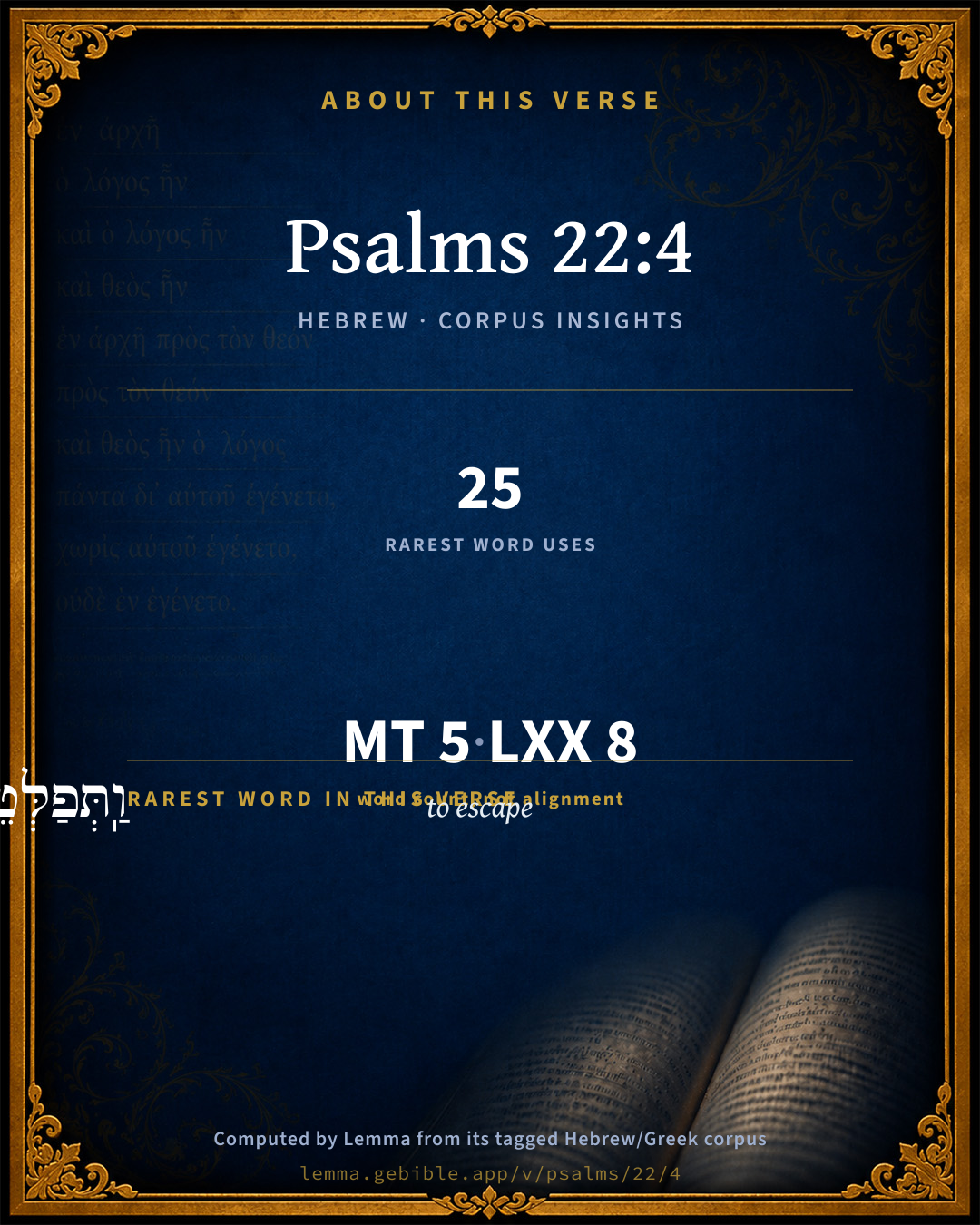
The rarest word here is וַֽתְּפַלְּטֵֽמוֹ to escape H6403 — appearing just 25 times in the whole Hebrew Bible.

Shared distinctive vocabulary

וַֽתְּפַלְּטֵֽמוֹ to escape H6403 occurs in 23 verses of the Hebrew Bible. Also found in:

Grammatical profile

  • 3 verbs
  • 1 noun
  • 1 preposition

Verb forms

  • בָּטְח֣וּ Qal · Perfect
  • בָּ֝טְח֗וּ Qal · Perfect
  • וַֽתְּפַלְּטֵֽמוֹ Piel · Sequential Imperfect

Repetition

A word recurs within this verse — often emphatic in Hebrew:

  • בָּטְח֣וּ to trust H982 ×2

Hebrew & Septuagint length

In English translation the verse runs 11 words from the Hebrew and 12 from the Septuagint (LXX English) — closely comparable.

A rough comparison of the two English renderings, which tokenize alike — not a word-level alignment.

Word counts can differ between the Hebrew and the Greek without any difference in meaning — e.g. the Hebrew direct-object marker אֵת has no separate Greek word, and Greek often adds the article ὁ.

In the original languages it is 5 Hebrew tokens and 8 Greek tokens — but the two are counted differently (Hebrew bundles its prefixes and suffixes into one token; the Greek is in lemma form), so that isn’t a like-for-like length.

Cross-references

9

Topical passages linked to Psalms 22:4 in the Treasury of Scripture Knowledge — connected by theme and wording, ordered by reader-vote popularity; previews shown in the World English Bible.

  • Exodus 14:31 Israel saw the great work which Yahweh did to the Egyptians, and the people feared Yahweh; and they believed in Yahweh, and in his servant Moses.
  • Exodus 14:13–14 Moses said to the people, "Don't be afraid. Stand still, and see the salvation of Yahweh, which he will work for you today: for the Egyptians whom you have seen today, you shall never see them again.
  • Genesis 15:6 He believed in Yahweh; and he reckoned it to him for righteousness.
  • Genesis 32:28 He said, "Your name will no longer be called 'Jacob,' but, 'Israel,' for you have fought with God and with men, and have prevailed."
  • Romans 4:18–22 Who in hope believed against hope, to the end that he might become a father of many nations, according to that which had been spoken, "So will your seed be."
  • Hebrews 11:8–32 By faith, Abraham, when he was called, obeyed to go out to the place which he was to receive for an inheritance. He went out, not knowing where he went.
  • Psalms 44:1–7 We have heard with our ears, God; Our fathers have told us, What work you did in their days, In the days of old.
  • Genesis 32:9–12 Jacob said, "God of my father Abraham, and God of my father Isaac, Yahweh, who said to me, 'Return to your country, and to your relatives, and I will do you good.'
  • 1 Samuel 7:9–12 Samuel took a sucking lamb, and offered it for a whole burnt-offering to Yahweh: and Samuel cried to Yahweh for Israel; and Yahweh answered him.

Cross-references courtesy of OpenBible.info (CC BY 4.0).

Hebrew and Greek witnesses Masoretic Hebrew ↔ Greek Septuagint

The same verse in the two great witnesses to the Old Testament, shown verse-for-verse.

You’re reading Greek Psalm 21 (Hebrew Psalm 22). The Septuagint counts the superscription, so verse numbers can differ from the Hebrew — chapter-level alignment, not verse-by-verse. Numbering follows Rahlfs.

These are two independent witnesses, not word-aligned to each other, and the Septuagint is shown in lemma (dictionary) form.

Hebrew Psalms 22:4 Masoretic · Westminster Leningrad Codex

בְּ֭ךָ בָּטְח֣וּ אֲבֹתֵ֑ינוּ בָּ֝טְח֗וּ וַֽתְּפַלְּטֵֽמוֹ

Our fathers trusted in you. They trusted, and you delivered them.

World English Bible · Public Domain

Greek LXX Greek Psalm 21:4 Septuagint · lemma form

σύ δέ ἐν ἅγιος καταοἰκέω ὁ ἔπαινος ἰσραήλ

Our fathers hoped in you; they hoped, and you did deliver them.

LXX2012 (modern English Septuagint) · Public Domain

Hebrew: Westminster Leningrad Codex (CC BY 4.0). Greek: Septuagint (public domain); English from LXX2012 (modern English Septuagint) (Public Domain). How the Septuagint differs from the Hebrew →

Commentary

Notes on Psalms 22:4 from classic Christian and Jewish commentators (each source and its license shown beneath its notes). The classic Christian expositions comment on the surrounding passage and are grouped to its opening verse, so a note may address several verses; the Jewish commentaries on the Tanakh (Rashi and others) are per-verse, so they appear only where the commentator wrote on this verse.

Lemma curates 59 commentaries, every one of them public domain or Creative Commons licensed, each selected and text-cleaned for this edition rather than reprinted as found. About our sources →

Trapp's Complete Commentary

John Trapp

Psa 22:4 Our fathers trusted in thee: they trusted, and thou didst deliver them.

Ver. 4. Our fathers trusted in thee] They trusted, and trusted, and trusted, they lengthened out their trust. The Hebrew word for hope or trust signifieth also a line; because thereby the heart is stretched out as a line to the thing hoped for; and he that believeth maketh not haste.

And thou didst deliver them] Never could any instance be given to the contrary. Let the success of our forefathers’ confidence, and hope unfailable, flowing from faith unfeigned, confirm our fiducial dependence upon gospel promises.

John Trapp, A Commentary or Exposition upon All the Books of the Old and New Testament (1647–1656) — public domain. Text from a community e-Sword module.

The Biblical Illustrator

Joseph S. Exell

Psa_22:4

Our fathers trusted in Thee.

The God of our fathers.

A sermon to young men

The age in which we live is an enlightened age. And no man is bound to be religious for no better reason than that his father was religious before him. With advancing light and knowledge great changes are coming, or have already come. But how far do such things affect our attitude and utterance like those of the text? Offer first one or two regulative thoughts.

1. It is only right and fair to remember that the great facts of human nature and of human life with which religion has to do remain substantially the same throughout the ages. In the great matters of essential religion, in the main, no one age is more favoured than another. Our fathers disease is our disease; and may not our fathers cure be our cure?

2. Scepticism and unbelief are not new. It is ignorance of the history of unbelief that makes modern unbelief, to many minds, so formidable. Scepticism may change its form,--now the light raillery of a Voltaire, now the learning and logical acumen of a Hume, now the bitter wail of a Mill,--but it is one thing, one principle, one substance. Every age has its sceptic, or its sceptics. It looks almost as if Almighty God permitted them that, intellectually, the Church might be kept from going to sleep.

3. Science is doing grand things today. Her beneficent step is heard almost everywhere. But physical science is comparatively young. And you know the characteristic defects of youth. It is headstrong and impatient, and often irreverent.

It is sometimes not over reticent, even on matters concerning which it cannot form reliable judgments I now speak on the claims of the religion of our fathers.

1. It was our fathers. That the sires trusted in God is a very sufficient reason why the sons should hesitate, and hesitate long, before they reach the grave conclusion that there is no God, or that if there be He cannot be trusted because He cannot be known. One of the healthiest facts of human nature and of human life has ever been that spirit of reverence for the past which links generation to generation, and practically makes the race one. We Englishmen are by no means destitute of this fine sentiment.

2. Our fathers proved it. What is the testimony borne by honest men who have preceded us? It is that the religion of Jesus is a grand reality and not a human dream; that the Bible contains a Divine and all-satisfying revelation of God; that it is not a fabrication or an imposture; that the heart of man is weary till it find rest in Christ; that there is such rest in Christ; that in the Cross of the Crucified One there is hope for all, comfort for all, heaven for all! And how are we asked to receive that testimony Some would have us believe that it is untrustworthy. Surely our fathers were not mere intellectual weaklings? What are we to say of the testimony they bore? We will go long before we speak ill, or listen with patience to ill spoken, of the bridge which bore them over!

3. They died in the faith of it. For me, I believe in the God of my fathers. I believe in the religion of my fathers. I will take the liberty of expressing it in forms suited to the spirit and the habits of thought of the age in which we live; but the essential Gospel of our Lord and Saviour Jesus Christ I keep. (J. Thew.)

Gods faithfulness to ancient saints good ground for trust and hope

Those who look upon this Psalm as having a primary reference to the King of Israel attribute great beauty to these words, from the very pleasing conjecture that David was, at the time of composing them, sojourning at Mahanaim, where Jacob, in his distress, wrestled with the angel and obtained such signal blessings. That, in a place so greatly hallowed by associations of the past, he should make his appeal to the God of his fathers, was alike the dictate of patriarchal feeling and religion. (John Morison.)

Strong warrant for trust

Our hope is not hung upon such untwisted thread as I imagined so or it is likely, but the cable, the strong hope of our fastened anchor, is the oath and promise of Him who is eternal verity; our salvation is fastened with Gods own hand and Christs own strength to the strong stake of Gods unchanging nature. (S. Rutherford.)

The Biblical Illustrator, edited by Joseph S. Exell (c. 1880s–1900s) — public domain. Text from a community e-Sword module.

The Treasury of David

Charles H. Spurgeon

Ver. 4. Our fathers trusted in thee: they trusted, and thou didst deliver them. This is the rule of life with all the chosen family. Three times over is it mentioned, they trusted, and trusted, and trusted, and never left off trusting, for it was their very life; and they fared well too, for thou didst deliver them. Out of all their straits, difficulties, and miseries faith brought them by calling their God to the rescue; but in the case of our Lord it appeared as if faith would bring no assistance from heaven, he alone of all the trusting ones was to remain without deliverance. The experience of other saints may be a great consolation to us when in deep waters if faith can be sure that their deliverance will be ours; but when we feel ourselves sinking, it is poor comfort to know that others are swimming. Our Lord here pleads the past dealings of God with his people as a reason why he should not be left alone; here again he is an example to us in the skilful use of the weapon of all prayer. The use of the plural pronoun "our" shows how one with his people Jesus was even on the cross. We say, "Our Father which art in heaven, "and he calls those "our fathers" through whom we came into the world, although he was without father as to the flesh.

Ver. 4-5. Those who look upon this Psalm as having a primary reference to the King of Israel, attribute great beauty to these words, from the very pleasing conjecture that David was, at the time of composing them, sojourning at Mahanaim, where Jacob, in his distress, wrestled with the angel, and obtained such signal blessings. That, in a place so greatly hallowed by associations of the past, he should make his appeal to the God of his fathers, was alike the dictate of patriarchal feeling and religion. John Morison, D.D., in "Morning Meditations."

Ver. 4. God's faithfulness in past ages a plea for the present.

Ver. 4-5. Ancient saints.

1. Their life. They trusted.

2. Their practice. They cried.

3. Their experience. Were not confounded.

4. Their voice to us.

Psalms 22:5*

Ver. 4-5. See Psalms on "Ps 22:4" for further information.

Those who look upon this Psalm as having a primary reference to the King of Israel, attribute great beauty to these words, from the very pleasing conjecture that David was, at the time of composing them, sojourning at Mahanaim, where Jacob, in his distress, wrestled with the angel, and obtained such signal blessings. That, in a place so greatly hallowed by associations of the past, he should make his appeal to the God of his fathers, was alike the dictate of patriarchal feeling and religion. John Morison, D.D., in "Morning Meditations."

Ver. 4-5. Ancient saints.

1. Their life. They trusted.

2. Their practice. They cried.

3. Their experience. Were not confounded.

4. Their voice to us.

Psalms 22:6*

Charles H. Spurgeon's The Treasury of David (1869–1885) — public domain. Psalms only. Text from a community e-Sword/MySword module.

Joseph Benson's Commentary

Psa 22:4-5. Our fathers, &c. — That is, my fathers, according to the flesh, the Israelites; trusted in thee, and were delivered — Were not disappointed of that for which they prayed and hoped: but whenever they cried unto thee in their distress, thou didst send them deliverance, as by Gideon, Samson, Samuel, &c. To trust in God is the way to obtain deliverance, and “the former instances of the divine favour are so many arguments why we should hope for the same; but it may not always be vouchsafed when we expect it. The patriarchs, and Israelites of old, were often saved from their enemies: but the holy Jesus was left to languish and expire under the malice of his. God knows what is proper for him to do and for us to suffer; we know neither. This consideration is an anchor for the afflicted soul, sure and steadfast.” — Horne.

Joseph Benson's Commentary on the Old and New Testaments (1811–1818) — public domain. Text from a community e-Sword module.

J. A. Alexander on Psalms

Joseph Addison Alexander

5. (Psa 22:4). In thee trusted our fathers; they trusted and thou savedst them. Not only was Jehovah the covenant God of Israel, and as such bound to help his people, but he had actually helped them in time past. This is urged as a reason why he should not refuse to help the sufferer in this case. The plural form, our fathers, makes the prayer appropriate to the whole church, without rendering it less so to the case of Christ, or to that of the individual believer.

Joseph Addison Alexander, The Psalms Translated and Explained (1850) — public domain. Text from a community e-Sword module.

Jamieson, Fausset & Brown

Robert Jamieson, A. R. Fausset & David Brown

Past experience of God's people is a ground of trust. The mention of "our fathers" does not destroy the applicability of the words as the language of our Saviour's human nature.

Jamieson, Fausset & Brown — Commentary Critical and Explanatory on the Whole Bible (1871) — public domain (CC PDM 1.0). Text via the HelloAO Bible API.

Adam Clarke's Commentary

Verse 4. Our fathers trusted in thee] David is supposed to have been, at the time of composing this Psalm, at Mahanaim, where Jacob was once in such great distress; where he wrestled with the angel, and was so signally blessed. David might well allude to this circumstance in order to strengthen his faith in God. I am now in the place where God so signally blessed the head and father of our tribes. I wrestle with God, as he did; may I not expect similar success?

Adam Clarke's Commentary on the Bible (1810–1826) — public domain. Text from a community e-Sword/MySword module.

John Calvin's Commentaries

4. Our fathers trusted in thee. Here the Psalmist assigns the reason why God sitteth amidst the praises of the tribes of Israel. The reason is, because his hand had been always stretched forth to preserve his faithful people. David, as I have just now observed, gathers together the examples of all past ages, in order thereby to encourage, strengthen, and effectually persuade himself, that as God had never cast off any of his chosen people, he also would be one of the number of those for whom deliverance is securely laid up in the hand of God. He therefore expressly declares that he belongs to the offspring of those who had been heard, intimating by this, that he is an heir of the same grace which they had experienced. He has an eye to the covenant by which God had adopted the posterity of Abraham to be his peculiar people. It would be of little consequence to know the varied instances in which God has exercised his mercy towards his own people, unless each of us could reckon himself among their number, as David includes himself in the Church of God. In repeating three times that the fathers had obtained deliverance by trusting, there is no doubt that with all modesty he intends tacitly to intimate that he had the same hope with which they were inspired, a hope which draws after it, as its effect, the fulfillment of the promises in our behalf. In order that a man may derive encouragement from the blessings which God has bestowed upon his servants in former times, he should turn his attention to the free promises of God’s word, and to the faith which leans upon them. In short, to show that this confidence was neither cold nor dead, David tells us, at the same time, that they cried unto God. He who pretends that he trusts in God, and yet is so listless and indifferent under his calamities that he does not implore his aid, lies shamefully. By prayer, then, true faith is known, as the goodness of a tree is known by its fruit. It ought also to be observed, that God regards no other prayers as right but those which proceed from faith, and are accompanied with it. It is therefore not without good reason that David has put the word cried in the middle between these words, They trusted in thee, they trusted, in the fourth verse, and these words, They trusted in thee, in the fifth verse.

John Calvin's Commentaries (1540-1563) — public domain. Text from the Calvin Translation Society English edition (1840s-50s) via the Christian Classics Ethereal Library (ccel.org). Calvin's coverage is partial (roughly two-thirds of the Bible); uncommented books and verses are honest gaps, never fabricated. The 19th-century editor's footnotes and remarks are omitted so the notes are faithfully Calvin's own voice.

The Cambridge Bible for Schools and Colleges

gen. ed. J. J. S. Perowne

4, 5. The thought of the preceding line is developed in an appeal to the past history of the nation. Cp. Psa_44:1, Psa_78:3, Psa_9:10. ‘Thou didst deliver them: why then am I deserted?’ The emphasis is throughout on thee.

In thee did our fathers trust:

They trusted, and thou didst deliver them.

Unto thee did they cry, and escaped:

In thee did they trust, and were not put to shame.

The Cambridge Bible for Schools and Colleges (gen. ed. J. J. S. Perowne; Cambridge University Press, 1878–1918) — public domain. Text from a community e-Sword module.

John Gill's Exposition

Our fathers trusted in thee,.... By whom are meant Abraham, Isaac, and Jacob, from whom our Lord descended; and the people of Israel when in Egypt, in the times of the judges, and in all ages before the coming of Christ, of whom, as concerning the flesh, or as to his human nature, Christ came, Rom 9:5; these, as they were sojourners, and went from place to place, especially the patriarchs, and were often in trouble and distress, when they called upon the Lord, looked to him, and put their trust and confidence in him; not in themselves, their own wisdom, riches, and strength, nor in others, in any mere creature, nor in any outward thing, or arm of flesh, but in the Lord Jehovah, in whom is everlasting strength; they believed in the power of God, that he was able to help and deliver them, and they had faith in him that he would; they depended upon his word and promise, and were persuaded he would never suffer his faithfulness to fail; they committed themselves to the Lord, and stayed themselves upon him;

they trusted; this is repeated not only for the sake of emphasis, pointing out something remarkable and commendable, and for the greater certainty of it, more strongly confirming it; or to observe the many that put their trust in the Lord, the numerous instances of confidence in him; but also to denote the constancy and continuance of their faith, they trusted in the Lord at all times;

and thou didst deliver them; out of the hands of all their enemies, and out of all their sorrows and afflictions; instances of which we have in the patriarchs, and in the people of Israel when brought out of Egypt, and through the Red sea and wilderness, and in the times of the judges, when they were distressed by their neighbours, and God sent them a deliverer time after time.

John Gill's Exposition of the Whole Bible (1746–1763) — public domain (CC PDM 1.0). Text via the HelloAO Bible API.

Albert Barnes' Notes on the Bible

Our fathers trusted in thee - This is a plea of the sufferer as drawn from the character which God had manifested in former times. The argument is, that he had interposed in those times when his people in trouble had called upon him; and he now pleads with God that he would manifest himself to him in the same way. The argument derives additional force also from the idea that he who now pleads was descended from them, or was of the same nation and people, and that he might call them his ancestors. As applicable to the Redeemer, the argument is that he was descended from those holy and suffering men who had trusted in God, and in whose behalf God had so often interposed. He identifies himself with that people; he regards himself as one of their number; and he makes mention of God’s merciful interposition in their behalf, and of the fact that he had not forsaken them in their troubles, as a reason why he should now interpose in his behalf and save him. As applicable to others, it is an argument which the people of God may always use in their trials - that God has thus interposed in behalf of his people of former times who trusted in him, and who called upon him. God is always the same. We may strengthen our faith in our trials by the assurance that he never changes; and, in pleading with him, we may urge it as an argument that he has often interposed when the tried and the afflicted of his people have called upon him.

They trusted, and thou didst deliver them - They confided in thee; they called on thee; thou didst not spurn their prayer; thou didst not forsake them.

Albert Barnes' Notes on the Bible (1834–1885) — public domain. Text from a community e-Sword/MySword module.

Matthew Poole's English Annotations

This he adds for the reasons mentioned in the first note, Psa 22:3.

Matthew Poole's English Annotations on the Holy Bible (1683–1685) — public domain. Text from a community e-Sword/MySword module.

The Pulpit Commentary

Our fathers trusted in thee. It sustains the Sufferer to think how many before him have cried to God, and trusted in him, and for a while been seemingly not heard, and yet at length manifestly heard and saved. They trusted in thee, and thou didst (ultimately) deliver them.

A pedigree of faith and piety.

"Our fathers trusted," etc. The Bible takes great account of pedigree. Yet not on those grounds in which men commonly glory rank, title, wealth, fame; but in the line of faith and piety. These words contain

I A THANKFUL REMEMBRANCE. It is no small honour and blessing to spring from a godly stock. Those who have not this happiness in family lineage may yet claim it by adoption. A true Christian has all past generations of God"s people as spiritual ancestors. (Gal_3:29 Rom_4:16, Rom_4:17)

II A HOLY EXAMPLE, powerfully moving to faith, prayer, and holiness. (Heb_6:12 Heb_12:1 2Ti_1:3-5) Noblesse oblige.

III A HUMBLE CLAIM ON GOD"S FAITHFULNESS. Because:

1. The trust and prayers of God"s people in past generations were not for themselves only, but for their children. (Gen_17:18, Gen_17:20) Ancestral prayers are a rich inheritance.

2. God"s promises have regard to the children of his people. (Psa_103:17, 18 Act_2:39 Act_3:25)

IV AN ENCOURAGEMENT TO FAITH. The experience of those who have gone before us, the consenting testimony of so many generations, and so innumerable a multitude of believers, to the truth of the Bible, the power of prayer, the reality of God"s grace, the fulfilment of his promises, is no small or feeble aid to our faith. (Psa_34:4-8 Heb_11:32-40)

CONCLUSION.

1. We inherit the past. The wise thoughts, immortal words, noble deeds, holy lives, fervent prayers, toils, and sufferings of those who have gone before us, are a great treasure and trust, of which we shall have to give account.

2. We are making the future. What pattern, work, prayer, memory, that they will "not willingly lot die," are we handing down to our successors?

The Pulpit Commentary (1880–1919), ed. H.D.M. Spence-Jones & Joseph S. Exell — public domain. Text from a community e-Sword module.

Rashi

Rabbi Shlomo Yitzchaki (Rashi)

But You are holy and You wait to hear the praises of Israel from time immemorial.

Rashi on the Tanakh — English translations: “The Judaica Press complete Tanach with Rashi, translated by A. J. Rosenberg” (CC BY 4.0); “Pentateuch with Rashi's commentary by M. Rosenbaum and A.M. Silbermann, 1929-1934” (public domain); “The Metsudah Tanach series, Lakewood, N.J” (CC BY 4.0); and “The Book of Joshua, Metsudah Publications, 1997” (CC BY 4.0). Text via Sefaria.

Radak

Rabbi David Kimhi (Radak)

And Thou continuest holy: – How, then, is it that Thou dost not answer now, seeing that Thou continuest holy and abidest for ever? Thou hast been so often

(Thou) the praises of Israel: – for they praised Thee when Thou didst deliver them out of their troubles. For praise and thanks-giving shall be (given) for deliverance. How is it that Thou dost not save him now? for Thou abided for ever, and as Thy power was then, so is Thy power now. (Thou) continuest, abidest that is, eternally; and so, “Thou, Lord, continuest for ever” (Lam. 5:19).

Radak on the Tanakh — English translations: “Sefaria Community Translation” (CC0 1.0 (public-domain dedication)); “Eliyahu Munk, HaChut Hameshulash” (CC BY 4.0); “Rabbi Mike Feuer, Jerusalem Anthology” (CC BY 4.0); and “R. David Kimhi on the first book of Psalms, Translated by R.G. Finch, London, 1919” (public domain). Text via Sefaria.

Lesson kit

Teaching starters — assembled from the data on this page, not authored interpretation. Every prompt links to the verse data it draws on. Edit before teaching.

Psalms, in the Wisdom, opens this verse with 5 words (3 distinct Hebrew lemmas). Its most distinctive word is pâlaṭ (“to escape”). A historical commentator’s framing appears above. Read the whole chapter for the surrounding context.

Discussion questions

  1. The word pâlaṭ carries the sense “to escape.” How does it shape the verse?
  2. 2 Samuel 22:2 shares the word «to escape» with this verse. How do the two illuminate each other?
  3. “to trust” occurs 2× in this one verse. What is the effect of the repetition?
  4. These translations render this verse differently; the difference is in the English rendering, not the original. What questions does that raise?
  5. The verb «בָּטְח֣וּ» is Qal Perfect. How does its form color the action?
  6. Reading how Trapp's Complete Commentary and The Biblical Illustrator read this verse, where do the two commentators agree and where do they part?

Things to notice

Reading settings

Reading text

Shown beneath each verse's original-language words.

Old Testament
Old Testament edition

Read the OT as the Masoretic Hebrew (MT) or the Greek Septuagint (LXX).

English shown for the Greek Septuagint (in the Hebrew ↔ Greek comparison).

Comparing translations? Open the Compare panel on any verse page to stack up to four side by side.