
1 Thessalonians 5:11

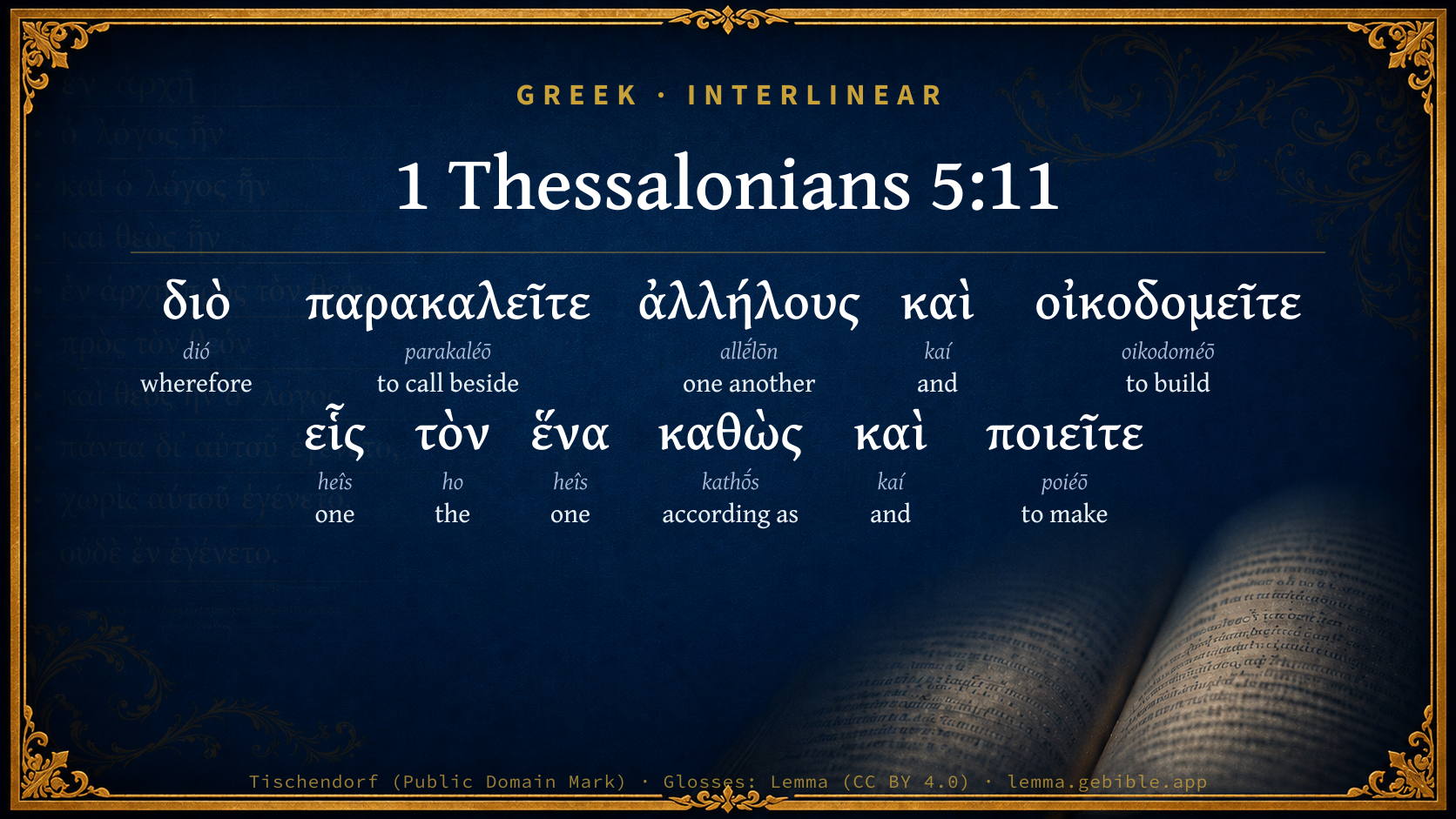
Greek (Tischendorf 8th ed.) 1 Thessalonians 5:11 appears in the Greek New Testament. The text above is from the Tischendorf 8th edition. Each word links to its Strong’s number and a concise gloss. Click any word for its full Thayer’s Greek Lexicon entry.
Download image
Cite this verse

1 Thessalonians 5:11 (World English Bible). Public Domain. Lemma interlinear Bible study tool, https://lemma.gebible.app/v/1-thessalonians/5/11.

Show BibTeX & RIS
BibTeX
RIS
English Translation
Therefore exhort one another, and build each other up, even as you also do.
World English Bible · Public Domain
Download a study sheet

One document with this verse’s original text, its word-by-word gloss line, the meaning frame, cross-references with their text, attributed commentary, and full source and license credits — printable, and it pastes into notes with its structure intact.

This verse Autodidact and up

Study sheet (.html) Plain text (.txt)

A passage Seminary Student

Up to 50 verses in one chapter. A passage sheet keeps up to 6 commentary sources and 12 cross-references per verse, in the order this page ranks them, and says so on the sheet whenever that leaves anything out. Ask for a single verse and you get the Autodidact verse sheet above.

Everything on this page stays free to read, with no account — the sheet is a download of what is already on screen, not access to it.

Want to remove ads? Support Godless Engineer
Compare translations 3

The same verse in 3 English versions, stacked beneath the original-language interlinear above. Click any original word for its lexicon entry.

Each is an independent rendering of the whole verse — the interlinear is not word-aligned to these translations.

Highlighted words mark where these versions differ — a whole-verse word diff, not a word-by-word alignment.

  • World English Bible Public Domain
    Therefore exhort one another, and build each other up, even as you also do.
  • King James Version Public Domain
    Wherefore comfort yourselves together, and edify one another, even as also ye do.
  • unfoldingWord Literal Text CC BY-SA 4.0
    Therefore, encourage one another and build up one the one, just as also you are doing.

unfoldingWord Literal Text — © unfoldingWord, licensed CC BY-SA 4.0. Word-aligned USFM3 via Door43 (git.door43.org/unfoldingWord/en_ult).

Versions to compare (up to 4)

3 of 4 selected

Show all 19 translations

Every available English version of this verse, each an independent rendering of the whole verse.

  • World English Bible Public Domain
    Therefore exhort one another, and build each other up, even as you also do.
  • Berean Standard Bible Public Domain
    Therefore encourage and build one another up, just as you are already doing.
  • Majority Standard Bible Public Domain
    Therefore encourage and build one another up, just as you are already doing.
  • King James Version Public Domain
    Wherefore comfort yourselves together, and edify one another, even as also ye do.
  • American Standard Version (1901) Public Domain
    Wherefore exhort one another, and build each other up, even as also ye do.
  • Revised Version (1885) Public Domain
    Wherefore exhort one another, and build each other up, even as also ye do.
  • Geneva Bible (1599) Public Domain
    Wherefore exhort one another, and edifie one another, euen as ye doe.
  • Douay-Rheims (1899) Public Domain
    For which cause comfort one another; and edify one another, as you also do.
  • Young's Literal Translation Public Domain
    wherefore, comfort ye one another, and build ye up, one the one, as also ye do.
  • Literal Standard Version CC BY-SA 4.0
    for this reason, comfort one another, and build up one another, as also you do.
  • Unlocked Literal Bible CC BY-SA 4.0
    Therefore comfort one another and build each other up, just as you are already doing.
  • unfoldingWord Literal Text CC BY-SA 4.0
    Therefore, encourage one another and build up one the one, just as also you are doing.
  • Darby Bible Public Domain
    Wherefore encourage one another, and build up each one the other, even as also ye do.
  • World Messianic Bible Public Domain
    Therefore exhort one another, and build each other up, even as you also do.
  • Webster's Bible Public Domain
    Wherefore, comfort yourselves together, and edify one another, even as also ye do.
  • Free Bible Version CC BY-SA 4.0
    So encourage and strengthen one another, just as you are doing.
  • Bible in Basic English Public Domain
    So then, go on comforting and building up one another, as you have been doing.
  • Text-Critical English NT CC BY 4.0
    Therefore encourage one another and build each other up, even as you are doing.
  • Tyndale New Testament (1534) Public Domain
    Wherfore comforte youre selves togedder and edifie one another even as ye do.

Literal Standard Version (2020), Covenant Press — licensed CC BY-SA 4.0. Text via the HelloAO Bible API (eBible.org). Unlocked Literal Bible (unfoldingWord) — licensed CC BY-SA 4.0. Text via the HelloAO Bible API (eBible.org). unfoldingWord Literal Text — © unfoldingWord, licensed CC BY-SA 4.0. Word-aligned USFM3 via Door43 (git.door43.org/unfoldingWord/en_ult). Free Bible Version, Dr. Jonathan Gallagher — licensed CC BY-SA 4.0. Text via the HelloAO Bible API (eBible.org).

Word by word

More ways to search: Search by grammar → Find every occurrence → Compare this word →

Practice this passage: Drill this verse → Learn its vocabulary →

οἰκοδομεῖτε
oikodoméō
G3618
“to build”
Verb, Present, Active, Imperative, 2nd person, Plural
Part of Speech
Verb
Tense
Present
Voice
Active
Mood
Imperative
Person
2nd person
Number
Plural
Full Thayer's Definition

Origin: from the same as G3619

TDNT: 07:16,7

1. to build a house, erect a building a. to build (up from the foundation) b. to restore by building, to rebuild, repair 2. metaph. a. to found, establish b. to promote growth in Christian wisdom, affection, grace, virtue, holiness, blessedness c. to grow in wisdom and piety
  1. διὸ dió G1352 “wherefore” Conjunction
  2. παρακαλεῖτε parakaléō G3870 “to call beside” Verb, Present, Active, Imperative, 2nd person, Plural
  3. ἀλλήλους allḗlōn G240 “one another” Reciprocal pronoun, Accusative, Plural, Masculine
  4. καὶ kaí G2532 “and” Conjunction
  5. εἷς heîs G1520 “one” Adjective, Nominative, Singular, Masculine
  6. τὸν ho G3588 “the” Article, Accusative, Singular, Masculine
  7. ἕνα heîs G1520 “one” Adjective, Accusative, Singular, Masculine
  8. καθὼς kathṓs G2531 “according as” Adverb
  9. καὶ kaí G2532 “and” Conjunction
  10. ποιεῖτε poiéō G4160 “to make” Verb, Present, Active, Indicative, 2nd person, Plural

About this verse

These counts appear in no published source. They are computed here, from the morphology-tagged text and Lemma’s own curated glosses. What Lemma adds →

11
words
9
distinct lemmas
Pauline Epistles
section

Shared distinctive vocabulary

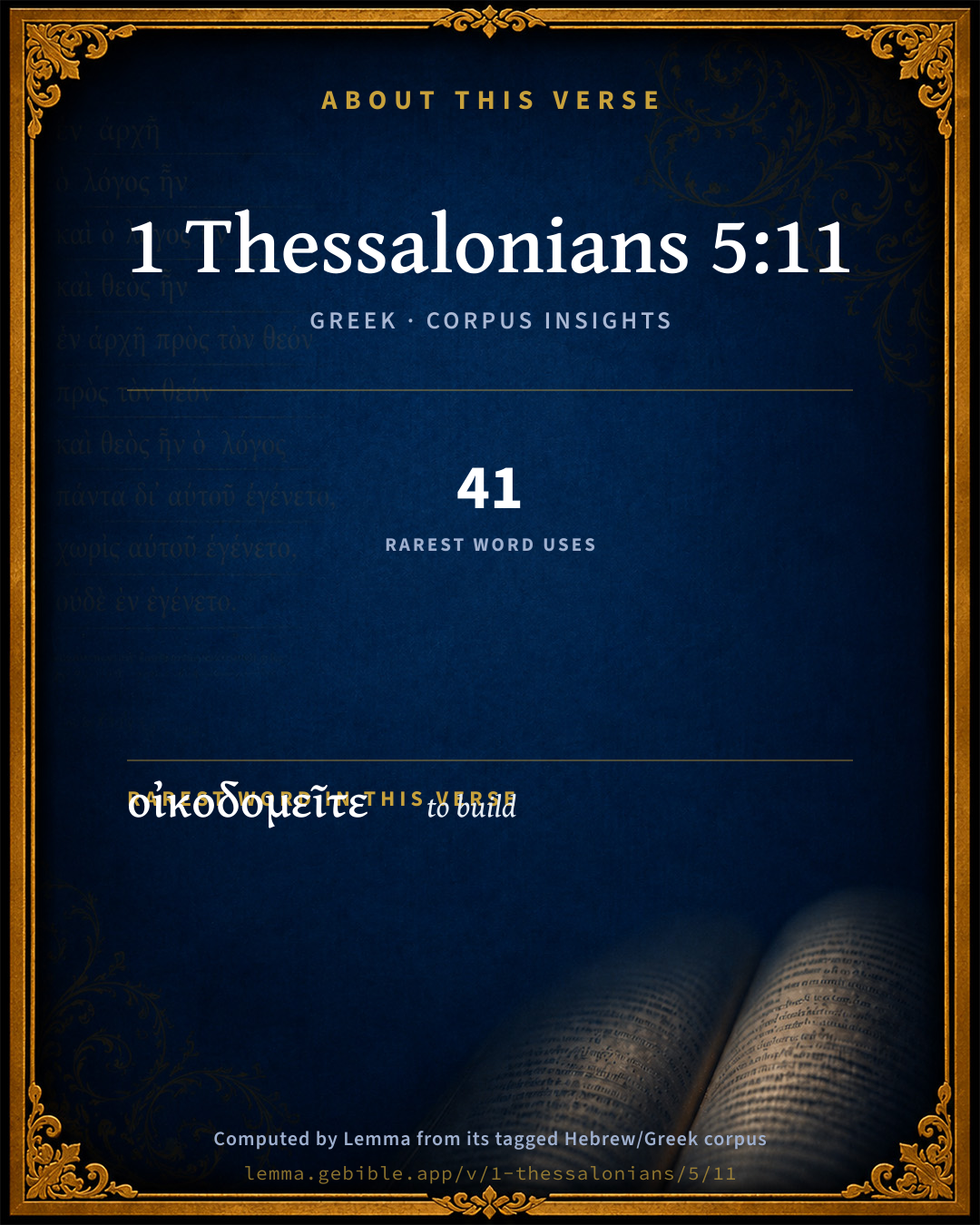
οἰκοδομεῖτε to build G3618 occurs in 39 verses of the Greek New Testament. Also found in:
Repetition

Words recur within this verse:

Cross-references

18

Topical passages linked to 1 Thessalonians 5:11 in the Treasury of Scripture Knowledge — connected by theme and wording, ordered by reader-vote popularity; previews shown in the World English Bible.

  • Ephesians 4:29 Let no corrupt speech proceed out of your mouth, but such as is good for building up as the need may be, that it may give grace to those who hear.
  • Romans 15:2 Let each one of us please his neighbor for that which is good, to be building him up.
  • Hebrews 10:25 not forsaking our own assembling together, as the custom of some is, but exhorting one another; and so much the more, as you see the Day approaching.
  • Hebrews 3:13 but exhort one another day by day, so long as it is called "today;" lest any one of you be hardened by the deceitfulness of sin.
  • 1 Thessalonians 4:18 Therefore comfort one another with these words.
  • Romans 14:19 So then, let us follow after things which make for peace, and things by which we may build one another up.
  • 1 Corinthians 14:12 So also you, since you are zealous for spiritual gifts, seek that you may abound to the building up of the assembly.
  • Ephesians 4:12 for the perfecting of the saints, to the work of serving, to the building up of the body of Christ;
  • Ephesians 4:16 from whom all the body, being fitted and knit together through that which every joint supplies, according to the working in measure of each individual part, makes the body increase to the building up of itself in love.
  • Jude 1:20 But you, beloved, keep building up yourselves on your most holy faith, praying in the Holy Spirit.
  • 1 Corinthians 10:23 "All things are lawful for me," but not all things are profitable. "All things are lawful for me," but not all things build up.
  • 2 Peter 1:12 Therefore I will not be negligent to remind you of these things, though you know them, and are established in the present truth.
  • Romans 15:14 I myself am also persuaded about you, my brothers, that you yourselves are full of goodness, filled with all knowledge, able also to admonish others.
  • 2 Corinthians 12:19 Again, do you think that we are excusing ourselves to you? In the sight of God we speak in Christ. But all things, beloved, are for your edifying.
  • 1 Corinthians 14:29 Let the prophets speak, two or three, and let the others discern.
  • 1 Corinthians 14:5 Now I desire to have you all speak with other languages, but rather that you would prophesy. For he is greater who prophesies than he who speaks with other languages, unless he interprets, that the assembly may be built up.
  • 1 Timothy 1:4 neither to pay attention to myths and endless genealogies, which cause disputes, rather than God's stewardship, which is in faith--
  • 1 Thessalonians 4:10 for indeed you do it toward all the brothers who are in all Macedonia. But we exhort you, brothers, that you abound more and more;

Cross-references courtesy of OpenBible.info (CC BY 4.0).

Commentary

Notes on 1 Thessalonians 5:11 from classic Christian and Jewish commentators (each source and its license shown beneath its notes). The classic Christian expositions comment on the surrounding passage and are grouped to its opening verse, so a note may address several verses; the Jewish commentaries on the Tanakh (Rashi and others) are per-verse, so they appear only where the commentator wrote on this verse.

Lemma curates 59 commentaries, every one of them public domain or Creative Commons licensed, each selected and text-cleaned for this edition rather than reprinted as found. About our sources →

Matthew Henry's Commentary

In these words the apostle exhorts the Thessalonians to several duties.

I. Towards those who were nearly related one to another. Such should comfort themselves, or exhort one another, and edify one another, Th1 5:11. 1. They must comfort or exhort themselves and one another; for the original word may be rendered both these ways. And we may observe, As those are most able and likely to comfort others who can comfort themselves, so the way to have comfort ourselves, or to administer comfort to others, is by compliance with the exhortation of the word. Note, We should not only be careful about our own comfort and welfare, but to promote the comfort and welfare of others also. He was a Cain that said, Am I my brother's keeper? We must bear one another's burdens, and so fulfil the law of Christ. 2. They must edify one another, by following after those things whereby one may edify another, Rom 14:19. As Christians are lively stones built up together a spiritual house, they should endeavour to promote the good of the whole church by promoting the work of grace in one another. And it is the duty of every one of us to study that which is for the edification of those with whom we converse, to please all men for their real profit. We should communicate our knowledge and experiences one to another. We should join in prayer and praise one with another. We should set a good example one before another. And it is the duty of those especially who live in the same vicinity and family thus to comfort and edify one another; and this is the best neighbourhood, the best means to answer the end of society. Such as are nearly related together and have affection for one another, as they have the greatest opportunity, so they are under the greatest obligation, to do this kindness one to another. This the Thessalonians did (which also you do), and this is what they are exhorted to continue and increase in doing. Note, Those who do that which is good have need of further exhortations to excite them to do good, to do more good, as well as continue in doing what they do.

II. He shows them their duty towards their ministers, Th1 5:12, Th1 5:13. Though the apostle himself was driven from them, yet they had others who laboured among them, and to whom they owed these duties. The apostle here exhorts them to observe,

1. How the ministers of the gospel are described by the work of their office; and they should rather mind the work and duty they are called to than affect venerable and honourable names that they may be called by. Their work is very weighty, and very honourable and useful. (1.) Ministers must labour among their people, labour with diligence, and unto weariness (so the word in the original imports); they must labour in the word and doctrine, Ti1 5:17. They are called labourers, and should not be loiterers. They must labour with their people, to instruct, comfort, and edify them. And, (2.) Ministers are to rule their people also, so the word is rendered, Ti1 5:17. They must rule, not with rigour, but with love. They must not exercise dominion as temporal lords; but rule as spiritual guides, by setting a good example to the flock. They are over the people in the Lord, to distinguish them from civil magistrates, and to denote also that they are but ministers under Christ, appointed by him, and must rule the people by Christ's laws, and not by laws of their own. This may also intimate the end of their office and all their labour; namely, the service and honour of the Lord. (3.) They must also admonish the people, and that not only publicly, but privately, as there may be occasion. They must instruct them to do well, and should reprove when they do ill. It is their duty not only to give good counsel, but also to give admonition, to give warning to the flock of the dangers they are liable to, and reprove for negligence or what else may be amiss.

2. What the duty of the people is towards their ministers. There is a mutual duty between ministers and people. If ministers should labour among the people, then, (1.) The people must know them. As the shepherd should know his flock, so the sheep must know their shepherd. They must know his person, hear his voice, acknowledge him for their pastor, and pay due regard to his teaching, ruling, and admonitions. (2.) They must esteem their ministers highly in love; they should greatly value the office of the ministry, honour and love the persons of their ministers, and show their esteem and affection in all proper ways, and this for their work's sake, because their business is to promote the honour of Christ and the welfare of men's souls. Note, Faithful ministers ought to be so far from being lightly esteemed because of their work that they should be highly esteemed on account of it. The work of the ministry is so far from being a disgrace to those who upon other accounts deserve esteem, that it puts an honour upon those who are faithful and diligent, to which otherwise they could lay no claim, and will procure them that esteem and love among good people which otherwise they could not expect.

III. He gives divers other exhortations touching the duty Christians owe to one another. 1. To be at peace among themselves, Th1 5:13. Some understand this exhortation (according to the reading in some copies) as referring to the people's duty to their ministers, to live peaceably with them, and not raise nor promote dissensions at any time between minister and people, which will certainly prove a hindrance to the success of a minister's work and the edification of the people. This is certain, that ministers and people should avoid every thing that tends to alienate their affections one from another. And the people should be at peace among themselves, doing all they can to hinder any differences from rising or continuing among them, and using all proper means to preserve peace and harmony. 2. To warn the unruly, Th1 5:14. There will be in all societies some who walk disorderly, who go out of their rank and station; and it is not only the duty of ministers, but of private Christians also, to warn and admonish them. Such should be reproved for their sin, warned of their danger, and told plainly of the injury they do their own souls, and the hurt they may do to others. Such should be put in mind of what they should do, and be reproved for doing otherwise. 3. To comfort the feebleminded, Th1 5:14. By these are intended the timorous and faint-hearted, or such as are dejected and of a sorrowful spirit. Some are cowardly, afraid of difficulties, and disheartened at the thoughts of hazards, and losses, and afflictions; now such should be encouraged; we should not despise them, but comfort them; and who knows what good a kind and comfortable word may do them? 4. To support the weak, Th1 5:14. Some are not well able to perform their work, nor bear up under their burdens; we should therefore support them, help their infirmities, and lift at one end of the burden, and so help to bear it. It is the grace of God, indeed, that must strengthen and support such; but we should tell them of that grace, and endeavour to minister of that grace to them. 5. To be patient towards all men, Th1 5:14. We must bear and forbear. We must be long-suffering, and suppress our anger, if it begin to rise upon the apprehension of affronts or injuries; at least we must not fail to moderate our anger: and this duty must be exercised towards all men, good and bad, high and low. We must not be high in our expectations and demands, nor harsh in our resentments, nor hard in our impositions, but endeavour to make the best we can of every thing, and think the best we can of every body. 6. Not to render evil for evil to any man, Th1 5:15. This we must look to, and be very careful about, that is, we must by all means forbear to avenge ourselves. If others do us an injury, this will not justify us in returning it, in doing the same, or the like, or any other injury to them. It becomes us to forgive, as those that are, and that hope to be, forgiven of God. 7. Ever to follow that which is good, Th1 5:15. In general, we must study to do what is our duty, and pleasing to God, in all circumstances, whether men do us good turns or ill turns; whatever men do to us, we must do good to others. We must always endeavour to be beneficent and instrumental to promote the welfare of others, both among ourselves (in the first place to those that are of the household o faith), and then, as we have opportunity, unto all men, Gal 6:10.

Matthew Henry's Commentary on the Whole Bible (1708–1710) — public domain (CC PDM 1.0). Text via the HelloAO Bible API.

The Biblical Illustrator

Joseph S. Exell

1Th_5:11

Wherefore comfort and edify one another

Comfort and edification

I.

Comfort implies--

1. The presence of discomfort, and the duty of mutual support under trial. Men are troubled--

(1) By sin. We must comfort by restoring such in the spirit of meekness, by pointing them to the Saviour.

(2) By infirmities. Here we must comfort by bearing one anothers burdens with sympathy and help.

(3) Affliction. When we can do no more, we can console with a few simple words. A word spoken in season, etc.

2. Owning our relationship with others. There is very deep comfort afforded to the solitary when we make them feel that they are not alone--e.g., in Christian testimony before an ungodly world; in work for the Master.

3. Reminding people of what they must expect from the world on the one hand, and of Christs helpfulness on the other (Joh_15:17).

4. Bringing before others the real grounds of comfort.

(1) Present acceptance with God.

(2) Future approval and reward.

II. Edification.

1. Presupposes a foundation--Christ Jesus.

2. Consists in--

(1) Christian conversation. Forsake not the assembling of yourselves together (Eph_4:29).

(2) Mutual prayer. If two of you shall agree, etc.

(3) Unity of design.

Conclusion: To fit yourselves for this work.

1. Search the Scriptures, which are full of words of comfort and edification.

2. Read Christian biographies.

3. Beware of Pharisaism. (Bp. Villiers.)

The power of comfort

So have I seen the sun kiss the frozen earth, which was bound up with the images of death and the colder breath of the north; and then the waters break forth from their enclosures, and melt with joy, and run in useful channels; and the flies do rise again from their little graves in walls, and dance awhile in the air, to tell that there is joy within, and that the great mother of creatures will open the stock of her new refreshment, become useful to mankind, and sing praises to her Redeemer. So is the heart of a sorrowful man under the discourses of a wise comforter. He breaks from the despairs of the grave, and the fetters of chains and sorrow; he blesses God, and he blesses thee, and he feels his life returning; for to be miserable is death, but nothing is life but to be comforted. And God is pleased with no music from below so much as in the thanksgiving song of relieved widows, of supported orphans, of rejoicing and comforted persons. (Jeremy Taylor.)

The power to comfort a test of religion

Shortly before his death, being visited by a clergyman whose features, as well as language, were more lugubrious than consoling, Hood looked up at him compassionately, and said, My dear sir, Im afraid that your religion doesnt agree with you. (W. Davenport Adams.)

Edification

is one of the metaphorical words which have passed into the language of Christianity from the lips of our Lord. The foundation and progress of the Christian life is likened by Him to the building of a house (Mat_7:24; cf. Luk_6:1; Luk_6:8; Col_1:23; 1Pe_5:10), and the parable of the improvident builder (Luk_14:28). Christ said, I will edify My Church (Mat_14:18). Thus the Christian Church and the Christian soul are alike compared to a building or temple. The building will not be finished out until Christ comes. Those who by sympathy, word, or deed, assist the growth of Christian wisdom, feeling, or life, are conceived of as builders, helping others or themselves to supply some part for the construction of the spiritual edifice, and are said to edify (1Co_7:1; 1Co_14:3-4; Col_2:7). (Bp. Alexander.)

Edification the aim of Christian speech

When Handels oratorio of the Messiah had won the admiration of many of the great, Lord Kinnoul took occasion to pay him some compliments on the noble entertainment he had given the town. My lord, said the composer, I should be sorry if I only entertained them: I wish to make them better. It is to be feared that many speechmakers at public meetings could not say as much; and yet how dare any of us waste the time of our fellow immortals in mere amusing talk! If we have nothing to speak to edification, how much better to hold our tongue. (C. H. Spurgeon.)

The Communion of saints

This forms an article of the Christian faith; but the profession of a truth and the experience or practice of it are widely different things.

I. What this communion is.

1. Saints are those who have been convinced of sin and saved by Christ, and are now living under the sanctifying influence of the Holy Ghost.

2. Their communion is a union of heart with Christ and one another. This is confined to no Church, age, people, or place. If grace sanctify some poor heathen five thousand miles away, and any poor sinner amongst ourselves, let them meet, and there will be a communion of feeling and interests between them. This communion has its type in the walk to Emmaus. The topics are--

(1) Themselves--their joys, griefs, failures, triumphs, fears, hopes.

(2) Their Lord--His condescension, goodness, love, truth.

(3) Christs kingdom and doctrine--how most effectually they may further the one and adorn the other.

(4) Their heritage--in its future and all glorious perfection.

II. Its advantages.

1. Comfort. The followers of Christ, so far from being exempt from trial, are often most troubled; but by communion they comfort themselves together. When one member suffers, all suffer.

2. Edification. Sometimes it is humbling, sometimes encouraging or consoling; but it is always edifying to commune with believers. Such an interchange of thought, feeling, and affection, produces often a friendship as intimate and endearing as that which subsisted between Jonathan and David. In conclusion, I would recommend--

1. Religious intercourse.

(1) There is an intercourse which seems to be religious, but is far from being so. Many talk about religion without talking religion itself.

(2) Many professors are wanting in Christian openness and candour. How freely worldlings communicate their ideas to each other. Should Christians be less communicative?

2. Devout retirement. Without this the life and power of religion cannot be maintained, much less communion. (W. Mudge, B. A.)

Christian comfort

Luther, at Wittenberg, discerning a very melancholy man, whom formerly he well knew, said unto him, Ah! human creature, what doest thou? Hast thou nothing else in hand but to think on thy sins, on death, and on damnation? Turn thine eyes quickly away, and look hither to this man Christ, of whom it is written, He was conceived by the Holy Ghost, born of the Virgin Mary, suffered, died, buried, the third day arose from the dead, and ascended up into heaven. Wherefore dost thou think all this was done? Verily, it was that thou shouldst comfort thyself against death and sin; therefore, forbear, be not afraid, neither do thou faint, for truly thou hast no cause; for Christ suffered death for thee, and prevailed for thy comfort and defence, and for that cause He sitteth at the right hand of His Father to deliver thee. Therefore, whosoever thou art that art possessed with such heavy thoughts, know for certain that the same is a work and devising of the devil; for God hath sent His Son into the world, not to affright, but to comfort sinners. From hence these and the like sentences are often expressed in the Scriptures: Rejoice; be joyful in the Lord. Be not afraid. Be not discouraged. Be of good comfort: I have overcome the world. (Luthers Table Talk.)

The Biblical Illustrator, edited by Joseph S. Exell (c. 1880s–1900s) — public domain. Text from a community e-Sword module.

MacLaren's Expositions of Holy Scripture

Alexander MacLaren

1 Thessalonians

EDIFICATION

1Th 5:11.

I do not intend to preach about that clause only, but I take it as containing, in the simplest form, one of the Apostle’s favourite metaphors which runs through all his letters, and the significance of which, I think, is very little grasped by ordinary readers.

‘Edify one another.’ All metaphorical words tend to lose their light and colour, and the figure to get faint, in popular understanding. We all know that ‘edifice’ means a building; we do not all realise that ‘edify’ means to build up . And it is a great misfortune that our Authorised Version, in accordance with the somewhat doubtful principle on which its translators proceeded, varies the rendering of the one Greek word so as to hide the frequent recurrence of it in the apostolic teaching. The metaphor that underlies it is the notion of building up a structure. The Christian idea of the structure to be built up is that it is a temple. I wish in this sermon to try to bring out some of the manifold lessons and truths that lie in this great figure, as applied to the Christian life.

Now, glancing over the various uses of the phrase in the New Testament, I find that the figure of ‘building,’ as the great duty of the Christian life, is set forth under three aspects; self-edification, united edification, and divine edification. And I purpose to look at these in order.

I. First, self-edification.

According to the ideal of the Christian life that runs through the New Testament, each Christian man is a dwelling-place of God’s, and his work is to build himself up into a temple worthy of the divine indwelling. Now, I suppose that the metaphor is such a natural and simple one that we do not need to look for any Scriptural basis of it. But if we did, I should be disposed to find it in the solemn antithesis with which the Sermon on the Mount is closed, where there are the two houses pictured, the one built upon the rock and standing firm, and the other built upon the sand. But that is perhaps unnecessary.

We are all builders; building up--what? Character, ourselves. But what sort of a thing is it that we are building? Some of us pigsties, in which gross, swinish lusts wallow in filth; some of us shops; some of us laboratories, studies, museums; some of us amorphous structures that cannot be described. But the Christian man is to be building himself up into a temple of God. The aim which should ever burn clear before us, and preside over even our smallest actions, is that which lies in this misused old word, ‘edify’ yourselves.

The first thing about a structure is the foundation. And Paul was narrow enough to believe that the one foundation upon which a human spirit could be built up into a hallowed character is Jesus Christ. He is the basis of all our certitude. He is the anchor for all our hopes. To Him should be referred all our actions; for Him and by Him our lives should be lived. On Him should rest, solid and inexpugnable, standing four-square to all the winds that blow, the fabric of our characters. Jesus Christ is the pattern, the motive which impels, and the power which enables, me to rear myself into a habitation of God through the Spirit. Whilst I gladly acknowledge that very lovely structures may be reared upon another foundation than Him, I would beseech you all to lay this on your hearts and consciences, that for the loftiest, serenest beauty of character there is but one basis upon which it can be rested. ‘Other foundation can no man lay than that which is laid, which is Jesus Christ.’

Then there is another aspect of this same metaphor, not in Paul’s writings but in another part of the New Testament, where we read: ‘Ye, beloved, building up yourselves on your most holy faith.’ So that, in a subordinate sense, a man’s faith is the basis upon which he can build such a structure of character; or, to put it into other words--in regard to the man himself, the first requisite to the rearing of such a fabric as God will dwell in is that he, by his own personal act of faith, should have allied himself to Jesus Christ, who is the foundation; and should be in a position to draw from Him all the power, and to feel raying out from Him all the impulses, and lovingly to discern in Him all the characteristics, which make Him a pattern for all men in their building.

The first course of stone that we lay is Faith; and that course is, as it were, mortised into the foundation, the living Rock. He that builds on Christ cannot build but by faith. The two representations are complementary to one another, the one, which represents Jesus Christ as the foundation, stating the ultimate fact, and the other, which represents faith as the foundation, stating the condition on which we come into vital contact with Christ Himself.

Then, further, in this great thought of the Christian life being substantially a building up of oneself on Jesus is implied the need for continuous labour. You cannot build up a house in half an hour. You cannot do it, as the old fable told us that Orpheus did, by music, or by wishing. There must be dogged, hard, continuous, life-long effort if there is to be this building up. No man becomes a saint per saltum . No man makes a character at a flash. The stones are actions; the mortar is that mystical, awful thing, habit; and deeds cemented together by custom rise into that stately dwelling-place in which God abides. So, there is to be a life-long work in character, gradually rearing it into His likeness.

The metaphor also carries with it the idea of orderly progression. There are a number of other New Testament emblems which set forth this notion of the true Christian ideal as being continual growth. For instance, ‘first the blade, then the ear, then the full corn in the ear,’ represents it as resembling vegetable growth, while elsewhere it is likened to the growth of the human body. Both of these are beautiful images, in that they suggest that such progressive advancement is the natural consequence of life; and is in one aspect effortless and instinctive.

But then you have to supplement that emblem with others, and there comes in sharp contrast to it the metaphor which represents the Christian progress as being warfare. There the element of resistance is emphasised, and the thought is brought out that progress is to be made in spite of strong antagonisms, partly to be found in external circumstances, and partly to be found in our own treacherous selves. The growth of the corn or of the body does not cover the whole facts of the case, but there must be warfare in order to growth.

There is also the other metaphor by which this Christian progress, which is indispensable to the Christian life, and is to be carried on, whatever may oppose it, is regarded as a race. There the idea of the great, attractive, but far-off future reward comes into view, as well as the strained muscles and the screwed-up energy with which the runner presses towards the mark. But we have not only to fling the result forward into the future, and to think of the Christian life as all tending towards an end, which end is not realised here; but we have to think of it, in accordance with this metaphor of my text, as being continuously progressive, so as that, though unfinished, the building is there; and much is done, though all is not accomplished, and the courses rise slowly, surely, partially realising the divine Architect’s ideal, long before the headstone is brought out with shoutings and tumult of acclaim. A continuous progress and approximation towards the perfect ideal of the temple completed, consecrated, and inhabited by God, lies in this metaphor.

Is that you , Christian man and woman? Is the notion of progress a part of your working belief? Are you growing, fighting, running, building up yourselves more and more in your holy faith? Alas! I cannot but believe that the very notion of progress has died out from a great many professing Christians.

There is one more idea in this metaphor of self-edification, viz., that our characters should be being modelled by us on a definite plan, and into a harmonious whole. I wonder how many of us in this chapel this morning have ever spent a quiet hour in trying to set clearly before ourselves what we want to make of ourselves, and how we mean to go about it. Most of us live by haphazard very largely, even in regard to outward things, and still more entirely in regard to our characters. Most of us have not consciously before us, as you put a pattern-line before a child learning to write, any ideal of ourselves to which we are really seeking to approximate. Have you? And could you put it into words? And are you making any kind of intelligent and habitual effort to get at it? I am afraid a great many of us, if we were honest, would have to say, No! If a man goes to work as his own architect, and has a very hazy idea of what it is that he means to build, he will not build anything worth the trouble. If your way of building up yourselves is, as Aaron said his way of making the calf was, putting all into the fire, and letting chance settle what comes out, nothing will come out better than a calf. Brother! if you are going to build, have a plan, and let the plan be the likeness of Jesus Christ. And then, with continuous work, and the exercise of continuous faith, which knits you to the foundation, ‘build up yourselves for an habitation of God.’

II. We have to consider united edification.

There are two streams of representation about this matter in the Pauline Epistles, the one with which I have already been dealing, which does not so often appear, and the other which is the habitual form of the representation, according to which the Christian community, as a whole, is a temple, and building up is a work to be done reciprocally and in common. We have that representation with special frequency and detail in the Epistle to the Ephesians, where perhaps we may not be fanciful in supposing that the great prominence given to it, and to the idea of the Church as the temple of God, may have been in some degree due to the existence, in that city, of one of the seven wonders of the world, the Temple of Diana of the Ephesians.

But, be that as it may, what I want to point out is that united building is inseparable from the individual building up of which I have been speaking.

Now, it is often very hard for good, conscientious people to determine how much of their efforts ought to be given to the perfecting of their own characters in any department, and how much ought to be given to trying to benefit and help other people. I wish you to notice that one of the most powerful ways of building up myself is to do my very best to build up others. Some, like men in my position, for instance, and others whose office requires them to spend a great deal of time and energy in the service of their fellows, are tempted to devote themselves too much to building up character in other people, and to neglect their own. It is a temptation that we need to fight against, and which can only be overcome by much solitary meditation. Some of us, on the other hand, may be tempted, for the sake of our own perfecting, intellectual cultivation, or improvement in other ways, to minimise the extent to which we are responsible for helping and blessing other people. But let us remember that the two things cannot be separated; and that there is nothing that will make a man more like Christ, which is the end of all our building, than casting himself into the service of his fellows with self-oblivion.

Peter said, ‘Master! let us make here three tabernacles.’ Ay! But there was a demoniac boy down below, and the disciples could not cast out the demon. The Apostle did not know what he said when he preferred building up himself, by communion with God and His glorified servants, to hurrying down into the valley, where there were devils to fight and broken hearts to heal. Build up yourselves, by all means; if you do you will have to build up your brethren. ‘The edifying of the body of Christ’ is a plain duty which no Christian man can neglect without leaving a tremendous gap in the structure which he ought to rear.

The building resulting from united edification is represented in Scripture, not as the agglomeration of a number of little shrines, the individuals, but as one great temple. That temple grows in two respects, both of which carry with them imperative duties to us Christian people. It grows by the addition of new stones. And so every Christian is bound to seek to gather into the fold those that are wandering far away, and to lay some stone upon that sure foundation. It grows, also, by the closer approximation of all the members one to another, and the individual increase of each in Christlike characteristics. And we are bound to help one another therein, and to labour earnestly for the advancement of our brethren, and for the unity of God’s Church. Apart from such efforts our individual edifying of ourselves will become isolated, the results one-sided, and we ourselves shall lose much of what is essential to the rearing in ourselves of a holy character. ‘What God hath joined together let not man put asunder.’ Neither seek to build up yourselves apart from the community, nor seek to build up the community apart from yourselves.

III. Lastly, the Apostle, in his writings, sets forth another aspect of this general thought, viz., divine edification.

When he spoke to the elders of the church of Ephesus he said that Christ was able ‘to build them up.’ When he wrote to the Corinthians he said, ‘Ye are God’s building.’ To the Ephesians he wrote, ‘Ye are built for an habitation of God through the Spirit .’ And so high above all our individual and all our united effort he carries up our thoughts to the divine Master-builder, by whose work alone a Paul, when he lays the foundation, and an Apollos, when he builds thereupon, are of any use at all.

Thus, dear brethren, we have to base all our efforts on this deeper truth, that it is God who builds us into a temple meet for Himself, and then comes to dwell in the temple that He has built.

So let us keep our hearts and minds expectant of, and open for, that Spirit’s influences. Let us be sure that we are using all the power that God does give us. His work does not supersede mine. My work is to avail myself of His. The two thoughts are not contradictory. They correspond to, and fill out, each other, though warring schools of one-eyed theologians and teachers have set them in antagonism. ‘Work out . . . for it is God that worketh in .’ That is the true reconciliation. ‘Ye are God’s building; build up yourselves in your most holy faith.’

If God is the builder, then boundless, indomitable hope should be ours. No man can look at his own character, after all his efforts to mend it, without being smitten by a sense of despair, if he has only his own resources to fall back upon. Our experience is like that of the monkish builders, according to many an old legend, who found every morning that yesterday’s work had been pulled down in the darkness by demon hands. There is no man whose character is anything more than a torso, an incomplete attempt to build up the structure that was in his mind--like the ruins of half-finished palaces and temples which travellers came across sometimes in lands now desolate, reared by a forgotten race who were swept away by some unknown calamity, and have left the stones half-lifted to their courses, half-hewed in their quarries, and the building gaunt and incomplete. But men will never have to say about any of God’s architecture, He ‘began to build and was not able to finish.’ As the old prophecy has it, ‘His hands have laid the foundation of the house, His hands shall also finish it.’ Therefore, we are entitled to cherish endless hope and quiet confidence that we, even we, shall be reared up into an habitation of God through the Spirit.

What are you building? ‘Behold, I lay in Zion for a foundation a stone.’ Let every man take heed what and how and that he buildeth thereon.

Alexander MacLaren, Expositions of Holy Scripture (1904–1910) — public domain. Text from a community e-Sword module.

Tyndale Open Study Notes

Tyndale Open Resources

5:11 Paul wants the Thessalonians to use the instruction about the end to encourage and build each other up (see 4:18), not to fuel speculation about the timing of the Lord’s return.

Tyndale Open Study Notes — © Tyndale Open Resources, licensed CC BY-SA 4.0. Text via the HelloAO Bible API.

Meyer's Critical & Exegetical Commentary

Heinrich August Wilhelm Meyer

1Th_5:11. Διό] therefore, sc. because we will undoubtedly be made partakers of the glory of Christ, brings the preceding explanation to a conclusion; comp. ὥστε, 1Th_4:18.

παρακαλεῖν] Grotius, Turretin, Flatt, Pelt, de Wette, Koch, Hofmann, and others interpret it as to exhort. More correctly, it is to be taken, as in 1Th_4:18, to comfort. For (1) the exhortation begun in 1Th_5:6 has already, in 1Th_5:9-10, been changed into words of comfort and consolation; (2) 1Th_5:10-11 stand in evident parallelism with chap. 1Th_4:17-18.

καὶ οἰκοδομεῖτε εἰς τὸν ἕνα] and edify one the other. Paul considers the Christian church, as also the individual Christian, as a holy building, a holy temple of God which is in the course of construction; comp. Eph_2:20 ff.; 1Co_3:16; 2Co_6:16. Accordingly οἰκοδομεῖν is a figurative designation of Christian progress generally; comp. 1Co_8:1; 1Co_10:23; 1Co_14:4.

εἷς τὸν ἕνα] equivalent to ἀλλήλους, see Kypke, Observ. sacr. II. p. 339. Comp. οἱ καθʼ ἕνα, Eph_5:33. Faber Stapulensis, Whitby, and Rückert (Römerbr. II. p. 249) read εἰς τὸν ἕνα, but differ from one another in their renderings. Faber Stapulensis finds the thought: aedificate vos mutuo ad unum usque, h. e. nullum omittendo; Whitby explains it: edify yourselves into one body; lastly, Rückert maintains οἰκοδομεῖν εἰς τὸν ἕνα is used in order to denote the One, Christ, as the foundation on whom the building should be reared. But in the first case Paul would have written ἕως ἑνός (comp. Rom_3:12), in the second εἰς ἕν (comp. Eph_2:14), and in the third ἐπὶ τῷ ἑνί (comp. Eph_2:19).

καθὼς καὶ ποιεῖτε] a laudatory recognition, that the οἰκοδομεῖν had already begun with the readers; comp. 1Th_4:1; 1Th_4:10.

Meyer — Critical and Exegetical Commentary on the New Testament — English translation by Peter Christie, edited by Frederick Crombie (T&T Clark, 1880) — public domain. Text from a community e-Sword module.

Expositor's Greek Testament

ed. W. Robertson Nicoll

1Th 5:11 . The modification in the primitive attitude of Christians to the Parousia of Jesus is significant. Instead of all expecting to be alive at that blessed crisis, the inroads of death had now forced men to the higher consolation that “it did not make the least difference whether one became partaker of the blessings of that event in the ranks of the dead or of the living. The question whether the Parousia was to happen sooner or later was no longer of paramount importance. The important thing was to cultivate that attitude of mind which the writer of this epistle recommended” (Baur). οἰκοδομεῖτε , the term sums up all the support and guidance that a Christian receives from the fellowship of the church ( cf. Beyschlag’s N.T. Theology , ii. 232). καθὼς καὶ ποιεῖτε , another instance ( cf. 1Th 4:1 ; 1Th 4:10 ) of Paul’s fine courtesy and tact. He is careful to recognise the Thessalonians’ attainments, even while stirring them up to further efforts.

The Expositor's Greek Testament, edited by W. Robertson Nicoll (1897–1910) — public domain. Text from a community e-Sword module.

International Critical Commentary

11. διὸ παρακαλεῖτε κτλ “Wherefore” (3:1; cf. ὥστ 4:17), since the day of the Lord, though it comes suddenly on all, believers and unbelievers, will not surprise you believers; and since the power of Christ makes possible that blamelessness of life which is necessary to salvation and so guarantees the realisation of your hope; do not be faint-hearted but “encourage one another” (παρακαλεῖτε ἀλλήλους as was just said in 4:18) “and build up one another.” Then remembering the actual practice of the converts, and justifying, as it were, his writing when there was no need to write (v. 1; cf. 4:9), he adds tactfully as in 4:10 (cf. 4:1): “as in fact (καθὼς και; see 3:4, 4:1) you are doing.”

οἰκοδομεῖν, οἰκοδαμη and ἐποικοδομεῖ are frequent words in Paul, especially in his letters to Corinth. From the figure of the church or the individual (1Co 6:19) as a temple of the Spirit, the further metaphor of “building up,” “constructing” a character would naturally develop (see Lft. on 1Co 3:12). The parallelism with ἀλλήλου demands for εις τον εν a sense similar to ἀλλήλου and the accentuation εἶς τὸν ἕν, “each one of you build up the other one.” Lillie observes: “no edition has εἰς τὸν ἕνα the construction adopted by Faber Stapulensis (ad unum usque, to a man), whitby (into one body), Rückert (who understands by τὸν ἕν Christ).” Blass (45:2) remarks on the phrase: “quite unclassic but Semitic for ἀλλήου” Of the many parallels cited by Kypke (II, 339), the closest is Theoc. 22:65: εἷς ἑνὶ χεῖρας ἄειρο The exact phrase, however, recurs later in the Greek Legend of Isa 2:8 (in Charles’s Ascen. Isaiah, 143); Testament Job, 27 (in James’s Apocrypha Anecdota); and in Pseudo-Cyrill. Alex. X, 1055 A, εἷς τῷ ἑνι = ἀλλήλοι (noted by Soph. Lex 427).

(7) Spiritual Labourers (5:12-13)

There are still some ὑστερήματ (3:12) which need to be adjusted. Hence the exhortations (4:1-5:11) are now continued, as δε introducing a new point and ἐρωτῶμε (cf. 4:1) intimate. The brethren as a whole are first urged to appreciate those who labour among them, two special functions of these labourers being selected for emphasis, that of leading and that of admonishing. But not only are they to appreciate the labourers, they are to do so very highly, and that too not from fear and distrust but from love, because of their work. Then changing from infinitive to imperative, he commands them to be at peace not “with them” but “among yourselves.”

12Furthermore, we ask you, brothers, to appreciate those who labour among you both acting as your leaders in the Lord and warning you; 13:and to rate them very highly in love for the sake of their work. Be at peace among yourselves.

There must be a reason for specifying two of the functions of “the workers” and for observing that in acting as leaders they do so in the Lord. Precisely what the reason is escapes our knowledge. It may be conjectured, however (see on 4:11), that the idlers in their want had appealed for assistance to those who laboured among them, managing the external affairs of the group including money matters and acting as spiritual advisers, and had been refused rather tactlessly with an admonition on the ground that the idle brothers though able were unwilling to support themselves, thus violating Paul’s express command (4:11, II 3:10). The result was friction between the idlers and “the workers” and the disturbance of the peace of the church. Paul recognises that there was blame on both sides; and so, addressing the brethren as a whole, for the matter concerned the entire brotherhood, he urges first, with the idlers in mind, that the workers be appreciated, that it be remembered that they manage the affairs of the church not on their own authority but on that of the indwelling Christ, and that they be highly esteemed because of the excellence of their services. He urges next, still addressing the church as a whole, but having in mind the attitude of the workers in admonishing, that they be at peace among themselves.

The arrangement of the exhortations in 5:12-22 is not perfectly obvious. To be sure, παρακαλοῦμεν δε (v. 14) is a fresh start, and vv. 16-18 and vv. 19-22 are distinct in themselves; but the division of the material in vv. 14-15 is uncertain. In the light, however, of the triplet in vv. 16-18, it is tempting to divide the six exhortations in vv. 14-15 into two groups of three each, putting a period after ἀσθενῶ and beginning afresh with μακροθυμεῖτε πρὸς πάντα In this case, we may subdivide as follows: The Spiritual Labourers (vv. 12-13); The Idlers, The Faint-hearted, and The Weak (v. 14 a-c); Love (vv. 14 d-15); Joy, Prayer, and Thanksgiving (vv. 16-18); and Spiritual Gifts (vv. 19-22).

International Critical Commentary — older volumes (1896–1929), various authors — public domain. Text from a community e-Sword module.

Geneva Bible (1599)

Geneva Bible translators

We must not only watch ourselves, but we are also bound to stir up and to confirm one another.

Geneva Bible (1599) marginal notes — public domain. Text via Bolls.life.

Jamieson, Fausset & Brown

Robert Jamieson, A. R. Fausset & David Brown

comfort yourselves--Greek, "one another." Here he reverts to the same consolatory strain as in Th1 4:18.

edify one another--rather as Greek, "edify (ye) the one the other"; "edify," literally, "build up," namely, in faith, hope, and love, by discoursing together on such edifying topics as the Lord's coming, and the glory of the saints (Mal 3:16).

Jamieson, Fausset & Brown — Commentary Critical and Explanatory on the Whole Bible (1871) — public domain (CC PDM 1.0). Text via the HelloAO Bible API.

Adam Clarke's Commentary

Verse 11. Comfort - one another] Rest assured that, in all times and circumstances, it shall be well with the righteous; let every man lay this to heart; and with this consideration comfort and edify each other in all trials and difficulties.

Adam Clarke's Commentary on the Bible (1810–1826) — public domain. Text from a community e-Sword/MySword module.

John Calvin's Commentaries

11 Exhort. It is the same word that we had in the close of the preceding chapter, and which we rendered comfort, because the context required it, and the same would not suit ill with this passage also. For what he has treated of previously furnishes matter of both — of consolation as well as of exhortation. He bids them, therefore, communicate to one another what has been given them by the Lord. He adds, that they may edify one another — that is, may confirm each other in that doctrine. Lest, however, it might seem as if he reproved them for carelessness, he says at the same time that they of their own accord did what he enjoins. But, as we are slow to what is good, those that are the most favourably inclined of all, have always, nevertheless, need to be stimulated.

John Calvin's Commentaries (1540-1563) — public domain. Text from the Calvin Translation Society English edition (1840s-50s) via the Christian Classics Ethereal Library (ccel.org). Calvin's coverage is partial (roughly two-thirds of the Bible); uncommented books and verses are honest gaps, never fabricated. The 19th-century editor's footnotes and remarks are omitted so the notes are faithfully Calvin's own voice.

Ellicott's Commentary for English Readers

(11) Comfort.—Rightly translated. St. Paul is here catching up once more the thought of 1Th_4:18. They are to comfort one another about their communion with the dead who live in Christ; but perhaps the word also involves the comfort to be imparted by the thought of predestination to earn salvation. The command to “Edify one another” certainly refers to the instruction given in 1Th_5:1-10 :” Build one another up “in these settled purposes of holy living. This metaphor of building is one which St. Paul uses frequently in his later writings, and which St. Peter (who uses the same) may have adopted from his brother Apostle. St. Paul considers not only the whole Catholic Church to be a great Temple of the Spirit, the stones of which are individual souls (1Pe_2:5; 1Co_3:16), but each believer is a temple too, complete in himself, or, rather, in continual process of completion (1Co_6:19).

A Bible Commentary for English Readers, edited by Charles John Ellicott (1878–1897) — public domain. Text from a community e-Sword module.

The Cambridge Bible for Schools and Colleges

gen. ed. J. J. S. Perowne

11. Wherefore comfort yourselves together] exhort (or encourage) one another—same verb as in ch. 1Th_4:18 (see note, and on ch. 1Th_3:2).

While “encouragement” would be drawn especially from 1Th_5:9-10, as from the closing vv. of ch. 4, the appeal to the Thessalonians to edify, i.e. build up each other, rests on the whole content of the paragraph, from the beginning of the chapter. The warnings of 1Th_5:3-8 tend to edification, promoting as they do seriousness and solidity of Christian life.

The word “edify”—a favourite word of St Paul’s—points to the Church as a house, the “habitation of God in the Spirit” (Eph_2:22), each part contributing to the welfare of every other and furthering the life and strength of the whole. In this word lies the germ of the Apostle’s conception of the Church, which he unfolded at a later time, in 1Co_12:12-27, and still further in the Epistle to the Ephesians.

even as also ye do] Comp. ch. 1Th_4:1; 1Th_4:9-10, and notes. These repeated acknowledgements attest the high quality and spirit of this Church. It excelled especially in mutual kindness and helpfulness.

St Paul ascribes the functions of “edification” to the whole body of the Church, and does not regard them as confined to the official ministry, of which he has immediately to speak (1Th_5:12-13). This collective office of edification is powerfully set forth in Eph_4:16; “All the Body, jointed together and compacted … each single part operating in its measure, makes its growth, to the end it may build up itself in love.”

The Cambridge Bible for Schools and Colleges (gen. ed. J. J. S. Perowne; Cambridge University Press, 1878–1918) — public domain. Text from a community e-Sword module.

John Gill's Exposition

Wherefore comfort yourselves together,.... Either with the doctrine of the resurrection of the dead, the second coming of Christ, and the thoughts of being for ever with him, and one another, and so may be a repetition of the advice in Th1 4:18 or with this consideration, that they were not in a state of darkness, ignorance, and infidelity, but were children of the light, and of the day, being called out of darkness into marvellous light, and should enjoy the light of life; and with the doctrine of predestination, they being appointed not to that wrath they were deserving of, but to be possessed of salvation by Jesus Christ, of which they could never fail, since the purpose of God according to election always stands sure, not upon the foot of works, but upon his own sovereign and unchangeable grace; or with the doctrine of Christ's sufferings and death, in their room and stead, whereby the law was fulfilled, justice satisfied, their sins atoned for, pardon procured, an everlasting righteousness brought in, and their salvation fully accomplished, things the apostle had spoken of in the context: the words will bear to be rendered, "exhort one another"; that is, not to sleep, as do others, or indulge themselves in sin and sloth; but to be sober, and upon their watch and guard, and in a posture of defence against the enemy; to put on the whole armour of God, and particularly the plate of faith and love, and for an helmet the hope of salvation:

and edify one another; by praying together, conversing with each other about the doctrines of the Gospel, and the dealings of God with their souls; abstaining from all corrupt communication, which has a tendency to hurt each other's principles or practices, or to stir up wrath and contention; attending only to those things which are for the use of edifying, whereby their souls might be more and more built upon Christ, and their most holy faith; and be a rising edifice, and grow up unto an holy temple in the Lord, and for an habitation of God through the Spirit:

even as also ye do; which is said in their commendation, and not through flattery, but to encourage them to go on in this way; and from whence it may be observed, that mutual consolation, exhortation, and edification, are things the saints should be stirred up to frequently, even though they are regarded by them, and much more then should these be pressed upon them who are careless and negligent of them.

John Gill's Exposition of the Whole Bible (1746–1763) — public domain (CC PDM 1.0). Text via the HelloAO Bible API.

Trapp's Complete Commentary

John Trapp

11 Wherefore comfort yourselves together, and edify one another, even as also ye do.

Ver. 11. Comfort yourselves together] This he subjoins as a singular help to the practice of the former points of duty. Social charity whets on to love and good works, as iron whets iron, as one billet kindleth another, &c.

John Trapp, A Commentary or Exposition upon All the Books of the Old and New Testament (1647–1656) — public domain. Text from a community e-Sword module.

Albert Barnes' Notes on the Bible

Wherefore comfort yourselves - notes, 1Th 4:18.

And edify one another - Strive to build up each other, or to establish each other in the faith by these truths; notes, Rom 14:19.

Even as also ye do - Continue to do it. Let nothing intervene to disturb the harmony and consolation which you have been accustomed to derive from these high and holy doctrines.

Albert Barnes' Notes on the Bible (1834–1885) — public domain. Text from a community e-Sword/MySword module.

Matthew Poole's English Annotations

These words are an exhortation to the whole church of Thessalonica, to comfort and edify one another. Though the ministry is appointed to this by especial office, yet private Christians are to practise it to one another; the former doth it in way of authority, the latter in a way of charity.

Comfort yourselves together: the apostle had laid before them many comfortable truths, which they were to comfort one another by; and if we read the words, exhort one another, it refers to the necessary duties of religion he had mentioned in this and the foregoing chapter.

And edify one another; and this follows from both the former, as alluding to a house that is built up by degrees: and so is every church the house of God; and consisting of living stones, every part is to seek the building up of the whole; and by mutual exhortation and comfort the whole may be edified. Christians, then, are to be blamed that only seek to edify themselves, and much more they who pull down, and divide, and destroy, instead of building up.

Even as also ye do: and what the apostle exhorted them to, they were already in the practice of; for which he here again commends them, as he had done upon several accounts before, not to flatter, but to encourage them to proceed, and to set before other churches their example for imitation.

Matthew Poole's English Annotations on the Holy Bible (1683–1685) — public domain. Text from a community e-Sword/MySword module.

Whedon's Commentary on the Bible

Daniel D. Whedon

11. Wherefore comfort—As a close of this afterpiece St. Paul reverts to 1Th_5:18, the close of the main picture of the advent, and advises the same consolatory uses.

Ye do—Their practice has anticipated his precepts, and he delights to so commend them.

Daniel D. Whedon (gen. ed.), Commentary on the Old and New Testaments (1874–1909) — public domain. Text from a community e-Sword module.

The Pulpit Commentary

Wherefore; because, whether alive or dead, you will equally share in the blessings of the advent. Comfort yourselves together. The words refer back to the last verse of the preceding chapter, (1Th_4:18) and with them the apostle concludes his consolatory address to those who were mourning over the loss of their friends. And edify one another; or, build up. It was a favorite figure of the apostle to compare the Christian Church and each individual believer to a building.

The Pulpit Commentary (1880–1919), ed. H.D.M. Spence-Jones & Joseph S. Exell — public domain. Text from a community e-Sword module.

McGarvey & Pendleton's Commentaries

J. W. McGarvey

Wherefore exhort one another, and build each other up, even as also ye do . [As Paul closed his main teaching about his Lord's coming with an injunction that the Thessalonians comfort each other with it ( 1Th_4:18 ), so he closes this afterpiece to it with a similar injunction that because of it they should exhort and strengthen one another.]

J. W. McGarvey (with Philip Y. Pendleton), Commentaries on the New Testament (The Fourfold Gospel, 1914; Acts; and the epistles) — public domain. Text from a community e-Sword/MySword module.

The People's New Testament

B. W. Johnson

11. Wherefore. This assurance is ground for comfort, and especially for comfort for mourners. Edify one another. Build each other up; strengthen each other.

B. W. Johnson's The People's New Testament with Notes (1889–1891) — public domain. Electronic text from the Christian Classics Ethereal Library (CCEL) ThML edition.

Cambridge Greek Testament for Schools and Colleges

11. Διὸ παρακαλεῖτε ἀλλήλους, a repetition of 1Th 4:18, showing that the matter of this section is closely bound up with that of the last; their misgiving about the lot of Christians dying prematurely before the Lord’s return, and their uncertainty about the precise time of the return, were troubling the Thessalonian believers in the same way. Διό however (cf. 1Th 3:1) replaces ὥστε: the former throws the reader back upon the ground of encouragement just given (1Th 5:9 f.); the latter particle carried him onward to the encouragement to be gathered from the previous words.

καὶ οἰκοδομεῖτε εἶς τὸν ἕνα, and edify each the other—lit. “one the one.” Εἶς τὸν ἕνα (= ἀλλήλους) is “a rather late, though not unclassical expression”: so Lightfoot, who finds the idiom in Theocritus xxii:65, εἶς ἑνὶ χεῖρας ἄειρον; 1Co 4:6 affords the only N.T. parallel, where, however, the addition of κατὰ τοῦ ἑτέρου makes the phrase εἶς ὑπὲρ τοῦ ἑνός run more smoothly. In later Epp. ἑαυτούς serves as the variant for ἀλλήλους: see Col 3:13; Eph 4:31 f.; Php 2:3; cf. 1Th 5:13 below. There is no occasion to refer the repetition of the numeral to Syriac (Aramaic) idiom; still less to turn εἶς into εἰς τὸν ἕνα, making the prepositional phrase equal to ἕως ἑνός, Rom 3:12 (“to the last man”—a harsh and unsuitable expression here), or rendering, as in Eph 2:15, “into the one” (the new Christian man, in whom all differences are reconciled)—which again is incongruous and far-fetched.

This is the first appearance of the Christian figure οἰκοδομέω (οἰκοδομή), which plays so large a part in St Paul’s writings (cf. however Mat 7:24 ff.), and contains implicitly his great conception of the Church as the οῖκος or ναὸς θεοῦ: see 1Co 3:9-17; 2Co 6:16; Eph 2:20 ff.; 1Ti 3:15; 2Ti 2:19 ff.

καθὼς καὶ ποιεῖτε. Cf. 1Th 4:1; 1Th 4:9 f., and notes; also 2Th 3:4; and similar expressions in Rom 15:14, 1Co 11:2, 2Pe 1:12.

Cambridge Greek Testament for Schools and Colleges (Cambridge University Press, 1896; 21 vols, various authors incl. Carr, Maclear, Plummer, Farrar, Lumby, Moule, M. R. James, Simcox) — public domain. Text from a community e-Sword module.

Alford’s Greek Testament

Henry Alford

11.] Conclusion from the whole—διό, ‘quæ cum ita sint’—since all this is so: or perhaps in literal strictness, as Ellic., quamobrem: which however is exceedingly close to the above meaning. παρακαλεῖτε, more naturally comfort, as in ch. 4:18, than ‘exhort.’ For as Lün. remarks, the exhortation begun ver. 6 has passed into consolation in vv. 9 10.

οἰκ. εἷς τὸν ἕνα] edify the one the other: see ref.: and cf. (Kypke) Theocr. Idyl. xxii. 65, εἷς ἑνὶ χεῖρας ἄειρον—Lucian, Asin. p. 169, ἐγὼ δὲ ἕνʼ ἐξ ἑνὸς ἐπιτρέχων—Arrian, Epict. i. 10, ἓν ἐξ ἑνὸς ἐπισεσώρευκεν.

Whitby, Rückert, al., would read εἰς τὸν ἕνα, and render ‘edify yourselves into one body’ (Whitb. εἰς ἕν)—or ‘so as to shew the One, Christ, as your foundation, on whom the building should be raised’ (Rückert: but this should be ἐπὶ τῷ ἑνί). The only allowable meaning of εἰς τὸν ἕνα would be, ‘into the One,’ viz., Christ, as in Eph 4:13. But the use of τὸν ἕνα for Christ, with any further designation, would be harsh and unprecedented.

Henry Alford, The Greek Testament (1849–1861) — public domain. Text from a community e-Sword module.

Vincent's Word Studies in the New Testament

Marvin R. Vincent

Comfort [παρακαλειτε] . Rev. renders exhort; but comfort suits better the general drift of the passage, and corresponds with ch. 4 18. There is some force in Bornemann's suggestion that the two meanings may be combined. Exhort each other to be of good heart.

Edify [οικοδομειτε] . Lit. build up. See on Act 20:32. The metaphorical sense habitually in Paul. See 1Co 8:1, 10; 1Co 10:23; 1Co 14:4; Eph 2:20. In O. T. mostly in the literal sense. See however LXX, Rut 4:11; Psa 27:5; Psa 88:2; Jer 31:4.

Marvin R. Vincent, Word Studies in the New Testament (1887–1900) — public domain. Text from a community e-Sword/MySword module.

Lesson kit

Teaching starters — assembled from the data on this page, not authored interpretation. Every prompt links to the verse data it draws on. Edit before teaching.

1 Thessalonians, in the Pauline Epistles, opens this verse with 11 words (9 distinct Greek lemmas). Its most distinctive word is oikodoméō (“to build”). A historical commentator’s framing appears above. Read the whole chapter for the surrounding context.

Discussion questions

  1. The word oikodoméō carries the sense “to build.” How does it shape the verse?
  2. Matthew 7:24 shares the word «to build» with this verse. How do the two illuminate each other?
  3. “one” occurs 2× in this one verse. What is the effect of the repetition?
  4. These translations render this verse differently. What is at stake in choosing one wording over another?
  5. Reading how Matthew Henry's Commentary and The Biblical Illustrator read this verse, where do the two commentators agree and where do they part?

Things to notice

Reading settings

Reading text

Shown beneath each verse's original-language words.

Old Testament
Old Testament edition

Read the OT as the Masoretic Hebrew (MT) or the Greek Septuagint (LXX).

English shown for the Greek Septuagint (in the Hebrew ↔ Greek comparison).

Comparing translations? Open the Compare panel on any verse page to stack up to four side by side.