Deuteronomy 13:7

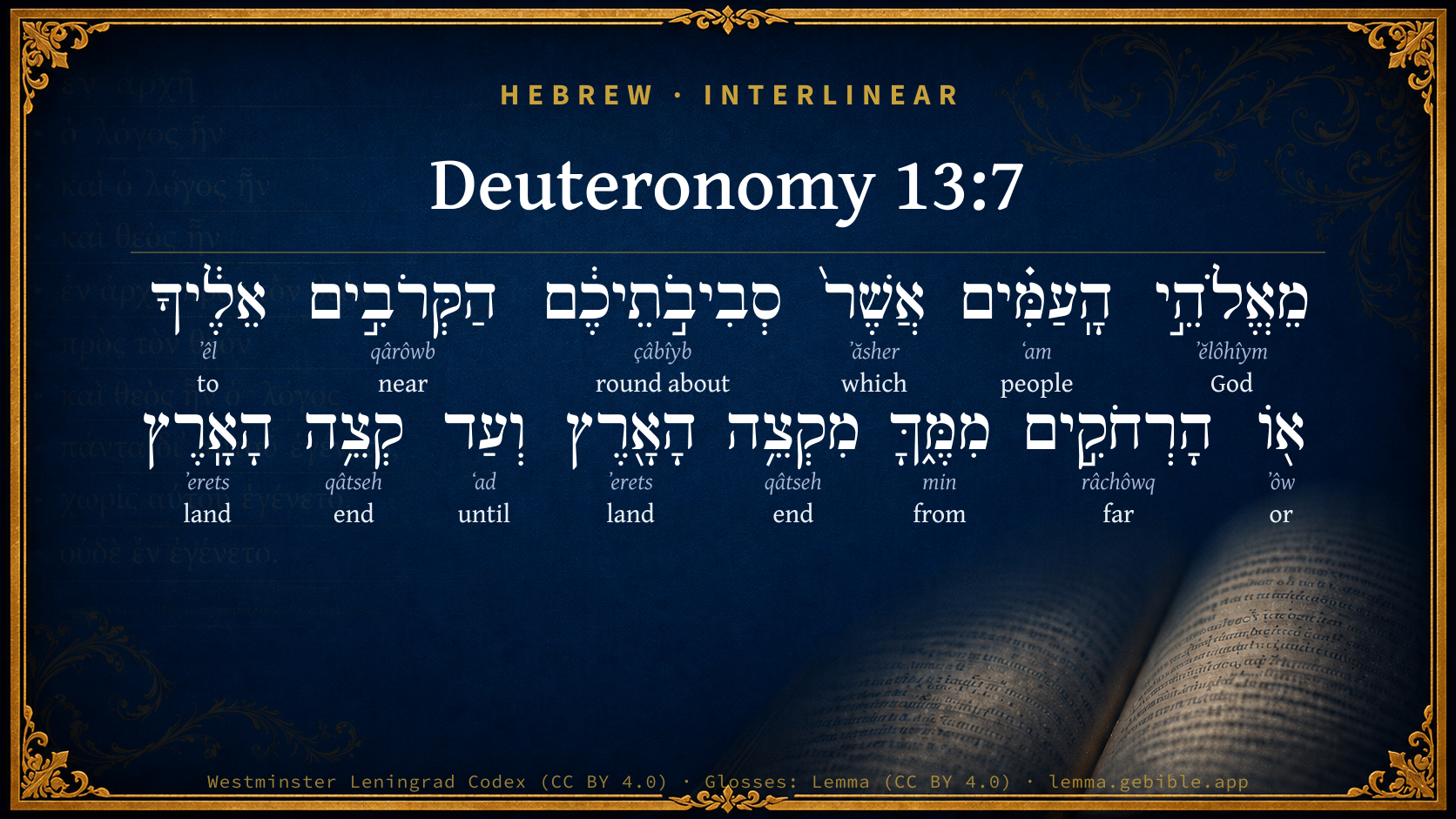
Hebrew (Westminster Leningrad Codex) Deuteronomy 13:7 appears in the Hebrew Old Testament. The text above is from the Westminster Leningrad Codex. Each word links to its Strong’s number, a concise gloss, and parsing drawn from the Open Scriptures Hebrew Bible morphology. Click any word for its full Brown-Driver-Briggs (BDB) entry.
Download image
Cite this verse

Deuteronomy 13:7 (World English Bible). Public Domain. Lemma interlinear Bible study tool, https://lemma.gebible.app/v/deuteronomy/13/7.

Show BibTeX & RIS
BibTeX
RIS
English Translation
of the gods of the peoples who are round about you, near to you, or far off from you, from the one end of the earth even to the other end of the earth;
World English Bible · Public Domain
Download a study sheet

One document with this verse’s original text, its word-by-word gloss line, the meaning frame, cross-references with their text, attributed commentary, and full source and license credits — printable, and it pastes into notes with its structure intact.

This verse Autodidact and up

Study sheet (.html) Plain text (.txt)

A passage Seminary Student

Up to 50 verses in one chapter. A passage sheet keeps up to 6 commentary sources and 12 cross-references per verse, in the order this page ranks them, and says so on the sheet whenever that leaves anything out. Ask for a single verse and you get the Autodidact verse sheet above.

Everything on this page stays free to read, with no account — the sheet is a download of what is already on screen, not access to it.

Want to remove ads? Support Godless Engineer
Compare translations 3

The same verse in 3 English versions, stacked beneath the original-language interlinear above. Click any original word for its lexicon entry.

Each is an independent rendering of the whole verse — the interlinear is not word-aligned to these translations.

Highlighted words mark where these versions differ — a whole-verse word diff, not a word-by-word alignment.

  • World English Bible Public Domain
    of the gods of the peoples who are round about you, near to you, or far off from you, from the one end of the earth even to the other end of the earth;
  • King James Version Public Domain
    Namely, of the gods of the people which are round about you, nigh unto thee, or far off from thee, from the one end of the earth even unto the other end of the earth;
  • unfoldingWord Literal Text CC BY-SA 4.0
    from the gods of the peoples that surround you, near to you or far from you, from end of the earth and to the end of the earth)

unfoldingWord Literal Text — © unfoldingWord, licensed CC BY-SA 4.0. Word-aligned USFM3 via Door43 (git.door43.org/unfoldingWord/en_ult).

Versions to compare (up to 4)

3 of 4 selected

Show all 18 translations

Every available English version of this verse, each an independent rendering of the whole verse.

  • World English Bible Public Domain
    of the gods of the peoples who are round about you, near to you, or far off from you, from the one end of the earth even to the other end of the earth;
  • Berean Standard Bible Public Domain
    the gods of the peoples around you, whether near or far, whether from one end of the earth or the other),
  • Majority Standard Bible Public Domain
    the gods of the peoples around you, whether near or far, whether from one end of the earth or the other),
  • King James Version Public Domain
    Namely, of the gods of the people which are round about you, nigh unto thee, or far off from thee, from the one end of the earth even unto the other end of the earth;
  • American Standard Version (1901) Public Domain
    of the gods of the peoples that are round about you, nigh unto thee, or far off from thee, from the one end of the earth even unto the other end of the earth;
  • Revised Version (1885) Public Domain
    of the gods of the peoples which are round about you, nigh unto thee, or far off from thee, from the one end of the earth even unto the other end of the earth;
  • Geneva Bible (1599) Public Domain
    Any of the gods of the people which are round about you, neere vnto thee or farre off from thee, from the one ende of the earth vnto ye other:
  • Douay-Rheims (1899) Public Domain
    Of all the nations round about, that are near or afar off, from one end of the earth to the other,
  • Young's Literal Translation Public Domain
    of the gods of the peoples who `are' round about you, who are near unto thee, or who are far off from thee, from the end of the earth even unto the end of the earth) --
  • Literal Standard Version CC BY-SA 4.0
    of the gods of the peoples who [are] around you, who are near to you, or who are far off from you, from the end of the earth even to the [other] end of the earth),
  • Unlocked Literal Bible CC BY-SA 4.0
    any of the gods of the peoples that are round about you, near to you, or far off from you, from the one end of the earth to the other end of the earth.'
  • unfoldingWord Literal Text CC BY-SA 4.0
    from the gods of the peoples that surround you, near to you or far from you, from end of the earth and to the end of the earth)
  • Darby Bible Public Domain
    of the gods of the peoples which are round about you, near unto thee, or far from thee, from one end of the earth even unto the other end of the earth),
  • World Messianic Bible Public Domain
    of the gods of the peoples who are around you, near to you, or far off from you, from the one end of the earth even to the other end of the earth—
  • Webster's Bible Public Domain
    Namely, of the gods of the people who are around you, nigh to thee, or far off from thee, from one end of the earth even to the other end of the earth;
  • Free Bible Version CC BY-SA 4.0
    the gods of the nations around you (whether they live close by or far away, in any direction),
  • Bible in Basic English Public Domain
    Gods of the peoples round about you, near or far, from one end of the earth to the other;
  • JPS Tanakh (1917) Public Domain
    (13-8) of the gods of the peoples that are round about you, nigh unto thee, or far off from thee, from the one end of the earth even unto the other end of the earth;

Literal Standard Version (2020), Covenant Press — licensed CC BY-SA 4.0. Text via the HelloAO Bible API (eBible.org). Unlocked Literal Bible (unfoldingWord) — licensed CC BY-SA 4.0. Text via the HelloAO Bible API (eBible.org). unfoldingWord Literal Text — © unfoldingWord, licensed CC BY-SA 4.0. Word-aligned USFM3 via Door43 (git.door43.org/unfoldingWord/en_ult). Free Bible Version, Dr. Jonathan Gallagher — licensed CC BY-SA 4.0. Text via the HelloAO Bible API (eBible.org).

Word by word

More ways to search: Search by grammar → Find every occurrence → Compare this word →

Practice this passage: Drill this verse → Learn its vocabulary →

הַקְּרֹבִ֣ים
qârôwb
H7138
“the · near”
Particle, Definite Article + Adjective, Adjective, Masculine, Plural, Absolute
Part of Speech
Particle + Adjective
Type
Adjective
Gender
Masculine
Number
Plural
State
Absolute
Full BDB Definition

Origin: from H7126

TWOT: 2065d

near - of place - of time - of personal relationship - kinship
  1. מֵאֱלֹהֵ֣י ʼĕlôhîym H430 “from · God(s) of” Preposition + Noun, Common, Masculine, Plural, Construct
  2. הָֽעַמִּ֗ים ʻam H5971 “the · peoples” Particle, Definite Article + Noun, Common, Masculine, Plural, Absolute
  3. אֲשֶׁר֙ ʼăsher H834 “which” Particle, Relative
  4. סְבִיבֹ֣תֵיכֶ֔ם çâbîyb H5439 “surroundings · your” Noun, Common, Both, Plural, Construct + Suffix, Personal, 2nd Person, Masculine, Plural
  5. אֵלֶ֔יךָ ʼêl H413 “to · you” Preposition + Suffix, Personal, 2nd Person, Masculine, Singular
  6. א֖וֹ ʼôw H176 “or” Conjunction
  7. הָרְחֹקִ֣ים râchôwq H7350 “the · far” Particle, Definite Article + Adjective, Adjective, Masculine, Plural, Absolute
  8. מִמֶּ֑ךָּ min H4480 “from · you” Preposition + Suffix, Personal, 2nd Person, Masculine, Singular
  9. מִקְצֵ֥ה qâtseh H7097 “from · end of” Preposition + Noun, Common, Both, Singular, Construct
  10. הָאָ֖רֶץ ʼerets H776 “the · land” Particle, Definite Article + Noun, Common, Both, Singular, Absolute
  11. וְעַד ʻad H5704 “and · until” Conjunction + Preposition
  12. קְצֵ֥ה qâtseh H7097 “end of” Noun, Common, Both, Singular, Construct
  13. הָאָֽרֶץ ʼerets H776 “the · land” Particle, Definite Article + Noun, Common, Both, Singular, Absolute

About this verse

These counts appear in no published source. They are computed here, from the morphology-tagged text and Lemma’s own curated glosses. What Lemma adds →

14
words
12
distinct lemmas
Pentateuch
section

Grammatical profile

  • 7 nouns
  • 2 adjectives
  • 3 prepositions
  • 1 conjunction
  • 1 particle

Repetition

Words recur within this verse — often emphatic in Hebrew:

  • מִקְצֵ֥ה end H7097 ×2
  • הָאָ֖רֶץ land H776 ×2

Hebrew & Septuagint length

In English translation the verse runs 34 words from the Hebrew and 30 from the Septuagint (LXX English) — closely comparable.

A rough comparison of the two English renderings, which tokenize alike — not a word-level alignment.

Word counts can differ between the Hebrew and the Greek without any difference in meaning — e.g. the Hebrew direct-object marker אֵת has no separate Greek word, and Greek often adds the article ὁ.

Hebrew and Greek witnesses Masoretic Hebrew ↔ Greek Septuagint

The same verse in the two great witnesses to the Old Testament, shown verse-for-verse.

These are two independent witnesses, not word-aligned to each other, and the Septuagint is shown in lemma (dictionary) form.

Hebrew Deuteronomy 13:7 Masoretic · Westminster Leningrad Codex

מֵאֱלֹהֵ֣י הָֽעַמִּ֗ים אֲשֶׁר֙ סְבִיבֹ֣תֵיכֶ֔ם הַקְּרֹבִ֣ים אֵלֶ֔יךָ א֖וֹ הָרְחֹקִ֣ים מִמֶּ֑ךָּ מִקְצֵ֥ה הָאָ֖רֶץ וְעַד קְצֵ֥ה הָאָֽרֶץ

of the gods of the peoples who are round about you, near to you, or far off from you, from the one end of the earth even to the other end of the earth;

World English Bible · Public Domain

Greek LXX Deuteronomy 13:7 Septuagint · lemma form

ἐάν δέ παρακαλέω σύ ὁ ἀδελφός σύ ἐκ πατήρ σύ ἤ ἐκ μήτηρ σύ ἤ ὁ υἱός σύ ἤ ὁ θυγάτηρ σύ ἤ ὁ γυνή ὁ ἐν κόλπος σύ ἤ ὁ φίλος ὁ ἴσος ὁ ψυχή σύ λάθρα λέγω βαδίζω καί λατρεύω θεός ἕτερος ὅς οὐ οἶδα σύ καί ὁ πατήρ σύ

of the gods of the nations that are round about you, who are near you or at a distance from you, from one end of the earth to the other;

LXX2012 (modern English Septuagint) · Public Domain

Hebrew: Westminster Leningrad Codex (CC BY 4.0). Greek: Septuagint (public domain); English from LXX2012 (modern English Septuagint) (Public Domain). How the Septuagint differs from the Hebrew →

Targum (Aramaic paraphrase)

2

The Targum is the ancient Jewish Aramaic paraphrase of the Hebrew Scriptures — an interpretive translation, not the Hebrew text itself. Onkelos (literal) and Pseudo-Jonathan (expansive) render the Torah, and Jonathan the Prophets. Coverage is partial: where no permissively-licensed English translation exists for a verse, only the Aramaic is shown. This is verse-level text, not a word-by-word alignment to the Hebrew.

  1. Targum Onkelos Torah (Genesis–Deuteronomy)
    אֲרֵי יְמַלְכִנָךְ אֲחוּךְ בַּר אִמָךְ אוֹ בְרָךְ אוֹ בְרַתָּךְ אוֹ אִתַּת קְיָמָךְ אוֹ חַבְרָךְ דִי כְנַפְשָׁךְ בְּסִתְרָא לְמֵימַר נְהַךְ וְנִפְלַח לְטַעֲוַת עַמְמַיָא דִי לָא יְדַעְתְּ אַתְּ וַאֲבָהָתָךְ

    (no public-domain English translation for this verse)

    Targum Onkelos — Aramaic: “Onkelos Genesis” (public domain); “Onkelos Exodus” (public domain); “Onkelos Leviticus” (public domain); “Onkelos Numbers” (public domain); “Onkelos Deuteronomy” (public domain). English: “Sefaria Community Translation” (CC0 1.0 (public-domain dedication)); “J.W. Etheridge. The Targums of Onkelos and Jonathan Ben Uzziel on the Pentateuch. London: Longmans, Green, 1862” (public domain). Text via Sefaria.

  2. Targum Pseudo-Jonathan Torah (Genesis–Deuteronomy)
    אֲרוּם יַטְעִינָךְ מִילְכָא בִּישָׁא אָחוּךְ בַּר אִימָךְ כָּל דְּכֵן בַּר אִיבָךְ אוֹ בְרָךְ אוֹ בְרַתָּךְ אוֹ אִתְּתָךְ דְּדַמְכָא בְּעוֹדָךְ אוֹ חַבְרָךְ דְּחָבִיב עֲלָךְ כְּנַפְשָׁךְ כָּרַז לְמֵימָר נְהַךְ וְנִפְלַךְ לְטַעֲוַות עַמְמַיָא דְלָא חַכִּימְתָּא אַנְתְּ וְאַבְהָתָךְ

    When thy brother, the son of thy mother, when even the son of thy father, or thy own son or thy daughter, or thy wife who reposeth with thee, or thy friend who is beloved as thy soul, shall give thee evil counsel, to make thee go astray, speaking out and saying, Let us go and worship the gods of the Gentiles, which neither thou nor thy fathers have known;

    Targum Pseudo-Jonathan — Aramaic: “Targum Jonathan on Genesis” (public domain); “Targum Jonathan on Exodus” (public domain); “Targum Jonathan on Leviticus” (public domain); “Targum Jonathan on Numbers” (public domain); “Targum Jonathan on Deuteronomy” (public domain). English: “The Targum of Jonathan ben Uzziel, trans. J. W. Etheridge, London, 1862” (public domain). Text via Sefaria.

Commentary

Notes on Deuteronomy 13:7 from classic Christian and Jewish commentators (each source and its license shown beneath its notes). The classic Christian expositions comment on the surrounding passage and are grouped to its opening verse, so a note may address several verses; the Jewish commentaries on the Tanakh (Rashi and others) are per-verse, so they appear only where the commentator wrote on this verse.

Lemma curates 59 commentaries, every one of them public domain or Creative Commons licensed, each selected and text-cleaned for this edition rather than reprinted as found. About our sources →

John Gill's Exposition

Namely, of the gods of the people which are round about you,.... As of the Edomites, Moabites, Ammonites, and Phoenicians:

nigh unto thee; as the above were, being on the borders of their land: the Targum of Jonathan interprets this of the idols of the seven nations, that is, of the land of Canaan: or

far off from thee; as the Babylonians, Persians, and others:

from the one end of the earth even unto the other end of the earth; which includes all the idols in the world, worshipped by whatsoever nation, and which were forbidden; and which shows the universality of idolatry in those times, and that that is an insufficient argument in its favour. Jarchi interprets this of the sun and moon, and the host of heaven, who go from one end of the world to the other; and this seems to have been the first and most common idolatry of the Gentile world, and which were worshipped in the several deities they set up.

John Gill's Exposition of the Whole Bible (1746–1763) — public domain (CC PDM 1.0). Text via the HelloAO Bible API.

Matthew Poole's English Annotations

He arms against the preference of the universality of this idol worship, wherewith they were like to be oft assaulted.

Matthew Poole's English Annotations on the Holy Bible (1683–1685) — public domain. Text from a community e-Sword/MySword module.

Keil & Delitzsch

C. F. Keil & F. Delitzsch

The second case was when the temptation to idolatry proceeded from the nearest blood-relations and friends. The clause, "son of thy mother," is not intended to describe the brother as a step-brother, but simply to bring out the closeness of the fraternal relation; like the description of the wife as the wife of thy bosom, who lies in thy bosom, rests upon thy breast (as in Deu 28:54; Mic 7:5), and of the friend as "thy friend which is as thine own soul," i.e., whom thou lovest as much as thy life (cf. Sa1 18:1, Sa1 18:3). בּסּתר belongs to יסית: if the temptation occurred in secret, and therefore the fact might be hidden from others. The power of love and relationship, which flesh and blood find it hard to resist, is placed here in contrast with the supposed higher or divine authority of the seducers. As the persuasion was already very seductive, from the fact that it proceeded from the nearest blood-relations and most intimate friends, and was offered in secret, it might become still more so from the fact that it recommended the worship of a deity that had nothing in common with the forbidden idols of Canaan, and the worship of which, therefore, might appear of less consequence, or commend itself by the charm of peculiarity and novelty. To prevent this deceptive influence of sin, it is expressly added in Deu 13:8 (7), "of the gods nigh unto thee or far off from thee, from the one end of the earth even unto the other end of the earth," i.e., whatever gods there might be upon the whole circuit of the earth.

Keil & Delitzsch — Biblical Commentary on the Old Testament (1861–1891) — public domain (CC PDM 1.0). Text via the HelloAO Bible API. (Old Testament only.)

Rashi

Rabbi Shlomo Yitzchaki (Rashi)

כי יסיתך IF [THY BROTHER …] ENTICE THEE — The term יסת always denotes to “stir up”, “to incite”, as it is said, (I Samuel 26:19) ”If it be the Lord that hath stirred thee up (הסיתך) against me” (Sifrei Devarim 87:2); inciter in O. F., Engl, to incite — i.e. that he induces one to act thus.

אחיך THY BROTHER — means, thy brother on the father’s side (Sifrei Devarim 87:4).

בן אמך THE SON OF THY MOTHER — i.e., thy brother on the mother’s side. (The meaning of the Hebrew words is: thy brother or the son of thy mother) (Sifrei Devarim 87:5).

חיקך [OR THE WIFE OF] THY BOSOM — i.e. who lies on thy bosom and is attached (מחוקה) to you, affichee in O. F. Similar is the expression (Ezekiel 43:14) “and from the bottom (מחיק) upon the ground” — i.e. from the foundation that is sunk in the ground.

אשר כנפשך [OR THY FELLOWMAN] WHO IS AS THINE OWN SOUL — Thus refers to thy father (Sifrei Devarim 87:11). Scripture specially mentions all those who are dear to you — that you must not consent unto them nor spare them (v. 9), how much the less should you consent unto others or spare them.

בסתר [IF THY BROTHER ENTICE THEE] SECRETLY — Scripture speaks of what usually occurs (but does not intend to exclude one who entices people publicly), for usually the words of the enticer are spoken in secret. Similarly does Solomon say of the strange woman that she practises her art of seduction (Proverbs 7:9) “In the twilight, in the evening of the day, in the blackness of night and the darkness” (Sifrei Devarim 87:12).

אשר לא ידעת אתה ואבתיך [LET US GO AND SERVE OTHER GODS] WHICH THOU HAST NOT KNOWN, THOU, NOR THY FATHERS — This would be a great disgrace for you: for not even the heathen nations abandon that which their fathers have handed down to them, and this man says to you, “Abandon what thy fathers have handed down to you”! (Sifrei Devarim 87:13).

Rashi on the Tanakh — English translations: “The Judaica Press complete Tanach with Rashi, translated by A. J. Rosenberg” (CC BY 4.0); “Pentateuch with Rashi's commentary by M. Rosenbaum and A.M. Silbermann, 1929-1934” (public domain); “The Metsudah Tanach series, Lakewood, N.J” (CC BY 4.0); and “The Book of Joshua, Metsudah Publications, 1997” (CC BY 4.0). Text via Sefaria.

Lesson kit

Teaching starters — assembled from the data on this page, not authored interpretation. Every prompt links to the verse data it draws on. Edit before teaching.

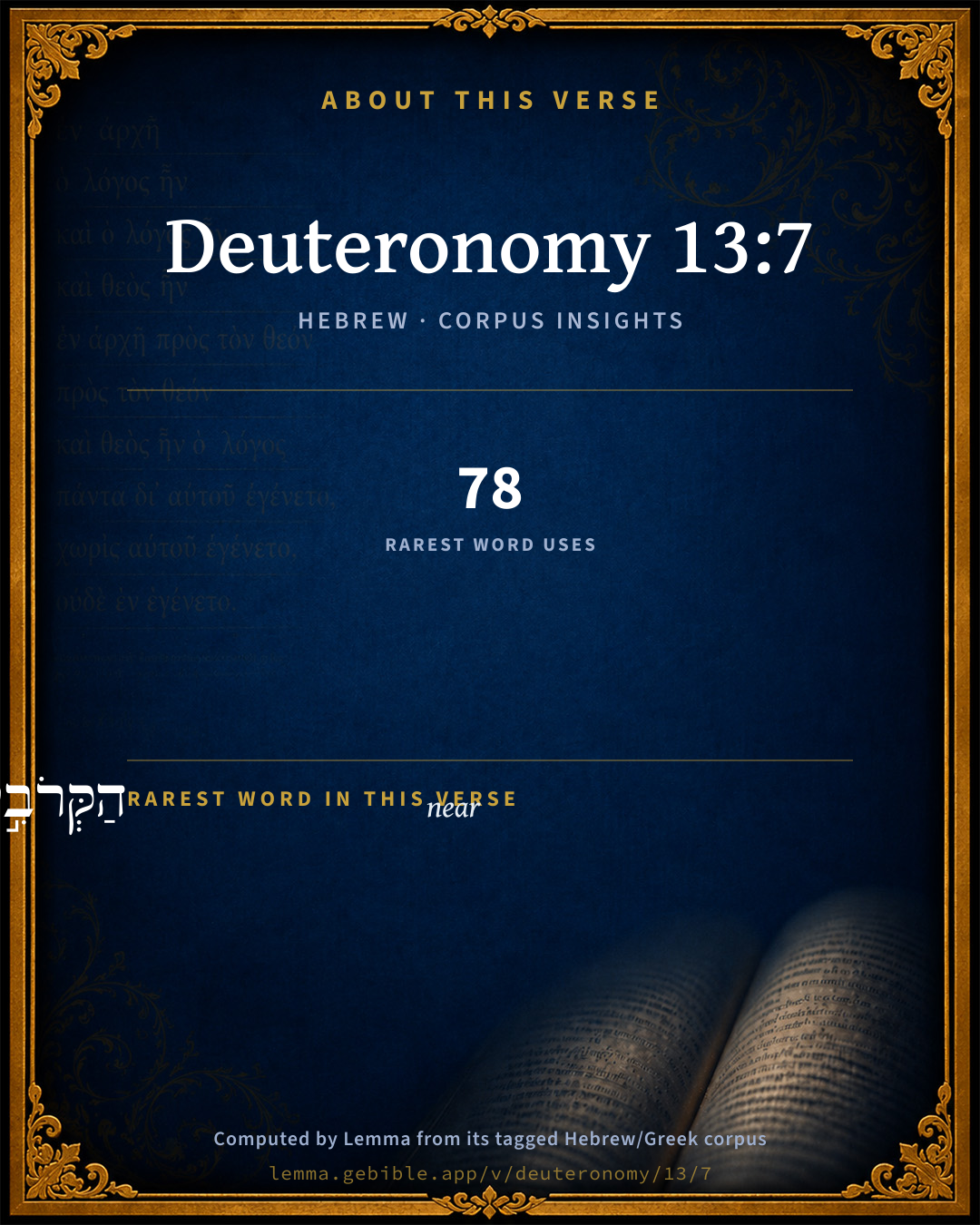
Deuteronomy, in the Pentateuch, opens this verse with 14 words (12 distinct Hebrew lemmas). Its most distinctive word is qârôwb (“near”). A historical commentator’s framing appears above. Read the whole chapter for the surrounding context.

Discussion questions

  1. The word qârôwb carries the sense “near.” How does it shape the verse?
  2. “end” occurs 2× in this one verse. What is the effect of the repetition?
  3. The translations on this page render this verse differently — a whole-verse word diff, not a word-by-word alignment. What might account for the different wordings?
  4. Reading how John Gill's Exposition and Matthew Poole's English Annotations read this verse, where do the two commentators agree and where do they part?

Things to notice

Reading settings

Reading text

Shown beneath each verse's original-language words.

Old Testament
Old Testament edition

Read the OT as the Masoretic Hebrew (MT) or the Greek Septuagint (LXX).

English shown for the Greek Septuagint (in the Hebrew ↔ Greek comparison).

Comparing translations? Open the Compare panel on any verse page to stack up to four side by side.