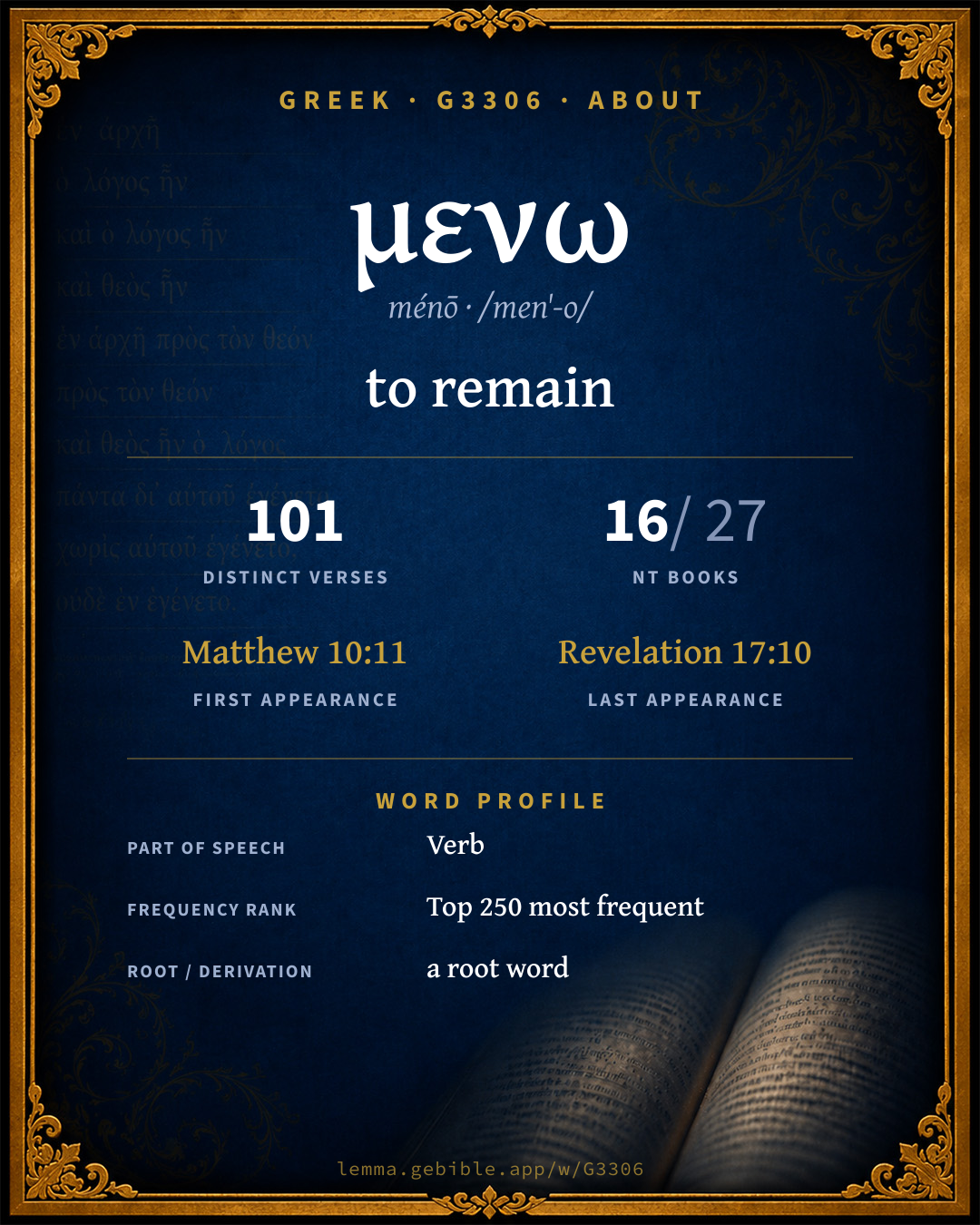
μένω
to remain
‘to remain’ is one of 7 main senses fuller range ↓
Full lexicon entry — Thayer's Greek Lexicon
From Thayer's Greek Lexicon
Where this word appears
See every Present-tense verb in the Greek New Testament →
Grammar key — what these labels mean
Part of speech
- Verb
- An action or state-of-being word.
Tense
- Present
- Ongoing or general action in present time (imperfective aspect).
- Aorist
- Action viewed as a simple whole, without regard to duration — often past (perfective aspect).
- Imperfect
- Continuous or repeated action in past time (“was writing”).
- Future
- Action expected in future time.
- Pluperfect
- A past action completed before another past point (“had written”).
Voice
- Active
- The subject performs the action.
Mood
- Indicative
- States a fact or asks a factual question (the mood of reality).
- Participle
- A verbal adjective (“writing,” “having written”).
- Infinitive
- A verbal noun (“to write”), unmarked for person or number.
- Subjunctive
- Expresses probability, purpose, or possibility (the mood of contingency).
- Imperative
- Expresses a command or request.
Case
- Nominative
- The case of the subject (and the predicate nominative).
- Accusative
- The case of the direct object and of extent.
- Genitive
- The case of source, possession, or “of” — answers “whose / from what.”
Person
- 3rd person
- The one spoken about (“he / she / it / they”).
- 2nd person
- The one addressed (“you”).
- 1st person
- The speaker (“I / we”).
Gender
- Masculine
- Grammatically masculine.
- Feminine
- Grammatically feminine.
- Neuter
- Grammatically neuter.
Number
- Singular
- One.
- Plural
- More than one.
Grammatical forms 33 distinct
- Verb, Present, Active, Indicative, 3rd person, Singular 28 times (24%)
- Verb, Aorist, Active, Indicative, 3rd person, Singular 9 times (8%)
- Verb, Present, Active, Participle, Nominative, Singular, Masculine 7 times (6%)
- Verb, Aorist, Active, Infinitive 6 times (5%)
- Verb, Aorist, Active, Subjunctive, 3rd person, Singular 6 times (5%)
- Verb, Aorist, Active, Imperative, 2nd person, Plural 5 times (4%)
- Verb, Present, Active, Imperative, 2nd person, Plural 5 times (4%)
- Verb, Present, Active, Imperative, 3rd person, Singular 5 times (4%)
+25 more forms (46 occurrences)
Parsed forms decoded from the imported morphology (Robinson–Tischendorf, public domain), counted across 117 parsed occurrences — not distinct verses.
Every verse where G3306 appears — 101 distinct verses across 16 books. Click any verse to open its interlinear word-by-word view. Verse text shown in the World English Bible for context — . Each verse’s Greek form is shown with its reference; the English is not keyword-highlighted, since the data carries no word-level English alignment. Use “Compare translations” on any verse to read it across multiple English versions. This concordance covers the Greek New Testament; Septuagint (Greek Old Testament) occurrences of this word are not indexed here.
Matthew 3 verses
- Matthew 10:11 μείνατε aor act impv 2pl Into whatever city or village you enter, find out who in it is worthy; and stay there until you go on.
- Matthew 11:23 ἔμεινεν aor act ind 3sg You, Capernaum, who are exalted to Heaven, you will go down to Hades. For if the mighty works had been done in Sodom which were done in you, it would have remained until this day.
- Matthew 26:38 μείνατε aor act impv 2pl Then he said to them, "My soul is exceedingly sorrowful, even to death. Stay here, and watch with me."
Mark 2 verses
Luke 6 verses
- Luke 1:56 Ἔμεινεν aor act ind 3sg Mary stayed with her about three months, and then returned to her house.
- Luke 8:27 ἔμενεν impf act ind 3sg When Jesus stepped ashore, a certain man out of the city who had demons for a long time met him. He wore no clothes, and didn't live in a house, but in the tombs.
- Luke 9:4 μένετε pres act impv 2pl Into whatever house you enter, stay there, and depart from there.
- Luke 10:7 μένετε pres act impv 2pl Remain in that same house, eating and drinking the things they give, for the laborer is worthy of his wages. Don't go from house to house.
- Luke 19:5 μεῖναι aor act inf When Jesus came to the place, he looked up and saw him, and said to him, "Zacchaeus, hurry and come down, for today I must stay at your house."
- Luke 24:29 μεῖνον μεῖναι aor act impv 2sg aor act inf They urged him, saying, "Stay with us, for it is almost evening, and the day is almost over." He went in to stay with them.
John 32 verses
- John 1:32 ἔμεινεν aor act ind 3sg John testified, saying, "I have seen the Spirit descending like a dove out of heaven, and it remained on him.
- John 1:33 μένον pres act ptcp acc sg neut I didn't recognize him, but he who sent me to baptize in water, he said to me, 'On whomever you will see the Spirit descending, and remaining on him, the same is he who baptizes in the Holy Spirit.'
- John 1:39 μένεις pres act ind 2sg He said to them, "Come, and see." They came and saw where he was staying, and they stayed with him that day. It was about the tenth hour.
- John 1:40 μένει ἔμειναν pres act ind 3sg aor act ind 3pl One of the two who heard John, and followed him, was Andrew, Simon Peter's brother.
- John 2:12 ἔμειναν aor act ind 3pl After this, he went down to Capernaum, he, and his mother, his brothers, and his disciples; and they stayed there a few days.
- John 3:36 μένει pres act ind 3sg One who believes in the Son has eternal life, but one who disobeys the Son won't see life, but the wrath of God remains on him."
- John 4:40 μεῖναι ἔμεινεν aor act inf aor act ind 3sg So when the Samaritans came to him, they begged him to stay with them. He stayed there two days.
- John 5:38 μένοντα pres act ptcp acc sg masc You don't have his word living in you; because you don't believe him whom he sent.
- John 6:27 μένουσαν pres act ptcp acc sg fem Don't work for the food which perishes, but for the food which remains to eternal life, which the Son of Man will give to you. For God the Father has sealed him."
- John 6:56 μένει pres act ind 3sg He who eats my flesh and drinks my blood lives in me, and I in him.
- John 7:9 ἔμεινεν aor act ind 3sg Having said these things to them, he stayed in Galilee.
- John 8:31 μείνητε aor act subj 2pl Jesus therefore said to those Jews who had believed him, "If you remain in my word, then you are truly my disciples.
- John 8:35 μένει μένει pres act ind 3sg pres act ind 3sg A bondservant doesn't live in the house forever. A son remains forever.
- John 9:41 μένει pres act ind 3sg Jesus said to them, "If you were blind, you would have no sin; but now you say, 'We see.' Therefore your sin remains.
- John 10:40 ἔμεινεν aor act ind 3sg He went away again beyond the Jordan into the place where John was baptizing at first, and there he stayed.
- John 11:6 ἔμεινεν aor act ind 3sg When therefore he heard that he was sick, he stayed two days in the place where he was.
- John 12:24 μένει pres act ind 3sg Most assuredly I tell you, unless a grain of wheat falls into the earth and dies, it remains by itself alone. But if it dies, it bears much fruit.
- John 12:34 μένει pres act ind 3sg The multitude answered him, "We have heard out of the law that the Christ remains forever. How do you say, 'The Son of Man must be lifted up?' Who is this Son of Man?"
- John 12:46 μείνῃ aor act subj 3sg I have come as a light into the world, that whoever believes in me may not remain in the darkness.
- John 14:10 μένων pres act ptcp nom sg masc Don't you believe that I am in the Father, and the Father in me? The words that I tell you, I speak not from myself; but the Father who lives in me does his works.
- John 14:17 μένει pres act ind 3sg the Spirit of truth, whom the world can't receive; for it doesn't see him, neither knows him. You know him, for he lives with you, and will be in you.
- John 14:25 μένων pres act ptcp nom sg masc I have said these things to you, while still living with you.
- John 15:4 μείνατε μένῃ μένητε aor act impv 2pl pres act subj 3sg pres act subj 2pl Remain in me, and I in you. As the branch can't bear fruit by itself, unless it remains in the vine, so neither can you, unless you remain in me.
- John 15:5 μένων pres act ptcp nom sg masc I am the vine. You are the branches. He who remains in me, and I in him, the same bears much fruit, for apart from me you can do nothing.
- John 15:6 μένῃ pres act subj 3sg If a man doesn't remain in me, he is thrown out as a branch, and is withered; and they gather them, throw them into the fire, and they are burned.
- John 15:7 μείνητε μείνῃ aor act subj 2pl aor act subj 3sg If you remain in me, and my words remain in you, you will ask whatever you desire, and it will be done for you.
- John 15:9 μείνατε aor act impv 2pl Even as the Father has loved me, I also have loved you. Remain in my love.
- John 15:10 μενεῖτε μένω fut act ind 2pl pres act ind 1sg If you keep my commandments, you will remain in my love; even as I have kept my Father's commandments, and remain in his love.
- John 15:16 μένῃ pres act subj 3sg You didn't choose me, but I chose you, and appointed you, that you should go and bear fruit, and that your fruit should remain; that whatever you will ask of the Father in my name, he may give it to you.
- John 19:31 μείνῃ aor act subj 3sg Therefore the Jews, because it was the Preparation Day, so that the bodies wouldn't remain on the cross on the Sabbath (for that Sabbath was a special one), asked of Pilate that their legs might be broken, and that they might be taken away.
- John 21:22 μένειν pres act inf Jesus said to him, "If I desire that he stay until I come, what is that to you? You follow me."
- John 21:23 μένειν pres act inf This saying therefore went out among the brothers, that this disciple wouldn't die. Yet Jesus didn't say to him that he wouldn't die, but, "If I desire that he stay until I come, what is that to you?"
Acts 12 verses
- Acts 5:4 μένον ἔμενεν pres act ptcp nom sg neut impf act ind 3sg While you kept it, didn't it remain your own? After it was sold, wasn't it in your power? How is it that you have conceived this thing in your heart? You haven't lied to men, but to God."
- Acts 9:43 μεῖναι aor act inf It happened, that he stayed many days in Joppa with one Simon, a tanner.
- Acts 16:15 μένετε pres act impv 2pl When she and her household were baptized, she begged us, saying, "If you have judged me to be faithful to the Lord, come into my house, and stay." So she persuaded us.
- Acts 18:3 ἔμενεν impf act ind 3sg and because he practiced the same trade, he lived with them and worked, for by trade they were tent makers.
- Acts 18:20 μεῖναι aor act inf When they asked him to stay with them a longer time, he declined;
- Acts 20:5 ἔμενον impf act ind 3pl But these had gone ahead, and were waiting for us at Troas.
- Acts 20:23 μένουσιν pres act ind 3pl except that the Holy Spirit testifies in every city, saying that bonds and afflictions wait for me.
- Acts 21:7 ἐμείναμεν aor act ind 1pl When we had finished the voyage from Tyre, we arrived at Ptolemais. We greeted the brothers, and stayed with them one day.
- Acts 21:8 ἐμείναμεν aor act ind 1pl On the next day, we, who were Paul's companions, departed, and came to Caesarea. We entered into the house of Philip the evangelist, who was one of the seven, and stayed with him.
- Acts 27:31 μείνωσιν aor act subj 3pl Paul said to the centurion and to the soldiers, "Unless these stay in the ship, you can't be saved."
- Acts 27:41 ἔμεινεν aor act ind 3sg But coming to a place where two seas met, they ran the vessel aground. The bow struck and remained immovable, but the stern began to break up by the violence of the waves.
- Acts 28:16 μένειν pres act inf When we entered into Rome, the centurion delivered the prisoners to the captain of the guard, but Paul was allowed to stay by himself with the soldier who guarded him.
Romans 1 verse
1 Corinthians 8 verses
- 1 Corinthians 3:14 μενεῖ fut act ind 3sg If any man's work remains which he built on it, he will receive a reward.
- 1 Corinthians 7:8 μείνωσιν aor act subj 3pl But I say to the unmarried and to widows, it is good for them if they remain even as I am.
- 1 Corinthians 7:11 μενέτω pres act impv 3sg (but if she departs, let her remain unmarried, or else be reconciled to her husband), and that the husband not leave his wife.
- 1 Corinthians 7:20 μενέτω pres act impv 3sg Let each man stay in that calling in which he was called.
- 1 Corinthians 7:24 μενέτω pres act impv 3sg Brothers, let each man, in whatever condition he was called, stay in that condition with God.
- 1 Corinthians 7:40 μείνῃ aor act subj 3sg But she is happier if she stays as she is, in my judgment, and I think that I also have God's Spirit.
- 1 Corinthians 13:13 μένει pres act ind 3sg But now faith, hope, and love remain--these three. The greatest of these is love.
- 1 Corinthians 15:6 μένουσιν pres act ind 3pl Then he appeared to over five hundred brothers at once, most of whom remain until now, but some have also fallen asleep.
2 Corinthians 3 verses
- 2 Corinthians 3:11 μένον pres act ptcp nom sg neut For if that which passes away was with glory, much more that which remains is in glory.
- 2 Corinthians 3:14 μένει pres act ind 3sg But their minds were hardened, for until this very day at the reading of the old covenant the same veil remains, because in Christ it passes away.
- 2 Corinthians 9:9 μένει pres act ind 3sg As it is written, "He has scattered abroad, he has given to the poor. His righteousness remains forever."
Philippians 1 verse
1 Timothy 1 verse
2 Timothy 3 verses
- 2 Timothy 2:13 μένει pres act ind 3sg If we are faithless, He remains faithful. He can't deny himself.
- 2 Timothy 3:14 μένε pres act impv 2sg But you remain in the things which you have learned and have been assured of, knowing from whom you have learned them.
- 2 Timothy 4:20 ἔμεινεν aor act ind 3sg Erastus remained at Corinth, but I left Trophimus at Miletus sick.
Hebrews 6 verses
- Hebrews 7:3 μένει pres act ind 3sg without father, without mother, without genealogy, having neither beginning of days nor end of life, but made like the Son of God), remains a priest continually.
- Hebrews 7:24 μένειν pres act inf But he, because he lives forever, has his priesthood unchangeable.
- Hebrews 10:34 μένουσαν pres act ptcp acc sg fem For you both had compassion on me in my chains, and joyfully accepted the plundering of your possessions, knowing that you have for yourselves a better possession and an enduring one in the heavens.
- Hebrews 12:27 μείνῃ aor act subj 3sg This phrase, "Yet once more," signifies the removing of those things that are shaken, as of things that have been made, that those things which are not shaken may remain.
- Hebrews 13:1 μενέτω pres act impv 3sg Let brotherly love continue.
- Hebrews 13:14 μένουσαν pres act ptcp acc sg fem For we don't have here an enduring city, but we seek that which is to come.
1 Peter 2 verses
- 1 Peter 1:23 μένοντος pres act ptcp gen sg masc having been born again, not of corruptible seed, but of incorruptible, through the word of God, which lives and remains forever.
- 1 Peter 1:25 μένει pres act ind 3sg But the Lord's word endures forever." This is the word of good news which was preached to you.
1 John 18 verses
- 1 John 2:6 μένειν pres act inf he who says he remains in him ought himself also to walk just like he walked.
- 1 John 2:10 μένει pres act ind 3sg He who loves his brother remains in the light, and there is no occasion for stumbling in him.
- 1 John 2:14 μένει pres act ind 3sg I have written to you, fathers, because you know him who is from the beginning. I have written to you, young men, because you are strong, and the word of God remains in you, and you have overcome the evil one.
- 1 John 2:17 μένει pres act ind 3sg The world is passing away with its lusts, but he who does God's will remains forever.
- 1 John 2:19 μεμενήκεισαν plup act ind 3pl They went out from us, but they didn't belong to us; for if they had belonged to us, they would have continued with us. But they left, that they might be revealed that none of them belong to us.
- 1 John 2:24 μενέτω μείνῃ μενεῖτε pres act impv 3sg aor act subj 3sg fut act ind 2pl Therefore, as for you, let that remain in you which you heard from the beginning. If that which you heard from the beginning remains in you, you also will remain in the Son, and in the Father.
- 1 John 2:27 μένει μένετε pres act ind 3sg pres act ind 2pl As for you, the anointing which you received from him remains in you, and you don't need for anyone to teach you. But as his anointing teaches you concerning all things, and is true, and is no lie, and even as it taught you, you will remain in him.
- 1 John 2:28 μένετε pres act impv 2pl Now, little children, remain in him, that when he appears, we may have boldness, and not be ashamed before him at his coming.
- 1 John 3:6 μένων pres act ptcp nom sg masc Whoever remains in him doesn't sin. Whoever sins hasn't seen him, neither knows him.
- 1 John 3:9 μένει pres act ind 3sg Whoever is born of God doesn't commit sin, because his seed remains in him; and he can't sin, because he is born of God.
- 1 John 3:14 μένει pres act ind 3sg We know that we have passed out of death into life, because we love the brothers. He who doesn't love his brother remains in death.
- 1 John 3:15 μένουσαν pres act ptcp acc sg fem Whoever hates his brother is a murderer, and you know that no murderer has eternal life remaining in him.
- 1 John 3:17 μένει pres act ind 3sg But whoever has the world's goods, and sees his brother in need, and closes his heart of compassion against him, how does the love of God remain in him?
- 1 John 3:24 μένει μένει pres act ind 3sg pres act ind 3sg He who keeps his commandments remains in him, and he in him. By this we know that he remains in us, by the Spirit which he gave us.
- 1 John 4:12 μένει pres act ind 3sg No one has seen God at any time. If we love one another, God remains in us, and his love has been perfected in us.
- 1 John 4:13 μένομεν pres act ind 1pl By this we know that we remain in him and he in us, because he has given us of his Spirit.
- 1 John 4:15 μένει pres act ind 3sg Whoever confesses that Jesus is the Son of God, God remains in him, and he in God.
- 1 John 4:16 μένων μένει μένει pres act ptcp nom sg masc pres act ind 3sg pres act ind 3sg We know and have believed the love which God has for us. God is love, and he who remains in love remains in God, and God remains in him.
2 John 2 verses
- 2 John 1:2 μένουσαν pres act ptcp acc sg fem for the truth's sake, which remains in us, and it will be with us forever:
- 2 John 1:9 μένων μένων pres act ptcp nom sg masc pres act ptcp nom sg masc Whoever transgresses and doesn't remain in the teaching of Christ, doesn't have God. He who remains in the teaching, the same has both the Father and the Son.
Revelation 1 verse
About this entry
At a glance — auto-summarized from this page’s data, not written by a person. Every figure links to its source below. This summary describes the numbers; it doesn’t interpret them.
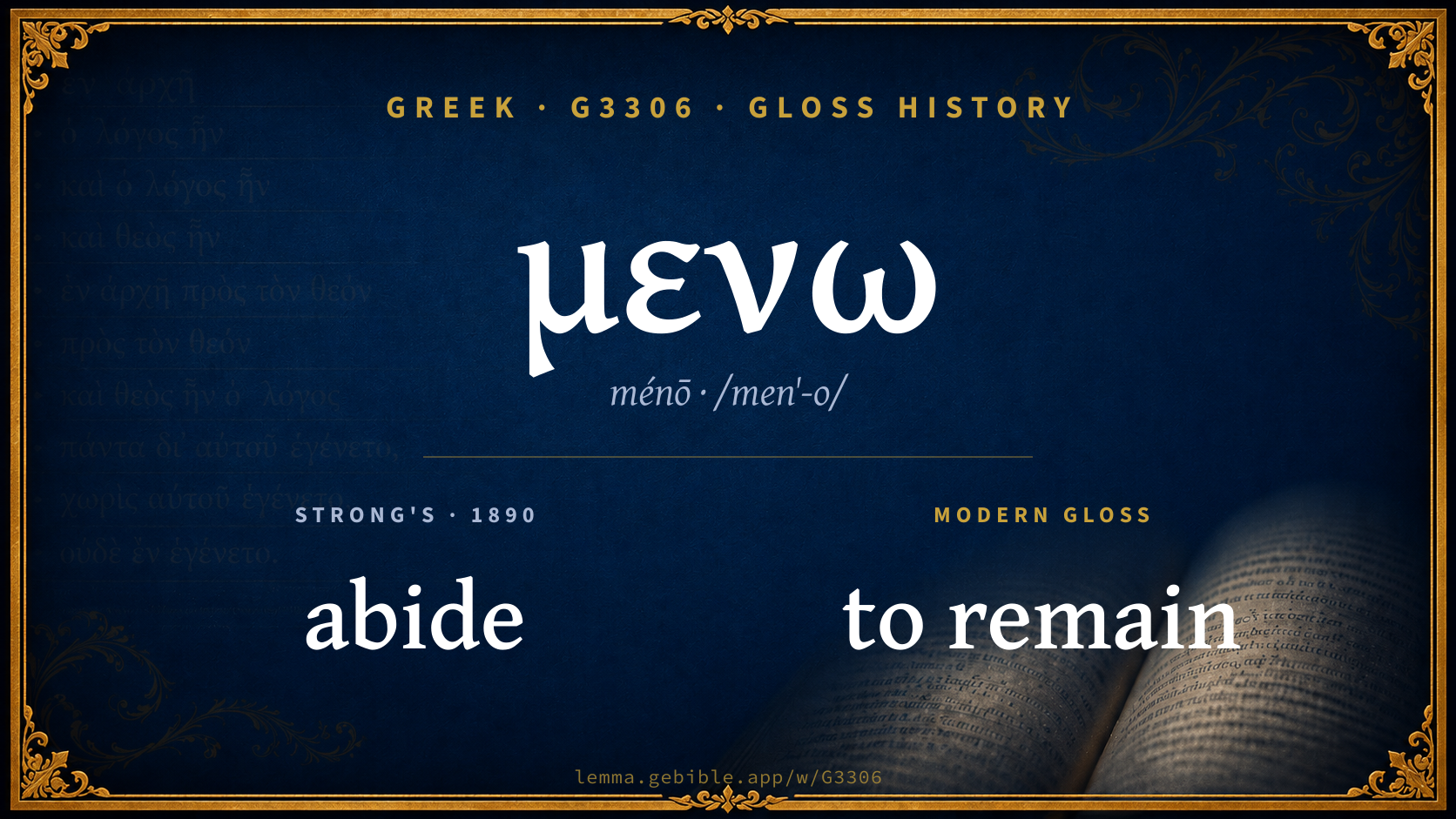
μενω (ménō) is a Greek verb most often rendered “to remain.” Its English rendering has broadened — “abide” classically, “remains” (Berean Standard Bible) and “remain” (unfoldingWord Literal Text) in modern versions; see the renderings breakdown. Spanning 101 verses in 16 books, it ranks among the common words of the Greek New Testament. John dominates its distribution — 32 of 101 verses. Its lexical range runs to 7 senses. For the data behind this summary, explore the sense tree and the renderings breakdown below.
Gloss history
Strong's 1890 vs modern scholarship
About this word
Strong's G3306 catalogs a Greek word from the Greek New Testament.
These counts are not copied from any lexicon or concordance. They are computed here, from the morphology-tagged Greek New Testament. What Lemma adds →
- 101
- distinct verses
- The word appears in 101 distinct verses.
- 16 / 27
- NT books
- The word appears in 16 of 27 New Testament books.
- #140
- by frequency
- Top 250 most frequent Greek words (rank 140 of 5,347 Greek words by occurrence).
View all 101 occurrences in the concordance →
By section of the New Testament
By traditional corpus
Conventional, traditional groupings — biblical authorship is debated, so this is a traditional corpus grouping, not an authorship claim. Some books belong to more than one corpus (Luke is in both the Gospels and the Lukan corpus, and so on), so these shares overlap and need not total 100%. Each figure is a share of the word’s 101 distinct verses.
- Johannine 53 verses · 52%
- Gospels 43 verses · 43%
- General (Catholic) Epistles 22 verses · 22%
- Lukan (Luke–Acts) 18 verses · 18%
- Pauline corpus 17 verses · 17%
- Hebrews 6 verses · 6%
- Revelation 1 verse · 1%
How translations render this word
Counts come from each version’s own published word-to-Strong’s tagging or interlinear alignment — an approximate guide to how each version renders this word, not a word-level alignment the data otherwise carries. Because each total is that version’s own tagged count, the per-version totals vary from one another and need not match the appearance or distinct-verse counts above. These counts may also differ from a printed concordance because Lemma counts each distinctly tagged rendering and does not collapse phrase taggings into a single head-word total. This is a fixed set of word-tagged versions (KJV, ASV, BSB, ULT) and does not change with the reading translation you choose elsewhere. Each version’s license is shown beside its name below (and on Sources).
- King James Version: Abide 20×, Abideth 16×, Dwelleth 8×
- American Standard Version: Abideth 27×, Abide 24×, Abiding 6×
- Berean Standard Bible: Remains 17×, Remain 15×, Stay 13×
- unfoldingWord Literal Text: Remain 25×, Remains 23×, Remaining 10×
King James Version Public Domain
Renders G3306 across 125 tagged occurrences — most commonly:
Plus other, less common renderings. Plus 30 renderings that appear only once — usually multi-word phrases or single function words the recovered tagging swept in, not distinct renderings. Not rendered by a distinct English word in 2 further occurrences.
American Standard Version Public Domain
Renders G3306 across 127 tagged occurrences — most commonly:
Plus other, less common renderings. Plus 32 renderings that appear only once — usually multi-word phrases or single function words the recovered tagging swept in, not distinct renderings.
Berean Standard Bible Public Domain
Renders G3306 across 115 tagged occurrences — most commonly:
Plus other, less common renderings. Plus 36 renderings that appear only once — usually multi-word phrases or single function words the recovered tagging swept in, not distinct renderings. Not rendered by a distinct English word in 2 further occurrences.
unfoldingWord Literal Text CC BY-SA 4.0
Renders G3306 across 129 tagged occurrences — most commonly:
Plus other, less common renderings. Plus 31 renderings that appear only once — usually multi-word phrases or single function words the recovered tagging swept in, not distinct renderings.
7 senses in Thayer's, in lexicon order
The 7 senses Thayer's distinguishes for this word, in lexicon order (not ranked by frequency or importance). The full entry — with sub-senses — is in the Lexicon Entry tab.
- in reference to place
- to continue to be present 1a
- to be held, kept, continually
- in reference to time
- of persons, to survive, live
- in reference to state or condition
- to wait for, await one
Word origin
Origin: a root word
A primary verb; to stay (in a given place state relation or expectancy): - abide continue dwell endure be present remain stand tarry (for) X thine own.
— Strong’s Exhaustive Concordance (1890), public domain.
Forms in the corpus
The 32 distinct written forms G3306 takes in the Greek New Testament, most frequent first — each parse links to that tense’s occurrences in the concordance.
Same root — word family
Other Thayer's entries built from the same root as G3306, grouped by Strong’s listed origin. These share a root / origin per the lexicon — not necessarily a shared meaning. Each links to that word’s own entry.
Derived from this word
Compare all same-root words → They share a root, not necessarily a meaning.
Septuagint usage
The same Greek word μενω appears 52 times in the Greek Old Testament (Septuagint), across 52 verses in 15 books.
- 52
- LXX occurrences
- Tagged occurrences of this Greek word in the Septuagint.
- 52
- verses
- Distinct Septuagint verses containing this word.
- 15 / 39
- OT books
- The word appears in 15 of the 39 Old Testament books.
Sample Septuagint occurrences
- Genesis 24:55 μένω
- Exodus 9:28 μένω
- Leviticus 13:5 μένω
- Numbers 30:5 μένω
- 1 Samuel 20:11 μένω
- 2 Samuel 18:14 μένω
- 2 Kings 7:9 μένω
- Job 15:23 μένω
- Psalms 9:8 μένω
- Proverbs 15:22 μένω
- Ecclesiastes 7:15 μένω
- Isaiah 5:2 μένω
Septuagint occurrences (same lexeme)
Every verse where the same Strong’s number (G3306) appears in the Greek Septuagint — showing the first 50 of 52. Verse text shown in the World English Bible for context; the Greek form is the matched word — the English is not keyword-highlighted.
- Genesis 24:55 μένω Her brother and her mother said, "Let the young lady stay with us a few days, at least ten. After that she will go."
- Genesis 45:9 μένω Hurry, and go up to my father, and tell him, 'This is what your son Joseph says, "God has made me lord of all Egypt. Come down to me. Don't wait.
- Exodus 9:28 μένω Pray to Yahweh; for there has been enough of mighty thunderings and hail. I will let you go, and you shall stay no longer."
- Leviticus 13:5 μένω The priest shall examine him on the seventh day, and, behold, if in his eyes the plague is arrested, and the plague hasn't spread in the skin, then the priest shall isolate him for seven more days.
- Leviticus 13:23 μένω But if the bright spot stays in its place, and hasn't spread, it is the scar from the boil; and the priest shall pronounce him clean.
- Leviticus 13:28 μένω If the bright spot stays in its place, and hasn't spread in the skin, but is faded, it is the swelling from the burn, and the priest shall pronounce him clean; for it is the scar from the burn.
- Leviticus 13:37 μένω But if in his eyes the itch is arrested, and black hair has grown in it; the itch is healed, he is clean. The priest shall pronounce him clean.
- Numbers 30:5 μένω But if her father disallow her in the day that he hears, none of her vows, or of her bonds with which she has bound her soul, shall stand: and Yahweh will forgive her, because her father disallowed her.
- Numbers 30:9 μένω But the vow of a widow, or of her who is divorced, [even] everything with which she has bound her soul, shall stand against her.
- Numbers 30:10 μένω If she vowed in her husband's house, or bound her soul by a bond with an oath,
- Numbers 30:13 μένω Every vow, and every binding oath to afflict the soul, her husband may establish it, or her husband may make it void.
- 1 Samuel 20:11 μένω Jonathan said to David, Come, and let us go out into the field. They went out both of them into the field.
- 2 Samuel 18:14 μένω Then said Joab, I may not wait thus with you. He took three darts in his hand, and thrust them through the heart of Absalom, while he was yet alive in the midst of the oak.
- 2 Kings 7:9 μένω Then they said one to another, We aren't doing right. This day is a day of good news, and we hold our peace: if we wait until the morning light, punishment will overtake us; now therefore come, let us go and tell the king's household.
- 2 Kings 9:3 μένω Then take the vial of oil, and pour it on his head, and say, Thus says Yahweh, I have anointed you king over Israel. Then open the door, and flee, and don't wait.
- Job 15:23 μένω He wanders abroad for bread, saying, 'Where is it?' He knows that the day of darkness is ready at his hand.
- Job 15:29 μένω He shall not be rich, neither shall his substance continue, Neither shall their possessions be extended on the earth.
- Job 21:11 μένω They send forth their little ones like a flock. Their children dance.
- Job 36:2 μένω "Bear with me a little, and I will show you; For I still have something to say on God's behalf.
- Psalms 9:8 μένω He will judge the world in righteousness. He will administer judgment to the peoples in uprightness.
- Psalms 32:11 μένω Be glad in Yahweh, and rejoice, you righteous! Shout for joy, all you who are upright in heart!
- Psalms 88:37 μένω
- Psalms 101:13 μένω
- Psalms 110:3 μένω Your people offer themselves willingly in the day of your power, in holy array. Out of the womb of the morning, you have the dew of your youth.
- Psalms 110:10 μένω
- Psalms 111:3 μένω His work is honor and majesty. His righteousness endures forever.
- Psalms 111:9 μένω He has sent redemption to his people. He has ordained his covenant forever. His name is holy and awesome!
- Psalms 116:2 μένω Because he has turned his ear to me, Therefore I will call on him as long as I live.
- Proverbs 15:22 μένω Where there is no counsel, plans fail; But in a multitude of counselors they are established.
- Proverbs 19:21 μένω There are many plans in a man's heart, But Yahweh's counsel will prevail.
- Ecclesiastes 7:15 μένω All this have I seen in my days of vanity: there is a righteous man who perishes in his righteousness, and there is a wicked man who lives long in his evil-doing.
- Isaiah 5:2 μένω He dug it up, Gathered out its stones, Planted it with the choicest vine, Built a tower in its midst, And also cut out a winepress therein. He looked for it to yield grapes, But it yielded wild grapes.
- Isaiah 5:4 μένω What could have been done more to my vineyard, that I have not done in it? Why, when I looked for it to yield grapes, did it yield wild grapes?
- Isaiah 5:7 μένω For the vineyard of Yahweh of Hosts is the house of Israel, And the men of Judah his pleasant plant: And he looked for justice, but, behold, oppression; For righteousness, but, behold, a cry of distress.
- Isaiah 5:11 μένω Woe to those who rise up early in the morning, that they may follow strong drink; Who stay late into the night, until wine inflames them!
- Isaiah 8:17 μένω I will wait for Yahweh, who hides his face from the house of Jacob, and I will look for him.
- Isaiah 10:32 μένω This very day shall he halt at Nob: he shakes his hand at the mountain of the daughter of Zion, the hill of Jerusalem.
- Isaiah 14:20 μένω You shall not be joined with them in burial, because you have destroyed your land, you have killed your people; the seed of evil-doers shall not be named forever.
- Isaiah 14:24 μένω Yahweh of Hosts has sworn, saying, Surely, as I have thought, so shall it happen; and as I have purposed, so shall it stand:
- Isaiah 27:9 μένω Therefore by this shall the iniquity of Jacob be forgiven, and this is all the fruit of taking away his sin: that he makes all the stones of the altar as chalk stones that are beaten in sunder, [so that] the Asherim and the sun-images shall rise no more.
- Isaiah 30:18 μένω Therefore will Yahweh wait, that he may be gracious to you; and therefore will he be exalted, that he may have mercy on you: for Yahweh is a God of justice; blessed are all those who wait for him.
- Isaiah 32:8 μένω But the noble devises noble things; and in noble things shall he continue.
- Isaiah 40:8 μένω The grass withers, the flower fades; but the word of our God shall stand forever.
- Isaiah 46:7 μένω They bear it on the shoulder, they carry it, and set it in its place, and it stands, from its place it shall not move: yes, one may cry to it, yet it can not answer, nor save him out of his trouble.
- Isaiah 59:9 μένω Therefore is justice far from us, neither does righteousness overtake us: we look for light, but, behold, darkness; for brightness, but we walk in obscurity.
- Isaiah 66:22 μένω For as the new heavens and the new earth, which I will make, shall remain before me, says Yahweh, so shall your seed and your name remain.
- Jeremiah 26:15 μένω Only know for certain that, if you put me to death, you will bring innocent blood on yourselves, and on this city, and on the inhabitants of it; for of a truth Yahweh has sent me to you to speak all these words in your ears.
- Daniel 6:13 μένω Then answered they and said before the king, That Daniel, who is of the children of the captivity of Judah, doesn't regard you, O king, nor the interdict that you have signed, but makes his petition three times a day.
- Daniel 6:27 μένω He delivers and rescues, and he works signs and wonders in heaven and in earth, who has delivered Daniel from the power of the lions.
- Daniel 8:19 μένω He said, Behold, I will make you know what shall be in the latter time of the indignation; for it belongs to the appointed time of the end.
These are occurrences of the same Greek lexeme (G3306) in the Septuagint — not a translation of any one Hebrew word. The store carries no word-level Hebrew↔Greek alignment, so no Hebrew original is asserted here. Counts come from the recovered LXX Strong's tagging — high-frequency vocabulary is well covered, while rare or late forms may be untagged — so they reflect tagged occurrences and may slightly undercount.