
2 Corinthians 3:14

Greek (Tischendorf 8th ed.) 2 Corinthians 3:14 appears in the Greek New Testament. The text above is from the Tischendorf 8th edition. Each word links to its Strong’s number and a concise gloss. Click any word for its full Thayer’s Greek Lexicon entry.
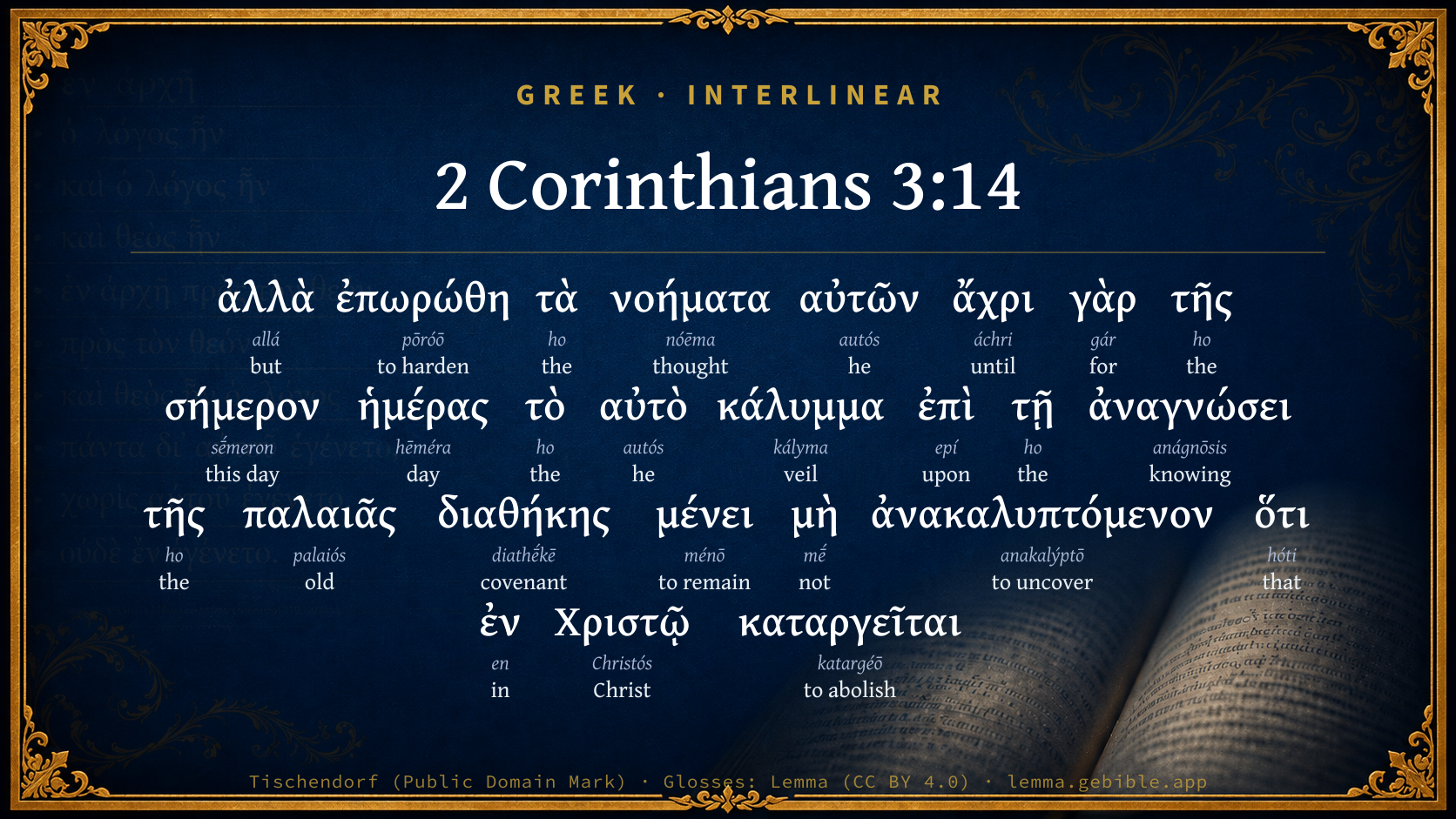
Download image
Cite this verse

2 Corinthians 3:14 (World English Bible). Public Domain. Lemma interlinear Bible study tool, https://lemma.gebible.app/v/2-corinthians/3/14.

Show BibTeX & RIS
BibTeX
RIS
English Translation
But their minds were hardened, for until this very day at the reading of the old covenant the same veil remains, because in Christ it passes away.
World English Bible · Public Domain
Highlights
  • 1 first appearance in the Greek New Testament
Full analysis ↓
Download a study sheet

One document with this verse’s original text, its word-by-word gloss line, the meaning frame, cross-references with their text, attributed commentary, and full source and license credits — printable, and it pastes into notes with its structure intact.

This verse Autodidact and up

Study sheet (.html) Plain text (.txt)

A passage Seminary Student

Up to 50 verses in one chapter. A passage sheet keeps up to 6 commentary sources and 12 cross-references per verse, in the order this page ranks them, and says so on the sheet whenever that leaves anything out. Ask for a single verse and you get the Autodidact verse sheet above.

Everything on this page stays free to read, with no account — the sheet is a download of what is already on screen, not access to it.

Want to remove ads? Support Godless Engineer
Compare translations 3

The same verse in 3 English versions, stacked beneath the original-language interlinear above. Click any original word for its lexicon entry.

Each is an independent rendering of the whole verse — the interlinear is not word-aligned to these translations.

Highlighted words mark where these versions differ — a whole-verse word diff, not a word-by-word alignment.

  • World English Bible Public Domain
    But their minds were hardened, for until this very day at the reading of the old covenant the same veil remains, because in Christ it passes away.
  • King James Version Public Domain
    But their minds were blinded: for until this day remaineth the same vail untaken away in the reading of the old testament; which vail is done away in Christ.
  • unfoldingWord Literal Text CC BY-SA 4.0
    But their minds were hardened, for until the present day, the same veil remains at the reading of the old covenant, not being lifted, because in Christ it is fading away.

unfoldingWord Literal Text — © unfoldingWord, licensed CC BY-SA 4.0. Word-aligned USFM3 via Door43 (git.door43.org/unfoldingWord/en_ult).

Versions to compare (up to 4)

3 of 4 selected

Show all 19 translations

Every available English version of this verse, each an independent rendering of the whole verse.

  • World English Bible Public Domain
    But their minds were hardened, for until this very day at the reading of the old covenant the same veil remains, because in Christ it passes away.
  • Berean Standard Bible Public Domain
    But their minds were closed. For to this day the same veil remains at the reading of the old covenant. It has not been lifted, because only in Christ can it be removed.
  • Majority Standard Bible Public Domain
    But their minds were closed. For to this day the same veil remains at the reading of the old covenant. It has not been lifted, because only in Christ can it be removed.
  • King James Version Public Domain
    But their minds were blinded: for until this day remaineth the same vail untaken away in the reading of the old testament; which vail is done away in Christ.
  • American Standard Version (1901) Public Domain
    but their minds were hardened: for until this very day at the reading of the old covenant the same veil remaineth, it not being revealed `to them' that it is done away in Christ.
  • Revised Version (1885) Public Domain
    but their minds were hardened: for until this very day at the reading of the old covenant the same veil remaineth unlifted; which veil is done away in Christ.
  • Geneva Bible (1599) Public Domain
    Therefore their mindes are hardened: for vntill this day remaineth the same couering vntaken away in the reading of the olde Testament, which vaile in Christ is put away.
  • Douay-Rheims (1899) Public Domain
    But their senses were made dull. For, until this present day, the selfsame veil, in the reading of the old testament, remaineth not taken away (because in Christ it is made void).
  • Young's Literal Translation Public Domain
    but their minds were hardened, for unto this day the same vail at the reading of the Old Covenant doth remain unwithdrawn -- which in Christ is being made useless --
  • Literal Standard Version CC BY-SA 4.0
    but their minds were hardened, for to this day the same veil at the reading of the Old Covenant remains unwithdrawn—which in Christ is being made useless—
  • Unlocked Literal Bible CC BY-SA 4.0
    But their minds were closed. For to this day, when they read the old covenant, that same veil remains. It has not been removed, because only in Christ is it taken away.
  • unfoldingWord Literal Text CC BY-SA 4.0
    But their minds were hardened, for until the present day, the same veil remains at the reading of the old covenant, not being lifted, because in Christ it is fading away.
  • Darby Bible Public Domain
    But their thoughts have been darkened, for unto this day the same veil remains in reading the old covenant, unremoved, which in Christ is annulled.
  • World Messianic Bible Public Domain
    But their minds were hardened, for until this very day at the reading of the old covenant the same veil remains, because in Messiah it passes away.
  • Webster's Bible Public Domain
    But their minds were blinded: for until this day the same vail remaineth untaken away in the reading of the old testament; which vail is done away in Christ.
  • Free Bible Version CC BY-SA 4.0
    In spite of that, they had a hard, stubborn attitude. For right up until today when the old agreement is read, the same “veil” remains. Only through Christ can it be removed.
  • Bible in Basic English Public Domain
    But their minds were made hard: for to this very day at the reading of the old agreement the same veil is still unlifted; though it is taken away in Christ.
  • Text-Critical English NT CC BY 4.0
    But their minds were hardened, for to this day the same veil remains unlifted when the old covenant is read. Only in Christ is this veil taken away.
  • Tyndale New Testament (1534) Public Domain
    But their myndes were blinded. For untill this daye remayneth the same coveringe vntake awaye in the olde testament when they reade it which in Christ is put awaye.

Literal Standard Version (2020), Covenant Press — licensed CC BY-SA 4.0. Text via the HelloAO Bible API (eBible.org). Unlocked Literal Bible (unfoldingWord) — licensed CC BY-SA 4.0. Text via the HelloAO Bible API (eBible.org). unfoldingWord Literal Text — © unfoldingWord, licensed CC BY-SA 4.0. Word-aligned USFM3 via Door43 (git.door43.org/unfoldingWord/en_ult). Free Bible Version, Dr. Jonathan Gallagher — licensed CC BY-SA 4.0. Text via the HelloAO Bible API (eBible.org).

Word by word

More ways to search: Search by grammar → Find every occurrence → Compare this word →

Practice this passage: Drill this verse → Learn its vocabulary →

ἀνακαλυπτόμενον
anakalýptō
G343
“to uncover”
Verb, Present, Passive, Participle, Nominative, Singular, Neuter
Part of Speech
Verb
Tense
Present
Voice
Passive
Mood
Participle
Case
Nominative
Number
Singular
Gender
Neuter
Full Thayer's Definition

Origin: from G303 (in the sense of reversal) and G2572

TDNT: 12:20,4

1. to unveil or uncover (by drawing back a veil)
  1. ἀλλὰ allá G235 “but” Conjunction
  2. ἐπωρώθη pōróō G4456 “to harden” Verb, Aorist, Passive, Indicative, 3rd person, Singular
  3. τὰ ho G3588 “the” Article, Nominative, Plural, Neuter
  4. νοήματα nóēma G3540 “thought” Noun, Nominative, Plural, Neuter
  5. αὐτῶν autós G846 “he” Personal pronoun, Genitive, Plural, Masculine
  6. ἄχρι áchri G891 “until” Adverb
  7. γὰρ gár G1063 “for” Conjunction
  8. τῆς ho G3588 “the” Article, Genitive, Singular, Feminine
  9. σήμερον sḗmeron G4594 “this day” Adverb
  10. ἡμέρας hēméra G2250 “day” Noun, Genitive, Singular, Feminine
  11. τὸ ho G3588 “the” Article, Nominative, Singular, Neuter
  12. αὐτὸ autós G846 “he” Personal pronoun, Nominative, Singular, Neuter
  13. κάλυμμα kályma G2571 “veil” Noun, Nominative, Singular, Neuter
  14. ἐπὶ epí G1909 “upon” Preposition
  15. τῇ ho G3588 “the” Article, Dative, Singular, Feminine
  16. ἀναγνώσει anágnōsis G320 “knowing” Noun, Dative, Singular, Feminine
  17. τῆς ho G3588 “the” Article, Genitive, Singular, Feminine
  18. παλαιᾶς palaiós G3820 “old” Adjective, Genitive, Singular, Feminine
  19. διαθήκης diathḗkē G1242 “covenant” Noun, Genitive, Singular, Feminine
  20. μένει ménō G3306 “to remain” Verb, Present, Active, Indicative, 3rd person, Singular
  21. μὴ mḗ G3361 “not” Particle, Negative
  22. ὅτι hóti G3754 “that” Conjunction
  23. ἐν en G1722 “in” Preposition
  24. Χριστῷ Christós G5547 “Christ” Noun, Dative, Singular, Masculine
  25. καταργεῖται katargéō G2673 “to abolish” Verb, Present, Passive, Indicative, 3rd person, Singular

About this verse

These counts appear in no published source. They are computed here, from the morphology-tagged text and Lemma’s own curated glosses. What Lemma adds →

26
words
21
distinct lemmas
Pauline Epistles
section

Notable vocabulary

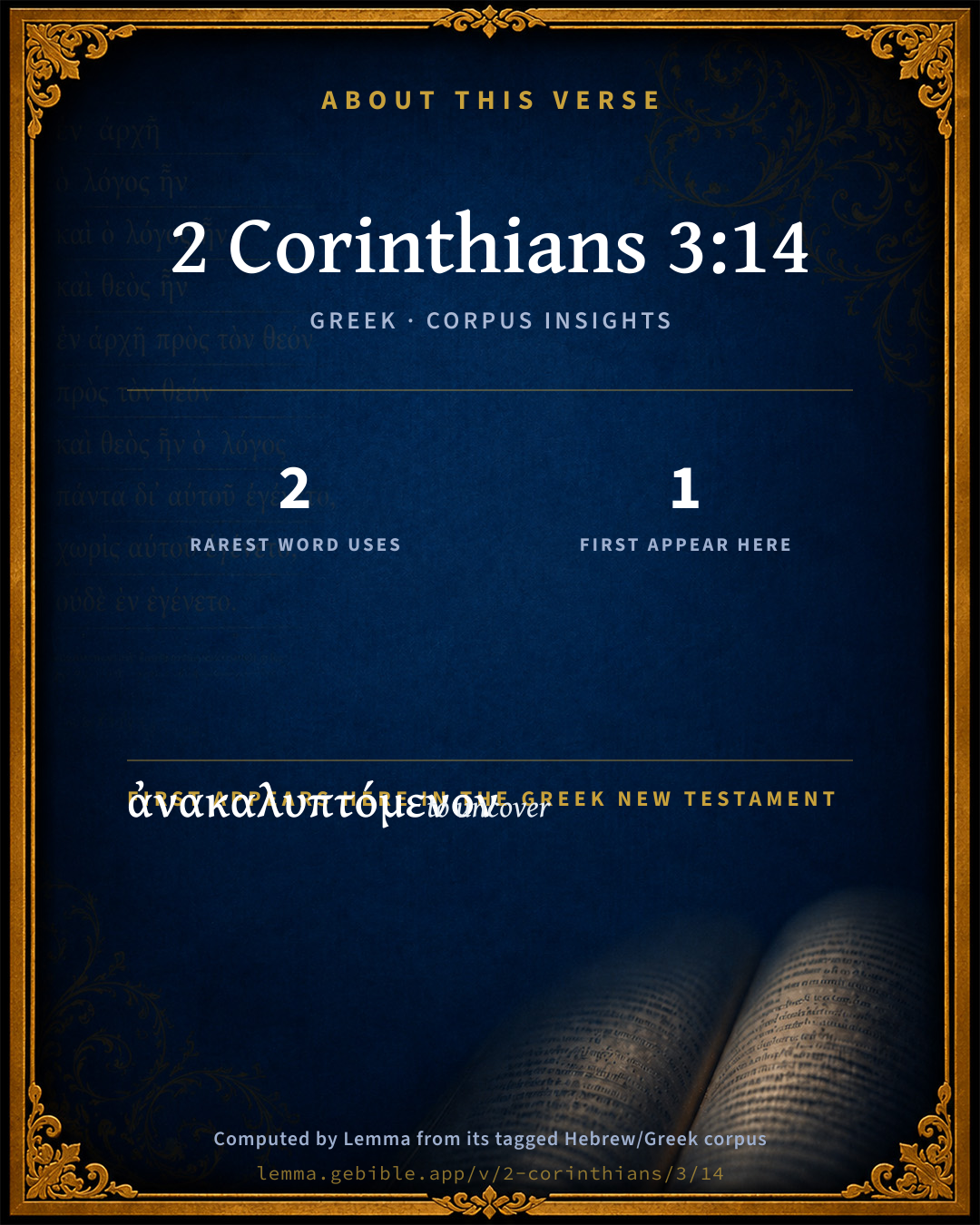
The rarest word here is ἀνακαλυπτόμενον to uncover G343 — appearing just 2 times in the whole Greek New Testament.

First appearance in Scripture

This word makes its first canonical appearance in the Greek New Testament here:

  • ἀνακαλυπτόμενον to uncover G343

Shared distinctive vocabulary

ἀνακαλυπτόμενον to uncover G343 occurs in 2 verses of the Greek New Testament. Also found in:
Repetition

Words recur within this verse:

  • τὰ the G3588 ×5
  • αὐτῶν he G846 ×2

Cross-references

31

Topical passages linked to 2 Corinthians 3:14 in the Treasury of Scripture Knowledge — connected by theme and wording, ordered by reader-vote popularity; previews shown in the World English Bible.

  • 2 Corinthians 4:3–4 Even if our Gospel is veiled, it is veiled in those who perish;
  • Acts 26:18 to open their eyes, that they may turn from darkness to light and from the power of Satan to God, that they may receive remission of sins and an inheritance among those who are sanctified by faith in me.'
  • Romans 11:25 For I don't desire, brothers, to have you ignorant of this mystery, so that you won't be wise in your own conceits, that a partial hardening has happened to Israel, until the fullness of the Gentiles has come in,
  • John 12:40 "He has blinded their eyes and he hardened their heart, Lest they should see with their eyes, And perceive with their heart, And would turn, And I would heal them."
  • Romans 11:7–10 What then? That which Israel seeks for, that he didn't obtain, but the chosen ones obtained it, and the rest were hardened.
  • 2 Corinthians 4:6 seeing it is God who said, "Light will shine out of darkness," who has shone in our hearts, to give the light of the knowledge of the glory of God in the face of Jesus Christ.
  • Ephesians 1:17–20 that the God of our Lord Jesus Christ, the Father of glory, may give to you a spirit of wisdom and revelation in the knowledge of him;
  • Matthew 13:11 He answered them, "To you it is given to know the mysteries of the Kingdom of Heaven, but it is not given to them.
  • John 8:12 Again, therefore, Jesus spoke to them, saying, "I am the light of the world. He who follows me will not walk in the darkness, but will have the light of life."
  • Isaiah 44:18 They don't know, neither do they consider: for he has shut their eyes, that they can't see; and their hearts, that they can't understand.
  • Jeremiah 5:21 Hear now this, foolish people, and without understanding; who have eyes, and don't see; who have ears, and don't hear:
  • Ezekiel 12:2 Son of man, you dwell in the midst of the rebellious house, who have eyes to see, and don't see, who have ears to hear, and don't hear; for they are a rebellious house.
  • Matthew 6:23 But if your eye is evil, your whole body will be full of darkness. If therefore the light that is in you is darkness, how great is the darkness!
  • Matthew 16:17 Jesus answered him, "Blessed are you, Simon Bar Jonah, for flesh and blood has not revealed this to you, but my Father who is in heaven.
  • Luke 18:31–34 He took the twelve aside, and said to them, "Behold, we are going up to Jerusalem, and all the things that are written through the prophets concerning the Son of Man will be completed.
  • Luke 24:25–27 He said to them, "Foolish men, and slow of heart to believe in all that the prophets have spoken!
  • Luke 24:44–46 He said to them, "This is what I told you, while I was still with you, that all things which are written in the law of Moses, the prophets, and the psalms, concerning me must be fulfilled."
  • John 9:39–41 Jesus said, "I came into this world for judgment, that those who don't see may see; and that those who see may become blind."
  • Acts 16:14 A certain woman named Lydia, a seller of purple, of the city of Thyatira, one who worshiped God, heard us; whose heart the Lord opened to listen to the things which were spoken by Paul.
  • Psalms 69:23 Let their eyes be darkened, so that they can't see. Let their backs be continually bent.
  • Isaiah 6:10 Make the heart of this people fat; Make their ears heavy, and shut their eyes; Lest they see with their eyes, And hear with their ears, And understand with their heart, And turn again, and be healed."
  • Isaiah 26:10–12 Let favor be shown to the wicked, yet will he not learn righteousness; in the land of uprightness will he deal wrongfully, and will not see the majesty of Yahweh.
  • Isaiah 42:18–20 Hear, you deaf; and look, you blind, that you may see.
  • Isaiah 56:10 His watchmen are blind, they are all without knowledge; they are all mute dogs, they can't bark; dreaming, lying down, loving to slumber.
  • Isaiah 59:10 We grope for the wall like the blind; yes, we grope as those who have no eyes: we stumble at noonday as in the twilight; among those who are lusty we are as dead men.
  • Matthew 13:13–15 Therefore I speak to them in parables, because seeing they don't see, and hearing, they don't hear, neither do they understand.
  • John 12:46 I have come as a light into the world, that whoever believes in me may not remain in the darkness.
  • Acts 13:15 After the reading of the law and the prophets, the rulers of the synagogue sent to them, saying, "Brothers, if you have any word of exhortation for the people, speak."
  • Isaiah 25:7 He will destroy in this mountain the surface of the covering that covers all peoples, and the veil that is spread over all nations.
  • 2 Corinthians 3:6 who also made us sufficient as servants of a new covenant; not of the letter, but of the Spirit. For the letter kills, but the Spirit gives life.
  • Acts 28:26–27 saying, 'Go to this people, and say, In hearing, you will hear, But will in no way understand. In seeing, you will see, But will in no way perceive.

Cross-references courtesy of OpenBible.info (CC BY 4.0).

Commentary

Notes on 2 Corinthians 3:14 from classic Christian and Jewish commentators (each source and its license shown beneath its notes). The classic Christian expositions comment on the surrounding passage and are grouped to its opening verse, so a note may address several verses; the Jewish commentaries on the Tanakh (Rashi and others) are per-verse, so they appear only where the commentator wrote on this verse.

Lemma curates 59 commentaries, every one of them public domain or Creative Commons licensed, each selected and text-cleaned for this edition rather than reprinted as found. About our sources →

The Pulpit Commentary

Their minds. This word is rendered" devices" in 2Co_2:11; "minds" in 2Co_3:14; 2Co_4:4; and "thought" in 2Co_10:5. It means that their powers of reason were, so to speak, petrified. Were blinded; rather, were hardened . The verb cannot mean" to blind." By whom were their minds hardened? It would be equally correct to say by themselves, (Heb_3:8) or by, (2Co_4:4) or by God. (Rom_11:7, Rom_11:8) The same veil. Of course the meaning is "a veil of which the veil of Moses is an exact type." The veil which prevented them from seeing the evanescence of the light which shone on the face of Moses was symbolically identical with that which prevented them also from seeing the transitory character of his Law. It had been as it were taken from his face and laid on their hearts. (see Act_13:27-29 Ro 11) Many commentators have seen in this verse a reference to the Jewish custom of covering the head with the tallith, a four-cornered veil, when they were in the synagogues. But this is doubtful, since the tallith did not cover the eyes. More probably his metaphor may have been suggested by Isa_25:7, "And he willdestroy in this mountain the face of the covering cast ever all people, and the veil that is spread over all nations." Untaken away. There are two other ways of rendering this verse:

(1) "For until this very day at the reading of the old covenant the same veil remaineth unlifted; which veil is done away in Christ," as in the Revised Version; or

(2) "The same veil remaineth, it not being revealed that it is done away in Christ," as it is taken by Chrysostom and many others, and in the margin of the Revised Version. The latter seems to be the better view. It is not the veil, but the old covenant, which is being done away in Christ. To the Jews that truth still remained under a veil. The present tense, "is in course of annulment," might naturally be used until the utter abrogation of even the possible fulfilment of the Mosaic Law at the fall of Jerusalem. In the reading of the old testament; rather, the old covenant. There is no allusion to the Old Testament as a book, but the phrase is equivalent to "Moses is read" in the next verse. (On this obduracy of the Jews, see Rom_11:7, Rom_11:8, Rom_11:25)

The Pulpit Commentary (1880–1919), ed. H.D.M. Spence-Jones & Joseph S. Exell — public domain. Text from a community e-Sword module.

Bengel's Gnomon

Johann Albrecht Bengel

2Co 3:14. Ἀλλʼ ἐπωρώθη, but were hardened) but is opposed to the phrase to look stedfastly.—τὸ αὐτὸ) the same, as in the time of Moses.—ἐπὶ, upon) i.e. when they read, and although they read.—ἀναγνώσει, reading) public, frequent, perpetual. Paul makes a limitation. The veil is not now on the face of Moses, or on his writings; but on the reading, while they read Moses, and that too in such a way as not to admit Christ; it is also upon their heart, 2Co 3:15.—μένει, μὴ ἀνακαλυπτόμενον) remains lying upon them, so that it is not indeed taken away [so that the veil is not even lifted off].—ὅτι, because it is not done away, save in Christ. [But Engl. Ver. “which veil is done away in Christ.”]—This is a statement introductory to the things which follow.—καταργεῖται, is abolished [done away]) the Old Testament; comp. 2Co 3:7; 2Co 3:11; 2Co 3:13. He does not say, has been abolished, but is being abolished in respect of those, that are about “to turn to the Lord.”

Bengel's Gnomon of the New Testament — English translation (T&T Clark, Edinburgh, 1860) — public domain. Text from a community e-Sword module.

Meyer's Critical & Exegetical Commentary

Heinrich August Wilhelm Meyer

2Co_3:14. Ἀλλʼ ἐπωρώθη κ.τ.λ.] This ἀλλά does not refer to the thought implied in the previous πρὸς τὸ μὴ ἀτενίσαι κ.τ.λ., that the Jews did not contemplate the end of the Mosaic ministry, for this was made impossible to them, in fact, by Moses himself and according to his own intention. What Billroth imports into ἀλλά is therefore also unsuitable: but instead there were hardened, etc. Flatt, Rückert, de Wette, Hofmann (comp. also Olshausen) take the connection rightly, that over against the utterance treating of the holders of the apostolic office, 2Co_3:12 f., stands that which speaks of Israel. Accordingly ἀλλά is at, nevertheless.

ἐπωρώθη] Paul does not here say by whom this certainly passive (in opposition to Theodoret) hardness of heart[170] has been caused. It may be conceived as produced by God (Romans 11 ff., comp. Joh_12:39 f.; Act_28:26) just as well as by the devil (2Co_4:4, comp. Mat_13:19), these two ways of regarding it not being contradictory to each other. The aorist denotes the hardness of heart which set in later after their intercourse with Moses, but in connection with the insight then rendered impossible to them. Πεπώρωται would have meant something else. On νοήματα, thoughts, the products of the ΝΟῦς, of the exercise of the theoretic and practical reason, which, through the hardness of heart, become inaccessible to, and insusceptible of, the perception of the divine, comp. on Php_4:7.

ἌΧΡΙ ΓᾺΡ Κ.Τ.Λ.] A proof, in accordance with experience, for what was just said ἘΠΩΡΏΘΗ Κ.Τ.Λ.

ΤῸ ΑὐΤῸ ΚΆΛΥΜΜΑ ἘΠῚ Κ.Τ.Λ.] The same veil is, of course, to be understood, not of material identity, but symbolically of the likeness of the spiritual hindrance. Without figure the meaning is: the same incapacity for recognising the end of the Mosaic ministry, which was produced among them then by the veil of Moses, remains with them to this day when the Old Covenant is read.

ἘΠῚ Τῇ ἈΝΑΓΝΏΣΕΙ] Paul conceives the public reading of the O. T. every Sabbath (Act_15:21) as overlaid with the veil hindering knowledge; still we need not assume, with Wolf, Michaelis, Semler, and others, a reference to the טַלִּית (see Lakemacher, Obss. III. p. 209 ff.) with which the Jews veiled themselves at the reading of the law and at prayer, because otherwise Paul must have made the veil fall on the countenances of the Jews, and not on the public reading. But he has conceived to himself the matter so, that the public reading takes place under the veil enwrapping this act, so that in this reading the Jews remain shut out from insight into the new covenant. 2Co_3:13; 2Co_3:15 preclude us from abandoning the local signification of ἐπί, on. The explanation, when there is public reading (Hofmann), confuses the meaning with the sensuous, but in relation to the context appropriate, form of presenting it.

τῆς παλ. διαθήκης] For when the law of Moses is publicly read, there is read the old covenant (comp. on 2Co_3:6) therein set forth. This is the contents of the public reading. Comp. 2Co_3:15 : ἀναγινώσκεται Μωϋσῆς. Ἡ παλ. διαθ. does not mean the books of the O. T., as is here usually suppose.

ΜῊ ἈΝΑΚΑΛΥΠΤΌΜΕΝΟΝ, ὍΤΙ ἘΝ Χ. ΚΑΤΑΡΓΕῖΤΑΙ] These words in themselves admit of two explanations; the first refers the participle and ΚΑΤΑΡΓΕῖΤΑΙ to ΤῸ ΚΆΛΥΜΜΑ, and takes ὍΤΙ in the sense of because, as specifying the ground of the μὴ ἀνακαλ. (so most of the older expositors, and recently Fritzsche, Billroth, Schrader, Olshausen, de Wette, Neander, Hofmann, comp. Ewald): without being uncovered, because it is annihilated in Christ (the veil), but Christ is not preached to them. On ἈΝΑΚΑΛΎΠΤΕΙΝ ΚΆΛΥΜΜΑ, to uncover a veil, comp. LXX. Deu_22:29 : οὐκ ἀνακαλύψαι συγκάλυμμα τοῦ πατρός. But against this view (a) ΚΑΤΑΡΓΕῖΤΑΙ seems decisive, which, according to the context (see 2Co_3:11; 2Co_3:13), cannot apply to the taking away of the veil, but only to the abolition of the Mosaic ministry, or according to the connection of 2Co_3:14, to the abolition of the old covenant, which is the object of the Mosaic ministry (comp. also Rom_3:31; Eph_2:15); and hence Paul, 2Co_3:16, does not use ΚΑΤΑΡΓΕῖΤΑΙ of the removal of the veil, but ΠΕΡΙΑΙΡΕῖΤΑΙ, which signifies the same thing as ἈΝΑΚΑΛΎΠΤΕΤΑΙ. (b) If μὴ ἀνακαλυπτόμενον were to refer to τὸ αὐτὸ κάλυμμα, then κάλυμμα in the contrast introduced by ἀλλά in 2Co_3:15 would necessarily be the same veil, of which ΜῊ ἈΝΑΚΑΛΎΠΤ. would be here said, and Paul must therefore at 2Co_3:15 have written ΤῸ ΚΆΛΥΜΜΑ with the article. Hence the second method of explanation[171] is to be preferred, according to which the participle is taken absolutely, and ὅτι as that, while καταργεῖται is referred to the παλ. διαθήκη, thus: while it is not disclosed (unveiled),[172] it remains hidden from the Jews, that in Christ the old covenant is done away, that in Christin His appearance and in His workthe abolition of the Old Covenant takes place (Rom_10:4; Col_2:14). The whole is thus a more precise practical definition of the previous τὸ αὐτὸ κάλυμμα … μένει. This absolute appositional use of the neuter participle (to be regarded as accusative, though viewed by Hermann and others as nominative) is a current Greek idiom in impersonal phrases. See Hermann, ad Viger. p. 769; Bernhardy, p. 471; Krüger, § lvi. 9. 5; Maetzner, ad Antiph. p. 176. Hence Rückert is without reason in referring μὴ ἀνακαλύπτ. to τὸ κάλυμμα, and yet understanding ὅτι as that and καταργεῖται of the Old Covenant, whereby the unwarranted importation of a thought becomes necessary, namely, to this effect: the same veil rests on the reading of the O. T. and is not uplifted, so that it (the people) might perceive that it (the O. T.) has its end in Christ. Luthers translation (comp. Erasmus, Beza, and Heumann) follows the reading ὅ,τι (Elzevir), which Scholz also has again taken up. This ὅ,τι would have to be explained as quippe quod (velamen), and would give from the nature of the veil (Kühner, ad Xen. Mem. ii. 1. 30) the information why it remains unlifted,an interpretation, however, which would only be compatible with the first view given above, and even with that would be unnecessar.

καταργεῖται] present; for the fact, that in Christ the Old Covenant is abolished, is laid down in theoretical form as an article of faith, as a truth which remains veiled from the Jews so long as they are not converted to Christ (2Co_3:16).

[170] πωροῦσθαι means to be made hard (from the substantive πῶρος), not to be blinded, as Schleusner (Thes. IV. p. 541) and others, following the Fathers, and also Hofmann would take it, since there is no trace at all of the use among the Greeks of an adjective πωρός, blind, which the Etymol. Gud. and Suidas quote. The Greeks have πῆρος, blindness, and πήρος, blind, but not πωρός. And if the LXX. translate כָּהָה, Job_7:7, by πωροῦσθαι, and Zec_11:17 by ἐκτυφλοῦσθαι (to which Hofmann makes appeal), this proves nothing in favour of that explanation of πωροῦσθαι, since the LXX. very often, with exegetical freedom, render the same word differently according to the context. We may add that Hofmann irrelevantly compares Lucian, Amor. 46, where πηροί does not mean blind at all, but has its fundamental meaning maimed. The passage in Lucian means: To whom are the glances of the eyes so blind (τυφλοί), and the thoughts of the understanding so lame (πηροί)? Here πηροί is a figurative expression for weakness.

[171] So among the older commentators Castalio, and recently Kypke, Flatt, Osiander, Maier; comp. also Krummel, who, however, mentally supplies by all teachers of the law.

[172] Very naturally and suitably Paul chose the word ἀνακαλ., not ἀποκαλ. (in opposition to de Wettes objection), since he has to do with the conception of a καλύμμα that remains. The veil remains, since it is not unveiled that, etc. In this way the explanatory expression is quite in keeping with the figure itself. Besides, ἀνακαλύπτειν was common enough in the sense of to make manifest, to make known (Tob_12:7; Tob_12:11; Polyb. iv. 85. 6).

2Co_3:14-18. Sad contrast which the procedure of the preachers of the gospel indicated in 2Co_3:12-13so wholly different from the procedure of Mosesmeets with in the hardening of Israel. How far off are they to this day from divine freedom! how altogether different, however (2Co_3:18), it is with us Christians!

Meyer — Critical and Exegetical Commentary on the New Testament — English translation by Peter Christie, edited by Frederick Crombie (T&T Clark, 1880) — public domain. Text from a community e-Sword module.

Expositor's Greek Testament

ed. W. Robertson Nicoll

2Co 3:14 . ἀλλʼ ἐπωρώθη τὰ νοήματα αὐτῶν : but their minds were blinded, sc. , in reference to what they saw ( cf. Rom 11:25 ); they took the brightness for an abiding glory ( cf. Deu 29:4 ). πῶρος , which primarily means a kind of marble, came to mean, in medical writers, a hardening of the tissues; and hence we have πωρός , (1) to petrify , (2) to become insensible or obtuse , and so (3) it comes to be used of insensibility of the organs of vision, to blind . (See J. A. Robinson in Journal of Theological Studies , Oct., 1901, and cf. reff. above.) ἄχρι γὰρ τῆς σήμερον ἡμέρας κ . f1τ . λ .: for until this very day at the reading of the Old Covenant the same veil remaineth unlifted ( for it is only done away in Christ ). (1) Some commentators take μὴ ἀνακαλυπτόμενον as a nominative absolute, and translate “the same veil remaineth, it not being revealed that it ( sc. , either the veil or the Old Covenant) is done away in Christ”. But the order of the words seems to force us to take the present participle with μένει it having a merely explanatory force and being almost redundant. (2) Again both A.V. and R.V. (text), while translating the first part of the clause as we have done, render ὅ τι ἐν Χρ . καταργεῖται “which veil is done away in Christ”. But it seems indefensible thus to take ὅ τι as equivalent to ὅ . (3) Field arrives at yet another rendering by taking κάλυμμα per synecdochem for the thing veiled , which is here declared to be the fact that the Old Covenant is done away in Christ. He renders “the same mystery remaineth unrevealed, namely , that it is done away in Christ”. But it is a grave objection to this that τὸ κάλυμμα has to be taken in a sense different from that which it has all through the rest of the passage. (4) We prefer, therefore (with Schmiedel and Schnedermann), to read ὅ τι as ὅτι , for , and to regard the phrase ὅτι ἐν χρ . καταργεῖται . as parenthetical: “until this day the veil remains unlifted (for it is only in Christ that it is done away)”; i.e. , the Jews do not recognise the vanishing away of the glory of the Law, which yet is going on before their eyes. How completely Judaism was dissociated in St. Paul’s mind from Christianity is plain from the striking phrase ἡ παλαιὰ διαθήκη (here only found; but cf. 2Co 3:6 ), by which he describes the religious system of his own early manhood, which had only been superseded by ἡ καινὴ διαθήκη thirty years before he wrote this letter. ἀνάγνωσις is (see reff.) the public reading of the Law in the synagogues; it seems, however, unnecessarily ingenious to see here, with Schmiedel, an allusion in τὸ κάλυμμα to the covers in which the Synagogue Rolls were preserved.

The Expositor's Greek Testament, edited by W. Robertson Nicoll (1897–1910) — public domain. Text from a community e-Sword module.

Cambridge Greek Testament for Schools and Colleges

14. ἀλλὰ ἐπωρώθη τὰ νοήματα αὐτῶν. But their minds were blinded. This suits those whose power of perception is covered with a veil, whose ‘minds the god of this world has blinded’ (2Co 4:4). The R.V. here substitutes ‘hardened’ for ‘blinded,’ in accordance with the original meaning of πῶρος and πωρόω. But ‘blinded’ is perhaps closer to the later meanings. To speak of ‘minds’ or ‘thoughts’ being ‘hardened’ is a curious expression. Comp. Rom 11:7; Rom 11:25; Eph 4:18. For νοήματα see on 2Co 2:11. By the πώρωσις of these is meant moral obtuseness, not wilful obstinacy. Their understandings lost their sensibility towards spiritual truths. In order to distinguish πωρόω from τυφλόω (2Co 4:4) ‘dulled’ might be used here. The ἀλλά refers to 2Co 3:13. They were not allowed to see the fading of the glory, which might have taught them that their dispensation was to pass away; but, on the contrary, their perceptions were paralysed, and to this day cannot grasp the situation. See a valuable note on this and kindred passages in the Journal of Theological Studies, Oct. 1901, pp. 81 ff. Lightfoot (on 2Th 2:8) points out that S. Paul sometimes uses καταργεῖν in opposition to ‘light’ as if with a sense of ‘darkening,’ ‘eclipsing’; 1Co 2:7; 2Ti 1:10. The use of it here (2Co 3:7; 2Co 3:14) confirms the meaning ‘blinded’ for ἐπωρώθη.

ἄχρι γὰρ τῆς σήμερον ἡμέρας. This is to justify so strong an expression as ἐπωρώθη. It can have been nothing less than πώρωσις, for it has lasted so long. See Chrysostom.

ἐπὶ τῇ ἀναγνώσει τῆς π. δ. This takes us to the public reading in the synagogue (τὴν ἀνάγνωσιν τοῦ νόμον, Act 13:15); and the synagogue, as in Acts, is the centre of unbelief.

τῆς παλαιᾶς διαθήκης. “Nothing more strongly expresses the Apostle’s conviction of the extinction of the Jewish system than this expression of the ‘Old Covenant,’ applied to the Jewish Scriptures within thirty years after the Crucifixion” (Stanley). See Westcott on Heb 8:13. The direct opposite of καινός is ἀρχαῖος, as is shown 2Co 5:17. But παλαιός, as meaning what has existed for a long time, may be opposed to either νέος (Mat 9:17; Mar 2:22) or καινός (Luk 5:36). ‘The same veil’ is not understood literally. It is the symbolical meaning which is the same in both cases, viz. the inability to see the vanishing of the glory of the Law.

μὴ ἀνακαλυπτόμενον. The construction and translation of these words is doubtful. They may refer to τὸ κάλυμμα which precedes; or they may be taken absolutely and refer to what follows. Either, at the reading of the old covenant the same veil abideth without being lifted, because it is done away in Christ; or, at the reading of the old covenant the same veil abideth, the revelation not being made that it is done away in Christ (Chrysostom). In the first rendering it is the veil that is done away in Christ; and this has two difficulties: (1) that it does not fit the context, for the veil abides unlifted, not because it is done away in Christ, but because of the πώρωσις of their hearts: (2) that throughout the passage (2Co 3:7; 2Co 3:11; 2Co 3:13-14) it is the glory of the Law which καταργεῖται. When S. Paul speaks of the veil being removed, he says περιαιρεῖται (2Co 3:16). Therefore the second rendering is preferable, according to which it is the Law which ἐν Χριστῷ καταργεῖται. This absolute use of a participle or adjective is found elsewhere: comp. καθαρίζον πάντα τὰ βρώματα (Rec. of Mar 7:19); εἰς οὐδὲν χρήσιμον (2Ti 2:14). The A.V. spoils the repetition of ‘done away’ (comp. 1Co 8:8) by substituting ‘abolished’ in 2Co 3:13. The R.V. does the like by substituting ‘pass away’ in 2Co 3:7; 2Co 3:11; but it has ‘done away’ in the margin. There are many places in the N.T. in which it is doubtful whether ὄτι is ‘that’ or ‘because’ (2Co 1:14; Luk 1:45; Luk 7:16; Luk 7:39; Luk 9:22; Luk 10:21; Luk 11:38; Luk 22:70; 1Jn 2:12-14, &c.).

Cambridge Greek Testament for Schools and Colleges (Cambridge University Press, 1896; 21 vols, various authors incl. Carr, Maclear, Plummer, Farrar, Lumby, Moule, M. R. James, Simcox) — public domain. Text from a community e-Sword module.

Jamieson, Fausset & Brown

Robert Jamieson, A. R. Fausset & David Brown

Parenthetical: Of Christians in general. He resumes the subject of the ministry, Co2 4:1.

minds--Greek, "mental perceptions"; "understandings."

blinded--rather, "hardened." The opposite to "looking steadfastly at the end" of the law (Co2 3:13). The veil on Moses' face is further typical of the veil that is on their hearts.

untaken away . . . which veil--rather, "the same veil . . . remaineth untaken away [literally, not unveiled], so that they do not see THAT it (not the veil as English Version, but 'THE OLD TESTAMENT,' or covenant of legal ordinances) is done away (Co2 3:7, Co2 3:11, Co2 3:13) in Christ" or, as BENGEL, "Because it is done away in Christ," that is, it is not done away save in Christ: the veil therefore remains untaken away from them, because they will not come to Christ, who does away, with the law as a mere letter. If they once saw that the law is done away in Him, the veil would be no longer on their hearts in reading it publicly in their synagogues (so "reading" means, Act 15:21). I prefer the former.

Jamieson, Fausset & Brown — Commentary Critical and Explanatory on the Whole Bible (1871) — public domain (CC PDM 1.0). Text via the HelloAO Bible API.

Adam Clarke's Commentary

Verse 14. But their minds were blinded] By resting in the letter, shutting their eyes against the light that was granted to them, they contracted a hardness or stupidity of heart. And the veil that was on the face of Moses, which prevented the glory of his face from shining out, may be considered as emblematical of the veil of darkness and ignorance that is on their hearts, and which hinders the glory of the Gospel from shining in.

Until this day remaineth the same veil] They are still ignorant of the spiritual meaning and intention of their own law, called here παλαια διαθηκη, the old covenant. See the word explained in the preface to St. Matthew.

In the reading of the Old Testament] Here is an evident allusion to the conduct of the Jews in their synagogues: when they read the law they cover their whole head with a veil, which they term the טלית tallith, veil, from טלל talal, to cover; and this voluntary usage of theirs, the apostle tells us, is an emblem of the darkness of their hearts while they are employed even in sacred duties.

Which veil is done away in Christ.] It is only by acknowledging Christ that the darkness is removed, and the end and spiritual meaning of the law discerned.

Adam Clarke's Commentary on the Bible (1810–1826) — public domain. Text from a community e-Sword/MySword module.

John Calvin's Commentaries

14. Their understandings were blinded. He lays the whole blame upon them, inasmuch as it was owing to their blindness, that they did not make any proficiency in the doctrine of the law. He afterwards adds, That veil remaineth even until this day. By this he means, that that dulness of vision was not for a single hour merely, but prefigured what the condition of the nation would be in time to come. “That veil with which Moses covered his face, when publishing the law, was the emblem of a stupidity, that would come upon that people, and would continue upon them for a long period. Thus at this day, when the law is preached to them, in

hearing they hear not, and in seeing they see not. (Matthew 13:13.)

There is no reason, however, why we should be troubled,

as though some new thing had happened. (1 Peter 4:12.)

God has shown long ago under the type of the veil, that it would be so. Lest, however, any blame should attach to the law, he again repeats it, that their hearts were covered with a veil

And it is not removed, because it is done away through Christ. He assigns a reason, why they are so long in blindness in the midst of light. For the law is in itself bright, but it is only when Christ. appears to us in it, that we enjoy its splendor. The Jews turn away their eyes as much as they can from Christ. It is not therefore to be wondered, if they see nothing, refusing as they do to behold the sun. This blindness on the part of the chosen people, especially as it is so long continued, admonishes us not to be lifted up with pride, relying on the benefits that God has conferred upon us. This point is treated of in Romans 11:20. Let, however, the reason of this blindness deter us from contempt of Christ, which God so grievously punishes. In the mean time, let us learn, that without Christ, the Sun of righteousness, (Malachi 4:2,) there is no light even in the law, or in the whole word of God.

John Calvin's Commentaries (1540-1563) — public domain. Text from the Calvin Translation Society English edition (1840s-50s) via the Christian Classics Ethereal Library (ccel.org). Calvin's coverage is partial (roughly two-thirds of the Bible); uncommented books and verses are honest gaps, never fabricated. The 19th-century editor's footnotes and remarks are omitted so the notes are faithfully Calvin's own voice.

Ellicott's Commentary for English Readers

(14) But their minds were blinded.—The Greek verb expresses strictly the callousness of a nerve that has become insensible, as in Mar_6:52; Mar_8:17; Rom_11:7. Here, as applied to the faculties of perception, “blinded” is, perhaps, a legitimate rendering.

Remaineth the same vail untaken away in the reading of the old testament . . .—The words are better translated: the same veil remaineth in the reading of the old covenant; the fact not being revealed (i.e., by the removal of the veil) that it (the old covenant) is being done away in Christ The figure is passing through a kind of dissolving change. There is still a veil between the hearers of the Law and its true meaning; but the veil is no longer on the face of the law-giver, but on their hearts; and the reason of this is that, the veil not being withdrawn, they do not see that the glory of the older covenant is done away by the brightness of the new. It is doing violence to the context to refer to the veil the words “is done away,” which through the whole passage is applied to the Law itself; and in 2Co_3:16 a new and appropriate word is used for the withdrawal of the veil. It is, the Apostle says, because the veil of prejudice and tradition hinders them from seeing the truth that the Jews of his own time still think of the Law as permanent, instead of looking on it as passing through a process of extinction. The “Old Testament” is clearly used, not, as in the modern sense, for the whole volume of the Law—Prophets and Psalms—but specially for the law which was the basis of the covenant. The other, but less adequate, rendering would be, the veil remaineth . . . unwithdrawn, for it (the veil) is abolished in Christ. If there was any authority for giving an active force to the middle form of the verb, we might translate with a perfectly satisfactory meaning, the same veil remaineth . . . not revealing the fact that it is being done away in Christ; but unfortunately there is no such authority. The English, “which veil is done away,” fails to give, in any case, the true force of the Greek.

A Bible Commentary for English Readers, edited by Charles John Ellicott (1878–1897) — public domain. Text from a community e-Sword module.

The Cambridge Bible for Schools and Colleges

gen. ed. J. J. S. Perowne

14. But their minds were blinded] They neither obeyed the Law when it was given, nor would cease to obey it when it was superseded. The word rendered blinded properly signifies hardened, and is so translated in Mar_6:52; Mar_8:17; Joh_12:40; and in the margin of Rom_11:7 (where the text gives the same translation as here). See also Eph_4:18. The rendering blinded is justified by the fact that many cases of what is called cataract are attributable to the hardening of the crystalline lens of the eye into a chalky substance, a process for which the Greek word here used is a proper equivalent. Our version here follows Tyndale. Wiclif has but the wittis of hem ben astonied, and the Rhemish but their senses were dulled. For the word translated minds see note on ch. 2Co_2:11. Cf. Isa_6:9-10; Mat_13:14, &c., and ch. 2Co_4:4. The word but implies that in consequence of the condition of the Israelites the Apostle’s plainness of speech was, to them at least, of no avail.

remaineth the same vail untaken away] Most modern commentators, and some ancient ones, e.g. Chrysostom, take the words rendered untaken away with what follows, and translate the same veil remaineth at the reading of the old covenant, it not being discovered that it is done away in Christ. The reasons for this rendering are (1) that it is not the veil but the old covenant with its glories which is ‘done away in Christ,’ (2) that St Paul uses another word in the original to signify the taking away of the veil, and (3) that the hardness of the hearts of the Israelites, and not the doing away of the veil in Christ, is the reason the veil is not removed. This hardness of heart prevented them (1) from seeing that the Mosaic was a temporary covenant, and (2) that it was rendered unnecessary by the coming of Christ. See Act_6:11; Act_6:13; Act_7:57; Act_13:45; Act_14:2; Act_21:20-21, &c.; 1Th_2:14-16. The word here translated ‘untaken away’ is translated ‘open,’ i.e. ‘unveiled’ in 2Co_3:18.

in the reading of the old testament] The words old covenant (see note on 2Co_3:6) refer, as 2Co_3:15 shews, not to the books we now include in the Old Testament, but to the books of Moses. It could hardly be said that to the prophets the abrogation of the Old Testament in Christ was a thing unknown. See Jer_31:31 above cited. For the regular reading of the books of the Law in the synagogue, see Act_13:15; Act_15:21. The prophets were also read, as we learn from the former passage (and also Act_15:27) and Luk_4:17.

The Cambridge Bible for Schools and Colleges (gen. ed. J. J. S. Perowne; Cambridge University Press, 1878–1918) — public domain. Text from a community e-Sword module.

John Gill's Exposition

But their minds were blinded,.... This confirms the sense given of the foregoing verse, and shows, that not the Israelites only in Moses's time, but the Jews in the times of the Gospel, had their minds so blinded, that they could not behold the glory of the Gospel, nor Christ the end of the law; see Rom 11:7.

For until this day, to this very time,

remaineth the same veil untaken away; not the selfsame veil that was on Moses's face, but the veil of blindness, darkness, and ignorance, upon the hearts of the Jews:

in the reading of the Old Testament; the books of the Old Testament, which were used to be read in their synagogues every sabbath day; the true spiritual meaning of which, as they respect Christ and the Gospel dispensation, they understood not; of which darkness, the veil on the face of Moses was a type and emblem:

which veil is done away in Christ; can only be removed by Christ, by his Spirit and grace, and through the light of the Gospel of Christ, shining into the heart; and so dispel that blindness and ignorance which is in the understanding; whereby the books of the Old Testament are understood, and appear to agree exactly with the Gospel of Christ, in the books of the New Testament.

John Gill's Exposition of the Whole Bible (1746–1763) — public domain (CC PDM 1.0). Text via the HelloAO Bible API.

Trapp's Complete Commentary

John Trapp

14 But their minds were blinded: for until this day remaineth the same vail untaken away in the reading of the old testament; which vail is done away in Christ.

Ver. 14. But their minds] Unless God give sight as well as light, and enlighten both organ and object, we can see nothing.

Which vail is done away] See Isa 25:7. Faith freeth from blindness; we no sooner taste of that stately feast by faith, but the vail of ignorance, which naturally covereth all flesh, is torn and rent.

John Trapp, A Commentary or Exposition upon All the Books of the Old and New Testament (1647–1656) — public domain. Text from a community e-Sword module.

Albert Barnes' Notes on the Bible

But their minds were blinded - The word used here (πωρόω pōroō) means rather to harden; to make hard like stone; and then to make dull or stupid. It is applied to the heart, in Mar 6:52; Mar 8:17; to persons, in Rom 11:7; and to the eyes, in Job 17:7. Paul refers here to the fact that the understandings of the Jews were stupid, dull, and insensible, so that they did not see clearly the design and end of their own institutions. He states simply the fact; he does not refer to the cause of it. The fact that the Jews were thus stupid and dull is often affirmed in the New Testament.

For until this day ... - The sense of this is, that even to the time when Paul wrote, it was a characteristic of the great mass of the Jewish people, that they did not understand the true sense of their own Scriptures. They did not understand its doctrines in regard to the Messiah. A veil seems to be thrown over the Old Testament when they read it, as there was over the face of Moses, so that the glory of their own Scriptures is concealed from their view, as the glory of the face of Moses was hidden.

Of the Old Testament - Greek, “of the old covenant.” See this word “testament,” or covenant, explained in the notes on 1Co 11:25. This, I believe, is the only instance in which the Scriptures of the Jews are called the “Old Testament,” or covenant, in the Bible. It was, of course, not a name which they used, or would use; but it is now with Christians the common appellation. No doubt can be entertained but that Paul uses the terms in the same manner in which we now do, and refers to all the inspired writings of the Jews.

Which vail is done away in Christ - In the manifestation, or appearance of Jesus the Messiah, the veil is removed. The obscurity which rested on the prophecies and types of the former dispensation is withdrawn; and as the face of Moses could have been distinctly seen if the veil on his face had been removed, so it is in regard to the true meaning of the Old Testament by the coming of the Messiah. What was obscure is now made clear; and the prophecies are so completely fulfilled in him, that his coming has removed the covering, and shed a clear light over them all. Many of the prophecies, for example, until the Messiah actually appeared, appeared obscure, and almost contradictory. Those which spoke of him, for illustration, as man and as God; as suffering, and yet reigning; as dying, and yet as ever-living; as a mighty Prince, a conqueror, and a king, and yet as a man of sorrows; as humble, and yet glorious: all seemed difficult to be reconciled until they were seen to harmonize in Jesus of Nazareth. Then they were plain, and the veil was taken away. Christ is seen to answer all the previous descriptions of him in the Old Testament; and his coming casts a clear light on all which was before obscure.

Albert Barnes' Notes on the Bible (1834–1885) — public domain. Text from a community e-Sword/MySword module.

Haydock's Catholic Bible Commentary

But the senses and minds of the Jews have been dulled, hardened, and blinded, so that to this day we may say the veil remains over their eyes and minds, and hearts; that is, the greatest part of them understand not Moses’ books, prophecies, and those things that were figures of Christ. But they shall understand them, and the veil shall be taken off, when they shall be converted before the end of the world. (Witham)

George Leo Haydock (1774–1849), Haydock's Catholic Family Bible and Commentary, 1859 edition — public domain. Excludes Psalms (Douay-Rheims chapter numbering differs from Protestant) and Deuterocanonical books (Catholic canon only).

Matthew Poole's English Annotations

Here the apostle expoundeth what he meant before by the mystical veil, viz. the blinding of the eyes of the Jews; of which we read often in the New Testament, Mat 13:14; Mar 4:12; Luk 8:10; Joh 12:40; Act 28:26; Rom 11:8; see the notes upon all those texts. And (saith the apostle) to this day the veil remaineth not taken away; that veil, which was signified by the veil with which Moses covered his face.

In the reading of the Old Testament, is, when the Old Testament is read: some part of which was wont to be read in the synagogues every sabbath day. But we shall meet with this in the next verse more fully. But (saith he) this

veil is done away in Christ. It is really taken away upon the coming of Christ; that is, the veil, that covered the face of Christ, is now truly, taken away upon his coming; the types are this filled in nim, as their complement and antitype; the prophecies are fulfilled in him, as he whom they concerned, and of whom the prophets spake. But the veil, that is drawn over men’s hearts, is not taken away, till they come to receive Jesus Christ as the end of the law for righteousness, to close with him, and to believe in him. God hath taken the veil off from Christ, by sending him personally to fulfil all righteousness; but Christ profiteth nothing particular souls, until they come to believe in him, then it is taken away from their souls, and not before. Which was the reason that it remained still upon the Jews, among whom he came, as among his own, but they received him not.

Matthew Poole's English Annotations on the Holy Bible (1683–1685) — public domain. Text from a community e-Sword/MySword module.

Whedon's Commentary on the Bible

Daniel D. Whedon

14. But their minds were blinded—Rather, their perceptive faculties were calloused. As if the retina of their mind’s eye was glazed, so as to blind their spiritual perceptions. What they could not see was, that the glory of the old covenant was as certainly transient as the glory on its founder’s face, being preparatory for a higher glory in a second founder, Christ. St. Paul does not, however, mean that it was a blindness in them not to see that the fading on Moses’s face was a showing of the transitory nature of the old covenant. He does not mean to affirm that the evanescence of the facial glory was a divinely intended type of fading Mosaicism. He uses it simply as a vivid illustration furnished by himself. The mind of the Jew in Moses’s day was blinded so as not to see that the Mosaic dispensation, in its whole structure and nature, was a preparation and a type to merge into its future antitype.

Remaineth the same vail— The same nonperception of the fading of the old covenant imaged by the same vail that concealed the evanescence of the facial radiance, remaineth. The same vail has passed from Moses’s face to overspread the Jewish heart in the reading of the old testament at this day.

Done away—The spiritual ignorance being removed in Christ.

Daniel D. Whedon (gen. ed.), Commentary on the Old and New Testaments (1874–1909) — public domain. Text from a community e-Sword module.

John Wesley's Explanatory Notes

The same veil remaineth on their understanding unremoved - Not so much as folded back, (so the word implies,) so as to admit a little, glimmering light. On the public reading of the Old Testament - The veil is not now on the face of Moses or of his writings, but on the reading of them, and on the heart of them that believe not. Which is taken away in Christ - That is, from the heart of them that truly believe on him.

John Wesley, Explanatory Notes Upon the Whole Bible (1754–1765) — public domain. Text via the GEBible commentary corpus.

Scofield Reference Notes

C. I. Scofield

vail

Omit the word italicized "vail".

The Scofield Reference Bible (1917 edition), notes by C. I. Scofield — public domain. Text from a community e-Sword module.

McGarvey & Pendleton's Commentaries

J. W. McGarvey

but their minds were hardened: for until this very day at the reading of the old covenant the same veil remaineth, it not being revealed to them that it is done away in Christ .

J. W. McGarvey (with Philip Y. Pendleton), Commentaries on the New Testament (The Fourfold Gospel, 1914; Acts; and the epistles) — public domain. Text from a community e-Sword/MySword module.

The People's New Testament

B. W. Johnson

14. But their minds were blinded. So blinded that they cannot see to this day that it has been set aside by the New Covenant, and that its types, figures and shadows find their fulfillment in Christ. Which veil is done away in Christ. Meyer, with many other able critics, contends that the proper translation of the latter part of the verse is: “It not being disclosed that the Old Covenant is taken away in Christ.” So also Conybeare and Howson. This is no doubt the meaning.

B. W. Johnson's The People's New Testament with Notes (1889–1891) — public domain. Electronic text from the Christian Classics Ethereal Library (CCEL) ThML edition.

unfoldingWord translationNotes

Door43 World Missions Community

But their minds were closed

"But their minds were hardened." Paul speaks of the minds of the Israelite people as objects that could be closed or made hard. This expression means that they were unable to understand what they saw. AT: "But the Israelites could not understand what they saw" (See: Metaphor)

For to this day ... But even today

These phrases refer to the time at which Paul was writing to the Corinthians.

when they read the old covenant, that same veil remains

Just as the Israelites could not see the glory on Moses' face because he covered his face with a veil, there is a spiritual veil that prevents people from understanding when they read the old covenant. (See: Metaphor)

when they read the old covenant

"when they hear someone read the old covenant"

It has not been removed, because only in Christ is it taken away

Here both occurrences of the word "it" refer to "the same veil." This can be stated in active form. AT: "No one removes the veil, because only in Christ does God remove it" (See: Active or Passive)

whenever Moses is read

Here the word "Moses" refers to the Old Testament law. This can be stated in active form. AT: "whenever someone reads the Mosaic law" (See: Metonymy and Active or Passive)

a veil covers their hearts

Here the word "hearts" represents what people think, and the people being unable to understand the old covenant is spoken of as if they have a veil that covers their hearts the way a physical veil would cover their eyes. AT: "they are unable to understand what they are hearing" (See: Metonymy and Metaphor)

when a person turns to the Lord

Here "turns to" is a metaphor that means to become loyal to someone. AT: "when a person starts to worship the Lord" or "when a person starts to trust in the Lord" (See: Metaphor)

the veil is taken away

God gives them the ability to understand. This can be stated in active form. AT: "God lifts the veil away" or "God gives them the ability to understand" (See: Active or Passive)

translationWords

mind

veil

covenant

Christ

Moses

heart

turn

lord

unfoldingWord translationNotes — © Distant Shores Media and the Door43 World Missions Community, licensed CC BY-SA 4.0. Source: git.door43.org/Door43/en_tn.

Alford’s Greek Testament

Henry Alford

14-18.] The contrast is now made between the children of Israel, on whose heart this vail still is in the reading of the O. T., and us all (Christians), who with uncovered face behold the glory of the Lord. This section is parenthetical. Before and after it, the ministry is the subject: in it, they to whom the ministry is directed. But it serves to shew the whole spirit and condition of the two classes, and thus further to substantiate the character of openness and freedom asserted of the Christian ministry.

14.] But (also) their understandings were hardened (on this, the necessary sense of ἐπωρώθη, see note, Eph 4:18). These words evidently refer, as well as what follows, not to the τέλος which they did not see, but to that which they did see: to that which answers to the present ἀνάγνωσις τῆς παλαιᾶς διαθήκης, viz. the word of God imparted by the ministration of Moses. And by these words the transition is made from the form of similitude just used, to that new one which is about to be used; q. d. ‘not only was there a vail on Moses’s face, to prevent more being known, but also their understandings were darkened: there was, besides, a vail on their hearts.’ So that ἀλλά = but also, or moreover.

To refer this ἀλλʼ ἐπωρ. to παῤῥησίᾳ χρώμεθα, to the present hard-heartedness of the Jews under the freedom of speech of the Gospel, as Olsh., De W., al., is, in my view, to miss the whole sense of the passage. No reference whatever is made to the state of the Jews under the preaching of the gospel, but only as the objects of the O. T. ministration,—then, under the oral teaching of Moses,—now, in the reading of the O. T.

In order to understand what follows, the change of similitude must be carefully borne in mind.

τὸ αὐτὸ κάλυμμα] ‘the vail once on Moses’s face,’ is now regarded as laid on their hearts. It denoted the ceasing, the covering up, of his oral teaching; for it was put on when he had done speaking to the people. Now, his oral teaching has altogether ceased, and the διακονία is carried on by a book. But as when we listen, the speaker is the agent, and the hearers are passive,—so on the other hand, when we read, we are the agents and the book is passive. The book is the same to all: the difference between those who understand and those who do not understand is now a subjective difference—the vail is no longer on the face of the speaker, but on the heart of the reader. So that of necessity the form of the similitude is changed. For (answering to an understood clause, ‘and remain hardened’) to the present day the same vail (which was once on the face of Moses) remains at the reading of the Old Testament (ἡ παλ. διαθ. here, as we now popularly use the words, the book comprising the ancient Covenant), the discovery not being made (by the removal of the vail) that it (the O. T.) is done away in Christ (that the Old Covenant has passed away, being superseded by Christ). This I believe to be the only admissible sense of the words, consistently with the symbolism of the passage. The renderings, ‘remains not taken away—for it (i.e. the vail) is done away in Christ,’ and (as E. V.) ‘remaineth … untaken away … which vail (ὅ τι) is done away in Christ,’—are inadmissible: (1) because they make καταργεῖται, which throughout the passage belongs to the glory of the ministry, to apply to the vail: and (2) because they give no satisfactory sense. It is not because the vail can only be done away in Christ, that it now remains untaken away on their hearts, but because their hearts are hardened. Besides, the Apostle would not have expressed it thus, but ἐν χριστῷ γὰρ καταργ. The word ἀνακαλυπτόμενον has been probably chosen, as is often the practice of the Apostle, on account of its relation to κάλυμμα,—it not being unvailed to them that.…

Henry Alford, The Greek Testament (1849–1861) — public domain. Text from a community e-Sword module.

International Critical Commentary

14. ἀλλὰ ἐπωρώθη τὰ νοήματα αὐτῶν. ‘But their minds were dulled.’ The ἀλλά looks back to the preceding μή. ‘Dulled’ is perhaps better than either ‘blinded’ (AV) or ‘hardened’ (RV). The Rhemish version has ‘their senses were dulled,’ following the Vulg., which has obtunsi sunt census eorum. Vulg. generally has excaecare, but Joh 12:4, indurare. ‘Harden’ is the original meaning of the verb, but this does not agree well with ‘minds’; minds are blinded, blunted, dulled. As ‘blinded’ is wanted for ἐτὐφλωσεν (4:4), ‘blunted’ or ‘dulled’ will be better here. J. A. Robinson (Ephesians, pp. 264-274) gives a full history of πωρόω and πώρωσις, and comes to the conclusion that from the original idea of petrifaction the words come to indicate insensibility, especially of the eyes. The meaning generally required by the context in the N.T. is obtuseness or intellectual blindness rather than hardness. Lightfoot on 2Th 2:8 remarks that St Paul sometimes uses καταργεῖν in opposition to ‘light’ (1Co 2:7; 2Ti 1:10) as here in vv. 7, 13, and this is somewhat in favour of ‘blinded’ or ‘dulled’ rather than ‘hardened.’ Strictly speaking, νοήματα are the products of νοῦς, and therefore ‘thoughts’ rather than ‘minds’: but here, as in 4:4 and 11:3, νόημα seems to mean the thinking faculty. The same difference of meaning is found in class. Grk.* See on 2:11.

It is not necessary to decide whether St Paul is speaking of the Jews of his own day, as what follows seems to intimate, or of the contemporaries of Moses, as what precedes rather implies. He is thinking of the nation as a whole without distinction of time. The aor. may be timeless, and in that case may be rendered ‘have been dulled’ or ‘are dulled.’ Nor need we ask whether their minds were dulled by God, or by the evil one, or by themselves: in different ways all three contributed to the result. The indefinite passive has the advantage of raising no side issue; the one important fact is the intellectual πώρωσις of the Jews, which is a warning to the Corinthians not to exchange Christian clearness and freedom for the obscure entanglements of Judaism.

To what does But’ (ἀλλά) refer? To the main topic of these verses, the παρρησία of the Apostle and his colleagues. ‘We do not use concealments, as Moses did; we speak openly to the people; but (aber) in spite of that, they do not understand. Even the free preaching of the Gospel is powerless against the deep-seated insensibility of Jewish prejudice. This is one of the strongest of St Paul’s strong statements against Judaism. Others explain, ‘But (Moses had no need to hide anything, for) their minds were dulled.’ This is a less obvious connexion.

ἄχρι γὰρ τ. σήμερον ἡμέρας. It must have been insensibility, for it remains unyielding still. “Why are ye perplexed that the Jews believe not Christ? They do not even believe the Law. They are ignorant of grace also, because they did not know even the Old Covenant, nor the glory which was in it. For the glory of the Law is to turn men to Christ” (Chrys.). Nisi enim credideritis, non intelligetis (Pseudo-Primasius).

τὸ αὐτὸ κάλυμμα. Not of course the same veil that Moses used, but one which had the same effect, viz. preventing them from recognizing that the Mosaic dispensation was transient. Aug. evidently thought that Moses wore the veil while he was speaking to the Israelites, for he says on this passage, sonabat enim vox Moysi per velum, et facies Moysi non apparebat; sic et modo Judaeis sonat vox Christi per vocem Scripturarum veterum: vocem earum audiunt, faciem sonantis non vident (Serm. lxxiv. 5). The tallith, which Jews now wear as a scarf on the shoulder when worshipping in the synagogue, was formerly worn on the head. It is just possible that there may be some reference to this. A reference to the wrappers in which the rolls of the sacred books were kept is not probable.

ἐπὶ τῇ ἀναγνώσει. ‘At the reading.’ This use of ἐπί of the occasion on which or circumstances in which something takes place is common enough (1:4, 7:4; 1Co 14:6; etc.). It makes rather strange sense to take ἐπὶ τ. ἀν after μένει, for a veil abiding on reading is a picture difficult to realize. We know from Acts and other sources that the synagogues, where the O.T. was publicly read (Act 13:15), were often the headquarters of hostility to the Gospel (Act 13:45, Act 13:50, Act 13:14:2, Act 13:19, etc.). Aug. De Civ. Dei, xviii. 7, says; “The O.T. from Mount Sinai which gendereth to bondage, profiteth nothing, except so far as it bears witness to the N.T.”

τῆς παλαιᾶς διαθήκης. ‘The Old Covenant’ and ‘the New Covenant’ are such familiar expressions to us that we are apt to forget their enormous significance to those who first used their equivalents. This is plainly stated in Heb 8:13; ‘In that he saith, A new covenant, he hath made the first old. But that which is becoming old and waxeth aged is nigh unto vanishing away.’ Nowhere else in N.T. is the expression παλαιὰ διαθήκη found, and it is possible that St Paul was the first person to declare the abrogation of the covenant made with Israel by speaking of the Pentateuch as ἡ παλαιὰ διαθήκη. Παλαιός implies far more than ἀρχαῖος does, that what is ‘old’ is the worse for wear. Trench, Syn. § lxvii.

μὴ ἀνακαλυπτόμενον. This probably agrees with τὸ κάλυμμα just mentioned; ‘the same veil abideth, without being lifted, because it is in Christ (and in Him alone) that it is done away.’ But μὴ ἀνακ may be a nom. or acc. absolute; ‘the same veil abideth, the revelation not having been made that it is done away in Christ.’ Field suggests a third method; ‘the same mystery remains unrevealed, viz. that it is done away in Christ.’ The second method labours under two disadvantages; (1) the clumsy absolute case, which, however, is not without examples; see Winer, p. 669, who rejects it as inapplicable to this passage; (2) the meaning given to ἀνακαλυπτόμενον, which in this context seems almost necessarily to refer to the moving of the veil; see v. 18. The third method avoids these drawbacks, but involves one which is more serious, viz. taking κάλυμμα in a different sense from that which it bears both before and after this verse. Everywhere else it means the veil and not the thing veiled, i.e. a mystery. The second method may be right; it is strongly supported by Meyer, Stanley, Alford, Bachmann, and others, and is admitted to RV. marg. But with AV, RV., most ancient writers, Waite, Way, Weymouth, J. H. Bernard, Massie, De Wette, Neander, B. Weiss, Schmiedel, Bousset, and others, it seems better to take μὴ ἀνακαλυπτόμενον with τὸ κάλυμμα.

ὅτι ἐν Χριστῷ καταργεῖται. AV and RV. read ὅ τι, and translate, ‘which veil is done away in Christ.’ But this use of ὅ τι for ὅ is open to question. Reading ὅτι, our rendering will depend on the rendering of μὴ ἀνακ. Either, ‘abideth without being lifted, for it is in Christ that it is done away’; or ‘abideth, the revelation not having been made that it is done away in Christ.’ Adopting the former, we make the sentence a parenthetical explanation of μένει μὴ ἀνακαλυπτόμενον, for it is union with Christ which does away with the veil, and this union the unconverted Jews reject. Note the emphatic position of ἐν Χρ. It is in union with Him, and in that alone, that the removal of this ignorance takes place. The difference between ἐν (1:14, 17) and διά (v. 4, 1:5) should be observed. The number of passages in which ὅτι may be either ‘because’ = ‘for,’ or ‘that,’ is considerable (1:14, 7:9, 13, 16; 1Co 1:5, 1Co 1:14; etc.). They are specially common in Lk. (1:45, 7:16, 39, 9:22, 10:21, 11:38, 22:70).

τῆς σήμερον ἡμέρας is the reading of nearly all authorities, but K L Syr. Pesh. Aeth., under the influence of v. 15. omit ἡμέρας.

International Critical Commentary — older volumes (1896–1929), various authors — public domain. Text from a community e-Sword module.

Vincent's Word Studies in the New Testament

Marvin R. Vincent

Minds [νοηματα] . Originally, things which proceed out of the mind. Compare hearts and minds, Phi 4:7, and devices, 2Co 2:11. Hence, derivatively, the minds themselves. The word occurs but once outside of this epistle, Phi 4:7. Some render here thoughts. So Rev., in margin.

Were blinded [επωρωθη] . See on the kindred noun pwrwsiv hardening, Mr 3:5. Rev., correctly, were hardened.

The same veil [το αυτο καλυμμα] . The expression their minds were hardened is carried out figuratively. There is a veil over their minds when the law is read, as there was over Moses ' face. They cannot yet recognize the end of the Mosaic ministry.

Untaken away [μη ανακαλυπτομενον] . Rev., admirably - giving the force of ajna up - unlifted. But both A. V. and Rev. construe unlifted with veil : the same veil remaineth untaken away (unlifted). This is objectionable, because katargeitai is done away is used throughout the chapter of the glory of the Mosaic ministry, while another word is employed in ver. 16 of the taking away of the veil. Further, the reading of the best texts is oti that or because, and not o ti which. Because is not true to the fact, since the veil remains unlifted, not because it is done away in Christ, but because of the hardness of their hearts. It is better, therefore, to take mh ajnakaluptomenon unlifted, as a nominative absolute, and to render, it not being revealed that it (the veil) is being done away in Christ. This falls in naturally with the drift of the whole passage. The veil remains on their hearts, since it is not revealed to them that the Mosaic economy is done away in Christ.

Marvin R. Vincent, Word Studies in the New Testament (1887–1900) — public domain. Text from a community e-Sword/MySword module.

Lesson kit

Teaching starters — assembled from the data on this page, not authored interpretation. Every prompt links to the verse data it draws on. Edit before teaching.

2 Corinthians, in the Pauline Epistles, opens this verse with 26 words (21 distinct Greek lemmas). Its most distinctive word is anakalýptō (“to uncover”). A historical commentator’s framing appears above. Read the whole chapter for the surrounding context.

Discussion questions

  1. The word anakalýptō carries the sense “to uncover.” How does it shape the verse?
  2. The word “to uncover” first appears here in Scripture. What is being introduced at this debut?
  3. 2 Corinthians 3:18 shares the word «to uncover» with this verse. How do the two illuminate each other?
  4. “the” occurs 5× in this one verse. What is the effect of the repetition?
  5. The translations on this page render this verse differently — a whole-verse word diff, not a word-by-word alignment. What might account for the different wordings?
  6. Reading how The Pulpit Commentary and Bengel's Gnomon read this verse, where do the two commentators agree and where do they part?

Things to notice

  • 1 word makes its first canonical appearance in Scripture here.
  • These translations choose different wording for 18 words in this verse.
  • “the” occurs 5× in this single verse.
  • 21 distinct Greek lemmas span 26 words in this verse.

Reading settings

Reading text

Shown beneath each verse's original-language words.

Old Testament
Old Testament edition

Read the OT as the Masoretic Hebrew (MT) or the Greek Septuagint (LXX).

English shown for the Greek Septuagint (in the Hebrew ↔ Greek comparison).

Comparing translations? Open the Compare panel on any verse page to stack up to four side by side.