1 John 2:10

Greek (Tischendorf 8th ed.) 1 John 2:10 appears in the Greek New Testament. The text above is from the Tischendorf 8th edition. Each word links to its Strong’s number and a concise gloss. Click any word for its full Thayer’s Greek Lexicon entry.
Download image
Cite this verse

1 John 2:10 (World English Bible). Public Domain. Lemma interlinear Bible study tool, https://lemma.gebible.app/v/1-john/2/10.

Show BibTeX & RIS
BibTeX
RIS
English Translation
He who loves his brother remains in the light, and there is no occasion for stumbling in him.
World English Bible · Public Domain
Download a study sheet

One document with this verse’s original text, its word-by-word gloss line, the meaning frame, cross-references with their text, attributed commentary, and full source and license credits — printable, and it pastes into notes with its structure intact.

This verse Autodidact and up

Study sheet (.html) Plain text (.txt)

A passage Seminary Student

Up to 50 verses in one chapter. A passage sheet keeps up to 6 commentary sources and 12 cross-references per verse, in the order this page ranks them, and says so on the sheet whenever that leaves anything out. Ask for a single verse and you get the Autodidact verse sheet above.

Everything on this page stays free to read, with no account — the sheet is a download of what is already on screen, not access to it.

Want to remove ads? Support Godless Engineer
Compare translations 3

The same verse in 3 English versions, stacked beneath the original-language interlinear above. Click any original word for its lexicon entry.

Each is an independent rendering of the whole verse — the interlinear is not word-aligned to these translations.

Highlighted words mark where these versions differ — a whole-verse word diff, not a word-by-word alignment.

  • World English Bible Public Domain
    He who loves his brother remains in the light, and there is no occasion for stumbling in him.
  • King James Version Public Domain
    He that loveth his brother abideth in the light, and there is none occasion of stumbling in him.
  • unfoldingWord Literal Text CC BY-SA 4.0
    The one loving his brother remains in the light and a stumbling block is not in him.

unfoldingWord Literal Text — © unfoldingWord, licensed CC BY-SA 4.0. Word-aligned USFM3 via Door43 (git.door43.org/unfoldingWord/en_ult).

Versions to compare (up to 4)

3 of 4 selected

Show all 19 translations

Every available English version of this verse, each an independent rendering of the whole verse.

  • World English Bible Public Domain
    He who loves his brother remains in the light, and there is no occasion for stumbling in him.
  • Berean Standard Bible Public Domain
    Whoever loves his brother remains in the light, and there is no cause of stumbling in him.
  • Majority Standard Bible Public Domain
    Whoever loves his brother remains in the light, and there is no cause of stumbling in him.
  • King James Version Public Domain
    He that loveth his brother abideth in the light, and there is none occasion of stumbling in him.
  • American Standard Version (1901) Public Domain
    He that loveth his brother abideth in the light, and there is no occasion of stumbling in him.
  • Revised Version (1885) Public Domain
    He that loveth his brother abideth in the light, and there is none occasion of stumbling in him.
  • Geneva Bible (1599) Public Domain
    Hee that loueth his brother, abideth in that light, and there is none occasion of euil in him.
  • Douay-Rheims (1899) Public Domain
    He that loveth his brother, abideth in the light, and there is no scandal in him.
  • Young's Literal Translation Public Domain
    he who is loving his brother, in the light he doth remain, and a stumbling-block in him there is not;
  • Literal Standard Version CC BY-SA 4.0
    he who is loving his brother, he remains in the light, and there is not a stumbling-block in him;
  • Unlocked Literal Bible CC BY-SA 4.0
    The one who loves his brother remains in the light and there is no occasion for stumbling in him.
  • unfoldingWord Literal Text CC BY-SA 4.0
    The one loving his brother remains in the light and a stumbling block is not in him.
  • Darby Bible Public Domain
    He that loves his brother abides in light, and there is no occasion of stumbling in him.
  • World Messianic Bible Public Domain
    He who loves his brother remains in the light, and there is no occasion for stumbling in him.
  • Webster's Bible Public Domain
    He that loveth his brother abideth in the light, and there is no occasion of stumbling in him.
  • Free Bible Version CC BY-SA 4.0
    Those who love their fellow Christians live in the light, and don't cause others to sin.
  • Bible in Basic English Public Domain
    He who has love for his brother is in the light, and there is no cause of error in him.
  • Text-Critical English NT CC BY 4.0
    Whoever loves his brother abides in the light, and there is no cause for stumbling in him.
  • Tyndale New Testament (1534) Public Domain
    He that loveth his brother abydeth in the light and ther is none occasion of evyll in him.

Literal Standard Version (2020), Covenant Press — licensed CC BY-SA 4.0. Text via the HelloAO Bible API (eBible.org). Unlocked Literal Bible (unfoldingWord) — licensed CC BY-SA 4.0. Text via the HelloAO Bible API (eBible.org). unfoldingWord Literal Text — © unfoldingWord, licensed CC BY-SA 4.0. Word-aligned USFM3 via Door43 (git.door43.org/unfoldingWord/en_ult). Free Bible Version, Dr. Jonathan Gallagher — licensed CC BY-SA 4.0. Text via the HelloAO Bible API (eBible.org).

Word by word

More ways to search: Search by grammar → Find every occurrence → Compare this word →

Practice this passage: Drill this verse → Learn its vocabulary →

σκάνδαλον
skándalon
G4625
“stumbling block”
Noun, Nominative, Singular, Neuter
Part of Speech
Noun
Case
Nominative
Number
Singular
Gender
Neuter
Full Thayer's Definition

Origin: probably from a derivative of G2578

TDNT: 12:39,1

1. the movable stick or trigger of a trap, a trap stick a. a trap, snare b. any impediment placed in the way and causing one to stumble or fall, (a stumbling block, occasion of stumbling) i.e. a rock which is a cause of stumbling c. fig. applied to Jesus Christ, whose person and career were so contrary to the expectations of the Jews concerning the Messiah, that they rejected him and by their obstinacy made shipwreck of their salvation 2. any person or thing by which one is (entrapped) drawn into error or sin
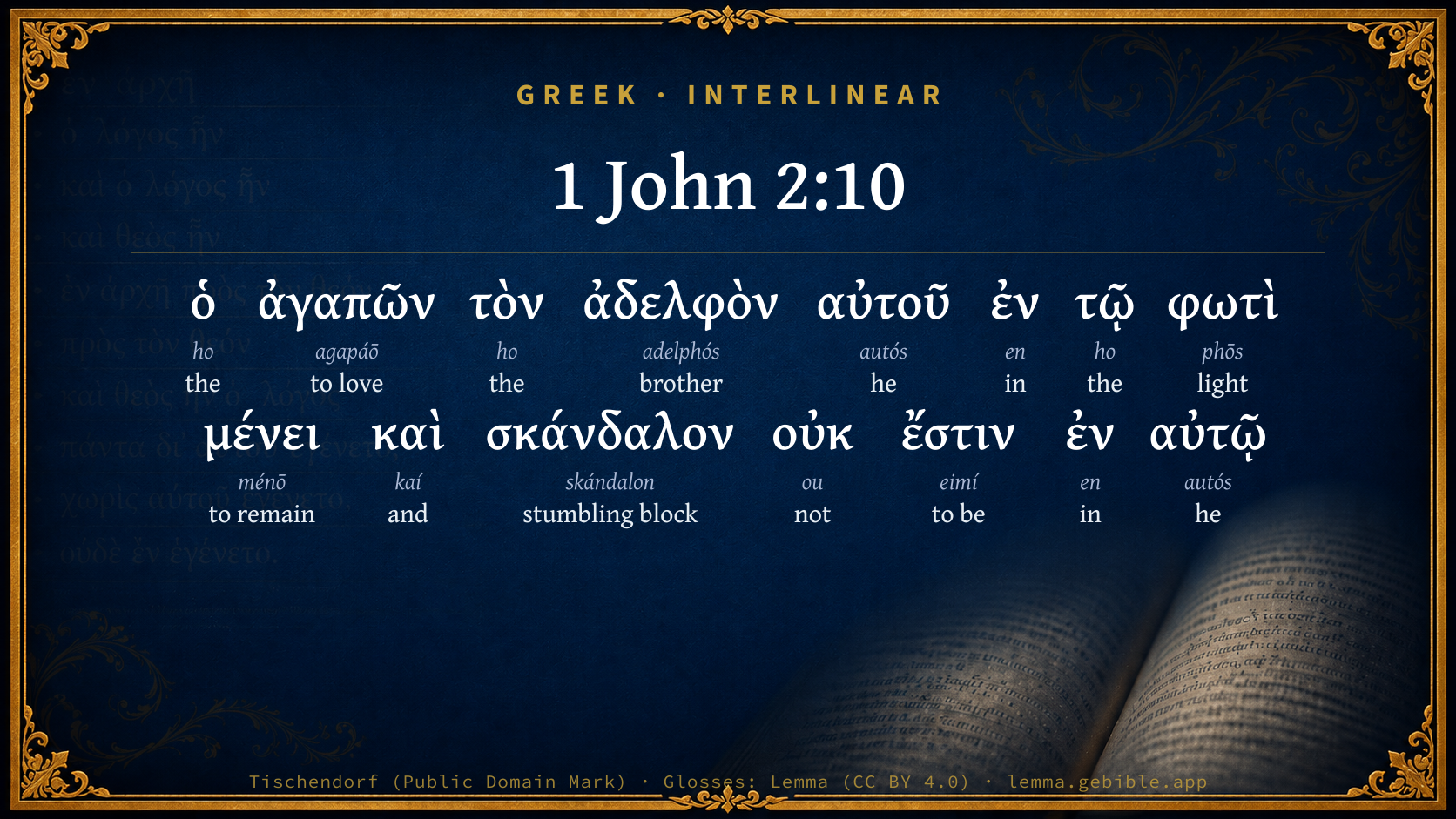
  1. ὁ ho G3588 “the” Article, Nominative, Singular, Masculine
  2. ἀγαπῶν agapáō G25 “to love” Verb, Present, Active, Participle, Nominative, Singular, Masculine
  3. τὸν ho G3588 “the” Article, Accusative, Singular, Masculine
  4. ἀδελφὸν adelphós G80 “brother” Noun, Accusative, Singular, Masculine
  5. αὐτοῦ autós G846 “he” Personal pronoun, Genitive, Singular, Masculine
  6. ἐν en G1722 “in” Preposition
  7. τῷ ho G3588 “the” Article, Dative, Singular, Neuter
  8. φωτὶ phōs G5457 “light” Noun, Dative, Singular, Neuter
  9. μένει ménō G3306 “to remain” Verb, Present, Active, Indicative, 3rd person, Singular
  10. καὶ kaí G2532 “and” Conjunction
  11. οὐκ ou G3756 “not” Particle, Negative
  12. ἔστιν eimí G1510 “to be” Verb, Present, Active, Indicative, 3rd person, Singular
  13. ἐν en G1722 “in” Preposition
  14. αὐτῷ autós G846 “he” Personal pronoun, Dative, Singular, Masculine

About this verse

These counts appear in no published source. They are computed here, from the morphology-tagged text and Lemma’s own curated glosses. What Lemma adds →

15
words
11
distinct lemmas
General Epistles
section

Notable vocabulary

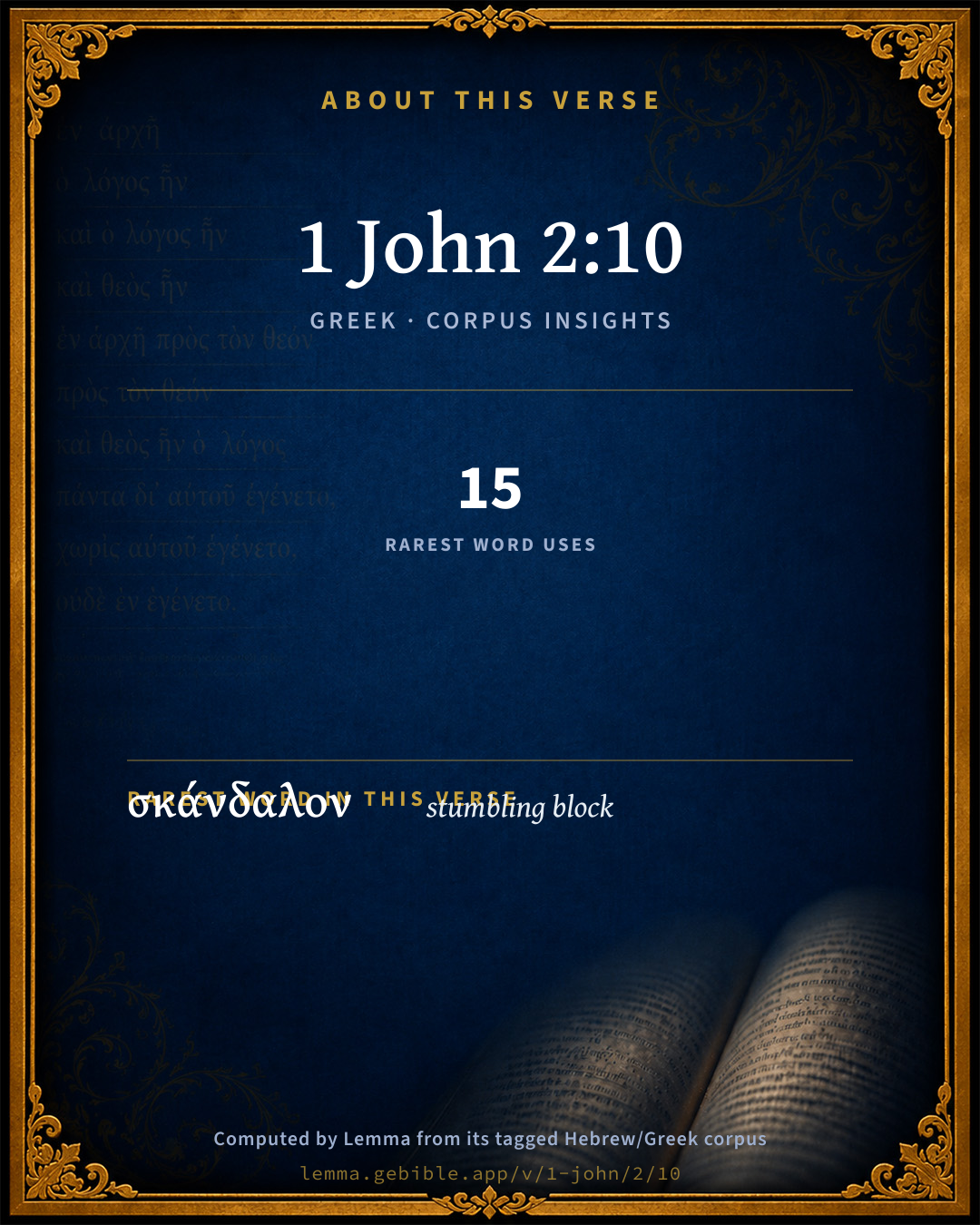
The rarest word here is σκάνδαλον stumbling block G4625 — appearing just 15 times in the whole Greek New Testament.

Shared distinctive vocabulary

σκάνδαλον stumbling block G4625 occurs in 13 verses of the Greek New Testament. Also found in:

Repetition

Words recur within this verse:

Cross-references

10

Topical passages linked to 1 John 2:10 in the Treasury of Scripture Knowledge — connected by theme and wording, ordered by reader-vote popularity; previews shown in the World English Bible.

  • 1 John 3:14 We know that we have passed out of death into life, because we love the brothers. He who doesn't love his brother remains in death.
  • Romans 9:32–33 Why? Because they didn't seek it by faith, but as it were by works of the law. They stumbled over the stumbling stone;
  • Hosea 6:3 Let us acknowledge Yahweh. Let us press on to know Yahweh. As surely as the sun rises, Yahweh will appear. He will come to us like the rain, Like the spring rain that waters the earth."
  • Romans 14:13 Therefore let's not judge one another any more, but judge this rather, that no man put a stumbling block in his brother's way, or an occasion for falling.
  • Matthew 13:21 yet he has no root in himself, but endures for a while. When oppression or persecution arises because of the word, immediately he stumbles.
  • Matthew 18:7 "Woe to the world because of occasions of stumbling! For it must be that the occasions come, but woe to that person through whom the occasion comes!
  • John 8:31 Jesus therefore said to those Jews who had believed him, "If you remain in my word, then you are truly my disciples.
  • 2 Peter 1:10 Therefore, brothers, be more diligent to make your calling and election sure. For if you do these things, you will never stumble.
  • Luke 17:1–2 He said to the disciples, "It is impossible that no occasions of stumbling should come, but woe to him through whom they come!
  • Philippians 1:10 so that you may approve the things that are excellent; that you may be sincere and without offense to the day of Christ;

Cross-references courtesy of OpenBible.info (CC BY 4.0).

Commentary

Notes on 1 John 2:10 from classic Christian and Jewish commentators (each source and its license shown beneath its notes). The classic Christian expositions comment on the surrounding passage and are grouped to its opening verse, so a note may address several verses; the Jewish commentaries on the Tanakh (Rashi and others) are per-verse, so they appear only where the commentator wrote on this verse.

Lemma curates 59 commentaries, every one of them public domain or Creative Commons licensed, each selected and text-cleaned for this edition rather than reprinted as found. About our sources →

Tyndale Open Study Notes

Tyndale Open Resources

2:10 To cause others to stumble can also mean to ensnare or entrap them. The Greek word skandalon means a trap or a block in someone’s path. The Gnostics, who taught falsehood about Christ, were hindering people by ensnaring them in error and darkness. • living in the light: A godly life will help, not hinder, the faith of other Christians.

Tyndale Open Study Notes — © Tyndale Open Resources, licensed CC BY-SA 4.0. Text via the HelloAO Bible API.

Bengel's Gnomon

Johann Albrecht Bengel

1Jn 2:10. Σκάνδαλον ἐν αὐτῷ οὐκ ἔστιν, there is no occasion of stumbling in him) The contrary is in 1Jn 2:11, has blinded. But the notion of the one is supplied from the other: in him who loves, there is neither blindness nor an occasion of stumbling: in him who does not love, there is both blindness and an occasion of stumbling. He who hates his brother, is a stumbling-block to himself, and stumbles against himself and everything within and without: he who loves, has a path free from obstacles.

Bengel's Gnomon of the New Testament — English translation (T&T Clark, Edinburgh, 1860) — public domain. Text from a community e-Sword module.

Expositor's Greek Testament

ed. W. Robertson Nicoll

1Jn 2:10 . ἐν τῷ φωτὶ μένει : he does not merely catch glimpses of the light but “abideth in it,” being of one mind with God, the common Father, who “is light” (1Jn 1:5 ). σκάνδαλον οὐκ ἔστιν ἐν αὐτῷ , “there is no occasion of stumbling, nothing to trip him up and make him fall, in his case” an echo of Joh 11:9-10 . Another interpretation, less agreeable to the context but more consonant with the common use of σκάνδαλον ( cf. Mat 13:41 ; Mat 18:7 ; Rom 14:13 ), is: Because he is winsome and gracious, there is in him no stumbling-block to others, nothing to deter them from accepting the Gospel. The love of the primitive Christians impressed the heathen. Cf. Tert. Apol. 39: “Vide, inquiunt, ut invicem se diligant: ipsi enim invicem oderunt; et ut pro alterutro mori sint parati: ipsi enim ad occidendum alterutrum paratiores erunt”. Ep. ad Diogn. 1: καὶ τίνα φιλοστοργίαν ἔχουσι πρὸς ἀλλήλους . This spirit disappeared, and in view of the bitter controversies of the 4th century the Pagan historian Ammianus avowed that “the enmity of the Christians toward each other surpassed the fury of savage beasts against man”. Another interpretation takes αὐτῷ as neuter: “There is no occasion of stumbling in it,” i.e. , in the light. Cf. Joh 11:9 .

The Expositor's Greek Testament, edited by W. Robertson Nicoll (1897–1910) — public domain. Text from a community e-Sword module.

Jamieson, Fausset & Brown

Robert Jamieson, A. R. Fausset & David Brown

Abiding in love is abiding in the light; for the Gospel light not only illumines the understanding, but warms the heart into love.

none occasion of stumbling--In contrast to, "He that hateth his brother is in darkness, and walketh in darkness, and knoweth not whither he goeth, because that darkness hath blinded his eyes." "In him who loves there is neither blindness nor occasion of stumbling [to himself]: in him who does not love, there is both blindness and occasion of stumbling. He who hates his brother, is both a stumbling-block to himself, and stumbles against himself and everything within and without; he who loves has an unimpeded path" [BENGEL]. John has in mind Jesus' words, Joh 11:9-10. ALFORD well says, "The light and the darkness are within ourselves; admitted into us by the eye, whose singleness fills the whole body with light."

Jamieson, Fausset & Brown — Commentary Critical and Explanatory on the Whole Bible (1871) — public domain (CC PDM 1.0). Text via the HelloAO Bible API.

Adam Clarke's Commentary

Verse 10. He that loveth his brother] That is, his neighbour, his fellow creature, whether Jew or Gentile, so as to bear him continual good will, and to be ready to do him every kind office; abideth in the light-not only gives proof that he has received Christ Jesus the Lord, but that he walks in him, that he retains the grace of his justification, and grows therein.

And there is none occasion of stumbling in him.] Και σκανδαλον εν αυτῳ ουκ εστιν· And there is no stumbling block in him; he neither gives nor receives offence: love prevents him from giving any to his neighbour; and love prevents him from receiving any from his neighbour, because it leads him to put the best construction on every thing. Besides, as he walks in the light, he sees the stumbling blocks that are in the way, and avoids them; every part of his path being illuminated. Many fall into sin because they do not see the snares that are in the way; and they do not see the snares because they either have not received, or do not abide in, the light.

Adam Clarke's Commentary on the Bible (1810–1826) — public domain. Text from a community e-Sword/MySword module.

John Calvin's Commentaries

John says in the third chapter, that we falsely boast of love to God, except we love our brethren; and this is most true. But he now takes love to the brethren as a testimony by which we prove that we love God. In short, since love so regards God, that in God it embraces men, there is nothing strange in this, that the Apostle, speaking of love, should refer at one time to God, at another to the brethren; and this is what is commonly done in Scripture. The whole perfection of life is often said to consist in the love of God; and again, Paul teaches us, that the whole law is fulfilled by him who loves his neighbor, (Romans 13:8;) and Christ declares that the main points of the law are righteousness, judgment, and truth. (Matthew 23:23.) Both these things are true and agree well together, for the love of God teaches us to love men, and we also in reality prove our love to God by loving men at his command. However this may be, it remains always certain that love is the rule of life. And this ought to be the more carefully noticed, because all choose rather almost anything else than this one commandment of God.

To the same purpose is what follows, and there is no occasion of stumbling in him — that is, in him who acts in love; for, he who thus lives will never stumble.

John Calvin's Commentaries (1540-1563) — public domain. Text from the Calvin Translation Society English edition (1840s-50s) via the Christian Classics Ethereal Library (ccel.org). Calvin's coverage is partial (roughly two-thirds of the Bible); uncommented books and verses are honest gaps, never fabricated. The 19th-century editor's footnotes and remarks are omitted so the notes are faithfully Calvin's own voice.

The Cambridge Bible for Schools and Colleges

gen. ed. J. J. S. Perowne

10. abideth in the light] Not only has entered into it but has made it his abode: see on 1Jn_2:24.

there is none occasion of stumbling in him] There are several ways of taking this. 1. He has in him nothing likely to ensnare him or cause him to stumble. 2. He has in him nothing likely to cause others to stumble. 3. There is in his case nothing likely to cause stumbling. 4. In the light there is nothing likely to cause stumbling;—the Greek for ‘in him’ being either masculine or neuter, and therefore capable of meaning ‘in it’. All make good sense, and the last makes a good antithesis to ‘knoweth not whither he goeth’ in 1Jn_2:11 : but the first is to be preferred on account of 1Jn_2:11. Yet in favour of the second it is worth noting that σκάνδαλον is commonly, if not always, used of offence caused to others. The parallel expressions ‘the truth is not in him’ (1Jn_2:4), ‘His word is not in us’ (1Jn_1:10; comp. 1Jn_1:8), make ‘in him’ more probable than ‘in his case’. And nothing here suggests the notion that the brother-hater leads others astray: it is his own dark condition that is contemplated. Moreover, there is the very close parallel in Joh_11:9-10; ‘If a man walk in the day, he stumbleth not, because he seeth the light of this world. But if a man walk in the night, he stumbleth, because the light is not in him.’ Comp. Psa_119:165, ‘Great peace have they which love Thy law: and nothing shall offend them’; i.e. there is no stumbling-block before them. Where the LXX. is very similar to this passage, omitting the preposition ‘in.’

The Cambridge Bible for Schools and Colleges (gen. ed. J. J. S. Perowne; Cambridge University Press, 1878–1918) — public domain. Text from a community e-Sword module.

John Gill's Exposition

He that loveth his brother,.... As such, and because he is his brother in Christ, and that cordially and sincerely, without hypocrisy and dissimulation, and by love serves him, both in things temporal and spiritual, and so observes the new, and yet old commandment,

abideth in the light: it is a plain case, that such a man is in the light of grace, and continues in it; for though it is not his love to the brethren which is the cause of his light, of his being and continuing in it, for that is owing to the spirit of light and knowledge, but on the contrary, light is the cause of his love; yet it is an evidence of it, that by which it is known, as the cause is known by the effect; see Joh 3:14;

and there is none occasion of stumbling in him, or "there is no scandal" or "offence in him"; he gives no offence to his brother, or at least, as much as in him lies, he takes care that he gives none; he avoids, as much as can be, putting a stumblingblock, or an occasion to fall, in his brother's way, by the use of things indifferent, or by any other action; nor will he easily take offence at what is said or done unto him, for charity or love is not easily provoked, it suffers long, and bears all things; see Co1 13:4; nor does he so much and so frequently transgress the laws of God, and particularly those which regard his neighbour or his brother, and so easily fall into the snares of Satan, because he is in the light, and walks in the light, and sees his way, and what lies in his way, and, so shuns and avoids occasion of stumbling and falling. There is not in him that wrath, and malice, and envy, which lead on to the commission of other sins; for love works no ill, but fulfils the law, and will not suffer him to commit adultery, to kill, to steal, or bear false witness against his neighbour, friend, and brother; see Rom 13:9; and such an one enjoys great peace, tranquillity, and happiness; he has much comfort in himself, and pleasure in the saints, and delight in their company; he walks inoffensively, and in an harmless manner, without hurting himself, or any other, Psa 119:165.

John Gill's Exposition of the Whole Bible (1746–1763) — public domain (CC PDM 1.0). Text via the HelloAO Bible API.

Trapp's Complete Commentary

John Trapp

10 He that loveth his brother abideth in the light, and there is none occasion of stumbling in him.

Ver. 10. None occasion, &c.] Gr. σκανδαλον, No scandal, i.e. no occasion of spiritual falling, whereby a man is made any manner of way worse, and backwarder in goodness. Quod fieri potest vel dicto, vel facto, sive exemplo in moribus, saith learned Lyserus, which may be done by word, deed, or evil example.

John Trapp, A Commentary or Exposition upon All the Books of the Old and New Testament (1647–1656) — public domain. Text from a community e-Sword module.

Albert Barnes' Notes on the Bible

He that loveth his brother abideth in the light - Has true religion, and enjoys it.

And there is none occasion of stumbling in him - Margin, “scandal.” Greek, “and there is no stumbling” (or scandal - σκάνδαλον skandalon - in him.) The word here used, means anything against which one strikes or stumbles; and then a stumbling-block, an impediment, or anything which occasions a fall. Then it is used in a moral or spiritual sense, as denoting that which is the occasion of falling into sin. See the Mat 5:29 note, and Rom 14:13 note. Here it refers to an individual in respect to his treatment of others, and means that there is nothing, so far as he is concerned, to lead him into sin. - Robinson, Lexicon. If he has love to the brethren, he has true religion; and there is, so far as the influence of this shall extend, nothing that will be the occasion of his falling into sin in his conduct toward them, for “love worketh no ill to his neighbor,” Rom 13:10. His course will be just, and upright, and benevolent. He will have no envy toward them in their prosperity, and will not be disposed to detract from their reputation in adversity; he will have no feelings of exultation when they fall, and will not be disposed to take advantage of their misfortunes; and, loving them as brethren, he will be in no respect under temptation to do them wrong. In the bosom of one who loves his brother, the baleful passions of envy, malice, hatred, and uncharitableness, can have no place. At the same time, this love of the brethren would have an important effect on his whole Christian life and walk, for there are few things that will have more influence on a man’s character in keeping him from doing wrong, than the love of the good and the pure. He who truly loves good people, will not be likely in any respect to go astray from the paths of virtue.

Albert Barnes' Notes on the Bible (1834–1885) — public domain. Text from a community e-Sword/MySword module.

Matthew Poole's English Annotations

His brother, put indefinitely, must be understood universally, i.e. he that loveth not this or that fellow Christian, upon some personal or private reason, but all, upon one and the same common and truly Christian account.

Abideth in the light; shows or doth demonstrate the settled, constant power, the regenerate, Divine principle hath over him.

And there is none occasion of stumbling in him; Greek, no scandal; no inconsistent thing, that ought to occasion him to judge otherwise of himself, or others to think otherwise of him.

Matthew Poole's English Annotations on the Holy Bible (1683–1685) — public domain. Text from a community e-Sword/MySword module.

The Pulpit Commentary

Whereas he who loves his brother has not only entered the region or" light, but has made it his home: he abideth in the light. It is difficult to determine whether the "occasion of stumbling" skandalon is in reference to himself or to others. The context here andptei Joh_11:9, 10are in favour of the former. It is a man"s own salvation that is under consideration here, not his influence over others: and prosko oti to fwv oujk e]stin ejn aujtw seems exactly parallel. To have no light in one is to be in danger of stumbling; to have light in one is to have no occasion of stumbling. (comp Eze_14:3, which is very parallel) But elsewhere in the New Testament skandalon means a stumbling-block or snare in another"s way, not in one"s own way; and this makes sense here. There is yet a third explanation. jEn aujtw may mean "in it," i.e., " in the light there is no occasion of stumbling." This makes a good antithesis to the close of verse 11, "knoweth not whither he goeth."

The Pulpit Commentary (1880–1919), ed. H.D.M. Spence-Jones & Joseph S. Exell — public domain. Text from a community e-Sword module.

John Wesley's Explanatory Notes

He that loveth his brother - For Christ's sake. Abideth in the light - Of God. And there is no occasion of stumbling in him - Whereas he that hates his brother is an occasion of stumbling to himself. He stumbles against himself, and against all things within and without; while he that loves his brother, has a free, disencumbered journey.

John Wesley, Explanatory Notes Upon the Whole Bible (1754–1765) — public domain. Text via the GEBible commentary corpus.

The People's New Testament

B. W. Johnson

10. He that loveth, etc. On the other hand, brotherly love shows that one abides in the light. None occasion of stumbling. Because he walks in the light and can see where he walks.

B. W. Johnson's The People's New Testament with Notes (1889–1891) — public domain. Electronic text from the Christian Classics Ethereal Library (CCEL) ThML edition.

Cambridge Greek Testament for Schools and Colleges

10. ὁ ἀγαπῶν. Nothing is said about what he professes; it is what he does that is of consequence. μένει means not only has entered into the light, but has it for his abode: see on 1Jn 2:24.

σκάνδαλον οὐκ ἔστιν ἐν αὐτῷ. There are four ways of taking this; three taking αὐτῷ as masculine, and one taking it as neuter, referring to τῷ φωτί. 1. He has in him nothing likely to ensnare him or cause him to stumble. 2. He has in him nothing likely to cause others to stumble. 3. There is in his case nothing likely to cause stumbling. 4. In the light there is nothing likely to cause stumbling. All make good sense, and the last makes a good antithesis to ‘knoweth not whither he goeth’ in 1Jn 2:11: but the first is to be preferred on account of 1Jn 2:11. Yet in favour of the second it is worth noting that σκάνδαλον is commonly, if not always, used of offence caused to others. The parallel expressions ‘the truth is not in him’ (1Jn 2:4), ‘His word is not in us’ (1Jn 1:10; comp. 1Jn 1:8), make ‘in him’ more probable than ‘in his case.’ And nothing here suggests the notion that the brother-hater leads others astray: it is his own dark condition that is contemplated: ipse sibi offendiculum est. Moreover, there is the very close parallel in Joh 11:9-10; ‘If a man walk in the day, he stumbleth not, because he seeth the light of this world. But if a man walk in the night, he stumbleth, because the light is not in him.’ Comp. Psa 119:165, ‘Great peace have they which love Thy law: and nothing shall offend them’; i.e. there is no stumbling-block before them: οὐκ ἔστιν αὐτοῖς σκάνδαλον. It is not impossible that this passage was in the Apostle’s mind: his ἐν may represent the ‘to’ in the Hebrew original. Comp. 1Sa 25:31 where σκάνδαλον represents the Hebrew mikshol, ‘a stumbling.’ Elsewhere it represents moqesh ‘a snare’ (Jdg 2:3; Jdg 8:27). It combines the notions of tripping up and ensnaring. The word is a late form of σκανδάληθρον (Aristoph. Ach. 687) the ‘baitstick’ in a trap.

Cambridge Greek Testament for Schools and Colleges (Cambridge University Press, 1896; 21 vols, various authors incl. Carr, Maclear, Plummer, Farrar, Lumby, Moule, M. R. James, Simcox) — public domain. Text from a community e-Sword module.

Alford’s Greek Testament

Henry Alford

10.] We now come to the enunciation of the law of brotherly love, and in a form resembling that used in ch. 1:8, 10: and in vv. 4 f. First is asserted the incompatibility of living in hatred and walking in the light: then the identity of walking in love and walking in the light: then lastly as a contrast to the last (ὁ ἀγαπῶν.… ὁ δὲ μισῶν), the same fact with regard to hatred and the darkness, and the blinding effect on him who walks in it. The φῶς is as before, the light of Christ, now partially shining, but one day to be fully revealed: the σκοτία is the darkness of this present world, now passing away). He that saith that he is in the light, and hateth his brother, is in the darkness until now (Düsterd. has very properly protested against the softening down of μισεῖν into “minus diligere, posthabere, non colere,” &c. “Nothing,” he says, “can be more shallow and weak as compared with the ethics of the whole Scripture. All the truth, depth, and power of Christian ethics rests on the ‘aut … aut,’ so distinctly insisted on by St. John. On the one side is God, on the other the world: here is life, there is death (ch. 3:14): here, love; there, hate, i. e. murder (ch. 3:14 ff.), there is no medium. In the space between, is nothing. Life may as yet be merely elementary and fragmentary. Love may be as yet weak and poor, but still, life in God and its necessary demonstration in love is present really and truly, and the word of our Lord is true, ‘He that is not against me is with me,’ Luk 9:50: and on the other side, the life according to the flesh, the attachment to the world, and the necessary action of this selfishness by means of hatred, may be much hidden, may be craftily covered and with splendid outer surface; but in the secret depth of the man, there where spring the real fountains of his moral life, is not God but the world; the man is yet in death, and can consequently love nothing but himself and must hate his brother: and then that other word of the Lord is true, ‘He that is not for me is against me,’ Luk 11:23. For a man can only be either for or against Christ, and consequently can only have either love or hate towards his brother.” Bengel says well, on ver. 11, “oppositio immediata: ubi non est amor, odium est: cor enim non est vacuum.”

It has been questioned, who is meant by τὸν ἀδελφὸν αὐτοῦ. It seems plain that the expression here is not = τὸν πλησίον αὐτοῦ, seeing that St. John is writing to Christians, and treating of their κοινωνία μετʼ ἀλλήλων. On the other hand, if we are to restrict the meaning, as is done by most modern Commentators, to Christian brotherhood, it is plain that we cannot understand strictly τὸν ἀδελφὸν αὐτοῦ in vv. 9, 11, seeing that the man there spoken of is in reality not a Christian at all. So that either we must enlarge the sense of ἀδελφός, or suppose some impropriety of language in the use of the term in these verses, q. d. him who ought to be loved by him as a Christian brother, supposing himself to be really a Christian. This difficulty does not seem to have struck any of the Commentators: but it is one which certainly will not allow us to confine the term to its utmost strictness of meaning.

ἕως ἄρτι, up to this moment: notwithstanding any apparent change which may have taken place in him when he passed into the ranks of nominal Christians).

10.] He that loveth his brother abideth in the light (i. e. the continuance of the habit of brotherly love is a measure of and a guarantee for his continuance in that light whose great command is Love), and there is no occasion of stumbling in him (so E. V., excellently. For it is clear by the parallel in ver. 11, that this is what is meant, and not that he gives no occasion of stumbling to others, as Calov., al., “Qui fratrem odit, ipse sibi offendiculum est, et incurrit in seipsum et in omnia intus et foris; qui amat, expeditum iter habet.” Bengel. Cf. also Joh 11:9, Joh 11:10, which is in more than one respect the key-text here. For it also explains the apparently difficult ἐν αὐτῷ, occurring as it does there in ver. 10, ἐὰν δέ τις περιπατῇ ἐν τῇ νυκτί, προσκόπτει, ὅτι τὸ φῶς οὐκ ἔστιν ἐν αὐτῷ. The light, and the darkness, by which we walk safely, or stumble, are within ourselves; admitted into us by the eye, whose singleness fills the whole body with light).

Henry Alford, The Greek Testament (1849–1861) — public domain. Text from a community e-Sword module.

International Critical Commentary

10. The contrast is, as usual, stated in terms which carry it a stage further, μένειν being substituted for εἶναι. It is possible that a man might attain to the light. He cannot abide in it without showing that love which the new light has revealed to be the true attitude of Christian to Christian, and of man to man. Cf. Joh 12:46, ἵνα πᾶς ὁ πιστεύων εἰς ἐμὲ ἐν τῇ σκοτίᾳ μὴ μείνῃ: 8:35, ὁ υἱὸς μένει εἰς τὸν αἰῶνα. The slave may learn much, but he cannot abide in the house for ever.σκάνδαλον … ἔστιν] The stumbling-block may be that which a man puts either in his own way, or in that of his neighbour. The word is not found elsewhere in the Johannine books, except Rev 2:14 (βαλεῖν σκάνδαλον ἐνώπιον τῶν υἱῶν Ἰσραήλ). The verb is found in Joh 6:61, Joh 16:1. The general usage of the New Testament, and perhaps the use of the verb in the Fourth Gospel, is in favour of the second interpretation. And it gives a possible sense. He who loves his neighbour not only abides in the light himself, but is also free from the guilt of causing others to offend. But the general context almost requires the other explanation. The effect of love and hate on the man himself is the subject of the whole passage. The sphere of his moral and spiritual progress or decline is regarded as being within himself. The occasions of falling are within. Cf. Hos 4:17, ἔθηκεν ἐαυτῷ σκάνδαλα. This may be suggested by what is probably the true form of the text, σκάνδαλον ἐν αὐτῷ οὐκ ἔστιν, internal stumbling-block, causing offence within, there is none. Possibly ἐν αὐτῷ may refer to ἐν τῷ φωτί,“In the light there is nothing to cause stumbling.” Cf., however, Joh 11:9, Joh 11:10. For the phrase itself we may compare the Rabbinic הַמֵּבִיא תְקָלָה לַחֲרֵיבוֹ quoted by Schlatter from Sifre, Num 5:15.

εν αυτω B Κ L Ρ al. pler. cat. vg. syrp arm. Thphyl. Oec. Aug.] post εστιν א A C 5. 105 jscr m syrsch sah. Lcif.

International Critical Commentary — older volumes (1896–1929), various authors — public domain. Text from a community e-Sword module.

Vincent's Word Studies in the New Testament

Marvin R. Vincent

Abideth [μενει] . See on ver. 6. Compare ver. 9, is in.

Occasion of stumbling [σκανδαλον] . See on offend, Mt 5:29. For the image in John, see Joh 6:61; Joh 11:9; Joh 16:1; Rev 2:14. The meaning is not that he gives no occasion of stumbling to others, but that there is none in his own way. See Joh 11:9, 10.

Marvin R. Vincent, Word Studies in the New Testament (1887–1900) — public domain. Text from a community e-Sword/MySword module.

Lesson kit

Teaching starters — assembled from the data on this page, not authored interpretation. Every prompt links to the verse data it draws on. Edit before teaching.

1 John, in the General Epistles, opens this verse with 15 words (11 distinct Greek lemmas). Its most distinctive word is skándalon (“stumbling block”). A historical commentator’s framing appears above. Read the whole chapter for the surrounding context.

Discussion questions

  1. What does “stumbling block” (skándalon) contribute to the verse as a whole?
  2. How does Matthew 13:41, which shares the word «stumbling block», read alongside this verse?
  3. What does the repetition of “the” (3× in this one verse) do in this verse?
  4. These translations render this verse differently; the difference is in the English rendering, not the original. What questions does that raise?
  5. Compare how Tyndale Open Study Notes and Bengel's Gnomon read this verse. Where do they agree or differ?

Things to notice

Reading settings

Reading text

Shown beneath each verse's original-language words.

Old Testament
Old Testament edition

Read the OT as the Masoretic Hebrew (MT) or the Greek Septuagint (LXX).

English shown for the Greek Septuagint (in the Hebrew ↔ Greek comparison).

Comparing translations? Open the Compare panel on any verse page to stack up to four side by side.