1 John 2:27

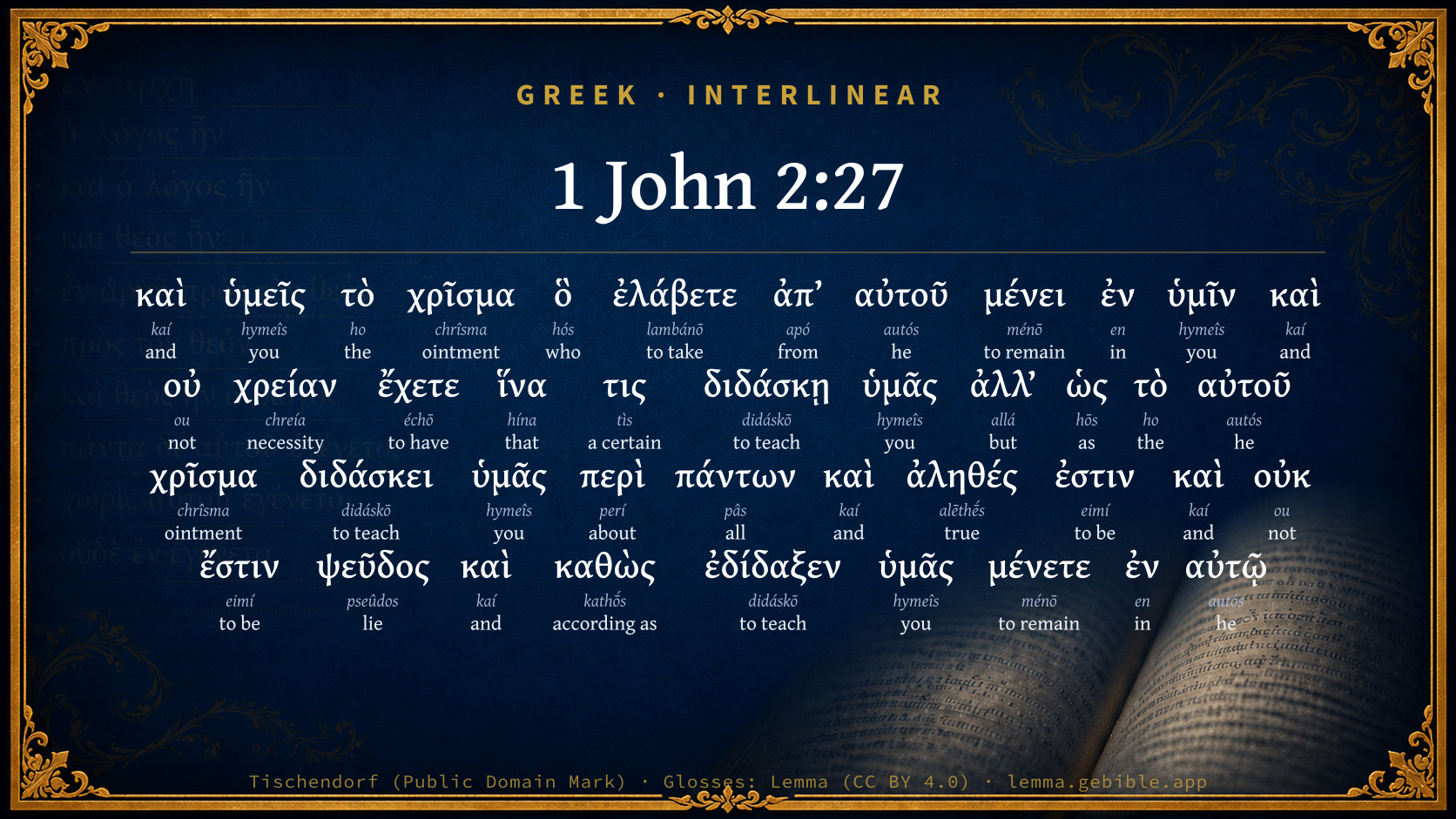
Greek (Tischendorf 8th ed.) 1 John 2:27 appears in the Greek New Testament. The text above is from the Tischendorf 8th edition. Each word links to its Strong’s number and a concise gloss. Click any word for its full Thayer’s Greek Lexicon entry.
Download image
Cite this verse

1 John 2:27 (World English Bible). Public Domain. Lemma interlinear Bible study tool, https://lemma.gebible.app/v/1-john/2/27.

Show BibTeX & RIS
BibTeX
RIS
English Translation
As for you, the anointing which you received from him remains in you, and you don't need for anyone to teach you. But as his anointing teaches you concerning all things, and is true, and is no lie, and even as it taught you, you will remain in him.
World English Bible · Public Domain
Download a study sheet

One document with this verse’s original text, its word-by-word gloss line, the meaning frame, cross-references with their text, attributed commentary, and full source and license credits — printable, and it pastes into notes with its structure intact.

This verse Autodidact and up

Study sheet (.html) Plain text (.txt)

A passage Seminary Student

Up to 50 verses in one chapter. A passage sheet keeps up to 6 commentary sources and 12 cross-references per verse, in the order this page ranks them, and says so on the sheet whenever that leaves anything out. Ask for a single verse and you get the Autodidact verse sheet above.

Everything on this page stays free to read, with no account — the sheet is a download of what is already on screen, not access to it.

Want to remove ads? Support Godless Engineer
Compare translations 3

The same verse in 3 English versions, stacked beneath the original-language interlinear above. Click any original word for its lexicon entry.

Each is an independent rendering of the whole verse — the interlinear is not word-aligned to these translations.

Highlighted words mark where these versions differ — a whole-verse word diff, not a word-by-word alignment.

  • World English Bible Public Domain
    As for you, the anointing which you received from him remains in you, and you don't need for anyone to teach you. But as his anointing teaches you concerning all things, and is true, and is no lie, and even as it taught you, you will remain in him.
  • King James Version Public Domain
    But the anointing which ye have received of him abideth in you, and ye need not that any man teach you: but as the same anointing teacheth you of all things, and is truth, and is no lie, and even as it hath taught you, ye shall abide in him.
  • unfoldingWord Literal Text CC BY-SA 4.0
    And you, the anointing that you received from him remains in you, and you do not have need that anyone should teach you. But as his anointing teaches you about all things and is true and is not a lie, and just as it has taught you, remain in him.

unfoldingWord Literal Text — © unfoldingWord, licensed CC BY-SA 4.0. Word-aligned USFM3 via Door43 (git.door43.org/unfoldingWord/en_ult).

Versions to compare (up to 4)

3 of 4 selected

Show all 19 translations

Every available English version of this verse, each an independent rendering of the whole verse.

  • World English Bible Public Domain
    As for you, the anointing which you received from him remains in you, and you don't need for anyone to teach you. But as his anointing teaches you concerning all things, and is true, and is no lie, and even as it taught you, you will remain in him.
  • Berean Standard Bible Public Domain
    And as for you, the anointing you received from Him remains in you, and you do not need anyone to teach you. But just as His true and genuine anointing teaches you about all things, so remain in Him as you have been taught.
  • Majority Standard Bible Public Domain
    And as for you, the anointing you received from Him remains in you, and you do not need anyone to teach you. But just as the same true and genuine anointing teaches you about all things, so you must remain in Him as you have been taught.
  • King James Version Public Domain
    But the anointing which ye have received of him abideth in you, and ye need not that any man teach you: but as the same anointing teacheth you of all things, and is truth, and is no lie, and even as it hath taught you, ye shall abide in him.
  • American Standard Version (1901) Public Domain
    And as for you, the anointing which ye received of him abideth in you, and ye need not that any one teach you; but as his anointing teacheth you; concerning all things, and is true, and is no lie, and even as it taught you, ye abide in him.
  • Revised Version (1885) Public Domain
    And as for you, the anointing which ye received of him abideth in you, and ye need not that any one teach you; but as his anointing teacheth you concerning all things, and is true, and is no lie, and even as it taught you, ye abide in him.
  • Geneva Bible (1599) Public Domain
    But that anointing which ye receiued of him, dwelleth in you: and ye neede not that any man teach you: but as the same Anoynting teacheth you of all things, and it is true, and is not lying, and as it taught you, ye shall abide in him.
  • Douay-Rheims (1899) Public Domain
    And as for you, let the unction, which you have received from him, abide in you. And you have no need that any man teach you; but as his unction teacheth you of all things, and is truth, and is no lie. And as it hath taught you, abide in him.
  • Young's Literal Translation Public Domain
    and you, the anointing that ye did receive from him, in you it doth remain, and ye have no need that any one may teach you, but as the same anointing doth teach you concerning all, and is true, and is not a lie, and even as was taught you, ye shall remain in him.
  • Literal Standard Version CC BY-SA 4.0
    and you, the anointing that you received from Him, it remains in you, and you have no need that anyone may teach you, but as the same anointing teaches you concerning all, and is true, and is not a lie, and even as was taught you, you will remain in Him.
  • Unlocked Literal Bible CC BY-SA 4.0
    As for you, the anointing that you received from him remains in you, and you do not need anyone to teach you. But as his anointing teaches you everything and is true and is not a lie, and just as it has taught you, remain in him.
  • unfoldingWord Literal Text CC BY-SA 4.0
    And you, the anointing that you received from him remains in you, and you do not have need that anyone should teach you. But as his anointing teaches you about all things and is true and is not a lie, and just as it has taught you, remain in him.
  • Darby Bible Public Domain
    and *yourselves*, the unction which ye have received from him abides in you, and ye have not need that any one should teach you; but as the same unction teaches you as to all things, and is true and is not a lie, and even as it has taught you, ye shall abide in him.
  • World Messianic Bible Public Domain
    As for you, the anointing which you received from him remains in you, and you don’t need for anyone to teach you. But as his anointing teaches you concerning all things, and is true, and is no lie, and even as it taught you, you will remain in him.
  • Webster's Bible Public Domain
    But the anointing which ye have received from him abideth in you, and ye need not that any man should teach you: but as the same anointing teacheth you concerning all things, and is truth, and is no lie, and even as it hath taught you, ye shall abide in him.
  • Free Bible Version CC BY-SA 4.0
    But the anointing you received from him means the Spirit lives in you, and you don't need to be taught by anyone. The Spirit's anointing teaches you about everything. It is the truth and not a lie. So live in Christ, just as you've been taught!
  • Bible in Basic English Public Domain
    As for you, the Spirit which he gave you is still in you, and you have no need of any teacher; but as his Spirit gives you teaching about all things, and is true and not false, so keep your hearts in him, through the teaching which he has given you.
  • Text-Critical English NT CC BY 4.0
    But the anointing you received from him abides in you, and you have no need for anyone to teach you. But the same anointing teaches you about all things; it is true, not a lie. So, just as it has taught you, you must abide in him.
  • Tyndale New Testament (1534) Public Domain
    And the anoyntynge which ye have receaved of him dwelleth in you. And ye nede not that eny man teache you: but as the annoyntynge teaheth you all thynges and is true and is no lye: and as it taught you even so byde therin.

Literal Standard Version (2020), Covenant Press — licensed CC BY-SA 4.0. Text via the HelloAO Bible API (eBible.org). Unlocked Literal Bible (unfoldingWord) — licensed CC BY-SA 4.0. Text via the HelloAO Bible API (eBible.org). unfoldingWord Literal Text — © unfoldingWord, licensed CC BY-SA 4.0. Word-aligned USFM3 via Door43 (git.door43.org/unfoldingWord/en_ult). Free Bible Version, Dr. Jonathan Gallagher — licensed CC BY-SA 4.0. Text via the HelloAO Bible API (eBible.org).

Word by word

More ways to search: Search by grammar → Find every occurrence → Compare this word →

Practice this passage: Drill this verse → Learn its vocabulary →

χρῖσμα
chrîsma
G5545
“ointment”
Noun, Nominative, Singular, Neuter
Part of Speech
Noun
Case
Nominative
Number
Singular
Gender
Neuter
Full Thayer's Definition

Origin: from G5548

TDNT: 17:13,1

1. anything smeared on, unguent, ointment, usually prepared by the Hebrews from oil and aromatic herbs. Anointing was the inaugural ceremony for priests
  1. καὶ kaí G2532 “and” Conjunction
  2. ὑμεῖς hymeîs G5210 “you” Personal pronoun, 2nd person, Nominative, Plural
  3. τὸ ho G3588 “the” Article, Nominative, Singular, Neuter
  4. ὃ hós G3739 “who” Relative pronoun, Nominative, Singular, Neuter
  5. ἐλάβετε lambánō G2983 “to take” Verb, Aorist, Active, Indicative, 2nd person, Plural
  6. ἀπ’ apó G575 “from” Preposition
  7. αὐτοῦ autós G846 “he” Personal pronoun, Genitive, Singular, Masculine
  8. μένει ménō G3306 “to remain” Verb, Present, Active, Indicative, 3rd person, Singular
  9. ἐν en G1722 “in” Preposition
  10. ὑμῖν hymeîs G5210 “you” Personal pronoun, 2nd person, Dative, Plural
  11. καὶ kaí G2532 “and” Conjunction
  12. οὐ ou G3756 “not” Particle, Negative
  13. χρείαν chreía G5532 “necessity” Noun, Accusative, Singular, Feminine
  14. ἔχετε échō G2192 “to have” Verb, Present, Active, Indicative, 2nd person, Plural
  15. ἵνα hína G2443 “that” Conjunction
  16. τις tìs G5100 “a certain” Indefinite pronoun, Nominative, Singular, Masculine
  17. διδάσκῃ didáskō G1321 “to teach” Verb, Present, Active, Subjunctive, 3rd person, Singular
  18. ὑμᾶς hymeîs G5210 “you” Personal pronoun, 2nd person, Accusative, Plural
  19. ἀλλ’ allá G235 “but” Conjunction
  20. ὡς hōs G5613 “as” Adverb
  21. τὸ ho G3588 “the” Article, Nominative, Singular, Neuter
  22. αὐτοῦ autós G846 “he” Personal pronoun, Genitive, Singular, Masculine
  23. χρῖσμα chrîsma G5545 “ointment” Noun, Nominative, Singular, Neuter
  24. διδάσκει didáskō G1321 “to teach” Verb, Present, Active, Indicative, 3rd person, Singular
  25. ὑμᾶς hymeîs G5210 “you” Personal pronoun, 2nd person, Accusative, Plural
  26. περὶ perí G4012 “about” Preposition
  27. πάντων pâs G3956 “all” Adjective, Genitive, Plural, Neuter
  28. καὶ kaí G2532 “and” Conjunction
  29. ἀληθές alēthḗs G227 “true” Adjective, Nominative, Singular, Neuter
  30. ἐστιν eimí G1510 “to be” Verb, Present, Active, Indicative, 3rd person, Singular
  31. καὶ kaí G2532 “and” Conjunction
  32. οὐκ ou G3756 “not” Particle, Negative
  33. ἔστιν eimí G1510 “to be” Verb, Present, Active, Indicative, 3rd person, Singular
  34. ψεῦδος pseûdos G5579 “lie” Noun, Nominative, Singular, Neuter
  35. καὶ kaí G2532 “and” Conjunction
  36. καθὼς kathṓs G2531 “according as” Adverb
  37. ἐδίδαξεν didáskō G1321 “to teach” Verb, Aorist, Active, Indicative, 3rd person, Singular
  38. ὑμᾶς hymeîs G5210 “you” Personal pronoun, 2nd person, Accusative, Plural
  39. μένετε ménō G3306 “to remain” Verb, Present, Active, Indicative, 2nd person, Plural
  40. ἐν en G1722 “in” Preposition
  41. αὐτῷ autós G846 “he” Personal pronoun, Dative, Singular, Masculine

About this verse

These counts appear in no published source. They are computed here, from the morphology-tagged text and Lemma’s own curated glosses. What Lemma adds →

42
words
24
distinct lemmas
General Epistles
section

Notable vocabulary

The rarest word here is χρῖσμα ointment G5545 — appearing just 3 times in the whole Greek New Testament.

Shared distinctive vocabulary

χρῖσμα ointment G5545 occurs in 2 verses of the Greek New Testament. Also found in:

Repetition

Words recur within this verse:

  • διδάσκῃ to teach G1321 ×3
  • χρῖσμα ointment G5545 ×2
  • μένει to remain G3306 ×2
  • ἐστιν to be G1510 ×2
  • καὶ and G2532 ×5
  • ὑμεῖς you G5210 ×5
  • αὐτοῦ he G846 ×3
  • τὸ the G3588 ×2
  • ἐν in G1722 ×2
  • οὐ not G3756 ×2

Cross-references

19

Topical passages linked to 1 John 2:27 in the Treasury of Scripture Knowledge — connected by theme and wording, ordered by reader-vote popularity; previews shown in the World English Bible.

  • John 14:26 But the Counselor, the Holy Spirit, whom the Father will send in my name, he will teach you all things, and will remind you of all that I said to you.
  • 1 John 2:20–21 You have an anointing from the Holy One, and you know the truth.
  • 1 Corinthians 2:13 Which things also we speak, not in words which man's wisdom teaches, but which the Holy Spirit teaches, comparing spiritual things with spiritual things.
  • John 16:13 However when he, the Spirit of truth, has come, he will guide you into all truth, for he will not speak from himself; but whatever he hears, he will speak. He will declare to you things that are coming.
  • Jeremiah 31:33–34 But this is the covenant that I will make with the house of Israel after those days, says Yahweh: I will put my law in their inward parts, and in their heart will I write it; and I will be their God, and they shall be my people:
  • 1 Thessalonians 2:13 For this cause we also thank God without ceasing, that, when you received from us the word of the message of God, you accepted it not as the word of men, but, as it is in truth, the word of God, which also works in you who believe.
  • Hebrews 8:10–11 "For this is the covenant that I will make with the house of Israel. After those days," says the Lord; "I will put my laws into their mind, I will also write them on their heart. I will be to them a God, And they will be to me a people.
  • John 15:4–7 Remain in me, and I in you. As the branch can't bear fruit by itself, unless it remains in the vine, so neither can you, unless you remain in me.
  • John 8:31–32 Jesus therefore said to those Jews who had believed him, "If you remain in my word, then you are truly my disciples.
  • 2 Peter 1:16–17 For we did not follow cunningly devised fables, when we made known to you the power and coming of our Lord Jesus Christ, but we were eyewitnesses of his majesty.
  • John 14:17 the Spirit of truth, whom the world can't receive; for it doesn't see him, neither knows him. You know him, for he lives with you, and will be in you.
  • 1 John 2:28 Now, little children, remain in him, that when he appears, we may have boldness, and not be ashamed before him at his coming.
  • Colossians 2:6 As therefore you received Christ Jesus, the Lord, walk in him,
  • 1 Peter 1:23 having been born again, not of corruptible seed, but of incorruptible, through the word of God, which lives and remains forever.
  • 1 John 3:24 He who keeps his commandments remains in him, and he in him. By this we know that he remains in us, by the Spirit which he gave us.
  • 2 John 1:2 for the truth's sake, which remains in us, and it will be with us forever:
  • Ephesians 4:21 if indeed you heard him, and were taught in him, even as truth is in Jesus:
  • John 4:14 but whoever drinks of the water that I will give him will never thirst again; but the water that I will give him will become in him a well of water springing up to eternal life."
  • 1 Timothy 2:7 to which I was appointed a preacher and an apostle (I am telling the truth in Christ, not lying), a teacher of the Gentiles in faith and truth.

Cross-references courtesy of OpenBible.info (CC BY 4.0).

Commentary

Notes on 1 John 2:27 from classic Christian and Jewish commentators (each source and its license shown beneath its notes). The classic Christian expositions comment on the surrounding passage and are grouped to its opening verse, so a note may address several verses; the Jewish commentaries on the Tanakh (Rashi and others) are per-verse, so they appear only where the commentator wrote on this verse.

Lemma curates 59 commentaries, every one of them public domain or Creative Commons licensed, each selected and text-cleaned for this edition rather than reprinted as found. About our sources →

Matthew Poole's English Annotations

But the anointing which ye have received: it is evident, that the ancient anointing of persons to some eminent office, was not a mere empty rite of investiture, or authorization, but also a symbol of their qualification by another Spirit then coming upon them. Whereupon our Lord Jesus was eminently the Christ, or anointed One, not only as denoting his solemn investiture with the sacred offices of King, Priest, and Prophet, which were all wont to be entered into by unction; but as signifying also his receiving the Spirit, (not by measure), by which he was most perfectly qualified for them. And whereas he is also said to have made those that believe on him, in a far inferior sense, kings and priests to his Father; to them also he imparts of the same Spirit, Rom 8:9, whence they are said to be anointed too, 2Co 1:21,22. And hence, as is here said, and 1Jo 2:27, they do not need, & c.

Ye need not that any man teach you; not as if they had absolutely no need at all of human teaching, for the apostle supposes not himself to be now doing a vain or needless thing; but that they had less need, having the internal principles of light and life in them, they were in a great measure capable of steering their own course. They had in themselves a living, ingrafted word, enabling them to teach and commune with themselves, as Deu 30:11,12; Ro 10:7-9. Hereupon their own reins could instruct them, Psa 16:7. Or, they could instruct themselves, εαυτους, as that may be read, Col 3:16, the word of Christ dwelling richly in them. Therefore they did not so need to be taught, as those that know not the first principles of the oracles of God.

Teacheth you of all things; i.e. all such necessary and essential things to the life and being of Christianity, of which sort that doctrine concerning the Messiah was, which he was now speaking of; not all things simply, for that had been to attribute to them far higher knowledge than he could pretend to himself, even that which was peculiar to God only. Nor was that knowledge which they had of those necessary things to be thought the effect of an immediate inspiration, but such as by ordinary external means they had already learned, but made vital and efficacious by the special sanctifying influence and operation of the Holy Ghost; who having begotten in them a correspondent impress to those great truths which are after godliness, formed the new creature in them, which is begotten of the word of truth, had made them capable of dijudication, or of distinguishing by a spiritual sense, Phi 1:9,10, between things that were grateful, suitable, and nutritive to the life of the new creature in them, and such things as were noxious and offensive. Whereas, in reference to things more remote from the vitals of religion and godliness, none can assure themselves of such a privilege. And as to these, they are to expect it in the way of their own sincere and diligent endeavours and prayers, as the effect of the habit of grace, maintained and kept up in life and vigour; and a reward of their sincere resignation and subjection of heart and soul to the governing power of truth, so far as it should be understood and known of them, according to that of our Saviour, Joh 7:17; If any man will do his will, he shall know of the doctrine whether it be of God, & c. And thus they might certainly keep their station, and

abide in him; unto which they are therefore exhorted.

Matthew Poole's English Annotations on the Holy Bible (1683–1685) — public domain. Text from a community e-Sword/MySword module.

Bengel's Gnomon

Johann Albrecht Bengel

1Jn 2:27. Καί ὑμεῖς, and ye) On this depends ye have no need; a befitting transposition.[5]—ἘΛΆΒΕΤΕ ἈΠʼ ΑὐΤΟῦ, ye have received from Him) Joh 1:16.—ἐν ὑμῖν μένει, abides in you) This indicative implies a very subtle exhortation (to be compared with 2Ti 3:14), by which he makes the faithful, when harassed by deceivers, thus to answer them: The anointing abideth in us: we do not need a teacher: it teaches us the truth: in that doctrine we will continue. See how pleasant the transition is from this introduction of the language of another speaker[6] to the direct address, in the following verse. Abides in you, ye shall abide in Him, are correlative expressions.—καὶ) and therefore.—οὐ χρείαν ἔχετε, ye have no need) A phrase indicative of character (or of courtesy), expressing the repulse of the faithful directed against deceivers. Αὐτάρκεια θεοδιδάκτων· They who are taught of God have a sufficiency in themselves. God is sufficient for those who are taught by Him.—τὶς) any one, whoever he may be. By rejecting the whole class of seducers, individuals are the more easily ordered to begone, although they wish to appear more excellent than others.—διδάσκῃ, teach) Heb 8:11, note.—ὑμᾶς, you) You are παιδία, little children, but not however ignorant.—ἀλλʼ ὡς, but [it is] as) The verb substantive is to be understood between the two particles, as between but as, and as, not as, in 1Jn 2:19; 1Jn 2:18, and ch. 1Jn 3:12; 2Co 3:13. Nor are we to think that as in this passage has not its Apodosis until the is, or, ye shall abide.—τὸ αὐτὸ, the same) at all times; not one thing at one time, and another at another, but consistent with itself, and the same in the case of all who are holy.—διδάσκει ὑμᾶς, teaches you) The mutual communication is not set aside, but is approved of, in the case of those who are made partakers of the anointing in one body. Teaches, the present tense: from which arises the past, hath taught, with an eye to the future, ye shall abide.—περὶ πάντων, concerning all things) which you ought to know and to be taught. An antithesis to one and the same.—καὶ οὐκ ἔστι ψεῦδος, and is no lie) like that, which they boast of.—ἐδίδαξεν, hath taught you) the anointing.—μενεῖτε, ye shall abide) The faithful are ordered to say, As the anointing hath taught us, abiding in that doctrine, we shall abide in the Son, and therefore in the Father also: 1Jn 2:24. This Future has the force of consolation and exhortation. The whole discourse brought down from 1Jn 2:18 to this verse, is most pleasantly adapted to young children, and in particular the mention of teaching and anointing.

[5] See Append. on HYPERBATON.—E.

[6] See Append. on SERMOCINATIO.—E.

Bengel's Gnomon of the New Testament — English translation (T&T Clark, Edinburgh, 1860) — public domain. Text from a community e-Sword module.

Expositor's Greek Testament

ed. W. Robertson Nicoll

1Jn 2:27 . The ground of the Apostle’s confidence in his readers. They need not be taught but only reminded. ἀλλʼ ὡς , κ . τ . λ ., a single sentence with one apodosis. Vulg. makes it a double sentence with two apodoses: “as His chrism is teaching you regarding all things, it is indeed true and is not a lie; and even as it taught you, abide in Him”. Reading ἀλλά , translate: “ye have no need that any one should teach you, but His chrism is teaching you … a lie; and even as, etc.” διδάσκει , of the continued teaching by the grace of the Spirit; ἐδίδαξεν , of the illumination at the hour of conversion. μένετε , plainly imperat. in next ver., can hardly be indicat. here (“ye are abiding”). The reading μενεῖτε (“ye shall abide”) would express the Apostle’s confidence in the steadfastness of his readers, like “England expects every man to do his duty”. Cf. Mat 5:48 : ἔσεσθε οὖν ὑμεῖς τέλειοι . ἐν αὐτῷ , in eo (Vulg), “in Him,” i.e. , in Christ and therefore in God ( cf. 1Jn 2:24 ). According to Aug., “in it,” i.e. , the chrism, unctio ( permanete in ipsa ).

The Expositor's Greek Testament, edited by W. Robertson Nicoll (1897–1910) — public domain. Text from a community e-Sword module.

Cambridge Greek Testament for Schools and Colleges

27, 28. THE PLACE OF SAFETY;—CHRIST

27. For ἐν ὑμῖν μένει ([516][517]) read μένει ἐν ὑμῖν ([518][519][520]); for τὸ αὐτὸ ([521][522][523]) read τὸ αὐτοῦ ([524][525][526]); and for μενεῖτε ([527][528]) read μένετε ([529][530][531][532] and Versions). [533] has χάρισμα for the first χρῖσμα and [534]1 has πνεῦμα for the second.

[516] 9th century. All three Epistles.

[517] 9th century. All three Epistles.

[518] 4th century. Discovered by Tischendorf in 1859 at the monastery of S. Catherine on Mount Sinai, and now at Petersburg. All three Epistles.

[519] 4th century. Brought to Rome about 1460. It is entered in the earliest catalogue of the Vatican Library, 1475. All three Epistles.

[520] 5th century. A palimpsest: the original writing has been partially rubbed out and the works of Ephraem the Syrian have been written over it. In the National Library at Paris. Part of the First and Third Epistles; 1Jn 1:1 to 1Jn 4:2; 3Jn 1:3-14. Of the whole N.T. the only Books entirely missing are 2 John and 2 Thessalonians.

[521] 5th century. Brought by Cyril Lucar, Patriarch of Constantinople, from Alexandria, and afterwards presented by him to Charles I. in 1628. In the British Museum. All three Epistles.

[522] 9th century. All three Epistles.

[523] 9th century. All three Epistles.

[524] 4th century. Discovered by Tischendorf in 1859 at the monastery of S. Catherine on Mount Sinai, and now at Petersburg. All three Epistles.

[525] 4th century. Brought to Rome about 1460. It is entered in the earliest catalogue of the Vatican Library, 1475. All three Epistles.

[526] 5th century. A palimpsest: the original writing has been partially rubbed out and the works of Ephraem the Syrian have been written over it. In the National Library at Paris. Part of the First and Third Epistles; 1Jn 1:1 to 1Jn 4:2; 3Jn 1:3-14. Of the whole N.T. the only Books entirely missing are 2 John and 2 Thessalonians.

[527] 9th century. All three Epistles.

[528] 9th century. All three Epistles.

[529] 4th century. Discovered by Tischendorf in 1859 at the monastery of S. Catherine on Mount Sinai, and now at Petersburg. All three Epistles.

[530] 5th century. Brought by Cyril Lucar, Patriarch of Constantinople, from Alexandria, and afterwards presented by him to Charles I. in 1628. In the British Museum. All three Epistles.

[531] 4th century. Brought to Rome about 1460. It is entered in the earliest catalogue of the Vatican Library, 1475. All three Epistles.

[532] 5th century. A palimpsest: the original writing has been partially rubbed out and the works of Ephraem the Syrian have been written over it. In the National Library at Paris. Part of the First and Third Epistles; 1Jn 1:1 to 1Jn 4:2; 3Jn 1:3-14. Of the whole N.T. the only Books entirely missing are 2 John and 2 Thessalonians.

[533] 4th century. Brought to Rome about 1460. It is entered in the earliest catalogue of the Vatican Library, 1475. All three Epistles.

[534] 4th century. Discovered by Tischendorf in 1859 at the monastery of S. Catherine on Mount Sinai, and now at Petersburg. All three Epistles.

27. καὶ ὑμεῖς τὸ χρ. δ ἐλάβετε. As in 1Jn 2:2, we have the false and the true Christians put side by side in contrast; but this does not justify us in turning S. John’s simple ‘and’ (καί) into ‘but’. As in 1Jn 2:24, we have the pronoun put first with great emphasis, and as a nominativus pendens. Moreover, the reception of the chrism refers to the definite occasion when Christ poured out His Spirit upon them, viz. their baptism; and therefore the aorist should be retained. Wherefore, as R.V., And as for you, the anointing which ye received.

μένει ἐν ὑμῖν. In order to convey a command or a rebuke gently, we often state as a fact what ought to be a fact. This may be the meaning here; and hence the Vulgate reads maneat in vobis. If not, it is an expression of the Apostle’s great confidence in the spiritual condition of his children. For λαμβάνειν ἀπό comp. 1Jn 3:22; 3Jn 1:7. S. John more often writes λαμβάνειν παρά, ‘to receive at the hands of’; Joh 5:41; Joh 5:44; Joh 10:18; 2Jn 1:4; Rev 2:27.

οὐ χρείαν ἔχετε ἵνα. Ye have no such need that any one teach you. The construction is peculiar to S. John (Gospel Joh 2:25; Joh 16:30): elsewhere either the infinitive or a genitive. For the meaning comp. 1Jn 2:20. He who has once been anointed with the Spirit of truth has no need even of an Apostle’s teaching, This seems to be quite conclusive against ‘little children’ anywhere in this Epistle meaning children in years or children in knowledge of the Gospel. S. John writes throughout for adult and well-instructed Christians, to whom he writes not to give information, but to confirm and enforce and perhaps develope what they have all along known. Of course S. John does not mean that the anointing with the Spirit supersedes all necessity for instruction. The whole Epistle, and in this chapter 1Jn 2:6-7; 1Jn 2:24, are conclusive against such a view. S. John assumes that his readers have been thoroughly instructed in ‘the word’ and ‘the truth’, before receiving the outpouring of the Spirit which shows them the full meaning of ‘the word’ and confirms them in ‘the truth’. If S. John has no sympathy with a knowledge which professed to rise higher than Christian teaching, still less has he sympathy with a fanaticism which would dispense with Christian teaching. While he condemns the Gnosticism of his own age, he gives no encouragement to the Montanism of a century later. But he does testify to the high position of the Christian laity who make good use of their privileges.

There are several various readings of importance in the second half of this verse: see critical notes. The A.V. deserts Wiclif, Purvey, Tyndale, Cranmer, and the Rhemish to follow the Genevan in preferring μενεῖτε to μένετε ([578][579][580][581] and Versions). The possible constructions are almost as numerous as the readings and are less easily determined, but they do not seriously affect the general sense. We may render (1) But as His anointing teacheth you concerning all things, and is true, and is no lie, and even as it taught you,—do ye abide in Him; making only one sentence with a long protasis. Or (2) we may break it into two sentences, each with a protasis and apodosis; But as His anointing teacheth you concerning all things, it is true and is no lie; and even as it taught you, do ye abide in Him. The majority of English Versions, including R.V., are for the former: so also the Vulgate. Commentators are much divided; but Huther claims to have most on his side for the latter. He has against him Alford, Braune, De Wette, Düsterdieck, Ewald, Lücke, Neander, Westcott. The sentence seems to be a recapitulation of the sentence:—ὡς τὸ αὐτοῦ χρίσμα διδάσκει ὑμᾶς περὶ πάντων recalls 1Jn 2:20; ἀληθές ἐστιν καὶ οὐκ ἔστιν ψεῦδος recalls 1Jn 2:21-23; μένετε ἐν αὐτῷ recalls 1Jn 2:24-25. The καθώς emphasizes the exactness of the conformity, even as: comp. 1Jn 2:6; 1Jn 2:8; 1Jn 3:2-3; 1Jn 3:7; 1Jn 3:23; 1Jn 4:17; 2Jn 1:4; 2Jn 1:6. What is the nominative to ἐδίδαξεν? Probably ‘He’ implied in αὐτῷ. This explains the change of tense: ἐδίδαξεν refers to the gift of the Spirit made once for all by Christ; διδάσκει to the continual illumination which is the result of that gift. Winer, 764. Whether μένετε is indicative, like the μένει just before, or imperative, like the μένετε just following, is uncertain and unimportant. Therefore we adopt (3) But as His anointing teacheth you concerning all things, and is true, and is no lie, and even as He taught you,—ye abide in Him, or abide in Him. The number of passages in S. John’s writings in which verbs occur which may be either imperative or indicative, is remarkable: comp. 1Jn 2:29; Joh 5:39; Joh 12:19; Joh 14:1; Joh 15:18; Joh 15:27. As in 1Jn 2:10, ἐν αὐτῷ is ambiguous: it may be neuter and mean ἐν τῷ χρίσματι, as some Latin Versions seem to have taken it; permanete in ipsa (unctione). But the next verse is decisive: ἐν αὐτῷ in both cases must mean in Christ. And this confirms the rendering ‘He taught’ as preferable to ‘it taught’. Luther makes ἐν αὐτῷ refer to καθὼς ἐδίδαξεν: und wie sie euch gelehret hat, so bleibet bei demselbigen.

[578] 4th century. Discovered by Tischendorf in 1859 at the monastery of S. Catherine on Mount Sinai, and now at Petersburg. All three Epistles.

[579] 5th century. Brought by Cyril Lucar, Patriarch of Constantinople, from Alexandria, and afterwards presented by him to Charles I. in 1628. In the British Museum. All three Epistles.

[580] 4th century. Brought to Rome about 1460. It is entered in the earliest catalogue of the Vatican Library, 1475. All three Epistles.

[581] 5th century. A palimpsest: the original writing has been partially rubbed out and the works of Ephraem the Syrian have been written over it. In the National Library at Paris. Part of the First and Third Epistles; 1Jn 1:1 to 1Jn 4:2; 3Jn 1:3-14. Of the whole N.T. the only Books entirely missing are 2 John and 2 Thessalonians.

Cambridge Greek Testament for Schools and Colleges (Cambridge University Press, 1896; 21 vols, various authors incl. Carr, Maclear, Plummer, Farrar, Lumby, Moule, M. R. James, Simcox) — public domain. Text from a community e-Sword module.

Geneva Bible (1599)

Geneva Bible translators

He commendeth both the doctrine which they had embraced, and also highly praiseth their faith and the diligence of such as taught them, yet so, that he taketh nothing from the honor due to the holy Ghost.

The Spirit which you have received of Christ, and which hath led you into all truth.

You are not ignorant of these things, and therefore I teach them not as things that were never heard of, but call them to your remembrance as things which you do know.

Geneva Bible (1599) marginal notes — public domain. Text via Bolls.life.

Jamieson, Fausset & Brown

Robert Jamieson, A. R. Fausset & David Brown

But--Greek, "And you (contrasting the believing readers with the seducers; the words 'and you' stand prominent, the construction of the sentence following being altered, and no verb agreeing with 'and you' until 'need not') . . . the anointing," &c. (resumed from Jo1 2:20).

received of him-- (Joh 1:16). So we "are unto God a sweet savor of Christ."

abideth in you--He tacitly thus admonishes them to say, when tempted by seducers, "The anointing abideth in us; we do not need a teacher [for we have the Holy Spirit as our teacher, Jer 31:34; Joh 6:45; Joh 16:13]; it teaches us the truth; in that teaching we will abide" [BENGEL].

and--and therefore. God is sufficient for them who are taught of Him; they are independent of all others, though, of course, not declining the Christian counsel of faithful ministers. "Mutual communication is not set aside, but approved of, in the case of those who are partakers of the anointing in one body" [BENGEL].

the same anointing--which ye once for all received, and which now still abides in you.

of--"concerning."

all things--essential to salvation; the point under discussion. Not that the believer is made infallible, for no believer here receives the Spirit in all its fulness, but only the measure needful for keeping him from soul-destroying error. So the Church, though having the Spirit in her, is not infallible (for many fallible members can never make an infallible whole), but is kept from ever wholly losing the saving truth.

no lie--as Antichristian teaching.

ye shall abide in him-- (Jo1 2:24, end); even as "the anointing abideth in you." The oldest manuscripts read the imperative, "abide in Him."

Jamieson, Fausset & Brown — Commentary Critical and Explanatory on the Whole Bible (1871) — public domain (CC PDM 1.0). Text via the HelloAO Bible API.

Adam Clarke's Commentary

Verse 27. But the anointing which ye have received] That ointment, the gifts of the Holy Spirit, mentioned Joh 2:20, where see the note.

Ye need not that any man teach you] The Gnostics, who pretended to the highest illumination, could bring no proof that they were divinely taught, nor had they any thing in their teaching worthy the acceptance of the meanest Christian; therefore they had no need of that, nor of any other teaching but that which the same anointing teacheth, the same Spirit from whom they had already received the light of the glory of God, in the face of Jesus Christ. Whatever that taught, they needed; and whatever those taught whose teaching was according to this Spirit, they needed. St. John does not say that those who had once received the teaching of the Divine Spirit had no farther need of the ministry of the Gospel; no, but he says they had no need of such teaching as their false teachers proposed to them; nor of any other teaching that was different from that anointing, i.e. the teaching of the Spirit of God. No man, howsoever holy, wise, or pure, can ever be in such a state as to have no need of the Gospel ministry: they who think so give the highest proof that they have never yet learned of Christ or his Spirit.

And is truth] Because it is the Spirit of truth Joh 16:13.

And is no lie] It has nothing like the fables of the Gnostics. It can neither deceive, nor be deceived.

Adam Clarke's Commentary on the Bible (1810–1826) — public domain. Text from a community e-Sword/MySword module.

John Calvin's Commentaries

27 And ye need not Strange must have been the purpose of John, as I have already said, if he intended to represent teaching as useless. He did not ascribe to them so much wisdom, as to deny that they were the scholars of Christ. He only meant that they were by no means so ignorant as to need things as it were unknown to be taught them, and that he did not set before them anything which the Spirit of God might not of himself suggest to them. Absurdly, then, do fanatical men lay hold on this passage, in order to exclude from the Church the use of the outward ministry. He says that the faithful, taught by the Spirit, already understood what he delivered to them, so that they had no need to learn things unknown to them. He said this, that he might add more authority to his doctrine, while every one repeated in his heart an assent to it, engraven as it were by the finger of God. But as every one had knowledge according to the measure of his faith, and as faith in some was small, in others stronger, and in none perfect, it hence follows, that no one knew so much, that there was no room for progress.

There is also another use to be made of this doctrine, — that when men really understand what is needful for them, we are yet to warn and rouse them, that they may be more confirmed. For what John says, that they were taught all things by the Spirit, ought not to be taken generally, but to be confined to what is contained in this passage. He had, in short, no other thing in view than to strengthen their faith, while he recalled them to the examination of the Spirit, who is the only fit corrector and approver of doctrine, who seals it on our hearts, so that we may certainly know that God speaks. For while faith ought to look to God, he alone can be a witness to himself, so as to convince our hearts that what our ears receive has come from him.

And the same is the meaning of these words, As the same anointing teaches you of all things, and is truth; that is, the Spirit is like a seal, by which the truth of God is testified to you. When he adds, and is no lie, he points out another office of the Spirit, even that he endues us with judgment and discernment, lest we should be deceived by lies, lest we should hesitate and be perplexed, lest we should vacillate as in doubtful things.

As it hath taught you, ye shall abide in him, or, abide in him. He had said, that the Spirit abode in them; he now exhorts them to abide in the revelation made by him, and he specifies what revelation it was, “Abide,” he says, “in Christ, as the Spirit hath taught you.” Another explanation, I know, is commonly given, “Abide in it,” that is, the unction. But as the repetition which immediately follows, cannot apply to any but to Christ, I have no doubt but that he speaks here also of Christ; and this is required by the context; for the Apostle dwells much on this point, that the faithful should retain the true knowledge of Christ, and that they should not go to God in any other way.

John Calvin's Commentaries (1540-1563) — public domain. Text from the Calvin Translation Society English edition (1840s-50s) via the Christian Classics Ethereal Library (ccel.org). Calvin's coverage is partial (roughly two-thirds of the Bible); uncommented books and verses are honest gaps, never fabricated. The 19th-century editor's footnotes and remarks are omitted so the notes are faithfully Calvin's own voice.

The Cambridge Bible for Schools and Colleges

gen. ed. J. J. S. Perowne

27, 28. The Place of Safety;—Christ

27. But the anointing which ye have received] As in 1Jn_2:2, we have the false and the true Christians put side by side in contrast; but this does not justify us in turning S. John’s simple ‘and’ (καί) into ‘but’. As in 1Jn_2:24, we have the pronoun put first with great emphasis, and as a nominativus pendens. Moreover, the reception of the chrism refers to the definite occasion when Christ poured out His Spirit upon them, viz. their baptism; and therefore the aorist should be retained. Wherefore, as R. V., And as for you, the anointing which ye received.

abideth in you] We often, in order to convey a command or a rebuke gently, state as a fact what ought to be a fact. This is perhaps S. John’s meaning here. If not, it is an expression of strong confidence in those whom he adresses.

ye need not that any man teach you] This seems to confirm the reading ‘ye know all things’ in 1Jn_2:20. The believer who has once been anointed with the Spirit of truth has no need even of an Apostle’s teaching. This seems to be quite conclusive against ‘little children’ anywhere in this Epistle meaning children in years or children in knowledge of the Gospel. S. John writes throughout for adult and well-instructed Christians, to whom he writes not to give information, but to confirm and enforce and perhaps develope what they have all along known. Of course S. John does not mean that the anointing with the Spirit supersedes all necessity for instruction. The whole Epistle, and in this chapter 1Jn_2:6-7; 1Jn_2:24, are conclusive against such a view. S. John assumes that his readers have been thoroughly instructed in ‘the word’ and ‘the truth’, before receiving the outpouring of the Spirit which shews them the full meaning of ‘the word’ and confirms them in ‘the truth’. If S. John has no sympathy with a knowledge which professed to rise higher than Christian teaching, still less has he sympathy with a fanaticism which would dispense with Christian teaching. While he condemns the Gnosticism of his own age, he gives no encouragement to the Montanism of a century later.

but as the same anointing … ye shall abide in him] We have here to settle, first the question of readings, and then the question of construction. ‘But as His anointing’ (אBC, Vulgate, Syriac) is certainly superior to ‘But as the same anointing’ (AKL, Coptic), and still more is ‘ye abide’ or ‘abide ye’ (אABC, Versions) superior to ‘ye shall abide’ (KL). The A. V. deserts Wiclif, Tyndale, Cranmer, and the Rhemish, to follow the Genevan in adopting the future. The construction is not so easily determined, but does not seriously affect the sense. We may render, (1) But as His anointing teacheth you concerning all things, and is true, and is no lie, and even as it taught you,—do ye abide in Him; making only one sentence with a long protasis. Or (2) we may break it into two sentences, each with a protasis and apodosis; But as His anointing teacheth you concerning all things, it is true and is no lie; and even as it taught you, do ye abide in Him, The majority of English Versions, including R.V., are for the former: so also the Vulgate. Commentators are much divided; but Huther claims to have most on his side for the latter. He has against him Alford, Braune, De Wette, Düsterdieck, Ewald, Lücke, Neander, Westcott. The sentence seems to be a recapitulation of the section. ‘As His anointing teaches you concerning all things’ recalls 1Jn_2:20; ‘is true and is no lie’ recalls 1Jn_2:21-23; ‘do ye abide in Him’ recalls 1Jn_2:24-25. Probably we ought to supply a new nominative for ‘taught’, viz. ‘He’, i.e. Christ understood from ‘in Him’. This explains the difference of tense: ‘taught’ refers to the gift of the Spirit of truth made once for all by Christ; ‘teacheth’ to the continual illumination which is the result of the gift. It is comparatively unimportant whether we consider ‘do ye abide’ (μένετε) as indicative, like ‘abideth’ just before, or as imperative, like ‘abide’ in the next verse. See on 1Jn_2:29.

The Cambridge Bible for Schools and Colleges (gen. ed. J. J. S. Perowne; Cambridge University Press, 1878–1918) — public domain. Text from a community e-Sword module.

John Gill's Exposition

But the anointing which ye have received of him,.... The Spirit, and the grace of the Spirit, which they had received out of the fulness of grace which is in Christ; and is compared to oil or ointment; See Gill on Jo1 2:20; for Christ, the anointed, is the fountain of it all, and it is had from him in a way of giving and receiving. So the second "Sephira", or number in the Jews' Cabalistic tree, which is wisdom, has for one of its surnames, the fountain of the oil of unction (i) this

abideth in you; the Syriac and Arabic versions render it, "if it abideth", which spoils the text, for the words are not conditional, but affirmative: grace is an internal thing, it is oil in the vessel of the heart, and where it once is, it abides; as does every grace of the Spirit, as faith, hope, love, and every other: grace can never be taken away; God will not take it away, where he has once bestowed it, and men and devils cannot; it can never be lost as to the principle and being of it; it is an incorruptible seed, and a living principle, which can never be destroyed, notwithstanding all the corruptions in a man's hart, the pollutions of the world, and the temptations of Satan:

and ye need not that any man teach you; not that they were perfect in knowledge, for no man is absolutely, only comparatively so, in this life; or that they needed not, and were above and exempt from the instructions of Christ's faithful servants; for John himself taught them, and to teach and instruct them was the end of his writing this epistle to them; but the sense is either that they needed not the teachings of these men before mentioned, the antichrists, liars, and seducers, being better taught, and having an unction by which they knew all things; or they needed not to be taught as if they were babes in Christ, as unskilful in the word of righteousness, but so as to increase in spiritual knowledge, and go on to perfection, and be established in the present truths, at least so as to be put in remembrance of them; or rather they needed not, nor were they to regard any mere human revelation and doctrine, for the whole Gospel was come by Jesus Christ, and no other is to be expected or received by men, nor any doctrine but what is according to the revelation of Christ; wherefore saints under the Gospel dispensation are taught of God by his Spirit, according to the word of truth, and by the ministry of it, and have no need of learning every man from his neighbour, or from his brother, any separate revelation; so that this passage does not militate against the external ministry of the Gospel, or human teachings according to that perfect rule and declaration of the whole mind and will of God by Christ under the Gospel dispensation:

but as the same anointing. The Vulgate Latin and Arabic versions read, "his anointing"; that is, God's or Christ's; and so the Syriac version renders it, "that unction which is of God"; meaning the same as before: the Ethiopic version renders it, his Spirit, which, though not a true version, is no improper or impertinent sense of the phrase: and this

teacheth you of all things; truths and doctrines necessary to salvation, as in 1Jo_2:20;

and is truth, and is no lie; or true and not a liar; which is a just character of the spirit of truth, in opposition to the spirit of error; and holds good of the grace of the Spirit, which is truth in the inward parts, and is genuine and sincere:

and even as it hath taught you, ye shall abide in him; in Christ, from whom they received this anointing; see Gill on Jo1 2:24; or in the anointing itself, in the grace of the Spirit, in which they stood. Some versions read in the imperative, abide in him, or it, as in 1Jo_2:28.

(i) Cabala Denudata, par. 2. p. 8.

John Gill's Exposition of the Whole Bible (1746–1763) — public domain (CC PDM 1.0). Text via the HelloAO Bible API.

Trapp's Complete Commentary

John Trapp

27 But the anointing which ye have received of him abideth in you, and ye need not that any man teach you: but as the same anointing teacheth you of all things, and is truth, and is no lie, and even as it hath taught you, ye shall abide in him.

Ver. 27. But the anointing] See 1Jn 2:20. It was an aggravation of the fall of Saul, 2Sa 1:21, as "though he had not been anointed;" so for the saints to fall from their own stedfastness.

John Trapp, A Commentary or Exposition upon All the Books of the Old and New Testament (1647–1656) — public domain. Text from a community e-Sword module.

Albert Barnes' Notes on the Bible

But the anointing which ye have received of him - See the notes at 1Jo 2:20.

Abideth in you - The meaning is, that the influence on your heart and life, which results from the fact that you are anointed of God, permanently abides with you, and will keep you from dangerous error. The apostle evidently meant to say that he felt assured that they would not be seduced from the truth, and that his confidence in regard to this was placed in the fact that they had been truly anointed unto God as kings and priests. Thus understood, what he here says is equivalent to the expression of a firm conviction that those who are true Christians will not fall away. Compare the notes at 1Jo 2:19-20.

And ye need not that any man teach you - That is, what are the things essential to true religion. See the notes at 1Jo 2:20.

But as the same anointing teacheth you of all things - This cannot mean that the mere act of anointing, if that had been performed in their case, would “teach” them; but it refers to what John includes in what he calls the anointing - that is, in the solemn consecrating to the duties of religion under the influences of the Holy Spirit.

And is truth, and is no lie - Leads to truth, and not to error. No man was ever led into error by those influences which result from the fact that he has been consecrated to the service of God.

Ye shall abide in him - Margin, “or it.” The Greek will bear either construction. The connection, however, seems to demand that it should be understood as referring to him - that is, to the Saviour.

Albert Barnes' Notes on the Bible (1834–1885) — public domain. Text from a community e-Sword/MySword module.

Haydock's Catholic Bible Commentary

You have no need, &c. You want not to be taught by any of these men, who, under pretence of imparting more knowledge to you, seek to seduce you, (ver. 26) since you are sufficiently taught already, and have all knowledge and grace in the Church, with the unction of the Holy Ghost, which these new teachers have no share in. (Challoner) --- His unction teacheth you concerning all things. Unction here signifies the doctrine which they received together with the Holy Ghost or Spirit of God; in which he exhorts them to remain, as being sufficient for their instruction, and to make them avoid the new teachers of false doctrine. (Witham)

George Leo Haydock (1774–1849), Haydock's Catholic Family Bible and Commentary, 1859 edition — public domain. Excludes Psalms (Douay-Rheims chapter numbering differs from Protestant) and Deuterocanonical books (Catholic canon only).

Whedon's Commentary on the Bible

Daniel D. Whedon

27. But every thing depends upon our retaining this chrism, this true anointing. As long as we possess the holy chrism we will adhere to the holy Christ. It is the rich assurance of the testifying and sanctifying Spirit that insures against apostatizing to the fellowship of them that seduce you. It gives you a reality of assurance that ye need no teachers.

According as you firmly retain that ye shall (rather, will, the simple future) abide in him.

Daniel D. Whedon (gen. ed.), Commentary on the Old and New Testaments (1874–1909) — public domain. Text from a community e-Sword module.

The Pulpit Commentary

Parallel to verse 24, but stating as a fact what is there given as a command. The emphatic uJmeiv again marks the emphatic contrast between St. John"s readers and the antichrists. Ap aujtou means "from Christ" (verse 20). The indicative menei states what ought to be true of them, and is a delicate equivalent to menetw (verse 24). The anointing of Christ tosma aujtou abides with them as a permanent gift, and renders further apostolic teaching unnecessary. It is quite a mistake to suppose that the superfluous teaching refers to the antichrists. The ideal to which the Christian must aspire is the being led into all truth by the Spirit; he will need no human teachers then. (see the remarkable parallel to this in Jer_31:33, and the quotation of it in Heb_8:10, Heb_8:11) The construction in the middle of the verse is amphibolous. We may take kaiv ejstin either as the apodosis of wjv ("as his anointing teacheth you so it is true") or as a continuation of the protasis, which is resumed by kaqwv ("as his anointing teacheth you and is true and even as"). Thereafter is better. The emphatic "and is no lie" is thoroughly Johannine (see on verse 23). The conclusion of the verse is doubtful also. The reading menete is certainly preferable to meneite; but menete may be indicative like menei in the first clause, or imperative like menete in the next verse. The latter is more probable.

The Pulpit Commentary (1880–1919), ed. H.D.M. Spence-Jones & Joseph S. Exell — public domain. Text from a community e-Sword module.

John Wesley's Explanatory Notes

Ye need not that any should teach you, save as that anointing teacheth you - Which is always the same, always consistent with itself. But this does not exclude our need of being taught by them who partake of the same anointing. Of all things - Which it is necessary for you to know. And is no lie - Like that which antichrist teaches. Ye shall abide in him - This is added both by way of comfort and of exhortation. The whole discourse, from verse 18 to this, 1 John ii, 18-27 is peculiarly adapted to little children.

John Wesley, Explanatory Notes Upon the Whole Bible (1754–1765) — public domain. Text via the GEBible commentary corpus.

The People's New Testament

B. W. Johnson

27. But the anointing which ye have received. See verse 20. This anointing is spoken of because it furnishes them a means of guarding against the false teachers and seducers. The passage does not teach a continuous revelation, or that we are to be led by the inner light, but that God has given us means of knowing whether men speak the truth. Ye need not that any man should teach you. There is another fountain of knowledge so that ye need not the aid of these opposing teachers. As the same anointing teacheth you all things. The Holy Spirit bestowed upon you. It was the promise of Christ that the Spirit should guide you into all truth (John 16:13). The Holy Spirit was thus imparted to the apostles and through them spiritual gifts were imparted everywhere in the early church. Among these gifts were wisdom, knowledge, prophecy, and discerning of spirits. These extraordinary gifts continued until the Holy Spirit had prepared the New Testament to guide the church (1 Cor. 13:8). Now we have the Word of God, which the Holy Spirit has given us, and the presence of the Spirit with us to fit us for understanding. The word and the unction still “teach us all things.”

B. W. Johnson's The People's New Testament with Notes (1889–1891) — public domain. Electronic text from the Christian Classics Ethereal Library (CCEL) ThML edition.

unfoldingWord translationNotes

Door43 World Missions Community

Connecting Statement:

Starting in verse 29, John introduces the idea of being born into God's family. The previous verses show that believers continue to sin; this part shows that believers also have the new nature, which cannot sin. It continues to show how believers can recognize each other.

As for you

This marks John's telling them something else about how they should live as followers of Jesus instead of following those who are against Christ.

the anointing

This refers to "God's Spirit." See the note about "anointing" in 1 John 2:20.

as his anointing teaches you everything

Here the word "everything" is a generalization. AT: "because his anointing teaches you everything that you need to know" (See: Hyperbole and Generalization)

remain in him

To remain in someone means to continue to have fellowship with him. See how you translated "remains in God" in 1 John 2:5-6. AT: "continue to have fellowship with him" or "stay joined with him" (See: Metaphor)

Now

This word is used here to mark a new part of the letter.

dear children

John was an elderly man and their leader. He used this expression to show his love for them. See how you translated this in 1 John 2:1. AT: "my dear children in Christ" or "you who are as dear to me as my own children" (See: Metaphor)

he appears

"we see him"

boldness

having no fear

not be ashamed before him

"not be ashamed in his presence"

at his coming

"when he comes again"

has been born from him

"has been born of God" or "is God's child"

translationWords

anoint

children

bold

righteous

born again

unfoldingWord translationNotes — © Distant Shores Media and the Door43 World Missions Community, licensed CC BY-SA 4.0. Source: git.door43.org/Door43/en_tn.

Alford’s Greek Testament

Henry Alford

27.] Conclusion of the section concerning antichrist. These things I wrote to you concerning them that deceive you (ταῦτα, the whole since ver. 18. The pres. part. πλανώντων describes the occupation, the endeavour of the antichrists: what result it had had, is not expressed: some result seems implied by ver. 19). And you (the same anacoluthon rhetoricum as in ver. 24: again setting his believing readers in marked contrast to the deceivers just mentioned),—the anointing which ye received from Him (Christ, ver. 25: see above, ver. 20: as also on χρῖσμα) abideth in you (“habet hic indicativus perquam subtilem exhortationem, conferendam ad 2Ti 3:14.” Bengel), and (“et ideo,” Beng.) ye have no need that any one teach you (the construction = χρείαν ἔχετε τοῦ διδάσκειν ὑμᾶς, Heb 5:12, or that with the simple infin., Mat 3:14, Mat 14:16, al. See reff. The ἵνα in such cases cannot be pressed to its telic meaning; rather we should say that the clause beginning with ἵνα is epexegetical of the verb preceding. Some Commentators have understood the διδάσκειν of the teaching of the antichrists: so Corn.-a-lap., “non est necesse ut pseudo-apostoli et hæretici vos doceant veram fidem et doctrinam:” so Semler, Sander, al.: but manifestly from want of apprehension of the Apostle’s meaning. His assertions here are so many delicate exhortations, veiled under the declaration of their true ideal state of unction with the Holy Spirit who guides into all truth. If that unction were abiding in them in all its fulness, they would have no need for his or any other teaching. And in what is said, he does not indeed say that it is not abiding in them; but the contrary, thus reminding them what their real state is): but (contrast to the οὐ χρείαν ἔχετε) as his anointing teacheth you concerning all things (if we read τὸ αὐτό, it is not, as Bengel, “semper idem, sibi constans:” but marks merely the identity of the anointing which they once received with that which was now abiding in them. On the reading, see the digest. Our διδάσκει ὑμᾶς περὶ πάντων is parallel to ὁδηγήσει ὑμᾶς εἰς τὴν ἀλήθειαν πᾶσαν, Joh 16:13.

Two ways are open to us of taking what follows. Either 1) καὶ ἀληθές ἐστιν καὶ οὐκ ἔστιν ψ., καὶ καθὼς ἐδίδαξεν ὑμᾶς is all part of the protasis, which begins with ὡς above, and the apodosis begins with μένετε,—or 2) the apodosis to ὡς κ.τ.λ. is καὶ ἀληθές ἐστιν κ. οὐκ ἔ. ψ., and then comes a new protasis, κ. καθὼς ἐδ. ὑμ., with its apodosis μένετε κ.τ.λ. The former view is taken by Œc. and Thl., by Lücke, De Wette, Neander, Düsterdieck, al.: the latter by Luther, Calv., Baumg.-Crus., Sander, Brückner, Huther, and indeed most Commentators. If we take the former, we must regard καὶ ἀλ. ἐ. κ. οὐκ ἔ. ψ. as a parenthetical insertion, stamping the character of the διδαχὴ περὶ πάντων just mentioned, and then καὶ καθὼς ἐδ. ὑμ. as a resumption, slightly varied, of ὡς … διδάσκει ὑμ. before. To this it is objected, that it is harsh, and not so like St. John’s style as the other: that καθώς does not naturally resume ὡς, nor καί, ἀλλά,—nor the aor. ἐδίδαξεν the pres. διδάσκει: that περὶ πάντων in the former clause has no correspondent in μένετε ἐν αὐτῷ in the latter. But it is answered on the other side, that these divergences from the former expression are entirely in accordance with the vivid and rapid movement of the thought in the Apostle’s style, and cannot in any way tend to obscure the connexion. The ἀλλά above was occasioned by the preceding οὐ χρείαν ἔχετε ἵνα, whereas the καί before καθώς seems to take up again the construction broken by the parenthesis κ. ἀλ.… ψ. Again καθώς, the fuller and more precise conjunction, not only repeats but enforces the ὡς above. And the change of the pres. διδάσκει into the aor. ἐδίδαξεν is no objection, but a recommendation, to this view. For by it we have, as so often in St. John’s repetitions, a new side of the subject brought out: viz. the absolute historical fact, that at a certain time this teaching came to them from Christ, viz. when they heard the apostolic preaching: so that the ὡς διδάσκει, its enduring teaching, is not only taken up again but placed in a new light, by its commencement being referred to. And as to the last objection, which is Huther’s, of there being in the resumption no member corresponding to περὶ πάντων, it seems to me to amount to nothing. The correspondent member would be found not in the apodosis, μενεῖτε or μένετε,—but in the resumption of the protasis: and there it may be well understood to be implied in ἐδίδαξεν, there being no reason why it should be again expressed. But against the second view there are weightier objections. First, the καί before ἀληθές is in this case no natural introduction to an apodosis. Huther compares it with the καί before ὑμεῖς in ver. 24: but that, giving (see there) the sense of “ye too,” is quite another thing. Here, there is no mutual correspondence, and the καί merely drags on the ear. Then, the apodosis thus introduced is no logical apodosis: “as it teaches you concerning all things, (so) it is true and is not a lie,” is not a connected judgment: its being true and not a lie may be an authoritative assertion inserted by way of reminding, but cannot be a logical inference from its teaching being universal; for universal teaching may be false, as well as true. For these reasons I prefer, and adopt the former rendering),—and is true, and is not a lie (what is true, and not a lie? the anointing itself, or that which it teaches about all things? Œc. and Thl. understand the latter: ἀληθές γάρ ἐστι κ. οὐκ ἔστι ψεῦδος ὃ δηλονότι ἐδίδαξεν ὑμᾶς. But the construction seems to require the other view: ἁληθές is in strict concord with τὸ χρῖσμα, and to supply τὸ διδασκόμενον would be very harsh. And this is quite correspondent to the fact that the Spirit who is this anointing, is the Spirit of Truth (Joh 14:17) and therefore leads into all truth (ib. 16:13). As Düsterd. remarks, “the chrisma which abides in and teaches believers, is essentially true, is not a lie, and hence nothing can come from it which is a lie”)—and even as He (or, it? so Erasmus, paraphrasing χρῖσμα by ‘Spiritus’ and adding “perseveretis in eo quod Ille vos semel docuit;” and so Düsterd.: but the change to the aor. seems necessarily to refer to Christ as the subject,—the ἅγιος from whom the χρῖσμα came, and who is ever in the Writer’s mind, a subject ever ready to be supplied) taught you, abide in Him (or, “in it,” as Erasmus? or, in that which it teaches, as Baumg.-Crus.? Neither of these: for the μένετε ἐν αὐτῷ is immediately after repeated, and the reference of αὐτῷ fixed, by what follows, to be to Christ. (But I see that Estius, holding it improbable that this αὐτῷ refers to Christ, makes that also to mean “in eo quod doctum fuerat:” supplying “Christ” as a subject before φανερωθῇ.)

As regards μένετε, Huther, who upholds this reading, takes it as indicative here, and imperative in the next verse. But, apart from the arbitrariness of such a distinction, would it be quite true or according to the Apostle’s way of asserting as existent the ideal Christian state of his readers? True, he does assert that the chrisma μένει in them, and from that abiding, important consequences are hortatively deduced: one of the most important of which is, the enduring and ultimate abiding in Christ. Therefore I much prefer taking μένετε imperative. The reading μενεῖτε is variously understood: by Socinus, Corn.-a-lap., Estius, Lorinus, Semler, al., as an imperative: by others as a pure future: so Beza, “mihi videtur omnino servanda futuri propria significatio ut est optime sperantis:” and Bengel, “vim consolandi et hortandi habet hoc futurum.” But see Digest).

Henry Alford, The Greek Testament (1849–1861) — public domain. Text from a community e-Sword module.

International Critical Commentary

27. καὶ ὑμεῖς] For the nominative absolute, cf. ver. 24. The position of ὑμεῖς is significant. The readers must meet the attempts to lead them astray by efforts on their own part. Warning and exhortation are of no avail without their active response.

τὸ χρίσμα ὃ ἐλάβετε] Cf. Joh 14:26, Joh 16:13.

ἀπʼ αὐτοῦ] From Christ, who is thought of as the source of the anointing, according to His promise to His disciples (Joh_14.). Throughout this passage, with the probable exception of ver. 29, αὐτός seems to refer to Christ. This is the customary usage of the Epistle, except where the context determines otherwise.

χρείαν ἔχετε] Cf. Joh 2:25, Joh 2:16:30; and with the infinitive, Joh 13:10.

ἵνα] One of the many instances of the purely definitive use of ἵνα. Attempts to find in it any telic force produce altogether forced interpretations.The gift of the Spirit which they received when they were baptized into Christ’s name was an abiding gift (cf. Joh 1:33). Its teaching is universal, it covers the whole ground where instruction is needed, and it is true. It is not the lie which the Antichrists have made of it. And though there was need of growth and development, all that was necessary and true was already contained implicitly in the teaching which they had received at the beginning. What they were taught at the first gave the standard by which all later developments must be measured. Their rule of life and thought, in accordance with which they “abide” in Christ, is the true teaching of the Spirit, which they received from the first days of their conversion. They must abide “as He taught them.” The earliest teaching had not been superseded by a higher and altogether different message, as the Gnostics would have it. They needed no further teaching. What they had received covered the necessary ground. It was true. It had not been superseded by deeper truths.

If this is the writer’s meaning, the second part of this verse (ἀλλʼ ὡς … αὐτοῦ) forms only one sentence: μένετε ἐν αὐτῷ ὡς… διδάσκει, καὶ ἀληθές ἐστιν …, καὶ καθὼς ἐδίδαξεν. The method of their abiding is characterized in three ways. They dwell in Christ, (i.) in accordance with the teaching which they have received, (ii.) which is sufficient, and true, (iii.) and permanent, never having been altered or superseded (διδάσκει περὶ πάντων,ἀληθές, καθὼς ἐδίδαξεν), though they are, or ought to be, continually learning more of its meaning.

It is, however, possible to divide the sentence and make καὶ ἀληθές, etc., the apodosis to ὡς τὸ αὐτοῦ κ.τ.λ. “As the unction teaches all that you need to know, so it is true and no lie. And as He taught you from the beginning, you abide in Him (or possibly you abide in the teaching which was taught you from the beginning). You have not to learn a new and better Christianity.”

But the introduction of an apodosis by καί is not in the writer’s style, and the result is a very weak climax. “The teaching you have received is not only comprehensive, it is true and not false.” On the other hand, if καθώς is taken as resumptive, we get a natural sequence, which is quite suitable to the context and the writer’s general thought. The unction which they received gives a teaching which is comprehensive, true, homogeneous. The later lessons grow out of the earlier, which need not be unlearned. To abide in Christ is to live by the lessons which were first learned, the import of which has grown with the growth of their experience and spiritual intelligence. Some Latin texts make ἐν αὐτῷ = ἐν τῷ χρίσματι: ver. 28 shows that it must mean “in Christ.”

ἀλλʼ ὡς] The reading ἀλλά is obviously a correction to simplify a difficult sentence.

μένετε] may be either indicative or imperative. The preceding μένει strongly supports the former alternative. Cf. ver. 29; Joh 5:39, Joh 5:12:19, Joh 5:14:1, Joh 5:15:18, Joh 5:27, where we have a similar doubt.

ψεῦδος] not ψευδές, which falls short of it, in much the same way as in English “the statement is false,” would differ from “the whole thing is a lie.”

χρισμα1o] χαρισμα B 10**.

απ] παρ Ia 200f (83) Ic 114 A θ.

μενει א A B C P 5. 13 31. 68 dscr * vg. sah. cop. aeth. Ath. Did. Cyr.

Thphyl. Aug.] post υμιν K L al. pler. cat. syrp Oec.: μενετω P 6. 7. 8. 13 27. 29. 31. 66**. 68. 69. 81. 137 ascr dscr vg. syrp Thphyl. Aug.: maneat (s. manebit) in uobis arm.

διδασκη] διδασκει C K L 13 31**. 100. 101. 106 Rev_4 scr: pr. scribat uobi aut boh.: διδαξη H δ6 (Ψ) Ia 200 (-ει) δ355 K 500.

υμας (? 1o) ημας και ημεις υμιν Ia 258 (56).

αλλ ως] αλλα B 25 aeth. Aug. Hier.

αυτου 2o] αυτο A K L al. longe. pl. cop. Thphyl. Oec. Hier.

χρισμα2o ] χρισματα Ia 382, 173, 1402 (231): χαρισμα10 **: πνευμα א* 25

81 cop. aeth. Cyr.: + ο ελαβετε απ αυτουIa δ180 (1319).

υμας2o] ημας H 257 (33) Ia 70, 175.

αληθες] αληθης א

εστιν?1o] Ic 250 (56).

ψευδος] ψευδες C (uid.) P: + in eo sah.: mendax boh.

και καθως] om. και A sah. Aug.

εδιδαξεν] εδιδαξαμεν H 162 (61).

υμας 3:0]ημας Ia 175 (319) Ia 258.

μενετε] μενειτε K L al. longe. plur. cat. Thphyl. Oec.: μεινατε Ia 200f (83).

αυτω] + τω θεω Ic 258 (56).

? ? υμας*υμας Ia 200f. (83) etc.

International Critical Commentary — older volumes (1896–1929), various authors — public domain. Text from a community e-Sword module.

Westcott on Hebrews & the Epistles of John

Brooke Foss Westcott

27. καὶ vpeis...] And as for you... The construction is like that in Ὁ. 24. The pronoun is set at the head of the sentence in order to bring out sharply the contrast between believers and their adversaries.

τὸ χρίσμα] Ὁ. 20 note.

ὃ ἐλάβ. da. av.|] which ye received Jrom Him ‘the Holy One’ (Ὁ. 20), even Christ (v. 25). The gift which before (v. 20) was simply described as a possession (ἔχετε) is now referred to its source. The personal relation to which it witnesses is a ground of confidence.

é\aB. an’ αὐὕἩ] The use of ἀπό to mark the source in this connexion has been already touched on (c.i.5). The distinction of the ‘source’ (ἀπό) and the ‘giver’ (παρά) is illustrated by the combination of the prepositions ἀπό and παρά with different verbs:

x. 18; 2 John4; Apoc. ii 27; Mk. xii. 2; Acts ii. 33; iii. 5; xvii. 9; xx. 24; aro I John iii, 22; 3 John 7; Matt. XVli. 25.

(3) ἔχειν παρά Acts ix. 14. ἔχειν

For ἀκούειν παρά, ἀπό see Ο. i. 5 note.

μένει] abideth. The apostle so writes as looking at the divine side of the

truth. The gifts of God are sure on His part.

ov χρείαν ἔχ....] ye have no need... The outpouring of the Spirit, the characteristic of the last days (Jer. xxxi. 34; Joel ii. 28; Heb. viii. 11; Acts ii. 17 ff.), gave to each one who received it a sure criterion of truth. Christians needed not fresh teaching even from apostles, still less from those who professed to guide them into new ‘depths.’

ov xp. ἔχ. ἵνα... non necesse habetis ut V., non habetis necessitatem ut Aug. The same construction occurs in John ii. 25, xvi. 30. The phrase χρείαν ἔχειν is used absolutely in several places: Mk. ii. 25; Acts ii. 45, iv. 35; 1 Cor. xii. 24; Eph. iv. 28, as in this Epistle c. iii. 17. This usage supplies a probable explanation of the construction: ‘Ye are not in need such that you require....’

GAN’ ὡς... καὶ xabds...€v αὐτῷ] but as His unction teacheth you...and even as it taught you, ye abide in Him. These words serve to establish the statement just made, ‘You need no one to teach you, but on the contrary you remain firm in that direct divine fellowship established by the teaching which you are continually receiving and which at first you received once for all.’ Impatience drives men to look without for the guidance which in due time will be recognised within. Such impatience is the opposite to the steadfastness of the Christian.

But while so much is clear the construction of the sentence is uncertain. The last clause (and even as...in Him) may be either a resumption or

σε ot τ oe oo τὸ τσ ψρτ eee

Brooke Foss Westcott (1825–1901), The Epistle to the Hebrews (1889) and The Epistles of St John (1883) — public domain (pre-1929). Text recovered from Internet Archive / Google Books OCR scans. Westcott’s Gospel of John commentary is not included (its OCR lost the chapter running-heads required for reliable verse-keying). Some Greek quoted in the Hebrews volume is imperfectly rendered by the OCR.

Lesson kit

Teaching starters — assembled from the data on this page, not authored interpretation. Every prompt links to the verse data it draws on. Edit before teaching.

1 John, in the General Epistles, opens this verse with 42 words (24 distinct Greek lemmas). Its most distinctive word is chrîsma (“ointment”). A historical commentator’s framing appears above. Read the whole chapter for the surrounding context.

Discussion questions

  1. How does “ointment” (chrîsma) shape what this verse is saying?
  2. How does 1 John 2:20, which shares the word «ointment», read alongside this verse?
  3. What does the repetition of “to teach” (3× in this one verse) do in this verse?
  4. The translations on this page render this verse differently — a whole-verse word diff, not a word-by-word alignment. What might account for the different wordings?
  5. Compare how Matthew Poole's English Annotations and Bengel's Gnomon read this verse. Where do they agree or differ?

Things to notice

  • These translations choose different wording for 24 words in this verse.
  • “to teach” occurs 3× in this single verse.
  • 24 distinct Greek lemmas span 42 words in this verse.

Reading settings

Reading text

Shown beneath each verse's original-language words.

Old Testament
Old Testament edition

Read the OT as the Masoretic Hebrew (MT) or the Greek Septuagint (LXX).

English shown for the Greek Septuagint (in the Hebrew ↔ Greek comparison).

Comparing translations? Open the Compare panel on any verse page to stack up to four side by side.