
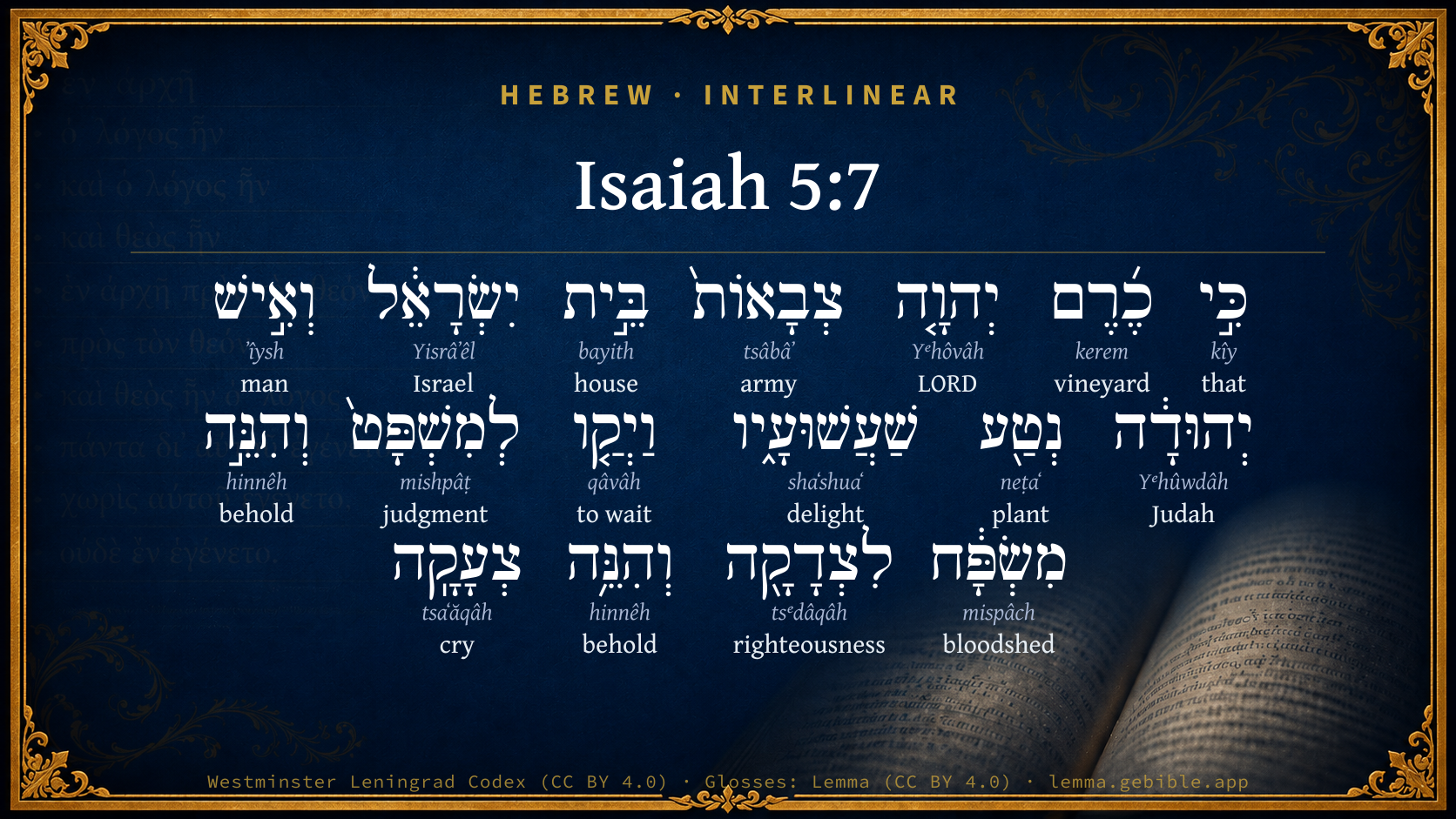
Isaiah 5:7

Hebrew (Westminster Leningrad Codex) Isaiah 5:7 appears in the Hebrew Old Testament. The text above is from the Westminster Leningrad Codex. Each word links to its Strong’s number, a concise gloss, and parsing drawn from the Open Scriptures Hebrew Bible morphology. Click any word for its full Brown-Driver-Briggs (BDB) entry.
Download image
Cite this verse

Isaiah 5:7 (World English Bible). Public Domain. Lemma interlinear Bible study tool, https://lemma.gebible.app/v/isaiah/5/7.

Show BibTeX & RIS
BibTeX
RIS
English Translation
For the vineyard of Yahweh of Hosts is the house of Israel, And the men of Judah his pleasant plant: And he looked for justice, but, behold, oppression; For righteousness, but, behold, a cry of distress.
World English Bible · Public Domain
Highlights
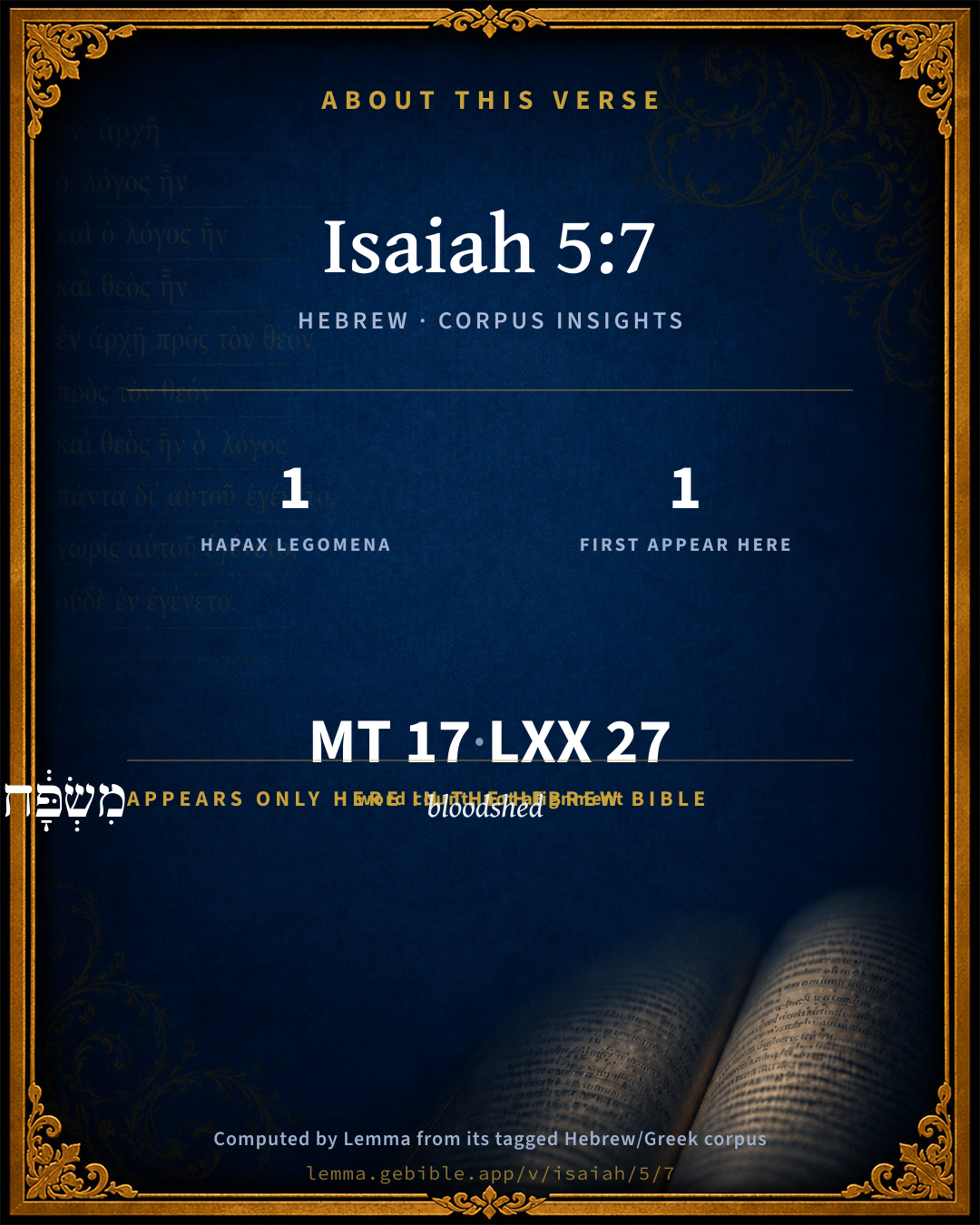
  • 1 hapax legomenon — only here in the Hebrew Bible
  • 1 first appearance in the Hebrew Bible
Full analysis ↓
Download a study sheet

One document with this verse’s original text, its word-by-word gloss line, the meaning frame, cross-references with their text, attributed commentary, and full source and license credits — printable, and it pastes into notes with its structure intact.

This verse Autodidact and up

Study sheet (.html) Plain text (.txt)

A passage Seminary Student

Up to 50 verses in one chapter. A passage sheet keeps up to 6 commentary sources and 12 cross-references per verse, in the order this page ranks them, and says so on the sheet whenever that leaves anything out. Ask for a single verse and you get the Autodidact verse sheet above.

Everything on this page stays free to read, with no account — the sheet is a download of what is already on screen, not access to it.

Want to remove ads? Support Godless Engineer
Compare translations 3

The same verse in 3 English versions, stacked beneath the original-language interlinear above. Click any original word for its lexicon entry.

Each is an independent rendering of the whole verse — the interlinear is not word-aligned to these translations.

Highlighted words mark where these versions differ — a whole-verse word diff, not a word-by-word alignment.

  • World English Bible Public Domain
    For the vineyard of Yahweh of Hosts is the house of Israel, And the men of Judah his pleasant plant: And he looked for justice, but, behold, oppression; For righteousness, but, behold, a cry of distress.
  • King James Version Public Domain
    For the vineyard of the LORD of hosts is the house of Israel, and the men of Judah his pleasant plant: and he looked for judgment, but behold oppression; for righteousness, but behold a cry.
  • unfoldingWord Literal Text CC BY-SA 4.0
    For the vineyard of Yahweh of Armies the house of Israel, and the man of Judah the planting of his delight. And he waited for justice, but behold, bloodshed; for righteousness, but behold, a cry. q1

unfoldingWord Literal Text — © unfoldingWord, licensed CC BY-SA 4.0. Word-aligned USFM3 via Door43 (git.door43.org/unfoldingWord/en_ult).

Versions to compare (up to 4)

3 of 4 selected

Show all 17 translations

Every available English version of this verse, each an independent rendering of the whole verse.

  • World English Bible Public Domain
    For the vineyard of Yahweh of Hosts is the house of Israel, And the men of Judah his pleasant plant: And he looked for justice, but, behold, oppression; For righteousness, but, behold, a cry of distress.
  • Berean Standard Bible Public Domain
    For the vineyard of the LORD of Hosts is the house of Israel, and the men of Judah are the plant of His delight. He looked for justice, but saw bloodshed; for righteousness, but heard a cry of distress.
  • Majority Standard Bible Public Domain
    For the vineyard of the LORD of Hosts is the house of Israel, and the men of Judah are the plant of His delight. He looked for justice, but saw bloodshed; for righteousness, but heard a cry of distress.
  • King James Version Public Domain
    For the vineyard of the LORD of hosts is the house of Israel, and the men of Judah his pleasant plant: and he looked for judgment, but behold oppression; for righteousness, but behold a cry.
  • American Standard Version (1901) Public Domain
    For the vineyard of Jehovah of hosts is the house of Israel, and the men of Judah his pleasant plant: and he looked for justice, but, behold, oppression; for righteousness, but, behold, a cry.
  • Revised Version (1885) Public Domain
    For the vineyard of the LORD of hosts is the house of Israel, and the men of Judah his pleasant plant: and he looked for judgment, but behold oppression; for righteousness, but behold a cry.
  • Geneva Bible (1599) Public Domain
    Surely the vineyard of the Lord of hostes is the house of Israel, and the men of Iudah are his pleasant plant, and hee looked for iudgement, but beholde oppression: for righteousnesse, but beholde a crying.
  • Young's Literal Translation Public Domain
    Because the vineyard of Jehovah of Hosts `Is' the house of Israel, And the man of Judah His pleasant plant, And He waiteth for judgment, and lo, oppression, For righteousness, and lo, a cry.
  • Literal Standard Version CC BY-SA 4.0
    Because the vineyard of YHWH of Hosts || [Is] the house of Israel, || And the man of Judah His pleasant plant, || And He waits for judgment, and behold, oppression, || For righteousness, and behold, a cry.
  • Unlocked Literal Bible CC BY-SA 4.0
    For the vineyard of Yahweh of hosts is the house of Israel, and the man of Judah his pleasant planting; he waited for justice, but instead, there was killing; for righteousness, but, instead, a shout for help.
  • unfoldingWord Literal Text CC BY-SA 4.0
    For the vineyard of Yahweh of Armies the house of Israel, and the man of Judah the planting of his delight. And he waited for justice, but behold, bloodshed; for righteousness, but behold, a cry. q1
  • Darby Bible Public Domain
    For the vineyard of Jehovah of hosts is the house of Israel, and the men of Judah the plant of his delight: and he looked for justice, and behold, blood-shedding; for righteousness, and behold, a cry.
  • World Messianic Bible Public Domain
    For the vineyard of the LORD of Hosts is the house of Israel, and the men of Judah his pleasant plant. He looked for justice, but behold, oppression, for righteousness, but behold, a cry of distress.
  • Webster's Bible Public Domain
    For the vineyard of the LORD of hosts is the house of Israel, and the men of Judah his pleasant plant: and he looked for judgment, but behold oppression; for righteousness, but behold a cry.
  • Free Bible Version CC BY-SA 4.0
    Israel is the vineyard of the Lord Almighty, and the people of Judah are the plants in his garden that made him happy. Yet while he hoped for justice, he only saw injustice; he hoped people would live right, but he only heard the cries of those who were suffering.
  • Bible in Basic English Public Domain
    For the vine-garden of the Lord of armies is the people of Israel, and the men of Judah are the plant of his delight: and he was looking for upright judging, and there was blood; for righteousness, and there was a cry for help.
  • JPS Tanakh (1917) Public Domain
    For the vineyard of the LORD of hosts is the house of Israel, and the men of Judah the plant of His delight; and He looked for justice, but behold violence; for righteousness, but behold a cry.

Literal Standard Version (2020), Covenant Press — licensed CC BY-SA 4.0. Text via the HelloAO Bible API (eBible.org). Unlocked Literal Bible (unfoldingWord) — licensed CC BY-SA 4.0. Text via the HelloAO Bible API (eBible.org). unfoldingWord Literal Text — © unfoldingWord, licensed CC BY-SA 4.0. Word-aligned USFM3 via Door43 (git.door43.org/unfoldingWord/en_ult). Free Bible Version, Dr. Jonathan Gallagher — licensed CC BY-SA 4.0. Text via the HelloAO Bible API (eBible.org).

Word by word

More ways to search: Search by grammar → Find every occurrence → Compare this word →

Practice this passage: Drill this verse → Learn its vocabulary →

מִשְׂפָּ֔ח
mispâch
H4939
“bloodshed”
Noun, Common, Masculine, Singular, Absolute
Part of Speech
Noun
Type
Common
Gender
Masculine
Number
Singular
State
Absolute
Full BDB Definition

Origin: from H5596

TWOT: 1534d

bloodshed, outpouring (of blood)
  1. כִּ֣י kîy H3588 “that” Conjunction
  2. כֶ֜רֶם kerem H3754 “vineyard of” Noun, Common, Both, Singular, Construct
  3. יְהוָ֤ה Yᵉhôvâh H3068 “LORD” Noun, Proper
  4. צְבָאוֹת֙ tsâbâʼ H6635 “armies” Noun, Common, Both, Plural, Absolute
  5. בֵּ֣ית bayith H1004 “house of” Noun, Common, Masculine, Singular, Construct
  6. יִשְׂרָאֵ֔ל Yisrâʼêl H3478 “Israel” Noun, Proper
  7. וְאִ֣ישׁ ʼîysh H376 “and · man of” Conjunction + Noun, Common, Masculine, Singular, Construct
  8. יְהוּדָ֔ה Yᵉhûwdâh H3063 “Judah” Noun, Proper
  9. נְטַ֖ע neṭaʻ H5194 “plant of” Noun, Common, Masculine, Singular, Construct
  10. שַׁעֲשׁוּעָ֑יו shaʻshuaʻ H8191 “delights · his” Noun, Common, Masculine, Plural, Construct + Suffix, Personal, 3rd Person, Masculine, Singular
  11. וַיְקַ֤ו qâvâh H6960 “and · to wait” Conjunction + Verb, Piel, Sequential Imperfect, 3rd Person, Masculine, Singular
  12. לְמִשְׁפָּט֙ mishpâṭ H4941 “to/for · judgment” Preposition + Noun, Common, Masculine, Singular, Absolute
  13. וְהִנֵּ֣ה hinnêh H2009 “and · behold” Conjunction + Particle, Demonstrative
  14. לִצְדָקָ֖ה tsᵉdâqâh H6666 “to/for · righteousness” Preposition + Noun, Common, Feminine, Singular, Absolute
  15. וְהִנֵּ֥ה hinnêh H2009 “and · behold” Conjunction + Particle, Demonstrative
  16. צְעָקָֽה tsaʻăqâh H6818 “cry” Noun, Common, Feminine, Singular, Absolute

About this verse

These counts appear in no published source. They are computed here, from the morphology-tagged text and Lemma’s own curated glosses. What Lemma adds →

17
words
16
distinct lemmas
Prophets
section

Notable vocabulary

1 hapax legomenon — a word that appears only here in the entire Hebrew Bible:

  • מִשְׂפָּ֔ח bloodshed H4939

First appearance in Scripture

This word makes its first canonical appearance in the Hebrew Bible here:

  • מִשְׂפָּ֔ח bloodshed H4939

Shared distinctive vocabulary

נְטַ֖ע plant H5194 occurs in 4 verses of the Hebrew Bible. Also found in:

Grammatical profile

  • 1 verb
  • 13 nouns
  • 1 conjunction
  • 2 particles

Verb forms

  • וַיְקַ֤ו Piel · Sequential Imperfect

Repetition

A word recurs within this verse — often emphatic in Hebrew:

  • וְהִנֵּ֣ה behold H2009 ×2

Hebrew & Septuagint length

In English translation the verse runs 36 words from the Hebrew and 39 from the Septuagint (LXX English) — closely comparable.

A rough comparison of the two English renderings, which tokenize alike — not a word-level alignment.

Word counts can differ between the Hebrew and the Greek without any difference in meaning — e.g. the Hebrew direct-object marker אֵת has no separate Greek word, and Greek often adds the article ὁ.

In the original languages it is 17 Hebrew tokens and 27 Greek tokens — but the two are counted differently (Hebrew bundles its prefixes and suffixes into one token; the Greek is in lemma form), so that isn’t a like-for-like length.

Cross-references

31

Topical passages linked to Isaiah 5:7 in the Treasury of Scripture Knowledge — connected by theme and wording, ordered by reader-vote popularity; previews shown in the World English Bible.

  • Psalms 80:8–11 You brought a vine out of Egypt. You drove out the nations, and planted it.
  • Jeremiah 12:10 Many shepherds have destroyed my vineyard, they have trodden my portion under foot, they have made my pleasant portion a desolate wilderness.
  • Matthew 3:8–10 Therefore bring forth fruit worthy of repentance!
  • James 5:4 Behold, the wages of the laborers who mowed your fields, which you have kept back by fraud, cry out, and the cries of those who reaped have entered into the ears of the Lord of Hosts.
  • Exodus 3:7 Yahweh said, "I have surely seen the affliction of my people who are in Egypt, and have heard their cry because of their taskmasters, for I know their sorrows.
  • Deuteronomy 15:9 Beware that there not be a base thought in your heart, saying, The seventh year, the year of release, is at hand; and your eye be evil against your poor brother, and you give him nothing; and he cry to Yahweh against you, and it be sin to you.
  • Nehemiah 5:1–5 Then there arose a great cry of the people and of their wives against their brothers the Jews.
  • Job 31:38–39 If my land cries out against me, And the furrows of it weep together;
  • Job 34:28 So that they caused the cry of the poor to come to him, He heard the cry of the afflicted.
  • Psalms 80:15 The stock which your right hand planted, The branch that you made strong for yourself.
  • Psalms 147:11 Yahweh takes pleasure in those who fear him, In those who hope in his loving kindness.
  • Psalms 149:4 For Yahweh takes pleasure in his people. He crowns the humble with salvation.
  • Proverbs 21:13 Whoever stops his ears at the cry of the poor, He will also cry out, but shall not be heard.
  • Song of Solomon 7:6 How beautiful and how pleasant are you, Love, for delights!
  • Isaiah 1:6 From the sole of the foot even to the head there is no soundness in it: Wounds, welts, and open sores. They haven't been closed, neither bandaged, neither soothed with oil.
  • Isaiah 3:14 Yahweh will enter into judgment with the elders of his people, And their leaders: "It is you who have eaten up the vineyard. The spoil of the poor is in your houses.
  • Isaiah 3:17 Therefore the Lord brings sores on the crown of the head of the women of Zion, And Yahweh will make their scalps bald."
  • Isaiah 5:2 He dug it up, Gathered out its stones, Planted it with the choicest vine, Built a tower in its midst, And also cut out a winepress therein. He looked for it to yield grapes, But it yielded wild grapes.
  • Isaiah 58:6–8 Isn't this the fast that I have chosen: to loose the bonds of wickedness, to undo the bands of the yoke, and to let the oppressed go free, and that you break every yoke?
  • Isaiah 62:5 For as a young man marries a virgin, so shall your sons marry you; and as the bridegroom rejoices over the bride, so shall your God rejoice over you.
  • Micah 6:8 He has shown you, O man, what is good. What does Yahweh require of you, but to act justly, To love mercy, and to walk humbly with your God?
  • Zephaniah 3:17 Yahweh, your God, is in the midst of you, a mighty one who will save. He will rejoice over you with joy. He will rest in his love. He will rejoice over you with singing.
  • Zechariah 7:9–14 "Thus has Yahweh of Hosts spoken, saying, 'Execute true judgment, and show kindness and compassion every man to his brother.
  • Matthew 23:23 "Woe to you, scribes and Pharisees, hypocrites! For you tithe mint, dill, and cumin, and have left undone the weightier matters of the law: justice, mercy, and faith. But you ought to have done these, and not to have left the other undone.
  • Luke 18:7 Won't God avenge his chosen ones, who are crying out to him day and night, and yet he exercises patience with them?
  • John 15:2 Every branch in me that doesn't bear fruit, he takes away. Every branch that bears fruit, he prunes, that it may bear more fruit.
  • 1 Corinthians 6:8–11 No, but you yourselves do wrong, and defraud, and that against your brothers.
  • Genesis 4:10 Yahweh said, "What have you done? The voice of your brother's blood cries to me from the ground.
  • Exodus 2:23–24 It happened in the course of those many days, that the king of Egypt died, and the children of Israel sighed because of the bondage, and they cried, and their cry came up to God because of the bondage.
  • Exodus 22:21–27 "You shall not wrong an alien, neither shall you oppress him, for you were aliens in the land of Egypt.
  • 1 John 3:7–8 Little children, let no one lead you astray. He who does righteousness is righteous, even as he is righteous.

Cross-references courtesy of OpenBible.info (CC BY 4.0).

Hebrew and Greek witnesses Masoretic Hebrew ↔ Greek Septuagint

The same verse in the two great witnesses to the Old Testament, shown verse-for-verse.

These are two independent witnesses, not word-aligned to each other, and the Septuagint is shown in lemma (dictionary) form.

Hebrew Isaiah 5:7 Masoretic · Westminster Leningrad Codex

כִּ֣י כֶ֜רֶם יְהוָ֤ה צְבָאוֹת֙ בֵּ֣ית יִשְׂרָאֵ֔ל וְאִ֣ישׁ יְהוּדָ֔ה נְטַ֖ע שַׁעֲשׁוּעָ֑יו וַיְקַ֤ו לְמִשְׁפָּט֙ וְהִנֵּ֣ה מִשְׂפָּ֔ח לִצְדָקָ֖ה וְהִנֵּ֥ה צְעָקָֽה

For the vineyard of Yahweh of Hosts is the house of Israel, And the men of Judah his pleasant plant: And he looked for justice, but, behold, oppression; For righteousness, but, behold, a cry of distress.

World English Bible · Public Domain

Greek LXX Isaiah 5:7 Septuagint · lemma form

ὁ γάρ ἀμπελών κύριος σαβαωθ οἶκος ὁ ἰσραήλ εἰμί καί ἄνθρωπος ὁ ιουδα νεόφυτος ἀγαπάω μένω ὁ ποιέω κρίσις ποιέω δέ ἀνομία καί οὐ δικαιοσύνη ἀλλά κραυγή

For the vineyard of the Lord of hosts is the house of Israel, and the men of Juda his beloved plant: I expected it to bring forth judgment, and it brought forth iniquity; and not righteousness, but a cry.

LXX2012 (modern English Septuagint) · Public Domain

Hebrew: Westminster Leningrad Codex (CC BY 4.0). Greek: Septuagint (public domain); English from LXX2012 (modern English Septuagint) (Public Domain). How the Septuagint differs from the Hebrew →

Targum (Aramaic paraphrase)

1

The Targum is the ancient Jewish Aramaic paraphrase of the Hebrew Scriptures — an interpretive translation, not the Hebrew text itself. Onkelos (literal) and Pseudo-Jonathan (expansive) render the Torah, and Jonathan the Prophets. Coverage is partial: where no permissively-licensed English translation exists for a verse, only the Aramaic is shown. This is verse-level text, not a word-by-word alignment to the Hebrew.

  1. Targum Jonathan Prophets (Joshua–Malachi)
    אֲרֵי עַמָא דַייָ צְבָאוֹת בֵּית יִשְׂרָאֵל וֶאֱנַשׁ יְהוּדָה נִצְבָא דְחֶדְוָתֵיהּ וַאֲמָרֵית דְיַעְבְּדוּן דִינָא וְהָא אִינוּן אֲנוּסִין אֲמָרִית דְיַעְבְּדוּן זָכוּ וְהָא אִינוּן מַסְגַן חוֹבִין:

    For the people of the Lord of hosts is the house of Israel, and the men of Judah his pleasant plant. And I thought that they should do judgment, but, behold, they are oppressors; I thought that they should do righteousness, but, behold, they are multiplying sins.

    Targum Jonathan — Aramaic: “Mikraot Gedolot” (public domain). English: “Sefaria Community Translation” (CC0 1.0 (public-domain dedication)); “London "Chaldee Paraphrase," 1871” (public domain). Text via Sefaria.

Commentary

Notes on Isaiah 5:7 from classic Christian and Jewish commentators (each source and its license shown beneath its notes). The classic Christian expositions comment on the surrounding passage and are grouped to its opening verse, so a note may address several verses; the Jewish commentaries on the Tanakh (Rashi and others) are per-verse, so they appear only where the commentator wrote on this verse.

Lemma curates 59 commentaries, every one of them public domain or Creative Commons licensed, each selected and text-cleaned for this edition rather than reprinted as found. About our sources →

Trapp's Complete Commentary

John Trapp

Isa 5:7 For the vineyard of the LORD of hosts [is] the house of Israel, and the men of Judah his pleasant plant: and he looked for judgment, but behold oppression; for righteousness, but behold a cry.

Ver. 7. For the vineyard, &c.] Exponit breviter mentem huius cantici. Here we have the parable expounded and applied: the Scripture is its own best interpreter; sometimes, as here and Joh 7:39, the sense is annexed. The Rabbis have a saying, Nulla est obiectio in lege quae non habet solutionem in latere. Nothing is exposed in law which does not have a solution in parts.

His pleasant plant.] Delectabilis in patriarchis, infructifera in palmitibus. Heb., "His plant of delights," but now turned into the degenerate plant of a "strange vine" unto him. {Jer 2:21} Good progenitors may have a bad offspring: the reason whereof is given by Augustine, {a} Homo liberos gignit ex carne vetusta et peccatrice, non ex spivitu, &c. Man begetteth children of the old and sinful flesh, and not of the Spirit.

And he looked for judgment, but behold oppression.] Or, Conspiracy; or, as some render it, a scab, a cleaving scab, such as a man cannot easily be rid or recovered from. And here in the original is excellent rhetoric past interpretation. It is as if we should say, a preacher, a prevaricator rather; a dispensation, a dissipation: the sound is almost the same the sense much different. There is a lawful use of rhetoric in divine discourses. Augustine confesseth that while he heard Ambrose for his eloquence only, together with his words which he loved, the matter which he at first cared not for, came into his mind: and while, saith he, I opened my heart to listen how trimly he spoke, I came to consider also how truly he spoke; gradatim quidem, even by decrees.

For righteousness, but behold a cry.] The clamour of the oppressed entered into the ears of the Lord of Sabbaoth, who heareth their groans, and beholdeth their grievances. {Job 34:28 Psa 12:5 Jas 5:4}

“ Clamitat in coelum vex sanguinis et Sodomorum,

Vex oppressorum, mercesque retenta laborum. ”

The twofold Ecce, "Behold oppression," "Behold a cry," showeth it to be an evil action with an accent, a wickedness with a witness. Aliam Hebroeorum labrusiam notat.

{a} Con. Pelag., lib. ii. cap. 9.

John Trapp, A Commentary or Exposition upon All the Books of the Old and New Testament (1647–1656) — public domain. Text from a community e-Sword module.

Joseph Benson's Commentary

Isa 5:7. For the vineyard, &c. — Or rather, Now the vineyard, as Dr. Waterland renders it: here we have the interpretation of the preceding parable in general. In the subsequent verses the prophet enters into particulars. This general interpretation is fully verified by the history of the Jewish people, especially in the time of our Lord and his apostles: and the men of Judah his pleasant plant — In whom God formerly delighted; and he looked for judgment — Both the administration of justice by magistrates, and justice in the dealings of the people with one another: but behold oppression — From the powerful upon their inferiors; and for righteousness — For equity, mercy, and benevolence; but behold a cry — From the oppressed, crying to men for help, and to God for vengeance. “The paronomasia, or play on the words, in the Hebrew, in this place, is very remarkable; mispat, mispach; zedakah, zeakah. There are many examples of it in the other prophets; but Isaiah seems peculiarly fond of it. The rabbins esteem it a great beauty: their term for it is, elegance of language.” — Bishop Lowth.

Joseph Benson's Commentary on the Old and New Testaments (1811–1818) — public domain. Text from a community e-Sword module.

The Preacher's Complete Homiletical Commentary

Joseph S. Exell (gen. ed.)

ON THE ADVANTAGE OF SMALL ALLOTMENTS OF LAND TO THE POOR

Isa_5:7-8. He looked for judgment, but behold oppression; for righteousness, but behold a cry. Woe unto them that join house to house, and lay field to field, till there be no place.

I. The Almighty expects from all His creatures, and especially from those to whom He has given wealth or power, the practice of justice and righteousness. II. The Almighty, instead of finding justice and righteousness among His creatures, discovers oppression on the part of the powerful, and a cry of lamentation and of indignation on the part of the poor: the proof of the oppression, and the cause of the cry is, that no place is left for the poor. There is a strong tendency to the accumulation of property, and especially of land, in the hands of a few; but such accumulations of land in a few hands tends to grave national evils—to luxury on the part of the rich, and to lawlessness on the part of the poor—and, therefore, instead of being promoted, should be discouraged by the legislature. But year by year we have been adding “field to field, and house to house,” till we have left the poor no place. Rights of common and rights of pasture have been taken away, and the beer-shop established by law to occupy that time which otherwise would have been employed in healthy toil for a happy family. Little farms, held by working farmers, have been joined together, so that one may live in luxury, where ten families once dwelt in simplicity and plenty. The cottager, with his little field, that once looked so fruitful and trim, cheering the eye and charming the heart, not only of himself, but of beings dear to and dependent upon him, has been driven into some town to add to its misery, its debasement, and its discontent. Let us pray that there may come a time when the gentle in rank shall be gentle in very deed; when the rich shall recognise that they are trustees for God, and shall use their property for the purposes for which He has placed it in their hands; when allotment acts shall remedy the ruin which enclosure acts have wrought; when an enlightened self-love, arising out of the possession of something to love, shall render the demagogue and the inciter to outrage a foreigner to our land; and when our “common Father shall find that “justice and righteousness” for which He looks.—R. C. Parkman, B.A., Sermons (1843), No. X.

The Preacher's Complete Homiletical Commentary (gen. ed. Joseph S. Exell; Funk & Wagnalls, c. 1892) — public domain (pre-1929). A full-Bible homiletical/sermon-outline anthology covering 65 of 66 books (2 John is absent from the source module). Text from a community e-Sword module.

Tyndale Open Study Notes

Tyndale Open Resources

5:7 The identification of Israel as the vineyard is a surprise that resolves the riddle of this passage. • Here, a powerful play on Hebrew words indicted Israel. The Lord expected justice (Hebrew mishpat) but saw only oppression (mispakh) of the needy. Instead of righteousness (tsedaqah), there were cries of violence (tse‘aqah) against the poor (see 1:21-23).

Tyndale Open Study Notes — © Tyndale Open Resources, licensed CC BY-SA 4.0. Text via the HelloAO Bible API.

Geneva Bible (1599)

Geneva Bible translators

Judgment and righteousness are true fruits of the fear of God, and therefore in the cruel oppression there is no religion.

Of them that are oppressed.

Geneva Bible (1599) marginal notes — public domain. Text via Bolls.life.

Jamieson, Fausset & Brown

Robert Jamieson, A. R. Fausset & David Brown

Isaiah here applies the parable. It is no mere human owner, nor a literal vineyard that is meant.

vineyard of the Lord--His only one (Exo 19:5; Amo 3:2).

pleasant--"the plant of his delight"; just as the husbandman was at pains to select the sorek, or "choicest vine" (Isa 5:2); so God's election of the Jews.

judgment--justice. The play upon words is striking in the Hebrew, He looked for mishpat, but behold mispat ("bloodshed"); for tsedaqua, but behold tseaqua (the cry that attends anarchy, covetousness, and dissipation, Isa 5:8, Isa 5:11-12; compare the cry of the rabble by which justice was overborne in the case of Jesus Christ, Mat 27:23-24).

Jamieson, Fausset & Brown — Commentary Critical and Explanatory on the Whole Bible (1871) — public domain (CC PDM 1.0). Text via the HelloAO Bible API.

Adam Clarke's Commentary

Verse 7. And he looked for judgment] The paronomasia, or play on the words, in this place, is very remarkable; mishpat, mishpach, tsedakah, tseakah. There are many examples of it in the other prophets, but Isaiah seems peculiarly fond of it. See Isa 13:6; Isa 24:17; Isa 32:7; Isa 28:1; Isa 57:6; Isa 61:3; Isa 65:11-12. Rabbi David Kimchi has noticed the paronomasia here: he expected משפט mishpat, judgment, but behold משפח mishpach, oppression; he expected צדקה tsedakah, righteousness, but behold צעקה tseakah, a cry. The rabbins esteem it a great beauty; their term for it is tsachoth haltashon, elegance of language.

Oppression - "tyranny."] משפח mishpach, from שפח shaphach, servum fecit, Arab. Houbigant: שפחה shiphchah is serva, a handmaid or female slave. משפח mispach, eighteen MSS.

Adam Clarke's Commentary on the Bible (1810–1826) — public domain. Text from a community e-Sword/MySword module.

Ellicott's Commentary for English Readers

(7) For the vineyard of the Lord of hosts.—The words remind us of Nathan’s “Thou art the man,” to David (2Sa_12:7), and of our Lord’s words in Mat_21:42-43.

Behold oppression.—The Hebrew word carries with it the idea of bloodshed, and points to the crimes mentioned in Isa_1:15; Isa_4:4. The “cry” is that of the victims who appeal to Jehovah when they find no help in man (Gen_4:10; Deu_24:15; Jas_5:4).

A Bible Commentary for English Readers, edited by Charles John Ellicott (1878–1897) — public domain. Text from a community e-Sword module.

The Cambridge Bible for Schools and Colleges

gen. ed. J. J. S. Perowne

7. The formal application of the parable, emphasising two facts: (1) Jehovah’s vineyard is the house of Israel, but especially the men of Judah, the plant of his delight (R.V. marg.); (2) “the wild grapes” it produces are the frightful oppressions and perversion of justice which are perpetrated in its midst. The underlying thought is that Jehovah’s signal care and goodness ought to have resulted in a national life corresponding to His moral character—a fundamental truth of the prophetic theology.

He looked for judgment (mishpâṭ), but behold bloodshed (mispâḥ);

For righteousness (çìdâqâh), but behold a cry! (çì‘âqâh).

These powerful assonances, which cannot be reproduced in English, are evidently designed to clinch the moral of the parable in the memories of the hearers. The “cry” is that of the oppressed, cf. Job_19:7.

The Cambridge Bible for Schools and Colleges (gen. ed. J. J. S. Perowne; Cambridge University Press, 1878–1918) — public domain. Text from a community e-Sword module.

John Gill's Exposition

For the vineyard of the Lord of hosts is the house of Israel,.... This is the explication of the parable, or the accommodation and application of it to the people of Israel, by whom are meant the ten tribes; they are signified by the vineyard, which belonged to the Lord of hosts, who had chosen them to be a peculiar people to him, and had separated them from all others:

and the men of Judah his pleasant plant; they were so when first planted by the Lord; they were plants of delight, in whom he took great delight and pleasure, Deu 10:15 these design the two tribes of Judah and Benjamin, in distinction from Israel:

and he looked for judgment; that the poor, and the fatherless, and the widow, would have their causes judged in a righteous manner, and that justice and judgment would be executed in the land in all respects; for which such provision was made by the good and righteous laws that were given them:

but behold oppression; or a "scab", such as was in the plague of leprosy; corruption, perverting of justice, and oppressing of the poor: Jarchi interprets it a gathering of sin to sin, a heaping up iniquities:

for righteousness, but behold a cry; of the poor and oppressed, for want of justice done, and by reason of their oppressions. Here ends the song; what has been parabolically said is literally expressed in the following part of the chapter.

John Gill's Exposition of the Whole Bible (1746–1763) — public domain (CC PDM 1.0). Text via the HelloAO Bible API.

Albert Barnes' Notes on the Bible

For the vineyard ... - This is the application of the parable. God had treated the Jews as a farmer does a vineyard. This was “his” vineyard - the object of his faithful, unceasing care. This was his “only” vineyard; on this people alone, of all the nations of the earth, had he bestowed his special attention.

His pleasant plant - The plant in which he delighted. As the farmer had been at the pains to plant the “sorek” Isa 5:2, so had God selected the ancient stock of the Jews as his own, and made the race the object of his chief attention.

And he looked for judgment - For justice, or righteousness.

But behold oppression - The word rendered “oppression” means properly “shedding of blood.” In the original here, there is a remarkable “paranomasia,” or play upon words, which is not uncommon in the Hebrew Scriptures, and which was deemed a great beauty in composition:

He looked for “judgment,”

משׁפט mishpâṭ,

And lo! “shedding of blood,”

משׂפח mis'pâch;

For “rightousness,”

צדקה tsedâqâh,

But lo! “a clamor,”

צעקה tse‛âqâh.

It is impossible, of course, to retain this in a translation.

A cry. A clamor - tumult, disorder; the clamor which attends anarchy, and covetousness, and dissipation Isa 5:8, Isa 5:11-12, rather than the soberness and steadiness of justice.

Albert Barnes' Notes on the Bible (1834–1885) — public domain. Text from a community e-Sword/MySword module.

Haydock's Catholic Bible Commentary

Israel. This comparison is very common, Psalm lxxix. 9., and Matthew xx. 1. (Calmet) --- The preceding parable is explained. (Menochius) --- Cry. For vengeance, Jeremias xii. 8., and Genesis iv. 10., and xviii. 20. (Calmet)

George Leo Haydock (1774–1849), Haydock's Catholic Family Bible and Commentary, 1859 edition — public domain. Excludes Psalms (Douay-Rheims chapter numbering differs from Protestant) and Deuterocanonical books (Catholic canon only).

Matthew Poole's English Annotations

The vineyard of the Lord of hosts is the house of Israel, and the men of Judah his pleasant plant; in whom God formerly delighted to dwell and converse. Compare Pro 8:31; Jer 31:20. Behold the cry from the oppressed, crying to men for help, and to God for vengeance.

Matthew Poole's English Annotations on the Holy Bible (1683–1685) — public domain. Text from a community e-Sword/MySword module.

The Pulpit Commentary

I will lay it waste; literally, I will make it a desolation. (comp. Isa_7:19, whereFor the vineyard, etc.) The full explanation of the parable follows immediately on the disclosure in ver. 6. The vineyard is "Israel," or rather "Judah;" the fruit expected from it, "judgment and righteousness;" the wild grapes which alone it had produced, "oppression" and the "cry" of the distressed. His pleasant plan; literally, the plant of his delights; i.e. the plantation in which he had so long taken delight. He looked for judgment, etc. Gesenius has attempted to give the verbal antithesis of the Hebrew, which is quite lost in our version"Er harrete auf Recht, und siehe da Unrecht, Auf Gerechtigkeit, und siehe da Schlechtigkeit.

The difference between what God asks and what God gets.

The original terms of this verse contain a very striking play upon words, which can but imperfectly be rendered into English. "He looked for judgment (mishpat), and behold oppression (mishpach); for righteousness ( tsedakah), and behold a cry (tseakah) of the oppressed for help." Dr. C. Geikie translates the verse thus: "And he hoped for deeds of good, but, behold, there are only deeds of blood; for righteousness, and, lo! there is only the cry of the oppressed." The appeal of God is applicable to all the ages, and, taken in a large sense, may be also applied to us. It should be our exceeding distress that so often we give to God quite other things than he asks of us.

I GOD ALWAYS ASKS FOR RIGHTEOUSNESS. The reference in the text is to public justice; right dealing between man and man; due considerateness for others; and the faithful administration of laws, both social and ecclesiastical. The people ought to be honest in all their dealings, and the magistrates just in all their decisions. But God asks for "righteousness" in a much higher sense than this. The creatures he has made in his imago he wants to he like himself. "Be ye holy, for I am holy;" "Be ye therefore perfect, even as your Father in heaven is perfect." The righteousness that he asks from us he has shown us in the person and the life of his dear Son. It is for us no vague thing, gathered up into a great and somewhat mysterious word; it is, plainly and practically, our being changed into Christ"s image, and bringing forth fruits of goodness like his. This may be fully worked out and illustrated along three lines. The righteousness God asks of us is

(1) loyalty to his revealed truth;

(2) obedience to his declared will; and

(3) manifestation, in practical life, of the spirit of heavenly, Divine charity.

II GOD OFTEN GETS "OPPRESSION" AND A "CRY." Here, too, the first suggestion is of social and national evil; injustice of magistrates, and masterfulness of the strong and wealthy over the poor. Everything was carried by clamor and noise; wickedness had usurped the place of judgment. But here, too, the response made to God may be dealt with in a larger way. The essence of all oppression" and cry" is somebody"s self-seeking spirit and self-seeking ways. In this we grieve God. He asks life for him, and for others in service to him; and we give him life full of self, that can even trample over his poor in accomplishing our own self-ends. So we, too, come under the Divine reproaches and judgments. R.T.

The Pulpit Commentary (1880–1919), ed. H.D.M. Spence-Jones & Joseph S. Exell — public domain. Text from a community e-Sword module.

John Wesley's Explanatory Notes

Pleasant - In whom God formerly delighted. A cry - From the oppressed, crying to men for help, and to God for vengeance.

John Wesley, Explanatory Notes Upon the Whole Bible (1754–1765) — public domain. Text via the GEBible commentary corpus.

Keil & Delitzsch

C. F. Keil & F. Delitzsch

"For the vineyard of Jehovah of hosts is the house of Israel, and the men of Judah are the plantation of His delight: He waited for justice, and behold grasping; for righteousness, and behold a shriek." The meaning is not that the Lord of the vineyard would not let any more rain fall upon it, because this Lord was Jehovah (which is not affirmed in fact in the words commencing with "for," Ci), but a more general one. This was how the case stood with the vineyard; for all Israel, and especially the people of Judah, were this vineyard, which had so bitterly deceived the expectations of its Lord, and indeed "the vineyard of Jehovah of hosts," and therefore of the omnipotent God, whom even the clouds would serve when He came forth to punish. The expression "for" (Ci) is not only intended to vindicate the truth of the last statement, but the truth of the whole simile, including this: it is an explanatory "for" (Ci explic.), which opens the epimythion. "The vineyard of the Lord of hosts" (Cerem Jehovah Zebaoth) is the predicate. "The house of Israel (Beth Yisrâel) was the whole nation, which is also represented in other passages under the same figure of a vineyard (Isa 27:2.; Ps 80, etc.). But as Isaiah was prophet in Judah, he applies the figure more particularly to Judah, which was called Jehovah's favourite plantation, inasmuch as it was the seat of the divine sanctuary and of the Davidic kingdom. This makes it easy enough to interpret the different parts of the simile employed. The fat mountain-horn was Canaan, flowing with milk and honey (Exo 15:17); the digging of the vineyard, and clearing it of stones, was the clearing of Canaan from its former heathen inhabitants (Psa 54:3); the sorek-vines were the holy priests and prophets and kings of Israel of the earlier and better times (Jer 2:21); the defensive and ornamental tower in the midst of the vineyard was Jerusalem as the royal city, with Zion the royal fortress (Mic 4:8); the winepress-trough was the temple, where, according to Psa 36:9 (8.), the wine of heavenly pleasures flowed in streams, and from which, according to Psa 42:1-11 and many other passages, the thirst of the soul might all be quenched. The grazing and treading down are explained in Jer 5:10 and Jer 12:10. The bitter deception experienced by Jehovah is expressed in a play upon two words, indicating the surprising change of the desired result into the very opposite. The explanation which Gesenius, Caspari, Knobel, and others give of mispâch, viz., bloodshed, does not commend itself; for even if it must be admitted that sâphach occurs once or twice in the "Arabizing" book of Job (Job 30:7; Job 14:19) in the sense of pouring out, this verbal root is strange to the Hebrew (and the Aramaean). Moreover, mispâch in any case would only mean pouring or shedding, and not bloodshed; and although the latter would certainly be possible by the side of the Arabic saffâch, saffâk (shedder of blood), yet it would be such an ellipsis as cannot be shown anywhere else in Hebrew usage. On the other hand, the rendering "leprosy" does not yield any appropriate sense, as mispachath (sappachath) is never generalized anywhere else into the single idea of "dirt" (Luzzatto: sozzura), nor does it appear as an ethical notion. We therefore prefer to connect it with a meaning unquestionably belonging to the verb ספח (see kal, Sa1 2:36; niphal, Isa 14:1; hithpael, Sa1 26:19), which is derived in יסף, אסף, סוּף, from the primary notion "to sweep," spec. to sweep towards, sweep in, or sweep away. Hence we regard mispach as denoting the forcible appropriation of another man's property; certainly a suitable antithesis to mishpât. The prophet describes, in full-toned figures, how the expected noble grapes had turned into wild grapes, with nothing more than an outward resemblance. The introduction to the prophecy closes here.

The prophecy itself follows next, a seven-fold discourse composed of the six-fold woe contained in vv. 8-23, and the announcement of punishment in which it terminates. In this six-fold woe the prophet describes the bad fruits one by one. In confirmation of our rendering of mispâch, the first woe relates to covetousness and avarice as the root of all evil.

Keil & Delitzsch — Biblical Commentary on the Old Testament (1861–1891) — public domain (CC PDM 1.0). Text via the HelloAO Bible API. (Old Testament only.)

J. A. Alexander on Isaiah

Joseph Addison Alexander

The startling menace at the close of the sixth verse would naturally prompt the question, Who is this that assumes power over clouds and rain, and what is the vineyard which he thus denounces? To this tacit question we have here the answer. As if he had said, do not wonder that the owner of the vineyard should thus speak, “For the vineyard of Jehovah of Hosts is the House of Israel,” the church, considered as a whole, “and the man of Judah is the plant of His pleasures,” or His favorite plant. “And He waited for judgment,” practical justice, as in (Isa 1:17), “and behold bloodshed, for righteousness and behold a cry,” either outcry and disturbance, or more specifically the cry of the oppressed, which last is more agreeable to usage, and at the same time more poetical and graphic.

Joseph Addison Alexander, The Prophecies of Isaiah (1846–1847; New York: Scribner, 1870–1878) — public domain. Text from a community e-Sword module.

unfoldingWord translationNotes

Door43 World Missions Community

General Information:

Isaiah explains the parable of the vineyard.

For the vineyard of Yahweh of hosts is the house of Israel

Isaiah states that the vineyard in the parable represents the people of Israel. AT: "For the vineyard of Yahweh of hosts represents the house of Israel" or "The people of Israel are like the vineyard of Yahweh, Lord of the angel armies" (See: Parables)

the house of Israel

The word "house" is a metonym for the family that lives in the house. In this case it refers to the kingdom of Israel. AT: "Israel" or "the kingdom of Israel" or "the people of Israel" (See: Metonymy)

the man of Judah his pleasant planting

The people of Judah are spoken of as if they are a vine that Yahweh planted. This can be stated as a simile. AT: "the people of Judah are like a vine that that Yahweh planted for Yahweh's pleasure" (See: Metaphor and Simile)

the man of Judah

Here "man" represents all the people of Judah. AT: "the people of Judah" (See: Generic Noun Phrases)

he waited for justice, but instead, there was killing

This can be changed so that the abstract noun "justice" can be expressed by the verb "do what is fair." The abstract noun "killing" can be expressed as "killed one another." AT: "Yahweh waited for the people to do what is fair, but instead they killed one another" (See: Abstract Nouns)

for righteousness

The phrase "he waited" is understood from earlier in the verse. It can be repeated to make the meaning clear. AT: "He waited for righteousness" or "He waited for them to do what is right" (See: Ellipsis)

instead, a shout for help

The words "there was" are understood from earlier in the verse. They can be repeated to make the meaning clear. The reason people shouted out for help can be made explicit. AT: "instead, there was a shout for help" or "instead, those who were weak shouted out for someone to help them because others were attacking them" (See: Ellipsis and Assumed Knowledge and Implicit Information)

a shout

This expression probably stands for many shouts. (See: Generic Noun Phrases)

translationWords

vineyard

Yahweh of hosts

house

Israel

Judah

just

righteous

unfoldingWord translationNotes — © Distant Shores Media and the Door43 World Missions Community, licensed CC BY-SA 4.0. Source: git.door43.org/Door43/en_tn.

Rashi

Rabbi Shlomo Yitzchaki (Rashi)

For the vineyard of the Lord of Hosts is the House of Israel To this vineyard are you compared, O House of Israel, for all that He did for this vineyard, He did for Israel. The vineyard represents Adam, for we find in Midrash Aggadah, in many places in Tanhuma, and in Genesis Rabbah [that] these passages are expounded concerning him, e.g., Adam was not expelled from Paradise until he reviled and blasphemed, as it is said: And He hoped to produce grapes,... (Gen. Rabbah 19:12). And in another place we find: He appointed guards over him that he should not eat from the Tree of Life, as it is said (verse 6): “And I will command the clouds...” (ibid. 21:8). And in this manner, [the following verses] can be expounded concerning him:

(1) My beloved had a vineyard. A vineyard This [alludes to] Adam.

My beloved This is the Holy One, blessed be He.

In a fertile corner in the Garden of Eden.

(2) And he fenced it in with the ten canopies mentioned in Ezekiel (28), in the section dealing with Hiram, king of Tyre.

And He cleared it of stones Of temptation, until he ate from the tree, and temptation gained entry into him.

And He planted it with the choicest vines The beginning of his formation was from the place of the altar.

And He built a tower in its midst And He breathed into his nostrils the spirit of life, from the heavenly beings.

And also a vat He hewed therein A spring flowing, the fountain of wisdom.

And He hoped to produce grapes that he would thank Him and praise Him.

And it produced wild berries putrid things; he reviled and blasphemed.

(3) Judge now Since the end of the parable comes to say that they too did like him, he asks them the judgment.

(5) I will inform you what I decided to do to him and I did.

I removed its hedge I expelled him from amidst his canopies.

And it shall be eaten up His end will be to die and to be ruled over by wild beasts.

Breach its wall I expelled from the enclosure of Paradise.

(6) And I made it a desolation I made him dwell in desolation, for I did not give the Torah in his days.

It shall neither be pruned nor hoed They will learn from him neither merit nor good deeds.

The shamir and desolation will come up Temptation ruled over him and his posterity, to perform corrupt deeds.

And I commanded the clouds I appointed guards over him to guard the way of the Tree of Life.

(7) For the vineyard of the Lord of Hosts is the House of Israel For the House of Israel is to Me like that vineyard; The ten tribes were to Me like a vineyard producing wine, like an olive orchard, in a fat corner, in a fat land, [producing anointing] oil for the priesthood, [anointing] oil for the kingdom, oil for the Menorah, oil for the meal offerings. I fenced them in first with the encirclement of the clouds of glory in the desert and I cleared them of stones, i.e., I cleansed them of the transgressors of the generation. I planted them with the choicest vines (שׂוֹרֵק) six hundred and six commandments, like the numerical value of שׂוֹרֵק, I added for them to the seven commandments that the children of Noah were commanded. I built a tower in their midst, My Tabernacle and My Temple, and also a vat, the altar and the pits [the pits by the side of the altar into which the remainder of the libations was poured.]

(2) And it produced wild berries They corrupted their deeds.

(3) And now, dwellers of Jerusalem and men of Judah who have not yet been exiled, please judge between me and between them concerning the evil that I brought on them; who sinned against whom? What more could I have done beneficial deeds for My vineyard, and I have not done for it?

(5) Now I will inform you Even you who anger Me, what is fitting in My eyes to do to My vineyard, according to all that I did to Adam, viz.

to remove its hedge I will remove My Shechinah from them, the Shechinah that covers them, as it is said (infra 22:8), “And He bared the covert of Judah.”

Breach its wall I will demolish its walls.

(6) And I will make it a desolation And I will make them forsaken [from Targum Jonathan].

It will neither be pruned nor hoed They will not be visited nor will they be supported. [from Targum Jonathan].

And the shamir and desolation will come up And they will be wandering and forsaken, represented by the שָׁמִיר וָשָׁיִת [desolation] of the vineyard, and regarding the vineyard itself in another place, it is rendered הֲבָאִי וּבוּר, desolate and fallow.

And I will command the clouds And I will command the prophets not to prophesy on your behalf [Jonathan]. Prophecy is analogous to rain, which the clouds receive from heaven; so do the prophets receive the divine prophecy.

The plant of His joy Comp. נָטָע (Job 14:9), but since it is in the construct state, it is vowelized with a patach, like (Num. 7:88) בְּקַר זֶבַח הַשְּׁלָמִים, “the cattle of the peace offerings.”

and He hoped that they would perform justice, and behold, there was מִשְׂפָּח, an accumulation of sin upon sin, like (I Sam. 26:19), “From cleaving (מֵהִסְתַּפֵּחַ),” also (ibid. 2:36), “Take me now into (סְפָחֵנִי).” Another explanation is that it is an expression of a lesion, and since it is a similar expression, for, in pronunciation, מִשְׂפָּח resembles מִשְׁפָּט, and so, זְעָקָה resembles צְדָקָה, it fell through divine inspiration into the prophet’s mouth.

Rashi on the Tanakh — English translations: “The Judaica Press complete Tanach with Rashi, translated by A. J. Rosenberg” (CC BY 4.0); “Pentateuch with Rashi's commentary by M. Rosenbaum and A.M. Silbermann, 1929-1934” (public domain); “The Metsudah Tanach series, Lakewood, N.J” (CC BY 4.0); and “The Book of Joshua, Metsudah Publications, 1997” (CC BY 4.0). Text via Sefaria.

Ibn Ezra

Rabbi Abraham ibn Ezra

The prophet now explains who is meant by the vineyard.

משפח Disease. Comp. מספחת scab (Lev. 13:6)

Ibn Ezra on the Tanakh — English translations: “Sefaria Community Translation” (CC0 1.0 (public-domain dedication)); “Yalkut, Sifsei Chachomim Chumash, Metsudah Publications, 2009” (CC BY 4.0); and “Commentary of Ibn Ezra on Isaiah - trans. by M. Friedlander, 1873” (public domain). Text via Sefaria.

Lesson kit

Teaching starters — assembled from the data on this page, not authored interpretation. Every prompt links to the verse data it draws on. Edit before teaching.

Isaiah, in the Prophets, opens this verse with 17 words (16 distinct Hebrew lemmas). Its most distinctive word is mispâch (“bloodshed”). A historical commentator’s framing appears above. Read the whole chapter for the surrounding context.

Discussion questions

  1. What does “bloodshed” (mispâch) contribute to the verse as a whole?
  2. 1 word here appears nowhere else in the Hebrew Bible. Why might the author reach for such rare wording?
  3. This is the first place “bloodshed” appears in Scripture (first appears here). What does its debut here establish?
  4. How does Job 14:9, which shares the word «plant», read alongside this verse?
  5. What does the repetition of “behold” (2× in this one verse) do in this verse?
  6. The translations on this page render this verse differently — a whole-verse word diff, not a word-by-word alignment. What might account for the different wordings?
  7. «וַיְקַ֤ו» is a Piel Sequential Imperfect verb. How does that grammatical form shape the action described?
  8. Compare how Trapp's Complete Commentary and Joseph Benson's Commentary read this verse. Where do they agree or differ?

Things to notice

  • 1 word in this verse appears nowhere else in the Hebrew Bible.
  • 1 word makes its first canonical appearance in Scripture here.
  • This verse counts 17 Hebrew ↔ 27 Greek words.
  • These translations choose different wording for 18 words in this verse.
  • “behold” occurs 2× in this single verse.

Reading settings

Reading text

Shown beneath each verse's original-language words.

Old Testament
Old Testament edition

Read the OT as the Masoretic Hebrew (MT) or the Greek Septuagint (LXX).

English shown for the Greek Septuagint (in the Hebrew ↔ Greek comparison).

Comparing translations? Open the Compare panel on any verse page to stack up to four side by side.