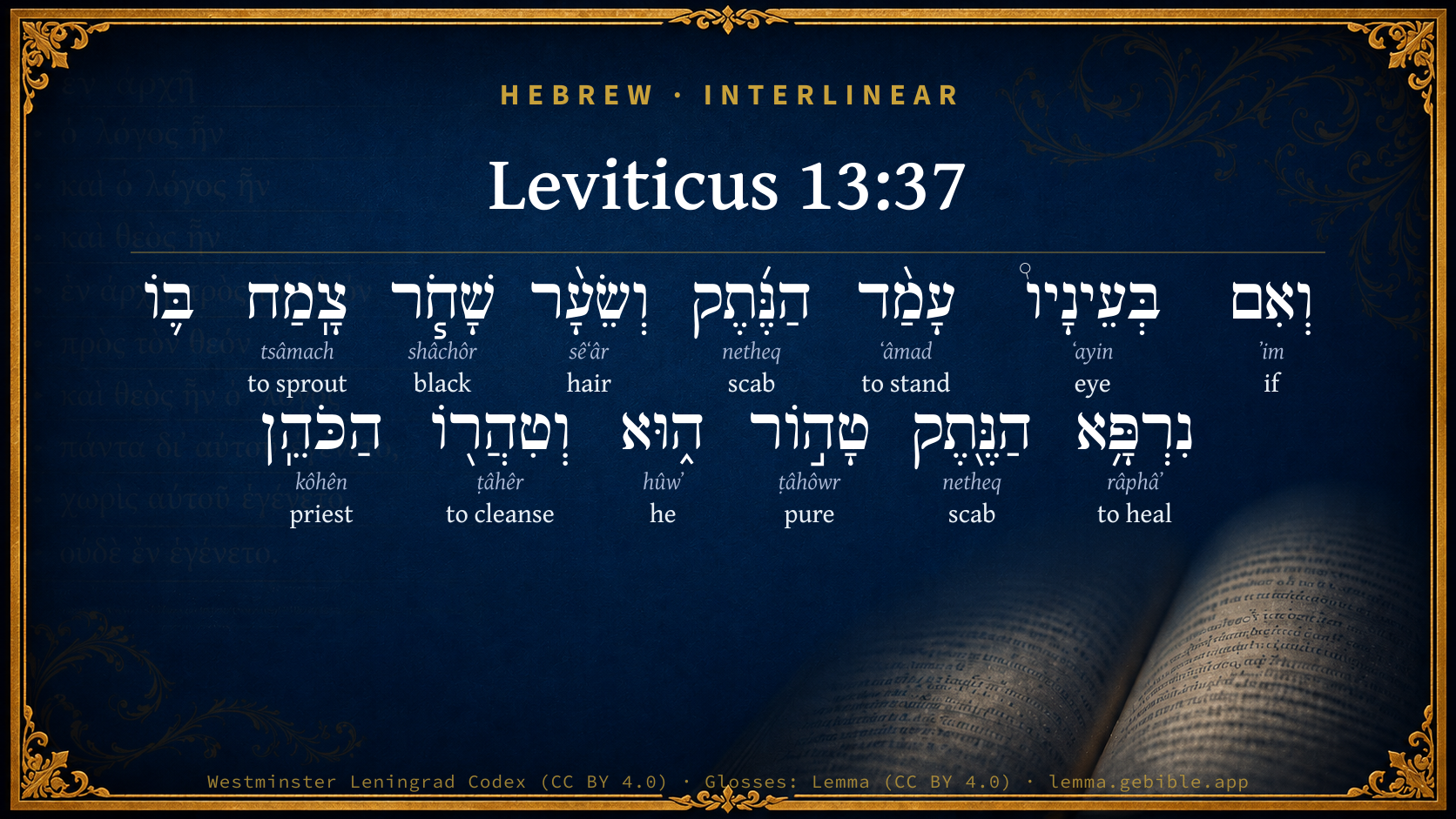
Leviticus 13:37

Hebrew (Westminster Leningrad Codex) Leviticus 13:37 appears in the Hebrew Old Testament. The text above is from the Westminster Leningrad Codex. Each word links to its Strong’s number, a concise gloss, and parsing drawn from the Open Scriptures Hebrew Bible morphology. Click any word for its full Brown-Driver-Briggs (BDB) entry.
Download image
Cite this verse

Leviticus 13:37 (World English Bible). Public Domain. Lemma interlinear Bible study tool, https://lemma.gebible.app/v/leviticus/13/37.

Show BibTeX & RIS
BibTeX
RIS
English Translation
But if in his eyes the itch is arrested, and black hair has grown in it; the itch is healed, he is clean. The priest shall pronounce him clean.
World English Bible · Public Domain
Download a study sheet

One document with this verse’s original text, its word-by-word gloss line, the meaning frame, cross-references with their text, attributed commentary, and full source and license credits — printable, and it pastes into notes with its structure intact.

This verse Autodidact and up

Study sheet (.html) Plain text (.txt)

A passage Seminary Student

Up to 50 verses in one chapter. A passage sheet keeps up to 6 commentary sources and 12 cross-references per verse, in the order this page ranks them, and says so on the sheet whenever that leaves anything out. Ask for a single verse and you get the Autodidact verse sheet above.

Everything on this page stays free to read, with no account — the sheet is a download of what is already on screen, not access to it.

Want to remove ads? Support Godless Engineer
Compare translations 3

The same verse in 3 English versions, stacked beneath the original-language interlinear above. Click any original word for its lexicon entry.

Each is an independent rendering of the whole verse — the interlinear is not word-aligned to these translations.

Highlighted words mark where these versions differ — a whole-verse word diff, not a word-by-word alignment.

  • World English Bible Public Domain
    But if in his eyes the itch is arrested, and black hair has grown in it; the itch is healed, he is clean. The priest shall pronounce him clean.
  • King James Version Public Domain
    But if the scall be in his sight at a stay, and that there is black hair grown up therein; the scall is healed, he is clean: and the priest shall pronounce him clean.
  • unfoldingWord Literal Text CC BY-SA 4.0
    But if, in his eyes, the scall stands, and black hair has sprouted on it, the scall has been healed. He clean, and the priest shall pronounce him clean.

unfoldingWord Literal Text — © unfoldingWord, licensed CC BY-SA 4.0. Word-aligned USFM3 via Door43 (git.door43.org/unfoldingWord/en_ult).

Versions to compare (up to 4)

3 of 4 selected

Show all 18 translations

Every available English version of this verse, each an independent rendering of the whole verse.

  • World English Bible Public Domain
    But if in his eyes the itch is arrested, and black hair has grown in it; the itch is healed, he is clean. The priest shall pronounce him clean.
  • Berean Standard Bible Public Domain
    If, however, in his sight the scaly outbreak is unchanged and black hair has grown in it, then it has healed. He is clean, and the priest is to pronounce him clean.
  • Majority Standard Bible Public Domain
    If, however, in his sight the scaly outbreak is unchanged and black hair has grown in it, then it has healed. He is clean, and the priest is to pronounce him clean.
  • King James Version Public Domain
    But if the scall be in his sight at a stay, and that there is black hair grown up therein; the scall is healed, he is clean: and the priest shall pronounce him clean.
  • American Standard Version (1901) Public Domain
    But if in his eyes the scall be at a stay, and black hair be grown up therein; the scall is healed, he is clean: and the priest shall pronounce him clean.
  • Revised Version (1885) Public Domain
    But if in his eyes the scall be at a stay, and black hair be grown up therein; the scall is healed, he is clean: and the priest shall pronounce him clean.
  • Geneva Bible (1599) Public Domain
    But if ye blacke spot seeme to him to abide, and that blacke heare growe therein, the blacke spot is healed, he is cleane, and the Priest shall declare him to be cleane.
  • Douay-Rheims (1899) Public Domain
    But if the spot be stayed, and the hair be black, let him know that the man is healed, and let him confidently pronounce him clean.
  • Young's Literal Translation Public Domain
    and if in his eyes the scall hath stayed, and black hair hath sprung up in it, the scall hath been healed -- he `is' clean -- and the priest hath pronounced him clean.
  • Literal Standard Version CC BY-SA 4.0
    and if in his eyes the scale has stayed, and black hair has sprung up in it, the scale has been healed—he [is] clean—and the priest has pronounced him clean.
  • Unlocked Literal Bible CC BY-SA 4.0
    But if in the priest's view the itching disease has stopped spreading and black hair has grown in the area, then the disease has healed. He is clean, and the priest must pronounce him clean.
  • unfoldingWord Literal Text CC BY-SA 4.0
    But if, in his eyes, the scall stands, and black hair has sprouted on it, the scall has been healed. He clean, and the priest shall pronounce him clean.
  • Darby Bible Public Domain
    But if the scall have in his sight remained as it was, and there is black hair grown up therein, the scall is healed: he is clean; and the priest shall pronounce him clean.
  • World Messianic Bible Public Domain
    But if in his eyes the itch is arrested and black hair has grown in it, then the itch is healed. He is clean. The priest shall pronounce him clean.
  • Webster's Bible Public Domain
    But if the scall shall be in his sight at a stay, and there is black hair grown in it; the scall is healed, he is clean: and the priest shall pronounce him clean.
  • Free Bible Version CC BY-SA 4.0
    But if the priest sees that the scabby infection hasn't changed, and black hair has grown in it, then it has healed. The person is clean, and the priest must declare it.
  • Bible in Basic English Public Domain
    But if, in his opinion, the growth is stopped, and black hair has come up on it, the disease has gone; he is clean and the priest will say that he is clean.
  • JPS Tanakh (1917) Public Domain
    But if the scall stay in its appearance, and black hair be grown up therein; the scall is healed, he is clean; and the priest shall pronounce him clean.

Literal Standard Version (2020), Covenant Press — licensed CC BY-SA 4.0. Text via the HelloAO Bible API (eBible.org). Unlocked Literal Bible (unfoldingWord) — licensed CC BY-SA 4.0. Text via the HelloAO Bible API (eBible.org). unfoldingWord Literal Text — © unfoldingWord, licensed CC BY-SA 4.0. Word-aligned USFM3 via Door43 (git.door43.org/unfoldingWord/en_ult). Free Bible Version, Dr. Jonathan Gallagher — licensed CC BY-SA 4.0. Text via the HelloAO Bible API (eBible.org).

Word by word

More ways to search: Search by grammar → Find every occurrence → Compare this word →

Practice this passage: Drill this verse → Learn its vocabulary →

שָׁחֹ֧ר
shâchôr
H7838
“black”
Adjective, Adjective, Masculine, Singular, Absolute
Part of Speech
Adjective
Type
Adjective
Gender
Masculine
Number
Singular
State
Absolute
Full BDB Definition

Origin: from H7835

TWOT: 2368b

black
  1. וְאִם ʼim H518 “and · if” Conjunction + Conjunction
  2. בְּעֵינָיו֩ ʻayin H5869 “in/at · eyes · his” Preposition + Noun, Common, Both, Dual, Construct + Suffix, Personal, 3rd Person, Masculine, Singular
  3. עָמַ֨ד ʻâmad H5975 “to stand” Verb, Qal, Perfect, 3rd Person, Masculine, Singular
  4. הַנֶּ֜תֶק netheq H5424 “the · scab” Particle, Definite Article + Noun, Common, Masculine, Singular, Absolute
  5. וְשֵׂעָ֨ר sêʻâr H8181 “and · hair” Conjunction + Noun, Common, Masculine, Singular, Absolute
  6. צָֽמַח tsâmach H6779 “to sprout” Verb, Qal, Perfect, 3rd Person, Masculine, Singular
  7. נִרְפָּ֥א râphâʼ H7495 “to heal” Verb, Niphal, Perfect, 3rd Person, Masculine, Singular
  8. הַנֶּ֖תֶק netheq H5424 “the · scab” Particle, Definite Article + Noun, Common, Masculine, Singular, Absolute
  9. טָה֣וֹר ṭâhôwr H2889 “pure” Adjective, Adjective, Masculine, Singular, Absolute
  10. ה֑וּא hûwʼ H1931 “he” Pronoun, Personal, 3rd Person, Masculine, Singular
  11. וְטִהֲר֖וֹ ṭâhêr H2891 “and · to cleanse · him” Conjunction + Verb, Piel, Sequential Perfect, 3rd Person, Masculine, Singular + Suffix, Personal, 3rd Person, Masculine, Singular
  12. הַכֹּהֵֽן kôhên H3548 “the · priest” Particle, Definite Article + Noun, Common, Masculine, Singular, Absolute

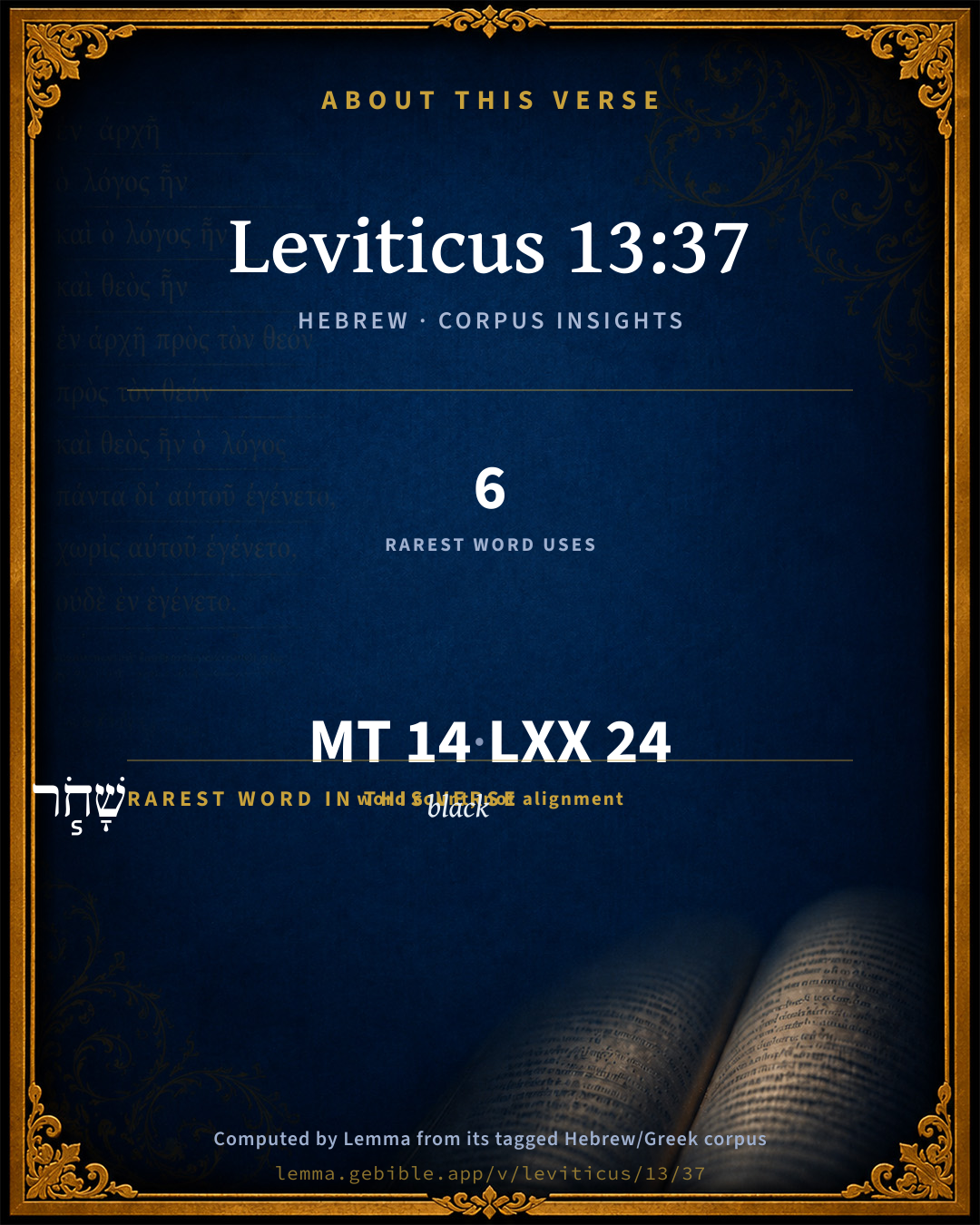
About this verse

These counts appear in no published source. They are computed here, from the morphology-tagged text and Lemma’s own curated glosses. What Lemma adds →

14
words
12
distinct lemmas
Pentateuch
section

Notable vocabulary

The rarest word here is שָׁחֹ֧ר black H7838 — appearing just 6 times in the whole Hebrew Bible.

Shared distinctive vocabulary

שָׁחֹ֧ר black H7838 occurs in 6 verses of the Hebrew Bible. Also found in:

Grammatical profile

  • 4 verbs
  • 5 nouns
  • 2 adjectives
  • 1 pronoun
  • 1 preposition
  • 1 conjunction

Verb forms

  • עָמַ֨ד Qal · Perfect
  • צָֽמַח Qal · Perfect
  • נִרְפָּ֥א Niphal · Perfect
  • וְטִהֲר֖וֹ Piel · Sequential Perfect

Repetition

A word recurs within this verse — often emphatic in Hebrew:

  • הַנֶּ֜תֶק scab H5424 ×2

Hebrew & Septuagint length

In English translation the verse runs 29 words from the Hebrew and 33 from the Septuagint (LXX English) — closely comparable.

A rough comparison of the two English renderings, which tokenize alike — not a word-level alignment.

Word counts can differ between the Hebrew and the Greek without any difference in meaning — e.g. the Hebrew direct-object marker אֵת has no separate Greek word, and Greek often adds the article ὁ.

In the original languages it is 14 Hebrew tokens and 24 Greek tokens — but the two are counted differently (Hebrew bundles its prefixes and suffixes into one token; the Greek is in lemma form), so that isn’t a like-for-like length.

Hebrew and Greek witnesses Masoretic Hebrew ↔ Greek Septuagint

The same verse in the two great witnesses to the Old Testament, shown verse-for-verse.

These are two independent witnesses, not word-aligned to each other, and the Septuagint is shown in lemma (dictionary) form.

Hebrew Leviticus 13:37 Masoretic · Westminster Leningrad Codex

וְאִם בְּעֵינָיו֩ עָמַ֨ד הַנֶּ֜תֶק וְשֵׂעָ֨ר שָׁחֹ֧ר צָֽמַח בּ֛וֹ נִרְפָּ֥א הַנֶּ֖תֶק טָה֣וֹר ה֑וּא וְטִהֲר֖וֹ הַכֹּהֵֽן

But if in his eyes the itch is arrested, and black hair has grown in it; the itch is healed, he is clean. The priest shall pronounce him clean.

World English Bible · Public Domain

Greek LXX Leviticus 13:37 Septuagint · lemma form

ἐάν δέ ἐνώπιον μένω ὁ θραῦσμα ἐπί χώρα καί θρίξ μέλας ἀνατέλλω ἐν αὐτός ὑγιάζω ὁ θραῦσμα καθαρός εἰμί καί καθαρίζω αὐτός ὁ ἱερεύς

But if the scurf remain before him in its place, and a dark hair should have arisen in it, the scurf is healed: he is clean, and the priest shall pronounce him clean.

LXX2012 (modern English Septuagint) · Public Domain

Hebrew: Westminster Leningrad Codex (CC BY 4.0). Greek: Septuagint (public domain); English from LXX2012 (modern English Septuagint) (Public Domain). How the Septuagint differs from the Hebrew →

Targum (Aramaic paraphrase)

2

The Targum is the ancient Jewish Aramaic paraphrase of the Hebrew Scriptures — an interpretive translation, not the Hebrew text itself. Onkelos (literal) and Pseudo-Jonathan (expansive) render the Torah, and Jonathan the Prophets. Coverage is partial: where no permissively-licensed English translation exists for a verse, only the Aramaic is shown. This is verse-level text, not a word-by-word alignment to the Hebrew.

  1. Targum Onkelos Torah (Genesis–Deuteronomy)
    וְאִם כַּד הֲוָה קָם נִתְקָא וְשֵׂעָר אֻכָּם צְמַח בֵּהּ אִתַּסִי נִתְקָא דְכֵי הוּא וִידַכִּנֵהּ כַּהֲנָא

    (no public-domain English translation for this verse)

    Targum Onkelos — Aramaic: “Onkelos Genesis” (public domain); “Onkelos Exodus” (public domain); “Onkelos Leviticus” (public domain); “Onkelos Numbers” (public domain); “Onkelos Deuteronomy” (public domain). English: “Sefaria Community Translation” (CC0 1.0 (public-domain dedication)); “J.W. Etheridge. The Targums of Onkelos and Jonathan Ben Uzziel on the Pentateuch. London: Longmans, Green, 1862” (public domain). Text via Sefaria.

  2. Targum Pseudo-Jonathan Torah (Genesis–Deuteronomy)
    וְאִם כַּד הֲוָה קָם נִיתְקָא וּשְעַר אוּכָם צָמַח בֵּיהּ אִיתְסֵי נִיתְקָא דְכֵי הוּא וְיַדְכִּינֵיהּ כַּהֲנָא

    But if the scar abideth, (without widening,) and black hair hath sprung up in it, the scar hath healed; he is clean, and the priest shall make him to be clean.

    Targum Pseudo-Jonathan — Aramaic: “Targum Jonathan on Genesis” (public domain); “Targum Jonathan on Exodus” (public domain); “Targum Jonathan on Leviticus” (public domain); “Targum Jonathan on Numbers” (public domain); “Targum Jonathan on Deuteronomy” (public domain). English: “The Targum of Jonathan ben Uzziel, trans. J. W. Etheridge, London, 1862” (public domain). Text via Sefaria.

Commentary

Notes on Leviticus 13:37 from classic Christian and Jewish commentators (each source and its license shown beneath its notes). The classic Christian expositions comment on the surrounding passage and are grouped to its opening verse, so a note may address several verses; the Jewish commentaries on the Tanakh (Rashi and others) are per-verse, so they appear only where the commentator wrote on this verse.

Lemma curates 59 commentaries, every one of them public domain or Creative Commons licensed, each selected and text-cleaned for this edition rather than reprinted as found. About our sources →

Trapp's Complete Commentary

John Trapp

Lev 13:37 But if the scall be in his sight at a stay, and [that] there is black hair grown up therein; the scall is healed, he [is] clean: and the priest shall pronounce him clean.

Ver. 37. Black hair.] A sign of soundness. Quod sanitas in corpore, id sanctitas in corde, saith Bernard.

John Trapp, A Commentary or Exposition upon All the Books of the Old and New Testament (1647–1656) — public domain. Text from a community e-Sword module.

Ellicott's Commentary for English Readers

(37) But if the scall be in his sight at a stay.—Better, But if the appearance of the scall hath remained the same.

And that there is black hair grown up therein.—Better, And if black hair hath, &c. If, in addition to its not spreading, the healthy colour of the hair has returned, it shows that the patient is cured of the leprosy, and the priest shall pronounce him clean. (See Lev_13:31.) According to the adminstrators of the law, there had at least to be two black hairs, of such a length that the top could bow towards the root. If two hairs grew up on the healed scall, one black and the other white or yellow, or one long and the other short, the patient could not be declared clean.

A Bible Commentary for English Readers, edited by Charles John Ellicott (1878–1897) — public domain. Text from a community e-Sword module.

John Gill's Exposition

Then the priest shall look,.... Upon the man or woman that has these spots, and upon the spots themselves, and examine them of what kind they are:

and, behold, if the bright spots in the skin of their flesh be darkish white; their whiteness is not strong, as Jarchi observes; but dusky and obscure, or "contracted" (w); small white spots, not large and spreading:

it is a freckled spot that grows in the skin; a kind of morphew, which the above writer describes as a sort of whiteness which appears in the flesh of a ruddy man:

he is clean; from leprosy; this is observed, lest a person that is freckled and has a morphew should be mistaken for a leprous person; as every man that has some spots, failings, and infirmities, is not to be reckoned a wicked man.

(w) "costractae", Junius & Tremellius, Piscator.

John Gill's Exposition of the Whole Bible (1746–1763) — public domain (CC PDM 1.0). Text via the HelloAO Bible API.

Albert Barnes' Notes on the Bible

Be in his sight at a stay - Or, Does not alter in appearance.

Albert Barnes' Notes on the Bible (1834–1885) — public domain. Text from a community e-Sword/MySword module.

Matthew Poole's English Annotations

The truth of the thing, and not the sentence of the priest, made him clean; and if the priest had partially pronounced one clean who was not clean, his sentence had been null. And therefore it is a fond and dangerous conceit to think that the absolution given to any sinner by a priest will stand him in any stead if he do not truly repent.

Matthew Poole's English Annotations on the Holy Bible (1683–1685) — public domain. Text from a community e-Sword/MySword module.

Keil & Delitzsch

C. F. Keil & F. Delitzsch

But if, on the contrary, the eruption stood (see Lev 13:5), and black hair grew out of it, he was healed, and the person affected was to be declared clean.

Keil & Delitzsch — Biblical Commentary on the Old Testament (1861–1891) — public domain (CC PDM 1.0). Text via the HelloAO Bible API. (Old Testament only.)

Rashi

Rabbi Shlomo Yitzchaki (Rashi)

ושער שחור AND [THERE BE] BLACK HAIR — Whence do I know that this applies also to yellow or reddish hair which also, like black hair here mentioned, are not gold-coloured? Because it states ושער “and hair” (whatever its colour may be) (Sifra, Tazria Parashat Nega'im, Chapter 9 14). The expression צָהוֹב denotes anything like the appearance of gold, and צהוב is equivalent to זהוב, orpàle in old French (English = pale gold).

טהור הוא וטהרו הכהן HE IS CLEAN AND THE PRIEST SHALL PRONOUNCE HIM CLEAN — Consequently a person who is really unclean whom the priest pronounces clean is not clean. [It is true that the declaration is left to the priest — as pointed out by Rashi on v. 2 — but if he erred or willfully pronounced the unclean person clean it is of no effect for Scripture states: he is clean and the priest then — and then only — shall pronounce him clean] (Sifra, Tazria Parashat Nega'im, Chapter 9 16).

Rashi on the Tanakh — English translations: “The Judaica Press complete Tanach with Rashi, translated by A. J. Rosenberg” (CC BY 4.0); “Pentateuch with Rashi's commentary by M. Rosenbaum and A.M. Silbermann, 1929-1934” (public domain); “The Metsudah Tanach series, Lakewood, N.J” (CC BY 4.0); and “The Book of Joshua, Metsudah Publications, 1997” (CC BY 4.0). Text via Sefaria.

Lesson kit

Teaching starters — assembled from the data on this page, not authored interpretation. Every prompt links to the verse data it draws on. Edit before teaching.

Leviticus, in the Pentateuch, opens this verse with 14 words (12 distinct Hebrew lemmas). Its most distinctive word is shâchôr (“black”). A historical commentator’s framing appears above. Read the whole chapter for the surrounding context.

Discussion questions

  1. The word shâchôr carries the sense “black.” How does it shape the verse?
  2. Leviticus 13:31 shares the word «black» with this verse. How do the two illuminate each other?
  3. “scab” occurs 2× in this one verse. What is the effect of the repetition?
  4. These translations render this verse differently; the difference is in the English rendering, not the original. What questions does that raise?
  5. The verb «עָמַ֨ד» is Qal Perfect. How does its form color the action?
  6. Reading how Trapp's Complete Commentary and Ellicott's Commentary for English Readers read this verse, where do the two commentators agree and where do they part?

Things to notice

Reading settings

Reading text

Shown beneath each verse's original-language words.

Old Testament
Old Testament edition

Read the OT as the Masoretic Hebrew (MT) or the Greek Septuagint (LXX).

English shown for the Greek Septuagint (in the Hebrew ↔ Greek comparison).

Comparing translations? Open the Compare panel on any verse page to stack up to four side by side.