
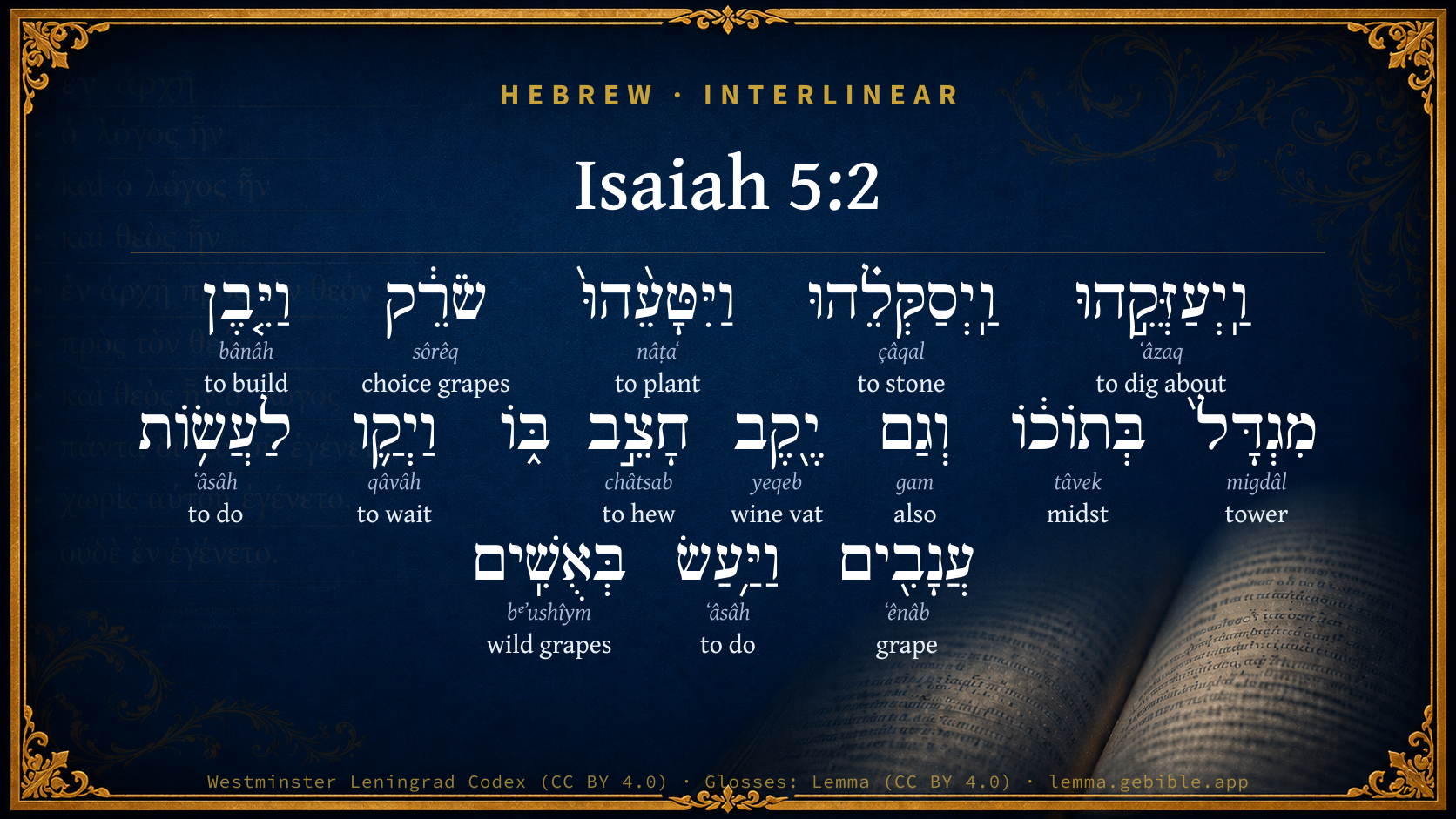
Isaiah 5:2

Hebrew (Westminster Leningrad Codex) Isaiah 5:2 appears in the Hebrew Old Testament. The text above is from the Westminster Leningrad Codex. Each word links to its Strong’s number, a concise gloss, and parsing drawn from the Open Scriptures Hebrew Bible morphology. Click any word for its full Brown-Driver-Briggs (BDB) entry.
Download image
Cite this verse

Isaiah 5:2 (World English Bible). Public Domain. Lemma interlinear Bible study tool, https://lemma.gebible.app/v/isaiah/5/2.

Show BibTeX & RIS
BibTeX
RIS
English Translation
He dug it up, Gathered out its stones, Planted it with the choicest vine, Built a tower in its midst, And also cut out a winepress therein. He looked for it to yield grapes, But it yielded wild grapes.
World English Bible · Public Domain
Highlights
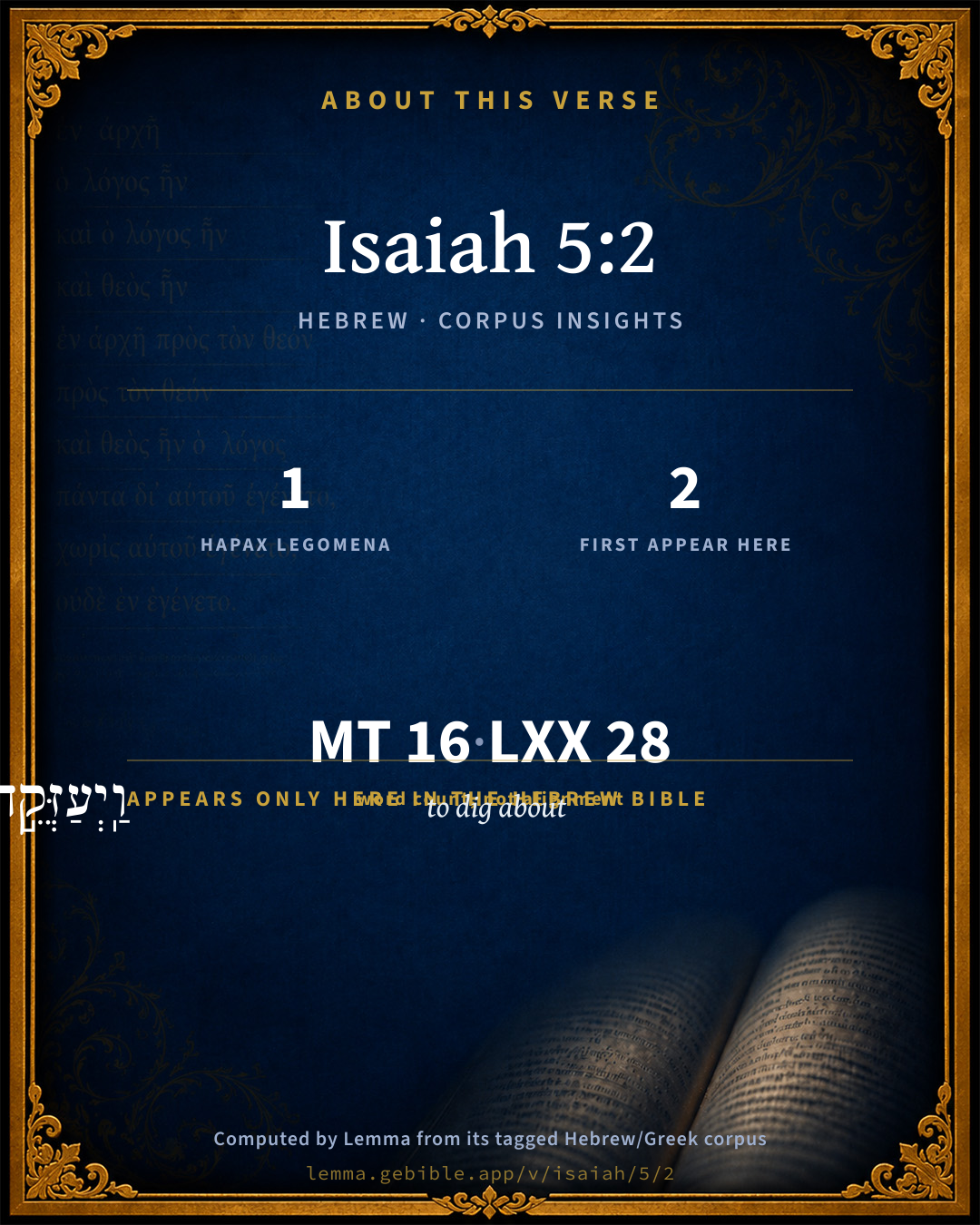
  • 1 hapax legomenon — only here in the Hebrew Bible
  • 2 first appearances in the Hebrew Bible
Full analysis ↓
Download a study sheet

One document with this verse’s original text, its word-by-word gloss line, the meaning frame, cross-references with their text, attributed commentary, and full source and license credits — printable, and it pastes into notes with its structure intact.

This verse Autodidact and up

Study sheet (.html) Plain text (.txt)

A passage Seminary Student

Up to 50 verses in one chapter. A passage sheet keeps up to 6 commentary sources and 12 cross-references per verse, in the order this page ranks them, and says so on the sheet whenever that leaves anything out. Ask for a single verse and you get the Autodidact verse sheet above.

Everything on this page stays free to read, with no account — the sheet is a download of what is already on screen, not access to it.

Want to remove ads? Support Godless Engineer
Compare translations 3

The same verse in 3 English versions, stacked beneath the original-language interlinear above. Click any original word for its lexicon entry.

Each is an independent rendering of the whole verse — the interlinear is not word-aligned to these translations.

Highlighted words mark where these versions differ — a whole-verse word diff, not a word-by-word alignment.

  • World English Bible Public Domain
    He dug it up, Gathered out its stones, Planted it with the choicest vine, Built a tower in its midst, And also cut out a winepress therein. He looked for it to yield grapes, But it yielded wild grapes.
  • King James Version Public Domain
    And he fenced it, and gathered out the stones thereof, and planted it with the choicest vine, and built a tower in the midst of it, and also made a winepress therein: and he looked that it should bring forth grapes, and it brought forth wild grapes.
  • unfoldingWord Literal Text CC BY-SA 4.0
    And he dug it up, and he cleared it of stones, and he planted it a choice vine, and he built a tower in the midst of it, and he also hewed out a winepress in it. And he waited for to produce grapes, but it produced wild grapes.

unfoldingWord Literal Text — © unfoldingWord, licensed CC BY-SA 4.0. Word-aligned USFM3 via Door43 (git.door43.org/unfoldingWord/en_ult).

Versions to compare (up to 4)

3 of 4 selected

Show all 17 translations

Every available English version of this verse, each an independent rendering of the whole verse.

  • World English Bible Public Domain
    He dug it up, Gathered out its stones, Planted it with the choicest vine, Built a tower in its midst, And also cut out a winepress therein. He looked for it to yield grapes, But it yielded wild grapes.
  • Berean Standard Bible Public Domain
    He dug it up and cleared the stones and planted the finest vines. He built a watchtower in the middle and dug out a winepress as well. He waited for the vineyard to yield good grapes, but the fruit it produced was sour!
  • Majority Standard Bible Public Domain
    He dug it up and cleared the stones and planted the finest vines. He built a watchtower in the middle and dug out a winepress as well. He waited for the vineyard to yield good grapes, but the fruit it produced was sour!
  • King James Version Public Domain
    And he fenced it, and gathered out the stones thereof, and planted it with the choicest vine, and built a tower in the midst of it, and also made a winepress therein: and he looked that it should bring forth grapes, and it brought forth wild grapes.
  • American Standard Version (1901) Public Domain
    and he digged it, and gathered out the stones thereof, and planted it with the choicest vine, and built a tower in the midst of it, and also hewed out a winepress therein: and he looked that it should bring forth grapes, and it brought forth wild grapes.
  • Revised Version (1885) Public Domain
    and he made a trench about it, and gathered out the stones thereof, and planted it with the choicest vine, and built a tower in the midst of it, and also hewed out a winepress therein: and he looked that it should bring forth grapes, and it brought forth wild grapes.
  • Geneva Bible (1599) Public Domain
    And hee hedged it, and gathered out the stones of it, and he planted it with the best plants, and hee builte a towre in the middes thereof, and made a wine presse therein: then hee looked that it should bring foorth grapes: but it brought foorth wilde grapes.
  • Young's Literal Translation Public Domain
    And he fenceth it, and casteth out its stones, And planteth it `with' a choice vine, And buildeth a tower in its midst, And also a wine press hath hewn out in it, And he waiteth for the yielding of grapes, And it yieldeth bad ones!
  • Literal Standard Version CC BY-SA 4.0
    And He fences it, and casts out its stones, || And plants it [with] a choice vine, || And builds a tower in its midst, || And has also hewn out a winepress in it, || And He waits for the yielding of grapes, || And it yields bad ones!
  • Unlocked Literal Bible CC BY-SA 4.0
    He spaded it, removed the stones, and planted it with an excellent kind of vine. He built a tower in the middle of it, and also built a winepress. He waited for it to produce grapes, but it only produced wild grapes.
  • unfoldingWord Literal Text CC BY-SA 4.0
    And he dug it up, and he cleared it of stones, and he planted it a choice vine, and he built a tower in the midst of it, and he also hewed out a winepress in it. And he waited for to produce grapes, but it produced wild grapes.
  • Darby Bible Public Domain
    And he dug it, and gathered out the stones thereof, and planted it with the choicest vine; and he built a tower in the midst of it, and also hewed out a winepress therein; and he looked that it should bring forth grapes, but it brought forth wild grapes.
  • World Messianic Bible Public Domain
    He dug it up, gathered out its stones, planted it with the choicest vine, built a tower in the middle of it, and also cut out a wine press in it. He looked for it to yield grapes, but it yielded wild grapes.
  • Webster's Bible Public Domain
    And he fenced it, and gathered out the stones of it, and planted it with the choicest vine, and built a tower in the midst of it, and also made a wine-press therein: and he expected that it would bring forth grapes, and it brought forth wild grapes.
  • Free Bible Version CC BY-SA 4.0
    He dug it over, cleared the ground of stones, and planted it with the very best vines. In the middle of it he built a watchtower, and he also cut out a winepress from the rock. Then he waited for a good harvest of grapes, but it only produced wild, sour grapes.
  • Bible in Basic English Public Domain
    And after working the earth of it with a spade, he took away its stones, and put in it a very special vine; and he put up a watchtower in the middle of it, hollowing out in the rock a place for the grape-crushing; and he was hoping that it would give the best grapes, but it gave common grapes.
  • JPS Tanakh (1917) Public Domain
    And he digged it, and cleared it of stones, and planted it with the choicest vine, and built a tower in the midst of it, and also hewed out a vat therein; and he looked that it should bring forth grapes, and it brought forth wild grapes.

Literal Standard Version (2020), Covenant Press — licensed CC BY-SA 4.0. Text via the HelloAO Bible API (eBible.org). Unlocked Literal Bible (unfoldingWord) — licensed CC BY-SA 4.0. Text via the HelloAO Bible API (eBible.org). unfoldingWord Literal Text — © unfoldingWord, licensed CC BY-SA 4.0. Word-aligned USFM3 via Door43 (git.door43.org/unfoldingWord/en_ult). Free Bible Version, Dr. Jonathan Gallagher — licensed CC BY-SA 4.0. Text via the HelloAO Bible API (eBible.org).

Word by word

More ways to search: Search by grammar → Find every occurrence → Compare this word →

Practice this passage: Drill this verse → Learn its vocabulary →

וַֽיְעַזְּקֵ֣הוּ
ʻâzaq
H5823
“and · to dig about · him”
Conjunction + Verb, Piel, Sequential Imperfect, 3rd Person, Masculine, Singular + Suffix, Personal, 3rd Person, Masculine, Singular
Part of Speech
Conjunction + Verb
Stem
Piel
Form
Sequential Imperfect
Person
3rd Person
Gender
Masculine
Number
Singular
Full BDB Definition

Origin: a primitive root

TWOT: 1597

(Piel) to dig about
  1. וַֽיְסַקְּלֵ֗הוּ çâqal H5619 “and · to stone · him” Conjunction + Verb, Piel, Sequential Imperfect, 3rd Person, Masculine, Singular + Suffix, Personal, 3rd Person, Masculine, Singular
  2. וַיִּטָּעֵ֨הוּ֙ nâṭaʻ H5193 “and · to plant · him” Conjunction + Verb, Qal, Sequential Imperfect, 3rd Person, Masculine, Singular + Suffix, Personal, 3rd Person, Masculine, Singular
  3. שֹׂרֵ֔ק sôrêq H8321 “choice grapes” Noun, Common, Masculine, Singular, Absolute
  4. וַיִּ֤בֶן bânâh H1129 “and · to build” Conjunction + Verb, Qal, Sequential Imperfect, 3rd Person, Masculine, Singular
  5. מִגְדָּל֙ migdâl H4026 “tower” Noun, Common, Both, Singular, Absolute
  6. בְּתוֹכ֔וֹ tâvek H8432 “in/at · midst · his” Preposition + Noun, Common, Masculine, Singular, Construct + Suffix, Personal, 3rd Person, Masculine, Singular
  7. וְגַם gam H1571 “and · also” Conjunction + Particle, Accusative
  8. יֶ֖קֶב yeqeb H3342 “wine vat” Noun, Common, Masculine, Singular, Absolute
  9. חָצֵ֣ב châtsab H2672 “to hew” Verb, Qal, Perfect, 3rd Person, Masculine, Singular
  10. וַיְקַ֛ו qâvâh H6960 “and · to wait” Conjunction + Verb, Piel, Sequential Imperfect, 3rd Person, Masculine, Singular
  11. לַעֲשׂ֥וֹת ʻâsâh H6213 “to do” Preposition + Verb, Qal, Infinitive Construct
  12. עֲנָבִ֖ים ʻênâb H6025 “grapes” Noun, Common, Masculine, Plural, Absolute
  13. וַיַּ֥עַשׂ ʻâsâh H6213 “and · to do” Conjunction + Verb, Qal, Sequential Imperfect, 3rd Person, Masculine, Singular
  14. בְּאֻשִֽׁים bᵉʼushîym H891 “wild grapes” Noun, Common, Masculine, Plural, Absolute

About this verse

These counts appear in no published source. They are computed here, from the morphology-tagged text and Lemma’s own curated glosses. What Lemma adds →

16
words
14
distinct lemmas
Prophets
section

Notable vocabulary

1 hapax legomenon — a word that appears only here in the entire Hebrew Bible:

  • וַֽיְעַזְּקֵ֣הוּ to dig about H5823

First appearance in Scripture

These words make their first canonical appearance in the Hebrew Bible here:

  • וַֽיְעַזְּקֵ֣הוּ to dig about H5823
  • בְּאֻשִֽׁים wild grapes H891

Shared distinctive vocabulary

בְּאֻשִֽׁים wild grapes H891 occurs in 2 verses of the Hebrew Bible. Also found in:

Grammatical profile

  • 8 verbs
  • 6 nouns
  • 1 preposition
  • 1 particle

Verb forms

  • וַֽיְעַזְּקֵ֣הוּ Piel · Sequential Imperfect
  • וַֽיְסַקְּלֵ֗הוּ Piel · Sequential Imperfect
  • וַיִּטָּעֵ֨הוּ֙ Qal · Sequential Imperfect
  • וַיִּ֤בֶן Qal · Sequential Imperfect
  • חָצֵ֣ב Qal · Perfect
  • וַיְקַ֛ו Piel · Sequential Imperfect
  • לַעֲשׂ֥וֹת Qal · Infinitive Construct
  • וַיַּ֥עַשׂ Qal · Sequential Imperfect

Repetition

A word recurs within this verse — often emphatic in Hebrew:

  • לַעֲשׂ֥וֹת to do H6213 ×2

Hebrew & Septuagint length

In English translation the verse runs 39 words from the Hebrew and 48 from the Septuagint (LXX English) — closely comparable.

A rough comparison of the two English renderings, which tokenize alike — not a word-level alignment.

Word counts can differ between the Hebrew and the Greek without any difference in meaning — e.g. the Hebrew direct-object marker אֵת has no separate Greek word, and Greek often adds the article ὁ.

In the original languages it is 16 Hebrew tokens and 28 Greek tokens — but the two are counted differently (Hebrew bundles its prefixes and suffixes into one token; the Greek is in lemma form), so that isn’t a like-for-like length.

Cross-references

25

Topical passages linked to Isaiah 5:2 in the Treasury of Scripture Knowledge — connected by theme and wording, ordered by reader-vote popularity; previews shown in the World English Bible.

  • Jeremiah 2:21 Yet I had planted you a noble vine, wholly a right seed: how then are you turned into the degenerate branches of a foreign vine to me?
  • Deuteronomy 32:32–33 For their vine is of the vine of Sodom, Of the fields of Gomorrah: Their grapes are grapes of gall, Their clusters are bitter:
  • Isaiah 1:2–4 Hear, heavens, And listen, earth; for Yahweh has spoken: I have nourished and brought up children, And they have rebelled against me.
  • Mark 11:13 Seeing a fig tree afar off having leaves, he came to see if perhaps he might find anything on it. When he came to it, he found nothing but leaves, for it was not the season for figs.
  • Luke 13:6–7 He spoke this parable. "A certain man had a fig tree planted in his vineyard, and he came seeking fruit on it, and found none.
  • 1 Corinthians 9:7 What soldier ever serves at his own expense? Who plants a vineyard, and doesn't eat of its fruit? Or who feeds a flock, and doesn't drink from the flock's milk?
  • Revelation 14:18–20 Another angel came out from the altar, he who has power over fire, and he called with a great voice to him who had the sharp sickle, saying, "Send forth your sharp sickle, and gather the clusters of the vine of the earth, for the earth's grapes are fully ripe!"
  • Hosea 10:1 Israel is a luxuriant vine that puts forth his fruit. According to the abundance of his fruit he has multiplied his altars. As their land has prospered, they have adorned their sacred stones.
  • Luke 20:10–18 At the proper season, he sent a servant to the farmers to collect his share of the fruit of the vineyard. But the farmers beat him, and sent him away empty.
  • Exodus 33:16 For how would people know that I have found favor in your sight, I and your people? Isn't it in that you go with us, so that we are separated, I and your people, from all the people who are on the surface of the earth?"
  • Numbers 23:9 For from the top of the rocks I see him, From the hills I see him: behold, it is a people that dwells alone, And shall not be reckoned among the nations.
  • Deuteronomy 32:6 Do you thus requite Yahweh, Foolish people and unwise? Isn't he your father who has bought you? He has made you, and established you.
  • Deuteronomy 32:8–9 When the Most High gave to the nations their inheritance, When he separated the children of men, He set the bounds of the peoples According to the number of the children of Israel.
  • Judges 16:4 It came to pass afterward, that he loved a woman in the valley of Sorek, whose name was Delilah.
  • Nehemiah 13:15 In those days saw I in Judah some men treading wine-presses on the Sabbath, and bringing in sheaves, and lading donkeys [therewith]; as also wine, grapes, and figs, and all manner of burdens, which they brought into Jerusalem on the Sabbath day: and I testified [against them] in the day in which they sold food.
  • Psalms 44:1–3 We have heard with our ears, God; Our fathers have told us, What work you did in their days, In the days of old.
  • Isaiah 1:8 The daughter of Zion is left like a shelter in a vineyard, Like a hut in a field of melons, Like a besieged city.
  • Isaiah 1:21–23 How the faithful city has become a prostitute! She was full of justice; righteousness lodged in her, But now murderers.
  • Isaiah 5:7 For the vineyard of Yahweh of Hosts is the house of Israel, And the men of Judah his pleasant plant: And he looked for justice, but, behold, oppression; For righteousness, but, behold, a cry of distress.
  • Isaiah 63:2–3 Why are you red in your clothing, and your garments like him who treads in the wine vat?
  • Micah 4:8 You, tower of the flock, the hill of the daughter of Zion, To you it will come, Yes, the former dominion will come, The kingdom of the daughter of Jerusalem.
  • Matthew 21:19 Seeing a fig tree by the road, he came to it, and found nothing on it but leaves. He said to it, "Let there be no fruit from you forever!" Immediately the fig tree withered away.
  • Matthew 21:34 When the season for the fruit drew near, he sent his servants to the farmers, to receive his fruit.
  • Mark 12:2 When it was time, he sent a servant to the farmer to get from the farmer his share of the fruit of the vineyard.
  • Romans 9:4 who are Israelites; whose is the adoption, the glory, the covenants, the giving of the law, the service, and the promises;

Cross-references courtesy of OpenBible.info (CC BY 4.0).

Hebrew and Greek witnesses Masoretic Hebrew ↔ Greek Septuagint

The same verse in the two great witnesses to the Old Testament, shown verse-for-verse.

These are two independent witnesses, not word-aligned to each other, and the Septuagint is shown in lemma (dictionary) form.

Hebrew Isaiah 5:2 Masoretic · Westminster Leningrad Codex

וַֽיְעַזְּקֵ֣הוּ וַֽיְסַקְּלֵ֗הוּ וַיִּטָּעֵ֨הוּ֙ שֹׂרֵ֔ק וַיִּ֤בֶן מִגְדָּל֙ בְּתוֹכ֔וֹ וְגַם יֶ֖קֶב חָצֵ֣ב בּ֑וֹ וַיְקַ֛ו לַעֲשׂ֥וֹת עֲנָבִ֖ים וַיַּ֥עַשׂ בְּאֻשִֽׁים

He dug it up, Gathered out its stones, Planted it with the choicest vine, Built a tower in its midst, And also cut out a winepress therein. He looked for it to yield grapes, But it yielded wild grapes.

World English Bible · Public Domain

Greek LXX Isaiah 5:2 Septuagint · lemma form

καί φραγμός περιτίθημι καί χαρακόω καί φυτεύω ἄμπελος σωρήκ καί οἰκοδομέω πύργος ἐν μέσος αὐτός καί προλήνιον ὀρύσσω ἐν αὐτός καί μένω ὁ ποιέω σταφυλή ποιέω δέ ἄκανθα

And I made a hedge round it, and dug a trench, and planted a choice vine, and built a tower in the midst of it, and dug a place for the wine-vat in it: and I waited for it to bring forth grapes, and it brought forth thorns.

LXX2012 (modern English Septuagint) · Public Domain

On this verse, Adam Clarke's Commentary discusses the Septuagint’s reading. Read the note in Commentary ↓

Hebrew: Westminster Leningrad Codex (CC BY 4.0). Greek: Septuagint (public domain); English from LXX2012 (modern English Septuagint) (Public Domain). How the Septuagint differs from the Hebrew →

Targum (Aramaic paraphrase)

1

The Targum is the ancient Jewish Aramaic paraphrase of the Hebrew Scriptures — an interpretive translation, not the Hebrew text itself. Onkelos (literal) and Pseudo-Jonathan (expansive) render the Torah, and Jonathan the Prophets. Coverage is partial: where no permissively-licensed English translation exists for a verse, only the Aramaic is shown. This is verse-level text, not a word-by-word alignment to the Hebrew.

  1. Targum Jonathan Prophets (Joshua–Malachi)
    וְקַדֵשְׁתִּינוּן וְיַקַרְתִּינוּן וְקַיַמְתִּינוּן כְּמַצַב גֶפֶן בְּחִירָא וּבְנִיתָא מַקְדְשִׁי בֵינֵיהוֹן וְאַף מַדְבְּחִי יְהָבִית לְכַפָּרָא עַל חֲטָאֵיהוֹן וַאֲמַרִית דְיַעְבְּדוּן עוֹבָדִין טָבִין קֳדָמַי וְאִינוּן אַבְאִישׁוּ עוֹבָדֵיהוֹן:

    I sanctified them, and I made them glorious, I propped them up as a precious vine; and I built my sanctuary in the midst of them; and I gave also mine altar to make an atonement for their sins; and I thought that they should do good works before me, but they did evil works.

    Targum Jonathan — Aramaic: “Mikraot Gedolot” (public domain). English: “Sefaria Community Translation” (CC0 1.0 (public-domain dedication)); “London "Chaldee Paraphrase," 1871” (public domain). Text via Sefaria.

Commentary

Notes on Isaiah 5:2 from classic Christian and Jewish commentators (each source and its license shown beneath its notes). The classic Christian expositions comment on the surrounding passage and are grouped to its opening verse, so a note may address several verses; the Jewish commentaries on the Tanakh (Rashi and others) are per-verse, so they appear only where the commentator wrote on this verse.

Lemma curates 59 commentaries, every one of them public domain or Creative Commons licensed, each selected and text-cleaned for this edition rather than reprinted as found. About our sources →

Adam Clarke's Commentary

Verse 2. And gathered out the stones - "And he cleared it from the stones"] This was agreeable to the husbandry: "Saxa, summa parte terrae, et vites et arbores laeduct; ima parte refrigerant;" Columell. de arb. iii. "Saxosum facile est expedire lectione lapidum;" Id. ii. 2. "Lapides, qui supersunt, [al. insuper sunt,] hieme rigent, aestate fervescunt; idcirco satis, arbustis, et vitibus nocent;" Pallad. i. 6. A piece of ground thus cleared of the stones. Persius, in his hard way of metaphor, calls "exossatus ager," an unboned field; Sat. vi. 52.

The choicest vine - "Sorek"] Many of the ancient interpreters, the Septuagint, Aquila, and Theod., have retained this word as a proper name; I think very rightly. Sorek was a valley lying between Ascalon and Gaza, and running far up eastward in the tribe of Judah. Both Ascalon and Gaza were anciently famous for wine; the former is mentioned as such by Alexander Trallianus; the latter by several authors, quoted by Reland, Palaest., p. 589 and 986. And it seems that the upper part of the valley of Sorek, and that of Eshcol, where the spies gathered the single cluster of grapes, which they were obliged to bear between two upon a staff, being both near to Hebron were in the same neighbourhood, and that all this part of the country abounded with rich vineyards. Compare Nu 13:22-23; Jdg 16:3-4. P. Nau supposes Eshcol and Sorek to be only different names for the same valley. Voyage Noveau de la Terre Sainte, lib. iv., chap. 18. See likewise De Lisle's posthumous map of the Holy Land. Paris, 1763. See Bochart, Hieroz. ii., col. 725. Thevenot, i, p. 406. Michaelis (note on Jdg 16:4, German translation) thinks it probable, from some circumstances of the history there given, that Sorek was in the tribe of Judah, not in the country of the Philistines.

The vine of Sorek was known to the Israelites, being mentioned by Moses, Ge 49:11, before their coming out of Egypt. Egypt was not a wine country. "Throughout this country there are no wines;" Sandys, p. 101. At least in very ancient times they had none. Herodotus, ii. 77, says it had no vines and therefore used an artificial wine made of barley. That is not strictly true, for the vines of Egypt are spoken of in Scripture, Ps 78:47; Ps 105:33; and see Ge 40:11, by which it should seem that they drank only the fresh juice pressed from the grape, which was called οινος αμπελινος; Herodot., ii. 37. But they had no large vineyards, nor was the country proper for them, being little more than one large plain, annually overflowed by the Nile. The Mareotic in later times is, I think, the only celebrated Egyptian wine which we meet with in history. The vine was formerly, as Hasselquist tells us it is now, "cultivated in Egypt for the sake of eating the grapes, not for wine, which is brought from Candia," c. "They were supplied with wine from Greece, and likewise from Phoenicia," Herodot., iii. 6. The vine and the wine of Sorek therefore, which lay near at hand for importation into Egypt, must in all probability have been well known to the Israelites, when they sojourned there. There is something remarkable in the manner in which Moses, Ge 49:11, makes mention of it, which, for want of considering this matter, has not been attended to it is in Jacob's prophecy of the future prosperity of the tribe of Judah: -

"Binding his foal to the vine,

And his ass's colt to his own sorek;

He washeth his raiment in wine,

And his cloak in the blood of grapes."

I take the liberty of rendering שרקה sorekah, for שרקו soreko, his sorek, as the Masoretes do by pointing עירה iroh, for עירו iro, his foal. עיר ir, might naturally enough appear in the feminine form; but it is not at all probable that שרק sorek ever should. By naming particularly the vine of Sorek, and as the vine belonging to Judah, the prophecy intimates the very part of the country which was to fall to the lot of that tribe. Sir John Chardin says, "that at Casbin, a city of Persia, they turn their cattle into the vineyards after the vintage, to browse on the vines." He speaks also of vines in that country so large that he could hardly compass the trunks of them with his arms. Voyages, tom. iii., p. 12, 12mo. This shows that the ass might be securely bound to the vine, and without danger of damaging the tree by browsing on it.

And built a tower in the midst of it] Our Saviour, who has taken the general idea of one of his parables, Mt 21:33; Mr 12:1, from this of Isaiah, has likewise inserted this circumstance of building a tower; which is generally explained by commentators as designed for the keeper of the vineyard to watch and defend the fruits. But for this purpose it was usual to make a little temporary hut, (Isa 1:8,) which might serve for the short season while the fruit was ripening, and which was removed afterwards. The tower therefore should rather mean a building of a more permanent nature and use; the farm, as we may call it, of the vineyard, containing all the offices and implements, and the whole apparatus necessary for the culture of the vineyard, and the making of the wine. To which image in the allegory, the situation the manner of building, the use, and the whole service of the temple, exactly answered. And so the Chaldee paraphrast very rightly expounds it: Et statui eos (Israelitas) ut plantam vineae selectae et aedificavi Sanctuarium meum in medio illorum. "And I have appointed the Israelites as a plant of a chosen vine, and I have built my sanctuary in the midst of them." So also Hieron. in loc. AEdificavit quoque turrim in medio ejus; templum videlicet in media civitate. "He built also a tower in the midst of it, viz., his own temple in the midst of the city." That they have still such towers or buildings for use or pleasure, in their gardens in the East, see Harmer's Observations, ii. p. 241.

And also made a wine-press therein. - "And hewed out a lake therein."] This image also our Saviour has preserved in his parable. יקב yekeb; the Septuagint render it here προληνιον, and in four other places υποληνιον, Isa 16:10; Joe 3:13; Hag 2:17; Zec 14:10, I think more properly; and this latter word St. Mark uses. It means not the wine-press itself, or calcatorium, which is called גת gath, or פורה purah; but what the Romans called lacus, the lake; the large open place or vessel, which by a conduit or spout received the must from the wine-press. In very hot countries it was perhaps necessary, or at least very convenient, to have the lake under ground, or in a cave hewed out of the side of the rock, for coolness, that the heat might not cause too great a fermentation, and sour the must. Vini confectio instituitur in cella, vel intimae domus camera quadam a ventorum ingressu remota. Kempfer, of Shiras wine. Amaen. Exot. p. 376. For the wind, to which that country is subject, would injure the wine. "The wine-presses in Persia," says Sir John Chardin, "are formed by making hollow places in the ground, lined with masons' work." Harmer's Observations, i., p. 392. See a print of one in Kempfer, p. 377. Nonnus describes at large Bacchus hollowing the inside of a rock, and hewing out a place for the wine-press, or rather the lake: -

Και σκοπελους ελαχηνε· πεδοσκαφεος δε σιδηρου

Θηγαλεῃ γλωχινι μυχον κοιληνατο πετρης·

Λειηνας δε μετωπα βαθυνομενων κενεωνων

Αφρον [f. ακρον] εΰστραφυλοιο τυπον ποιησατο λενου.

DIONYSIAC. lib. xii., l. 331.

"He pierced the rock; and with the sharpen'd tool

Of steel well-temper'd scoop'd its inmost depth:

Then smooth'd the front, and form'd the dark recess

In just dimensions for the foaming lake."

And he looked - "And he expected"] Jeremiah, Jer 2:21, uses the same image, and applies it to the same purpose, in an elegant paraphrase of this part of Isaiah's parable, in his flowing and plaintive manner: -

"But I planted thee a sorek, a scion perfectly genuine:

How then art thou changed, and become to me the degenerate

shoots of the strange vine!"

Wild grapes - "poisonous berries."] באשים beushim, not merely useless, unprofitable grapes, such as wild grapes; but grapes offensive to the smell, noxious, poisonous. By the force and intent of the allegory, to good grapes ought to be opposed fruit of a dangerous and pernicious quality; as, in the explication of it, to judgment is opposed tyranny, and to righteousness, oppression. גפן gephen, the vine, is a common name or genus, including several species under it; and Moses, to distinguish the true vine, or that from which wine is made, from the rest. calls it, Nu 6:4, גפן היין gephen haiyayin, the wine-vine. Some of the other sorts were of a poisonous quality, as appears from the story related among the miraculous acts of Elisha, 2Kg 4:39-41. "And one went out into the field to gather potherbs; and he found a field vine, and he gathered from it wild fruit, his lapful; and he went and shred them into the pot of pottage, for they knew them not. And they poured it out for the men to eat: and it came to pass, as they were eating of the pottage, that they cried out and said, There is death in the pot, O man of God; and they could not eat of it. And he said, Bring meal, (leg. קחו kechu, nine MSS., one edition,) and he threw it into the pot. And he said, Pour out for the people, that they may eat. And there was nothing hurtful in the pot."

From some such sorts of poisonous fruits of the grape kind Moses has taken these strong and highly poetical images, with which he has set forth the future corruption and extreme degeneracy of the Israelites, in an allegory which has a near relation, both in its subject and imagery, to this of Isaiah: De 32:32-33.

"Their vine is from the vine of Sodom,

And from the fields of Gomorrah:

Their grapes are grapes of gall;

Their clusters are bitter:

Their wine is the poison of dragons,

And the cruel venom of aspics."

"I am inclined to believe," says Hasselquist, "that the prophet here, Isa 5:2-4, means the hoary nightshade, solanum incanum; because it is common in Egypt, Palestine, and the East; and the Arabian name agrees well with it. The Arabs call it anab el dib, i.e., wolf grapes. The באשים beushim, says Rab. Chai., is a well known species of the vine, and the worst of all sorts. The prophet could not have found a plant more opposite to the vine than this; for it grows much in the vineyards, and is very pernicious to them; wherefore they root it out: it likewise resembles a vine by its shrubby stalk;" Travels, p. 289. See also Michaelis, Questions aux Voyageurs Danois, No. 64.

Adam Clarke's Commentary on the Bible (1810–1826) — public domain. Text from a community e-Sword/MySword module.

Trapp's Complete Commentary

John Trapp

Isa 5:2 And he fenced it, and gathered out the stones thereof, and planted it with the choicest vine, and built a tower in the midst of it, and also made a winepress therein: and he looked that it should bring forth grapes, and it brought forth wild grapes.

Ver. 2. And he fenced {a} it.] Maceria munivit; he hedged it in, or walled it about, protecting his people from the rage of enemies wherewith that country was begirt. God was "a wall of fire to them," {Zec 2:5} and a wall of water to them, {as Exo 14:22} whence their land, though part of the continent, is called "an island," {Isa 26:6} not only because separated from other countries, but because secured and made media insuperabilis unda.

And gathered out the stones thereof.] He not only cast out the Canaanites, but flatly forbade idolatry, and all other wickednesses, παντα τα σκανδαλα, every scandal or rock of offence that might hinder their growth, or turn them out of the way. {Heb 12:13}

And planted it with the choicest vine.] Heb., Sorek; the vines of which place {Jdg 16:4} may seem to be the best and choicest, like as now in Germany are the vines of Herbipolis. See Jer 2:21. The saints of God are noble plants, and of choice spirits; they are the chiefest personages, and of highest account in heaven.

And built a tower in the midst of it.] For both beauty, defence, and convenience. This may be meant of Jerusalem, or the temple therein, that "tower of the flock," and the "stronghold of the daughter of God’s people." {Mic 4:8} Religion set up in the power and purity of it, is the beauty and bulwark of any place.

And also made a winepress therein.] For the pressing of the grapes, and saving of the vine; but, alas! that labour might have been saved for any grapes he got, or wine he made.

“ Fallitur augurio spes bona saepe suo. ”

Little good is done many times by the most pressing and piercing exhortations and argumeuts used by God’s faithful prophets.

And he looked that it should bring forth grapes,] i.e., Good grapes, as little thinking ut opera perdatur et spes eludatur, to have lost all his care and cost, as he did. For who planteth a vineyard and eateth not of the fruit thereof? or who feedeth a flock and eateth not of the milk of the flock? {1Co 9:7}

And it brought forth wild grapes.] Stinking stuff, as the word signifieth, that which was naught and noisome: grapes of Sodom and clusters of Gomorrah. {Deu 32:32-33} He looked for the "fruit of the Spirit"; but behold the "works of the flesh" {Gal 5:19} No whit answerable to his continual care, culture, and custody, they made him, as one saith, a contumacious and contumelious retribution. Thus the wicked answer Heaven’s kindness with an ungrateful wickedness.

{a} Pro Sepivit alii vertunt Fodit, pastinavit, plantavit.

John Trapp, A Commentary or Exposition upon All the Books of the Old and New Testament (1647–1656) — public domain. Text from a community e-Sword module.

The Biblical Illustrator

Joseph S. Exell

Isa_5:2

It brought forth wild grapes

Wild grapes

The history of the Jewish nation is written for our warning, and the lessons taught by this parable are sadly needed by the England of today.

There is not one word of this description of the vineyard at its best which is not true of this highly favoured land. This, too, is a very fruitful hill. Under the soil, what unheard of mineral riches, mines of wealth! Above the soil and in it what fertility, what productive power! Around us, from port and bay and harbour, our merchant fleets take and fetch and gather the riches of the earth! Here, too, is planted a chosen and favoured vine. Here God has planted the Anglo-Saxon race, so blended with some other tribal blood that, even our enemies being judges, we have been unequalled in hardy daring, conquering energy, splendid enterprise, and universal stretch of power. We, too, have been strangely fenced in by the providence of God. Our iron coasts, compassed by the inviolate sea, have largely made and kept us separate and safe. Out of this land have also been gathered the stones of idolatry, barbarism, despotism, bigotry, slavery. Here, too, the Husbandman hath built His tower and made His wine press. The temples of His grace, how beautiful they stand! Surely the Lord hath not dealt so with any people! To us He says, as well as to Israel of old, What more could I do to My vineyard, that I have not done? Why, then, when I looked for grapes, brought it forth wild grapes? Is not this indictment true? Wild grapes, offensive to God, mischievous to others, and ruinous to us, are being produced on every hand. The Husbandman describes some of them.

1. The excessive greed of gain (Isa_5:8). The sin lies not in the mere addition of house to house, by fair and lawful means, or a moderate gathering together of earthly good; but in that mad rush and scramble, that strife and struggle to lay hold of all the hand can grasp. Never was Nebuchadnezzars golden god worshipped with half the eager frenzy of today. Utterly reckless of Naboths honest claim to his little vineyard--regardless of the right of poorer neighbours to gain a livelihood, a powerful purse shall buy them out; huge estates shall be enclosed in an ever-expanding ring fence; rampant speculators shall starve the spinner and weaver by the cunning of a cotton corner. It is a moral wrong; it is a national calamity; it is a wild grape which wins a woe from God. The one gleam of hope lies in the fact that the monster will be its own destroyer. Of a truth, many such houses, great and fair, shall be without inhabitant.

2. Another wild grape is the crying sin of intemperance (Isa_5:11).

3. Another wild grape is the headstrong rush after pleasure; the follies and frivolities of the tens of thousands whose whole time and tastes and talents are wickedly laid on the shrine of sensual delights. A perpetual round of feasting, junketing, dancing, sightseeing, and sensational enjoyments is the be-all and end-all of their existence (Isa_5:12).

4. Another wild grape is sensuality in its grosser and fouler shapes. Woe unto them which draw iniquity with cords, and sin as with a cart rope. In this ease the silken threads which bound them to the gilded chariot of pleasure have been woven by the force of habit into strong cords and cables, and they are drawn by the baser passions into bestial sensuality, and within the veil of secrecy, and under the curtains of night, uncleanness reigns.

5. Another wild grape is infidelity. Woe unto them that regard not the work of the Lord, neither consider the operations of His hands. They deny His creating power, they question His existence, and as for the operation of His providence, not God but law and nature is the cause of all! And all this in England!

6. Another wild grape here mentioned is fraud and falsehood: and still another is dishonesty. Woe to them who put bitter for sweet, and sweet for bitter, and so on. Again, Woe unto them which justify wickedness for reward! Tricks of trade, scamped handiwork, adulterated goods, lying puffs and advertisements, commercial frauds, haphazard speculations--oh, tis a sickening list! What shall be the end of it? Must England, like Israel, perish, forsaken of her God? No nation that forgets God shall prosper: look on the ruins of Babylon, of Greece, of Israel, of Rome. No city that forgets God shall prosper: read the sad records of Nineveh, of Tyre, of Jerusalem, of Sardis, of Laodicea. No man that forgets God shall prosper: look at the graves of Pharaoh, of Ahab, of Saul, of Herod, of Napoleon. If England lives on, and grows in lustre as she lives, it must be because the King Emmanuel is undisputed Monarch of the national heart, uncontrolled Director of the national policy and the national will. (J. J.Wray, M. A.)

Isaiah an embodied conscience

Isaiah was speaking in the first years of the reign of Ahaz, who, by his luxury and effeminacy, was beginning to imperil the splendid results of the reigns of Uzziah and Jotham. Like most men who are embodied consciences, the prophet was looked upon as a busybody. Those are usually most hated who do that which is most needed. Having attracted attention by his parable of the vineyard and the grapes, Isaiah became a remorseless and terrible voice. The man seemed to have disappeared, while the voice spoke the retributions of the Almighty. This embodied conscience was terribly faithful. It is useless to attempt argument with a conscience. It can never be argued with--it must be heard. It utters its imperative, and you are heedless at your peril. Some things may be reasoned about; a matter of conscience, never. Furthermore, conscience is always and of necessity prophetic. Whenever conscience tells you that you are wrong, it tells you more than that--it tells you that you must turn or you will be punished. That is what makes it a terror. Not only does it point the finger of shame; it also points the finger of doom. So is it with the national conscience; it, too, is prophetic, and always speaks of judgment. Isaiah was the conscience of Judah speaking its imperative, as Wendell Phillips and William Lloyd Garrison were our national conscience in the days when the Republic protected slavery. Judah had grown rich; she was getting careless; she was trusting in her riches. Judah had been sadly disciplined. There had been earthquakes, loss of territory, defeat, and now there was approaching the spectre of an Assyrian invasion. For all this she boasted of her riches and neglected God. (Amory H. Bradford, D. D.)

Old foes with new faces

1. As soon as a people become rich, they usually begin to subvert the natural and Divine order to their own selfishness. The tendency of riches is to lead people to do wrong. That may be why it is so hard for a rich man to get into heaven. He makes the mistake of thinking he can buy his way anywhere, and finds at last that character, not gold, is the currency he needs.

2. The sternness of the prophet continues. Those who have grown rich have also grown luxurious. They have learned the pleasures of the wine cup; they tarry long at the wine. The land question is an old one; the liquor question is equally old. Again I ask, Who shall tell why, as soon as men begin to prosper, they begin to do what is worst for themselves and worst for the world? Read that fifth chapter from Isa_5:12-17. How true to life! The mean man is bowed down, and the great man is humbled. The low-bred fellow drinks his fiery liquor and wallows in the gutter; the high-bred and rich say that they can mind their own business, and go to the same disgusting squalor. But Isaiah was speaking of the nation rather than to individuals It was a national shame that such things were tolerated then; it is a disgrace that such things are tolerated now. If Isaiah were alive today, or, better, if Jesus Christ could have your attention for a moment, He would say, How can you justify yourselves in giving so much time to purely economic questions and so little to the devising of means for the abolition of what ruins the finest of our boys, blights homes that would otherwise be beautiful and full of love, and makes so many of our rulers more like swine than the sovereigns they were intended to be? These two old foes are still alive, with new faces--the land question and the liquor question. The lesson which we have to learn is the one which the prophet sought to impress in his time--that both individuals and nations are responsible to God; that responsibility is real; and that there is a judgment seat before which men and nations must stand. For all this His anger is not turned away, but His hand is stretched out still. Let us not forget that we--our community, our state, our nation--are in the moral order of God; that everything we do is making ourselves and all others better or worse; that we are all called to fellowship with the prophets and apostles and faithful souls in all ages, to do something toward bringing in the time when the good things of the world shall belong to all people. (Amory H. Bradford, D. D.)

A reasonable expectation

God expects vineyard fruit from those that enjoy vineyard privileges. (M. Henry.)

The Biblical Illustrator, edited by Joseph S. Exell (c. 1880s–1900s) — public domain. Text from a community e-Sword module.

Joseph Benson's Commentary

Isa 5:2. And he fenced it — In this verse the prophet, carrying on the allegory, proceeds to express, in parabolical language, the singular favours which God had bestowed on the Jewish nation, and the peculiar care which he had taken of them. He separated them from other nations, took them into covenant with himself, gave them a variety of laws and ordinances respecting his worship and service, and became, in an especial manner, their protector and governor. Thus he fenced his vineyard; Hebrew, יעזקהו, circumsepsit eam, hedged it round on all sides. In removing the heathen nations, and destroying all the forms of their idolatrous worship, forbidding all idolatry, and all intimate friendship and intermarriages with idolaters, and by giving them plain and ample directions for their whole conduct, lest they should fall by error or mistake, he gathered out the stones thereof — Which otherwise might have marred the land, (2Ki 3:19,) and injured the vines. In other words, he removed all the hinderances of fruitfulness. In that he formed his church of the posterity of those wise, holy, and faithful men, Abraham, Isaac, and Jacob, and purged and reformed the nation in the wilderness before he established them in Canaan, he might truly be said to plant his vineyard with the choicest vine — Or, as the Hebrew is, the vine of Sorek, alluding to a valley between Ascalon and Gaza, running up eastward into the tribe of Judah, and famous for the best vines, and the richest vineyards. And he built a tower in the midst of it — As edifices, termed towers by the Jews, were erected in vineyards, containing, as Bishop Lowth supposes, “all the offices and implements, and the whole apparatus necessary for the culture of them, and the making of wine;” and, doubtless, also serving for the accommodation and defence of the labourers; and as places of pleasure for the owners of the vineyards; so God provided his church with a most commodious and magnificent temple, furnished with all conveniences for every part of that worship and service which he required his people to perform to him, and affording every requisite accommodation for the residence, support, and comfort of the priests and Levites, while ministering in holy things, and employed in cultivating God’s mystical vineyard; and where he, the Lord of the vineyard, might be peculiarly present, as the protector and consolation of his people, their refuge and strength, and very present help in times of trouble or danger. Thus the Chaldee paraphrast: “I have constituted them the plant of a choice vine, and built my sanctuary in the midst of them.” So also Jerome interprets the clause. He also made a wine-press therein — Hebrew, וגם יקב חצב, which Bishop Lowth properly translates, “And he hewed out also a lake therein;” observing that the word יקבmeans, not the wine-press itself, or calcatorium, (the vessel or place where the grapes were stamped, or trod for the wine, which is expressed by another word,) but “what the Romans called lacus, the lake; the large open place or vessel, which, by a conduit, or spout, received the must (or new wine) from the wine-press.” This place, he thinks, in very hot countries, it was necessary, or very convenient, to have under ground, or in a cave hewed out of the side of a rock, “for coolness; that the heat might not cause too great a fermentation, and sour the must.” Now this lake, made to contain the new wine, may here signify the great altar, made to receive the sacrifices and oblations, as the fruits of the spiritual vineyard. And he looked that it should bring forth grapes — Real, genuine fruit, true, substantial piety and virtue, or godliness and righteousness; and it brought forth wild grapes — Or, rather, poisonous berries, as Bishop Lowth translates באשׁים, the word here used, which does not signify “merely useless, unprofitable grapes, such as wild grapes; but grapes offensive to the smell, noxious, poisonous;” such as those mentioned 2Ki 4:39-41. For, according to the force and intent of the allegory, “To good grapes ought to be opposed fruit of a dangerous and pernicious quality; as, in the explication of it, to judgment is opposed tyranny, and to righteousness oppression.” See an elegant paraphrase of this part of the parable, Jer 2:21.

Joseph Benson's Commentary on the Old and New Testaments (1811–1818) — public domain. Text from a community e-Sword module.

The Preacher's Complete Homiletical Commentary

Joseph S. Exell (gen. ed.)

DIVINE DISAPPOINTMENTS

Isa_5:2. He looked that it should bring forth grapes, and it brought forth wild grapes.

“I believe in God.” Which God? The God constructed for us by philosophers, who is impassive, throned in eternal calm, unmoved by the crimes or the virtues of men, all of which He has foreseen from eternal ages, and which cannot in any way affect Him at the time of their occurrence; a God who towers above men, majestic and unchangeable, like an Alpine peak, which is the same whether sunlight cheers or clouds darken the valleys beneath? No, but the God of the Bible, who loves and hates, who rejoices with us in our gladness and sorrows with us in our griefs, who foresees and overrules all, and yet can hope and be disappointed.

I. That God can be disappointed is distinctly the implication of our text. “He looked that it,” &c.

1. Isaiah’s parable recalls the privileges which God had conferred upon the Jews; and we know that He dealt with them as He did, in order that they might become a holy nation (Exo_19:6; Deu_7:6; Deu_26:18-19). Was their persistent unholiness no disappointment to Him?

2. The same truth is implied in what we are told of God’s feelings in view of the wickedness of the antediluvians (Gen_6:5-6). He had made man in His own image, in order that He might continue therein, and shine with the lustre of His own moral perfections; each man was to be a planet in the moral universe, reflecting the glory of the great central Sun; and when He saw man transformed into the image of Satan, and His purposes concerning him frustrated, He was filled with profound regret.

3. The same truth is implied in what we are told concerning Christ. “He came unto His own” (Joh_1:11). For what purpose? Certainly not that He might be rejected, but that He might be received by them. But He was rejected! See how forcibly this is brought out in His parable (Luk_20:9-15—especially Isa_5:13).

4. It is implied in Christ’s tears and lament over Jerusalem (Luk_19:41; Mat_23:37).

5. It is implied in the apostolic declarations, that God is desirous that all men should repent and be saved (1Ti_2:4; 2Pe_3:9). We must not minimise the force of θέλει—ὃς πάντας ἀνθρώπους θέλει σωθῆναι. The strength of any one’s desire is to be measured by what he will do or sacrifice to accomplish it; and God gave His only begotten Son in order that all men might have everlasting life. But all men are not saved. That the Scriptures teach that God can be—and often is—disappointed, is clear.

II. “But it is impossible that God can be disappointed, seeing that He is omniscient and foresees all things. Surprise, and consequently disappointment, is not possible to perfect knowledge.”

1. This objection appears to be very reasonable, but against it there is this fatal objection, that we cannot measure God by our reason [586] We cannot tell how He will act or feel under certain circumstances: all we know is, that under all circumstances God will act and feel in a manner worthy of Himself. But what is, or is not, consistent with His attributes, we are not in a position to determine. Take, for instance, His omnipresence. If we were present when dastardly wrongs and great crimes are committed, and were clothed with power to prevent them, how certain it is that we should prevent them [589] But every day He stands by and sees such wickednesses perpetrated, and is silent, and gives no sign. Let us, then, not be in a hurry to decide that disappointment is not consistent with omniscience.

2. There is an experience very frequent among men, which may perhaps help us a little to understand what disappointment is in God. Evils may be long distinctly foreseen—as, for example, the death of a dear friend suffering from an incurable disease—but yet not realised until they actually occur. The blow is foreseen long before it falls, but it is felt when it falls. Every man knows that he must die, and yet how nearly a surprise is death to every man!

3. Whether we can understand it or not, it is our duty to accept this declaration, that in view of the ingratitude and sinfulness of men whom God has blessed and has sought to win to virtue and holiness, He is profoundly grieved and disappointed. Such declarations are not to be dismissed as “anthromorphological.” However much that is in them may be figurative, there is a reality behind the figures.

[586] God is to us, and to every creature incomprehensible. If thou couldst fathom or measure Him, and know His greatness by a comprehensive knowledge, He were not God. A creature can comprehend nothing but a creature. You may know God, but not comprehend Him; as your foot treadeth on the earth, but doth not cover all the earth. The sea is not a sea if you can hold it in a spoon. Thou canst not comprehend the sun which thou seest, and by which thou seest all things else, nor the sea, nor the earth, no, nor a worm, nor a blade of grass: thy understanding knoweth not all that God hath put into the least of these; thou art a stranger to thyself, both body and soul. And thinkest thou, that perfectly comprehendest nothing, to comprehend God? Stop then thy over-bold inquiries, and remember that thou art a shallow, finite worm, and God is infinite. First seek to comprehend the heaven and earth and whole creation, before thou think of comprehending Him to whom the whole world is nothing, or vanity.—Baxter, 1615–1691.

[589] During one part of the trip our party was augmented by a redif, or soldier of the reserves, who was going home on leave of absence. He wore the uniform of the Turkish soldier, but I observed that in the evening he threw over his shoulders a woman’s robe, made of a soft thin kind of felt, worn by the women in this country, and beautifully embroidered in colours around the neck and bosom. I had the curiosity to inquire into the history of this gown, and could scarcely restrain my indignation at the story I heard. This soldier said he had got the gown at Saitschar. After the discovery of the evacuation of the place by the Servians, he and a party of four or five more entered the town. In one of the houses they found a Servian family that had decided to remain in their house, and throw themselves on the mercy of the Turks. This family consisted of an old man, a married daughter with two children, and a girl of fourteen, whose relationship to the rest of the family they did not take the trouble to inquire into. The husband of the woman, if she had one, was absent. They began by fastening all the doors, so that nobody could escape: then they thoroughly pillaged the house, and took and divided everything of value among themselves. They were in the house a day and a night, for it was a rich one apparently, and it took some time to get everything properly divided and packed; and besides, they were disposed to be merry and make a night of it.

I will not enter into the details of what they did during this night, because there are people who do not apparently object in the least to the commission of these deeds, who object to anybody lifting a finger to prevent them, or even to the expression of any indignation on the subject, but who are dreadfully shocked at the recital of them; and I wish to spare the feelings of these sensitive persons. Suffice it to say that the next morning the question arose as to what should be done with the two women, the two children, and the old man. Some of the party were in favour of letting them go; but the rest were of opinion that it would be amusing to kill them, and a discussion ensued, which lasted more than an hour, in presence of the weeping, trembling victims, who were wildly begging for mercy, and among whom, it should be remembered, there was a mother begging for the lives of her two children. The narrator said that he, with another of the party, had leant to the side of mercy, but that the majority were against them, and that they finally ended the discussion and the prayers of the victims by falling upon them with their sabres. I asked him how he had come by the gown, and he replied that, seeing what the result was going to be, he had stripped it from the girl while the discussion was in progress, before she was killed, so that it might not be blood-stained. He had taken a fancy to it, because it would just be right for his daughter, who was about the same age; and his companions, perceiving this, made him pay rather high for it—fifty piastres. He was a heavy, dull-looking brute, and it seemed strange to think that he had a daughter, a pretty, tender, joyous little thing, perhaps, that would wear this gown with delight. He told the story in a quiet, phlegmatic manner, and spoke very freely, looking upon me as an Englishman, and therefore as a friend.—Letter in the “Daily News,” Nov. 15, 1876.

III. Whatever mystery may attach to this declaration, consider how precious it is—

1. A God who can be disappointed is precisely the God we need. How else could we be assured of His sympathy with us in the disappointments which so frequently come upon us, and which make up so considerable a part of the experiences of our life? Were God such a being as the philosophers have imagined, we might feel that He understood us, as an anatomist understands exactly how a frog on which he is operating will act when exposed to galvanic shocks, but we could not have had the inexpressible consolation of the assurance of His sympathy. It is only a mother who has been bereaved who can comfort a mother who is weeping over her dead child.

2. A God who is so much interested in us that our failures in virtue inspire Him with profound grief and disappointment, is again precisely the God we need. Of what value to us would be a God who looked upon us with as little emotion as a king may be supposed to do upon the ants who crawl across his path? It is because men do not think of God as He is revealed in our text, that they sin against Him; if they did but realise how He feels about them, it would be impossible for them to transgress as they do. I accept His declaration, that He is disappointed in view of human sin, and I try to measure His disappointment. I find help in this endeavour in this Old Testament parable: how profound would be the disappointment of a husbandman under such circumstances as are supposed! But I find yet more valuable help in the greatest of the New Testament parables. How bitter must have been the disappointment of the father of the Prodigal when he went away into a far country! Such disappointments break the hearts of tens of thousands of fathers and mothers, and brings down their grey hairs with sorrow to the grave; and precisely such disappointment it is, only vaster, deeper, sadder, that fills the heart of our Heavenly Father when His children go astray. It is thus that some of you have grieved Him; it is thus that some of you are grieving Him to-day by your contemptuous disregard of His offers of mercy and forgiveness. Oh, think what it is that you do, and surely your carelessness must give place to profound contrition, and you will resemble the Prodigal in your penitence, as you have done in your ingratitude and your guilt.

The Preacher's Complete Homiletical Commentary (gen. ed. Joseph S. Exell; Funk & Wagnalls, c. 1892) — public domain (pre-1929). A full-Bible homiletical/sermon-outline anthology covering 65 of 66 books (2 John is absent from the source module). Text from a community e-Sword module.

Tyndale Open Study Notes

Tyndale Open Resources

5:2 The Lord gave the best care to his vineyard, preparing and nursing it as an expert agriculturalist. He watched over it with great attentiveness, planting the best vines—ones that had the potential for abundant sweet grapes. God had great expectations of Israel as his people (see Exod 19:5-6), so the bitter grapes they produced—their unrighteous deeds—were useless and disappointing (cp. Gal 5:22-23).

Tyndale Open Study Notes — © Tyndale Open Resources, licensed CC BY-SA 4.0. Text via the HelloAO Bible API.

Geneva Bible (1599)

Geneva Bible translators

In the seventh verse he declareth what they were.

He spared no diligence nor cost.

Geneva Bible (1599) marginal notes — public domain. Text via Bolls.life.

Jamieson, Fausset & Brown

Robert Jamieson, A. R. Fausset & David Brown

fenced--rather, "digged and trenched" the ground to prepare it for planting the vines [MAURER].

choicest vine--Hebrew, sorek; called still in Morocco, serki; the grapes had scarcely perceptible seeds; the Persian kishmish or bedana, that is, "without seed" (Gen 49:11).

tower--to watch the vineyard against the depredations of man or beast, and for the use of the owner (Mat 21:33).

wine-press--including the wine-fat; both hewn, for coolness, out of the rocky undersoil of the vineyard.

wild grapes--The Hebrew expresses offensive putrefaction, answering to the corrupt state of the Jews. Fetid fruit of the wild vine [MAURER], instead of "choicest" grapes. Of the poisonous monk's hood [GESENIUS]. The Arabs call the fruit of the nightshade "wolf grapes" (Deu 32:32-33; Kg2 4:39-41). JEROME tries to specify the details of the parable; the "fence," angels; the "stones gathered out," idols; the "tower," the "temple in the midst" of Judea; the "wine-press," the altar.

Jamieson, Fausset & Brown — Commentary Critical and Explanatory on the Whole Bible (1871) — public domain (CC PDM 1.0). Text via the HelloAO Bible API.

Ellicott's Commentary for English Readers

(2) And he fenced it.—In the “fence” we may recognise the law and institutions of Israel which kept it as a separate people (Eph. Ii. 14); in the “stones” that were gathered out, the removal of the old idolatries that would have hindered the development of the nation’s life; in the “tower” of the vineyard (comp. in a different context Isa_1:8), the monarchy and throne of David, or the watch-tower from which the prophets looked forth (Hab. Ii. 1; Isa_21:5-8); in the “winepress,” the temple in which the fruits of righteousness were to issue in the wine of joy and adoration (Zec_9:17; Eph_5:18). It was, we may note, one of the maxims of the Rabbis that the duty of a scribe was “to set a fence around the law” (Pirke Aboth, i. 1). In the last clause of the verse the pleasant song suddenly changes its tone, and the “wild grapes (sour and hard, and not larger than bilberries) are types of deeds of harsh and cruel injustice on which the prophet proceeds to dwell.

A Bible Commentary for English Readers, edited by Charles John Ellicott (1878–1897) — public domain. Text from a community e-Sword module.

The Cambridge Bible for Schools and Colleges

gen. ed. J. J. S. Perowne

2. (Six lines.) The situation was all that could be desired: and labour had not been spared. Note the resemblances in Mat_21:33 ff.; Mar_12:1 ff. fenced it] digged it (R.V. marg.). The word is not found elsewhere, but the meaning is certain. gathered out the stones thereof] In Heb. a single word: lit “stoned it” (ch. Isa_62:10). The phrase “stone a field,” for “clear it of stones,” is said to be common in some parts of England. the choicest vine] A technical name (collective) for the finest sort of grapes grown in Syria. The word occurs again in Jer_2:21; the corresponding noun of unity (fem.) in Gen_49:11. built a tower] for the watchers; not a mere hut, as in Isa_1:8.

and also … winepress] yea, and hewed out a winefat (ὑπολήνιον, Mar_12:1). The yeqeb is the receptacle (here cut out of the rock) into which the juice flows from the winepress (gath). (Cf. Joe_3:13; Pro_3:10; Neh_13:15, &c.) The emphasis on this clause calls attention to the owner’s confident expectation of a return for his outlay.

brought forth wild grapes] Cf. Jer_2:21.

The Cambridge Bible for Schools and Colleges (gen. ed. J. J. S. Perowne; Cambridge University Press, 1878–1918) — public domain. Text from a community e-Sword module.

John Gill's Exposition

And he fenced it,.... With good and wholesome laws, which distinguished them, and kept them separate from other nations; also with his almighty power and providence; especially at the three yearly festivals, when all their males appeared before God at Jerusalem:

and gathered out the stones thereof; the Heathens, the seven nations that inhabited the land of Canaan, compared to stones for their hardness and stupidity, and for their worshipping of idols of stone; see Psa 80:8.

and planted it with the choicest vine; the seed of Abraham, Joshua, and Caleb, who fully followed the Lord, and the people of Israel with them, who first entered into the land of Canaan, and inhabited it; such having fallen in the wilderness, who murmured and rebelled against God, Jer 2:21.

and built a tower in the midst of it; in which watchmen stood to keep the vineyard, that nothing entered into it that might hurt it; this may be understood of the city of Jerusalem, or the fortress of Zion, or the temple; so Aben Ezra, the house of God on Mount Moriah; and the Targum,

"and I built my sanctuary in the midst of them:''

and also made a winepress therein; to tread the grapes in; this the Targum explains by the altar, paraphrasing the words,

"and also my altar I gave to make an atonement for their sins;''

so Aben Ezra; though Kimchi interprets it of the prophets, who taught the people the law, that their works might be good, and stirred them up and exhorted them to the performance of them.

And he looked that it should bring forth grapes; this "looking" and "expecting", here ascribed to God, is not to be taken properly, but figuratively, after the manner of men, for from such a well formed government, from such an excellent constitution, from a people enjoying such advantages, it might have been reasonably expected, according to a human and rational judgment of things, that the fruits of righteousness and holiness, at least of common justice and equity, would have been brought forth by them; which are meant by "grapes", the fruit of the vine, see Isa 5:7.

and it brought forth wild grapes; bad grapes; corrupt, rotten, stinking ones, as the word (s) used signifies; these, by a transposition of letters, are in the Misnah (t) called which word signifies a kind of bad grapes, and a small sort: evil works are meant by them, see Isa 5:7 the Targum is,

"I commanded them to do good works before me, and they have done evil works.''

(s) The Septuagint render it "thorns". (t) Maaserot c. 1. sect. 2. Vid. Maimon. & Bartenora in ib.

John Gill's Exposition of the Whole Bible (1746–1763) — public domain (CC PDM 1.0). Text via the HelloAO Bible API.

Albert Barnes' Notes on the Bible

And he fenced it - Margin, ‘Made a wall about it.’ The word used here is supposed rather to mean “to dig about, to grub,” as with a pick-axe or spade. - “Gesenius.” It has this signification in Arabic, and in one place in the Jewish Talmud. - “Kimchi.” The Vulgate and the Septuagint understands it of making a hedge or fence, probably the first work in preparing a vineyard. And as ‘a hedge’ is expressly mentioned in Isa 5:5, it seems most probable that that is its meaning here.

And gathered out the stones ... - That it might be easily cultivated. This was, of course, a necessary and proper work.

And planted it with the choicest vine - Hebrew, ‘With the sorek.’ This was a choice species of vine, the grapes of which, the Jewish commentators say, had very small and scarcely perceptible stones, and which, at this day, is called “serki” in Morocco; in Persia, “kishmis.” - “Gesenius.”

And built a tower - For the sake of watching and defending it. These towers were probably placed so as to overlook the whole vineyard, and were thus posts of observation; compare the note at Isa 1:8; see also the note at Mat 21:33.

And also made a wine-press - A place in which to put the grapes for the purpose of expressing the juice; see the note at Mat 21:33.

And he looked - He waited in expectation; as a farmer waits patiently for the vines to grow, and to bear grapes.

Wild grapes - The word used here is derived from the verb באשׁ bâ'ash, “to be offensive, to corrupt, to putrify;” and is supposed by Gesenius to mean “monk’s-hood,” a poisonous herb, offensive in smell, which produces berries like grapes. Such a meaning suits the connection better than the supposition of grapes that were wild or uncultivated. The Vulgate understands it of the weed called “wild vine - labruscas.” The Septuagint translates it by “thorns,” ἄκανθας akanthas. That there were vines in Judea which produced such poisonous berries, though resembling grapes, is evident; see 2Ki 4:39-41 : ‘And one went out into the fields to gather pot herbs, and he found a field vine, and he gathered from it wild fruit.’ Moses also refers to a similar vine; Deu 32:32-33 : ‘For their vine is as the vine of Sodom; their grapes are grapes of gall; their clusters are bitter.’ Hasselquist thinks that the prophet here means the “nightshade.” The Arabs, says he, call it “wolf-grapes.” It grows much in vineyards, and is very pernicious to them. Some poisonous, offensive berries, growing on wild vines, are doubtless intended here.

The general meaning of this parable it is not difficult to understand; compare the notes at Mat 21:33. Jerome has attempted to follow out the allegory, and explain the particular parts. He says, ‘By the metaphor of the vineyard is to be understood the people of the Jews, which he surrounded or enclosed by angels; by gathering out the stones, the removal of idols; by the tower, the temple erected in the midst of Judea; by the wine-press, the altar.’ There is no propriety, however, in attempting thus minutely to explain the particular parts of the figure. The general meaning is, that God had chosen the Jewish people; had bestowed great care on them in giving them his law, in defending them, and in providing for them; that he had omitted nothing that was adapted to produce piety, obedience, and happiness, and that they had abused it all, and instead of being obedient, had become exceedingly corrupt.

Albert Barnes' Notes on the Bible (1834–1885) — public domain. Text from a community e-Sword/MySword module.

Haydock's Catholic Bible Commentary

Stones. They burn and starve in different seasons, Colossians xii. 3. --- Choicest. Hebrew sorek. (Haydock) --- There was a famous valley of this name, Judges xvi. 4. The angels guarded the vineyard, in which Abraham, Moses, &c., were found. --- Tower. To keep the wine, &c., Matthew xxi. 33. It denotes the temple, (Calmet) Scriptures, &c. (Menochius) --- Wild. Sour, Deuteronomy xxxii. 32.

George Leo Haydock (1774–1849), Haydock's Catholic Family Bible and Commentary, 1859 edition — public domain. Excludes Psalms (Douay-Rheims chapter numbering differs from Protestant) and Deuterocanonical books (Catholic canon only).

Matthew Poole's English Annotations

Fenced it, that neither men nor beasts might spoil it.

Gathered out the stones thereof; which otherwise would have marred the land; of which see 2Ki 3:19. The sense is, He removed all hinderances, and gave them all the means of fruitfulness.

Built a tower, for the residence of the keepers, that they might be obliged and encouraged to watch over it with more diligence.

Matthew Poole's English Annotations on the Holy Bible (1683–1685) — public domain. Text from a community e-Sword/MySword module.

The Pulpit Commentary

He fenced it. So the LXX, the Vulgate, Aben Ezra, Jarchi, Rosenm Lowth, Kay. Gesenius, Knobel, and Mr. Cheyne prefer to translate, "he dug it over;" while the Revisers of 1885 have suggested, "he made a trench about it." The word occurs only in this place, and has no cognates in Hebrew. And gathered out the stones. (comp. Isa_62:10) In the stony soil of Palestine, to collect the surface stones into heaps, or build them into walls, is of primary necessity for the improvement of the land. Conversely the stones were put back, and scattered over the land, by those who wished to "mar" it. (2Ki_3:19, 2Ki_3:25) Planted it with the choicest vine . (comp. Gen_49:11 Jer_2:21) The sorek seems to have been a particular kind of vine, reckoned superior to others. The etymology of the word indicates that it was of a deep red color. Built a tower. (comp. Mat_21:33) Towers had to be built in gardens, orchards, and vineyards, that watch might be kept from them against thieves and marauders. (see 1Ki_17:9 1Ki_18:8 2Ch_26:10 2Ch_27:4, etc.) Made a wine-press; literally, dug a winepress. The excavation was made to contain a vat, above which was the "press," worked by men, who wrung the liquor out of a great bag containing the grapes. (See the Egyptian rock-paintings, passim, where the operation is represented repeatedly.) It brought forth wild grapes. The natural, not the cultivated fruit, a worthless product.

The Pulpit Commentary (1880–1919), ed. H.D.M. Spence-Jones & Joseph S. Exell — public domain. Text from a community e-Sword module.

John Wesley's Explanatory Notes

He gathered - He removed all hindrances, and gave them all the means of fruitfulness. A tower - For the residence of the keepers.

John Wesley, Explanatory Notes Upon the Whole Bible (1754–1765) — public domain. Text via the GEBible commentary corpus.

J. A. Alexander on Isaiah

Joseph Addison Alexander

Not only was the vineyard favorably situated, but assiduously tilled, protected from intrusion, and provided with every thing that seemed to be needed to secure an abundant vintage. “And he digged it up, and gathered out the stones thereof, and planted it with Sorek,” mentioned elsewhere (Jer 2:21) as the choicest kind of vine, which either gave or owed its name to the valley of Sorek (Jdg 16:4), “and built a tower in the midst of it,” partly for protection from men and beasts, and partly for the pleasure and convenience of the owner, “and also a wine-vat,” to receive the juice from the winepress immediately above, “he hewed in it”, (i.e., in a rock); (or hewed may be simply used for excavated in the ground, a common situation in hot countries for the lacks, reservoir, or wine-vat), “and he waited for it”, (i.e., he allowed it time), “to make, (produce, bear, bring forth) grapes, and it produced wild grapes.”

Joseph Addison Alexander, The Prophecies of Isaiah (1846–1847; New York: Scribner, 1870–1878) — public domain. Text from a community e-Sword module.

Rashi

Rabbi Shlomo Yitzchaki (Rashi)

And he fenced it in Heb. וַיְעַזְּקֵהוּ. He fenced it and walled it around, surrounded like a sort of ring, translated into Aramaic as עִיזְקָא.

and he cleared it of stones Heb. וַיְסַקְלֵהוּ. He cleared it of the stones that are detrimental to the vines, comp. (infra 62:10) “Clear of stones (סַקְּלוֹ מֵאֶבֶן).”

and he planted it with the choicest vines They are the best of all branches for planting.

and he built a tower in its midst A press in which to press the grapes.

and also a vat he hewed therein Heb. יֶקֶב, the pit that is before the press, to receive the wine. Likewise, every יֶקֶב in Scripture is an expression denoting a pit. Likewise (Zechariah 14:4), עַד יִקְבֵי הַמֶלֶךְ, which Jonathan renders, “Until the King’s pits.” This is the depth of the ocean. Therefore, the expression of hewing applies, just like (Deut. 6:11): “and hewn pits.”

and he hoped to produce grapes And my beloved hoped that this vineyard would produce grapes for him.

and it produced wild berries Heb. בְּאֻשִׁים. Similar to grapes, and they are called lanbrojjses in O.F.

Rashi on the Tanakh — English translations: “The Judaica Press complete Tanach with Rashi, translated by A. J. Rosenberg” (CC BY 4.0); “Pentateuch with Rashi's commentary by M. Rosenbaum and A.M. Silbermann, 1929-1934” (public domain); “The Metsudah Tanach series, Lakewood, N.J” (CC BY 4.0); and “The Book of Joshua, Metsudah Publications, 1997” (CC BY 4.0). Text via Sefaria.

Ibn Ezra

Rabbi Abraham ibn Ezra

ויעזקהו According to some: he sealed it; comp. the Chaldæan עזקתא Ring (3:21) for the Hebrew;טבעת but this gives no sense; I think that this word is hapax legomenon. In Arabic there is, however, a word of the same root, meaning fence or hedge (to fence).

ויסקלהו, Piel; he removed the stones thereof; the Kal, (סקל) has the meaning, to heap up stones; comp. ושרשך And he shall root thee out (Ps. 52:7).

ויטעהו מטע שרק ═ ויטעהו שרק And he planted it, the planting of a choicest vine. The verbal substantive is implied in every form of the verb, whether past or future.

Tower. A place for the watchman to dwell in.

And also made a wine-press therein. To press the vine within the vineyard.

באושים Thorns; comp. באשה thorn (31:40).

[The application of the parable is as follows:] And he fenced it. Palestine was filled with good houses and protected by strong walls. And he removed the stones thereof. God expelled the Canaanites. And built a tower. The temple on Mount Moriah was built. And also made a wine-press. The altar of burnt-offering was erected. And he looked that it should bring forth grapes, that is righteous men.

Ibn Ezra on the Tanakh — English translations: “Sefaria Community Translation” (CC0 1.0 (public-domain dedication)); “Yalkut, Sifsei Chachomim Chumash, Metsudah Publications, 2009” (CC BY 4.0); and “Commentary of Ibn Ezra on Isaiah - trans. by M. Friedlander, 1873” (public domain). Text via Sefaria.

Lesson kit

Teaching starters — assembled from the data on this page, not authored interpretation. Every prompt links to the verse data it draws on. Edit before teaching.

Isaiah, in the Prophets, opens this verse with 16 words (14 distinct Hebrew lemmas). Its most distinctive word is ʻâzaq (“to dig about”). A historical commentator’s framing appears above. Read the whole chapter for the surrounding context.

Discussion questions

  1. The word ʻâzaq carries the sense “to dig about.” How does it shape the verse?
  2. This verse holds 1 word here found nowhere else in the Hebrew Bible. What might the rare word draw attention to?
  3. 2 words here appear for the first time in Scripture. What is being introduced at this debut?
  4. Isaiah 5:4 shares the word «wild grapes» with this verse. How do the two illuminate each other?
  5. “to do” occurs 2× in this one verse. What is the effect of the repetition?
  6. These translations render this verse differently. What is at stake in choosing one wording over another?
  7. The verb «וַֽיְעַזְּקֵ֣הוּ» is Piel Sequential Imperfect. How does its form color the action?
  8. Reading how Adam Clarke's Commentary and Trapp's Complete Commentary read this verse, where do the two commentators agree and where do they part?

Things to notice

  • 1 word in this verse appears nowhere else in the Hebrew Bible.
  • 2 words make their first canonical appearance in Scripture here.
  • This verse counts 16 Hebrew ↔ 28 Greek words.
  • These translations choose different wording for 22 words in this verse.
  • “to do” occurs 2× in this single verse.

Reading settings

Reading text

Shown beneath each verse's original-language words.

Old Testament
Old Testament edition

Read the OT as the Masoretic Hebrew (MT) or the Greek Septuagint (LXX).

English shown for the Greek Septuagint (in the Hebrew ↔ Greek comparison).

Comparing translations? Open the Compare panel on any verse page to stack up to four side by side.