
Proverbs 19:21

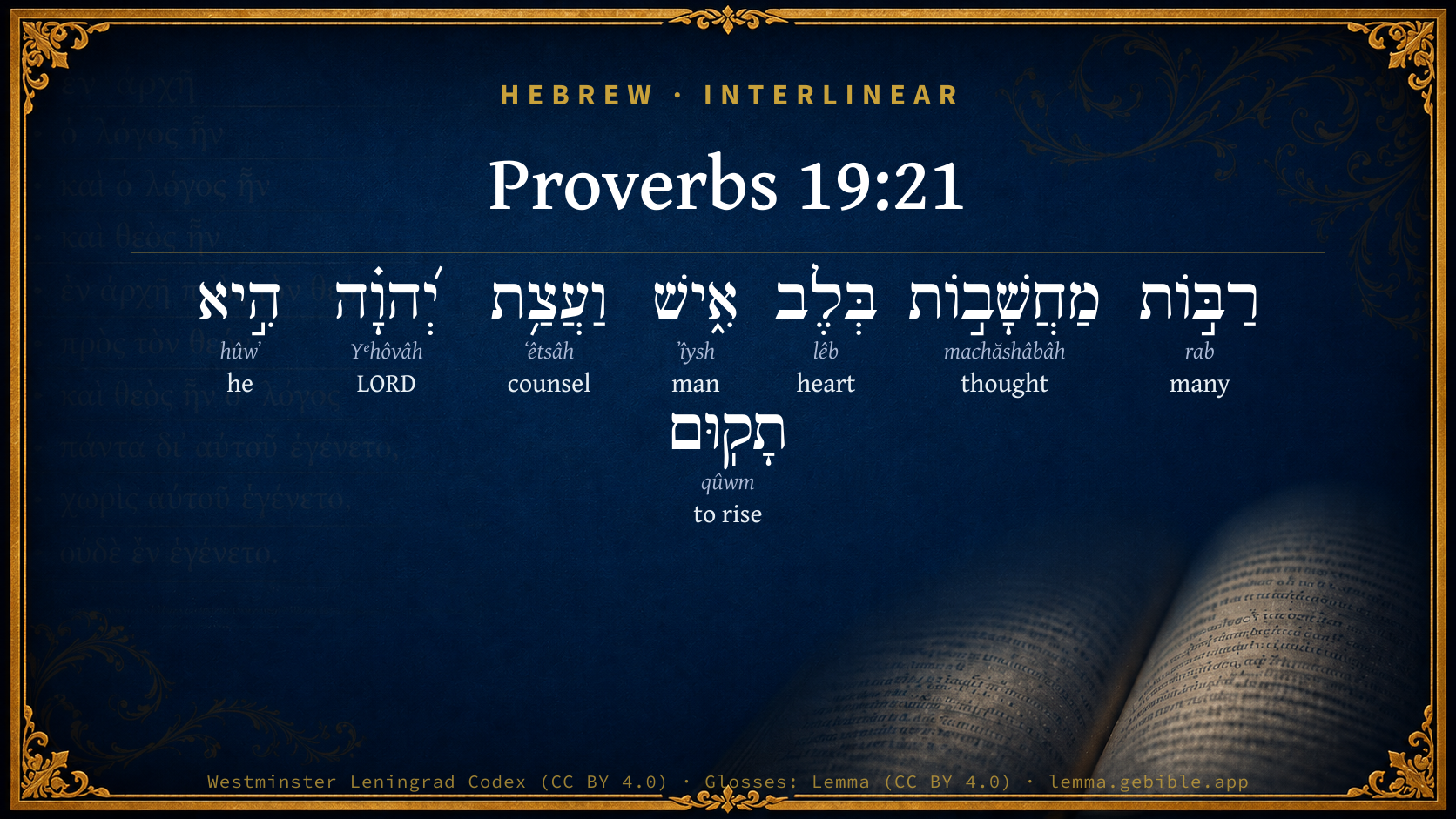
Hebrew (Westminster Leningrad Codex) Proverbs 19:21 appears in the Hebrew Old Testament. The text above is from the Westminster Leningrad Codex. Each word links to its Strong’s number, a concise gloss, and parsing drawn from the Open Scriptures Hebrew Bible morphology. Click any word for its full Brown-Driver-Briggs (BDB) entry.
Download image
Cite this verse

Proverbs 19:21 (World English Bible). Public Domain. Lemma interlinear Bible study tool, https://lemma.gebible.app/v/proverbs/19/21.

Show BibTeX & RIS
BibTeX
RIS
English Translation
There are many plans in a man's heart, But Yahweh's counsel will prevail.
World English Bible · Public Domain
Download a study sheet

One document with this verse’s original text, its word-by-word gloss line, the meaning frame, cross-references with their text, attributed commentary, and full source and license credits — printable, and it pastes into notes with its structure intact.

This verse Autodidact and up

Study sheet (.html) Plain text (.txt)

A passage Seminary Student

Up to 50 verses in one chapter. A passage sheet keeps up to 6 commentary sources and 12 cross-references per verse, in the order this page ranks them, and says so on the sheet whenever that leaves anything out. Ask for a single verse and you get the Autodidact verse sheet above.

Everything on this page stays free to read, with no account — the sheet is a download of what is already on screen, not access to it.

Want to remove ads? Support Godless Engineer
Compare translations 3

The same verse in 3 English versions, stacked beneath the original-language interlinear above. Click any original word for its lexicon entry.

Each is an independent rendering of the whole verse — the interlinear is not word-aligned to these translations.

Highlighted words mark where these versions differ — a whole-verse word diff, not a word-by-word alignment.

  • World English Bible Public Domain
    There are many plans in a man's heart, But Yahweh's counsel will prevail.
  • King James Version Public Domain
    There are many devices in a man's heart; nevertheless the counsel of the LORD, that shall stand.
  • unfoldingWord Literal Text CC BY-SA 4.0
    Many the plans in the heart of a man, but the counsel of Yahweh, it will stand.

unfoldingWord Literal Text — © unfoldingWord, licensed CC BY-SA 4.0. Word-aligned USFM3 via Door43 (git.door43.org/unfoldingWord/en_ult).

Versions to compare (up to 4)

3 of 4 selected

Show all 18 translations

Every available English version of this verse, each an independent rendering of the whole verse.

  • World English Bible Public Domain
    There are many plans in a man's heart, But Yahweh's counsel will prevail.
  • Berean Standard Bible Public Domain
    Many plans are in a man’s heart, but the purpose of the LORD will prevail.
  • Majority Standard Bible Public Domain
    Many plans are in a man’s heart, but the purpose of the LORD will prevail.
  • King James Version Public Domain
    There are many devices in a man's heart; nevertheless the counsel of the LORD, that shall stand.
  • American Standard Version (1901) Public Domain
    There are many devices in a man's heart; But the counsel of Jehovah, that shall stand.
  • Revised Version (1885) Public Domain
    There are many devices in a man’s heart; but the counsel of the LORD, that shall stand.
  • Geneva Bible (1599) Public Domain
    Many deuises are in a mans heart: but the counsell of the Lord shall stand.
  • Douay-Rheims (1899) Public Domain
    There are many thoughts in the heart of a man: but the will of the Lord shall stand firm.
  • Young's Literal Translation Public Domain
    Many `are' the purposes in a man's heart, And the counsel of Jehovah it standeth.
  • Literal Standard Version CC BY-SA 4.0
    The purposes in a man’s heart [are] many, || And the counsel of YHWH—it stands.
  • Unlocked Literal Bible CC BY-SA 4.0
    Many are the plans in a person's heart, but it is the purpose of Yahweh that will stand.
  • unfoldingWord Literal Text CC BY-SA 4.0
    Many the plans in the heart of a man, but the counsel of Yahweh, it will stand.
  • Darby Bible Public Domain
    Many are the thoughts in a man's heart, but the counsel of Jehovah, that doth stand.
  • World Messianic Bible Public Domain
    There are many plans in a man’s heart, but the LORD’s counsel will prevail.
  • Webster's Bible Public Domain
    There are many devices in a man's heart; nevertheless the counsel of the LORD, that shall stand.
  • Free Bible Version CC BY-SA 4.0
    Human beings make many plans in their minds, but the final decision is the Lord's.
  • Bible in Basic English Public Domain
    A man's heart may be full of designs, but the purpose of the Lord is unchanging.
  • JPS Tanakh (1917) Public Domain
    There are many devices in a man's heart; but the counsel of the LORD, that shall stand.

Literal Standard Version (2020), Covenant Press — licensed CC BY-SA 4.0. Text via the HelloAO Bible API (eBible.org). Unlocked Literal Bible (unfoldingWord) — licensed CC BY-SA 4.0. Text via the HelloAO Bible API (eBible.org). unfoldingWord Literal Text — © unfoldingWord, licensed CC BY-SA 4.0. Word-aligned USFM3 via Door43 (git.door43.org/unfoldingWord/en_ult). Free Bible Version, Dr. Jonathan Gallagher — licensed CC BY-SA 4.0. Text via the HelloAO Bible API (eBible.org).

Word by word

More ways to search: Search by grammar → Find every occurrence → Compare this word →

Practice this passage: Drill this verse → Learn its vocabulary →

About this verse

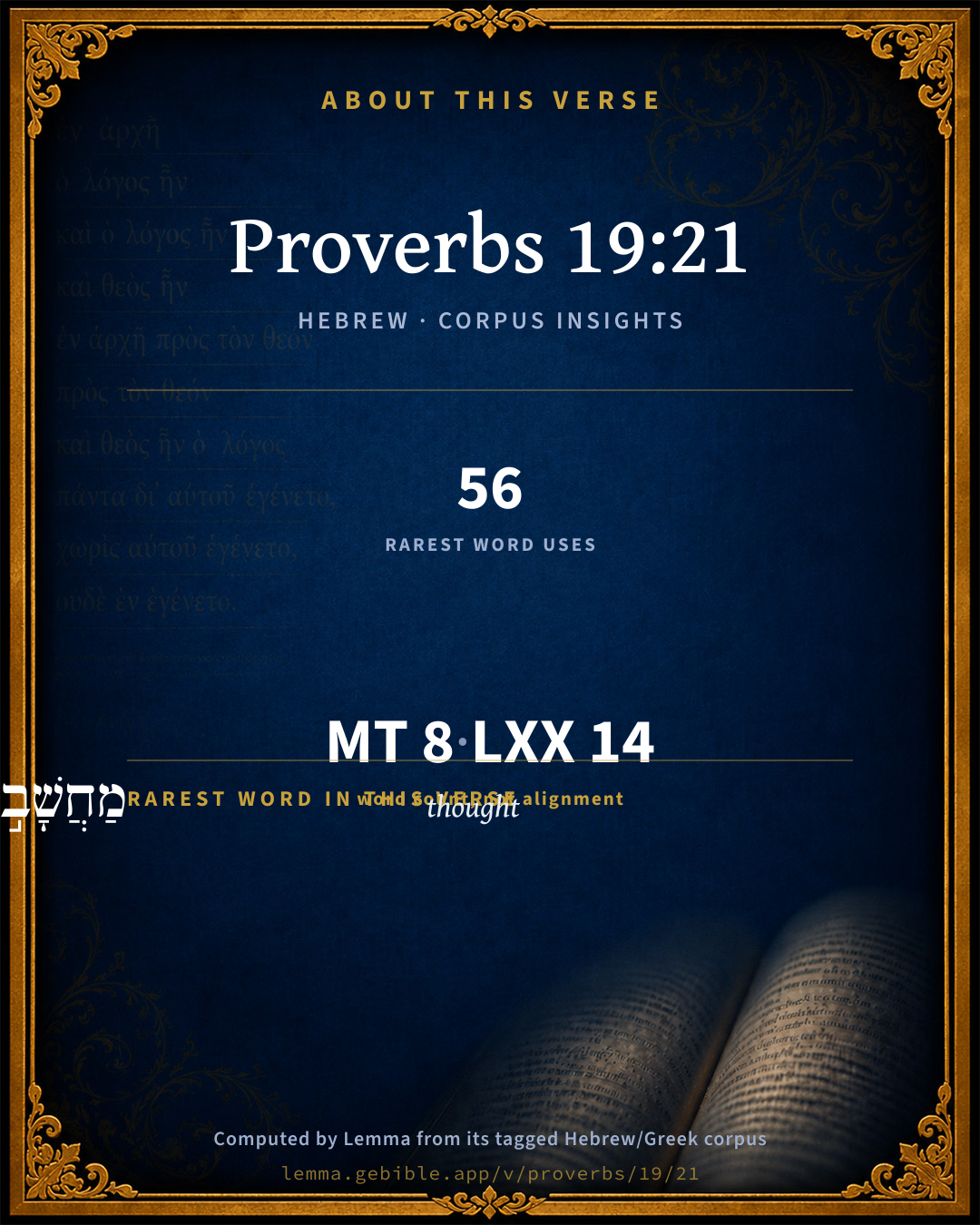
These counts appear in no published source. They are computed here, from the morphology-tagged text and Lemma’s own curated glosses. What Lemma adds →

8
words
8
distinct lemmas
Wisdom
section

Shared distinctive vocabulary

מַחֲשָׁב֣וֹת thought H4284 occurs in 52 verses of the Hebrew Bible. Also found in:

Grammatical profile

  • 1 verb
  • 5 nouns
  • 1 adjective
  • 1 pronoun

Verb forms

  • תָקֽוּם Qal · Imperfect

Hebrew & Septuagint length

In English translation the verse runs 13 words from the Hebrew and 17 from the Septuagint (LXX English) — closely comparable.

A rough comparison of the two English renderings, which tokenize alike — not a word-level alignment.

Word counts can differ between the Hebrew and the Greek without any difference in meaning — e.g. the Hebrew direct-object marker אֵת has no separate Greek word, and Greek often adds the article ὁ.

In the original languages it is 8 Hebrew tokens and 14 Greek tokens — but the two are counted differently (Hebrew bundles its prefixes and suffixes into one token; the Greek is in lemma form), so that isn’t a like-for-like length.

Cross-references

28

Topical passages linked to Proverbs 19:21 in the Treasury of Scripture Knowledge — connected by theme and wording, ordered by reader-vote popularity; previews shown in the World English Bible.

  • Proverbs 16:9 A man's heart plans his course, But Yahweh directs his steps.
  • Isaiah 14:24 Yahweh of Hosts has sworn, saying, Surely, as I have thought, so shall it happen; and as I have purposed, so shall it stand:
  • Proverbs 16:1 The plans of the heart belong to man, But the answer of the tongue is from Yahweh.
  • Psalms 33:10–11 Yahweh brings the counsel of the nations to nothing. He makes the thoughts of the peoples to be of no effect.
  • Isaiah 46:10 declaring the end from the beginning, and from ancient times things that are not [yet] done; saying, My counsel shall stand, and I will do all my pleasure;
  • Proverbs 21:30 There is no wisdom nor understanding Nor counsel against Yahweh.
  • Ephesians 1:11 in whom also we were assigned an inheritance, having been foreordained according to the purpose of him who works all things after the counsel of his will;
  • Job 23:13 But he stands alone, and who can oppose him? What his soul desires, even that he does.
  • Isaiah 14:26–27 This is the purpose that is purposed on the whole earth; and this is the hand that is stretched out on all the nations.
  • Proverbs 21:1 The king's heart is in Yahweh's hand like the watercourses. He turns it wherever he desires.
  • Acts 5:38–39 Now I tell you, withdraw from these men, and leave them alone. For if this counsel or this work is of men, it will be overthrown.
  • Daniel 4:35 All the inhabitants of the earth are reputed as nothing; and he does according to his will in the army of heaven, and among the inhabitants of the earth; and none can stay his hand, or tell him, What do you?
  • Psalms 21:11 For they intended evil against you. They plotted evil against you which cannot succeed.
  • Acts 4:27–28 For truly, in this city against your holy servant, Jesus, whom you anointed, both Herod and Pontius Pilate, with the Gentiles and the people of Israel, were gathered together
  • Ecclesiastes 7:29 Behold, this only have I found: that God made man upright; but they search for many schemes.
  • 1 Peter 2:8 and, "A stone of stumbling, and a rock of offense." For they stumble at the word, being disobedient, whereunto also they were appointed.
  • Genesis 45:4–8 Joseph said to his brothers, "Come near to me, please." They came near. "He said, I am Joseph, your brother, whom you sold into Egypt.
  • Genesis 50:20 As for you, you meant evil against me, but God meant it for good, to bring to pass, as it is this day, to save many people alive.
  • Matthew 27:63–64 saying, "Sir, we remember what that deceiver said while he was still alive: 'After three days I will rise again.'
  • Proverbs 12:2 A good man shall obtain favor from Yahweh, But he will condemn a man of wicked devices.
  • Jude 1:4 For there are certain men who crept in secretly, even those who were long ago written about for this condemnation: ungodly men, turning the grace of our God into lasciviousness, and denying our only Master, God, and Lord, Jesus Christ.
  • Isaiah 7:6–7 "Let's go up against Judah, and tear it apart, and let's divide it among ourselves, and set up a king in the midst of it, even the son of Tabeel."
  • Esther 9:25 but when [the matter] came before the king, he commanded by letters that his wicked device, which he had devised against the Jews, should return on his own head, and that he and his sons should be hanged on the gallows.
  • Daniel 11:24–25 In time of security shall he come even on the fattest places of the province; and he shall do that which his fathers have not done, nor his fathers' fathers; he shall scatter among them prey, and spoil, and substance: yes, he shall devise his devices against the strongholds, even for a time.
  • Matthew 26:4–5 They took counsel together that they might take Jesus by deceit, and kill him.
  • Hebrews 6:17–18 In this way God, being determined to show more abundantly to the heirs of the promise the immutability of his counsel, interposed with an oath;
  • Psalms 83:4 "Come," they say, "and let's destroy them as a nation, That the name of Israel may be remembered no more."
  • Genesis 37:19–20 They said one to another, "Behold, this dreamer comes.

Cross-references courtesy of OpenBible.info (CC BY 4.0).

Hebrew and Greek witnesses Masoretic Hebrew ↔ Greek Septuagint

The same verse in the two great witnesses to the Old Testament, shown verse-for-verse.

These are two independent witnesses, not word-aligned to each other, and the Septuagint is shown in lemma (dictionary) form.

Hebrew Proverbs 19:21 Masoretic · Westminster Leningrad Codex

רַבּ֣וֹת מַחֲשָׁב֣וֹת בְּלֶב אִ֑ישׁ וַעֲצַ֥ת יְ֝הוָ֗ה הִ֣יא תָקֽוּם

There are many plans in a man's heart, But Yahweh's counsel will prevail.

World English Bible · Public Domain

Greek LXX Proverbs 19:21 Septuagint · lemma form

πολύς λογισμός ἐν καρδία ἀνήρ ὁ δέ βουλή ὁ κύριος εἰς ὁ αἰών μένω

There are many thoughts in a man's heart; but the counsel of the Lord abides for ever.

LXX2012 (modern English Septuagint) · Public Domain

On this verse, The Pulpit Commentary discusses the Septuagint’s reading. Read the note in Commentary ↓

Hebrew: Westminster Leningrad Codex (CC BY 4.0). Greek: Septuagint (public domain); English from LXX2012 (modern English Septuagint) (Public Domain). How the Septuagint differs from the Hebrew →

Commentary

Notes on Proverbs 19:21 from classic Christian and Jewish commentators (each source and its license shown beneath its notes). The classic Christian expositions comment on the surrounding passage and are grouped to its opening verse, so a note may address several verses; the Jewish commentaries on the Tanakh (Rashi and others) are per-verse, so they appear only where the commentator wrote on this verse.

Lemma curates 59 commentaries, every one of them public domain or Creative Commons licensed, each selected and text-cleaned for this edition rather than reprinted as found. About our sources →

Trapp's Complete Commentary

John Trapp

Pro 19:21 [There are] many devices in a man’s heart; nevertheless the counsel of the LORD, that shall stand.

Ver. 21. There are many devices in a man’s heart.] They may purpose, but God alone disposeth of all. {See Trapp on "Pro 16:1"} {See Trapp on "Pro 16:9"} Some think to rise by ill principles, but it will not be. Some to be rich, but God crosseth them, and holds them to prisoners’ pittances, to hard meat, as we say. Some, to live long, and to enjoy what they have gotten: but they hear, "Thou fool, this very night shall thy soul be taken from thee." {Luk 12:20} Some set themselves to root out true religion, to dethrone the Lord Christ. But God sees and smiles, looks and laughs. {Psa 2:4} The counsel of the Lord, that shall stand when all is done. Christ shall reign in the midst of his enemies: the stone cut out of the mountains without hands shall bring down the golden image with a vengeance, and make it "like the chaff of the summer floor." {Dan 2:35} Sciat Celsitudo vestra et nihil dubitet - saith Luther in a letter to the Elector of Saxony - longe aliter in coelo quam Noribergae de hoc negotio conclusum esse. {a} Let your highness be sure that the Church’s business is far otherwise ordered in heaven, than it is by the emperor and states at Norimberg. And Gaudeo quod Christus Dominus est; alioqui totus desperassem, - I am glad that Christ is King; for otherwise I had been utterly out of heart and hope - saith holy Myconius in a letter to Calvin, upon the view of the Church’s enemies.

{a} Scult., Annal

John Trapp, A Commentary or Exposition upon All the Books of the Old and New Testament (1647–1656) — public domain. Text from a community e-Sword module.

The Biblical Illustrator

Joseph S. Exell

Pro_19:21

There are many devices in a mans heart; nevertheless, the counsel of the Lord, that shall stand.

Devices and counsel

It being impossible for us to know God absolutely, the highest degree of knowledge we can hope to attain unto is by way of comparison with ourselves and other creatures. But because we fail in right knowledge of ourselves, we fail also in right knowledge of God. We think God is altogether such an one as ourselves, and yet we do not know what we ourselves are. The subject introduced by this text is, the difference between the devices of a man and the counsel of the Lord.

I. The differences.

1. In the names. Devices, imaginations, fancies, chimaeras, castles in the air. The vanity of mens fancies is seen in our ordinary dreams. The name of devices is too high an appellation to bestow upon our vain imaginations, if we knew a worse; so the name of counsel is too low to bestow upon God Almightys eternal purpose, if we knew a better.

2. In the number. Ours are devices--in the plural; His but one--counsel in the singular. Mens purposes are various and changeable. It is the honour of God that His counsel is but one, and unchangeable. The immutability of His counsel. With God there is no after-counsel, to correct the errors of the former.

3. The efficacy. Seen in their different manner of existing. The devices of man are in his heart, but he cannot make them stand. The counsel of the Lord shall stand; nothing can hinder it from having its intended effect. The foundation of God standeth firm.

II. The reasons for these differences.

1. God is the prima causa, the sovereign agent, and first mover in every motion and inclination of the creature. God so orders the vain things of mans devices by His overruling providence as to make them subservient to His everlasting counsels.

2. Gods eternity. Man is but of yesterday, and his thoughts casual. As himself is mutable, fickle, and uncertain, so are the things he hath to do with subject to contingencies and variations. But the nature of the Godhead is not subject to mutability. All change is either for the better or for the worse, but God cannot change for the better, because He is already best; nor for the worse, for then He should cease to be best.

3. The wisdom of God. Besides their natural ignorance, through precipitancy, misinformation, prejudice, partial affections, and other causes, they are subject to very many mistakes and aberrations. God alone is wise. He will not deceive, being of infinite goodness; He cannot be deceived by any, being of infinite wisdom. There is no room for second thoughts or after-counsels.

4. The power of God. It is not in the power of man to remove those obstacles which prevent his accomplishing his devices, but the power of God has no bars or bounds other than those of His own will.

III. The inferences.

1. Learn not to trust too much to our own wit; neither to lean to our own understandings; nor to please ourselves over-much in the vain devices, imaginations, fancies, and dreams of our own hearts.

2. However judgment may begin at the house of God, most certain it is that it shall not end there.

3. This is a comfortable consideration to all those that with patience and cheerfulness suffer for the testimony of God, or a good conscience, and in a good cause, under the insolences of proud and powerful persecutors. God can curb and restrain their malice, when they have devised wicked devices.

4. It is well for us, and our bounden duty, to submit to such sufferings as God shall call us to. Give up thyself faithfully to follow the good counsel of God in His revealed will; and then give up thy desires entirely, to be disposed by His wise counsel in His secret will; and He shall undoubtedly give thee thy hearts desire. If we submit our wills to His, both in doing and suffering, doubtless we cannot finally miscarry. He will consult nothing but for our good; and what He hath consulted must stand. (Bp. Sanderson.)

Mans devices and Gods counsel

;--A mans heart is a little world, full of scheming and business. Let a man have a full inspection of his heart, its devices, its schemes, its designs, in their succession. Notice the variety in the kinds of devices, and in mens temper and manner in respect to them. Some men are very communicative of their hearts devices; others are close, reserved, dark. Suppose that all the devices of all men could be brought out, in full manifestation, then you would have human nature displayed in its real quality. What manner of spectacle would it be! Suppose that all these devices could be accomplished. What a world you have then! One mans devices cannot be accomplished compatibly with the accomplishments of anothers. The great collective whole of the devices of all hearts constitutes the grand complex scheme of the human race for their happiness. To every device of all hearts, Gods counsel, His design, exists parallel, whether in coincidence or in opposition. In other words, respecting the object of every device, He has His design. The text implies a great disconformity--a want of coalescence between the designs of man and God; an estranged spirit of design on the part of man.

I. The designs of mens hearts are formed independently of God. In what proportion of mens internal devisings may we conjecture that there is any real acknowledgment of God? Mans devising and prosecuting are in such a spirit as if there were no such thing as Providence to aid or defeat. It is deplorable to see dependent, frail, short-sighted creatures confidently taking on themselves the counsel, execution, and hazard of their schemes for being happy, in the very presence, and as in contempt, of the all-wise and almighty Director.

II. Mans heart entertains many devices in contrariety to God. It can cherish devices which involve a rebellious emotion of displeasure, almost resentment, that there is a Sovereign Lord, whose counsel shall stand. There is one other Mind, which has the knowledge and command of all things, a fixed design, respecting them all, paramount to all designs and devices. The counsel of the Lord sometimes is, not to prevent mans designs taking effect in the first instance. He can let men bring their iniquitous purposes into effect, and then seize that very effect, reverse its principle of agency, and make it produce immense, unintended good. But in other cases God directly frustrates them. Some devise to oppose religion; others to baffle the practical measures taken for promoting religion; others strive to get rid of the strictness of the laws of God. There are also many projects for temporal gomod, ade in a right spirit, which nevertheless are disappointed and fail, so that we have humbly and complacently to repose in the determination of our God as to what is best. (John Foster.)

The decrees of God, or impressive impressions

The Westminster divines say, The decrees of God are His eternal purpose, according to the counsel of His will, whereby for His own glory He hath foreordained whatsoever comes to pass. This embraces three propositions.

I. There are decrees of God. God must have formed a plan by which to conduct all His operations. God knows the arrangements upon the accomplishment of which He has determined. The word decree is of the same meaning as the word determine.

II. The decrees of God are all involved in one eternal purpose. All the future, and everything included in all the future, is at once and for ever before the glance of His eye.

III. The decrees of God were all formed according to the counsel of His will. Who can comprehend all that the counsel of His will embraced as to things decreed to exist?

IV. The decrees of God take effect in everything that comes to pass. This has its illustration in--

1. Gods works of creation.

2. Gods works of providence.

3. Gods works of grace.

Objections to this explanation of the decrees of God may be taken.

(1) Some say that this doctrine annihilates mans responsibility.

(2) Some say, Then if we are to be saved, we shall be saved; and if to be lost, lost.

But this is a gross perversion of gospel truth. The means, through the appointed use of which eternal life may be obtained, should be diligently and unweariedly cultivated. (Thomas Adam.)

The devices of man and the counsel of God

Two parts in this text--the proposition and the qualification.

I. The proposition.

1. The property mentioned. Many devices; by which we may understand conceits or contrivances. Man by nature is very apt and prone to these, whether in matter of apprehension or resolution. Reference here is specially to vain and foolish, or wicked and sinful, devices, which man easily frames, since he voluntarily and wilfully forsook the counsel of God. The variety of mans devices from the impetuousness and unsatiableness which is commonly in mens desires; from the levity and inconstancy which is upon mens souls; from a variety of lusts, and corrupt and inordinate principles, with which the heart of man is cumbered.

2. The subject of this property, man, and precisely, the heart of man. Devices seem to belong to the head rather than to the heart. The heart is here put for the whole mind and soul. The devices are in the heart originally, as the spring and fountain of all. Mens opinions and conceits take their rise first from their heart.

II. The qualification.

1. The simple assertion. The counsel of God may be the Word and truth of God, or the purpose and decree of God.

2. The additional opposition or correction of it. Nevertheless. Here is the consistence of Gods counsels with mans. Though man has his devices, God will have His. Because man has his devices, therefore God the Father has His. His counsel is even promoted by mans devices. (T. Horton, D. D.)

Mans devices and Gods overrulings

I. Men projecting. They keep their designs to themselves, but they cannot hide them from God. There are devices against Gods counsels, without His counsels, and unlike His counsels. Men are wavering in their devices, and often absurd and unjust; but Gods counsels are wise and holy, steady and uniform.

II. God overruling. His counsel often breaks mens measures, and baffles their devices; but their devices cannot in the least alter His counsel, nor disturb the proceedings of it, nor put Him upon new counsels. What a check does this put on designing men, who think they can outwit all mankind! There is a.God in heaven who laughs at them! (Psa_2:4). (Matthew Henry.)

Human devices

I. The devices of mens hearts. The heart of man is a little world of scheming, and planning, and business. We are always devising.

II. The vanity of these devices. Our safety consists in their being kept in. They could not be suffered to come forth but at the expense of the ruin of the world. They cannot all be accomplished, because they oppose each other.

III. The counsel of the Lord overruling these devices. Amidst all these various devices, there is one mighty will going on. All human devices serve Gods counsel. Therefore we should seek to have our devices in principle compatible with Gods counsel. (The Evangelist.)

The mind of man and the mind of God

I. The mind of man has many devices; the mind of God has but one counsel.

II. The mind of man is subordinate, the mind of God supreme.

1. This is a fact well attested by history.

2. This is a fact that reveals the greatness of God.

III. The mind of man is changeable, the mind of God unalterable. Lessons:

1. The inevitable fall of all that is opposed to the will of God.

2. The inevitable fulfilment of all Gods promises. (D. Thomas, D. D.)

The Biblical Illustrator, edited by Joseph S. Exell (c. 1880s–1900s) — public domain. Text from a community e-Sword module.

Joseph Benson's Commentary

Pro 19:21. There are many devices in a man’s heart — Which shall not stand, but be disappointed; many designs and contrivances, which he thinks to be so well devised and planned that they cannot miscarry. Nevertheless, the counsel of the Lord — Which ofttimes contradicts, and therefore overrules or defeats the designs and purposes of men; that shall stand — Shall certainly be fulfilled, and bring to pass whatever he pleases.

Joseph Benson's Commentary on the Old and New Testaments (1811–1818) — public domain. Text from a community e-Sword module.

The Preacher's Complete Homiletical Commentary

Joseph S. Exell (gen. ed.)

MAIN HOMILETICS OF Pro_19:21

MANY PLANS WORKING TO ONE END

This proverb suggests—

I. The ignorance and sinfulness of man, the infinite knowledge and goodness of God. Man is a creature of many devices; he is changeable in his purposes and plans because he is so ignorant concerning their issue. He cannot foretel with any certainty whether the event will be according to his desire, or, if it should be so, whether it will bring him satisfaction. Hence the purpose of to-day is not the purpose of next year—the plans of his youth are different from those of his riper years. But God is the same in His purposes yesterday, to-day, and for ever, because He can “declare the end from the beginning, and from ancient times the things that are not yet done” (Isa_46:10). A man’s devices change in proportion as his feelings and desires vary; and these are changeable in proportion as he lacks perfection in his moral nature. But a Being of infinite goodness is not subject to these changing moods and desires: and His plans are like His character, always the same.

II. The attitude which men ought to take in relation to this truth. It is obvious that the counsel of God must stand, and that it deserves to stand before all the devices of men. If, therefore, men would have their devices stand they must learn to square them by the counsel of God. A child will have its own way when it has learned to conform its will to the will of its parent. And if a man would have his “heart’s desire,” he must so “delight in God” (Psa_37:4) that what pleases God pleases him also. For other Homiletics on this subject see on chap. Pro_16:1; Pro_16:9, pp. 451, 468.

OUTLINES AND SUGGESTIVE COMMENTS

The great collective whole of the “devices” of all hearts constitutes the grand complex scheme of the human race for their happiness. Respecting the object of every device, God has His design. There is in the world a want of coalescence between the designs of man and God—an estranged spirit of design on the part of man. God’s design is fixed and paramount.—J. Foster.

A man of the better sort. This is simply one of the names for man. We do not always translate it one of the better sort. But it is rarely chosen listlessly. Here it creates an emphasis. The most imposing “schemes” belong to the intelligent and great. The world is full of them. How foolish to build them up! Jehovah advises a whole new behaviour for His creatures. How mad to scheme away from it.—Miller.

The Preacher's Complete Homiletical Commentary (gen. ed. Joseph S. Exell; Funk & Wagnalls, c. 1892) — public domain (pre-1929). A full-Bible homiletical/sermon-outline anthology covering 65 of 66 books (2 John is absent from the source module). Text from a community e-Sword module.

Geneva Bible (1599)

Geneva Bible translators

Man’s device shall not have success, except God govern it, whose purpose is unchangeable.

Geneva Bible (1599) marginal notes — public domain. Text via Bolls.life.

Matthew Henry's Commentary

Here we have, 1. Men projecting. They keep their designs to themselves, but they cannot hide them from God; he knows the many devices that are in men's hearts, - devices against his counsels (as those, Psa 2:1-3; Mic 4:11), - devices without his counsel (no regard had to his providence, as those Jam 4:13, this and the other they will do, and not take God along with them), - devices unlike God's counsels; men are wavering in their devices, and often absurd and unjust, but God's counsels are wise and holy, steady and uniform. 2. God overruling. Various men have various designs, according as their inclination or interest leads them, but the counsel of the Lord, that shall stand, whatever becomes of the devices of men. His counsel often breaks men's measures and baffles their devices; but their devices cannot in the least alter his counsel, not disturb the proceedings of it, nor put him upon new counsels, Isa 14:24; Isa 46:11. What a check does this give to politic designing men, who think they can outwit all mankind, that there is a God in heaven that laughs at them! Psa 2:4. What comfort does this speak to all God's people, that all God's purposes, which we are sure are right and good, shall be accomplished in due time!

Matthew Henry's Commentary on the Whole Bible (1708–1710) — public domain (CC PDM 1.0). Text via the HelloAO Bible API.

Jamieson, Fausset & Brown

Robert Jamieson, A. R. Fausset & David Brown

(Compare Pro 16:1, Pro 16:9; Psa 33:10-11). The failure of man's devices is implied.

Jamieson, Fausset & Brown — Commentary Critical and Explanatory on the Whole Bible (1871) — public domain (CC PDM 1.0). Text via the HelloAO Bible API.

Adam Clarke's Commentary

Verse 21. There are many devices, &c.] The same sentiment as in Pr 16:1, where see the note. See Clarke on Pr 16:1.

Adam Clarke's Commentary on the Bible (1810–1826) — public domain. Text from a community e-Sword/MySword module.

Ellicott's Commentary for English Readers

(21) There are many devices (or, thoughts) in a man’s heart.—“He disquieteth himself in vain” (Psa_39:6), endeavouring to carry out his various plans in life, while the one unchangeable “counsel of the Lord,” that shall stand—i.e., abide in all its fulness. (Comp, Isa_46:10-11; Psa_33:11; Job_23:13.)

A Bible Commentary for English Readers, edited by Charles John Ellicott (1878–1897) — public domain. Text from a community e-Sword module.

John Gill's Exposition

There are many devices in a man's heart,.... Some about civil things; to get wealth and riches: to obtain honour and glory among men; to attain to a long life, and to perpetuate their memories after death: some about sinful things; to gratify their carnal lusts and sensual appetites; and to do mischief to others, particularly the people of God, and the cause and interest of Christ: some about religious things; coming new doctrines, devising new ordinances and modes of worship; contriving other methods of salvation than by Christ; as by the light of nature; by the law of Moses; by mere morality, civility, and external justice between man and man; by keeping to the religion they were born and brought up in; and by a mere outward profession of religion, and submission to ordinances, and performance of duties, and a multitude more of the like kind;

nevertheless, the counsel of the Lord, that shall stand; and can never be frustrated by the devices of man's heart, though there are many, and that but one; see Psa 33:10. This may be applied to the Gospel, and the scheme of salvation in it, called the whole counsel of God, Act 20:27; it being the fruit of infinite wisdom, and the effect of a divine council between the eternal Three, and full of the best advice and instructions to the sons of men; and which has stood, and shall stand, notwithstanding the persecutions of wicked men, the craft of false teachers, and the ridicule of a profane world; it will continue till all the elect are gathered in, even, to the end of the world; and so will the ordinances of it, which are also called the counsel of God, Luk 7:30; and which will continue till the second coming of Christ. Moreover, the purposes of God, his counsels of old, or his eternal decrees, may be here meant; which are wisely formed in his own breast, and are not frustrable; and according to which counsel of his will all things are done in nature, providence, and grace; all things in this world are ordered as he pleases, and all things are done as he has ordered them; all his purposes are or will be fulfilled; his designs will be accomplished in the world and in his church, in spite of all the schemes, contrivances, and opposition of men and devils.

John Gill's Exposition of the Whole Bible (1746–1763) — public domain (CC PDM 1.0). Text via the HelloAO Bible API.

Albert Barnes' Notes on the Bible

Contrast the many purposes of man, shifting, changing, from good to better, from bad to worse, and the one unchanging righteous “counsel” of Yahweh.

Albert Barnes' Notes on the Bible (1834–1885) — public domain. Text from a community e-Sword/MySword module.

Haydock's Catholic Bible Commentary

Firm. Ignorance and weakness cause men to change.

George Leo Haydock (1774–1849), Haydock's Catholic Family Bible and Commentary, 1859 edition — public domain. Excludes Psalms (Douay-Rheims chapter numbering differs from Protestant) and Deuterocanonical books (Catholic canon only).

Matthew Poole's English Annotations

There are many devices in a man’s heart; understand out of the opposite clause, which shall not stand, but be disappointed.

The counsel of the Lord; his eternal, and unchangeable, and most wise decree, which ofttimes contradicts, and always overrules, the designs and purposes of men.

Shall stand, i.e. be certainly fulfilled, as this phrase is used, Jer 44:28,29, and elsewhere.

Matthew Poole's English Annotations on the Holy Bible (1683–1685) — public domain. Text from a community e-Sword/MySword module.

Whedon's Commentary on the Bible

Daniel D. Whedon

21. Are many devices — Schemes, plans. Compare note on Pro_16:1-9. Job_23:13; Psa_33:10.

Daniel D. Whedon (gen. ed.), Commentary on the Old and New Testaments (1874–1909) — public domain. Text from a community e-Sword module.

The Pulpit Commentary

The immutability of the counsel of God is contrasted with the shifting, fluctuating purposes of man. (comp. Pro_16:1, 9 Num_23:19 Mal_3:6) Aben Ezra connects this verse with the preceding, as though it gave the reason for the advice contained therein. But it is most natural to take the maxim in a general sense, as above RAPC Wis 9:14, "The thoughts of mortal men are miserable, and our devices are but uncertain." The counsel of the Lord, that shall stand; permanebit, Vulgate; eiv to , "shall abide forever," Septuagint. (Psa_33:11)

The mind of man and the mind of God.

Here is a contrast which we do well to consider. Between our human spiritual nature and that of the Divine Spirit it is possible to find resemblances and contrasts. Both are interesting and instructive.

I THE THOUGHTS OF MAN"S MIND. We know how fugitive these are; how they come and go like the flash of the lightning; and even those which linger are but short-lived, they soon give place to others. Even those thoughts which become "fixed," which settle down into plans and purposes, have but a brief tenure in our brain; they, too, pass away and make room for others in their turn. Our thoughts are:

1. Fluctuating and therefore many. We care for one pleasure, we pursue one object now; but in a few weeks, or even days, we may weary of the one, we may be compelled to turn our attention from the other.

2. Feeble and therefore many. We propose and adopt one method, but it fails; and then we try another, and that fails; then we resort to a third, which also fails. We pass from thought to thought, from plan to plan; our very feebleness accounting for the manifoldness of our devices.

3. False and therefore many. We hold certain theories today; tomorrow they will be exploded, and we shall entertain another; before long that will yield to a third.

4. Sinful and therefore many. Nothing that is wrong can last; it must be dethroned, because it is evil, immoral, guilty.

5. Selfish and therefore many. We are concerning ourselves supremely about our own affairs or those of our family; but these are passing interests, changing with the flitting hours.

II THE THOUGHTS WHICH ARE IN THE MIND OF GOD. His counsel stands (text). "The counsel of the Lord standeth forever, the thoughts of his heart to all generations". (Psa_33:11) God"s purpose holds from age to age. For:

1. He rules in righteousness. He is governing the world by Divine and unchanging principles. "With him is no variableness," because he ever loves what is righteous and hates what is unholy and impure and unkind. He cannot change his course, because he cannot change his character.

2. He is working out one great beneficent conclusion. He is redeeming a lost world, reconciling it unto himself, uprooting the multiform sources of wrong and wretchedness, establishing the blessed kingdom of Christ, the kingdom of heaven on the earth.

3. He has ample time and power at his command; he has no need to change his plan, to resort to "devices." "His eternal thought moves on His undisturbed affairs;" and is working out a glorious consummation which nothing shall avail to avert.

4. His perfect wisdom makes quite unnecessary the adoption of any other course than that which he is employing.

(1) Steadfastness is one sign of wisdom. If we see a man or a Church perpetually changing its methods, we may be sure that it is weak.

(2) Let us make God"s great and holy purpose ours;

(a) for it is that with which our eternal interest is bound up;

(b) it is certain to be victorious.

5. Let us work on for our Lord and with him, in the calmness that becomes those who are confident of ultimate success. C.

The Pulpit Commentary (1880–1919), ed. H.D.M. Spence-Jones & Joseph S. Exell — public domain. Text from a community e-Sword module.

Bridges on Proverbs

Charles Bridges

Here is a fine contrast between man and God, setting out the just relative disproportion between the worm and his Maker. Man’s most serious, well-digested thoughts are only devices — imaginations — uncertainty — a poor nonentity. God’s mind is counsel,†1 firm and full purpose. Man’s devices are many; God’s counsel is like himself — Unity. Man’s devices are full of anxiety. Many are eventually fruitless.†2 All of them are vain.†3 God’s counsel is immutable, and shall stand for ever.†4 "I will work and who shall let it — My counsel shall stand, and I will do all my pleasure."†5

Now when God and man were at one, man’s devices were identified with God’s counsel. Then it was "as the days of heaven upon earth." But ever since the fall, man’s devices and God’s counsel are at opposite. Which will triumph, who can doubt? "There is no wisdom, nor understanding, nor counsel against the LORD." (Pro 21:30 . Heb 6:17 .)

We mark this conflict in every day’s life. Man’s own way is a way devised by human weakness and folly; and it is impossible to make a solid road out of such frail materials. Even in the most plausible path — a well-calculated moderation in their earthly projects, he is only preparing for himself certain disappointment, and increasing the certainty and perplexity of that disappointment by his every movement. He devises his whole way, when not a single step is under his own control; not one step can he take, for one moment in opposition to the LORD’s counsel. (Lam 3:37 .) That shall stand, though it may be reluctantly to give him up his own devices; still — even after he has left him — seem to send a longing, lingering look after him.†6 The malice of Joseph’s brethren was the means of fulfilling the Divine counsel in the salvation of his Church.†7 The plot laid for the destruction of Israel furthered their prosperity.†8 The vain attempts at opposition to Christ were subservient to the great end of "the determinate counsel and foreknowledge of God."†9 The device of man to prevent the Apostle’s journey to Rome was signally defeated.†10

How vain the impious attempt to "fight against God!"†11 "Woe unto him that striveth with his Maker!"†12 Our liberty does not interfere with his secret purpose. But let us be careful, that it does not resist his declared will. As his Providence chooses our lot, let his word discipline our desires, as the best means of bringing them to a prosperous issue. After all, it is a cheering hope. All is clear above, however cloudy it be below. All is calm in heaven, however stormy it may be on earth. There is no confusion there. One will alone reign. Every purpose reaches its appointed end. "He is of one mind, and who can turn him? And what his soul desireth, even that he doeth." (Job 23:13 .)

Footnotes:

†1 Eph 1:11.

†2 Psa 21:11.

†3 Psa 94:11.

†4 Psa 89:2; Psa 119:89 .

†5 Isa 43:13; Isa 46:10 .

†6 See Psa 81:11-14 .

†7 Gen 37:19; Gen 45:5-6 .

†8 Exo 1:8-12, Exo 1:20 .

†9 Psa 2:1-6, with Act 4:26-28 ; Act 2:23 .

†10 Act 23:12, Act 23:15, with Act 23:11 .

†11 Act 5:39.

†12 Isa 45:9.

Charles Bridges, An Exposition of the Book of Proverbs (1846) — public domain. Text from a community e-Sword module.

Kretzmann's Popular Commentary

Paul E. Kretzmann

v. 21. There are many devices in a man’s heart, he may have many ideas and plans; nevertheless, the counsel of the Lord, that shall stand; it is He who disposes, leading the affairs of all men according to His will.

Paul E. Kretzmann, Popular Commentary of the Bible (1921–1924) — public domain. Text from a community e-Sword module.

unfoldingWord translationNotes

Door43 World Missions Community

in a person's heart

Here the "heart" is used to refer to the "mind" to emphasize a person's desire. AT: "in a person's mind" or "that a person desires" (See: Metonymy)

the purpose of Yahweh

"Yahweh's purpose" or "Yahweh's plans"

that will stand

This idiom means to "happen." AT: "that will happen" (See: Idiom)

translationWords

heart

Yahweh

unfoldingWord translationNotes — © Distant Shores Media and the Door43 World Missions Community, licensed CC BY-SA 4.0. Source: git.door43.org/Door43/en_tn.

Lesson kit

Teaching starters — assembled from the data on this page, not authored interpretation. Every prompt links to the verse data it draws on. Edit before teaching.

Proverbs, in the Wisdom, opens this verse with 8 words (8 distinct Hebrew lemmas). Its most distinctive word is machăshâbâh (“thought”). A historical commentator’s framing appears above. Read the whole chapter for the surrounding context.

Discussion questions

  1. How does “thought” (machăshâbâh) shape what this verse is saying?
  2. Genesis 6:5 shares the word «thought» with this verse. How do the two illuminate each other?
  3. These translations render this verse differently. What is at stake in choosing one wording over another?
  4. The verb «תָקֽוּם» is Qal Imperfect. How does its form color the action?
  5. Reading how Trapp's Complete Commentary and The Biblical Illustrator read this verse, where do the two commentators agree and where do they part?

Things to notice

Reading settings

Reading text

Shown beneath each verse's original-language words.

Old Testament
Old Testament edition

Read the OT as the Masoretic Hebrew (MT) or the Greek Septuagint (LXX).

English shown for the Greek Septuagint (in the Hebrew ↔ Greek comparison).

Comparing translations? Open the Compare panel on any verse page to stack up to four side by side.