
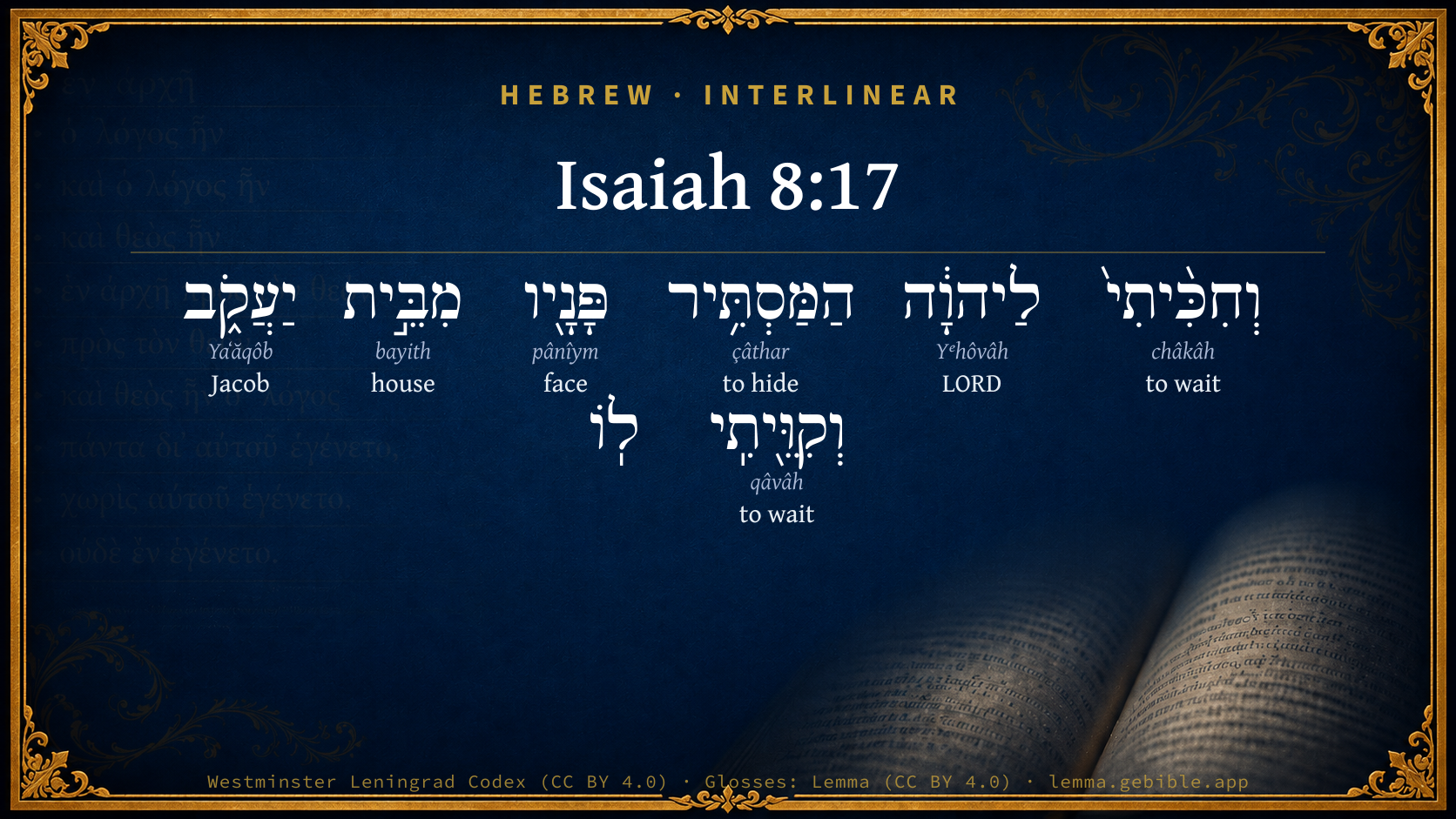
Isaiah 8:17

Hebrew (Westminster Leningrad Codex) Isaiah 8:17 appears in the Hebrew Old Testament. The text above is from the Westminster Leningrad Codex. Each word links to its Strong’s number, a concise gloss, and parsing drawn from the Open Scriptures Hebrew Bible morphology. Click any word for its full Brown-Driver-Briggs (BDB) entry.
Download image
Cite this verse

Isaiah 8:17 (World English Bible). Public Domain. Lemma interlinear Bible study tool, https://lemma.gebible.app/v/isaiah/8/17.

Show BibTeX & RIS
BibTeX
RIS
English Translation
I will wait for Yahweh, who hides his face from the house of Jacob, and I will look for him.
World English Bible · Public Domain
Download a study sheet

One document with this verse’s original text, its word-by-word gloss line, the meaning frame, cross-references with their text, attributed commentary, and full source and license credits — printable, and it pastes into notes with its structure intact.

This verse Autodidact and up

Study sheet (.html) Plain text (.txt)

A passage Seminary Student

Up to 50 verses in one chapter. A passage sheet keeps up to 6 commentary sources and 12 cross-references per verse, in the order this page ranks them, and says so on the sheet whenever that leaves anything out. Ask for a single verse and you get the Autodidact verse sheet above.

Everything on this page stays free to read, with no account — the sheet is a download of what is already on screen, not access to it.

Want to remove ads? Support Godless Engineer
Compare translations 3

The same verse in 3 English versions, stacked beneath the original-language interlinear above. Click any original word for its lexicon entry.

Each is an independent rendering of the whole verse — the interlinear is not word-aligned to these translations.

Highlighted words mark where these versions differ — a whole-verse word diff, not a word-by-word alignment.

  • World English Bible Public Domain
    I will wait for Yahweh, who hides his face from the house of Jacob, and I will look for him.
  • King James Version Public Domain
    And I will wait upon the LORD, that hideth his face from the house of Jacob, and I will look for him.
  • unfoldingWord Literal Text CC BY-SA 4.0
    And I will wait for Yahweh, the one hiding his face from the house of Jacob, and I will hope in him.

unfoldingWord Literal Text — © unfoldingWord, licensed CC BY-SA 4.0. Word-aligned USFM3 via Door43 (git.door43.org/unfoldingWord/en_ult).

Versions to compare (up to 4)

3 of 4 selected

Show all 18 translations

Every available English version of this verse, each an independent rendering of the whole verse.

  • World English Bible Public Domain
    I will wait for Yahweh, who hides his face from the house of Jacob, and I will look for him.
  • Berean Standard Bible Public Domain
    I will wait for the LORD, who is hiding His face from the house of Jacob. I will put my trust in Him.
  • Majority Standard Bible Public Domain
    I will wait for the LORD, who is hiding His face from the house of Jacob. I will put my trust in Him.
  • King James Version Public Domain
    And I will wait upon the LORD, that hideth his face from the house of Jacob, and I will look for him.
  • American Standard Version (1901) Public Domain
    And I will wait for Jehovah, that hideth his face from the house of Jacob, and I will look for him.
  • Revised Version (1885) Public Domain
    And I will wait for the LORD, that hideth his face from the house of Jacob, and I will look for him.
  • Geneva Bible (1599) Public Domain
    Therefore I will waite vpon the Lord that hath hid his face from the house of Iaakob, and I wil looke for him.
  • Douay-Rheims (1899) Public Domain
    And I will wait for the Lord, who hath hid his face from the house of Jacob, and I will look for him.
  • Young's Literal Translation Public Domain
    And I have waited for Jehovah, Who is hiding His face from the house of Jacob, And I have looked for Him.
  • Literal Standard Version CC BY-SA 4.0
    And I have waited for YHWH, || Who is hiding His face from the house of Jacob, || And I have looked for Him.
  • Unlocked Literal Bible CC BY-SA 4.0
    I will wait for Yahweh, who hides his face from the house of Jacob; I will trust in him.
  • unfoldingWord Literal Text CC BY-SA 4.0
    And I will wait for Yahweh, the one hiding his face from the house of Jacob, and I will hope in him.
  • Darby Bible Public Domain
    And I will wait for Jehovah, who hideth his face from the house of Jacob; and I will look for him.
  • World Messianic Bible Public Domain
    I will wait for the LORD, who hides his face from the house of Jacob, and I will look for him.
  • Webster's Bible Public Domain
    And I will wait upon the LORD, that hideth his face from the house of Jacob, and I will look for him.
  • Free Bible Version CC BY-SA 4.0
    I will wait for the Lord, the one who is hiding his face from Jacob's descendants. I will wait in hope for him.
  • Bible in Basic English Public Domain
    And I will be waiting for the Lord, whose face is veiled from the house of Jacob, and I will be looking for him.
  • JPS Tanakh (1917) Public Domain
    And I will wait for the LORD, that hideth His face from the house of Jacob, and I will look for Him.

Literal Standard Version (2020), Covenant Press — licensed CC BY-SA 4.0. Text via the HelloAO Bible API (eBible.org). Unlocked Literal Bible (unfoldingWord) — licensed CC BY-SA 4.0. Text via the HelloAO Bible API (eBible.org). unfoldingWord Literal Text — © unfoldingWord, licensed CC BY-SA 4.0. Word-aligned USFM3 via Door43 (git.door43.org/unfoldingWord/en_ult). Free Bible Version, Dr. Jonathan Gallagher — licensed CC BY-SA 4.0. Text via the HelloAO Bible API (eBible.org).

Word by word

More ways to search: Search by grammar → Find every occurrence → Compare this word →

Practice this passage: Drill this verse → Learn its vocabulary →

וְחִכִּ֨יתִי֙
châkâh
H2442
“and · to wait”
Conjunction + Verb, Piel, Sequential Perfect, 1st Person, Common, Singular
Part of Speech
Conjunction + Verb
Stem
Piel
Form
Sequential Perfect
Person
1st Person
Gender
Common
Number
Singular
Full BDB Definition

Origin: a primitive root [apparently akin to H2707 through the idea of piercing]

TWOT: 645

to wait, wait for, await - (Qal) to wait for - (Piel) - to wait, tarry - to wait (in ambush) - to wait for, long for
  1. לַיהוָ֔ה Yᵉhôvâh H3068 “to/for · LORD” Preposition + Noun, Proper
  2. הַמַּסְתִּ֥יר çâthar H5641 “the · hiding” Particle, Definite Article + Verb, Hiphil, Participle Active, Masculine, Singular, Absolute
  3. פָּנָ֖יו pânîym H6440 “face(s) · his” Noun, Common, Both, Plural, Construct + Suffix, Personal, 3rd Person, Masculine, Singular
  4. מִבֵּ֣ית bayith H1004 “from · house of” Preposition + Noun, Common, Masculine, Singular, Construct
  5. יַעֲקֹ֑ב Yaʻăqôb H3290 “Jacob” Noun, Proper
  6. וְקִוֵּ֖יתִֽי qâvâh H6960 “and · to wait” Conjunction + Verb, Piel, Sequential Perfect, 1st Person, Common, Plural

About this verse

These counts appear in no published source. They are computed here, from the morphology-tagged text and Lemma’s own curated glosses. What Lemma adds →

8
words
7
distinct lemmas
Prophets
section

Notable vocabulary

The rarest word here is וְחִכִּ֨יתִי֙ to wait H2442 — appearing just 14 times in the whole Hebrew Bible.

Shared distinctive vocabulary

וְחִכִּ֨יתִי֙ to wait H2442 occurs in 13 verses of the Hebrew Bible. Also found in:

Grammatical profile

  • 3 verbs
  • 4 nouns
  • 1 preposition

Verb forms

  • וְחִכִּ֨יתִי֙ Piel · Sequential Perfect
  • הַמַּסְתִּ֥יר Hiphil · Participle Active
  • וְקִוֵּ֖יתִֽי Piel · Sequential Perfect

Hebrew & Septuagint length

In English translation the verse runs 20 words from the Hebrew and 26 from the Septuagint (LXX English) — closely comparable.

A rough comparison of the two English renderings, which tokenize alike — not a word-level alignment.

Word counts can differ between the Hebrew and the Greek without any difference in meaning — e.g. the Hebrew direct-object marker אֵת has no separate Greek word, and Greek often adds the article ὁ.

Cross-references

29

Topical passages linked to Isaiah 8:17 in the Treasury of Scripture Knowledge — connected by theme and wording, ordered by reader-vote popularity; previews shown in the World English Bible.

  • Hebrews 10:36–39 For you need endurance so that, having done the will of God, you may receive the promise.
  • Habakkuk 2:3 For the vision is yet for the appointed time, and it hurries toward the end, and won't prove false. Though it takes time, wait for it; because it will surely come. It won't delay.
  • Isaiah 25:9 It shall be said in that day, Behold, this is our God; we have waited for him, and he will save us: this is Yahweh; we have waited for him, we will be glad and rejoice in his salvation.
  • Lamentations 3:25–26 Yahweh is good to those who wait for him, to the soul that seeks him.
  • Psalms 33:20 Our soul has waited for Yahweh. He is our help and our shield.
  • Isaiah 54:8 In overflowing wrath I hid my face from you for a moment; but with everlasting loving kindness will I have mercy on you, says Yahweh your Redeemer.
  • Deuteronomy 31:17–18 Then my anger shall be kindled against them in that day, and I will forsake them, and I will hide my face from them, and they shall be devoured, and many evils and troubles shall come on them; so that they will say in that day, Haven't these evils come on us because our God is not among us?
  • Hebrews 9:28 so Christ also, having been once offered to bear the sins of many, will appear a second time, without sin, to those who are eagerly waiting for him for salvation.
  • Psalms 27:14 Wait for Yahweh. Be strong, and let your heart take courage. Yes, wait for Yahweh.
  • Isaiah 50:10 Who is among you who fears Yahweh, who obeys the voice of his servant? He who walks in darkness, and has no light, let him trust in the name of Yahweh, and rely on his God.
  • Isaiah 59:2 but your iniquities have separated between you and your God, and your sins have hidden his face from you, so that he will not hear.
  • Micah 3:4 Then they will cry to Yahweh, But he will not answer them. Yes, he will hide his face from them at that time, Because they made their deeds evil."
  • Micah 7:7 But as for me, I will look to Yahweh. I will wait for the God of my salvation. My God will hear me.
  • 1 Thessalonians 1:10 and to wait for his Son from heaven, whom he raised from the dead-- Jesus, who delivers us from the wrath to come.
  • Deuteronomy 32:20 He said, I will hide my face from them, I will see what their end shall be: For they are a very perverse generation, Children in whom is no faithfulness.
  • Ezekiel 39:23–24 The nations shall know that the house of Israel went into captivity for their iniquity; because they trespassed against me, and I hid my face from them: so I gave them into the hand of their adversaries, and they fell all of them by the sword.
  • Hosea 12:6 Therefore turn to your God. Keep kindness and justice, And wait for your God continually.
  • Psalms 39:7 Now, Lord, what do I wait for? My hope is in you.
  • Isaiah 1:15 When you spread forth your hands, I will hide my eyes from you; Yes, when you make many prayers, I will not hear. Your hands are full of blood.
  • Isaiah 64:7 There is none who calls on your name, who stirs up himself to take hold of you; for you have hid your face from us, and have consumed us by means of our iniquities.
  • 2 Thessalonians 3:5 May the Lord direct your hearts into the love of God, and into the patience of Christ.
  • Genesis 49:18 I have waited for your salvation, Yahweh.
  • Psalms 130:5 I wait for Yahweh. My soul waits. I hope in his word.
  • Isaiah 26:8 Yes, in the way of your judgments, Yahweh, have we waited for you; to your name, even to your memorial [name], is the desire of our soul.
  • Psalms 37:34 Wait for Yahweh, and keep his way, And he will exalt you to inherit the land. When the wicked are cut off, you shall see it.
  • Psalms 40:1 I waited patiently for Yahweh. He turned to me, and heard my cry.
  • Isaiah 33:2 Yahweh, be gracious to us; we have waited for you: be our arm every morning, our salvation also in the time of trouble.
  • Isaiah 64:4 For from of old men have not heard, nor perceived by the ear, neither has the eye seen a God besides you, who works for him who waits for him.
  • Luke 2:38 Coming up at that very hour, she gave thanks to the Lord, and spoke of him to all those who were looking for redemption in Jerusalem.

Cross-references courtesy of OpenBible.info (CC BY 4.0).

Hebrew and Greek witnesses Masoretic Hebrew ↔ Greek Septuagint

The same verse in the two great witnesses to the Old Testament, shown verse-for-verse.

These are two independent witnesses, not word-aligned to each other, and the Septuagint is shown in lemma (dictionary) form.

Hebrew Isaiah 8:17 Masoretic · Westminster Leningrad Codex

וְחִכִּ֨יתִי֙ לַיהוָ֔ה הַמַּסְתִּ֥יר פָּנָ֖יו מִבֵּ֣ית יַעֲקֹ֑ב וְקִוֵּ֖יתִֽי לֽוֹ

I will wait for Yahweh, who hides his face from the house of Jacob, and I will look for him.

World English Bible · Public Domain

Greek LXX Isaiah 8:17 Septuagint · lemma form

καί εἶπον μένω ὁ θεός ὁ ἀποστρέφω ὁ πρόσωπον αὐτός ἀπό ὁ οἶκος ἰακώβ καί πείθω εἰμί ἐπί αὐτός

And one shall say, I will wait for God, who has turned away his face from the house of Jacob, and I will trust in him.

LXX2012 (modern English Septuagint) · Public Domain

Hebrew: Westminster Leningrad Codex (CC BY 4.0). Greek: Septuagint (public domain); English from LXX2012 (modern English Septuagint) (Public Domain). How the Septuagint differs from the Hebrew →

Targum (Aramaic paraphrase)

1

The Targum is the ancient Jewish Aramaic paraphrase of the Hebrew Scriptures — an interpretive translation, not the Hebrew text itself. Onkelos (literal) and Pseudo-Jonathan (expansive) render the Torah, and Jonathan the Prophets. Coverage is partial: where no permissively-licensed English translation exists for a verse, only the Aramaic is shown. This is verse-level text, not a word-by-word alignment to the Hebrew.

  1. Targum Jonathan Prophets (Joshua–Malachi)
    אֲמַר נְבִיָא עַל דָא צַלֵיתִי קֳדָם יְיָ דַאֲמַר לְסַלְקָא שְׁכִנְתֵּיהּ מִדְבֵית יַעֲקֹב וּבְעֵיתִי מִן קֳדָמוֹהִי:

    The prophet said, On account of this I prayed before the Lord, who has said that he would take away His Shekinah from the house of Jacob, and I intreated before Him.

    Targum Jonathan — Aramaic: “Mikraot Gedolot” (public domain). English: “Sefaria Community Translation” (CC0 1.0 (public-domain dedication)); “London "Chaldee Paraphrase," 1871” (public domain). Text via Sefaria.

Commentary

Notes on Isaiah 8:17 from classic Christian and Jewish commentators (each source and its license shown beneath its notes). The classic Christian expositions comment on the surrounding passage and are grouped to its opening verse, so a note may address several verses; the Jewish commentaries on the Tanakh (Rashi and others) are per-verse, so they appear only where the commentator wrote on this verse.

Lemma curates 59 commentaries, every one of them public domain or Creative Commons licensed, each selected and text-cleaned for this edition rather than reprinted as found. About our sources →

Trapp's Complete Commentary

John Trapp

Isa 8:17 And I will wait upon the LORD, that hideth his face from the house of Jacob, and I will look for him.

Ver. 17. And I will wait upon the Lord.] I will patiently and peaceably submit to his holy will in the exercise of mine office, hoping that I shall be acknowledged and approved of him, though men reject me, and are for their obstinace deservedly rejected of God.

And I will look for him.] As it were with outstretched neck. Difficile opus et arduum! Difficult and arduous work! Good men find it more easy to bear evil than to wait till the promised good be enjoyed. {Heb 10:36}

John Trapp, A Commentary or Exposition upon All the Books of the Old and New Testament (1647–1656) — public domain. Text from a community e-Sword module.

The Biblical Illustrator

Joseph S. Exell

Isa_8:17

And I will wait upon the Lord

Waiting upon the Lord

In the practice of this becoming resolution, Jehovah is the object of--

1.

Intense desire.

2. Diligent attention.

3. Earnest expectation.

4. Constant dependence.

In this all-important exercise, humility and hope, patience and perseverance, are happily combined with an agreeable serenity of mind, which stands in direct opposition to turbulence of spirit and uneasy emotions of soul. It cheeks every opposite passion, and preserves the mind in a pleasing tranquillity, satisfied with the sovereign good pleasure of God, and attentive to the diligent improvement of all the means appointed for attaining the end in view. In every change, affliction, and trial it disposes wholly to rely upon God, for all the blessings He hath promised to bestow, in the season He sees most proper to confer them. Hence, in the last clause of this verse, the same resolution is thus expressed, I will look for Him. (R. Macculloch.)

Waiting on the Lord in desertion and gloom

I. THE CHARACTERISTIC APPELLATION OF JEHOVAH. The God who hideth Himself.

II. THE IMPLIED MYSTERIOUSNESS OF HIS DEALINGS WITH HIS PEOPLE.

III. THE RESOLVE OF THE BELIEVER UNDER THIS VISITATION. (G. Smith, D. D.)

The Biblical Illustrator, edited by Joseph S. Exell (c. 1880s–1900s) — public domain. Text from a community e-Sword module.

Joseph Benson's Commentary

Isa 8:17-18. And — Or yet, as the same particle is translated, Jer 2:32; Jer 2:35, and elsewhere; I will wait on the Lord — Notwithstanding this dreadful prophecy, concerning the unbelief and rejection of Israel, I will cast my care upon him, and expect the accomplishment of his promise, in sending the Messiah, and in conferring upon me, and all believing Israelites, all his mercies and blessings, to be procured for mankind by his merits; that hideth his face from the house of Jacob — That now doth, and threatens that he will hereafter, withdraw his favour and blessing from the family or people of Israel. And I will look for him — With an eye of faith and expectation, till his time come. Behold, I, &c. — These words were literally spoken by Isaiah concerning himself, but mystically concerning Christ, of whom the prophet was a type, and therefore they are fitly applied to Christ, Heb 2:13; and the children whom the Lord hath given me — His spiritual children, whom he had either begotten or instructed by his ministry; are for signs, &c., in Israel — Are a gazing-stock; are derided and ridiculed, for our folly in believing God’s promises, and this even among the Israelites, who have been taught and who profess better things. From the Lord of hosts — Which comes to pass by the wise counsel and providence of God; which dwelleth in Zion — Where the temple was now, and where the Messiah was to set up his kingdom.

Joseph Benson's Commentary on the Old and New Testaments (1811–1818) — public domain. Text from a community e-Sword module.

The Preacher's Complete Homiletical Commentary

Joseph S. Exell (gen. ed.)

WAITING ON THE LORD IN DESERTION AND GLOOM

Isa_8:17. And I will wait upon the Lord, &c.

I. The characteristic appellation of Jehovah. “The God who hideth Himself” [866]

[866] For details and suggestions under this division, see outline: THE HIDDEN THINGS OF GOD, chap. Isa_45:15.

[867] For details and suggestions under this division, see outline: THE HIDDEN THINGS OF GOD, chap. Isa_45:15.

[868] For details and suggestions under this division, see outline: THE HIDDEN THINGS OF GOD, chap. Isa_45:15.

II. The implied mysteriousness of His dealings with His people. It is not merely from Babylon or Egypt, from Tyre or Nineveh, that He hides His face, but from “the house of Jacob.”

1. The persons referred to may be regarded as typical of the Church. Though descended from Abraham, they were called “the house of Jacob,” to denote that they were a chosen people—a praying people (this at least was true of the best men among them)—a people in whom God delighted.

2. With these persons He dealt in a manner contrary to what we should have expected. Looking only at the relation in which He stood to them, we should have expected that the light of His countenance would have gladdened them continually. Yet He hid Himself; and He frequently hides himself not only from the world, but from the Church; not only from the wicked man, but from the believer. Yet here is a difference: in the one case it is total and constant, in the other it is but partial and temporary. In the one case it is in anger, in the other it is in love (Rev_3:19).

3. The modes in which He hides Himself.

(1) In the cloud of providential darkness—affliction, bereavement, &c. (Isa_1:10).

(2) In the withholding of the conscious enjoyment of religion (Job_15:11; Job_22:2) [869]

[869] For various suggestions and illustrations, see H. E. I. 200, 1644–1659, and P. D. 815.

III. The resolve of the believer under this visitation. In nothing does the grace of God shine more unmistakably than in the way in which the Christian bears trouble. “Behold, this evil is of the Lord; why should I wait for the Lord any longer?” said a wicked man of old; but “I will look unto the Lord, and will wait for Him,” is the prophet’s resolve.

1. As to looking for Him.

(1.) For whom do we look? For our God—our Father—our Friend—our Deliverer.

(2.) Where shall we look for Him? He is near, though concealed. Then look for Him in Christ, in whom He is reconciling the world unto Himself, in whom He is well pleased even with us. Look for Him in His promises—in His ordinances—in your closet.

(3.) How shall we look for Him? With faith—zeal—energy—determination (Job_35:10; Jer_29:13).

2. As to waiting for Him. This is a state of mind frequently enjoined and commended in the Bible. Waiting implies faith—desire—patience (P. D. 2643). When you have found Him, fall at His feet and confess your unworthiness. Resolve to follow Him fully. Cleave to Him with purpose of heart Pray, “Abide with me!”—George Smith, D.D.

PENITENTIAL WAITING ON GOD

Isa_8:17. And I will wait upon the Lord, &c.

Believers are in the Scriptures abundantly encouraged to wait upon God (Psa_37:14; Isa_25:9). In Psa_62:5, it is suggested that this waiting upon God is connected with hopeful expectation of receiving a blessing. The same truth is taught us by our Lord in His parable on prayer (Luk_18:1-8). However long God delays, we must wait expectantly. In our text, however, we have the idea of waiting upon God while He is hiding His face from His people. The very possibility that He should assume this attitude towards us is depressing, and not unfrequently in our religious exercises we are haunted by the fear that this is the attitude He has assumed towards us. Through fears and doubts that intercept our vision of Him, we look up to see the face of our Father, and behold only a cloud! In such a case our faith needs quickening, that our hopes may be raised and our courage renewed. The following thoughts may conduce to this end. I. God does not hide His face from us because His blessings have diminished (Isa_40:26-31; Jer_2:13; Jer_17:13). II. God does not hide His face from us on account of any weariness in His love (Joh_13:1; Isa_49:15). III. God does not hide His face from us because of any caprice in His nature (Jas_1:16-17). IV. If God does hide His face from us, it is only on account of our sinfulness. This is the dark atmosphere in which God becomes lost to us (chap. Isa_49:1-2). V. Consequently, if God’s face is hidden from us, it is at once our only hope and our positive duty to wait upon Him (Jas_4:8). Let us wait for Him and look for Him.

1. Penitently.

2. Believingly.

3. Patiently. Then will the Lord turn us again; He will cause His face to shine upon us, and we shall be saved.—William Manning.

The Preacher's Complete Homiletical Commentary (gen. ed. Joseph S. Exell; Funk & Wagnalls, c. 1892) — public domain (pre-1929). A full-Bible homiletical/sermon-outline anthology covering 65 of 66 books (2 John is absent from the source module). Text from a community e-Sword module.

Tyndale Open Study Notes

Tyndale Open Resources

8:17 I will wait for the Lord . . . I will put my hope in him: Isaiah’s message against Syria, Israel, and Assyria would be proven true in the historical events that followed. The fulfillment would further encourage the godly to await the final downfall of all ungodly power structures (see 8:9-10). Waiting for the Lord requires submission, prayer, hope, and faith (see 25:9; 26:8; 33:2), resulting in a quiet spirit and a renewal of inner strength (40:31). The book of Hebrews applies these words to Jesus Christ (Heb 2:13). • God had turned away; the people of Israel and Judah were alienated from the Lord because of their sin.

Tyndale Open Study Notes — © Tyndale Open Resources, licensed CC BY-SA 4.0. Text via the HelloAO Bible API.

Jamieson, Fausset & Brown

Robert Jamieson, A. R. Fausset & David Brown

I--Whatever the rest of the nation may do, I will look to Jehovah alone.

that hideth . . . face--though He seems now to withdraw His countenance from Judah (the then representative of "the house of Jacob"). Let us wait and trust in, though we cannot see, Him (Isa 50:10; Isa 54:8; Hab 2:3; Luk 2:25, Luk 2:38).

Jamieson, Fausset & Brown — Commentary Critical and Explanatory on the Whole Bible (1871) — public domain (CC PDM 1.0). Text via the HelloAO Bible API.

Ellicott's Commentary for English Readers

(17) And I will wait upon the Lord, that hideth his face . . .—The words come in somewhat abruptly, but not to the extent that justifies the assumption of some critics that a verse has been lost. The prophet enforces precept by example. He has learnt to conquer the feverish desire to know the future, which led men to trust in soothsayers and diviners, and from which even his own disciples were not altogether exempt. He is content to “wait,” even though Jehovah “hide His face,” though predictions seem to fail (see Note on Isa_8:1), and all seems dark and hopeless. There is, perhaps, a contrast between the fact that Jehovah hides His face from the house of Jacob, that all is dark for the nation’s life as such, while yet the prophet, in his own individuality, can “look for Him” with the eye of faith.

A Bible Commentary for English Readers, edited by Charles John Ellicott (1878–1897) — public domain. Text from a community e-Sword module.

The Cambridge Bible for Schools and Colleges

gen. ed. J. J. S. Perowne

17. that hideth his face …] A very common expression for Jehovah’s anger: Deu_31:17 f.; Mic_3:4; Jer_33:5; Psa_13:1; Psa_44:24; Job_13:24, &c. The special mark of displeasure which Isaiah has in view is the cessation of those admonitions and warnings which Jehovah had sent through him to the people.

will look for him] Better: will hope in Him. The counsel which the nation and the king rejected becomes the rule of the prophet’s own life.

The Cambridge Bible for Schools and Colleges (gen. ed. J. J. S. Perowne; Cambridge University Press, 1878–1918) — public domain. Text from a community e-Sword module.

John Gill's Exposition

And I will wait upon the Lord,.... Or "for the Lord" (x); for the coming of Christ, the Immanuel, who would be a sanctuary to some, and a stone of stumbling to others, and whose doctrine in the meanwhile would be bound up and sealed; faith in, and expectation of the Messiah's coming, are often signified by waiting for him, Isa 25:9,

that hideth his face from the house of Jacob; to whom the promise of him was made, from whom he should descend, to whom he should be sent, and whom he would redeem. This is not to be understood of his deserting of his people, and withdrawing his gracious presence from them, to show his displeasure at them, and resentment of their conduct, which is sometimes the sense of this phrase; but as descriptive of Christ before his assumption of human nature, when he was "Deus absconditus", the hidden God, as some render the words in Isa 45:15 until he was manifest in the flesh; and which is therefore called his "appearing", Ti2 1:10,

and I will look for him; the prophet here speaks in his own person, and in the person of the church who in that, and in succeeding ages, as well as before, were looking by faith for the coming of Christ, and redemption by him, Luk 2:38 though some understand this of Christ, expressing his satisfaction in the few disciples he had among the Jews, and determining to wait for the accomplishment of divine promises hereafter, when he should have a larger number; the Lord for the present hiding his face from the Jewish nation, and giving them to a spirit of judicial blindness; which sense well agrees with what goes before, and follows after.

(x) "praestolabor Dominum", Montanus; "expectabo Dominum", V. L.

John Gill's Exposition of the Whole Bible (1746–1763) — public domain (CC PDM 1.0). Text via the HelloAO Bible API.

Albert Barnes' Notes on the Bible

And I will wait upon the Lord - This is the commencement of a new subject. The prophet had closed his former message; but had seen that in regard to the great mass of the nation, his exhortation had been in vain. He now says, that having delivered his message, he would patiently look to God alone. His hope was in him, though the nation looked elsewhere; and though calamities were coming, yet he would still trust in God only.

That hideth his face - This is a figurative expression, denoting the withdrawing of his favor and protection. He would leave them, and give them to deserved punishment; compare Job 23:9; Job 13:24; Psa 44:24; Psa 10:1; Psa 104:29.

And I will look for him - I will expect aid from him, and will believe that his promises of final protection will yet be fulfilled; compare Hab 2:3 :

For the vision is yet for an appointed time,

But at the end it shall speak, and not lie:

Though it tarry, wait for it;

Because it will surely come, it will not tarry.

Albert Barnes' Notes on the Bible (1834–1885) — public domain. Text from a community e-Sword/MySword module.

Haydock's Catholic Bible Commentary

Jacob. Having resolved on their ruin. (Calmet)

George Leo Haydock (1774–1849), Haydock's Catholic Family Bible and Commentary, 1859 edition — public domain. Excludes Psalms (Douay-Rheims chapter numbering differs from Protestant) and Deuterocanonical books (Catholic canon only).

Matthew Poole's English Annotations

And, or, as this particle is rendered Jer 2:32,35, and elsewhere, yet, notwithstanding this dreadful prophecy concerning the unbelief and rejection of Israel,

I will wait upon the Lord; I will refer myself and this matter unto God, casting my care upon him, and expecting the accomplishment of his promise in sending the Messiah, and in conferring upon me and all believing Israelites, all his mercies and blessings, to be procured by and through his blood and merits.

That hideth his face; that now doth, and threateneth that he will hereafter, withdraw his favour and blessing as this phrase signifies, Psa 10:1; 27:9, and oft elsewhere.

From the house of Jacob; from the family or people of Israel.

I will look for him with an eye of faith and expectation, till his time cometh.

Matthew Poole's English Annotations on the Holy Bible (1683–1685) — public domain. Text from a community e-Sword/MySword module.

Whedon's Commentary on the Bible

Daniel D. Whedon

17. And I — The person “I” is Isaiah, (not Messiah, as Henderson, Alexander, Cowles, etc.) The prophet, at least, will wait upon the Lord; that is, he who had been seized by “the strong hand,” (Isa_8:11,) the mighty inspiring power of Jehovah, and whose will and thought are in complete union with him, “will wait upon”… and… look for him. Such a one surely is prepared to trust God absolutely, and to inspire such trust in others who are but faintly cleaving to Jehovah.

That hideth his face — As God had said he should, in case of their rebelling. Deu_31:17-18; Deu_32:20.

From the house of Jacob — From all his descendants, the houses of Judah and Israel.

Daniel D. Whedon (gen. ed.), Commentary on the Old and New Testaments (1874–1909) — public domain. Text from a community e-Sword module.

The Pulpit Commentary

Vers. 17, 18. ISAIAH DEFINES HIS OWN ATTITUDE AND THAT OF HIS CHILDREN. It is questioned whether something has not fallen out between vers. 16 and 17. The transition is exceedingly abrupt, undoubtedly; but perhaps not more abrupt than elsewhere in Isaiah and the prophets contemporary with him. The Divine "instruction" comes to an end in ver. 16; and Isaiah might have been expected to comment on it, or enforce its teaching; but he does neither. He simply states what his own attitude will be under the coming calamity (ver. 8). He will "wait for the Lord and look to him" (ver. 17), and consider himself and his children as doing a work for God in being "signs" (ver. 18) signs to which the rest of Israel may look, and from which they may derive sufficient hope and confidence to carry them through the dark time which is approaching.

I will wait upon the Lord; rather, I will wait for the Lord; i.e. "await the time of his relenting". (see Isa_30:18 Isa_64:4, etc.) That hideth his face from the house of Jacob (compare the threats in Deu_31:17 Deu_32:20). The light of God"s countenance is to the spiritual what that of the sun is to the material world. All life, health, joy, happiness, proceed from it. This light was now to be withdrawn for a time on account of the people"s sins. But Isaiah would "wait" for its reappearance.

Waiting for God.

"Waiting for God" is submitting ourselves to his good pleasure in respect of time, being content that he should settle the question, "How long?" and looking still to him from first to last, however extended the term during which our "waiting" has to continue. It is important that we wait

I PATIENTLY. "I waited patiently for the Lord," says holy David, "and he inclined unto me, and heard my calling". (Psa_40:1) A thousand years are with God as one day, and one day as a thousand years age is even as nothing in respect of him". (Psa_39:5) It is, no doubt, hard for man to be patient, not to weary in well-doing, not to fret at what seems to him useless and unnecessary delay, not to desire to expedite matters and bring about the accomplishment of any end which seems to him good at once. But God"s ways are not as our ways. God is never in a hurry. God tries his people by delay, and forms in them the temper of patience, and "lets it have its perfect work". (Jam_1:4) God knows that we "have need of patience", (Heb_10:36) and makes our life a discipline of patience, that so we may be the more conformed to his image.

II CHEERFULLY. It is not enough to wait patiently, unless we also wait cheerfully. "Rejoice in the Lord always," says the apostle; "and again I say, Rejoice". (Php_4:4) We should do the will of God "from the heart." If he makes our cross to be one of waiting, we should feel that waiting is what we need, what is best for us; and we should be thankful that God deals with us so lovingly as to lay this burden upon us.

III FAITHFULLY. All waiting is a trial of faith. God "hides his face from us." Will he ever cease to do so? Will he ever again cheer us with the light of his countenance? He does not grant our petitions. Will he ever grant them? Our ghostly enemy continually suggests these questions, endeavoring to undermine and destroy our faith and trust in God. It is our part, with Isaiah, to defeat him by continually "looking for God" and resting upon him. We must "have him always before our face;" hold fast by him, cling to him, look to him, and pray to him "without ceasing" for support and strength during the whole weary time of waiting, or our faith may fail, and our trial prove too much for us. We must, therefore, also wait

IV PRAYERFULLY; i.e. , with continued earnest supplication to God, both for the end that we desire and for his help while he keeps us waiting. His help alone will keep us patient, cheerful, and faithful during the time that our trial lasts, and render it the blessing that he intends it to be to us.

HOMILIES BY W.M. STATHAM Ver. 17. Waiting and looking.

"And I will wait upon the Lord, that hideth his face from the house of Jacob, and I will look for him." There is life in a look. It is so true that the eye is the window of the soul, even as speech is the door of the soul. "Look unto him, and be ye saved, all the ends of the earth," teaches us how the whole nature of man can concentrate itself in a look.

I DARK HOURS. The Lord "hides his face." This expression is used, because the face is the expression of character and feeling. It reveals our emotions of love and anger, of confidence and distrust. To hide it, is to turn away in disgust, in sorrow, in shame. God is ashamed of his people Israel, whom he had set apart for his glory. A hidden face is a terrible punishment. The child feels that, and longs for the returning smile of approval and love. How beautiful is the prayer, "God be merciful unto us, and bless us; and cause his face to shine upon us!

II DIVINE SUPPLICATION. "I will wait upon the Lord." Not with hurried petition does the prophet come, but with an attitude of soul that shall show depth of desire and earnestness of purpose. Prayer is a sign of renewed life. We cannot long continue to ask for blessings that we do not really desire. Hypocrisy soon fatigues, even where it is not found out; and our poor human nature, sinful as it is, wearies of subterfuges. In waiting upon God we have the surest evidence that our penitence is sincere and our faith vital.

III UPLIFTED VISION. "I will look for him." Men look for so much, and not for God. For human approval, for earthly success, for ambition"s tinsel crown. In looking for God his Savior, the prophet is looking for all that the house of Jacob needs. It is a wistful eye that we read of here. Anxious, but yet hopeful. Some had sought unto familiar spirits, and wizards that peep and mutter;" and it seems as if the world had not yet grown wise enough to forsake all that kind of seeking today! Should not a people seek unto their God?" asks the prophet; and in every age those who look alone unto him have never been disappointed. When the eyes are opened, and the heart is full, even if the lips be not eloquent, God can read deep meaning in the earnest gaze of faith; and he will return and bless his people Israel, according to his Word. W.M.S.

The hiding of God"s face.

Jehovah is here spoken of as the Lord, that hideth his face from the house of Jacob;" and Jeremiah uses a similar figure in one of his prayers: "Thou hast covered thyself with a cloud, that our prayer should not pass through". (Lam_3:44) Aside from the historical associations of the text, the expression itself is a suggestive one, and may be made the basis of meditation. Whatever may be the fact concerning God, this at least is the fact of the pious man"s experience it feels to him as if God had hidden his face and covered himself with a cloud. Two thoughts are suggested by the figure.

I THE TWILIGHT GLOOM OF THE CHRISTIAN OFTEN ARISES FROM THE SENSE OF CHANGE IN HIMSELF. There are more twilight-times than night-times in the circle of the year, and in the circle of a religious life. Isaac Taylor reminds us that, in a whole year, there are only two or three absolutely dark nights. Nature gets a great blessing out of those two or three, but could not bear more. And in a religious life there are many things large enough to dim the rays of hope, and cast long and dark shadows over the spirit, but very few things strong enough to blot out the sun and stars, and make a midnight for the soul. Now, we need to see clearly that the gloom of spirit we feel usually comes from changes in ourselves . We are so ready to settle our twilight glooms upon God, as though in his sovereignty he had thus dealt with us; and then we fail to see our own mistakes, and we make no efforts to remedy the evils which are the immediate occasion of our fears.

1. Much inward trouble comes from the state of our bodies. The action and reaction of body and mind are exceedingly subtle.

2. Much of our inward distress comes from unwatchfulness. We may easily pass through most important changes of circumstances unheedingly. We often are in new circumstances before we are at all prepared for them, and then their influence may prove depressing or overwhelming. Life is to be for us all a succession of surprises, and yet we are never to be taken unawares. Our bodily weakness, our unwatchfulness, our indulgence in sin, hides God"s face from us by putting a cloud across it. It is hidden, but we must see that we ourselves are the occasion and cause of the hiding. It lies with us to get the cloud away.

II THE MIDNIGHT GLOOM OF THE CHRISTIAN OFTEN ARISES FROM THE IDEA OF CHANGE IN GOD. Christian joy comes from a clear consciousness of the Divine nearness face of God shining upon his servant." Christian woe comes when God seems to be afar off, hidden; it is as though the sun had passed in behind a cloud; the face that made heaven for us shows frowns. It may well he called midnight darkness when the soul has conceived the idea of changed relations in God. One or two comforting considerations may be dwelt on.

1. Change in God only comes as a consequence of change in the Christian. He is the unchangeable One; but in his role he adjusts relations to those whom he would bless. To the sinner, he is a God of holy indignations. To the penitent, he is a God of saving mercies. To the earth-child, trying to live a godly life, he is a watching, guiding Father. To the Christian in trouble or pain, he is a tender, comforting Mother. He is not varying and uncertain; that would make him untrustworthy. He is adapting himself to us, so that if ever God seems to have changed towards us, we may be quite sure that the truth is we have changed towards him. If he hides himself, there must be some cherished wrong in us, as certainly as there was in the Israel of Isaiah"s times.

2. Change in God is never change in his feelings, only in sensible relations. It should be settled, as one of our immovable truths, that there can be no real change in God, whatever appearances we may discern. Look long with our human eyes, and the firmest steeple will seem to be trembling and tottering to a fall; but the trembling is only in our vision. For a "little moment God may hide his face from you, but with great loving-kindness he will gather you." Change in sensible relations there may be. The joy of his love we may lose, not his love. The impulse of his grace we may lose, not the grace. The comfort of his presence we may lose, not the presence. It should, indeed, humble us that we may lose so much, but even in our soul"s midnight hours we need not despair. As the child in the dark whispers "Father!" and is at peace when the father-arms press closer, so we, in the night, may find that if our Father"s face is hidden, our Father himself is near. R.T.

The Pulpit Commentary (1880–1919), ed. H.D.M. Spence-Jones & Joseph S. Exell — public domain. Text from a community e-Sword module.

John Wesley's Explanatory Notes

Yet - Yet, notwithstanding this dreadful prophecy concerning the rejection of Israel. Wait - I will cast my care upon him, and expect the accomplishment of his promise, in sending the Messiah, and in conferring upon me and all believing Israelites all his mercies and blessings. Hideth - That now withdraws his favour and blessings, from the people of Israel.

John Wesley, Explanatory Notes Upon the Whole Bible (1754–1765) — public domain. Text via the GEBible commentary corpus.

Keil & Delitzsch

C. F. Keil & F. Delitzsch

Whilst offering this prayer, and looking for its fulfilment, he waits upon Jehovah. "And I wait upon Jehovah, who hides His face before the house of Jacob, and hope for Him." A time of judgment had now commenced, which would still last a long time; but the word of God was the pledge of Israel's continuance in the midst of it, and of the renewal of Israel's glory afterwards. The prophet would therefore hope for the grace which was now hidden behind the wrath.

Keil & Delitzsch — Biblical Commentary on the Old Testament (1861–1891) — public domain (CC PDM 1.0). Text via the HelloAO Bible API. (Old Testament only.)

J. A. Alexander on Isaiah

Joseph Addison Alexander

“And I (the Messiah) will wait for Jehovah that hideth his face from the house of Jacob, and will expect Him.” Most writers make these the words of the Prophet; but since he is addressed in the verse preceding, without any intimation of a change of speaker here, and since the next verse is quoted in Heb 2:13, as the words of the Messiah, it seems better to assume, that throughout this passage the Messiah is the speaker. The phrase to wait upon has changed its meaning since the date of the English version, the prominent idea being now that of service and attendance, not as of old that of expectation, which is the meaning of the Hebrew verb.

God’s hiding His face from the house of Jacob implies not only outward troubles but the withholding of divine illumination, indirectly threatened in the verse preceding. The house of Jacob is the whole race of Israel, perhaps with special reference to Judah. The thing to be expected is the fullness of time when the Messiah, no longer revealed merely to a few, should openly appear. For a time the import of God’s promises shall be concealed from the majority, and during that interval Messiah shall wait patiently until the set time has arrived.

Joseph Addison Alexander, The Prophecies of Isaiah (1846–1847; New York: Scribner, 1870–1878) — public domain. Text from a community e-Sword module.

Rashi

Rabbi Shlomo Yitzchaki (Rashi)

And I will wait for the Lord Said Isaiah: I wait for the Lord, Who hides His countenance from the ten tribes. I hope for Him to fulfill these my words, and to save the House of David.

Rashi on the Tanakh — English translations: “The Judaica Press complete Tanach with Rashi, translated by A. J. Rosenberg” (CC BY 4.0); “Pentateuch with Rashi's commentary by M. Rosenbaum and A.M. Silbermann, 1929-1934” (public domain); “The Metsudah Tanach series, Lakewood, N.J” (CC BY 4.0); and “The Book of Joshua, Metsudah Publications, 1997” (CC BY 4.0). Text via Sefaria.

Ibn Ezra

Rabbi Abraham ibn Ezra

And I will wait. These are the words of the prophet; he will delay revealing the divine message till the Almighty shall give him permission.

Ibn Ezra on the Tanakh — English translations: “Sefaria Community Translation” (CC0 1.0 (public-domain dedication)); “Yalkut, Sifsei Chachomim Chumash, Metsudah Publications, 2009” (CC BY 4.0); and “Commentary of Ibn Ezra on Isaiah - trans. by M. Friedlander, 1873” (public domain). Text via Sefaria.

Lesson kit

Teaching starters — assembled from the data on this page, not authored interpretation. Every prompt links to the verse data it draws on. Edit before teaching.

Isaiah, in the Prophets, opens this verse with 8 words (7 distinct Hebrew lemmas). Its most distinctive word is châkâh (“to wait”). A historical commentator’s framing appears above. Read the whole chapter for the surrounding context.

Discussion questions

  1. How does “to wait” (châkâh) shape what this verse is saying?
  2. How does 2 Kings 7:9, which shares the word «to wait», read alongside this verse?
  3. These translations render this verse differently; the difference is in the English rendering, not the original. What questions does that raise?
  4. «וְחִכִּ֨יתִי֙» is a Piel Sequential Perfect verb. How does that grammatical form shape the action described?
  5. Compare how Trapp's Complete Commentary and The Biblical Illustrator read this verse. Where do they agree or differ?

Things to notice

Reading settings

Reading text

Shown beneath each verse's original-language words.

Old Testament
Old Testament edition

Read the OT as the Masoretic Hebrew (MT) or the Greek Septuagint (LXX).

English shown for the Greek Septuagint (in the Hebrew ↔ Greek comparison).

Comparing translations? Open the Compare panel on any verse page to stack up to four side by side.