
Isaiah 40:8

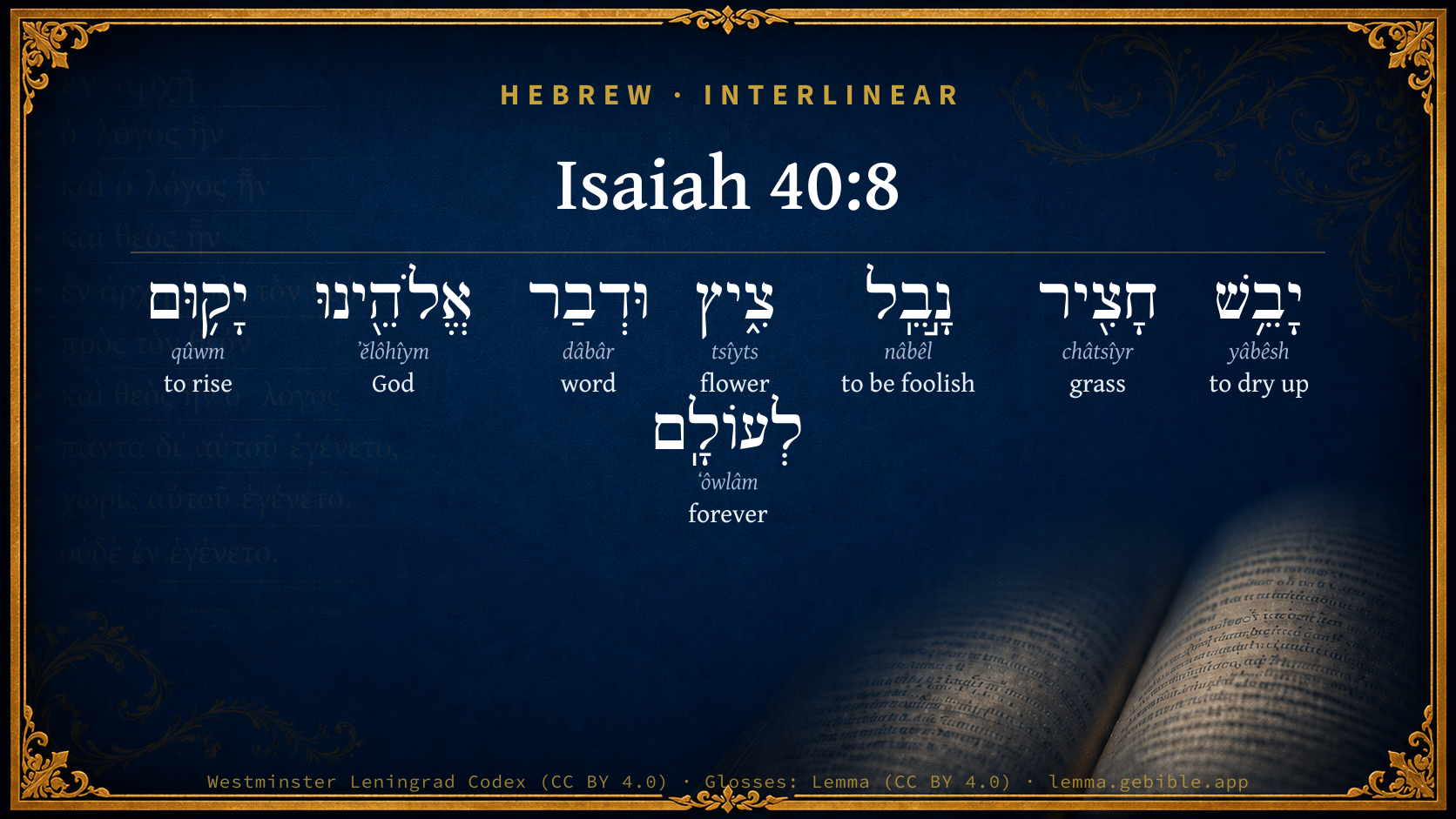
Hebrew (Westminster Leningrad Codex) Isaiah 40:8 appears in the Hebrew Old Testament. The text above is from the Westminster Leningrad Codex. Each word links to its Strong’s number, a concise gloss, and parsing drawn from the Open Scriptures Hebrew Bible morphology. Click any word for its full Brown-Driver-Briggs (BDB) entry.
Download image
Cite this verse

Isaiah 40:8 (World English Bible). Public Domain. Lemma interlinear Bible study tool, https://lemma.gebible.app/v/isaiah/40/8.

Show BibTeX & RIS
BibTeX
RIS
English Translation
The grass withers, the flower fades; but the word of our God shall stand forever.
World English Bible · Public Domain
Download a study sheet

One document with this verse’s original text, its word-by-word gloss line, the meaning frame, cross-references with their text, attributed commentary, and full source and license credits — printable, and it pastes into notes with its structure intact.

This verse Autodidact and up

Study sheet (.html) Plain text (.txt)

A passage Seminary Student

Up to 50 verses in one chapter. A passage sheet keeps up to 6 commentary sources and 12 cross-references per verse, in the order this page ranks them, and says so on the sheet whenever that leaves anything out. Ask for a single verse and you get the Autodidact verse sheet above.

Everything on this page stays free to read, with no account — the sheet is a download of what is already on screen, not access to it.

Want to remove ads? Support Godless Engineer
Compare translations 3

The same verse in 3 English versions, stacked beneath the original-language interlinear above. Click any original word for its lexicon entry.

Each is an independent rendering of the whole verse — the interlinear is not word-aligned to these translations.

Highlighted words mark where these versions differ — a whole-verse word diff, not a word-by-word alignment.

  • World English Bible Public Domain
    The grass withers, the flower fades; but the word of our God shall stand forever.
  • King James Version Public Domain
    The grass withereth, the flower fadeth: but the word of our God shall stand for ever.
  • unfoldingWord Literal Text CC BY-SA 4.0
    The grass dries up, the flower withers, but the word of our God will stand forever.” q1

unfoldingWord Literal Text — © unfoldingWord, licensed CC BY-SA 4.0. Word-aligned USFM3 via Door43 (git.door43.org/unfoldingWord/en_ult).

Versions to compare (up to 4)

3 of 4 selected

Show all 18 translations

Every available English version of this verse, each an independent rendering of the whole verse.

  • World English Bible Public Domain
    The grass withers, the flower fades; but the word of our God shall stand forever.
  • Berean Standard Bible Public Domain
    The grass withers and the flowers fall, but the word of our God stands forever.”
  • Majority Standard Bible Public Domain
    The grass withers and the flowers fall, but the word of our God stands forever.”
  • King James Version Public Domain
    The grass withereth, the flower fadeth: but the word of our God shall stand for ever.
  • American Standard Version (1901) Public Domain
    The grass withereth, the flower fadeth; but the word of our God shall stand forever.
  • Revised Version (1885) Public Domain
    The grass withereth, the flower fadeth: but the word of our God shall stand for ever.
  • Geneva Bible (1599) Public Domain
    The grasse withereth, the floure fadeth: but the worde of our God shall stand for euer.
  • Douay-Rheims (1899) Public Domain
    The grass is withered, and the flower is fallen: but the word of our Lord endureth for ever.
  • Young's Literal Translation Public Domain
    Withered hath grass, faded the flower, But a word of our God riseth for ever.
  • Literal Standard Version CC BY-SA 4.0
    Grass has withered, the flower faded, || But a word of our God rises forever.
  • Unlocked Literal Bible CC BY-SA 4.0
    The grass withers, the flower wilts, but the word of our God will stand forever.”
  • unfoldingWord Literal Text CC BY-SA 4.0
    The grass dries up, the flower withers, but the word of our God will stand forever.” q1
  • Darby Bible Public Domain
    The grass withereth, the flower fadeth; but the word of our God abideth for ever.
  • World Messianic Bible Public Domain
    The grass withers, the flower fades; but the word of our God stands forever.”
  • Webster's Bible Public Domain
    The grass withereth, the flower fadeth: but the word of our God shall shall stand forever.
  • Free Bible Version CC BY-SA 4.0
    However, even though the grass wilts and the flower fades, the word of our God will endure forever.”
  • Bible in Basic English Public Domain
    The grass is dry, the flower is dead; but the word of our God is eternal.
  • JPS Tanakh (1917) Public Domain
    The grass withereth, the flower fadeth; but the word of our God shall stand for ever.'

Literal Standard Version (2020), Covenant Press — licensed CC BY-SA 4.0. Text via the HelloAO Bible API (eBible.org). Unlocked Literal Bible (unfoldingWord) — licensed CC BY-SA 4.0. Text via the HelloAO Bible API (eBible.org). unfoldingWord Literal Text — © unfoldingWord, licensed CC BY-SA 4.0. Word-aligned USFM3 via Door43 (git.door43.org/unfoldingWord/en_ult). Free Bible Version, Dr. Jonathan Gallagher — licensed CC BY-SA 4.0. Text via the HelloAO Bible API (eBible.org).

Word by word

More ways to search: Search by grammar → Find every occurrence → Compare this word →

Practice this passage: Drill this verse → Learn its vocabulary →

About this verse

These counts appear in no published source. They are computed here, from the morphology-tagged text and Lemma’s own curated glosses. What Lemma adds →

8
words
8
distinct lemmas
Prophets
section

Notable vocabulary

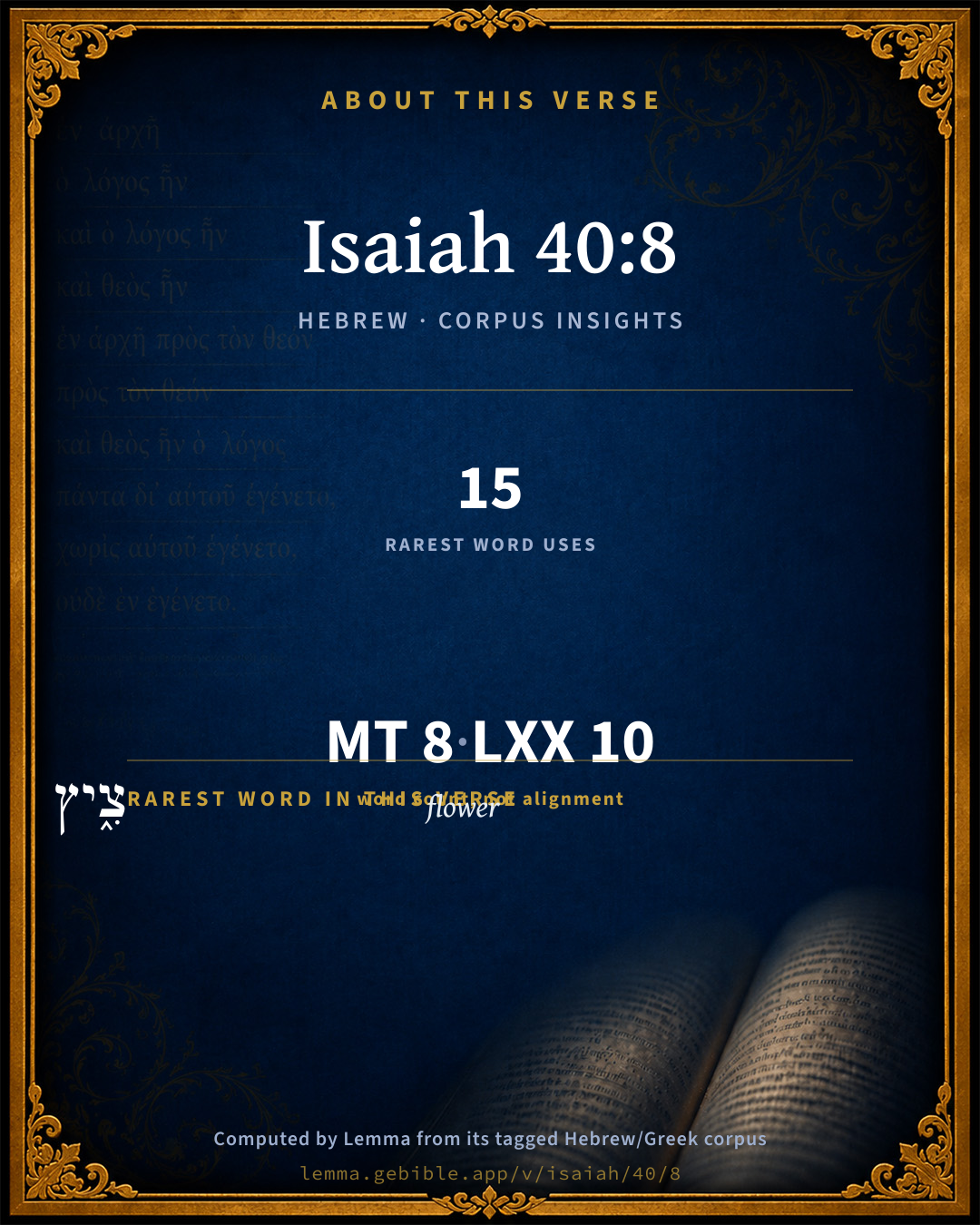
The rarest word here is צִ֑יץ flower H6731 — appearing just 15 times in the whole Hebrew Bible.

Shared distinctive vocabulary

צִ֑יץ flower H6731 occurs in 15 verses of the Hebrew Bible. Also found in:

Grammatical profile

  • 3 verbs
  • 5 nouns

Verb forms

  • יָבֵ֥שׁ Qal · Perfect
  • נָ֣בֵֽל Qal · Perfect
  • יָק֥וּם Qal · Imperfect

Hebrew & Septuagint length

In English translation the verse runs 15 words from the Hebrew and 16 from the Septuagint (LXX English) — closely comparable.

A rough comparison of the two English renderings, which tokenize alike — not a word-level alignment.

Word counts can differ between the Hebrew and the Greek without any difference in meaning — e.g. the Hebrew direct-object marker אֵת has no separate Greek word, and Greek often adds the article ὁ.

In the original languages it is 8 Hebrew tokens and 10 Greek tokens — but the two are counted differently (Hebrew bundles its prefixes and suffixes into one token; the Greek is in lemma form), so that isn’t a like-for-like length.

Cross-references

12

Topical passages linked to Isaiah 40:8 in the Treasury of Scripture Knowledge — connected by theme and wording, ordered by reader-vote popularity; previews shown in the World English Bible.

  • Mark 13:31 Heaven and earth will pass away, but my words will not pass away.
  • Matthew 24:35 Heaven and earth will pass away, but my words will not pass away.
  • 1 Peter 1:25 But the Lord's word endures forever." This is the word of good news which was preached to you.
  • Psalms 119:89–91 Yahweh, your word is settled in heaven forever.
  • Matthew 5:18 For most assuredly, I tell you, until heaven and earth pass away, not even one smallest letter or one tiny pen stroke shall in any way pass away from the law, until all things are accomplished.
  • Isaiah 55:10–11 For as the rain comes down and the snow from the sky, and doesn't return there, but waters the earth, and makes it bring forth and bud, and gives seed to the sower and bread to the eater;
  • Isaiah 46:10–11 declaring the end from the beginning, and from ancient times things that are not [yet] done; saying, My counsel shall stand, and I will do all my pleasure;
  • John 10:35 If he called them gods, to whom the word of God came (and the Scripture can't be broken),
  • Isaiah 59:21 As for me, this is my covenant with them, says Yahweh: my Spirit who is on you, and my words which I have put in your mouth, shall not depart out of your mouth, nor out of the mouth of your seed, nor out of the mouth of your seed's seed, says Yahweh, from henceforth and forever.
  • Zechariah 1:6 But my words and my decrees, which I commanded my servants the prophets, didn't they overtake your fathers? "Then they repented and said, 'Just as Yahweh of Hosts determined to do to us, according to our ways, and according to our practices, so he has dealt with us.'"
  • John 12:34 The multitude answered him, "We have heard out of the law that the Christ remains forever. How do you say, 'The Son of Man must be lifted up?' Who is this Son of Man?"
  • Romans 3:1–3 Then what advantage does the Jew have? Or what is the profit of circumcision?

Cross-references courtesy of OpenBible.info (CC BY 4.0).

Hebrew and Greek witnesses Masoretic Hebrew ↔ Greek Septuagint

The same verse in the two great witnesses to the Old Testament, shown verse-for-verse.

These are two independent witnesses, not word-aligned to each other, and the Septuagint is shown in lemma (dictionary) form.

Hebrew Isaiah 40:8 Masoretic · Westminster Leningrad Codex

יָבֵ֥שׁ חָצִ֖יר נָ֣בֵֽל צִ֑יץ וּדְבַר אֱלֹהֵ֖ינוּ יָק֥וּם לְעוֹלָֽם

The grass withers, the flower fades; but the word of our God shall stand forever.

World English Bible · Public Domain

Greek LXX Isaiah 40:8 Septuagint · lemma form

ὁ δέ ῥῆμα ὁ θεός ἐγώ μένω εἰς ὁ αἰών

The grass withers, and the flower fades: but the word of our God abides for ever.

LXX2012 (modern English Septuagint) · Public Domain

Hebrew: Westminster Leningrad Codex (CC BY 4.0). Greek: Septuagint (public domain); English from LXX2012 (modern English Septuagint) (Public Domain). How the Septuagint differs from the Hebrew →

Targum (Aramaic paraphrase)

1

The Targum is the ancient Jewish Aramaic paraphrase of the Hebrew Scriptures — an interpretive translation, not the Hebrew text itself. Onkelos (literal) and Pseudo-Jonathan (expansive) render the Torah, and Jonathan the Prophets. Coverage is partial: where no permissively-licensed English translation exists for a verse, only the Aramaic is shown. This is verse-level text, not a word-by-word alignment to the Hebrew.

  1. Targum Jonathan Prophets (Joshua–Malachi)
    מִית רַשִׁיעַיָא אֲבָדוּ עֶשְׁתּוֹנוֹהִי וּפִּתְגָמָא דְאֶלָהָנָא קַיָם לְעָלְמִין:

    The wicked dieth, and his thoughts perish; but the word of our God shall stand for ever.

    Targum Jonathan — Aramaic: “Mikraot Gedolot” (public domain). English: “Sefaria Community Translation” (CC0 1.0 (public-domain dedication)); “London "Chaldee Paraphrase," 1871” (public domain). Text via Sefaria.

Commentary

Notes on Isaiah 40:8 from classic Christian and Jewish commentators (each source and its license shown beneath its notes). The classic Christian expositions comment on the surrounding passage and are grouped to its opening verse, so a note may address several verses; the Jewish commentaries on the Tanakh (Rashi and others) are per-verse, so they appear only where the commentator wrote on this verse.

Lemma curates 59 commentaries, every one of them public domain or Creative Commons licensed, each selected and text-cleaned for this edition rather than reprinted as found. About our sources →

Trapp's Complete Commentary

John Trapp

Isa 40:8 The grass withereth, the flower fadeth: but the word of our God shall stand for ever.

Ver. 8. But the word of our God shall stand for ever,] q.d., Though the elect also as well as others are grass, frail and fading creatures, yet the grace of God wrought in their hearts by the gospel is stable and lasting. See 1Pe 1:23. {See Trapp on "1Pe 1:23"} And so necessary is this whole doctrine here delivered, that the ministers of the gospel are commanded here not to write it only, but to speak it: nor that only, but to cry it also with all possible affection and power of enforcement.

John Trapp, A Commentary or Exposition upon All the Books of the Old and New Testament (1647–1656) — public domain. Text from a community e-Sword module.

The Biblical Illustrator

Joseph S. Exell

Isa_40:8

The grass withereth

The decay of the material

Viewed in its immediate relations to the context, the flesh, which is grass, is the vast population of the Babylonian empire.

The goodliness thereof, which is the flower of the grass, is the pomp and pride of the Babylonian civilisation. The Word of the Lord is that prophetic word of the future glory of Israel and her Messiah-King which seems to have found a grave of oblivion beneath the overshadowing growth of Babylonian splendour.

I. THE NECESSARY DECADENCE OF ALL THAT IS SIMPLY MATERIAL AND EARTHLY.

1. The world had never looked upon a more splendid civilisation than that which greeted the eye of the prophet as he looked down in vision upon the great empire of Nebuchadnezzar. For a thousand years Babylon had been the seat of empire, but under her present sovereign she had risen to a glory of which her founders had never dreamed. Nebuchadnezzar, following in the footsteps of Nabopolassar, his illustrious father, had extended his empire by conquest until he was in fact as well as in name, King of men. Northward, he held all Assyria in subjection, and reigned to the limits of the frozen zone. Southward, he had subjugated Egypt with its vast empire, and reigned to the limits of the equatorial belt. Tyre, with all her world-wide commerce, was his vassal, and so his fame had been carried to the remotest borders of the great west. This vast empire it was now the ambition of Nebuchadnezzar to consolidate and unify. For this purpose he had opened long lines of communication between its remotest parts. Canals, one of which was five hundred miles in length; highways across the great deserts connecting with the hills of Arabia and the Mediterranean Sea, with caravansaries, fortified garrisons, wells of water, etc., at all needed points; walled cities along the great thoroughfares as storehouses and resting-places for man and beast--these were amongst the wise provisions for bringing the people of various nationalities and races into the cordial relations of mutual interchange and commerce. But the purposes of the great conqueror went further than this. To give stability to his empire he sought to bring about an amalgamation of all the races and a unification of all the religions within his realm. This was the significance of the image of gold which was set up in the plain of Dura, and which all were required to worship on penalty of being thrown into the furnace of fire. And when, in obedience to the Divine voice, the prophet declared all this might and glory to be but as the evanescent and fading flower, you and I, if we had been present, would have looked upon him as some misanthropic churl. And yet, what were the real facts in the case? Within less than forty years from the time to which the prophet alludes, the city was captured and pillaged, the seat of government removed, and the empire distributed among the conquering allies.

2. We find ourselves to-day in the midst of a civilisation as much more splendid than that of Rome as the latter was superior to that of Chaldea. In all that constitutes true greatness; in all that is at once beneficent and beautiful; in liberty, in philanthropy, in literary and aesthetic culture, in adventure of science and perfection of art, there seems scarcely anything more to be desired. Humanity seems at last to have attained its goal. Culture is in its richest and most perfect flower. We are ready to say, Surely this consummate civilisation of our race shall not wither like that of Babylon or Rome! Has it any elements of durability that its forerunners had not? The answer to these questions will be found in the answer to another, namely, whether this civilisation shall root itself simply in that which is material, or shall be permeated by that which is spiritual and Divine? For amidst all the decadence of the past, there has been ever that which could not perish, which was not subject to change, and which had the power of communicating its own stability to all that came under its influence.

II. THE STABILITY OF THAT WHICH IS SPIRITUAL AND DIVINE. The Word of the Lord. Other things undergo mutations, but it abides ever the same. It has also this marvellous property, that it communicates the elements of its own permanence to all that comes under its influence. It is thus like a seed cast into the soil, which takes up inert matter, incorporating it with itself, and thus imparting to it the life which is immanent in itself. Of this life-containing, life-imparting power of the Word of God we may find beautiful illustration in the history of the decline and fall of the empires to which we have referred. Look first at Babylon. Is there anything that shall survive the wreck of the imperial city? Yes, there is a captive people, despised, toiling as slaves in the erection of the splendid architectural monuments of Nebuchadnezzars reign. Few and feeble apparently they are, overshadowed by the countless hosts of Chaldea. But they are believers in the Word of the Lord. That Word has, as an incorruptible seed, found a lodgment in their hearts. It has imparted to them its own immortality. Babylon, that rejects this Word, shall perish; but Israel that believes it and lives upon it shall survive. That which we have seen to be true in this respect of Babylon was equally true of Rome. The eternal city was laid on heaps, but from the ruins came Christianity in all the beauty of undying youth. The Vandals that destroyed everything else had no power over it. Nay, in the breasts of the very slaves whom they bore to their northern homes, they carried this incorruptible seed. The religion of the slave conquered the master; and hence came that hardy type of Celtic and Saxon Christianity which made the north of Europe the seed-bed of the Reformation. There are preserving salts which, taken up into the pores of the frailest grass and the most delicate flower, do, as it were, transfigure them in their beauty and so preserve them for ever from decay. And thus the religion of Christ has power to give immortality to that which is most fleeting and evanescent. It lays its wand upon that frail flower of physical beauty which lasts but for a day, and it transforms it into the undecaying beauty of the resurrection. It enters into the pulses of youthful ardour and enthusiasm, and makes them beat high and warm in pursuits that can never be interrupted and from motives that never pall. It lifts ambition to a higher plane. It gives to all the activities of the soul their normal and healthful development. It brings the favour of God which is life, and His loving-kindness which is better than life. And what it does for individuals it does in a certain sense for nations also. Let the atheistic materialism, which is seeking to supplant Christianity, become the dominant influence in this country, and Ichabod is written upon all our institutions. The fate of Babylon and of Rome will be ours. The nation and kingdom that will not serve God shall perish. (T. D. Witherspoon, D. D.)

The flower fadeth

Progress in decay

There are at least two sides to everything. To everything in morals there is a dark and a bright side. Every truth is a revelation of God--a Theophany--a Shechinah. And as the Divine pillar in the Exodus had sometimes an aspect of cloud, and sometimes of fire, so is it with all truth. Its appearance alters with our own changes of character or condition; to the eye of sense it may be a Shechinah of gloom, to the eye of faith a Shechinah of glory. Thus is it with our text.

I. LET US CONTEMPLATE IT FIRST BY THE EYE OF SENSE. Let us sit solemnly together in the shadow of the Shechinah. How depressing seems the thought! What a tender and fragile growth is the grass! How short-lived all the goodliness of the flower of the field! Yet such is human life! The flower fadeth! How impressive the truth when we think of others--the beloved of home and life! Where are the happy children who sat with you in the school, and went forth in your holiday?rathe men and women who shared with you lifes heavier tasks and strangely saddened joys? How many of them do you meet to-day?

2. The flower fadeth! How impressive the truth when you think of yourselves! Where now is me bounding heart of your childhood? Where the unclouded hopefulness of youth? As the tide of time rolls on, first, youthful beauty fades like a flower. Then activity declines: the airy step of childhood flags into the slow measures of weary feet! Then strength decays: the right arm loses its cunning, the form bends under its load! Meanwhile, even the moral man seems to share the infirmities of the physical; the tender affections are chilled, the glorious intellect unhinged or exhausted. And it is all saddening--this withering of the human blossom, and the heart recoils from its emblem--a fading flower! Let us so live that it may be said of us truly, His glorious beauty was a fading flower. For the fading flower hath fulfilled well its ministry! Was its life long or short; was its beauty great or little; was its sphere wide or narrow; the flower had done well the special work God gave it to do. Richly varied and full of splendour was the flora of the now barren Palestine in the days when Isaiah swept from his harp this requiem to the withering flower! In nothing, perhaps, are there more notable differences than in the spheres and services of flowers. In the wild howling desert the stately palm waves its radiant flower-tuft, and many a lowly plant and shrub open fragrant blossoms. And amid Polar ice-fields and in the fissured lava of volcanoes come forth these sweet children of the summer in their ministry of beauty and of love. Meanwhile, earths fairer fields are beautified, like old Eden, with their blessed omnipresence. They are all of different classes and uses; but each, in its own season and sphere, makes its little life a blessing--and the air of heaven is sweeter, and insect-life is fed, and the heart of childhood is thrilled with joy, and the soul of wearied manhood is made happier and holier, because of the silent yet earnest ministries of the fading flower!

II. TO THE EYE OF FAITH THE SHECHINAH IS GLORIOUS. Indeed, did these tides of time roll over a sinless world, every premonition even of our mortal decay would awaken only joyful anticipations and emotions. For what, after all, is a flower? Is it in itself a perfection--a consummation? No! far from it! It is, at most, a phenomenon of progress! And its decay is only the passing away of a good thing, giving place to a better! The great end and purpose of all vegetable life is the perfected seed! And analogous to this is the progress and development of mans mortal life. Its earthly offices and uses are only for the strengthening within of the spiritual and immortal; our present life, with all its activities and enjoyments, is but the flower-form of a being whose fruit-form or seed-form is in an after and higher life! And death itself is no more than the falling of the petals from the well-set fruit. Therefore, as the wise husbandman grieves not when his orchards shower their gay blossoms, but rejoices, rather, because this is but a prophecy and promise of the golden wealth of autumn, so we should not grieve when, in the development of man, the mortal flower-leaves fall away from the swelling fruit of immortality!

1. It applies to individuals. Fruit is always of greater value than flowers. Therefore, the trained intellect, the calm judgment, the sanctified affections, the subdued passions, the strong, retruant conscience of the mature man, are worth incalculably more than the fiery impulses, the hot and headlong passions, and all the prodigal bloom and aroma of his younger and fairer life. It applies as well to communities or nations--to that organic life of the race which constitutes its oneness. Here, too, the fruit is worth more than the flowers.

2. The world has had its radiant spring-time and its gorgeous flora. In Rome, Greece, Persia, Egypt, Assyria, Judaea, human nature put forth splendid blossoms until the whole air was fragrant with intoxicating aroma. The old philosophy, the old mythology, the old arts and eloquence and poetry--the whole power and passion of the young imperial genius of old time gave to earth the seeming of a fairy palace filled with shapes and sounds of surpassing splendour. And verily that weird glory hath passed away t. But have we lost by the decay? Are earth and life sadder than in those heroic times? Would you exchange your printing-press for all the pencils of old artists, and the tongues of old orators, and the harps of old minstrels? Would you barter railroad and telegraph and steamship for all the radiant dreams of the old idealists? Would you give up your simple Christian faith for the old gorgeous mythology?

3. We are considering the whole of earthly life as the flower-form, rudimental to the heavenly fruit-form; and the analogy between flower-life and man-life is manifold.

(1) Flowers differ widely in their beauty and glory. Among species ranking as equals, how the lily differs from the rose; and both from the violet! And so is it of humanity. It has its roses, and lilies, and violets; and now and then a magnificent or monstrous aloe, and always its countless myriads of flowers of the grass. And although to the eye of sense the value of flowers is according to their outward manifestations; yet, true wisdom regards colour and aroma as only phenomenal of progress. Presently the petals, alike of the grand flower and the tiny blossom, will wither, and of both the value seems only in the accomplishment of their Makers purpose with the fruit or the seed. So God accounts of His children. The king, the conqueror, the man of imperial gifts and genius will die as fades the great aloe, and the humble pass away as the flower of grass. And then the search, as material for the Judgment, will be the fruit or seed of the developed character.

(2) Flowers differ widely in their seasons and spheres of influence. Fair children die like snowdrops in the early spring. Then come the summer flora. Men in the meridian splendour of their powers passing away, as vineyards and orchards and meadows shower their prodigal blossoms. Nor is the human winter without its flowers of exquisite fragrance and beauty. We have them in our midst, men whose grey heads are our crowns of glory. And as in their seasons, so in their spheres, men, like flowers, differ. At the foot of the awful arctic glacier did our heroic Kane find blossoms of delicate beauty; and in the dreariest waste of Sahara the eye of the fainting explorer grew bright as it fell on a bursting flower. So is it of human influence. In the loneliness of obscurity, in the humiliation of poverty, in the dark chamber of patient, unpretending suffering, have saintly spirits wrought a gracious work.

(3) Meantime, human life and flower-life are alike, mainly because both are phenomenal of progress. Earthly life is short, and we would not have it longer. The season of flowers is full of peril to the tender germ of fruit. Having perfected the seed, natures next care is to disperse or distribute them. Some are borne away on their own airy wings, and as they float up in the sunshine, freed of their heavy earthy beauty, the perfected seed, as a spiritualised blossom, seems fairer than all flowers! Some are borne across oceans, and take root in other continents. Such is the progress and development of that whose young life was born of a fading flower! Oh, to a prescient eye what possibilities, what colours of beauty, what forms of majesty, what felicities, what glorious hopes, what ineffable fruitions, are embosomed in a seed! And analogous to this--but immeasurably more wonderful--are the embryonic powers, and shall be the development of the human soul in the after-state! (C. Wadsworth.)

Summer blossoms

We expect the leaves to fade and fall in October. They have had their full time of growth and unfolding, and their fair share of the beauty and blessedness of the world. But there is nothing to prepare us for the fading of the blossoms of early summer. When, therefore, we see the flowers fading on the ground and the blossoms falling from the tree, our feelings receive something like a shock. The contrast between the death of these fair creations and the bright overflowing fulness of life around fills us with a peculiar sadness. A premature fate, we feel, has overtaken them; they have not had their full share of the feast of life.

1. Looking exclusively at the fact itself, there is nothing but sadness in the fading of the flower. It seems a wanton destruction of so much life and beauty; and we are apt to ask, To what purpose is this waste?

2. But much as we mourn all these fading flowers, the human as well as the natural, we cannot wish them to abide for ever. It is the fading flower that is so wonderfully beautiful. Fix its beauty unchanged, and you make it an artificial flower, a dry mummy. It is the fleeting human blossom that is so tenderly dear. We love each other more devotedly owing to the shadow feared of man that falls upon and consecrates our love; because we must soon, we know not how soon, be parted. We should feel everlasting flowers to be utterly incongruous in a world of change and decay; their steadfast continuance, when there was no reason for their continuance, would weary and offend our minds.

3. But the truth of the fading flower has another and a brighter side. It is not all death and desolation. We shall pass at once out of the shadow into the sunshine when we consider the reason why the flower fades. The flower fades that the fruit may take its place. The fading of the flower, rightly viewed, is therefore a natural and necessary phenomenon of life. In itself it is joyous, and not grievous. In the unfallen Eden the fading flowers suggested no thought of gloom to Adam, but only of bright progress from life to fuller life, from a lower to a higher stage of development and perfection. Viewed, then, in the light of Him who hath brought life and immortality to light in His Gospel, and free from the cloud of sin, the fading of human-life and of flower-life is not in reality sad, but joyful. Man dies, but his life on earth is only for the formation of the eternal life. Every gift we receive is but a promise; every beauty we behold but a prophecy; every pleasure we enjoy but a foretaste. The Christians whole life is but the earnest of the inheritance that awaits him. We see by faith, although we are slow of heart to believe it, that our very losses and privations are ministering to a noble and goodly development pregnant with an everlasting promise. Death itself is the act of blossoming. It is a scientific fact that it is the dying plant alone that flowers. Blossoming is the highest point in plant life. When it has produced its blossom it perishes. In human life it is so likewise. Our existence here is but a daily dying, the continual production of a blossom, within whose petals as they wither is expanding the immortal fruit; and death is but the final falling of the sere petals from the fruit when it has set. It is not destruction, but development; the mortal not destroyed, but putting on immortality.

4. Then, consider that the blossom belongs to the plant itself, the fruit to the race. The blossom is the end of the selfish life; the fruit is the beginning of the unselfish.

5. Further still, the plant that flowers is confined to one spot; but when it fruits and seeds it gets wings, as it were, and can fly away from its natal place to long distances, as you have often seen the thistle-down or the fleecy parasol of the dandelion do, to make the wilderness and the solitary place to be glad, and the desert to rejoice and blossom as the rose. Is it not so in human life? That death which seems to bound our life, in reality gives us wings, and takes us out of this cramped and narrow sphere of change, and sorrow, and sin, into the freer air and larger sunshine of Gods everlasting kingdom. The fruition of life is not the limitation, but the freedom and enlargement of life. And who knows what life and beauty and blessedness to others may spring from seed dropped by our losses and death? Looking thus at this life as only the flower-form of our being, we see the reason of its brevity. The life of the blossom is short because it has to prepare the way for the fruit; and the season in which it is put forth is dangerous to the formation of the tender germ. We should welcome the growing infirmities and decays of life as signs that summer, the season of fleeting glories, is passing away, and that autumn, the season of enduring fruition, is drawing nigh. They proclaim to us that now our salvation is nearer than when we believed.

6. But I reserve the grandest thought connected with my theme to the last. The flower fades and falls off the plant, but it does not altogether vanish; it does not perish utterly. Some part of it, larger or smaller, according to the species, remains behind to form the nucleus of the fruit. In every case the lower part of the central and most important part of the blossom is left, and it is out of it that the fruit is formed. A good deal of the fleeting flower, indeed all that is essential in it, is thus made permanent in the enduring fruit; and the fruit itself may be looked upon as a more perfect and lasting blossom, retaining the colour, and fragrance, and grace of form that distinguished the blossom, but superadding qualities, such as nutritiousness and flavour, which the blossom lacked. Is not the analogy here very instructive and consoling? Not only do all our sanctified losses turn to gains, but the gains are largely composed of what we lost. We take up with us into every stage of our advancing progress what was best and most serviceable in the previous stage; and in the fruit of our achievements we can trace much of the fair blossoms of hope and aspiration which led to its formation. Nothing that is really good in human life ought to be thrown away as useless when we have outgrown it. The good of childhood ought to remain in manhood. The enthusiasm, the freshness of interest, the innocent simplicity, the spirit of hope, inquiry, and wonder which characterise our early years, ought to endure late in life, under the calmer and quieter outside of maturity. Let us not mourn, then, that so many fair and precious things pass away from us as we go on to our immortality; for nothing that is really essential to our well-being shall perish utterly, but shall be absorbed into our souls and become their eternal wealth. (H. Macmillan, LL. D.)

The thought of death

The thought of death is not to be dwelt upon morbidly in the manner of Swift, who said, I was forty-seven years old when I began to think of death, and the reflections upon it now begin when I wake in the morning and end when I am going to sleep. But it is well for us to have the thought at hand. (W. R. Nicoll, LL. D.)

The Word of our God shall stand for ever

The higher criticism

I. WHAT IS MEANT BY THE WORD OF OUR GOD? You answer, The Bible. I think not. At least, and certainly, to Isaiah it could not mean more of the Old Testament than he possessed--a mere fragment of the Book in our hands. Even to Peter it could not have meant all the records we have, seeing that some had not been written when he repeated the prophets statement. What, then, are we to understand by this phrase, the Word of our God? Simply, truth. Truth in its very widest sense, whether in the Bible or out of it, is the Word of God.

II. Higher criticism proposes to solve for you and me, what we have neither the time nor ability to do for ourselves, TO WHAT EXTENT INTERPOLATION HAS GONE ON. It is a strictly honest, unbiassed, sincere scrutiny into the claims, history, authorship, date, and language of the books of the Bible.

III. WHAT WILL BE THE RESULT? Only good. If we are honest we shall want only the truth; and after the examination is completed truth will stand more grandly than ever before us.

IV. OUR ATTITUDE TOWARD HIGHER CRITICISM may well be for these reasons--

1. One of welcome. We rejoice in every honest and reverential inquiry for truth.

2. One of hope. The future of our faith looks all the brighter from the discussions and questionings of to-day. Men are beginning to think. An interest is awakening in the vast questions that relate to our higher life.

3. One of confidence. Are we wise in our fear for the safety of the Word of our God? Does the Word of our God need our defence? Is not He pledged to its security? That which cannot stand the test of criticism had better go; but truth, the Word of our God, shall stand for ever. (J. E. W. Cook.)

The enduring Word

The Word of the Lord endureth for ever. How do we know that? Certainly, not in the same way as we are sure of the universality of death. We know it to be true if we believe two things--

1. That God, the perfect moral being, exists.

2. That He has spoken to mare The Word of God, speaking in conscience, in revelation, is like God Himself--above the waterfloods of change; it lasts. (H. P. Liddon, D. D.)

The passing and the abiding

I. Since the Word of our God shall stand for ever, the BIBLE WILL REMAIN.

1. Think of the Bible as history. The Old Testament is supported by the exhumed records of the kings of Egypt and Babylon and Nineveh and Moab. We are now shown in the Boulag Museum at Cairo the very body of the Egyptian king who oppressed Israel. At a hundred points confirmatory evidence has been dug out of the Assyrian ruins. In the day when the Bible was attacked by unbelief, there appeared out of the very ground hosts of defenders. Gods Providence supports His Book.

2. Think of the Bible as to philosophy. John Stuart Mill will tell us, It is impossible to find in the ideas of any philosophy, even the latest, a single point which is not anticipated and ennobled in Christianity.

3. Think of the Bible as to science. It is true, as one has said wisely and wittily, that the intention of Holy Scripture is to teach us to go to heaven, and not how the heavens go. And yet the great astronomer Sir John Herschel will tell us: All human discoveries seem to be made only for the purpose of confirming more and more strongly the truth contained in the Sacred Scriptures.

4. Think of the Bible as to morals. Those words of James Russell Lowell, spoken so bravely at a dinner in London, before a company of sceptics, are well worth treasuring: The worst kind of religion is no religion at all. And those men, living in ease and luxury, indulging themselves in the amusement of going without religion, may be thankful that they live in lands where the Gospel they neglect has tamed the beastliness and ferocity of the men who, but for Christianity, might long ago have eaten their carcasses like the South Sea Islanders, or cut off their heads and tanned their hides like the monsters of the French Revolution. This Bible, the Word of God, which history substantiates, which philosophy cannot anticipate, which science reinforces, which is the source of all true morals and secure civilisation, is to abide.

II. Since the Word of our God shall stand for ever, THE KINGDOM OF CHRIST IS TO ENDURE AND CONQUER. For the very heart and kernel of Gods Word is the revelation of the certainly vanquishing kingdom of our Lord and Saviour Jesus Christ.

III. Since the Word of our God standeth for ever, HEAVEN WILL SHINE ON US AT THE LAST. (W. Hoyt, D. D.)

The Word of our God

All explanations can be reconciled by suffering the prophet to express his own ideas, without any adventitious limitation and admitting, as the only sure conclusion, that by Word he means neither promise, nor prophecy, nor Gospel merely, but every word that proceedeth out of the mouth of God (Deu_8:3; Mat_4:4). There is a tacit antithesis between the Word of God and man; what man says is uncertain and precarious, what God says cannot fail. Thus understood, it includes prediction, precept, promise, and the offer of salvation; and although the latter is not meant exclusively, the apostle makes a perfectly correct and most important application of the verse when, after quoting it, he adds, and this is the Word which is preached (εὐαγγελισθέν) unto you; that is to say, this prophetic declaration is emphatically true of the Gospel of Christ. (J. A. Alexander.)

The Bible its own defence

A well-known Presbyterian minister is reported to have said, We must defend the Bible. Must we? The Bible is badly off when it needs your defence or mine. I stood on the Big Four railway track the other day watching the Cincinnati and Cleveland express pass by. A young bee, called out by the warm April winds and bright spring sunshine, flew toward the train. Supposing I had rushed for a club or a rifle, and had run down toward the approaching express, crying aloud, I must defend the cars from that bees attack, would you not have said, Get out of the way; let the train defend itself? The Bible is its own best defence. (J. E. W. Cook.)

The Biblical Illustrator, edited by Joseph S. Exell (c. 1880s–1900s) — public domain. Text from a community e-Sword module.

Tyndale Open Study Notes

Tyndale Open Resources

40:8 the word of our God stands forever: All of God’s words (his plans as well as the written word) will succeed. God might frustrate human expectations, but everything will happen according to his wise plan (see 14:24; 55:8-11; see also Matt 25:34).

Tyndale Open Study Notes — © Tyndale Open Resources, licensed CC BY-SA 4.0. Text via the HelloAO Bible API.

Geneva Bible (1599)

Geneva Bible translators

Though considering the frailty of man’s nature many of the Jews should perish, and so not be partakers of this deliverance, yet God’s promise should be fulfilled, and they that remained, should feel the fruit thereof.

Geneva Bible (1599) marginal notes — public domain. Text via Bolls.life.

The Cambridge Bible for Schools and Colleges

gen. ed. J. J. S. Perowne

8. the word of our God] is the word spoken by the prophets to Israel, the announcement of Jehovah’s immutable purpose in the world; this is the one permanent factor in human history. It is a mistake to limit the reference to the word of promise just declared by the prophet; the statement is general, although the implied argument is that as the threatening predictions of earlier prophets have been fulfilled, so this new word of comfort shall stand, because it proceeds from the same God, who can dissolve the mightiest combinations of human power (Isa_40:23).

The Cambridge Bible for Schools and Colleges (gen. ed. J. J. S. Perowne; Cambridge University Press, 1878–1918) — public domain. Text from a community e-Sword module.

John Gill's Exposition

The grass withereth, the flower fadeth,.... Which is repeated, to raise attention to it, as being a matter of importance, and for the confirmation of it:

but the word of our God shall stand for ever; the Apostle Peter adds, by way of explanation,

and this is the word, which by the Gospel is preached unto you; who seems to distinguish the word from the Gospel, by which it is preached, and to intend Christ the essential Word; who stands or abides for ever as a divine Person; in his office as Mediator, being Prophet, Priest, and King for ever; in the efficacy of his blood, righteousness, and sacrifice; and in the fulness of his grace: it is true of the written word or Gospel, which remains, is everlasting, and will stand and continue, notwithstanding the persecutions of tyrants, the craft of false teachers, the reproach of ungodly men, and the death of the best of men, even of ministers; though all flesh is grass, fading and withering, the word of God is fresh and lively, firm and durable; and so it is as transcribed into the hearts of men, where it becomes the ingrafted word, and issues in everlasting life. It may be applied to God's word of promise, which is for ever settled in heaven, and is always fulfilled.

John Gill's Exposition of the Whole Bible (1746–1763) — public domain (CC PDM 1.0). Text via the HelloAO Bible API.

Albert Barnes' Notes on the Bible

The grass withereth ... - This is repeated from the former verse for the sake of emphasis, or strong confirmation.

But the word of our God - The phrase ‘word of our God,’ refers either to his promise to be the protector and deliverer of his people in their captivity, or, in general, means that all his promises shall be firm and unchanging.

Shall stand for ever - Amidst all revolutions among men, his promise shall be firm. It shall not only live amidst the changes of dynasties, and the revolutions of empires, but it shall continue forever and ever. This is designed for support to an afflicted and oppressed people; and it must have been to them, in their bondage, the source of high consolation. But it is equally so now. Amidst all the changes on earth; the revolutions of empires; the vanishing of kingdoms, God is the same, and his promises are unfailing. We see the grass wither at the return of autumn, or in the drought: we see the flower of the field lose its beauty, and decay; we see man rejoicing in his vigor and his health, cut down in an instant; we see cities fall, and kingdoms lose their power and vanish from among nations, but God changes not. He presides in all these revolutions, and sits calm and unmoved amidst all these changes. Not one of his promises shall fail; and at the end of all the changes which human things shall undergo, Yahweh, the God of his people, will be the same.

Albert Barnes' Notes on the Bible (1834–1885) — public domain. Text from a community e-Sword/MySword module.

Haydock's Catholic Bible Commentary

CHAPTER XL.

George Leo Haydock (1774–1849), Haydock's Catholic Family Bible and Commentary, 1859 edition — public domain. Excludes Psalms (Douay-Rheims chapter numbering differs from Protestant) and Deuterocanonical books (Catholic canon only).

Matthew Poole's English Annotations

Whatsoever God hath said shall infallibly come to pass.

Matthew Poole's English Annotations on the Holy Bible (1683–1685) — public domain. Text from a community e-Sword/MySword module.

The Pulpit Commentary

The Word of our God shall stand for ever. Amid all human frailty, shiftingness, changefulness, there is one thing that endures, and stroll endure God"s Word (see the comment on the first part of ver. 6). In the sureness of God"s promises is Israel"s exceeding comfort.

The Pulpit Commentary (1880–1919), ed. H.D.M. Spence-Jones & Joseph S. Exell — public domain. Text from a community e-Sword module.

J. A. Alexander on Isaiah

Joseph Addison Alexander

“Dried is the grass, faded the flower, and the word of our God shall stand forever.” The comparatively rare use of adversative particles in Hebrew is exemplified in this verse, in which the relation of the clauses can be fully expressed in English only by means of the word ‘but’. By ‘word’ he means neither promise, nor prophecy, nor gospel merely, but every word that proceedeth out of the mouth of God (Deu 8:3; Mat 4:4). There is a tacit antithesis between the word of God and man; what man says is uncertain and precarious, what God says cannot fail. Thus understood it includes prediction, precept, promise, and the offer of salvation, and although the latter is not meant exclusively, the Apostle makes a perfectly correct and most important application of the verse when, after quoting it, he adds, and this is the word which is preached (euaggelisthen) {edayyfXia&Ep} unto you,’ that is to say, this prophetic declaration is emphatically true of the gospel of Christ. To ‘stand forever’ is a common Hebrew phrase for perpetuity, security, and sure fulfillment. The expression ‘our God’ contains, as usual, a reference to the covenant relation between God and his people. It is possible to avoid the appearance of tautology and give the passage a dramatic form, by making the last clause of v. 6 and the whole of v. 7 a continuation of the words of the second voice, and then regarding v. 8 as a rejoinder by the first voice. The whole may then be paraphrased as follows. ‘A voice says, Cry! And (another voice) says, What shall I cry (i.e., to what purpose can I cry, or utter promises like those recorded in vs. 1-5), since all flesh is grass etc.; the grass withereth etc.; surely the people is grass (and cannot be expected to witness the fulfillment of these promises). But the first voice says again: The grass does wither, and the flower does fade; but these events depend not on the life of man, but on the word of God, and the word of God shall stand forever.’

Joseph Addison Alexander, The Prophecies of Isaiah (1846–1847; New York: Scribner, 1870–1878) — public domain. Text from a community e-Sword module.

Ibn Ezra

Rabbi Abraham ibn Ezra

The grass withereth, etc. Since he is like grass, he will wither; since he is like the flower, he will fade away; but the word of the Lord shall stand—יעמוד═יקום —and none will frustrate it.

רוח ה׳ The wind of the Lord, that is, the wind, which is sent by Him, נשבה בו Bloweth upon it, that is, upon the grass, and it becomes dry.

Ibn Ezra on the Tanakh — English translations: “Sefaria Community Translation” (CC0 1.0 (public-domain dedication)); “Yalkut, Sifsei Chachomim Chumash, Metsudah Publications, 2009” (CC BY 4.0); and “Commentary of Ibn Ezra on Isaiah - trans. by M. Friedlander, 1873” (public domain). Text via Sefaria.

Lesson kit

Teaching starters — assembled from the data on this page, not authored interpretation. Every prompt links to the verse data it draws on. Edit before teaching.

Isaiah, in the Prophets, opens this verse with 8 words (8 distinct Hebrew lemmas). Its most distinctive word is tsîyts (“flower”). A historical commentator’s framing appears above. Read the whole chapter for the surrounding context.

Discussion questions

  1. How does “flower” (tsîyts) shape what this verse is saying?
  2. How does Exodus 28:36, which shares the word «flower», read alongside this verse?
  3. These translations render this verse differently; the difference is in the English rendering, not the original. What questions does that raise?
  4. «יָבֵ֥שׁ» is a Qal Perfect verb. How does that grammatical form shape the action described?
  5. Compare how Trapp's Complete Commentary and The Biblical Illustrator read this verse. Where do they agree or differ?

Things to notice

Reading settings

Reading text

Shown beneath each verse's original-language words.

Old Testament
Old Testament edition

Read the OT as the Masoretic Hebrew (MT) or the Greek Septuagint (LXX).

English shown for the Greek Septuagint (in the Hebrew ↔ Greek comparison).

Comparing translations? Open the Compare panel on any verse page to stack up to four side by side.