
1 John 2:19

Greek (Tischendorf 8th ed.) 1 John 2:19 appears in the Greek New Testament. The text above is from the Tischendorf 8th edition. Each word links to its Strong’s number and a concise gloss. Click any word for its full Thayer’s Greek Lexicon entry.
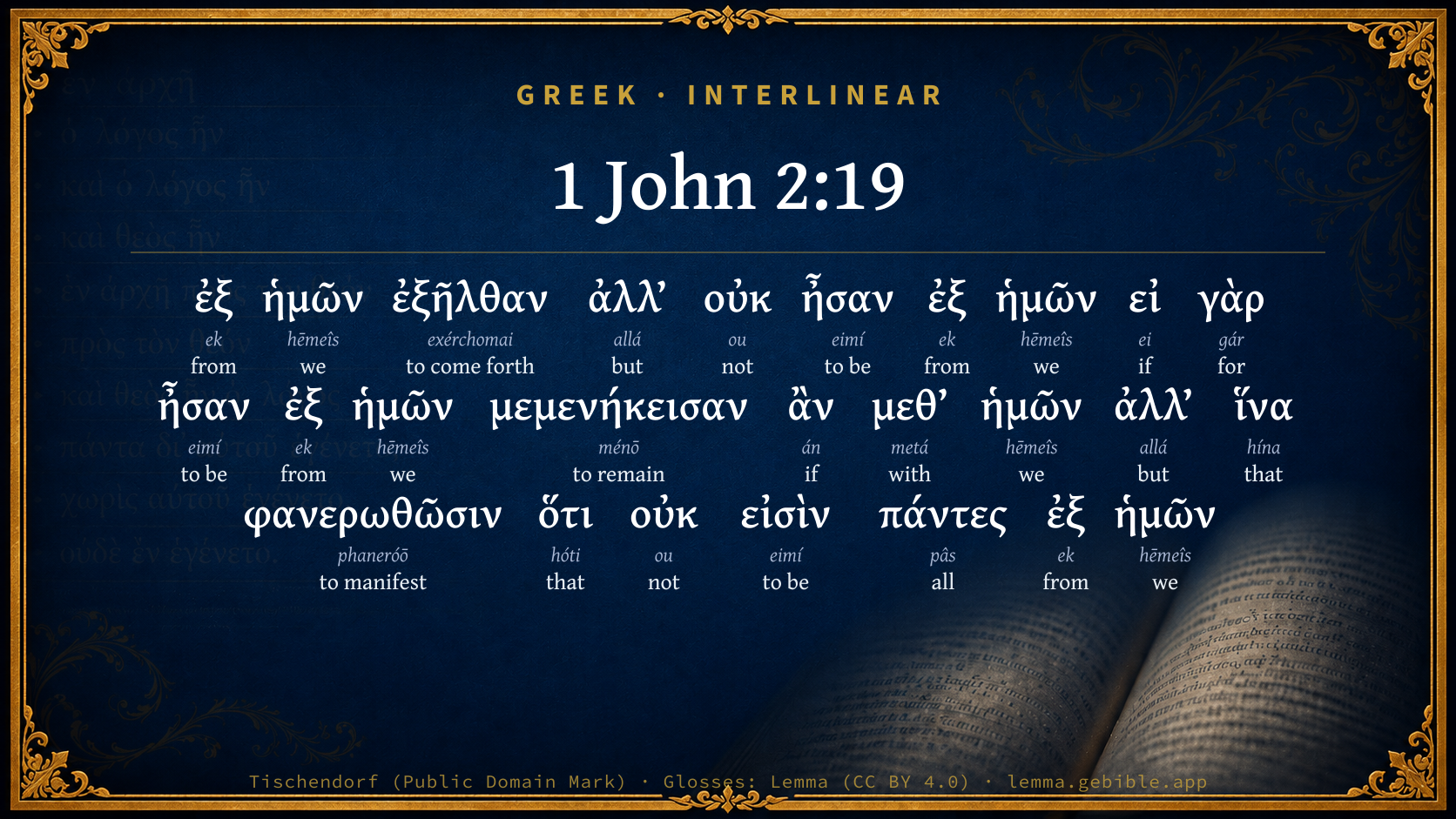
Download image
Cite this verse

1 John 2:19 (World English Bible). Public Domain. Lemma interlinear Bible study tool, https://lemma.gebible.app/v/1-john/2/19.

Show BibTeX & RIS
BibTeX
RIS
English Translation
They went out from us, but they didn't belong to us; for if they had belonged to us, they would have continued with us. But they left, that they might be revealed that none of them belong to us.
World English Bible · Public Domain
Download a study sheet

One document with this verse’s original text, its word-by-word gloss line, the meaning frame, cross-references with their text, attributed commentary, and full source and license credits — printable, and it pastes into notes with its structure intact.

This verse Autodidact and up

Study sheet (.html) Plain text (.txt)

A passage Seminary Student

Up to 50 verses in one chapter. A passage sheet keeps up to 6 commentary sources and 12 cross-references per verse, in the order this page ranks them, and says so on the sheet whenever that leaves anything out. Ask for a single verse and you get the Autodidact verse sheet above.

Everything on this page stays free to read, with no account — the sheet is a download of what is already on screen, not access to it.

Want to remove ads? Support Godless Engineer
Compare translations 3

The same verse in 3 English versions, stacked beneath the original-language interlinear above. Click any original word for its lexicon entry.

Each is an independent rendering of the whole verse — the interlinear is not word-aligned to these translations.

Highlighted words mark where these versions differ — a whole-verse word diff, not a word-by-word alignment.

  • World English Bible Public Domain
    They went out from us, but they didn't belong to us; for if they had belonged to us, they would have continued with us. But they left, that they might be revealed that none of them belong to us.
  • King James Version Public Domain
    They went out from us, but they were not of us; for if they had been of us, they would no doubt have continued with us: but they went out, that they might be made manifest that they were not all of us.
  • unfoldingWord Literal Text CC BY-SA 4.0
    They went out from us, but they were not from us. For if they had been from us, they would have remained with us, but so that they would be made apparent that they are all not from us.

unfoldingWord Literal Text — © unfoldingWord, licensed CC BY-SA 4.0. Word-aligned USFM3 via Door43 (git.door43.org/unfoldingWord/en_ult).

Versions to compare (up to 4)

3 of 4 selected

Show all 19 translations

Every available English version of this verse, each an independent rendering of the whole verse.

  • World English Bible Public Domain
    They went out from us, but they didn't belong to us; for if they had belonged to us, they would have continued with us. But they left, that they might be revealed that none of them belong to us.
  • Berean Standard Bible Public Domain
    They went out from us, but they did not belong to us. For if they had belonged to us, they would have remained with us. But their departure made it clear that none of them belonged to us.
  • Majority Standard Bible Public Domain
    They went out from us, but they did not belong to us. For if they had belonged to us, they would have remained with us. But their departure made it clear that none of them belonged to us.
  • King James Version Public Domain
    They went out from us, but they were not of us; for if they had been of us, they would no doubt have continued with us: but they went out, that they might be made manifest that they were not all of us.
  • American Standard Version (1901) Public Domain
    They went out from us, but they were not of us; for if they had been of us, they would have continued with us: but `they went out', that they might be made manifest that they all are not of us.
  • Revised Version (1885) Public Domain
    They went out from us, but they were not of us; for if they had been of us, they would have continued with us: but they went out, that they might be made manifest how that they all are not of us.
  • Geneva Bible (1599) Public Domain
    They went out from vs, but they were not of vs: for if they had bene of vs, they should haue continued with vs. But this cometh to passe, that it might appeare, that they are not all of vs.
  • Douay-Rheims (1899) Public Domain
    They went out from us, but they were not of us. For if they had been of us, they would no doubt have remained with us; but that they may be manifest, that they are not all of us.
  • Young's Literal Translation Public Domain
    out of us they went forth, but they were not of us, for if they had been of us, they would have remained with us; but -- that they might be manifested that they are not all of us.
  • Literal Standard Version CC BY-SA 4.0
    they went forth out of us, but they were not of us, for if they had been of us, they would have remained with us; but [they went out] so that they might be revealed that they are not all of us.
  • Unlocked Literal Bible CC BY-SA 4.0
    They went out from us, but they were not from us. For if they had been from us they would have remained with us. But when they went out, that showed they were not from us.
  • unfoldingWord Literal Text CC BY-SA 4.0
    They went out from us, but they were not from us. For if they had been from us, they would have remained with us, but so that they would be made apparent that they are all not from us.
  • Darby Bible Public Domain
    They went out from among us, but they were not of us; for if they had been of us, they would have surely remained with us, but that they might be made manifest that none are of us.
  • World Messianic Bible Public Domain
    They went out from us, but they didn’t belong to us; for if they had belonged to us, they would have continued with us. But they left, that they might be revealed that none of them belong to us.
  • Webster's Bible Public Domain
    They went out from us, but they were not of us; for if they had been of us, they would no doubt have continued with us: but they went out, that they might be made manifest that they were not all of us.
  • Free Bible Version CC BY-SA 4.0
    They left us, but they didn't belong with us, for if they did, they would have remained with us. When they left they showed that none of them belonged with us.
  • Bible in Basic English Public Domain
    They went out from us but they were not of us; if they had been of us they would still be with us: but they went out from us so that it might be made clear that they were not of us.
  • Text-Critical English NT CC BY 4.0
    They went out from us, but they did not belong to us; for if they had belonged to us, they would have remained with us. But they went out so that it might be revealed that they do not belong to us.
  • Tyndale New Testament (1534) Public Domain
    They went oute from vs but they were not of vs. For yf they had bene of vs they wolde no dout have continued with vs. But that fortuned that that myght appere that they were not of vs.

Literal Standard Version (2020), Covenant Press — licensed CC BY-SA 4.0. Text via the HelloAO Bible API (eBible.org). Unlocked Literal Bible (unfoldingWord) — licensed CC BY-SA 4.0. Text via the HelloAO Bible API (eBible.org). unfoldingWord Literal Text — © unfoldingWord, licensed CC BY-SA 4.0. Word-aligned USFM3 via Door43 (git.door43.org/unfoldingWord/en_ult). Free Bible Version, Dr. Jonathan Gallagher — licensed CC BY-SA 4.0. Text via the HelloAO Bible API (eBible.org).

Word by word

More ways to search: Search by grammar → Find every occurrence → Compare this word →

Practice this passage: Drill this verse → Learn its vocabulary →

φανερωθῶσιν
phaneróō
G5319
“to manifest”
Verb, Aorist, Passive, Subjunctive, 3rd person, Plural
Part of Speech
Verb
Tense
Aorist
Voice
Passive
Mood
Subjunctive
Person
3rd person
Number
Plural
Full Thayer's Definition

Origin: from G5318

TDNT: 09:03,1

1. to make manifest or visible or known what has been hidden or unknown, to manifest, whether by words, or deeds, or in any other way a. make actual and visible, realised b. to make known by teaching c. to become manifest, be made known d. of a person 1. expose to view, make manifest, to show one's self, appear e. to become known, to be plainly recognised, thoroughly understood 1. who and what one is
  1. ἐξ ek G1537 “from” Preposition
  2. ἡμῶν hēmeîs G2249 “we” Personal pronoun, 1st person, Genitive, Plural
  3. ἐξῆλθαν exérchomai G1831 “to come forth” Verb, Aorist, Active, Indicative, 3rd person, Plural
  4. ἀλλ’ allá G235 “but” Conjunction
  5. οὐκ ou G3756 “not” Particle, Negative
  6. ἦσαν eimí G1510 “to be” Verb, Imperfect, Active, Indicative, 3rd person, Plural
  7. ἐξ ek G1537 “from” Preposition
  8. ἡμῶν hēmeîs G2249 “we” Personal pronoun, 1st person, Genitive, Plural
  9. εἰ ei G1487 “if” Conditional
  10. γὰρ gár G1063 “for” Conjunction
  11. ἦσαν eimí G1510 “to be” Verb, Imperfect, Active, Indicative, 3rd person, Plural
  12. ἐξ ek G1537 “from” Preposition
  13. ἡμῶν hēmeîs G2249 “we” Personal pronoun, 1st person, Genitive, Plural
  14. μεμενήκεισαν ménō G3306 “to remain” Verb, Pluperfect, Active, Indicative, 3rd person, Plural
  15. ἂν án G302 “if” Particle
  16. μεθ’ metá G3326 “with” Preposition
  17. ἡμῶν hēmeîs G2249 “we” Personal pronoun, 1st person, Genitive, Plural
  18. ἀλλ’ allá G235 “but” Conjunction
  19. ἵνα hína G2443 “that” Conjunction
  20. ὅτι hóti G3754 “that” Conjunction
  21. οὐκ ou G3756 “not” Particle, Negative
  22. εἰσὶν eimí G1510 “to be” Verb, Present, Active, Indicative, 3rd person, Plural
  23. πάντες pâs G3956 “all” Adjective, Nominative, Plural, Masculine
  24. ἐξ ek G1537 “from” Preposition
  25. ἡμῶν hēmeîs G2249 “we” Personal pronoun, 1st person, Genitive, Plural

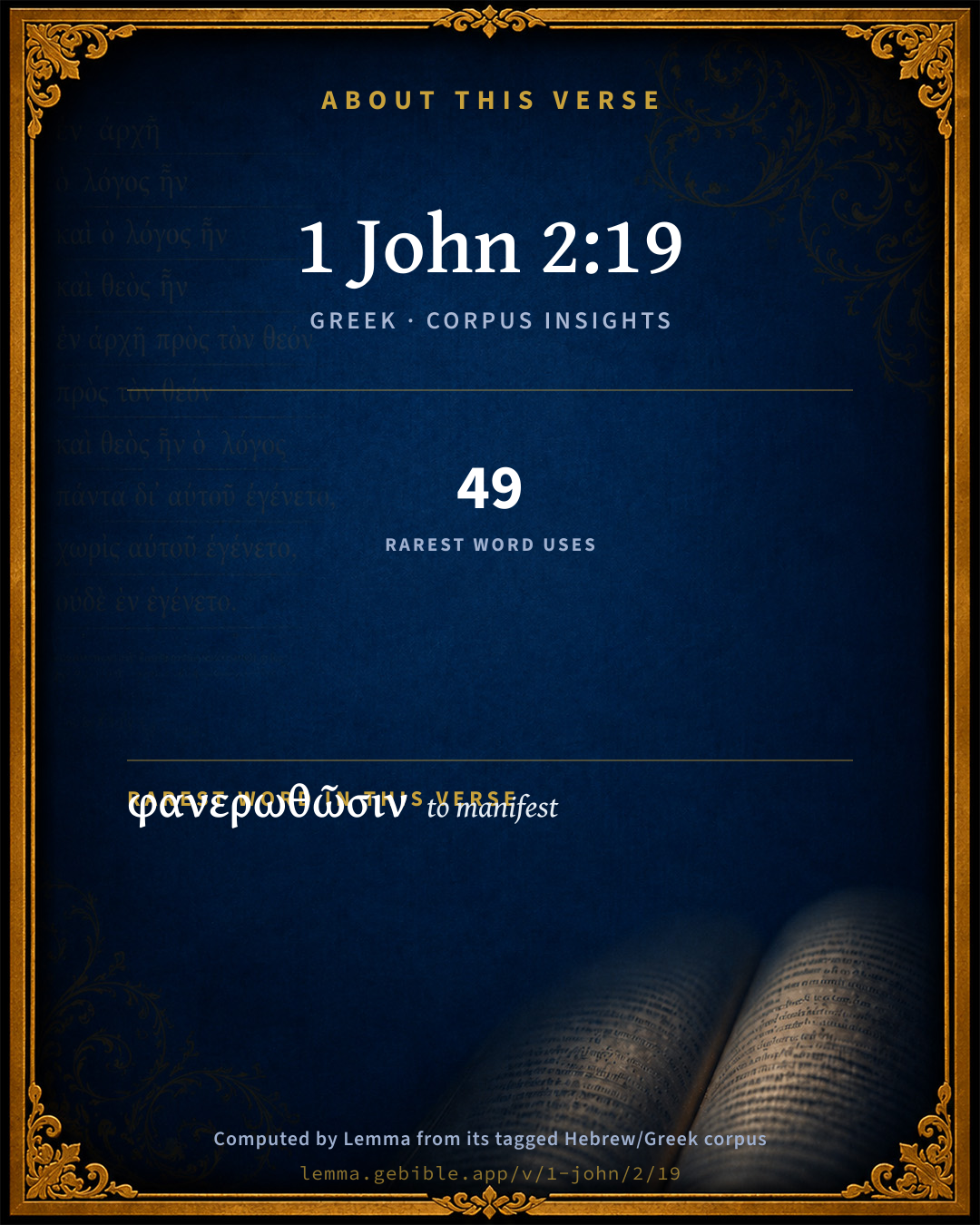
About this verse

These counts appear in no published source. They are computed here, from the morphology-tagged text and Lemma’s own curated glosses. What Lemma adds →

26
words
15
distinct lemmas
General Epistles
section

Shared distinctive vocabulary

φανερωθῶσιν to manifest G5319 occurs in 43 verses of the Greek New Testament. Also found in:
Repetition

Words recur within this verse:

Cross-references

29

Topical passages linked to 1 John 2:19 in the Treasury of Scripture Knowledge — connected by theme and wording, ordered by reader-vote popularity; previews shown in the World English Bible.

  • Acts 20:30 Men will arise from among your own selves, speaking perverse things, to draw away the disciples after them.
  • 1 Corinthians 11:19 For there also must be factions among you, that those who are approved may be revealed among you.
  • Luke 8:13 Those on the rock are they who, when they hear, receive the word with joy; but these have no root, who believe for a while, then fall away in time of temptation.
  • Jude 1:19 These are they who cause divisions, and are sensual, not having the Spirit.
  • 2 Peter 2:20–21 For if, after they have escaped the defilement of the world through the knowledge of the Lord and Savior Jesus Christ, they are again entangled therein and overcome, the last state has become worse with them than the first.
  • Matthew 13:20–21 What was sown on the rocky places, this is he who hears the word, and immediately with joy receives it;
  • 2 Timothy 2:19 However God's firm foundation stands, having this seal, "The Lord knows those who are his," and, "Let every one who names the name of the Lord depart from unrighteousness."
  • John 6:37–39 All those who the Father gives me will come to me. Him who comes to me I will in no way throw out.
  • Deuteronomy 13:13 Certain base fellows are gone out from the midst of you, and have drawn away the inhabitants of their city, saying, Let us go and serve other gods, which you have not known;
  • Job 17:9 Yet shall the righteous hold on his way. He who has clean hands shall grow stronger and stronger.
  • Jeremiah 32:38–40 and they shall be my people, and I will be their God:
  • Matthew 24:24 For there will arise false christs, and false prophets, and they will show great signs and wonders, so as to lead astray, if possible, even the chosen ones.
  • Mark 4:5–6 Others fell on the rocky ground, where it had little soil, and immediately it sprang up, because it had no depth of soil.
  • Mark 13:22 For there will arise false christs and false prophets, and will show signs and wonders, that they may lead astray, if possible, even the chosen ones.
  • John 10:28–30 I give eternal life to them. They will never perish, and no one will snatch them out of my hand.
  • Acts 15:24 Because we have heard that some who went out from us have troubled you with words, unsettling your souls, saying, 'You must be circumcised and keep the law,' to whom we gave no commandment;
  • Hebrews 10:39 But we are not of those who shrink back to destruction, but of those who have faith to the saving of the soul.
  • Psalms 37:28 For Yahweh loves justice, And doesn't forsake his saints. They are preserved forever, But the children of the wicked shall be cut off.
  • 2 Timothy 2:10 Therefore I endure all things for the chosen ones' sake, that they also may obtain the salvation which is in Christ Jesus with eternal glory.
  • 1 Peter 1:2–5 according to the foreknowledge of God the Father, in sanctification of the Spirit, that you may obey Jesus Christ and be sprinkled in his blood: Grace to you and peace be multiplied.
  • Psalms 125:1–2 Those who trust in Yahweh are as Mount Zion, Which can't be moved, but remains forever.
  • John 4:14 but whoever drinks of the water that I will give him will never thirst again; but the water that I will give him will become in him a well of water springing up to eternal life."
  • Romans 9:6 But it is not as though the word of God has come to nothing. For they are not all Israel, that are of Israel.
  • Romans 11:5–6 Even so then at this present time also there is a remnant according to the election of grace.
  • Jude 1:1 Jude, a servant of Jesus Christ, and brother of James, to those who are called, sanctified by God the Father, and kept for Jesus Christ:
  • Psalms 41:9 Yes, my own familiar friend, in whom I trusted, Who ate bread with me, Has lifted up his heel against me.
  • Mark 4:16–17 These in like manner are those who are sown on the rocky places, who, when they have heard the word, immediately receive it with joy.
  • John 15:2 Every branch in me that doesn't bear fruit, he takes away. Every branch that bears fruit, he prunes, that it may bear more fruit.
  • 2 Timothy 3:9 But they will proceed no further. For their folly will be evident to all men, as theirs also came to be.

Cross-references courtesy of OpenBible.info (CC BY 4.0).

Commentary

Notes on 1 John 2:19 from classic Christian and Jewish commentators (each source and its license shown beneath its notes). The classic Christian expositions comment on the surrounding passage and are grouped to its opening verse, so a note may address several verses; the Jewish commentaries on the Tanakh (Rashi and others) are per-verse, so they appear only where the commentator wrote on this verse.

Lemma curates 59 commentaries, every one of them public domain or Creative Commons licensed, each selected and text-cleaned for this edition rather than reprinted as found. About our sources →

John Calvin's Commentaries

19 They went out from us He anticipates another objection, that the Church seemed to have produced these pests, and to have cherished them for a time in its bosom. For certainly it serves more to disturb the weak, when any one among us, professing the true faith, falls away, than when a thousand aliens conspire against us. He then confesses that they had gone out from the bosom of the Church; but he denies that they were ever of the Church. But the way of removing this objection is, to say, that the Church is always exposed to this evil, so that it is constrained to bear with many hypocrites who know not Christ, really, however much they may by the mouth profess his name.

By saying, They went out from us, he means that they had previously occupied a place in the Church, and were counted among the number of the godly. He, however, denies that they were of them, though they had assumed the name of believers, as chaff though mixed with wheat on the same floor cannot yet be deemed wheat.

For if they had been of us He plainly declares that those who fell away had never been members of the Church. And doubtless the seal of God, under which he keeps his own, remains sure, as Paul says, (2 Timothy 2:19.) But here arises a difficulty, for it happens that many who seemed to have embraced Christ, often fall away. To this I answer, that there are three sorts of those who profess the Gospel; there are those who feign piety, while a bad conscience reproves them within; the hypocrisy of others is more deceptive, who not only seek to disguise themselves before men, but also dazzle their own eyes, so that they seem to themselves to worship God aright; the third are those who have the living root of faith, and carry a testimony of their own adoption firmly fixed in their hearts. The two first have no stability; of the last John speaks, when he says, that it is impossible that they should be separated from the Church, for the seal which God’s Spirit engraves on their hearts cannot be obliterated; the incorruptible seed, which has struck roots, cannot be pulled up or destroyed.

He does not speak here of the constancy of men, but of God, whose election must be ratified. He does not then, without reason declare, that where the calling of God is effectual, perseverance would be certain. He, in short, means that they who fall away had never been thoroughly imbued with the knowledge of Christ, but had only a light and a transient taste of it.

That they might be made manifest He shews that trial is useful and necessary for the Church. It hence follows, on the other hand, that there is no just cause for perturbation. Since the Church is like a threshing-floor, the chaff must be blown away that the pure wheat may remain. This is what God does, when he casts out hypocrites from the Church, for he then cleanses it from refuse and filth.

John Calvin's Commentaries (1540-1563) — public domain. Text from the Calvin Translation Society English edition (1840s-50s) via the Christian Classics Ethereal Library (ccel.org). Calvin's coverage is partial (roughly two-thirds of the Bible); uncommented books and verses are honest gaps, never fabricated. The 19th-century editor's footnotes and remarks are omitted so the notes are faithfully Calvin's own voice.

Ellicott's Commentary for English Readers

(5) THE GLORIOUS RESULTS OF GOD’S LOVE REALISED THROUGH THE SONSHIP (1Jn_2:19-24).

(a) The comfort of assurance (1Jn_2:19-21).

(b) The grant of our requests (1Jn_2:22).

(c) The presence of God (1Jn_2:23).

(d) The gift of the Spirit (1Jn_2:24).

The style of St. John is so much the opposite of rhetorical, that the transitions are very gradual, and the paragraphs melt one into another. Here the reality and sincerity of the brotherly love which he has been urging reminds him of one happy consequence of it: that it convinces us of the truth of our profession and of the deep security of our relation to God. If we love as God loves, then our hearts need not fear. This immediately suggests, by way of contrast, the wholesome thought that, if our heart does condemn us, we ought very seriously to repent, because God is a far more accurate and searching judge. Moving on, however, from the idea of confidence, St. John next dwells on the happy consequence of keeping God’s commandments and doing what is pleasing in His sight, as we can do when we are really His sons: and that is, the certainty that, in one way or another, according to His will, all our prayers will be answered. Then, lest there should be any mistake about the nature of God’s commandments, he puts them in their simplest form: belief in the revealer of His will for theory, brotherly love for practice. This brings forward another result of being enabled to keep His commandments: the presence of God in the Christian, and the life of the Christian in God. Lastly, if we ask how we are to be sure of this presence, we are led to what may be regarded as the fourth consequence of sonship: the demonstrable transformation of all our aims and thoughts by the silent working of the Divine Spirit. Thus, although St. John did not set out intending to lay down these four results, they stand out evident from the rest of the train of thought.

(5 a.) (19) Hereby refers to what precedes in 1Jn_2:18. “And” is best omitted. For “we know” read shall we know.

Are of the truth.—That we have our foundation in, and draw our life from, the truth—that we belong to its kingdom. “The truth” means all of the eternal nature, purpose, and will of God which it concerns us to know—revealed in Christ, brought home by the Spirit, exemplified in Christian lives. “The heart” means the affections (comp. Joh_14:1; Joh_14:27; Joh_16:6; Joh_16:22); the seat of the moral feelings, as distinct from the intellect; the emotional side of the moral nature, of which the intellectual side was called by St. Paul “the conscience.” (Comp. Act_24:16; Rom_2:15; Rom_9:1; Rom_13:5; 1Co_8:7; 2Co_5:11.) The construction here is more disputed than that of any other passage in the Epistle. There are five ways of taking it:—

(1) Shall assure our hearts before Him; because, if our heart condemn us, it is because God is greater than our heart, and knoweth all things.

(2) Shall assure our hearts before Him, whereinsoever our hearts condemn us; for God is greater than our heart, and knoweth all things.

(3) Shall persuade our hearts before Him that, if our heart condemn us, God is greater than our heart, and knoweth all things.

(4) Shall assure our hearts before him; for, if our heart condemn us, God, since He is greater than our heart, knows all things.

(5) As in the text.

The fifth makes the best sense, and is far more like St. John’s usual style, with the statement, the contrast, and the statement repeated in a stronger form; but it is obliged to consider one of the words—the second “that” or the second “because,” as in (1)—a redundant repetition. The bias of the reader will probably be turned to one or other of these renderings, according as he holds “greater” to mean “more searching” or “more merciful.” The former is necessary if we consider 1Jn_2:20 a contrast, after the manner of St. John.

(5 b.) The grant of requests the second result of this near relation to God (1Jn_2:22-23).

(22) Whatsoever we ask.—If this sounds unlimited, we should remember that it is said of us in our character as children of God; as far as that is true of us, we cannot ask anything contrary to His will. (Comp. Joh_16:23-24.) Our prayers are heard through the merits of Christ; but if we do not keen the commands of God, if (still more positively) we make no attempt to do what is pleasing in his sight, prayer must be fruitless. The fact is that, unless there is such a moral result in ourselves, our faith has not laid hold of Christ’s merits, is dead, and is no true faith at all.

(23) And this . . .—The sum of God’s commandments, and the compendium of the life that pleases Him, is stated shortly in two spiritual facts indissolubly connected—(a) belief on the Name; (b) brotherly love. Belief is the root of the matter, because the recognition of Jesus as Messiah is the essential foundation of the Christian fellowship. (Comp. Gal_5:6-14; and 1Ti_1:5.)

(5 100) The mutual indwelling of the Father and His redeemed sons the third result of the Adoption. (Comp 1Jn_1:3; 1Jn_2:6; 1Jn_2:24; 1Jn_2:28; 1Jn_4:13.) St. John is not thinking specially of any Person of the Deity.

(5 d.) The solid proof of the indwelling, and therefore the Sonship, is the demonstrable presence of the Spirit (end of 1Jn_2:24).

Hitherto the thoughts have been chiefly about the Father and the Son where any direct reference was made to Persons in the Trinity. Here the Divine Spirit comes into prominence; formerly He had only been alluded to in the anointing (1Jn_2:20; 1Jn_2:26; comp. Rom_8:15; Rom_15:19; 1Co_2:4; Gal_4:6 1Th_1:5).

The mention of faith in 1Jn_2:23 suggests to St. John the necessity of a still further discussion of truth and error, lest it should be thought that all religious fervour is of the truth. The mention of the Spirit enables him to make the transition distinctly, and he treats of the various phases of religious life, true and false, under the corresponding name of spirits.

A Bible Commentary for English Readers, edited by Charles John Ellicott (1878–1897) — public domain. Text from a community e-Sword module.

Joseph Benson's Commentary

1Jn 2:19. They went out from us — Separated themselves from the communion of the true church of Christ. Hence it is one of the marks of antichrist, that he had been once in the Christian Church, and a teacher by profession, but had left it or apostatized; but they were not of us — When they went, their hearts were before departed from God; for if they had been of us — Had been inspired by the same spirit wherewith we are inspired; they would, no doubt, have continued with us — For upright men, of a pure intention, would never have seen any cause to leave us, and divine grace would have preserved such from being overcome by the temptations of these artful deceivers; but they went out — They were permitted to apostatize outwardly; that they might be made manifest — See 1Co 11:19. (This was made manifest by their going out;) that they were not all of us — Sound members of our body, really believing the same truths which we believe, and partaking of the same grace which we partake of.

Joseph Benson's Commentary on the Old and New Testaments (1811–1818) — public domain. Text from a community e-Sword module.

Tyndale Open Study Notes

Tyndale Open Resources

2:19 These people left our churches: This is John’s first direct statement about the false teachers. At one point, they had been part of the church community, in fellowship with John and the other apostles. Then they left that fellowship and evidently formed a separate, exclusive community based on their false teachings about Jesus (see 4:1; 2 Jn 1:7; 3 Jn 1:9-10). • they never really belonged with us: True believers would have stayed in fellowship with the apostles and remained faithful to their teachings.

Tyndale Open Study Notes — © Tyndale Open Resources, licensed CC BY-SA 4.0. Text via the HelloAO Bible API.

Bengel's Gnomon

Johann Albrecht Bengel

1Jn 2:19. Ἐξῆλθον, they went out) The antithesis is, they would have remained.—εἰ γὰρ, for if) One who is truly faithful does not easily fall away: ch. 1Jn 3:9, 1Jn 5:18.—ἀλλʼ ἵνα, but that) that is, but they went out, that, etc.

Bengel's Gnomon of the New Testament — English translation (T&T Clark, Edinburgh, 1860) — public domain. Text from a community e-Sword module.

Meyer's Critical & Exegetical Commentary

Heinrich August Wilhelm Meyer

1Jn_2:19. Relation of the ἀντίχριστοι to the Christian Church.

ἐξ ἡμῶν ἐξῆλθαν, ἀλλʼ οὐκ ἧσαν ἐξ ἡμῶν] On the form of the second aorist with α, see Winer, p. 68 (VII. p. 71).

By ἡμῶν we are not to understand the Jews (Grotius, Eichhorn, Rickli), nor the apostles (S. Schmid, Spener, Besser, and others), but Christians in general, as the Church of Christ.[162] ἘΞῆΛΘΑΝ is taken by several commentators = prodierunt (Vulgate, Baumgarten-Crusius, Erdmann, and others), finding the idea of origin expressed in it; this is incorrect; the following ΜΕΜΕΝΉΚΕΙΣΑΝ shows that it is rather to be taken in the sense of secessio (so Augustin, Bede, Erasmus; and among the moderns, Lücke, Düsterdieck, Ebrard, Braune, and others). By the emphatic position of ἘΞ ἩΜῶΝ it is brought out that the antichrists were previously ΜΕΘʼ ἩΜῶΝ, and belonged therefore to the Christian Church. How far this separation had been formally accomplished, John does not say; but it is contained in ἘΞῆΛΘΑΝ that they had taken up an antagonistic position, not merely to the apostolic doctrine (Beza: ad mutationem non loci sed doctrinae pertinet), but to those who by their faithful observance of the unadulterated gospel proved themselves to be the children of God (as also Braune).

ἈΛΛʼ ΟὐΚ ἮΣΑΝ ἘΞ ἩΜῶΝ] ἈΛΛʼ expresses the contrast to the preceding thought: although they went out from us (and therefore were connected with us), yet they were not of us. ΕἾΝΑΙ ἘΚ expresses connection in the most complete reality, thus: they were not of us, viz. in such a way that they would have really belonged to us, as common members of one body, in which one soul lives; in contrast to which the εἶναι μετά contained in the following ΜΕΜΕΝΉΚΕΙΣΑΝ ἊΝ ΜΕΘʼ ἩΜῶΝ expresses the outward fellowship as distinguished from the former idea. Even here ἐκ does not depart from its original meaning (see on 1Jn_2:16), for he only truly belongs to the Church of the Lord who in regard to his inner life has proceeded from it, i.e. from the Spirit ruling in it.[163] The imperfect ἮΣΑΝ embraces the whole previous period during which the antichristians were connected with the believers, and does not merely refer to the time immediately preceding their separation (Episcopius, Socinus).

That they were not ἘΞ ἩΜῶΝ, John proves by the words: ΕἸ ΓᾺΡ ἮΣΑΝ ἘΞ ἩΜῶΝ, ΜΕΜΕΝΉΚΕΙΣΑΝ ἊΝ ΜΕΘʼ ἩΜῶΝ. The ἈΝΤΊΧΡΙΣΤΟΙ belonged therefore to the Christians for a while; they were ΜΕΤʼ ΑὐΤῶΝ, although not ἘΞ ΑὐΤῶΝ, for in this case they would also have remained ΜΕΤʼ ΑὐΤῶΝ. Here, too, John proceeds on the idea that the ΜΈΝΕΙΝ is the evidence of the ΕἾΝΑΙ. On the pluperfect without the augment, see Winer, p. 67 (VII. p. 70).

ἈΛΛʼ ἽΝΑ ΦΑΝΕΡΩΘῶΣΙΝ Κ.Τ.Λ.] ἈΛΛΆ refers back to ἘΞῆΛΘΑΝ, or to the thought: Οὐ ΜΕΜΕΝΉΚΑΣΙ ΜΕΘʼ ἩΜῶΝ: but they have not remained with us. Less simply Düsterdieck interprets: they have not remained with us, but (ἀλλά) they have been separated from us, in order that. Such a double supplement is not necessary, for ἈΛΛΆ is not necessarily the antithesis of a negation.

By ἽΝΑ Κ.Τ.Λ. it is not the result (Paulus), but the purpose that is stated,the purpose, namely, of their separation or not remaining, which was willed by God; the purpose is that it might be manifest that they are not ἘΞ ἩΜῶΝ. The connection of ΦΑΝΕΡΩΘῶΣΙΝ with the following ὍΤΙ ΟὐΚ ΕἸΣῚ ΠΆΝΤΕς ἘΞ ἩΜῶΝ is not quite regular; Socinus construes Οὐ and ΠΆΝΤΕς together: non omnes = nulli i.e. nemo ex illis est ex nostro numero; this is incorrect, Οὐ ΠΆΝΤΕς is not = nulli, but = nonnulli; de Wette rightly supposes the conjunction of two thoughts, viz. (1) ἽΝΑ ΦΑΝΕΡΩΘῇ, ὍΤΙ ΟὐΚ ΕἸΣῚ ΠΆΝΤΕς ἘΞ ἩΜῶΝ; and (2) ἽΝΑ ΦΑΝΕΡΩΘῶΣΙΝ, ὍΤΙ ΟὐΚ ΕἸΣῚΝ ἘΞ ἩΜῶΝ, only de Wette should have put the second thought first, for Johns immediate intention was, as the plural ΦΑΝΕΡΩΘῶΣΙΝ shows, to speak only of the ἈΝΤΊΧΡΙΣΤΟΙ, but then he extends his idea so as to introduce the new subject ΠΆΝΤΕς; the sense is: it was to be made manifest in the ἈΝΤΊΧΡΙΣΤΟΙ that they were notand therefore that all who were ΜΕΘʼ ἩΜῶΝ were not

ἘΞ ἩΜῶΝ (so also Braune[164]).

For the work of the Christian Church it is necessary that it shall be manifest who really belongs to it and who does not; this ΚΡΊΣΙς is the purpose for the sake of which God has so arranged it that those ἈΝΤΊΧΡΙΣΤΟΙ should go out; comp. with the idea in 1Co_11:19.

[162] Ebrard finds himself compelled by his interpretation of παιδία not to include in ἡμεῖς those addressed, but to say: the apostle puts himself and the Church in contrast to the little ones whom he addresses.

[163] Düsterdieck: That those antichrists left the fellowship of the believers, follows from μεμενήκ. ἂν μεθʼ ἡμῶν; but the original, inner, ethical relationship of those men who went out from the bosom of Christian fellowship and fell away from it, is indicated by the different meaning in which the same phrase ἐξ ἡμῶν appears, on the one hand, with ἐξῆλθαν, with which μεμενήκ. κ.τ.λ. is to be combined; and, on the other hand, in the expressions οὐκ ἦσαν ἐξ ἡμῶν and εἰ γὰρ ἦσαν ἐξ ἡμ.

[164] Myrberg interprets: sed (egressi sunt) ut manifesti redderentur; nam non omnes sunt de nobis; but incorrectly, for (1) φανερωθῶσιν requires a more particular definition; and (2) the idea: non omnes sunt de nobis, cannot serve to establish the idea φανερωθῶσιν. According to Hilgenfeld, πάντες is to be referred only to the antichrists: that they all were not of us; but this is refuted by the position of πάντες.

REMARK.

In the words: εἰ ἦσαν ἐξ ἠμῶν, μεμενήκεισαν ἂν μεθʼ ἡμῶν, this thought is contained: He who really belongs to the Church never leaves it; he who leaves it shows thereby that he did not really belong to it. This confidence of the apostle in the preserving love of the Lord, and in the faithfulness of those whom He has saved, seems to be opposed to the idea brought out in Heb_6:4 ff., that even those who were once enlightened, and have tasted of the heavenly gift, and were made partakers of the Holy Ghost, etc., may fall away. But, as constantly in his Epistle, so here also John speaks absolutely, without taking into view the state of gradual development, from which, however, it does not follow that he does not recognise it. The one circumstance that he exhorts believers as such to abide in Christ, shows that he would not deny the possibility of their falling away; only it isjustlycertain to him that he who does not abide had not yet with his whole heart entered into the fellowship of the Lord, but, even though touched by His love, and exhibiting the trace of love towards Him, had nevertheless not broken completely with the world. Ebrard thinks that the apostle means only, that temptation by this particular lie (namely, by Gnosticism) is only possible with those who in their inner being were previously strangers to Christianity; but even though John here speaks of particular Antichrists, yet the general thought is at the basis of the words εἰ ἦσαν uttered in reference to them; otherwise the apostle would have definitely pointed out the difference of these apostates from others to whom the word has no reference.

Augustin, Calvin, Beza, etc., find in the words a confirmation of their doctrine of predestination, but only by inserting in them ideas which are foreign to them, since the subject here is neither a donum perseverantiae nor a distinction of the vocati and electi.

Meyer — Critical and Exegetical Commentary on the New Testament — English translation by Peter Christie, edited by Frederick Crombie (T&T Clark, 1880) — public domain. Text from a community e-Sword module.

Expositor's Greek Testament

ed. W. Robertson Nicoll

1Jn 2:19 . Cf. Aug.: “Sic sunt in corpore Christi quomodo humores mali. Quando evomuntur, tunc relevatur corpus: sic et mali quando exeunt, tunc Ecclesia relevatur. Et dicit quando eos evomit atque projicit corpus: Ex me exierunt umores isti, sed non erant ex me. Quid est, non erant ex me? Non de carne mea præcisi sunt, sed pectus mihi premebant cum inessent”. ἵνα , sc. ἐξῆλθαν or γέγονε τοῦτο a frequent Johannine ellipse: cf. Joh 1:8 ; Joh 9:3 ; Joh 13:18 ; Joh 15:25 .

The Expositor's Greek Testament, edited by W. Robertson Nicoll (1897–1910) — public domain. Text from a community e-Sword module.

Geneva Bible (1599)

Geneva Bible translators

A digression against certain offenses and stumbling blocks, whereat that rude age especially might stumble and be shaken. Therefore that they should not be terrified with the soul falling back of certain, first he maketh plain unto them, that although such as fall from God and his religion, had place in the Church, yet they were never of the Church, because the Church is the company of the elect which cannot perish, and therefore cannot fall from Christ.

Secondly, he showeth that these things fall out to the profit of the Church, that hypocrites may be plainly known.

So then the elect can never fall from grace.

Geneva Bible (1599) marginal notes — public domain. Text via Bolls.life.

Jamieson, Fausset & Brown

Robert Jamieson, A. R. Fausset & David Brown

out from us--from our Christian communion. Not necessarily a formal secession or going out: thus Rome has spiritually gone out, though formally still of the Christian Church.

not of us--by spiritual fellowship (Jo1 1:3). "They are like bad humors in the body of Christ, the Church: when they are vomited out, then the body is relieved; the body of Christ is now still under treatment, and has not yet attained the perfect soundness which it shall have only at the resurrection" [AUGUSTINE, Ten Homilies on the First Epistle of John, Homily 3.4].

they would . . . have continued--implying the indefectibility of grace in the elect. "Where God's call is effectual, there will be sure perseverance" [CALVIN]. Still, it is no fatal necessity, but a "voluntary necessity" [DIDYMUS], which causes men to remain, or else go from the body of Christ. "We are either among the members, or else among the bad humors. It is of his own will that each is either an Antichrist, or in Christ" [AUGUSTINE]. Still God's actings in eternal election harmonize in a way inexplicable to us, with man's free agency and responsibility. It is men's own evil will that chooses the way to hell; it is God's free and sovereign grace that draws any to Himself and to heaven. To God the latter shall ascribe wholly their salvation from first to last: the former shall reproach themselves alone, and not God's decree, with their condemnation (Jo1 3:9; Jo1 5:18).

that they were not all of us--This translation would imply that some of the Antichrists are of us! Translate, therefore, "that all (who are for a time among us) are not of us." Compare Co1 11:19, "There must be heresies among you, that they which are approved may be made manifest among you." For "were" some of the oldest manuscripts read "are." Such occasions test who are, and who are not, the Lord's people.

Jamieson, Fausset & Brown — Commentary Critical and Explanatory on the Whole Bible (1871) — public domain (CC PDM 1.0). Text via the HelloAO Bible API.

Adam Clarke's Commentary

Verse 19. They went out from us] These heretics had belonged to our Christian assemblies, they professed Christianity, and do so still; but we apostles did not commission them to preach to you, for they have disgraced the Divine doctrine with the most pernicious opinions; they have given up or explained away its most essential principles; they have mingled the rest with heathenish rites and Jewish glosses. While, therefore, we acknowledge that they once belonged to us, we assert that they are not of us. They are not Christians; we abhor their conduct and their creed. We never sent them to teach.

They were not of us] For a considerable time before they left our assemblies they gave proofs that they had departed from the faith; for if they had been of us-if they had been apostles, and continued in the firm belief of the Christian doctrines, they would not have departed from us to form a sect of themselves.

That they were not all of us.] They were not expelled from the Christian Church; they were not sent out by us; but they separated from it and us. None of them had been inspired as we apostles were, though they pretended to a very high teaching; but their separating from us manifested that they were not taught, as we were, by the Spirit of God. These false teachers probably drew many sincere souls away with them; and to this it is probable the apostle alludes when he says, they were not ALL of us. Some were; others were not.

Adam Clarke's Commentary on the Bible (1810–1826) — public domain. Text from a community e-Sword/MySword module.

The Cambridge Bible for Schools and Colleges

gen. ed. J. J. S. Perowne

19. The relation of these antichristian teachers to the Church of Christ. They were formerly nominal members, but never real members of it. They are now not members in any sense. Note the repetition, so characteristic of S. John, of the key-word ‘us’, which means the Christian Church. It occurs 5 times in this one verse.

They went out from us] It was their own doing, a distinct secession from our communion: in the Greek, ‘from us’ comes first for emphasis. It is incredible that the words can mean ‘they proceeded from us Jews’. What point would there be in that? Moreover, S. John never writes as a Jew, but always as a Christian to Christians. ‘Us’ includes all true Christians, whether of Gentile or Jewish origin. Comp. S. Paul’s warning to the Ephesian presbyters; ‘From among your own selves shall men arise, speaking perverse things, to draw away the disciples after them’ (Act_20:30); where the Greek is similar to what we have here: and ‘Certain men, the children of Belial’, are gone out from among you, and have withdrawn the inhabitants of their city, saying, Let us go and serve other gods, which ye have not known’ (Deu_13:13); where the Greek of LXX. is still closer to this passage.

but they were not of us] They have a foreign origin. The single act of departure (aorist) is contrasted with the lasting condition of being ‘of us’ (imperfect). ‘Of us’ here is exactly analogous to ‘of the Father’ and ‘of the world’ in 1Jn_2:16. It is difficult to bring out in English the full force of the antithesis which is so easily expressed in the Greek. ‘From out of us they went forth, but they were not from out of us’; where ‘from out of us’ (ἐξ ἡμῶν) is of course used in two different senses, ‘out from our midst’ and ‘originating with us.’

they would no doubt have continued with us] Better, they would have abided with us: there is nothing in the Greek to represent ‘no doubt,’ and the verb is S. John’s favourite word ‘abide’ (see on 1Jn_2:24). Almost all the earlier English Versions go wrong as to ‘no doubt’. Tyndale and Cranmer have ‘no dout’, the Genevan has ‘douteles’, and the Rhemish ‘surely’. Probably these are attempts to translate the utique of the Vulgate, permansissent utique nobiscum: and the utique, which is as old as Tertullian (De Praescr, Haer. III.) is a mistaken endeavour to give a separate word to represent the Greek particle ἄν. Oddly enough, Wiclif, who worked from the Vulgate, has nothing to represent utique; ‘they hadden dwelte with us. Luther inserts ‘ja’; ‘so wären sie ja bei uns geblieben’; which looks as if he also were under the influence of the utique. There is a similar instance Joh_8:42, where Wiclif has ‘sothli ye schulden love Me’, Cranmer, ‘truly ye wolde love Me’, and the Rhemish, ‘verely ye would love Me’, because the Vulgate (not Tertullian) gives diligeretis utique Me for ἠγαπᾶτε ἂν ἐμέ. The meaning here is that secession proves a want of fundamental union from the first. As Tertullian says: Nemo Christianus, nisi qui ad finem persevcraverit. Note that S. John does not say ‘they would have abided among us (ἐν ἡμῖν),’ but ‘with us (μεθ' ἡμῶν)’. This brings out more clearly the idea of fellowship: ‘these antichrists had no real sympathy with us’.

but they went out that they might be made manifest] As the italics in A.V. shew, there is no Greek to represent ‘they went out’. ‘But that’ or ‘but in order that’ (α'λλ' ἵνα) is an elliptical expression very frequent in S. John’s Gospel (Joh_1:8, Joh_9:3, Joh_13:18, Joh_14:31, Joh_15:25). We may often fill up the ellipse in some such way as ‘but this took place’, or ‘this came to pass, in order that’. S. John’s favourite construction ‘in order that’ (see on 1Jn_1:9) again points to the Divine government of events. It was in accordance with God’s will that these spurious members should be made known as such. The process which all through his Gospel the Apostle depicts as a necessary result of Christ’s coming, still continues after His departure; the separation of light from darkness, of the Church from the world, of real from unreal Christians (see introductory note to John v.). S. John assures his readers that the appearance of error and unbelief in the Church need not shake their faith in it: it is all in accordance with the Divine plan. Revelation of the truth necessarily causes a separation between those who accept and those who reject it, and is designed to do so. God does not will that any should reject the truth; but He wills that those who reject should be made manifest. S. Paul states this truth the other way; that the faithful need to be distinguished. ‘For there must be also heresies among you, that (ἵνα) they which are approved may be made manifest among you’ (1Co_11:19).

that they were not all of us] Or, that not all are of us, as in the margin of R.V. But this is doubtful; the Greek being οὐκ εἰσὶν πάντες, not οὐ πάντες εἰσιν. The Greek is somewhat ambiguous, but certainly we must have ‘are’ and not ‘were’. Two ideas seem to be in the Apostle’s mind, and his words may be the expression partly of the one, and partly of the other: 1. that these antichrists may be made manifest as not really of us; 2. that it may be made manifest that not all professing Christians are really of us.

In this verse S. John does not teach that the Christian cannot fall away; his exhortations to his readers not to love the world, but to abide in Christ, is proof of that. He is only putting in another form the declaration of Christ, ‘I give unto them eternal life; and they shall never perish, and no one shall snatch them out of My hand’ (Joh_10:28). Apostasy is possible, but only for those who have never really made Christ their own, never fully given themselves to Him.

The Cambridge Bible for Schools and Colleges (gen. ed. J. J. S. Perowne; Cambridge University Press, 1878–1918) — public domain. Text from a community e-Sword module.

John Gill's Exposition

They went out from us,.... Which intends not the persons that went down from Judea to Antioch, Act 15:1, who preached destructive doctrines to the Gentiles, which the apostles and the church of Judea disowned and censured; by which it appeared, that all the preachers of these doctrines were not of them, and of the same mind with them: for this sense makes these antichrists to be only preachers; whereas, though many of them might be such, yet not all; for whoever, in a private capacity denied the Father and the Son, or that Christ was come in the flesh, was antichrist; and to these private believers are opposed in Jo1 2:20; and it also makes the "us" to be the apostles, whereas they were all dead but John; and these antichrists were men that had risen up then in the last time, and therefore could not, with propriety, be said to go out from the apostles; besides, whenever the apostle uses this pronoun "us", he includes with himself all true believers, and may more especially here intend the churches of Asia; or rather the members of the church at Ephesus, where he was; nor is it likely he should have in view the church of Judea, and a case in which that was concerned near forty years ago: moreover, such a sense makes the going out to be merely local and corporeal, and which is in itself not criminal; the persons that went from Judea to Antioch were not blamable for going thither, nor for going out from the apostles thither, but for troubling the disciples with words, to the subverting of their souls; nor was a corporeal departure from the apostles any evidence of not being of the same mind with them; for they often departed one from other, yet continued of the same mind, and in the same faith: but the sense is, that there were some persons in the Apostle John's time, who had made a profession of religion, were members of the church, and some of them perhaps preachers, and yet they departed from the faith, and dropped their profession of it, and withdrew themselves from the church, or churches to which they belonged, and set up separate assemblies of their own:

but they were not of us: they were of the church, and of the same mind with it, at least in profession, antecedent to their going out; for had they not been in communion with the church, they could not be properly said to go out of it; and if they had not been of the same mind and faith in profession, they could not be said to depart from it; but they were not truly regenerated by the grace of God, and so apparently were not of the number, of God's elect: notwithstanding their profession and communion with the church, they were of the world, and not of God; they were not true believers; they had not that anointing which abides, and from which persons are truly denominated Christians, or anointed ones:

for if they had been of us, they would no doubt have continued with us; in the doctrine of the apostles, and in the fellowship of the church, as true believers do: if their hearts had been right with God, they would have remained steadfast to him, his Gospel, truths, and ordinances, and faithful with his saints; for such who are truly regenerate are born of an incorruptible seed, and those that have received the anointing which makes them truly Christians, that abides, as does every true grace, faith, hope, and love; and such who are truly God's elect cannot possibly fall into such errors and heresies as these did, and be finally deceived, as they were:

but they went out; "they went out from us", so the Syriac version reads;

that they might be made manifest that they were not all of us; the word "all" is left out in the Syriac version. The defection and apostasy of these persons were permitted by God, that it might appear they had never received the grace of God in truth; and their going out was in such a manner, that it was a certain argument that they were not of the elect; since they became antichrists, denied the deity or sonship of Christ, or that he was come in the flesh, or that he was the Christ, and therefore are said to be of the world, and not of God, 1Jo_2:22, so that this passage furnishes out no argument against the saints' perseverance, which is confirmed in Jo1 2:20.

John Gill's Exposition of the Whole Bible (1746–1763) — public domain (CC PDM 1.0). Text via the HelloAO Bible API.

Trapp's Complete Commentary

John Trapp

19 They went out from us, but they were not of us; for if they had been of us, they would no doubt have continued with us: but they went out, that they might be made manifest that they were not all of us.

Ver. 19. But they were not of us] No more were our Anti-trinitarians, Arians, Anti-scripturists, ever of our Church, otherwise than as wens and botches, whatever our adversaries aver and cavil. So of old, because the Waldenses and Manichees lived in the same places, and were both held heretics, the Papists maliciously gave out that the Waldenses (those ancient Protestants) were defiled with the errors of the Manichees and Catharists, which yet they ever abhorred.

John Trapp, A Commentary or Exposition upon All the Books of the Old and New Testament (1647–1656) — public domain. Text from a community e-Sword module.

Albert Barnes' Notes on the Bible

They went out from us - From the church. That is, they had once been professors of the religion of the Saviour, though their apostasy showed that they never had any true piety. John refers to the fact that they had once been in the church, perhaps to remind those to whom he wrote that they knew them well, and could readily appreciate their character. It was a humiliating statement that those who showed themselves to be so utterly opposed to religion had once been members of the Christian church; but this is a statement which we are often compelled to make.

But they were not of us - That is, they did not really belong to us, or were not true Christians. See the notes at Mat 7:23. This passage proves that these persons, whatever their pretensions and professions may have been, were never sincere Christians. The same remark may be made of all who apostatize from the faith, and become teachers of error. They never were truly converted; never belonged really to the spiritual church of Christ.

For if they had been of us - If they had been sincere and true Christians.

They would no doubt have continued with us - The words “no doubt” are supplied by our translators, but the affirmation is equally strong without them: “they would have remained with us.” This affirms, without any ambiguity or qualification, that if they had been true Christians they “would” have remained in the church; that is, they would not have apostatized. There could not be a more positive affirmation than that which is implied here, that those who are true Christians will continue to be such; or that the saints will not fall away from grace. John affirms it of these persons, that if they had been true Christians they would never have departed from the church. He makes the declaration so general that it may be regarded as a universal truth, that if “any” are truly “of us,” that is, if they are true Christians, they will continue in the church, or will never fall away. The statement is so made also as to teach that if any “do” fall away from the church, the fact is full proof that they never had any religion, for if they had had they would have remained steadfast in the church.

But they went out, that they might be made manifest that they were not all of us - It was suffered or permitted in the providence of God that this should occur, “in order” that it might be seen and known that they were not true Christians, or in order that their real character might be developed. It was desirable that this should be done:

(a)In order that the church might be purified from their influence - compare the notes at Joh 15:2;

(b)In order that it might not be responsible for their conduct, or reproached on account of it;

(c)In order that their real character might be developed, and they might themselves see that they were not true Christians;

(d)In order that, being seen and known as apostates, their opinions and conduct might have less influence than if they were connected with the church;

(e)In order that they might themselves understand their own true character, and no longer live under the delusive opinion that they were Christians and were safe, but that, seeing themselves in their true light, they might be brought to repentance.

For there is only a most slender prospect that any who are deceived in the church will ever be brought to true repentance there; and slight as is the hope that one who apostatizes will be, such an event is much more probable than it would be if he remained in the church. People are more likely to be converted when their character is known and understood, than they are when playing a game of deception, or are themselves deceived. What is here affirmed of these persons often occurs now; and those who have no true religion are often suffered to apostatize from their profession for the same purposes. It is better that they should cease to have any connection with the church than that they should remain in it; and God often suffers them to fall away even from the profession of religion, in order that they may not do injury as professing Christians. This very important passage, then, teaches the following things:

(1) That when people apostatize from the profession of religion, and embrace fatal error, or live in sin, it proves that they never had any true piety.

(2) The fact that such persons fall away cannot be adduced to prove that Christians ever fall from grace, for it demonstrates nothing on that point, but proves only that these persons never had any real piety. They may have had much that seemed to be religion; they may have been zealous, and apparently devoted to God, and may even have had much comfort and peace in what they took to be piety; they may have been eminently “gifted” in prayer, or may have even been successful preachers of the gospel, but all this does not prove that they ever had any piety, nor does the fact that such persons apostatize from their profession throw any light on a question quite foreign to this - whether true Christians ever fall from grace. Compare Mat 7:22-23.

(3) The passage before us proves that if any are true Christians they will remain in the church, or will certainly persevere and be saved. They may indeed backslide grievously; they may wander far away, and pain the hearts of their brethren, and give occasion to the enemies of religion to speak reproachfully; but the apostle says, “if they had been of us, they would have continued with us.”

(4) One of the best evidences of true piety is found in the fact of continuing with the church. I do not mean nominally and formally, but really and spiritually, having the heart with the church; loving its peace and promoting its welfare; identifying ourselves with real Christians, and showing that we are ready to cooperate with those who love the Lord Jesus and its cause.

(5) The main reason why professing Christians are suffered to apostatize is to show that they had no true religion. It is desirable that they should see it themselves; desirable that others should see it also. It is better that it should be known that they had no true religion than that they should remain in the church to be a burden on its movements, and a reproach to the cause. By being allowed thus to separate themselves from the church, they may be brought to remember their violated vows, and the church will be free from the reproach of having those in its bosom who are a dishonor to the Christian name. We are not to wonder, then, if persons apostatize who have been professors of true religion; and we are not to suppose that the greatest injury is done to the cause when they do it. A greater injury by far is done when such persons remain in the church.

Albert Barnes' Notes on the Bible (1834–1885) — public domain. Text from a community e-Sword/MySword module.

Haydock's Catholic Bible Commentary

They were not of us, true and profitable members; though it can scarce be doubted but that some of them, at least for some time, truly believed: and by their going off, God was pleased to make it manifest that they were not of his faithful members. Such were Simon Magus, Cerinthus, Ebion, Nicolas of Antioch, &c. (Witham) --- They, &c. That is, they were not solid, steadfast, genuine Christians, otherwise they would have remained in the Church. (Challoner) --- The true note or mark of heresy, is the going out of or leaving the Catholic Church. God permitteth some to go out, that the true and tried faithful may be known.

George Leo Haydock (1774–1849), Haydock's Catholic Family Bible and Commentary, 1859 edition — public domain. Excludes Psalms (Douay-Rheims chapter numbering differs from Protestant) and Deuterocanonical books (Catholic canon only).

Matthew Poole's English Annotations

If they had been of us, they would no doubt have continued with us: sincere and living Christians are so strongly held in with Christ, and the truly Christian community, by a union and bond of life, and by sense of pleasures which thereupon they find in that holy communion, with the expectation which their lively faith gives them of eternal life at last, that there is no doubt of their continuance.

But they went out, that they might be made manifest that they were not all of us: others, that are Christians upon external inducements, alter, as these do, and are permitted to do so, that the difference may appear between true and counterfeit ones, 1Co 11:19.

Matthew Poole's English Annotations on the Holy Bible (1683–1685) — public domain. Text from a community e-Sword/MySword module.

Whedon's Commentary on the Bible

Daniel D. Whedon

19. St. John now proceeds to declare that these Nicolaitans, or Gnostics, were not so much apostates as original heretics, at heart discordant with the Church from the very first. So Simon Magus, an original juggler and false doctrinary, entered the Christian body without ever being a Christian; and though he went out formally from the Christian body, he did not apostatize from Christ, for he was never a Christian.

They—The antichrists.

Went out from us—They made open exodus from the Christian body.

Not of us—Not of the true body of Christ in doctrine or heart. They were Maguses, who inserted themselves in the Church, yet holding Christ to be a phantasm.

If they had been—If they had truly known and loved Christ.

Have continued with us—The cause of their secession could not then have existed. Loving God and loving the brethren, they would have loved the communion of the Church, and rejoiced to remain in the Christian body.

But—Their exodus was no loss to the Church, but a good providence.

That—It was graciously designed.

Manifest—Their exposure would relieve the Church of all responsibility for their false doctrines and unbecoming lives.

They were not all of us— Truer rendering, that not all (among us) are (truly) of us. It becomes a clear case that there are some among us for whose principles and conduct the true gospel is irresponsible. Alford, following Dusterdieck, has an elaborate dissertation on the passage, as if it had some bearing on the question of the necessary final perseverance of all true believers. He writes as if the apostle assumed a universal law in the kingdom of God, that a man once converted always continues a saved man. But St. John’s word continued refers not to continuing a Christian, but to the remaining in the Church if you are a Christian. It does not say, or assume, that all Christians will forever stay Christians; but that it may be assumed, when we know nothing to the contrary, that these men would have remained in the Church if they had been, and as long as they were, Christians. Why not?

Daniel D. Whedon (gen. ed.), Commentary on the Old and New Testaments (1874–1909) — public domain. Text from a community e-Sword module.

The Pulpit Commentary

They went out from us ejx hJmwn ejxhlqan; just as the evil spirit went out of the demoniac (ejxhlqen ejx aujtou. (Mar_1:26) But they were not of us oujk hsan ejx hJmwn; they had not their origin with us, just as the unbelieving Jews were "not of God" ejk tou Qeou oujk ejste, but of the devil. (Joh_8:23, Joh_8:44, Joh_8:47) The emphatic repetition of hjmwn, five times in one verse, is quite in St. John"s style. The "no doubt" of the Authorized Version, rightly omitted in the Revised Version, probably represents the utique of the Vulgate, which is a mistaken attempt to give a separate word to translate a]n (compare forsitan in Joh_4:10 Joh_5:46. For the elliptical ajll ina. (comp. Joh_1:8) What follows is not clear, and is taken in three ways:

(1) "That all are not of us," which seems to imply that some of them are of us. This can hardly be right.

(2) "That all of them are not of us;" i.e., are aliens (verse 21; 1 John Rev_22:3; Mat_24:22; Mar_13:20; Luke Rom_3:20; Gal_2:16; Eph_5:5) But in that case we should expect pantev oujk eijsin, not oujk eijsintev.

(3) Two thoughts are mixed together:

(a) "That they may be made manifest that they are not of us;

(b) "That it may be made manifest that not all who are with us meq are of us ejx hJmwn." This seems preferable. The renegade and apostate was all along only nominally a Christian. Of the true Christian the declaration remains true, "No one snatcheth them out of his hand.

Deserters, self-revealers.

Connecting link: "Even now are there many antichrists" are the words we have just studied. Do not these words raise the question But whence come these antichrists? The reply, as indicated by this verse, is painful enough. They went out from the bosom of the Church itself. They first espoused the cause of the Lord Jesus, and then from some cause or other took offence, went out, and since have fought against the very Saviour for whom they had vowed, with us, that they would live and die! TopicAn early defection from the Church, and how it is accounted for. Let us arrange our expansion of the teachings of this verse under two heads.

I HERE IS A PAINFUL HISTORIC FACT, WITH AN APOSTLE"S COMMENT THEREON.

1. There had been a defection from the ranks of the faithful. They went out from us." How many questions we would like to ask the Apostle John about this! But details are not given us, nor are they accessible. We can gather little more than we have hinted at already, that some many of those who now ranked with the antichristian party had once sought admission to and found a home within the visible Church of the Lord Jesus Christ. What was the pressure put upon them from without we cannot tell; but outside pressure alone, however great, would not account for their apostasy.

2. The apostle at once reaches a definite conclusion that, though these deserters had once had a name and a place on the Christian roll, yet they had never known that living fellowship with the Father and with his Son Jesus Christ which alone is the actual raison d"etre for Churches at all.

3. This conclusion is something more than a decision of the judgment; it is a manifested fact. "That it might be made manifest that they all were not of us." "All." Without exception. They could not have drifted off from the ranks of Christ"s followers and joined an antichristian heretical party if they had been really in Christ.

4. Their defection was a Divine provision for the exposure of the hollowness of their profession. jAll ina fanerwqwsin "in order that," etc.; either they went out with that purpose, or God had that end in view. We cannot suppose the former. We are shut up to the latter. If there are hypocrites in the Church, God will not allow his Church to be wrecked by them, but will cause them somehow or other to be exposed to view. A gardener was once asked, "Why do so many pears fall off that tree?" "Oh! sir," was his reply, "it is only those that are rotten inside that fall off." Some there are who "receive the Word with joy," and "for a while believe;" but they have "no root in themselves, and in time of temptation fall away.

II BOTH FACT AND COMMENT TEACH LESSONS OF PERMANENT VALUE.

1. External Church-membership and vital fellowship with Christ and his people are by no means the same in substance or uniform in extent. The one is a form; the other is the reality of which the form is supposed to be the expression. If there is the reality, the form should follow. But it is quite possible for the form to be adopted without any such reality behind it. Judas. Demas. Achan.

2. There may be much to attract adherents to a visible Church. The first outgushing of brotherly love and community of goods attracted Ananias and Sapphire. Success. "Nothing succeeds like success." When "religion walks in silver slippers" many will be ready to follow. Wealth. Power. Patronage. Splendour. Ornate services. All such features in the external framework and environment of Churches will attract numbers of adherents. And if such a phase of social life should show itself, as for it to be "the thing" to make a profession of religion, thousands will do it for the sake of going with the stream.

3. Being in the external Church will not minister life, any more than it will prove its existence. If belonging to God"s own Church is a sure means of salvation, these deserters would have been saved by union with it, specially when under the oversight of the Apostle John! But no! No Church on earth can minister spiritual life to any soul, by any ordinances whatever. What a scathing rebuke to "sacramental efficacy," or any such doctrine, is the fact indicated in our text! Note: John had once had to learn that a man might be with Christ, though he did not follow with the apostles. He has now had to learn that a man may follow with apostles, and yet not be with Christ.

4. All such merely external adherents are but dead weights in a Church. They do not and cannot increase its living acting force; they are rather a drag on the body to which they are outwardly attached. When a living Church is encumbered with them it is like a living body tied to so many dead ones.

5. It is even possible that many forms of antichristian evil may exist in such. "Many antichrists they went out from us." A living faith in a living Lord ensures unity in all essential points. But if men are only dead professors, numberless forms of error may take root in them and bear poisonous fruit. If, e.g., it has been fashionable to belong to this or that Church, to repeat a form of sound words, and to accept such and such a creed merely because it is the law of the land, there is scarcely any form of pestiferous error which may not nestle beneath such hollowness as that. Nor can any order of Church life, however free in action, pure in creed, scriptural in government, or becoming in its forms of service, be proof against the intrusion of dead professors.

6. Consequently, any external Church may require weeding to a very considerable extent. In such cases as those we have before us, this weeding process will often have to precede all others. The ground must be cleared of its cumberers, that the plants of grace may thrive the better.

7. If Churches are on the whole loyal and sound, false men will "go out" from them. "They went out," etc. This is an effective yet potent kind of Church discipline, when Church ministration and testimony are so faithful and effective that false adherents spontaneously quit its ranks. Happy is the Church whose constitution is so sound that foreign substances expel themselves from its body!

8. Where this is not the case, God will in his providence use another and a sharper remedy. "Judgment must begin at the house of God" (cf. Isa_4:6). It may be:

1. Persecution.

2. Disease and death. (1Co_11:32)

3. Fierce blasts of temptation.

4. Keen and searching, criticism.

5. New forms of alien thought.

All these may and will have a telling effect on formalists in the Churches in any age. Their defection will save the Church!

9 . Let us not be discouraged at the fact that we cannot prevent the intrusion of false members into the Church. Doubtless we should be glad enough of the charism of "discernment of spirits;" but we see that even in the apostle"s lifetime that was not granted for their convenience. It did not then ensure a Church being proof against imposture. But God will not let the Church be fatally injured by aliens within. It may be annoyed; but antichrist shall be exposed, and the living fellowship saved. 10. Let each reader take home to himself three closely and sternly practical lessons.

(1) May a man be in the visible Church and yet be an "antichrist"? Then should not each one ask tremulously, "Lord, is it I?

(2) Is it so? Then let each one of us sympathize with the Church, and not pour scorn upon it.

(3) Is it so? Then let us, each of us, say, "The more strenuously the foes of Christ, secretly or openly, fight against him, the more courageously will I fight for him!"

The Pulpit Commentary (1880–1919), ed. H.D.M. Spence-Jones & Joseph S. Exell — public domain. Text from a community e-Sword module.

John Wesley's Explanatory Notes

They were not of us - When they went; their hearts were before departed from God, otherwise, they would have continued with us: but they went out, that they might be made manifest - That is, this was made manifest by their going out.

John Wesley, Explanatory Notes Upon the Whole Bible (1754–1765) — public domain. Text via the GEBible commentary corpus.

Scofield Reference Notes

C. I. Scofield

went out from us

"Went out from us," that is, doctrinally. Doubtless then, as now, the deniers of the Son 1Jn 2:22; 1Jn 2:23 still called themselves Christians. Cf 2Ti 1:15.

The Scofield Reference Bible (1917 edition), notes by C. I. Scofield — public domain. Text from a community e-Sword module.

The People's New Testament

B. W. Johnson

19. They went out from us. This implies that these antichrists were apostates. The worst men are often those who were once outwardly religious and have fallen away. If they had been of us. Had they been true and genuine Christians they could hardly have fallen into such a state of enmity. Their going away and bitter opposition show that they were not real converts.

B. W. Johnson's The People's New Testament with Notes (1889–1891) — public domain. Electronic text from the Christian Classics Ethereal Library (CCEL) ThML edition.

Cambridge Greek Testament for Schools and Colleges

19. The relation of these antichristian teachers to the Church of Christ. They were formerly nominal members, but never real members of it. They are now not members in any sense. Note the repetition, so characteristic of S. John, of the key-word ἡμῶν, which means the Christian Church. It occurs five times in this one verse.

ἐξ ἡμῶν ἐξῆλθαν. Tenses, which in other respects are second aorists in form, frequently in LXX. and N.T. have the α of the first aorist. Comp. 2Jn 1:5; 2Jn 1:7; 3Jn 1:7. Winer, 86, 87. Note the chiasmus: ἐξ ἡμῶν stands first in the one clause and last in the other for emphasis. ‘Out from us they went; it was their own doing,—a distinct separation from our communion: but that very fact proves that their origin is not from us’. We can hardly express in English the simple and forcible antithesis of ἐξ ἡμῶν. It is incredible that the first clause means ‘they proceeded from us Jews.’ What point is there in that? Moreover, S. John never writes as a Jew, but always as a Christian to Christians. Ἡμῶν includes all true Christians, whether Jews or Gentiles in origin. Comp. καὶ ἐξ ὑμῶν αὐτῶν ἀναστήσονται ἄνδρες λαλοῦντες διεστραμμένα (Act 20:30), which may refer to these very antichrists (the words are addressed to the Ephesian presbyters): and ἐξηλθον ἄνδρες παράνομοι ἐξ ὑμῶν καὶ ἀπέστησαν τοὺς κατοικοῦντας τὴν πόλιν αὐτῶν (Deu 13:14). In the second clause ἐξ ἡμῶν is exactly analogous to ἐκ τού πατρός and ἐκ τοῦ κόσμου in 1Jn 2:16. The contrast between the single act of departure (ἐξῆλθαν) and the lasting condition of origin (ἦσαν) is clearly marked by the tenses. Comp. Joh 4:27; Joh 4:47; Joh 4:50; Joh 5:9; Joh 6:1-2; Joh 6:16-17; Joh 6:66; Joh 7:14; Joh 7:30-31; Joh 7:44.

μεμεν. ἄν μεθ ̓ ἡμῶν. They would have abided with us. See on 1Jn 2:24. The ‘no doubt’ of A.V. corresponds to nothing in the Greek, and the intrusion is interesting. Almost all the earlier English Versions go wrong as to ‘no doubt.’ Tyndale and Cranmer have ‘no dout,’ the Genevan has ‘douteles,’ and the Rhemish ‘surely.’ Probably these are attempts to translate the utique of the Vulgate, permansissent utique nobiscum: and the utique, which is as old as Tertullian (De Praescr. Haer. III.), is a mistaken endeavour to give a separate word to represent the Greek particle ἄν. Wiclif (not Purvey) has ‘sotheli’ to represent utique; ‘sotheli they hadden dwelte with us’. Luther inserts ‘ja’; ‘so wären sie ja bei uns geblieben’; which looks as if he also were under the influence of the utique. There is a similar instance Joh 8:42, where Wiclif has ‘sotheli ye schulden love Me’, Cranmer, ‘truly ye wolde love Me’, and the Rhemish, ‘verely ye would love Me’, because the Vulgate (not Tertullian) gives diligeretis utique Me for ἠγαπᾶτε ἂν ἐμέ. Comp. 3Jn 1:9, where the Vulgate has scripsissem forsitan to represent the reading ἔγραψα ἄν. The meaning here is that secession proves a want of fundamental union from the first. As Tertullian says: Nemo Christianus, nisi qui ad finem perseveraverit. Note that S. John does not say ‘they would have abided among us (ἐν ἡμῖν)’, but ‘with us (μεθ ̓ ἡμῶν)’. This brings out more clearly the idea of fellowship: ‘these antichrists had no real sympathy with us’.

ἀλλʼ ἵνα φανερωθῶσιν. Ἀλλ ̓ ἵνα is an elliptical expression very frequent in S. John’s Gospel (Joh 1:8; Joh 9:3; Joh 13:18; Joh 14:31; Joh 15:25). The ellipse may be filled up thus; ἀλλὰ τοῦτο γέγονεν ἵνα, or by supplying a verb from the previous sentence; ἀλλʼ ἐξῆλθαν ἵνα. Winer, 398, 774. The Apostle’s favourite construction with ἵνα (see on 1Jn 1:9) again points to the Divine government of events. It was God’s will that these spurious members should be made known as such. The κρίσις, which all through the Gospel is given as the necessary result of the manifestation of the Son, still continues after His return to the Father—the separation of light from darkness, of the Church from the world, of real from unreal Christians (see introductory note to John 5). S. John assures his readers that the appearance of error and unbelief in the Church need not shake their faith in it: it is all in accordance with the Divine plan. Revelation of the truth necessarily causes a separation between those who accept and those who reject it, and is designed to do so. God does not will that any should reject the truth; but He wills that those who reject should be made manifest. S. Paul states this truth the other way; that the faithful need to be distinguished from the rest: δεῖ γὰρ καὶ αἱρέσεις ἐν ὑμῖν εἶναι, ἵνα οἱ δόκιμοι φανεροὶ γένωνται ἐν ὑμῖν (1Co 11:19).

ὅτι οὐκ εἰσὶν πάντες ἐξ ἡμῶν. Does this mean ‘that not all are of us’, as in the margin of R.V., or ‘that they are not, any of them, of us’? Certainly the latter. ‘That they were not all of us’, as A.V. is doubly wrong. Where the negative immediately precedes πᾶς, it negatives the πᾶς, and the meaning is non omnis, ‘not every one’ or ‘not all’. Where the verb intervenes, the οὐ negatives the verb and not the πᾶς: ‘not any one’ or ‘all … not’. This idiom appears to be a Hebraism, far more common in LXX. than in N.T.; comp. Exo 12:16; Exo 12:44; Exo 25:40; &c. &c. Contrast οὐ πᾶσα σὰρξ ἡ αὐτὴ σάρξ (1Co 15:39) with οὐκ ἂν ἐσώθη πᾶσα σάρξ (Mat 24:22). Wiclif, Tyndale, and Cranmer rather avoid the difficulty by omitting ‘all’; but the omission gives the right sense in a weakened form. The erroneous ‘were’ comes from Tyndale and Cranmer: Wiclif, the Genevan and the Rhemish are right. For οὐ … πᾶς comp. Rev 21:27; Luk 1:37; Rom 3:20. Winer, 214.

In this verse S. John does not teach that the Christian cannot fall away; his exhortations to his readers not to love the world, but to abide in Christ, is proof of that. He is only putting in another form the declaration of Christ, ‘I give unto them eternal life; and they shall never perish, and no one shall snatch them out of My hand’ (Joh 10:28). Apostasy is possible, but only for those who have never really made Christ their own, never fully given themselves to Him.

Cambridge Greek Testament for Schools and Colleges (Cambridge University Press, 1896; 21 vols, various authors incl. Carr, Maclear, Plummer, Farrar, Lumby, Moule, M. R. James, Simcox) — public domain. Text from a community e-Sword module.

Alford’s Greek Testament

Henry Alford

19.] These antichrists are designated as having been formerly attached to the Christian church, but never really members of it. They had not that communion with the Father and the Son in which the communion of Christians with one another really consists, inasmuch as they deny the Father and the Son. They went out from among us, but they were not of us (it is plain that the prep. ἐξ must in this sentence be taken in two different meanings: first, with ἐξῆλθαν, in the mere local reference, and even so our Lord Himself uses the expression, Joh 8:42, ἐγὼ γὰρ ἐκ τοῦ θεοῦ ἐξῆλθον καὶ ἥκω, words which are varied, Joh 13:3, by ἀπό, and 16:27 by παρά. And in 13:3, the local meaning is stamped as the true one by the addition of καὶ πρὸς τὸν θεὸν ὑπάγει. On the other hand, ἐκ with εἶναι is very frequently used by our Apostle to denote that inner and vital dependence which betokens origin: cf. Joh 3:31, Joh 3:7:17, Joh 3:8:23, 44, &c. It is clear then from this double meaning of ἐξ, that ἐξῆλθαν ἐξ ἡμῶν should be rendered with Aug. and Bede, “ex nobis exierunt,” and not “ex nobis prodierunt,” as vulg. The idea of origin should be kept out of view, as necessarily not contained in the words, which are to be understood as Œc. and Thl., γεγονότες μαθηταὶ ἀπέστησαν τῆς ἀληθείας καὶ ἰδίας βλασφημίας ἐξεῦρον. Aug. and Bede illustrate their relation to the body of Christ by a homely but instructive comparison: “quandoquidem adhuc curatur corpus ipsius (Domini nostri Jesu Christi), et sanitas perfecta non erit nisi in resurrectione mortuorum; sic sunt in corpore Christi, quomodo humores mali. Quando evomuntur, tunc relevatur corpus: sic et mali quando exeunt, tunc ecclesia relevatur. Et dicit quando eos evomit atque projicit corpus, ex me exierunt humores isti, sed non erant ex me. Quid est, non erant ex me? Non de carne mea præcisi sunt, sed pectus mihi premebant dum inessent.” Aug. in Ep. Joh. Tract. iii. 4, vol. iii. p. 1999. On this, see more below): for if they had been of us (ἐξ ἡμῶν is emphatically repeated), they would have remained with us (the E. V. inserts “no doubt,” as representing the “utique” of the vulgate, which was the result of the futile endeavour to render the Greek verbatim, and was intended to give the ἄν. In some places this endeavour has produced results more serious than here. In Joh 4:10, σὺ ἂν ᾔτησας is rendered “tu forsitan petiisses,” and by the Rheims version, “Thou perhaps wouldest have asked of Him:” in Joh 5:46, “si enim crederetis Mosi, crederetis forsitan et mihi:” see also Vulgate, and Rheims, and Bishops’ Bible, in Joh 8:42, Mat 11:23. I am indebted for this useful remark to the Rev. Henry Craik of Bristol.

The sense is, if they had really belonged to our number, had been true servants of Christ, they would have endured, and would not have become ἀντίχριστοι: their very becoming so, proves the unreality of their Christian profession. This point is now brought out in what follows): but (the ellipsis is variously supplied: by ἐξῆλθαν from above; so the Syr., Bengel, Lücke, al.: by τοῦτο πεποιήκασιν, πεπόνθασιν, as Œc., Thl.: “hoc factum est,” as Socinus: “hæc facit Deus,” as Calvin. All these in fact come to the same, provided that we keep ἵνα to its true telic meaning, which must imply a doer; and that doer, God. So that it will be better, as the divine purpose must be understood in the depth of the meaning, whatever be supplied, to take the simplest supplement, viz. the ἐξῆλθαν, which is already the expressed verb of the sentence) in order that they may be made manifest, that all are not of us (the construction is a mixed one, compounded of two, 1) ἵνα φανερωθῶσιν ὅτι οὐκ ἦσαν ἐξ ἡμῶν, and 2) ἵνα φανερωθῇ ὅτι οὐκ εἰσὶν πάντες ἐξ ἡμῶν: and the meaning is, that by their example it may be made manifest that all (who are among us) are not of us. This is shewn by the change of tense from ἦσαν to εἰσίν: and by the impossibility of giving any adequate grammatical sense to the words on the other hypothesis, viz. that πάντες means “they all,” viz. the ἀντίχριστοι. For, of the two ways in which the words have been taken, we have 1) that of the E. V. “that they were not all of us,” which leaves open the inevitable conclusion that some of them are of us. Œcumenius indeed tries to make the distinction in another way,—τουτέστι κατάδηλοι γένωνται ὅτι πάντη ἀπηλλοτρίωνται ἡμῶν καὶ μετὰ τῶν οὐχ ἡμετέρων προσεκολλήθησαν. εἰσὶ γάρ τινες ἐν τούτοις καὶ οὐχ ἐξ ἡμῶν ὄντες, οἷς δηλαδὴ συνῆψαν ἑαυτοὺς οἱ ἐξ ἡμῶν ἐξελθόντες.… ἡμῶν γὰρ ἀποῤῥαγέντες τῶν οἰκείων, ἄλλοις ἐκολλήθησαν τοῖς ἀλλοτρίοις ἡμῶν. But this is manifestly a mistake, and is in fact a confounding of ἐξ ἡμῶν εἰσιν with ἐξ ἡμῶν ἐξῆλθαν, which the Apostle expressly distinguishes. Then 2) we have the way proposed by Socinus, to take οὐ πάντες for “nulli;” not “non omnes” but “omnes non:” in fact making οὐκ belong to the predicate, εἰσὶν ἐξ ἡμῶν, not to the subject, πάντες; which is the case in Rom 3:20, ἐξ ἔργων νόμου οὐ δικαιωθήσεται πᾶσα σάρξ. But it may fairly be replied here, that whereas in that passage there is no ambiguity whatever, the words πᾶσα σάρξ falling emphatically at the end, here there would be every chance of the reader mistaking the meaning, no such stress lying on the πάντες as would lie if the arrangement were οὐκ εἰσὶν ἐξ ἡμῶν πάντες, or πάντες οὐκ εἰσὶν ἐξ ἡμῶν. So that our only refuge seems to be, to believe that the Apostle makes their φανέρωσις the proof not that they were not of us, but that all are not of us, scil. who are commonly found among us. This is the rendering of the principal modern Commentators: cf. Lücke, De Wette, Düsterdieck, Huther. See on the sense, 1Co 11:19, δεῖ γὰρ καὶ αἱρέσεις ἐν ὑμῖν εἶναι, ἵνα (καὶ) οἱ δόκιμοι φανεροὶ γένωνται ἐν ὑμῖν.

It is not my intention to go at length into the question as to the dogmatic consequences which have been deduced from this verse. It may be sufficient to refer my readers to the principal sources of the two antagonistic opinions as to the final perseverance (not of the elect, which is a truism, but) of those who have been once truly children of God. They will find the most complete statement of the predestinarian view as founded on our passage, in Augustine, De dono perseverantiæ, 8 (19), 9 (21), vol. x. p. 1003 f. and De correptione et gratia, 9 (20), p. 928. In the former passage he says, “Hominibus videtur omnes qui boni apparent fideles perseverantiam usque in finem accipere debuisse. Deus autem melius esse judicavit, miscere quosdam non perseveraturos certo numero sanctorum, ut quibus non expedit in hujus vitæ tentatione securitas, non possint esse securi, 1Co 10:12. Ex duobus autem piis cur huic donetur perseverantia usque in finem, illi autem non detur, inscrutabiliora sunt judicia Dei. Illud tamen fidelibus debet esse certissimum, hunc esse ex prædestinatis, illum non esse. Nam si fuissent ex nobis, ait unus prædestinatorum, qui de pectore Domini bibebat hoc secretum, mansissent utique nobiscum.” See also Calvin h. l., who sums up all thus, “Quare non immerito dicit, ubi efficax est Dei vocatio, illic certam perseverantiam fore.” The other side is ably stated by Didymus (cited in Düsterd.), whose conclusion is, “Igitur, licet figurate dicta sint hæc, attamen voluntariam necessitatem ostendunt, a quorum et cohabitatione quæ potest esse malis viris cum bonis abscesserint, dum vitio suo tales sint facti. Non igitur oportet intelligi contrarietatem hoc verbo significari naturarum.” The various opponents of the predestinarian view as such, have had recourse, as so often, to various unworthy artifices and untenable explainings away of words, to escape from the inference pressed on them. Thus Socinus and Episcopius lay stress on the fact that ἦσαν is imperfect, not perfect: “non enim Apostolus dicit antichristos illos nunquam antea vere Christianos fuisse, sed tantum quod tum, vel jam antequam antichristos se esse profiterentur, non erant ii, qui esse debebant,” &c. And so even Grot. (“qui ista crepitabant, jam deseruerant Christianam professionem … Si illi tunc ex animo fuissent Christiani cum ista inciperent, non deseruissent cœtus nostros”). Calov.again tries to escape from the inference, by making ἐξ ἡμῶν apply not to Christians in general, but to the Apostles only.

The best account of the whole matter is found in Düsterdieck’s long note, in which he has thoroughly gone over all the opinions and given his own conclusion. It is, in the main, as follows. The Apostle is speaking here not dogmatically but ethically. As Didymus above, if there is a necessity in the μεμενήκεισαν, it is a “necessitas voluntaria.” As Aug. in his comm. here (written sixteen years before the treatise De dono perseverantiæ), “de voluntate sua quisque aut Antichristus, aut in Christo est. Aut in membris sumus, aut in humoribus malis. Qui se in melius commutat, in corpore membrum est: qui autem in malitia permanet, humor malus est: et quando exierit, relevabuntur qui premebantur.” We must take these words, ver. 19, in intimate connexion with the enunciation of this whole portion of the Epistle, ch. 1:5-7. The object of this portion is, ch. 1:3, that ye may have fellowship with us, in that we have fellowship with the Father and the Son. This aim penetrates all the warning and exhortation vv. 18-28. This fellowship depends on the walking in light, i. e. on knowledge of the truth as regards ourselves and God, and love to God and the brethren. He who departs from the truth, he who loves not God and the brethren, belongs not to this fellowship, and shews that he belongs not to it. If he had belonged to it, he would have held fast his walk in the light, as shewn by these indications. This is the human side, on which our passage regards the act and fact. There is also a divine side. They who attain eternal life are given by the Father to the Son, and no man can come to the Son except the Father draw him (Joh 6:37, Joh 6:44, Joh 6:65, Joh 6:17:6), and such are kept by God (ib. 17:11); but also we read that they believe on the Son, receive the word of the Son, and keep themselves (Joh 6:40, Joh 17:6 f., Joh 1:12, Jas 1:27). And so again on the other side, they who remain at last excluded from eternal life, are thus excluded not only by God’s decree, but by their own evil choice and will. The words cited above, Joh 6:65, were spoken by our Lord with direct reference to the traitor Judas: but on the other hand St. John gives notices of the ethical development of Judas which leave no doubt that his depravity went hand in hand with God’s judgment on him. Judas was covetous: his heart was inclined to mammon; hence he understood not the love of Mary when she anointed Jesus with her precious ointment: he grudged his Lord this token of love: he could not abide with Christ, because he shut his heart through greed, through love of the world, against the love of Christ; for the knowledge of the Lord, faith in Him, fellowship with Him, are all summed up in Love. Thus we see that in the rejection, as in the acceptance of eternal life, the two factors, God’s will and man’s will, are to be regarded in their ethical connexion only. In order to that knowledge of God, which is eternal life, man must be taught of God (Joh 6:45): but man must also learn of God. And the more St. John sets forth the essential nature of this knowledge of God and Jesus Christ as ethical, the more does he recognize, in putting forward God’s will in the matter, man’s will also. Christ is the Saviour of the whole world, ch. 2:2, 4:14. But in the personal appropriation of this universal salvation, not all really take it to themselves,—and many, who have taken it, fall away again, because they do not keep the grace given, do not abide in Christ, do not walk in the light. This last is by no means denied by St. John when he says “if they had been of us they would have remained with us.” The words set forth an ideal (ἄν, not γε or a similar particle) similar to that in ch. 2:5, 3:9, 5:18. As in no one of those places can the Apostle possibly mean, that a true believer, one really born of God, has perfect love to God and cannot sin (for what then would ch. 2:1 mean?),—so neither here can he mean that whoever once inwardly and truly belongs to the communion of believers cannot by any possibility fall from it. I have abridged Düsterd.’s remarks, and thereby, I fear, not increased their perspicuity. Those who are able (and I would hope, for the sake of English theology, that this number is daily increasing) should by all means give some days to the thorough study of them).

20,

Henry Alford, The Greek Testament (1849–1861) — public domain. Text from a community e-Sword module.

Vincent's Word Studies in the New Testament

Marvin R. Vincent

They went out from us [εξ ημων εξηλθαν] . The phrase went out from, may mean either removal (Rev 28:4; Joh 8:59) or origin (Rev 9:3; Rev 14:13, 15, 17; Rev 19:5, 21). Here the latter, as appears from the following clause. Compare Act 20:30.

Were not of. See on Joh 1:46.

No doubt. A needless addition of the A. V.

With us [μεθ ημων] . En hJmin, among us, would be more according to John's ordinary usage; but his thought rests here rather on fellowship than on the unity of believers as one body.

They might be made manifest (fanerwqwsin). See on Joh 21:1.

They were not all [ουκ εισιν παντες] . Rev., more correctly, they all are not. 65

Marvin R. Vincent, Word Studies in the New Testament (1887–1900) — public domain. Text from a community e-Sword/MySword module.

Westcott on Hebrews & the Epistles of John

Brooke Foss Westcott

19. ἐξ np. €&.] La nobis prodierunt (exterunt) V., They went out from us, they proceeded from our midst. They belonged at first to our outward communion and shared all our privi-

leges. Till the moment of separation they were undistinguishable from the rest of the Christian society; but they were not of us, they did not draw their life from our life (c. i. 3) and so form living members of the body. Comp. Heb. vi. 4 ff.

The change in the position of ἐξ ἡμῶν in the successive clauses varies the emphasis: ‘From us, it is true, they went out, but they were not of us; for if they had been of ws really...’ For εἶναι ἐκ see v. 16 note.

The phrase ἐξελθεῖν ἐξ may describe either removal (Apoc. xviii. 4; John viii. 59) or origin (Apoe. ix. 3; xiv. 13 ff.; xix. 5, 21; John iv. 30). The correspondence with οὐκ ἦσαν ἐξ ἡμῶν decides here in favour of the latter sense (comp. Acts xx. 30), though it necessarily leads to the other. This trait in the Antichrists indicates one . ground of their influence. They professed to speak with the voice of the Christian Body. Διὰ ri ἀπὸ τῶν τοῦ χοιεν τὸ πιστὸν τοῖς πλανωμένοις κομίζειν ὡς ἀπὸ τῶν μαθητῶν ὄντες... (Theophlct.)

εἰ yap...] If they had in the truest sense shared our life, the life would have gone forward to its fruitful consummation (μεμενήκεισαν av permanstssent utique V.). The fact of separation revealed the imperfection of their fellowship. The words will not admit of any theoretical deductions. The test of experience is laid down as final. — Non audio quid sonet, Augustine says, sed video quid vivat. Opera loguuntur ; et verba requirimus ἢ

Here, looking upon the manifest apostasy, St John denies the truth of the life; from another point of sight, in regard to the uncertain future, the

- -- ae ee er ree —

20. Even without this revelation

xviii. 37. See. 16 note. The source of falsehood is marked in John Vili. 44.

2. The essence and the power of the Truth (22—25).

The mention of ‘lies’ in v. 21 leads directly to the question as to the essential character of him who maintains them, and by contrast of him who holds the Truth (22, 23). Then follows the portraiture of the power of the Truth firmly held, which brings fellowship with God, even eternal life (24, 25).

=2Who is the liar but he that denieth that Jesus is the Christ ἢ This is the Antichrist, even he that denteth the Father and the Son. 33 Every one that denieth the Son hath not even the Father: he that conJesseth the Son hath the Father also. 34 45 for you, let that which ye heard from the beginning abide in you. If that abide in you which ye heard from the beginning, ye also shall abide in the Son and in the Father. And this is the promise that he himself promised us, even the life eternal.

Brooke Foss Westcott (1825–1901), The Epistle to the Hebrews (1889) and The Epistles of St John (1883) — public domain (pre-1929). Text recovered from Internet Archive / Google Books OCR scans. Westcott’s Gospel of John commentary is not included (its OCR lost the chapter running-heads required for reliable verse-keying). Some Greek quoted in the Hebrews volume is imperfectly rendered by the OCR.

Lesson kit

Teaching starters — assembled from the data on this page, not authored interpretation. Every prompt links to the verse data it draws on. Edit before teaching.

1 John, in the General Epistles, opens this verse with 26 words (15 distinct Greek lemmas). Its most distinctive word is phaneróō (“to manifest”). A historical commentator’s framing appears above. Read the whole chapter for the surrounding context.

Discussion questions

  1. How does “to manifest” (phaneróō) shape what this verse is saying?
  2. Mark 4:22 shares the word «to manifest» with this verse. How do the two illuminate each other?
  3. “to be” occurs 3× in this one verse. What is the effect of the repetition?
  4. These translations render this verse differently; the difference is in the English rendering, not the original. What questions does that raise?
  5. Reading how John Calvin's Commentaries and Ellicott's Commentary for English Readers read this verse, where do the two commentators agree and where do they part?

Things to notice

Reading settings

Reading text

Shown beneath each verse's original-language words.

Old Testament
Old Testament edition

Read the OT as the Masoretic Hebrew (MT) or the Greek Septuagint (LXX).

English shown for the Greek Septuagint (in the Hebrew ↔ Greek comparison).

Comparing translations? Open the Compare panel on any verse page to stack up to four side by side.