Numbers 30:9

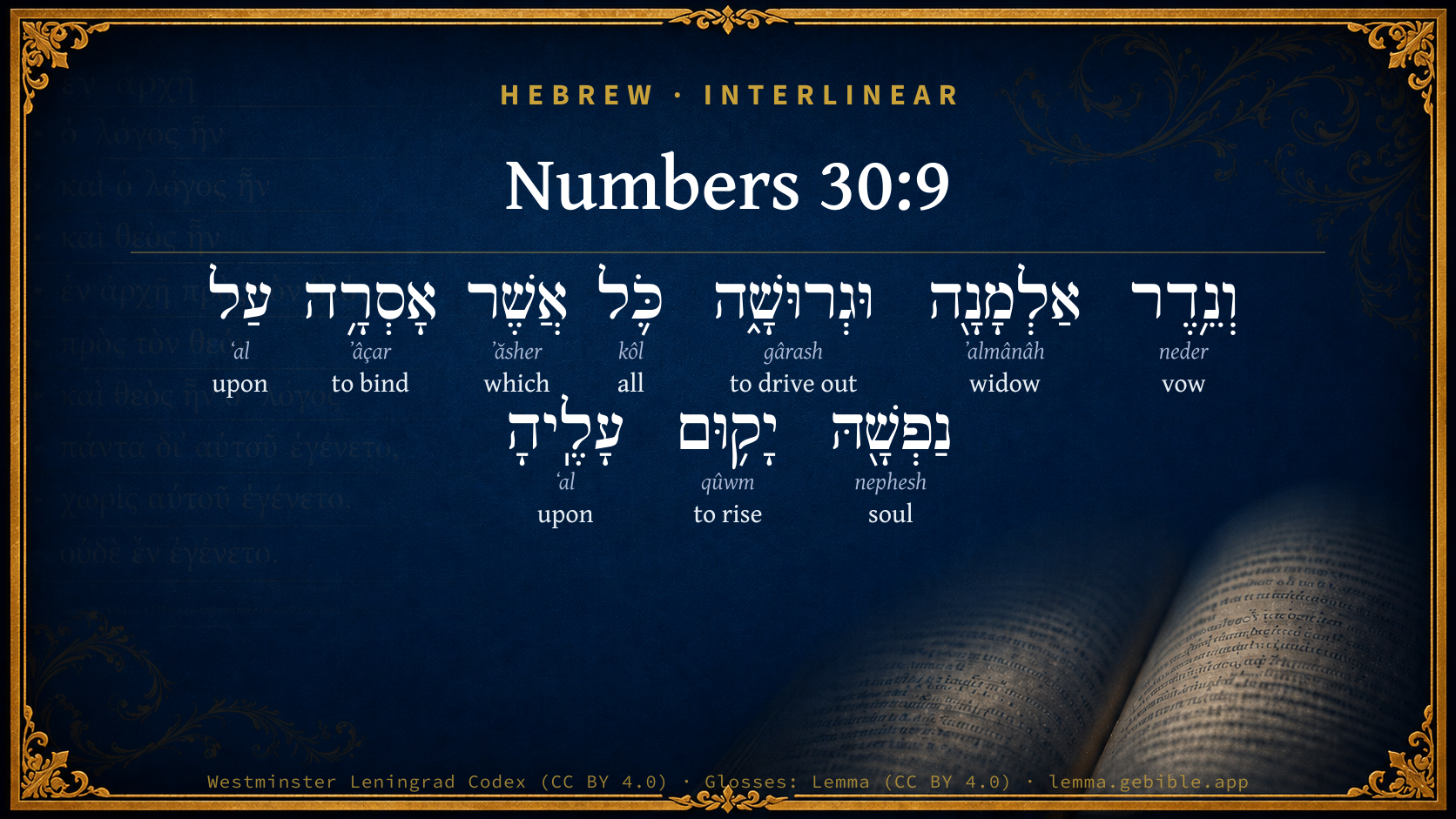
Hebrew (Westminster Leningrad Codex) Numbers 30:9 appears in the Hebrew Old Testament. The text above is from the Westminster Leningrad Codex. Each word links to its Strong’s number, a concise gloss, and parsing drawn from the Open Scriptures Hebrew Bible morphology. Click any word for its full Brown-Driver-Briggs (BDB) entry.
Download image
Cite this verse

Numbers 30:9 (World English Bible). Public Domain. Lemma interlinear Bible study tool, https://lemma.gebible.app/v/numbers/30/9.

Show BibTeX & RIS
BibTeX
RIS
English Translation
But the vow of a widow, or of her who is divorced, [even] everything with which she has bound her soul, shall stand against her.
World English Bible · Public Domain
Download a study sheet

One document with this verse’s original text, its word-by-word gloss line, the meaning frame, cross-references with their text, attributed commentary, and full source and license credits — printable, and it pastes into notes with its structure intact.

This verse Autodidact and up

Study sheet (.html) Plain text (.txt)

A passage Seminary Student

Up to 50 verses in one chapter. A passage sheet keeps up to 6 commentary sources and 12 cross-references per verse, in the order this page ranks them, and says so on the sheet whenever that leaves anything out. Ask for a single verse and you get the Autodidact verse sheet above.

Everything on this page stays free to read, with no account — the sheet is a download of what is already on screen, not access to it.

Want to remove ads? Support Godless Engineer
Compare translations 3

The same verse in 3 English versions, stacked beneath the original-language interlinear above. Click any original word for its lexicon entry.

Each is an independent rendering of the whole verse — the interlinear is not word-aligned to these translations.

Highlighted words mark where these versions differ — a whole-verse word diff, not a word-by-word alignment.

  • World English Bible Public Domain
    But the vow of a widow, or of her who is divorced, [even] everything with which she has bound her soul, shall stand against her.
  • King James Version Public Domain
    But every vow of a widow, and of her that is divorced, wherewith they have bound their souls, shall stand against her.
  • unfoldingWord Literal Text CC BY-SA 4.0
    And the vow of a widow and a driven out woman, all that she binds on her life shall stand on her.

unfoldingWord Literal Text — © unfoldingWord, licensed CC BY-SA 4.0. Word-aligned USFM3 via Door43 (git.door43.org/unfoldingWord/en_ult).

Versions to compare (up to 4)

3 of 4 selected

Show all 18 translations

Every available English version of this verse, each an independent rendering of the whole verse.

  • World English Bible Public Domain
    But the vow of a widow, or of her who is divorced, [even] everything with which she has bound her soul, shall stand against her.
  • Berean Standard Bible Public Domain
    Every vow a widow or divorced woman pledges to fulfill is binding on her.
  • Majority Standard Bible Public Domain
    Every vow a widow or divorced woman pledges to fulfill is binding on her.
  • King James Version Public Domain
    But every vow of a widow, and of her that is divorced, wherewith they have bound their souls, shall stand against her.
  • American Standard Version (1901) Public Domain
    But the vow of a widow, or of her that is divorced, `even' everything wherewith she hath bound her soul, shall stand against her.
  • Revised Version (1885) Public Domain
    But the vow of a widow, or of her that is divorced, even every thing wherewith she hath bound her soul, shall stand against her.
  • Geneva Bible (1599) Public Domain
    But if her husband disallow her the same day that hee heareth it, then shall hee make her vowe which shee hath made, and that that shee hath pronounced with her lips, wherewith shee bound her selfe, of none effect: and the Lord will forgiue her.
  • Douay-Rheims (1899) Public Domain
    But if as soon as he heareth he gainsay it, and make her promises and the words wherewith she had bound her soul of no effect: the Lord will forgive her.
  • Young's Literal Translation Public Domain
    `As to the vow of a widow or cast-out woman, all that she hath bound on her soul is established on her.
  • Literal Standard Version CC BY-SA 4.0
    As for the vow of a widow or cast-out woman, all that she has bound on her soul is established on her.
  • Unlocked Literal Bible CC BY-SA 4.0
    But as for a widow or a divorced woman, everything by which she has bound herself will remain in force against her.
  • unfoldingWord Literal Text CC BY-SA 4.0
    And the vow of a widow and a driven out woman, all that she binds on her life shall stand on her.
  • Darby Bible Public Domain
    But the vow of a widow, and of her that is divorced, -- everything wherewith she hath bound her soul shall stand against her.
  • World Messianic Bible Public Domain
    “But the vow of a widow, or of her who is divorced, everything with which she has bound her soul shall stand against her.
  • Webster's Bible Public Domain
    \\30:8\\But if her husband disallowed her on the day that he heard it; then he shall make of no effect her vow which she vowed, and that which she uttered with her lips, with which she bound her soul: and the LORD shall forgive her.
  • Free Bible Version CC BY-SA 4.0
    Every solemn promise made by a widow or a woman who is divorced must be kept.
  • Bible in Basic English Public Domain
    But if her husband, hearing of it, makes her take it back, then the oath she made and the undertaking she gave without thought will have no force or effect, and she will have the Lord's forgiveness.
  • JPS Tanakh (1917) Public Domain
    (30-10) But the vow of a widow, or of her that is divorced, even every thing wherewith she hath bound her soul, shall stand against her.

Literal Standard Version (2020), Covenant Press — licensed CC BY-SA 4.0. Text via the HelloAO Bible API (eBible.org). Unlocked Literal Bible (unfoldingWord) — licensed CC BY-SA 4.0. Text via the HelloAO Bible API (eBible.org). unfoldingWord Literal Text — © unfoldingWord, licensed CC BY-SA 4.0. Word-aligned USFM3 via Door43 (git.door43.org/unfoldingWord/en_ult). Free Bible Version, Dr. Jonathan Gallagher — licensed CC BY-SA 4.0. Text via the HelloAO Bible API (eBible.org).

Word by word

More ways to search: Search by grammar → Find every occurrence → Compare this word →

Practice this passage: Drill this verse → Learn its vocabulary →

וּגְרוּשָׁ֑ה
gârash
H1644
“and · driven out”
Conjunction + Verb, Qal, Participle Passive, Feminine, Singular, Absolute
Part of Speech
Conjunction + Verb
Stem
Qal
Form
Participle Passive
Gender
Feminine
Number
Singular
State
Absolute
Full BDB Definition

Origin: a primitive root

TWOT: 388

to drive out, expel, cast out, drive away, divorce, put away, thrust away, trouble, cast up - (Qal) to thrust out, cast out - (Niphal) to be driven away, be tossed - (Piel) to drive out, drive away - (Pual) to be thrust out
  1. וְנֵ֥דֶר neder H5088 “and · vow of” Conjunction + Noun, Common, Masculine, Singular, Construct
  2. אַלְמָנָ֖ה ʼalmânâh H490 “widow” Noun, Common, Feminine, Singular, Absolute
  3. כֹּ֛ל kôl H3605 “all” Noun, Common, Masculine, Singular, Absolute
  4. אֲשֶׁר ʼăsher H834 “which” Particle, Relative
  5. אָסְרָ֥ה ʼâçar H631 “to bind” Verb, Qal, Perfect, 3rd Person, Feminine, Singular
  6. עַל ʻal H5921 “upon” Preposition
  7. נַפְשָׁ֖הּ nephesh H5315 “soul · her” Noun, Common, Both, Singular, Construct + Suffix, Personal, 3rd Person, Feminine, Singular
  8. יָק֥וּם qûwm H6965 “to rise” Verb, Qal, Imperfect, 3rd Person, Masculine, Singular
  9. עָלֶֽיהָ ʻal H5921 “upon · her” Preposition + Suffix, Personal, 3rd Person, Feminine, Singular

About this verse

These counts appear in no published source. They are computed here, from the morphology-tagged text and Lemma’s own curated glosses. What Lemma adds →

10
words
9
distinct lemmas
Pentateuch
section

Shared distinctive vocabulary

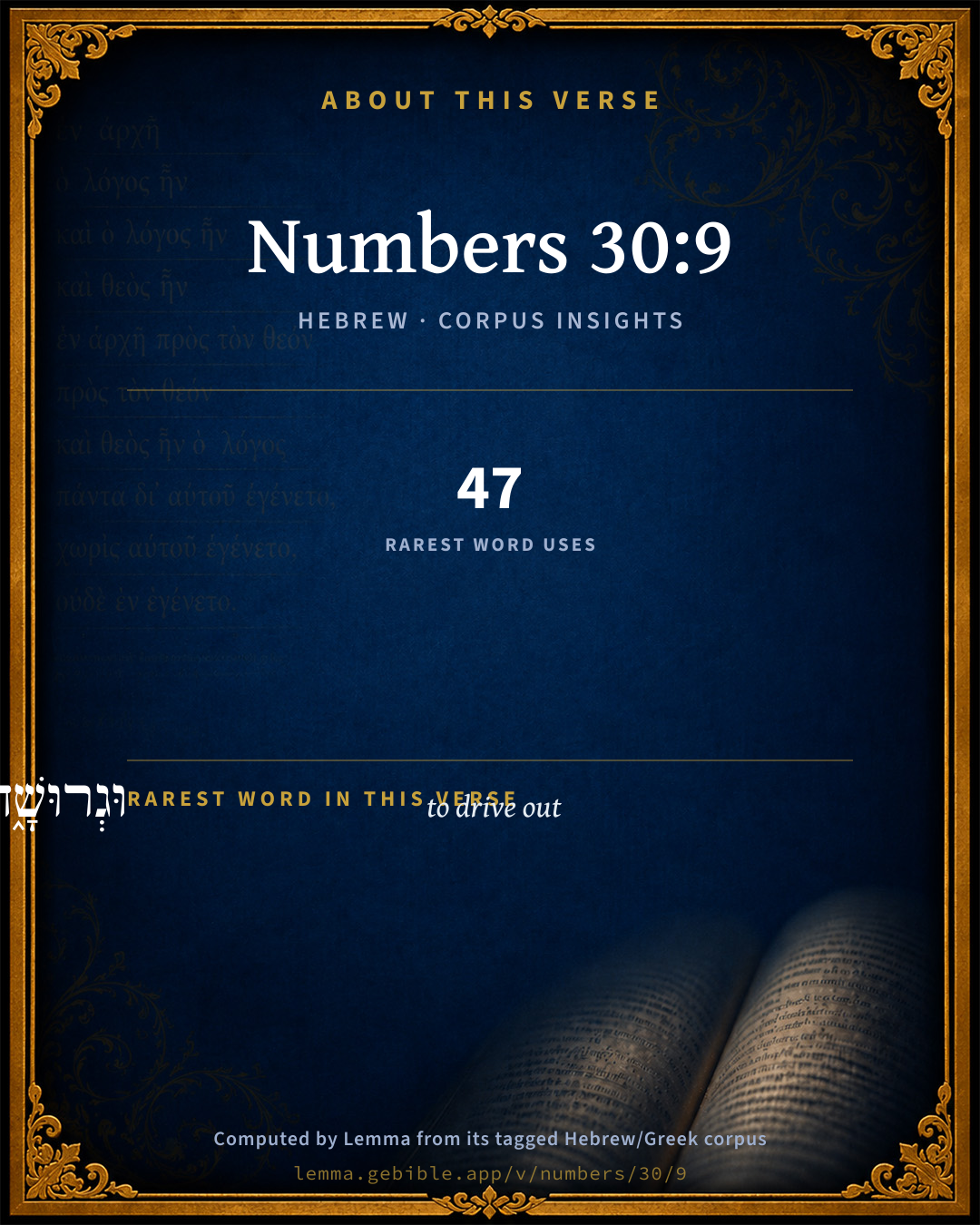
וּגְרוּשָׁ֑ה to drive out H1644 occurs in 45 verses of the Hebrew Bible. Also found in:

Grammatical profile

  • 3 verbs
  • 4 nouns
  • 2 prepositions
  • 1 particle

Verb forms

  • וּגְרוּשָׁ֑ה Qal · Participle Passive
  • אָסְרָ֥ה Qal · Perfect
  • יָק֥וּם Qal · Imperfect

Repetition

A word recurs within this verse — often emphatic in Hebrew:

Hebrew & Septuagint length

In English translation the verse runs 25 words from the Hebrew and 45 from the Septuagint (LXX English) — the Septuagint runs noticeably longer here. See the side-by-side →

A rough comparison of the two English renderings, which tokenize alike — not a word-level alignment.

Word counts can differ between the Hebrew and the Greek without any difference in meaning — e.g. the Hebrew direct-object marker אֵת has no separate Greek word, and Greek often adds the article ὁ.

Cross-references

3

Topical passages linked to Numbers 30:9 in the Treasury of Scripture Knowledge — connected by theme and wording, ordered by reader-vote popularity; previews shown in the World English Bible.

  • Luke 2:37 and she had been a widow for about eighty-four years), who didn't depart from the temple, worshipping with fastings and petitions night and day.
  • Romans 7:2 For the woman that has a husband is bound by law to the husband while he lives, but if the husband dies, she is discharged from the law of the husband.
  • Leviticus 21:7 "'They shall not marry a woman who is a prostitute, or profane; neither shall they marry a woman divorced from her husband: for he is holy to his God.

Cross-references courtesy of OpenBible.info (CC BY 4.0).

Hebrew and Greek witnesses Masoretic Hebrew ↔ Greek Septuagint

The same verse in the two great witnesses to the Old Testament, shown verse-for-verse.

Here the Septuagint runs noticeably longer than the Hebrew — LXX2012 (modern English Septuagint) 45 words vs World English Bible 25. A rough length comparison of the two English translations, not a word-level alignment — read both below.

These are two independent witnesses, not word-aligned to each other, and the Septuagint is shown in lemma (dictionary) form.

Hebrew Numbers 30:9 Masoretic · Westminster Leningrad Codex

וְנֵ֥דֶר אַלְמָנָ֖ה וּגְרוּשָׁ֑ה כֹּ֛ל אֲשֶׁר אָסְרָ֥ה עַל נַפְשָׁ֖הּ יָק֥וּם עָלֶֽיהָ

But the vow of a widow, or of her who is divorced, [even] everything with which she has bound her soul, shall stand against her.

World English Bible · Public Domain

Greek LXX Numbers 30:9 Septuagint · lemma form

ἐάν δέ ἀνανεύω ἀνανεύω ὁ ἀνήρ αὐτός ὅς ἄν ἡμέρα ἀκούω πᾶς ὁ εὐχή αὐτός καί ὁ ὁρισμός αὐτός ὅς ὁρίζω κατά ὁ ψυχή αὐτός οὐ μένω ὅτι ὁ ἀνήρ ἀνανεύω ἀπό αὐτός καί κύριος καθαρίζω αὐτός

But if her husband should straitly forbid her in the day in which he should hear her, none of her vows or obligations which she has contracted upon her soul shall stand, because her husband has disallowed her, and the Lord shall hold her guiltless.

LXX2012 (modern English Septuagint) · Public Domain

Hebrew: Westminster Leningrad Codex (CC BY 4.0). Greek: Septuagint (public domain); English from LXX2012 (modern English Septuagint) (Public Domain). How the Septuagint differs from the Hebrew →

Targum (Aramaic paraphrase)

2

The Targum is the ancient Jewish Aramaic paraphrase of the Hebrew Scriptures — an interpretive translation, not the Hebrew text itself. Onkelos (literal) and Pseudo-Jonathan (expansive) render the Torah, and Jonathan the Prophets. Coverage is partial: where no permissively-licensed English translation exists for a verse, only the Aramaic is shown. This is verse-level text, not a word-by-word alignment to the Hebrew.

  1. Targum Onkelos Torah (Genesis–Deuteronomy)
    וְאִם בְּיוֹמָא דִשְׁמַע בַּעֲלַהּ אַעְדִי יָתַהּ וִיבַטֵּל יָת נִדְרָהָא דִי עֲלַהּ וְיָת פֵּירוּשׁ סִפְוָתָהָא דִי אֲסָרַת עַל נַפְשַׁהּ וּמִן קֳדָם יְיָ יִשְׁתְּבֵק לַהּ

    (no public-domain English translation for this verse)

    Targum Onkelos — Aramaic: “Onkelos Genesis” (public domain); “Onkelos Exodus” (public domain); “Onkelos Leviticus” (public domain); “Onkelos Numbers” (public domain); “Onkelos Deuteronomy” (public domain). English: “Sefaria Community Translation” (CC0 1.0 (public-domain dedication)); “J.W. Etheridge. The Targums of Onkelos and Jonathan Ben Uzziel on the Pentateuch. London: Longmans, Green, 1862” (public domain). Text via Sefaria.

  2. Targum Pseudo-Jonathan Torah (Genesis–Deuteronomy)
    וְאִין בְּיוֹמָא דְשָׁמַע בַּעֲלָהּ בָּטִיל לָהּ וְיִשְׁרֵי יַת נִדְרָהּ דַעֲלָהּ וְיַת פֵּירוּשׁ סִפְתָהָא דַאֲסָרַת עַל נַפְשָׁהּ וּמִן קֳדָם יְיָ יִשְׁתְּרֵי וְיִשְׁתְּבֵק לָהּ

    But if her husband prohibit her on the day that he heareth, then the vow which is upon her, and the utterance of her lips which bound her soul, are remitted and forgiven her.

    Targum Pseudo-Jonathan — Aramaic: “Targum Jonathan on Genesis” (public domain); “Targum Jonathan on Exodus” (public domain); “Targum Jonathan on Leviticus” (public domain); “Targum Jonathan on Numbers” (public domain); “Targum Jonathan on Deuteronomy” (public domain). English: “The Targum of Jonathan ben Uzziel, trans. J. W. Etheridge, London, 1862” (public domain). Text via Sefaria.

Commentary

Notes on Numbers 30:9 from classic Christian and Jewish commentators (each source and its license shown beneath its notes). The classic Christian expositions comment on the surrounding passage and are grouped to its opening verse, so a note may address several verses; the Jewish commentaries on the Tanakh (Rashi and others) are per-verse, so they appear only where the commentator wrote on this verse.

Lemma curates 59 commentaries, every one of them public domain or Creative Commons licensed, each selected and text-cleaned for this edition rather than reprinted as found. About our sources →

Joseph Benson's Commentary

Num 30:9. Widow or divorced — Though she be in her father’s house, whither such persons often returned.

Joseph Benson's Commentary on the Old and New Testaments (1811–1818) — public domain. Text from a community e-Sword module.

Whedon's Commentary on the Bible

Daniel D. Whedon

THE VOW OF THE WIDOW AND OF THE DIVORCED WIFE, Num_30:9.

Such a vow must be paid, because both the widow and the divorced wife are free from the law of the husband and the father also. According to the rabbins, marriage to a second husband before the vow is performed has no effect upon the vow. It is not in his power to make it void.

Daniel D. Whedon (gen. ed.), Commentary on the Old and New Testaments (1874–1909) — public domain. Text from a community e-Sword module.

Tyndale Open Study Notes

Tyndale Open Resources

30:9 A widow or a divorced woman usually returned to her father’s family (Lev 22:13), but a mature single woman who made a vow or pledge was required to fulfill her religious duties.

Tyndale Open Study Notes — © Tyndale Open Resources, licensed CC BY-SA 4.0. Text via the HelloAO Bible API.

Geneva Bible (1599)

Geneva Bible translators

For she is in subjection to her husband, and can perform nothing without his consent.

Geneva Bible (1599) marginal notes — public domain. Text via Bolls.life.

Jamieson, Fausset & Brown

Robert Jamieson, A. R. Fausset & David Brown

every vow of a widow--In the case of a married woman, who, in the event of a separation from her husband, or of his death, returned, as was not uncommon, to her father's house, a doubt might have been entertained whether she was not, as before, subject to paternal jurisdiction and obliged to act with the paternal consent. The law ordained that the vow was binding if it had been made in her husband's lifetime, and he, on being made aware of it, had not interposed his veto [Num 30:10-11]; as, for instance, she might have vowed, when not a widow, that she would assign a portion of her income to pious and charitable uses, of which she might repent when actually a widow; but by this statute she was required to fulfil the obligation, provided her circumstances enabled her to redeem the pledge. The rules laid down must have been exceedingly useful for the prevention or cancelling of rash vows, as well as for giving a proper sanction to such as were legitimate in their nature, and made in a devout, reflecting spirit.

Next: Numbers Chapter 31

Jamieson, Fausset & Brown — Commentary Critical and Explanatory on the Whole Bible (1871) — public domain (CC PDM 1.0). Text via the HelloAO Bible API.

John Gill's Exposition

But every vow of a widow,.... The Scripture speaks, as Jarchi says, of a widow from marriage, or that has been married, but a widow from espousals (or that has been only espoused), the husband dead, the power is transmitted, and returns to the father; and with respect to such a case, it is said in the Misnah (y)"if the father (of such a betrothed person) dies, the power is not transmitted to the husband; but if the husband dies, the power is transmitted to the father; in this case, greater is the power of a father than of an husband; in others, greater is the power of an husband than of a father, because an husband makes void (the vow of) one at age, but a father does not make void (the vow of) such an one:"

and of her that is divorced: from her husband on some account or another; now in each of these cases, the one being loosed from the law of her husband by death, and the other by a bill of divorce, if they vowed:

the vows wherewith they have bound their souls shall stand against her; against either of them, they having none over them to disapprove of, contradict, and make void their vows.

(y) Nedarim, c. 10. sect. 2.

John Gill's Exposition of the Whole Bible (1746–1763) — public domain (CC PDM 1.0). Text via the HelloAO Bible API.

Matthew Poole's English Annotations

Though she be in her father’s house, whither such persons oft returned; which limitation may be gathered both from the opposition of her being

in her husband’s house, Num 30:10, and from hence, that this was the only doubtful cast for if such a person was not in her father’s house, she was unquestionably bound by it, but being now freed from her husband, and returned to her father, it was doubtful whether she was not returned to the same state of subjection in which she was before, and consequently unable to make or perform a vow without her father’s consent, as she was before, which is here denied.

Matthew Poole's English Annotations on the Holy Bible (1683–1685) — public domain. Text from a community e-Sword/MySword module.

The Pulpit Commentary

Every vow of a widow, and of her that is divorced. This is not one of the cases treated of in this section (see verse 16), but is only mentioned in order to point out that it falls under the general principle laid down in verse 2.

The Pulpit Commentary (1880–1919), ed. H.D.M. Spence-Jones & Joseph S. Exell — public domain. Text from a community e-Sword module.

John Wesley's Explanatory Notes

Widow or divorced - Though she be in her father's house, whither such persons often returned.

John Wesley, Explanatory Notes Upon the Whole Bible (1754–1765) — public domain. Text via the GEBible commentary corpus.

unfoldingWord translationNotes

Door43 World Missions Community

General Information:

Moses continues telling the leaders of the tribes what Yahweh has commanded.

a divorced woman

This can be stated in active form. AT: "a woman who has been divorced by a man" (See: Active or Passive)

by which she has bound herself

Here Moses speaks of how a woman has committed herself to fulfilling a promise as if her promise were a physical object that she had bound to her body. AT: "which she has committed herself to fulfill" (See: Metaphor)

will remain in force against her

This is an idiom. It means that her vows will remain in effect and she will be required to fulfill them. See how you translated a similar phrase in Numbers 30:4. AT: "she will be obligated to fulfill" (See: Idiom)

If a woman made a vow in her husband's house

This refers to a married woman. You can make the meaning of this statement clear. AT: "If a married woman makes a vow" (See: Assumed Knowledge and Implicit Information)

then all her vows must stand ... remain in force

This is an idiom. The phrase "remain in force" means that her vows will remain in effect and she will be required to fulfill them. See how you translated a similar phrase in Numbers 30:4. AT: "then she must fulfill all her vows ... she must fulfill" (See: Idiom)

all her vows must stand ... the obligations she made must remain in force

These two statements say basically the same thing twice for emphasis and can be combined. AT: "then all of her vows and promises with which she has made must remain in force" (See: Parallelism)

translationWords

divorce

oath

unfoldingWord translationNotes — © Distant Shores Media and the Door43 World Missions Community, licensed CC BY-SA 4.0. Source: git.door43.org/Door43/en_tn.

Rashi

Rabbi Shlomo Yitzchaki (Rashi)

והפר את נדרה AND HE (THE HUSBAND) ANNULS HER VOW — One might think that since confirmation by the husband does not require the assent of the father, in the case mentioned here it is annulled even if the father has not annulled it! It, however, states, (v. 17): "[These are the laws … relating to a father with his daughter] בנעריה בית אביה" which means: so long as she is בנעריה (not fully married) she is under her father’s control (Sifrei Bamidbar 155; Ketuvot 46b).

Rashi on the Tanakh — English translations: “The Judaica Press complete Tanach with Rashi, translated by A. J. Rosenberg” (CC BY 4.0); “Pentateuch with Rashi's commentary by M. Rosenbaum and A.M. Silbermann, 1929-1934” (public domain); “The Metsudah Tanach series, Lakewood, N.J” (CC BY 4.0); and “The Book of Joshua, Metsudah Publications, 1997” (CC BY 4.0). Text via Sefaria.

Lesson kit

Teaching starters — assembled from the data on this page, not authored interpretation. Every prompt links to the verse data it draws on. Edit before teaching.

Numbers, in the Pentateuch, opens this verse with 10 words (9 distinct Hebrew lemmas). Its most distinctive word is gârash (“to drive out”). The Greek Septuagint runs longer here. A historical commentator’s framing appears above. Read the whole chapter for the surrounding context.

Discussion questions

  1. What does “to drive out” (gârash) contribute to the verse as a whole?
  2. Genesis 3:24 shares the word «to drive out» with this verse. How do the two illuminate each other?
  3. “upon” occurs 2× in this one verse. What is the effect of the repetition?
  4. Compared with the Hebrew, the Septuagint runs longer here. What questions does that raise?
  5. These translations render this verse differently; the difference is in the English rendering, not the original. What questions does that raise?
  6. The verb «וּגְרוּשָׁ֑ה» is Qal Participle Passive. How does its form color the action?
  7. Reading how Joseph Benson's Commentary and Whedon's Commentary on the Bible read this verse, where do the two commentators agree and where do they part?

Things to notice

Reading settings

Reading text

Shown beneath each verse's original-language words.

Old Testament
Old Testament edition

Read the OT as the Masoretic Hebrew (MT) or the Greek Septuagint (LXX).

English shown for the Greek Septuagint (in the Hebrew ↔ Greek comparison).

Comparing translations? Open the Compare panel on any verse page to stack up to four side by side.