
1 John 4:15

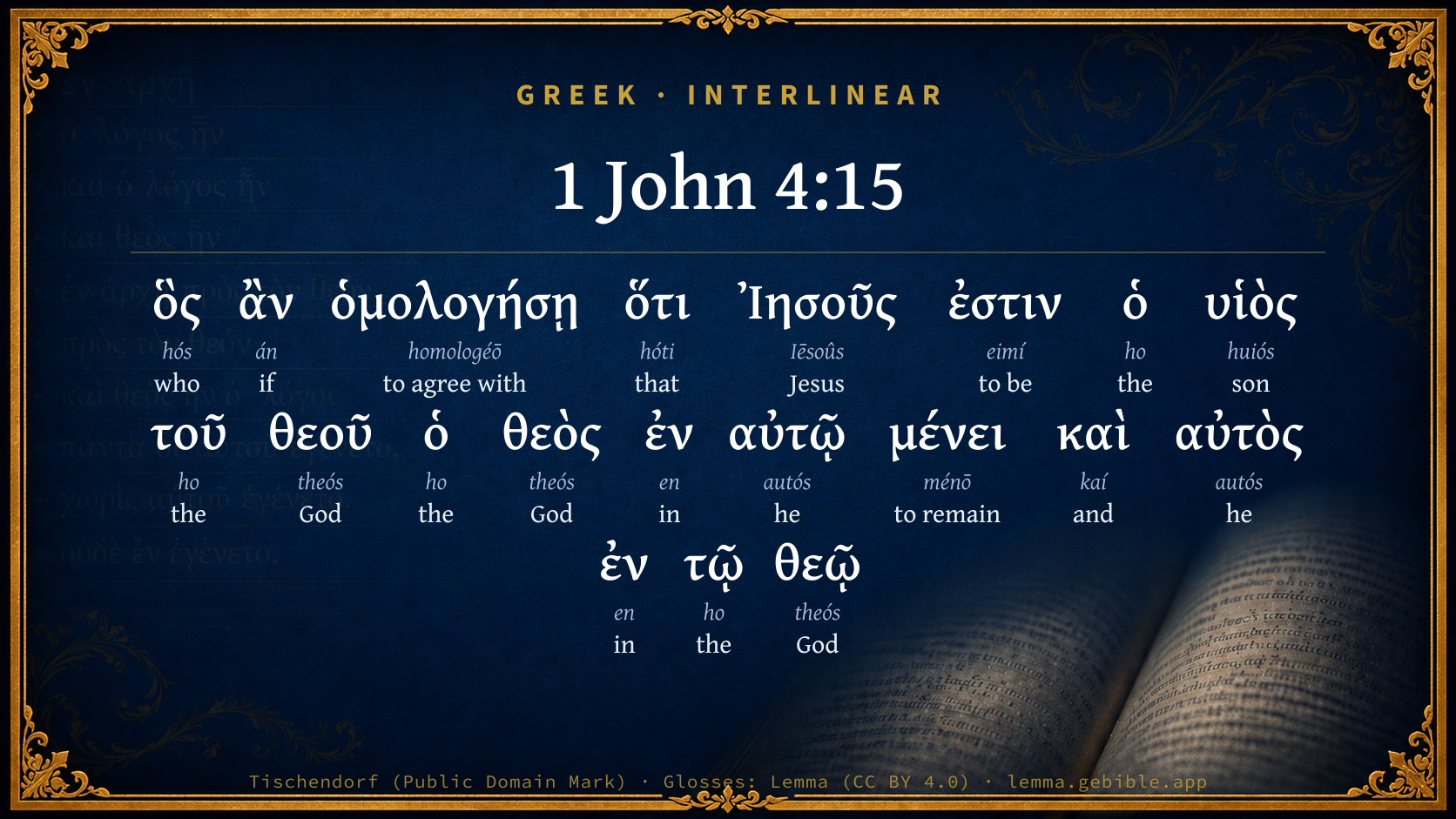
Greek (Tischendorf 8th ed.) 1 John 4:15 appears in the Greek New Testament. The text above is from the Tischendorf 8th edition. Each word links to its Strong’s number and a concise gloss. Click any word for its full Thayer’s Greek Lexicon entry.
Download image
Cite this verse

1 John 4:15 (World English Bible). Public Domain. Lemma interlinear Bible study tool, https://lemma.gebible.app/v/1-john/4/15.

Show BibTeX & RIS
BibTeX
RIS
English Translation
Whoever confesses that Jesus is the Son of God, God remains in him, and he in God.
World English Bible · Public Domain
Download a study sheet

One document with this verse’s original text, its word-by-word gloss line, the meaning frame, cross-references with their text, attributed commentary, and full source and license credits — printable, and it pastes into notes with its structure intact.

This verse Autodidact and up

Study sheet (.html) Plain text (.txt)

A passage Seminary Student

Up to 50 verses in one chapter. A passage sheet keeps up to 6 commentary sources and 12 cross-references per verse, in the order this page ranks them, and says so on the sheet whenever that leaves anything out. Ask for a single verse and you get the Autodidact verse sheet above.

Everything on this page stays free to read, with no account — the sheet is a download of what is already on screen, not access to it.

Want to remove ads? Support Godless Engineer
Compare translations 3

The same verse in 3 English versions, stacked beneath the original-language interlinear above. Click any original word for its lexicon entry.

Each is an independent rendering of the whole verse — the interlinear is not word-aligned to these translations.

Highlighted words mark where these versions differ — a whole-verse word diff, not a word-by-word alignment.

  • World English Bible Public Domain
    Whoever confesses that Jesus is the Son of God, God remains in him, and he in God.
  • King James Version Public Domain
    Whosoever shall confess that Jesus is the Son of God, God dwelleth in him, and he in God.
  • unfoldingWord Literal Text CC BY-SA 4.0
    Whoever confesses that Jesus is the Son of God, God remains in him and he in God.

unfoldingWord Literal Text — © unfoldingWord, licensed CC BY-SA 4.0. Word-aligned USFM3 via Door43 (git.door43.org/unfoldingWord/en_ult).

Versions to compare (up to 4)

3 of 4 selected

Show all 19 translations

Every available English version of this verse, each an independent rendering of the whole verse.

  • World English Bible Public Domain
    Whoever confesses that Jesus is the Son of God, God remains in him, and he in God.
  • Berean Standard Bible Public Domain
    If anyone confesses that Jesus is the Son of God, God abides in him, and he in God.
  • Majority Standard Bible Public Domain
    If anyone confesses that Jesus is the Son of God, God abides in him, and he in God.
  • King James Version Public Domain
    Whosoever shall confess that Jesus is the Son of God, God dwelleth in him, and he in God.
  • American Standard Version (1901) Public Domain
    Whosoever shall confess that Jesus is the Son of God, God abideth in him, and he in God.
  • Revised Version (1885) Public Domain
    Whosoever shall confess that Jesus is the Son of God, God abideth in him, and he in God.
  • Geneva Bible (1599) Public Domain
    Whosoeuer confesseth that Iesus is the Sone of God, in him dwelleth God, and he in God.
  • Douay-Rheims (1899) Public Domain
    Whosoever shall confess that Jesus is the Son of God, God abideth in him, and he in God.
  • Young's Literal Translation Public Domain
    whoever may confess that Jesus is the Son of God, God in him doth remain, and he in God;
  • Literal Standard Version CC BY-SA 4.0
    whoever may confess that Jesus is the Son of God, God remains in him, and he in God;
  • Unlocked Literal Bible CC BY-SA 4.0
    Whoever acknowledges that Jesus is the Son of God, God remains in him and he in God.
  • unfoldingWord Literal Text CC BY-SA 4.0
    Whoever confesses that Jesus is the Son of God, God remains in him and he in God.
  • Darby Bible Public Domain
    Whosoever shall confess that Jesus is the Son of God, God abides in him, and he in God.
  • World Messianic Bible Public Domain
    Whoever confesses that Yeshua is the Son of God, God remains in him, and he in God.
  • Webster's Bible Public Domain
    Whoever shall confess that Jesus is the Son of God, God dwelleth in him, and he in God.
  • Free Bible Version CC BY-SA 4.0
    God lives in everyone who declares that Jesus is the Son of God, and they live in God.
  • Bible in Basic English Public Domain
    Everyone who says openly that Jesus is the Son of God, has God in him and is in God.
  • Text-Critical English NT CC BY 4.0
    If anyone confesses that Jesus is the Son of God, God abides in him, and he in God.
  • Tyndale New Testament (1534) Public Domain
    Whosoever confesseth that Iesus is the sonne of god in him dwelleth god and he in god.

Literal Standard Version (2020), Covenant Press — licensed CC BY-SA 4.0. Text via the HelloAO Bible API (eBible.org). Unlocked Literal Bible (unfoldingWord) — licensed CC BY-SA 4.0. Text via the HelloAO Bible API (eBible.org). unfoldingWord Literal Text — © unfoldingWord, licensed CC BY-SA 4.0. Word-aligned USFM3 via Door43 (git.door43.org/unfoldingWord/en_ult). Free Bible Version, Dr. Jonathan Gallagher — licensed CC BY-SA 4.0. Text via the HelloAO Bible API (eBible.org).

Word by word

More ways to search: Search by grammar → Find every occurrence → Compare this word →

Practice this passage: Drill this verse → Learn its vocabulary →

ὁμολογήσῃ
homologéō
G3670
“to agree with”
Verb, Aorist, Active, Subjunctive, 3rd person, Singular
Part of Speech
Verb
Tense
Aorist
Voice
Active
Mood
Subjunctive
Person
3rd person
Number
Singular
Full Thayer's Definition

Origin: from a compound of the base of G3674 and G3056

TDNT: 08:19,7

1. to say the same thing as another, i.e. to agree with, assent 2. to concede a. not to refuse, to promise b. not to deny 1. to confess 2. declare 3. to confess, i.e. to admit or declare one's self guilty of what one is accused of 3. to profess a. to declare openly, speak out freely b. to profess one's self the worshipper of one 4. to praise, celebrate
  1. ὃς hós G3739 “who” Relative pronoun, Nominative, Singular, Masculine
  2. ἂν án G302 “if” Particle
  3. ὅτι hóti G3754 “that” Conjunction
  4. Ἰησοῦς Iēsoûs G2424 “Jesus” Noun, Nominative, Singular, Masculine
  5. ἐστιν eimí G1510 “to be” Verb, Present, Active, Indicative, 3rd person, Singular
  6. ὁ ho G3588 “the” Article, Nominative, Singular, Masculine
  7. υἱὸς huiós G5207 “son” Noun, Nominative, Singular, Masculine
  8. τοῦ ho G3588 “the” Article, Genitive, Singular, Masculine
  9. θεοῦ theós G2316 “God” Noun, Genitive, Singular, Masculine
  10. ὁ ho G3588 “the” Article, Nominative, Singular, Masculine
  11. θεὸς theós G2316 “God” Noun, Nominative, Singular, Masculine
  12. ἐν en G1722 “in” Preposition
  13. αὐτῷ autós G846 “he” Personal pronoun, Dative, Singular, Masculine
  14. μένει ménō G3306 “to remain” Verb, Present, Active, Indicative, 3rd person, Singular
  15. καὶ kaí G2532 “and” Conjunction
  16. αὐτὸς autós G846 “he” Personal pronoun, Nominative, Singular, Masculine
  17. ἐν en G1722 “in” Preposition
  18. τῷ ho G3588 “the” Article, Dative, Singular, Masculine
  19. θεῷ theós G2316 “God” Noun, Dative, Singular, Masculine

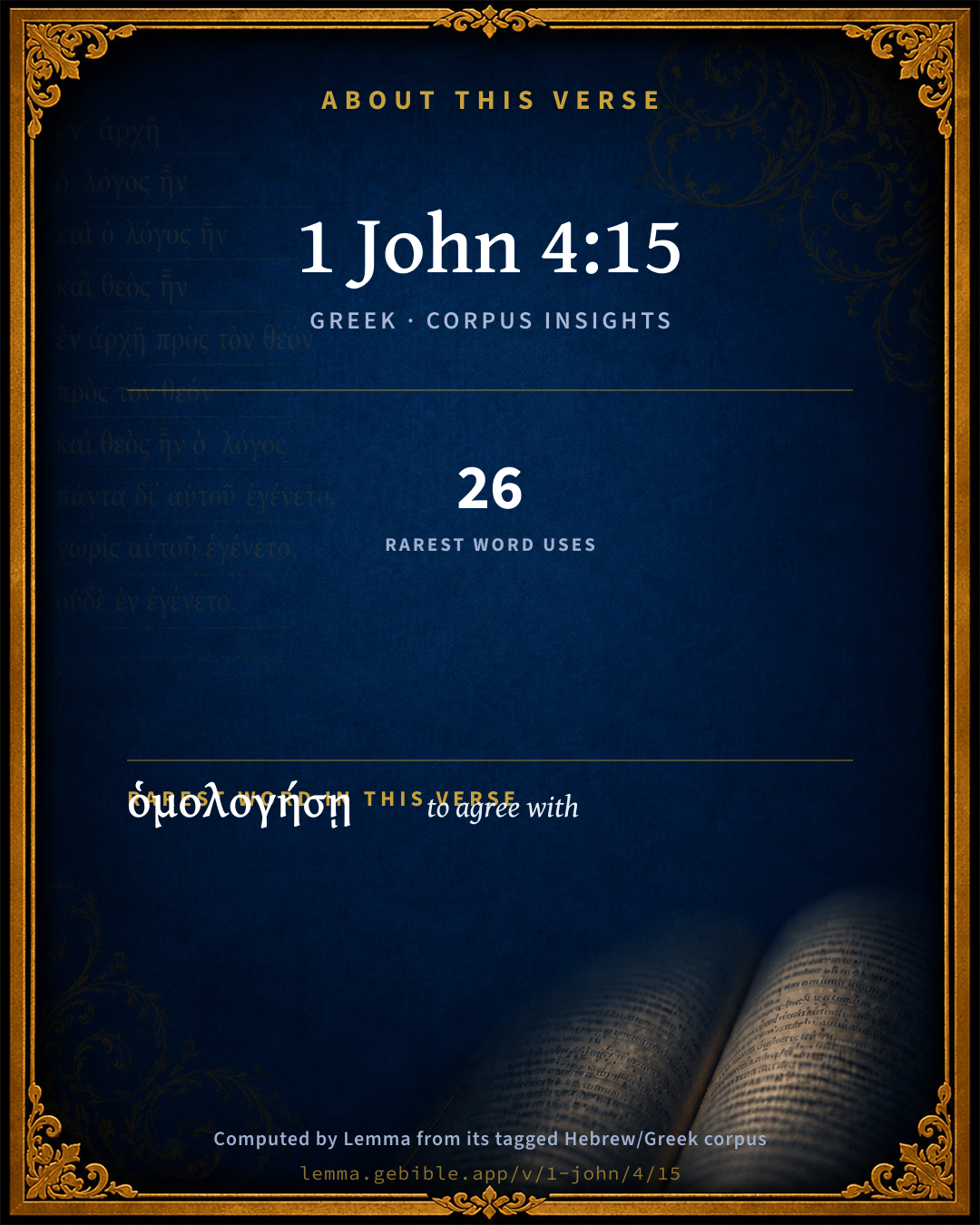
About this verse

These counts appear in no published source. They are computed here, from the morphology-tagged text and Lemma’s own curated glosses. What Lemma adds →

20
words
13
distinct lemmas
General Epistles
section

Shared distinctive vocabulary

ὁμολογήσῃ to agree with G3670 occurs in 23 verses of the Greek New Testament. Also found in:
Repetition

Words recur within this verse:

Cross-references

10

Topical passages linked to 1 John 4:15 in the Treasury of Scripture Knowledge — connected by theme and wording, ordered by reader-vote popularity; previews shown in the World English Bible.

  • Romans 10:9 that if you will confess with your mouth the Lord Jesus, and believe in your heart that God raised him from the dead, you will be saved.
  • Matthew 10:32 Everyone therefore who confesses me before men, him I will also confess before my Father who is in heaven.
  • 1 John 5:5 Who is he who overcomes the world, but he who believes that Jesus is the Son of God?
  • 1 John 3:24 He who keeps his commandments remains in him, and he in him. By this we know that he remains in us, by the Spirit which he gave us.
  • 1 John 4:2 By this you know the Spirit of God: every spirit who confesses that Jesus Christ has come in the flesh is of God,
  • Philippians 2:11 and that every tongue should confess that Jesus Christ is Lord, to the glory of God the Father.
  • 1 John 4:12 No one has seen God at any time. If we love one another, God remains in us, and his love has been perfected in us.
  • 1 John 5:1 Whoever believes that Jesus is the Christ is born of God. Whoever loves the father also loves the child who is born of him.
  • Luke 12:8 "I tell you, everyone who confesses me before men, him will the Son of Man also confess before the angels of God;
  • 2 John 1:7 For many deceivers have gone out into the world, those who don't confess that Jesus Christ came in the flesh. This is the deceiver and the Antichrist.

Cross-references courtesy of OpenBible.info (CC BY 4.0).

Where the printed editions differ

1 variant

Places in this verse where the major printed Greek editions disagree on the wording in a way that affects the translation — a comparison of editions, not a manuscript-by-manuscript collation. The editions are the modern critical texts (Nestlé-Aland 28/27, SBL, Westcott-Hort, Tregelles, Tyndale House) and the traditional texts behind the KJV (the Textus Receptus and the Byzantine/Majority text). It is not a claim about which reading is original.

  1. Extra text
    Χριστός

    “Christ”

    In WH Not in NA28NA27TynSBLTregTRByz

    Χριστός (Christos) 'Christ' is only in a few manuscripts (WH)

Textual data: Translators Amalgamated Greek New Testament (STEPBible TAGNT) · CC BY 4.0.

Commentary

Notes on 1 John 4:15 from classic Christian and Jewish commentators (each source and its license shown beneath its notes). The classic Christian expositions comment on the surrounding passage and are grouped to its opening verse, so a note may address several verses; the Jewish commentaries on the Tanakh (Rashi and others) are per-verse, so they appear only where the commentator wrote on this verse.

Lemma curates 59 commentaries, every one of them public domain or Creative Commons licensed, each selected and text-cleaned for this edition rather than reprinted as found. About our sources →

The Biblical Illustrator

Joseph S. Exell

1Jn_4:15

Whosoever shall confess that Jesus is the Son of God, God dwelleth in him, and he in God

Confessing Jesus as the Son of God

This implies--

1.

A deep and living conviction, a true perception of mind and heart, that Jesus Christ is the propitiation for our sins and the only Saviour for lost mankind.

2. A vital belief in His salvation, in the efficacy of His blood, and the power of His grace.

3. A hearty and full acceptance of the gospel of the Son of God; a resting in all the doctrines, a waiting for all the promises, an observance of all the ordinances, an obedience to all the commandments.

4. A proclaiming of the Lord as our Divine Redeemer in the face of the world. (J. Slade, M. A.)

The Biblical Illustrator, edited by Joseph S. Exell (c. 1880s–1900s) — public domain. Text from a community e-Sword module.

Joseph Benson's Commentary

1Jn 4:15-17. Whosoever shall — From a principle of loving faith, openly confess — In the face of all opposition and danger, maintaining this profession with resolution and zeal, and acting in conformity to it; that Jesus is the Son of God — The Christ, the Saviour of the world; God abideth in him, and he in God — There is a blessed union between God and his soul, so that it is, in the language of Scripture, the habitation of God; who, as it were, lives and walks in him, Eph 2:22; 1Co 3:16; 2Co 6:18. And we have known and believed — By the influence of the same Spirit; the love that God hath to us — And hath manifested, not only by giving his Son to die for us, (1Jn 4:9-10,) but by making us his children in and through his Son, 1Jn 3:1. God is love — The apostle repeats what he had declared 1Jn 4:8, where see the note; and he that abideth in love — Namely, in love to God, his people, and all mankind; abideth in God, and God in him — His union and communion with God are hereby continued and increased. Herein — Or hereby, that is, by the continuance of this communion with God; is our love made perfect — We are brought to love him with all our hearts, and our neighbour as ourselves; that we may have — That is, so that we shall have; boldness in the day of judgment — When all the stout-hearted shall tremble; because as he, Christ, is, so are we — Who are fathers in Christ; in this world — Even while we live on earth, so far as the imperfections of this mortal life, to which we are here confined, will admit.

Joseph Benson's Commentary on the Old and New Testaments (1811–1818) — public domain. Text from a community e-Sword module.

The Preacher's Complete Homiletical Commentary

Joseph S. Exell (gen. ed.)

CRITICAL AND EXEGETICAL NOTES

1Jn_4:15. Son of God.—St. John was jealous of the double truth of the person of Jesus—His Divinity and His humanity.

1Jn_4:17. Made perfect.—Or reaches its purpose and end. The sign of its being fully developed in us will be the removal of fear in relation to the “day of judgment.” We shall no more fear it than Jesus did. Enter into sonship, and all thought of judgment day passes away from us. Children are not afraid of their father.

1Jn_4:20-21.—A recapitulation, in a vivid form, of the truth and the duty contained in 1Jn_4:10-11. The love of our neighbour cannot be separated from the love of God, of which it is a distinguishing and essential mark. Sight is the great provocative of love. The difficulty of our loving God as an unseen being is met by the manifestation of God in His Son. This commandment.—Mat_22:37-39.

MAIN HOMILETICS OF THE PARAGRAPH.—1Jn_4:15-21

The Triumphs of the Perfect Love.—There is considerable repetition of statement in this epistle, the repetition of a man who has a few main truths which he holds tightly, and loves to brood over. He delights in the sound of them, and so goes over them again and again. The additional thought here is, that when our love—our love to God, and to our brother—has grown into such strength that it can fairly be called “perfect,” that is, perfect within the measures of the human, it proves to have a splendid power in our lives, elevating us to meet all occasions, freeing us from all fear, giving us grand inspirations, and even making us bold to meet the testings of the judgment day. Then, as if it were to him an absolutely essential point, he urges again on attention that the love he means is only that love which comes by the conviction and persuasion of God’s love in Christ to us, and finds its natural and befitting expression in self-sacrificing love to the brethren. 1Jn_4:18 is “proof of the preceding statement that perfect love will give us boldness, by showing the mutually exclusive nature of love and fear. Love moves towards others in the spirit of self-sacrifice; fear shrinks from others in the spirit of self-preservation. The two are to be understood quite generally; neither love of God nor fear of God is specially meant. In all relations whatever, perfect love excludes fear, and fear prevents love from being perfect. And the two vary inversely: the more perfect the love, the less possibility of fear; and the more the fear, the less perfect the love. But though as certain as any physical law, the principle, that perfect love excludes all fear, is an ideal that has never been verified in fact. Like the first law of motion, it is verified by the approximations made to it. No believer’s love has ever been so perfect as entirely to banish fear; but every believer experiences that as his love increases his fear diminishes” (A. Plummer, D.D.).

I. Love’s triumph in the judgment day.—What can there possibly be to condemn in a life ruled and toned by love? That can be answered by asking another question—What was there to condemn in that human life which was lived by the Lord Jesus, and was ruled and toned by love? It is inconceivable that the Lord Jesus could fear any attempt to appraise, or test, or judge His human life. Then, in the degree in which we have the perfect love, it can be said of us, “As He is, so are we in this world,” and therefore we need fear judgment no more that He did.

II. Love’s triumph over the inward distress of fear.—“Perfect love casteth out fear: because fear hath torment.” It worries us, causes fretting and anxiety, because it keeps our thoughts circling round self and self-interests. There is no fear in love, because it takes us out of ourselves, and makes us spend ourselves in the service of others. And anxiety about them is altogether different from fear, which concerns ourselves. “If we live in this serene atmosphere of pure sympathy with God and man, Christ is in us, and we in Him, because God is love itself. Sharing His nature, therefore, we must be like Him; and the more completely we allow this Divine love towards our Father and our brothers to transform our whole being, the more we shall be like our Judge, and the less cause we shall have for dread.” “The more perfect this disposition of serene sympathy becomes, the less share can any form of anxiety have in it. Where it is a well-grounded sympathy with a perfect being, its serenity is all the more complete in proportion to its sincerity.”

SUGGESTIVE NOTES AND SERMON SKETCHES

1Jn_4:15. The Divinity of Christ a Test Doctrine.—“Jesus is the Son of God.” Compare 1Jn_4:2, which demands the confession that “Jesus Christ is come in the flesh,” or took upon Himself a veritable human body. But this comparison brings to view a distinction not always recognised. Belief in the humanity of Christ is absolutely demanded as a condition of being a Christian at all; but no such absolute demand is made in relation to belief in Christ’s Divinity. What is said about that is that it is essential to the higher Christian life, it belongs to the higher experiences; the man who can see in Christ the Son of God enters into the more advanced privileges; God dwelleth in him, and he in God. When this distinction is set before us, we remember that our Lord’s disciples had Him first in a human fellowship, and apprehended Him, and believed in Him as the Messiah-man Christ Jesus. It even appears that they only very slowly grew into the idea of His Divine Sonship. St. Peter was manifestly in advance of them all with his confession. But none of them entered into the higher life of relations with Christ until they did fully grasp the truth of the Divine Sonship. To be saved men must believe in the human Saviour, in Christ “come in the flesh.” To be sanctified, to attain the higher life, men must believe that “Jesus is the Son of God.” So the test of the regenerate life was—and perhaps, if we stated things aright, we should see that it still is—believing that Christ is “come in the flesh.” And the test of Christian attainment is the sign of the cultured soul-power that can grip the truth, that “Jesus is the Son of God.”

1Jn_4:16. God is Love.—There is one form of worship that is universal and involuntary, and that is the resemblance which the deity and the devotee are certain to bear to one another. They who worship an idol are like to the idol in the beginning, for they fashion it after the model of something in themselves; but they grow more and more like to it afterwards, by sharing and copying the qualities with which they fancy the false god to be endowed. No man is better than what he burns incense to, but every man takes on more and more of the character of his favourite divinity. How came human parents by their love? Through the being made in the image and likeness of God. Parental love is a valuable salvage from the wreck of the Fall. This is our subject—the divinity of Love, and the love of Divinity.

I. The strong representation, “God is love.”—There is a most vital difference betwixt the conduct of any being and the character of any being; and there is a yet further distinction between character and essence. This emphatic language—the calling the Being the attribute—is a dignity reserved for this one attribute alone. I read that “with God is terrible majesty,” but I have no recollection of being told that “God is majesty.” (See, however, the expression “God is light.”) How could love have been embodied so richly as it was in the Seeker and Saviour of the lost, the Friend of little children, the Companion of sorrowful women, the Comforter of penitent outcasts, the Refuge of publicans and sinners, and the Sacrifice in body and blood for the world of the ungodly? Surely, herein is love. This text is Immanuel in print. We want both the “love” and the “God.” Call Christ “God,” or call Christ “Love,” as you need Him at the moment, for He is both. Being both makes Him the Mediator.

II. The extraordinary language touching the relation of the Christian with Christ.—We are, first, the inhabitants, with Christ for a dwelling, and then we are the houses, in which Christ makes a home. Two very different ideas, but both equally beautiful and equally instructive.—Henry Christopherson.

1Jn_4:18-21. Perfect Love casteth out Fear.—(This outline is given as an illustration of the evangelistic method of dealing with the passage.)

I. The state of an awakened soul.—“Fear hath torment.” There are two kinds of fear mentioned in the Bible. The one is the atmosphere of heaven, the other of hell.

1. There is the fear of love.

2. There is the fear of terror. Deal with the latter, and explain its rise in the soul.

(1) A natural man casteth off fear, and restrains prayer before God.

(2) When the Spirit of God opens the eyes, He makes the sinner tremble.

(3) The Spirit makes him feel the greatness of sin, the exceeding sinfulness of it.

(4) Then the sense of corruption working in the heart torments the soul.

(5) The Spirit also convinces the soul of his inability to help himself.

(6) And then the man fears he shall never be in Christ.

II. The change on believing.—The love here spoken of is not our love to God, but His to us; for it is called perfect love.

2. But where does this love fall? On Jesus Christ.

III. His love gives boldness in the day of judgment—Because then—

1. Christ shall be our Judges 2. The Father Himself loves us.

IV. The consequences of being in the love of God—

1. We love Him.

2. We love our brother.—R. M. McCheyne.

1Jn_4:18. Two Kinds of Fear.—The Bible speaks of two kinds of fear. One is terror, fright, dread,—the lively apprehension of evil to come; the crouching and crying of the dog in anticipation of the lash whose whistle in the air he already hears. The other is reverence, respect, adoration,—the awe that fills the mind as it stands in the presence of errorless Wisdom; the instinctive tribute that weakness pays to Omnipotence; the admiration that human frailty cannot conceal, or suppress, when God’s flawless goodness rises before it; tho impression of the Divine on the human; the worshipful stoop of the soul before God, not because it is frightened, not because God has thunder-bolts in His hands, and legions of heaven-bright warriors, with swords that turn every way around Him, but because He is altogether lovely, because He has mercy for thousands, because He is holy and good, because He is God—because He is Love.—J. Morgan Gibbon.

Love and Fear.—In the epistles of the apostle of love comes out most broadly, most sternly, the principle that all mankind are divided into two great classes,—the one, those that are of God; and the other, those that are of the world and of the devil. Whatever is not of light is darkness. There are only two motives, St. John says, that rule men in regard to God—only two emotions: either love or fear.

I. The universal dominion of fear.—Wherever there is not the presence of active love. This rests on the universal consciousness of sin. All men everywhere have some more or less active or torpid working of conscience. It is not made doubtful by the fact, that the ordinary condition of men is not one of active dread of God. Man has a strange power of refusing to think of a subject, because he knows that to think of it would be torture and terror. The fear which springs from the conviction of God as righteous, and the consciousness of individual sinfulness, varies in energy with the varying strength of these two convictions, and it assumes various forms. Sometimes it appears as a straining after forgetfulness—that is fear wearing the mask of godlessness. Sometimes it assumes the very opposite shape, and becomes the underlying basis of vast and complicated systems of rigorous, joyless worship—that is fear wearing the mask of godliness. Sometimes this fear takes the understanding into its pay, and appears as enlightened disbelief in God and immortality. Sometimes it takes the shape of vehement efforts to get rid of unwelcome thought by fierce plunging into business, or into wild riot. Whatever form it take, the fear which hath torment lies like a sleeping serpent in the hearts of all who think of God, and who cannot say, “We have known and believed the love which God hath to us.”

II. The fearlessness of perfect love.—Love is no weak thing, no mere sentiment. The manliness of Christian love, and the putting away from ourselves of all fear, because we are “perfected in love,” is one of the highest lessons that the gospel teaches us, and one of the greatest things which the gospel gives us. Love and fear exclude each other. Fear is based upon a consideration of some possible personal evil consequence coming down upon me from that clear sky above me. Love is based upon the forgetfulness of self altogether. The love of God, entering a man’s heart, destroys all fear of Him. All the attributes of God come to be on our side. The love which casts out fear rises in the heart as a consequence of knowing and believing the love which God hath to us. This love to God, which is built upon God’s love to us, is the all-powerful motive for every good thing. If you would grow in power, holiness, blessedness, remember this, “Love is the fulfilling of the law.” Perfect love is perfect man. And love, which destroys fear, heightens reverence and deepens self-distrust.—A. Maclaren, D.D.

1Jn_4:19. The Genesis of Christian Love.—“We love, because He first loved us.” Spontaneous love, loving just because He is love, and must give out Himself, may be predicated of God, but it can be predicated of none else. Yet even the love of God can do nothing until it finds an object to spend itself upon. All love other than God’s is kindled by love. It is like life—it cannot exist save by the contact of love. Nobody on earth ever loves unless he is loved. The love may be that of some one who loves us, or it may be the love of some one whom we love. In any and every case we love because somebody loves us. And St. John does not simply say that we love God because He loves us; but he urges the larger and altogether more searching truth, that the love of God to us cannot have its right influence on us unless it makes us loving—loving to the brethren, loving to everybody. The Christian love is precisely that feeling a man can alone have when he “knows and believes the love that God hath unto him.”

Love the Cause of Love.

I. The love of God to us as sinners is the “sole” cause of our love to Him.—To make this fully appear, we may specify those other sources from which this disposition might be supposed to proceed.

1. Our love to God might be supposed to be the result of a superior discernment of the Divine character. But as that character is an object of dislike to all men in their natural, fallen state, it is obvious that this repugnance is not to be overcome by the exhibition of that character in a clearer light. An object of terror or dislike, so long as it is viewed as such, cannot be loved; and the more distinctly such an object appears, the more intensely will it be hated. The antipathy to it can only be removed by means of some new discovery, which shall place that object in an attractive light.

2. It might be thought that love to God, where it exists, is the result of some predisposition in the sinner’s heart towards God. Such partialities and predilections operate very generally among men. But since the heart of every man, by nature, is at enmity to God, our love to Him cannot be attributed to this source. If in any heart it might have originated thus, we should expect to find it in the amiable John. But he himself is no exception.

3. It might be supposed, again, that the principle of love to God is directly planted in the heart by the hand of God. But true love cannot be forced; it withers under the breath and touch of violence. No other source but the Divine compassion to us as sinners can give birth to this heavenly principle.

II. This love of God is the “sufficient” cause of our love to Him.—The stoutest rebel must relent and love a Being whose mercy and compassion he has been brought to feel extends to himself.—Anon.

1Jn_4:20. Keeping with Brethren.—To separate ourselves from our brethren is to lose power. Half-dead brands heaped close will kindle one another, and flame will sparkle beneath the film of white ashes on their edges. Fling them apart, and they go out. Rake them together, and they glow. Let us try not to be little, feeble tapers, stuck in separate sockets, and each twinkling struggling rays over some inch or so of space; but draw near to our brethren, and be workers together with them, that there may rise a glorious flame from our summed and collective brightness which shall be a guide and hospitable call to many a wandering and weary spirit.—A. Maclaren, D.D.

ILLUSTRATIONS TO CHAPTER 4

1Jn_4:17. Perfect Love.—We are along way yet from perfect love; it is too Divine a thing to be speedily fulfilled in the creature. But we are coming to it; and then, when we do come to it, we shall know more fully how great and blessed it is as the best wine, creation’s endless festival, by reviewing the ages upon ages of division and strife through which we have struggled on to the unity of love in Christ. The labours of God, the labours of the angels, the labours of the Church, the groans and contentions of all creatures and all elements, will go on, and never cease, until the redemption of mankind; for the perfect individual is essential to the perfection of love.—Pulsford.

1Jn_4:18. Love casting out Fear.—The literal sense of this verse is as follows: (Slavish) fear exists not in this love, but perfect love (such as this) casts aside fear; for (such) fear carries with it terror (which is inconsistent with love), since he who feareth is not perfected in love, does not love perfectly and sincerely. φόβος, “fear,” here signifies a fear, not of displeasing God, but of incurring His punishment, which conscience raises. “Casteth out fear” refers to the previous verse, and is contrasted with a joyful confidence in the mercy of God—Bloomfield.

1Jn_4:19. Love-won Love.—Have you seen a broad, straight path of silver brightness lying by night upon a smooth sea, and stretching from your feet away until it was lost in the distance—a path that seemed to have been trodden by the feet of all the saints who have ever passed through a shifting world to the eternal home? Oh, that silver path by night across the sea, it glittered much; but it was not its brightness that lighted up the moon in the sky, neither was it the love to Jesus, trembling in a believer’s heart, that kindled forgiving love in Him! The love that makes bright a forgiven sinner’s path across the world was kindled by the light of life in the face of Jesus.—W. Arnot.

CHAPTER 5

The Preacher's Complete Homiletical Commentary (gen. ed. Joseph S. Exell; Funk & Wagnalls, c. 1892) — public domain (pre-1929). A full-Bible homiletical/sermon-outline anthology covering 65 of 66 books (2 John is absent from the source module). Text from a community e-Sword module.

Tyndale Open Study Notes

Tyndale Open Resources

4:15 Those who believe in Christ have God living in them, and they live in God. The Father and the Son experience this fellowship (John 10:38; 14:10; 17:21). Experiencing God in this way is a special privilege for believers (see John 14:20; 15:5; 17:21-24).

Tyndale Open Study Notes — © Tyndale Open Resources, licensed CC BY-SA 4.0. Text via the HelloAO Bible API.

Bengel's Gnomon

Johann Albrecht Bengel

1Jn 4:15. Ὁ Υἱὸς τοῦ Θεοῦ, the Son of God) and therefore the Saviour of the world, 1Jn 4:14.

Bengel's Gnomon of the New Testament — English translation (T&T Clark, Edinburgh, 1860) — public domain. Text from a community e-Sword module.

Expositor's Greek Testament

ed. W. Robertson Nicoll

1Jn 4:15 . ὁμολογήσῃ , aor. of a definite confession born of persuasion. Such a conviction implies fellowship with God.

The Expositor's Greek Testament, edited by W. Robertson Nicoll (1897–1910) — public domain. Text from a community e-Sword module.

Geneva Bible (1599)

Geneva Bible translators

With such a confession as cometh from true faith and is accompanied with love, so that there be an agreement of all things.

Geneva Bible (1599) marginal notes — public domain. Text via Bolls.life.

Jamieson, Fausset & Brown

Robert Jamieson, A. R. Fausset & David Brown

shall confess--once for all: so the Greek aorist means.

that Jesus is the Son of God--and therefore "the Saviour of the world" (Jo1 4:14).

Jamieson, Fausset & Brown — Commentary Critical and Explanatory on the Whole Bible (1871) — public domain (CC PDM 1.0). Text via the HelloAO Bible API.

Adam Clarke's Commentary

Verse 15. Whosoever shall confess] Much stress is laid on this confession, because the false teachers denied the reality of the incarnation; but this confession implied also such a belief in Christ as put them in possession of his pardoning mercy and indwelling Spirit.

Adam Clarke's Commentary on the Bible (1810–1826) — public domain. Text from a community e-Sword/MySword module.

John Calvin's Commentaries

15 Whosoever shall confess He repeats the truth, that we are united to God by Christ, and that we cannot be connected with Christ except, God abides in us. Faith and confession are used indiscriminately in the same sense; for though hypocrites may wisely boast of faith, yet the apostle here acknowledges none of those who ordinarily confess, but such as truly and from the heart believe. Besides, when he says that Jesus is the Son of God, he briefly includes the sum and substance of faith; for there is nothing necessary for salvation which faith finds not in Christ

After having said in general, that men are so united to Christ by faith, that Christ unites them to God, he subjoined what they themselves had seen so that he accommodated a general truth to those to whom he was writing. Then follows the exhortation, to love one another as they were loved by God. Therefore the order and connection of his discourse is this, — Faith in Christ, makes God to dwell in men, and we are partakers of this grace; but as God is love, no one dwells in him except he loves his brethren. Then love ought to reign in us, since God unites himself to us.

John Calvin's Commentaries (1540-1563) — public domain. Text from the Calvin Translation Society English edition (1840s-50s) via the Christian Classics Ethereal Library (ccel.org). Calvin's coverage is partial (roughly two-thirds of the Bible); uncommented books and verses are honest gaps, never fabricated. The 19th-century editor's footnotes and remarks are omitted so the notes are faithfully Calvin's own voice.

The Cambridge Bible for Schools and Colleges

gen. ed. J. J. S. Perowne

15. Whosoever shall confess] This was what the false prophets refused to do: see on 1Jn_4:2-3 : also on 1Jn_5:1.

dwelleth in him] Better, abideth in him: see on 1Jn_2:24.

and he in God] The communion is of the closest description: comp. 1Jn_3:24; Joh_6:56; Joh_14:20; Joh_15:5. Even Apostles, who have beheld and borne witness, can have no more than this Divine fellowship, which is open to every believer.

The Cambridge Bible for Schools and Colleges (gen. ed. J. J. S. Perowne; Cambridge University Press, 1878–1918) — public domain. Text from a community e-Sword module.

John Gill's Exposition

Whosoever shall confess that Jesus is the Son of God,.... The only begotten of the Father; that he is not a mere man, as the Jews, and Ebion and Cerinthus said, but a divine person, equal with the Father; which contains all that relates to the dignity of his person, and his fitness for his office as a Saviour, and which was the test of faith in those times, and the grand article of belief: not that a bare assent to this had what followed annexed to it; for the devils believed and owned that Jesus was the Son of God; and so might, and did, unregenerate persons, as the centurion at the cross of Christ, who know nothing what communion with God is; but this confession is such as is attended with a believing in Christ from the heart unto righteousness, life, and salvation, and a cheerful obedience to his ordinances and commands, from a principle of love to him, and faith in him, things not to be found in devils and carnal men; see Rom 10:9.

God dwelleth in him, and he in God; See Gill on Jo1 4:13; this should encourage to an open and hearty confession of Christ as the Son of God, and Saviour of sinners, and to a public profession of his name, and faith in him, and an holding it fast without wavering.

John Gill's Exposition of the Whole Bible (1746–1763) — public domain (CC PDM 1.0). Text via the HelloAO Bible API.

Trapp's Complete Commentary

John Trapp

15 Whosoever shall confess that Jesus is the Son of God, God dwelleth in him, and he in God.

Ver. 15. Whosoever shall confess] {See Trapp on "1Co 12:3"}

John Trapp, A Commentary or Exposition upon All the Books of the Old and New Testament (1647–1656) — public domain. Text from a community e-Sword module.

Albert Barnes' Notes on the Bible

Whosoever shall confess that Jesus is the Son of God - In the true sense, and from the heart. This will always prove that a man is a Christian. But the passage cannot mean that if he merely says so in words, or if he does it insincerely, or without any proper sense of the truth, it will prove that he is a Christian. On the meaning of the sentiment here expressed, see the notes at 1Jo 4:2. Compare the notes at Rom 10:10.

Albert Barnes' Notes on the Bible (1834–1885) — public domain. Text from a community e-Sword/MySword module.

Matthew Poole's English Annotations

This discourse is most studiously and observably interwoven, of these two great things, mentioned 1Jo 3:23, faith in the Messiah, and the love of one another, as being the principal antidotes against the poisonous insinuations of the apostates. Of confessing: See Poole on "1Jo 4:2".

Matthew Poole's English Annotations on the Holy Bible (1683–1685) — public domain. Text from a community e-Sword/MySword module.

Whedon's Commentary on the Bible

Daniel D. Whedon

15. Confess—In accordance with our testify, in last verse.

Jesus… Son of God—Not but that men may barely confess this one article and reject other truths, and thus be unsaved heretics. Our apostle simply gives this essential part for the whole testify; this being the test question between him and the heretics with whom he is dealing, Note 1Jn_4:2.

Daniel D. Whedon (gen. ed.), Commentary on the Old and New Testaments (1874–1909) — public domain. Text from a community e-Sword module.

The Pulpit Commentary

Whosoever confesseth onv a oJmologhsh. This rendering seems preferable to "whosoever shall confess" or "shall have confessed." The exact meaning is, "Whosoever has once for all taken up the position of confessing." Verse 14 gave the ease of the apostles; this gives that of those who accept their witness. In the next verse we have that of both together.

Vers. 15, 16.

Divine love a home for the soul, and a force within it.

Connecting link: There is a connection between the several verses on which we are now dwelling (verses 7-19). But it is not so much a connection of thoughts that follow consecutively one from another, as a connection such as exists between glowing sparks that follow one after another, from the same mass, when struck upon the same anvil, by the same hammer, wielded by the same arm. The apostle gives us here a startlingly beautiful succession of truths concerning love Divine love revealed in Christ, and laying hold of men. Obviously, in verses 15, 16 there are two statements concerning believers generally shall confess," etc.; "He that dwelleth in love," etc. There is also one statement concerning the apostle and his fellow-workers We have known," etc. Let us take these in their order.

I HERE ARE TWO GENERAL STATEMENTS, CONCERNING A BLESSED CONDITION AND THOSE TO WHOM IT BELONGS.

1. Here is a supremely happy condition. It is twofold.

(1) The soul full of God. "God dwelleth in him". (cf Joh_6:56 Joh_14:23; Col_1:27; Gal_2:20; 2Co_13:5; Rom_8:9; Eph_2:22 Eph_5:18; Rev_3:20) In some passage the Dweller in the heart is spoken of as "Christ," sometimes as "the Spirit," sometimes as "the Father with the Son," sometimes as "God by the Spirit." In all cases the meaning is that there is a Divine Energy within the man, quickening, inspiring, and controlling him a new directing and strengthening force, leading on to all holy action, to patient endurance, to final victory. Man moves not upward and heavenward by a self-elicited force, but soars thither by a Divine power imparted and sustained from above!

(2) The soul at home in God. "He dwelleth in God." God is not only a new life in him, but a new home for him, in which he abides, and from which he cannot be dislodged. His wanderings are over. He has a settled rest, an everlasting home. It is in the Father"s house, nay, in the Father"s heart, the heart of boundless love. He is seated now in "the heavenly places in Christ Jesus." Happy, happy home! It is heaven. It will never break up. No foe can invade it. Sin shall not mar it. Death cannot disturb it. Oh, to have found already a home like this! It is well worth our while to ask to whom it belongs. (Note: The two indwellings complete each other. God dwelling in the soul ensures the soul continuously dwelling in its true home; and the soul, being always at home, has entire repose, leaving all its force free for harpy, holy service.)

2. To whom does this twofold blessedness belong? See footnote to homily 1Jn_3:4-12. There are here two statements in reply to this question. The apostle says, "Whosoever shall confess that Jesus is the Son of God" is thus blessed; and that "he that dwelleth in love" is so also. We must elucidate this by offering, first, a word or two on each phrase, and then by showing the connection that exists between them.

(1) The twofold indwelling is realized by him who "dwells in love," i.e., whose whole being is, as it were, bathed in an atmosphere of love; who lives, moves, thinks, acts, in that sphere, and never out of it. Such a one "dwells in God," etc. The definite article ejn th ajaph should be noticed here, as defining the love. Following, too, on the phrase, oJ Qeoph ejsti, its force is equivalent to "God is love, and he that lives and moves in that love of God has his abiding home in the God of love.

(2) The twofold indwelling is realized also by him who "confesses that Jesus is the Son of God." This sentence probably is suggested by verse 14, indicating that the continuous witness-bearing for Christ caused them to realize more fully than ever their heavenly privilege, a privilege which the apostle seems to say, "Every confessor will share with us." It is very remarkable, however, that the apostle should attribute a like blessedness to such apparently different (but not contradictory) conditions. The reciprocal indwelling is realized by him who lives and moves in love, and also by him who openly and continuously avows a certain "dogma" (to use a common mode of expression). The former is clear enough. Not so, perhaps, the latter. But what if the two should be concurrent? (not coincident, as the writer in the "Speaker"s Commentary," by a strange oversight of logic, remarks). They are concurrent. Thus

(a) that "Jesus is the Son of God," and as such the Revealer of love, is the message addressed to faith.

(b) Faith receives him, and with him the love which he reveals.

(c) Confession constantly rings out the faith, and by so doing vastly increases faith"s realizing power.

(d) This, through the energy of the Holy Ghost, (1Co_12:3) makes the love of God in Christ so real to the faithful confessor, that he actually dwells in love, and so reaches the state specified as "dwelling in love" (verse 16). Thus the two conditions differ only as the terminus a quo from the terminus ad quem. Confession is the former; dwelling in love is the latter. Note: This is verified by the order of the phrases being in the one case, "God dwelleth in him, and he in God;" and in the other, "dwelleth in God, and God in him.

II THE APOSTLE MAKES A SPECIFIC APPLICATION OF THIS TO HIMSELF AND HIS FELLOW-BELIEVERS. He has not been writing at random, nor has he been moving in a region so transcendental that experience cannot verify it. He can verify it from his own experience. Those to whom he is writing can verify it from theirs. The difference between the Authorized Version and the Revised Version should be noted here: "We have known and believed the love that God hath in us ejn hJmin." Not "toward us" or "to us," as if it were eijv hJmav. The miserable marginal rendering in the Revised Version should also be carefully avoided: "in our case" (!). The believer has gone much further than to know the love of God to him. He knows it in him, as a reviving, cheering, glowing, inspiring, life-giving power. It is in him as the "living water springing up into everlasting life." The following order of thought might develop this. Divine love is:

1. A manifestation amongst us, ejn hJmin (verse 9).

2. An impartation realized in us. (Rom_5:5)

3. A reciprocated love, as ours has been called forth thereby (verse 19).

4. A transforming love, causing us to love as God loves (verse 12).

5. A self-consummating love, fulfilling its own ends in and through us, and causing its outworking to be perfected in us, as its newly opened channel, through which it is flowing on to the boundless ocean of everlasting life and glory hJ ajgaph aujtou teteleiwmenh ejstin ejn hJmin.

Who, who is equal to the adequate unfolding of thoughts so sublime? In writing this homily we feel as if human words were an intrusion; and such they are, if irrelevant or superfluous. But if they are such as we aim to make them illustrative of the thoughts in the text then the gracious Spirit wilt deign to own them, however far they fall short of what the writer"s largest wishes could desire. With three queries for the conscience and the heart we close.

(1) Who can adequately extol the greatness of the Divine condescension, in choosing us as vehicles through which his love may be conveyed, and so taught to others?

(2) Who can but wonder at the dignity conferred on man, in making him the means of manifesting such a love?

(3) Who would not open his heart to God that he may dwell therein and sanctify it, having expelled the sin which would have corrupted and destroyed it?

The Pulpit Commentary (1880–1919), ed. H.D.M. Spence-Jones & Joseph S. Exell — public domain. Text from a community e-Sword module.

John Wesley's Explanatory Notes

Whosoever shall, from a principle of loving faith, openly confess in the face of all opposition and danger, that Jesus is the Son of God, God abideth in him.

John Wesley, Explanatory Notes Upon the Whole Bible (1754–1765) — public domain. Text via the GEBible commentary corpus.

The People's New Testament

B. W. Johnson

15. Whosoever shall confess, etc. In verse 2 confession of Jesus Christ in word and life is declared proof of the indwelling Spirit; here it is proof of God dwelling in us, which means the same thing.

B. W. Johnson's The People's New Testament with Notes (1889–1891) — public domain. Electronic text from the Christian Classics Ethereal Library (CCEL) ThML edition.

unfoldingWord translationNotes

Door43 World Missions Community

Whoever acknowledges that Jesus is the Son of God

"Anyone who says the truth about Jesus, that he is the Son of God"

Son of God

This is an important title for Jesus that describes his relationship to God. (See: Translating Son and Father)

God remains in him and he in God

To remain in someone means to continue to have fellowship with him. See how you translated "remains in God" in 1 John 2:5-6. AT: "God continues to have fellowship with him and he continues to have fellowship with God" or "God stays joined to him and he stays joined to God (See: Metaphor)

and he in God

The word "remains" is understood from the previous phrase. AT: "and he remains in God" (See: Ellipsis)

God is love

This is a metaphor which means "the character of God is love." See how you translated this in 1 John 4:8. (See: Metaphor)

the one who remains in this love

"those who continue to love others"

remains in God, and God remains in him

To remain in someone means to continue to have fellowship with him. See how you translated "remains in God" in 1 John 2:5-6. AT: "continues to have fellowship with God, and God continues to have fellowship with him" or "stays joined with God, and God stays joined with him" (See: Metaphor)

translationWords

Jesus

Son of God

believe

unfoldingWord translationNotes — © Distant Shores Media and the Door43 World Missions Community, licensed CC BY-SA 4.0. Source: git.door43.org/Door43/en_tn.

Cambridge Greek Testament for Schools and Colleges

15. After Ἰησοῦς [732] inserts Χριστός.

[732] 4th century. Brought to Rome about 1460. It is entered in the earliest catalogue of the Vatican Library, 1475. All three Epistles.

15. ὃς ἂν ὁμολ. Quicunque confessus fuerit (Vulgate): less well, Si quis confessus fuerit (Jerome Adv. Jovin. II. 29). This explains and confirms τοῦ κόσμου. Without any exception, Whosoever shall confess (see on 1Jn 2:5) God abideth in him: but this was just what the false prophets refused to do. See on 1Jn 4:2-3, and on 1Jn 5:1. Comp. Eph 3:17.

ὁ Θεὸς … τῷ Θεῷ. The communion is of the closest kind: comp. 1Jn 3:24; Joh 6:56; Joh 14:20; Joh 15:5. Even Apostles, who have beheld and borne witness, can have no more than this Divine fellowship, which is open to every believer. For μένει see on 1Jn 2:24. Vicissim in se habitant qui continet et qui continetur. Habitas in Deo, sed ut continearis: habitat in te Deus, sed ut contineat ne cadas, quia sic de ipsa caritate apostolus ait; Caritas nunquam cadit. Quomodo cadit quem continet Deus? (Bede).

Cambridge Greek Testament for Schools and Colleges (Cambridge University Press, 1896; 21 vols, various authors incl. Carr, Maclear, Plummer, Farrar, Lumby, Moule, M. R. James, Simcox) — public domain. Text from a community e-Sword module.

Alford’s Greek Testament

Henry Alford

15.] And recognition of this fact is a condition and proof of the life of God. Whosoever confesseth (the aorist can only be given by the English present and an exegesis,—viz. that this present betokens not a repeated act and habit, but a great act once for all introducing the man into a state of ὁμολογῆσαι. All futures, “shall confess,” and futuri exacti, “shall have confessed,” are objectionable; the one as losing the retrospective tinge, the other as making it unduly prominent, and indeed imparting a slight hue of transitoriness, which least of all belongs to the word.

The same remark holds good of this confessing, as before with regard to denying, ch. 2:23: viz., that we must not bring into it more than the Apostle intends by it: it is not the “confession of the life” which is here spoken of, but that of the lips only. Of course it would be self-evident that this is taken by the Apostle as ruling the life: but simply as a matter of course. He speaks of the ideal realized) that Jesus is the Son of God (i. e. receives the testimony in the last verse as true), God abideth in him, and he in God.

Henry Alford, The Greek Testament (1849–1861) — public domain. Text from a community e-Sword module.

International Critical Commentary

15. ὁμολογήσῃ] Cf. 4:2 and notes. The confession is stated variously; cf. 4:2; 2Jn 1:7, and the various confessions is the Gospel. The essential point seems to be the identity of Jesus, the man who lived on earth a human life, with the Son of God, who as only-begotten Son of His Father could reveal the Father to men. In the thought of the writer no other conditions could assure the validity of the revelation and the possibility of its comprehension by man. He who “confesses” this, i.e. makes this belief the guiding principle of his life and action, is assured of the truth of his fellowship with God. Thus the work of the original witnesses is continued in the “confession” of those who “have not seen and yet have believed.” Such a confession is as sure a test of Divine fellowship as “mutual love.” As it cannot be true unless it issues in such mutual love, it is difficult to distinguish the two. The writer probably puts it forward rather for its value as an objective sign to others, than for its power of giving assurance to him who makes it. In the Christian community there is external as well as internal assurance to be found by those who look for it.

16a. καὶ ἡμεῖς ἐγνώκαμεν καὶ πεπιστεύκαμεν] If, as seems probable, the first person plural still refers to the writer and other teachers who, like him, had seen the Lord on earth, he is thinking of his early experiences in Galilee or Jerusalem, when growing acquaintance passed into assured faith, which had never since been lost. Contrast the order in the confession of S. Peter, Joh 6:69. The growth of knowledge and the growth of faith act and react on each other.

ἐν ἡμῖν] The love which God has for men is manifested in those who respond to it, in whom it issues in higher life. But perhaps it is safer to regard the preposition as a trace of the influence of Aramaic forms of expression on the writer’s style.

ομολογηση] ομολογηA 5 | ιησους] κσ̄Ia 101 (40): χσ̄ κσ̄Ia 382 (231): + χριστοςB m, arm-codd. Cf. Tert.

αυτος] ουτοςIa δ 457-110 (209) : + est s. manet boh. sah.

πεπιστευκαμεν και εγνωκαμενarm. | πεπιστευκαμεν] πιστευομενA 13 am. tol. cop.

την αγαπην] +Dei am. * arm.

εχει] εσχενH δ6 (Ψ).

εν ημιν] μεθ ημωνIa 397ffff. δ157 (96).

16b-21. Love and Faith in relation to Judgment. The nature of true love.Since God is love, he who abides in love abides in God and God in him. Thus the test of love can give full assurance with regard to the reality of our fellowship with God. It is a logical deduction from the very nature of God. Love has been made perfect in us when, and only when, we can look forward with entire confidence to the great day of God’s judgment, knowing that as the exalted Christ abides in the Father’s love, so we abide in it so far as that is possible under the conditions of our present existence. Where full confidence is not yet possible, love is not yet made perfect, for fear and dread have no place in true love. It drives them out completely from the sphere of its activity. For fear has in itself something of the nature of punishment, and he who experiences it has not yet been made perfect in love. How then can we say that we have love? Because our love, in whatever degree we possess it as yet, has its origin in something that is above and beyond us. It has its origin in God. It is called out in response to the love which God has for us. But our claim to love can be put to an obvious test. Love is active, and must, if it is real, go forth to those who need it. If any one claims to love God and does not show love to his brethren, his claim is not only false, but reveals a falseness of character. Love will show itself wherever an object of love is to be found. He who will not take even the first step can never reach the goal. If the sight of his brother does not call out his love, the fact shows that he cannot have love enough to reach as far as God. And for us the matter is determined, once for all, by the Master’s command. He has said, “The first commandment is, Thou shalt love the Lord thy God. And the second is this, Thou shalt love thy neighbour as thyself.”

16b. ὁ θεός κ.τ.λ.] Cf. ver. 8, where love is shown to be the necessary condition of knowledge of God. Here it is presented as the necessary condition of fellowship.

ὁ μένων κ.τ.λ.] Cf. ver. 12, where the writer emphasizes the fact that God’s love for men is shown most completely in His willingness to “abide” in us. Here the emphasis is laid on the mutual character of the intercourse, ἐν τῷ θεῷ μένει καὶ ὁ θεὸς ἐν αὐτῷ, and especially on the human side. By abiding in love, the Christian realizes the divine fellowship.

και4o—μενει2o] om. Syrsch | om H δ2 (א)—μενει2oא B K L al. fere. 50 sah. cop. syrp arm. Cyp. Aug.] om. A al. sat. mul. cat. vg. aeth. Thphyl. Oec. Cyp.

International Critical Commentary — older volumes (1896–1929), various authors — public domain. Text from a community e-Sword module.

Vincent's Word Studies in the New Testament

Marvin R. Vincent

Whosoever [ος εαν] . Lit., who if there be any.

Shall confess. See on 1 9.

Son of God. See on 1 7.

Marvin R. Vincent, Word Studies in the New Testament (1887–1900) — public domain. Text from a community e-Sword/MySword module.

Westcott on Hebrews & the Epistles of John

Brooke Foss Westcott

15. ὃς ἐάν] See ii. 5 note. There is no limitation in the will of God (1 Tim. ii. 3).

note. The different forms of the confession require to be studied together. He that confesseth the Son hath the Father also (ii. 23); Every spirit that confesseth Jesus Christ come in the flesh is of God (iv. 2); Whosoever confesseth that Jesus [Christ] is the Son of God, God abideth in him and he in God. The exact point of the confession here prepares for the conclusion. The recognition of the revelation of God is the sign of the presence of God (comp. 1 Cor. xii. 3). The fruit of the confession characterised in Ὁ. 2 is now described fully.

"Incods...6 υἱὸς τοῦ θ.] Comp. Hebr. iv. 14 note; and c. iii. 8 note.

ὁ 0. ἐν αὐ... αὐ. ἐν τῷ θ.] God in him ...e tn God. See Additional Note.

The two clauses mark two aspects of the Christian’s life. The believer has a new and invincible power for the fulfilment of his work on earth: ‘God is in him” And again he realises that his life is not on earth, that he belongs essentially to anotherorder: ‘he is in God.’ The divine fellowship is complete and effective in each direction.

This complementary view of the fulness of the Christian life, as the believer lives in God and God in him, is presented by St John in several forms. Zhe love of God abideth in him (iii. 17), and he abideth in love (iv. 16). ternal life abides in him (iii, 15); and this life is in the Son of God (v.11). The Truth is in him (i. 8; ii. 4), and he walketh in the Truth (2 Ep. 3). The word of God is and abideth in him (i. 10; ii. 14; cf. ii. 24), and he abides in the word (John viii. 31). He is and abides in the light (ii. 9 f), and the unction of God abides in him (ii. 27), and guides him to all the Truth. Comp. Apoc. ili. 20,

Vicissim in se habitant qui continet et qui continetur. Habitas in Deo, sed ut continearis: habitat in te Deus, sed ut te contineat ne cadas (Aug., Bede).

Brooke Foss Westcott (1825–1901), The Epistle to the Hebrews (1889) and The Epistles of St John (1883) — public domain (pre-1929). Text recovered from Internet Archive / Google Books OCR scans. Westcott’s Gospel of John commentary is not included (its OCR lost the chapter running-heads required for reliable verse-keying). Some Greek quoted in the Hebrews volume is imperfectly rendered by the OCR.

Lesson kit

Teaching starters — assembled from the data on this page, not authored interpretation. Every prompt links to the verse data it draws on. Edit before teaching.

1 John, in the General Epistles, opens this verse with 20 words (13 distinct Greek lemmas). Its most distinctive word is homologéō (“to agree with”). A historical commentator’s framing appears above. Read the whole chapter for the surrounding context.

Discussion questions

  1. How does “to agree with” (homologéō) shape what this verse is saying?
  2. Matthew 7:23 shares the word «to agree with» with this verse. How do the two illuminate each other?
  3. “God” occurs 3× in this one verse. What is the effect of the repetition?
  4. The translations on this page render this verse differently — a whole-verse word diff, not a word-by-word alignment. What might account for the different wordings?
  5. Reading how The Biblical Illustrator and Joseph Benson's Commentary read this verse, where do the two commentators agree and where do they part?

Things to notice

Reading settings

Reading text

Shown beneath each verse's original-language words.

Old Testament
Old Testament edition

Read the OT as the Masoretic Hebrew (MT) or the Greek Septuagint (LXX).

English shown for the Greek Septuagint (in the Hebrew ↔ Greek comparison).

Comparing translations? Open the Compare panel on any verse page to stack up to four side by side.