
Leviticus 13:28

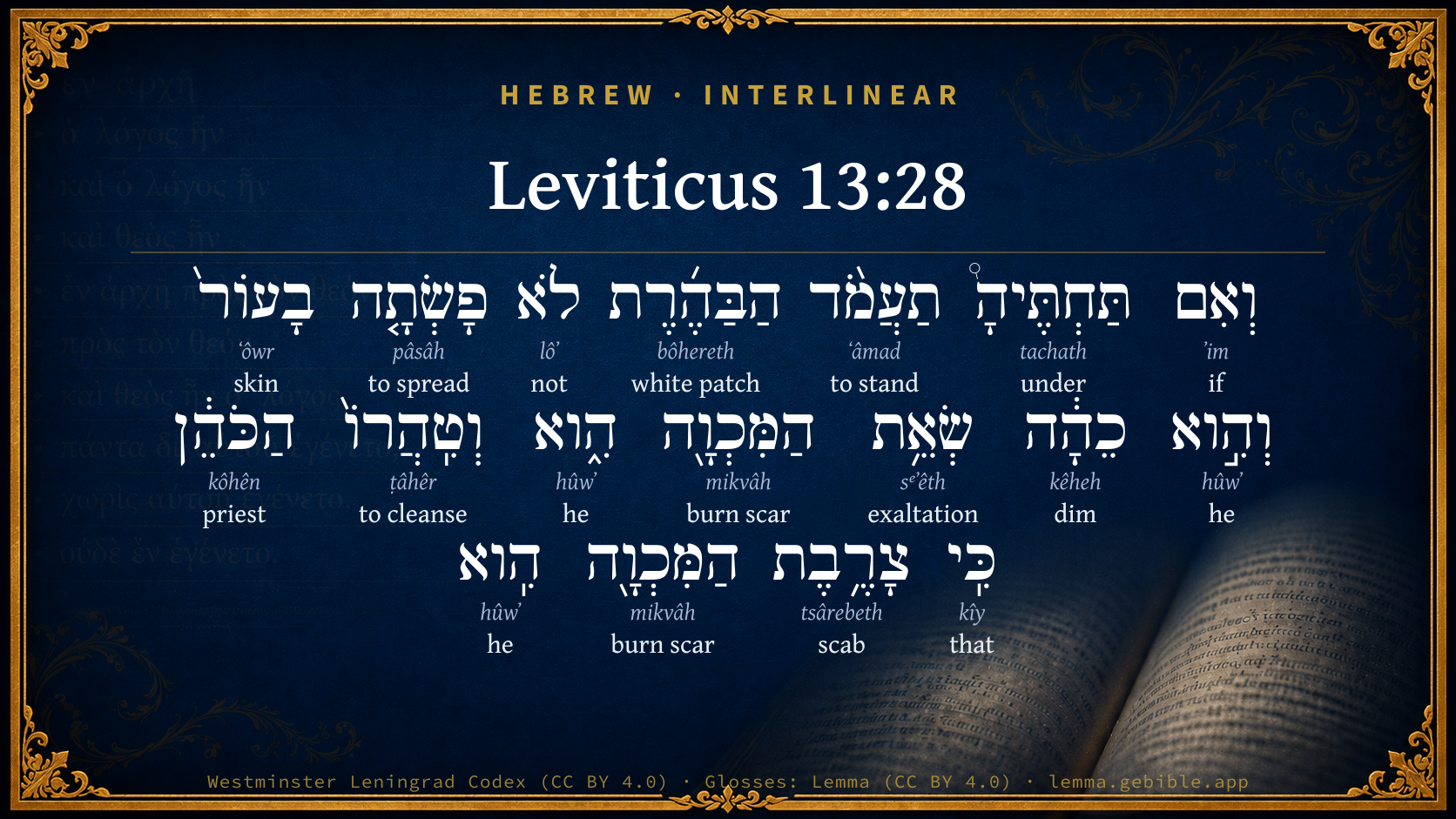
Hebrew (Westminster Leningrad Codex) Leviticus 13:28 appears in the Hebrew Old Testament. The text above is from the Westminster Leningrad Codex. Each word links to its Strong’s number, a concise gloss, and parsing drawn from the Open Scriptures Hebrew Bible morphology. Click any word for its full Brown-Driver-Briggs (BDB) entry.
Download image
Cite this verse

Leviticus 13:28 (World English Bible). Public Domain. Lemma interlinear Bible study tool, https://lemma.gebible.app/v/leviticus/13/28.

Show BibTeX & RIS
BibTeX
RIS
English Translation
If the bright spot stays in its place, and hasn't spread in the skin, but is faded, it is the swelling from the burn, and the priest shall pronounce him clean; for it is the scar from the burn.
World English Bible · Public Domain
Download a study sheet

One document with this verse’s original text, its word-by-word gloss line, the meaning frame, cross-references with their text, attributed commentary, and full source and license credits — printable, and it pastes into notes with its structure intact.

This verse Autodidact and up

Study sheet (.html) Plain text (.txt)

A passage Seminary Student

Up to 50 verses in one chapter. A passage sheet keeps up to 6 commentary sources and 12 cross-references per verse, in the order this page ranks them, and says so on the sheet whenever that leaves anything out. Ask for a single verse and you get the Autodidact verse sheet above.

Everything on this page stays free to read, with no account — the sheet is a download of what is already on screen, not access to it.

Want to remove ads? Support Godless Engineer
Compare translations 3

The same verse in 3 English versions, stacked beneath the original-language interlinear above. Click any original word for its lexicon entry.

Each is an independent rendering of the whole verse — the interlinear is not word-aligned to these translations.

Highlighted words mark where these versions differ — a whole-verse word diff, not a word-by-word alignment.

  • World English Bible Public Domain
    If the bright spot stays in its place, and hasn't spread in the skin, but is faded, it is the swelling from the burn, and the priest shall pronounce him clean; for it is the scar from the burn.
  • King James Version Public Domain
    And if the bright spot stay in his place, and spread not in the skin, but it be somewhat dark; it is a rising of the burning, and the priest shall pronounce him clean: for it is an inflammation of the burning.
  • unfoldingWord Literal Text CC BY-SA 4.0
    But if the bright spot stands under it—it has not spread on the skin but it faded—it the swelling of the burn. And the priest shall pronounce him clean, because it the scar of the burn.

unfoldingWord Literal Text — © unfoldingWord, licensed CC BY-SA 4.0. Word-aligned USFM3 via Door43 (git.door43.org/unfoldingWord/en_ult).

Versions to compare (up to 4)

3 of 4 selected

Show all 18 translations

Every available English version of this verse, each an independent rendering of the whole verse.

  • World English Bible Public Domain
    If the bright spot stays in its place, and hasn't spread in the skin, but is faded, it is the swelling from the burn, and the priest shall pronounce him clean; for it is the scar from the burn.
  • Berean Standard Bible Public Domain
    But if the spot is unchanged and has not spread on the skin but has faded, it is a swelling from the burn, and the priest is to pronounce him clean; for it is only the scar from the burn.
  • Majority Standard Bible Public Domain
    But if the spot is unchanged and has not spread on the skin but has faded, it is a swelling from the burn, and the priest is to pronounce him clean; for it is only the scar from the burn.
  • King James Version Public Domain
    And if the bright spot stay in his place, and spread not in the skin, but it be somewhat dark; it is a rising of the burning, and the priest shall pronounce him clean: for it is an inflammation of the burning.
  • American Standard Version (1901) Public Domain
    And if the bright spot stay in its place, and be not spread in the skin, but be dim; it is the rising of the burning, and the priest shall pronounce him clean: for it is the scar of the burning.
  • Revised Version (1885) Public Domain
    And if the bright spot stay in its place, and be not spread in the skin, but be dim; it is the rising of the burning, and the priest shall pronounce him clean: for it is the scar of the burning.
  • Geneva Bible (1599) Public Domain
    And if the spot abide in his place, not growing in the skin, but is darke, it is a rising of the burning: the Priest shall therefore declare him cleane, for it is the drying vp of the burning.
  • Douay-Rheims (1899) Public Domain
    But if the whiteness stay in its place, and be not very clear, it is the sore of a burning, and therefore he shall be cleansed, because it is only the scar of a burning.
  • Young's Literal Translation Public Domain
    `And if the bright spot stay in its place, it hath not spread in the skin, and is become weak; a rising of the burning it `is', and the priest hath pronounced him clean; for it `is' inflammation of the burning.
  • Literal Standard Version CC BY-SA 4.0
    And if the bright spot stays in its place, it has not spread in the skin, and has faded; it [is] a rising of the burning, and the priest has pronounced him clean; for it [is] inflammation of the burning.
  • Unlocked Literal Bible CC BY-SA 4.0
    If the spot stays in its place and has not spread in the skin but has faded, then it is a swelling from the burn, and the priest must pronounce him clean, for it is nothing more than the scar of the burn.
  • unfoldingWord Literal Text CC BY-SA 4.0
    But if the bright spot stands under it—it has not spread on the skin but it faded—it the swelling of the burn. And the priest shall pronounce him clean, because it the scar of the burn.
  • Darby Bible Public Domain
    But if the bright spot have remained in its place, [and] not spread in the skin, and is pale, it is the rising of the inflammation; and the priest shall pronounce him clean; for it is the scar of the inflammation.
  • World Messianic Bible Public Domain
    If the bright spot stays in its place, and hasn’t spread in the skin, but is faded, it is the swelling from the burn, and the priest shall pronounce him clean, for it is the scar from the burn.
  • Webster's Bible Public Domain
    And if the bright spot shall stay in its place, and not spread in the skin, but be somewhat dark; it is a rising of the burning, and the priest shall pronounce him clean: for it is an inflammation of the burning.
  • Free Bible Version CC BY-SA 4.0
    But if the spot stays the same and hasn't spread on the skin, but has faded, it's the swelling from the burn, and the priest will declare them clean because it's just the scar from the burn.
  • Bible in Basic English Public Domain
    And if the bright place keeps the same size and gets no greater on the skin, but is less bright, it is the effect of the burn, and the priest will say that he is clean: it is the mark of the burn.
  • JPS Tanakh (1917) Public Domain
    And if the bright spot stay in its place, and be not spread in the skin, but be dim, it is the rising of the burning, and the priest shall pronounce him clean; for it is the scar of the burning.

Literal Standard Version (2020), Covenant Press — licensed CC BY-SA 4.0. Text via the HelloAO Bible API (eBible.org). Unlocked Literal Bible (unfoldingWord) — licensed CC BY-SA 4.0. Text via the HelloAO Bible API (eBible.org). unfoldingWord Literal Text — © unfoldingWord, licensed CC BY-SA 4.0. Word-aligned USFM3 via Door43 (git.door43.org/unfoldingWord/en_ult). Free Bible Version, Dr. Jonathan Gallagher — licensed CC BY-SA 4.0. Text via the HelloAO Bible API (eBible.org).

Word by word

More ways to search: Search by grammar → Find every occurrence → Compare this word →

Practice this passage: Drill this verse → Learn its vocabulary →

צָרֶ֥בֶת
tsârebeth
H6867
“scab of”
Noun, Common, Feminine, Singular, Construct
Part of Speech
Noun
Type
Common
Gender
Feminine
Number
Singular
State
Construct
Full BDB Definition

Origin: from H6686

TWOT: 1966a , 1966b

scab, scar of a sore (noun feminine) - burning, scorching (adjective)
  1. וְאִם ʼim H518 “and · if” Conjunction + Conjunction
  2. תַּחְתֶּיהָ֩ tachath H8478 “under · her” Preposition + Suffix, Personal, 3rd Person, Feminine, Singular
  3. תַעֲמֹ֨ד ʻâmad H5975 “to stand” Verb, Qal, Imperfect, 3rd Person, Feminine, Singular
  4. הַבַּהֶ֜רֶת bôhereth H934 “the · white patch” Particle, Definite Article + Noun, Common, Feminine, Singular, Absolute
  5. לֹא lôʼ H3808 “not” Particle, Negative
  6. פָשְׂתָ֤ה pâsâh H6581 “to spread” Verb, Qal, Perfect, 3rd Person, Feminine, Singular
  7. בָעוֹר֙ ʻôwr H5785 “in/at the · skin” Preposition, Determined + Noun, Common, Masculine, Singular, Absolute
  8. וְהִ֣וא hûwʼ H1931 “and · he” Conjunction + Pronoun, Personal, 3rd Person, Feminine, Singular
  9. כֵהָ֔ה kêheh H3544 “dim” Adjective, Adjective, Feminine, Singular, Absolute
  10. שְׂאֵ֥ת sᵉʼêth H7613 “exaltation of” Noun, Common, Feminine, Singular, Construct
  11. הַמִּכְוָ֖ה mikvâh H4348 “the · burn scar” Particle, Definite Article + Noun, Common, Feminine, Singular, Absolute
  12. הִ֑וא hûwʼ H1931 “he” Pronoun, Personal, 3rd Person, Feminine, Singular
  13. וְטִֽהֲרוֹ֙ ṭâhêr H2891 “and · to cleanse · him” Conjunction + Verb, Piel, Sequential Perfect, 3rd Person, Masculine, Singular + Suffix, Personal, 3rd Person, Masculine, Singular
  14. הַכֹּהֵ֔ן kôhên H3548 “the · priest” Particle, Definite Article + Noun, Common, Masculine, Singular, Absolute
  15. כִּֽי kîy H3588 “that” Conjunction
  16. הַמִּכְוָ֖ה mikvâh H4348 “the · burn scar” Particle, Definite Article + Noun, Common, Feminine, Singular, Absolute
  17. הִֽוא hûwʼ H1931 “he” Pronoun, Personal, 3rd Person, Feminine, Singular

About this verse

These counts appear in no published source. They are computed here, from the morphology-tagged text and Lemma’s own curated glosses. What Lemma adds →

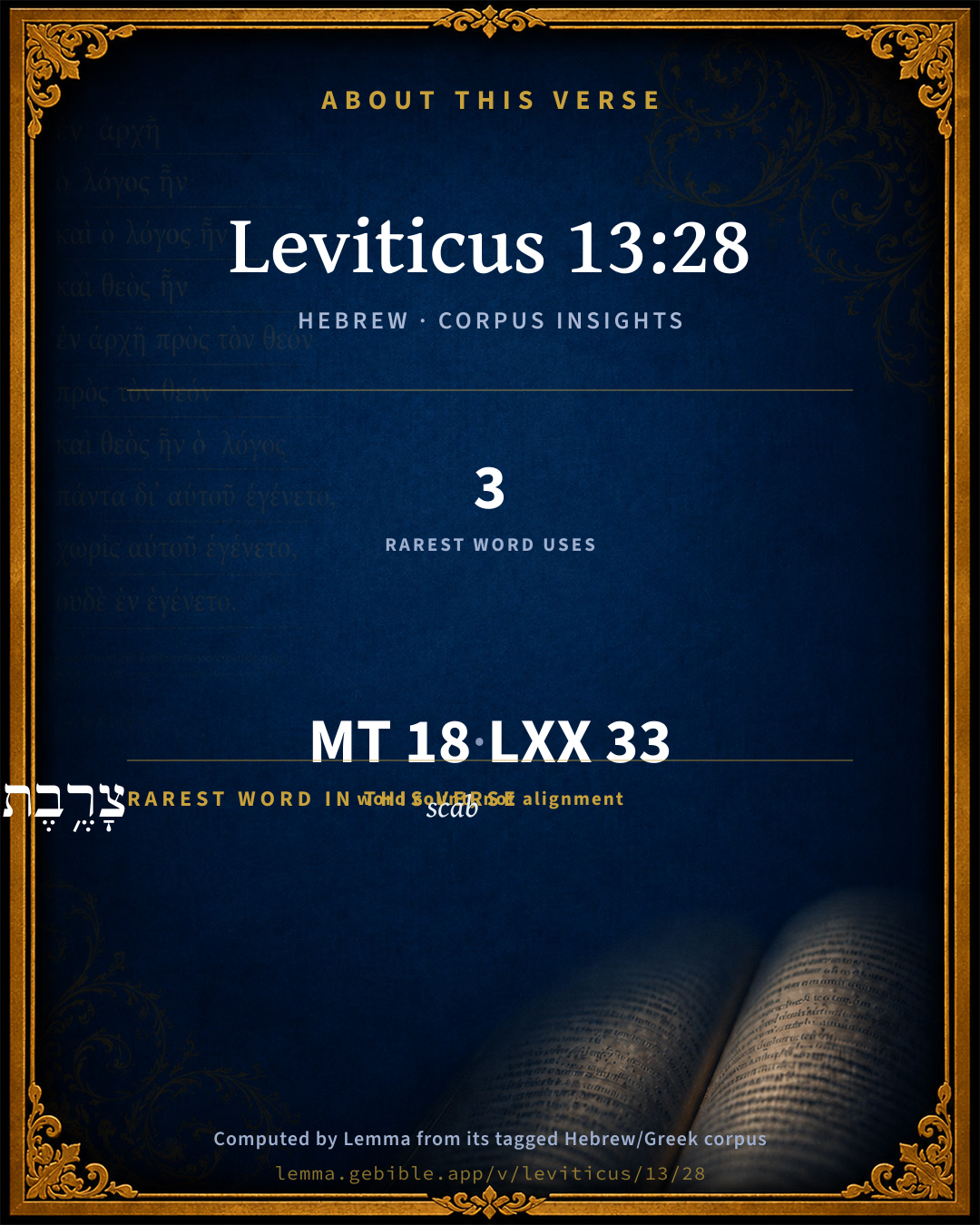
18
words
15
distinct lemmas
Pentateuch
section

Notable vocabulary

The rarest word here is צָרֶ֥בֶת scab H6867 — appearing just 3 times in the whole Hebrew Bible.

Shared distinctive vocabulary

צָרֶ֥בֶת scab H6867 occurs in 3 verses of the Hebrew Bible. Also found in:

Grammatical profile

  • 3 verbs
  • 7 nouns
  • 1 adjective
  • 3 pronouns
  • 1 preposition
  • 2 conjunctions
  • 1 particle

Verb forms

  • תַעֲמֹ֨ד Qal · Imperfect
  • פָשְׂתָ֤ה Qal · Perfect
  • וְטִֽהֲרוֹ֙ Piel · Sequential Perfect

Repetition

Words recur within this verse — often emphatic in Hebrew:

  • הַמִּכְוָ֖ה burn scar H4348 ×2
  • וְהִ֣וא he H1931 ×3

Hebrew & Septuagint length

In English translation the verse runs 39 words from the Hebrew and 41 from the Septuagint (LXX English) — closely comparable.

A rough comparison of the two English renderings, which tokenize alike — not a word-level alignment.

Word counts can differ between the Hebrew and the Greek without any difference in meaning — e.g. the Hebrew direct-object marker אֵת has no separate Greek word, and Greek often adds the article ὁ.

In the original languages it is 18 Hebrew tokens and 33 Greek tokens — but the two are counted differently (Hebrew bundles its prefixes and suffixes into one token; the Greek is in lemma form), so that isn’t a like-for-like length.

Hebrew and Greek witnesses Masoretic Hebrew ↔ Greek Septuagint

The same verse in the two great witnesses to the Old Testament, shown verse-for-verse.

These are two independent witnesses, not word-aligned to each other, and the Septuagint is shown in lemma (dictionary) form.

Hebrew Leviticus 13:28 Masoretic · Westminster Leningrad Codex

וְאִם תַּחְתֶּיהָ֩ תַעֲמֹ֨ד הַבַּהֶ֜רֶת לֹא פָשְׂתָ֤ה בָעוֹר֙ וְהִ֣וא כֵהָ֔ה שְׂאֵ֥ת הַמִּכְוָ֖ה הִ֑וא וְטִֽהֲרוֹ֙ הַכֹּהֵ֔ן כִּֽי צָרֶ֥בֶת הַמִּכְוָ֖ה הִֽוא

If the bright spot stays in its place, and hasn't spread in the skin, but is faded, it is the swelling from the burn, and the priest shall pronounce him clean; for it is the scar from the burn.

World English Bible · Public Domain

Greek LXX Leviticus 13:28 Septuagint · lemma form

ἐάν δέ κατά χώρα μένω ὁ αὐγάζω καί μή διαχέω ἐν ὁ δέρμα αὐτός δέ εἰμί ἀμαυρός ὁ οὐλή ὁ κατάκαυμα εἰμί καί καθαρίζω αὐτός ὁ ἱερεύς ὁ γάρ χαρακτήρ ὁ κατάκαυμα εἰμί

But if the bright spot remain stationary, and be not spread in the skin, but the sore should be dark, it is a scar of inflammation; and the priest shall pronounce him clean, for it is the mark of the inflammation.

LXX2012 (modern English Septuagint) · Public Domain

Hebrew: Westminster Leningrad Codex (CC BY 4.0). Greek: Septuagint (public domain); English from LXX2012 (modern English Septuagint) (Public Domain). How the Septuagint differs from the Hebrew →

Targum (Aramaic paraphrase)

2

The Targum is the ancient Jewish Aramaic paraphrase of the Hebrew Scriptures — an interpretive translation, not the Hebrew text itself. Onkelos (literal) and Pseudo-Jonathan (expansive) render the Torah, and Jonathan the Prophets. Coverage is partial: where no permissively-licensed English translation exists for a verse, only the Aramaic is shown. This is verse-level text, not a word-by-word alignment to the Hebrew.

  1. Targum Onkelos Torah (Genesis–Deuteronomy)
    וְאִם בְּאַתְרָהָא קָמַת בַּהֶרְתָּא לָא אוֹסֵפַת בְּמַשְׁכָּא וְהִיא עָמְיָא עוֹמֶק כְּוָאָה הִיא וִידַכִּנֵהּ כַּהֲנָא אֲרֵי רֹשֶׁם כְּוָאָה הִיא

    (no public-domain English translation for this verse)

    Targum Onkelos — Aramaic: “Onkelos Genesis” (public domain); “Onkelos Exodus” (public domain); “Onkelos Leviticus” (public domain); “Onkelos Numbers” (public domain); “Onkelos Deuteronomy” (public domain). English: “Sefaria Community Translation” (CC0 1.0 (public-domain dedication)); “J.W. Etheridge. The Targums of Onkelos and Jonathan Ben Uzziel on the Pentateuch. London: Longmans, Green, 1862” (public domain). Text via Sefaria.

  2. Targum Pseudo-Jonathan Torah (Genesis–Deuteronomy)
    וְאִין בְּאַתְרָהּ קָמַת בַּהֲקֵי לָא הֲלִיכַת פִּסְיָינָתָא בְּמוֹשְׁכָא וְהִיא עַמְיָא שׁוּמַת כְּוָאָה הוּא וְיַדְכְּאִינֵיהּ כַּהֲנָא אֲרוּם צוֹלְקַת כְּוָואָה הוּא

    *But if the inflamed spot abide in its place, and go not on to widen in the skin and it be dim (in appearance), it is a burning spot; and the priest shall make him to be clean, for it is a burning wound.

    Targum Pseudo-Jonathan — Aramaic: “Targum Jonathan on Genesis” (public domain); “Targum Jonathan on Exodus” (public domain); “Targum Jonathan on Leviticus” (public domain); “Targum Jonathan on Numbers” (public domain); “Targum Jonathan on Deuteronomy” (public domain). English: “The Targum of Jonathan ben Uzziel, trans. J. W. Etheridge, London, 1862” (public domain). Text via Sefaria.

Commentary

Notes on Leviticus 13:28 from classic Christian and Jewish commentators (each source and its license shown beneath its notes). The classic Christian expositions comment on the surrounding passage and are grouped to its opening verse, so a note may address several verses; the Jewish commentaries on the Tanakh (Rashi and others) are per-verse, so they appear only where the commentator wrote on this verse.

Lemma curates 59 commentaries, every one of them public domain or Creative Commons licensed, each selected and text-cleaned for this edition rather than reprinted as found. About our sources →

Joseph Benson's Commentary

Lev 13:28. Of the burning — Arising from the burning, mentioned Lev 13:24.

Joseph Benson's Commentary on the Old and New Testaments (1811–1818) — public domain. Text from a community e-Sword module.

Geneva Bible (1599)

Geneva Bible translators

Or, swelling.

Geneva Bible (1599) marginal notes — public domain. Text via Bolls.life.

John Gill's Exposition

And if the bright spot stay in his place, and spread not in the skin,.... If, after being shut up, seven days, it appears that the spot is no larger than, when it was first viewed, but is as it was, and not at all increased:

but it be somewhat dark; either not so bright as it was, or more contracted:

it is a rising of the burning; or a swelling of it, a swelling which sprung from it, and nothing else:

the priest shall pronounce him clean; from the leprosy, and so set him at liberty to go where he will, and dwell and converse with men as usual:

for it is an inflammation of the burning; or an inflammation or blister occasioned by the burning, and no leprosy.

John Gill's Exposition of the Whole Bible (1746–1763) — public domain (CC PDM 1.0). Text via the HelloAO Bible API.

Albert Barnes' Notes on the Bible

“And if the glossy spot continues unchanged and makes no advance in the skin, and is rather indistinct” (see the note at Lev 13:6), “it is the mark of the inflammation, and the priest shall pronounce him clean, for it is the (mere) hurt of inflammation.”

Albert Barnes' Notes on the Bible (1834–1885) — public domain. Text from a community e-Sword/MySword module.

Matthew Poole's English Annotations

i.e. Arising from the burning mentioned Lev 13:24.

Matthew Poole's English Annotations on the Holy Bible (1683–1685) — public domain. Text from a community e-Sword/MySword module.

John Wesley's Explanatory Notes

Of the burning - Arising from the burning mentioned, ver. 24.

John Wesley, Explanatory Notes Upon the Whole Bible (1754–1765) — public domain. Text via the GEBible commentary corpus.

Lesson kit

Teaching starters — assembled from the data on this page, not authored interpretation. Every prompt links to the verse data it draws on. Edit before teaching.

Leviticus, in the Pentateuch, opens this verse with 18 words (15 distinct Hebrew lemmas). Its most distinctive word is tsârebeth (“scab”). A historical commentator’s framing appears above. Read the whole chapter for the surrounding context.

Discussion questions

  1. What does “scab” (tsârebeth) contribute to the verse as a whole?
  2. Leviticus 13:23 shares the word «scab» with this verse. How do the two illuminate each other?
  3. “burn scar” occurs 2× in this one verse. What is the effect of the repetition?
  4. The translations on this page render this verse differently — a whole-verse word diff, not a word-by-word alignment. What might account for the different wordings?
  5. The verb «תַעֲמֹ֨ד» is Qal Imperfect. How does its form color the action?
  6. Reading how Joseph Benson's Commentary and Geneva Bible (1599) read this verse, where do the two commentators agree and where do they part?

Things to notice

Reading settings

Reading text

Shown beneath each verse's original-language words.

Old Testament
Old Testament edition

Read the OT as the Masoretic Hebrew (MT) or the Greek Septuagint (LXX).

English shown for the Greek Septuagint (in the Hebrew ↔ Greek comparison).

Comparing translations? Open the Compare panel on any verse page to stack up to four side by side.