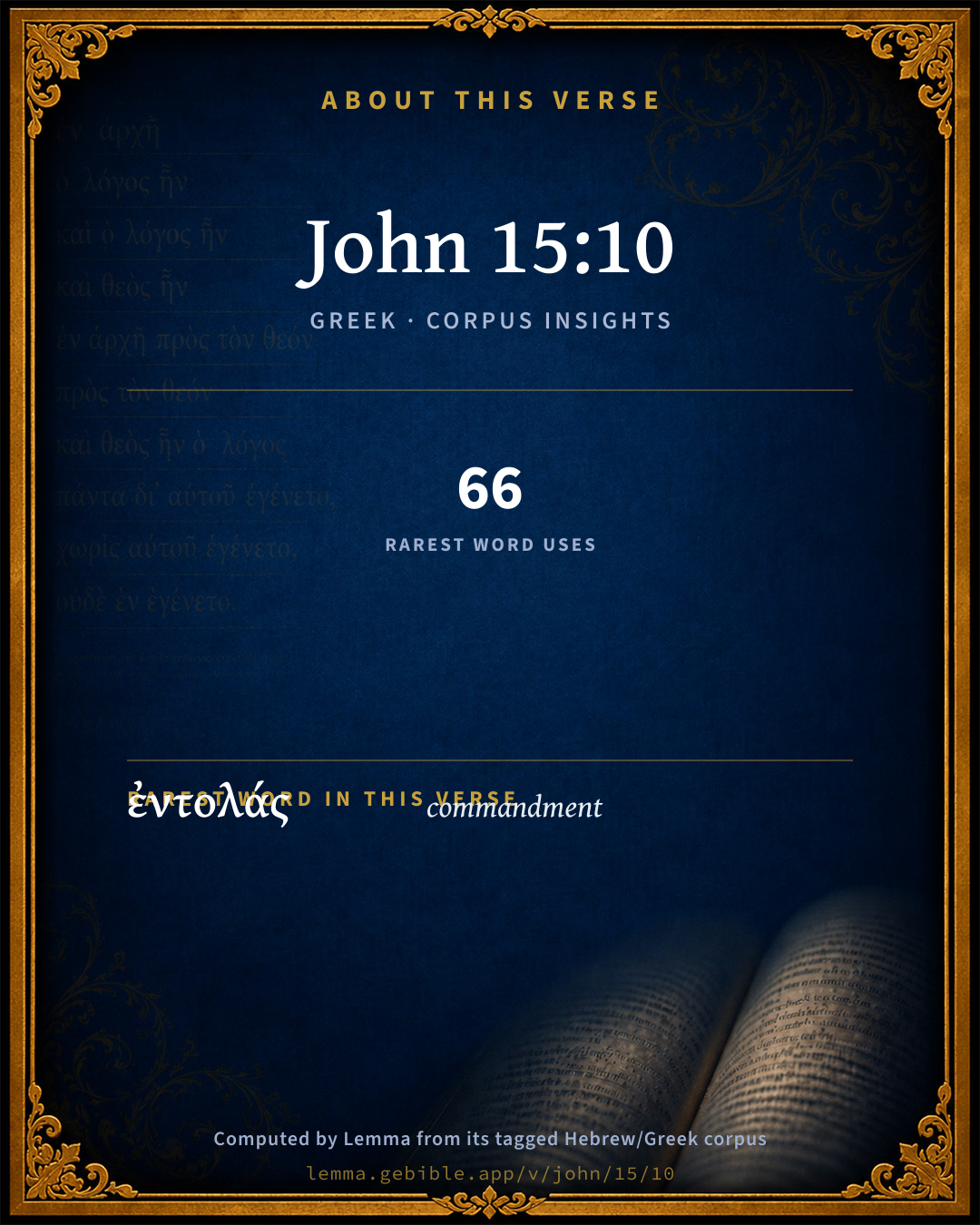
John 15:10

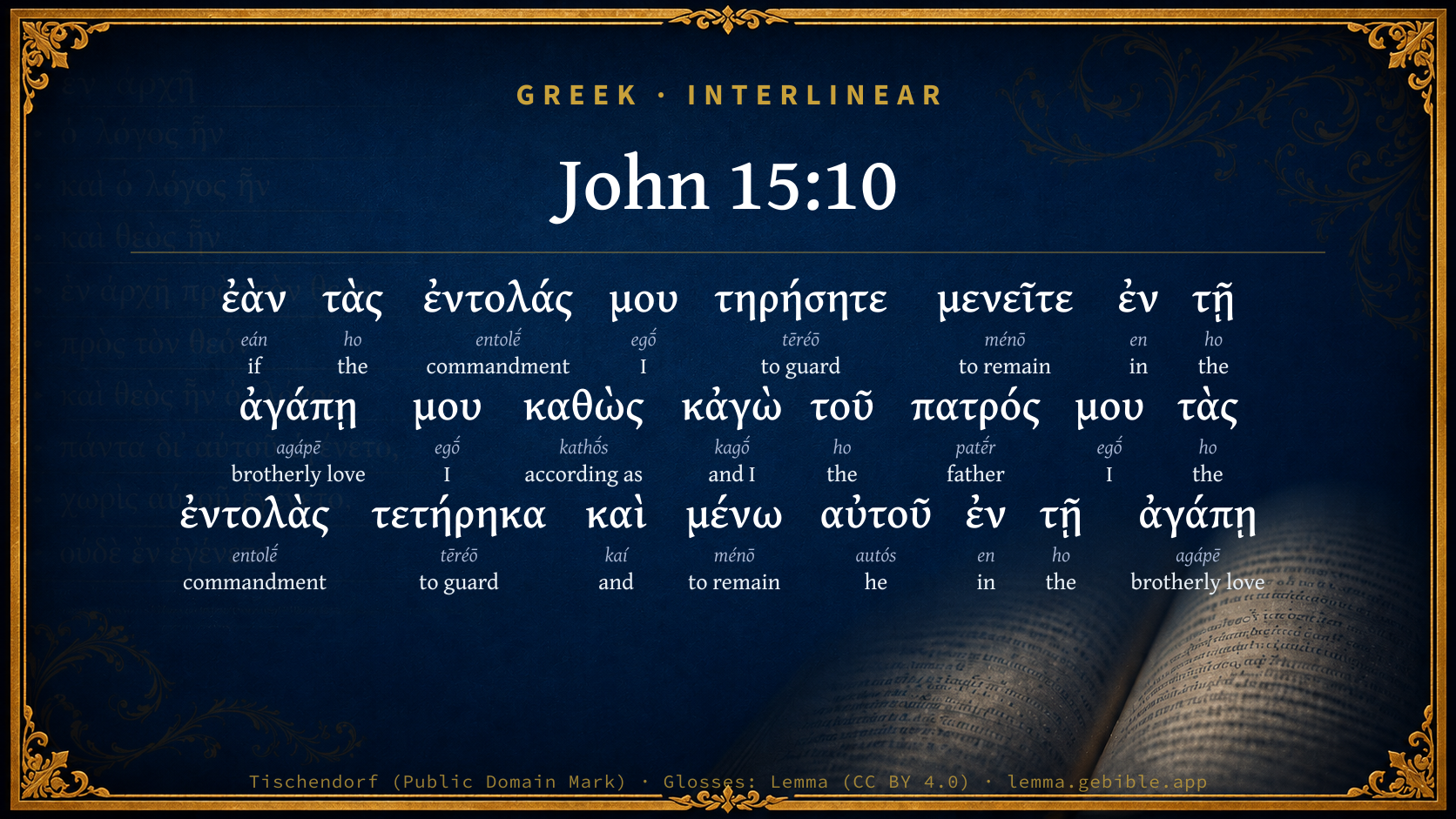
Greek (Tischendorf 8th ed.) John 15:10 appears in the Greek New Testament. The text above is from the Tischendorf 8th edition. Each word links to its Strong’s number and a concise gloss. Click any word for its full Thayer’s Greek Lexicon entry.
Download image
Cite this verse

John 15:10 (World English Bible). Public Domain. Lemma interlinear Bible study tool, https://lemma.gebible.app/v/john/15/10.

Show BibTeX & RIS
BibTeX
RIS
English Translation
If you keep my commandments, you will remain in my love; even as I have kept my Father's commandments, and remain in his love.
World English Bible · Public Domain
Download a study sheet

One document with this verse’s original text, its word-by-word gloss line, the meaning frame, cross-references with their text, attributed commentary, and full source and license credits — printable, and it pastes into notes with its structure intact.

This verse Autodidact and up

Study sheet (.html) Plain text (.txt)

A passage Seminary Student

Up to 50 verses in one chapter. A passage sheet keeps up to 6 commentary sources and 12 cross-references per verse, in the order this page ranks them, and says so on the sheet whenever that leaves anything out. Ask for a single verse and you get the Autodidact verse sheet above.

Everything on this page stays free to read, with no account — the sheet is a download of what is already on screen, not access to it.

Want to remove ads? Support Godless Engineer
Compare translations 3

The same verse in 3 English versions, stacked beneath the original-language interlinear above. Click any original word for its lexicon entry.

Each is an independent rendering of the whole verse — the interlinear is not word-aligned to these translations.

Highlighted words mark where these versions differ — a whole-verse word diff, not a word-by-word alignment.

  • World English Bible Public Domain
    If you keep my commandments, you will remain in my love; even as I have kept my Father's commandments, and remain in his love.
  • King James Version Public Domain
    If ye keep my commandments, ye shall abide in my love; even as I have kept my Father's commandments, and abide in his love.
  • unfoldingWord Literal Text CC BY-SA 4.0
    If you keep my commandments, you will remain in my love, just as I have kept the commandments of the Father and remain in his love.

unfoldingWord Literal Text — © unfoldingWord, licensed CC BY-SA 4.0. Word-aligned USFM3 via Door43 (git.door43.org/unfoldingWord/en_ult).

Versions to compare (up to 4)

3 of 4 selected

Show all 18 translations

Every available English version of this verse, each an independent rendering of the whole verse.

  • World English Bible Public Domain
    If you keep my commandments, you will remain in my love; even as I have kept my Father's commandments, and remain in his love.
  • Berean Standard Bible Public Domain
    If you keep My commandments, you will remain in My love, just as I have kept My Father’s commandments and remain in His love.
  • Majority Standard Bible Public Domain
    If you keep My commandments, you will remain in My love, just as I have kept My Father’s commandments and remain in His love.
  • King James Version Public Domain
    If ye keep my commandments, ye shall abide in my love; even as I have kept my Father's commandments, and abide in his love.
  • American Standard Version (1901) Public Domain
    If ye keep my commandments, ye shall abide in my love; even as I have kept my Father's commandments, and abide in his love.
  • Revised Version (1885) Public Domain
    If ye keep my commandments, ye shall abide in my love; even as I have kept my Father’s commandments, and abide in his love.
  • Geneva Bible (1599) Public Domain
    If ye shall keepe my commandements, ye shall abide in my loue, as I haue kept my Fathers commandements, and abide in his loue.
  • Young's Literal Translation Public Domain
    if my commandments ye may keep, ye shall remain in my love, according as I the commands of my Father have kept, and do remain in His love;
  • Literal Standard Version CC BY-SA 4.0
    if you may keep My commands, you will remain in My love, according as I have kept the commands of My Father, and remain in His love;
  • Unlocked Literal Bible CC BY-SA 4.0
    If you keep my commandments, you will remain in my love, as I have kept the commandments of my Father and remain in his love.
  • unfoldingWord Literal Text CC BY-SA 4.0
    If you keep my commandments, you will remain in my love, just as I have kept the commandments of the Father and remain in his love.
  • Darby Bible Public Domain
    If ye shall keep my commandments, ye shall abide in my love, as I have kept my Father's commandments and abide in his love.
  • World Messianic Bible Public Domain
    If you keep my commandments, you will remain in my love, even as I have kept my Father’s commandments and remain in his love.
  • Webster's Bible Public Domain
    If ye keep my commandments, ye shall abide in my love; even as I have kept my Father's commandments, and abide in his love.
  • Free Bible Version CC BY-SA 4.0
    If you do what I say, you will remain in my love, just as I do what my Father says and remain in his love.
  • Bible in Basic English Public Domain
    If you keep my laws, you will be ever in my love, even as I have kept my Father's laws, and am ever in his love.
  • Text-Critical English NT CC BY 4.0
    If you keep my commandments, you will abide in my love, just as I have kept my Father's commandments and abide in his love.
  • Tyndale New Testament (1534) Public Domain
    Yf ye shall kepe my commaudementes ye shall byde in my love even as I have kept my fathers comaundementes and byde in his love.

Literal Standard Version (2020), Covenant Press — licensed CC BY-SA 4.0. Text via the HelloAO Bible API (eBible.org). Unlocked Literal Bible (unfoldingWord) — licensed CC BY-SA 4.0. Text via the HelloAO Bible API (eBible.org). unfoldingWord Literal Text — © unfoldingWord, licensed CC BY-SA 4.0. Word-aligned USFM3 via Door43 (git.door43.org/unfoldingWord/en_ult). Free Bible Version, Dr. Jonathan Gallagher — licensed CC BY-SA 4.0. Text via the HelloAO Bible API (eBible.org).

Word by word

More ways to search: Search by grammar → Find every occurrence → Compare this word →

Practice this passage: Drill this verse → Learn its vocabulary →

ἐντολάς
entolḗ
G1785
“commandment”
Noun, Accusative, Plural, Feminine
Part of Speech
Noun
Case
Accusative
Number
Plural
Gender
Feminine
Full Thayer's Definition

Origin: from G1781

TDNT: 11:05,2

1. an order, command, charge, precept, injunction a. that which is prescribed to one by reason of his office 2. a commandment a. a prescribed rule in accordance with which a thing is done 1. a precept relating to lineage, of the Mosaic precept concerning the priesthood 2. ethically used of the commandments in the Mosaic law or Jewish tradition
  1. ἐὰν eán G1437 “if” Conditional
  2. τὰς ho G3588 “the” Article, Accusative, Plural, Feminine
  3. μου egṓ G1473 “I” Personal pronoun, 1st person, Genitive, Singular
  4. τηρήσητε tēréō G5083 “to guard” Verb, Aorist, Active, Subjunctive, 2nd person, Plural
  5. μενεῖτε ménō G3306 “to remain” Verb, Future, Active, Indicative, 2nd person, Plural
  6. ἐν en G1722 “in” Preposition
  7. τῇ ho G3588 “the” Article, Dative, Singular, Feminine
  8. ἀγάπῃ agápē G26 “brotherly love” Noun, Dative, Singular, Feminine
  9. μου egṓ G1473 “I” Personal pronoun, 1st person, Genitive, Singular
  10. καθὼς kathṓs G2531 “according as” Adverb
  11. κἀγὼ kagṓ G2504 “and I” Personal pronoun, 1st person, Nominative, Singular, Aramaic form
  12. τοῦ ho G3588 “the” Article, Genitive, Singular, Masculine
  13. πατρός patḗr G3962 “father” Noun, Genitive, Singular, Masculine
  14. μου egṓ G1473 “I” Personal pronoun, 1st person, Genitive, Singular
  15. τὰς ho G3588 “the” Article, Accusative, Plural, Feminine
  16. ἐντολὰς entolḗ G1785 “commandment” Noun, Accusative, Plural, Feminine
  17. τετήρηκα tēréō G5083 “to guard” Verb, Perfect, Active, Indicative, 1st person, Singular
  18. καὶ kaí G2532 “and” Conjunction
  19. μένω ménō G3306 “to remain” Verb, Present, Active, Indicative, 1st person, Singular
  20. αὐτοῦ autós G846 “he” Personal pronoun, Genitive, Singular, Masculine
  21. ἐν en G1722 “in” Preposition
  22. τῇ ho G3588 “the” Article, Dative, Singular, Feminine
  23. ἀγάπῃ agápē G26 “brotherly love” Noun, Dative, Singular, Feminine

About this verse

These counts appear in no published source. They are computed here, from the morphology-tagged text and Lemma’s own curated glosses. What Lemma adds →

24
words
13
distinct lemmas
Gospels
section

Repetition

Words recur within this verse:

  • ἐντολάς commandment G1785 ×2
  • τηρήσητε to guard G5083 ×2
  • μενεῖτε to remain G3306 ×2
  • ἀγάπῃ brotherly love G26 ×2
  • τὰς the G3588 ×5
  • μου I G1473 ×3
  • ἐν in G1722 ×2

Cross-references

19

Topical passages linked to John 15:10 in the Treasury of Scripture Knowledge — connected by theme and wording, ordered by reader-vote popularity; previews shown in the World English Bible.

  • John 14:15 If you love me, keep my commandments.
  • 1 John 5:3 For this is the love of God, that we keep his commandments. His commandments are not grievous.
  • 1 John 3:21–24 Beloved, if our hearts don't condemn us, we have boldness toward God;
  • 1 John 2:5 But whoever keeps his word, God's love has most assuredly been perfected in him. This is how we know that we are in him:
  • 2 Peter 2:21 For it would be better for them not to have known the way of righteousness, than, after knowing it, to turn back from the holy commandment delivered to them.
  • John 4:34 Jesus said to them, "My food is to do the will of him who sent me, and to accomplish his work.
  • John 8:29 He who sent me is with me. The Father hasn't left me alone, for I always do the things that are pleasing to him."
  • 1 John 2:1–2 My little children, I write these things to you so that you may not sin. If anyone sins, we have a Counselor with the Father, Jesus Christ, the righteous.
  • John 17:4 I glorified you on the earth. I have accomplished the work which you have given me to do.
  • Matthew 3:15–17 But Jesus, answering, said to him, "Allow it now, for this is the fitting way for us to fulfill all righteousness." Then he allowed him.
  • John 12:49 For I spoke not from myself, but the Father who sent me, he gave me a commandment, what I should say, and what I should speak.
  • John 14:21 One who has my commandments, and keeps them, that person is one who loves me. One who loves me will be loved by my Father, and I will love him, and will reveal myself to him."
  • John 14:31 But that the world may know that I love the Father, and as the Father commanded me, even so I do. Arise, let us go from here.
  • 1 Thessalonians 4:1 Finally then, brothers, we beg and exhort you in the Lord Jesus, that as you received from us how you ought to walk and to please God, that you abound more and more.
  • Isaiah 42:1–4 Behold, my servant, whom I uphold; my chosen, in whom my soul delights: I have put my Spirit on him; he will bring forth justice to the Gentiles.
  • Revelation 22:14 Blessed are those who do his commandments, that they may have the right to the tree of life, and may enter in by the gates into the city.
  • 1 Corinthians 7:19 Circumcision is nothing, and uncircumcision is nothing, but the keeping of the commandments of God.
  • Hebrews 10:5–10 Therefore when he comes into the world, he says, "Sacrifice and offering you didn't desire, But a body did you prepare for me;
  • Hebrews 7:26 For such a high priest was fitting for us: holy, guiltless, undefiled, separated from sinners, and made higher than the heavens;

Cross-references courtesy of OpenBible.info (CC BY 4.0).

Commentary

Notes on John 15:10 from classic Christian and Jewish commentators (each source and its license shown beneath its notes). The classic Christian expositions comment on the surrounding passage and are grouped to its opening verse, so a note may address several verses; the Jewish commentaries on the Tanakh (Rashi and others) are per-verse, so they appear only where the commentator wrote on this verse.

Lemma curates 59 commentaries, every one of them public domain or Creative Commons licensed, each selected and text-cleaned for this edition rather than reprinted as found. About our sources →

The Biblical Illustrator

Joseph S. Exell

Joh_15:10

If ye keep My commandments, ye shall abide in My love

The condition of abiding in Christs love

What is implied in that keeping of His commandments, which is essential to abiding in His love?

The keeping of all those commandments of His

I. WHICH REFER TO THE MAINTAINING OF SPIRITUAL COMMUNION WITH HIMSELF. He kept constantly all such commandments of His Father, and so continued in His Fathers love. If we would abide in Christs love, we must imitate Him and make an earnest use of the means of grace. There are those who neglect these, and thus plainly do not keep Gods commandments. There are others who do not quite neglect them, and yet do not use them as Christs commandments require, and therefore not so as to benefit by them.

II. WHICH REQUIRE US TO BE LIKE HIMSELF IN SPIRIT. We must seek after the wisdom, truthfulness, delicacy of feeling, purity of heart, disinterestedness, patience, humility, charity, piety, and all those other excellencies which were included in His perfection. What a number of people there are so engrossed in business that they can find no time for moral, or mental, or spiritual culture! Others, again, feel that Christ has claims upon them, and that they should be at work in His service; but they are not thoughtful, and do not realize how much of Christs work is inward, not outward. There is a great deal of so-called doing good which is very worthless and comes to nothing, because it does not flow naturally from real inward goodness. Be good and you will do good, without having to go out of your way to seek to do it.

III. WHICH REFER TO THE ORDINARY COMMON DUTIES OF DAILY LIFE--to the relationships in which we are placed by nature and Providence; and if we would continue in Christs love, we must be careful to obey these. The Christian life is to fill and beautify our whole existence. It is not by what a man does on special occasions in public, or to those who seldom come into contact with him, that you can form an accurate estimate of him, but by his daily ordinary life--by knowing what sort of son or brother he has been, or what sort of a husband he is. Love to Christ will show itself much better there than anywhere else. It is especially through these that God seeks to train into order and obedience, into nobleness and freedom, the souls of the children of men.

IV. WHICH POINT US TO A LIFE OF ACTIVE BENEFICENCE; and if we would continue in His love, we must do good to all men. Christs death for all men pledges us to the love of all men. To abide in the love of Christ, we must seek to lessen pain and suffering, ignorance and crime, wrong and injustice, and to make all to whom our influence can reach better and happier. Thus living in love to our brethren, for whom Christ died, we shall live in the love of Christ, who died for them as well as for us. (R. Flint, D. D.)

The Biblical Illustrator, edited by Joseph S. Exell (c. 1880s–1900s) — public domain. Text from a community e-Sword module.

Tyndale Open Study Notes

Tyndale Open Resources

15:10 Just as Jesus demonstrated his love for the Father by obeying his will (14:31), Jesus’ disciples exhibit their love through obedience to him (13:34-35; 14:15; 1 Jn 2:5; 5:2-3).

Tyndale Open Study Notes — © Tyndale Open Resources, licensed CC BY-SA 4.0. Text via the HelloAO Bible API.

Bengel's Gnomon

Johann Albrecht Bengel

Joh 15:10. Τετήρηκα, I have kept) even up to the moment of My departure from the world: 1Jn 4:17, “Herein is our love made perfect, that we may have boldness in the day of judgment; because as He is, so are we in this world.” As He was when He went out of the world, so He is always.

Bengel's Gnomon of the New Testament — English translation (T&T Clark, Edinburgh, 1860) — public domain. Text from a community e-Sword module.

Expositor's Greek Testament

ed. W. Robertson Nicoll

Joh 15:10 . That possibility is defeated, ἐὰν τὰς ἐντολάς μου τηρήσητε . To encourage them in keeping His commandments He reminds them that He also has been subject to the same conditions, and by keeping the Father’s commandments has remained in His love.

The Expositor's Greek Testament, edited by W. Robertson Nicoll (1897–1910) — public domain. Text from a community e-Sword module.

International Critical Commentary

10. The precept is “abide in my love,” and the way to obey it is to keep His commandments: ἐὰν τὰς ἐντολάς μου τηρήσητε, μενεῖτε ἐν τῇ ἀγάπῃ μου. The ἀγάπη is the love of Jesus for His disciples, not their love for Him, as it is in 14:15. It is over subtle to attempt a distinction between ἐν τῇ ἀγάπῃ τῇ ἐμῇ of v. 9 and ἐν τῇ ἀγάπῃ μου of v. 10. Both phrases mean the same thing, sc. the love of Jesus for His own. Jn. is specially fond of ἐμός, which occurs 37 times in the Gospel, and always in words of Jesus.1

καθὼς ἐγὼ (אD have καθὼς κἀγώ) τοῦ πατρός μου (B. om. μοῦ) τὰς ἐντολὰς τετήρηκα. This is the high example set before the Christian disciple. Jesus had claimed (8:29) ἐγὼ τὰ ἀρεστὰ αὐτῷ ποιῶ πάντοτε, and now, looking back, He can say τετήρηκα (cf. 17:4). No man could say with such complete assurance, “I have kept the commandments of my Father”; while it is possible at the end to say, with Paul, τὴν πίστιν τετήρηκα (2Ti 4:7).

καὶ μένω αὐτοῦ ἐν τῇ ἀγάπῃ. This is the eternal issue of the ministry of Christ, the resumption of His place in the bosom of Deity, who is Love (cf. 17:24).

Westcott2 finds here an advance on the teaching of 14:15, 21; and if this could surely be traced, the traditional order of chapters (c. 14 preceding c. 15) would be in some degree corroborated. But his reasoning is precarious. The idea of the ἐντολαί given by Jesus is only found in cc. 13, 14, 15; and the relevant passages are quite consistent with the order of chapters adopted here, viz.:

15:10 “If ye keep my commandments, ye will abide in my love.” As we have seen, this is the fundamental idea in the Allegory of the Vine.

15:12 Next, Jesus bids them love one another.

13:34 This commandment is repeated and described as “new.” See Introd., p. xxi.

14:15 He tells His disciples that if they love Him, they must keep His commandments.

14:21 And, finally, He gives them the great promise, that if they thus show their love for Him, the Father will love them, and He Himself will love them and will manifest Himself to them. There is no “advance” on this teaching in c. 15, nor could there be.

The truth is, that we must not expect a continuous logical sequence in the discourses of the Fourth Gospel. The sacred words are set down as they are remembered by the aged disciple of Jesus,1 but there is no attempt to present them in the manner which would be suitable to a theological treatise.

International Critical Commentary — older volumes (1896–1929), various authors — public domain. Text from a community e-Sword module.

Jamieson, Fausset & Brown

Robert Jamieson, A. R. Fausset & David Brown

If ye keep my commandments, ye shall abide in my love--the obedient spirit of true discipleship cherishing and attracting the continuance and increase of Christ's love; and this, He adds, was the secret even of His own abiding in His Father's love!

Jamieson, Fausset & Brown — Commentary Critical and Explanatory on the Whole Bible (1871) — public domain (CC PDM 1.0). Text via the HelloAO Bible API.

Adam Clarke's Commentary

Verse 10. If ye keep my commandments, &c.] Hence we learn that it is impossible to retain a sense of God's pardoning love, without continuing in the obedience of faith.

Adam Clarke's Commentary on the Bible (1810–1826) — public domain. Text from a community e-Sword/MySword module.

John Calvin's Commentaries

10. If you keep my commandments. He points out to us the method of perseverance. his, to follow where he calls, for, as Paul says,

They who are in Christ walk not according to the flesh, but according to the Spirit, (Romans 8:1.)

For these two things are continually united, that faith which perceives the undeserved love of Christ toward us, and a good conscience and newness of life. And, indeed, Christ does not reconcile believers to the Father, that they may indulge in wickedness without reserve, and without punishment; but that, governing them by his Spirit, he may keep them under the authority and dominion of his Father. Hence it follows, that the love of Christ is rejected by those who do not prove, by true obedience, that they are his disciples.

If any one object that, in that case, the security of our salvation depends on ourselves, I reply, it is wrong to give such a meaning to Christ’s words; for the obedience which believers render to him is not the cause why he continues his love toward us, but is rather the effect of his love. For whence comes it that they answer to their calling, but because they are led by the Spirit of adoption of free grace?

But again, it may be thought that the condition imposed on us is too difficult, that we should keep the commandments of Christ, which contain the absolute perfection of righteousness, — a perfection which far exceeds our capacity, — for hence it follows, that the love of Christ will be useless, if we be not endued with angelical purity. The answer is easy; for when Christ speaks of the desire of living a good and holy life, he does not exclude what is the chief article in his doctrine, namely, that which alludes to righteousness being freely imputed, in consequence of which, through a free pardon, our duties are acceptable to God, which in themselves deserved to be rejected as imperfect and unholy. Believers, therefore, are reckoned as keeping the commandments of Christ when they apply their earnest attention to them, though they be far distant from the object at which they aim; for they are delivered from that rigorous sentence of the law,

Cursed be he that hath not confirmed all the words of this law to do them, (Deuteronomy 27:26).

As I also have kept my Father’s commandments. As we have been elected in Christ, so in him the image of our calling is exhibited to us in a lively manner; and therefore he justly holds himself out to us as a pattern, to the imitation of which all the godly ought to be conformed. “In me,” says he, “is brightly displayed the resemblance of those things which I demand from you; for you see how sincerely I am devoted to obedience to my Father, and how I persevere in this course. My Father, too, hath loved me, not for a moment, or for a short time, but his love toward me is constant.” This conformity between the Head and the members ought to be always placed before our eyes, not only that believers may form themselves after the example of Christ, but that, they may entertain a confident hope that his Spirit will every day form them anew to be better and better, that they may walk to the end in newness of life.

John Calvin's Commentaries (1540-1563) — public domain. Text from the Calvin Translation Society English edition (1840s-50s) via the Christian Classics Ethereal Library (ccel.org). Calvin's coverage is partial (roughly two-thirds of the Bible); uncommented books and verses are honest gaps, never fabricated. The 19th-century editor's footnotes and remarks are omitted so the notes are faithfully Calvin's own voice.

Ellicott's Commentary for English Readers

(10) If ye keep my commandments, ye shall abide in my love.—Comp. Joh_14:21; Joh_14:24. keeping of His commandments is the outward proof of love towards Him; so that the love of the human heart towards Christ, which itself flows from Christ’s love to us (see Note on previous verse), becomes the condition of abiding in that love. While we cherish love for Him, our hearts are abiding in that state which can receive His love for us.

Even as I have kept my Father’s commandments . . .—Comp. Note on Joh_15:9 and reference there. This is again an appeal to His perfect sinlessness, and willing subordination as Son to the Father. We should notice also that the keeping of the commandments is not an arbitrary condition imposed upon human love; but a necessary result of love itself, and therefore as true in the relation of the Son to the Father as it is in our relation to Him. Because the Son loved the Father, therefore He kept His commandments, and in this love He abode in the Father’s love. Because we love God we necessarily keep His commandments, and in this love is the receptive power which constitutes abiding in the divine love.

A Bible Commentary for English Readers, edited by Charles John Ellicott (1878–1897) — public domain. Text from a community e-Sword module.

The Cambridge Bible for Schools and Colleges

gen. ed. J. J. S. Perowne

10. If ye keep] See on Joh_14:15; Joh_14:21; Joh_14:24. To keep His commandments not only proves our love for Him but secures His love for us.

I have kept my Father’s commandments] This being in a subordinate sentence the tremendous import of it is liable to pass unnoticed. Looking back over a life of thirty years Jesus says, ‘I have kept the Father’s commandments.’ Would the best man that ever lived, if only a man, dare to make such a statement? See on Joh_14:30.

The Cambridge Bible for Schools and Colleges (gen. ed. J. J. S. Perowne; Cambridge University Press, 1878–1918) — public domain. Text from a community e-Sword module.

John Gill's Exposition

These things have I spoken unto you,.... Concerning the vine and branches, his abiding in them, and they in him, their fruitfulness from him, and perseverance in him, his love to them, and theirs to him:

that my joy might remain in you; meaning either that joy with which he joyed in and over them, as united to him, and which is of the same nature as the joy of the bridegroom over the bride, and which will always remain and continue the same; or rather that joy which he is the author, object, ground, and matter of, for there is always reason to rejoice in him, even in the most afflictive circumstances of life:

and that your joy might be full; that grace of joy which is implanted in the soul, by the Spirit of God in regeneration, and arises from, and is increased by discoveries of the person, grace, blood, righteousness, and sacrifice of Christ; and is "full of glory", Pe1 1:8; upon a clear sight of him in this life, and will be entirely full, completely perfected in the other world, when he will be seen as he is,

John Gill's Exposition of the Whole Bible (1746–1763) — public domain (CC PDM 1.0). Text via the HelloAO Bible API.

Trapp's Complete Commentary

John Trapp

10 If ye keep my commandments, ye shall abide in my love; even as I have kept my Father’s commandments, and abide in his love.

Ver. 10. Even as I have kept my Father’s] Christ’s obedience must be our pattern of imitation. All his actions were either moral or mediatory. In both we are to imitate him. In the former by doing as he did, Mat 11:29; 1Pe 2:23. In the latter, by similitude, translating that to our spiritual life which he did as mediator; as to die to sin, to rise to righteousness.

John Trapp, A Commentary or Exposition upon All the Books of the Old and New Testament (1647–1656) — public domain. Text from a community e-Sword module.

Albert Barnes' Notes on the Bible

See Joh 14:23-24.

Albert Barnes' Notes on the Bible (1834–1885) — public domain. Text from a community e-Sword/MySword module.

Haydock's Catholic Bible Commentary

As I also have kept my Father’s commandments. He still speaks of himself, as man. (Witham) --- This frequent admonition, of keeping the commandments, proveth, that a Christian’s life consists not in faith only, but in good works. (Bristow)

George Leo Haydock (1774–1849), Haydock's Catholic Family Bible and Commentary, 1859 edition — public domain. Excludes Psalms (Douay-Rheims chapter numbering differs from Protestant) and Deuterocanonical books (Catholic canon only).

Matthew Poole's English Annotations

Abiding in Christ’s love, in this verse, may be interpreted as before; either actively, you shall continue your love to me, according to what we had, Joh 14:15; obedience to the commandments of Christ being the only way to show and declare the truth of our love to Christ. Or else passively, you shall keep yourselves in my favour, I will love you. Thus I abide in my Father’s love; I do not show love to my Father by my words and expressions only, nor by performance of some ceremonial ritual services, which he hath required; but by fulfilling his whole will and counsel, by yielding an obedience to him in all things. I love you as my Father loveth me; and you must abide in my love by the same ways and means that I abide in my Father’s love. The disciple is not above his master, nor the servant above his lord.

Matthew Poole's English Annotations on the Holy Bible (1683–1685) — public domain. Text from a community e-Sword/MySword module.

Whedon's Commentary on the Bible

Daniel D. Whedon

10. If ye keep my commandments… kept my Father’s commandments— The fourth attainment is a love from the believer to Christ, evidenced by an obedience to his commandments paralleled only by the love of Christ to the Father. So that, reciprocally, as in the last verse we have a perfect love of Christ toward his elect, so here we have a perfect accord of heart and will from the elect to the Redeemer.

Daniel D. Whedon (gen. ed.), Commentary on the Old and New Testaments (1874–1909) — public domain. Text from a community e-Sword module.

The Pulpit Commentary

If ye keep my commandments, ye shall abide in my love. This is the method and secret, the stimulus and proof, of abiding in the love of Christ. This is not exactly the converse (Westcott) of "If ye love me, keep my commandments." Doubtless there is a love which dictates obedience to the loved One"s will. Our Lord here avers, however, something further, viz. that obedience issues in a higher love. The obedience here described is the outcome of love, but the power is thus gained to continue, dwell, in the Divine love, to abide, that is, in the full enjoyment and fullness of my Divine love to you. This is obvious from the confirmatory clause: Even as I have kept my Father"s commandments, and abide in his love. The Lord kept the Father"s commandment always, doing those things which please him, offering up his precious life, laying it down that he might take it again; and the consequence is that he then and there knew that he was filled with all the fullness of the Divine love. The very impressive line of thought pervades this passage, that what the Father was to him, that he would prove to his disciples. What the love of God was to the Christ, the love of Christ was to his disciples.

The Pulpit Commentary (1880–1919), ed. H.D.M. Spence-Jones & Joseph S. Exell — public domain. Text from a community e-Sword module.

John Wesley's Explanatory Notes

If ye keep my commandments, ye shall abide in my love - On these terms, and no other, ye shall remain the objects of my special affection.

John Wesley, Explanatory Notes Upon the Whole Bible (1754–1765) — public domain. Text via the GEBible commentary corpus.

Burkitt's Expository Notes on the New Testament

William Burkitt

Christ had told his disciples in the foregoing verse, that he had loved them, even as the Father had loved him; that is, with an eternal love, with a real and operative love, with an immutable and constant love.

In this verse he directs them how they may continue in the sense of his love; namely, by their constant obedience to his commands, as his obedience to his Father’s commands had secured him a continuance in his Father’s love; If ye keep my commandments, ye shall abide in my love: that is, in the sense of my love, and under the sweet apprehensions of it.

Learn hence, That as our obedience to Christ is the best evidence of our love to him, so is it the best mean to preserve and keep us in the sense and assurance of his love to us.

William Burkitt's Expository Notes on the New Testament (1700–1703) — public domain. Text from a community e-Sword module.

The People's New Testament

B. W. Johnson

10. If ye keep my commandments, ye shall abide in my love. He abode in the love of the Father by a life of perfect obedience. So we must abide in his love.

B. W. Johnson's The People's New Testament with Notes (1889–1891) — public domain. Electronic text from the Christian Classics Ethereal Library (CCEL) ThML edition.

unfoldingWord translationNotes

Door43 World Missions Community

If you keep my commandments, you will remain in my love, as I have kept the commandments of my Father and remain in his love

When Jesus' followers obey him, they show their love for him. AT: "When you do the things I have told you to do, you are living in my love, just as I obey my Father and live in his love" (See: Assumed Knowledge and Implicit Information)

my Father

Here "Father" is an important title for God. (See: Translating Son and Father)

I have spoken these things to you so that my joy will be in you

"I have told you these things so that you will have the same kind of joy that I have"

so that your joy will be complete

You can translate this in an active form. AT: "so that you will be completely joyful" or "so that your joy may have nothing missing" (See: Active or Passive)

translationWords

command

God the Father

joy

unfoldingWord translationNotes — © Distant Shores Media and the Door43 World Missions Community, licensed CC BY-SA 4.0. Source: git.door43.org/Door43/en_tn.

Cambridge Greek Testament for Schools and Colleges

10. καθὼς ἐγώ. This being a subordinate sentence, the tremendous import of it is liable to pass unnoticed. Looking back over a life of thirty years Jesus says, I have kept the Father’s commandments. Would the best man that ever lived, if only a man, dare to say this? see on Joh 8:29; Joh 8:46, Joh 14:9; Joh 14:30. Between the disciple and Christ, as between Christ and the Father, obedience proves love and secures love in return.

Cambridge Greek Testament for Schools and Colleges (Cambridge University Press, 1896; 21 vols, various authors incl. Carr, Maclear, Plummer, Farrar, Lumby, Moule, M. R. James, Simcox) — public domain. Text from a community e-Sword module.

Alford’s Greek Testament

Henry Alford

10.] The way thus to remain is prescribed; even that way of simple obedience to His Will, which He followed to the Will of the Father.

On τῇ ἀγάπῃ μου, see above: in the last clause, αὐτοῦ is prefixed, as Meyer well says, to denote the high consciousness of bliss and dignity in abiding in the Father’s love.

Henry Alford, The Greek Testament (1849–1861) — public domain. Text from a community e-Sword module.

Lesson kit

Teaching starters — assembled from the data on this page, not authored interpretation. Every prompt links to the verse data it draws on. Edit before teaching.

John, in the Gospels, opens this verse with 24 words (13 distinct Greek lemmas). Its most distinctive word is entolḗ (“commandment”). A historical commentator’s framing appears above. Read the whole chapter for the surrounding context.

Discussion questions

  1. How does “commandment” (entolḗ) shape what this verse is saying?
  2. John 14:15 shares this passage’s theme. How do the two illuminate each other?
  3. “commandment” occurs 2× in this one verse. What is the effect of the repetition?
  4. These translations render this verse differently. What is at stake in choosing one wording over another?
  5. Reading how The Biblical Illustrator and Tyndale Open Study Notes read this verse, where do the two commentators agree and where do they part?

Things to notice

  • These translations choose different wording for 9 words in this verse.
  • “commandment” occurs 2× in this single verse.
  • 13 distinct Greek lemmas span 24 words in this verse.

Reading settings

Reading text

Shown beneath each verse's original-language words.

Old Testament
Old Testament edition

Read the OT as the Masoretic Hebrew (MT) or the Greek Septuagint (LXX).

English shown for the Greek Septuagint (in the Hebrew ↔ Greek comparison).

Comparing translations? Open the Compare panel on any verse page to stack up to four side by side.