Numbers 30:13

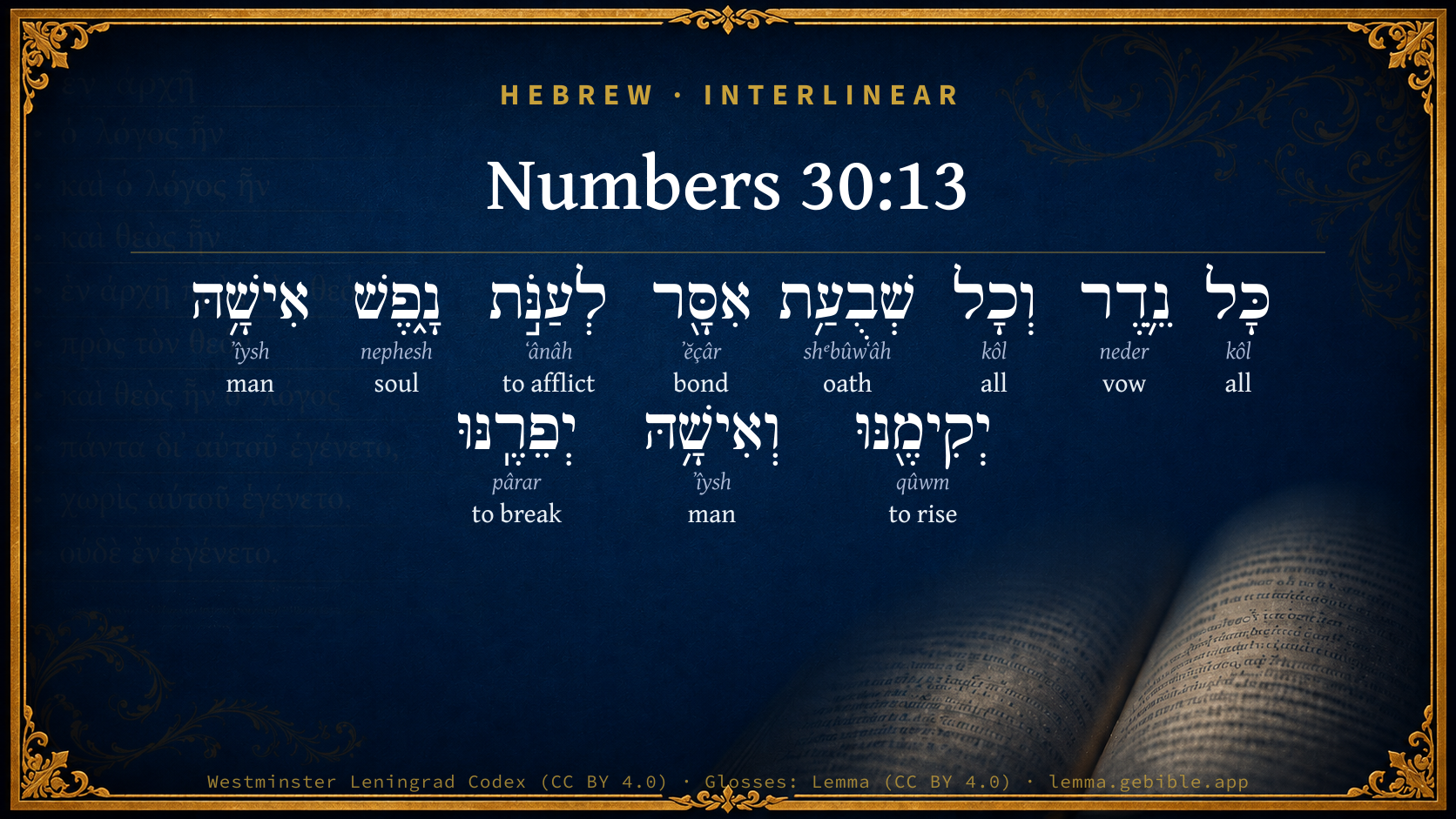
Hebrew (Westminster Leningrad Codex) Numbers 30:13 appears in the Hebrew Old Testament. The text above is from the Westminster Leningrad Codex. Each word links to its Strong’s number, a concise gloss, and parsing drawn from the Open Scriptures Hebrew Bible morphology. Click any word for its full Brown-Driver-Briggs (BDB) entry.
Download image
Cite this verse

Numbers 30:13 (World English Bible). Public Domain. Lemma interlinear Bible study tool, https://lemma.gebible.app/v/numbers/30/13.

Show BibTeX & RIS
BibTeX
RIS
English Translation
Every vow, and every binding oath to afflict the soul, her husband may establish it, or her husband may make it void.
World English Bible · Public Domain
Download a study sheet

One document with this verse’s original text, its word-by-word gloss line, the meaning frame, cross-references with their text, attributed commentary, and full source and license credits — printable, and it pastes into notes with its structure intact.

This verse Autodidact and up

Study sheet (.html) Plain text (.txt)

A passage Seminary Student

Up to 50 verses in one chapter. A passage sheet keeps up to 6 commentary sources and 12 cross-references per verse, in the order this page ranks them, and says so on the sheet whenever that leaves anything out. Ask for a single verse and you get the Autodidact verse sheet above.

Everything on this page stays free to read, with no account — the sheet is a download of what is already on screen, not access to it.

Want to remove ads? Support Godless Engineer
Compare translations 3

The same verse in 3 English versions, stacked beneath the original-language interlinear above. Click any original word for its lexicon entry.

Each is an independent rendering of the whole verse — the interlinear is not word-aligned to these translations.

Highlighted words mark where these versions differ — a whole-verse word diff, not a word-by-word alignment.

  • World English Bible Public Domain
    Every vow, and every binding oath to afflict the soul, her husband may establish it, or her husband may make it void.
  • King James Version Public Domain
    Every vow, and every binding oath to afflict the soul, her husband may establish it, or her husband may make it void.
  • unfoldingWord Literal Text CC BY-SA 4.0
    Every vow and every oath of a binding vow to afflict her life, her husband may make it stand, and her husband may break it.

unfoldingWord Literal Text — © unfoldingWord, licensed CC BY-SA 4.0. Word-aligned USFM3 via Door43 (git.door43.org/unfoldingWord/en_ult).

Versions to compare (up to 4)

3 of 4 selected

Show all 18 translations

Every available English version of this verse, each an independent rendering of the whole verse.

  • World English Bible Public Domain
    Every vow, and every binding oath to afflict the soul, her husband may establish it, or her husband may make it void.
  • Berean Standard Bible Public Domain
    Her husband may confirm or nullify any vow or any sworn pledge to deny herself.
  • Majority Standard Bible Public Domain
    Her husband may confirm or nullify any vow or any sworn pledge to deny herself.
  • King James Version Public Domain
    Every vow, and every binding oath to afflict the soul, her husband may establish it, or her husband may make it void.
  • American Standard Version (1901) Public Domain
    Every vow, and every binding oath to afflict the soul, her husband may establish it, or her husband may make it void.
  • Revised Version (1885) Public Domain
    Every vow, and every binding oath to afflict the soul, her husband may establish it, or her husband may make it void.
  • Geneva Bible (1599) Public Domain
    But if her husband disanulled them, the same day that he heard them, nothing that proceeded out of her lippes concerning her vowes or concerning her bondes, shall stand in effect: for her husband hath disanulled them: and the Lord will forgiue her.
  • Douay-Rheims (1899) Public Domain
    But if forthwith he gainsay it, she shall not be bound by the promise: because her husband gainsaid it, and the Lord will be merciful to her.
  • Young's Literal Translation Public Domain
    `Every vow and every oath -- a bond to humble a soul -- her husband doth establish it, or her husband doth break it;
  • Literal Standard Version CC BY-SA 4.0
    Every vow and every oath—a bond to humble a soul—her husband establishes it, or her husband breaks it;
  • Unlocked Literal Bible CC BY-SA 4.0
    Every vow or oath a woman takes that binds her to deny herself something may be confirmed or canceled by her husband.
  • unfoldingWord Literal Text CC BY-SA 4.0
    Every vow and every oath of a binding vow to afflict her life, her husband may make it stand, and her husband may break it.
  • Darby Bible Public Domain
    Every vow, and every binding oath to afflict the soul, her husband can establish it, or her husband can annul it.
  • World Messianic Bible Public Domain
    Every vow, and every binding oath to afflict the soul, her husband may establish it, or her husband may make it void.
  • Webster's Bible Public Domain
    \\30:12\\But if her husband hath utterly made them void on the day he heard them; then whatever proceeded out of her lips concerning her vows, or concerning the bond of her soul, shall not stand: her husband hath made them void; and the LORD shall forgive her.
  • Free Bible Version CC BY-SA 4.0
    Her husband may also confirm or disallow any solemn promise or pledge the woman may make for self-denial.
  • Bible in Basic English Public Domain
    But if her husband, on hearing of it, made them without force or effect, then whatever she has said about her oaths or her undertaking has no force: her husband has made them without effect, and she will have the Lord's forgiveness.
  • JPS Tanakh (1917) Public Domain
    (30-14) Every vow, and every binding oath to afflict the soul, her husband may let it stand, or her husband may make it void.

Literal Standard Version (2020), Covenant Press — licensed CC BY-SA 4.0. Text via the HelloAO Bible API (eBible.org). Unlocked Literal Bible (unfoldingWord) — licensed CC BY-SA 4.0. Text via the HelloAO Bible API (eBible.org). unfoldingWord Literal Text — © unfoldingWord, licensed CC BY-SA 4.0. Word-aligned USFM3 via Door43 (git.door43.org/unfoldingWord/en_ult). Free Bible Version, Dr. Jonathan Gallagher — licensed CC BY-SA 4.0. Text via the HelloAO Bible API (eBible.org).

Word by word

More ways to search: Search by grammar → Find every occurrence → Compare this word →

Practice this passage: Drill this verse → Learn its vocabulary →

אִסָּ֖ר
ʼĕçâr
H632
“bond”
Noun, Common, Masculine, Singular, Absolute
Part of Speech
Noun
Type
Common
Gender
Masculine
Number
Singular
State
Absolute
Full BDB Definition

Origin: from H631

TWOT: 141d

bond, binding obligation, obligation
  1. כָּל kôl H3605 “all of” Noun, Common, Masculine, Singular, Construct
  2. נֵ֛דֶר neder H5088 “vow” Noun, Common, Masculine, Singular, Absolute
  3. וְכָל kôl H3605 “and · all of” Conjunction + Noun, Common, Masculine, Singular, Construct
  4. שְׁבֻעַ֥ת shᵉbûwʻâh H7621 “oath of” Noun, Common, Feminine, Singular, Construct
  5. לְעַנֹּ֣ת ʻânâh H6031 “to afflict” Preposition + Verb, Piel, Infinitive Construct
  6. נָ֑פֶשׁ nephesh H5315 “soul” Noun, Common, Both, Singular, Absolute
  7. אִישָׁ֥הּ ʼîysh H376 “man · her” Noun, Common, Masculine, Singular, Construct + Suffix, Personal, 3rd Person, Feminine, Singular
  8. יְקִימֶ֖נּוּ qûwm H6965 “to rise · him” Verb, Hiphil, Imperfect, 3rd Person, Masculine, Singular + Suffix, Personal, 3rd Person, Masculine, Singular
  9. וְאִישָׁ֥הּ ʼîysh H376 “and · man · her” Conjunction + Noun, Common, Masculine, Singular, Construct + Suffix, Personal, 3rd Person, Feminine, Singular
  10. יְפֵרֶֽנּוּ pârar H6565 “to break · him” Verb, Hiphil, Imperfect, 3rd Person, Masculine, Singular + Suffix, Personal, 3rd Person, Masculine, Singular

About this verse

These counts appear in no published source. They are computed here, from the morphology-tagged text and Lemma’s own curated glosses. What Lemma adds →

11
words
9
distinct lemmas
Pentateuch
section

Notable vocabulary

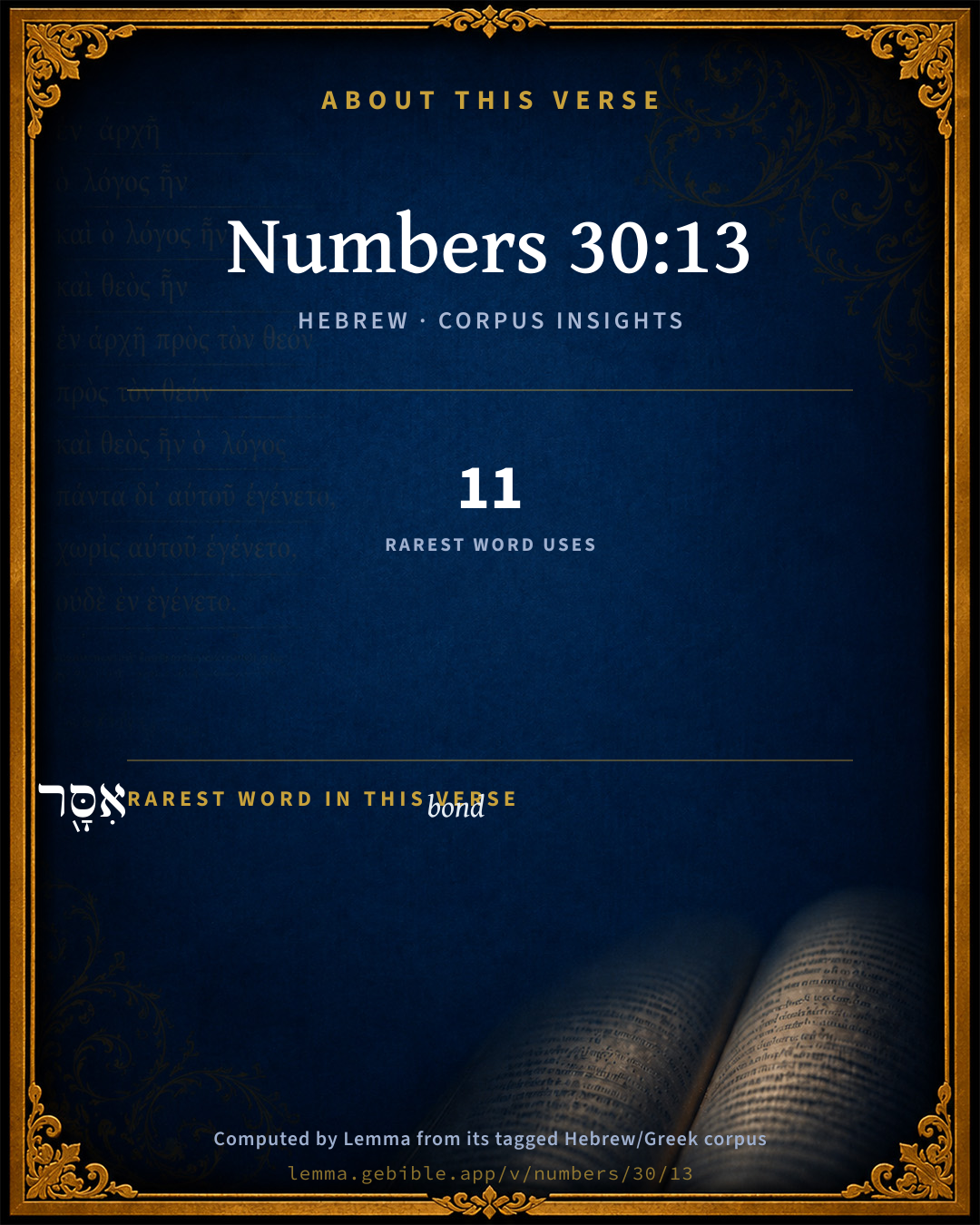
The rarest word here is אִסָּ֖ר bond H632 — appearing just 11 times in the whole Hebrew Bible.

Shared distinctive vocabulary

אִסָּ֖ר bond H632 occurs in 10 verses of the Hebrew Bible. Also found in:

Grammatical profile

  • 3 verbs
  • 8 nouns

Verb forms

  • לְעַנֹּ֣ת Piel · Infinitive Construct
  • יְקִימֶ֖נּוּ Hiphil · Imperfect
  • יְפֵרֶֽנּוּ Hiphil · Imperfect

Repetition

Words recur within this verse — often emphatic in Hebrew:

  • כָּל all H3605 ×2
  • אִישָׁ֥הּ man H376 ×2

Hebrew & Septuagint length

In English translation the verse runs 22 words from the Hebrew and 56 from the Septuagint (LXX English) — the Septuagint runs noticeably longer here. See the side-by-side →

A rough comparison of the two English renderings, which tokenize alike — not a word-level alignment.

Word counts can differ between the Hebrew and the Greek without any difference in meaning — e.g. the Hebrew direct-object marker אֵת has no separate Greek word, and Greek often adds the article ὁ.

Cross-references

11

Topical passages linked to Numbers 30:13 in the Treasury of Scripture Knowledge — connected by theme and wording, ordered by reader-vote popularity; previews shown in the World English Bible.

  • 1 Corinthians 11:3 But I would have you know that the head of every man is Christ, and the head of the woman is the man, and the head of Christ is God.
  • Leviticus 16:29 "It shall be a statute to you forever: in the seventh month, on the tenth day of the month, you shall afflict your souls, and shall do no manner of work, the native-born, or the stranger who lives as a foreigner among you:
  • Leviticus 23:27 "However on the tenth day of this seventh month is the day of atonement: it shall be a holy convocation to you, and you shall afflict yourselves; and you shall offer an offering made by fire to Yahweh.
  • Leviticus 23:32 It shall be a Sabbath of solemn rest for you, and you shall deny yourselves. In the ninth day of the month at evening, from evening to evening, you shall keep your Sabbath."
  • Numbers 29:7 On the tenth day of this seventh month you shall have a holy convocation; and you shall afflict your souls: you shall do no manner of work;
  • Ezra 8:21 Then I proclaimed a fast there, at the river Ahava, that we might humble ourselves before our God, to seek of him a straight way for us, and for our little ones, and for all our substance.
  • Psalms 35:13 But as for me, when they were sick, my clothing was sackcloth. I afflicted my soul with fasting. My prayer returned into my own bosom.
  • Isaiah 58:5 Is such the fast that I have chosen? the day for a man to afflict his soul? Is it to bow down his head as a rush, and to spread sackcloth and ashes under him? will you call this a fast, and an acceptable day to Yahweh?
  • 1 Corinthians 11:9 for neither was man created for the woman, but woman for the man.
  • 1 Peter 3:1–6 In like manner, wives, be in subjection to your own husbands; so that, even if any don't obey the Word, they may be won by the behavior of their wives without a word;
  • 1 Corinthians 7:5 Don't deprive one another, unless it is by consent for a season, that you may give yourselves to fasting and prayer, and may be together again, that Satan doesn't tempt you because of your lack of self-control.

Cross-references courtesy of OpenBible.info (CC BY 4.0).

Hebrew and Greek witnesses Masoretic Hebrew ↔ Greek Septuagint

The same verse in the two great witnesses to the Old Testament, shown verse-for-verse.

Here the Septuagint runs noticeably longer than the Hebrew — LXX2012 (modern English Septuagint) 56 words vs World English Bible 22. A rough length comparison of the two English translations, not a word-level alignment — read both below.

These are two independent witnesses, not word-aligned to each other, and the Septuagint is shown in lemma (dictionary) form.

Hebrew Numbers 30:13 Masoretic · Westminster Leningrad Codex

כָּל נֵ֛דֶר וְכָל שְׁבֻעַ֥ת אִסָּ֖ר לְעַנֹּ֣ת נָ֑פֶשׁ אִישָׁ֥הּ יְקִימֶ֖נּוּ וְאִישָׁ֥הּ יְפֵרֶֽנּוּ

Every vow, and every binding oath to afflict the soul, her husband may establish it, or her husband may make it void.

World English Bible · Public Domain

Greek LXX Numbers 30:13 Septuagint · lemma form

ἐάν δέ περιαἱρέω περιαἱρέω ὁ ἀνήρ αὐτός ὅς ἄν ἡμέρα ἀκούω πᾶς ὅσος ἐάν ἐκἔρχομαι ἐκ ὁ χεῖλος αὐτός κατά ὁ εὐχή αὐτός καί κατά ὁ ὁρισμός ὁ κατά ὁ ψυχή αὐτός οὐ μένω αὐτός ὁ ἀνήρ αὐτός περιαἱρέω καί κύριος καθαρίζω αὐτός

But if her husband should utterly cancel the vow in the day in which he shall hear it, none of the things which shall proceed out of her lips in her vows, and in the obligations contracted upon her soul, shall stand to her; her husband has cancelled them, and the Lord shall hold her guiltless.

LXX2012 (modern English Septuagint) · Public Domain

Hebrew: Westminster Leningrad Codex (CC BY 4.0). Greek: Septuagint (public domain); English from LXX2012 (modern English Septuagint) (Public Domain). How the Septuagint differs from the Hebrew →

Targum (Aramaic paraphrase)

2

The Targum is the ancient Jewish Aramaic paraphrase of the Hebrew Scriptures — an interpretive translation, not the Hebrew text itself. Onkelos (literal) and Pseudo-Jonathan (expansive) render the Torah, and Jonathan the Prophets. Coverage is partial: where no permissively-licensed English translation exists for a verse, only the Aramaic is shown. This is verse-level text, not a word-by-word alignment to the Hebrew.

  1. Targum Onkelos Torah (Genesis–Deuteronomy)
    וְאִם בַּטָלָא יְבַטֵל יָתְהוֹן בַּעֲלַהּ בְּיוֹמָא דִשְׁמַע כָּל אַפָּקוּת סִפְוָתָהָא לְנִדְרָהָא וּלְאִסַר נַפְשַׁהּ לָא יְקוּמוּן בַּעֲלַהּ בְּטֵלִינוּן וּמִן קֳדָם יְיָ יִשְׁתְּבֵק לַהּ

    (no public-domain English translation for this verse)

    Targum Onkelos — Aramaic: “Onkelos Genesis” (public domain); “Onkelos Exodus” (public domain); “Onkelos Leviticus” (public domain); “Onkelos Numbers” (public domain); “Onkelos Deuteronomy” (public domain). English: “Sefaria Community Translation” (CC0 1.0 (public-domain dedication)); “J.W. Etheridge. The Targums of Onkelos and Jonathan Ben Uzziel on the Pentateuch. London: Longmans, Green, 1862” (public domain). Text via Sefaria.

  2. Targum Pseudo-Jonathan Torah (Genesis–Deuteronomy)
    וְאִין מִישְׁרָא יִשְׁרֵי יַתְהוֹן בַּעֲלָהּ בְּיוֹמָא דְשָׁמַע כָּל אַפְקוּת שִפְתָהָא לְנִדְרָהָא וּלְאִיסְרֵי נַפְשָׁהָא לָא יִתְקַיְימוּן וְאִין בַּעֲלָהּ בְּטֵילִינוּן וְלָא יַדְעַת וַעֲבָרַת מִן קֳדָם יְיָ יִשְׁתְּבֵק לָהּ

    But if her husband released her on the day that he heard, then, whatever her lips had pronounced to be a vow, or a bond upon her soul, shall not be confirmed; and if her husband had annulled them, and she, not knowing, had performed, it shall be forgiven her before the Lord.

    Targum Pseudo-Jonathan — Aramaic: “Targum Jonathan on Genesis” (public domain); “Targum Jonathan on Exodus” (public domain); “Targum Jonathan on Leviticus” (public domain); “Targum Jonathan on Numbers” (public domain); “Targum Jonathan on Deuteronomy” (public domain). English: “The Targum of Jonathan ben Uzziel, trans. J. W. Etheridge, London, 1862” (public domain). Text via Sefaria.

Commentary

Notes on Numbers 30:13 from classic Christian and Jewish commentators (each source and its license shown beneath its notes). The classic Christian expositions comment on the surrounding passage and are grouped to its opening verse, so a note may address several verses; the Jewish commentaries on the Tanakh (Rashi and others) are per-verse, so they appear only where the commentator wrote on this verse.

Lemma curates 59 commentaries, every one of them public domain or Creative Commons licensed, each selected and text-cleaned for this edition rather than reprinted as found. About our sources →

Trapp's Complete Commentary

John Trapp

Num 30:13 Every vow, and every binding oath to afflict the soul, her husband may establish it, or her husband may make it void.

Ver. 13. To afflict her soul.] This is one instance of what she may vow. She may curb wanton flesh from the use of things lawful in themselves, but harmful to her, and that by a vow, as did the Rechabites, {Jer 35:8-10} which the devil seeing will despair; for vows are as exorcisms to allay our rebellious spirits, and as cords to hamper our treacherous hearts, when they would slip the collar, and decline the yoke. In short, a man may lawfully vow a thing that is either a part of God’s worship - as to fast once a month before the sacrament, to pray so many times a day, &c. - or a furtherance thereof, - as to found a lecture, build a college, school, almshouse, give so much weekly to the poor, &c.

John Trapp, A Commentary or Exposition upon All the Books of the Old and New Testament (1647–1656) — public domain. Text from a community e-Sword module.

Joseph Benson's Commentary

Num 30:13. To afflict the soul — Herself, by fasting, by watching, or the like. And these words are added to show that the husband had this power not only in those vows which concerned himself or his estate, but also in those which might seem only to concern her own person and body; and the reason is, because the wife’s person or body being the husband’s right, she might not do any thing to the injury of her body without his consent.

Joseph Benson's Commentary on the Old and New Testaments (1811–1818) — public domain. Text from a community e-Sword module.

Geneva Bible (1599)

Geneva Bible translators

Hebrew, the bonds of her soul.

Geneva Bible (1599) marginal notes — public domain. Text via Bolls.life.

Ellicott's Commentary for English Readers

(13) Every vow, and every binding oath to afflict the soul.—Reference is again made to the two kinds of vows which are treated of in this chapter—viz., a vow to do anything, and a vow to abstain from anything.

A Bible Commentary for English Readers, edited by Charles John Ellicott (1878–1897) — public domain. Text from a community e-Sword module.

The Cambridge Bible for Schools and Colleges

gen. ed. J. J. S. Perowne

13. to afflict the soul] See on Num_29:7.

The Cambridge Bible for Schools and Colleges (gen. ed. J. J. S. Perowne; Cambridge University Press, 1878–1918) — public domain. Text from a community e-Sword module.

John Gill's Exposition

Every vow, and every binding oath to afflict the soul,.... By fasting, as Aben Ezra observes; as when a vow was made, or a person bound herself by an oath to abstain from such and such food, or to fast on such a day; to keep a fast which was not appointed, to set apart a day for fasting, besides the grand and general fast on the day of atonement: Jarchi from hence gathers, that a man only makes vows of afflicting the soul, or vows of fasting; but this is not said by way of limitation and restriction, but by way of amplification and illustration, giving a particular instance, by which others may be judged of:

her husband may establish it, or her husband may make it void, just as he pleased; and this power an husband had, to prevent confusion in the family, and trouble in the affairs of it, by vowing abstinence from such and such food, or from such and such liquor, and the like; and to prevent running into expenses he was not able to answer, by vowing and dedicating, this and the other to holy uses, for sacrifices, and repairs of the temple, and the like.

John Gill's Exposition of the Whole Bible (1746–1763) — public domain (CC PDM 1.0). Text via the HelloAO Bible API.

Matthew Poole's English Annotations

Afflict the soul, i.e. herself by fasting, which oft goes under that name, as Lev 16:29,31; 23:27,32; Isa 58:5, by watching, or the like. And these words are added not for limitation, for it is manifest from Num 30:5,8,10,12, that the power of parents and husbands was more general and large; but for amplification, to show that the husband had this power not only in those vows which concerned himself or his estate, but also in those which might seem only to concern her own person or body. And the reason hereof is, because the wife’s person or body being the husband’s right, she might not do any thing to the injury of her body without his consent.

Matthew Poole's English Annotations on the Holy Bible (1683–1685) — public domain. Text from a community e-Sword/MySword module.

The Pulpit Commentary

Oath to afflict the soul. No doubt by fasting or by other kinds of abstinence. The expression is especially used in connection with the rigorous fast of the day of atonement. (Lev_16:29 Num_29:7; and cf. Isa_58:5 1Co_7:5)

The Pulpit Commentary (1880–1919), ed. H.D.M. Spence-Jones & Joseph S. Exell — public domain. Text from a community e-Sword module.

John Wesley's Explanatory Notes

To afflict her soul - Herself by fasting, by watching, or the like. And these words are added to shew that the husband had this power not only in those vows which concerned himself or his estate, but also in those which might seem only to concern her own person, or body, and the reason is, because the wife's person or body being the husband's right; she might not do any thing to the injury of her body without his consent.

John Wesley, Explanatory Notes Upon the Whole Bible (1754–1765) — public domain. Text via the GEBible commentary corpus.

unfoldingWord translationNotes

Door43 World Missions Community

Every vow or oath ... may be confirmed or canceled by her husband

This can be stated in active form. AT: "A woman's husband may confirm or cancel any vow or oath she has taken that binds her to deny herself something" (See: Active or Passive)

that binds her

Here Moses speaks of a woman's promise that she is committed to as if it were something physically binding her body. AT: "that she is committed to" (See: Metaphor)

binding promises

Moses describes a woman's promises as if they were something that she is physically bound by. AT: "obligations" or "promises" (See: Metaphor)

because he has said nothing to her

You can make clear the understood information. AT: "because he has said nothing to her about them" (See: Ellipsis)

translationWords

vow

promise

unfoldingWord translationNotes — © Distant Shores Media and the Door43 World Missions Community, licensed CC BY-SA 4.0. Source: git.door43.org/Door43/en_tn.

Lesson kit

Teaching starters — assembled from the data on this page, not authored interpretation. Every prompt links to the verse data it draws on. Edit before teaching.

Numbers, in the Pentateuch, opens this verse with 11 words (9 distinct Hebrew lemmas). Its most distinctive word is ʼĕçâr (“bond”). The Greek Septuagint runs longer here. A historical commentator’s framing appears above. Read the whole chapter for the surrounding context.

Discussion questions

  1. What does “bond” (ʼĕçâr) contribute to the verse as a whole?
  2. How does Numbers 30:2, which shares the word «bond», read alongside this verse?
  3. What does the repetition of “all” (2× in this one verse) do in this verse?
  4. The Septuagint runs longer here than the Hebrew. What might account for the difference?
  5. The translations on this page render this verse differently — a whole-verse word diff, not a word-by-word alignment. What might account for the different wordings?
  6. «לְעַנֹּ֣ת» is a Piel Infinitive Construct verb. How does that grammatical form shape the action described?
  7. Compare how Trapp's Complete Commentary and Joseph Benson's Commentary read this verse. Where do they agree or differ?

Things to notice

Reading settings

Reading text

Shown beneath each verse's original-language words.

Old Testament
Old Testament edition

Read the OT as the Masoretic Hebrew (MT) or the Greek Septuagint (LXX).

English shown for the Greek Septuagint (in the Hebrew ↔ Greek comparison).

Comparing translations? Open the Compare panel on any verse page to stack up to four side by side.