
2 Corinthians 3:11

Greek (Tischendorf 8th ed.) 2 Corinthians 3:11 appears in the Greek New Testament. The text above is from the Tischendorf 8th edition. Each word links to its Strong’s number and a concise gloss. Click any word for its full Thayer’s Greek Lexicon entry.
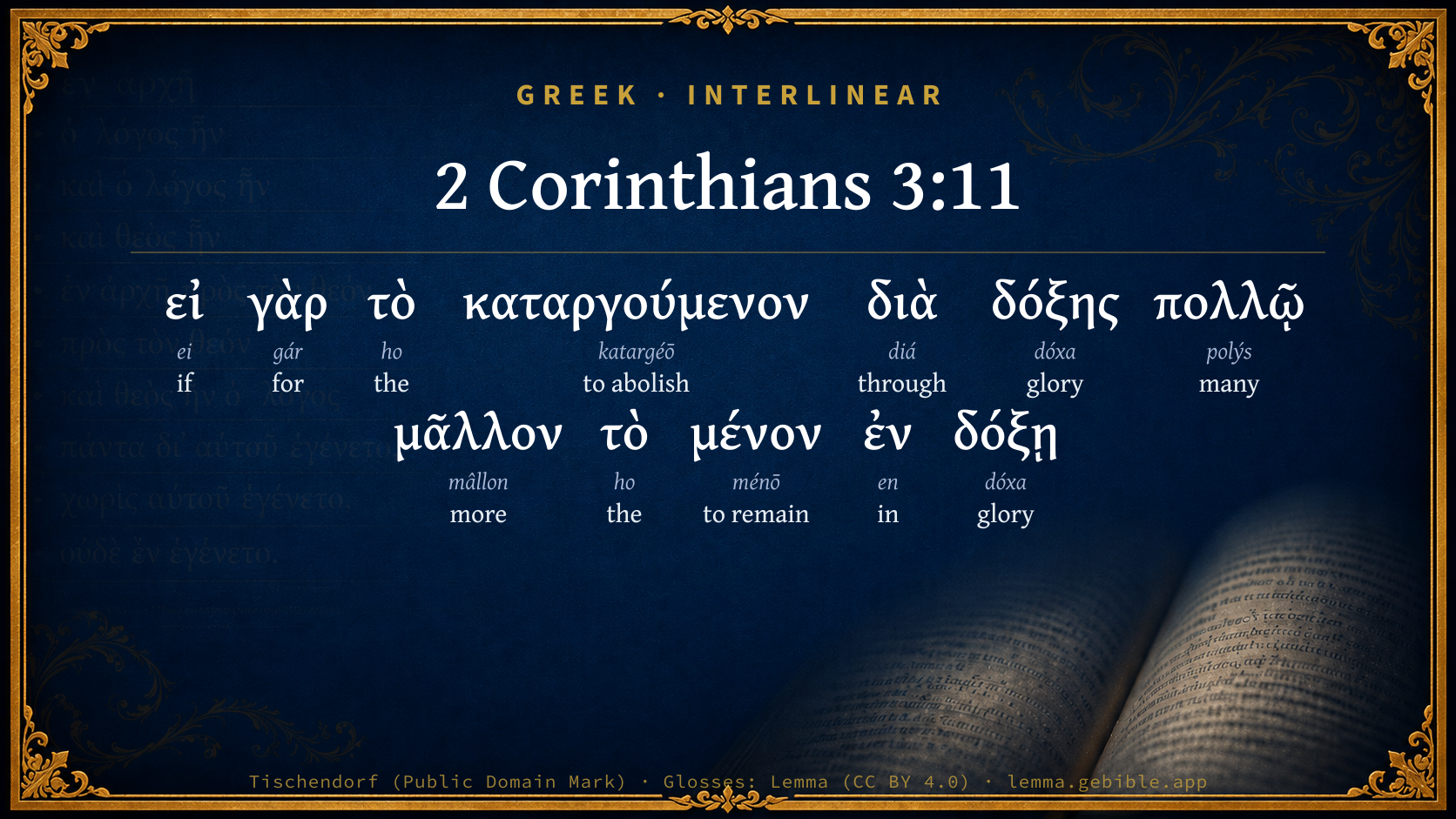
Download image
Cite this verse

2 Corinthians 3:11 (World English Bible). Public Domain. Lemma interlinear Bible study tool, https://lemma.gebible.app/v/2-corinthians/3/11.

Show BibTeX & RIS
BibTeX
RIS
English Translation
For if that which passes away was with glory, much more that which remains is in glory.
World English Bible · Public Domain
Download a study sheet

One document with this verse’s original text, its word-by-word gloss line, the meaning frame, cross-references with their text, attributed commentary, and full source and license credits — printable, and it pastes into notes with its structure intact.

This verse Autodidact and up

Study sheet (.html) Plain text (.txt)

A passage Seminary Student

Up to 50 verses in one chapter. A passage sheet keeps up to 6 commentary sources and 12 cross-references per verse, in the order this page ranks them, and says so on the sheet whenever that leaves anything out. Ask for a single verse and you get the Autodidact verse sheet above.

Everything on this page stays free to read, with no account — the sheet is a download of what is already on screen, not access to it.

Want to remove ads? Support Godless Engineer
Compare translations 3

The same verse in 3 English versions, stacked beneath the original-language interlinear above. Click any original word for its lexicon entry.

Each is an independent rendering of the whole verse — the interlinear is not word-aligned to these translations.

Highlighted words mark where these versions differ — a whole-verse word diff, not a word-by-word alignment.

  • World English Bible Public Domain
    For if that which passes away was with glory, much more that which remains is in glory.
  • King James Version Public Domain
    For if that which is done away was glorious, much more that which remaineth is glorious.
  • unfoldingWord Literal Text CC BY-SA 4.0
    For if is fading away with glory, much more remains with glory!

unfoldingWord Literal Text — © unfoldingWord, licensed CC BY-SA 4.0. Word-aligned USFM3 via Door43 (git.door43.org/unfoldingWord/en_ult).

Versions to compare (up to 4)

3 of 4 selected

Show all 19 translations

Every available English version of this verse, each an independent rendering of the whole verse.

  • World English Bible Public Domain
    For if that which passes away was with glory, much more that which remains is in glory.
  • Berean Standard Bible Public Domain
    For if what was fading away came with glory, how much greater is the glory of that which endures!
  • Majority Standard Bible Public Domain
    For if what was fading away came with glory, how much greater is the glory of that which endures!
  • King James Version Public Domain
    For if that which is done away was glorious, much more that which remaineth is glorious.
  • American Standard Version (1901) Public Domain
    For if that which passeth away `was' with glory, much more that which remaineth `is' in glory.
  • Revised Version (1885) Public Domain
    For if that which passeth away was with glory, much more that which remaineth is in glory.
  • Geneva Bible (1599) Public Domain
    For if that which should be abolished, was glorious, much more shall that which remaineth, be glorious.
  • Douay-Rheims (1899) Public Domain
    For if that which is done away was glorious, much more that which remaineth is in glory.
  • Young's Literal Translation Public Domain
    for if that which is being made useless `is' through glory, much more that which is remaining `is' in glory.
  • Literal Standard Version CC BY-SA 4.0
    for if that which is being made useless [is] through glory, much more that which is remaining [is] in glory.
  • Unlocked Literal Bible CC BY-SA 4.0
    For if that which was passing away had glory, how much more will what is permanent have glory!
  • unfoldingWord Literal Text CC BY-SA 4.0
    For if is fading away with glory, much more remains with glory!
  • Darby Bible Public Domain
    For if that annulled [was introduced] with glory, much rather that which abides [subsists] in glory.
  • World Messianic Bible Public Domain
    For if that which passes away was with glory, much more that which remains is in glory.
  • Webster's Bible Public Domain
    For if that which was done away was glorious, much more that which remaineth is glorious.
  • Free Bible Version CC BY-SA 4.0
    If the old that is fading away had glory, the new that continues has so much more glory.
  • Bible in Basic English Public Domain
    For if the order which was for a time had its glory, much more will the eternal order have its glory.
  • Text-Critical English NT CC BY 4.0
    And if what was fading away came with glory, what remains will be even more glorious.
  • Tyndale New Testament (1534) Public Domain
    Then if that which is destroyed was glorious moche more shall that which remayneth be glorious.

Literal Standard Version (2020), Covenant Press — licensed CC BY-SA 4.0. Text via the HelloAO Bible API (eBible.org). Unlocked Literal Bible (unfoldingWord) — licensed CC BY-SA 4.0. Text via the HelloAO Bible API (eBible.org). unfoldingWord Literal Text — © unfoldingWord, licensed CC BY-SA 4.0. Word-aligned USFM3 via Door43 (git.door43.org/unfoldingWord/en_ult). Free Bible Version, Dr. Jonathan Gallagher — licensed CC BY-SA 4.0. Text via the HelloAO Bible API (eBible.org).

Word by word

More ways to search: Search by grammar → Find every occurrence → Compare this word →

Practice this passage: Drill this verse → Learn its vocabulary →

καταργούμενον
katargéō
G2673
“to abolish”
Verb, Present, Passive, Participle, Nominative, Singular, Neuter
Part of Speech
Verb
Tense
Present
Voice
Passive
Mood
Participle
Case
Nominative
Number
Singular
Gender
Neuter
Full Thayer's Definition

Origin: from G2596 and G691

TDNT: 08:32,8

1. to render idle, unemployed, inactivate, inoperative a. to cause a person or thing to have no further efficiency b. to deprive of force, influence, power 2. to cause to cease, put an end to, do away with, annul, abolish a. to cease, to pass away, be done away b. to be severed from, separated from, discharged from, loosed from any one c. to terminate all intercourse with one
  1. εἰ ei G1487 “if” Conditional
  2. γὰρ gár G1063 “for” Conjunction
  3. τὸ ho G3588 “the” Article, Nominative, Singular, Neuter
  4. διὰ diá G1223 “through” Preposition
  5. δόξης dóxa G1391 “glory” Noun, Genitive, Singular, Feminine
  6. πολλῷ polýs G4183 “many” Adjective, Dative, Singular, Neuter
  7. μᾶλλον mâllon G3123 “more” Adverb
  8. τὸ ho G3588 “the” Article, Nominative, Singular, Neuter
  9. μένον ménō G3306 “to remain” Verb, Present, Active, Participle, Nominative, Singular, Neuter
  10. ἐν en G1722 “in” Preposition
  11. δόξῃ dóxa G1391 “glory” Noun, Dative, Singular, Feminine

About this verse

These counts appear in no published source. They are computed here, from the morphology-tagged text and Lemma’s own curated glosses. What Lemma adds →

12
words
10
distinct lemmas
Pauline Epistles
section

Shared distinctive vocabulary

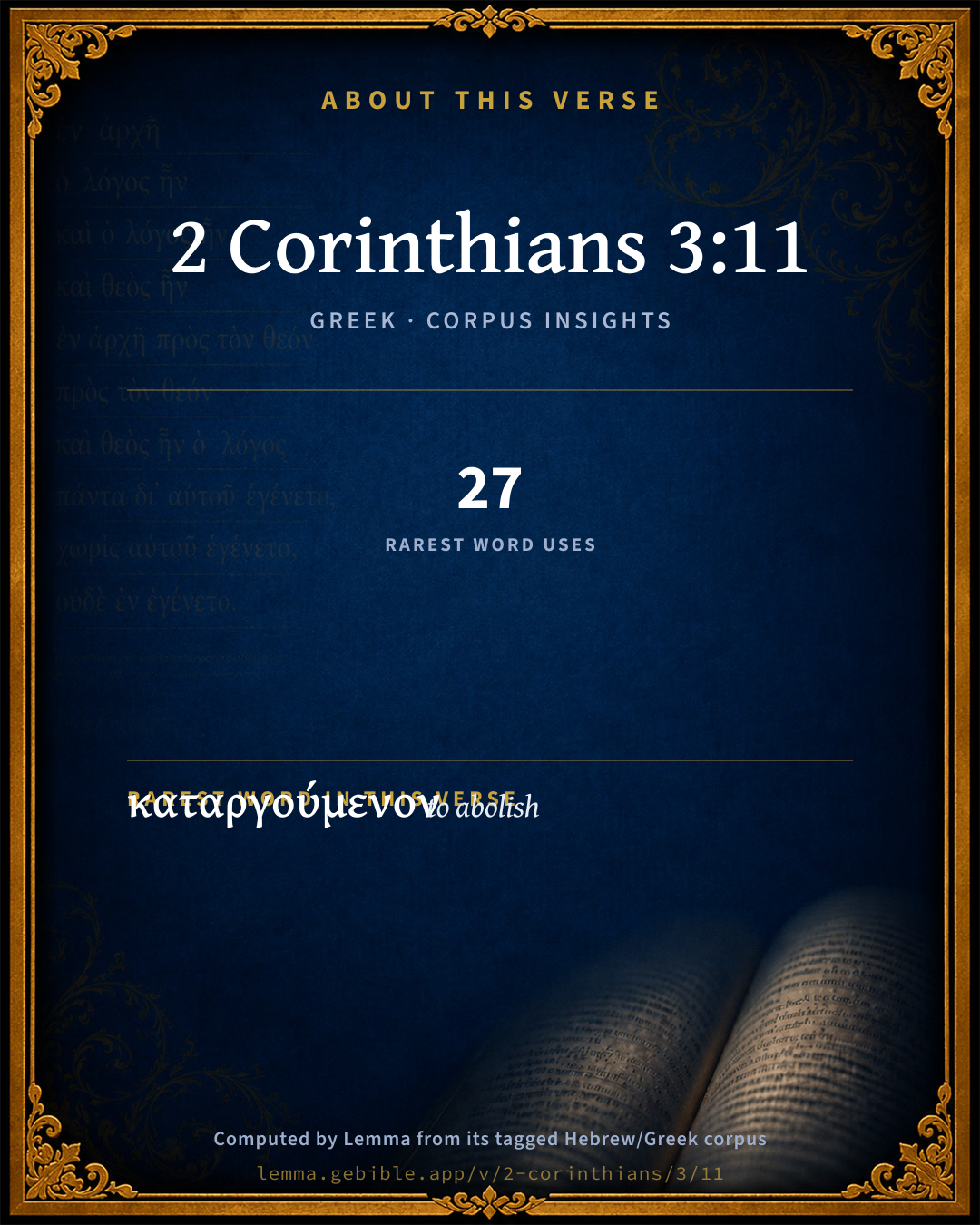
καταργούμενον to abolish G2673 occurs in 26 verses of the Greek New Testament. Also found in:
Repetition

Words recur within this verse:

Cross-references

6

Topical passages linked to 2 Corinthians 3:11 in the Treasury of Scripture Knowledge — connected by theme and wording, ordered by reader-vote popularity; previews shown in the World English Bible.

  • Romans 5:20–21 The law came in besides, that the trespass might abound; but where sin abounded, grace did abound more exceedingly;
  • Hebrews 8:13 In that he says, "A new covenant," he has made the first old. But that which is becoming old and grows aged is near to vanishing away.
  • Hebrews 7:21–25 (for they indeed have been made priests without an oath), but he with an oath by him that says of him, "The Lord swore and will not change his mind, 'You are a priest forever, According to the order of Melchizedek'".
  • 2 Corinthians 3:6–7 who also made us sufficient as servants of a new covenant; not of the letter, but of the Spirit. For the letter kills, but the Spirit gives life.
  • 2 Corinthians 4:1 Therefore seeing we have this ministry, even as we obtained mercy, we don't faint.
  • Hebrews 12:25–29 See that you don't refuse him who speaks. For if they didn't escape when they refused him who warned on the Earth, how much more will we not escape who turn away from him who warns from heaven,

Cross-references courtesy of OpenBible.info (CC BY 4.0).

Commentary

Notes on 2 Corinthians 3:11 from classic Christian and Jewish commentators (each source and its license shown beneath its notes). The classic Christian expositions comment on the surrounding passage and are grouped to its opening verse, so a note may address several verses; the Jewish commentaries on the Tanakh (Rashi and others) are per-verse, so they appear only where the commentator wrote on this verse.

Lemma curates 59 commentaries, every one of them public domain or Creative Commons licensed, each selected and text-cleaned for this edition rather than reprinted as found. About our sources →

Bengel's Gnomon

Johann Albrecht Bengel

2Co 3:11. Διὰ δόξης· ἐν δοξῃ, marked by glory; in glory) The particles are properly varied [the distinction is lost in Engl. Vers., glorious—glorious]. Supply is.—τὸ μένον, that which remains) The διακονία, ministry, itself, does not remain any more than whatever is in part [as for instance, knowledge], 1Co 13:10; but the Spirit, righteousness, life remain; therefore the neuter gender is used.

Bengel's Gnomon of the New Testament — English translation (T&T Clark, Edinburgh, 1860) — public domain. Text from a community e-Sword module.

Meyer's Critical & Exegetical Commentary

Heinrich August Wilhelm Meyer

2Co_3:11. A justification of the foregoing expression τῆς ὑπερβαλλ. δόξης by a general proposition, the application of which in conformity with the connection is left to the reader, and the truth of which in this connection lies in the idea of the completion, which the facts of salvation in the O. T. have to find in the kingdom of God. For if that which ceases is glorious, much more is that which abides glorious.

τὸ καταργούμενον] that which is in the act of passing away. This the reader was to apply to the διακονία of Moses[164] spoken of in 2Co_3:7-10, in so far, namely, as this ministry is in the course of its abolition through the preaching of the gospel by means of the διακονία τῆς δικαιοσύνης. Moses ceases to be lawgiver, when the gospel is preached; for see Rom_10:4. That this is the application intended by Paul, is confirmed by the contrast τὸ μένον, which the reader was to apply to the teaching ministration of the N. T. (not to the Christian religion, as Emmerling and Flatt, following older commentators, think), in so far, namely, as that ministration is not abolished, but continues on to the Parousia (whereupon its glory sets in). Fritzsche is of opinion that the διακονία of Moses is τὸ καταργούμενον for the reason: quod ejus fulgor muneris Christiani gloria superatur, et ita sane καταργεῖται, nullus redditur. But in that case the subject of καταργεῖται would in fact be the splendour, not the διακονία itself. This applies at the same time in opposition to Billroth, who refers τὸ καταργ. to the lustre of Moses office on each occasion soon disappearing, which is impossible on account of διὰ δόξης.

διὰ δόξης] sc. ἐστι. διά expresses the situation, condition, and so is a circumlocution for the adjective. Stallbaum, ad Plat. Phileb. p. 192; Bernhardy, p. 235; Fritzsche, ad Rom. I. p. 138. ἐν δόξῃ (2Co_3:7) is not different in sense; but the supposition of Estius, Billroth, Olshausen, Osiander, Neander, Hofmann, that διά indicates only what is transient, and ἐν what is abiding, is mere fancy. Paul is fond of varying the prepositions in designating the same relation. Comp. Rom_3:30; Rom_5:10; Rom_15:2; Gal_2:16; Phm_1:5. Comp. also Kühner, II, p. 319.

[164] Not to the Mosaic religion in general, which ceases through Christ (Theodoret, Theophylact, and many others, including Emmerling and Flatt),which is quite at variance with the context. See vv. 710.

Meyer — Critical and Exegetical Commentary on the New Testament — English translation by Peter Christie, edited by Frederick Crombie (T&T Clark, 1880) — public domain. Text from a community e-Sword module.

Expositor's Greek Testament

ed. W. Robertson Nicoll

2Co 3:11 . εἰ γὰρ τὸ καταργ . κ . τ . λ .: for if that which passes away was with glory, much more that which abideth is in glory . The difference of prepositions διὰ δόξης … ἐν δόξῃ should not be overlooked; the Ministration of the Old Covenant was only with a transient flush of glory, that of the New abides in glory ( cf. esp. Heb 12:18-27 ). It is true that St. Paul sometimes changes his prepositions in cases where we find difficult to assign a sufficient reason ( e.g. , διά and ἐκ , Rom 3:30 , Gal 2:16 ); but that is no reason for confusing the force of διὰ and ἐν , when the preservation of the distinction between them adds point to the passage ( cf. Rom 5:10 , where διὰ and ἐν are again confused in the A.V.). See further on 2Co 6:8 .

The Expositor's Greek Testament, edited by W. Robertson Nicoll (1897–1910) — public domain. Text from a community e-Sword module.

Geneva Bible (1599)

Geneva Bible translators

The Law, yea, and the ten commandments themselves, together with Moses, is abolished, if we consider the ministry of Moses apart by itself.

Geneva Bible (1599) marginal notes — public domain. Text via Bolls.life.

Jamieson, Fausset & Brown

Robert Jamieson, A. R. Fausset & David Brown

was glorious--literally, "was with glory"; or "marked by glory."

that which remaineth--abideth (Rev 14:6). Not "the ministry," but the Spirit, and His accompaniments, life and righteousness.

is glorious--literally, "is in glory." The Greek "with" or "by" is appropriately applied to that of which the glory was transient. "In" to that of which the glory is permanent. The contrast of the Old and New Testaments proves that Paul's chief opponents at Corinth were Judaizers.

Jamieson, Fausset & Brown — Commentary Critical and Explanatory on the Whole Bible (1871) — public domain (CC PDM 1.0). Text via the HelloAO Bible API.

Adam Clarke's Commentary

Verse 11. For if that which is done away, c.] Here is another striking difference between the law and the Gospel. The former is termed τοκαταργουμενον, that which is counterworked and abolished the latter τομενον, that which continues, which is not for a particular time, place, and people, as the law was; but for ALL times, all places, and all people. As a great, universal, and permanent GOOD vastly excels a good that is small, partial, and transitory; so does the Gospel dispensation, that of the law.

Adam Clarke's Commentary on the Bible (1810–1826) — public domain. Text from a community e-Sword/MySword module.

Ellicott's Commentary for English Readers

(11) For if that which is done away . . .—The Greek participle is in the present tense, “being done away,” or “failing,” expressing the same thought as the “decaying and waxing old” of Heb_8:13. The contrast between the transient and the permanent is expressed by the same Greek words as in 1Co_13:8-11.

Glorious.—Literally, through glory, seen, as it were, through a medium of glory which surrounded it. The second “in glory” is meant, probably, to express a state of greater permanence.

A Bible Commentary for English Readers, edited by Charles John Ellicott (1878–1897) — public domain. Text from a community e-Sword module.

The Cambridge Bible for Schools and Colleges

gen. ed. J. J. S. Perowne

11. For if that which is done away] Rather, is (or was) being done away. See note on 2Co_3:7.

was glorious] Literally, was by means of, or through glory, i.e. was accompanied with, or seen through a haze of glory. See note on 2Co_3:7.

much more that which remaineth is glorious] Literally, is in glory, i.e. as a permanent attribute. Some, however, think that the Apostle often uses different prepositions (see last note) to express the same meaning. The passages, however, to which they refer, though they render this view probable, do not establish it as a fact beyond the reach of doubt.

The Cambridge Bible for Schools and Colleges (gen. ed. J. J. S. Perowne; Cambridge University Press, 1878–1918) — public domain. Text from a community e-Sword module.

Trapp's Complete Commentary

John Trapp

11 For if that which is done away was glorious, much more that which remaineth is glorious.

Ver. 11. Much more that, &c.] As the sun outshineth Lucifer his herald.

John Trapp, A Commentary or Exposition upon All the Books of the Old and New Testament (1647–1656) — public domain. Text from a community e-Sword module.

Albert Barnes' Notes on the Bible

For if that which is done away ... - The splendor that attended the giving of the Law; the bright shining of the face of Moses; and the ritual institutions of his religion. It was to be done away. It was never designed to be permanent. Everything in it had a transient existence, and was so designed. Yet it was attended, Paul admits, with much that was magnificent, and splendid. He had, in the previous verses, stated several important differences between the Law and the gospel. He here states another. The Law he calls τὸ καταργόυμενον to katargoumenon the thing which was to be made to cease; to be put an end to; to be done away with; to be abolished. It had no permanency; and it was designed to have none. Its glory, therefore, great as in many respects it might be, could not be compared with that which was to be permanent - as the light of the stars fades away at the rising sun. It is implied here, that it was originally designed that the Mosaic institutions should not be permanent; that they should be mere shadows and types of better things; and that when the things which they adumbrated should appear, the shadows would vanish of course. This idea is one which prevails everywhere in the New Testament, and which the sacred writers are often at great pains to demonstrate.

Was glorious - Greek “By glory” (διὰ δόξης dia doxēs. That is, it was attended by glory; it was introduced by glory, it was encompassed with glory when it was established The idea here is, not that it was glorious in itself, but that it was accompanied with splendor and majesty.

That which remaineth - The gospel τὸ μένον to menon. The thing that is to remain; that is permanent, abiding, perpetual; that has no principle of decay, and whose characteristic it is, that it is everlasting. The gospel is permanent, or abiding:

(1) Because it is designed to remain immutable through the remotest ages. It is not to be superseded by any new economy, or institution. It is the dispensation under which the affairs of the world are to be wound up, and under which the world is to close; see the note, 1Co 15:51.

(2) Its effects on the heart are permanent. It is complete in itself. It is not to be succeeded by any other system, and it looks to no other system in order to complete or perfect its operations on the soul.

(3) Its effects are to abide forever. They will exist in heaven. They are to be seen in the soul that shall be recovered from sin, and that shall be glorious in the bosom of God forever and ever. The Mosaic system - glorious as it was - shall be remembered as introducing the gospel; the gospel shall be remembered as directly fitting for heaven. Its most great and glorious results shall be seen in the permanent and eternal joys of heaven. The gospel contemplates a great, permanent, and eternal good, adapted to all ages, all climes, all people, and all worlds. It is, therefore, so much more glorious than the limited, temporary, and partial good of the Mosaic system, that that may be said in comparison to have had no glory.

Albert Barnes' Notes on the Bible (1834–1885) — public domain. Text from a community e-Sword/MySword module.

Matthew Poole's English Annotations

The apostle, by another argument, proveth the ministration of the gospel to be much more glorious than the ministration of the law, because it is more durable and abiding. The strength of the argument dependeth upon this principle, that any durable good is more excellent and glorious than that which is but transitory, and for a time. The ministration of the law is done away; the law, contained in ordinances, is itself done away, and therefore the ministration of it must needs cease. There are now no priests and Levites, no worldly sanctuary, nor any ministrations in it, or relating to it. But our Saviour hath told us, that the gospel shall be preached to the end of the world; so as that ministration must (according to all principles of reason) be more glorious, as that which is eternal is more glorious than that which is fluid and vanishing.

Matthew Poole's English Annotations on the Holy Bible (1683–1685) — public domain. Text from a community e-Sword/MySword module.

Whedon's Commentary on the Bible

Daniel D. Whedon

11. Remaineth—And never will be done away, or give place to another ministration. The permanent is much more glorious than is the transient. St. Paul here seems to predict the historic permanence of the Christian dispensation as a fixture for centuries. The Mosaic dispensation, though it had lasted more than a thousand years, was transitory in comparison with the Christian ages. This view stands in apparent contradiction of any assumption that the second advent of Christ was at hand.

Daniel D. Whedon (gen. ed.), Commentary on the Old and New Testaments (1874–1909) — public domain. Text from a community e-Sword module.

The Pulpit Commentary

For. An explanation of the "surpassing" glory of the later covenant founded on its eternity. That which is done away; rather, that which is evanescing; " which is being done away," as in ver. 7. Was glorious is glorious. The expression is varied in the Greek. The brief, the evanescent covenant was "through glory," i.e. it was a transitory gleam; the abiding covenant is "in glory;" i.e. it is an eternal splendour. It is, however, a disputed point whether St. Paul intended such rigid meanings to be attached to his varying prepositions stev Rom_3:30, ejk pi diastewv Rom_5:10, diatou ejn th zwhrgwn Gal_2:16, ejx e diastewv Phm_1:5, pro torion eijv touv aJgiouv. That which remaineth. The final, eternal, unshakable gospel. (Heb_12:27) Is glorious; literally, is in glory. Christ is eternally the Light of the world; (Joh_1:9 Joh_9:5) and Moses and Elias derived all their permanence of glory by reflection from this transfiguring light.

The Pulpit Commentary (1880–1919), ed. H.D.M. Spence-Jones & Joseph S. Exell — public domain. Text from a community e-Sword module.

John Wesley's Explanatory Notes

That which remaineth - That dispensation which remains to the end of the world; that spirit and life which remain forever.

John Wesley, Explanatory Notes Upon the Whole Bible (1754–1765) — public domain. Text via the GEBible commentary corpus.

McGarvey & Pendleton's Commentaries

J. W. McGarvey

For if that which passeth away was with glory, much more that which remaineth is in glory . [If the old covenant which brought death glorified its introducing minister, so that the face of Moses shone as he brought it from God to the people, and glowed so resplendently that the children of Israel could not look steadily at him (though we should note in passing that this glory was of a temporary, evanescent nature); is it not more to be expected that the initiatory ministers of that new covenant which brings life shall be glorified? For if there was glory in ministering under that covenant which brought condemnation, much more is there glory in ministering under that which brings justification through righteousness. For even though the old covenant was made glorious it had no glory in respect to or comparison with the new covenant by reason of the excelling glory of the latter. For if that which was outshone is glorious, much more is that glorious which outshines it and continues to obscure it. Paul's language suggests the rising sun. Before he comes the stars seem glorious, yet they have no glory in comparison with him. If they are glorious, much more is the king of day glorious, who, by his superior brightness, reminds all their glittering orbs to darkness.]

J. W. McGarvey (with Philip Y. Pendleton), Commentaries on the New Testament (The Fourfold Gospel, 1914; Acts; and the epistles) — public domain. Text from a community e-Sword/MySword module.

The People's New Testament

B. W. Johnson

11. For if that which is done away was glorious. That which was glorious in the Old Covenant, or law. It includes the Decalogue (@verse 7). The whole is done away. This clear and emphatic statement is made on account of the Judaizing teachers of whom we find many traces in the two Letters to the Corinthian church. It is clearly asserted that the Old Covenant, “the ministration of death written and engraven on stones,” is done away. We are “not under the law, but under grace.” Compare Hebrews 8:13. But if that which was done away is glorious, much more is that glorious which abides forever.

B. W. Johnson's The People's New Testament with Notes (1889–1891) — public domain. Electronic text from the Christian Classics Ethereal Library (CCEL) ThML edition.

Cambridge Greek Testament for Schools and Colleges

11. He continues the justification (γάρ) of what has been said. For if that which is being done away (2Co 3:7) was through glory, much more that which abideth (Rom 9:11) is in glory. The fading of the glory from the face of Moses indicated that the ministration which he instituted was not to last. To the old dispensation glory was a phase, through which it passed; to the new it is a sphere in which it abides (2Co 9:9; 1Co 13:13; Joh 15:4).

Cambridge Greek Testament for Schools and Colleges (Cambridge University Press, 1896; 21 vols, various authors incl. Carr, Maclear, Plummer, Farrar, Lumby, Moule, M. R. James, Simcox) — public domain. Text from a community e-Sword module.

Alford’s Greek Testament

Henry Alford

11.] For (a fresh ground of superiority in glory of the Christian over the Mosaic ministry) if that which is transitory (not here, as above, the brilliancy of the visage of Moses, for that was the δόξα, but the ministry itself, the whole purpose which that ministry served, which was parenthetical and to come to an end) was with glory (διὰ, see reff., of the condition or circumstances in which a thing takes place), much more is that which abideth (the everlasting gospel) in glory. Estius says, “per gloriam (διὰ δ.) innuere videtur aliquid momentaneum ac transitorium: in gloria, aliquid manens et stabile.” Similarly, Olshausen: but it is quite in the style of our Apostle to use various prepositions to express nearly the same relation,—see Rom 3:22, Rom 3:30; Rom 5:10.

12,

Henry Alford, The Greek Testament (1849–1861) — public domain. Text from a community e-Sword module.

International Critical Commentary

11. Third contrast; again explanatory (γάρ) and in support of what precedes. ‘For if that which was being done away was through glory, to a much greater extent that which abideth is in glory.’ What is given to last only for a time is as nothing in comparison with what is given to last for ever. Christianity is εὐαγγέλιον αἰώνιον (14:6), a Gospel reaching forward into eternity and bringing with it σωτηρίαν αἰώνιον (Isa 45:17; Heb 5:9), and its ministers are ministers διαθήκης αἰωνίου (Heb 13:20). They have not the transitory glory of Moses in their faces, but in their souls they have the everlasting glory of the message which they deliver. Supply ἐστίν rather than ἔσται with ἐνδόξῃ.

The change from διὰ δόξης to ἐν δόξῃ may indicate the difference between what passes and what abides. We have a similar change Rom 5:10, in a sentence very similar in construction to this; εἰ γὰρ ἐχθροὶ ὄντες κατηλλάγημεν τῷ Θεῷ διὰ τοῦ θανάτου τοῦ υἱτοῦ αὐτοῦ πολλῶ μᾶλλον καταλλαγέτεσσωθησύμεθα ἐν τῇ ζωῇ αὐτοῦ. In Eph 1:7 we have the converse change from ἐν to διά, from what is permanent to what was transitory; ἐν ᾧ ἔχομεν τὴν ἀπολύτρωσιν διὰ τοῦ αἵματος αὐτοῦ. St Paul is fond of changes in prepositions; 1Co 12:8; Gal 2:16; Rom 3:30.

These verses (7-11) show what a revolution had taken place in the mind of St Paul since he had exchanged the Law for the Gospel. Christianity is so superior to Judaism that it has extinguished it. Even in its best days, when it also was a Divine revelation to the human race, Judaism had a glory which was infinitesimal compared with that which was inaugurated by Christ. A rich variety of expressions is used to bring this out. The Gospel is μᾶλλον ἐν δόξῃ is πολλῷ μᾶλλον ἐν δόξῃ πολλῷ μᾶλλον περισσεύει δόξῃ, and the δόξα is ὑπερβάλλουσα. It secures from death, it secures from condemnation, and it abides. In this argument the Apostle has chiefly in view the Judaizers who made the Law indispensable and superior to the Gospel. Beet, p. 349.

3:12-4:6. The Great Boldness of the New Ministers

Conscious of the vast superiority of the New Covenant, we need no veil to cover deficiencies, but deliver our message with boldness and openness.

12 Seeing, therefore, that we servants of the Gospel have a sure expectation that the glory of the new covenant will prove as superior in duration as it is in splendour, and will never disappear before a far greater glory, we venture to preach with great confidence, frankness, and courage, at the risk of being accused of self-commendation. 13 Unlike our opponents, we have nothing to conceal. We have no need to act as Moses did. He used to put a veil over his face, to prevent the children of Israel from gazing at the gradual dying away of the glory which the presence of the Lord had imparted to his countenance. The passing away of that glory symbolized the transitory character of the Mosaic dispensation; and by concealing the former from the people Moses might seem to be concealing the other also. 14 But, so far from seeing what the fading of the glory signified, or profiting by our plain speaking, their spiritual perceptions were deadened. For down to this very day, when the records of the old covenant (which might teach them so much) are read, the same veil of ignorance as to the transitory character of the Law lies still upon their minds, still unlifted, because by becoming members of Christ, and in that way alone, is it done away. 15 And unto this very day, whenever the Law of Moses is read in their synagogues, a veil of miscomprehension lies upon their hearts. 16 But just as Moses, when he returned to the presence of the Lord, removed the veil from his face, so, when any one of them turns to the Lord, the veil is removed from his heart, and he sees that the dispensation of the Law has come to an end. 17 Now the Lord to whom such an one turns is the Spirit of Christ, and where the Spirit of Christ is, there is emanicipation from the bondage of the Law and of sin. 18 And all we Christian men, freed from the Law and freely obeying a higher commandment, have a glory which resembles that of the unveiled Moses. As we gaze with unveiled face upon the glory of the Lord Christ, before which the glory of Moses vanished away, we are daily being transformed into spiritual likeness to Him, from one degree of brightness to another,—an amazing transformation, but not beyond belief, when we remember that the power which transforms us is a Spirit which is Lord.

International Critical Commentary — older volumes (1896–1929), various authors — public domain. Text from a community e-Sword module.

Vincent's Word Studies in the New Testament

Marvin R. Vincent

That which is done away [το καταργουμενον] . Lit., which is being done away; in course of abolition through the preaching of the Gospel. Both the A. V., and Rev. passeth fail to bring, out the idea of process. Was glorious [δια δοξης] . Lit., through glory. Rev., with glory. 142

Marvin R. Vincent, Word Studies in the New Testament (1887–1900) — public domain. Text from a community e-Sword/MySword module.

Lesson kit

Teaching starters — assembled from the data on this page, not authored interpretation. Every prompt links to the verse data it draws on. Edit before teaching.

2 Corinthians, in the Pauline Epistles, opens this verse with 12 words (10 distinct Greek lemmas). Its most distinctive word is katargéō (“to abolish”). A historical commentator’s framing appears above. Read the whole chapter for the surrounding context.

Discussion questions

  1. How does “to abolish” (katargéō) shape what this verse is saying?
  2. How does Luke 13:7, which shares the word «to abolish», read alongside this verse?
  3. What does the repetition of “glory” (2× in this one verse) do in this verse?
  4. These translations render this verse differently. What is at stake in choosing one wording over another?
  5. Compare how Bengel's Gnomon and Meyer's Critical & Exegetical Commentary read this verse. Where do they agree or differ?

Things to notice

  • These translations choose different wording for 8 words in this verse.
  • “glory” occurs 2× in this single verse.
  • 10 distinct Greek lemmas span 12 words in this verse.

Reading settings

Reading text

Shown beneath each verse's original-language words.

Old Testament
Old Testament edition

Read the OT as the Masoretic Hebrew (MT) or the Greek Septuagint (LXX).

English shown for the Greek Septuagint (in the Hebrew ↔ Greek comparison).

Comparing translations? Open the Compare panel on any verse page to stack up to four side by side.