Philippians 1:25

Greek (Tischendorf 8th ed.) Philippians 1:25 appears in the Greek New Testament. The text above is from the Tischendorf 8th edition. Each word links to its Strong’s number and a concise gloss. Click any word for its full Thayer’s Greek Lexicon entry.
Download image
Cite this verse

Philippians 1:25 (World English Bible). Public Domain. Lemma interlinear Bible study tool, https://lemma.gebible.app/v/philippians/1/25.

Show BibTeX & RIS
BibTeX
RIS
English Translation
Having this confidence, I know that I will remain, yes, and remain with you all, for your progress and joy in the faith,
World English Bible · Public Domain
Download a study sheet

One document with this verse’s original text, its word-by-word gloss line, the meaning frame, cross-references with their text, attributed commentary, and full source and license credits — printable, and it pastes into notes with its structure intact.

This verse Autodidact and up

Study sheet (.html) Plain text (.txt)

A passage Seminary Student

Up to 50 verses in one chapter. A passage sheet keeps up to 6 commentary sources and 12 cross-references per verse, in the order this page ranks them, and says so on the sheet whenever that leaves anything out. Ask for a single verse and you get the Autodidact verse sheet above.

Everything on this page stays free to read, with no account — the sheet is a download of what is already on screen, not access to it.

Want to remove ads? Support Godless Engineer
Compare translations 3

The same verse in 3 English versions, stacked beneath the original-language interlinear above. Click any original word for its lexicon entry.

Each is an independent rendering of the whole verse — the interlinear is not word-aligned to these translations.

Highlighted words mark where these versions differ — a whole-verse word diff, not a word-by-word alignment.

  • World English Bible Public Domain
    Having this confidence, I know that I will remain, yes, and remain with you all, for your progress and joy in the faith,
  • King James Version Public Domain
    And having this confidence, I know that I shall abide and continue with you all for your furtherance and joy of faith;
  • unfoldingWord Literal Text CC BY-SA 4.0
    And having become confident of this, I know that I will remain and will continue with you all for your progress and joy in the faith

unfoldingWord Literal Text — © unfoldingWord, licensed CC BY-SA 4.0. Word-aligned USFM3 via Door43 (git.door43.org/unfoldingWord/en_ult).

Versions to compare (up to 4)

3 of 4 selected

Show all 19 translations

Every available English version of this verse, each an independent rendering of the whole verse.

  • World English Bible Public Domain
    Having this confidence, I know that I will remain, yes, and remain with you all, for your progress and joy in the faith,
  • Berean Standard Bible Public Domain
    Convinced of this, I know that I will remain and will continue with all of you for your progress and joy in the faith,
  • Majority Standard Bible Public Domain
    Convinced of this, I know that I will remain and will continue with all of you for your progress and joy in the faith,
  • King James Version Public Domain
    And having this confidence, I know that I shall abide and continue with you all for your furtherance and joy of faith;
  • American Standard Version (1901) Public Domain
    And having this confidence, I know that I shall abide, yea, and abide with you all, for your progress and joy in the faith;
  • Revised Version (1885) Public Domain
    And having this confidence, I know that I shall abide, yea, and abide with you all, for your progress and joy in the faith;
  • Geneva Bible (1599) Public Domain
    And this am I sure of, that I shall abide, and with you all continue, for your furtherance and ioy of your faith,
  • Douay-Rheims (1899) Public Domain
    And having this confidence, I know that I shall abide, and continue with you all, for your furtherance and joy of faith:
  • Young's Literal Translation Public Domain
    and of this being persuaded, I have known that I shall remain and continue with you all, to your advancement and joy of the faith,
  • Literal Standard Version CC BY-SA 4.0
    and being persuaded of this, I have known that I will remain and continue with you all, to your advancement and joy of the faith,
  • Unlocked Literal Bible CC BY-SA 4.0
    Being convinced of this, I know that I will remain and continue with you all, for your progress and joy in the faith,
  • unfoldingWord Literal Text CC BY-SA 4.0
    And having become confident of this, I know that I will remain and will continue with you all for your progress and joy in the faith
  • Darby Bible Public Domain
    and having confidence of this, I know that I shall remain and abide along with you all, for your progress and joy in faith;
  • World Messianic Bible Public Domain
    Having this confidence, I know that I will remain, yes, and remain with you all for your progress and joy in the faith,
  • Webster's Bible Public Domain
    And having this confidence, I know that I shall abide and continue with you all for your furtherance and joy of faith;
  • Free Bible Version CC BY-SA 4.0
    Since I'm absolutely sure of this, I know that I'll stay here, remaining with you all to help you as your trust and delight in God grows,
  • Bible in Basic English Public Domain
    And being certain of this, I am conscious that I will go on, yes, and go on with you all, for your growth and joy in the faith;
  • Text-Critical English NT CC BY 4.0
    Convinced of this, I know that I will remain and continue with you all for the sake of your progress and joy in the faith,
  • Tyndale New Testament (1534) Public Domain
    And this am I sure of that I shall abyde and with you all continue for the furtheraunce and ioye of youre fayth

Literal Standard Version (2020), Covenant Press — licensed CC BY-SA 4.0. Text via the HelloAO Bible API (eBible.org). Unlocked Literal Bible (unfoldingWord) — licensed CC BY-SA 4.0. Text via the HelloAO Bible API (eBible.org). unfoldingWord Literal Text — © unfoldingWord, licensed CC BY-SA 4.0. Word-aligned USFM3 via Door43 (git.door43.org/unfoldingWord/en_ult). Free Bible Version, Dr. Jonathan Gallagher — licensed CC BY-SA 4.0. Text via the HelloAO Bible API (eBible.org).

Word by word

More ways to search: Search by grammar → Find every occurrence → Compare this word →

Practice this passage: Drill this verse → Learn its vocabulary →

προκοπὴν
prokopḗ
G4297
“progress”
Noun, Accusative, Singular, Feminine
Part of Speech
Noun
Case
Accusative
Number
Singular
Gender
Feminine
Full Thayer's Definition

Origin: from G4298

TDNT: 17:43,9

1. progress, advancement
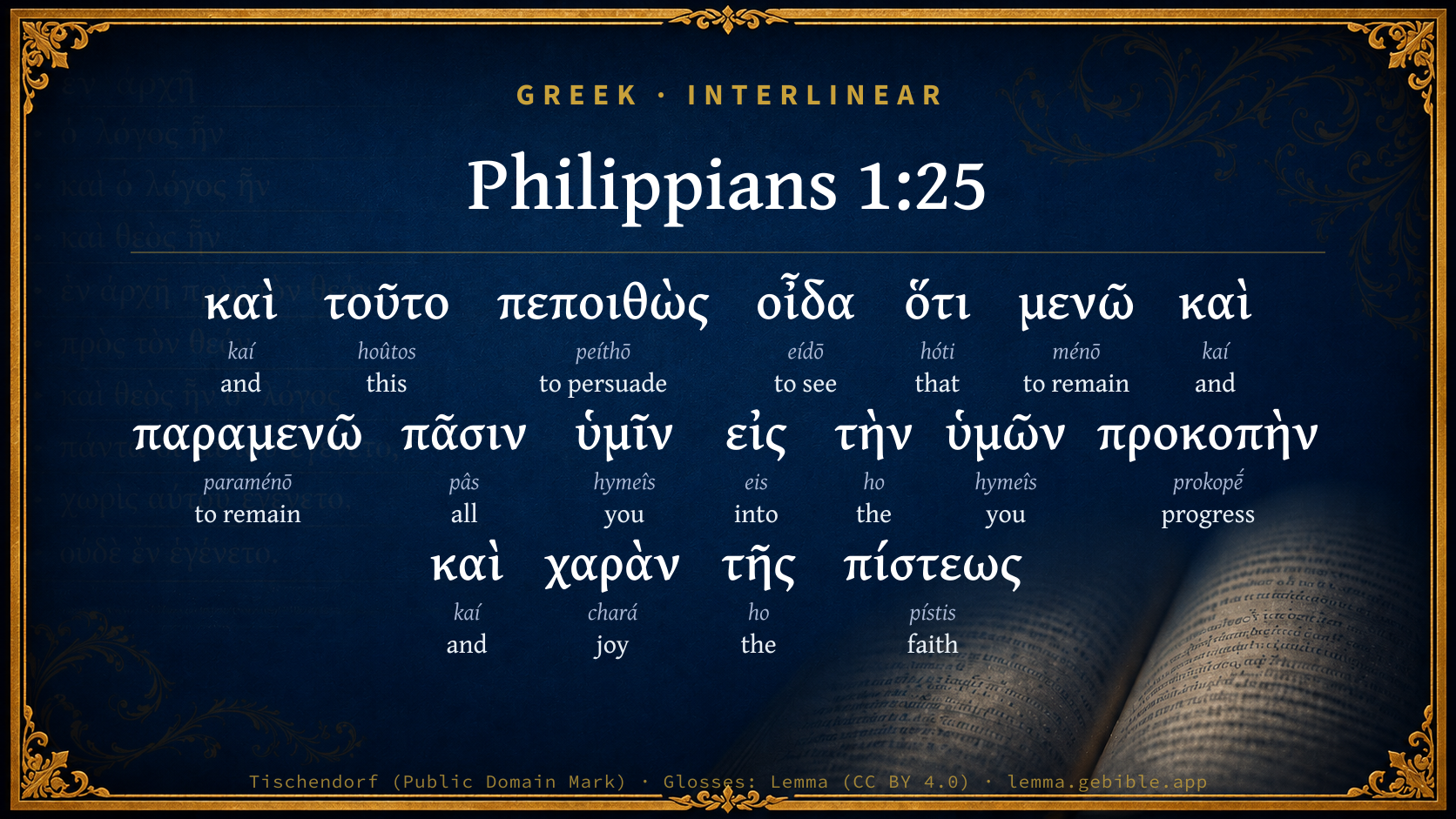
  1. καὶ kaí G2532 “and” Conjunction
  2. τοῦτο hoûtos G3778 “this” Demonstrative pronoun, Accusative, Singular, Neuter
  3. πεποιθὼς peíthō G3982 “to persuade” Verb, Perfect, Active, Participle, Nominative, Singular, Masculine
  4. οἶδα eídō G1492 “to see” Verb, Perfect, Active, Indicative, 1st person, Singular
  5. ὅτι hóti G3754 “that” Conjunction
  6. μενῶ ménō G3306 “to remain” Verb, Future, Active, Indicative, 1st person, Singular
  7. καὶ kaí G2532 “and” Conjunction
  8. παραμενῶ paraménō G3887 “to remain” Verb, Future, Active, Indicative, 1st person, Singular
  9. πᾶσιν pâs G3956 “all” Adjective, Dative, Plural, Masculine
  10. ὑμῖν hymeîs G5210 “you” Personal pronoun, 2nd person, Dative, Plural
  11. εἰς eis G1519 “into” Preposition
  12. τὴν ho G3588 “the” Article, Accusative, Singular, Feminine
  13. ὑμῶν hymeîs G5210 “you” Personal pronoun, 2nd person, Genitive, Plural
  14. καὶ kaí G2532 “and” Conjunction
  15. χαρὰν chará G5479 “joy” Noun, Accusative, Singular, Feminine
  16. τῆς ho G3588 “the” Article, Genitive, Singular, Feminine
  17. πίστεως pístis G4102 “faith” Noun, Genitive, Singular, Feminine

About this verse

These counts appear in no published source. They are computed here, from the morphology-tagged text and Lemma’s own curated glosses. What Lemma adds →

18
words
14
distinct lemmas
Pauline Epistles
section

Notable vocabulary

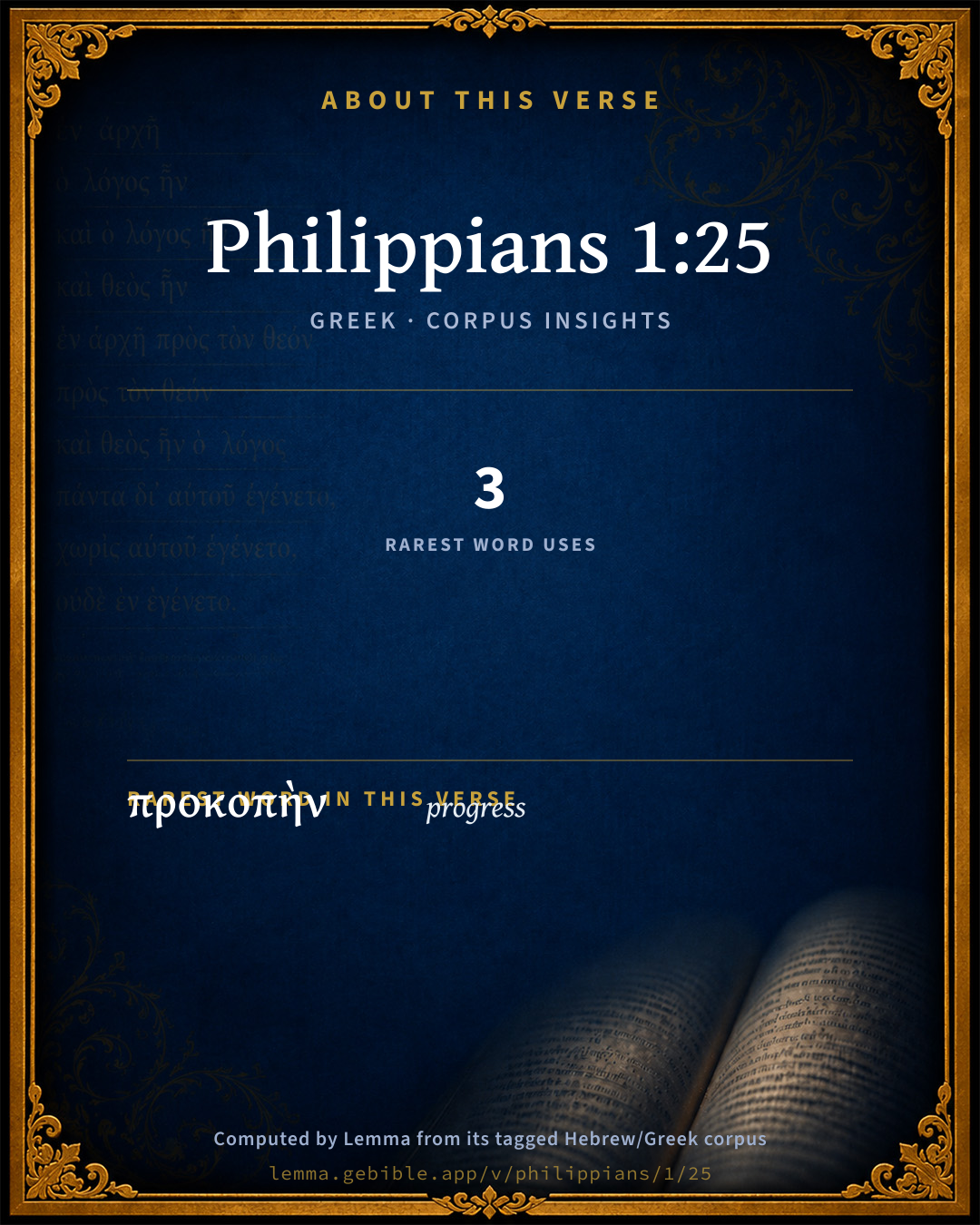
The rarest word here is προκοπὴν progress G4297 — appearing just 3 times in the whole Greek New Testament.

Shared distinctive vocabulary

προκοπὴν progress G4297 occurs in 3 verses of the Greek New Testament. Also found in:

Repetition

Words recur within this verse:

Cross-references

15

Topical passages linked to Philippians 1:25 in the Treasury of Scripture Knowledge — connected by theme and wording, ordered by reader-vote popularity; previews shown in the World English Bible.

  • Philippians 2:24 But I trust in the Lord that I myself also will come shortly.
  • 2 Corinthians 1:24 Not that we have lordship over your faith, but are fellow workers with you for your joy. For you stand firm in faith.
  • Ephesians 4:11–13 He gave some to be apostles; and some, prophets; and some, evangelists; and some, shepherds and teachers;
  • Acts 20:25 Now, behold, I know that you all, among whom I went about preaching the Kingdom of God, will see my face no more.
  • Romans 1:11–12 For I long to see you, that I may impart to you some spiritual gift, to the end that you may be established;
  • Romans 5:2 through whom we also have our access by faith into this grace in which we stand. We rejoice in hope of the glory of God.
  • Romans 15:13 Now may the God of hope fill you with all joy and peace in believing, that you may abound in hope, in the power of the Holy Spirit.
  • Psalms 60:6 God has spoken from his sanctuary: "I will triumph. I will divide Shechem, And measure out the valley of Succoth.
  • Luke 22:32 but I prayed for you, that your faith wouldn't fail. You, when once you have turned again, establish your brothers."
  • John 21:15–17 So when they had eaten their breakfast, Jesus said to Simon Peter, "Simon, son of Jonah, do you love me more than these?" He said to him, "Yes, Lord; you know that I have affection for you." He said to him, "Feed my lambs."
  • Acts 11:23 who, when he had come, and had seen the grace of God, was glad. He exhorted them all, that with purpose of heart they should remain near to the Lord.
  • Acts 14:22 confirming the souls of the disciples, exhorting them to continue in the faith, and that through many afflictions we must enter into the Kingdom of God.
  • Romans 15:18 For I will not dare to speak of any things except those which Christ worked through me, for the obedience of the Gentiles, by word and deed,
  • Romans 15:29 I know that, when I come to you, I will come in the fullness of the blessing of the Gospel of Christ.
  • 1 Peter 1:8 whom not having known you love; in whom, though now you don't see him, yet believing, you rejoice greatly with joy unspeakable and full of glory--

Cross-references courtesy of OpenBible.info (CC BY 4.0).

Commentary

Notes on Philippians 1:25 from classic Christian and Jewish commentators (each source and its license shown beneath its notes). The classic Christian expositions comment on the surrounding passage and are grouped to its opening verse, so a note may address several verses; the Jewish commentaries on the Tanakh (Rashi and others) are per-verse, so they appear only where the commentator wrote on this verse.

Lemma curates 59 commentaries, every one of them public domain or Creative Commons licensed, each selected and text-cleaned for this edition rather than reprinted as found. About our sources →

The Biblical Illustrator

Joseph S. Exell

Php_1:25

Having this confidence--This I know of the apostle has something like its parallel in that of Luther, when his friend and true yoke fellow, Melancthon, lay at the point of death.

The reformer, it is said, after earnest prayer approached the sick bed, and uttered these prophetic words, Cheer up, Philip; you are not going to die. Luther was in no sense prophesying, but he had been praying; and in answer to his prayer the conviction was irresistibly borne in upon his mind and heart, that his colleague, for whom so much work was waiting, would yet live to do it. What, then, of personal conviction Luther asserted about another, Paul here asserts about himself. We thus see that blended humility and trustfulness, more especially in strongly emotional natures, can dare sometimes to use the bold language of assured conviction even in regard to issues which are to us uncertain, for they are with God alone. But it is to be noticed that this language never can be used when merely personal or private ends are in view. When Paul said I know in this case, he was indeed alluding to his own future, but he was contemplating it in relation not to his own individual interests, but solely to his friends progress and joy in the faith,--their advancement in the inner life through strengthening faith, and their joy, as overflowing out of that faith, in their outward life of Christian service. All this would be theirs by his presence restored to them for a time, more than by any letter, however tender, he could write to them. (J. Hutchison, D. D.)

The Biblical Illustrator, edited by Joseph S. Exell (c. 1880s–1900s) — public domain. Text from a community e-Sword module.

Whedon's Commentary on the Bible

Daniel D. Whedon

3. Paul’s hopes of his Philippians, Php_1:25-26.

25. Having this confidence—So fully was he persuaded of this necessity, that however uncertain he might be as to what he ought to choose, he felt it certain that he would remain and again visit Philippi. The return to them of their apostle could have had no other result than the enlargement of their faith, and the increase of their joy.

Daniel D. Whedon (gen. ed.), Commentary on the Old and New Testaments (1874–1909) — public domain. Text from a community e-Sword module.

Tyndale Open Study Notes

Tyndale Open Resources

1:25 The well-being of the church is more important to Paul than his own desire to be with Christ. • experience the joy of your faith: Believers are encouraged to find joy even in the midst of suffering (see 4:4; John 15:11, 20; 16:20-24; 1 Thes 5:16).

Tyndale Open Study Notes — © Tyndale Open Resources, licensed CC BY-SA 4.0. Text via the HelloAO Bible API.

Bengel's Gnomon

Johann Albrecht Bengel

Php 1:25. Καὶ τοῦτο, and this) While he was writing these things, he had a prophetical suggestion in his mind concerning his continuance among them.—πεποιθὼς οἶδα, I confidently know) He knew by spiritual confidence; he did not yet know from the report of men, Php 1:17, ch. Php 2:23.—μενῶ, that I shall continue) in life.—συμπαραμενῶ, remain with you) I shall remain for a considerable length of time with you. Psa 72:5, the LXX., συμπαραμενεῖ τῷ ἡλιῳ, He shall continue along with [as long as] the sun. There is no doubt that Paul returned from his first captivity into that country, Philem Php 1:22; Heb 13:19.

Bengel's Gnomon of the New Testament — English translation (T&T Clark, Edinburgh, 1860) — public domain. Text from a community e-Sword module.

Meyer's Critical & Exegetical Commentary

Heinrich August Wilhelm Meyer

Php_1:25-26. Τοῦτο πεποιθ.] τοῦτο does not belong to οἶδα, but to πεποιθ., and refers to the case of necessity just expressed; having which is the object of his confidence, Paul knows that, etc., so that ὅτι is dependent on οἶδα alone,in opposition to Theophylact, Erasmus, Calovius, Heinrichs, Flatt, and others, under whose view the οἶδα would lack the specification of a reason, which is given in this very τοῦτο πεποιθ., as it was practically necessary. On the accusative of the object with πεποιθ., comp. Bernhardy, p. 106; Kühner, II. 1, p. 267; also Wunder, ad Soph. O. T. 259 f. Observe that we may say: πεποίθησιν πέποιθα, 2Ki_18:19. Comp. on Php_2:18.

μενῶ] I shall remain; contrast to the ἀναλῦσαι, which was before expressed by ἐπιμένειν ἐν τ. σαρκί. Comp. Joh_12:34; Joh_21:22 f.; 1Co_15:6. The loving emotion of the apostle (Php_1:8) leads him to add to the absolute μενῶ: καὶ συμπαραμενῶ πᾶσιν ὑμῖν, and I shall continue together with all of you; I shall with you all be preserved in temporal life. From Php_1:6; Php_1:10 there can be no doubt as to the terminus ad quem which Paul had in view; and the πᾶσιν (comp. 1Co_15:51; Rom_13:11) shows how near he conceived that goal to be (Php_4:5). Notwithstanding, Hofmann terms this view, which is both verbally and textually consistent, quixotic, and invents instead one which makes Paul mean by μενῶ the remaining alive without his co-operation, and by παραμενῶ, which should (according to Hofmann) be read (see the critical remarks), his remaining willingly, and which assumes that the apostle did not conceive the καὶ παραμενῶ πᾶσιν ὑμῖν as dependent on ὅτι, but conveys in these words a promise to remain with those, from whom he could withdraw himself. What a rationalistic, artificial distinction of ideas and separation of things that belong together! and what a singular promise from the apostles lips to a church so dear to him: that he will not withdraw himself, but will remain faithful to them (Schneider and Krüger, ad Xen. Anab. ii. 6. 2)! If παραμενῶ is the true reading, Paul says quite simply: I know that I shall remain (shall not be deprived of life), and continue with you all, i.e. and that I shall be preserved to you all; comp. Heb_7:23; Sir_12:15; Hom. Il. xii. 402; Plat. Menex. p. 235 B; Lucian. Nigr. 30; Herodian. vi. 2. 19.

παραμενῶ, to continue there, just like μενῶ in the sense of in vita manere, Herod. Php_1:30. Hence συμπαραμένειν (Thuc. vi. 89. 3; Men. in Stob., lxix. 4, 5), to continue there with, to remain alive along with. Thus LXX. Psa_72:5; Basil, I. p. 49; Gregory of Nazianzus, I. p. 74 (joined with συνδιαιωνίζειν).

εἰς τὴν ὑμῶν … πίστ.] ὑμῶν, as the personal subject of the προκοπή and χαρὰ τῆς πίστεως, is placed first, with the emphasis of loving interest; the latter genitive, however, which is the real genitive of the subject, belongs to both words, προκοπὴν κ. χαράν. Hence: for your faithfurtherance and joy. Both points are to be advanced by the renewed labours of the apostle among them (Php_1:26). The blending of them together by an ἓν διὰ δυοῖν (Heinrichs, Flatt) is erroneous. Weiss, however, is also in error in urging that τῆς πίστ. cannot belong to προκοπήν also, because it would be in that case the genitive of the object; the faith also is to be an increasing and progressive thing, 2Co_10:15.

Php_1:26. ἵνα τὸ καύχημα κ.τ.λ.] the special and concrete aim of the general proposition εἰς τὴν ὑμῶν προκ. κ. χ. τ. πίστ., which is consequently represented as the ultimate aim of the μενῶ καὶ συμπαραμ. πᾶσ. ὑμ. Comp. Php_1:10. The καύχημα, because ὑμῶν is placed along with it (comp. 1Co_5:6; 1Co_9:15; 2Co_2:14; 2Co_9:3), is that of the readers and not of the apostle (Chrysostom: μειζόνως ἔχω καυχᾶσθαι ὑμῶν ἐπιδόντων, Ewald: my pride in you at the last day); nor is it equivalent to καύχησις, gloriatio (Flatt and many others), but it denotes, as it invariably does,[78] materies gloriandi (Rom_4:2; 1Co_5:6; 1Co_9:15 f.; 2Co_1:14; 2Co_5:12; Gal_6:4). Hence: that the matter in which you have to glory, i.e. the bliss as Christians in which you rejoice (compare previously the χαρὰ τῆς πίστεως), may increase abundantly (comp. previously the προκοπὴ τῆς πίστεως). The ἘΝ ΧΡΙΣΤῷ ἸΗΣΟῦ that is added expresses the sphere in which the περισσεύειν is to take place, and characterizes the latter, therefore, as something which only develops itself in Christ as the element, in which both the joyful consciousness and the ethical activity of life subsist. If the ΠΕΡΙΣΣΕΎΕΙΝ took place otherwise, it would be an egotistical, foreign, generally abnormal and aberrant thing; as was the case, for example, with some of the Corinthians and with Judaistic Christians, whose ΚΑΥΧᾶΣΘΑΙ was based and grew upon works of the law. The normal ΠΕΡΙΣΣΕΎΕΙΝ of the ΚΑΎΧΗΜΑ of the Philippians, however, namely, its ΠΕΡΙΣΣΕΎΕΙΝ ἘΝ ΧΡΙΣΤῷ ἸΗΣΟῦ, shall take placeand this is specially added as the concrete position of the matter

ἘΝ ἘΜΟῚ ΔΙᾺ ΤῊς ἘΜῆς ΠΑΡΟΥΣΊΑς Π. ΠΡῸς ὙΜᾶς, that is, it shall have in me by my coming again to you its procuring cause; inasmuch as through this return in itself, and in virtue of my renewed ministry among you, I shall be the occasion, impulse, and furtherance of that rich increase in your καύχημα, and thus the ΠΕΡΙΣΣΕΎΕΙΝ will rest in me. Consequently the ἐν in ἘΝ Χ. Ἰ., and the ἘΝ in ἘΝ ἘΜΟΊ, are differently conceived; the former is the specific, essential definition of περισσεύῃ, the latter the statement of the personal procuring ground for the περισσ. ἐν Ἰ. Χ., which the apostle has in view in reference to the ΚΑΎΧΗΜΑ of his readers,a statement of the ground, which is not surprising for the service of an instrument of Christ (Hofmann), and which quite accords with the concrete species facti here contemplated, the personal return and the apostolic position and ministry. The interpretation of Hofmann is thus all the more erroneous, viz. that the increase of their glorying is given to the readers in the person of the apostle, in so far as the having him again among them would be a matter of Christian joy and pride to them. Thus would the apostle make himself in fact the object and contents of the καυχᾶσθαι, which would neither be consistent with the logical relation of the ἽΝΑ to the preceding ΕἸς Τ. ὙΜ. ΠΡΟΚΟΠῊΝ Κ.Τ.Λ., nor with Pauls own deep humility (1Co_3:21; 1Co_15:9; Eph_3:8), which he satisfies also in 2Co_1:14 by the mutual nature of the καύχημα between himself and his friends, and in view of the day of Christ. By many (see Calvin, Heinrichs, Rheinwald, Rilliet, and others) ἐν Χ. Ἰ., and by some even ἘΝ ἘΜΟΊ (Storr, Flatt, Huther), are referred, contrary to the position of the words, to ΤῸ ΚΑΎΧΗΜΑ ὙΜῶΝ, with various arbitrary definitions of the sense, e.g. Flatt: so that ye shall have still more reason, in reference to me, to glorify Jesus Christ (who hath given me again to you); Rheinwald: If I shall be delivered by the power of Christ, ye will find abundant cause for praising the Lord, who has done such great things for me.

πάλιν] is connected, as an adjectival definition, with ΠΑΡΟΥΣ. See on 2Co_11:23; Gal_1:13; 1Co_8:7.

[78] This applies also against Huther, l.c. p. 585, who, in support of the signification gloriatio, appeals to Pind. 1sth. v. 65: καύχημα κατάβρεχε σιγᾷ. But in this passage also καύχημα means that in which one glories, as the Scholiast has appropriately explained it: εἰ καὶ τηλικαῦτα εἰσὶ τῶν Αἱγινητῶν τὰ κατορθώματα, βρίκι καὶ ἐπικάλυπτε τῇ σιωπῇ.

REMARK.

From Php_1:20-26 we are not to conclude that Paul at that time was in doubt whether he should live to see the Parousia (Usteri, Lehrbegr. p. 355, and others). For in Php_1:20 he only supposes the case of his death, and that indeed, in Php_1:21, as the case which would be profitable for himself, and for which, therefore, he protests in Php_1:23 that he longs. But on account of the need for his life being prolonged (Php_1:24), he knows (Php_1:25) that that case will not come to pass. This οἶδα (Php_1:25) is not to be weakened into a probabiliter sperare or the like (Beza, Calvin, Estius, and many others, also Heinrichs, Rheinwald; comp. Matthies, van Hengel, Rilliet), with which Grotius, from connecting οἶδα πεποιθ., even brings out the sense, scio me haec sperare, i.e. malle; whilst others fall back upon the argumentum a silentio, viz. that Paul says nothing here of any revelation (see Estius, Matthies, and others), but only expresses an inference in itself liable to error (Weiss). No, although he has supposed the possibility (comp. Php_2:17) of his being put to death, he nevertheless knew that he should remain alive; and it must withal be confessed that the result did not correspond to this definite οἶδα, which Bengel even goes so far as to refer to a dictamen propheticum. By no means, however, is an imaginary situation[79] to be suspected here (Baur), and just as little can a second imprisonment at Rome be founded on this passage (Chrysostom, Oecumenius, Theodoret, Bullinger, Piscator, Calovius, Estius, Bengel, and many others, also Wiesinger); as to the relation of this passage to Act_20:25, see on Acts.

We have further to notice that Paul, according to Php_1:23, assumes that, in case he should be put to death, he would go not into Hades, but into heaven to Christ,a conviction of the bliss attending martyrdom which is found in 2Co_5:8 and in the history of Stephen, Act_7:59, and therefore does not occur for the first time in the Apocalypse (Rev_6:9 ff., Rev_7:9 ff.).[80] Wetsteins idea is a mere empty evasion, that by ἈΝΑΛῦΣΑΙ is doubtless meant the dying, but by ΣῪΝ Χ. ΕἾΝΑΙ only the time following the resurrection (comp. also Weitzel, Stud. u. Krit. 1836, p. 954 ff.); as also is that of Grotius, that σὺν Χ. εἶναι means: in Christi custodia esse, and nihil hinc de loco definiri potest. It is also altogether at variance with the context (see Php_1:20-21), if, with Kaeuffer, we interpret ἀναλῦσαι as the change that takes place at the Parousia (ut quasi eximeretur carne). Comp. on the contrary, Polycarp: ad Phil. 9, ὅτι εἰς τὸν ὀφειλόμενον αὐτοῖς τόπον εἰσὶ παρὰ τῷ ΚΥΡΊΩ, ᾯ ΚΑῚ ΣΥΝΈΠΑΘΟΝ, Clem. Rom. 1 Corinthians 5, of Peter: μαρτυρήσας ἐπορεύθη εἰς τὸν ὁφειλόμενον τόπον τῆς δόξης, and of Paul: εἰς τὸν ἅγιον τόπον ἐπορεύθη, Martyr. Ignat. 26. It is an intermediate state, not yet the fully perfected glory, but in heaven, where Christ is (Php_3:20 f.). Georgii, in Zellers theolog. Jahrb. 1845, I. p. 22, following Usteri, Lehrbegr. p. 368, erroneously discovers in our passage a modification of the New Testament view, developed only when the hope of a speedy Parousia fell into the background. Comp. Neander and Baumgarten Crusius (whose view amounts to an inconsistency of the conceptions). Opposed to these views, even apart from 2Co_5:8 and Act_7:59, is the fact that the speedy Parousia appears still to be very distinctly expected in this epistle. See particularly Php_3:20 f. But we find nothing said in the New Testament as to an intermediate body between death and resurrection. See remark on 2Co_5:3. There is a vague fanciful idea in Delitzsch, Psychol. p. 443 f., who in p. 419 ff., however, forcibly shows the incorrectness of the doctrine of the sleep of the soul.

[79] Hinsch even assigns, l.c. p. 71, to the passage with its vivid emotion the character of a historico-critical reflection. He represents the author of the epistle as having in view the various opinions current in his age regarding the close of the apostles life, in other words, the question, whether his captivity at that time ended in his being put to death, or in his being set at liberty and beginning a new course of labour. The author adduces the grounds of both views, putting them in the mouth of the apostle, and in ver. 24 decides in favour of the second; the original, of which the present passage is an imitation, is to be found (as Baur also thinks) in 2Co_5:8, Rom_14:8. See Hilgenfeld, in opposition to Baur and Hinsch.

[80] All we can gather from Rom_8:10 f. is merely that the life of believers remains unaffected by the death of the body; as at Joh_11:25 f. They remain in fellowship with Christ; but as to the mode and place of this fellowship, of which they might indeed be partakers even in Hades (Paradise, Luk_16:22 ff; Luk_23:43; Php_2:10), as little is said in that passage as in Rom_8:38, Rom_14:8. But in the passage we are considering, the words σὺν Χριστῷ εἶναι point to an actual being with the Lord in heaven (comp. 1Th_4:14; 1Th_4:17; Act_7:59; 2 Cor. l.c.), and do not therefore apply to the state in Hades (in opposition to Güder, Erschein. Chr. unt. d. Todten, p. 111, and others); see also 2Co_5:8. This union with Christ, however, is not the δόξα as the ultimate goal of hope; see Php_3:20 f.; Col_3:3. To the latter belongs also the bodily transfiguration, which can only take place at the Parousia, 1Co_15:23. This applies also in opposition to Gerlach, d. letzt. Dinge, p. 79 ff., whose distinction between corporeality and materiality [Leiblichkeit und Körperlichkeit] is not in harmony with the New Testament, which distinguishes rather between σῶμα and σάρξ.

Meyer — Critical and Exegetical Commentary on the New Testament — English translation by Peter Christie, edited by Frederick Crombie (T&T Clark, 1880) — public domain. Text from a community e-Sword module.

Expositor's Greek Testament

ed. W. Robertson Nicoll

Phi 1:25 . καὶ τ . π . οἶδα . “With this conviction ( sc. , that his life is needful for them) I know,” etc. Paul does not claim to be infallible, but he is so confident of the Philippians’ need of him that he cannot doubt that this will be God’s purpose too. There is every reason to believe that his hope was justified (see Introduction ). παραμενῶ (which is best attested) has in later Greek the special sense of “remaining alive”. See Schmid, Atticismus , i., p. 132, who quotes Dio., i., 62, 8; 333, 29; Herod., i., 30, and compares Plat., Phaed. , 62 [60] , 86 C. εἰς τ . ὑ προκ . κ . τ . λ . Probably προκ . should be taken apart from πίστεως , which goes closely with χαράν . “With a view to your progress and the joy of your faith.” ὥστε στηριχθῆναι μᾶλλον ὑμᾶς καθάπερ νεοττοὺς δεομένους τῆς μητρὸς ἕως ἂν αὐτοῖς παγῇ τὰ πτερά (Chr [61] ).

[60] Codex Sangermanensis (sæc. ix.), a Græco-Latin MS., now at St. Petersburg, formerly belonging to the Abbey of Saint-Germain-des-Prés. Its text is largely dependent upon that of D. The Latin version, e (a corrected copy of d), has been printed, but with incomplete accuracy, by Belsheim (18 5).

[61] Chrysostom.

The Expositor's Greek Testament, edited by W. Robertson Nicoll (1897–1910) — public domain. Text from a community e-Sword module.

Jamieson, Fausset & Brown

Robert Jamieson, A. R. Fausset & David Brown

Translate, "And being confident of this."

I know, &c.--by prophetical intimations of the Spirit. He did not yet know the issue, as far as human appearances were concerned (Phi 2:23). He doubtless returned from his first captivity to Philippi (Heb 13:19; Plm 1:22).

joy of faith--Greek, "joy in your faith."

Jamieson, Fausset & Brown — Commentary Critical and Explanatory on the Whole Bible (1871) — public domain (CC PDM 1.0). Text via the HelloAO Bible API.

Adam Clarke's Commentary

Verse 25. Having this confidence, I know that I shall abide] Convinced that it is necessary that I should live longer, for the spreading and defence of the Gospel, I am persuaded that I shall now be liberated. This was in fact the case, for, after having been two years in bonds at Rome, he was released.

For your furtherance] In the way of righteousness.

And joy of faith] And happiness in that way. The farther a man proceeds in the way of truth, the stronger his faith will be; and the stronger his faith, the greater his joy or happiness.

Adam Clarke's Commentary on the Bible (1810–1826) — public domain. Text from a community e-Sword/MySword module.

John Calvin's Commentaries

25 And having this confidence. Some, reckoning it an inconsistent thing that the Apostle should acknowledge himself to have been disappointed of his expectation, are of opinion that he was afterwards freed from bonds, and went over many countries of the world. Their fears, however, as to this are groundless, for the saints are accustomed to regulate their expectations according to the word of God, so as not to promise themselves more than God has promised. Thus, when they have a sure token of God’s will, they in that case place their reliance also upon a sure persuasion, which admits of no hesitation. Of this nature is a persuasion respecting a perpetual remission of sins, respecting the aid of the Spirit for the grace of final perseverance, (as it is called,) and respecting the resurrection of the flesh. Of this nature, also, was the assurance of the Prophets respecting their prophecies. As to other things, they expect nothing except conditionally, and hence they subject all events to the providence of God, who, they allow, sees more distinctly than they. To remain, means here, to stay for a little while: to continue, means, to remain for a long time.

John Calvin's Commentaries (1540-1563) — public domain. Text from the Calvin Translation Society English edition (1840s-50s) via the Christian Classics Ethereal Library (ccel.org). Calvin's coverage is partial (roughly two-thirds of the Bible); uncommented books and verses are honest gaps, never fabricated. The 19th-century editor's footnotes and remarks are omitted so the notes are faithfully Calvin's own voice.

Ellicott's Commentary for English Readers

(25) I know.—The word is not to be pressed too far. It is simply, “I feel certain;” and it is obvious to remark that in Act_20:25 it is used by St. Paul of a conviction (that he would “see the face” of the Ephesians “no more”) which, so far as we can follow out the history, was not verified. The apostolic inspiration, like the apostolic power of miracle, was a gift relative to the apostolic work, not necessarily extending beyond it.

Abide and continue with you.—The latter verb is in the original a compound of the former, “I shall abide,” and “shall abide side by side with you.” It was for their sakes that it was needful for him to live. Hence to the simple idea “I shall abide,” it was natural to add at once the phrase “with you,” or “for you,” as explaining the very object of his abiding in the flesh.

For your furtherance and joy of faith.—In these words St. Paul’s presence with them is spoken of, first, as in some degree necessary for their spiritual advance; next, as being to them a gift of God for their joy and comfort, even beyond what was actually necessary. (See the next verse.)

A Bible Commentary for English Readers, edited by Charles John Ellicott (1878–1897) — public domain. Text from a community e-Sword module.

The Cambridge Bible for Schools and Colleges

gen. ed. J. J. S. Perowne

25. having this confidence] The Greek is the same as in Php_1:6 above, where see note.

I know] An unqualified assertion, made more explicit still by the next verse. We have the strongest ground, from the merely historical point of view, for saying that this expectation was verified by the event; that the Apostle was released, and enabled to revisit his missions. See 1Ti_1:3 for an intimation of a visit to Macedonia, later in date than the writing of this passage.

It has been asked how this “I know” is to be reconciled with the “I know that ye all shall see my face no more,” of Act_20:25. Were both verified by the event? We believe that they were, and that only our necessary ignorance of the history in detail makes the difficulty. We believe that the guidance of the Divine Spirit, however His action worked through a perfect freedom of mental processes in St Paul, secured the veracity of his deliberate forecasts in a way quite supernatural. But apart from this ground of inference, we think that Act_20:25 has natural evidences of its fulfilment. The narrative there, acts 1:37, 38, calls special and pathetic attention to the prediction; and it seems hardly credible that if it had been contradicted by events within a few years the passage should have remained intact; some sort of intimation that St Paul had after all met them again would have crept in. And we have seen that there is good evidence for the fulfilment of the present anticipation also. It seems reasonable, then, from the merely historical point of view, to assume that events did prevent an after-visit of St Paul’s to Ephesus, though he did revisit Miletus (2Ti_4:20); or at least that there was no such after-visit as allowed him to meet that body of presbyters again.

and continue with you all] Better, with R.V., yea, and abide with you all. The word “abide” is repeated: it will be not only continuance, but continuance with you.—Quite lit., “abide by you all”; as side by side in Christian life and labour.

furtherance] R.V., progress; more accurately. The A.V. suggests St Paul’s helping them on, which is not the point of the Greek word here. See above on Php_1:12.

joy of faith] Lit., “joy of the faith.” R.V. “joy in the faith.” But Rom_15:13 (“joy … in believing”) seems to us to favour the A.V., and Marg. R.V. The definite article quite naturally may mean “your faith,” your act and experience of believing. For the deep connexion between joy and faith see Rom. quoted above; Act_16:34; 1Pe_1:8.—Both “progress” and “joy” in this verse have relation to the word “faith.”

The Cambridge Bible for Schools and Colleges (gen. ed. J. J. S. Perowne; Cambridge University Press, 1878–1918) — public domain. Text from a community e-Sword module.

John Gill's Exposition

And having this confidence, I know that I shall abide,.... In the flesh, in the body, live a little longer in the world. These words must be understood either of a certain infallible knowledge, arising from a divine revelation, and a firm persuasion and confidence founded upon that which the apostle had, of his being delivered from his bonds, and spared a little longer for further usefulness among the churches; and accordingly some have thought that he was after this set at liberty, and travelled through several countries preaching the Gospel, and after that was committed to prison and suffered death; but of this there is no sufficient proof: or rather therefore of a conjectural knowledge arising from the present state of things, and his view of it; being willing to hope, and persuade himself that he should be delivered from his confinement, and his life be spared for the good of the interest of Christ, and the glory of his name; it being what his heart was set upon, and he was very desirous of:

and continue with you all; not only with the Philippians, but other saints, and other churches, who were dear to him, and he to them; though he may mean more especially these believers:

for your furtherance, or "profiting"; in divine and spiritual things, in the knowledge of Christ, and the truths of the Gospel:

and joy of faith; for the furtherance, or increase of that joy which faith is attended with, and which springs from it; for true solid joy springs from faith in the person, blood, righteousness, and atonement of Christ; and is what may be increased, and is often done by and through the ministry of the word, and the ministers of the Gospel; who do not pretend to a dominion over the faith of men, only to be helpers of their joy, as they sometimes are, as also of their faith, which as it comes by hearing is increased the same way. The phrase is Jewish; mention is made in the writings of the Jews (f) of , "the joy of faith",

(f) Zohar in Gen. fol. 113. 4. & in Exod. fol. 36. 4.

John Gill's Exposition of the Whole Bible (1746–1763) — public domain (CC PDM 1.0). Text via the HelloAO Bible API.

Trapp's Complete Commentary

John Trapp

25 And having this confidence, I know that I shall abide and continue with you all for your furtherance and joy of faith;

Ver. 25. And joy of faith] That is, for your full assurance, which is that highest degree of faith, whereby a believer having gotten victory over his doubtings, triumpheth with a large measure of joy.

John Trapp, A Commentary or Exposition upon All the Books of the Old and New Testament (1647–1656) — public domain. Text from a community e-Sword module.

Albert Barnes' Notes on the Bible

And having this confidence - “Being persuaded of this, that my continuance on earth is desirable for your welfare, and that the Lord has a work for me to do, I confidently expect that I shall be permitted to live.” The “confidence” here referred to was, that his life was needful for them, and hence that God would spare him. A literal translation would be, “And being persuaded as to this, or of this” - τοῦτο πεποιθὼς touto pepoithōs - “I know,” etc. The foundation of his expectation that he should live does not appear to have been any revelation to that effect, as Doddridge supposes; or any intimation which he had from the palace of the intentions of the government, as some others suppose, but the fact that he believed his life to be necessary for them, and that therefore God would preserve it.

I know that I shall abide - The word “know,” however, (οιδα oida) is not to be pressed as denoting absolute necessity - for it appears from Phi 1:27 and Phi 2:17, that there was some ground for doubt whether he would live - but is to be taken in a popular sense, as denoting good courage, and an earnest hope that he would be permitted to live and visit them. Heinrichs.

And continue with you all - That is, that he would be permitted not only to live, but to enjoy their society.

For your furtherance and joy of faith - For the increase of your faith, and the promotion of that joy which is the consequence of faith. Wetstein has quoted a beautiful passage from Seneca (Epis. 104) which strikingly resembles this sentiment of Paul. He says that when a man had meditated death, and when on his own account he would be willing to die, yet that he ought to be willing to live - to come back again to life - for the sake of his friends. Pagan adds: “It pertains to a great mind to be willing to come back to life for the sake of others; which distinguished people often do.”

Albert Barnes' Notes on the Bible (1834–1885) — public domain. Text from a community e-Sword/MySword module.

Haydock's Catholic Bible Commentary

And having this confidence. In effect St. Paul escaped this first danger, for after having remained two years at Rome, he was taken from his confinement. (Calmet) --- I know (or am persuaded, as in the Greek) that I shall remain....by my coming to you again. This is one argument that this epistle was written during his first imprisonment at Rome: yet this is not agreed upon by the interpreters, and especially whether he ever returned again to Philippi. (Witham)

George Leo Haydock (1774–1849), Haydock's Catholic Family Bible and Commentary, 1859 edition — public domain. Excludes Psalms (Douay-Rheims chapter numbering differs from Protestant) and Deuterocanonical books (Catholic canon only).

Matthew Poole's English Annotations

And having this confidence; viz. being persuaded of what went immediately before, how useful the continuance of his life, for a further time in this world, would be to the church of Christ, and particularly to them, he determines (as should seem) with more than probable conjecture; though, upon supposition it should be otherwise, he gives them abundant satisfaction in their adhering to Christ, Phi 1:27; 2:17.

I know; even with a well grounded knowledge, either by a prophetic Spirit, from a particular revelation such as he had sometimes before had, Act 16:9,10; 23:11, or the sanctifying Spirit witnessing with his spirit, Rom 8:16, strengthening his faith and persuasion, helped by their faith and prayer, Phi 1:19, compared with 1Pe 1:8.

I shall abide and continue with you all for your furtherance and joy of faith; to these ends, that, by his personal presence with them, he might by his ministry further their faith in Christ, their joy in the Holy Ghost, and more abundant glorying in the power of Jesus Christ, for his safety, and being restored to them, as we see in what follows; and Eph 4:1, with 2Ti 4:17, we find, from his first imprisonment at Rome, (when likely this Epistle was written), he was delivered, and for some years restored to the churches which he had planted.

Matthew Poole's English Annotations on the Holy Bible (1683–1685) — public domain. Text from a community e-Sword/MySword module.

The Pulpit Commentary

And having this confidence, I know that I shall abide and continue with you all. Being persuaded of this, that my life is needful for you; or, as others render, "And this I certainly, confidently know." The first translation seems preferable, for St. Paul"s assurance does not seem to rest on direct inspiration, but on a calculation of probabilities. The apostles could not always foresee their own future. (Act_20:22) Bishop Lightfoot says, "The same word oida is used Act_20:25, where he expresses his belief that he shall not see his Asiatic converts again. Viewed as infallible presentiments, the two are hardly reconcilable; for the one assumes, the other negatives, his release. The assurance here recorded was fulfilled; (1Ti_1:3) while the presentiment there expressed was overruled by events." (2Ti_1:15, 18 4:20) For your furtherance and joy of faith; for the progress and joy of your faith, that you may continually increase in faith and take delight in it. Joy is the keynote of this Epistle.

Vers. 25, 26. The apostle"s personal conviction as to his future course.

He might be uncertain as to which he should choose, but he was fully confident as to what would befall him. Notice

I THE KNOWLEDGE OF HIS CONTINUANCE WITH HIS CONVERTS. "And being confidently persuaded of this that his life would be for their spiritual advantage I know that I shall abide, and abide with you all." His knowledge was not necessarily derived from special revelation or from mere presentiment, but represents his firm personal conviction that he would survive his present imprisonment. His assurance was eventually fulfilled, as we know by his labors during the remaining years of his life. He knew that his times were in God"s hands, and that the same Lord who foretold the manner of Peter"s end would fix the time of his own end. He could feel he was immortal till his work was done.

II THE EFFECT OF HIS CONTINUED LABOURS. "For your furtherance and joy of faith." The life of a minister is intimately associated with the spiritual comfort of his flock.

1. The apostle would be the means of increasing their faith.

(1) By his imparting of new truth;

(2) by his skillful application of old truth to new circumstances;

(3) by deepening the dependence of his converts on that Lord whom the twelve apostles once unanimously addressed with the words, "Increase our faith"; (Luk_17:5)

(4) by imparting spiritual gifts. (Rom_1:11)

2. The apostle would contribute to the joy of their faith.

(1) This joy is essentially connected with faith as its source; for the God of hope fills us "with all joy and peace in believing". (Rom_15:13)

(2) Faith in its fullness inspires a deep joy in proportion to its thorough realization of Divine realities and blessings. "In whom, though now ye see him not, yet believing, ye rejoice with joy unspeakable". (1Pe_1:8)

(3) The apostle would thus promote their spiritual strength; for "the joy of the Lord" would become "their strength.

III THE ULTIMATE DESIGN OF HIS CONTINUANCE. "That your matter for boasting in the fact of your condition as Christians may abound in Christ Jesus in me through my coming to you again.

1. The element of increase in Christian living and Christian privilege is in Christ Jesus; for it is in virtue of its connection with the head "that the body maketh increase of itself in love". (Eph_4:16)

2. The instrumental source of increase is in me through the apostle"s continued labor.

3. It would be still more marked by his personal visits to his converts; for he would come to them in fullness of the blessing of the gospel of Christ. T.C.

The Pulpit Commentary (1880–1919), ed. H.D.M. Spence-Jones & Joseph S. Exell — public domain. Text from a community e-Sword module.

John Wesley's Explanatory Notes

I know - By a prophetic notice given him while he was writing this. That I shall continue some time longer with you - And doubtless he did see them after this confinement.

John Wesley, Explanatory Notes Upon the Whole Bible (1754–1765) — public domain. Text via the GEBible commentary corpus.

Burkitt's Expository Notes on the New Testament

William Burkitt

St. Paul having in the foregoing verses told the Philippians how needful it was for him to abide in the flesh, with respect to them, he here gives them a sort of confident assurance (which was given him by immediate revelation) that his life should at this time be preserved for the benefit of the church, and he set at liberty; and that he should come and spend a part of his time amongst them for the furtherance of their faith, and the increase of their joy, that so they might have more abundant matter of rejoicing in Christ, having received a new proof of his power and good-will towards them, in delivering him their apostles from death, and sending him to them again.

Learn hence, 1. That God always can, and sometimes will, so calm the rage of persecutors, that they cannot execute the evil by them intended and resolved against his faithful ministers and servants.

Notwithstanding Nero’s cruelty, St. Paul had a confident persuasion that he should come out of prison and once more visit the churches.

Learn, 2. That Almighty God in great mercy to his church, doth sometimes prolong the lives of his faithful ministers, and most useful servants, and keep them longer out of heaven, that his people may reap the greater advantage by their labours here on earth.

Learn, 3. That the more unexpectedly the life of a laborious minister, or a pious and extraordinary Christian, is given him by God, the more abundant ought the church to be in their expressions of joy and thanksgiving to God for such an invaluable blessing: That your rejoicing may be more abundant in Jesus Christ for me, by my coming to you.

William Burkitt's Expository Notes on the New Testament (1700–1703) — public domain. Text from a community e-Sword module.

The People's New Testament

B. W. Johnson

25. And having this confidence. Rather, “Being fully persuaded of this.” Sure that he is needed on earth by the churches, he has no doubt that he will be delivered from his present danger and abide and continue, live to further their faith.

B. W. Johnson's The People's New Testament with Notes (1889–1891) — public domain. Electronic text from the Christian Classics Ethereal Library (CCEL) ThML edition.

unfoldingWord translationNotes

Door43 World Missions Community

Being convinced of this

"Since I am sure that it is better for you that I stay alive"

I know that I will remain

"I know that I will continue to live" or "I know that I will keep on living"

so that in me

"so that because of me" or "so that because of what I do"

that you are standing firm in one spirit, with one mind striving together for the faith of the gospel

The phrases "standing firm in one spirit" and "with one mind striving together" share similar meanings and emphasize the importance of unity. (See: Parallelism)

with one mind striving together

"striving together with one mind." Agreeing with one another is spoken of as having one mind. AT: "agreeing with one another and striving together" (See: Metaphor)

striving together

"working hard together"

for the faith of the gospel

Possible meanings are 1) "to spread the faith that is based on the gospel" or 2) "to believe and live as the gospel teaches us"

translationWords

confidence

joy

faith

Jesus

worthy

good news

spirit

unfoldingWord translationNotes — © Distant Shores Media and the Door43 World Missions Community, licensed CC BY-SA 4.0. Source: git.door43.org/Door43/en_tn.

Cambridge Greek Testament for Schools and Colleges

25. οἶδα, ὅτι μενῶ. We have good ground for saying that this οἶδα was verified in the event; see 1Ti 1:3 for an intimation of a visit to Macedonia after this date.

παραμενῶ πᾶσιν ὑμῖν. T. R., συμπαραμενῶ, which seems preferable; see critical note. Not only will he “stay” (μενῶ) “in the flesh”; his stay will be “with and beside” (συμπαραμενῶ) the Philippians, whether in bodily presence or in other full communication.

προκοπὴν. “Progress”; see on Php 1:12.

χαρὰν τῆς πίστεως. “Joy of (i.e. related to, born of) the (i.e. your) faith.” R.V. renders “joy in the faith.” But cp. Rom 15:13, χαρὰ … ἐν τῷ πιστεύειν, where joy appears as one of the bright issues of personal faith. Ἡ πίστις in the sense of creed, the truth believed (Jud 1:3, and perhaps 20), is rarely (at most) to be found in St Paul. 1 Tim. gives the most probable examples of it; cp. 1Ti 3:9, 1Ti 4:1; 1Ti 4:6, 1Ti 5:8, 1Ti 6:10; 1Ti 6:21. Even there it is difficult to explain the word as only objective; it may rather mean the believer’s apprehension of the revealed truth. See Ellicott on Gal 1:23.

Connect both προκοπὴν and χαρὰν with πίστεως. He thinks of them as alike advancing and rejoicing in the believing life.

Cambridge Greek Testament for Schools and Colleges (Cambridge University Press, 1896; 21 vols, various authors incl. Carr, Maclear, Plummer, Farrar, Lumby, Moule, M. R. James, Simcox) — public domain. Text from a community e-Sword module.

Alford’s Greek Testament

Henry Alford

25.] And having this confidence (Thl., al., take τοῦτο with οἶδα, and render πεποιθώς adverbially, ‘confidently,’—which last can hardly be, besides that οἶδα will thus lose its reference, τοῦτο … ὅτι being un. meaning in the context), I know that I shall remain and continue alive (so Herod. i. 30, σφι εἶδε ἃπασι τέκνα ἐκγενόμενα, καὶ πάντα παραμείναντα. συμπαραμένω (see var. readd.) occurs in Psa 71:5, and in Thuc. vi. 89) with you all (the dative may either be after the compound verb, or better perhaps a ‘dativus commodi’) for your advancement and joy in your faith (both προκ. and χαρ. govern τῆς πίσ. which is the subjective genitive; it is their faith which is to advance, by the continuance of his teaching, and to rejoice, as explained below, on account of his presence among them),

Henry Alford, The Greek Testament (1849–1861) — public domain. Text from a community e-Sword module.

International Critical Commentary

25. καὶ τοῦτο πεποιθὼς οἶδα: ‘And being confident of this I know.’ Construe τοῦτο with πεποιθὼς, not with οἶδα, as Lightf., who takes πεπ. adverbially with οἶδα, ‘I confidently know,’ citing Rom 14:14; Eph 5:5. But these are hardly in point. (Comp. vs. 6.) Οἶδα is not prophetic. It merely expresses personal conviction.

μενῶ καὶ παραμενῶ:

TR συμπαραμενω with DEKLP and some Fathers.

For similar word-plays, see Rom 1:20, Rom 1:5:19; 2Co 4:8, 2Co 4:5:4; 2Th 3:11; Act 8:30. Μενῶ is absolute, ‘to abide in life’: παραμενῶ is relative, ‘to abide with some one.’ Παραμενῶ in a manner defines the simple verb. The value of his remaining in life lies chiefly in his being with his brethren and promoting their spiritual welfare. Paul uses μένειν in the sense of continuing to live, only here and 1Co 15:6.

εἰς τὴν ὑμῶν προκοπὴν καὶ χαρὰν τῆς πίστεως: ‘for your progress and joy in the faith.’ For προκοπὴν, see on vs. 12. The genitives τῆς πίστεως and ὑμῶν to be taken with both nouns. (Comp. 1:20, and see Win. xix.) For the phrase ‘joy of faith,’ comp. χαρὰ ἐν τῷ πιστεύειν (Rom 15:13). Progressiveness and joyfulness alike characterise faith.

Kl. and Weiss take πίστεως with χαρὰν only.

International Critical Commentary — older volumes (1896–1929), various authors — public domain. Text from a community e-Sword module.

Vincent's Word Studies in the New Testament

Marvin R. Vincent

Furtherance. See on ver. 12.

Of faith. Rev., in the faith. To be connected with both furtherance and joy. For promoting your faith and your joy in believing. For joy of faith, compare Rom 14:13.

Marvin R. Vincent, Word Studies in the New Testament (1887–1900) — public domain. Text from a community e-Sword/MySword module.

Lesson kit

Teaching starters — assembled from the data on this page, not authored interpretation. Every prompt links to the verse data it draws on. Edit before teaching.

Philippians, in the Pauline Epistles, opens this verse with 18 words (14 distinct Greek lemmas). Its most distinctive word is prokopḗ (“progress”). A historical commentator’s framing appears above. Read the whole chapter for the surrounding context.

Discussion questions

  1. What does “progress” (prokopḗ) contribute to the verse as a whole?
  2. How does Philippians 1:12, which shares the word «progress», read alongside this verse?
  3. What does the repetition of “and” (3× in this one verse) do in this verse?
  4. These translations render this verse differently. What is at stake in choosing one wording over another?
  5. Compare how The Biblical Illustrator and Whedon's Commentary on the Bible read this verse. Where do they agree or differ?

Things to notice

Reading settings

Reading text

Shown beneath each verse's original-language words.

Old Testament
Old Testament edition

Read the OT as the Masoretic Hebrew (MT) or the Greek Septuagint (LXX).

English shown for the Greek Septuagint (in the Hebrew ↔ Greek comparison).

Comparing translations? Open the Compare panel on any verse page to stack up to four side by side.